




Abstract
This article examines the impact of a service-learning program based on positive youth development and social and emotional learning principles in two high-poverty urban middle schools. A longitudinal mixed-methods design was implemented, and qualitative data analysis yielded unexpected results associated with the professional development of teachers and social workers involved in the program. The data suggests that participation in weekly program sessions for students contributed to positively shifting adults’ perceptions of students, and expanding the repertoire of classroom management strategies, which, in turn, overflowed into other areas of the school culture. This case analysis proposes a theoretical shift to interdisciplinary professional development that incorporates social and emotional learning strategies implemented in the classroom and through service learning as part of a comprehensive program.
Keywords
Background
Classroom management strategies are critical for teachers to facilitate an effective learning environment and enriching school culture for students (Alvarez, 2007). Experienced teachers regularly advise novice teachers that if control of the classroom is lost within the first months of the academic year, then a continuing downward slide results. This pressure often results in a hierarchical relationship where students have little input into classroom rules or expectations, and it may impede the teacher’s ability to view students as individuals with unique struggles, capabilities, and aspirations (Schonert-Reichl, 2017). Furthermore, inability to successfully manage student behavior and create a safe learning environment is a key reason why otherwise promising teachers struggle or leave the profession (Brouwers and Tomic, 2000; Desimone et al., 2013; Schonert-Reichl, 2017). Teachers working in high-poverty urban schools face additional challenges, frequently reporting that their teacher education experiences did not sufficiently prepare them for inner-city school classrooms (Desimone et al., 2013; Schonert-Reichl, 2017; Stoughton, 2007).
Although research on the management of student behavior abounds, it is not necessarily tailored to the unique culture of struggling urban school districts (Desimone et al., 2013). Schools in the USA that report higher levels of poverty are often situated in a community which struggles with embedded economic disadvantage, including unemployment, higher crime rates, substance misuse, and violence, which may disrupt students’ lives and their school culture (Burke et al., 2011; Desimone et al., 2013; Kena et al., 2015; Turnbull et al., 2002). The evidence suggests that teachers may leave high-poverty urban schools because of inadequate classroom support and poor work conditions (Johnson et al., 2012). However, classroom management training for teachers typically focuses on student behaviors rather than a comprehensive social and emotional learning (SEL) method within this larger cultural context (Reupert and Woodcock, 2010; Schonert-Reichl, 2017).
The framework for classroom management provided in teacher education is often a focus of rewards and penalties in a tiered, step-by-step approach with students (Reupert and Woodcock, 2010). Strategies generally fall into five categories: (1) increasing a framework of predictability; (2) reflective teaching and providing feedback to students on expectations; (3) engaging students; (4) incorporating a continuum of strategies to recognize appropriate behavior; and (5) responding to inappropriate behavior (Oliver et al., 2011; Simonsen et al., 2008; Wilson and Lipsey, 2006). These types of techniques may be helpful early in the academic year, but will likely fall short if not incorporated into a larger theoretical method that shares power by recognizing the reciprocal and interconnected relationships between adults and youth (Allen, 2010; Schonert-Reichl, 2017).
In the USA, once teachers complete formal training, much of their educational development occurs within their classrooms through “trial by fire” (Desimone et al., 2013; Stoughton, 2007). A school administrator or experienced teacher might coach a novice or struggling teacher during a teachable moment, but providing classroom-based mentorship is a rare occurrence in the USA, given the resource restraints in today’s urban schools and the focus on academic performance (Kena et al., 2015; Stoughton, 2007; Warren, 2014; Wyatt, 2015).
However, a growing body of research suggests that teachers’ professional development benefits from peer learning with other teachers (Jackson and Bruegmann, 2009), and that building positive relationships to improve the classroom culture can also be a strong catalyst for student engagement (Pianta et al., 2012). It suggests that prioritizing students’ social and emotional development will positively impact students’ academic success (Jones and Doolittle, 2017). It can be viewed as critical for student focus and learning, which is a pathway for students’ academic success (Farrington et al., 2012; Pellegrini, 2002; Roeser et al., 1998; Ross, 2013). Redirecting attention to help teachers and other professionals cultivate positive interactions that prioritize students’ social and emotional needs may have a greater impact on their academic achievement than previously realized (Farrington et al., 2012).
This article explores the implementation of a middle-school-based positive youth development (PYD) program that incorporates SEL principles and service learning. Using a mixed-methods longitudinal approach, the study’s aim was to investigate the strengths and challenges of using an interdisciplinary collaboration to deliver this program in the classroom, and to identify related student outcomes. 1 The article first explains why the program was included in the classroom setting and then describes specific qualitative findings from in-depth interviews, focus groups, and observations. These case results highlight an unexpected transition in how school professionals and students interacted with each other, which positively shifted the classroom environment and teachers’ perceptions of students. The rich description provided by school administrators, teachers, and students comprises an embedded case study which suggests a theoretical shift in how professional development in classroom management is implemented.
Implementation context
What is the Teen Outreach Program?
The Teen Outreach Program (TOP®) is an evidence-based program sponsored by a non-profit organization which is often implemented in high-poverty neighborhoods. Delivered weekly by trained facilitators for one hour over the course of an entire school year, TOP focuses on helping students develop a sense of purpose, life skills, and healthy behaviors through three program components: (1) weekly educational peer group meetings; (2) positive adult guidance and support; and (3) community service learning.
The program elements of TOP are based on the theory of PYD, which has identified six principles that foster SEL among youth (Kia-Keating et al., 2010). These principles include competence, confidence, connection, character, caring, and contribution (Lerner et al., 2005). TOP uses a service-learning pedagogy to put these principles into practice, where students design and implement projects that matter to them or their communities.
TOP has been listed on a number of evidence-based practice lists, including the Substance Abuse and Mental Health Services Administration’s National Registry of Evidence-Based Programs and Practices and the SEL guide Preparing youth to thrive (Smith et al., 2016). However, previous studies (e.g. Allen et al., 1990; Allen and Philliber, 2001) almost exclusively focus on TOP as an after-school program for high school students (grades 9–12 in the USA). Few studies have examined how the program works when embedded within school curricula and at the middle school level (typically ages 11–14).
Implementation design
Given the successful implementation of TOP as an after-school program, several administrators from high-poverty urban middle schools in the St Louis area believed that the program might be beneficial if implemented during the school day, making it accessible for all students across one grade level. This interest spurred a new collaboration with the schools involved, a sponsoring nonprofit organization, and a university’s school of social work.
After discussion with the school district administration and principals in the partnering middle schools, it was decided that the youth would have their weekly TOP meeting integrated during their social studies class period. With this model, every student across one grade level would receive TOP once a week for the entire academic year. The community organization worked with the university partner to recruit Master of Social Work students and licensed social workers as TOP facilitators, coordinate training to include university course credit, and also help with the design and implementation of the research on the program. Then the program was guided by the trained TOP facilitators, sharing the classroom with the teacher during the days that TOP was implemented.
It is important to note that, in the USA, including social work professionals in classrooms as facilitators is a new idea. The typical role of a school social worker is to utilize case management strategies with individual students considered most at risk, or with small groups of students struggling with peer relationships or school adjustment issues. Social workers rarely spend regular time within specific classrooms, and middle-level teachers, understandably, try to protect their students and classrooms from influences that would detract from learning required by the curriculum content. This new model represented an adjustment for teachers, social worker facilitators, and students. Furthermore, the TOP curriculum covers topics such as goal-setting and decision-making, and then sensitive issues such as peer pressure, adolescent health, and sexuality. Students also engaged in 20 hours or more of service designed to promote community awareness. Some of the service projects occurred within the school setting, but others were field experiences in the neighboring communities.
Research questions
The research questions focused on the implementation of the service-learning program and the impact of the intervention on the school’s organizational culture, as well as students’ social, emotional, and academic achievement. Specific questions included: What are the challenges and successes of implementation? What organizational characteristics are needed for optimal implementation? What is the impact of the TOP curriculum, weekly meetings, and service learning on students’ social and emotional development and academic achievement?
Research methods
This article presents the results of three years of qualitative interviews and student focus groups. However, the larger case study design and data under analysis also include pre-/post-student surveys, student academic records, and other documents. The sponsoring university obtained Institutional Review Board approval for the research. 2
Study design and study sites
The two schools for this study are located in the inner suburban ring of a Midwestern city. School 1 implemented TOP beginning in the fall of 2012 in the 7th grade. School 2 participated as a comparison school during 2012–2013 and then implemented TOP in two grades during 2013–2014. District demographic data for the year 2012 is included in Table 1. Both schools identified as the type of struggling urban school that has been tagged by US federal policy as a “turnaround school,” which targets the bottom 5% of schools in student performance with the hope of establishing new practices to quickly and dramatically improve academic outcomes (Herman, 2012).
School district and state demographic data for 2012.
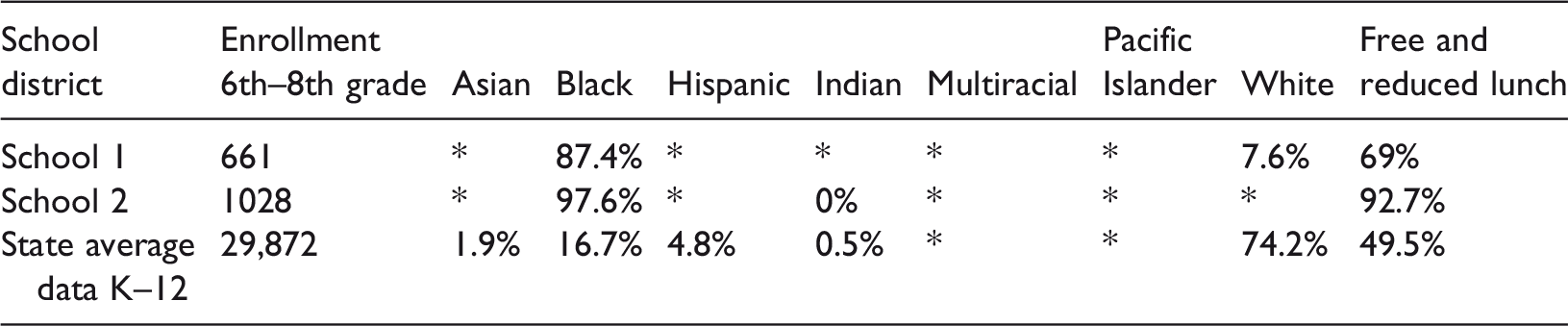
Source: State and district demographic data. (Available at: https://mcds.dese.mo.gov/guidedinquiry/Pages/District-and-School-Information.aspx; accessed 5-1-2017).
*The figure has been suppressed because of a small percentage.
Qualitative research methods and samples
Individual interviews of approximately 45 minutes were conducted with school administrators, social studies teachers, and TOP facilitators in the spring during the academic years that the TOP program was implemented at the study sites. Student focus groups were conducted in the late spring of each academic year, and included between 8 and 10 students in each session. The interviews and focus groups were all conducted at the study sites, in private rooms, and were audio-recorded (for research participant details, see Table 2).
School samples for the academic years 2012–2015.
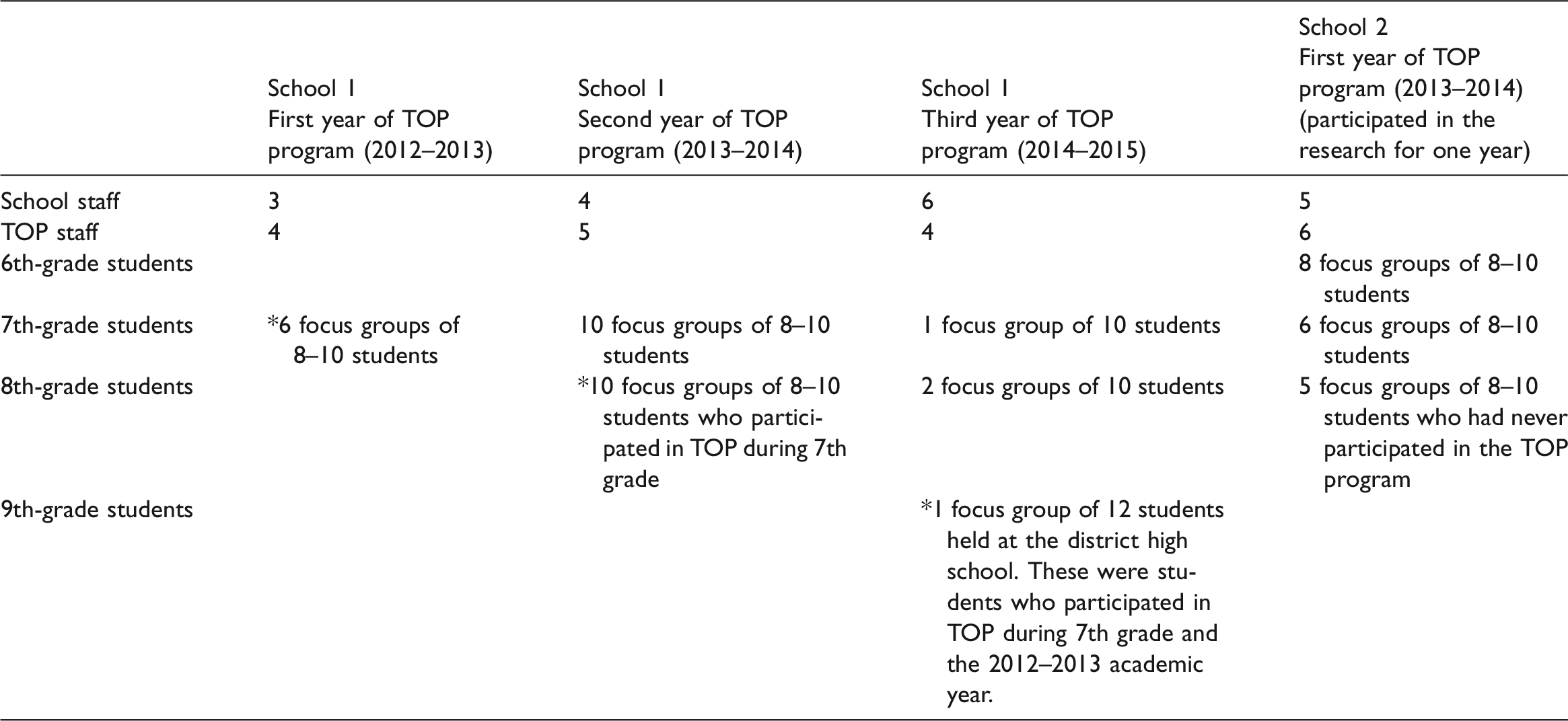
*Student cohort that was followed for three academic years.
In addition, the first cohort of students from the intervention school (School 1) was followed for two years after receiving the TOP program, completing a post-survey in the spring and participating in a reflection group during 8th grade and then in 9th grade after the transition to a new high school.
Qualitative data analysis
All of the interviews and focus groups were transcribed verbatim, and codes were used to replace identifying information. A grounded theory approach was utilized for the analysis of this large qualitative data set, which included interviews, focus groups, and observations (Charmaz, 2008; Yin, 2009). The transcription narratives were uploaded into NVivo and read by two independent coders for strengths and challenges, and dominant themes were established through discussion. The nine themes—classroom management; disconnect with TOP implementation; dynamic improvement; hearing children’s voices; relationship-building; school and classroom integration; service learning and implementation; students’ social and emotional experience; and new emic ideas—were established as a framework for coding across subsequent interviews and focus groups. An iterative process was used to identify subthematic categories and emic concepts that emerged. Summaries were also provided annually to the partners, school administrators, and returning facilitators involved in the project to share perceptions and allow for clarification, feedback, and discussion.
Interpretation
This section explores key themes and specific subcategories associated with professional development for teachers and social workers, specifically highlighting school and classroom integration issues that emerged during iterative reviews of the data. For example, the theme of classroom management included comments associated with student behavioral issues and creating safe learning environments, with subcategories such as teacher characteristics, facilitator characteristics, and the impact of the TOP collaboration. The theme of students’ social and emotional experiences reflected comments associated with empathy, efficacy, and engagement, and then subcategories such as communication, relationship-building, and community-consciousness. The school and classroom integration theme included thoughts associated with the planning and organizational strategies used to implement the program within the district, school, and classroom. Subcategories included communicating with school professionals, preparing professionals for high-poverty schools, stability, and TOP professional development. Looking deeper into these topics provides additional insight consistent with an exploratory instrumental case study development (Stake, 2005; Yin, 2009).
Challenges of implementation
Communicating with teachers about TOP
All of the social studies teachers involved with the TOP implementation were experienced teachers with four or more years in an urban classroom. Although the TOP facilitators and managers tried to meet with teachers prior to implementation to facilitate joint planning, the unfamiliar hierarchy of communication, typical of many schools, made that process rocky at School 1, as one teacher highlights: “I really felt out of the loop when we started. To be perfectly candid, I felt like it was the blind leading the blind, because it was new … everything, you know?” As discussed later, a strength for School 2 was that the principals required the teachers to complete TOP training, but other teachers who were unfamiliar with TOP goals, its PYD approach, and the service-learning focus reported being at a significant disadvantage.
In particular, teachers identified tensions about the role of the facilitator and the expectations for the teacher during the TOP hour, when the facilitators (usually two) and the teacher were sharing classroom space. Teachers reflected that they initially felt uncomfortable with the facilitators’ informal PYD style with students. There was confusion about the underlying goals of the more participatory and active TOP hour. There were games that required students to shift their desks and chairs so they could move around or, in some cases, throw soft toys to each other while sharing personal experiences.
Also, the facilitators were addressed by an informal nickname, such as “Curly Sue,” rather than “Miss” or “Mr” and their surname. In both participating schools, this practice was noted by teachers as being problematic, as one TOP facilitator clarifies: My TOP name was actually “Crash.” So a lot of students saw me in the hallway, and say, “Hi, Crash” or “Hi, Mr. Crash,” and a lot of times there was not a Mister to go along with it. A lot of the other staff here were sort of confused at why they address me with a nickname.
After several months and additional meetings about expectations, the teachers and facilitators were able to find common ground on some issues. For example, the facilitators agreed to be addressed as “Miss” or “Mr” and their nickname. Teachers began to participate more in the classroom discussions during the TOP hour by sharing their personal experiences along with the students. Also, after observing the successful implementation of the first off-campus service-learning activities at neighborhood nursing homes, teachers became more enthusiastic.
Then, just when the adults felt that things were going more smoothly, there was a financial shortfall in the School 2 district in January. Staff reductions shifted teaching assignments and classroom configurations with students. Rapport had to be developed again with new teachers and the changed peer dynamic within classrooms. It became clear that communication about program goals would need to be an ongoing process, particularly in an environment where complex external issues overflowed into the school and classroom culture.
Preparing facilitators for high-poverty urban school classrooms
My biggest challenge was learning the skills to do more classroom management. (TOP facilitator reflection)
The cultural disconnect also extended to interactions within a traditional hierarchical school culture. In both schools, service activities were coordinated during times that did not conflict with academic priorities, such as tests. The TOP coordinators struggled with navigating permissions and the paperwork required to include students in activities on and off campus. In addition to local nursing homes, the community-based sites included locations such as a food bank, daycare centers, a community garden, and a refugee center. The lack of awareness of the complex approval logistics shifted the facilitators’ plans for service learning on more than one occasion in both schools.
The unique dynamics occurring in the community also overflowed into the school setting and presented challenges. The facilitator training stresses the importance of developing a team where students feel safe, are able to share feelings and ideas openly, and are contributing members with their peers. These social and emotional skills are grounded in trust, consistency, and gradually getting to know others well. However, the facilitators reflected that they had entered an environment where a neighborhood incident might lead to a fight in the hallway between one or more students. The skirmish could carry over into the classroom and disrupt other students.
High student mobility created a shifting student population throughout the year. This was a particular problem in School 2, where the district lost state accreditation. As a result, almost one-third of the district’s parents removed their children and sent them to neighboring school districts. However, some of the receiving districts had difficulty integrating the children, so the students gradually returned to School 2 after a few months. Under these circumstances, the facilitators reported that they spent considerable time prioritizing strategies to assure that they knew all the students in the classrooms, and repeating activities for students designed to build positive peer relationships.
Successes of implementation
Including teachers in TOP professional development and planning
The school principals requested additional training for teachers, and four of the seven social studies teachers sharing classroom space with the TOP facilitators received the same training required of facilitators prior to the second year of TOP implementation (2013–2014). The preparation includes information about adolescent development, an overview of the PYD curriculum, and SEL strategies with suggested games and activities. There was also an opportunity to role-play about challenging classroom management situations. Teachers were unusually enthusiastic about this experience, as one teacher shares: I expected, to be really honest, it would be like most PDs … professional development where you sit in a room and listen to people talk. You know, it’s like, “Oh my goodness. Do you need me to do this for days from 8 to 5?” I’m like, “Ughh! But hey, I’m going to do it.” And it was one of the best. I’m not going to say “one” of the best, it was the best training that I have ever attended. So it was a surprise … a very worthwhile surprise. It really teaches you how to listen to the students, open up to them a little bit more, give the students a voice—not necessarily tell them what to do, but direct them about what is going on. That is what I really took out of the TOP training. Students’ voice and choice is huge. That is why it was a lot different than any other professional development.
Social and emotional learning
By the end of the first year of TOP implementation, students, teachers, and facilitators suggested that the curriculum and program implementation increased students’ empathy. Students were encouraged to talk about issues such as bullying, anger management, stereotypes and discrimination, healthy relationships, and sensitive subjects related to sex education. Students noted their initial reluctance to speak, but, as trust developed, they felt comfortable laughing and joking together, and felt safe to have deeper discussions about difficult topics.
The facilitators reflected that they worked hard to cultivate an atmosphere of trust and monitored it throughout the year in the classroom and during service-learning experiences. Occasionally, when they felt that the respectful environment was slipping, they would revisit specific activities that were designed for team-building with the students. There seemed to be a greater need for these relationship-building check-ups after a long holiday break, if disruptive incidents had occurred in the community, and particularly in School 2, given the high student mobility.
The facilitators were often surprised and somewhat frustrated with the amount of time spent revisiting strategies to teach respect, anger management, and empathy that they thought the students had integrated. However, students did not seem to realize that the facilitators were disappointed, and mentioned how they valued the facilitators and their persistently welcoming and positive “values-neutral approach,” where students did not feel judged. One student clarifies: “One thing I like about TOP are the facilitators, because they put in work. They won’t, like, get an attitude with you.”
Throughout the academic year, the social studies teachers observed how the program unfolded in their classrooms, and they helped chaperone off-site service-learning projects. Teachers’ reflections suggest that there was a gradual transformation in their understanding of how PYD strategies could positively impact students’ social and emotional development. They were surprised at the personal things students shared during their TOP time about their family life or their worries, but it helped the teachers understand the challenges that their students were facing. Several of the teachers reflected that other teachers in the school who were not directly involved in the program began to wonder what was happening and, specifically, how the social studies teachers knew so much about the students’ personal lives. One social studies teacher told her colleague that she learned about them from “chicken check-in,” which is one of the ice-breaker activities where facilitators toss a rubber chicken to students in order to engage them to share informally at the beginning of the TOP hour.
Most of the teachers were reluctant to go off campus on the first service-learning experience and worried that students’ behavior would be appropriate. However, they were “pleasantly surprised,” mentioning that they saw their students in a different light. For example, teachers observed a student with a history of challenging behavior in the school setting compassionately helping elders at the retirement center or another, typically quiet student in the classroom, showing leadership skills in the service-learning setting. Subsequently, the facilitators and teachers began to regularly discuss observed successes, and some teachers started to incorporate the PYD strategies into their own classroom practices on non-TOP days. One teacher highlighted that she was having real difficulty interacting with a particular student but tried some of the same skills she had observed the facilitator using successfully with the same student and experienced similar success. Teachers also contributed more to the conceptual development of the program, suggesting service-learning activities that would overlap with the TOP discussions and the social studies curriculum. At one school, this included the planning and implementation of a peaceful social justice march in response to several volatile community incidents.
The social studies teachers participating in the program for two or more years felt strongly that the program had improved. They appreciated regular planning meetings and that the continuity of some of the facilitators had a stabilizing effect for the students and the professional team approach. Overall, teachers felt more prepared to integrate TOP into their classrooms and were supportive of the service-learning activities.
Spillover effects of TOP
Several of the teachers reflected that students were less likely to get into trouble on the day of the week that TOP was implemented in the classroom. During one interview, a teacher paused for a considerable time to recall if she had even given one discipline referral for any of her challenging students that year, and felt certain that she had not. She highlighted that the PYD strategies encouraged students to release stress during the first few minutes of class, and that this practice contributed to reduced discipline issues not only in the classroom, but also during passing in the hallways and during lunchtime. 3
Students’ reflections also suggested that they felt their TOP days were different from the other days of the week. They mentioned the relationship-building strategies and believed that the facilitators cared about what was going on in their lives in a manner that was different from the teachers. Students shared examples where they were angry and wanted to fight with another student but the facilitators helped them think through other choices so they resolved the issue without violence. Since the TOP facilitators had an accessible office in the school building, the students began to occasionally stop by, just as a friendly way of connecting with their facilitator during the school day or if they needed help with peer interactions. As social workers, the facilitators had the training to respond to mental health or counseling needs. However, there may be less stigma attached to chatting with the TOP facilitator when compared to the school counselor or school social worker, even though the conversation might cover issues similar to what a counselor would address. The facilitators thought that just by being informally available for students, many disruptive situations were averted.
Facilitators’ positive influence in the classroom
In order to gain students’ understanding of the residual impact of the program, focus groups were conducted with 8th-graders and 9th-graders who had previously received the TOP program. These students recognized the facilitators’ important contribution to help them resolve difficulties with peers and improve collaboration, and believed that was still needed in later grades. They appreciated the stabilizing relationship that had developed and suggested that the same facilitators could follow them into other grades and still help. One student clarifies: “They [the facilitators] were really good people … didn’t judge us … liked everyone.”
Students in 8th grade reported feeling significant stress to do well academically in preparation for 9th grade. Some students had the added anxiety of competitive applications to private high schools or public magnet schools. In one school, the annual academic testing was truly a high-stakes event, because of the district’s struggle to maintain accreditation. Older students recognized that their teachers cared, but relationships were strained because of the pressure to cover academic work and pass tests. They believed that teachers could not take time to talk about students’ personal problems. However, it was just such time—for example, a few minutes chatting quietly with an upset student—that the young people mentioned as being important for defusing a troubling situation.
Discussion
The deeper case analysis suggests that the shared-space approach provided reciprocal mentoring for teachers and facilitators, which increased their confidence working with adolescents’ social and emotional needs. The team effort supported the development of both sets of professionals and motivated them to integrate new strategies for sustaining a positive classroom culture. Recognizing its importance and then finding professional development approaches that appreciate the benefits of SEL for teachers, especially in complicated urban school cultures, may be critical for teaching similar skills to students (Brouwers and Tomic, 2000; Jennings et al., 2011).
One teacher participant highlights the importance of teachers shifting their beliefs and practice: Because adults and their mindset have to change. We have to start acknowledging that our children’s social needs are just as important as them learning math. In many ways, it’s more important. Because if my social needs are not met, I don’t even have a context for trying to engage in mathematics. And so, it’s gonna take time for us, the educators, teachers, to change our mindset about the children we teach today. Because it’s very different than it’s been in the past. I mean, when I say it [teacher education] didn’t prepare me, it prepared me academically, that’s very strong. But as far as culture and trying to understand things, and how poverty plays into the classroom, middle school, high risk, hormones all over the place … all of the things that these kids deal with on a daily basis. I was not prepared for it because I don’t even think that the school district was prepared for it.
The sharing classroom approach also suggests a potential new role for social workers in the school environment. Often assigned to case management of high-risk children and families, this study suggests the value of including social workers in the classroom. In addition to their knowledge of PYD, the facilitators served as another positive adult resource on which the students could rely.
Based on the findings from this case study, the following represents key strategies for program implementation:
Develop a common understanding of core program concepts and school culture. All participants must start the academic year with a common understanding of goals, expectations, and thoughts around culture. Communicate. There must be regular and consistent communication among all participants who interact directly with the youth. It should be recognized that this communication occurs formally and informally. Cultivate a team approach with equality of power. All should work as a team while sharing the classroom space, where teachers contribute as they feel comfortable and no one has the responsibility for formerly evaluating the other. Develop a routine during the academic year and, ideally, stability over several years. Teachers, social workers, and students should be able to depend on each other throughout the academic year. The program implementation should occur at the same time weekly, and there should be reasonable stability within the school’s organizational structure. Communicate benefits throughout the year. Acknowledge and celebrate program achievements. Ideally, all participants would have the opportunity to document students’ social and emotional development, and reflect together as a professional community.
Beyond the findings regarding PYD, the experience of implementing this program—by sharing spaces—raised a number of important implications for the implementation of any community-based intervention within the classroom context. From these findings, additional consideration should be given to teacher and social work professional development beyond purely academic endeavors.
Footnotes
Declaration of Conflicting Interests
The authors declared no potential conflicts of interest with respect to the research, authorship, and/ or publication of this article.
Funding
The authors received no financial support for the research, authorship, and/or publication of this article.