




Abstract
This article approaches the question of how far critical pedagogy can be institutionalised through a series of historical and contemporary examples. Current debates concerned with the co-operative university are examined, as well as histories of independent working-class education and the free university movement. Throughout this history, critical pedagogy has occupied a difficult space in relation to higher education institutions, operating simultaneously against and beyond the academy. The Deweyian concept of ‘democratisation’ allows the institutionalisation of critical pedagogy to be considered as a process, which has never been and may never be achieved, but is nevertheless an ‘end-in-view’. The article concludes by offering the Lucas Plan as a model of radical trade unionism that could be applied to the democratisation of existing universities and the institutionalisation of critical pedagogy.
Keywords
Introduction
As political activists and critical pedagogues working ‘in, against and beyond’ universities in the UK, we are by now aware of the ways in which neo-liberalism transforms and dominates society, its institutions and social relations (Brown, 2015; Davies, 2014; Mirowski, 2013). The term ‘critical pedagogy’ was coined and popularised by Henry Giroux (1983; 1989) in the 1970s, but has a genealogy that ‘extends back centuries (Amsler, 2013: 64). Today, more than two decades deep into a period of far-reaching reforms to higher education and the growth of academic capitalism, the idea of critical pedagogy seems to have acquired an aura as the obvious ‘alternative’ to all forms of commodified and marketized education. At the same time, depoliticized forms of ‘critical thinking’ have been integrated into the curricula of university programmes oriented towards shaping the ‘entrepreneurial’ student-subject. And yet, what it means to think, teach or ‘be’ critically, in theory and in practice, is rarely articulated among university students or teachers. It is time, once again, to take stock. (Amsler, 2013: 66–67)
This article will focus on some historical and contemporary examples of (2) and (3) to raise the question of how far critical pedagogy in these forms can be institutionalised. As Amsler (2013) points out, (1) often results in ‘depoliticized forms of critical thinking’. The pressures of marketisation not only make such consciousness-raising extremely difficult, with students understandably wanting their £9000 degree to lead to a decent career, but in many cases this kind of critical pedagogy is all too easily recuperated into the marketised system as part of a university’s brand, as with Goldsmiths, University of London, for example. Furthermore, in terms of emancipatory research, the Research Excellence Framework pushes all knowledge production towards utilitarian ends, ultimately encouraging, at best, game-playing and cynicism and, at worst, capture and monetisation within overarching neoliberal objectives (Hammersley, 2014; Holmwood, 2011a; Watermeyer, 2014). The 2016–2017 Higher Education Bill proposes to consolidate the marketisation of higher education, firstly introducing ‘alternative providers’ to create a ‘quasi-market’, and secondly implementing the Teaching Excellence Framework, which John Holmwood (2015) has described as an ingenious ‘big data project’ designed to realign higher education towards neo-liberal socio-economic ends.
This article explores the question of critical pedagogy’s institutionalisation through the concept of ‘democratisation’. For John Dewey, a key figure in the early history of critical pedagogy, institutions are ‘relatively fixed’ – they are ‘a tough body of customs, ingrained habits of actions, organized and authorized standards and methods of procedure’ (Dewey, 2008: 153). Institutions should be analysed in terms of their function, and educational institutions should be critiqued according to how far they encourage what Dewey called ‘growth’, which is the enlarging and enriching of experience (Ralston, 2010). For Dewey, life itself is educative, and experience is a process of problem solving that can be developed into more or less institutionalised forms of inquiry, such as science, morality and education. As ingrained social ‘habits’, institutions can be made more intelligent. As intelligence is the capacity to deal successfully with problems arising in experience, the intelligence of an institution can be judged on how far it frustrates or encourages the application of natural intelligence in dynamic problem solving. Democracy, as ‘an ethical way of life’, is a way of organising people that decentralises responsibility and control as much as possible while encouraging pluralism in points of view. Both aspects of democracy encourage growth, and should form the basis for any process of ‘democratisation’. ‘Democratisation’ is used instead of ‘democracy’, as the former is concerned with a process of transformation, rather than with a fixed ideal. For Bernstein (1983: 4), ‘democratisation’ is more realistic and ‘helps us to keep aware of the fact that, in all probability, there is no fixed, or final state of democracy’.
In Deweyian terms, ‘democratisation’ is an ‘end-in-view’ (Dewey, 1916). Dewey argued that there is no such thing as an ‘end-in-itself’, just as it is obvious that there cannot be a ‘means-in-itself’. Instead, he proposed a ‘means–end continuum’, which from a pragmatic perspective means that all ends become means for further action, and means must be sometimes considered as ends – for example, when new tools, concepts or theories are developed. For critical pedagogy, as an ‘end-in-view’, democratisation is both end and means. Critical pedagogy tends to separate the critique of neo-liberalism and neo-liberal education from critical-pedagogical practice. Many of the theories of the latter are developed in contexts that are so different from the here and now that the recommendations seem utopian. The concept of democratisation changes the question from ‘What is wrong with the world and what should it be like?’ to ‘Where are we going and how do we get there?’ The former encourages disappointment, and what Dewey (1917) would call ‘consolation’ in theory, while the latter is explicitly oriented towards action. Democratisation allows us to be pragmatic, rather than idealistic. The ‘against and beyond’ thus describes a process rather than a dichotomy, and transforms critical pedagogy into an inquiry into the limits of its own institutionalisation.
Beyond the neo-liberal university
In response to the privatisation and marketisation of the public sector, many educational institutions have turned towards ‘co-operation’ as an alternative. Since 2008, 700 co-operative schools have been created in England (Woodin, 2015), with the Schools Co-operative Society now one of the ‘fastest growing networks of schools in the UK … dwarfing the academy chains more frequently mentioned in the press’ (Cook, 2013: 10). The co-operative movement is now considering how this success can be extended to higher education, with a new discourse around the ‘co-operative university’ emerging (Boden et al., 2012; Cook, 2013; Neary and Winn, 2016; Ridley-Duff, 2011; Somerville, 2014; Yeo, 2015). For many, the need to think about co-operative higher education is a direct result of marketisation, and co-operative universities are a way to protect ‘the idea of the university’, which is to say ‘higher education as a public good’ (Holmwood, 2011b; Yeo, 2015).
The co-operative university model seems to provide an excellent ‘end-in-view’ for democratisation. The 1995 ‘Statement of cooperative identity’ defines the core values of co-operatives as ‘self-help, self-responsibility, democracy, equality, equity and solidarity’ (Woodin, 2015: 204). Furthermore, two co-operative principles highly relevant to democratisation are ‘democratic member control’ and ‘member economic participation’. Democratic member control requires that members ‘actively participate in setting their policies’ and in decision-making. Member economic participation requires that ‘at least part of the capital [of the co-operative] is the common property of the cooperative’ (Woodin, 2015: 205). In terms of democratisation, the former principle would ensure that the people affected by decisions made by the institution are involved in the decision-making process, and thus also must take responsibility for any decisions made, while the latter principle grounds this participatory process in concrete economic concerns, preventing this process from becoming a facade.
As well as co-operatives providing an attractive end-in-view for democratisation, the principle of the ‘autonomy and independence’ of co-operatives strikes a chord with the idea of academic freedom at the heart of modern universities. The UNESCO (1992) working document on ‘Academic freedom and university autonomy’ defines the latter as a ‘characteristic of the decision-making process’ of universities, and asserts that ‘each university must make its own decisions on matters related to knowledge, research, and teaching’. Within actually existing universities, this does not translate to democratic structures of collegiality. Murray et al. draw attention to the way in which the concept of ‘academic freedom’ has been increasingly absorbed into an institutionalised view of autonomy: The implication here appears to be that ‘academic freedom’ belongs to the university, not to the academic. Here and elsewhere it seems that there is a not-too-subtle redefinition by university managers of ‘academic freedom’ from meaning ‘freedom of academics from us’ to ‘freedom for us from everyone’. And this is taking place at a time of growing concern about whether real academic freedom is really being protected. (Murray et al., 2013: 8)
The problematic link between institutional autonomy and academic freedom points to governance as a key site of struggle for democratisation. For Boden et al. (2012), the separation of ownership and control in ‘quasi-private’ universities, in particular post-92 universities, has led to serious issues in governance. The ‘fuzzy’ question of who owns these ‘quasi-private’ institutions, combined with managerial approaches that distrust collegiality and collective-bargaining traditions, results in ‘managerial predation’ on the part of vice chancellors. This can be evidenced by the astonishing increases in vice-chancellor salaries: in 2016, their average salary was £272,432, with the maximum being £516,000 (University of Salford). The average pay increase for vice chancellors between 2013–2014 and 2014–2015 was 3% (University and College Union, 2016b), compared with a real-terms loss of 14.5% since 2009 for academics (University and College Union, 2016c).
Shattock’s (2012) triangle of good governance allows us to see the problem of governance in universities more clearly (see Figure 1). Within neo-liberal universities – that is, universities which have become victim to ‘new managerialism’ as a result of neo-liberal reforms (Bacon, 2014; Deem et al., 2007) – this triangle breaks down at two points. Firstly, governing bodies ‘don’t always assert themselves’ and have ‘great difficulty in challenging their executives’ (Shattock, 2012: 59). Furthermore, governing bodies tend to be made up of ‘part-time amateurs largely unfamiliar with the organisation’s culture’ who ‘without specialised knowledge … tend to dwell on the more familiar realms of operations, finance and investment, usually to the neglect of the institution’s core business’ (Chait et al, in Shattock, 2006: 50). Secondly, academic self-government has been replaced by senior management teams – senior colleagues transformed into line managers, who are directly answerable to the executive. What collegial behaviour remains is skewed by targets and the measurement of outputs within regimes of performance management. Thus, the system of ‘checks and balances’ that should underpin good governance in universities cannot function, resulting in not just managerial predation, but also excessive risk-taking with what still remain public institutions.
Shattock's triangle of good governance.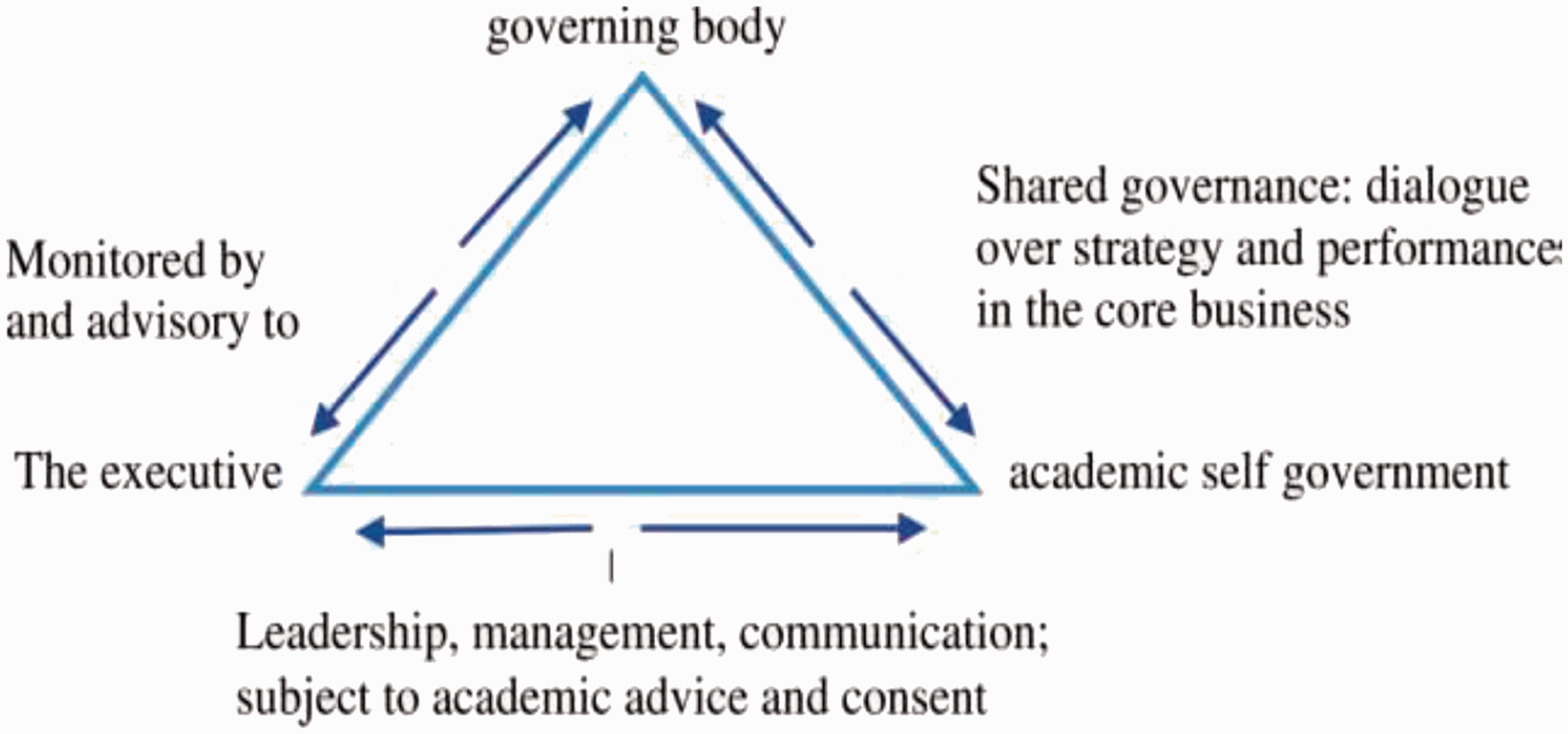
Boden et al. (2012) suggest the idea of a ‘trust university’, based on the John Lewis Partnership model, as a solution to this governance problem, while at the same time offering a means of defending the idea of the university in a concrete way. In a ‘trust university’, the combined assets of the institution would be put into a ‘non-revocable trust’, which would mean that they could not be sold off for the self-interest of any member of the institution. This move is particularly important as the higher education sector becomes marketised, as this would ensure that public assets, paid for by taxpayers, are protected. As with the John Lewis Partnership, employees can then be made beneficiaries, effectively becoming ‘partners’ with rights to influence decision-making, and any profits are either put back into the company (which would be most appropriate for a ‘quasi-public’ institution) or redistributed as an annual bonus. The public interest and democratic structure of the ‘trust university’ can then be enshrined in a charter. The first article of the John Lewis Partnership’s trust deed, for example, outlines the purpose of the company: ‘To ensure happiness of all its members through their worthwhile and satisfying employment in a successful business’ (quoted in Boden et al., 2012: 21).
For critics of this model, however, the trust university does not, in fact, overcome the deep problems of governance caused by the separation of ownership and control. In a trust university, corporate governance would not necessarily change, and workers would not necessarily be directly involved in decision-making. For Somerville (2014: 4–5), the trust university is ‘way short of being a member controlled body [as] there is no challenge to either the capitalist wage or to the internal management hierarchy’. Cook (2013) agrees, pointing out that the trust university is a ‘sub-optimal’ model of co-operation, as the division of labour is retained and market pressures still encourage efficiency over democracy. Even at Mondragon University, arguably the most successful co-operative university in existence, the reality and myth of worker participation have diverged significantly. For Kasmir (1996), who conducted a deep ethnographic study of Mondragon, the myth and the overwhelming desire to believe in co-operative education hide evidence of suppressed dissatisfaction among workers there. Kasmir describes how the myth of co-operation creates an apolitical system where workers are not actively engaged in holding governing process to account, and workers are manipulated by managers through nationalist ideologies. Mondragon teaches us of the importance of politics, the necessary role of organisation, and the continuing value of syndicates and unions for transforming the workplace.
The Lincoln Social Science Centre (SSC) represents an attempt to democratise higher education by building a new university on co-operative principles. It is also an explicit attempt to institutionalise critical pedagogy within its foundations. The SSC was ‘conceived in response to the UK Coalition government’s changes to higher education funding which involved an increase in student fees up to £9,000 and defunding of teaching in the Arts, Humanities and Social Sciences’ (Neary and Winn, 2016: 3). In its own words, the SSC organises free higher education in Lincoln and is run by its members. The SSC is a co-operative and was formally constituted in May 2011 with help from the local Co-operative Development Agency. There is no fee for learning or teaching, but most members voluntarily contribute to the Centre either financially or with their time. No one at the Centre receives a salary and all contributions are used to run the SSC. When students leave the SSC they will receive an award at higher education level. This award will be recognized and validated by the scholars who make up the SSC, as well as by our associate external members – academics around the world who act as our expert reviewers. The SSC has no formal connection with any higher education institution, but attempts to work closely with like-minded organizations in the city. We currently have twenty-five members and are actively recruiting for this year’s programmes. (Social Science Centre, 2013)
Although the SSC has never had a significant number of students, at least compared to traditional higher education institutions, it has managed to survive since 2011 and retain its co-operative structure. The 2016–2017 Higher Education Bill poses an interesting dilemma for the SSC: A key objective in these government reforms is to open the sector to ‘alternative providers’. Up until now, this has been interpreted as providing a space for market-based provision, accentuating the principle of the policy. Our point is that it opens up a ‘crack’ for a real alternative, neither private nor public, that undermines the policy and resists the logic of the capitalist state on which it is premised. (Neary and Winn, 2016: 3)
This problem of the institutionalisation of critical pedagogy also runs through the history of independent working-class education (IWCE). The SSC ‘recognises and builds on a long tradition of working class, self-managed, alternative, open and radical education’ (Neary and Winn, 2016: 28) – a tradition that can be traced back to the correspondence societies of the late 18th century. As described by E. P. Thompson (1963) in The Making of the English Working Class, correspondence societies were informal gatherings of artisans and other working people, who met to read aloud and discuss the latest radical pamphlets – Tom Paine’s The Rights of Man being a popular example. In contrast to the ‘bourgeois’ public sphere (Habermas et al., 1964), these crucial institutions of its ‘plebeian’ (Fraser, 1990; Negt and Kluge, 1993) counterpart were explicitly political and radically democratic, placing no limitations on membership. Thomas Hardy argued that the purpose of the Sheffield Correspondence Society was to enlighten the people, to show the people the reason, the ground of all their sufferings; when a man works hard for thirteen or fourteen hours of the day, the week through, and is not able to maintain his family; that is what I understood of it; to show the people the ground of this; why they were not able. (quoted in Thompson, 1963: 151)
The IWCE tradition continued with the Chartists in their critique of ‘useful knowledge’. The idea of ‘useful knowledge’ descended from the middle and upper classes, as an attempt to civilise the increasingly unruly and independent working class, which were beginning to be perceived as dangerous. The Society for the Diffusion of Useful Knowledge, for example, was a mid 19th-century organisation that simplified scientific texts for a wide audience, with the explicit purpose of neutralising radical pamphlets and newspapers (Johnson, 1988). In contrast to such uses of knowledge as ‘subjection’, Chartist really useful knowledge ‘served practical ends, ends that is for the knower’ (Johnson, 1988: 21). For 19th-century radicals, ‘practical’ meant learning how to change the world through understanding the ‘conditions of life’ and real problems faced by real people. This knowledge, according to George Jacob Holyoake, ‘lies everywhere to hand for those who observe and think’ (quoted in Johnson, 1988: 18), and because its purpose was the emancipation of the working class, it was inherently partisan. Again, we can see here an early version of critical pedagogy, especially in its emphasis on everyday problems that, through reflection, become the vehicle for emancipatory knowledge. The partisan emphasis also echoes Dewey’s (1935) concern for the unity of means and ends, where democratic knowledge is knowledge that is used by those who created it, not for the profit of others who appropriate it or a means for subjection.
The debate between useful and really useful knowledge initiates an antagonism between formal and informal education which lasts right up until the present day, and which is also a history of attempts to institutionalise critical pedagogy. This antagonism came to a head at the beginning of the 20th century at Ruskin College, which offered an early version of the university extension courses that became popular in the mid 20th century (for which E. P. Thompson and Raymond Williams taught). The impetus behind Ruskin College was the same as that of ‘useful knowledge’ – to provide an education for the working class that shows them the ‘correct’ way to think, so that they would become amenable to and aspire to middle-class ideas, rather than the revolutionary ideas coming at that time from European Marxism. But again, the already radicalised working-class students at Ruskin rejected these attempts at pacification, and demanded a more radical curriculum. This dispute reached a crisis point in 1908 when the Marxist students formed the Plebs League, went on ‘strike’ and eventually left Ruskin to set up their own independent working-class college, the Central Labour College in Oxford (Waugh, 2009). This college was initially supported by the National Union of Railwaymen and later by the Trades Union Congress, and soon grew into a network of independent labour colleges under the umbrella organisation the National Council of Labour Colleges. After the Ruskin strike, the adult education movement split into independent (National Council of Labour Colleges) and paternalistic forms, the latter represented by the Workers’ Educational Association, which set up university extension courses all over Britain. The National Council of Labour Colleges, due to a lack of funding and a deep suspicion of state intervention, eventually collapsed into the trade union movement, which, according to Armstrong (1988), had itself become ‘right wing’ during the period of labour-capital compromise coming out of the Second World War.
This history of IWCE opens up once again the question of the desirability of institutionalisation. Institutionalisation is attractive because the resources and longevity of established institutions can be, at least in principle, appropriated for radical ends. But for IWCE, institutionalisation was a primary danger, representing, on the one hand, appropriation by the middle class and, on the other, increased state control. For IWCE, institutionalisation came to represent a fundamental threat to independence. But, as Armstrong (1988) argues, this fear of institutionalisation also undermined any possibility for such independent forms to become sustainable; we can see the history of IWCE as a history of failed attempts to sustain a movement. With IWCE, we see once again the dialectic of institutionalisation and independence that is at the heart of critical-pedagogical practice. For Armstrong (1988), this dialectic must today be once again raised to consciousness if any attempt to rescue IWCE is undertaken, primarily through an understanding of the Gramscian concept of ‘hegemony’ (the way that institutions reproduce the class form of capitalist society) and incorporating this into the theoretical foundations of IWCE. For Waugh (2016: 20), IWCE practitioners should become ‘midwives’, ‘working with people to help them level up their own insights into a consistent socialist consciousness and capacity to act’.
In the 1960s, the free university movement re-enacted this dialectic of institutionalisation, but from the perspective of middle-class intellectuals. According to the ‘Winter catalogue’ of 1966, the Free University of New York was forged in response to the intellectual bankruptcy and spiritual emptiness of the American educational establishment. It seeks to develop the concepts necessary to comprehend the events of this century and the memory of one’s own life within it, to examine artistic expression and promote the social integrity and commitment from which scholars usually stand aloof. (quoted in Jakobsen, 2013: 10) The staff and visiting lecturers somehow all fell out, the administration was chaotic and a lack of funding eventually led to their eviction from the building on Rivington Street. Despite everyone’s best efforts, the Antiuniversity did not revolutionise academia and create a new world order, but it left a legacy. (Shalmy, 2016) an international organization with branch universities near the capital cities of every country in the world. It will be autonomous, unpolitical, economically independent. Membership in one branch (as teacher or student) will entitle one to membership in all branches, and travel to and residence in foreign branches will be energetically encouraged … Each branch of the spontaneous university will be the nucleus of an experimental town to which all kinds of people will be attracted for shorter or longer periods of time and from which, if we are successful, they will derive a renewed and infectious sense of life. We envisage an organization whose structure and mechanisms are infinitely elastic; we see it as the gradual crystallization of a regenerative cultural force, a perpetual brainwave, creative intelligence everywhere recognizing and affirming its own involvement. (Trocchi, 1963)
The ‘spontaneous university’ also establishes a strain of ‘horizontalism’ that runs through the free university movement, becoming so important in the 2010 student movement. Horizontalism, as described in protean form by Trocchi, is a form of organisation that is fundamentally generative and creative, as well as ‘prefigurative’. Within horizontalist organisations, the controlling idea is actualised in concrete attempts at institutionalisation, but is not exhausted through this process. Each institution is autonomous, but supported and nourished by this controlling idea. We see this explicitly in the self-description of the University for Strategic Optimism (2011): ‘The University for Strategic Optimism is a nomadic university with a transitory campus, based on the principle of free and open education, a return of politics for the public, and the politicisation of public space’. The University for Strategic Optimism encouraged other groups of activists to set up their own campuses wherever they liked, or steal and reuse any of the theories, analyses or techniques that had been developed through ongoing political action. In what was to become an influential use of ‘flash mobbing’, the University for Strategic Optimism temporarily occupied a Lloyds Bank high-street branch in central London, turning it into a ‘transitory campus’ and recording an impromptu lecture that went viral on the Internet. We see here also how the controlling idea – ‘free and open education’ – along with the subsidiary aims are realised but not exhausted in such transitory campuses.
The contemporary concept of ‘horizontalism’ also derives from the ‘alter-globalisation’ movement, in particular from the Zapatistas of Chiapas, Mexico, and is a translation of the original and indigenous concept horizontalidad. For Sitrin: Horizontalidad does not just imply a flat plane for organizing, or nonhierarchical relationships in which people no longer make decisions for others. It is a positive word that implies the use of direct democracy and the striving for consensus, processes in which everyone is heard and new relationships are created. Horizontalidad is a new way of relating, based in affective politics, and against all of the implications of ‘isms’. (Sitrin, 2006: vi–vii)
Our last example, by reinventing the Anti-University for the 21st century, seems to learn from all the traditions we have looked at so far. The contemporary Anti-University builds on the concept of the ‘organised network’ (Rossiter, 2006). Organised networks recognise the need for face-to-face organisation alongside online communication and networks, taking seriously the social basis of sustainability: ‘In order for networks to organize mobile information in strategic ways that address the issues of scale and sustainability, a degree of hierarchization, if not centralization, is required’ (Rossiter, 2006: 205–208). The Anti-University encourages groups of activists based in any location across the world (although mainly in the UK) to organise events under the Anti-University banner. These events all take place within a week, and are organised and advertised centrally through an attractive and cleverly designed website. In 2016, events included: a lecture, a round table discussion, a gallery tour, an interruption, a presentation, a screening, a public reading, a practical workshop, a walking tour … While everyone worked under the Antiuniversity Now banner, most people didn’t know each other and we, the three co-organisers, never met most of the hosts. In fact, we never imagined that so many people would even hear about our project, never mind put all that time and effort into planning so many events. (Shalmy, 2016)
This section has discussed some key examples of critical pedagogy that attempt to deal with the question of institutionalisation in practice. Any attempt to create such practices today must not only learn from the fact that this is a history of failure, but also realise that failure is a necessary component of democratisation. Democratisation must be pragmatic; it is a process and relies on a certain amount of optimism. Democracy is not something that can ever be achieved, but rather something that must be striven for and realised in all our strivings. Dewey’s (1938) argument with Marxism hinged on this point. He felt that Marxism, represented by Trotsky in his public debate with Dewey, deduced the means – violent revolution – from an end – socialism – which was itself based on a deterministic theory of history. For Dewey, the means must be continuous with the end, and then the end must be worked out in practice. Democratisation, as both means and end, cannot decide the specific form that institutionalisation may take. The history of critical-pedagogical practice provides lessons both as to means that can be applied and as to formal characteristics that can be selected in order to shape its instructional structures. The analysis in this section points to the co-operative form as an excellent institutional basis for critical pedagogy, having a well-developed controlling idea in its principles of co-operation, as well as a rich and successful history of sustainable yet radical examples. The idea of a ‘secondary co-operative’ also provides flexibility, solidarity and resources through a centralised network of primary co-operatives (Ridley-Duff, 2011).
Against the neo-liberal university
As indicated in the previous section, the co-operative form seems to present the most appropriate model for the institutionalisation of critical pedagogy. Democratisation, however, dictates that the co-operative form should not be posited as an abstract end, but as an end-in-view, to be realised in critical-pedagogical practice. This is all the more important today as neo-liberalism seeks to replace the values and practice of co-operation with those of individualism and competition. As Cook (2013: 43) argues, ‘cooperation is fundamentally an educative process’, which is why ‘cooperative education’ has always been both a core principle and a fundamentally important practice in the history of the co-operative movement. For Dewey also, co-operation is a habit that we learn and develop through practice, and the best way to learn is to try things out (Bohman, 2010) . Trade unionism, as the historical struggle of workers to learn to co-operate with the aim of democratising society, presents a possible critical-pedagogical mechanism for the realisation of the co-operative university. To provide such a mechanism, however, trade unionism will need to move from being a defence of existing industrial relations to a form of creative inquiry into new possibilities for democratic worker control.
According to Hyman (2001), the history of British capitalism is distinctive in that it never had to deal with social revolutions, as in France, for example. This has meant that the two antagonistic forces of labour and capitalist management gradually adapted to each other, with employers reaching a grudging acceptance of the functions of trade unions, and the latter settling for a fair day’s pay for a fair day’s work. In contrast to continental labour movements, British unionism has been historically anti-intellectual and has largely resisted total co-option by far-left parties such as the Communist Party. British trade unions have, by and large, ‘accepted and adapted to existing social and economic conditions’, and are resigned to protecting terms and conditions for workers within this system (Hyman, 2001: 68). The tradition of ‘free collective bargaining’ in the UK has also meant that the gains of trade unions have never been fixed at a wider political level. This means that terms and conditions are more sensitive to changes in political leadership and economic turbulence, exacerbating the mostly defensive posture of trade unions, as they spend most of the time ‘firefighting’.
After the Second World War, industrial relations in the UK experienced a period of relative stability. This was because trade unions had had ‘a good war’, playing a key role in militarisation and managing the war economy, and both Labour and Conservative governments were happy to involve trade unions in the post-war reconstruction of British society (Undy, 2013). But after the Winter of Discontent in the late 1970s, where trade unions (in particular, the miners) confronted the Labour government at the time, which wanted to control spiralling inflation through caps on pay rises (thus betraying the ‘social contract’ that had been established between the Trades Union Congress and the government), resulting in highly controversial strikes by gravediggers and waste collectors, trade unions in Britain lost large sections of support within the wider public. This loss of support was capitalised on by Margaret Thatcher in 1979, who rose to power through supply-side economic policy, which also had the desired secondary effect of crushing union strength through deregulation and mass unemployment. The Conservative leadership also introduced many anti-trade-union policies in subsequent years, including laws against secondary picketing, ‘closed shops’ (where all new employees must also be trade union members) and the involvement of trade unions in the highest levels of industrial decision-making (Undy, 2013).
Today, trade union membership is at its lowest since 1995, with 6.5 million workers in trade unions – 24.7% of the population (Department for Business, 2016). This is a long way from the peak of trade union membership in 1979, when 13 million workers were members of a trade union. The decline in trade union strength continued after Thatcher, with New Labour claiming to be supportive of trade unions while at the same time furthering the deregulation and modernisation of the British economy which started in the 1980s. The biggest challenge facing trade unions today, aside from this drop in membership, is the changing state of the UK workforce: The [2013] Workplace Employment Relations Survey … indicates that the use of fixed-term or temporary contracts grew in both the public and private sectors with five or more employees between 2004 and 2011. Their use rose from 51 to 53 per cent of in the private sector and from 17 to 21 per cent in the public sector. (Hudson, 2014: 7)
This move towards an organisational model of trade union strategy, as well as efforts to organise precarious workers, can be complimented by an even more radical form of grass-roots activism. In 1976, in response to mass redundancies in their workplace and an ineffective trade union apparatus, the Lucas Aerospace Combine Shop Stewards Committee produced their ‘Corporate plan: A contingency strategy as a positive alternative to recession and redundancies’ – now simply known as the ‘Lucas Plan’. In response to a questionnaire distributed by the Combine to Lucas Aerospace workers, 150 socially useful products were suggested. Among those selected for further research were green innovations decades ahead of their time, such as ‘heat pumps, solar cell technology, wind turbines and fuel cell technology’, as well as ‘a new hybrid power pack for motor vehicles and road-rail vehicles’ (Salisbury, 2016). Although the Plan was rejected ‘out of hand’ by Lucas Aerospace management, the inquiry was itself as important as the stated aims of saving jobs and creating ‘socially useful’ products: Perhaps the most significant feature of the corporate Plan is that trade unionists are attempting to transcend the narrow economism which has characterized trade union activity in the past and expand out demands to the extent of questioning the products on which we work and the way in which we work upon them. This questioning of basic assumptions about what should be produced and how it should be produced is one that is likely to grow in momentum. (Lucas Aerospace, 1976: 9)
As Mike Cooley, a key contributor to the original Lucas Plan, later reflected: On the front page of the now famous Lucas Workers' Plan for Socially Useful Production there is the statement that ‘there cannot be islands of social responsibility in a sea of depravity’. Lucas workers themselves never believed that it would be possible to establish in Lucas Aerospace alone the right to produce socially useful products … What the Lucas workers did was to embark on an exemplary project which would enflame the imagination of others. To do so, they realized that it was necessary to demonstrate in a very practical and direct way the creative power of ‘ordinary people’. (Cooley, 2016: 139)
Conclusion
This article has approached the question of how far critical pedagogy can be institutionalised through a series of historical and contemporary examples. Co-operatives seem to suggest the most appropriate form of institutionalisation, as democracy is not just a key co-operative principle, but also enshrined in the co-operative form through worker control and ownership. As the longevity of the SSC shows, co-operatives do not necessarily have to mimic the unwieldy and expensive structures of traditional universities, and can operate more like the ‘anti-institutions’ of the free university movement. Secondary co-operatives also offer the kind of ‘organised networks’ that are a key innovation of contemporary free universities. By remaining in a utopian, or ‘prefigurative’, space, however, alternative institutions ‘outside’ the academy are severely limited in their capacity to democratise higher education. Within a post-Higher Education Bill marketised sector, co-operative universities face a difficult choice of becoming ‘alternative providers’, being subject to market forces and pressures that would inevitably undermine the radical potential of the co-operative form, or remaining aloof, relying on the unsustainable free time of academics and fluctuations of interest on the part of the public.
Democratisation through trade union activism, converting existing universities to the co-operative form, is a much more exciting possibility, but perhaps a more daunting prospect. Trade union structures already exist, providing much-needed support and sustainability for attempts to democratise higher education, but ironically the institutionalisation of trade unionism leads to a conservativism in industrial strategy. Trade unions are still primarily concerned with protecting existing conditions and relations, and would see democratisation as outside traditional bargaining machinery. However, as the Lucas Plan has shown, workers’ inquiry, as a form of both critical pedagogy and democratisation, is an alternative trade union strategy that is effective in creating solidarity both in the workplace and with the wider public. In higher education trade unionism, this potential for building broad-based support alongside other public sector workers is crucial for creating leverage in the fight against privatisation and marketisation, and is also more likely to appeal to a new non-traditional membership of casualised and migrant workers. The Lucas Plan suggests that, through inquiries into alternative corporate plans, existing union structures can be democratised alongside the university.
Footnotes
Declaration of Conflicting Interests
The author declared no potential conflicts of interest with respect to the research, authorship, and/or publication of this article.
Funding
The author received no financial support for the research, authorship, and/or publication of this article.