




Abstract
In this paper I theorise a contemporary educational configuration, which comprises a physical classroom and an online space. I invoke the hybrid concept of the heterotopic affinity space as a tool for helping us think more clearly about this configuration. The paper thus contributes an alternative way of thinking about a contemporary educational space. Drawing on an empirical classroom research project, I pay particular attention to the way the disciplinary space of a Sixth Form ‘dyslexia support workshop’ is reconfigured into a space which exhibits features of both a heterotopia and an affinity space. However, neither of these concepts by itself can adequately explain the space. The concept of heterotopia is insufficient because although it indicates certain characteristics of the space, it does not adequately account for the shared learning endeavour; the concept of affinity space is insufficient because although it helps us understand aspects of learning within the space, it does not adequately account for the Otherness of the space. I propose the new hybrid concept of heterotopic affinity space as a way of better understanding the project space, and suggest this concept may be useful in coming to understand other contemporary educational configurations.
Introduction: Theorising educational space
In this paper I seek to make a contribution to the perceived spatial turn in education (Soja, 1996) by synthesising two established spatial concepts in order to theorise a particular educational configuration. This synthesis produces a hybrid concept, the heterotopic affinity space. This I define as a space affording deep, authentic learning (Gee, 2005) around a shared endeavour, with that learning having a political dimension in that it resists, contests, transgresses or disrupts dominant culture and power relations. The paper thus contributes an alternative way of thinking about a contemporary educational configuration. The conceptualisation offered is timely, given that classrooms and other sites of learning, both formal and informal, increasingly combine real and virtual spaces, thus making the distinction between online and offline ever harder to sustain. The space comprises a physical classroom in a Sixth Form College, 1 usually used for ‘dyslexia support workshops’ and a group Facebook page, inhabited and constructed by a group of five Sixth Form College students, themselves labelled as dyslexic, during a project in which they explored dyslexia through a variety of ways and means.
In theorising an attempt to understand the character of, and activity within space, the first spatial metaphor I utilise is Michel Foucault's heterotopia (Foucault, 1984, 1988) and I argue that dyslexia, adolescence and the project space constitute heterotopic conditions. The second spatial metaphor is James Paul Gee's (2005) affinity spaces. I interpret the classroom setting and Facebook page combining to create an affinity space. I then explore the extent to which combining these two metaphors is helpful in appreciating the students' learning and participation. My thesis is that whilst both metaphors are helpful in coming to understand the students' literacy and learning practices as mediated by the space and their identity work, neither alone is sufficient. The concept of heterotopia is insufficient because although it indicates certain characteristics of the space, especially its Otherness, it does not adequately account for the shared learning endeavour; the concept of affinity space is insufficient because although it helps us understand aspects of learning within the space, it does not adequately account for the Otherness of the space. Combining these two ways of thinking thus allows a deeper appreciation of the character and affordances of the space, and I suggest that the hybrid concept of the heterotopic affinity space may be useful in coming to understand other contemporary educational configurations.
About the project
The theorising undertaken here is grounded in an empirical study which took place in a Sixth Form College in north-west England. At the time, I was employed by the college as a specialist dyslexia tutor. The college had an intake of approximately 1000 students per year, five or six of whom would disclose dyslexia upon application or enrolment. A whole-cohort dyslexia screening and assessment programme 2 resulted in a further 20–30 students being identified as dyslexic each year. College policy was to add mandatory ‘dyslexia support workshops’ to such students’ timetables. About five students were allocated to each workshop. The expectation was to address the literacy and learning deficits these students were thought to evidence, through interventions such as highly structured, systematic spelling programmes, guided reading, and study-skills development in areas such as memorising and recall, vital for the A-Level exams being prepared for. Whilst typical in dyslexia support contexts, and undoubtedly effective for some, these deficit-based, normative interventions were not universally loved, and neither were they universally effective. Some students regularly failed to attend; others attended and participated reluctantly or intermittently; a few were enthusiastic about some or most aspects of their support. Mindful of this, and increasingly uneasy with the formidable and pervasive deficit discourse surrounding dyslexia, I sought an alternative approach. The five students in one workshop expressed a particular interest in my proposed project, and the College Principal gave permission for us to set aside the normal workshop agenda. We were also given permission to access Facebook, which was barred on the College PC network. Over five weeks the students researched, discussed and produced artefacts on the topic of dyslexia, and chose to co-construct a group Facebook page about dyslexia by posting links, documents, videos and so on they had both found and made. The space was thus dissociated from the institutionalised norms associated with ‘doing’ literacy in school contexts, and was constituted by a classroom, a Web 2.0 space and the actions of a group of dyslexic adolescent students and myself as teacher–researcher. As such, the students’ regular ‘dyslexia support’ classroom was reconfigured as ‘an inquiry-oriented learning environment that positioned students as active collaborators investigating their learning, personal responsibility, and construction of identities as self-sufficient learners’ (Greenleaf and Hinchman, 2009: 11). The project generated a considerable amount and variety of data from pre- and post-project semi-structured interviews, classroom video recordings, fieldnotes, the Facebook page itself, paper-based artefacts, dynamic screen capture, think-aloud protocols (Ericsson and Simon, 1993) and reflective Q-Sorts (Van Exel, 2005; Watts and Stenner, 2005). In this paper I draw on interview and artefactual data to help develop my argument.
Heterotopia
Soja (1996) contends that Foucault was at the forefront of what later became known as the ‘spatial turn’, which calls attention to how space helps constitute social practices (Vadeboncoeur, 2009). In introducing heterotopias during a short lecture entitled Of Other Spaces, Foucault begins by introducing space as the defining obsession of the twentieth century. Foucault then uses several analogies, metaphors and examples to illustrate his conceptualisation of heterotopias. As flagged by the title of Foucault's lecture, ‘Otherness’ is a fundamental feature of these spaces (Allan, 2012; Rymarczuk and Derkson, 2014), and for this reason Foucault's example of the mirror is perhaps the most apposite instance of a heterotopia. His description evokes worlds within worlds, emplacements which are simultaneously real and unreal, reflecting, refracting and disrupting other spaces. Thus, in the mirror we appear to occupy an illusory virtual space generated by the physical reality of the mirror's surface, yet which we cannot actually inhabit (Foucault, 1984: 4): The mirror functions as a heterotopia in this respect: it makes this place that I occupy at the moment when I look at myself in the glass at once absolutely real, connected with all the space that surrounds it, and absolutely unreal, since in order to be perceived it has to pass through this virtual point which is over there.
Mirrors and social network sites thus simultaneously and paradoxically affirm and distort our sense of reality. This unsettling quality resonates with one of the most significant defining characteristics of heterotopias: that they are political. Heterotopias are sites of resistance, contestation, transgression and the disruption of dominant culture and power. Dyslexia and adolescence can both be thought of as heterotopic conditions. Foucault re-emphasises the Otherness of heterotopias through naming ‘crisis’ and ‘deviation’ heterotopias as the two main types (Foucault, 1984, 1988). They have in common the characteristic of being exclusionary. Foucault (1984: 4) contends that the crisis heterotopias of ‘so-called primitive societies’, explicitly including adolescence, are now in decline, although this is perhaps contestable given persistent moral panics about teenagers in contemporary Westernised cultures. Moreover, as teenagers in such cultures undergo the metamorphosis, or ‘rite of passage’ (Johnson, 2006: 78) into adulthood, they have to grapple with particular issues and complexities of self-definition and identity formation. Dyslexia can also be conceived of as a heterotopic state, a heterotopia of deviance: ‘those in which individuals whose behaviour is deviant in relation to the required mean or norm are placed’ (Foucault, 1984: 25). We can thus characterise dyslexia as a heterotopia inhabited by people who disrupt the hegemonic ideal of the literate norm because their literacy skills are perceived as lacking relative to culturally constructed norms and expectations (Collinson, 2012; Danermark, 2002).
There is a strong argument for saying that mass schooling and dyslexia were invented at the same time; that only when the hegemonic ideal of a literate norm began to suffuse society could a certain subsection of the population, those who struggled to meet the new curricular and cultural literacy demands, be deemed different and dangerous (through threatening normativity and productivity), and hence acquire the label of dyslexic (Campbell, 2011, 2013; Collin and Apple, 2007). Rather than literacy empowering, for some it becomes a form of discipline and differentiation in a ‘grammocentric world’ (Ball, 2013: 47). Those deemed abnormal, threatening social order and economic agendas through their perceived inability to conform to literacy and learning norms are punished through the ‘corrective’ (Foucault, 1995: 179), purifying, disciplinary regimes of exclusion and special education. In an education system fixated on pathologising and eradicating difference through assessing, diagnosing, prognosticating and pedagogy, the study support or ‘remedial’ classroom manifests – in bricks and mortar, in bodies and social events and in the disciplinary technology of literacy (Tambouko, 2004) – the power embodied in the State apparatus of control (Armstrong, 1999; Cudworth, 2015). The power of normative, schooled literacy as a technology of discipline was evident in the pre-project interviews I conducted with the participants.
Chloe 3
Interviewer: How do you feel about writing? Chloe: Just like when you're trying to type an essay and you know what you want to say and you just can't get it out and just when it really starts to become a problem you think what's the point it's just really not happening for me it's not working and sometimes it can get a bit annoying … [sighs] it takes me forever it just takes too long and even if I write something you can guarantee that I'm gonna have to rewrite it two or three times because I'll have made that many spelling mistakes and muddled my words around and different things especially in class when everybody else is finished reading and I'm still sort of still only on the first half of it or something it can be quite like I may as well just not bother coz I'm not getting through it when everybody else is.
Josh
Interviewer: Ok and what about writing what do you think about writing? Josh: Again not a huge fan erm 'cos I s'pose you could say I'm kind of self conscious about my writing because just how scruffy it is and the spelling and I just kind of feel like I'm at Primary school level with my writing and er I don't really think it's matched up with my actual intelligence … which is quite frustrating
Danny
Interviewer: Ok. Traditionally, education has relied a lot on reading and writing. What is your attitude to reading? Danny: Don't like reading Interviewer: Why do you feel like that about it? Danny: I just I struggle … I'll try and persevere with it but usually it gets to that point where I just can't carry on. Interviewer: What stops you from carrying on? Danny: Erm I just sometimes I might read a few words wrong and then the story just dunt make sense to me … erm words get blurry and generally my handwriting changes it's just … spelling as well sometimes I'll get my spelling wrong Interviewer: Okay. And those things are important to you? Danny: Yeah 'cos you need 'em all to get through life really
Affinity spaces
To call a space a heterotopia is to describe the overall Otherness of that space, rather than to offer a detailed description of what goes on there. Gee's (2005) concept of the affinity space is more helpful in this regard. Perceiving a number of difficulties with the concept of community of practice (Lave and Wenger, 1991), Gee offers an alternative way of conceptualising collective activities, which he calls an affinity space. Rather than focusing on who is involved in the activity, as in a community of practice, Gee focuses on where the activity happens. An affinity is a natural liking of, or attraction to, something; hence, an affinity space is quite simply a space where ‘people bond primarily to a shared endeavour or interest’ (Gee, 2005: 19). People may be active in the same space but not necessarily working towards shared or complementary goals: there may be allegiances but also hostilities. Affinity spaces may be real spaces or virtual spaces: both a football stadium and Massive Multiplayer Online Role Playing Game, for example, are spaces organised around a collective endeavour where we see both cooperation and competition and different modes and levels of engagement. In both spaces we will see different kinds of actors in different kinds of roles: allies/adversaries, moderators/referees, spectators/fans, and so on. As with heterotopias, some appreciation of affinity spaces is a necessary precursor to understanding heterotopic affinity spaces. I now provide a brief overview of this idea.
Gee (2005) posits that affinity spaces are particularly important contemporary social configurations, which educators ought to attend to for two main reasons. Firstly, he contends that affinity spaces have features which are crucial for deep and effective learning, by which he means learning which has a lasting impact on identity and ability to participate in desired discourses. Secondly, that the current proliferation of affinity spaces young people can access offers ‘a different and arguably powerful vision of learning, affiliation, and identity’ (Gee, 2005: 29) where learning is simultaneously a personal, unique trajectory and a social journey as one shares aspects of that trajectory with others. His suggestion is to make classrooms and learning spaces more characteristic of affinity spaces, in order to promote deep individual and social learning through students bonding with the learning endeavour.
According to Gee (2005), spaces in general are defined by the following three features. Firstly, a space needs content – something for the space to be about. In this case, the space is about the students’ dyslexia research, knowledge and identity work. A space also needs at least one generator. Generators are whatever provide the content for the space. In this case, students, teacher–researcher, digital media and the Internet all act as generators. A space also needs at least one portal. Portals are places through which people access content. The classroom door is a portal, as is classroom dialogue, as is Facebook, as is the Internet (it is common for generators to also be portals and vice versa). Once we have content, generator and portal, we can look at the space in two different ways: as content, and how people interact with that content. And once we have identified these features we are also in position to determine the extent to which a space is an affinity space. Affinity spaces are spaces, real or virtual, where people bond primarily to a shared endeavour. In an affinity space, ‘newbies, masters and everyone else share common space’, there are ‘many different forms and routes to participation’ and ‘lots of different routes to status’ (Gee, 2005: 20). In this project, we all shared a space as co-researchers and co-learners, developing status and co-constructing both the Facebook page and knowledge of dyslexia through face-to-face and online discussion, sharing and creating multimedia resources including texts, images and videos, and teaching each other how to create these artefacts.
For example, Gee makes a case for an online real-time strategy game, Age of Mythology, as an affinity space. A defining feature is its reflexivity. The affinity space reflexively shapes the practices and identities of people in that space. I suggest that what Gee contends is the case for the shared social space of a computer game is also true for the shared social space of a group Facebook page, of the kind created by this project's participants (Gee, 2005: 13): … the acts of people helping form the interactional organisation of the space as a set of social practices and typical identities can rebound on the acts of the content designers, since the designers must react to the pleasures and displeasures of the people interacting with the content they have designed. At the same time, the acts of those designing the content rebound on the acts of those helping organise the interaction as a set of social practices and identities, since that content shapes and transforms (though by no means fully determines) those practices and identities.
Charlotte
(Prompted by a link to a documentary about Kara Tointon, an actress who identifies as dyslexic): I watched that at home actually because I showed my mum the page and she was like oh add me to it …
Interviewer: Oh okay so your mum wanted to be added to the group Charlotte: Er, she thinks she's dyslexic … and she thinks that my grandad's is dyslexic as well so … Interviewer: Right and they were what, hoping to find out a bit more about dyslexia … Charlotte: Yeah Interviewer: Did you have erm many conversations with people … .as a result of this or using what you learnt from this? Charlotte: Yeah I did actually my usually with my dad because he was quite interested in it because he's not dyslexic himself but he's quite interested in the way the brain works and stuff
Mo
Interviewer: What made you add that person [to the Facebook group]? Mo: Because he's my cousin so I added him to see what he'd say about dyslexia Interviewer: Okay and did you get anything back from him? Mo: Yeah after he said to me because of what happened in school about teachers he's scared to accept it he said "I don't know nothing about that." [Mo's cousin didn't want to accept the invitation to the group because of the stigma around dyslexia at his school] Interviewer: So although he didn't respond on the Facebook page you had a conversation about it later, you did get some kind of response. Mo: Yeah
Chloe
Interviewer: Erm then ah here you added some more friends … can you remember why you did that? Chloe: My dad was being nosy and my friend Lauren does English language so she was findin' it was quite interesting Interviewer: Any response from your Dad? Chloe: He thought it was interesting he give me in-depth hour-long reports on how interesting he thought it all was … he thinks he's dyslexic and his mum was dyslexic and he said it was interesting to like watch it and see things and think yeah I do that and yeah I do that and yeah that explains why I do that.
Josh
Interviewer: You've added quite a lot of people in the early stages. What was your thinking there? Josh: A lot of the people I added … don't have knowledge of dyslexia … so it's more about educating people, about showing people “this is what it is” … I imagine it's difficult to understand what it is if you don't have it. Interviewer: What sort of feedback did you get from people? Josh: To be honest, the feedback that I got was that it [the Facebook page] was quite funny and informative …
Heterotopic affinity spaces?
Having thus far considered affinity spaces and heterotopias separately, I now bring them together in order to analyse and theorise one contemporary educational configuration. This move is necessary because whilst both metaphors illuminate some aspects of the educational space, neither offers a sufficient, satisfactory explanation. As already noted, the concept of heterotopia is insufficient because although it indicates certain characteristics of the space, it does not adequately account for the shared learning endeavour; the concept of affinity space is insufficient because although it helps us understand aspects of learning within the space, it does not adequately account for the Otherness of the space. In synthesising these two concepts, I propose that what distinguishes a heterotopic affinity space is deep, authentic learning around a shared endeavour, with that learning having a political dimension in that it resists, contests, transgresses or disrupts dominant culture and power relations.
The ensuing comparison will take account of one major criticism of heterotopias: that Foucault's (1984, 1988) description is so vague that all spaces can potentially be designated heterotopias, and so the concept has little value. Certainly, the number and variety of places that have been characterised as heterotopias is extensive, including an entire Further Education college, not dissimilar to the physical location of this project (Blair, 2009), and the whole Facebook site (Rymarczuk and Derkson, 2014). To counter this criticism, Rymarczuk and Derkson (2014) suggest that the usefulness of heterotopias stems from Foucault's assertion that heterotopias function in relation to other spaces, and thereby invite reflection on their relations to other spaces. As the mirror invites contemplation of the self observed in the physical world, so the project space invited reflection on perceived identities in the outside world. Rymarczuk & Derkson (2014) go on to cite Johnson's (2013) assertion that heterotopias ought to be adopted as ‘tools of analysis to illuminate the multifaceted features of cultural and social spaces and to invent new ones’. Meanwhile, Gee (2005: 6) notes that affinity spaces ‘can fruitfully be compared and contrasted with other forms’. A comparison of the features of each space may be illustrated by a simple Venn diagram, with the overlaps indicating what the characteristics of a heterotopic affinity space might be (Figure 1).
Heterotopic affinity space Venn.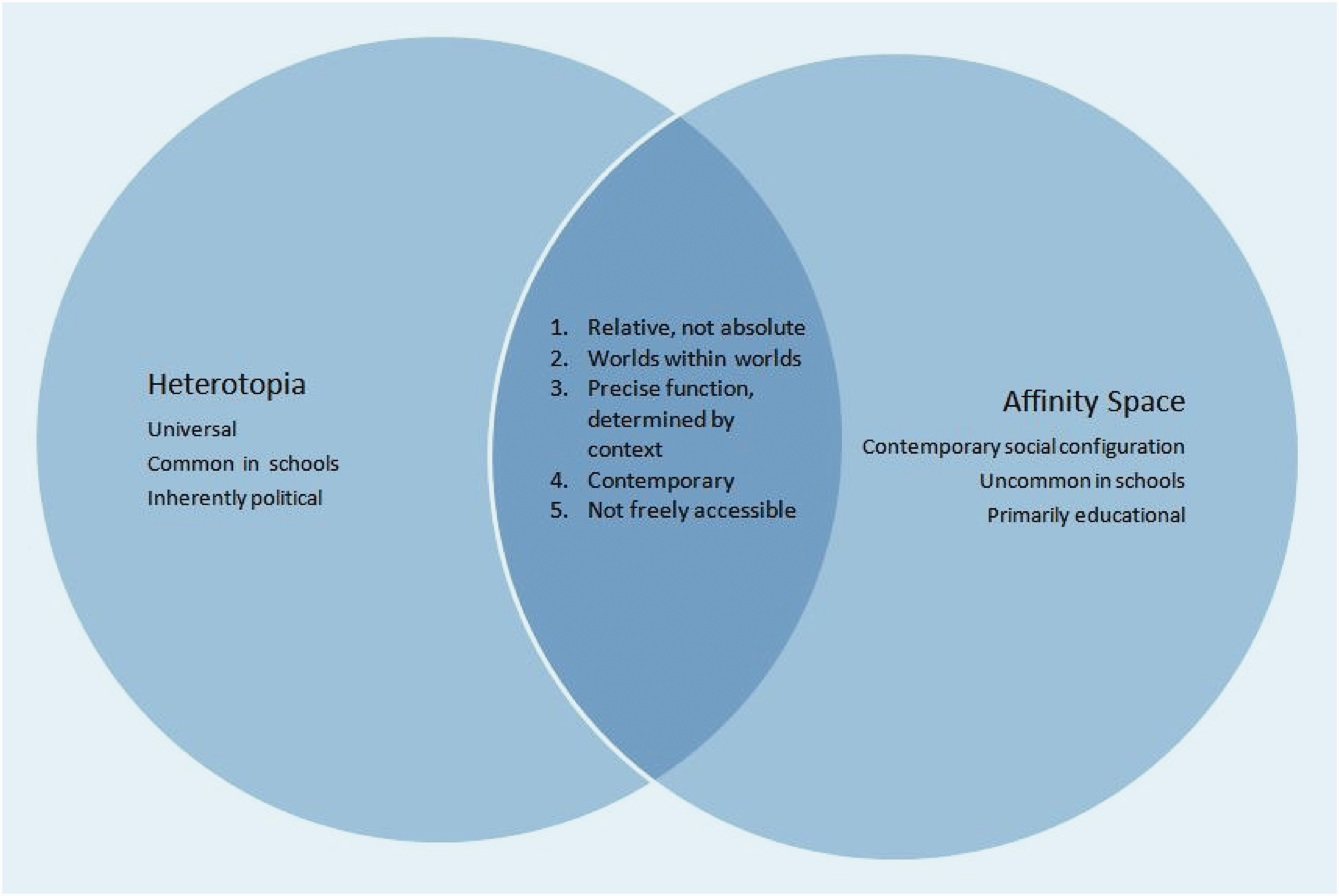
It is immediately apparent that there are several significant synergistic overlaps. The first of these concerns the relativity of both spaces: neither heterotopias nor affinity spaces are absolutes, but spaces may have features which make them more or less like heterotopias or affinity spaces. So, Johnson (2006: 84) asserts that ‘there is no pure form of heterotopia’ and Gee (2005: 19) states that ‘we do not have to see an affinity space as an all-or-nothing thing’. The second commonality is that both spaces are microcosms. Heterotopias are depicted as worlds within worlds; similarly, affinity spaces are spaces, like videogames and social network sites, which are part of, yet also stand in isolation from, the rest of the world. The third similarity is that heterotopias and affinity spaces are both related to specific time periods. Foucault (1984: 26) describes heterotopias as being ‘most often linked to slices in time’, whilst for Gee (2005), affinity spaces are particularly significant contemporary social configurations. So it seems as though a contemporary heterotopia, such as this study's project space, may also be characterised as an affinity space. Here we may ascertain a link to a fourth overlap: that both spaces have a precise function which is determined by context. Heterotopias are bound to a specific cultural, social and historical moment, and I suggest this is true for the Facebook project space, which was bound to a particular educational, social and technological context in 21st-century England. In an affinity space, the precise function relates to ‘learning, affiliation and identity’ (Gee, 2005: 29). The final overlapping characteristic of the two spaces is that neither is freely accessible. Entry to heterotopias is contingent on systems of openings and closings as well as rites and purifications (Foucault, 1984). Affinity spaces must be accessed through portals, be they software programmes, classroom doors or online accounts.
Consideration of the apparent dissonances highlights shortcomings in each conceptualisation and leads me to propose the heterotopic affinity space as a way of understanding the project space. Affinity spaces are primarily educative. In an affinity space, power, knowledge and identities are distributed, dynamic and fluid, and learning is emphasised more than power relations (though these are of course still evident). In contrast, heterotopias are explicitly political: they are spaces of resistance, contestation, transgression and disruption of the dominant culture. They are spaces in which young people may productively resist socially ascribed identities, in this instance through using discursive practices associated with Facebook, digital media and a particular classroom to perturb the dominant literacy-deficit discourse of dyslexia (Alvermann and Hagood, 2000; Kellner and Share, 2005). This apparent dissonance may be resolved, however. Learning may beget agency, so perhaps a feature of a heterotopic affinity space, which distinguishes it from other spaces, is that the learning which takes place there has a political component as well as being deep and authentic. Space in educational contexts, particularly classrooms, has political potential because it is not merely a static background for action, but may be socially and reflexively produced, thereby generating possibilities for change (Burnett, 2013; Forbes and Weiner, 2012). A second difference concerns the prevalence of each space in education. Heterotopias are said to be common to all cultures, whereas Gee (2005) contends that affinity spaces are rare in schools. But this is a minor issue, for it does not matter how common each space is, only whether they can and do co-exist. My contention is that they can, as I shall now try to illustrate.
One heterotopic affinity space
The project space can be conceived of as a heterotopia and as an affinity space. By suspending the norms of the dyslexia support workshop, the learning space changed from being merely exclusionary to one which was still segregated yet also disruptive and transgressive. This Other space was explicitly political, with the students contesting power relations, literacy and educational norms (Barden, 2012), and, through extensive identity work (Barden, 2014), deficit models of dyslexia. At the outset of the project, I encouraged the students to set down some collective aims for what they wanted it to achieve, and they did. Listing them, it is evident that they are strongly political. The students were explicitly seeking to influence the thoughts and actions of others, including the College's management team as well as their peers and the wider public, in order to address perceived inequalities, stigma and injustices. They wrote:
Getting the point that Facebook can benefit education across to senior College management; Using Facebook for peer support, to improve learning; To find out what other people think about dyslexia; Making people more aware of dyslexia and its effects; To find ways to overcome dyslexia, and prove that the participants and other people with dyslexia aren't stupid and are normal; To show that students can be responsible using social networking sites; To help the College's reputation by showing that it trusts students; To prove that a different form of communication is efficient / better, by showing students communicating about work.
Furthermore, within the space, the students appropriated literacy as a technology of resistance (Tambouko, 2004) instead of experiencing it as a disciplinary technology (Ball, 2013). This is evident in the data analysis presented below. The project culminated with the students imagining, planning, storyboarding, shooting and uploading a short stop-motion Lego movie about dyslexia. There was very little input from me beyond tacit suggestion (one student got the idea for the soundtrack for the movie from a link I had posted to the group Facebook page) and organising some help with syncing the audio and images from one of the College's IT technicians. The students chose to upload this video to the group Facebook page to summarise and communicate to others what they felt about dyslexia (and themselves). This decision reflects shifts in the students' identities, as their self-esteem and sense of agency improved and they began to inhabit roles as a group of capable researchers and ‘expert-helpers’ on the topic of dyslexia. The sophistication of the video illustrates the project space evidencing another key feature of an affinity space: reflexivity. That is, changes in thoughts and actions related to content about dyslexia reciprocally transformed the design of content about dyslexia subsequently generated in the project space, as they progressed from posting YouTube links to making their own artefacts. We return here to a sense of not just looking into Foucault's mirror, but reaching through it and altering the image – with those alterations made in the virtual space then altering reality. The students' growing sense of agency, fostered by the project space, enables them to collaboratively produce a complex, literate, political text which, when emplaced within that same space, enables renegotiation of power relations in their networks. For example, in support of the students' first stated aim of ‘Getting the point that Facebook can benefit education across to senior College management’, I showed the finished video to the College Principal, who subsequently agreed to review the College's Facebook embargo and social media policy. At the start of the following academic year, the College launched its own official Facebook page.
My argument then, is that the concept of heterotopic affinity space helps account for the learning which takes place there having an explicitly political, disruptive, agentive component as well as being deep and authentic. An analysis of two screenshots taken from the stop-motion movie helps illustrate why I think this is the case (Figure 2).
Scrabble was invented by Nazis.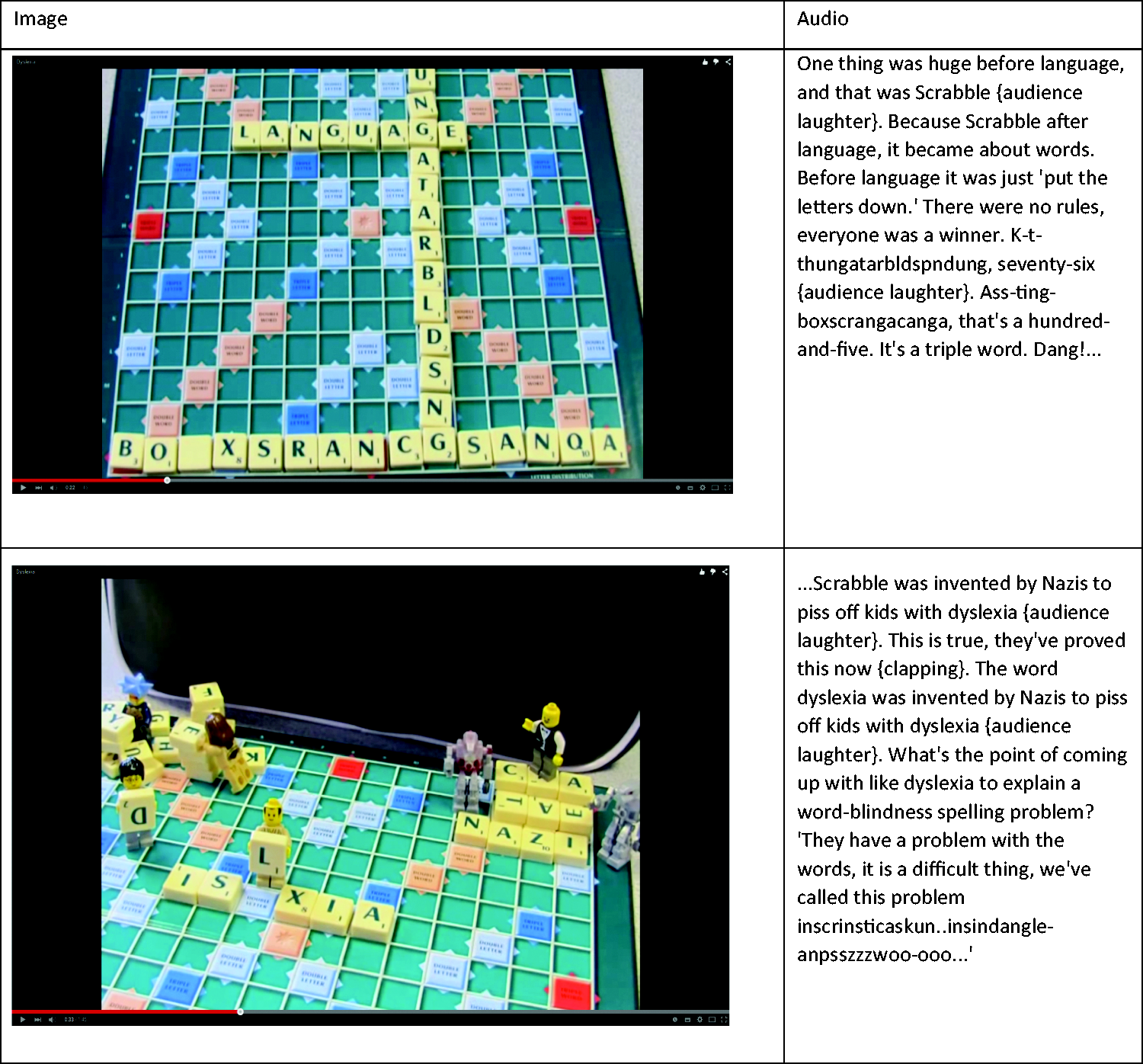
The inspiration for the video came from a YouTube video of the English stand-up comedian Eddie Izzard, who identifies himself as dyslexic. Part of Izzard's routine is about dyslexia: difficulties with spelling, dyslexia itself being a difficult word for the people it most applies to, and some of his own childhood experiences of dyslexia. He uses the board game Scrabble to help explain these issues to comic effect. The students storyboarded and then shot the movie, using an SLR stills camera, a Scrabble set and Lego figures they brought into college from home. The video matches an audio excerpt from Izzard's routine with visuals they produced themselves. Within the affinity space of the interlinked classroom–Facebook page, the students produce and publish a video collectively, playfully and creatively resisting and subverting disabling expectations about dyslexia, dyslexics and literacy. As Allan (2012) argues, these moments of freedom or Otherness, of crossing boundaries, are characteristic of Foucauldian transgression and by extension, I suggest, heterotopias. The video is both a product and constituent of the heterotopic affinity space.
The video begins with a shot of an empty Scrabble board. As the soundtrack to Izzard's routine starts, we see some of the words he is saying being spelt out letter-by-letter on the board. The first is language, emphasising the relationship between spelling, language and dyslexia. Next we see representations of the two enormous nonsense words Izzards utters in order to get laughs from the audience whilst also making a point about the difficulties both Scrabble and spelling conventions more generally present for people labelled as dyslexic. However, in the deliberate spelling out of these huge, ridiculous nonsense words we see the students playfully and creatively resisting and subverting the expectation that people with dyslexia can't spell. They assert that they can spell, even tremendously complex words that don't really exist. This is a political act. The second scene begins with Izzard saying 'Scrabble was invented by Nazis to piss off kids with dyslexia’. We see a male Lego figure, complete with a small moustache and one arm raised, atop a dais formed of Scrabble letters, the bottom row of which are arranged to spell out ‘Nazi’. A bipedal robot figure beneath him is suggestive of a stormtrooper. Clearly, the first figure symbolises Hitler orating. On the left-hand side of the shot, other Lego figures are struggling with a pile of letters, attempting to spell ‘dyslexia’ but producing “_islixia”, with one character about to lay an upside-down D at the start. Through the Hitler figure the students endorse Izzard's comments, while this time the deliberate mis-spelling of ‘dyslexia’ and the adoption of the mild curse word ‘piss’ into their own work are the playful, transgressive, political acts that are permitted within the heterotopic affinity space. The production and publication of this sophisticated, literate, disruptive, political artefact is precipitated and enabled by the students' identity work and growing sense of agency, which are characteristic of the deep learning Gee (2005) contends is typical for affinity spaces.
Conclusions
Before concluding, I must pause to address a potential objection to this hybrid concept. The question arises as to whether entry to an affinity space must be voluntary, and motivated by the shared endeavour, whereas entry to heterotopias is not necessarily voluntary. People who play online roleplaying games do so because they want to. People who find themselves in heterotopias of deviance, like dyslexia, may have little or no say in the matter. If entry to affinity spaces must be voluntary, this might rule out designating the project space as an affinity space, heterotopic or otherwise. Nevertheless, I would like to try and defend describing the project site as a heterotopic affinity space on two grounds. The first is one already acknowledged, that of Gee's caveat concerning relativity when determining the extent to which a space is an affinity space. A second line of defence is that the students who participated in this research project did so voluntarily. Had anyone in the group not wanted to participate, arrangements would have been made for them to continue with the usual study-support and literacy development sessions the College normally ran for students identified as dyslexic. However, someone could still conceivably assert that through this project I have, as a teacher–researcher, merely reconstituted my hegemonic control. That is to say, in setting aside the normative literacy expectations and practices associate with provision and pedagogy for dyslexia I have co-opted the students' technologies of resistance (Tambouko, 2004) to meet my own ends. Here I must reiterate that the students participated voluntarily, gave fully informed consent and maintained their right to withdraw without prejudice. They helped to design the project and had their own political agenda for it, which was explicitly around changing perceptions of dyslexia, literacy and Facebook. The students, for political reasons, chose to base the project around Facebook. I initially piloted the project using the closed social network site Ning, but the students were unanimous in asserting their desire to use Facebook instead. I acknowledge that my position of authority as both their teacher and a university researcher may well have influenced their decision to participate, although, as discussed above, they had their own political agenda which the project helped serve. Similarly, I acknowledge that I created the conditions for the project, which might make participation in the learning endeavour seem somehow artificial. However, videogames are engineered and so in a sense artificial rather than natural or spontaneous sites for participation and learning. If game sites, which are artificial constructs, can be affinity spaces, it does not seem unreasonable to describe a purposively constructed educational site as a heterotopic affinity space.
I therefore conclude that the project space was a heterotopic affinity space, and I advocate heterotopic affinity spaces as a way to conceptualise learning environments characterised by deep, authentic, political, disruptive, agentive learning. This concept may be useful for other educators seeking to understand similar spaces or contexts, perhaps involving different Othered groups. For example, a conference I recently attended on disability in education, where academics and disabled people came together for two days to challenge assumptions and prejudice around disability, and to celebrate diverse embodiment as an educational resource, strikes me as another potential heterotopic affinity space. Alternatively, the concept of the heterotopic affinity space may be useful to teachers seeking to resist and develop pedagogical alternatives to the skill-and-drill models so prevalent in, for example, literacy lessons and dyslexia support as usually practiced. It may also be applicable to other collaborative, Web 2.0 spaces.