




Abstract
The promotion and progression of black and minority ethnic academics and teachers in England has been the subject of much debate. Although several theories have been put forward, racial equality has stood out as a major contributing factor. The experiences of black and minority ethnic academics and teachers in England are similar in terms of aspirations, and their experience of organisations also points to similar patterns of exclusions. This integrated study provides thick data from qualitative interviews with academics and teachers, theorised through the lens of whiteness theory and social identity theory, of their experience of promotion and progression, how they feel organisations respond to them and how they, in turn, are responding to promotion and progression challenges. There was a shared view amongst the participants that, for black and minority ethnic academics and teachers to progress in England, they need ‘white sanction’ – a form of endorsement from white colleagues that in itself has an enabling power.
Keywords
Introduction and contextualisation
The participation of black and minority ethnic (BME) teachers and academics in the UK’s education system has been a source of much research and debate. Similarly, the progression of BME teachers and academics in senior roles in educational institutions has been a source for much research and debate. Despite debates and research evidence, however, progression for BME teachers and academics remains a deep-rooted and continuing struggle at the individual and group levels. Put differently, BME teachers and academics are far more likely to occupy entry-level and junior roles in schools (Earley et al., 2012) and universities (Bhopal and Jackson, 2013; Equality Challenge Unit, 2014) for what appears to be no other reason than their ethnic/racial profiles.
In any educational institution, the promotion and progression of staff is arguably a complex affair and subject to much speculation about why and how some individuals progress and why and how others do not. Nevertheless, the progression and promotion of BME staff is a simultaneously complex and fraught issue, underpinned by decades and histories of racial inequality in the UK and its education system. On the one hand, the struggle for promotion and progression among all teachers and academics is a personal one, associated with each individual’s quest to be successful in life and their careers. On the other hand, however, the struggle for promotion and progression among BME staff is a struggle not only for their success, but also for mutual recognition at individual and group levels, and for equality. The continuing struggle for mutual recognition and equality in terms of promotion and progression among BME teachers and academics has led them to question the usefulness of the national and institutional apparatuses in place that are believed to be genuinely advancing equality and diversity, when, in fact, evidence continues to confirm that whereas white teachers and academics continue to progress in their careers, the promotion and progression of BME teachers and academics has more or less flatlined. This article examines, in an integrated analysis, BME promotion and progression among schoolteachers and university academics in England.
BME teachers
As of January 2015, there were 8.4 million pupils enrolled in state-funded and independent schools in England, with 30.4% of primary school pupils and 26.6% of secondary school pupils with minority ethnic origins (Department for Education, 2015b). Patterns of variation exist within the overall data, with some schools in London, for example, having up to 70% BME students enrolled, although staffing profiles do not always reflect the student body. In November 2014, there were 454,900 full-time equivalent teachers in state-funded schools in England, of whom 87.5% were White British. Teachers from ‘Other white’ (3.6%), White Irish (1.7%), Indian (1.7%) and Black Caribbean (1.0%) backgrounds made up the next largest groups (Department for Education, 2014). Of the approximately 18,000 qualified BME teachers, around 1000 are in leadership roles and only 104 (or 3%) are head teachers – that is, in 2014, 93.7% of head teachers were recorded as White British, a slight reduction from the previous year (93.9%).
The necessity and value of having BME teachers and school leaders is well documented. BME students benefit from seeing BME staff in leadership roles, which provides a role model for them, built on what Wei (2007: 10) describes as ‘co-identification’. It is widely believed that co-identification can play a role in enticing BME students to enter the teaching profession (McNamara et al., 2009). Furthermore, ‘[h]aving a leadership team from a range of ethnic backgrounds also helps to forge good relationships between students and staff’ (SecEd, 2015). It has also been reported that BME leaders can draw on their own experiences to engage with BME students by challenging racial stereotypes and making changes throughout the school in order to address issues of discrimination in trying to create a more inclusive environment (McNamara et al., 2009).
It is arguably the government’s recognition of the continuing problem of BME promotion and progression to school leadership and the associated value of BME school leaders that underpins the introduction of the Leadership Equality and Diversity Fund, which aims to support BME teachers in gaining senior leadership roles within 12 months (Department for Education, 2015a). Although no independent evaluation has so far been undertaken, the government has opened up the fund to all schools – up from the 30 (20 secondary and 10 primary) it started with in 2014.
BME academics
Data from the Higher Education Statistics Agency suggests that there are an estimated 1,829,195 UK-domiciled students in higher education. Of this number, there are 33,290 whose ethnicity is unknown. Of the 1,795,910 whose ethnicity is known, there are 377,225 students from BME backgrounds (Higher Education Statistics Agency, 2016). Higher Education Statistics Agency (2014) data also suggests that there are approximately 186,000 academics employed in UK higher education institutions. Of this number, approximately 14,694 (7.9%) are from BME backgrounds (Singh and Kwhali, 2015). Singh and Kwhali (2015) also report that nearly 11% (18,843) of the 171,306 white academic staff are professors, compared with approximately 192 BME professors, of whom 85 are black. Furthermore, the Equality Challenge Unit (ECU, 2014) reports that BME women are less likely to occupy senior positions; BME staff are more likely to be on fixed-term contracts; and BME staff receive lower levels of pay – in particular, those from black and Chinese backgrounds.
Similar to BME teachers, the value of having BME academics and managers has been the focus of research and government initiatives. Launched in 2014, the Race Equality Charter Mark targets the improvement of the representation, progression and success of minority ethnic staff and students in higher education, underlining that ‘the continued existence of racial inequalities limits both minority ethnic individuals and the sector as a whole in fulfilling its full potential’ (Equality Challenge Unit, 2014). However, despite the ‘plausible link between BME students and recruitment of staff to higher education’ (Singh and Kwhali, 2015: 8), ‘the value of having BME staff can go unrecognised in the UK higher education system’ (Bhopal and Jackson, 2013: i), since, according to Shilliam (2015: 32), ‘British academia remains administratively, normatively, habitually and intellectually “White”, and Black academics and students suffer the most from the institutional racism and implicit biases that accompany this mono-culturalism’. Furthermore, as Deem et al. (2005) and Law et al. (2004) suggest, UK universities appear, for quite some time, to have been immune to scrutiny. It is perhaps for these reasons that only 30 universities volunteered to take part in piloting the ECU-led Race Equality Charter Mark, of which 21 volunteered to trial the framework; and of the 21 that trialled the framework, only 8 met the standard for a Bronze Award, in recognition of their action plans and efforts to improve race equality (Equality Challenge Unit, 2015).
White privilege/whiteness theory
White privilege is a term used to describe a set of privileges that advantage people identified as white in Western countries, compared with what is usually experienced by non-white people under the same set of political, social political and/or economic conditions. Critical race theory suggests that racism is normal and, as key thinkers in this area have reported, race is a key organising category for inequality based on an ideology of white supremacy (Du Bois, 1997; Woodson, 2006; Omi and Winant, 1986).
Ladson-Billings and Tate (1995) situate race as the organising principle of domination. Lynn (1999) cautions against ignoring this reality, which is central to the history of civilisation. Within a system of domination, ‘Whiteness is the ideology and way of being in the world that is used to maintain White supremacy’ (Picower, 2009: 198). McIntosh (1990: 31) argues that whites in Western societies enjoy advantages that non-whites do not experience, and describes them as an ‘an invisible package of unearned assets’. McIntosh also proposes that white privilege is an institutional arrangement that grants a set of unearned benefits to white persons for being white. Sue (2003: 7) sees this as particularly problematic, since white privilege provides unearned advantages and benefits to white persons based on a system ‘normed on the experiences, values, and perceptions’ of white persons. Furthermore, Kendall (2006: 63) describes white privilege as ‘an institutional, rather than personal, set of benefits granted to people whose race resembles that of the people who are in power’.
According to Picower (2009: 198), ‘Whiteness is operationalised in a variety of ways’, although it has been commonly agreed that whiteness has three main components: racial identity, racial bias and racial privilege (Lyubansky and Barter, 2011). In terms of racial identity, whiteness derives its strength from four primary sources – namely, group size, group power, group discrimination and group appearance. Whiteness as racial identity holds that ethnic minorities have less power compared with other groups, do not resemble the majority group, and experience more and varied forms of discrimination. Conversely, because of their majority status, the majority racial group see their racial identity as normal (McIntosh, 1990; Stovall, 2006). In contrast to racial identity, whiteness as racial bias has been viewed as a philosophy underpinned by racial bias (Kincheloe and Steinberg, 1997). This view holds that society is characterised by a socially created racial hierarchy that values whiteness above all other identities, and that because whites are socialised into this identity, they are more susceptible to internalising messages regarding white superiority, even if they consciously reject racist beliefs (Croll, 2013). It is believed that this internalisation leads to unconscious (and therefore unintentional) bias in favour of those who are white (Lipsitz, 1998) – a bias believed to be less noticeable or non-existent among non-white groups (Lyubansky and Barter, 2011). Whiteness as privilege, on the other hand, is arguably characterised by privilege and less by racial bias – that is, because one is white and whiteness has an invisible quality (McClendon, 2004), there are certain privileges associated with these statuses, most notably, the privilege to live one’s life without the need to be aware of one’s whiteness and how this might be impacting on one’s life (McIntosh, 1988).
Social identity theory
The main argument of social identity theory is that a person’s sense of who they are is based on their group membership(s) – for example, ethnicity, social class or religious group. Tajfel and Turner (1986) propose that the groups to which people belong are very important to their social identity and provide a sense of belonging. They also propose that, in order to enhance our sense of self, we enhance the status of the group to which we belong (known as the ‘in-group’) – for example, ‘England has the best educational researchers’ – or discriminate against or have prejudiced views against others (known as the ‘out-group’) – for example, ‘White academics are better than academics from other ethnicities’. The process of dividing people into an in-group (us) and an out-group (them) – known as social categorisation – is one of three mental processes, according to Tajfel and Turner (1979), that underpin an ‘us’ versus ‘them’ mentality. The other two states are social identification and social comparison. Social categorisation categories are made in order to help people understand their social environment – for example, black, white, Muslim, Christian, etc. In social identification, people adopt the identity of the group to which they categorise themselves as belonging and conform to the norms of the group, which in turn produces an emotional significance to their identification with that group. Furthermore, their self-esteem will become bound up with group membership (McLeod, 2008). In social comparison, people tend to draw comparisons between different groups based on a range of explicit and/or implicit factors. For Tajfel and Turner (1986), understanding these processes is crucial to understanding how prejudice works, since categorising people into groups can lead to the exaggeration of (a) differences between groups and (b) similarities of things in the same group.
BME academics and progression in England
The progression of BME academics is fraught, according to a sustained body of research findings in this area. For example, just over 16 years ago, Carter et al. (1999) and Fenton et al. (2000) cited evidence of discriminatory practices in relation to the progression of BME staff. These follow on from earlier studies spotlighting the under-representation and disadvantage of BME staff in the academic labour force. For example, Puwar (2004) found that BME academics who enter and progress in traditionally white ‘space’ have been described as ‘space invaders’ and ‘out of place’. According to Puwar (2001: 659), the presence of BME staff in high-level positions can lead to a disorientation of whiteness, resulting in a ‘double-take’ occurring ‘because authority is sedimented and naturalised in white bodies’. Accordingly, Puwar (2004: 1) postulates, ‘[w]hile [BME staff] now exist on the inside, they still do not have an undisputed right to occupy the space’. Puwar’s observations have been underlined by Pilkington (2013: 232), who found that BME staff are more likely to experience or encounter ‘hyper-surveillance’. Deem and Morley (2006) found that equality issues involving staff are not given the same attention as equality issues for students, and Arday (2015), Loke (2015) and the ECU (2014) found that BME academics are more likely to be employed at post-1992 universities, mirroring the situation for BME students in higher education.
Research into race inequality in education in England has continued to gain momentum over the last few years as concerns about the inclusion and progression of BME staff have surfaced and become more widely debated (Bhopal and Jackson, 2013). There is, however, a growing body of research literature which suggests that diversity in higher education has become ‘primarily a matter of documentation, audits and bureaucratic paper trails’ (Bhopal and Jackson, 2013: 2), which can expose ‘the gap between words, images and deeds’ (Ahmed, 2007: 607), although there is an urgent need to ensure action (Ahmed, 2007, 2012; Pilkington, 2011). The ECU (2011: 46–47) reports that some initiatives have failed due to ‘the absence of resources and authority for the initiative, and sometimes fatigue and apathy towards new initiatives where previous staff experiences tend to be of unsuccessful initiatives that achieved neither substance nor sustainability’.
Furthermore, in 2011, the ECU reported that BME academic staff who are as qualified as their white counterparts are often overlooked for promotions or are not encouraged to apply for senior positions. As Bhopal and Jackson (2013: 7) also observe, ‘there is a higher percentage of BME staff at lower grades in the higher education sector compared to their representation at senior levels’. This observation mirrors the situation in other fields and sections of the wider education sector. Indeed, in 2012, the ECU reported that only a small number of BME academics hold senior posts and, overall, staff of BME origin tend to make up the lower rungs of organisations. Kalra et al. (2009) argue that, in order for diversity initiatives to be productive, they need to be so as to ensure individuals are supported and, as appropriate, changes to organisational cultures are promoted and implemented.
In 2015, Miller reported that BME academics – in particular females – are less likely to gain a promotion due to perceived racial discrimination and the fact of having to ‘prove themselves’ or not belonging to an ‘in-group’ or ‘club’. Connecting ‘through intermediate social structures – webs of association and shared understandings of how to behave’ (Halpern, 2005: 3) – is an important issue to which I will return later in the discussion. Suffice to say here, however, that mentoring (Roofe and Miller, 2015) and networking are crucial to progressing in one’s academic career (Kalra et al., 2009; Fenton et al., 2000). Nevertheless, as Goulbourne (2006: 239–240) puts it, ‘what is social capital in one social context may not be social capital in another context’, thereby posing a potential challenge for BME academics to access predominantly white middle-class, male-dominated networks in higher education (Bhopal and Jackson, 2013).
BME teachers and progression in England
The issue of teacher progression is highly subjective and often teachers, school boards and policymakers have differing views regarding possible factors influencing an appointment or, indeed, a ‘non-appointment’. Pioneering research by Morgan et al. (1983) found that head teacher selection is arbitrary and problematic, and that selection panels do not always have clear criteria for selection. Furthermore, where criteria do exist, final decisions are not always based on these. Around 15 years ago, Earley et al. (2002) found that race/ethnicity is a problem in teacher progression, as evidenced by the small numbers of BME staff in senior leadership roles in schools. Ten years later, Earley et al. (2012) reconfirmed that BME staff are disadvantaged in gaining senior leadership roles in schools due to their race/ethnicity, suggesting that underlying essentialist stereotypes and a glass ceiling are responsible.
These observations were confirmed by Bush et al. (2006) and Lumby and Coleman (2007), who also found that race/ethnicity is a factor in the career progression of some BME teachers. Coleman (2007: 389) also noted that the appointment of women principals is still problematic, commenting that, ‘overall, women are more likely to become head teachers and are now less likely to be categorised into pastoral roles, but in some cases women still meet prejudice from governors and others in the wider community’. Research conducted by Moreau et al. (2007) and Bullock (2009) showed that women are disproportionately represented in senior leadership posts.
Research by Shah and Shaikh (2010) found that religious and ethnic affiliation is a contributing factor in teacher progression. Specifically, they found that being male and Muslim is problematic in the quest for a principal’s job. More generally, the literature in England has identified several barriers that limit teachers’ progress to leadership positions in the forms of marginalisation and indirect racism (Powney et al., 2003), and the subtle influence of informal networks that exclude some groups (Harris et al., 2003). Research by McNamara et al. (2009) found, inter alia, that BME teachers are committed to teaching and ambitious to progress, although discrimination at work remains a key barrier to progression. Research by Miller (2014) found that government policy, social connections and school-level jockeying/interference are primary barriers (and simultaneously enablers) to promotion and progression among teachers.
The study
Data collection for this qualitative study was conducted in two phases between March 2014 and November 2015. The overall focus of the study was to gain insights and accounts of BME teachers and academics regarding their progression and promotion experiences.
Phase One was conducted from March 2014 to March 2015. It included seven BME academics (two male, five female). Two of the female academics were employed at ‘Russell Group’ universities, two of the academics were employed at ‘plate-glass’ universities and three of the academics were employed at ‘post-1992’ universities. Between them, they had over 60 years of university teaching experience, or an average of 8.5 years. The academics held job roles such as lecturer and senior lecturer. They were drawn from four London-based universities. All of the academics were interviewed using a semi-structured interview guide. The interviews were held via telephone and face-to-face. A combination of convenience and snowball sampling was used to enlist the academics.
Phase Two was conducted from May 2015 to November 2015. It included eight BME teachers (five male, three female). One was employed at an ‘Outstanding’ school, five were employed at a ‘Good’ school and two were employed at a school ‘Requiring Improvement’. Between them, they had over 68 years of teaching experience, or an average of 8.5 years. The teacher participants occupied roles such as classroom teacher, head of year, head of department, assistant head teacher and deputy head teacher. They were drawn from eight different schools located in five London boroughs; one was employed at a primary school and seven were employed at secondary schools. All of the teachers were interviewed using a semi-structured interview guide. The interviews were held via telephone and face-to-face. A combination of convenience and snowball sampling was used to enlist the teachers.
Analysis
The data analysis approach I adopted in this study draws on a combined descriptive and auto-ethnographic research methodology. Whereas descriptive research attempts to provide a detailed picture of a particular situation (Nueman, 2006) – in this case, the promotion and progression of BME teachers and academics – auto-ethnographic research attempts to provide accounts from participants’ viewpoints. By combining these two approaches, it was felt that the research findings would provide better insights, and therefore be more authoritative (Etherington, 2004; Sikes, 2013). It is important to note, however, that this study did not attempt to measure the experiences of BME teachers and academics, but rather to provide a description of those experiences (Chieffo and Griffiths, 2004). The main question asked of the BME teachers and academics in this study was: ‘What factors hinder/enable the career progression and promotion of BME teachers and academics in England?’
Findings
The findings reported in this article relate to the perceptions and experiences of BME academics and teachers in relation to their promotion and progression in their chosen careers. The data presented is based on themes derived from the participant interviews, not on participant groupings such as ‘teachers’ or ‘academics’. The main findings are presented below.
Promotion and progression based on ‘white sanction’
Several of the participants expressed that white colleagues were like ‘gatekeepers’, and there was no way you could get a job without first impressing and/or forming an alliance with them. I have termed the situation of having to gain endorsement for progression and promotion from white colleagues as ‘white sanction’. Two of the academics reflected: It’s no longer enough to be qualified. Meritocracy will get you only so far. You have to have connections with white colleagues, and those connections must be more than surface level. Surface-level connections are ‘invisible’, but you need connections that are ‘visible’ – connections with white colleagues in influential positions who will write your job references, deliver an address at your book launch, submit the next research bid with you, co-author a paper with you, and co-present a paper at a conference/seminar with you. Anything less than this is not going to get you anywhere. (black academic, male, plate-glass university) I have been at my current university for over nine years. I am still a lecturer. I do think being a black female has to do with my non-promotion. However, I feel it has much more to do with the fact I am a black woman. It took me a while to realise, but I think I now get it. To get a promotion, as a black academic, you need an ally – preferably a white person who is in a position of influence and who can therefore influence things for you. Without this ally, your journey to promotion is going to be tedious, messy and possibly non-existent. (black academic, female, Russell Group university) I have been in my school now for 12 years and I have seen a number of white teachers progressing and, in a sense, leaving me behind. I love my job and I love my school. However, despite applying for internal promotion four times, I have not gotten through. It’s always ‘You are not ready yet’. If I am not ready after 12 years in one school working in several roles and amassing significant experience, when will I be ready? I guess when they tell me I am. (black teacher, male) I have 13 years’ teaching experience in this country and 5 years in Guyana. I have been promoted to a head of department and now lead practitioner since arriving here. But it seems that’s as far as I will be allowed to go. Look around. White overseas-trained teachers seem to progress effortlessly to senior leadership, but, for BME teachers, this is not the case. Although my native language is English, and since I cannot change my skin colour, I guess I should commit to speaking the Queen’s English – and that may give me an edge. (black teacher, female)
Racial discrimination
A number of the participants felt that racial discrimination in the actual appointments process or within their institution’s psyche had contributed to or was responsible for their lack of progression: Discrimination and racist attitudes are perceived factors … everything seemed to be fine – ‘I am the perfect candidate for the job, I tell myself’ … until I walk into the room and they realise I am black. Then they feed back to me, ‘You did not get the job because you did not seem as if you really wanted the job’ and ‘my publications were not enough’, although it was a teaching post only. I have found many interview processes are just veneers. (black academic, female, post-1992 university) I applied for a post at an institution where I had previously been employed – the post was almost identical to that which I had left. Interview feedback was that I had not demonstrated that I could deliver the academic programme in a location other than the HEI [higher education institution]. I later learnt that the post was offered to a candidate who had recently completed the same postgraduate academic programme where the vacancy was held. This white male had no prior experience of working in an HEI, no experience of teaching either at the undergraduate or postgraduate levels, whilst I had over 10 years’ experience at the time. (black academic, female, Russell Group university) People are sometimes shocked to learn I am not further up the ladder. There is a lot of institutional racism at my university, which is compounded by notions of what one perceives an academic should look like – usually someone who is white. (black academic, female, Russell Group university) From my personal experience, I have seen BME teachers, in particular overseas-trained teachers, overlooked for promotion – especially those that were internally advertised. I often questioned what the barriers are and have narrowed it down to either skin colour or accent. (black teacher, male) I think that, despite being allowed to migrate here to teach and despite having the relevant qualifications and experience, my experience has taught me that school aims to subtly promote British teachers to positions of responsibility and leadership. (black teacher, female) More recently, I was invited to attend a course called ‘Stepping up to Leadership’ for BME teachers. Why can’t BME teachers not apply to the ‘Future Leaders’ programme like anyone else? Why must there be a course especially for BME teachers? Will this solve the problem and create more opportunities? BME under-representation is clearly a nationwide issue. (black teacher, female)
Social connections/networks
There was a feeling among the participants that recruitment and appointment panels, and therefore institutions, already knew who they were going to appoint based on racial and/or other ascriptions, and not merit. As described by the participants, progression and promotion had more to do with social connections (who you know or who knows you) and networking with white colleagues, and was less about ability and experience. I have labelled this notion ‘wrong face’. For at least five interviews that I had, I felt that they were unsuccessful because I was not in the ‘inner circle’. When one colleague found out that I did not get one of the jobs in particular, she was confident it was because ‘my face didn’t fit’. I share this sentiment too. It’s about face and it’s about a club. (black academic, female, plate-glass university) Sometimes I think it’s pointless for black academics to even apply for jobs/promotion because someone in the ‘club’ will usually get it. It may seem cynical but my only hope for progression may be to join their ‘club’. (Asian academic, female, plate-glass university) The focus of institutions seems to be more on appearance rather than on skills, experience and qualifications. (Asian academic, female, plate-glass university) I have applied for an internal post advertised externally and was ‘pipped to the post’ by an external candidate who was deemed to have had more recent evidence of successfully running an academic programme. The person appointed, in fact, had less experience teaching at university and held their previous post for less than two years. I am more qualified and more experienced than the person appointed, but was told: ‘It was close’. It goes without saying the person appointed was white. I think he got the job because he knew people on the inside. (black academic, female, Russell Group university) There is a lot of corruption in progression and promotion in schools – especially for internal posts. I am an assistant head teacher and I have seen instances at my school where my head teacher has made progression and promotion decisions contrary to school policies. These decisions are rarely questioned by the governors, who have complete faith in her. But these decisions do not promote diversity and inclusion. (black teacher, male) More recently, there was a demand for recruiting teachers who attended top universities in preference for those who did not. This will invariably affect some teachers, especially BME teachers from overseas, who qualified at universities not considered ‘top’ by the UK establishment. Soon, the school system will be led by only one type of leaders – those from certain backgrounds – whereas the teachers will be the minions from the less prestigious universities and from overseas. (black teacher, male)
Discussion
The promotion and career progression of BME academics and teachers continues to be a source of much debate at the levels of policy and practice. Simultaneously, the promotion and career progression of BME academics and teachers continues to be fraught. The factors limiting career progression for BME academics and teachers are multiple and interrelated. For example, the ECU (2014) reported that the continued existence of racial inequalities limits both the potential of minority ethnic individuals and that of education as a whole. This important observation from the ECU mirrors one of Tajfel and Turner (1979) key assumptions that, by exaggerating differences between groups through a process of social categorisation, some groups are disadvantaged not only at the cost of a particular group, but also at the cost of society as a whole. The problems associated with such assumptions and their potential impact on promotion and progression decisions are incalculable. For BME staff, however, such assumptions can, and do, influence decisions by white colleagues about their organisational value, capabilities and therefore career progression. One teacher reasoned that, ‘[to them], we are fit to manage pupil behaviour and to teach but not fit to lead’ – an observation supported by Saran (2007: 68), who acknowledged that ‘[t]he notion of superiority creates internal colonisation of society … in a general sense, Whites of European heritage consider themselves superior’.
Wei (2007), Bhopal and Jackson (2013) and SecEd (2015) propose several individual, group and organisational benefits associated with employing BME staff at different levels in educational institutions. From the interview data reported in this article, BME academics and teachers fully understand these benefits and their role in delivering these benefits to students in particular, and to the organisation as a whole. Many, however, described their minority ethnic status, and therefore their ‘out-group’ status, as being responsible for, or at least a significant contributor to being ‘passed over for promotion’, ‘not supported for going for promotion progression’ and being ‘written off’ because ‘my face doesn’t fit’. Although such suggestions can be made by any individual or group to explain non-promotion and non-progression, they are consistent with research by McNamara et al. (2009) on ‘the leadership aspirations and careers of black and minority ethnic teachers, and by Loke (2015), Shilliam (2015) and Goulbourne (2006), who highlighted a range of challenges for BME academics in accessing white spaces, often dominated by white middle-class males.
‘White sanction’
Based on the evidence from this and previous studies on BME progression, I argue that in order for BME teachers and academics to progress in their careers, it appears that they need to go through a process of ‘white sanction’. Used here, ‘white sanction’ occurs where the skills and capabilities of a BME individual are, first, acknowledged and, second, endorsed/promoted by a white individual, who is positioned as a broker and/or mediator acting on behalf of or in the interests of the BME individual. ‘White sanction’ can be ‘indirect’ (e.g. a verbal reference and/or nomination for an activity) or ‘direct’ (e.g. a written reference, joint publication, joint appearance at a conference or joint grant application). I should point out, however, that not every act of acknowledgement is itself ‘white sanction’ and, for ‘white sanction’ to occur, it must satisfy three conditions: acknowledgement/recognition, endorsement and ‘brokerage’. Brokerage is about leveraging opportunities for the BME individual. I also propose that ‘white sanction’ has two forms or outputs, discussed below.
‘White sanction’ as legitimacy
Whereas Bhopal et al. (2015) reported that BME academics are not particularly good at networking, Harris et al. (2003) found that the subtle influence of informal networks excludes some groups (of teachers). Nevertheless, notions that the progression of BME academics and teachers is ultimately tied to having a white colleague vouch for and/or attest to their capabilities are problematic. First, such practices undermine the value of meritocracy and the authenticity of the potential benefits to be derived by anyone, regardless of their status, from working hard or hard work. It was strongly felt by both the academics and teachers alike, however, that one of the more likely ways of ‘getting noticed’ or of being ‘given a chance’ is to have the blessing or endorsement of white colleagues. The endorsement of a white colleague, one might argue, provides BME academics and teachers with a form of legitimacy not readily available through their BME peer networks, which is of crucial importance in the eyes of, in particular, white peers who are in control of the seat of power and decision-making. Second, such practices bring to the surface several important questions in relation to the role and power of networks – in particular, white networks, whether formal or informal. Based on the findings from this research and previous studies on BME progression, one can argue that, in the main, in order for BME academics and teachers to progress, (it appears) they need a white colleague to act as a kind of broker, providing a note of verbal and/or written recommendation that says to other white colleagues, especially, that ‘this person has an acceptable personality’ and is therefore ‘ok to work with’. This important note of acknowledgement/endorsement – which could be, for example, a recommendation that the BME individual be approached to do a particular task – is, however, only the first step in a two-step process.
‘White sanction’ as enabling
The importance of connecting ‘through intermediate social structures – webs of association and shared understandings of how to behave’ – as described by Halpern (2005: 3), is a significant issue at this juncture. And, for the BME academic and teacher, these connections – ‘webs of association’ – must be within their ‘out-group’ and, more importantly, outside their ‘out-group’ (Kalra et al., 2009; Fenton et al., 2000) – that is, for BME staff to increase their scope of promotion and progression, social connections external to their ‘out-group’ are fundamental to their success. Without such connections, their chances of progression are severely diminished, since BME networks, formal or otherwise, do not have as much clout as white networks, and therefore lack the ability (and possibly the credibility) to leverage promotion and progression opportunities, despite being an important space for ‘talking through issues’ and ‘affirming each other’. Based on the findings reported here and on previous studies on BME progression, one can argue that, in the main, in order for BME academics and teachers to progress, (it appears) they need an ally, in particular a white ally – someone who is well connected, highly respected, listened to, a mover and a shaker, and can open doors for them. It is this ‘ally’ who will move beyond brokering (or acknowledgement) to creating and leveraging opportunities for the said BME individual in networks previously closed to them, which could include the conduct of joint research and initiatives and/or joint appearances at conferences.
Institutional interaction with BME staff
The findings reported in this article point to a range of problems at the individual, group and organisational levels. At the individual level, BME academics and teachers feel sidelined for promotion and progression opportunities for no other reason than their ethnicity/race – a situation in contrast to whiteness theory, which holds that whites are advantaged simply for being white (Lipsitz, 1998). At the same time, the feelings held by BME academics and teachers, and their experiences of promotion and progression, point to a process of social categorisation, the result and fundamental underpinnings of which are prejudice and discrimination (Tajfel and Turner, 1979). At the group level, this limits the ability of BME academics and teachers to sufficiently counteract stereotypes about BME staff and students due to not having adequate numbers of staff in senior/leadership roles (McNamara et al., 2009) and/or a lack of authority despite being in a post (Puwar, 2004), and therefore being unable or unlikely to directly influence decision-making and/or institutional-level policymaking. Furthermore, the result of not having BME staff in senior/leadership roles restricts the quality of mentoring they are able to provide to BME students and the numbers of aspirational role models available to BME students based on their ethnic co-identification (Wei, 2007).
For the organisation, by not recruiting and/or promoting suitably qualified BME staff, this reifies the problems of exclusivity (Tajfel and Turner, 1979) and simultaneously colonises the production and acceptance of forms of knowledge (Saran, 2007). Furthermore, this sends a signal to students and the wider community that, for institutions to work and thrive, they must be headed by white leaders, and predominantly white staff must be the key office-holders, underlining the ‘us’ versus ‘them’ view, and the suggestion by one teacher participant that ‘[to them] we are fit to manage pupil behaviour and to teach but not fit to lead’.
Institutional interaction with BME staff.
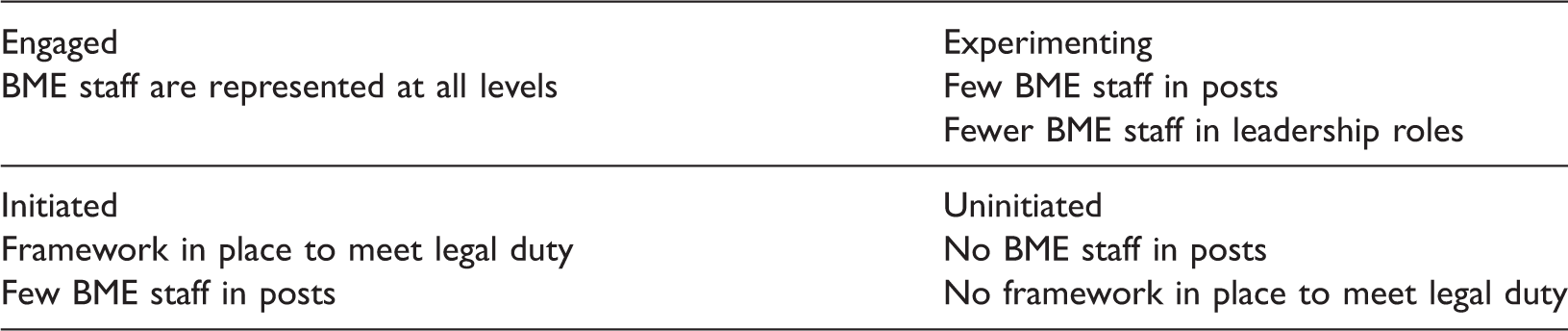
In an ‘engaged’ organisation, there are BME staff at all levels of its hierarchy, including in (senior) leadership roles. In an ‘experimenting’ organisation, there are few BME staff in posts and a smaller number of BME staff in leadership roles. In an ‘initiated’ organisation, there exists a framework for meeting its legal duty, although BME staff recruitment is kept to a bare minimum, with no BME staff in leadership roles. In an ‘uninitiated’ organisation, no framework exists for meeting its legal duty and no BME staff are in posts.
BME staff responses to the challenges of promotion and progression
BME individual and group responses to the challenges of promotion and progression.
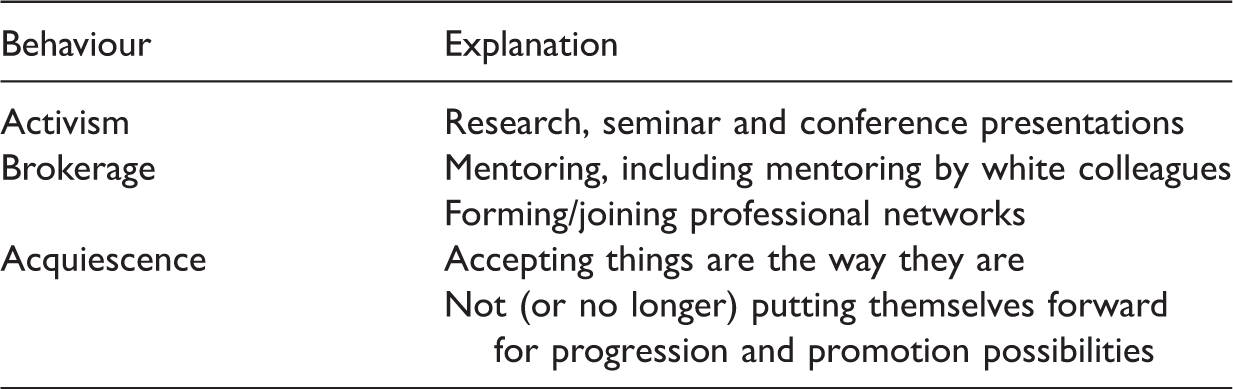
The BME academics and teachers who are involved in activism are those who are engaged in research – as doers, participants or both – and in seminar and conference presentations, contributing to public debate. Those BME academics and teachers who are involved in brokerage are those who are involved in mentoring other BME staff, being mentored by a BME and/or white staff member, and joining and/or forming professional networks, whether formal or informal. The BME academics and teachers at the point of acquiescence are those who have ‘given up’ due to being ‘fed up’ and ‘tired’ of a system (and institutions) that has consistently let them down and in which they feel that they will not be able to progress.
Conclusions
Goulbourne (2006: 239–240) suggests that ‘what is social capital in one social context may not be social capital in another context’. In the context of this research study and from ongoing debates about BME staff progression in England, there appear to be two forms of capital: a BME capital – which is restricted and (can be) restrictive – and a white capital – which has a degree of power and influence that can provide access to predominantly white middle-class spaces. As problematic as this proposition is, the research evidence suggests that the relationship between white academics and teachers and BME academics and teachers is one that is structurally flawed, where white staff have the power to influence and/or decide the career progress of both white and BME colleagues. In such a situation, McClendon (2004: 223) proposes, ‘Whiteness has a certain invisible quality’ which, according to Saran (2007: 68), ‘has shaped all aspects of schooling and has justified the privileges of the white population’, leading to individuals from other ethnic backgrounds losing out.
From the findings presented in this article, it appears that essentialist stereotypes about the ability and talents of BME academics and teachers continue to play a major role in current attitudes regarding their promotion and progression in England’s education system. BME academics and teachers continue to be outnumbered by their white peers in (senior) leadership roles in educational institutions for no other explanation than the fact of their numeric differences. Proportionally, the number of BME academics and teachers in a (senior) leadership role is lagging behind that of white academics and teachers, respectively.
Despite research evidence and debates associated with the lack of BME staff in (senior) leadership roles, and despite research evidence and debates associated with the benefits and value of having BME staff in (senior) leadership roles, institutional interaction with BME staff appears, in the main, to be of light touch and self-serving. Light-touch and self-serving interactions and interventions are those that are superficial (voluntary or otherwise) and lacking in accountability, and that, by their existence, reify notions of exclusivity which highlight weaknesses in policy leadership and educational practices, from the nursery to university. Ultimately, White sanction will prevail in contexts where government policies lacks enforcement and monitoring and where race equality interventions are voluntary and not mandated. In 21st-century England a multi-racial, multi-ethnic and multi-cultural country, any suggestion of ethnic and/or racial superiority should be vigorously pushed back and talents, skills and voices from all ethnicities legitimised and respected (Hooks, 1994).
BME academics and teachers are no longer hoping that the system will deliver justice and equity to them. Instead, they are re-interpreting the rules of power by joining forces, researching and making public their experiences. Despite its power and influence and power to influence, BME academics and teachers should not need to rely on a ‘white sanction’ to legitimise and enable them. The research evidence suggests that BME academics and teachers are consciously and purposefully taking matters into their own hands by rallying and supporting each other through mentoring and networking, and in thinking about and working towards promotion and progression in ways that appreciate the value of BME talents, whilst simultaneously drawing on the influence and power of white networks. Such thinking is not about an ‘out-group’ versus an ‘in-group’ or ‘them’ versus ‘us’. Rather, it is common-sense thinking born out of their lived realities aimed at bringing about changes to attitudes about racial inequality/race equality, and therefore changes in representation in the leadership landscape of England’s educational institutions.