




Abstract
The student voice is currently absent from the employability agenda for higher education in the UK. A government-led neo-liberal model of employability, claiming what employers want when employing graduates, has been uncritically adopted by many universities in the UK to inform higher education strategy and policy. Many undergraduates and graduates perceive this employability model as incongruent and disingenuous to their experiences in gaining and sustaining work. The dominant employability discourse masks inequalities in the contemporary labour market. In developing policies for the future of higher education, British government departments should recognise the student lens by researching students’ qualitative experiences and reflections of teaching, learning and work. Students should be a collaborative part of future planning, and their voices should be continuously informing higher education practice. Student and graduate views can be used to inform higher education curricula and develop meaningful future policy relating to higher education.
Keywords
Introduction
This article proposes recasting prevailing notions of ‘employability’ by incorporating student perspectives from undergraduate experiences and from the aspirations and experiences of graduate work. The authentic student voice is currently absent from the employability agenda for higher education in the UK. In formulating policies for the future of higher education, British government departments should recognise the student lens by researching students’ experiences and reflections of teaching, learning and work. Students should be a collaborative part of future planning, and their voices should be continuously informing higher education practice. The student and graduate conceptualisation of employability and its place within the undergraduate curriculum should be sought. Student and graduate views can be used to inform higher education curricula and to develop future policy relating to higher education.
Currently, in Britain, there is a dominant government-led model of employability which is skills-based. Government policy promotes these skills as ‘what employers want’ when employing university graduates (Browne, 2010; Department for Business, 2009, 2011, 2015). Consequently, students are encouraged to collect these skills, as if deposits in a bank, from school age onwards. The meritocratic rhetoric throughout education and training is that those who collect the most skills, and particularly the most advanced skills, are highly attractive to employers and are rewarded with a job. This article explores research which shows that some students and graduates strongly disagree with this dominant discourse. These undergraduates and graduates claim that their reality is different. Their experiences of employability are not being defined by human capital theory and the acquisition of skills. Students and graduates from UK universities view skills as merely the base line. Instead, employability is perceived as far more complex, requiring the necessary social, cultural and financial capital to break into the industry they aspire to work within. The research participants argue that many careers are not about accessing skills acquisition, but are more about accessing the inner circles within the industry and gaining access to the gatekeepers of potential work opportunities. Policy discourses (Browne, 2010; BIS, 2011; Wilson, 2012; BIS, 2015) stress continually that students are the main focus of their policy. The literature refers to students as customers, students as consumers, students that are in the driving seat, students which lead provision through demand and students that are able to choose their own provision. What is surprising is that although the student is promoted as central in this political literature, government researchers have not consulted students with the same vigour as they have employers. Consultation with the student voice and their experiences has been absent.
In this article, the dominant models for employability are introduced which are influencing higher education institutions and their programmes. It then explores how the student/graduate voice can be sought by drawing on recent research with students and graduates from UK universities. The findings of this contemporary research have been, and can be, used by others to explore alternative approaches for employability within teaching and learning in many discipline areas, and to prepare undergraduates and graduates for potential working life.
Human capital theory: skilling up for employability
Employers and government departments lead in the conceptualisation of employability in the UK. Employability is a contested concept. There is no agreed definition or construct of what employability is and no evidence that it could be/has been acquired by undergraduates for graduate work. In Britain, a Labour government and the recent Conservative–Liberal Democrat Coalition government (hereafter Coalition government) outlined a similar conceptualisation of ‘employability’. Both governments supported a dominant model which brings education together with industry and employers (Browne, 2010; Department for Business, 2009, 2011). The features of this common model (Higdon, 2013) are:
Both governments focused on skills acquisition for employability in undergraduate degree programmes in order to meet employers’ graduate needs (Browne, 2010; Confederation of British Industry, 2009; Confederation of British Industry and Universities UK, 2009; Department for Business, 2011). Both governments sought and valued employers’ definitions of graduate employability and employers’ views of current undergraduate degree provision (Confederation of British Industry, 2009; Hesketh, 2000; High Fliers Research, 2009, 2015). Both governments bought into human capital theory (Becker, 1962; Hanushek, 2013; Mincer, 1958; Schultz, 1961), which links government policy and higher education together with employment growth. Both governments, along with employers, promoted internships, work placements and work experience as key requisites for graduate employability (Archer and Davison, 2008; BBC, 2009; Browne, 2010; Confederation of British Industry and Universities UK, 2009; Department for Business, 2011). Both governments measured graduate employability through graduate first-employment destinations six months after leaving university (Confederation of British Industry, 2012; High Fliers Research, 2009; Higher Education Statistical Agency, 2013). Both governments believed that higher education and industry should work more closely together to develop employability for graduate jobs within undergraduate degrees (Confederation of British Industry, 2009, 2010; Department for Business, 2011; Wilson, 2012).
This neo-liberal model is an industry-led conception, which has been uncritically implemented in the policies of higher education. Higher education has been directed, by the Labour and Coalition governments, to develop the skills that employers believe they need for their workforce. Higher education’s function is explicitly to create a dynamic workforce. British governments push for employer-led skills acquisition in the university curriculum, driven by human capital theory, and the belief that a prosperous economy is built by the workforce collecting skills, as if deposits in a bank, remains unsubstantiated (Higdon, 2013).
Some of the documents noted above (such as Browne, 2010; Confederation of British Industry, 2009, 2010; Department for Business, 2011; Wilson, 2012) are the key British government-led reports that outline how higher education and industry should collaborate to develop employability for graduate jobs within undergraduate degrees. They focus on universities developing a student experience to meet employers’ needs. The recent Green Paper from the Conservative government (Department for Business, 2015) continues this emphasis, using the phrase ‘what employers want’ 35 times, and crudely reveals that the report has employers’ rather than students’ interests at its heart (University of Sussex Students’ Union, 2015).
The author’s research with current students and recent graduates of 13 creative disciplines from 23 universities (10 pre-1992 and 13 post-1992 institutions) provides evidence that graduate and student views of employability do not match the government-led skills-based model of employability which is widely promoted in government policy (Higdon, 2010, 2014). In order to enter creative careers such as architecture, publishing, journalism, design, the performing arts, fine art, fashion, photography, film, television and radio, students and graduates argue that ‘employability’ should be defined as having confidence, contacts and money. Graduates in the research identified a lack of personal industry contacts and money as being the main obstacles to accessing and sustaining creative employment. Personal contacts are needed to fight the competition for opportunities. Money is needed to finance long periods of unpaid internship, work experience, and continuously developing agency through further training and development.
Constructing employability
Yorke (2006: 5) identifies three key areas that make up the construct of employability and contribute to its various conceptualisations across disciplines:
Employability as demonstrated by the graduate actually obtaining a job. Employability due to the student being developed by his or her experience of higher education (a curricular and perhaps extracurricular process). Employability in terms of the possession of relevant achievements (and, implicitly, potential).
Graduate employability cannot be linked only to the undergraduate degree experience. The success or failure in finding a graduate job does not relate to the course and institution alone. There are many socio-economic factors involved, such as the economic climate for potential employment, the graduate’s nationality, family background, geographic location, entry qualifications, class, ethnicity, age, religion, family connections and family wealth. These factors intersect, so it is difficult to unravel the separate threads in particular cases in order to isolate which variables are the most pertinent (Higdon, 2013).
‘Employability, a relatively obscure concept’ a decade ago (McQuaid and Lindsay, 2005: 199), is now prominent in many areas of government policy covering education, culture and work. McQuaid and Lindsay (2005: 197) argue that employability ‘plays a crucial role in informing labour market policy in the UK, the EU [European Union] and beyond’. Employability is not only on Britain’s own domestic agenda, but is also one of its European neighbours’ concerns. Forty-seven European ministers (in which the UK is included) collectively define employability as salient to the European agenda. The 47 countries of the European Higher Education Area focus on employability as transversal, multidisciplinary skills/competences in subject-specific knowledge, contributing to the wider society and to the labour market (Bucharest Communiqué, 2012). The role of higher education in this context is to equip students with the skills and attributes (knowledge, attitudes and behaviours) that individuals need in the workplace to meet employers’ needs. The European ministers also make a direct link between employability and education institutions, particularly with higher education providing generic employability skills by the time the student graduates. The European conceptualisation of employability views graduates as important players in economic growth. However, equality of opportunity, access, diversity, social advantages and increased tolerance of other cultures are more explicit in European strategy, compared to British strategy, as goals in education and work policy (Bucharest Communiqué, 2012).
Employability strategies
At a national level, British government policies press for ‘employability’ skills to be incorporated into higher education degrees through institutional employability strategies (Browne, 2010; Department for Business, 2011; Wilson, 2012). This is not only in England, but common across all four nations, ensuring that graduates ‘are ready and able to contribute to future economic growth’ (Pegg et al., 2012: 6).
Employability as skills acquisition has been influenced by Dearing (1997), who identified a set of key skills which are ‘relevant throughout life, not simply in employment’. Employability skills are being seen as important learning in any discipline and at any level in formal education in the UK (Confederation of British Industry, 2012; Department for Business, 2015; Higher Education Authority, 2009; Quality Assurance Agency, 2009; Wilson, 2012). Employers are regularly surveyed about the skills they want, and their perceptions are used to influence education provision and what should be taught (Confederation of British Industry, 2010; Confederation of British Industry and Universities UK, 2009; High Fliers Research, 2009, 2015).
There is evidence that higher education is shifting to a more vocational rather than scholarly foundation. This emphasis on learning for work begins in secondary school; UK employers ‘expect to be able to recruit young people with the right skills, capabilities and attitude for the work place’ (Confederation of British Industry, 2013). Learners are explicitly being prepared for the labour market at all levels of education and to meet employers’ needs. Indeed, the Confederation of British Industry (2013) states that ‘business relies on our universities for research, innovation, workforce training and graduate talent’.
In 2016, engaging with ‘employability skills’ and making this type of learning explicit in the curriculum has become established practice in British universities. Most universities responded to the Browne Review and White Paper (Browne, 2010; Department for Business, 2011) by developing institution-wide employability strategies and recruiting personnel to coordinate employability activities across the university (JiscMail, 2011). ‘Many university departments now use a mix of embedded and stand-alone teaching methods in their efforts to develop employability skills’ (Mason et al., 2009: 2). These include modifications to existing course modules to teach and assess employability skills; creating new modules with explicit employability learning outcomes to meet employers’ needs; and developing the provision of work placements to allow students to practise employability skills and work with employers. The Higher Education Academy, which supports higher education institutions, collects case studies for teaching methods to develop employability, and is promoting pedagogy for employability within the higher education curriculum and wider student experience (Pegg et al., 2012). The Teaching Excellence Framework in the 2015 Green Paper further stresses the pressure for universities to focus on employment and graduate outcomes by linking their measurement to increased tuition fees (Department for Business, 2015).
Failings in employability strategies
Employability strategies in universities promote the benefit for the student to be involved in all kinds of work opportunities, such as part-time work, placements, internships and holiday work experience, as evidence of their accumulating skills on their curricula vitae. In reality, some work experience can be detrimental to the student. Access to funding has an effect on whether a student has time to join in activities or has to find paid employment to pay for living and studies (Purcell et al., 2009). Purcell et al. (2005) and Humphrey (2006) researched students who had to work to support their studies and found evidence of achievement of lower marks and less participation in social life affecting the students’ ability to compete in the graduate labour market. Purcell et al. (2009) cite Humphrey’s research showing that students who worked during term were overwhelmingly from state schools rather than from independent privately funded schools, which also indicates that ‘structured inequality, an inherent feature of a divided secondary education system, is being pulled firmly into HE [higher education]’ (Humphrey, 2006: 286).
Mason et al. (2006, 2009) found that structured work experience has clear positive effects on the ability of graduates, firstly, to find employment within six months of graduation and, secondly, to secure employment in graduate-level jobs. This is reiterated by High Fliers Research (2015) with regard to graduate recruitment within Russell Group universities, which revealed that 31% of entry-level jobs are filled by Russell Group graduates who already know and have worked within the organisation through work experience or placements.
Mason et al. (2009) demonstrate further evidence that jobs at graduate level are associated positively with employer involvement in degree course design and delivery. However, they found that there was no evidence that the emphasis given by university departments on the teaching, learning and assessment of employability skills had a significant effect on either of the labour market outcomes considered here: ‘There may be little to be gained from universities seeking to develop skills that are best acquired (or can only be acquired) after starting employment rather than beforehand’ (Mason et al., 2009: 23).
Harvey and Morey (2003) highlight more long-term skills, rather than job-specific ones, which graduates need to manage their careers and continue learning throughout their working lives. Gilleard (2010) also focuses on keeping employed through long-term skills, arguing that graduates can fully expect to still be in the world of work in 2058, ‘applying skills that we haven’t even thought of today’. Mason (1998, 1999) argues that employers, in reality, look for work-ready graduates rather than long-term skills. Mason et al.’s (2009) research with engineering and science graduates found employers favouring work experience and evidence of commercial understanding in their graduate recruitment, in order to avoid newly employed graduates requiring a long learning curve. Mason et al. (2006: 19) argue that the probability of being employed is ‘significantly and positively related’ to graduating with a first-class or upper-second degree, or students who have taken a long placement (one year or sometimes two or three months) in their degree.
Allen and van der Velden (2001) found evidence that employers can be biased, as they may select graduates based on work experience, sex and social background. This may account for why individuals with similar levels of formal certification may gain varying degrees of success in the graduate job market. Smith et al. (2000) suggest that the probability of students being employed six months after graduation and in a graduate-level role is not related to undergraduate skills acquisition, but is affected by the class of degree, the subject studied, prior educational achievement and social class. The Institute of Fiscal Studies, the University of Cambridge, the Institute of Education and Harvard University found that wealthy students have a significant advantage in their future employment, both in job opportunities and salary – way ahead of middle-class and low-income families (Coughlan, 2016). This evidence disputes the meritocracy discourse.
McQuaid and Lindsay (2005: 200) cite Gazier’s (1998) history of the concept of employability, which gives a valuable overview of how employability has been conceptualised since the 20th century. This summary is useful for understanding the ways that employability has been defined across the world. In recent British government policies, initiative and interactive employability, as conceptualised by Gazier (1998), seem to have been most prevalent. Initiative employability emerged in the North American and European human resource development literature of the late 1980s. It reflected on an acceptance amongst individuals and organisations that successful career development requires the development of skills that are transferable and the flexibility to move between job roles. The focus is on the individual, with the onus on workers to develop their skills and networks in the workplace, so strengthening their position when they wish, or are required, to move. Interactive employability emerged first in North America and then internationally from the end of the 1980s, and maintained the emphasis on individual initiative, while also acknowledging that the employability of the individual is relative to the employability of others and the opportunities, institutions and rules that govern the labour market. This can be seen as implying the importance of the role of employers and labour demand in determining a person’s employability. Gazier identifies two main operational implications arising from this approach to employability: (1) the targeting of long-term unemployed people and other disadvantaged groups by policymakers and (2) the resulting focus of many Western governments on activation policies which seek to intervene to prevent long-term unemployment.
Along with initiative and interactive conceptualisations of employability, in Britain the emphasis is on a neo-liberalist ideology, post-Thatcher, where the individual is increasingly seen to be taking responsibility and accountability for their own employability, and personally paying to acquire competitive skills. This discourse is evident in the dominant employability model of the Labour and Coalition governments discussed earlier in this article, and also in current Conservative government policy, with its emphasis on individuals’ value for money in the acquisition of the graduate skills that employers want (Department for Business, 2015).
The neo-liberal discourse, emphasising the marketisation of skills, can be challenging for graduates. Helyer (2011) claims that the pressure on higher education graduates is greater than ever. The British government supports skills with the greatest economic value and graduates who are prepared to work in industries that do not yet exist. Graduates are viewed as needing to be changeable and adaptable to meet the challenges of the job market, and willing to continuously develop themselves. Helyer (2011: 101) suggests that being a university student is no longer about being able to focus only on academic learning: ‘Employed students have multifaceted lives, and commitments (family, work, community)’. Students’ economic and social circumstances will have an effect on their ability to specialise through postgraduate training, participate in low-paid work experience and physically move for work.
Contemporary British students are well documented through media stories and academic journals as being a diverse, international cohort, having multiple identities and multiple needs throughout the student experience. Contemporary students therefore need multifaceted support to access university, complete their programmes, and graduate successfully and move on. Contemporary British workers are depicted by government policy and media news as needing to adapt to meet employers’ needs, to constantly change and manage their own employability skills throughout their lives, and to survive economic recessions. Contemporary learning and contemporary work within these paradigms are depicted as pressured and stressful, with constant challenges to balance work, learning, development and leisure, and a subsequent blurring of them together.
The marketisation of higher education
From 2009 onwards, new foci came into government employability policies – the importance of the student experience and the student voice (BBC, 2009; Browne, 2010; Department for Business, 2011). Both Labour and Coalition government policies have pushed the marketisation of higher education, in which universities are competing for funding and students. Both governments in their literature use metaphors that link students to higher education as a commercial enterprise and assert the student/customer as central to policy development (Browne, 2010; Department for Business, 2011, 2015; Wilson, 2012). As noted in the introduction, it is astonishing that, in this policy discourse, government researchers have not consulted students with the same vigour as they have employers. There is little evidence of students and graduates being given a voice and asked about their definitions or experiences of employability, in order to inform and guide this policy development.
The introduction of tuition fees means that current and potential students are being encouraged by government policy to look personally for ‘value for money’ in their degree experience and a return on their investment in terms of graduate earnings (Browne, 2010; Department for Business, 2011, 2015; Wilson, 2012). The main conduit for listening to students’ voices in the UK is through the National Student Survey. The National Student Survey questionnaire invites students to give an indication of whether or not they enjoyed their experience as an undergraduate. Essentially, it works as a student satisfaction survey. The survey measures student satisfaction with current provision, but it does not involve the student voice in shaping future provision or invite student collaboration. Worryingly, the National Student Survey continues to be the main tool used to compare the ‘quality’ of courses across British universities, and the questionnaire has become a powerful and influential mechanism by which to rate universities, which recent governments (Labour, Coalition and now Conservative) have supported. We have yet to see if the Teaching Excellence Framework introduced in the recent Green Paper (Department for Business, 2015) will become the new quality tool.
The National Student Survey was introduced in 2005 in the UK and arose from Labour’s idea to have a national survey that assessed teaching quality to inform students of university provision and to enable them to be ‘intelligent customers’ (Department for Education, 2003: 47). The survey does not deliver on this original purpose, and it has been highly criticised anecdotally by academics and evidenced as only measuring student subjective satisfaction (Attwood, 2012). Clear trends have been revealed in student responses based on participants’ sex, ethnicity, age and background (Attwood, 2012). The survey does not reflect learners’ development, standards in teaching, scholarship and intellectual development, the specifics of the university experience, or any external evaluations of how institutions and courses compare.
The survey, despite its flaws, has meant that undergraduate feedback in the National Student Survey carries immense power politically both at the macro and micro levels in the UK. Surprisingly, in 2016 there are no mechanisms in place to invite students to directly inform higher education provision and its development. Nor are there mechanisms for students, recent graduates, government departments, academics, higher education institutions, employers and other relevant parties to collaborate on higher education planning. The Green Paper in 2015 continues to not recognise the value of the future planning of higher education with those who directly experience the sector (Department for Business, 2015).
It seems paradoxical that the student experience is promoted as so important in the government literature (Browne, 2010; Department for Business, 2009, 2011, 2015), but little research seems to have been undertaken with the students themselves to inform the planning of the student experience in government policy. The consumer voice gained through the National Student Survey could be replaced with the seeking of the genuine student voice to inform and shape future government policy. Students could be given the opportunity to voice how they want their learning and education to be shaped. They could be consulted about what they believe is important and what they feel meets their needs. A diverse student voice is needed to evaluate and feed back on learning in order to co-produce provision.
The student voice is imperative. Learning should not be planned without learners’ contributions to help structure it. Learning becomes relevant and successful if the learners themselves are part of its planning. The student voice, by definition, must be a part of the collaborative processes of shaping learning and shaping the student experience. Co-producing the future of higher education through involving and interacting with students seems urgent.
Listening to and being informed by the student voice is not a new principle. The student experience evaluations and student surveys at module, programme and institutional level are commonplace. An argument for taking note of the student voice is well established within higher education debate (Dearing, 1997; Harvey, 1997; Hill et al., 2003; Ramsden, 1991). The involvement of students in curriculum design is also encouraged in academic development within Post Graduate Certificate programmes and continuous development (Bovill et al., 2011; Campbell, 2010).
Researching the student view of ‘employability’
The research outlined in this article aimed to fill this gap by talking to graduates and students about their experiences of employability within undergraduate degrees and afterwards. Their voices reflecting on their experiences would be used to interpret university provision. Also, they were invited to collaborate on how future provision could be improved and the student experience developed to be more meaningful, engaging and relevant.
Current students and recent graduates of 13 disciplines from 23 universities (10 pre-1992 and 13 post-1992 institutions) contributed to the research data. An initial sample of 20 students from a post-1992 university was interviewed using semi-structured interviews. Ten students were in the first year of their undergraduate degree course (five from architecture and five from dance) and ten students were in their final undergraduate degree year (five from architecture and five from dance). The 20 interviews lasted approximately an hour each. The interviews were audio-recorded and transcribed.
The disciplines in the graduate sample.
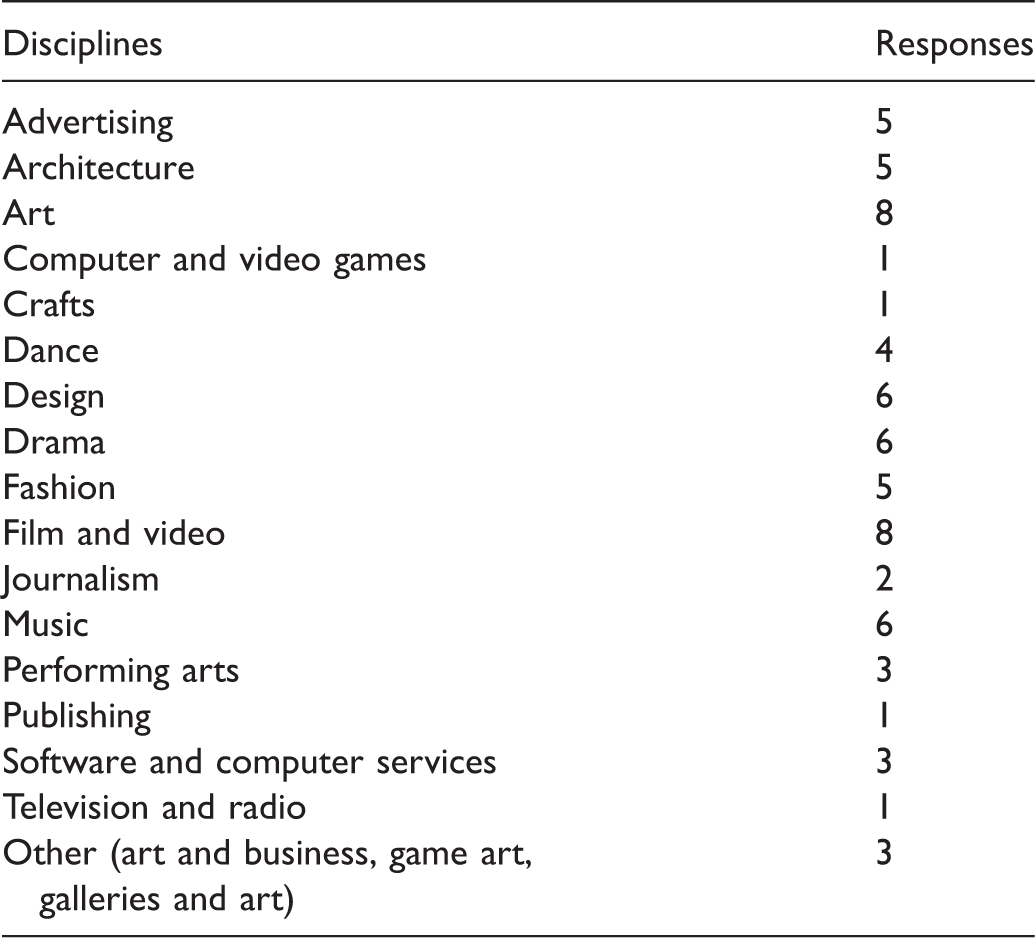
Using theoretical sampling within a grounded methodology (Charmaz, 2006), the initial undergraduate and graduate sample was developed. The extensive sample of graduates and students is challenging to quantify, their voices having been gained through student employability events, graduate events, academic development sessions, research seminars, university visits, focus groups and teaching sessions through collaboration with academics and practitioners within their own discipline areas (Higdon, 2015). The data collection took place over a six-year period from 2010 to 2015. The research provides evidence that graduate and student views of employability do not match the government-led skills-based model of employability which is widely promoted in government policy (Higdon, 2010, 2014, 2015). The student voice views employability as complex, multifaceted and defined within the university/industry nexus. Opportunities and activities that allow students and graduates to meet the gatekeepers of potential work are seen as far more important than skills development.
By taking a grounded approach (Charmaz, 2006) theory, categories and themes were sought that arose from the data from the actual participants themselves. By adopting grounded theory methods, one can direct, manage and streamline data collection and, moreover, construct an original analysis of the data (Charmaz, 2006: 2). Specific questions from 2010 with the initial sample looked to investigate how employability was conceptualised through undergraduate and graduate voices; whether undergraduates and graduates believed employability could be acquired in the undergraduate experience; and what place employability should have in undergraduate degrees. As the sample grew with informal contributions at graduate events, academic development sessions, research seminars and teaching sessions, the participants were presented with the data and the research outcomes, and asked if they concurred with the data or believed there were errors or omissions. This type of theoretical sampling and iteration in Charmaz’s grounded approach aims to include as many voices as possible in order to offer triangulation and a robust evaluation of the data. The informal nature of this kind of sampling does have a disadvantage: a precise sample, past the initial sample, cannot be quantified.
To reiterate, the dominant model of employability is of skills development to meet employers’ needs. This provides a neo-liberal, dominant map of the employability area, as described above, through Labour, Coalition and Conservative policy. Rather than view the student journey through a fixed or preconceived lens to find evidence to support the terrain of the dominant model, the data was trusted to emerge by holding a magnifying glass to other people’s journeys – those of the graduates and undergraduates – and exploring, through the interpretation of their voices, the emerging themes and, in doing so, perhaps revealing a different map of the area. By seeing the world through their eyes – understanding current creative graduates’ views of their working world and its relationship to their undergraduate experience – the aim was to gain an understanding of their definitions of employability and their viewpoints of its place in their undergraduate degrees.
The constant feedback through evaluation and dissemination events gave validation to both the research findings and the creative methodological approach taken to investigate creative graduates’ conceptualisation of employability, without answers being predetermined by the researcher. It ensured that the interpretations that the researcher made were continually being checked and verified as being authentic. It allowed the data to be triangulated as being reliable, by many different groups of undergraduates, graduates, academics, practitioners and employers throughout the six years of research. The graduates reflected on their undergraduate experience of what was successful and what areas they believe could have been developed to support them for potential graduate work after university.
Results
This section presents the results. The first part summarises the key success factors that the graduates identified which helped them develop for ‘potential’ work. ‘Potential’ work is stressed, as many graduates are aware that securing work cannot be guaranteed. However, they do believe that there are factors which can support them to make it more probable. The second section presents the views of the first- and final-year undergraduate students on employability.
The graduates identified key success factors which they felt helped them develop for ‘potential’ work. They needed networking contacts to create work opportunities and collaborations: ‘Contacts – film is who you know. I have got work through someone I met on the course’, claimed a film graduate. The graduates wanted industry brought into the academic curriculum and visiting professionals to be involved in their teaching, learning and assessment: ‘We put together shows and critiqued others and were critiqued by others. My job now is in this field and this work was very useful’, said a galleries event management graduate. ‘Working with those in the industry. Being challenged to work outside what you thought you were good at [was very useful]’, asserted an art graduate. The graduates preferred lecturers to be practitioners working and teaching in the industry, ensuring practice was current and contemporary: ‘The expertise of lecturers and their links to the profession and working in it with them [is imperative]’, a television graduate said. The graduates found that a specific industry-related curriculum, where theory and practice were entwined, made learning more meaningful: ‘The theory was great and we were able to do lots of practice’, an architecture graduate maintained. Other students refer too to modules where they are able to put theory into practice. One design graduate claims that ‘meeting others on the course – learning together, working together with different people was significant’. Another graduate from game design explains that ‘working together with classmates and experiential learning was hands on’.
The graduates asked for feedback from others, such as industry professionals, practitioners, academics, graduates and students, from both in and outside of the programme: ‘Working with businesses, other designers and the shows. It gave me a taste of the working world’, said an art graduate. ‘Outside speakers and professional practitioners coming to work with us in workshops. Lots of variety and creative input. Lecturers brought in others to complement their teaching. It was a stimulating environment to learn in’, a journalism graduate clarified. The graduates requested modules and projects that were aligned to industry work. They wanted opportunities for work experience, placements and internships that were organised for them by the university and they did not have to find themselves: ‘Having design briefs from external companies and help from tutors to organise work placements in the industry over our summer holidays’, said a design and products graduate.
Careers guidance was notoriously underdeveloped and disappointing in their universities. The graduates sought careers advice and guidance that was specific, detailed and tailored to a specific industry. Some thought that careers advice and guidance should not be a centralised service, but offered through the degree’s discipline by a specialised, discrete member of staff: ‘I visited them in my first year and they talked about my options. I realised from this point on that I wanted specifically to teach and combine with painting my own work. The two seem to fit well and gave me a rewarding career’, an art and design graduate explained, referring to specialised careers provision for art students.
The graduates recognised that they needed an awareness of the graduate attributes required for work, and that these needed to be made explicit in their curricula: ‘I developed the mindset of being a graduate’, a web design graduate acknowledged. In addition, they spoke of continual opportunities for reflection and feedback on their abilities in industry to develop a personal identity that brought confidence and agency: ‘I was very shy at Uni[versity] and by being made to present each project made me a lot more confident, which was crucial in interviews and meetings at work’, explained a software design graduate. ‘Learning about myself and the human body was very useful, as I developed my confidence and learned ways to cope with stress and self-analyse’, said a performing arts graduate, who acknowledged both the stress involved in creative work and the need for confidence. Another dance graduate explained: ‘I work for myself as an artist. I have community projects and local authority work, as well as independent jobs. Gave me the confidence to go off on my own’. The graduates wanted to explore their potential as a creative artist in industry, bringing confidence and assurance of their worth and value. In the words of a theatre graduate: Everyone needs to have confidence to survive in creative work, as so much of it is about risk and fake it till you make it. A private school education makes you very confident about what you can achieve. I was lucky enough to have this. I saw on my course that others didn’t have this.
Gaining confidence through engagement
The graduates across the 13 disciplines felt that, above all, confidence was needed to get work in a creative industry – confidence that is gained through understanding the industry and confidence that is gained through imagining themselves able to work within it. How these graduates/students see themselves as having what is needed to be a creative artist, graduate producer or creator is crucial. The students understanding the industry and the students understanding themselves in the industry are needed in tandem. The graduate’s notion of employability in the undergraduate experience is looking out, to understand work, and looking in, to understand themselves as workers. The graduates believe that both an external and an internal perspective are needed (Higdon, 2015).
The third-year undergraduates wanted connections with people from the industry, in order to gain an understanding of how the industry worked. The third-year students also spoke of the importance of these industry contacts to break into initial work, gain work experience and find paid work. They also referred to the importance of confidence – of believing in themselves, of handling competition, and of seeing themselves entering and succeeding within the industry. They felt that those third-year students who had been mentored by a professional – such as architects, designers, directors or dancers – were most likely to have this confidence. This suggests that, even at the third-year stage, most students are still dependent, needing external feedback from others, such as university tutors or practitioners in the creative industry, to help build this self-belief and confidence, and imagine their identity as creative workers (Higdon, 2015).
Feelings of inferiority
The mentoring of the high achievers or ‘stars’ within courses can make those who are not identified as stars perceive themselves as inadequate or inferior to others on their course. The students who are not being mentored also focus on the rich and connected students on their course, who they believe do not need star status to succeed. Third-year students perceived these ‘rich’ students as having their own contacts, who would give them work opportunities, and the financial means to work for free within the industry for long periods of time. The students who see themselves as not well connected, rich or the stars of their course feel disadvantaged and talked about competing ferociously for the very few advertised work opportunities.
Student views of employability
First-year undergraduates
The first-year students’ concept of employability mostly fits with government definitions of successful employment six months after graduation and meeting employers’ needs for skills and being a good employee whom employers would want to hire. Two dance undergraduates, Shelley and Giselle, whose names are pseudonyms, did not recognise the word ‘employability’, yet were trying to improve themselves to ‘please employers’. However, within the discipline of architecture, William distrusted the employability agenda: ‘it is made up’. Another two students did not experience it in their own countries. Veejay said, ‘I’ve not heard of it in India’ and Saverio claimed, ‘We do not have it in Italy’.
Most of the first-year students wanted to work for themselves in their own practices. This may be because they are entrepreneurial or being pragmatic in hard times by creating their own work. The first-year students’ conceptualisation of employability is very different from the third-year undergraduates’ perceptions, which seem less mainstream, more pluralistic, and related to who you know rather than what you know. The first-year students’ interest in being self-employed may be a rejection of the employer/employee model, where the employee needs to be ‘good’ (one participant Anna’s word) to meet the wants of the employer. The first-year undergraduates may view becoming the powerless in this working relationship as very unattractive, and want to pursue creative autonomy and independence through being self-employed (Higdon, 2015).
The first-year students have a conceptualisation of employability that seems to be influenced by pre-university definitions of employability and how employability is discussed at school and college. Both the first-year and third-year undergraduates talked of being encouraged by their school or college to view graduate employment as a factor in their choice of discipline and undergraduate course at university. Undergraduate students seem to be suggesting that they are influenced in their school/further education college experience to understand that a degree is the next step after compulsory education, and a safe option or prerequisite for getting a ‘good’ job.
The first-year and third-year students’ conceptualisation of employability mostly fit with the government policy conceptualisation of employability – that is, employability is defined as getting an actual graduate job, having the right skills that employers say they want, and seeing the employer–good employee fit as crucial. The employer is viewed as having the dominant role and the employee the subordinate role in the employment relationship. The ideal employment relationship in terms of employer and employee metaphors is described as a parent needing an obedient child or an expert needing an attentive novice. However, the first-year and third-year students talked about the importance of contacts to break into creative work, and this does not fit with this dominant model. They conceptualise the word ‘employability’ in terms of the dominant model, but do not relate this model to themselves. They see confidence, contacts and money as crucial factors in their own conceptualisation of their own creative employability (Higdon, 2015).
Third-year undergraduates
The third-year undergraduate students believe that, in order to access and sustain creative work, creative workers need to have an element of luck in relation to being ‘in the right place at the right time’ and making the most of chance meetings. The undergraduates want a personal network of industry contacts. They said that they need to develop the tenacity to continuously network within work and personal life because that is what successful creative workers do. They also need to have a passion for their discipline, which drives them to work creatively and create work without the motivation of monetary payment. They must be able to access ongoing personal development, self-drive and self-motivation. As creative workers constantly ‘keep up’ their discipline-specific skills and techniques, so must they as creative graduates. They need to accept that a creative career is a journey that takes many different paths with many different destinations. They should hold the view that creative life is experiential and involves action. The third-year undergraduates acknowledged that work experience in particular gains industry contacts, and they want university tutors to provide these industry contacts.
There were differences between the disciplines. Dance students, for example, viewed work experience as important only to make industry contacts. Work experience was mostly at entry level and was not perceived as relevant in skills development. The dance students talked of ‘a normal job’ to support their unpaid or low-paid creative work. A lack of money was accepted, and the students showed they were versatile in finding ways to support their creative work. The dance students saw part-time teaching as a means to support creative work, while keeping up their technique and skills, but contemplated other non-related dance jobs to subsidise creative living. However, in the discipline of architecture, the students varied significantly to dance students in terms of seeing the destination in their careers. These students accepted that their career destination and environment may be different to what they envisaged, and they were resigned to being adaptable about where they would end up working. However, they all viewed not becoming an architect as a failure or waste of their degree. All these students perceived work experience as necessary to get to the next stage for qualifying and building their networks of industry contacts. These students all referred to architects needing to travel globally to find work and the implications this had on their personal life – for example, maintaining links with their religious communities or being able to have a family.
The final-year students from all of the creative disciplines viewed well-paid graduate creative work as being only for the privileged (Higdon, 2014). These privileged few were perceived as having the money and connections needed to succeed; the ‘stars’ of the degree course, having been identified early as having star quality and being personally mentored or given special attention to succeed during and after university; more skilled in making the most of chances in life; and lucky. These findings have been reiterated by two very recent research studies – one by the Sutton Trust and the other by Goldsmiths and the London School of Economics. Both studies found that the creative industries are the domain of the middle class, the privately educated and the rich (Thorpe, 2016).
Graduate students
The lack of relevant skills acquisition was not identified as the main obstacle to finding work in the industry of choice. Maybe this is because it is assumed by graduates that students need these skills. The graduates believed that there were obstacles to finding creative work that were not particular to a recession. The graduates identified the lack of personal industry contacts and money as being the main obstacles to accessing and sustaining creative employment. Personal contacts are needed to fight competition for opportunities. Money is needed to finance long periods of unpaid internship or work experience. Cash flow is needed to sustain a career of contract working, portfolio working, project working and sole trading.
Undergraduate students need to be able to imagine themselves in potential work and need to be able to belong to a creative community. Confidence is a prerequisite factor which helps students imagine or believe in their own successful identity.
Communities of practice were perceived by the graduates as communities of membership or privilege. Contacts were seen to be needed to provide work opportunities and for work creation. The undergraduates’ personal narratives show that they linked their course choice to their aspirations of graduate creative work. Many chose a career related to the discipline where they experienced the most pleasure. This pleasure was reinforced by influential people or role models, feedback from others, self-development, peer learning and their own emotional experiences.
Incorporating students’ perceptions into ‘employability’
Creative work can be conceptualised by the metaphor of a journey taking multiple paths and with many destinations. The journey can cover many different terrains with physical and mental obstacles ‘en route’. A certain mindset is needed to prepare for and manage this unpredictable journey, which requires constant training, development, physical and emotional risk, and resilience.
The graduates would develop their undergraduate courses with networking and contacts given and made in the industry. They would encourage students to be able to work regularly with professionals and ex-graduates. Exposure to the industry would be developed through mentoring and work experience. Courses need to offer workshops with professionals in the industry. Meeting, collaborating and co-creating, simulations and role play with those in creative business should be a regular method of learning. Real work environments and working in real industry should be set up with real design briefs, in real places, with real people. Exploring how to set up and manage a business was seen to be useful for any discipline. Offering opportunities for graduate scholarships and ways to develop knowledge and understanding of how the industry ‘works’ was seen as crucial.
The graduates stressed that they needed safe opportunities to fail. Didactic forms of learning like lectures and seminars were not seen as the best way to learn and were viewed as old-fashioned.
Discussion
The findings demonstrate that the current model of employability in the UK defined by government policy is problematic. This employability policy is the outcome of surveying leading employers’ industry needs, a commitment to human capital theory (Becker, 1962; Hanushek, 2013; Mincer, 1958; Schultz, 1961) and the upskilling of the whole workforce through skills in the belief that it generates increases in economic growth. This article posits that the dominant model for employability (Browne, 2010; Department for Business, 2009, 2011) does not sit with the complexities of contemporary creative education, the collaborative nature of creative work, how creative work is secured, and how creative people say they want to learn.
Of more concern is that this study highlights within the graduates’ and undergraduates’ data that their responses do not fit a human capital model, but recognise that wealth, contacts and confidence are more likely to turn potential work into an actuality (Higdon, 2014). The dominant employability discourse argues that skills acquisition brings meritocracy to graduate employment. Students and universities are buying into a neo-liberal ideology of being competitive to secure employment and remain employable. Often, this ‘buy-in’ is reluctant, as others have critiqued (Collini, 2013; McGettigan, 2013). The neo-liberal ideology claims that disadvantaged groups can ‘upskill’ to a better life by developing their employability to meet employers’ needs. Employability is viewed as an individual initiative, and the individual is at fault if he or she cannot secure a job.
Although the government literature claims that the student experience is at the heart of its policy (Browne, 2010; Department for Business, 2009, 2011, 2015), the voices of students have been largely ignored in the dominant employability discourse. The voices of students and graduates reveal that they are discovering that it is social capital that is the crucial factor which opens up work opportunities, not the acquisition of competitive skills advocated in the government discourse (Browne, 2010; Department for Business, 2009, 2011). Perhaps this is why governments and employers do not seek out the student voice, as it dangerously undermines their dominant rhetoric. The dominant discourse of employability is masking the real agenda, which is that inequality exists in the contemporary labour market. This contemporary research concurs with other studies which find that social capital, cultural capital and financial capital provide advantage and privilege for graduates in the workplace (Allen and van der Velden, 2001; Coughlan, 2016; Humphrey, 2006; Smith et al., 2000; Thorpe, 2016).
The student voice should be used to challenge the role of education in employability, particularly in relation to its outcomes of graduate employment. The student voices in this study demonstrate that linking graduate employment outcomes to degree programmes is controversial. The student voice infers that the Teaching Excellence Framework’s (Department for Business, 2015) use of an institution’s graduate employment statistics as an educational outcome of an undergraduate degree, and also its links to increased tuition fees, is contentious.
The graduate data identified key success factors to develop for potential work. The graduates stressed the need for networking and contacts, building confidence, and a curriculum bringing theory, practice, academics and industry together. This echoes Mason et al. (2009), who stressed that employer involvement in degree courses and delivery allowed students to meet their employers and linked positively to graduate employment. This is reflected by the fact that 31% of graduates securing entry-level jobs have already worked with the organisation that has hired them (High Fliers Research, 2015).
In order to address the marked discrepancy between government policy and student voice, students, graduates, practitioners, employers and academics collaborated together to offer alternative conceptions of employability in the undergraduate experience, and developed practices which have more meaning to them and are more relevant to their aspirations and potential creative work. These alternative discourses came from talking and reflecting on their own experience of both undergraduate learning and work. These contributions have been used to develop local educational strategies in university departments that meet students’ aspirations/needs and follow the epistemologies, practices and discourses of the discipline itself, and have been evaluated by universities and students as more meaningful than previous government-led strategies that influence one-size-fits-all university employability strategies. These alternative strategies will be presented and evaluated in further research.
Conclusion
This article has offered a rationale to actively pursue student perspectives of ‘employability’ from their undergraduate experiences and from their aspirations and experiences of graduate work. The student voice remains absent from the employability agenda for higher education in the UK. Students themselves should be continually informing higher education policy and practice. The British government should take heed of students’ qualitative reflections on teaching, learning and work.
The data from graduates and students within this research suggests that these research participants realised that becoming and remaining employable is underpinned with inequality. The dominant employability discourse masks these issues of social justice. The research findings imply that the missing voice may be deliberately absent.