




Abstract
Adored worldwide for its ‘outstanding’ education system, Finland has relied on its excellent results in studies of the Programme for International Student Assessment to advertise and sell its education abroad. One of the keys to this success is often attributed to Finnish teachers, who are said to be ‘the best and most respected in the world’. This article questions this official narrative by examining the way teachers are perceived by Finnish society through analysing the front-page headlines of the Finnish tabloid Ilta-Sanomat in 2000–2013. To the authors’ knowledge, the way teachers are constructed in the Finnish press has not been studied extensively, while international studies, especially from English-speaking countries, highlight negative constructions of teachers in the press and cultural products. The data consist of 81 front pages, which were analysed using three methods: content analysis, discourse analysis and critical discourse analysis. The study of the photographs used on the front covers complements the analyses. The results show that the way Finnish teachers are constructed on the tabloid front pages has changed significantly between 2000 and 2013, and they could signal changes in the way education and the status of teachers are considered in the Nordic country. They also show a shift in the way the power of teachers has been depicted.
Introduction
According to Finnish and foreign observers, the teaching profession has traditionally been highly valued in Finland (Sahlberg, 2011; Välijärvi, 2007: 59–62). As such, teachers are said to have represented the ‘Candles of the Nation’, who bring the ‘light’ of civilization to the common people (Simola, 1995: 233–235). Academically, in Finland, the teaching profession is often compared to other ‘prestigious’ fields such as medicine or law (Luukkainen, 2004: 48–53; Niemi, 2010; Sahlberg, 2011; Välijärvi, 2007). In international comparisons, the valued status of Finnish teachers is somewhat unusual. For example, in the last few decades, teachers’ prestige, autonomy and wages have decreased in the USA and the UK. The preservation of the high status of Finnish teachers appears to be related to the Nordic country’s success in the Organization for Economic Cooperation and Development’s worldwide study, the Programme for International Student Assessment (PISA) (Dervin, 2013; Säntti, 2010: 185–189). Following the first PISA results of 2001, Finnish teachers have often been referred to as ‘the best and most respected in the world’. In this article, we are interested in comparing this ‘excellent reputation’ to how the Finnish media – more precisely, tabloids – ‘discourse’ on Finnish teachers. At the same time, we examine how the power of such media can challenge and undermine the reputation of educators.
In general, research on how teachers are described and presented in the media shows that they often get bad publicity, especially in English-speaking publications (Cohen, 2010; Goldstein, 2011; Keogh and Garrick, 2011; Macmillan, 2002; Thomas, 2003, 2006). Very few articles or books have been published on the topic in relation to Finland. Some researchers have examined how teachers are portrayed in Finnish films (Kujala, 2008) fiction (Silventoinen, 2008). Yet these studies do not demonstrate directly if the perception of teachers is positive, negative or something else in Finland. Thus, it appears important to analyse more critically how the media deal with Finnish ‘teacherhood’ and what this tells us about societal perceptions of teachers. One important reason for us to do so is inspired by Fairclough (2002: 10), for whom the media have ‘the ability to influence knowledge, beliefs, values, social relations, [and] social identities. They are able to make things relevant by presenting them in certain ways’. The press plays an effective role in spreading ideologies and defining and building public opinion (e.g. see Dreier, 2005; Druckman, 2005; Gerstl-Pepin, 2002; Haas, 2007).
This article is based on headlines published in a Finnish evening newspaper (tabloid) for the years 2000–2013. This publishing period was chosen because it was an important era for Finnish education, thanks to the PISA studies, the first results of which were published in 2001. The choice of the media ‘genre’ of tabloids is based on the fact that tabloids are interested in creating controversies and that they can easily have an impact on common sense. In Finland, tabloids are considered to be more important than in many other countries (Kivioja, 2008), as they reach a nationwide range of readers. In most kiosks or food supermarkets in Finland, the first pages of the two main Finnish tabloids are highly visible and cannot be avoided. As such, one can argue that they represent a wide range of readership – both the mainstream and the ‘elite’ (Örnebring and Jönsson, 2004). Yet media research is not really established as a separate field of knowledge, and so we have to take advantage of theories and methods from other disciplines, such as social, behavioural and cultural research disciplines (Kantola et al., 1998; Marris and Thornham, 2006).
Problematizing the media construction of teachers
This section problematizes the media machinery/establishment in relation to how teachers have been portrayed in cultural productions and the press in different parts of the world. The third subsection defines tabloids as a specific media genre.
Teachers in cultural productions: good and evil
It is believed that every person who has been to school has a certain vision of what a teacher ‘should be like’, especially a ‘good’ teacher. This might be why teachers often appear in the news and in cultural productions such as novels and films. Most importantly, these productions contribute to creating both localized and globalized images of educators, which can influence how they are perceived and treated in a society. The powerful media machinery can easily impose certain negative and positive representations of the teaching profession, which can be unstable (Miettunen and Dervin, 2014).
Teachers’ constructed images or representations in films have been studied by, for example, Beyerbach (2005), Dalton (2010), Giroux (1997), and Reed Scull and Peltier (2007). As far as television series are concerned, Banks and Esposito (2002), Blake and Edwards (2013), Gray (2005), and Tillman and Trier (2007) have done some analytical work on teachers’ images. All of these studies were based on American movies and television entertainment – except for Blake and Edwards (2013), whose studies were based on a British television series. Miettunen and Dervin (2014) have examined how teachers are represented in a recent Finnish television series. They show that the representations are not only one-sided, but also caricatures, which, the authors argue, puts into question the respect and appreciation of teachers in Finnish society. The depiction of teachers has also been examined in comics (Warburton and Saunders, 1996).
In their study of Anglo-Saxon productions, Weber and Mitchell (1995) demonstrate that female teachers are often described as neat, well groomed and well dressed, while male teachers often appear as ‘geeks’. They all also often wear glasses. The appearance of teachers rarely highlights their attractiveness or sexiness (Weber and Mitchell, 1995: 44–46, 58). A smart and neat appearance appears to be part of the typical teacher’s model and high morality (Kujala, 2008; Simola, 1995; Weber and Mitchell, 1995: 58). Beyerbach’s (2005: 270) study shows, on the contrary, that some teachers have sometimes been described negatively in more recent movies. They can also be presented as dull, inadequate and powerless in front of their students.
The studies by Kujala (2008) and Nygren (2007) are two of the rare studies on teachers in Finnish films. Kujala (2008) studied the position of male teachers in Finnish films from the 1930s until the 2000s. He notes that teachers’ images have changed from a strong Christian model to that of a defender of a democratic and pluralistic society. In Nygren’s (2007) study of teachers in Finnish movies that describe Finnish society in the early 1900s to the 2000s, her investigation concentrated on teachers’ external and mental capabilities. She categorized the teachers separately according to gender: female teachers were divided into ‘mothers’, ‘dictators’ and ‘arousing the admiration of students’, and male teachers represented not only ‘fatherly figures’, but also ‘despots’. As to fiction, Silventoinen (2008) found that teachers were depicted in rural areas, where they acted as reformers and professional educators. They were wise, fair, patient and devoted to their work. Their lifestyles were also very healthy. However, other models were identified with teachers not caring about their job or about their students.
Teachers in the news: signs of educational crises?
Previous research about teachers’ descriptions in the press is (again) strongly focused on English-speaking countries: the UK (e.g. Blackmore and Thomson, 2004; Cohen, 2010; Macmillan, 2002), the USA (Goldstein, 2011), Canada (Ungerleider, 2006) and Australia (Blackmore and Thorpe, 2003; Keogh and Garrick, 2011; Thomas, 2003, 2006, 2011).
In Australia, Thomas (2006) explains that the negative depiction of teachers is not a recent phenomenon. The news coverage of education policy has rehearsed a certain number of themes: students’ low standards in mathematics, indifferent teachers, the weak connections between schools and the ‘real world’, and the problems of transition from school to the university world (Thomas, 2006: 17). Concerning the British press, similar themes were already found in the 1990s (Ball, 1992). These setbacks eventually led to an education crisis in the UK, for which teachers were blamed (Cohen, 2002). During the last decade, the tone of the articles has been even more negative. For many, the decay of schooling in these contexts corresponds to broader moral degeneration (Thomas, 2003). Yet Levin (2004) points out that the news coverage is by no means only negative. Positive news tends to focus on individuals or individual school successes, whereas for the entire school system the picture is more negative.
Most of the research that deals with teachers in newspaper headlines has concentrated on broadsheets. Research on tabloids is limited. Macmillan (2002) is an exception in the UK. Macmillan (2002: 32) argues that little research is done on tabloids because tabloids only refer to education when something sensational or ‘disturbing’ takes place in a school – sex, violence, crime and punishment. The few headlines that Macmillan (2002: 31) identified in the British tabloids deal with pupils’ failure and teachers’ inadequacy. The terms used are quite negative: ‘war’, ‘hell’ and ‘crisis’. Or, for example, when references are made to school management, the word ‘depraved’ and the metaphor ‘rotten’ are used by the tabloids (Macmillan 2002: 34). What Macmillan’s (2002: 36) study underlines is that teachers tend to be powerless in relation to how they are depicted by the media machinery. As in fiction, films and media productions, teachers lose their agency in the news and become prey to essentializing discourses, which have an influence on how a society perceives their characteristics, importance and roles.
A few words about the tabloid press
The term ‘tabloid’ refers not only to the size of the newspaper, but also to a certain way of presenting news items. Originally, the tabloid-size newspaper was designed to be small and compact to read – for example, on public transport. It had to include sensational, emotional and oversimplified events to attract readers (Örnebring and Jönsson, 2004). According to studies on tabloid newspapers, the reading of them still typically takes place in public places – coffee shops, vehicles, canteens, hairdressing salons and restaurants or bars (Johansson, 2007: 120; Kivioja, 2008: 24). However, today the tabloid format has been borrowed by traditionally broadsheet newspapers – for example, in Finland by the national newspapers Helsingin Sanomat and Hufvudstadsbladet.
The perception of the Finnish tabloid media is twofold. On the one hand, they are thought to be fast and major information resources. On the other hand, they are seen to play with gossip, to be misleading and, further, to act unethically (Kivioja, 2008: 16–17, 24). Sparks (2000: 14–15) has proposed five different types of press outlets according to how seriously they are considered: (1) the serious press; (2) the half-serious press; (3) the serious popular press; (4) the news-stand tabloid press; and (5) the supermarket tabloid press. Kivioja (2008: 14) considers Finnish tabloids (evening papers) to be (3) serious popular publications.
The dichotomy between broadsheets and tabloids has often left tabloids being labelled as ‘bad press’. But this is a bit too simplistic. Örnebring and Jonsson (2004) argue that the tabloid press is an important component of today’s society, as it proposes an alternative to the elite and the views of mainstream media. By doing so, tabloids can empower other members of society to speak up. With the current popularity of online press outlets, the characteristics of the tabloid press and those of broadsheets seem to be increasingly blurred and overlapping. It is also important to note at this stage that, in Finland, like in other countries, tabloids belong to the same media consortia as broadsheets, and they often refer to each other. So, in a sense, the power of the more ‘serious’ broadsheets can add to that of the less ‘serious’ tabloids, and vice versa.
Methodology
Data
Number of headlines per year.
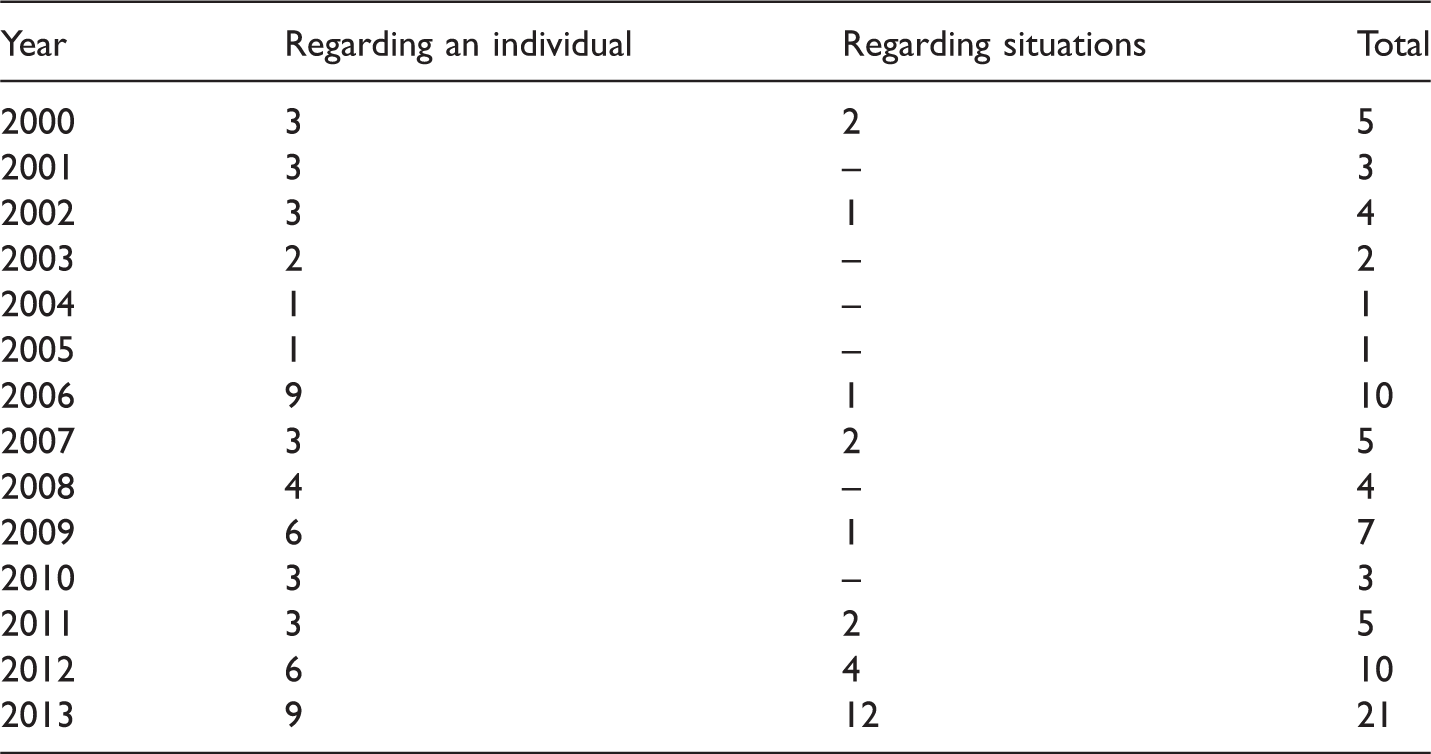
Our focus is on one of the two Finnish tabloids – that is, Iltasanomat which translates as The Evening). When taking into account the printed and online versions of this evening paper, it has the largest weekly readership of more than 2.5 million (Finland’s population is about 5 million). The tabloid’s readership is high compared to daily newspapers, as only the national newspaper Helsingin Sanomat has a bigger readership number. The newspaper also represents very well the profile of the Finnish population (Kivioja, 2008: 18–20): it is read by people of all ages and both sexes are represented (54% men and 46% women). Yet readers under the age of 40 are slightly under-represented. Readers’ educational background is in line with that of the general population, with a difference between white-collar and highly educated people – the latter being under-represented. Readers are mostly urban dwellers, living especially in the Greater Helsinki area (with a population of 1 million inhabitants).
Research questions and methods
The media produce an image of ‘objectivity’ and ‘truth’ about the world. Yet media objectivity should be considered critically and with care (Gamson et al., 1992). The role of headlines in this regard is essential. Headlines are not randomly chosen and produced; they refer to newsworthy, powerful and ‘saleable’ events (Harcup and O’Neill, 2001). Galtung and Ruge (1965) explained that a headline should contain an element of surprise (an unexpected or rare event), simplicity (the event and its background are easy to understand) and negativity (‘bad news’ at the expense of ‘good news’), and refer to short-term duration (see also Harcup and O’Neill, 2001; Kivioja, 2008: 35). Bell (2001: 64) points out that the news must also satisfy the requirement of ‘narration’, and thus appeal to readers. For tabloids, headlines are essential selling points.
This article examines how Finnish teachers are constructed in tabloid front-cover headlines. Media texts can be examined from a wide range of theoretical and methodological perspectives. We are using three methods to analyse the data from different perspectives: content analysis, discourse analysis and critical discourse analysis. A visual analysis of pictures complements these methods.
We have chosen the reference framework of critical discourse analysis as proposed by Norman Fairclough (2001, 2002, 2006, 2010, 2013). Critical discourse analysis as a starting point fits particularly well with the analysis of media texts because it allows us to examine language as a social activity (see Fairclough, 2006: 308–309). Critical discourse analysis can help us reveal the linguistic choices made to create power differentials, taking into account underlying ideologies. Critical discourse analysis is thus intended not to bring out the existing realities and to evaluate them, but to try to explain them (Fairclough, 2013). In order to analyse our data, we started by looking at the word choice, especially the verbs used to describe what the actors – be they teachers, students, parents or school staff – were made to do (Pietikäinen, 2000: 146; see also Cohen, 2010). Nominalization, agency and causality were also examined (see Fairclough, 2001: 41–45).
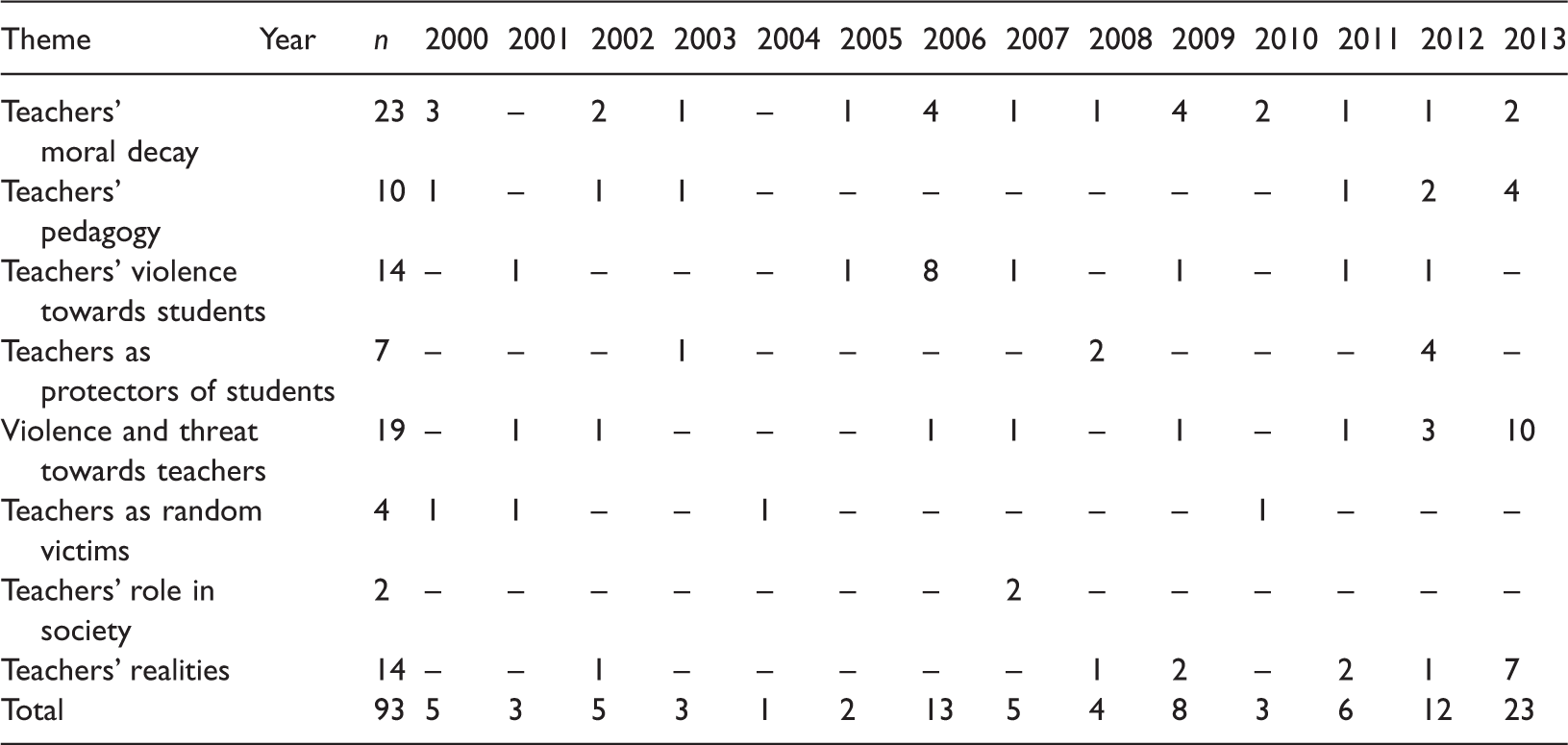
Themes and number of occurrences between 2000-2013.
Analysis and results
The larger picture: themes contained in the headlines
By means of content analysis of the headlines and images found on the tabloid covers between 2000 and 2013 (see Tuomi and Sarajärvi, 2004: 103), we have identified recurring themes. The following themes emerged (the numbers in parentheses represent the number of headlines):
teachers’ moral decay (23); teachers’ pedagogy (10); teachers’ violence towards students (14); teachers as protectors of students (7); violence and threat towards teachers (the teacher as sacrifice) (19); teachers as random victims (4); teachers’ role in society (2); teachers’ realities (14).
As is often the case with the categorization of data, some of the headlines and images were easier to classify as belonging to a particular category than others. Some headlines were counted several times as they could relate to, for example, sexual behaviour (‘Male teacher used students as models for sex positions’, 28 February 2001) and, at the same time, refer to questionable pedagogical practices and also a teacher’s sense of morality. This is why the total number in the above categories exceeds the total of 81 headlines.
The largest number of headlines concerns teachers’ moral decay and teachers experiencing violence, with 23 and 19, respectively. The next largest groups are the headlines about teachers’ violence towards students (14) and teachers’ realities (14). We will examine each of the categories in turn.
‘Teachers’ moral decay’ is presented in two different ways in the data. On the one hand, it is associated with sexual behaviour or otherwise inappropriate interaction with students (e.g. ‘Teacher engaged to 14-year-old student’, 22 August 2000). On the other hand, moral decay is exemplified through the use of alcohol (e.g. ‘Schoolteacher drunk during school excursion: Abandoned schoolgirls at Milan airport’, 19 May 2006). Some of the sexual behaviour was also classified as violence against a child. In one example (‘Schoolmistress changed gender during holidays’, 13 August 2009), the connection to morality was not explicitly interpretable as judgmental, but we interpreted it as belonging to this category since discussions about this issue have been heated in Finland.
The category about pedagogy refers to discipline-related headlines (e.g. ‘Teachers’ right to discipline unruly pupils’, 21 June 2000, and ‘School discipline missing. 8 true stories: Can the teacher punish like this?’, 24 August 2012), as well as other pedagogical solutions (e.g. ‘Primary school female principal prosecuted: Taped students’ mouths and tied with a belt’, 30 March 2012, and ‘The teacher kept Kaapo in a box for 2 months’, 30 May 2013), which sometimes had to be classified in the categories of ‘teachers’ moral decay’ (mainly sexual behaviour) or ‘teachers’ violence towards students’.
The category concerning ‘teachers’ violence towards students’ includes both physical expressions of violence (e.g. ‘Principal kicked pupil – no charge’, 25 May 2001, and ‘Teacher punched and kicked a 10-year-old child’, 20 March 2009) and sexual violence (e.g. ‘Principal took advantage: He locked a little schoolgirl in the attic’, 10 August 2006). ‘Teachers as protectors of students’ refers to situations where a teacher protected students against someone – usually another student (e.g. ‘Teacher tried to stop the killer’, 25 September 2008, or ‘Girl waved a knife in junior high school: The principal stopped her’, 16 October 2012). Other kinds of ‘protection’ were also provided (e.g. ‘Principal censored sex issues in health questionnaire’, 4 September 2003).
Physical or psychological ‘violence and threat towards teachers’ deals with students (e.g. ‘8-year-old got mad: Karate-kicked into the teacher’s side’, 12 December 2001) and their parents (e.g. ‘Gap between schools and homes widens: Parents threatened thousands of teachers’, 10 March 2013). The category of ‘teachers as random victims’ consists of headlines about teachers encountering sudden death. The headlines do not indicate if the death was an intentional or violent death.
The ‘teachers’ role in society’ category contains only two headlines, one of which dealt with teachers’ salaries and the other with teachers’ qualifications (e.g. ‘IS tested schools: Primary education: Anyone can be a substitute. Teachers just one phone call away’, 11 October 2007). Finally, the category of ‘teachers’ realities’ contains testimonies from teachers (e.g. ‘Teachers tell you: Troublemakers ruin teaching’, IS, 8 April 2013).
In general, one can note the rather negative tones of the headlines about teachers’ behaviour and professional identity or the conditions that they experience in schools. Interaction between educators and, for example, students and parents is also depicted as being ‘poisonous’. Only one category seems to stick to the discourse of teachers as important figures (‘teachers as protectors of students’). This macro approach to the data projects counter-truths about the well-respected and ‘best’ positions of Finnish teachers.
Interpretative repertoires: the traditional teacher versus the vulnerable teacher figure
When analysing the data in detail, we came up with two repertoires of interpretation concerning teachers: the traditional teacher and the vulnerable teacher figure. The traditional teacher appears in articles where the teacher is presented as a moral actor, or simply as a role model. The vulnerable teacher figure is made to tell a different ‘truth’/‘reality’ about Finnish schools today. It is important to bear in mind that we see these two categories as cultural forms, neither of which is more ‘realistic’ or ‘right’ than the other (Billig et al., 1988: 27–32).
The traditional teacher
The traditional teacher repertoire symbolizes teachers who are constructed as people who are expected to have higher moral and ethical ways of being than many other professionals. This is reflected in an interesting way in the following headline, for example: ‘Pre-service teachers had a porn party at university’ (5 October 2002). Although the actors are ‘only’ future teachers, certain behaviours are expected of them, according to the tabloid. The matter probably would have hit the headlines. Other headlines referred to teachers in relation to ‘crimes’ – for example: ‘Finland’s largest paedophile ring: One teacher amongst them’ (28 September 2006).
One theme that appears to be a taboo is that of a teacher appearing to be too ‘sexy’. On 10 October 2012, one headline read: ‘Sexy teacher bullied’. The picture illustrating the selected cover is interesting. The female teacher is wearing glasses, her hair is in a bun and she is also wearing a tight polo shirt. Her mouth is slightly open in a smile, her eyes are half closed and she is looking directly into the camera (see Weber and Mitchell, 1995: 44–46). The sexy teacher appears to be well groomed and looks nice (she has clean hair and glasses; see Figure 1).
Front cover from 10.10.2012. Headline: According to a Finnish study: Sexy teachers get bullied.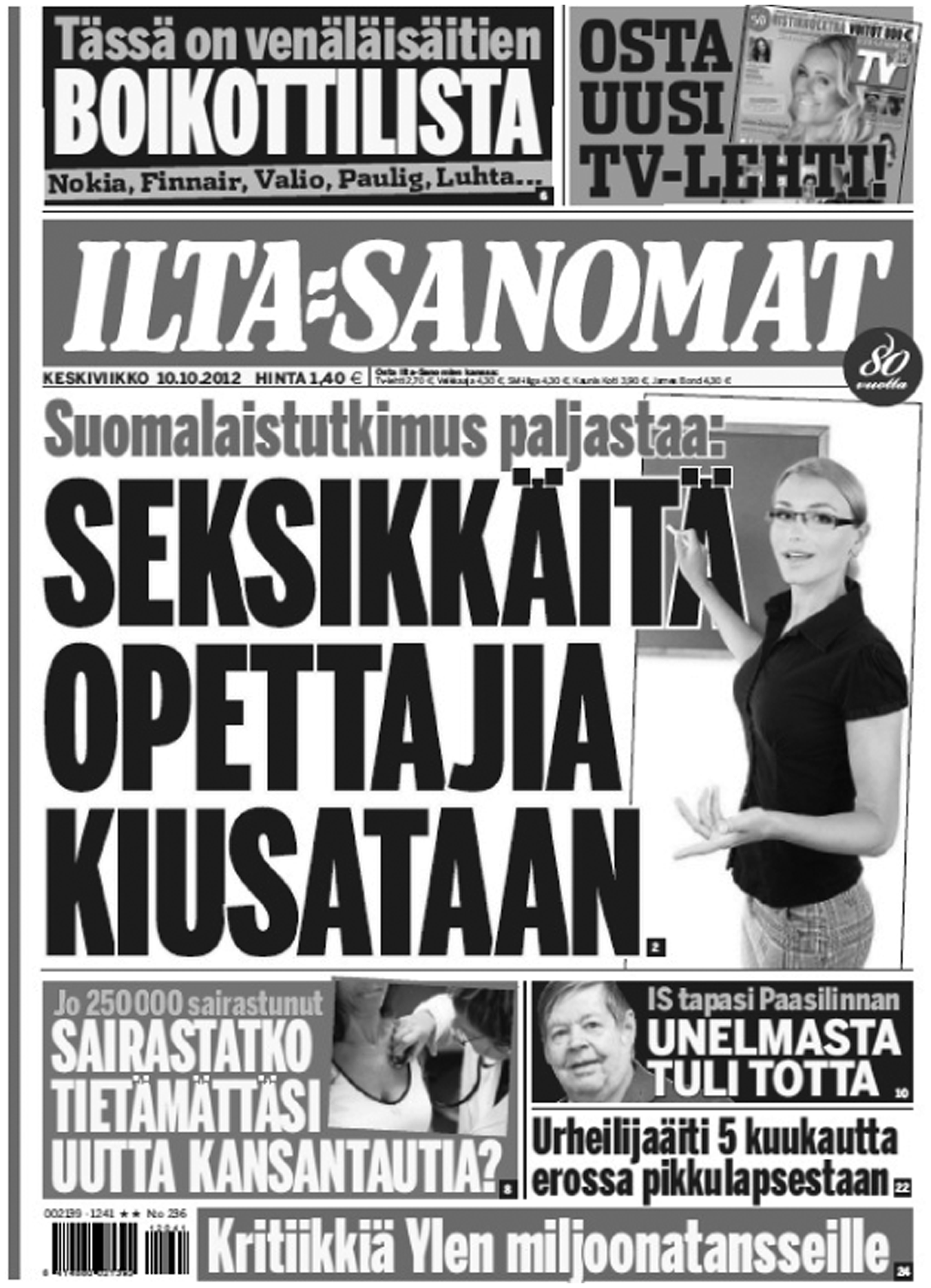
In her research, Kamila (2012) examined how teachers perceive each other’s appearance – and the ‘sexy teacher’ fared badly. She identified four types of discourse: a ‘model citizen’, who is sober, grey and unobtrusive; an ‘unconventional teacher’, who creates a new, problematic teacher identity; an ‘aesthetic teacher’, who emphasizes elegance and good taste; and a ‘sexualized teacher’, who does not convince his or her colleagues and experiences harassment. The aforementioned headline can thus be interpreted in two ways. It may be thought that it is outrageous that sexy teachers are bullied or that teachers should be as sexy as they wish. Another option is to interpret the headline as follows: the teacher should not have ‘sex appeal’, which is why, when one dresses sexily, bullying should be expected or is even deserved.
The vulnerable teacher figure
The vulnerable teacher figure identified in the tabloid corresponds to a changing world, where teachers do not have the same authority and respect, and have lost, in the Finnish context, the status of being ‘Candles of the Nation’ – an image that is still often mistakenly projected in discourses about the ‘wonders’ of Finnish education (Dervin, 2013; Miettunen and Dervin, 2014). In some recent headlines, teachers have been constructed as someone who feels threatened by pupils and their parents (see previous section). Teachers have no access or means to solve these problems. The vulnerable teacher figure refers to the teacher’s power struggles with students and parents, as constructed by the media. It also reflects the power struggles Finnish teachers have to experience increasingly in Finnish society.
Macmillan (2002) investigated British tabloid headlines where students were described as ‘yobs’ and ‘thugs’. Such descriptions seem to correspond to the spirit of the times: students are hooligans who behave violently towards each other and their teachers – or any other educators, even parents (Macmillan, 2002). Although such discussions were foreign to the Finnish context in the early 2000s, in our data, in the most recent years, teachers are threatened not only by students, but also by parents: Read teachers’ horror stories: Shocking truth about modern children. (6 August 2011) Bullying and intimidation: Teachers say parents are monsters. (4 August 2012) This is how parents torment teachers: Untrue child protection notifications, being called a whore. (5 August 2013)
Teachers are described as being relatively powerless and vulnerable in these headlines (as demonstrated by the use of affective terms such as ‘horror stories’, ‘shocking truth’ and ‘monsters’). On 29 October 2013, the main headline affirmed that ‘Students have become lazy’ as an answer to the fact that Finland’s ranking would drop in the PISA studies to be published two months later. The picture shown next to the headline was meant to emphasize the message of laziness: it shows a pigtailed student, who looks like a successful student, but she has fallen asleep at her desk (see Figure 2).
Cover from 29.10.2013. Headline: ‘Students have become lazy'.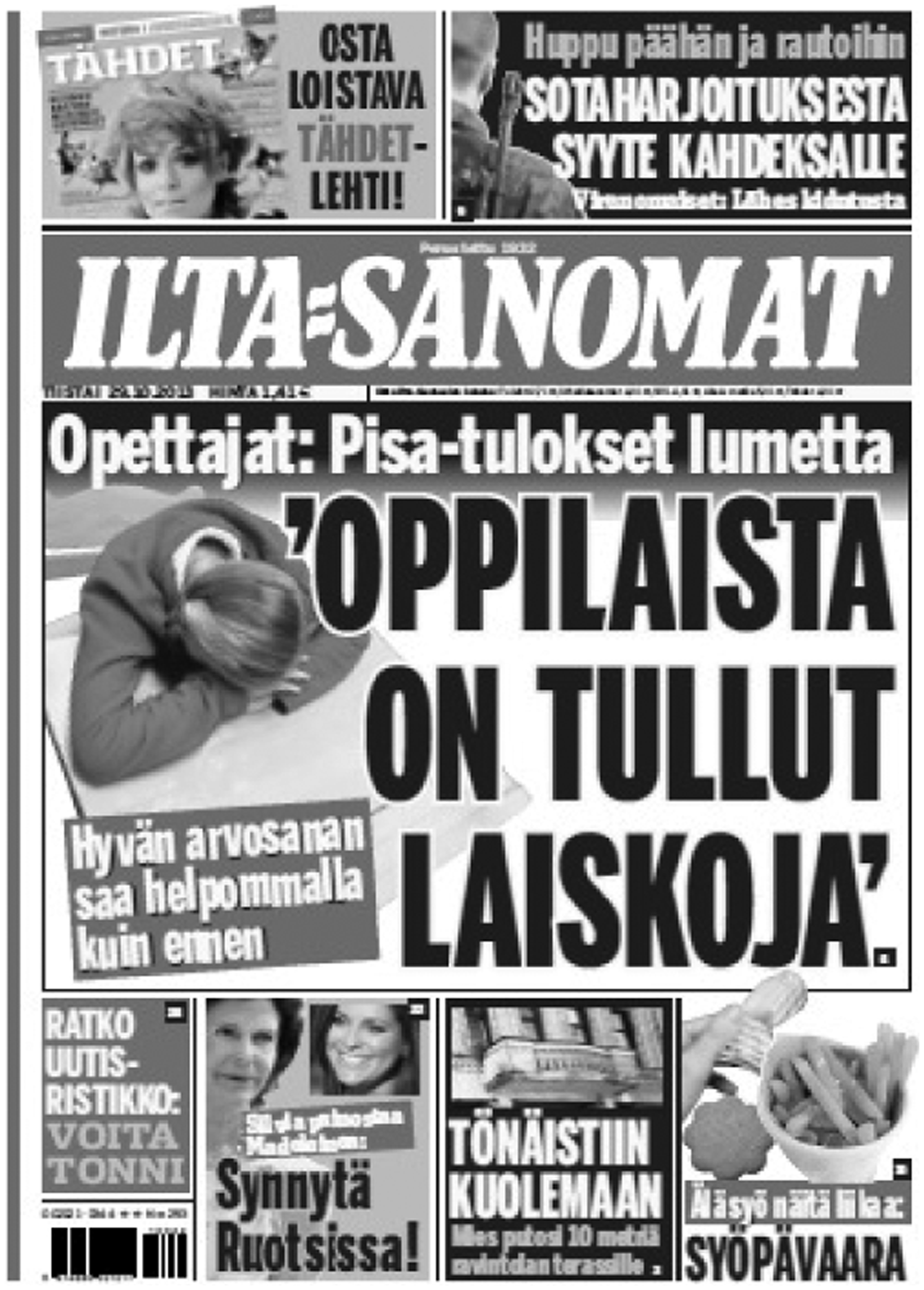
This image seems to serve as a metonymy (see Banks, 2001: 18), representing all the other ‘good’ students. The choice of the expression ‘have become lazy’ seems to leave Finnish teachers powerless and vulnerable – their former strength has been lost.
The lack of agency of teachers or the impossibility of facing this new changing world is also reflected in the following headlines: Seized from schoolchildren: Weapons, drugs, firecrackers. Teachers’ fears and torment. (18 August 2012) A new study reveals: Spooky truth of schools. Mobile porn, teachers stoned … (1 February 2013)
These headlines reflect a certain reality of life that many educators are also facing around the world (Macmillan, 2002): violence, fear and sex. Finnish teacherhood ‘collapses’ before the harsh reality of postmodern times.
Violence and threats
In this subsection, we explore further the themes of violence and threats as they were reported by the tabloid, especially in relation to teaching. Violent behaviour is often described through individual cases in the headlines, thus suggesting that this is not a general phenomenon in Finnish schools, or at least not yet. The choice of words to describe these situations is always striking: a situation is described as ‘uncontrollable’ and requiring police intervention, and words and phrases such as ‘rampage’, ‘slapped his fist’ and ‘waved a knife’ are used: These two examples demonstrate such choice of words: A stone used. The police called to the school. A 10-year-old throws stones at two teachers. (13 September 2012) Girl waved a knife in junior high school: The principal stopped her. (16 October 2012) Teachers face increasing sentences: Name-calling, defamation, death threats. (23 May 2013) ‘After four years of torment’ principal speaks out about the harassment of parents. (6 August 2013) Lack of school discipline. 8 real stories: Can teachers punish like this? (24 August 2012) A new phenomenon interferes with teaching: Teachers are limited by mobile phone videos. (24 April 2013) Teachers say: Disturbances spoil teaching. (4 August 2013) Teachers: ‘students have become lazy’ – good grades are awarded more easily than before. (29 October 2013)
In a similar vein to Macmillan’s (2002) study, students’ negative characteristics are used to describe the lack of discipline in schools: they are ‘lazy’, ‘violent’, and so on (see Macmillan’s ‘yobs’ and ‘thugs’). Teachers seem to be ‘protected’ by the media – in other words, they are not to be blamed.
Let us conclude this section by also considering two headlines which seem to suggest that violence and threats are multifaceted in the school environment (as suggested by Kivioja, 2008: 65–80). In order to do so, the ‘war’ metaphor is used: Teachers’ complete ban on smoking: Tobacco war intensifies in schools. (14 January 2000) Nurses and teachers wage war. (22 September 2007)
Teachers’ sense of immorality
Besides violence and threats, immorality is an important component of the collected headlines. The choice of words and phrases used to deal with teachers’ sense of immorality plays a specific role: to upset (read ‘shock’) readers, which is, of course, the ultimate goal of the tabloid, in order to attract them (Wright, 2011: 318–319). Goldstein (2011) reminds us that visual elements – such as images, but also statistics used to accompany headlines on front covers – are never random.
On 28 February 2001, IS published a front-page headline which presents a morally questionable male teacher, who asked his students to serve ‘as models for sex positions’. Most teachers in Finland are female, and it is interesting that the tabloid decided to mention the gender of the irresponsible teacher. Were the journalists trying to suggest that male teachers, because of their ‘physical strength’, are more inclined to such coercive behaviour? In any case, the mention of gender might have helped the readers to ‘imagine’ what happened. In the headline in Finnish, the verb ‘to use’ has been selected to describe what the teacher did. In Finnish, this verb tends to be used in relation to objects rather than people. So, in a sense, the idea that the teacher ‘took advantage’ of the students could easily be suggested by using this verb. It is also interesting to note that, under the main headline, the tabloid added the following sentence: ‘in addition to presenting the positions, the teacher invited primary school students to learn about porn films’ – adding to his immorality. No specific image was added to accompany this story, except maybe the picture of a sexy lady wearing a bikini, which is used to illustrate the second story on the front cover, and which may have been chosen as a supplementary visual message with regard to the story about the teacher.
On another front cover, a teacher’s immorality is presented by the story of the teacher being drunk during a school trip abroad: ‘Schoolteacher drunk during school excursion: Abandoned schoolgirls at Milan airport’ (19 May 2006). Again, the choice of words is interesting. The headline mentions the moment it took place (on a school trip). Most parents will be aware of the fact that, during such trips, teachers should be fully responsible and active in avoiding accidents, for example. So, in short, school trips are official working hours for them. In Finnish, the verb ‘to abandon’ corresponds more to the English verb ‘to reject’. The headline could have said that the teacher ‘left’ or ‘forgot’ the students, but the verb used is ‘reject’/‘abandon’, which is stronger. Finally, the fact that the school students were ‘helpless girls’, abandoned abroad, also seems to add to the immorality of the episode and the potential anger it could trigger in readers.
Conclusion
In Finland, teaching is a prestigious profession, and many students aspire to be teachers. (Sahlberg, 2011: 11)
In this article, we have described the way in which teachers were represented in the headlines of a Finnish tabloid during the years 2000–2013, which cover the PISA era of Finland’s ‘miracle of education’. It is interesting to note, first of all, that these headlines rarely appear in the international press. Instead discourses on Finnish education as ‘the best and most respected teachers in the world’ have been overly positive, uncritical and somewhat naïve. Listening to those who have tried to sell Finnish education around the world – be they Finnish officials and scholars or foreign politicians and academics – Finland is often presented as a ‘little paradise’, where bullying, inequality, violence towards teachers, immorality and so on are non-existent. The rhetoric of Nordic values is often used to justify the ‘absence’ of such phenomena. Although we are cautious about the influence of media (tabloid) discourses on education, the examples from this study present a strong counternarrative. Finnish education seems to correspond to one of Blommaert’s (2005: 71) ‘travelling discourses’: ‘whenever discourses travel across the globe, what is carried with them is their shape, but their value, meaning, or function do not often travel along’. The tabloid headlines add to the missing ‘value, meaning, or function’ that are often lacking in discourses about Finnish education.
Our study is original because it is one of the first to demonstrate that research results emerging from so-called English-speaking countries (Ball, 1992; Thomas, 2006) – reviewed at the beginning of this article – seem to be increasingly applicable in the societal discourses on education and teachers in Finland. Increasingly, the power of media discourse circulation is making the ‘strong’ and ‘traditionally well-respected’ Finnish teacher somewhat vulnerable. It might thus be useful for teachers and teacher educators in this context to examine such discourses on teachers in order to develop strategies that might help teachers and teacher educators move beyond them (Reed Scull and Peltier, 2007). Times have changed and, like many other parts of the world, Finland is not immune to the negative ‘travelling discourses’ on education and teachers that seem to be ‘polluting’ our world. It would be interesting also to compare such discourses from the Finnish context in other salient contexts. In conclusion, it is important for us to reiterate that we were not interested in how ‘things are’, but in how they ‘seem to be’ in relation to teachers in Finland. The methods used to analyse the data have helped us to explain realities, rather than bringing them out and evaluating them (Fairclough, 2013).