




Abstract
Within the classroom milieu a teacher wields considerable power; however, teaching may become overwhelming when the teacher is faced with somewhat diverse learners. Dealing with such in the classroom is a challenging task. This qualitative study aims to explore how teachers confront issues of language and race within mathematics education. It was carried out at one university in KwaZulu-Natal (KZN), South Africa. The participants are mathematics teachers who enrolled as postgraduate mathematics education students at the university. The study was framed using Perkins and Zimmerman’s notion of empowerment theory. Qualitative data were gathered during the 2012–2013 and 2013–2014 academic years, from a final sample of 22 postgraduate mathematics education students, and through a questionnaire administered to teachers and semi-structured interview schedules. The corollary findings provide a glimpse of how issues of language and race are confronted within mathematics education in South Africa, and they are important in terms of advancing curriculum and teacher development. Internationally and nationally, the findings have particular resonance and relevance when considering the powerful role that language and race play in mathematics education.
Introduction
‘Education is the most powerful weapon which you can use to change the world’ (Mandela, 2012: 101). Education is deeply entrenched in the politics of culture (Apple, 1993) and the perception of race, rather than class, is a key form of domination in South African society (Cole, 2009). South Africa is home to a diverse multiracial, multicultural and multilingual population (Beutel and Anderson, 2008). In this paper, diverse learners refer to learners within the South African context, many of whom have varied backgrounds with respect to culture, language and race. To cater for diversity more effectively, South African teachers have encountered sweeping modifications within the education sector (Vandeyar, 2005); for example, the new language-in-education policy recognizes 11 official languages 1 in an attempt to redress the historical dominance of English and Afrikaans, and the undervaluing of African indigenous languages (Hunter and Hachimi, 2012). As a result, many classrooms in South Africa are referred to as multilingual classrooms since they include individuals who speak two or more languages.
In South Africa, English is positioned as a powerful language (Pimentel, 2011) as it provides access to the international community and commercial success in global markets (Iseke-Barnes, 2000). Moreover, learners are motivated to learn in the so-called ‘legitimate’ language because of the social status it confers on its speakers (Bourdieu, 1991: 3–5). The language of instruction in the majority of South African schools is English. Unfortunately for the majority of learners, this is their second, third or fourth language (Setati and Adler, 2001; Vandeyar, 2010). Thus, those who are fully literate in the language of instruction have greater cultural capital to exchange in global markets compared with those who have not yet mastered the language of instruction (Rassool et al., 2006). In other words, in South Africa the language of instruction disadvantages many learners and empowers a minority of the population. With this in mind, it is necessary to explore the question: How do teachers confront issues of language and race within mathematics education?
Literature review
Language and power
‘Language is an instrument of action and power…’ (Bourdieu, 1991: 37) and so, as a political tool (Setati, 2008), it is used by society to determine power and identity (Bereketeab, 2010; Gutièrrez, 2002). Language pervades every aspect of people's lives and may be used to include or exclude people in important decision-making processes. It is therefore powerful both on a macro level, with respect to policy construction and on a micro level in relation to classroom collaborations (Setati, 2005, 2008). Through language class, status and worth can be demonstrated (Barwell et al., 2007); hence, language as a cultural symbol plays an important role in the politics of power (Bereketeab, 2010). Similarly, research has maintained that if the language of instruction is not the learners’ first language then this can potentially disadvantage and disempower them (Setati and Adler, 2001; Setati et al., 2008).
While teachers face challenges when teaching within multiracial, multilingual classrooms (Anthony and Walshaw, 2009; Vandeyar, 2010), they are aware of the importance of English and the power it affords those who can communicate in it (Setati, 2008). Power ultimately forms and inspires an individual’s current and imminent actions (Foucault, 1982). Power relations in wider society express themselves within schools, as well as other social and cultural learning spaces (Cummins, 2009). This suggests that if learners cannot express themselves in the language of instruction they are rendered relatively powerless to secure their equity educationally. In contrast, learners who adopt the dominant language of instruction may, in fact, be able to access more prestigious and profitable career paths (Bereketeab, 2010).
Race and power
During the apartheid 2 era, the South African population was segregated along racial lines 3 and yet two decades on from the advent of democracy 4 racial inequality still persists and pervades South African society (Beutel and Anderson, 2008). Schooling in South Africa is overwhelmed by racial discrimination (Kahn, 2004) with schools in rural contexts lacking both infrastructure and human and material resources (Adler, 2001). In an effort to cater for the varied nature of South African society, the post-apartheid South African education system has been shaped by unification (Meier and Hartell, 2009). Schools in South Africa are challenged to surpass educational racism by creating equal opportunities for all learners regardless of race (Vandeyar, 2010).
In order to transform education and promote equitable teaching and learning, teachers ought to consider the racial, cultural and linguistic backgrounds of learners (Hand, 2012). Teachers are expected to create empowering environments that are culturally pertinent, racially affirming and socially significant (Stemn, 2010). However, creating empowering educational milieus has presented many challenges for teachers in South Africa (Meier and Hartell, 2009). Teachers are relatively powerless in coping with the intricate demands of reform and curriculum change (Vandeyar, 2005). A teacher who encourages equity in the classroom provides opportunities for empowering learners by sharing and comparing different approaches to solving the same educational problem (Stemn, 2010). In practice, however, this is often a difficult task as learners have diverse backgrounds and complex needs. Further, in bringing knowledge and understanding entrenched in the particularities of their own racial, cultural and socio-economic backgrounds, they inevitably bring a wealth of experience that differs widely from the expectations of the socially organized curriculum, where such gaps are readily exposed by the requirements of formal learning (Adler and Davis, 2006; White Paper, 2011).
Mathematics education and power
Mathematics education is viewed as a tool of power that influences how individuals engage with significant social processes (Anthony and Walshaw, 2009; Valero, 2005). Mathematical knowledge is seen as an asset for any individual and thus acts as a gatekeeper, providing access to universities and the accrual of capital. It further provides learners with power and status to succeed in many different career paths (Battey, 2013; Siyepu, 2013). The significant role that mathematics education plays in society implies that a decline in learners’ achievement in the subject will affect every aspect and domain of a country’s economy (Raghunathan, 2003). Mathematics is said to underpin social development and the global economy at every level, and it is thus viewed as a necessary filter to stratify and structure society (Battey, 2013; Iseke-Barnes, 2000).
Beyond the requirement to grasp the relevant facts, skills and linguistic conventions of the subject: mathematics, in order to participate effectively within mathematics education, learners must also acquire the requisite cultural knowledge, the language of the school and school mathematics (Morgan, 2007). Consequently, the dilemma is faced of whose language is used to teach mathematics? And how does the use of this language impact on relations of power within the classroom on a micro level and relations of power in society on a macro level?
Theoretical framework
Empowerment theory
Discussions revolving around notions of empowerment and empowerment theory advanced in the 1960s and 1970s out of concern for the powerlessness of specific groups in society (Stewart, 2000). The theory of empowerment suggests that views about the self may be instrumental in contributing to individual, community and social change (Gutièrrez, 1995). Thus, empowerment theory creates a platform for the transformation of human behaviour and, subsequently, possibilities for the reform of structures within society. It allows individuals to build expertise and confidence, and creates new opportunities for action (Delp et al., 2005). While much research relating to empowerment theory has been carried out already (Gutièrrez, 1995; Lawson, 2011; Stewart, 2000), this paper focuses on Perkins and Zimmerman’s (1995: 570) notion of empowerment, in which professionals are encouraged to engage as ‘collaborators’ rather than ‘authoritative experts’.
This paper demonstrates that the professionals discussed here saw themselves as teachers who worked in collaboration with their learners. Based on analysis of the collected data, it was evident that notions of empowerment within the classrooms served to enhance both teacher fulfilment and learner commitment (Lawson, 2011). Thus, in these instances the school milieu is viewed as an establishment that supported rather than challenged the power of learner individualism (Cummins, 2009). The teacher became a collaborator with the learner and this partnership allowed learners to take ownership of their learning experience (Rindner, 2004), as encouraged by Perkins and Zimmerman (1995). Therefore, power within the classroom is not static, but rather produced through exchanges with others (Cummins, 2009).
Empowerment theory proposes the idea that an individual’s success may be enhanced through empowering them. This increases personal and interpersonal power with the aim of constructing a responsive society (Hick, 2006; Perkins and Zimmerman, 1995). Disempowering social processes create a sense of helplessness among marginalized communities. Thus empowerment theory encourages action and activity that creates a positive level of agency and empowerment (Perkins and Zimmerman, 1995). Teachers who deploy the notion of empowerment within their classrooms are prepared to hand over (some) control of the learning process to learners, which ensures that it becomes a collaborative effort rather than a coerced one (Lawson, 2011). This was evident with the participants, for they saw themselves as collaborators with their learners during the teaching and learning process. Learners within these empowering classroom contexts know that their ideas will be welcomed and respected (Cummins, 2009). The theory of empowerment embraces the idea that learners who have access to resources, language, and equal opportunities are equipped to develop and flourish in society. The focus of this paper revolves around empowerment theory that suggests that empowerment is an ongoing process involving mutual respect, collaboration, critical thinking, reflection and understanding (Perkins and Zimmerman, 1995).
Methodology
This interpretative study employed the use of a questionnaire administered to teachers and a semi-structured teacher interview schedule to gather qualitative data. The study was located within one university in Kwazulu-Natal, South Africa. The participating teachers were postgraduate mathematics education students, who differed with respect to age, race, gender, teaching experience and professional development. Thirty teachers were invited to participate in the study. Twenty-two teachers responded positively to the invitation, five teachers were selected at random to participate in the pilot study and the remaining seventeen (nine men and eight women) teachers participated in the main study. The teaching experience of each participant varied from 5 years to 18 years of school teaching.
Ethical issues
Gatekeeper access was obtained from the university research office at the participating university. Each teacher who registered for a postgraduate course in mathematics education in 2012, 2013 and 2014, was provided with an information sheet detailing the purpose and process of the study, and anonymity protocols in the study. In order to gain informed consent for their participation, each participant was informed, in writing, of their right to withdraw from the study at any time, and they were also informed they would be invited to a dissemination of results discussion session at the end of the study.
Data collection
The questionnaire comprised three sections. The first section was called ‘the school profile’. In this section, participants were required to provide information regarding the school and the learner profile of the school. This assisted in locating each school and their learners within a social context. The second section required each participant to provide information about the infrastructure that they had access to at their schools, which assisted in providing useful detail on the kind of access to resources each participant had.
The final section of the questionnaire focused on teacher profile; this section provided vital information about each participant with respect to professional development, gender, race, age, teaching experience, teaching resources and pedagogic strategies employed to teach mathematics. Each questionnaire was analysed and open questions coded qualitatively. Based on the analysis of each questionnaire, ten of the seventeen participants were invited to participate in the teacher interviews. These teachers were selected purposively because they met various criteria, such as context, teaching experience, professional development and pedagogic strategies employed. Additionally, based on analysis of the questionnaire, each selected participant had the knowledge, skills and experience of using different strategies to negotiate issues of language and race within their mathematics classroom.
Semi-structured interviews were conducted in a location selected by each participant. The choice of the location was aimed at placing the participant at ease. The interview started with a few social questions and once each participant was comfortable the actual interview commenced. Each interview commenced with similar questions which were followed by questions probing individual responses. Each interview lasted between forty and sixty minutes.
Data analysis and findings
Participants in the study.
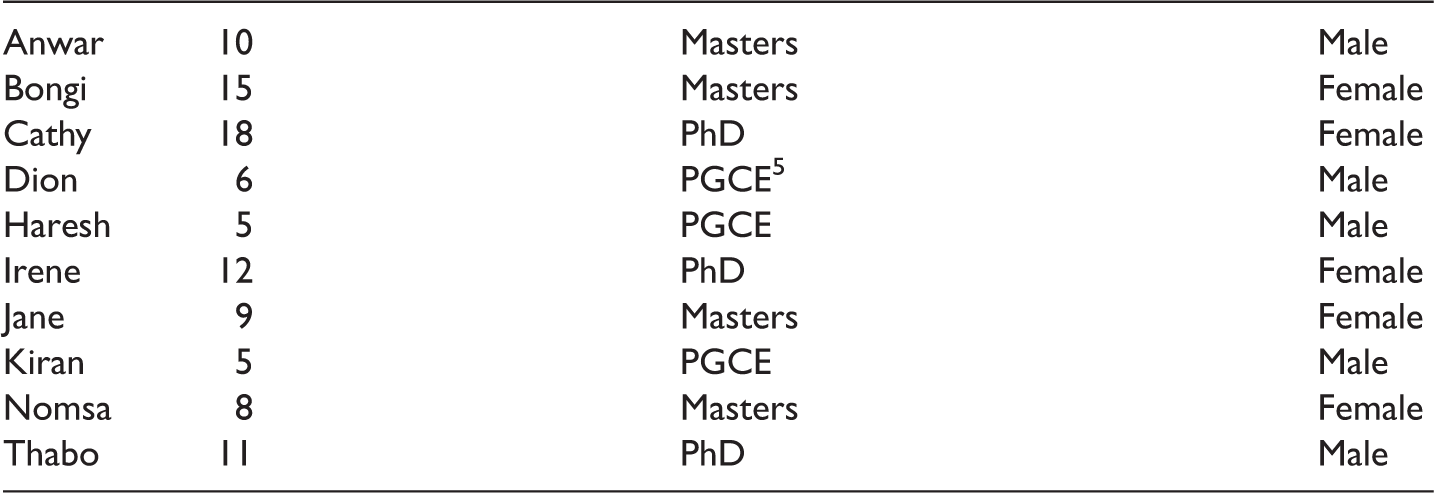
When analysing each participant’s pedagogic strategies, three themes emerged: empowering the classroom milieu; the classroom community; and the learner. These themes are discussed in the subsequent section.
Discussion: Empowering pedagogic strategies
Shortages of skilled qualified mathematics teachers in South Africa are critical (Adler and Davis, 2006), and retaining teachers with strong backgrounds in mathematics is an ongoing challenge in poorer communities (Allexsaht-Snider and Hart, 2001). While the participants were concerned about curriculum requirements: Jane: ‘… we must stick to policy…’ Cathy: ‘… we have to complete sections, it does not matter whether they [the learners] 6 get it… we must complete the work… that’s the policy requirement… complete the syllabus…’ the participants acknowledged that learners in their classrooms were different and diverse in their ability and in their understanding of crucial mathematics knowledge: Thabo ‘… the level of mathematics is too demanding for the kids… they come in without knowing all the work…’
Therefore, teachers’ awareness of mathematics, their planning to teach mathematics and their expertise for teaching learners from various backgrounds is important for maintaining equitable instruction (Allexsaht-Snider and Hart, 2001). The participants used pedagogic strategies that allowed learners to work together and actively participate in the learning process with the aim of achieving a common goal (Bender, 2005). The participants’ pedagogic strategies created a sense of empowerment within the classroom milieu, among the classroom community and for each learner. It was evident that learner empowerment advanced teacher accomplishment and increased learner commitment to learn (Lawson, 2011). More detailed descriptions of the participants’ pedagogic strategies are subsequently discussed.
Empowering the classroom milieu: Making learning meaningful
Research (Behrman, 2006; Stemn, 2010) has shown that learners require meaningful and relevant contexts in which to learn. For teachers to provide meaningful contexts within mathematics education suggests that they ought to be aware of the relationship between mathematics learning, mathematics learners and socio-political structures (Hand, 2012). The participants in this study were aware of the above aspects and started by removing the barriers to learning within their classrooms. Removing barriers to learning supports learners in flourishing within the classroom milieu (Landis et al., 2010). Learner success is supported by the theory of empowerment, whereby learner well-being is encouraged and enhanced (Perkins and Zimmerman, 1995).
The participants argued that they created a classroom milieu that was devoid of social bias, prejudice and discrimination. They felt that these classroom milieus incorporated and supported active learning, deep understanding and the construction of new knowledge grounded by learners’ prior knowledge (Cummins, 2009). Some of the classrooms were equipped with resources, which included extension or remedial worksheets, textbooks, manipulatives, calculators, mathematics sets, colouring pencils and pens. All resources were provided by the participants at their own expense. The primary idea behind creating a resource station within the classroom was to remove the stigma attached to learners not having the appropriate equipment because they could not afford it. Another reason given was that having the resources was helpful to learners if they did not understand the nature of the content (of mathematics being) discussed. Through the use of relevant resources learners were able to achieve the same level of mathematics knowledge as the rest of their peers, which served to empower and motivate their learning (Lawson, 2011). The classroom milieu supported learners in the pursuit of equitable and empowering mathematics education.
Kiran: ‘… they [the learners] come from poor backgrounds and they don’t have all the stationery… they know they can borrow from the table in front and return when they are done… everyone can complete the tasks now…’
Nomsa: ‘… I provide the worksheets so that they [the learners] can use them… no one needs to know what worksheet they are picking up… for extension or revision… they are embarrassed to ask… if it is available they will take them [the worksheets] and work on their own…’
Thabo: ‘… having resources for them [the learners] helps to level the maths playing field… everyone has the same equipment… no one feels disadvantaged…’
Irene: ‘… I ask learners to use colours to underline… the learners know that if they don’t have they can use the ones at the front of the class… it is for everyone… some forget to bring their colours and some can’t afford the colouring pens…’
The consensus amongst participants who had created the resource stations was that they would rather continue with the teaching and learning than have learners feel excluded or left behind because they did not have an important piece of equipment. The participants created a classroom environment that was conducive to teaching and learning rather than one that alienated or discouraged learners; in this sense, the environment was created to be relevant to the learner and learners’ needs.
Some participants also created a mathematics library within their classroom. These libraries were equipped with mathematics books, past exam papers and articles to keep learners up to date with mathematics issues. The reasoning behind this initiative was that many learners did not have access to functional libraries, and participants wanted to ensure that these students were not disadvantaged and could work on research projects with ease. The classroom milieu was created to be empowering, relevant and meaningful for the learners.
Bongi: ‘… I have all the necessary stuff for them [the learners] to use if we have a project… I even have a stapler for them… there are so many projects in the new document… there are no libraries here… this is a rural school… there is no internet to use… I just want them to learn in the class… I want them to work on their own… for their own good… they are in charge of their learning…’
Thus, in Bongi’s classroom, due to encouraging the practices of empowerment, she felt free to engage in progressive pedagogies within her mathematics classroom (Lawson, 2011). Some of the participants indicated that they used charts and posters to assist in enhancing their mathematics classrooms and scaffold the teaching and learning of mathematics.
Irene: ‘… having formulae sheets with diagrams especially of 3D shapes on the wall helps the students… they [the learners] don’t have to ask me for the formula, they go directly to the poster and copy from there… in this way they take ownership for their own learning… I am not spoon feeding…’
In the better-resourced schools, the participants used educational games and mathematics videos to teach abstract mathematics concepts. These videos and games were available for learners to borrow overnight. One learner in each mathematics classroom was assigned the role of class representative, and part of the class representative’s responsibilities was ensuring a smooth process for lending and returning videos and games. This duty is rotated on a monthly basis via a democratic election process and learners are given the power to choose the class representative.
Although there are many challenges associated with the use of technology, computer mediated and online research is an emerging area of research within the field of education (Dunne, 2009). The idea associated with having the games and videos available to learners was to encourage learners to take control of their own learning. Within a classroom situation, when a teacher passes over some control of classroom activity to learners, the teacher is sharing power with such learners. The teacher shared power in the classroom by assigning important roles to the learner such as monitor of resources, group leader and class representative. Additionally, the teacher empowered learners by allowing them to take responsibility for their own learning by making available videos and games for them to use at home. The teacher created an empowering classroom milieu, which was inviting, meaningful, relevant and stimulating. This is in line with enhancing and encouraging learner well-being as discussed within the ambit of empowerment theory (Perkins and Zimmerman, 1995).
Anwar: ‘… I gave them [the learners] roles and duties… it works well… the videos are always returned… I trust them and they appreciate that…’
Dion: ‘… the pupils know that all the videos are there for them to borrow… they [the learners] use the videos to catch up with work… also sometimes they use the videos for extension exercises… in a way they are in charge of their own learning…’
Haresh: ‘… the classroom is always a hive of activity… I mean they [the learners] are always occupied with work… I have games for them to play if they are done with the classwork… they show me that they are responsible for their own learning and continue with the maths games when they have free time…’
As is evident from the above transcript excerpts, by creating an empowering classroom environment, which is meaningful and relevant to the learner and addresses their needs, learners can thrive and take charge of their own learning. Learners were thus empowered by their environment in which resources were provided for them.
Empowering the classroom community: Embracing diversity
In education, power can be seen in dominating racial groups having power and control over others (Vandeyar, 2010). This is evidenced in that learners frequently feel the pressure to adopt and further conform to existing principles that align with the prevailing group within their school (Meier and Hartell, 2009). To complicate matters further, many teachers completed their training in previously segregated education systems in South Africa with the understanding that they would be teaching learners from only one racial group and not multiracial learners (Vandeyar, 2005). Hence, teachers’ perceptions, ideas and experiences may conflict with the experiences of learners who come from diverse backgrounds (Meier and Hartell, 2009). To ensure that the classroom is without racial bias, the teacher needs to develop a strong sense of their own identity and the importance of promoting democratic values (Adler and Davis, 2006).
Many South African schools attempt to engage diverse learners by hosting a cultural day. However, a cultural day at school is not enough if a school stops there, and schools need to do more in order to transform the curriculum effectively (Meier and Hartell, 2009). Some participants had the same view: that they transformed their lessons to complement the diversity of different learners. Participants grouped their learners during lessons purposively based on teachers’ perceptions of their different cultural beliefs. The aim of this grouping was to enable learners to share cultural models and ideas for solving mathematical problems, and learners were asked to share indigenous knowledge with their peers.
Dion: ‘… I introduced how measurement was done by ancient cultures… I allowed them [the learners] to discuss in groups how objects were measured then and now… the pupils also discussed how measurement was done within their culture… sometimes they asked their parents or grandparents and came back to class to share with their groups…’
Nomsa: ‘… I think they [the learners] feel comfortable sharing ideas in their groups first… I ask them to present about different cultural models used in mathematics… the class can now identify with the maths being taught…’
Jane: ‘… I was teaching probability… the boys started talking about cards… isigunku [card game played among the Black population]… the other pupils spoke about thunee [card game is generally played among the Indian population]… there was so much discussion… we ended up creating a new game [Royal Spades]… sharing ideas allowed us to move further with the lesson… we created new maths questions on probability by using our new game…’
Haresh: ‘… my class is very diverse… I know the kids like playing sport… I used this to my advantage… we started the lesson talking about cricket… the class then introduced another game… ushumpu [ball game played by Black children]… we spoke about the game… then we spoke about the maths involved… the class started talking freely with each other… they really enjoyed the lesson…’
Teachers argued that they empowered learners to work collaboratively with their peers to develop the lesson content in a way that was linked to their own interests (Davis, 2009). Learners embraced their various ideas to work collaboratively in linking such to mathematics. Moreover, participants acknowledged that every year their class would become more diverse and, as a consequence, they were compelled to revisit, reflect on and evaluate pedagogic strategies and tools. In some cases, lesson plans needed to be changed, in situ, while they were teaching.
Anwar: ‘… I planned to use the computer to teach geometry, I used Sketchpad… but as I taught, I noticed that not all students in the class could work on the computer… it was the first time for them… I realised I needed to change my style… I then worked on the board… only when they [the learners] knew what was expected… I moved back to the computer… they all completed the classwork…'
Reflecting on and questioning their assumptions and experiences are an important part of becoming an effective teacher (Stemn, 2010). From Anwar’s comment above, it is evident that the teacher evaluated his own practice through self-reflection, which incorporated a notion of empowerment (Lawson, 2011). Self-reflection is part of the effective practice of empowerment theory, as discussed by Perkins and Zimmerman (1995). Teachers often work with learners who have limited opportunities to learn and think about mathematics (Adler and Davis, 2006), and so by changing his pedagogic strategy Anwar created a situation whereby learners who would normally feel marginalized now felt better equipped to access a more equitable form of education (Allexsaht-Snider and Hart, 2001; Hand, 2012). Here, learners were empowered to learn what was expected of them and continue with the task.
Empowering the learner: Giving learners a voice
Within South Africa there is a consensus amongst parents that their children should be educated in English, since English is considered a universal language (Setati, 2008). However, research conducted within multilingual classrooms has proposed that the use of learners’ home language is an important resource in scaffolding the effective teaching and learning of mathematics (Moschkovich, 2002; Ncedo et al., 2002; Setati et al., 2002). The use of the learner’s home language in the teaching and learning of mathematics is an important framing factor for learners as they develop fluency and proficiency in the language of instruction and the language of mathematics (Setati, 2005).
The teachers in the study knew their learners and used this knowledge to reflect on, and further adapt their lessons to ensure the maximum benefit for their students. Some of the participants used group discussions and peer work to engage learners to discuss their thoughts and ideas about mathematics concepts.
Jane: ‘… I allow the pupils to discuss amongst themselves in groups… sometimes they [the learners] find it hard to verbalise what they are thinking… in a group with their friends they are less shy and collectively they are able to express their ideas…’
Cathy: ‘… sometimes the language in the text book is not familiar… I allow them [the learners] to discuss the problems in a group… they share meanings and ideas… at the end they reach a common understanding and then we talk about their ideas as a whole class…’
In these classrooms, it was argued that text and talk played a decisive part in the implementation of power, as teachers shared their power in the classroom by allowing learners to explore and voice their ideas. Group talk where learners explore concepts is valuable for effective learning to occur, and so encouraging this kind of strategy is crucial in fostering learners’ understanding of concepts (Clegg and Afitska, 2011). Additionally, the use of discussion allows for the inclusion of multiple perspectives on the issues being discussed (Dunne, 2009).
Kiran: ‘… my class is mixed… they [the learners] talk to each other using language they are comfortable with… once the work is understood… English is used to share their understanding… sometimes they help each other by explaining the meaning of concepts in another language… eventually everyone solves the problems in English… there is a sense of community… they don’t feel left out… they are helped by their friends in the class…’
The language an individual uses can attract people or deter them (Setati, 2005). Second and third language learners benefit from code switching with the teacher or peers. Code-switching refers to the use of more than one language to assist in understanding and conceptualizing ideas and concepts (Clegg and Afitska, 2011). In a learning situation, the teacher creates opportunities, through language, to involve fellow learners in their thoughts. Code-switching is seen as a powerful strategy to promote thinking, learning and the articulation of ideas (Morgan, 2007). When learners code-switch, this provides teachers with important information about the conceptual knowledge that learners have. In turn, learners can express their knowledge in the language in which they are fluent, which is especially important if they are unable to express this knowledge in the language of instruction (Clegg and Afitska, 2011).
Some participants employed the use of a mathematics dictionary, journal writing and class presentations to assist with issues of language acquisition. Learners and the teacher worked collectively to provide meanings of words and phrases for the mathematics dictionary. Collaboration between teacher and pupil served to empower the learners, for they knew their ideas were valued within the classroom. Indeed, collaboration and joined-up thinking is widely encouraged within the ambit of empowerment theory (Perkins and Zimmerman, 1995). The journal writing activity was introduced to improve the learners’ use of language. The rationale underpinning this activity was that if learners could construct sentences this would then serve to support them in reading and understanding word problems in mathematics. The class presentations were used to allow pupils to become more proficient with the use of the English language, as well as to provide learners with the power and freedom to express themselves in front of others. These pedagogic strategies are useful when the language at home differs from the language of instruction.
Bongi: ‘… I started with the maths dictionary because I know that words in English do not mean the same as words in maths for example: power, volume, function… it’s difficult for them [the learners] to understand… so if we place these words in the maths dictionary they can see what it means when it appears in a maths problem…’
Thabo: ‘… I introduced journal writing in my class because I noticed they [the learners] could not read mathematics problems… reading and writing was a problem in my class… I know from my lectures at university that journal writing assists with reading and writing… if they get used to writing this would help them with reading and understanding word problems in maths…’
Haresh: ‘… I use class presentations… they [the learners] find it exciting to research something and discuss or teach the concepts to the entire class… they feel powerful and in charge… they are very animated when they present… sometimes they use their home language… they want everyone to understand important ideas… they make charts and posters…’
In the classrooms described above, teachers argue that they used activities to introduce learners to the power of language, so as to create learning opportunities that bridged the gaps between different languages, cultural viewpoints and beliefs about diversity (Landis et al., 2010); pedagogical strategies that allow learners to make choices about which languages to use may be instrumental in the effective teaching and learning of mathematics (Morgan, 2007) and thus empower pupils to work towards educational success. The activities described employed methods for encouraging learners to gain personal power (Gutièrrez, 1995). Thus, useful pedagogic strategies served to empower learners within the mathematics classroom by giving them a voice. In this manner, the teachers worked in partnership with their learners which empowered them to succeed (Perkins and Zimmerman, 1995).
Conclusion
Democracy in South Africa has initiated an awareness of diversity, a multicultural, multilingual and multiracial society. Based on the interview data, it appears that participating teachers recognized they had the power to transform education. This transformation can only take place if teachers are willing to collaborate with and empower their learners. Power is created and shared within a dynamic classroom setting where thoughts and identities intersect (Cummins, 2009). This was evident within all the accounts of the participants that were interviewed. In addition, there was a notable relationship between teachers’ pedagogic strategies, learner empowerment and equity in education. The latter involves teachers selecting pedagogic strategies to include what is known about their learners, with the aim of empowering them and thereby improving learning outcomes. These sentiments resonate well with the theory of empowerment in which a learner’s well-being is enhanced (Perkins and Zimmerman, 1995), as well as their expertise and confidence nurtured (Delp et al., 2005).
The participants realized that traditional textbooks and pedagogic strategies ought to be supported by additional materials that are popular and relevant to learners’ experiences so as to empower and motivate them. It was found that participants’ use of pedagogic strategies (for example: charts, class presentations, code-switching, dictionaries, games, group work, journal writing, libraries, resource stations and videos) were successful in confronting issues of language and race within their classroom milieus.
It can be noted that the pedagogic strategies highlighted within this study may be replicated in any classroom and are thus not confined to the context of the mathematics’ classroom. If teachers become aware of the pedagogic strategies used in confronting issues of language and race within their classrooms, this may produce an adjustment of their own pedagogic strategies which may, in turn, have a positive global effect. The improved outcome may allow more learners access to a university education, which may result in more skilled professionals being trained. This will impact instrumentally on the structures of economy and society, and enable learners to become empowered to accomplish their goals and live more fulfilled lives.