




Abstract
A modified Fast Fourier Transform method based on the pulsation ratio preprocessing is carried out in this study. When the density wave instability occurs, the method is applied to capture the characteristic signals in the frequency domain. Thus, the stable boundary in two-phase flow can be recognized accurately. In this paper, experiments are conducted in a system based on a narrow annular channel. The method is verified through two groups of experimental data collected in different conditions. The results indicate that the modified method can avoid the problem of DC component spectrum leakage in traditional frequency-domain analysis with the false value interference eliminated. Accordingly, it can improve the accuracy of boundary identification effectively when the instability occurs.
Introduction
It has been recognized that small-integrated pressurized water reactors have the specialties of inherent safety, passive, several utilities, and modularity during the development of new generation reactors.1–4 The compact steam generator is an important equipment in the small-integrated pressurized water reactor for its compact heat transfer structure and large heat flux density. Mainly because of low secondary pressure, two-phase flow instability occurs in the case of large heat flux density in integrated pressurized water reactors. The two-phase flow instability refers to the periodic flow oscillation with constant or varying amplitude; the zero-frequency flow excursion phenomenon of thermal parameters is caused by the change of mass flow density, pressure drop, or cavitation, which will bring on the periodic pulsation for flow rate and wall temperature of the steam generator, resulting in mechanical vibration, thermal fatigue heat, and heat transfer crises on the heat transferring wall, making damage to the control system and steam generator.5,6
Density wave oscillation is a common type of two-phase flow instability. Wang and Sefiane, 7 Guo et al., 8 Yanping et al., 9 and Wu et al. 10 carried out experimental studies on the instability in narrow annular channels. The oscillation conditions of parameters such as inlet flow rate, differential pressure, and temperature in time domain are analyzed. They also investigated the stabile boundary under different conditions through time-domain oscillation curves with no relevant criteria explicitly listed.
In order to correctly compare the stability of the two-phase flow in steam generators, it is necessary to establish the data processing method and criteria in the experimental study to evaluate the stability boundary. Some widely used criteria were concluded as follows 6 : (1) the inlet flow oscillation reaches some certain amplitude, which varies in different researches, and commonly taken as 5, 10, 20, or 30% of stable flow rate of heat transfer channel; (2) the slight oscillation of inlet flow rate occurs; (3) the flow rate oscillation of different amplitude occurs; (4) when the relation curve of flow rate oscillating amplitude and heating power is extrapolated to zero. However, in practical tests, the flow stability boundary may distribute in a quite wide range according to these criteria above, owing to not the subjective factors of experimenters, but the noise factor in the two-phase flow system. 11
Experimental data may contain various levels of noise when researching on the density wave instability in the steam generator. It can be brought about by sorts of factors including random characteristics of boiling process, pump noise, power supply noise, turbulence of the fluid, local vortex of flow, noise of instrument and meter, disturbance caused by circuit characteristics, etc. Generally, the average amplitude of these noises could achieve up to 10% of the mass flow rate amplitude in stable regime. Besides, in some typical steam generator channels, when the two-phase flow transits from stable to unstable regime, the flow rate oscillation is increasing slowly instead of explosively which makes the start boundary of instability quite vague. The determination of stable boundary by amplitude in time domain will be quite difficult.12–14
Accordingly, when the two-phase instability occurs the measurement and analysis of the instability characteristics is vulnerable to internal and external disturbances. In previous study, the raw data cannot be processed effectively at high resolution with traditional method. The result of the stable boundary recognition is far from ideal. In this article, a method for determining the stable boundary by capturing the characteristic signals in frequency domain while density wave instability occurring is researched. Based on the traditional Fourier transform, it adds pulsation ratio preprocessing to original signals, improving the accuracy of boundary identification, which is verified through experimental data.
Experimental apparatus
In this article, the two-phase test section is a narrow annular channel. The experimental system consists of three circuits shown in Figure 1. The primary circuit contains pump (#1), primary heater (#2), and primary side (#4) of the channel. High-pressure single-phase deionized water is used as working fluid to heat the fluid in the secondary side; the secondary circuit mainly contains narrow channel test section (#4) with a 1.0 mm gap; the third circuit is the cooling circuit of the system, with the function of absorbing the heat of vapor in the condenser (#6). The heat of experimental system finally is discharged into the atmosphere through the water cooling tower (#11).
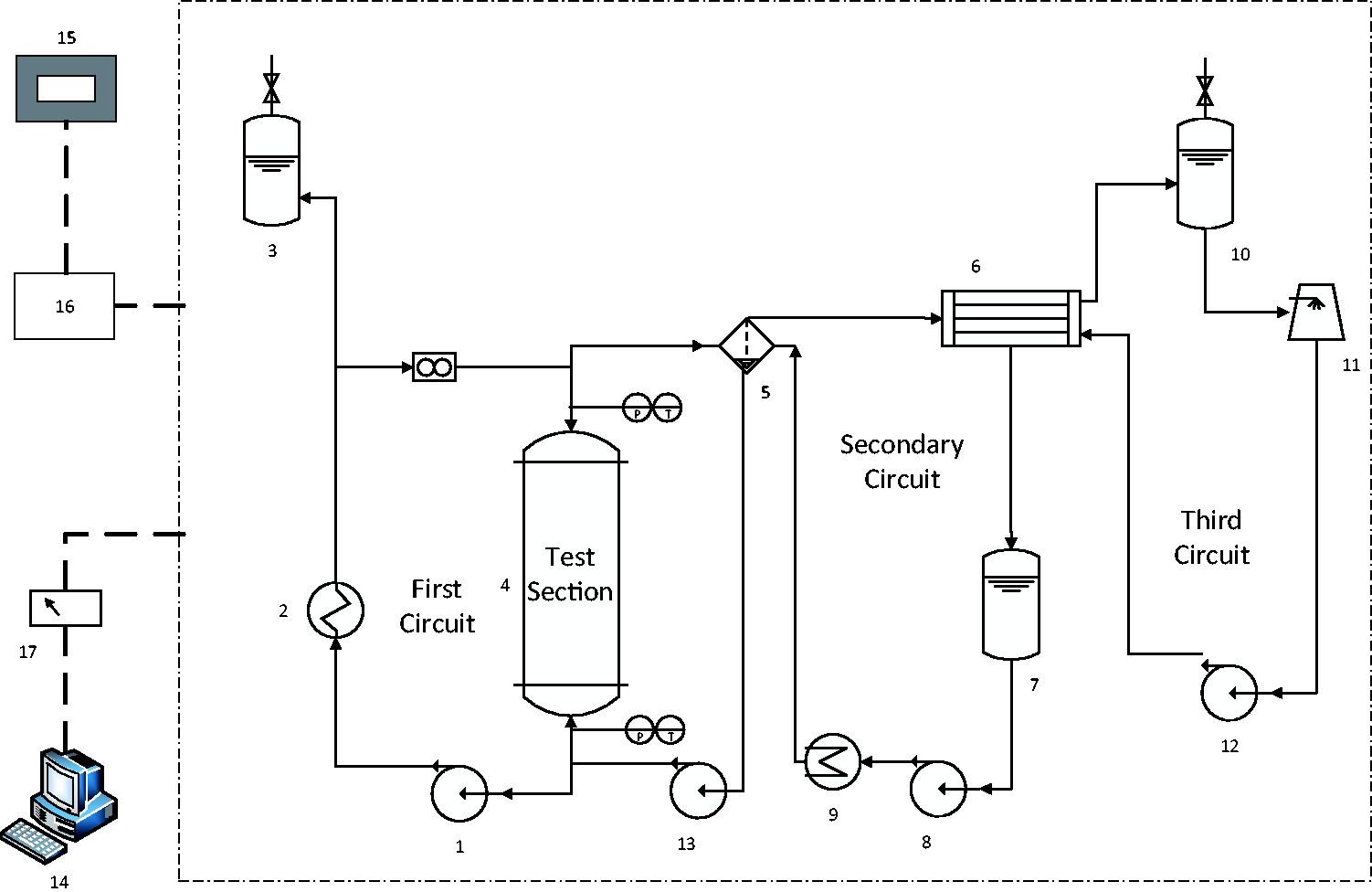
Schematic diagram of the experimental apparatus. 1. Pump in primary circuit, 2. Heating electric power in primary circuit, 3. Stabilizer in primary circuit, 4. Narrow channel test section, 5. Steam separator, 6. Condenser, 7. Container in secondary circuit, 8. Injection pump, 9. Preheater, 10. Stabilizer in third circuit, 11. Air cooling tower, 12. Cooling pump in third circuit, 13. Solartion IMP 35951C DCS, 14. Computer, 15. External power supply, 16. Voltage regulator.
The main measured parameters are the flow rate, temperature, pressure, and differential pressure. The flow rate of primacy/secondary circuit of the test channel is measured by ultrasonic flowmeter FLUXUS ADM, 6725 with the precision of 1.0%. The fluid temperature of inlet/outlet is measured by ϕ 0.8 mm I grade precision T-thermocouples. Rosemont 3051C pressure transmitters with the precision of 0.075% are used for measuring the pressure and differential pressure. The data acquisition device is Solartron IMP 35951C with 4 Hz sampling frequency.
Pulsation ratio preprocessing FFT method
When two-phase flow transits from stable to unstable in the steam generator, some low-frequency oscillation parameters are measured such as flow rate and inlet differential pressure. But on the border between stable and unstable zones, the oscillation of the parameters is easily disturbed or obscured by the background noise. It shows that the density wave oscillating frequency and background noise frequency distribute on different spectrum after the time-domain variables are transformed into frequency-domain spectrum function. Thus, the interference of background noise can be eliminated. When the ratio of the low-frequency oscillation amplitude for the specific frequency in density wave instability to the noise signal amplitude reaches a certain value, the thermal parameters in the channel can be applied to identify the density wave instability boundary.
Discrete Fourier transform
In the experiment, the amplitude of the physical parameters such as flow rate and inlet differential pressure changes continuously over time when the density wave instability occurs. In the data acquisition process, the continuous data are converted into discrete series. Discrete analog signal
Fourier transform is carried out for flow rate/inlet differential pressure signal

Here the value range of k is
FFT is one sort of fast algorithm for the discrete Fourier transform and has been widely used in signal analysis and processing.
Pulsation ratio preprocessing
When oscillation occurs, the average value of the flow rate/inlet differential pressure is still relatively constant, which makes the results from using Fourier transform directly contain strong DC component. Taking up Fourier transform directly to flow rate/differential pressure signals will not generate in a peak at X-coordinate origin, but result in great false value interference with adjacent spectral lines, because of the spectrum leakage problem in discrete Fourier transform, as shown in Figure 2. The inlet differential pressure value is shown in Figure 2(a) and (b) and it shows the results of direct FFT taken on the origin differential pressure value above. It can be observed from the figures that some large amplitude generates in the range
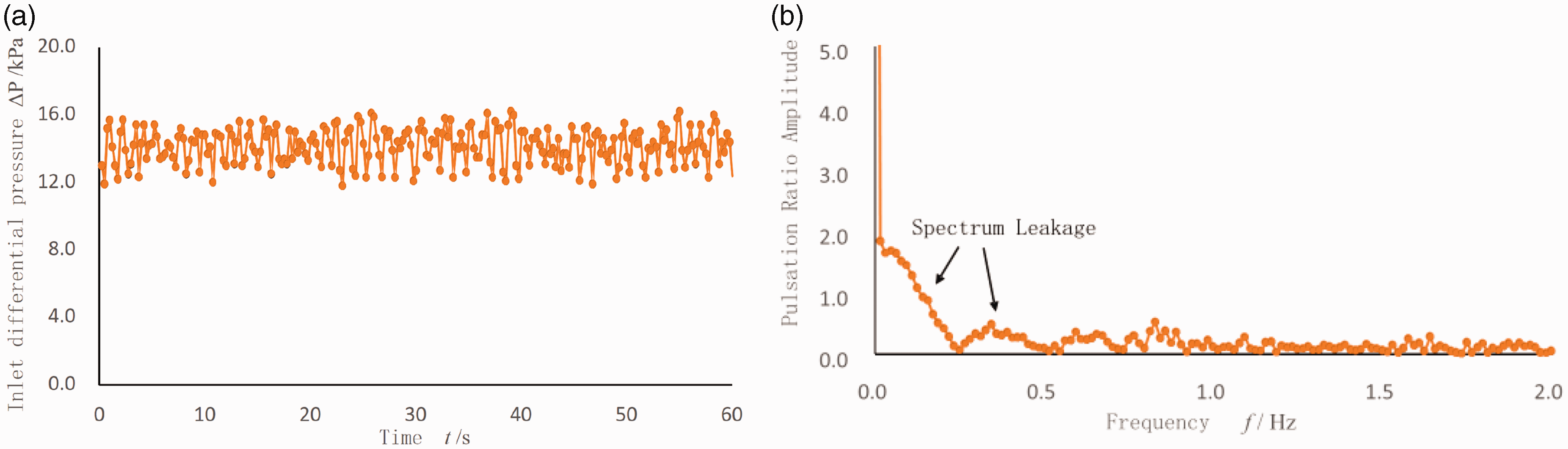
Measured busing inlet differential pressure value and FFT result. (a) Measured differential pressure value at busing inlet and (b) direct FFT result of inlet differential pressure data.
The pulsation ratio preprocessing method was developed to solve the DC leakage problem. Defining the transient value of physical parameters as

Defining the pulsation ratio of physical parameters as

Rewrite the Fourier transform formula (1) with pulsation ratio

The pulsation ratio preprocessing Fourier transform is taken up for measured value of inlet differential pressure in Figure 2(a) with formula (4) and the result is shown in Figure 3. The result shows that the amplitude of energy at all frequencies is low, and the pulsating quantities in the measured signal attribute to the superposition of sorts of background noises, besides, density wave oscillation does not occur with the two-phase flow still in stable zone.
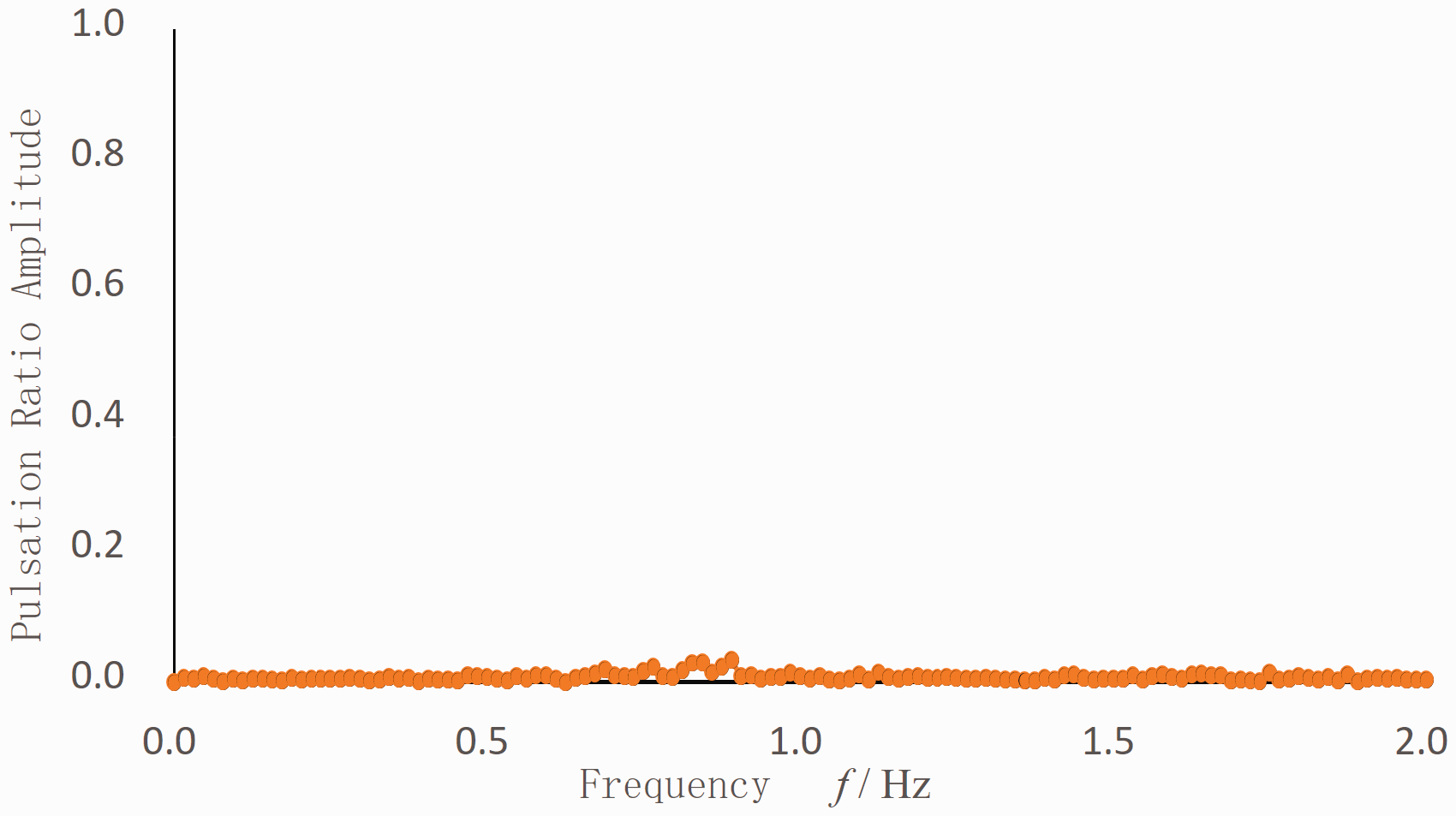
Inlet differential pressure FFT results based on pulsation ratio preprocessing.
Results and discussion
In order to verify the accuracy of the pulsation ratio preprocessing method for boundary recognition, two groups of experimental data are selected. The primary experimental parameters are shown in Table 1 in detail.
The main test parameters.
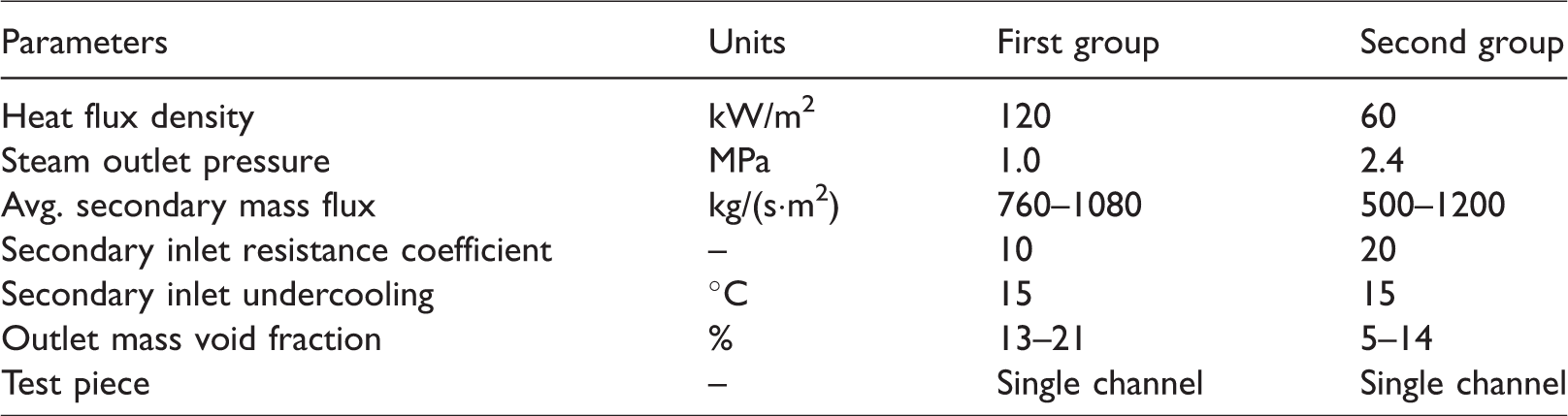
The experiments are carried out under specific heat flux density and inlet resistance conditions. When the experiment system reaches the thermal equilibrium, as the mass flow rate in secondary side reduced gradually, the two-phase flow in steam generator transits from stable zone to unstable zone. The adjusting interval of mass flow rate in experiments is 40 kg/(s·m2). In the pulsation ratio FFT results, the amplitude of background noises is normally less than 0.05. When the amplitude of certain frequency is twice over the background noise on spectral line, the density wave instability is considered occurring.
Four operating points intercepted from first group are shown in Figure 4. In Figure 4(a) and (b), the secondary mass flow rate decreases from 1080 to 920 kg/(s·m2). It can be figured out no significant peak value is found in the FFT figure of the inlet resistance pulsation value.
In Figure 4(c), as the secondary mass flux decreases to 800 kg/(s·m2) gradually, the pulsation amplitude peak first appears at 1.9 Hz with the amplitude exceeding 0.1, which is considered the stable boundary in the first group of experiments. As shown in Figure 4(d), along with the secondary mass flux further decreases, the amplitude of pulsation continues to increase at 1.9 Hz; meanwhile the second peak value appears at 1.3 Hz, which means the two-phase flow becomes more unstable.
Four operating points intercepted from the second group of experiments are shown in Figure 5. As the secondary mass flux decreases to 660 kg/(s·m2) gradually, the pulsation amplitude peak exceeds 0.1 first appears at 0.7 Hz, which is considered the stable boundary in the second group experiments.
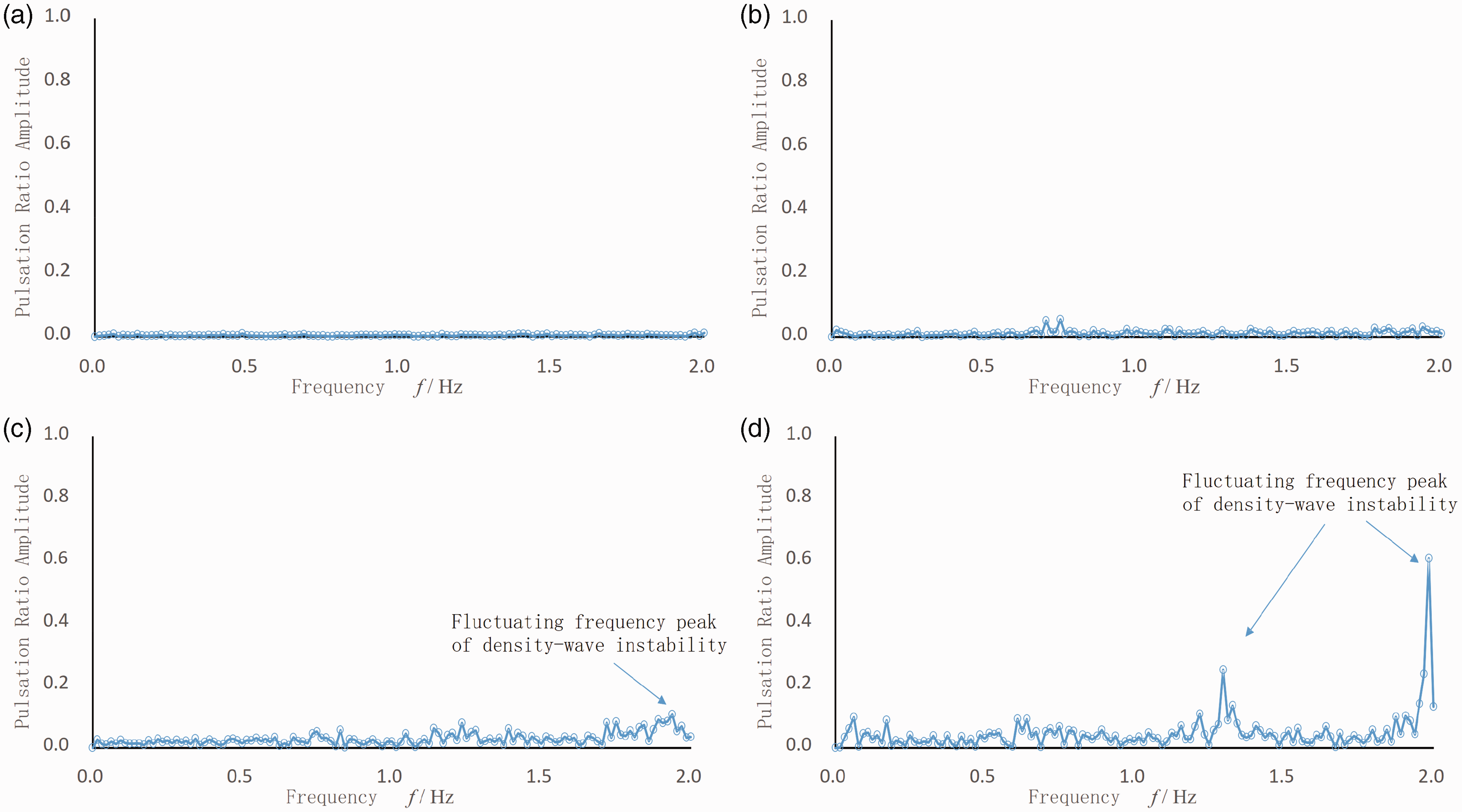
Inlet differential pressure FFT results based on pulsation preprocessing under different flow rate in the first group. (a) Secondary mass flux: 1080 kg/(s·m2), (b) secondary mass flux: 920 kg/(s·m2), (c) secondary mass flux: 800 kg/(s·m2), and (d) secondary mass flux: 760 kg/(s·m2).
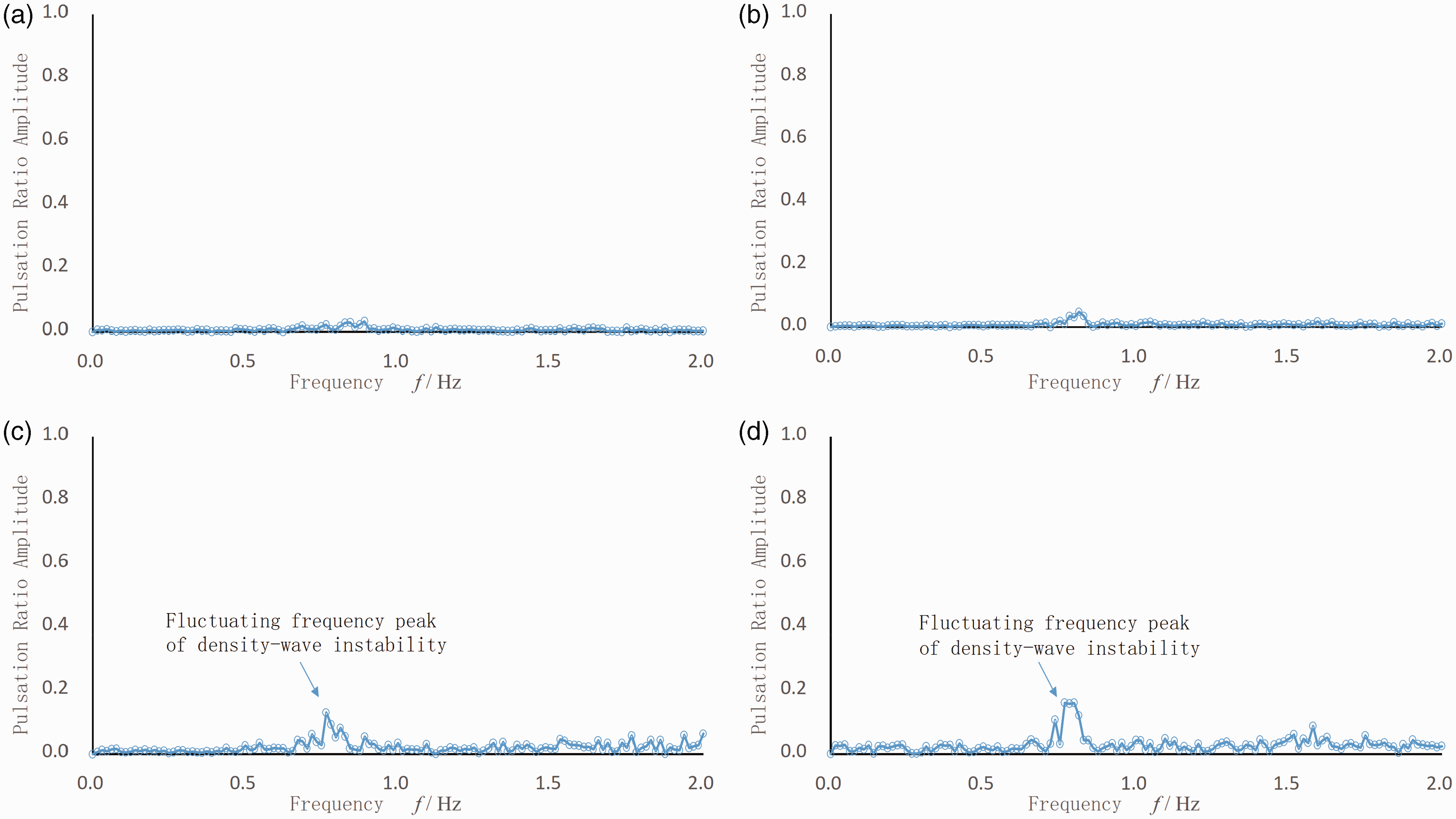
Inlet differential pressure FFT results based on pulsation preprocessing under different flow rate in the second group. (a) Secondary mass flux: 1160 kg/(s·m2), (b) secondary mass flux: 770 kg/(s·m2), (c) secondary mass flux: 660 kg/(s·m2), and (d) secondary mass flux: 560 kg/(s·m2).
The analysis of the two groups of experimental data above show that, when the two-phase flow instability occurs, the FFT method based on pulsation ratio preprocessing is able to extract characteristic frequency and amplitude effectively. In other words, this method is capable of recognizing the two-phase flow instability boundary quite well.
Conclusions
In this article, a method of recognizing the two-phase flow instability boundary is investigated. Experiments in different conditions are conducted based on the narrow annular channel test section. The effectiveness and accuracy of the method are verified through analysis of experimental data. The main conclusions are as follows:
When the two-phase flow instability occurs, in order to eliminate the background noise interference, the oscillation frequency and background noise frequency are decomposed to different spectral lines by Fourier transform. According to data processing results in different conditions, when the amplitude proportion of characteristic frequency to noises is larger than 2, the two-phase instability is considered occurring. Using discrete Fourier transform method for inlet differential pressure signals collected in stable regime, great false value for spectrum leakage of DC components appears in the range Two groups of experimental data in different conditions are analyzed. In the conditions the two-phase flow transits from stable to unstable. The good accuracy of this method is verified when the two-phase flow instability occurs. The results indicate that the modified method can effectively extract the actual oscillation frequency and improves the accuracy in recognizing the stable boundary.
Footnotes
Declaration of conflicting interests
The author(s) declared no potential conflicts of interest with respect to the research, authorship, and/or publication of this article.
Funding
The author(s) disclosed receipt of the following financial support for the research, authorship, and/or publication of this article: The Tsinghua University Initiative Scientific Research Program (No. 20151080383) and Tsinghua University Laboratory Innovation Fund (No. 10101) supported this study.