




Abstract
This work numerically investigates longitudinal and azimuthal thermo-acoustic instabilities in the swirl-stabilised can-type industrial SGT-100 gas turbine combustor operated at elevated pressures of 3 and 6 bar. Previous experiments have shown that the combustor is susceptible to self-excited flame oscillations sustained by a thermo-acoustic feedback loop at specific operating conditions. In order to gain a better understanding of this feedback loop, a fully compressible large eddy simulation method is applied. The unknown sub-grid scale turbulence-chemistry interactions are modelled via a transported probability density function approach solved by the Eulerian stochastic fields method. First, the reaction zones and global flame topology at both operating pressures are analysed and compared to experimental images providing good qualitative agreement. Radial profiles of time-averaged and root-mean-square quantities furthermore demonstrate good quantitative agreement with the available measurement data. The applied simulation approach is capable of successfully reproducing self-excited thermo-acoustic instabilities in the longitudinal direction. The fundamental frequency of the predicted limit-cycle oscillation matches the experimentally measured frequency with high accuracy. Similar to the experimental observations, the fluctuation amplitudes of the pressure and global heat release rate increase significantly upon increasing the mean operating pressure from 3 to 6 bar. In addition to the dominant longitudinal mode, a high-frequency, low-amplitude azimuthal mode is also identified at both pressures. This azimuthal mode is periodically amplified and attenuated by the superposed longitudinal mode and induces small asymmetric (around the burner circumference) fluctuations of the local fuel and total mixture mass flow rates entering the flame region.
Keywords
Introduction
Increasingly stringent emissions regulations in the civil aviation and stationary power generation industries have led to the development of lean partially premixed gas turbine combustors. A major drawback of these combustors is their susceptibility to self-excited (and self-sustained) combustion instabilities, which are often coupled to acoustic modes acting in the longitudinal or transverse directions1,2. Longitudinal acoustic modes are typically characterised by axisymmetric flow patterns and relatively low oscillation frequencies on the order of
Transverse combustion instabilities have predominantly been studied in annular-type combustion chambers using e.g., experimental6–9, numerical4,10–13 and theoretical14–20 methods. In these annular configurations, acoustic waves travelling in the transverse direction were found to periodically modulate the local flame response of each individual combustor around the chamber’s circumference. The resulting spatial non-uniformity in heat release gives rise to pressure disturbances, which propagate as acoustic waves closing the feedback loop. Smith et al. 21 recently showed that in addition to directly interacting with the flame, these pressure disturbances can also induce fluctuations of the longitudinal velocity (i.e., mass flow rate) in each single combustor unit, thereby provoking an unsteady heat release response. To reduce the problem size by representing only a sector of the full annular geometry, some studies have applied transverse acoustic forcing of single or multiple flame set-ups, see e.g.,22–24. Transverse modes in can-annular or single can-type combustion chambers, on the other hand, have received much less attention in the open literature. Notable works of can-annular configurations include literary works25–28, whereas swirl-stabilised, single can combustors have been studied in literary works29–34. A general review of transverse combustion instabilities in air-breathing systems can be found in O’Connor et al. 3 .
To the authors’ best knowledge, numerical simulations of transverse combustion instabilities in the open literature have so far only been reported for test cases at atmospheric pressure. This includes the work of Ghani et al., 35 who examined both longitudinal and transverse modes in an afterburner-type configuration. Selle et al.29,30 and Noh et al. 34 successfully identified self-excited azimuthal modes in their respective swirl-stabilised combustor configurations. Experimentally, combustion instabilities in high-pressure test cases are also rarely investigated, since they require sophisticated testing facilities and introduce additional complexities such as rapid window degradation, which can impair the accuracy of any optical measurement techniques. Nevertheless, Buschhagen et al. 36 recently conducted measurements of a single jet flame combustor at elevated pressure. They studied the characteristics of a rotating transverse instability mode and found it was correlated to an asymmetric vortex shedding pattern.
Another experiment involving combustion instabilities at elevated pressure was reported by Stopper et al. 37 . During measurements of the industrial Siemens Energy SGT-100 gas turbine combustor, self-excited flame oscillations were identified at an operating pressure of 6 bar (Case B). These oscillations were accompanied by an axial motion of the inner recirculation zone (IRZ) as well as vortex shedding from the burner rim. The unstable flame behaviour was attributed to a thermo-acoustic coupling, which involved periodic variations of the reactants’ mixture fraction induced by different acoustic impedances of the fuel and air supply streams; leading to equivalence ratio oscillations2,38. Karlis et al. 39 analysed the original measurement data of Cases A and B (operating pressures of 3 and 6 bar, respectively) to further investigate the combustor’s thermo-acoustic behaviour. Phase-averaging was applied to characterise the limit-cycle perpetuation mechanism, which was found to involve the periodic shedding of toroidal vortices. Dynamic mode decomposition (DMD) was employed to examine the periodic appearance of flame kernels in the outer recirculation zone (ORZ). The radial asymmetry of these flame kernels was argued to be the result of mixture Lewis number non-uniformities, which in combination with high strain rates along the outer shear layer (OSL) can lead to locally increased heat release.
Prior numerical investigations of the SGT-100 combustor include the works of Xia et al.,40–42 who applied a coupled numerical approach combining incompressible large eddy simulation (LES) with a low-order acoustic network solver to study Cases A and B. The combustor’s flame describing function (FDF)43–45 was extracted by periodically forcing the inflow velocity at different frequencies and amplitudes, while measuring the subsequent heat release response. A limit-cycle oscillation was identified by feeding the obtained FDF into the acoustic solver providing the dominant modes and growth rates. The predicted oscillation was found to be sustained by a longitudinal thermo-acoustic mode at a frequency of about 209 Hz, closely matching the experimentally measured value. Zhang et al.46,47 recently utilised a similar LES methodology including artificial forcing of the inflow velocity. The combustor’s flame dynamics were analysed, although no direct comparison against the experimental data was presented for the reacting flow field. A periodically excited single and double helix precessing vortex core (PVC) was identified, and its role in modulating the unsteady flame response was described.
It should be noted that several other numerical works in the open literature have also simulated the SGT-100 combustor. However, these works have focused almost exclusively on the more acoustically stable operating condition at 3 bar (Case A) with the aim of evaluating the performance of different combustion, chemistry, radiation or adaptive mesh refinement models48–64. An isothermal flow case was furthermore simulated by Bulat et al., 65 who identified both a PVC and a central vortex core inside the combustion chamber, whereas Xia et al. 66 studied the dispersion of artificially induced entropy perturbations. The actual combustor geometry, as deployed in industrial gas turbines, was investigated in literary works67,68 using scale-adaptive simulation methods. Lu et al. 69 also recently studied the effects of hydrogen enrichment on the flame characteristics.
In the present work, fully compressible LES is applied for the first time to examine the unstable flame behaviour observed in the SGT-100 combustor. The main objective is to study the effects of increased operating pressure on the combustor’s thermo-acoustic characteristics and to gain a better understanding of the underlying thermo-acoustic feedback mechanisms at play. For this purpose, two different elevated operating pressures of 3 and 6 bar are simulated in accordance with the experimental measurement campaign. 37 The paper is organised as follows. First, the applied numerical method and test case setup are described. Then, relevant results from the simulations are presented and discussed with a focus on experimental comparisons and the physical mechanism of the thermo-acoustic feedback loop. A brief summary and conclusions close the paper.
Numerical method
All simulations have been performed with the in-house, pressure-based, fully compressible LES code BOFFIN-LESc
70
. The code solves the governing equations for compressible reacting flows (see e.g., Poinsot et al.
71
) on block-structured, boundary conforming grids. Due to the density-weighted LES filtering, an unknown sub-grid scale (sgs) stress tensor arises in the Navier-Stokes equations, which is evaluated via the dynamically calibrated version of the Smagorinsky model.
72
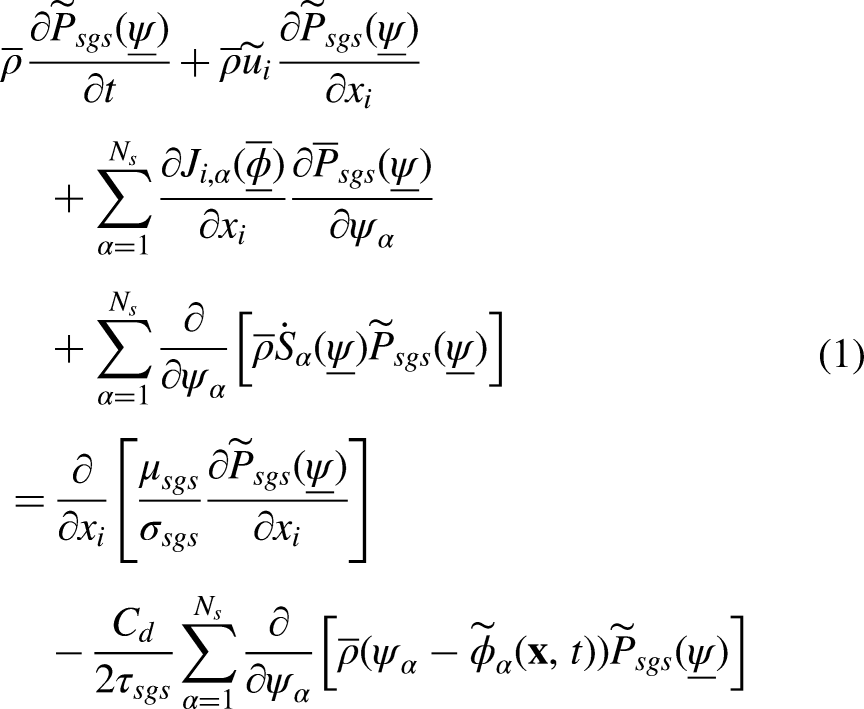
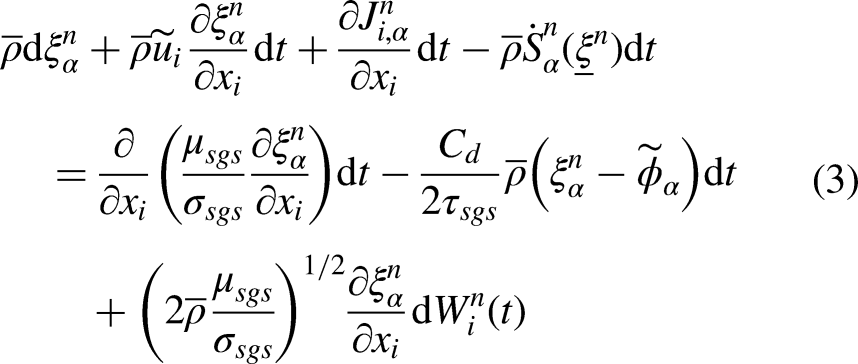
For the species and enthalpy, a joint transported probability density function (PDF) approach is adopted. The main advantage of this approach is that the chemical source terms

Test case
Experimental configuration
A comprehensive measurement campaign of the original-sized SGT-100 combustor was carried out by Stopper et al.
37
. The combustor was operated with German Natural Gas at different fuel-lean, partially premixed operating conditions and elevated pressures between 3 and 6 bar (labelled Cases A through D) with bulk Reynolds numbers
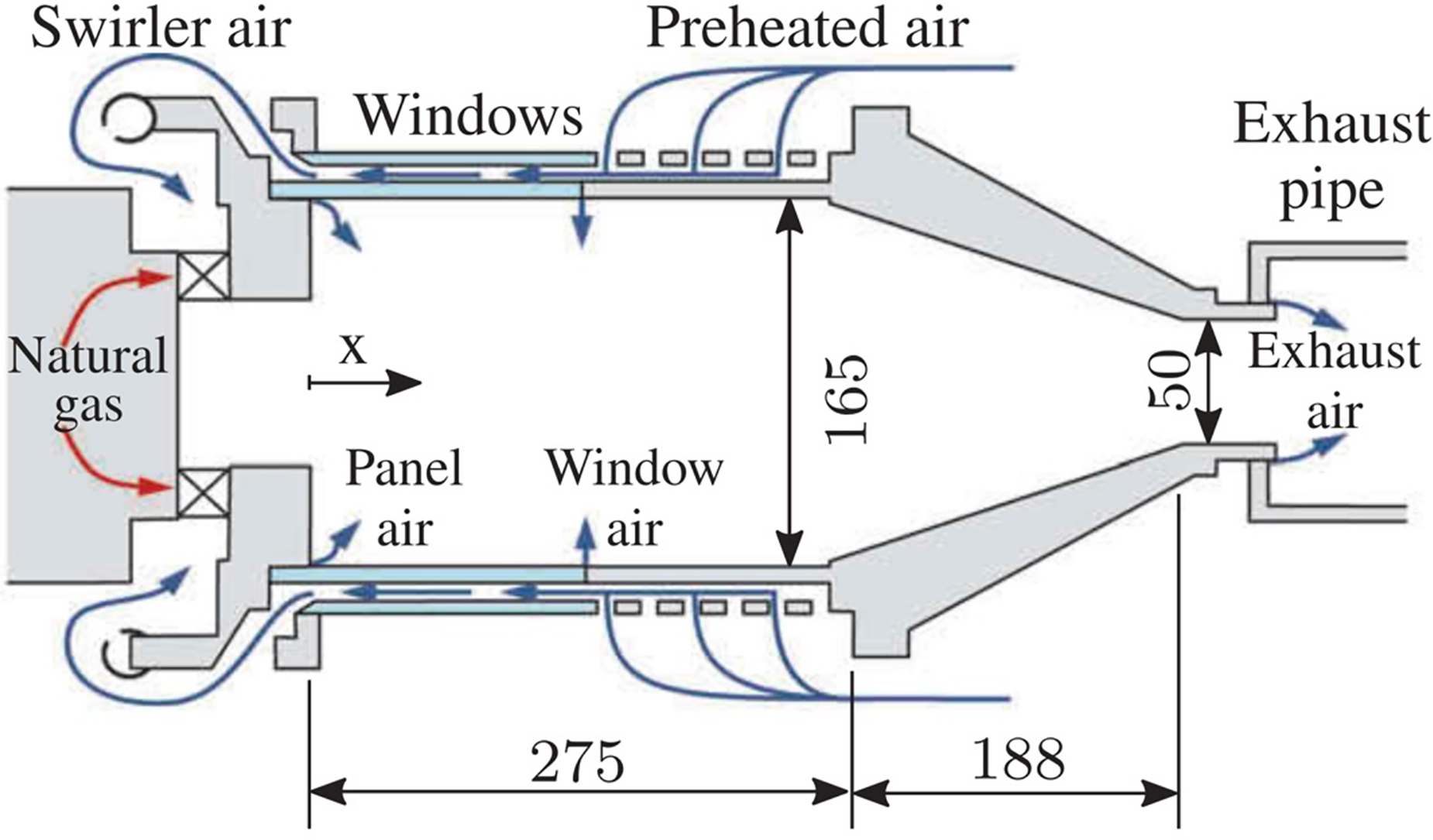
Schematic representation of the experimental test rig setup (dimensions are in mm) adapted from Stopper et al. 37 .
Numerical setup
The full-scale experimental combustor geometry extending from the swirler inlet to the combustion chamber exit, as shown in Figure 2, is retained in the simulations. The geometry is discretised by a computational mesh of about 8.5 million grid points with refinement regions in the reaction zone and near the fuel injectors. The same mesh was also used in the previous works by Bulat et al.49,50 and Xia et al.,40–42 where more details can be found including a mesh independence study. All walls are treated using an approximate near-wall model
83
with no-slip conditions. On the upstream end of the domain, the complex geometry of the air plenum and the perforated plate installed as a flow conditioner are excluded from the simulation domain. Instead, the inflow of preheated, pressurised air is located just upstream of the radial swirler inlet. Following Xia et al.
42
, the perforated plate is assumed to introduce a strong acoustic damping. Hence, a non-reflecting inflow boundary condition is utilised with prescribed target values for the density and the three velocity components based on the experimental operating conditions specified in Table 1. Here, it should be noted that the bulk flow velocity and global equivalence ratio remain approximately constant between Cases A and B. The formulation of the non-reflecting inflow boundary condition follows the work described in literary works84,85, using a relaxation coefficient of
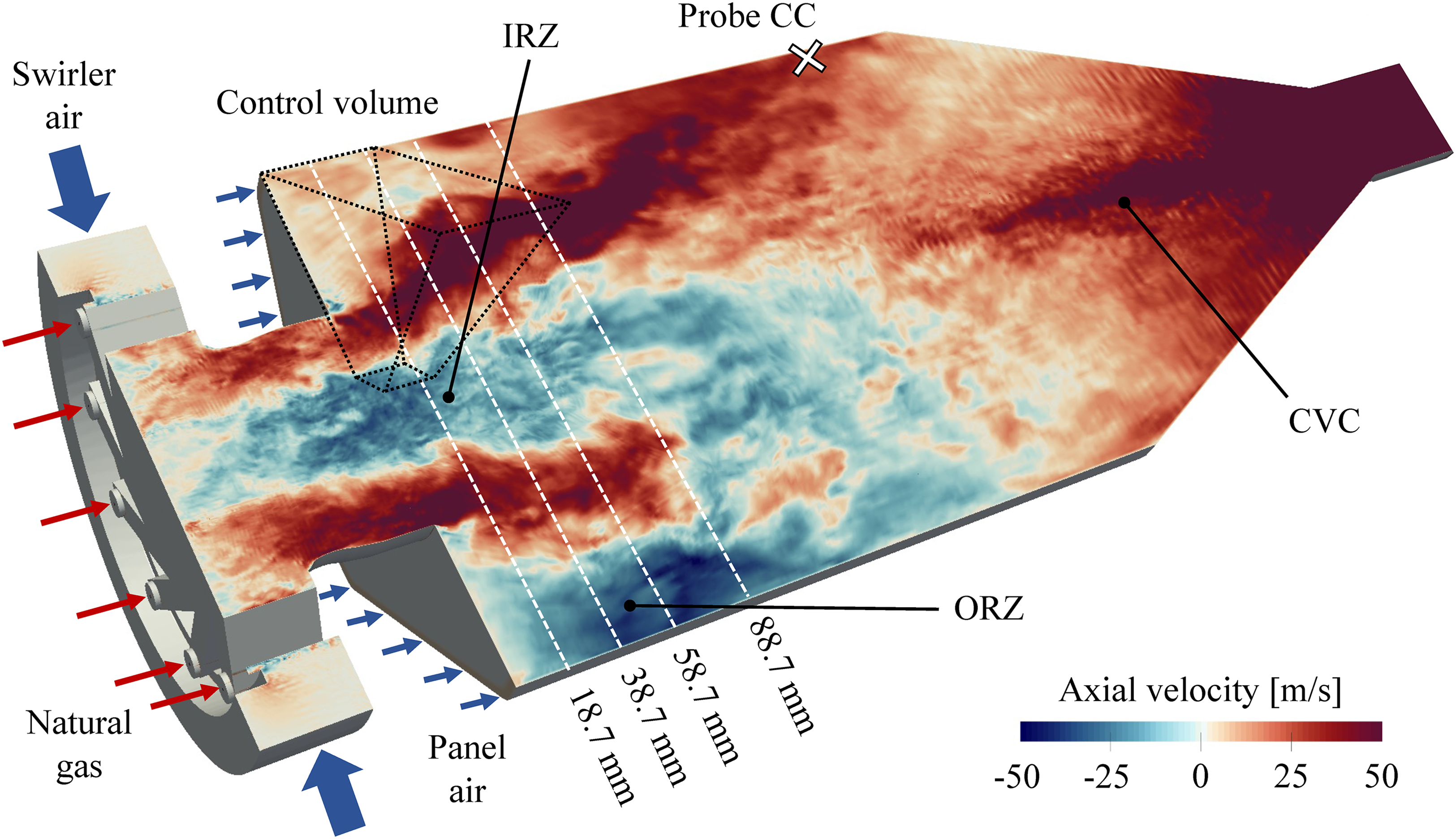
Vertical cut through the computational combustor geometry overlaid by an instantaneous snapshot of the axial velocity from the 6 bar case.
Summary of the simulated combustor operating conditions (Cases A and B in the experiments 37 ).

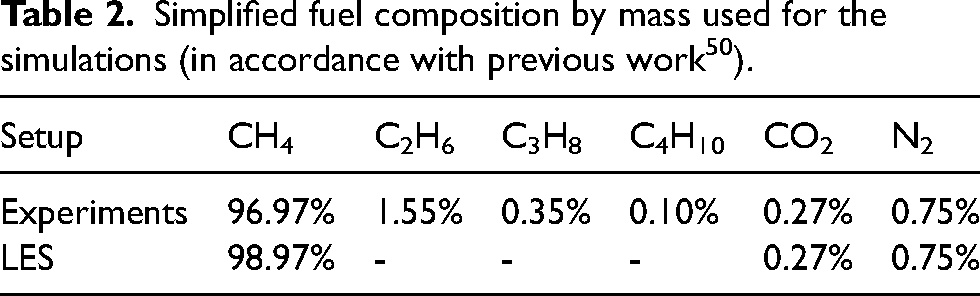
Simplified fuel composition by mass used for the simulations (in accordance with previous work 50 ).
Results and discussion
First, the instantaneous reaction zone characteristics and global flame topology are analysed and compared to experimental observations for Cases A and B. Then, time-averaged radial profiles from the 6 bar case are presented to assess and quantify the simulation’s agreement with the measurements. The thermo-acoustically unstable operating behaviour of the combustor is examined based on selected results at both operating pressures; with a specific focus on the higher pressure case. This is followed by a detailed description of the observed azimuthally spinning instability mode and its underlying feedback mechanism.
Reaction zone and global flame topology
In their experimental work of the SGT-100 combustor, Stopper et al. 37 argue that because of the short mean lifetime of the excited state of OH* radicals (on the order of 0.1 to 1 ns), a high local OH* chemiluminescence signal is a good indicator for a high amount of heat being released by the reactions. It was therefore possible to localise the average zone of heat release, and hence the global flame topology, by ensemble-averaging chemiluminescence single exposures and subsequent image deconvolution using an inverse Abel transformation. In Figure 3, the resulting experimental images of the time-averaged OH* density in the mid-plane for Cases A and B are shown and qualitatively compared to the corresponding time-averaged HRR from the LES. The results show good agreement at both operating pressures. The main reaction zone is located between 3 and 7 cm downstream of the chamber entry plane. In the 6 bar case, both the length and spreading angle of the toroidal flame zone appear to be slightly under-predicted by the LES. This may be the result of inaccurate assumptions regarding the heat transfer modelling at the walls. The trend towards a shorter axial penetration of the incoming jet of reactants from Case A to Case B, possibly caused by the decreased ignition delay time and the increased turbulent flame speed at higher pressure 37 , is well-captured in the simulations.
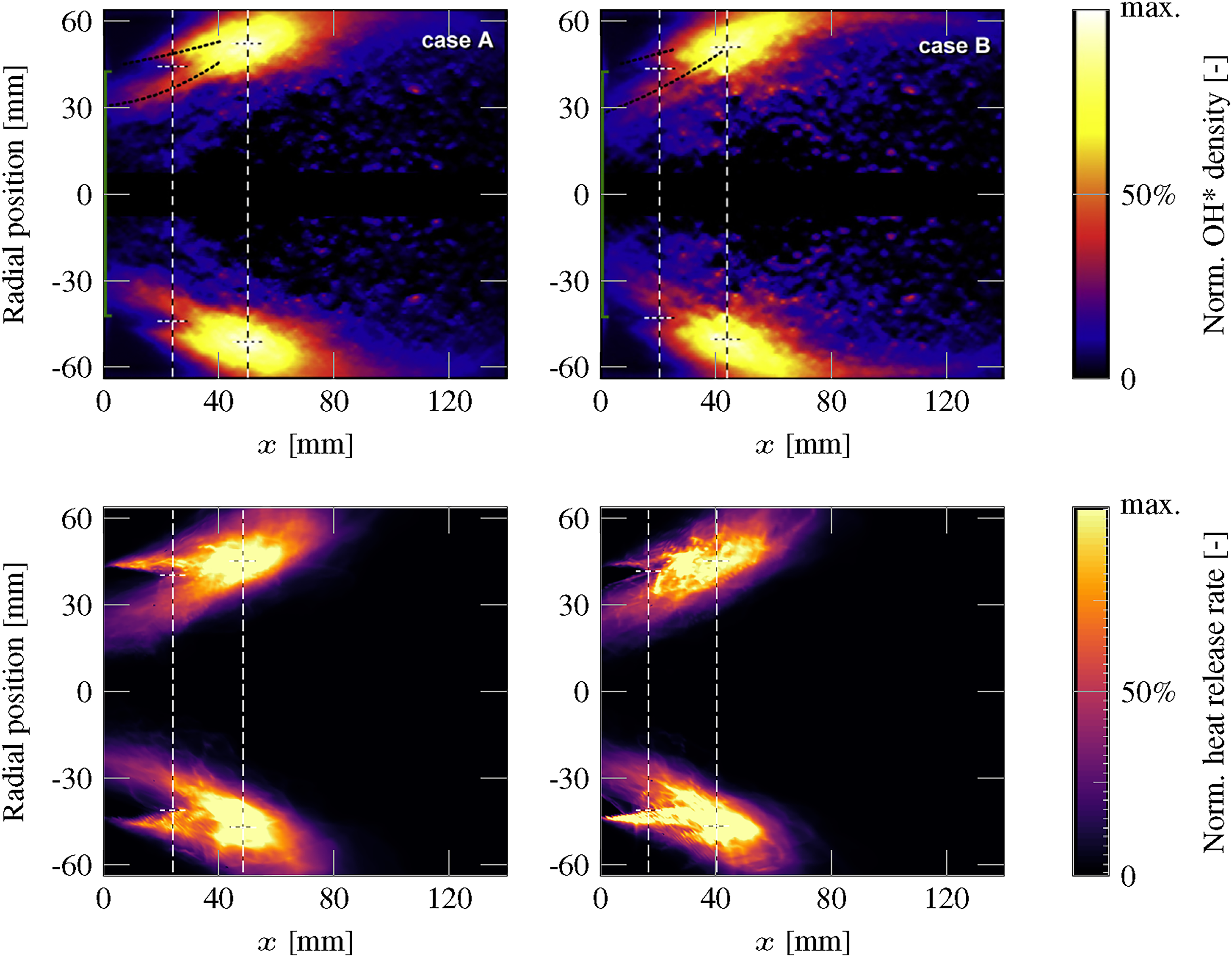
Time-averaged OH* density from the experiments 37 (top row) and heat release rate from the large eddy simulation (LES) (bottom row) in the mid-plane for Cases A (left) and B (right). Dashed lines and crosses indicate the end of the non-reacting inflow zone and the spots with the maximum heat release.
Figure 4 shows typical instantaneous snapshots of the measured OH PLIF intensity and the simulated OH mass fraction in the mid-plane for Cases A and B. The respective gradient fields for each quantity are shown as well. The corrugation of the instantaneous flame front by turbulence is captured in the simulations 87 . The LES is also capable of reproducing the global relocation of the main reaction zone from the outer flame branch at 3 bar towards the inner flame branch at 6 bar. Significant flame lift-off from the pre-chamber lip in the OSL, which was attributed to the mixture’s local ignition delay time in Stopper et al. 37 , is evident in all snapshots. It should be noted that the experiments of Case A showed intermittent flame attachment on the pre-chamber lip, whereas most prior CFD studies reported constant flame attachment (see e.g., Mcmanus et al. 63 ). It may therefore be concluded that weak thermo-acoustic effects, in combination with heat losses to the base plate wall, likely contribute to the partial lift-off of the outer flame branch. Similar (thermo-acoustically induced) flame lift-off events in a gas turbine model combustor were previously studied by Fredrich et al. 88 . Their work demonstrated how periodic vortex shedding, which was also observed experimentally in the present test case,37,39 can enhance flame lift-off from the burner rim.
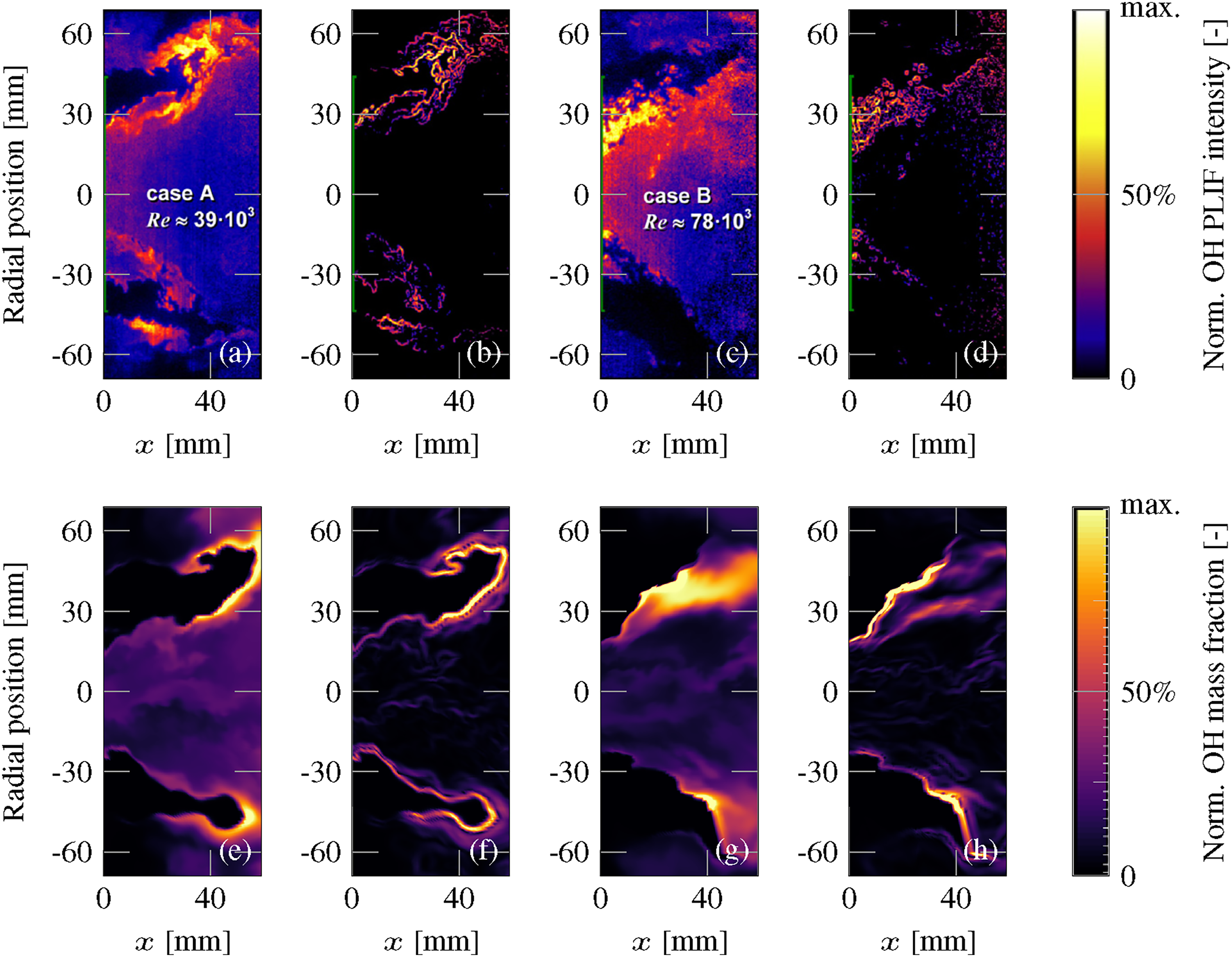
Top row: Instantaneous OH PLIF intensity and its gradient from the experiments 37 for Cases A: (a) and (b); and B: (c) and (d). Bottom row: Instantaneous OH mass fraction and its gradient from the LES for Cases A: (e) and (f); and B: (g) and (h). Results shown in the mid-plane. LES: large eddy simulation; OH PLIF: OH planar laser-induced fluorescence.
Time-averaged radial profiles
Figures 5 and 6 show, respectively, time-averaged and root-mean-square (RMS) radial profiles of the axial and radial velocity components and the temperature and mixture fraction for Case B (6 bar). These profiles were sampled at four different downstream locations – indicated by the white dashed lines marked in Figure 2 – for a duration of over 100 ms of physical time (the estimated combustor flow-through time is 4.5 ms 50 ) and compared against the corresponding experimental data. 37 In terms of the velocities, both the time-averaged and RMS results obtained from the simulation are in good agreement with the measurements, i.e., the location and strength of the IRZ, ORZ and annular jet of unburnt reactants are accurately captured. A minor under-prediction of the jet’s spreading angle can be deduced from the slight inwards shift of the two velocity maxima and thus narrower IRZ.
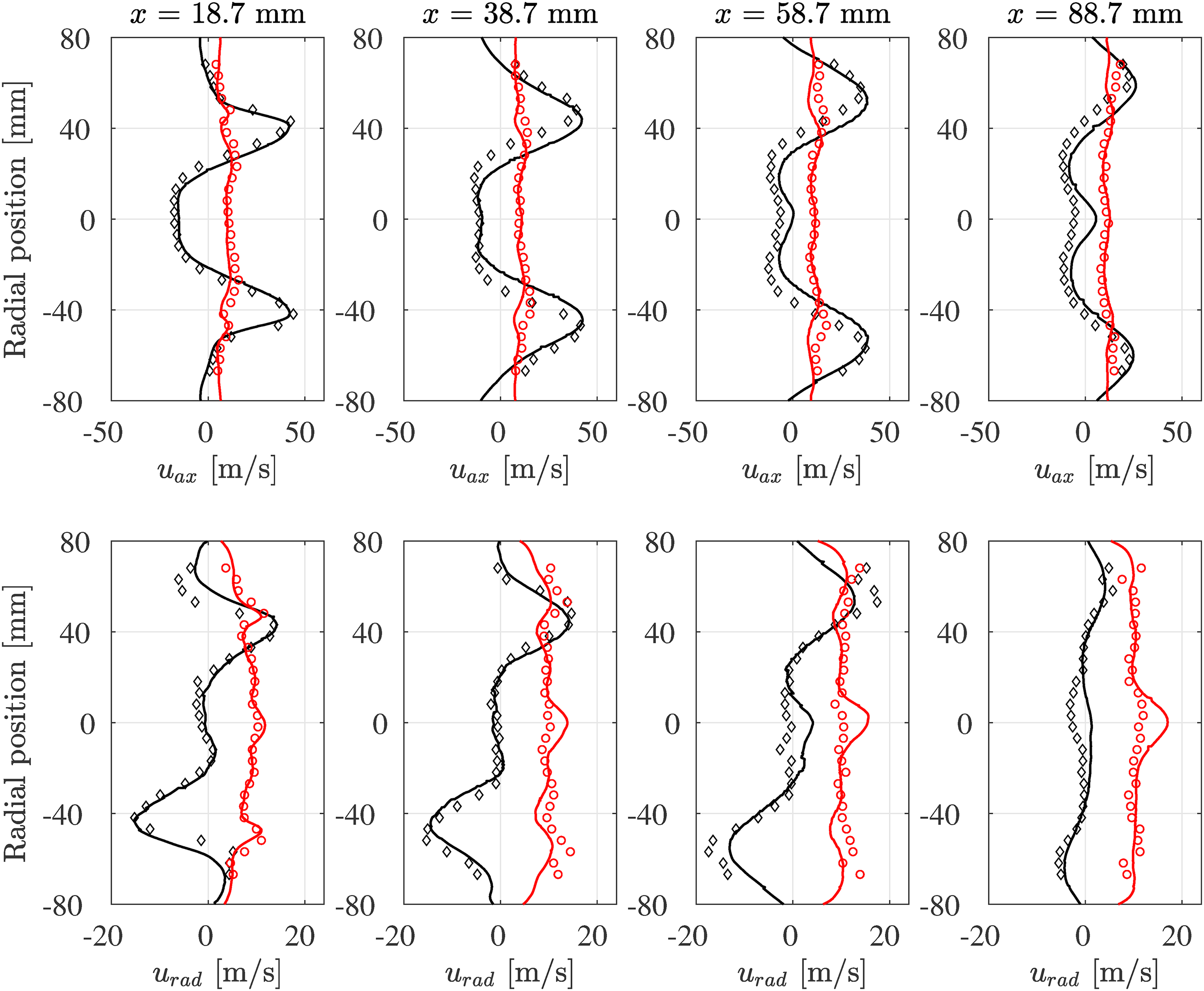
Radial profiles of the time-averaged (black) and root-mean-square (RMS) (red) axial (top row) and radial (bottom row) velocity components at four different downstream locations,
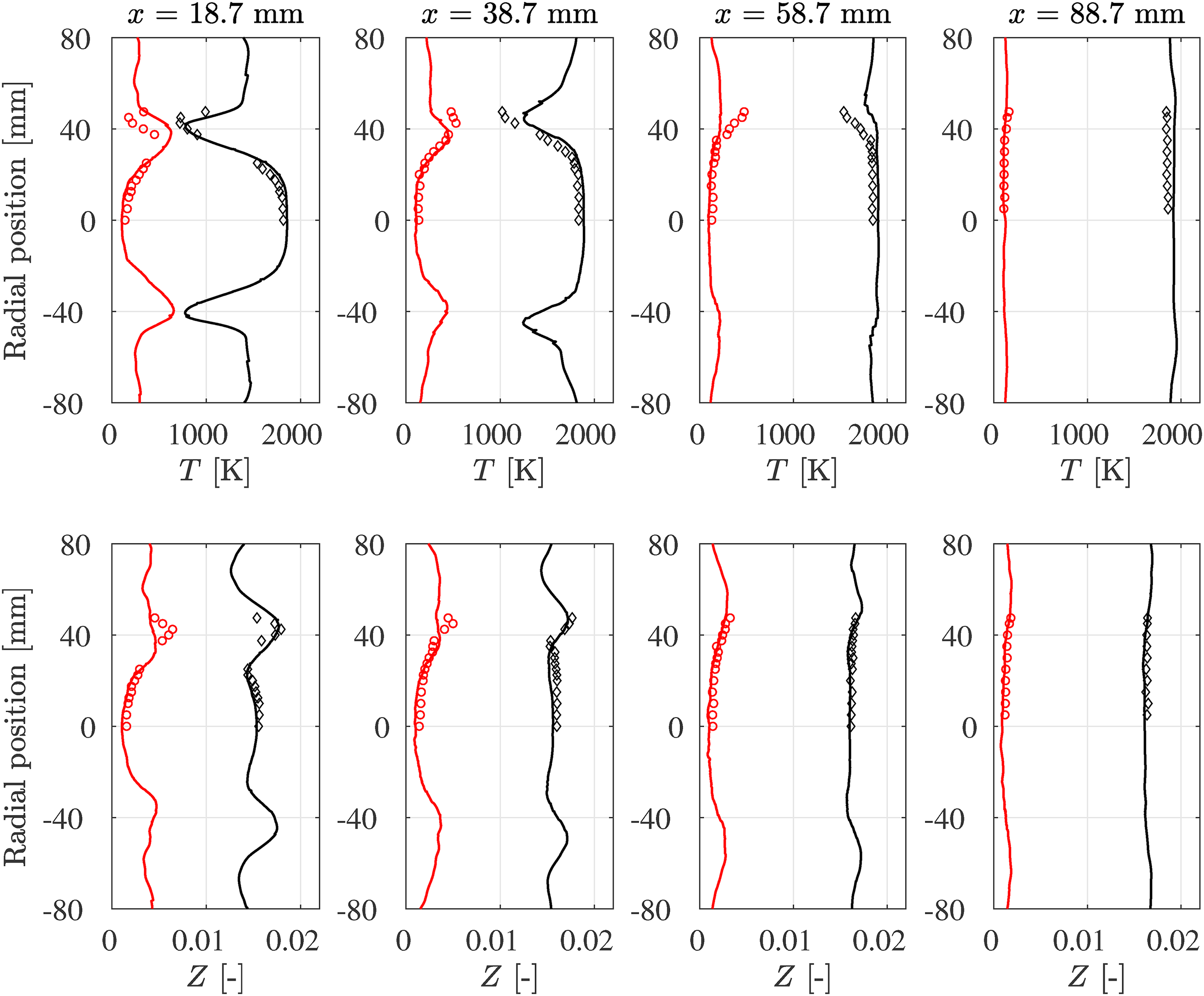
Radial profiles of the time-averaged (black) and root-mean-square (RMS) (red) temperature (top row) and mixture fraction (bottom row) at four different downstream locations,
Looking at the time-averaged temperature profiles in Figure 6, it becomes clear that the average flame length is underestimated. This is consistent with previous LES studies of the SGT-100 combustor, though the exact reasons for the flame shortening remain unclear. The temperatures within the IRZ, on the other hand, are well predicted and the inner flame front is correctly situated around the inner shear layer at a radial position of
Thermo-acoustic behaviour
Fluctuations of the local pressure and global HRR are shown in Figures 7 and 8 for the 3 and 6 bar case, respectively. The local pressure was sampled at probe CC (see Figure 2), positioned 231 mm downstream of the combustion chamber entry plane; identical to the location of the experimental pressure transducer. In addition, the global HRR was spatially integrated over the entirety of the computational domain. At both operating pressures, the pressure and HRR signals fluctuate periodically and in phase with a fundamental frequency of approximately 228 Hz. The in-phase relationship between the two signals implies a positive Rayleigh criterion, 89 therefore suggesting the existence of a thermo-acoustic limit-cycle oscillation. This oscillation represents a low-frequency longitudinal mode, which is perpetuated by acoustic waves that are generated by the unsteady flame front and propagate up- and downstream inside the combustor. An equivalent longitudinal mode in the frequency range of 220–230 Hz was also reported experimentally by Stopper et al. 37 and Karlis et al. 39 and in the prior simulations by Xia et al. 42 .
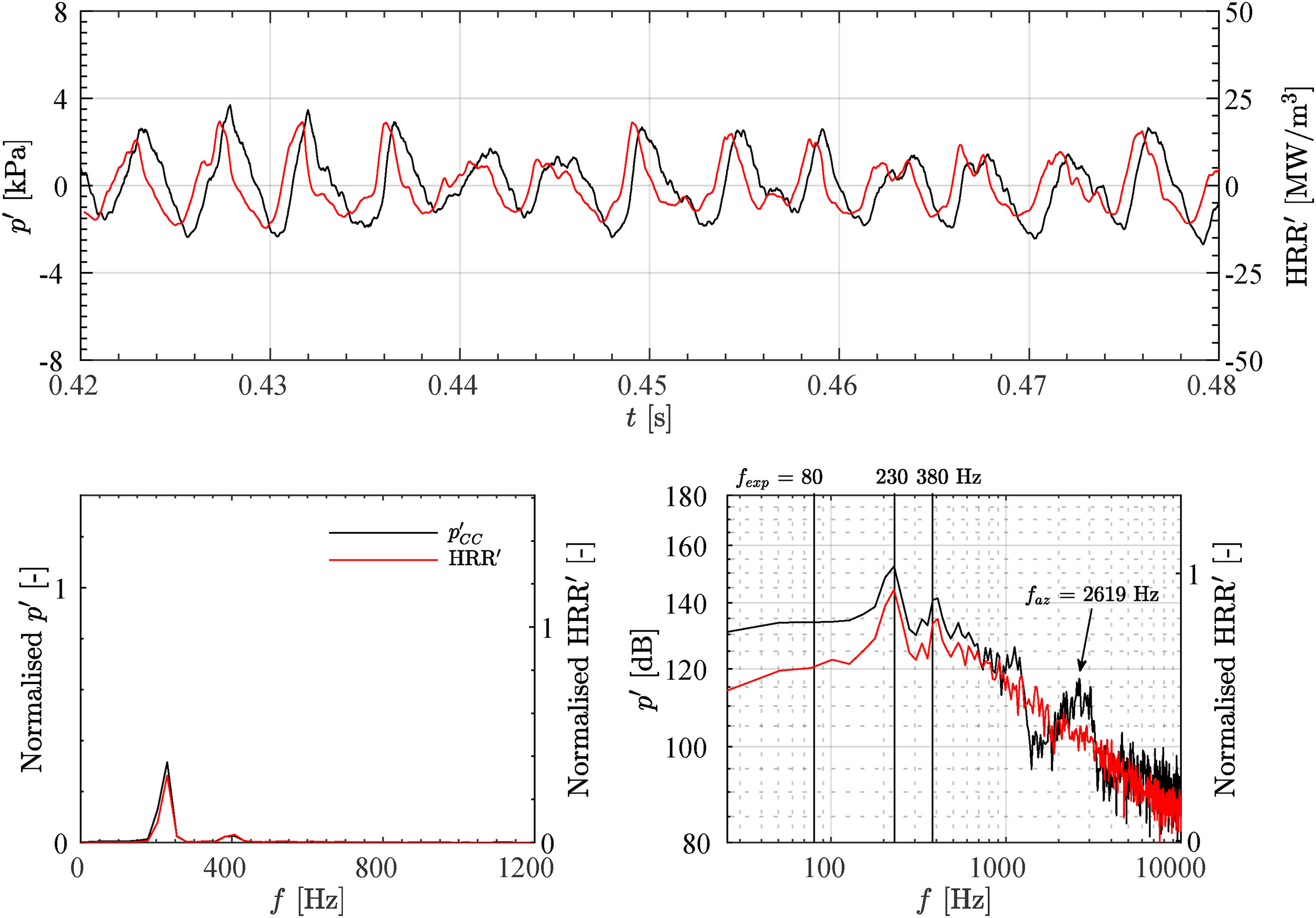
Top: Time signals of the global heat release rate (red) and local pressure (black) fluctuations recorded at probe CC. Bottom: Their respective power spectra. Vertical lines indicate the experimentally measured peak frequencies. Case A – 3bar.
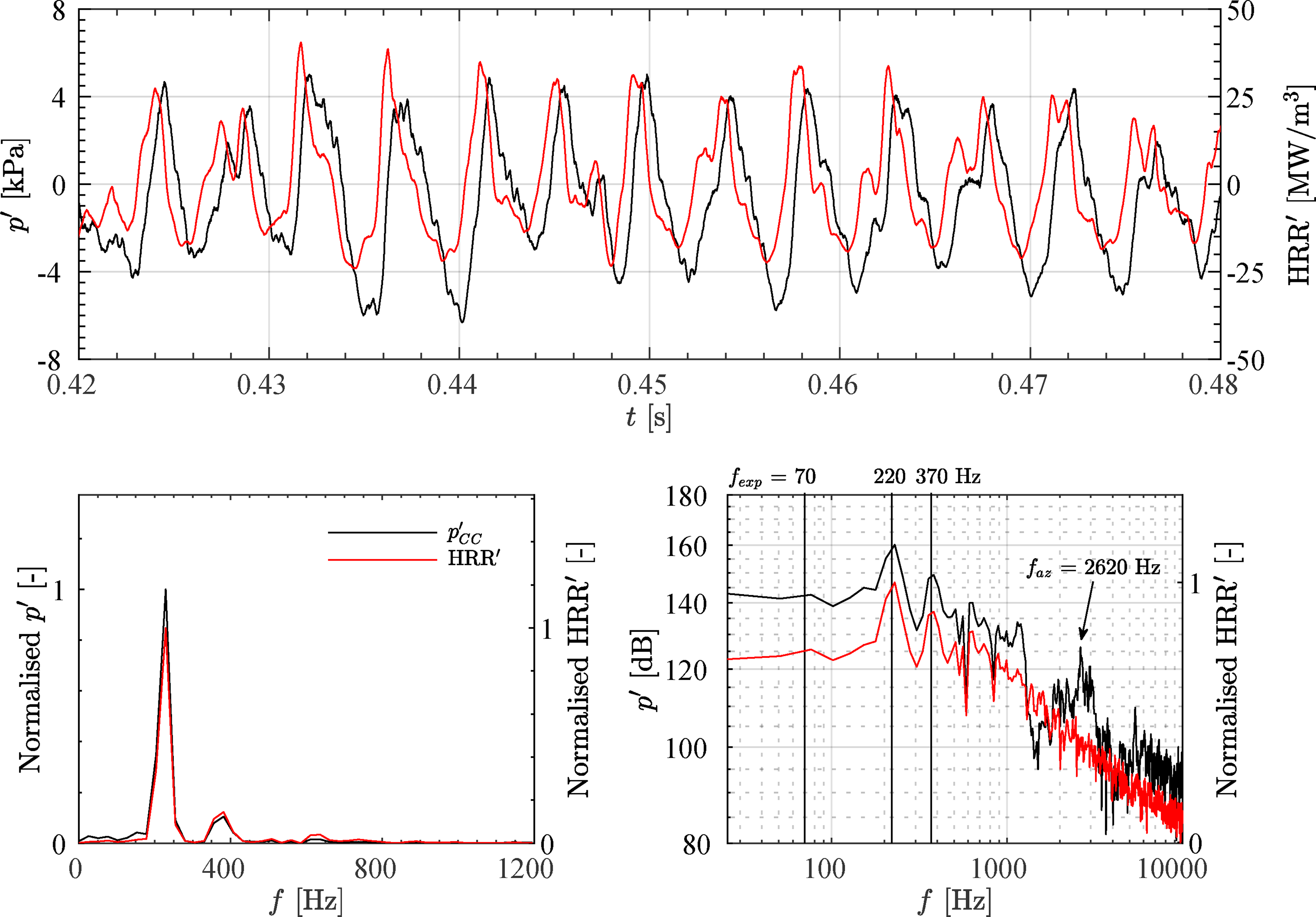
Top: Time signals of the global heat release rate (red) and local pressure (black) fluctuations recorded at probe CC. Bottom: Their respective power spectra. Vertical lines indicate the experimentally measured peak frequencies. Case B – 6 bar.
Experimental measurements37,39 of the local mixture fraction and phase-averaged velocity field had previously confirmed that combined mass flow rate and equivalence ratio oscillations 2 are the main mechanism underlying the observed thermo-acoustic feedback loop. These oscillations are a result of local density non-uniformities induced by the acoustic waves, which periodically modulate the air mass flow rate entering the radial swirler unit. Conversely, the fuel jets injected from the small fuel holes within each swirler vane are expected to maintain a fairly constant mass flow rate due to the high acoustic impedance of the injection lines. 39 The exact role of mass flow rate and equivalence ratio oscillations in a gas turbine model combustor with similar design to the SGT-100 test case was recently studied and quantified numerically in literary works.88,90,91
While the frequency of the predicted limit-cycle oscillation is almost identical for Cases A and B, the oscillation amplitude is clearly affected by the combustor’s operating pressure. Case A exhibits pressure fluctuations with a peak amplitude of about 3 kPa. This value is considered to be fairly low and matches the maximum peak amplitude reported in the measurements. 39 Moreover, the global HRR is found to fluctuate with a peak amplitude of approximately 15 MW/m3. Upon raising the mean operating pressure from 3 bar to 6 bar (Case B), the maximum peak amplitudes of the pressure and HRR fluctuations increase to about 6 kPa and 30 MW/m3, respectively. In absolute terms, these values constitute a twofold increase from the 3 bar case. Even though the absolute value of the pressure fluctuation amplitude in Case B appears to be under-predicted compared to the maximum experimental value of 20 kPa, the trend towards a higher amplitude limit-cycle oscillation with increasing operating pressure is successfully reproduced. An improved boundary condition treatment, i.e., more realistic acoustic impedances, or incorporating extended parts of the test rig geometry may lead to a more accurate prediction of the fluctuation amplitudes. Note that such parametric adjustments are not within the scope of the present work.
A fast Fourier transform (FFT) was furthermore performed to quantify the pressure and HRR signals’ power spectrum in the frequency domain and reveal other significant modes. The time series used as input for the FFT each had a total length of over 60 ms, equivalent to about 14 oscillation cycles of the fundamental 228 Hz longitudinal mode. In Case A, the 228 Hz mode is accompanied by a broader thermo-acoustic peak between 381 Hz and 406 Hz as well as a minor peak in the HRR at around 100 Hz. The frequencies of these two additional modes are in good agreement with the experimentally detected modes of 380 and 80 Hz, respectively. A similar frequency spectrum is also obtained for Case B, where secondary thermo-acoustic peaks at 76 and 381 Hz are in excellent agreement with the measured modes of 70 and 370 Hz. The reason for the existence of the two additional modes, which are equidistant (at a frequency of 150 Hz) to the fundamental thermo-acoustic mode, is still unclear. Karlis et al. 39 suggested the 150 Hz mode provides a secondary flow-flame interaction timescale linked to the periodic intrusion of flame kernels into the ORZ. They further argued that the superposition of this secondary timescale with the fundamental acoustically related timescale over a turbulent background played a role in establishing an intermittent regime of thermo-acoustic instabilities, where the dynamics transitioned between quiescent and fully oscillatory. This theory can neither be confirmed nor disproved in the present work. However, the time-resolved, three-dimensional data acquired from the compressible LES may contribute to the future investigation of the combustor’s complex mode spectrum.
In addition to the three identified low-frequency modes, the power spectra of Cases A and B also show a peak in the pressure signal around 2620 Hz. The physical nature of this high-frequency mode is examined in the following.
High-frequency azimuthally spinning mode
It can be shown that the high-frequency instability mode found at a frequency of 2620 Hz represents a transverse acoustic mode, or more specifically, an azimuthal mode that rotates about the central burner axis at the speed of sound. Figure 9 shows typical instantaneous snapshots of the normalised pressure from the 6 bar case for one full period of the azimuthal mode. A spinning pressure structure is clearly visible, locally confined in the region of the ORZ just downstream of the dump expansion. Its absolute amplitude is subject to periodic amplification and attenuation by the superimposed longitudinal mode. It should be noted that this azimuthal mode was not previously identified in the experimental test campaign. A possible reason for this could be the downstream location of the pressure transducer used in the experiments. Eder et al. 92 also recently applied compressible LES to study another swirl-stabilised, can-type combustor and identified a similar self-excited transverse mode, which was also not detected experimentally. They argue the mode was not a numerical instability, but may only exist in an acoustically ideal scenario without any geometrical imperfections such as increased surface roughness or window leakage resulting in acoustic dissipation. In the prior simulations of the SGT-100 combustor performed by Xia et al., 42 the azimuthal mode was likely not identified due to the exclusively longitudinal acoustic forcing 71 utilised in their combined incompressible LES and FDF approach.
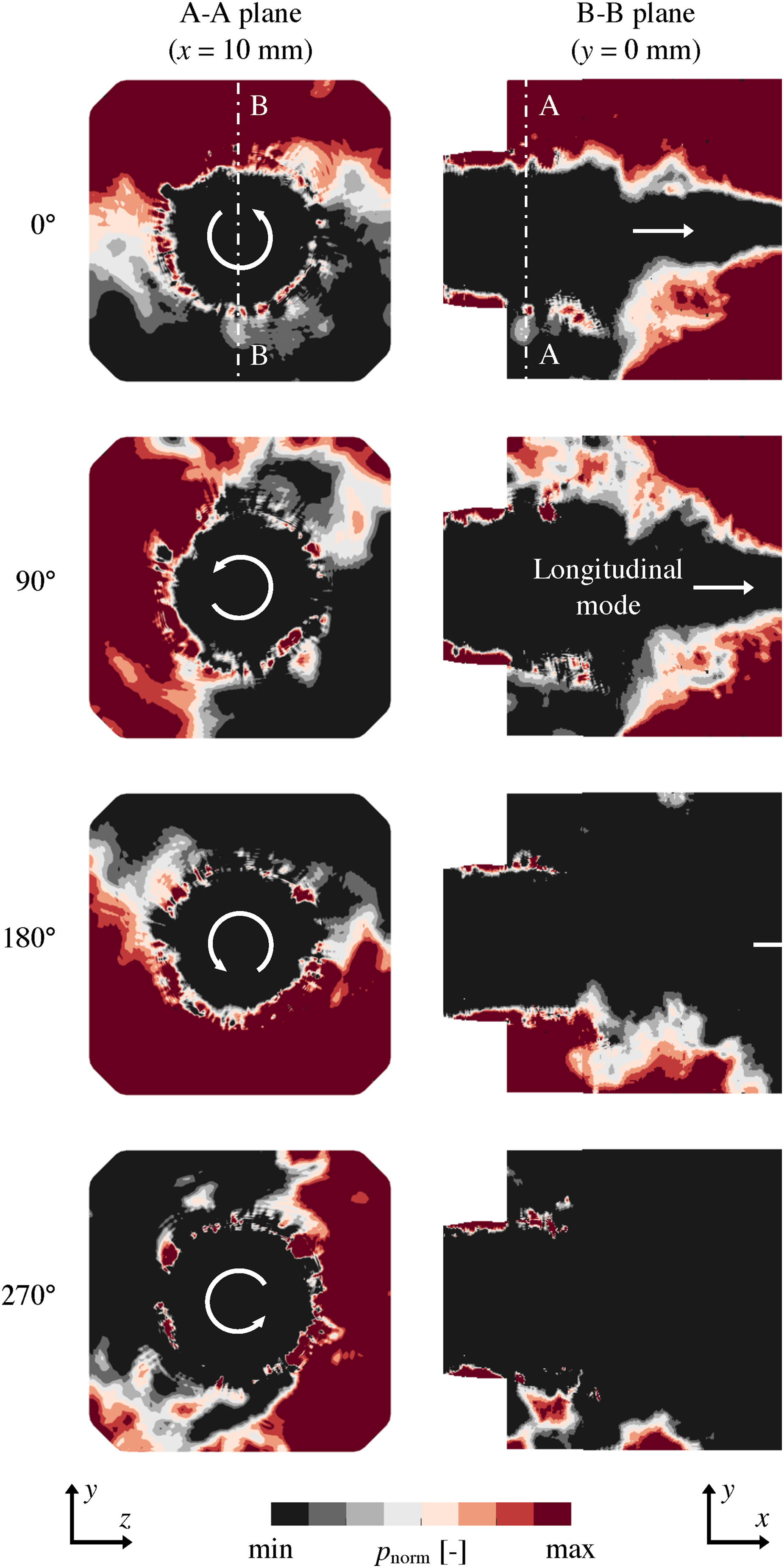
Instantaneous snapshots of the normalised pressure in an axial plane at
As evident from the HRR signals in Figures 7 and 8, the azimuthal mode has no direct effect on the global flame response. This is a result of the asymmetric modulation of the flame’s heat release, which cancels out circumferentially over time and is thus not detectable in the global HRR signal. Nevertheless, the azimuthal mode may impact the spatial heat release distribution in the transverse direction and provoke a thermo-acoustic coupling by locally satisfying the Rayleigh criterion. Such coupling is difficult to verify due to the comparatively much lower amplitude in relation to the dominant longitudinal mode. Future work will therefore include a DMD analysis to obtain the spatial Rayleigh index (see e.g., Schiavo et al. 93 ).
In an attempt to determine the underlying feedback mechanism of the azimuthal mode, the mass flow rate entering the combustion chamber at
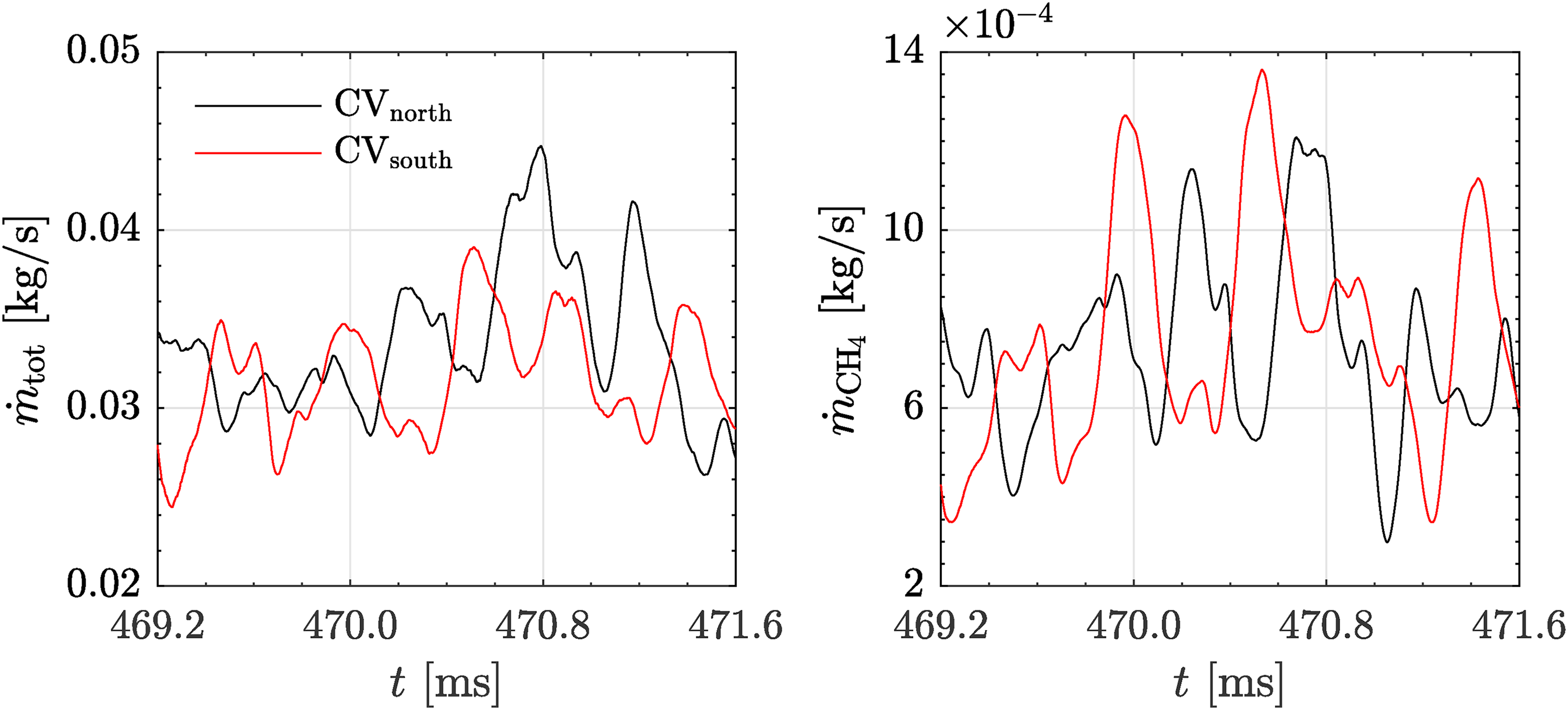
Temporal evolution of the total (left) and methane (right) mass flow rates entering the north (
Finally, the existence of the azimuthal mode may also serve as a possible explanation for the asymmetric behaviour of the flame kernels observed to periodically intrude the ORZ
39
. In the experiments, these kernels penetrated into the upper and lower half of the ORZ region (line-of-sight integrated) with a slight time delay
94
on the order of
Summary and conclusions
The effects of elevated operating pressures on the thermo-acoustic behaviour of the can-type industrial SGT-100 gas turbine combustor were studied using compressible LES. A transported PDF approach solved by the Eulerian stochastic fields method was applied to account for the unknown sgs species formation rates. Two different combustor operating conditions, labelled Cases A (3 bar) and B (6 bar), were simulated. Good qualitative agreement with previous experimental measurement data was found in terms of the global topology and instantaneous structure of the flame. This includes a relocation of the main reaction zone with increasing operating pressure. Despite obtaining a slightly under-predicted flame length and lift-off height in the simulations of Case B, time-averaged and RMS profiles of the velocity, temperature and mixture fraction were also shown to be in good quantitative agreement with the measurements. The combustor’s thermo-acoustic behaviour at both operating pressures was analysed based on time series of the local pressure and global HRR. Both parameters were found to periodically fluctuate in phase with a frequency of 228 Hz, representing a thermo-acoustically coupled limit-cycle oscillation in the longitudinal direction. In line with prior experimental observations, the respective fluctuation amplitudes of the pressure and HRR increased significantly upon increasing the operating pressure from 3 to 6 bar. An FFT analysis further revealed two secondary peaks equidistant on either side of the fundamental thermo-acoustic mode. The predicted frequencies of all three low-frequency modes were in excellent agreement with the available measurement data of Cases A and B. In addition, a high-frequency, low-amplitude azimuthal mode of about 2620 Hz was also identified in both cases, but determined to have virtually no impact on the global flame response. The governing feedback mechanism of the azimuthal mode was subsequently examined in more detail. Its spinning pressure structure was shown to locally modulate the fuel and total mixture mass flow rates entering the main flame region. It was argued that this variation of the incoming reactant stream leads to fluctuations of the local HRR, which in turn perpetuate the spinning pressure mode closing the feedback loop. Future work may include the simulation of modified combustor geometries in an attempt to find ways of damping the observed thermo-acoustic instability, e.g. by breaking the combustor’s axisymmetry.
Footnotes
Acknowledgements
Stathis Karlis, Jim Rogerson, and Suresh Sadasivuni are gratefully acknowledged for the helpful discussions and for providing some of the experimental data.
Declaration of conflicting interests
The author(s) declare no potential conflicts of interest with respect to the research, authorship, and/or publication of this article.
Funding
The author(s) disclosed receipt of the following financial support for the research, authorship, and/or publication of this article: This work was funded by the UKCTRF [Grant no. EP/K026801/1 and EP/R029369/1] and used the ARCHER2 UK National Supercomputing Service ( ). This work was financially supported by Siemens Energy Industrial Turbomachinery Ltd.
Article Note
The following texts are updated in the article.
1. Under the section Numerical method, the text “Therefore, an ensemble of
2. Under the section Test case, the text “The ensuing dump expansion (defined as the combustion chamber entry plane at
Correction (February 2024):
Article updated; for further details please see the Article Note at the end of the article.