




Abstract
We propose a hybrid strategy for modeling non-linear thermoacoustic phenomena, e.g. limit-cycle (LC) oscillations, in can-annular combustion systems. The suggested model structure comprises a compressible CFD simulation limited to the burner/flame zone of one single can, coupled to a low-order model (LOM) representing the remaining combustor. In order to employ the suggested strategy for modeling non-linear phenomena like LC oscillations, the LOM must capture non-linear flame dynamics in the cans, which are not resolved by CFD. Instead of identifying such non-linear flame models in preliminary simulations, we aim at learning the non-linear dynamics “on-the-fly”, while simulating the self-excited system under consideration. Based on the observation of flame dynamics in the CFD domain, the parameters of the employed non-linear models are estimated during run time. The present study reveals that block-oriented models, which comprise a linear dynamic part followed by a static non-linear function, are well suited for this purpose.
The proposed hybrid model is applied to a laminar can-annular combustor. Results agree well with the monolithic CFD simulation of the entire combustor, while the computational cost is drastically reduced. The employed flame models, whose parameters are identified during the simulation of the self-excited LC oscillation, represent well the relevant non-linear dynamics of the considered flame.
Keywords
Introduction
Thermoacoustic combustion instabilities pose a major threat for modern low-emission gas turbine combustion systems. Emerging from constructive feedback of acoustics and flame dynamics they cause oscillations of flow variables, which limit the operational range and may even cause structural damage. It is thus of utmost importance to address thermoacoustic instabilities already in the design phase of a new combustion system. 1 Modern land-based gas turbines are often equipped with can-annular combustion systems. Those configurations feature separate flames in nominally identical cans, which are arranged equidistantly around the circumference of the engine. The individual cans are connected acoustically, e.g. via the so-called annular gap in front of the first turbine stage at the downstream side, and via the compressor exit plenum at the upstream side. 2 This coupling gives rise to azimuthal thermoacoustic modes, which involve all cans simultaneously.3–5 It is thus not possible to model thermoacoustics of can-annular configurations by considering only one can without any further means.6–8 While a fully compressible, reactive LES captures all relevant physical phenomena, the computational cost of resolving an entire applied combustion system is very high, even for a relatively small (annular) configuration9–11 or a two-can setup. 12 During the design process, which is characterized by repeated modifications of the setup, the computational cost of such an approach is prohibitive.
In order to reduce the computational cost, strategies based on Bloch-wave theory 13 have been developed recently. By exploiting the discrete rotational symmetry of typical (can-)annular configurations, the computational domain can be limited to only one can or one sector. Mensah et al. 14 utilized Bloch-wave theory to efficiently calculate the eigenfrequencies of an annular test-rig. Combined with a flame describing function (FDF) this approach was also used to predict the limit-cycle (LC) amplitude with frequency domain methods. 15 Haeringer and Polifke 7 proposed a strategy to utilize Bloch-wave theory in time domain. There, a CFD simulation of one burner/flame zone (or one can) is coupled to a low-order model (LOM), which includes Bloch boundary conditions and thus accounts for the discrete rotational symmetry of the system. This allows the direct and efficient simulation of LC oscillations in (can-)annular configurations, circumventing the costly computation of an FDF and not relying on the assumptions associated with the FDF.
These approaches generally assume that discrete rotational symmetry holds, even for high-amplitude LC oscillations. However, in particular for azimuthally standing waves emerging from degenerate modes, the individual flames are exposed to different amplitude levels causing different levels of non-linear saturation, which breaks the symmetry among the respective cans or sectors. 16 Additionally, only modes of one single azimuthal order can be represented in a single simulation that relies on Bloch-wave theory. On the one hand, this means that multiple simulations are required to assess the stability and to model the LC of all mode orders. On the other hand, possible non-linear interactions of modes of different azimuthal order can not be captured.
In the present study, we propose a hybrid approach similar to that of Haeringer and Polifke 7 , but now the CFD simulation of one can is coupled to a LOM, which explicitly models the remaining combustor. This removes the above mentioned restrictions of the Bloch-wave approach by dropping its central assumption that the acoustic field in the combustor features a certain symmetry.
In order to simulate LC oscillations, the proposed approach has to account for the non-linear dynamics of the flames. While this is inherently the case for the flame resolved by CFD, the LOM must also include non-linear flame models representing the dynamics of all remaining flames. However, non-linear flame models, which are valid for a wide range of frequencies and amplitudes - the relevant frequencies and amplitudes are typically not known in advance - are generally very costly to determine17–19 or are only of qualitative nature. 20 Instead, here we propose to identify the non-linear flame models “on-the-fly”, based on a linear model of flame dynamics plus observations of non-linear flame dynamics in CFD during the simulation of the self-excited configuration. The resulting flame model will in general only be valid for the frequencies observed in the respective simulation. This, however, allows the use of relatively simple model structures and limits the amount of data needed for identification.
Recently, Yu et al.21–23 investigated a related approach. Yu et al. employed data assimilation techniques for online identification of state and parameters of a level-set based flame model, in order to match the dynamics of the identical flame resolved in CFD. Although there are similarities to the present approach, note that Yu et al. aim to match the dynamics of the same flame resolved in CFD, while our goal is to learn the dynamics of a different flame, which has only the same characteristics as the resolved one but is in general subjected to a different input. Instead of achieving an exact one-to-one match with the CFD observation, which requires parameter and state identification, the goal of the present approach is to constantly improve the model by merely online parameter identification.
The structure of the paper is as follows: In Sec. “Hybrid modeling approach”, the proposed hybrid strategy is introduced in detail. Afterwards, Sec. “Flame model structure…” deals with the non-linear flame model structure chosen in this study and the online identification of its parameters. In Sec. “Application to generic can-annular combustor” the results of the proposed strategy applied to a “toy model” are presented and compared to results from monolithic CFD of the entire combustor. A conclusion and a short outlook are presented in Sec. “Conclusion”.
Hybrid modeling approach
The general strategy is depicted in Figure 1. A fully compressible, reactive CFD simulation of the burner/flame zone in one can is coupled to a LOM of the remaining combustor, which represents acoustics and flame dynamics of all components not resolved by the CFD. To abbreviate the notation in the following, the parts resolved in the CFD domain are denoted “resolved”, while all remaining parts of the combustor are denoted “modeled”.
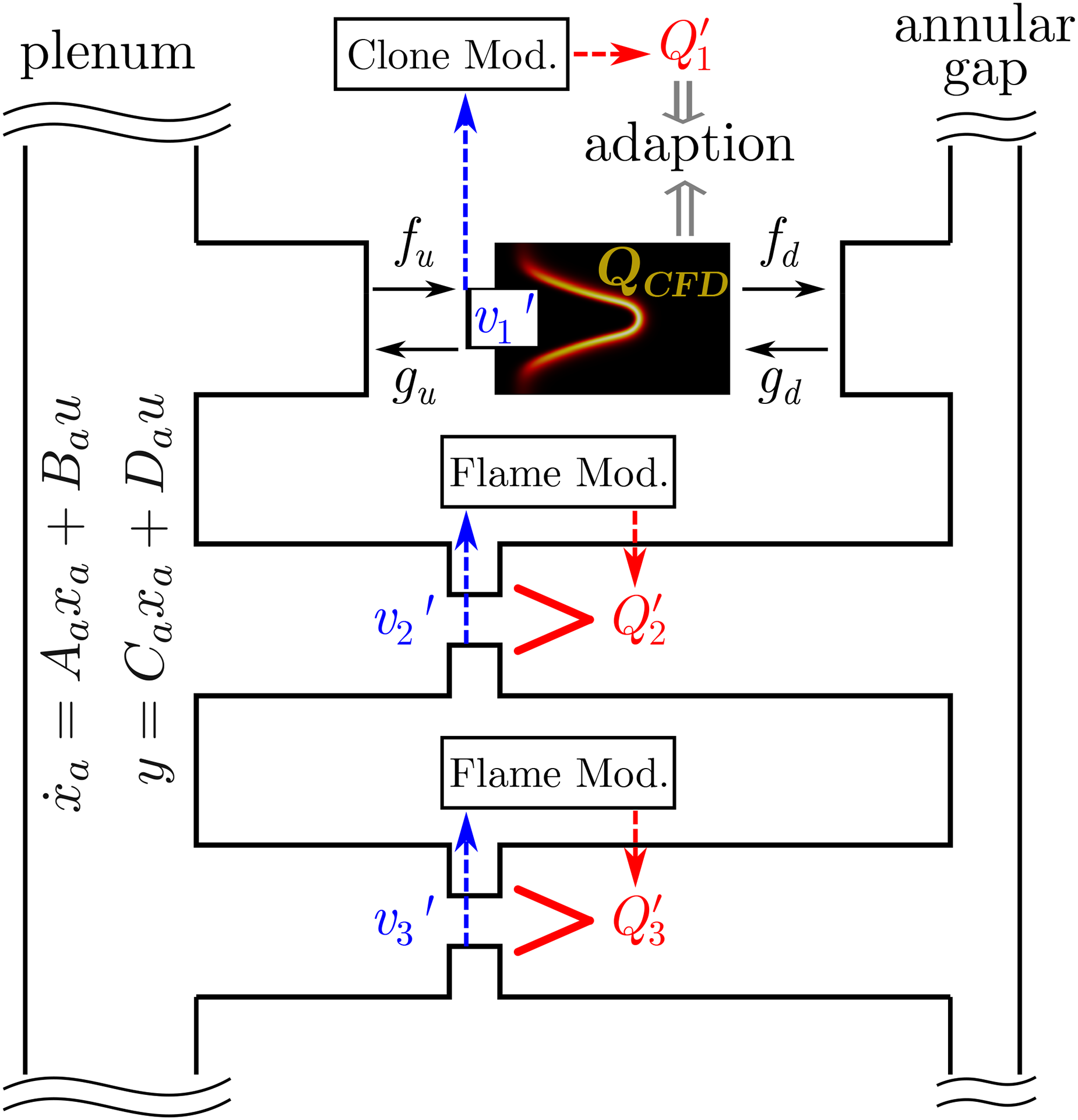
Schematic of the proposed hybrid approach. Compressible CFD coupled to linear acoustic model via CBSBC. Flame models are connected with acoustic model and adapted according to the observation in CFD and “clone model”.
The present strategy can be seen as an extension of the hybrid modeling approach proposed by Jaensch et al. 24 . By employing characteristic-based state-space boundary conditions (CBSBC), 25 Jaensch et al. coupled a compressible CFD simulation of a laminar slit flame 1 to an acoustic LOM of the remaining single-burner combustor. The resulting hybrid model could well represent non-linear thermoacoustic oscillations of the considered single burner combustor. In the present study, we again employ CBSBC to couple compressible CFD and LOM. What distinguishes the present work from the study of Jaensch et al., is that in the present work the hybrid model represents a multi-burner configuration and thus the LOM comprises not only linear acoustic elements but also non-linear flame models.
The CBSBCs couple a compressible CFD simulation with general linear acoustic models via the plane acoustic waves



The non-linear flame models are adapted “on-the-fly”, based on the observation of the resolved flame dynamics. Generally, we assume nominally identical flames within each can. However, this does neither imply identical current states of all flame models, nor identical in-/output behavior of all flames. This is a result of the nature of azimuthal modes present in can-annular combustors. They generally result in non-identical acoustic states in the individual cans. If degenerate modes form azimuthally standing waves, they even cause different amplitude levels in the individual cans, which affects the amplitude dependent in-/output behavior of the non-linear flame models. 16 Thus, the parameter adaption is based on a “clone model” (see Figure 1), which is fed with the same input as the resolved flame, thus ensuring that the model is exposed to the same amplitude level and the same acoustic state as the resolved flame. Based on the output of the “clone model” and the resolved flame, the model parameters are estimated and applied to all other flame models.
The identified non-linear dynamics will in general only be valid in the vicinity of the simulated trajectory of the self-excited system and the proposed approach will not yield a general non-linear flame model, which is valid for all frequencies, amplitudes, and operating conditions. This, however, is not the goal of the proposed strategy, as we only want to find the stable LC of the considered system.
Due to the coupling of CFD and LOM via CBSBC, the considered modeling strategy is limited to plane acoustic waves at the interface between CFD and LOM. While this is not a severe restriction for typical can-annular combustors,
8
this limitation will inhibit the application of the present strategy to annular combustors. Note that this limitation is only caused by the coupling framework employed here and is not a general limitation of the proposed hybrid strategy. Using a different coupling framework based on heat release rate
Flame model structure and online parameter adaption
The flame models employed for the present purpose must meet the following requirements. They must
feature non-linear dynamics, in particular saturation of gain (and possibly change in phase) for high input amplitudes. Other non-linear effects like the generation of higher harmonics and cross-frequency coupling are desired as well. accurately represent linear dynamics (in the limit of zero input amplitude) for a wide frequency range. This ensures the correct stability properties of the considered system. depend only on a few free parameters because the amount of training data available during identification “on-the-fly” is limited. allow training of the free model parameters without heavy computations, as this would slow down the entire simulation.
Among all available model structures, block-oriented non-linear models meet the above requirements best (see e.g. Schoukens and Tiels
26
for an overview of block-oriented models and their identification). Commonly, block-oriented non-linear models are applied for systems with separable linear and non-linear dynamics, e.g. to account for non-linear sensor or actuator characteristics.
27
This is clearly not the case here. The separation has no physical motivation, but is convenient for the present purpose and captures the essential features of non-linear flame dynamics, as shown in Sec. “Application to…”.
We choose a so-called “Wiener-model” structure,
28
where a linear dynamic model part is followed by a static non-linear function as illustrated in Fig 2. Here, the dynamic linear model is denoted as flame transfer function (FTF) and represents linear flame dynamics for a large frequency range. It thus governs the linear stability properties of the considered configuration. The FTF is measured or identified in advance using established system identification techniques
29
and it is not modified during the simulation. Instead, only the parameters

Wiener-type flame model comprising a linear time-invariant dynamic part (FTF) and a static non-linear function correcting the linear model output
We consider perfectly premixed velocity sensitive flames. In frequency domain (

The transfer function

For the static non-linear part of the model, a variety of different functional forms are conceivable, but they have to meet the requirements stated above. According to our observations the algebraic function


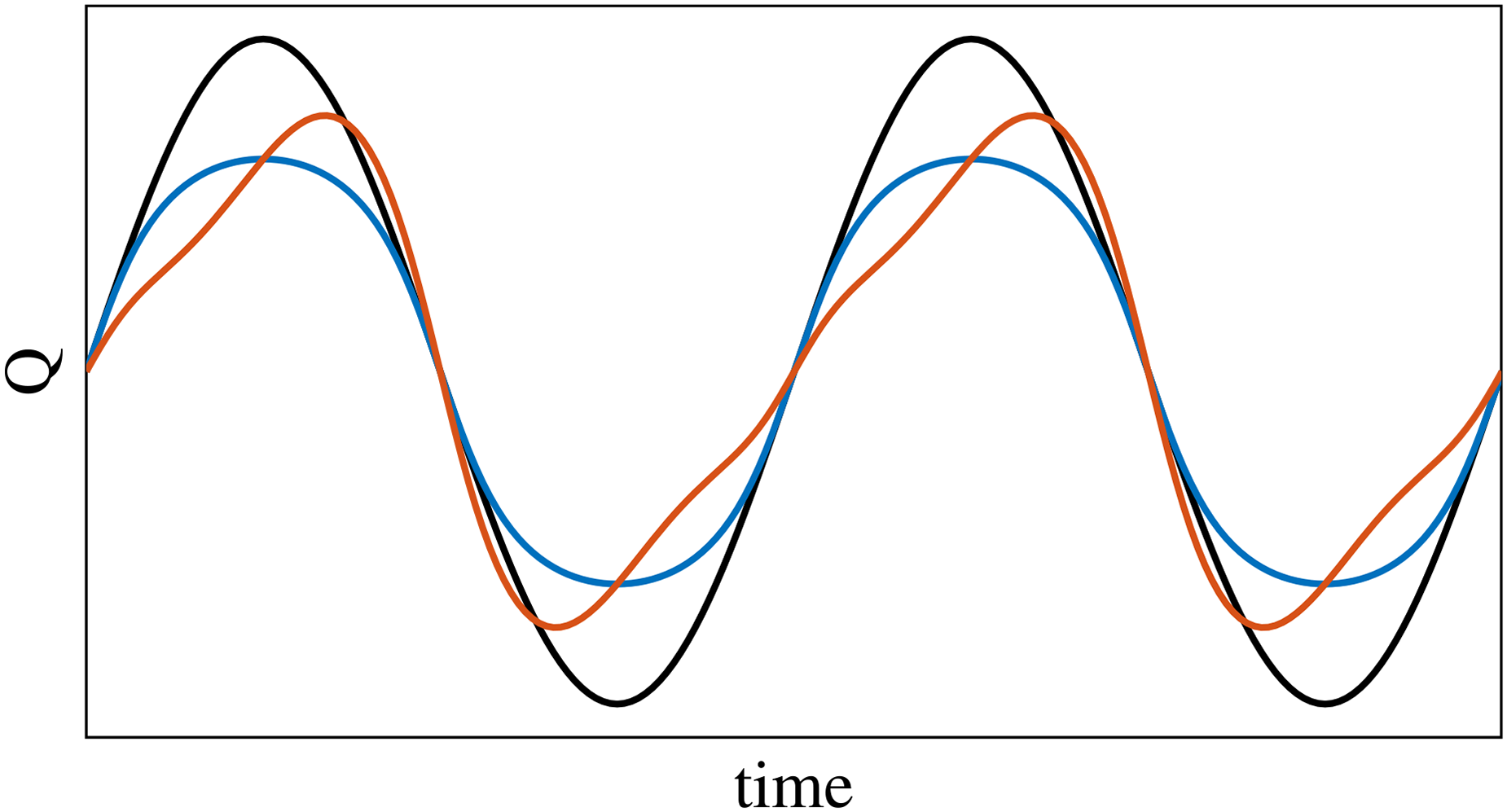
Output of static non-linear function (red) with exemplary
The drawback of the considered static non-linear function is, that it can not modify the phase of the linear model output. This could be achieved by choosing a different model structure. However, as shown in Sec. “Analysis of adapted flame model”, this does not seem to be necessary for the considered configuration, because there the phase of the flame response changes only slightly with amplitude.
32
Linearizing the static non-linear function yields the relation


The output of the static non-linear function is controlled by the tuning parameters

Equation (10) demonstrates the advantage of a block-oriented non-linear model structure for the present purpose. The optimization routine relies on stored time-series from CFD and linear model output, which are independent of the parameters
Application to a generic can-annular combustor
Setup
The proposed hybrid approach is applied to a quasi-2D laminar premixed can-annular combustor with 4 cans and is validated with the results from a compressible CFD simulation of the entire configuration, hereafter referred to as “monolithic” CFD simulation. The considered combustor can be seen as a “toy model”, for which a CFD simulation of the entire combustor is feasible.
We consider the exact same configuration as in Haeringer and Polifke 7 . This allows a direct comparison of the results from the hybrid time-domain Bloch-wave approach of Haeringer and Polifke with the present results. The configuration investigated in Haeringer and Polifke and in the present study is similar to that illustrated in Figure 1. The 4 cans of the combustor contain laminar slit flames and are coupled by an upstream plenum. Instead of the annular gap in the generic setup shown in Figure 1, the cans are terminated with acoustically open ends at the downstream side.
For the monolithic CFD simulation, the entire combustor is discretized with
The FTF needed for the flame model structure illustrated in Figure 2 is taken from a previous study,
36
which investigated the same burner/flame zone. The parameters of the static non-linear function are initialized with
Comparison with monolithic CFD
Figure 4 shows the time traces of heat release rate in all individual cans obtained from monolithic CFD. The simulation starts with the simultaneous ignition of all flames. The initial transient resulting from ignition is excluded from this view. Figure 5 shows the same results obtained with the proposed hybrid approach. Here the simulation starts from a nearly converged mean-field and zero acoustic
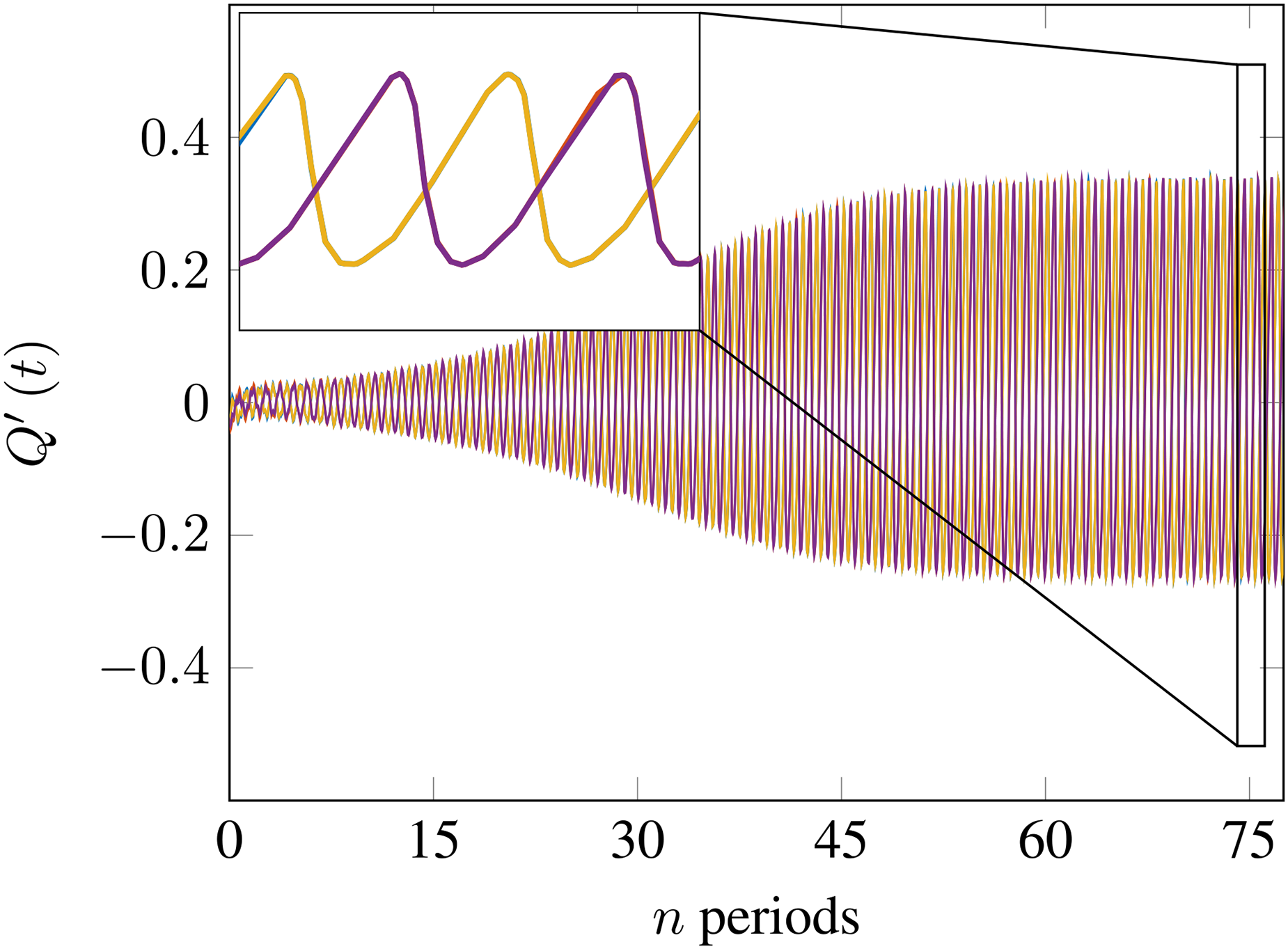
Heat release rate fluctuations in all cans obtained with monolithic CFD.
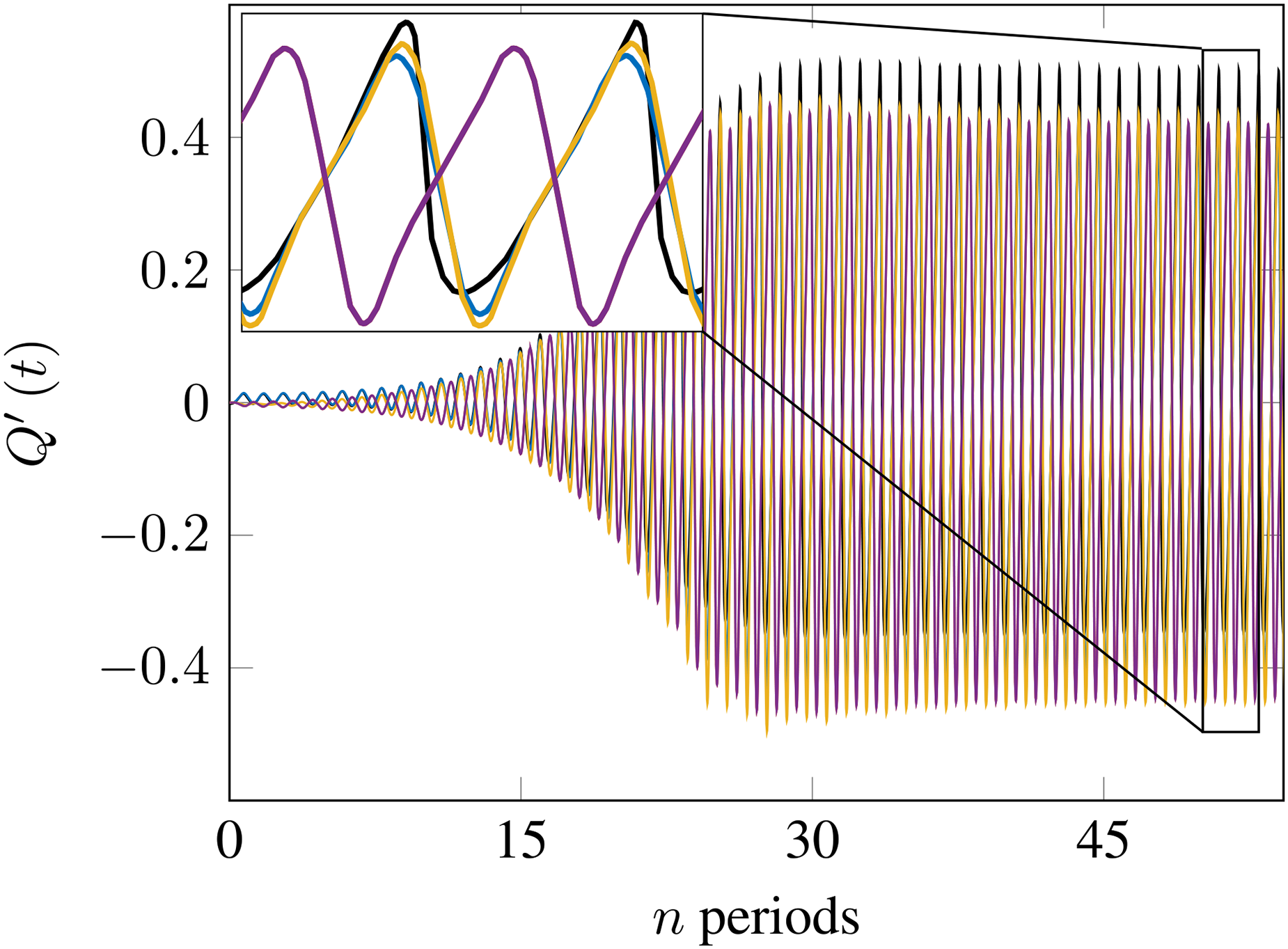
Heat release rate fluctuations in all cans obtained with hybrid model (c.f. Figure 1).
For both approaches, the configuration is linearly unstable, which leads to exponential growth of oscillation amplitudes and the formation of a stable LC oscillation. The heat release time-series are characteristic of a so-called “push-pull” mode, which is in the present 4-can configuration a mode of azimuthal order
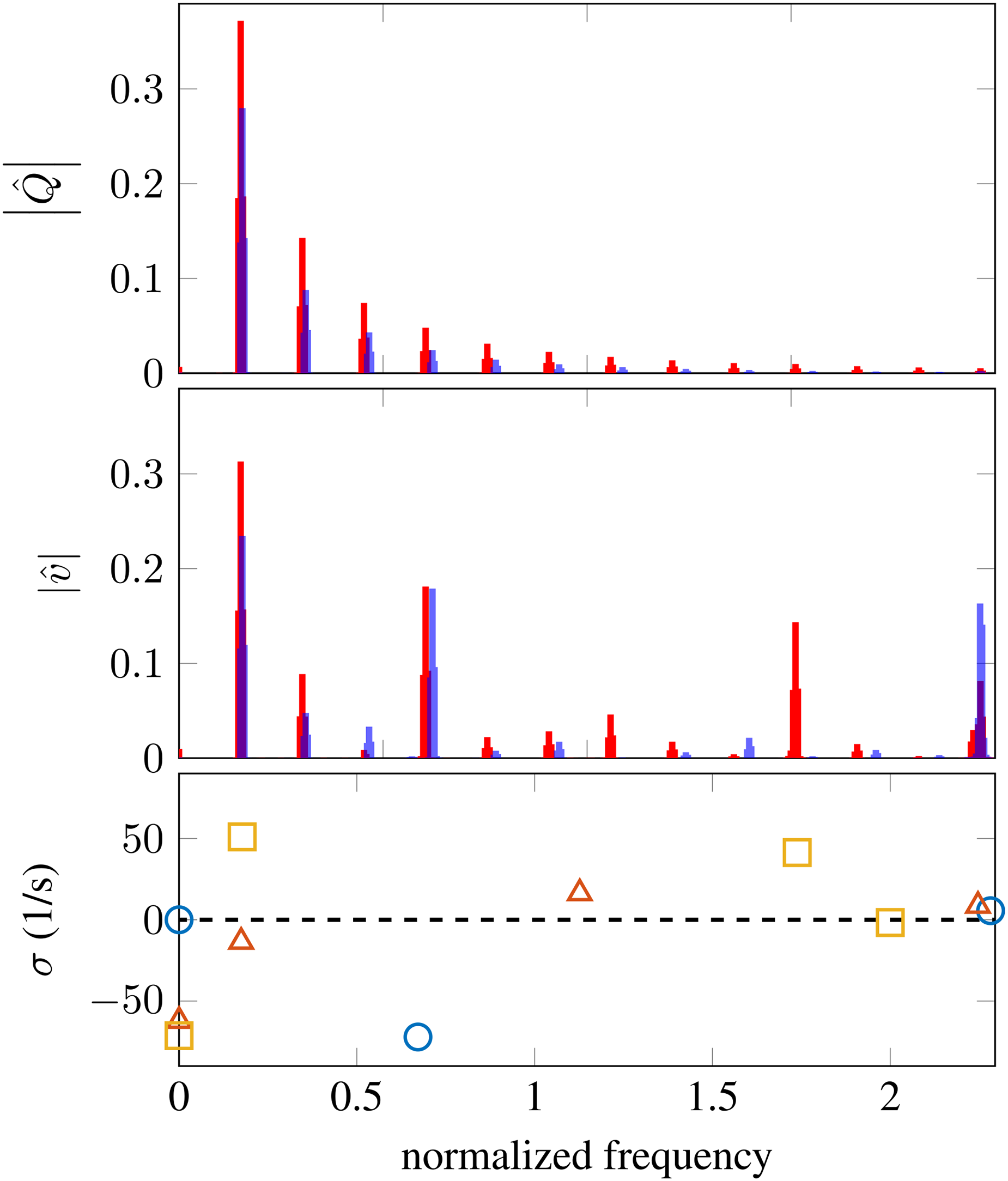
LC spectrum of heat release rate (top) and reference velocity (middle). Hybrid approach in red, monolithic CFD in blue. Result of linear stability analysis (bottom) shows eigenmodes of azimuthal order
Considering Figure 5, the hybrid approach reproduces the oscillation pattern well. The time traces of the two opposing modeled flames
The hybrid model clearly overestimates the LC amplitude level. Possible reasons are discussed in Sec. “Analysis of the adapted flame model”. Additionally, it features a higher growth rate
The spectral analysis of the LC oscillations in the monolithic CFD and the hybrid model shown in Figure 6 is in line with the outcome of the previous analysis. The top plot in Figure 6 compares the LC spectrum of heat release rate
The bottom plot of Figure 6 shows the eigenfrequencies of the configuration obtained from linear stability analysis. The dominant unstable mode is a
The further peaks observed in the top and middle plot of Figure 6 are higher harmonics of the unstable “push-pull” mode. Due to resonance, the harmonics are amplified in the vicinity of other eigenfrequencies.
32
The LC obtained from monolithic CFD shows distinct resonances only with the axial
Comparison with Bloch-wave approach
Here we compare the present results with those of the hybrid time-domain Bloch-wave approach of Haeringer and Polifke
7
. As the CFD domain is identical in both approaches, the computational cost of one simulation is comparable. Note, however, that if the dominant azimuthal mode order is not known in advance, multiple simulations are necessary to investigate all mode orders
Figure 7 shows the LC amplitude spectrum of heat release rate and reference velocity obtained with the Bloch-wave approach at
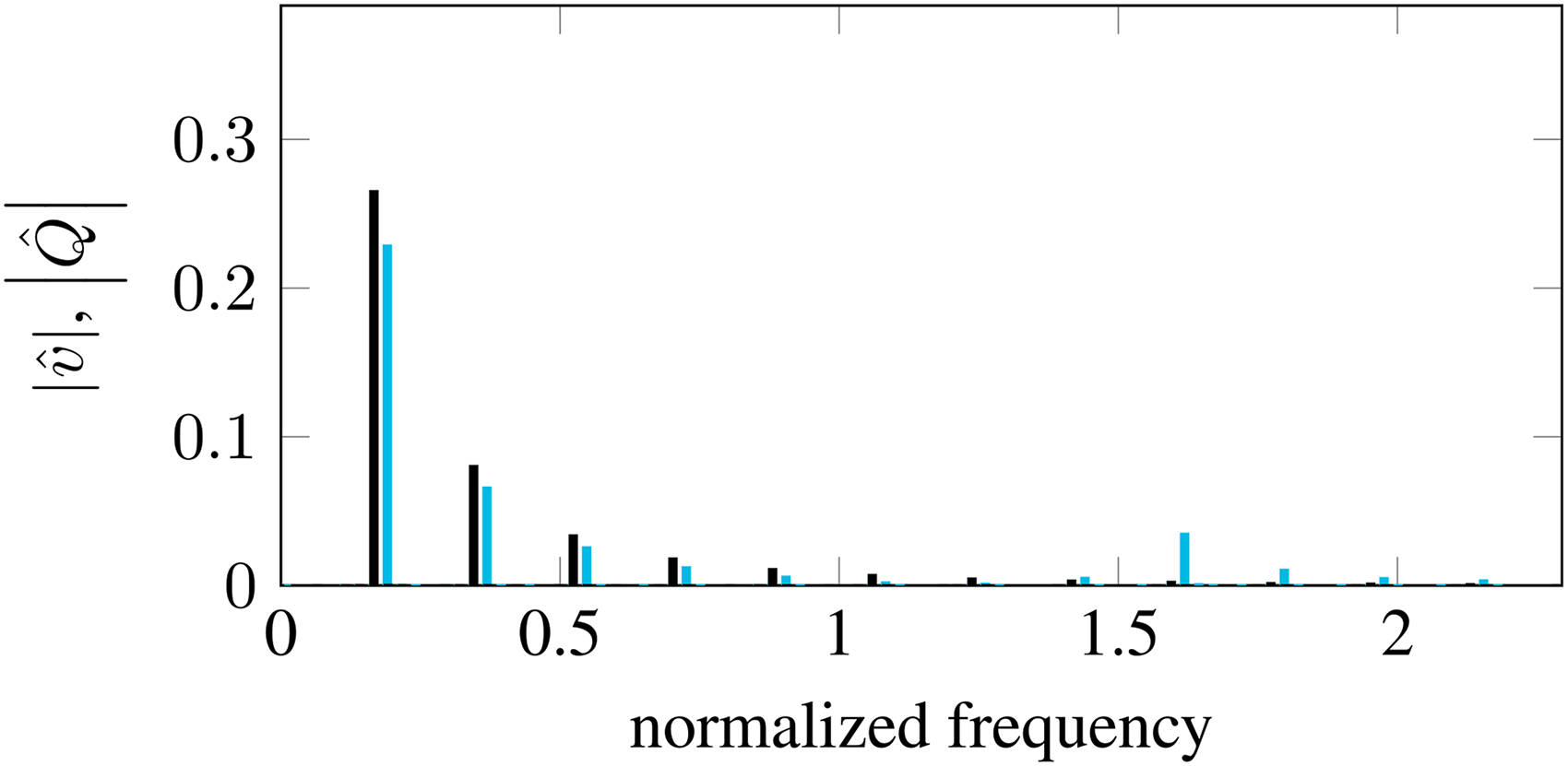
LC spectrum of heat release rate (black) and reference velocity (blue) obtained from Bloch-wave approach with
To summarize, compared to the Bloch-wave approach, the present approach is less accurate in predicting the LC amplitude of an isolated azimuthal mode, which does not break the symmetry of the system. On the other hand, it is more general and computationally more efficient.
Analysis of adapted flame model
The parameters identified “on-the-fly” converge smoothly to final values of
As stated in Sec. “Hybrid modeling approach”, the identified flame model will in general only be valid in the vicinity of the system trajectory observed in the simulation. Thus, comparing the model frequency response with the xFDF for a large frequency range is pointless. Instead we compare in Figure 8 the in-/output relation of adapted model and xFDF only for the observed dominant frequency
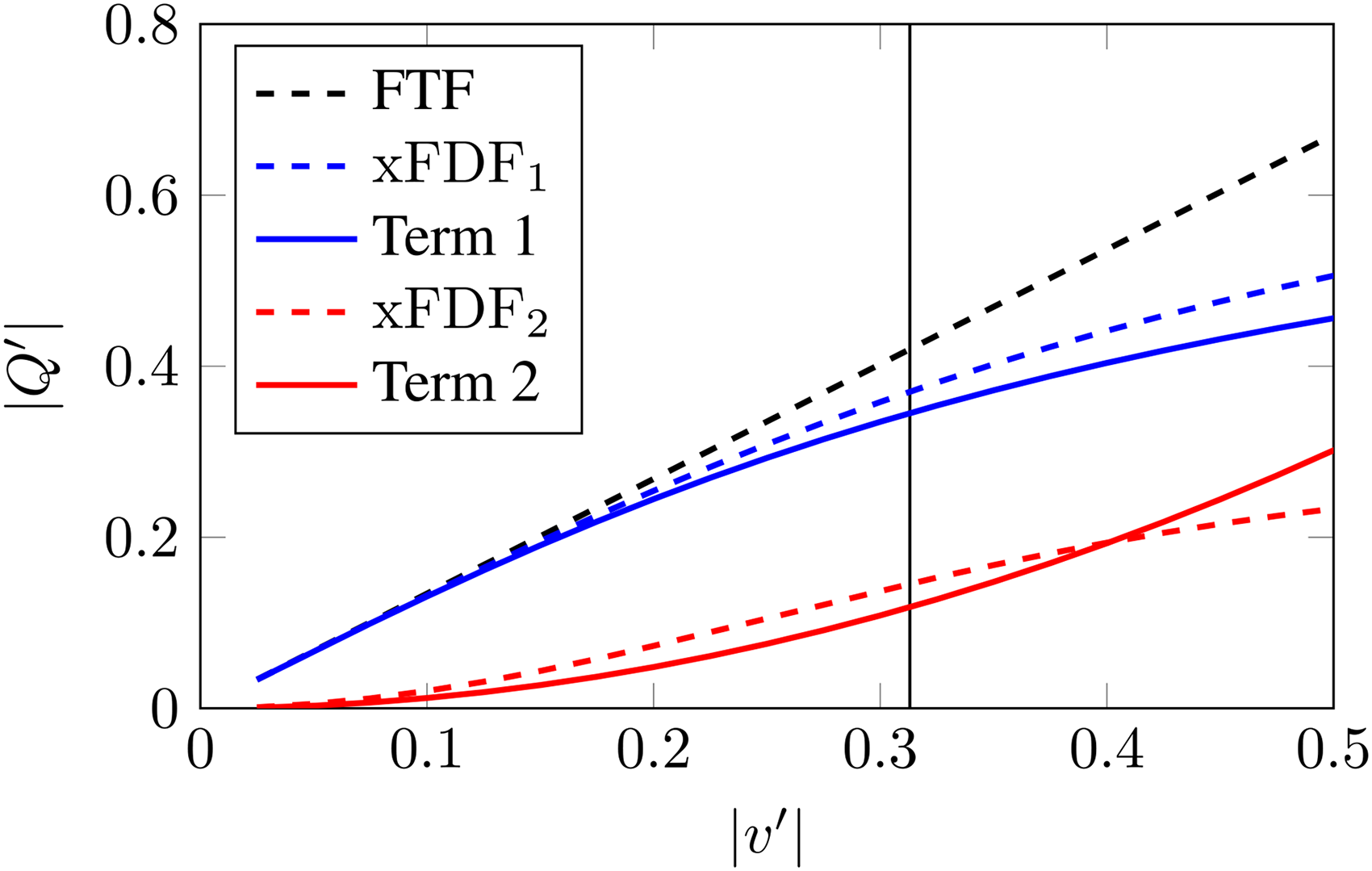
In-/output relation of adapted flame model, first two xFDF describing functions and FTF at LC frequency
Overall, the results shown in Figure 8 confirm that the “on-the-fly” parameter identification works as intended. However, the question remains why the LC amplitude is overestimated by the hybrid model, especially because the non-linear saturation of the adapted flame model is even slightly bigger than that of the xFDF.
We identify two possible reasons for the over-estimation of the LC amplitude. First, the employed model structure can not adapt to changes in the flame response phase. However, as the unstable mode is of ITA origin, any changes in phase would directly reflect to the oscillation frequency. But as the LC frequency is almost identical to the linear eigenfrequency, changes of phase with amplitude seem to be negligible. Second, the employed LOM only includes linear acoustic losses at the burner plate, which are very small for the considered configuration. During the LC, non-linear acoustic losses at the burner plate may, however, play a significant role, especially in relation to the negligible linear losses. To address this problem in future work, one might include a model for these non-linear losses and identify its parameters “on-the-fly”, just like it is done for the flame model.
Conclusion
We propose a hybrid approach for the efficient simulation of limit-cycle (LC) oscillations in can-annular combustors. The suggested hybrid model couples a CFD simulation of the burner/flame zone of one can with a low-order model (LOM) of the remaining combustor.
In order to account for non-linear thermoacoustic phenomena, for example the formation of LC oscillations, the LOM must include non-linear flame models. The tedious and costly identification of such models in preceding simulations is avoided by identifying them “on-the-fly” during the simulation of the self-excited system under consideration. Due to the much smaller CFD domain, the computational cost is massively reduced compared to a monolithic CFD simulation of the entire combustion system. This allows the application of the proposed approach for predicting thermoacoustic LC oscillations already in the design phase of a new combustion system.
The presented hybrid model shares similarities with the time-domain Bloch-wave approach proposed by Haeringer and Polifke 7 , especially regarding the reduction of the CFD domain to one burner/flame zone. While the Bloch-wave approach assumes perfect symmetry of the considered system and yields more accurate predictions if this assumption applies, the present approach is more generally applicable.
The capabilities of the suggested hybrid approach are demonstrated by applying it to a laminar 4-can “toy model” combustor and by validating it with monolithic CFD. A possible next step for future work is to apply the modeling framework to a realistic turbulent can-annular combustor. This requires incorporating a noise model in the flame model structure in order to capture resonances of turbulent combustion noise. 37 The present study focuses on can-annular combustors. However, while following the same general strategy, one may simply replace the coupling of CFD and LOM via CBSBC with a coupling based on reference velocity and heat release rate, which does not rely on plane acoustic waves at the CFD boundaries. 24 This would make the proposed strategy also applicable to annular configurations.
Footnotes
Acknowledgements
We appreciate Stefan Jaensch’s valuable contributions to the development of the general idea. The authors gratefully acknowledge the Research Association for Combustion Engines (Forschungsvereinigung Verbrennungskraftmaschinen e.V. FVV, project number 6012700) for the financial support to Matthias Haeringer and the compute and data resources provided by the Leibniz Supercomputing Centre ( ).
).