



Abstract
Background:
Coeliac disease (CeD) is a chronic immune-mediated disease triggered by exposure to dietary gluten in genetically predisposed individuals. The burden of CeD on patients and the healthcare system remains poorly evaluated in Germany.
Objectives:
To assess the healthcare resource utilisation (HCRU) and costs of diagnosed CeD patients in a German claims database.
Design:
A retrospective CeD case–control study was conducted using German claims data between 2017 and 2021.
Methods:
CeD diagnosis was defined by at least one inpatient or two outpatient diagnostic codes (International Statistical Classification of Diseases and Related Health Problems, 10th Revision, German Modification (ICD-10-GM) K90.0) within four quarters (irrespective of calendar year) for CeD during the study period. Controls (non-CeD patients) were matched in a ratio of 5:1 by age, Charlson Comorbidity Index, sex and region. HCRU (hospitalisations, outpatient visits, medication use, sick leaves) and healthcare costs (outpatient services, inpatient services, outpatient pharmaceuticals, sick leaves and aids and remedies) were compared between CeD patients and controls.
Results:
From the 3,352,188 patients with continuous enrolment during the study period (2017–2021), 8258 (0.25%) patients were identified as having a CeD diagnosis. The mean number of hospitalisations and outpatient visits within 5 years was 1.8- and 1.5-fold higher among matched CeD patients (n = 8243) compared to their controls (n = 41,215), resulting in an excess healthcare cost of €5251. Inpatient expenses were the main cost driver and accounted for 31.5% of total incremental costs.
Conclusion:
The current study showed that CeD patients have considerably higher HCRU and related costs compared to matched controls. Our findings suggest the need for improved treatment options for CeD patients in addition to a gluten-free diet.
Plain language summary
Coeliac disease (CeD) is a serious illness where the body reacts to gluten found in food. In Germany, the effects of CeD on patients and the healthcare system are not well-known. We aimed to find out how much healthcare resources and money were used to treat people with CeD in Germany. Health insurance data from 2017 to 2021 were analysed. Out of a population of about 3 million individuals observable in the database, over 8,200 patients with CeD were identified and compared to those without CeD but had similar age, sex, region of residence, and other illnesses. The study revealed that over five years, patients with CeD had more hospital visits and outpatient appointments compared to those without CeD. This led to an extra cost of €5,251 per patient. Most of this cost came from hospital stays. This suggests that better care and treatments are needed for CeD patients beyond just following a gluten-free diet. Improving care for CeD patients might enhance their quality of life and help to reduce healthcare costs in the long run.
Introduction
Coeliac disease (CeD) is a chronic immune-mediated disorder that leads to small intestinal mucosal damage after exposure to gluten in genetically predisposed individuals. 1 Manifestations range from severe gastrointestinal symptoms, including malabsorption and anaemia, to mild intestinal and often also extraintestinal symptoms.1–3 The global prevalence of CeD is between 1% and 2% in most populations.1,4 This includes high prevalence in Europe, the Americas and most of China and India.5–7 The local prevalence of CeD in Germany was estimated at 0.9% determined from a combination of serological findings and clinical histories, 8 which is similar to reported prevalence in most other countries.
To date, the only treatment of CeD is a gluten-free diet (GFD). However, 20%–40% of patients remain symptomatic despite a strict GFD, often accompanied by incomplete mucosal healing, highlighting the need for nondietary therapy.9–11 Moreover, most CeD patients remain undiagnosed or are diagnosed many years after the first symptoms.12–14 Accordingly, CeD has a substantial impact on well-being, social interactions, anxiety and depression and relationships, mainly due to fear of inadvertent gluten contamination when dining out, or of complications of CeD, such as refractory CeD or intestinal T-cell lymphoma.15–17 Furthermore, CeD imposes a significant burden on healthcare systems due to increased healthcare resource utilisation (HCRU) and costs.18–21 While there are some in-depth economic analyses from the United States,18,21 United Kingdom, 22 Israel 23 and Sweden, 19 to the best of our knowledge there is no extensive study for Germany covering diagnoses prevalence, HCRU and costs of CeD. Here we assessed diagnosed prevalence rate and additionally compared HCRU and costs of diagnosed CeD patients in Germany, a country with a CeD prevalence comparable to other EU countries8,24 and a good healthcare system, 25 versus matched controls using a large database of key healthcare payers and providers.
Methods
Study design
The present retrospective CeD case–control study spanned from 1 January 2017 to 31 December 2021 using German Statutory Health Insurance (SHI) claims data from the ‘Institute for Applied Health Research Berlin’ (InGef), and captured the latest 5 years available in the database at the time of study initiation. The HCRU and healthcare costs of diagnosed CeD patients and matched controls (non-CeD patients) that occurred within the 5-year study period (2017–2021) were compared.
Data source
The InGef research database comprises anonymised claims data from approximately 4 million individuals representing the German population in terms of age, sex and region.26,27 The research database represents approximately 4.8% of the German population 28 and 5.5% of the SHI population 29 as of 2021. The InGef database has proven to have good external validity to the German population in terms of morbidity, mortality and medication use.26,27 The database encompasses information on a range of different healthcare areas such as the inpatient, outpatient and the pharmacy sector.
Claims data from the participating SHIs are joined in a specialised trust centre, anonymised and transferred to InGef before the data are made available for research. As the raw dataset is not allowed to leave the secured storage facilities, all analyses for this study were performed by InGef staff based on the pre-specified study protocol. Only aggregated results were provided. In accordance with the ‘GPS – Good Practice in Secondary Data Analysis’ (Guideline 1: Ethics), 30 the analysis of German claims data from the SHI does not require the approval of an independent ethics committee.
Study population
To identify diagnosed patients in the timeframe between 1 January 2017 and 31 December 2021, patients were required to have continuous enrolment during this timeframe (this included patients who were born between 2017 and 2021). Coeliac diagnosis was defined by at least one inpatient (primary or secondary discharge diagnosis) or two outpatient diagnostic codes (recorded diagnostic certainty: ‘verified’) within four quarters (irrespective of calendar year) for CeD (International Statistical Classification of Diseases and Related Health Problems, 10th Revision, German Modification (ICD-10-GM) code K90.0) during the study period (2017–2021).
Statistical analysis
Diagnosed CeD patients were compared to controls without CeD with respect to HCRU as well as healthcare costs via an individual matching approach. Matching was based on the variables age (in years at diagnosis), sex, region (rural, urban; between 2017 and 2021 as a region with the longest residence) and Charlson Comorbidity Index (CCI; 0, 1, 2, 3, 4+; between 2017 and 2021). The CCI is a tool designed to predict the risk of mortality and health outcomes based on the presence of comorbid conditions (e.g. heart failure, chronic obstructive pulmonary disease, diabetes, cancer), where a higher score indicates a higher comorbidity burden. 31 Each individual in the CeD cohort was matched on a fixed ratio of 1:5 to the control cohort. Controls were required to have continuous enrolment for the whole study period. Potential controls with at least one inpatient or outpatient diagnosis of dermatitis herpetiformis (ICD-10-GM code: L13.0) were excluded. Identified patients were stratified by the following age groups: <6, 6–11, 12–17, 18–67 and >67 years. Differences between the matched groups were tested for statistical significance by applying the Chi-square test for categorical variables and the unpaired t-test for continuous variables. A p-value of less than 0.05 was considered statistically significant. Statistical analysis was performed with R-studio version R-4.0.2, © 2019-2024 Posit Software, PBC.
Categorical outcomes were presented as frequencies (numbers and percentages). Continuous outcomes were summarised by providing the mean, standard deviation (SD), median, 25th percentile (Q1) and 75th percentile (Q3). HCRU was assessed in terms of hospitalisations, outpatient visits, outpatient pharmaceutical prescriptions and sick leaves. Hospitalisations were analysed as the number and proportion of patients with at least one hospitalisation as well as the frequency of hospitalisations, and length of hospital stay. All-cause hospitalisations were determined, that is, every hospital admission was considered, and no specific primary or secondary diagnosis was required. Outpatient visits were approximated as days with performed services/procedures identified by official EBM codes, which is the Official German Remuneration Scheme for Outpatient Care. The EBM catalogue serves as the binding billing basis for contracted physicians and psychotherapists in Germany and includes all items in the doctor’s fee schedule that are billable in outpatient medical care (including respective monetary value). 32 In case two EBM codes were recorded by the same physician on the same day, it was counted as one visit. Outpatient visits were analysed as the number and proportion of patients with at least one physician visit as well as the frequency of physician visits overall and for general practitioner, gastroenterologist and paediatrician. Outpatient pharmaceutical prescriptions were analysed as number of filled prescriptions and proportion of patients with at least one outpatient pharmaceutical prescription identified by 7-digit Anatomical Therapeutic Chemical (ATC) classification codes (standardised system used to categorise drugs and medications based on their anatomical and therapeutic properties). 33 Sick leaves were analysed as the number and proportion of employed patients with at least 1 day of sick leave as well as frequency of sick leave days. In Germany, the costs of sick pay are covered by the SHI from the seventh week of sickness. Healthcare costs included the cost domains outpatient services, inpatient services, pharmaceuticals in the outpatient setting, sick leave and aids and remedies, and were analysed in total as well as by cost domain. The timeframe for HCRU and cost comparisons was the full 5-year study period.
Due to missing data in the domain of aids and remedies (less than 5% of patients) as well as sick leave (less than 1% of patients), a single imputation by mean was applied for patients with invalid data using the mean of patients with valid data.
Reporting
The reporting of this study was conducted in accordance with the Strengthening the Reporting of Observational Studies in Epidemiology (STROBE) statement for cohort studies (Supplemental Material File 1). 34
Results
Study population
Overall, 3,352,188 patients were continuously enrolled between 2017 and 2021 in the database and were evaluated for a diagnosis of CeD. Thereof, 8258 patients (corresponding to a prevalence rate of 0.25%) fulfilling the case definition of CeD were identified, of which the majority were female (70.3%). The mean (SD) age at diagnosis was 37.4 (22.3) years. Children (<12 years), adolescents (12–17 years) and adults (⩾18 years) accounted for 16.2% (n = 1337), 9.5% (n = 782) and 74.3% (n = 6139) of all identified patients, respectively. During the matching process, 8243 out of the 8258 patients (99.8%) were retained (see Figure 1), which were matched to 41,215 controls.
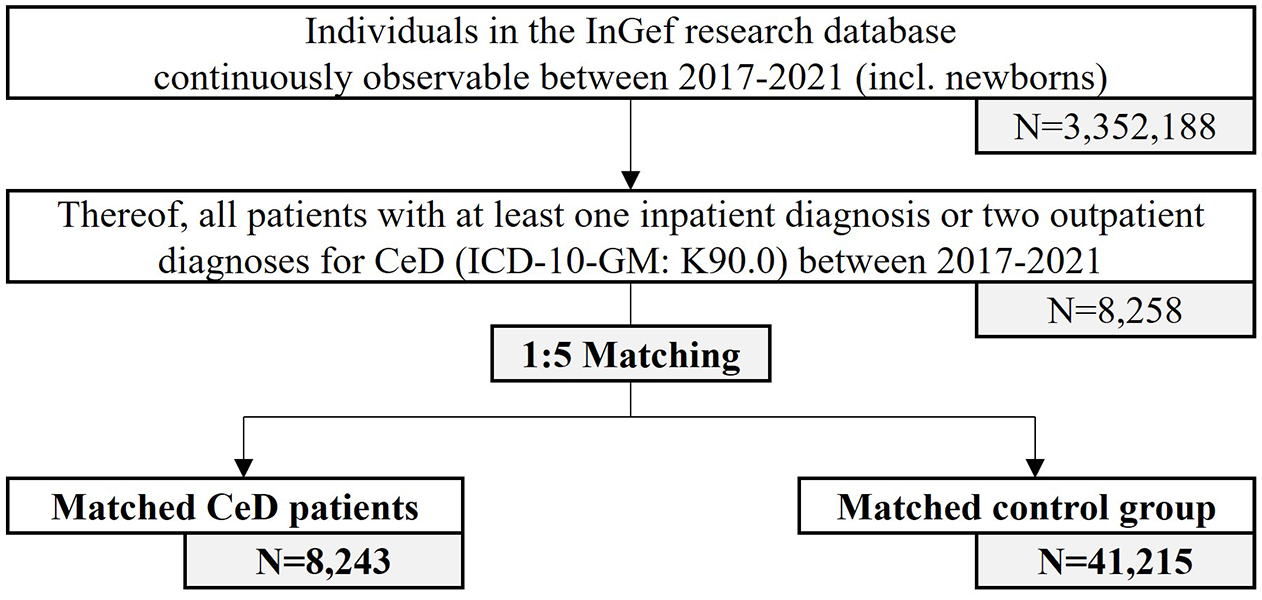
Patient selection process.
Detailed patient characteristics of diagnosed CeD patients after matching are shown in Table 1.
Participant demographic and clinical characteristics comparing CeD patients versus controls.

CCI, Charlson Comorbidity Index; CeD, coeliac disease, n, number; Q1, 25th percentile; Q3, 75th percentile; SD, standard deviation.
Healthcare resource utilisation
During the 5-year study period (2017–2021), diagnosed patients with CeD had significantly higher HCRU compared to the controls with respect to more frequent hospital visits as well as longer hospital stays, more frequent outpatient visits, outpatient pharmaceutical prescriptions and longer duration of sick leave (see Table 2).
Healthcare resource utilisation of diagnosed CeD patients the during 5-year study period (2017–2021).

Absolute difference between groups. Please note that figures were commercially rounded, which may result in minor calculation differences.
CeD, coeliac disease, n, number; Q1, 25th percentile; Q3, 75th percentile; SD, standard deviation.
Hospitalisation rates comparing CeD patients versus controls were 67.5% versus 48.1% (p < 0.01). The mean number of hospitalisations (calculated for the whole sample) was 1.4 hospitalisations higher among CeD patients (2.9 vs 1.6 hospitalisations; p < 0.01). The average time patients spent in the hospital (calculated only for patients with a hospitalisation) was 6.1 days longer for CeD patients (35.4 vs 29.3 days, p < 0.01). Similarly, the mean number of outpatient visits was 32.9 visits higher among CeD patients compared to the control group (106.0 vs 73.1 visits, p < 0.01; see Table 2), as also reflected by visits to general practitioners (37.5 vs 28.7 visits, p < 0.01) and gastroenterologists (1.4 vs 0.4 visits, p < 0.01; Supplemental Material File 2). CeD patients had, on average, 8.7 more outpatient prescriptions than their controls (47.2 vs 38.5 prescriptions, p < 0.01; see Table 2), with higher prescription rates for iron preparations (ATC code: B03A-), steroids (ATC codes: H02A-) and antidepressants (ATC code: N06A-; see Supplemental Material File 3), and pre-defined selected functional gastrointestinal disorders, which are shown in Table 3. CeD patients had a 9.5 days longer sick leave duration compared to their controls (46.8 vs 37.3 days, p < 0.01).
Selected prescriptions of interest for diagnosed CeD patients during the 5-year study period (2017–2021).

Results are shown for n ⩾ 5 CeD patients.
ATC, Anatomical Therapeutic Chemical; CeD, coeliac disease; n, number.
Healthcare costs
Within the 5-year study period, diagnosed CeD patients had average total healthcare costs of €16,492 compared to €11,240 among the control group (increment: €5251, i.e. €1050 per year; p < 0.01). Inpatient costs of prevalent CeD patients accounted for 31.5% of total average incremental costs, followed by outpatient costs at 26.2%, and aids and remedies costs at 22.2% (see Figure 2 and Supplemental Material File 4).

Mean healthcare costs of diagnosed CeD patients during the 5-year study period (2017–2021) over all age groups by cost domain.
Results for all outcomes stratified by age groups are shown in Supplemental Material File 5.
Discussion
We assessed HCRU and healthcare costs of diagnosed CeD patients compared to matched controls using a large administrative claims data database in Germany. To the best of our knowledge, this is the first study to thoroughly assess these parameters in a representative EU country.
From the 3,352,188 patients with continuous enrolment during the study period (2017–2021), 8258 patients were identified as having a CeD diagnosis, which corresponds to a 5-year prevalence rate of 0.25%. This is lower than the results of a former population-based study in 12,741 children and adolescents assessed in a randomly selected sample of subjects in Germany. In this study, which utilised IgA anti-transglutaminase 2 serum test and partial confirmation by duodenal histology, the authors found the prevalence of CeD in Germany to be 0.9%, 8 similar to the United States and other European countries. The up to fourfold higher prevalence of often oligosymptomatic or atypical CeD as detected by modern serological screening (and usually confirmed by biopsy) versus clinically apparent or registry cases is in line with numerous prior studies in the United States, Europe and most of Asia.1,35–37 It is important to note that these studies have focused on the total estimated prevalence of CeD, whereas our research specifically addresses the actual diagnosed prevalence. The results of the present research are in line with a UK study using data from the Clinical Practice Research Datalink (CPRD) database. A diagnosed prevalence was estimated at 0.24% across 10,872 individuals with CeD who were alive as of 30 June 2011 and contributed data. 38 In our cohort, women were more often diagnosed with CeD than men (70% of diagnoses), which is comparable with on average 60% of females as reported in a large meta-analysis. 39
Within the 5-year study period, the proportion of diagnosed patients with at least one hospitalisation was significantly increased for CeD patients compared to their matched controls (67.5% vs 48.1%, p < 0.01). Diagnosed CeD patients had, on average, 1.8 times more hospitalisations than their controls (p < 0.01) and an almost 1.5-fold increased number of outpatient visits (p < 0.01). Similar findings have been reported in other international studies,18,21,40 although these differences are greater in our study. The duration of sick leave was 1.3-fold higher for diagnosed employed CeD patients than their controls during the study period (p < 0.01). In a Swedish study, the reported difference was even higher, with a 1.5 times higher mean number of lost workdays in 2015. While in our study the incapacity to work was related to employees, the Swedish study covered also unemployed or individuals on parental leave in case of sick leave. In addition, different time periods for the recording of sick leave episodes were considered. 41
The only treatment currently available for CeD is strict adherence to a lifelong GFD. This treatment can be challenging due to various factors, including limited availability of gluten-free products, unclear product labelling, higher cost associated with gluten-free alternatives, the risk of cross-contamination and social pressure.42,43 Notably, the costs of gluten-free alternatives can at least double the daily food expenses, which might be unaffordable for some patients,44–47 and are not reimbursed in most European countries except, for example, Italy. 46 It was not possible to assess the use and costs of gluten-free food and dietary supplements as the InGef research database solely contains data on services reimbursable by the SHI. CeD patients identified in our study had significantly more outpatient prescriptions than their controls (47.2 vs 38.5 in 5 years (1.2 times more prescriptions), p < 0.01). Antidepressants were more frequently prescribed to CeD patients than to the controls, which may be an indication of the psychosocial burden of CeD and the GFD (see Supplemental Material File 3). This is consistent with a prior study that found increased use of psychotropic medication in patients with CeD, with antidepressants prescribed in 16.4% of cases and 13.4% of controls (p = 0.03). 48 Furthermore, diagnosed CeD patients had more prescriptions for iron preparations and corticosteroids, which likely reflects iron deficiency and gastrointestinal or autoimmune inflammation (see Supplemental Material File 3).
Moreover, as a valid indicator of the burden of disease, total mean healthcare costs of diagnosed CeD patients, which included the cost domains outpatient services, inpatient services, outpatient pharmaceuticals, sick leaves and aids and remedies, were almost 1.5-fold higher compared to the matched controls (increment: €5251, i.e. €1050 per year; p < 0.01) within the 5-year study period. Inpatient expenses were the main driver and accounted for 31.5% of total incremental costs, followed by outpatient costs with 26.2%. Outpatient prescriptions made up 15.2% of total incremental mean costs. Higher healthcare costs of CeD patients compared to their controls were also reported elsewhere.18,20,21,23,49
Some strengths and limitations of our study must also be considered.
Strengths
This study analysed a large and representative German database, which includes routinely gathered information for reimbursement purposes on all different healthcare sectors such as the inpatient, outpatient and pharmacy sectors. Health insurance is compulsory in Germany. About 88% of the German population is insured under one of the public health insurances,28,29 which offer the same comprehensive benefits package defined in Social Law. Therefore, the analysis reflects the actual utilisation of health services from the perspective of public SHIs in Germany.
In addition, the present study identified a large number of CeD patients (n = 8258), 99.8% of whom were 1:5 matched to controls without CeD. The study population included children, adolescents and adults to include all available age groups and compare the results accordingly.
Our study is unique due to the large representative cohorts of relatively well-characterised CeD patients and matched controls. Furthermore, our cohort included a wide range of cost categories (outpatient services, inpatient services, costs of pharmaceuticals, other remedies and aids in the outpatient setting and costs due to sick leave). By contrast, other published studies mostly focused on inpatient, outpatient and medication costs.19,20,49 However, our study results cannot be directly compared with other published studies because of differences in healthcare systems (e.g. frequency of doctor visits, reimbursement of GFD), other data sources, study population, time periods and cost categories.
Limitations
As claims data are primarily collected for reimbursement and not research purposes, they do not always capture the full spectrum of a patient’s health status or disease severity. Key clinical information, such as lab test results (e.g. serological tests which would be necessary for definitive diagnosis or assessment of disease activity) are not available in the database. Therefore, the identification of CeD patients in this study was based on ICD-10-GM codes and comprised therefore a minor subset of diagnosed cases. CeD patients who were not actively being monitored and therefore escaped diagnosis (which is common) as well as patients who were ‘asymptomatic’ or mildly symptomatic were misclassified as non-CeD patients, leading to a significant underestimation of the real CeD prevalence. We addressed potential diagnosis coding errors and validated diagnosis records for CeD in the outpatient sector, by requiring two outpatient diagnoses (recorded as verified) within a timeframe of four quarters (irrespective of the calendar year). However, some degree of misclassification of both cases and controls is inherent in claims-based research, which may also have contributed to an underestimation of CeD cases, as CeD patients with only one outpatient diagnosis during the analysis period or those with one diagnosis in the observation period and another diagnosis at the end of the previous year or the beginning of the following year were excluded. Also, patients with diagnoses not recorded within four quarters in the 5-year observation period were not included in the study population. Furthermore, symptoms of CeD often overlap with other gastrointestinal and non-gastrointestinal conditions (e.g. irritable bowel syndrome, lactose intolerance), leading to potential misdiagnosis. To date, there is no literature available determining the predictive nature of claims for biopsy-confirmed CeD in Germany. There was an attempt in Canada to validate an algorithm based on health administrative data diagnostic codes derived to identify children with biopsy-proven CeD. 50 However, the algorithm presented is specific to Canada, so the transferability to German data is unknown, which emphasises the need for a validation study of a claims algorithm for CeD in Germany. To distinguish the specific CeD burden from the general burden of multiple comorbidities, the CCI was included as a matching variable. However, this could distort the results, as it might lead to the control group having a higher CCI score than the general population and thus higher HCRU and costs so the incremental differences between patients with CeD and controls could be even greater if the CCI had not been used for matching.
Furthermore, patients were required to be observable throughout the entire 5-year period. Hence, only patients in the CeD and control groups who did not decease throughout the study period were included. As HCRU and, consequently, healthcare costs tend to increase towards the end of life, this might lead to an underestimation of HCRU and costs within our study.
Claims data include all prescriptions that have been dispensed. However, data do not provide insight into the specific clinical indications for which each medication was prescribed as well as information regarding the dosage and actual intake of the medications prescribed. Similarly, there is no information on potential therapy discontinuation available.
The socioeconomic status of patients (e.g. income, education) and health-related behaviours (e.g. smoking, alcohol use) were not available in the database. However, patients with lower socioeconomic status tend to incur higher hospital costs and utilisation.51,52 Therefore, CeD patients with lower socioeconomic status might face greater challenges in adhering to a strict GFD, making them more vulnerable to health complications. Also, health-related behaviours such as smoking, physical inactivity and alcohol use are predictors of adverse health outcomes and might lead to higher resource use and related costs in healthcare sector.53,54 Consequently, these factors could have influenced the study results.
The present study included only diagnosed CeD patients, who in Germany as in most other countries represent only a minor fraction of celiac subjects uncovered by (serological) population screening.7,55 The conventionally diagnosed CeD patients tend to exhibit more pronounced symptoms. Consequently, the total costs may be somewhat higher if additional cases of CeD that would have been identified through, for example, a transglutaminase screening programme had been included in the study. Furthermore, the absence of regular follow-up increases the risk of progression to more severe health issues, which can further inflate healthcare costs. Further studies are needed to fully understand the economic impact and healthcare needs of all individuals affected by CeD.
The large sample size may lead to the overinterpretation of findings, as statistically significant results can be obtained even for small effect sizes. 56 However, in our study, the observed differences were substantial enough to be considered clinically relevant. Furthermore, our findings align with existing literature, reinforcing their importance and applicability in real-world settings.
Conclusion
To the best of our knowledge, this is the first comprehensive database study reflecting the burden of disease of diagnosed patients with CeD, particularly from an economic point of view, using a claims data analysis for Germany as a representative example for the EU. Diagnosed CeD patients had a considerably higher HCRU (1.8 times more hospitalisations, 1.5 times more outpatient visits, 1.3 times more days of sick leave and 1.2 times more drug prescriptions) and costs (~€1050 per year) compared to matched controls. The results underscore the reality of the German healthcare landscape for patients with recorded CeD diagnoses. Overall, our findings suggest the need for appropriate treatment options for CeD patients which might increase the quality of life and relieve the healthcare system regarding costs and resource allocation.
Supplemental Material
sj-docx-1-tag-10.1177_17562848251314803 – Supplemental material for Burden of coeliac disease in Germany: real-world insights from a large retrospective health insurance claims database analysis
Supplemental material, sj-docx-1-tag-10.1177_17562848251314803 for Burden of coeliac disease in Germany: real-world insights from a large retrospective health insurance claims database analysis by Bernd Bokemeyer, Leonarda Serdani-Neuhaus, Juliane Sünwoldt, Christina Dünweber, Svitlana Schnaidt and Detlef Schuppan in Therapeutic Advances in Gastroenterology
Supplemental Material
sj-docx-2-tag-10.1177_17562848251314803 – Supplemental material for Burden of coeliac disease in Germany: real-world insights from a large retrospective health insurance claims database analysis
Supplemental material, sj-docx-2-tag-10.1177_17562848251314803 for Burden of coeliac disease in Germany: real-world insights from a large retrospective health insurance claims database analysis by Bernd Bokemeyer, Leonarda Serdani-Neuhaus, Juliane Sünwoldt, Christina Dünweber, Svitlana Schnaidt and Detlef Schuppan in Therapeutic Advances in Gastroenterology
Supplemental Material
sj-docx-3-tag-10.1177_17562848251314803 – Supplemental material for Burden of coeliac disease in Germany: real-world insights from a large retrospective health insurance claims database analysis
Supplemental material, sj-docx-3-tag-10.1177_17562848251314803 for Burden of coeliac disease in Germany: real-world insights from a large retrospective health insurance claims database analysis by Bernd Bokemeyer, Leonarda Serdani-Neuhaus, Juliane Sünwoldt, Christina Dünweber, Svitlana Schnaidt and Detlef Schuppan in Therapeutic Advances in Gastroenterology
Supplemental Material
sj-docx-4-tag-10.1177_17562848251314803 – Supplemental material for Burden of coeliac disease in Germany: real-world insights from a large retrospective health insurance claims database analysis
Supplemental material, sj-docx-4-tag-10.1177_17562848251314803 for Burden of coeliac disease in Germany: real-world insights from a large retrospective health insurance claims database analysis by Bernd Bokemeyer, Leonarda Serdani-Neuhaus, Juliane Sünwoldt, Christina Dünweber, Svitlana Schnaidt and Detlef Schuppan in Therapeutic Advances in Gastroenterology
Supplemental Material
sj-docx-5-tag-10.1177_17562848251314803 – Supplemental material for Burden of coeliac disease in Germany: real-world insights from a large retrospective health insurance claims database analysis
Supplemental material, sj-docx-5-tag-10.1177_17562848251314803 for Burden of coeliac disease in Germany: real-world insights from a large retrospective health insurance claims database analysis by Bernd Bokemeyer, Leonarda Serdani-Neuhaus, Juliane Sünwoldt, Christina Dünweber, Svitlana Schnaidt and Detlef Schuppan in Therapeutic Advances in Gastroenterology
Footnotes
Acknowledgements
The analysis was performed in collaboration with Prof. Dr. rer. pol. Wolfgang Greiner and the Institute for Applied Health Research Berlin (InGef) and was funded by Takeda Pharma Vertrieb GmbH & Co. KG. Research and writing assistance were provided by Dr. Christian Jacob and Dominic Meise, employees of Xcenda GmbH, part of Cencora Inc., and were funded by Takeda Pharma Vertrieb GmbH & Co. KG.
Declarations

Supplemental material
Supplemental material for this article is available online.
References
Supplementary Material
Please find the following supplemental material available below.
For Open Access articles published under a Creative Commons License, all supplemental material carries the same license as the article it is associated with.
For non-Open Access articles published, all supplemental material carries a non-exclusive license, and permission requests for re-use of supplemental material or any part of supplemental material shall be sent directly to the copyright owner as specified in the copyright notice associated with the article.
