




Abstract
Background:
Non-alcoholic fatty liver disease (NAFLD) affects up to 30% of the population. Clinical trials have questioned the role of vitamin E in the treatment of NAFLD with or without other interventions, with still no firm conclusion reached. This study aims to examine the efficiency of vitamin E alone or combined in the management of NAFLD.
Methods:
We performed a systematic literature search on PubMed, Scopus, Embase, Ovid, EBSCO host, Science Direct, Web of Science, and Cochrane CENTRAL for randomized controlled trials (RCTs) of the role of vitamin E alone or combined in NAFLD patients. Extracted manuscripts reported data on biochemical, histological, anthropometric, and metabolic outcomes. Baseline characteristics, settings, dosage, and frequency were also collected.
Research:
A total of 1317 patients from 15 RCTs were included in our systematic review and meta-analysis. Vitamin E was superior at improving alanine aminotransferase (ALT), aspartate aminotransferase (AST), NAFLD activity score (NAS), and fibrosis in short- and long-term follow up in the adult population, and long-term follow up in the pediatric population. Improvements in metabolic outcomes were best noticed in pediatric patients. Results from multiple regression models showed a significant association between ALT-AST levels and vitamin E dose. AST levels had a significant effect on NAS, and patients with a baseline AST > 50 IU/l showed more promising results. Changes in weight and body mass index (BMI) were strongly associated with changes in NAS.
Conclusion:
Current evidence affirms that vitamin E – whether alone or combined – improves biochemical and histological outcomes in adults and pediatric patients.
Introduction
Liver disorders are a principal cause of mortality and morbidity worldwide. 1 Since 1980, mortality related to liver disorders has increased by 46%. 1 In addition, non-alcoholic fatty liver disease (NAFLD) affects 20–30% of the population, and has become the most common liver disease worldwide. NAFLD is the process of lipid deposition within hepatocytes in the complete absence of excessive alcohol consumption or any other known cause of hepatic steatosis.2–4 The disease progresses from simple steatosis to steatohepatitis, with potential development of fibrosis and cirrhosis in up to 15% of patients.5,6 Insulin resistance is one of the most frequent findings associated with NAFLD, together with features of metabolic syndrome such as obesity, central fat distribution, diabetes, dyslipidemia, and atherosclerosis, assigning NAFLD as the hepatic manifestation of metabolic syndrome.7,8
Reports in the literature record NAFLD as an interaction between metabolic abnormality and oxidative stress that triggers inflammation and subsequent damage to hepatocytes. 9 The increased production of reactive oxygen species (ROS) is known to affect cellular functions and hemostasis in all organisms and to provoke impaired nucleotide and protein synthesis, leading to the activation of hepatic stellate cells. 10 The stress of endoplasmic reticulum (ER) also modifies the development of NAFLD, as disruption in pathological conditions such as inflammation, cardiovascular diseases, and metabolic disturbance implicates ER activity. 10 Empirical data revealed that oxidative stress induces ER stress, which further weakens the vital role of ER in maintaining cellular calcium hemostasis, biosynthesis of sterols, carbohydrate, and lipids, leading to cellular damage by ROS. 11 Further, the ER stress reduces hepatic lipogenesis and induces lipid droplets accumulation in hepatocytes. 12 These events outline the first step in the development of hepatic steatosis. 12
Meanwhile, there is no approved primary intervention for NAFLD, but suggested approaches include lifestyle modification, physical exercise, and weight loss. 13 These approaches show effectiveness in some patients yet require a combined therapy, strict compliance, and long-term effort, which is not compatible with most patients.3,14 With the increased understanding of NAFLD pathogenesis, antioxidant agents have become promising remedies to resist the effects of ROS. 10 Among many antioxidants, vitamin E is the most evaluated agent in NAFLD management, with promising results, as it stabilizes the cell membrane by protecting unsaturated fatty acids from lipid peroxidation and subsequent ROS. 15 Clinical trials have investigated the role of vitamin E in the treatment of NAFLD with or without other interventions, but no firm conclusions have yet been reached. 16
A previous systematic review concluded that adjuvant vitamin E is beneficial for the treatment of NAFLD exclusively in the adult population. 17 However, the conclusion did not offer confirmed implications; with a relatively small size of only five trials and unreliable statistical analyses, the meta-analysis showed no statistical significance for any outcome.
Accordingly, our study aims to compare the efficacy of vitamin E with a placebo, a lifestyle modification, or a no-intervention in NAFLD patients. We consider short-, intermediate-, and long-term follow ups, the effect of co-interventions, baseline variations, and potential associations between the underlying pathogenesis and the drug’s mechanism of action or vital markers that could affect drug efficacy.
Methods
To conduct this systematic review and meta-analysis: we followed the Preferred Reporting Items for Systematic Reviews and Meta-analyses (PRISMA) statement guidelines (Supplementary), as well as the standards of the Cochrane Handbook for Systematic Reviews of Interventions. 18
Literature search strategy
A comprehensive literature search was conducted in eight electronic databases including PubMed, Scopus, Embase, Ovid, EBSCO host, Science Direct, Web of Science, and Cochrane CENTRAL. The following keywords were used: “NASH”, “NAFLD”, “nonalcoholic steatohepatitis”, “nonalcoholic fatty liver disease”, “fatty liver”, “vitamin E”, “alpha-tocopherol”, “alpha-tocotrienol”.
All published manuscripts (full-text and conference) were considered, with no language or publication period restrictions. The bibliography of the included studies was searched manually to identify additional relevant records that were not retrieved during the literature search.
Eligibility criteria and study selection
We included all studies meeting the following criteria: (1) population: patients diagnosed with NAFLD, regardless of age and gender, (2) intervention: vitamin E (all doses) alone or combined with any other co-interventions, (3) comparator: placebo, lifestyle modifications or no intervention, (4) outcomes: trials reporting the impact of vitamin E on at least one of the following treatment outcomes: (I) biochemical outcomes [alanine aminotransferase (ALT), aspartate aminotransferase (AST)]; (II) histological outcomes [NAFLD activity score (NAS) – covering steatosis, lobular inflammation, hepatocellular ballooning – and fibrosis Score]; (III) anthropometric outcomes [body mass index (BMI), weight, and waist circumference); (IV) metabolic outcomes [fasting blood glucose (FBG) and fasting blood insulin (FBI) levels, homeostatic model assessment of insulin resistance (HOMA-IR), total cholesterol, triglycerides, low-density lipoprotein (LDL) and high-density lipoprotein (HDL)]; were considered for inclusion, and (5) study design: randomized controlled trials (RCTs). We excluded the following: (1) observational and non-randomized trials, (2) in vitro and animal studies, and (3) studies whose data were unreliable for extraction and analysis. Duplicates were removed using EndNote X9.3.3 software. Retrieved references were screened in two steps: the first step was to screen titles/abstracts for matching our inclusion criteria, and the second step was to screen the retrieved full-text articles for eligibility to meta-analysis. Each step was performed by three independent reviewers.
Data extraction
Each type of dataset was extracted independently by two authors. Discrepancies were reconciled through full discussion and consensus among the reviewers. The extracted data involved the following: (I) summary of patients included in our study including: study ID (name of the author, year and setting of the publication), study design, major inclusion criteria, various intervention groups (intervention group, number of participants, dosage, frequency per day and co-intervention), study duration period, follow up in months and the conclusion of each study; (II) baseline characteristics of each intervention arm of the enrolled patients including: sex, age, anthropometric parameters (BMI, weight and waist circumference), metabolic parameters (triglycerides, total cholesterol, HDL, LDL, FBG, FBI, HOMA-IR, AST, ALT), and histological parameters (NAS, steatosis grade, ballooning grade, fibrosis grade, lobular inflammation, and portal inflammation); (III) risk of bias (ROB) domains including: randomization, allocation concealment, blinding of participants, blinding of outcome assessment, incomplete outcome data, selective reporting, and other bias; and (IV) treatment outcome measures. The following outcome measures were extracted at various week endpoints as mean and standard deviations (SDs) to indicate the short- and long-term efficacy related to the treatment groups: (1) Biochemical outcomes (ALT, AST); (2) Histological outcomes (NAS – covering steatosis, lobular inflammation, hepatocellular ballooning – fibrosis score); (3) anthropometric outcomes (BMI, weight, and waist circumference); (4) metabolic outcomes (FBG, FBI, HOMA-IR, total cholesterol, triglycerides, LDL, HDL).
ROB assessment
The risk of bias within each included study was assessed by two independent authors using the Cochrane ROB assessment tool -adequately described in chapter 8.5 of the Cochrane handbook of systematic reviews of interventions. 18 ROB domains included randomization (selection bias); allocation concealment (selection bias); blinding of participants (performance bias); blinding of outcome assessment(detection bias); incomplete outcome data (attrition bias), selective reporting (reporting bias), and other sources of bias including extreme baseline irregularity, unreliable study design, or trial termination shortly due to data-dependent considerations. We classified RCTs in each domain as low, high, or unclear ROB. Any discrepancies were settled through discussion and consent. The assessments of publication bias using funnel plots and Egger’s test were performed. We also considered the Grading of Recommendations Assessment Development and Evaluation (GRADE) framework (Table 1).
The GRADE framework for the major outcomes.

Eight included studies reported superiority of vitamin E alone or combined compared with control. Five other trials demonstrated that the control was more efficient in reducing NAFLD relative to Vitamin E. Another two trials reported that the two arms did not differ markedly in terms of their effects in improving hepatic and metabolic outcomes.
Wide 95% CI was present at some endpoints.
ALT, alanine aminotransferase; AST, aspartate aminotransferase; CI, confidence interval; GRADE, grading of recommendations assessment development and evaluation; MD, mean difference; NAFLD, non-alcoholic fatty liver disease; NAS, NAFLD activity score.
Data synthesis
Statistical analyses were performed using Open Meta (Analyst) and STATA version 16.0. We employed the random-effects model with the Der-Simonian Liard method. All data were continuous (means of change and standard deviations “SD”) and were pooled as weighted mean differences (MD) with 95% confidence intervals (CI). Missing SD of changes from baseline was calculated from the standard error or 95% CI or range according to Wan et al. 19 or obtained from SD of baseline and SD of final endpoint according to Cochrane 16.1.3.2. 18 Heterogeneity between trials was examined visually and statistically through Chi-square and I 2 tests: values of 0−40%, 30−60%, 50−90%, and 75−100% represented low, moderate, substantial, and considerable heterogeneity; respectively. p < 0.1 was set as a level of significant heterogeneity. When considerable heterogeneity was detected: we performed a sensitivity analysis to determine the source of heterogeneity by excluding one study at a time. Subgroup analysis was employed according to follow-ups and study population. Further, a meta-regression was conducted to examine: whether dose, sex, age, co-interventions, anthropometric and metabolic parameters may predict alterations in biochemical and histological outcomes.
Results
Search results and characteristics of included studies
Our search retrieved 7264 unique citations from searching electronic databases. Following title and abstract screening, 52 full-text articles were retrieved and screened for eligibility. Of them: 37 articles were excluded, and 15 RCTs of 13 articles and two conferences (n = 1317 patients) were reviewed in detail and included in this meta-analysis (PRISMA flow diagram; Figure 1A).

(A) PRISMA flow diagram illustrates the search strategy, screening and the selection process. (B) Risk of bias graph according to Cochrane risk of bias assessment tool.
The references of the included RCTs were searched manually, but no further records were added. All the included studies were performed between 2003 and 2020; eight studies in Europe,20–27 four studies in North America,9,28–30 and three studies in Asia.31–33 A total of 12 studies compared vitamin E with placebo,9,20–25,27–29,30,31 and three studies compared vitamin E with lifestyle modifications or no intervention.26,32,33 Six trials included lifestyle modifications as a co-intervention to vitamin E, four trials involved vitamin C, two trials involved ursodeoxycholic acid (UDCA), one trial involved docosahexaenoic acid (DHA) plus choline, one trial involved hydroxytyrosol, and one trial involved Silymarin (Table 2 in Supplemental Material).
The majority of the studies reported a frequency of one dose per day, three trials considered a frequency of two doses daily; eight trials reported a dosage of 400 IU or below, six trials involved 600–1000 IU. The follow-up period ranged from 1 month to 24 months. Half of the trials included adult populations (n = 8 RCTs), and the other half included pediatric populations (n = 7 RCTs) (Table 2).
Summary data of patients in included studies.
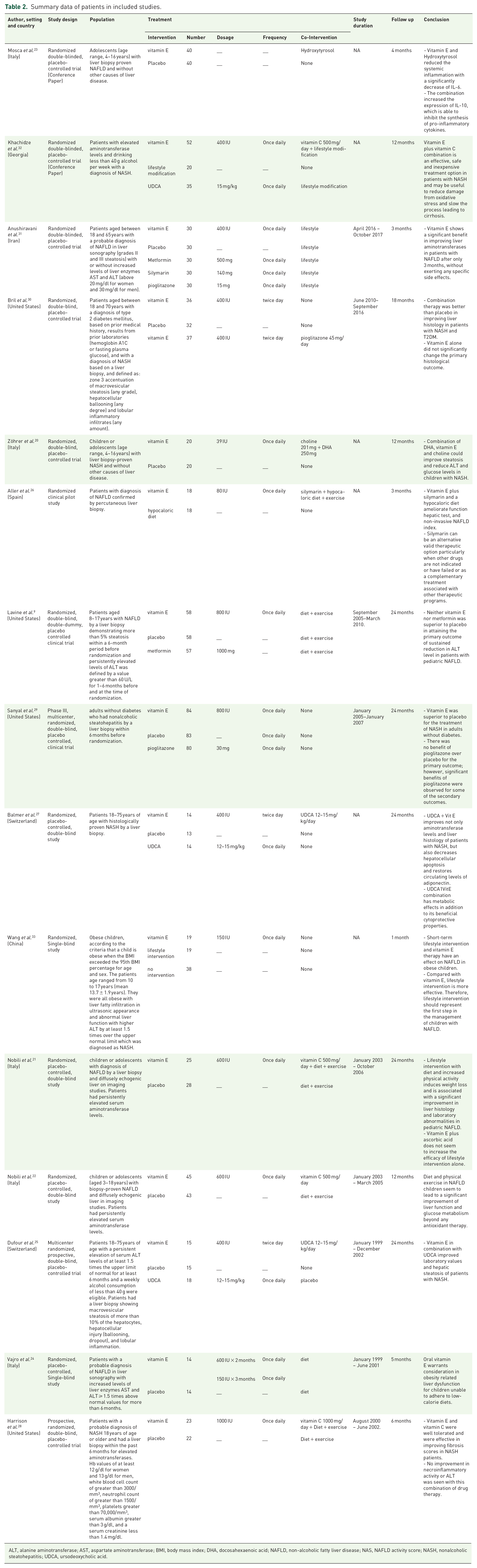
ALT, alanine aminotransferase; AST, aspartate aminotransferase; BMI, body mass index; DHA, docosahexaenoic acid; NAFLD, non-alcoholic fatty liver disease; NAS, NAFLD activity score; NASH, nonalcoholic steatohepatitis; UDCA, ursodeoxycholic acid.
Males and females were represented equally between studies. A summary of the characteristics of included patients and studies is available in Table 2 in the Supplemental Material.
Potential sources of bias
Following the Cochrane ROB tool, the quality of the included studies ranged from moderate to high. The main concern was incomplete outcome data (loss to follow up), which was detected in Bril et al., 30 Harrison et al., 28 Lavine et al., 9 Nobili et al., 22 Sanyal et al., 29 and Zöhrer et al. 20 A summary of quality assessment domains is presented in Figure 1B. while authors’ judgments with justifications are shown in Supplemental File X and Supplemental Figure S4.
Funnel plots of the standard errors versus the mean differences were examined for all major outcomes; no publication bias was detected visually for ALT, AST, NAS, and Fibrosis (Figure 2V−Y). Further, Egger’s regression revealed no small study effects.

The overall meta-regression mean difference of the interaction between dose/age on x-axis and ALT/AST on y-axis. (E–H) The overall meta-regression mean difference of the interaction between age/sex on x-axis and Fibrosis/NAS on y-axis. (I–Q) The overall meta-regression mean difference of the interaction between ALT/AST/BMI/weight on x-axis and Fibrosis/NAS on y-axis. (R–U) The overall meta-regression mean difference of the interaction between co-interventions on x-axis and ALT/AST/Fibrosis/NAS on y-axis. The stars indicates significant predictions. (V–Y) Funnel plots of ALT/AST/Fibrosis/NAS showing no evidence of publication bias.
Outcomes
Biochemical outcomes
Alanine aminotransferase
The overall effect showed a significant difference between the two groups in ALT levels [MD = −11.430, 95% CI (−17.493, −5.367)] favoring vitamin E (Figure 3A).

Forest plots show the MD in each outcome along with the associated 95% CI in the two arms at 3, 6, 12, 18, and 24 months; p indicates pediatric population. Outcomes: (A) ALT, (B) AST, (C) fibrosis, (D) NAS, (E) BMI, (F) weight, (G) waist-circumference, (H) FBG, (I) FBI, (J) HOMA-IR, (K) total-cholesterol, (L) triglycerides, (M) to HDL, (N) LDL.
In the adult population, vitamin E significantly reduced ALT levels after 6 months [MD = −20.700, 95% CI (−33.040, −8.360)], 18 months [MD = −18.600, 95% CI (−30.406, −6.794)], and 24 months [MD = −26.152, 95% CI (−46.498, −5.805)]; pooled analyses were homogenous, and reductions were not significant at the other endpoints.
In the pediatric population, vitamin E significantly reduced ALT levels after 12 months [MD = −12.997, 95% CI (−21.404, −4.591)]; pooled analyses were homogenous, and reductions were not significant at the other endpoints.
Aspartate aminotransferase
The overall effect showed a significant difference between the two groups in AST levels [MD = −6.766, 95% CI (−11.686, −1.846)] favoring vitamin E (Figure 3B).
In the adult population, vitamin E significantly reduced AST levels after 6 months [MD = −12.000, 95% CI (−19.452, −4.548)], 12 months [MD = −18.660, 95% CI (−33.062, −4.258)], 18 months [MD = −9.000, 95% CI (−17.153, −0.847)], and 24 months [MD = −27.327, 95% CI (−49.457, −5.197)]; pooled analyses were homogenous, heterogeneity was not significant, and reductions were not significant at the other endpoints.
In the pediatric population, vitamin E significantly reduced AST levels after 12-months [MD = −4.212, 95% CI (−8.033, −0.391)]; pooled analyses were homogenous, and reductions were not significant at the other endpoints.
Histological outcomes
NAFLD activity score
The overall effect showed a significant difference between the two groups in NAS levels [MD = −1.503, 95% CI (−2.495, −0.510)] favoring vitamin E (Figure 3D).
In the adult population, vitamin E significantly reduced NAS levels after 12 months [MD = −1.700, 95% CI (−2.090, −1.310)] and 24 months [MD = −1.405, 95% CI (−1.642, −1.168)]; pooled analyses were homogenous, and reductions were not significant at the other endpoints.
In the pediatric population, reductions were not significant.
Fibrosis score
The overall effect showed a significant difference between the two groups in fibrosis levels [MD = −0.224, 95% CI (−0.426, −0.023)] favoring vitamin E (Figure 3C).
In the adult population, vitamin E significantly reduced fibrosis levels after 24 months [MD = −0.395, 95% CI (−0.757, −0.033)]; pooled analyses were homogenous, and reductions were not significant at the other endpoints.
In the pediatric population, reductions were not significant.
Anthropometric outcomes
The pooled analysis revealed no significant differences between the two groups in BMI, weight, and waist circumference, either in the adult or the pediatric populations (Figure 3E–G).
Metabolic outcomes
In the adult populations, reductions were significant in FBI levels after 18 months [MD −6.000, 95% CI (−11.219, −0.781)], whereas, in the pediatric populations, reductions were significant in HOMA-IR levels after 12 months [MD = −0.451, 95% (−0.843, −0.060)] and FBG levels after 12 months [MD = −3.686, 95% (−7.132, −0.239)].
Otherwise, the pooled analysis revealed no significant differences between the two groups in total cholesterol, triglycerides, LDL, and HDL (Figure 3H−N).
Meta-regression models
Results from multiple regression models showed a significant association of a 49% R2 between ALT levels and vitamin E dose (coefficient −0.039679; p = 0.002), and AST levels and vitamin E dose (coefficient ‒0.0245566; p = 0.01). It also showed no significant effect of age on ALT (p = 0.06) or AST (p = 0.1), and no significant effect of sex on fibrosis (p = 0.7) or NAS (p = 0.1). However, the regression showed a strong effect of age on fibrosis (coefficient −0.008; p = 0.013; R2 = 64.57) and NAS (Coefficient 0.042; p = 0.019; R2 = 70.09) (Figure 2A–H).
Double interaction regression of fibrosis versus ALT, AST, BMI, and weight revealed that patients with a baseline AST > 50 IU/l show more promising results (coefficient ‒0.0093526; p = 0.03, R2 = 47%), changes in AST were strongly associated with changes in fibrosis (coefficient 0.029093; p = 0.000, R2 = 100%), neither changes in weight nor BMI were associated with changes in fibrosis (p = 0.8, p = 0.7; respectively). Double interaction regression of NAS versus ALT, AST, BMI, and weight revealed that: changes in weight and BMI were associated strongly with changes in NAS; a weight loss by 5−10 kg was associated with a reduction in NAS by 1 degree (coefficients ‒0.1618272; p = 0.0233, R2 = 40%) (Figure 2I–Q).
We performed additional meta-regression to determine whether these favorable outcomes were due to the effects of vitamin E or attributed to the co-interventions. According to our regression model, co-interventions had no significant modification on the changes of ALT (p = 0.927), AST (p = 0.897), fibrosis (p = 0.960), or NAS (p = 0.174) (Figure 2R–U).
Discussion
In this systematic review and meta-analysis of 15 RCTs and 1317 patients, eight of our included studies reported superiority of vitamin E alone or combined over placebo or lifestyle modifications.23–27,29,31,32 However, five other trials demonstrated that the comparable intervention was more efficient in reducing NAFLD or nonalcoholic steatohepatitis (NASH) relative to Vitamin E.9,21,22,30,33 To complicate this even further, two other trials reported that the two arms did not differ markedly in terms of their effects in improving hepatic and metabolic parameters.20,28 In a previous systematic review of nine RCTs, the authors concluded that adjuvant vitamin E might produce significant biochemical and histological improvements only in the adult population. 17 The conclusion was not conclusive, as the meta-analysis included only five RCTs and showed no statistically significant difference at any outcome.
Nonetheless, the relatively small sample size, the short-term follow ups, the absence of dose consideration, non-comprehensive literature search, the inclusion of post hoc analyses, the unreliable statistical combination of mean change with final endpoint mean, and the significant heterogeneity left the question unsettled. Whether the intervention is more efficient remains a valid debate. And what type of patient can benefit the most remains a critical clinical question. Thus, we performed this meta-analysis to compare the efficacy of vitamin E with a placebo, lifestyle modification, or no-intervention comparison in NAFLD and NASH patients. We considered short, intermediate, and long-term follow ups, the effect of co-interventions, baseline variations, possible associations between the underlying pathogenesis and the drug’s mechanism of action, and significant markers that could indicate drug efficacy.
Our analysis revealed that the group who received vitamin E had a statistically significant improvement in ALT, AST, fibrosis, and NAS at early and late follow up. This improvement was prominent in the adult population. In the pediatric population, the significant change in biochemical parameters started to appear at long-term follow-up. This delay could explain the negative results of short-term studies.22,33 Further, the regression model revealed a strong negative association between age and histological changes. This finding justifies the minimal improvement in pediatric histological parameters, and also the negative results of previous studies.9,30 Otherwise, vitamin E showed more favorable metabolic changes in the pediatric population, although the histological changes were minimal. A possible explanation for this negative association between age and histological changes may be attributed to the increased oxidative stress in pediatric populations.34–36
Interestingly, the regression revealed no significant association between metabolic changes and histological changes. This finding softens the traditional hypothesis that weight changes affect fibrosis.37,38 However, a strong association was present between change in weight or BMI and change in NAS. Double interaction regression revealed no significant overlap between fibrosis and NAS. This diversion implies that no single medication can guarantee both metabolic and all-histological improvement at the same time. Hence, this finding supports the idea of combined or multiple interventions. 39 We also examined whether these favorable outcomes were due to the effect of vitamin E or attributed to the co-interventions. According to our regression model: co-interventions did not significantly modify the changes in ALT, AST, fibrosis, or NAS. This finding implies that vitamin E alone can improve these outcomes, which lessens the general attitude that considers it as merely an adjuvant.40,41
The proper dose of vitamin E has long been debated, with considerable variations among trials.42,43 Results from multiple regression models showed a significant negative association between ALT, AST levels, and vitamin E dosage – more favorably between 400 and 800 IU. We also considered the clinical question of what type of patient and what kind of prognosis. According to our analysis, the most promising patient is an obese male or female aged between 15 and 50 years, with baseline AST > 50 IU/l, daily intake of 400–800 IU vitamin E, and liability to lose 5–10 kg. The interaction regression of this combination yields an R2 of 100% (p = 0.000). We propose this as a score from 1 to 5 where 3 points or above leads to a good prognosis. Previous analyses considered NAFLD as a predictor for Type-II diabetes mellitus (DM) or cardiovascular events.44,45 In contrast, this score can help predict the course of NAFLD itself with vitamin E.
Previous cumulative analyses support our results.16,17 Amanullah and colleagues examined the effects of vitamin E among different k population groups, but data concerning vitamin E impact on hepatic histology were insufficient. Sato et al. reported significant results of liver function improvement due to vitamin E. The mechanism of action of vitamin E in NAFLD and NASH patients involves anti-oxidant, anti-free-radical, anti-apoptotic, and anti-fibrotic roles.46,47 In NAFLD: mitochondrial malfunctions and pathological cytokines increase the production of ROS leading to lipid peroxidation and oxidative stress, which plays a vital role in the progression of the disease from NAFLD to NASH.48,49 While this mechanism justifies the biochemical and histological effects, it does not explain its metabolic actions.
Meanwhile, a previous meta-analysis indicated that a high dose of vitamin E could increase the risk of mortality, 50 though the association was not well established.51,52 Other reports raised concerns about prostate cancer risks, though the data are insufficient for a conclusive answer.53,54 Further, a more extensive meta-analysis of 57 RCTs revealed that vitamin E doses up to 5500 IU/day did not affect all-cause mortality. 55 Also, another meta-analysis reported a possible increased risk of hemorrhagic stroke by 22% (1 in every 1250 patients), and reduced risk of ischemic stroke by 10% with vitamin E (1 in every 476 patients). 56 However, the study included only five blinded and two open-label trials in the analysis with different baseline morbidities and without emphasis on follow-up duration. The safety profile of vitamin E remains a highly important clinical question, with an urgent call for further investigations, especially on long-term follow up.
The quality of a systematic review and meta-analysis rests upon its included studies. Our included studies presented relatively high quality. Our findings settle a group of assumptions and advocate a reliable reference for prospective clinical decisions. To our knowledge, this the first systematic review and meta-analysis to analyze the short-, intermediate-, and long-term outcomes of vitamin E in pediatric and adult populations over 24 months with meta-regression considerations. Even so, there were some limitations to our work. The results of the metabolic outcomes were limited by the heterogeneity of the included studies. The variations in the clinical definitions of NAFLD may contribute to the clinical heterogeneity. Additionally, most of the trials had moderately small sample sizes.
Overall, the current evidence indicates that vitamin E is superior in improving biochemical outcomes in adult and pediatric patients – whether alone or combined. It also favors additional histological improvements for adults and metabolic improvements for pediatric populations. Further multi-center, large sample RCTs are needed to investigate the safety of daily vitamin E alone or combined with other anti-oxidants. Future studies should also consider our prognosis score in the management of NAFLD and NASH patients.
Highlights
In the pediatric population: the significant change in biochemical parameters appears at long-term follow up.
Data from RCTs reveal no significant association between metabolic changes and fibrosis changes.
A strong association was present between change in weight or BMI and change in NAS.
The most promising patient is an obese male or female aged between 15 and 50 years, with a baseline AST > 50 IU/l, daily intake of 400–800 IU vitamin E, and liability to lose 5–10 kg.
Supplemental Material
sj-pdf-1-tag-10.1177_1756284820974917 – Supplemental material for The efficacy of vitamin E in reducing non-alcoholic fatty liver disease: a systematic review, meta-analysis, and meta-regression
Supplemental material, sj-pdf-1-tag-10.1177_1756284820974917 for The efficacy of vitamin E in reducing non-alcoholic fatty liver disease: a systematic review, meta-analysis, and meta-regression by Mohamed Abdel-Maboud, Amr Menshawy, Esraa Menshawy, Amany Emara, Mohamed Alshandidy and Muhammad Eid in Therapeutic Advances in Gastroenterology
Supplemental Material
sj-pdf-2-tag-10.1177_1756284820974917 – Supplemental material for The efficacy of vitamin E in reducing non-alcoholic fatty liver disease: a systematic review, meta-analysis, and meta-regression
Supplemental material, sj-pdf-2-tag-10.1177_1756284820974917 for The efficacy of vitamin E in reducing non-alcoholic fatty liver disease: a systematic review, meta-analysis, and meta-regression by Mohamed Abdel-Maboud, Amr Menshawy, Esraa Menshawy, Amany Emara, Mohamed Alshandidy and Muhammad Eid in Therapeutic Advances in Gastroenterology
Footnotes
Author contributions
M.A. and A.M. conceptualized the question and designed the study. M.A., E.M, A.M., and AE. performed the literature search. A.M., E.M., AE., MA., M.E., and M.A. extracted the data from eligible studies and performed the quality assessment. M.A. conducted the statistical analysis and interpreted data. M.A., A.M., M.A., A.E., M.E., and E.M. drafted the manuscript, revised it critically, and approved the version to be published. All authors read and agreed on the final version of the manuscript.
Funding
The authors received no financial support for the research, authorship, and/or publication of this article.
Conflict of interest statement
The authors declare that there is no conflict of interest.
Ethical approval
This article does not contain any studies with human participants or animals performed by any of the authors.

Supplemental material
Supplemental material for this article is available online.
References
Supplementary Material
Please find the following supplemental material available below.
For Open Access articles published under a Creative Commons License, all supplemental material carries the same license as the article it is associated with.
For non-Open Access articles published, all supplemental material carries a non-exclusive license, and permission requests for re-use of supplemental material or any part of supplemental material shall be sent directly to the copyright owner as specified in the copyright notice associated with the article.
