




Abstract
Dear Editor
Malespin and colleagues reported that 9% of genotype-1 chronic hepatitis C (CHC) patients receiving different approved sofosbuvir (SOF)-based therapies, had detectable viremia at the end of treatment (EOT+) and all EOT+ cases reached sustained virological response (SVR), termed here EOT+/SVR. 1 Hepatitis C virus (HCV) RNA levels were measured by Roche CobasTaqMan version 2.0 (CTM, Roche Molecular Diagnostics, Indianapolis, IN, USA) or Abbott RealTime HCV (ART, Abbott Laboratories, Abbott Park, IL, USA). Malespin and colleagues showed that all EOT+ cases were observed by the more sensitive ART. 1 Maasoumy and colleagues provided a detailed HCV RNA kinetic analysis of CHC patients receiving different approved SOF-based therapies, by comparing CTM and ART. 2 They showed that the ART assay detected HCV RNA on treatment several weeks longer than CTM, suggesting a slower viral decline with ART compared with CTM. They reported that 20% of genotype-1 CHC patients were EOT+ by ART, 92% of whom achieved SVR. The observation made by Malespin and colleagues and Maasoumy and colleagues1,2 was confirmed by a recent analysis of 417 patients treated with SOF plus ledipasvir (LED), with or without ribavirin, in which 29% of genotype-1 CHC patients were EOT+/SVR by ART. 3 To date, the EOT+/SVR pattern has not been reported in patients receiving direct-acting antiviral (DAA) therapy for acute hepatitis C (AHC).
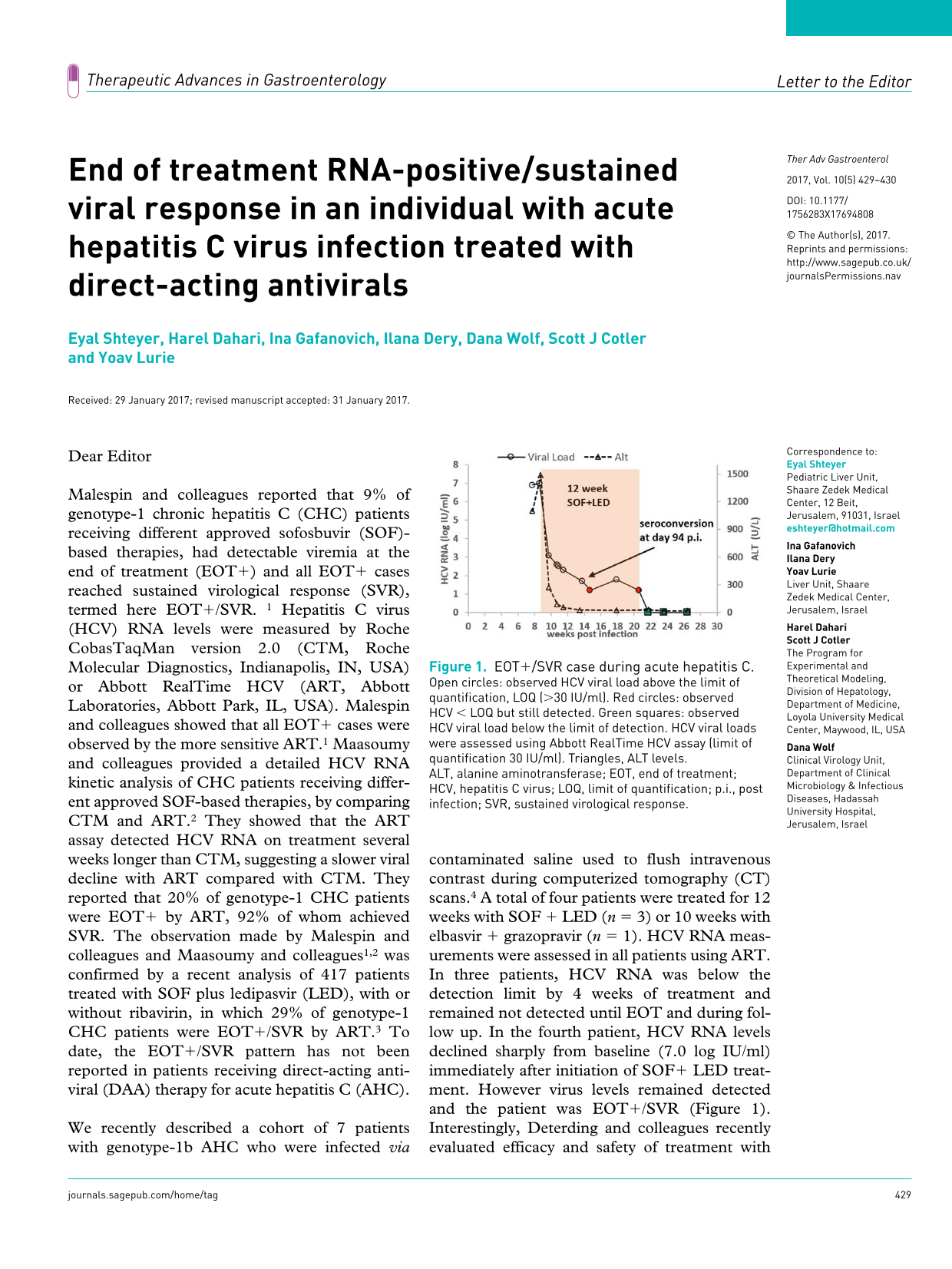
We recently described a cohort of 7 patients with genotype-1b AHC who were infected via contaminated saline used to flush intravenous contrast during computerized tomography (CT) scans. 4 A total of four patients were treated for 12 weeks with SOF + LED (n = 3) or 10 weeks with elbasvir + grazopravir (n = 1). HCV RNA measurements were assessed in all patients using ART. In three patients, HCV RNA was below the detection limit by 4 weeks of treatment and remained not detected until EOT and during follow up. In the fourth patient, HCV RNA levels declined sharply from baseline (7.0 log IU/ml) immediately after initiation of SOF+ LED treatment. However virus levels remained detected and the patient was EOT+/SVR (Figure 1). Interestingly, Deterding and colleagues recently evaluated efficacy and safety of treatment with SOF + LED for 6 weeks in genotype-1 AHC patients. 5 In all patients, HCV RNA was undetectable by CTM before EOT and all patients achieved SVR. In conjunction with the case presented here, the report by Deterding and colleagues suggests that the EOT+/SVR pattern is more likely to be observed in AHC patients by the more sensitive ART assay than by CTM, as seen in CHC patients.

EOT+/SVR case during acute hepatitis C.
In conclusion, we observed the EOT+/SVR pattern with the ART assay in a patient treated for AHC with SOF + LED, providing evidence that the phenomenon of EOT+/SVR is not restricted to CHC and that EOT+ by ART does not equal DAA treatment failure in AHC patients.
Footnotes
Funding
The research was supported in part by the US National Institute of Health grant R01-AI078881.
Conflict of interest statement
The authors declare that there is no conflict of interest.