




Abstract
This article critiques and builds upon existing notions of primary institutions within the English School, arguing for a return to Bullian notions of “necessity”—namely the minimum institutional requirements for international order—when defining the primary institutions of international society. By using notions of necessity this work seeks to develop a functional typology for primary institutions that is capable of accommodating variation and change across different historical and regional contexts. It also seeks to provide a similar functional framework for an English School understanding of domestic society and the state. This development of English School thinking aims to highlight the interrelated nature of domestic and international norms and practices, as well as highlighting the role of domestic norms in shaping the outlook of international relations practitioners.
A cornerstone of the development of the English School approach to international relations theory has been the deepening of its understanding of primary institutions. From early accounts of primary (or “foundational”) institutions in the work of Wight (1978) and Bull (1977h), before being revived as a topic of interest by the “New Institutionalists” such as, Buzan (2004b), Holsti (2004h), Schouenborg (2013) and Knudsen and Navari (2018) who each added to the school’s collective understanding of primary institutions through analytical refinement. This article critiques aspects of the current approach of the New Institutionalists and seeks to return to Bullian notions of “necessity”—namely the minimum institutional requirements for international order—when defining the primary institutions of international society. By doing so this work aims to provide two major contributions to the ongoing development of the understanding of primary institutions. Firstly, by using notions of necessity to develop a functional typology this work seeks to create an understanding of primary institutions that is capable of accommodating variation and change across different historical and regional contexts. This allows a move beyond conceptualizing primary institutions as defined by the institutions particular to modern, global international society, contributing to growing work conceptualizing alternative historic and regional international societies. This work thus seeks to provide a framework that can bridge the gap between theoretical conceptions of primary institutions and empirical work describing international societies outside of the modern, global context. Secondly, this work seeks to provide a similar functional framework for an English School understanding of domestic society and the state (in terms of primary institutions) which mirrors the English School understanding of international society. This seeks to bring the English School’s theoretical model closer to the experience of real practitioners of international relations. It does this both by recognizing that these practitioners are socialized into the norms and practices of their domestic society as well as international society, and that the primary institutions of international society are influenced by domestic norms and practices (and vice versa). Overall, this work seeks to continue in the tradition of existing theoretical contributions to English School thinking by using a functional typology to provide greater clarity to the role that the primary institutions are playing in providing order in international society and thus further contributing to the understanding of primary institutions.
The debate over the nature of primary institutions and a return to necessity
Before outlining a functional typology for the primary institutions of international society, this section seeks to answer the question—what is a primary institution? As well as contextualize this work in the wider debates ongoing within the English School regarding the nature of primary institutions and how they should be used when theorizing international society.
To begin with, the definition of a primary institution this work uses is: Primary institutions are particular expressions of the norms and practices which are the preconditions of establishing ordered relations between states. This definition builds upon ideas of Bull (1977h), Wight (1978), Holsti (2004h), Duvall and Wendt (1989), Knudsen (2019), and Knudsen and Navari (2018). These norms and practices provide the relational/regulatory rules by which states interact with one another (the “rules of the game” of international politics). Primary institutions also provide a constitutive function, both defining the members and nature of international society and imbuing these members with agency (Holsti, 2004h). “The preconditions of establishing ordered relations between states” is used in the definition to distinguish that these are the norms and practices necessary for international order, rather than just repeated patterns of practice between states. Duval and Wendt argue that these institutions were “fundamental” in that they were the preconditions of meaningful relations between states, (Duvall and Wendt, 1989) similarly Bull states “that these rules and institutions are part of the efficient causation of international order, that they are among the necessary and sufficient conditions of its occurrence” (Bull, 1977a: 71). “Particular expressions of norms and practices” is used to recognize that these norms are arrived at through the historic development of international practice, and that while they represent the necessary elements of international order; different particular regional norms and practices have existed historically which have fulfilled similar roles in international society (Wight, 1977c).
Before beginning to interrogate the idea of primary institutions, this work will begin with the maximalist case against primary institutions put forward by Wilson (2012)—Why not abandon the use of primary institutions all together if it fails to capture the complexity of really existing international society through its reliance on what are inevitably categorical abstractions? It does appear that each of the lists of primary institutions; both from the first generation (Wight, Bull) and those New Institutionalists such as Buzan and Holsti have all left something to be desired, and are open to critiques of missing elements or the inclusion of elements that do not fit their own definitions. While I am deeply sympathetic to the proposed approach for the study of international society by Wilson and the other anti-institutionalists who advocate for moving beyond abstract primary institutions to a grounded approach to the study of diplomatic activity (and the inclusion of domestic norms and practices in this article seeks to return us closer to real practitioners); adopting a grounded approach does not necessitate the abandonment of the New Institutionalists project to theorize international society’s primary institutions.
If one is to adopt a grounded approach to the study of diplomatic discourse, it soon becomes clear that the diplomatic community shares a set of norms and practices around repeatedly used terms such as sovereignty, international law, diplomacy (among others) which are themselves abstractions. Those practitioners (the diplomats and statespeople) of international relations are no more able to escape the need to think in abstractions than those who study them. If there was not a shared language and a shared meaning around certain abstracted norms and practices, (what sovereignty means, how international law is to be applied, how diplomatic exchange is to be conducted), then there would be no functioning international society, as a working agreement on terms is the bare minimum for a shared diplomatic culture to develop. Practitioners continue to make reference to the primary institutions of international society when engaging in diplomatic activity, even when they are not themselves thinking in terms of international society. Therefore I do not see the need to abandon the effort of defining primary institutions if one wishes to adopt a grounded approach to international society. The use of a grounded approach can instead add richness to the researcher’s understanding of the primary institutions such that they properly reflect the complexities of actual international relations practice. Primary institutions are still a useful conceptual tool for the study of international society, because it mirrors the thinking of real world practitioners, and provides the researcher with a focus of study for their investigation.
This raises the question of the nature of primary institutions: Navari & Knudsen argues that primary institutions are “intersubjectively real. They are real in the sense of shared understandings. . . .that have become codified into social practices or institutions” (Knudsen and Navari, 2018: 7). Keene (2009), Jackson (2004), and others have engaged in theorizing of elements of the international society as Weberian “Ideal Types.” Here I would argue that these concepts are interrelated, and that part of the intersubjective understanding for practitioners is in the mental landscape of ideal types. For example, practitioners have an understanding of how sovereignty should be practiced which is inevitably a simplified abstraction—much like an ideal type, which due to its nature as a simplified understanding allows for it to be shared intersubjectively between practitioners. Then beyond this there is the “reality” of the way in which sovereignty is actually practiced. But given that this idealized intersubjective understanding of sovereignty is a key social constraint on the actions of practitioners, it is valuable for us as academics studying practitioners to theorize understandings of these primary institutions as ideal types—with the goal that the understanding of the ideal type of sovereignty held by academics and the view of practitioners be as close as possible, informed through empirical analysis which grounds the academic in the worldview of the practitioner, as advocated for by Wilson (2012).
The Structuralist/Interpretivist debate has been key to differing notions of the nature of primary institutions among academics theorizing international society. Are primary institutions describing the necessary structural elements of international society (a Bullian approach) or are they describing existing norms that are unmoored from any concept of necessity or structure (a Manning approach), and are the norms of international society fulfilling a social function? 1 This work adopts instead a Structuration approach (Giddens, 1986) as outlined by Navari with relation to the English School, as a synthesis between these two concepts (Navari, 2020). This work argues that there are certain necessary elements for the maintenance of international order, for example there must be a process by which political entities recognize each other’s jurisdictions. However, there exists a range of possibilities for the way in which this could be enacted, and the particular approach international society takes to any of these necessary elements can differ over time and is historically contingent. Particular formulations of the necessary elements for international order to exist are arrived at through the negotiation and reinterpretation of these norms and practices by the practitioners of international society—namely the politicians and civil servants who define the policies of their respective states. However this ability for reinterpretation is not limitless, firstly because that new formulation must continue to fulfill the social functions of international society, and secondly because practitioners become socialized within the web of norms and practices that is already established in international society, which serves as a meaningful constraint on the ability to advance alternative international orders (Navari, 2020).
Schouenborg argues that there are three dominant perspectives on primary institutions by theorists: Functional (Bull), Historical/Descriptive (Wight) and Typological (Holsti) (Holsti, 2004h). This is an important distinction as most English School authors fall into the Historical/Descriptive camp (as exemplified by Wight), and thus while Bull is seen as one of the foundational authors in the English School canon, few researchers are engaging in his approach to primary institutions. What separates Bull from the Historical/Descriptive authors and the Typological authors in Schouenborg’s (2013) (and my) view is that Bull is primarily interested with the necessary conditions for international order, whereas other English School authors begin with trying to describe the general social phenomena of international society from an empirical basis. The question of necessity has led to the common reading of Bull’s primary institutions as determined structurally, which I argue is a mistake. Bull explicitly states as much in Chapter 3 of Anarchical Society in reference to the particulars of his primary institutions “The present study is not an attempt to apply ‘structural-functionalist’ explanation.” (Bull, 1977a: 70–71) If Bull believed that the primary institutions of international society were determined, he would not have been able to conceive of alternative forms of international society or international order, an effort which consumes the final third of the text (Bull, 1977g). Bull’s interest in function (and structural-functionalism) came at the conceptual question of what was necessary and sufficient for international society, not what were the particulars of actually existing international society today. Schouenborg agrees that Bull did make attempts to empirically determine his primary institutions (Schouenborg, 2013) and I would argue Bull in fact remains quite open to developments and alternative forms of international order/society.
What Bull does in Anarchical Society is outline the necessary and sufficient features for an international society to function, then observe the specific examples that exist contemporaneously, before conceiving of alternative ways that the same function could be fulfilled under different forms of norms and practices. This begins in Chapter 3 by outlining the need for “Common Interests” “Rules” & “Institutions” (Bull, 1977a) to form an international society, before outlining those institutions that exist as Bull sees them (the primary institutions of international society in contemporary English School language). The question associated with Bull—what are the necessary conditions for order in international society is thus a different one from the question of what are the particular primary institutions of any given international society. The question of necessity is a conceptual one, it asks what social functions would be necessary in order to achieve an international society, however these social functions could be achieved in different ways given different social, technological or other contexts. For example the need for mutual recognition between agents could occur through systems of sovereign equality, or hierarchical suzerainty. If we think of the functionalist and historical approaches as answering two different questions, the approach of Bull becomes compatible (and in fact complimentary) with the historical approach of other English School authors, and Bull himself would use the historical approach to outline the nature of his primary institutions in Anarchical Society (Bull, 1977f).
This work aims to return to the thinking of Bull, and construct a functional typology of the necessary factors for an ordered international society, then consider what these elements look like now, and have looked like in the past. By thinking about social function before going on to the work of description, this article aims to provide a pathway to overcome the deficiencies of previous attempts at categorizing and describing international society’s primary institutions. The goal here is not to try to provide a comprehensive list of the primary institutions as previous institutionalists have done, but to provide a set of functional categories necessary for international society, that can then be filled with the specific primary institutions of any given historic or regional international society as well as our contemporary global one. This article is thus a framework for thinking about primary institutions, which can be filled with later rich and grounded study of the particular primary institutions that exist within the categories and how they may have changed over time—this work thus sees itself in conversation with the previous and ongoing research within the English School.
An obvious objection (particularly from anti-institutionalists) to this approach arises—namely is this not simply another list, moving the problem up a conceptual level? If the previous English School Institutionalists failed to include certain key primary institutions in their analysis, does this work not risk simply reproducing this error by failing to include necessary categories? I aim to solve this problem in multiple ways. Firstly my approach compares the categorizations with the primary institutions given by multiple institutionalists who have come before, finding a category for each previously analyzed primary institution. This hopefully forms a unified categorical approach to the research that has come in the field before. Secondly this work seeks to return to a social theorizing about the necessary elements of a society (international and domestic), and thus by theorizing about their basic social functions avoid the missing of key primary institutional categories.
The English School concept of the state—domestic primary institutions
When discussing the English School approach, it is the concept of international society that stands at the forefront of discourse within the discipline, but this often misses the English School’s analysis of the internal makeup of the state itself. 2 Before thinking about how states interrelate, it is important to determine the nature of the state itself, as these building blocks are the entities which make up (through the actions of their representative practitioners) international society. This article draws upon ideas from the upcoming work of Buzan (2022) as well as authors like Mayall (1990c), Holsti (2004a), and Bull (1977e) who considered the state and its normative constitution deeply. This article proposes a greater recognition of domestic institutions which define the nature of the state as well as how these states interrelate in international society. This work seeks to maintain the English School focus on rulership, order and the state as the primary subject of interest for English School analysis. As such this section presents five functional categories of domestic norms and practices that define a practitioner’s (and society generally) relationship to the state and are necessary for the establishment of ordered domestic rulership. This work proposes the title of—domestic primary institutions, to separate them from the “international” primary institutions of the English School, while recognizing that they are deeply interrelated to them.
It is important to consider these domestic norms and practices, as the practitioners of international relations are first socialized into their domestic context before becoming practitioners, and as such we see that the norms and practices of international society, mirror the normative character of the domestic societies that practitioners have been socialized into. A distinction can be made between domestic and international primary institutions. This is a valuable tool for ordering our thinking about primary institutions. However, it is important to note that the co-constitutive nature of primary institutions operates between both types of primary institutions, and this is a way of structuring our understanding rather than a barrier between the external and the internal. For example, international norms of human rights have influenced the nature of domestic rights within states, while freedoms first developed on a domestic level now form a bedrock of international human rights law such as freedom to religious practice. Thus we should think of the barriers and categorizations set out in the following schema as porous and mutually reinforcing, rather than as strict dividing lines.
Expanding our thinking about primary institutions to include those norms and practices normally considered constitutive of the domestic state is a valuable addition to the English School understanding of primary institutions for three reasons. Firstly because as discussed the domestic and international primary institutions of international society influence one another and as such failing to integrate a thorough understanding of these domestic primary institutions lessens the understanding of both the nature and historic development of the international primary institutions. Secondly, it is essential to recognize that in order to become a member of international society, states must exist within a certain model of domestic political practice to be received by the international community as a state and thus part of the framework of international society. As such it is important to consider the domestic norms and practices which define the nature of the state, as these expectations equally define the nature of international society. Finally, when we talk about international society, it is important to remember that these states act through their representatives at the international level, who are in turn socialized by their nation’s domestic norms and practices. As such, the boundaries of what is deemed appropriate practice for states by practitioners is in part determined by their experience of their own state’s practice. If we are to maintain the grounded approach to the study of the practitioners of international relations, it is important to consider how the domestic norms and practices of their state have also socialized them into certain practices on the world stage. Failing to do so divorces us as researchers from understanding the real practitioners of international relations and thus leaves us with an analytical blind-spot.
This work thus proposes including the necessary norms and practices that form the domestic framework of state power as a type of primary institution. The following elements outlined are those necessary political structures for a political entity to have sovereign power, a pre-requisite for being recognized within international society, which this work will refer to as domestic primary institutions. For most English School authors the notion of the modern state is fundamentally Weberian in character (Weber, 2014b) (although for Manning it is Wittgensteinian). It is defined territorially, it is legitimated by a form of what Weber refers to as Legal Authority, and it wields a monopoly on the use of violence within the state (Bull, 1977e; Jackson, 1993; Mayall, 1990b). While anarchy is the background upon which the partially consensual model of international society is built for the English School, it is the normative aspects that promote cooperation and avoid the need for direct violence that is the point of interest for the English School. The use of force is in many ways the mirror within the state, while it is true that the state ultimately enforces its will upon citizens through coercion, the point of interest for the English School is the social legitimation and legalistic/bureaucratic structures that the state builds in order to operate without needing to do so. A valuable addition of the English School to theorizing about the state, both in Bull’s theorizing of alternative orders in Anarchical Society (Bull, 1977g) and Buzan’s newest work on global order (Buzan, 2022) is to think about how we can conceive of “The State” (or more broadly Rulership) beyond modes of modern Legal Authority but as political entities that share characteristics with pre-modern states reliant on Traditional and Charismatic Authority which fulfill the same necessary societal roles through different means. This work seeks to operate in this tradition and conceive of the units of international society beyond just the modern Weberian state, but in terms of the necessary functions that allowed for sovereign power to be exercised in its predecessors and possible future developments. The concept of primary institutions can also serve as a way of connecting the norms and practices that define the state internally to the international without which we are missing a significant part of the story of the development of primary institutions.
The first necessary element of a stable system of rulership and the first category of domestic primary institutions is a set of norms and practices which establishes the legitimacy of the ruler. By ruler here this work means both in the individual sense of the figure of a president or monarch, but also in the abstract sense of the structures of the state: the parliaments, courts, civil services, police, military, etc. who command authority and obedience in society. While rule has been established with different degrees of consent versus violence in different systems over history, no stable and successful system of rule has been established without any consent from key parties underneath the ruler. Forms of legitimation are never universal across all those ruled, and are often differentially applied, but it remains an essential part of establishing a stable relationship between ruler and ruled. Modern forms of nation state rely on rational-legalistic forms of authority, but also require normative investment by the population in the continued existence of the state (Weber, 2014a: 196–266). This investment can be derived through democratic practices, but also forms of charismatic legitimacy such as personal rule, popular presidents and religious leaders, nationalism (a subject of analysis for many English School authors) (Mayall, 1990c) and in some cases its more unsavory cousin nativism plays another key element of legitimation in the modern nation state—to represent the will of the imagined collective of the nation is fundamental to the ongoing legitimacy of the state itself. Finally the advancement of materialist benefits to the people serves as another key plank of legitimacy in some states. Contemporary examples of primary institutions of legitimation include: Nationalism, Nativism, Materialism, Democratic Practices, Legalism, Monarchy, Personal Rule, Political Institutions and Religious Identity while historical examples include Dynasticism and The Divine Right of Kings. These domestic practices define the legitimacy of sovereignty in international society—as membership of international society relies upon the mutual respect of a state’s legitimacy by the practitioners of other states. In the nineteenth century expectations on the legitimate forms of statehood were tightly prescriptive, the states of international society were expected to meet a certain standard of civilization (Gong, 1984). Whereas in the contemporary era, legitimation of the state on the international level is far more pluralist. All of the above are examples of ways in which a state can legitimate itself allows the government of that state to argue they are a genuine embodiment of the collective will of a particular peoples. By legitimating themselves domestically, that government is seen internationally to be a genuine expression of self-determination, which is the contemporary measure by which states are legitimated into international society; (Mellish, 2023) thus the domestic and the international principles are fundamentally intertwined.
The next necessary element for understanding the nature of rulership are the obligations established between the ruler and ruled. These norms and practices limit the use of power by the ruler on their subjects and are highly constitutive of the nature of the state. Rulership is rarely arbitrary in its demands but operates through a network of obligations and rights between the individual and ruler, less it undermine the legitimacy by which that rule is established and normalized (Weber, 2014a: 196–266). In return for fulfilling these obligations, individuals receive legal protections enforced by the ruler. Key to this in the modern era is the concept of citizenship, which defines the individual as holding certain legal rights and obligations in relation to the state that others are excluded from. In the modern era this system is universalized in most states, whereas historic systems differentiated obligations based on social position. Contemporary examples of primary institutions establishing obligations to and from the ruler include: Conscription, Citizenship, Constitutional Rights, Legal Equality and Individual Rights. Historic examples include: Serfdom, Tithes and Feudal Obligations.
The management of territorial space is another fundamental element of establishing rulership. Territoriality along with the legitimacy to rule and the monopoly of the legitimate use of violence form Weber’s three elements of the state (Weber, 1978). The establishment of territorial jurisdiction over regions is essential both for the state to control the productive capacity of the area but also for the implementation of state legal systems (although many states struggle to meet this criteria) (Jackson, 1993). These claims managing the jurisdiction of rulership can often differ between de jure and de facto claims, with disputed and breakaway territories often limiting the de jure claims of rulership to more limited de facto spaces. How these claims clash with the competing claims of other entities is a key element of the international primary institutions of international society. Contemporary examples of primary institutions for managing space include: Territoriality, Sovereignty and historic examples include; Colonial Overseas Territories, Mandate Territories & Imperial Territory Management.
The next necessary primary institutions for understanding the nature of rulership are those which manage the productive forces within the state. Without the ability to manage productive forces to some degree, it becomes impossible for the system of rule to be maintained, as the obligations the ruler has toward the ruled could not be met, and the ability to maintain the rule against challengers would not be possible. This category not only includes the state’s direct interaction with the economy such as systems of taxation, but also encompasses the norms and practices which define the predominant economic system of the state itself. As such contemporary primary institutions for the management of productive forces would include: Capitalism, Property Rights, Taxation, Corporate Personhood, and Environmental Law. While historic examples would include: Slavery, Guild Systems, and Mercantilism. Domestic understandings of economic practices such as contract law and property rights have shaped international regulative practices of trade between states.
The final important practice for understanding the nature of rulership and the state are the norms and practices which form the nature of the state bureaucracy that administers the ruler’s interaction with these other primary institutions. The earliest and most basic bureaucratic institutions for the management of rulership were highly personalized. The “bureaucratic staff” of feudal societies were a combination of the personal retainers of the sovereign and church officials. The late-modern state is characterized by a rationalization of these bureaucratic practices to increase formalization and remove corruption and to open up the bureaucracy on a meritocratic basis (Weber, 2014c). This process is one that is incomplete in many developing nation states and low levels of formalization of the bureaucracy is often a marker of weak state apparatuses. Another unique element of the modern non-democratic state with developed political party institutions is the party-led bureaucracy, in which states bureaucracies are either formally or informally dominated by a single political party that both serve as legitimators of the political process and administrators of the political will which can similar to formally depoliticized civil services have different degrees of meritocracy versus corruption. Thus contemporary primary institutions for the management of state bureaucracies include: Formalized Civil Services, Political Patronage Networks, Party-Ruled States and historic examples include; Personal Retinues, Religious Bureaucracies. The practices of state bureaucracy is an essential constitutive element of the state that defines an individual’s right to be a practitioner of international diplomacy and thus able to represent the state in international society.
These five categories of domestic primary institutions combine to form an English School conceptual analysis of the state, as summarized in Figure 1. The list of institutions outlined over the preceding pages is not meant to be exhaustive, but to give examples of relevant institutions for each category. Firstly, it is important to note the space for historically determinant particulars of different states. For a state to be able to function, it requires each of these elements, but these elements need not necessarily present themselves similarly in all states. Historically regional international societies have operated in a similar way, with core necessities for the system to function, but the particular expressions of these institutions in for example the Islamic international society of the 1400s need not be the same as the European international society of the same period, as long as the social functions were provided for. These international societies of course interacted with one another, they were not sealed units, but what separated the societies was a lack of mutual recognition and legitimation that existed within the regional international societies. As international society has expanded from regional formulations to encompass the entire globe, the opportunity for particularisms to exist between different international societies and between states have become more restrictive. Where greater degrees of differentiation continues to exist is within the states themselves, with different bureaucratic models, forms of legitimacy, citizen-state obligations, norms for economic management and the management of space. Of these five categories of primary institutions, it is the final two in which increasing degrees of uniformity have been imposed by actors in the international community on others—driven by the internationalized nature of the modern global economy and territorial relations.
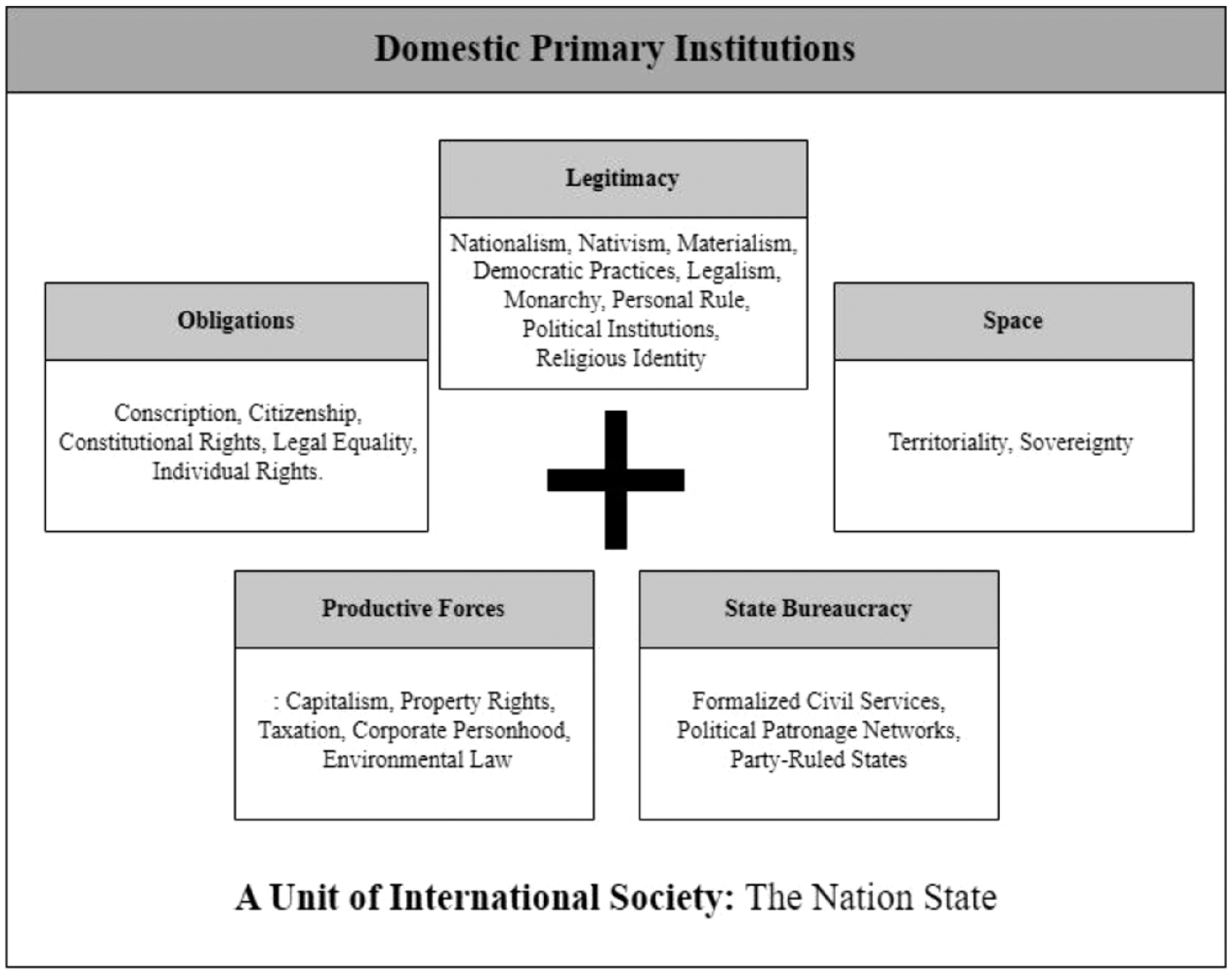
An English School conception of the state.
The second important element to note is the co-constitutive nature of these primary institutions. It is not possible to classify one of these categories as “more necessary” than the other, or more foundational to the nature of the state. The nature of each individual state unit depends upon the combination of all of these factors, the sum total of which could be considered the logic of the state. A change to one of the domestic primary institutions results in a transformation of the functioning of the other primary institutions. For example, the transition from serfdom to capitalism as a primary institution for managing productive forces that occurred in Europe in the 1500-1800s, resulted in new concepts of what it means to be a citizen, new legal rights and obligations for those freed from serfdom, the rise of nationalism, increasingly formal bureaucracy, and a concentration of power in the central state rather than the local nobility.
The necessary elements of international society
There has been considerable research into the primary institutions that determine both the international recognition of states in international society and their proper practice (the “rules of the game” of international politics) by the English School. As such there is an extensive previous literature on the topic of what constitutes these primary institutions of international society. This article aims to categorize the primary institutions listed by earlier authors by the necessary function they play within international society into a categorical framework. Buzan’s 2004a 3 work on primary institutions provides a comprehensive overview of many key authors within the English School and their understanding of primary institutions. However, rather than following the Buzan innovation of sorting these into master and derivative institutions, this work takes all primary institutions as co-constitutive and sorts them by function. It is important to recognize that differing theorists of primary institutions have approached conceiving of them using both different theoretical approaches and also for different purposes. Mayall looked to conceive of primary institutions in relation to nationalism and the nation state (Mayall, 1990c) Holsti seeking to create a typology of modern and historic institutions that influenced international society (Holsti, 2004h) and so on. However, a consistent approach to both the nature of international society and the premises of theorizing allow us to compare these differing primary institutions. This work seeks to provide a greater capacity for comparative investigations of historical and regional international societies, and a greater focus on the socialization of practitioners. Hence the focus on creating a functional typology that can be applied across different time and regional contexts.
The first necessary function of international society is the recognition and legitimation of entities within international society. In order for international society to function, it is necessary that the states within international society recognize each other and their areas of authority in order to not be in constant conflict. It is also necessary for those states within international society to accept that other states have legitimate claims to rulership within their respective territories. This has taken the form of sovereign equality in post-Westphalian Europe, but can also exist in hierarchical, suzerain led international societies such as the Pre-Qing East-Asian international order, in which China occupied a special position of authority while simultaneously recognizing the legitimacy of the smaller tributary states to rule. International society is not able to function without these forms of mutual recognition and legitimation between states, as the constant conflict a lack of mutual recognition engenders would leave the development of any other forms of mutual international norms impossible. What differentiated the regional international societies of the early modern and prior eras and the contemporary global international order is that the system of recognition and legitimation has now expanded to encompass all states under the norm of the sovereign equality of states.
The key primary institution of recognition and legitimation in contemporary international society is sovereignty, recognized by Wight (1977a), Mayall (1990b), Holsti (2004b), James (1999), & Jackson (2000a) as a primary institution (and for Holsti, James and Jackson it is the bedrock institution that all others are built upon). Sovereignty in the contemporary era both encompasses both the mutual recognition that other states have the equal right to rule over their respective territory, and also norms of non-intervention in states domestic affairs and territorial integrity. Mayall goes on to give territorial integrity as a separate “principle,” Holsti gives territoriality as a foundational institution and James states that independence is the core of sovereignty (James, 1984). These norms are usually encompassed as a necessary part of sovereignty. Mayall also gives both self-determination and non-intervention as principles, which for this work we can think of as methods of recognizing the legitimacy of states; namely the belief that peoples have a right to form states and that the domestic affairs of those states should not be interfered with, promotes the mutual recognition and legitimacy within international society and deters conflict.
Bull is one of few authors not to list “sovereignty” as a primary institution, but does analyze the state as a concept in Anarchical Society (Bull, 1977e) which encompasses the norms of sovereignty within it, similar to Holsti. Finally from Wight we have “neutrality” as a primary institution, which is the most difficult to categorize, however the right to neutrality, much like self-determination and non-intervention is effectively a recognition that states are allowed to make foreign policy decisions free from coercive influence, and as such I have categorized it here as part of recognition and legitimation for the same reason listed prior. Mutual recognition of other states and the acceptance of them as having legitimate interests and claims is central to the English School analysis of international society. It is the recognition that the practitioners of international politics value the continued operation of international society and become socialized into behaviors that promote its continuation that separates the English School’s analysis from realist concepts of international order.
The second necessary element of international society is the ability for the states in international society to communicate and reach mutual agreement with each other. Again, without the ability for states to reach agreement on issues, either bilaterally or multilaterally, it is impossible for an international society to be maintained. Historically this began through forms of bilateral diplomatic exchange, organized through emissaries. This early system was reliant on general norms both against deal-breaking and violence against emissaries of other states, norms that continue to exist today. Systems of mutual agreement would become multilateral and more formalized into international law in the early modern period, developing simultaneously with increasingly complex and formal legal practices (Wight, 1977d). International Law developed during the early modern period alongside understandings of domestic jurisprudence which have become normalized into most domestic societies. Practitioners of international relations are thus socialized domestically into certain expectations of legal practice before ever becoming state representatives, which are mirrored at the international level in international legal practice. This highlights the importance of not dividing our understanding of international norms from domestic norms as researchers of international society.
Both diplomacy and international law are recognized as primary institutions of international society by Bull (1977f), Mayall (2000), Wight (1978: 200), Holsti (2004c, 2004d), James (1978), and Jackson (2000c), so there is a general consensus among key authors of the importance of both of these norms. Considerable current work is still being done within the English School on both of these institutions. To these key primary institutions Mayall adds Human Rights and Non-Discrimination as key principles of international society, both forming the basis of much of international law. Finally Wight (1978) adds Arbitration, Alliances and Guarantees as primary institutions, these later two are both forms of signaling to other members of the international community as well as repeated diplomatic practice between the states within the Alliance/Guarantee relationship. Alliance structures themselves are forms of mutual agreement between the participants to enter into the alliance, and the right to form alliances is itself part of international law. Arbitration is a form of mutual agreement building as part of diplomatic practice that involves not only the conflicting parties but also the broader international community, and is a quasi-legal method of conflict resolution which has standing in contemporary international law. Diplomatic practice and international law, like sovereignty, are both primary institutions that have been heavily analyzed by English School theorists, and the dual institutions of international law and diplomacy covers the broad set of practices that facilitate communication and agreement making between states. Bull argues that international society is made up of practitioners (Bull, 1977f: 2)—the diplomats and state leaders that engage in the “high politics” of international relations, and thus international society is heavily concerned with norms of communication between these practitioners.
The third necessary element of international society is forms of exchange between states. While recognition and communication are necessary to have a framework under which states can develop shared norms, the “raison de système” logic should not be thought of purely in terms of limitations on state action. The ability for states to engage in forms of exchange provides a further reason for said states to prefer international society to conquest. Through exchange states are able to meet their needs without needing to resort to conquest, and therefore when a state is in a geopolitically dominant position it can prefer the enforcement and maintenance of international norms that promote beneficial exchange for that state over global conquest. I specifically use the phrase “exchange” here for two reasons. Firstly because exchange should be thought of as more than just the trade of goods and services between states. It is also the exchange of ideas, technology, people and other transfers. Secondly, I use the phrase exchange rather than trade or mutual exchange to recognize that international exchange systems are often coercive and enforced upon weaker powers in the international system, much as other norms are. What separates the primary institutions of exchange from the prior two primary institutions is that the prior institutions are based on frameworks of legal equality—sovereignty, diplomatic norms and international law all adopt a position of legal equality between the states, whereas the international political economy does not. However, the sometimes-coercive nature of its application is not to discount it as a grouping of norms and practices which shape the character of international society.
Trade is the most basic form of primary institution regulating exchange between states, and is recognized by both Wight (1977a), Mayall (1990c), and Holsti (2004e) as primary institutions. The practice of international trade has become an increasingly complex network in the globalized system of international market relations that forms a key part of contemporary international society. Colonialism is the other primary institution recognized by Holsti (2004f) and Jackson (2000c) which regulated international exchange prior to its decline in the mid-twentieth century. Only Wight, Mayall and Holsti devote any significant analysis to questions of trade, and Holsti & Jackson’s analysis of colonialism is less concerned with its role in international capital formation, rather their focus is on colonialism as a norm of global territorial/sovereign governance. The cause of a lack of interest in these primary institutions has been in part that they are not conducted primarily by the traditional subjects of English School analysis—statespeople, and thus its role in constituting the nature of international society has been heavily underrepresented. This is despite trade being the most regular interaction between states and significant amounts of international law and international governance existing to regulate international trade. The English School has always endeavored to take an international sociological approach to understanding international society, by studying state relations through the diplomatic practices of its principal agents—namely diplomats. As the post-1945 world order has seen the rapid expansion of bodies to regulate and formalize international relations, this focus on one particular agent deserves revisiting. The English School should not divorce itself from its focus on rulership and the state, but should recognize that it is not only the formal diplomatic representatives that are participating in international society, but a wider body of NGO workers, intelligence operatives, financiers, international lawyers, and others who play key roles in international society.
The final category of primary institutions of international society is the norms and practices of great power management. Stability of international society requires the buy in of all the great powers within the system in order for it to be maintained. This raises the question of what constitutes a great power. Bull provides a definition of the great powers as a group (there cannot be one great power or it becomes hegemonic) of top-tier military powers that are part of a club which order international society (Bull, 1977d). This is a good starting point for understanding the great powers, but its focus on military capacity misses other important factors such as prestige, diplomatic legitimacy, and economic power. Bull’s definition of the great powers would exclude states such as Austria in 1815, or arguably contemporary China until its recent military modernizations of the last decade. I thus propose this simple and broader formulation of a great power. A great power is any state with the capacity (by whatever means, military, economic) to destabilize international order should it wish to, and as such concessions must be made to the state when it demands, less it become a revisionist power and aim to overturn the primary institutions of international society and reorder them to their benefit. This is a preferable definition for great power status because it gets at the major concern states have with great powers, that they are able to operate in international society with the threat of being able to upend the established order.
Great power management provides three necessary features for the functioning of international society. Firstly it discourages conflict between great powers which has the possibility for the disintegration of international society into conflict so great that international society can no longer function. Secondly, by setting the limits of great power activity, it allows the great powers to punish other norms violators in international society and maintain the overall stability of the system. Finally by allowing for accommodations between the great powers, it encourages the great powers to support the stability of the system rather than engaging in violent efforts to reorder the system for their advantage.
Great power management has traditionally been viewed by the English School as a primary institution that promotes the health of the wider international society by limiting the ability for individual great powers to overwhelm international society through conquest. This has been the primary mode of great power interaction historically, where great power politics was largely conducted in a competitive, militaristic framework of alliance building and warfare. However, the increasingly globalized world economy, combined with a growing recognition of the need to protect the environment as a form of global commons has provided the possibility for new forms of great power management that are far more cooperative than prior modes of great power management. The arena that has received the most interest from the English School in this regard has been climate management, particularly from Falkner (2021). The great powers occupy their position in part because they are the largest economies of the world and as such are the primary contributors to climate change, placing them in the unique position to construct the rules necessary for the management of this newly recognized global commons. While climate change regulation is conducted multilaterally between large and small states, the viability of proposals for protecting the climate are decided by the ability for it to command the support of the USA, EU, China, and to a lesser extent, Brazil, India and Russia. This more cooperative form of great power (economic) management has adopted a mixed diplomatic and legalistic approach to cooperation between the great powers, and this, combined with the disproportionate role of the large economies makes international climate agreements better thought of as great power management rather than purely as international law. This new positive form of international management by the great powers may allow for the understanding of great power management to extend beyond simple concert and balancing arrangements to limit conquest.
The primary institutions associated with great power management are the most contentious among the key authors of the English School. The role of force in the maintenance of order has been a strong dividing line between different English School authors and as such different conclusions are reached regarding primary institutions depending on if one agrees with authors such as Bull that believed that conflict between the great powers can provide for the overall health of the system in the long run, or if one considers great power conflict as a fundamental failure of international society to manage great power relations. The Balance of Power is the quintessential primary institutions of this type for the early English School, recognized by Wight (1977b), Bull (1977b), & Mayall (1990a) as primary institutions of international society. A Balance of Power is necessary for the maintenance of great power cooperation, as significant imbalances between great power alliance structures encourages the domination of one power over the other and thus conflict, rather than cooperation. However the question remains the degree to which states operate under a balance of power logic versus bandwagoning and other strategies in the international system. A more important objection to the inclusion of the balance of power as a primary institution is the question of if it is a norm or practice in which states attempt to participate in consistently. While there have certainly been cases of deliberate balancing (the Concert of Europe in the early nineteenth century being the paradigmatic case), Great Powers are just as often trying to overcome the Balance of Power in their favor (such as during the Cold War). There have also been cases of international societies in which the balance of power is not present, particularly the international society in East Asia centered around Pre-Qing China, and arguably the Hegemonic US position during the post-Cold War period. International Society endured because the hegemonic power was willing to sustain the society system. The balance of power may be a material factor which incentivizes the compromises that encourage the formation of an international society. However this author would argue that it differs from the other norms and practices of international society normally defined as primary institutions, as it often lacks support from the practitioners of international relations, and thus this author would argue that it cannot be considered a norm or practice in the same way as international law or sovereignty.
War is another contentious feature recognized by Bull (1977c), Holsti (2004g), and Jackson (2000b) as a primary institution. War as argued by Bull is necessary in order to maintain the balance of power in international society and defeat revisionist powers, and thus serves to maintain international society in the long run. Even if this was true in the nineteenth century, this is a difficult argument to maintain in the contemporary world of nuclear weapons (as Bull recognized (Bull, 1977c)). Bull believed that war as an institution also served to limit more heinous acts of violence through its developed structures and normative frameworks (Bull, 1977c). This author would argue this is a better argument for the inclusion of the “rules of war” to be considered a primary institution, rather than war itself—and normative frameworks such as just war theory have served to limit the exceptional violence of warfare in some cases. However, this author argues that both normative conduct in war, and the international societal limitations on war are too rarely followed to show a consistent sociological pattern of constraint on state activity. Too often warfare is the point at which the norms and practices of international society begin to be abandoned rather than strengthened as conflict offers an existential threat to the state. This particularly seems to be the case as wars become more protracted, and irregular, which tends to promote the further abandonment of norms that may have been held to at the beginning of a conflict. As such this author would argue against the inclusion of warfare as a primary institution of international society.
The key element of this fourth category of necessary features of international society is the limitation of conflict (and promotion of cooperation) between the great powers. This is essential, given the destabilizing power held by the great powers in international society. This paper gives arguments against the inclusion of both war and the balance of power as primary institutions, however strong arguments are given for these elements as primary institutions by other authors and it is beyond the scope and objectives of this article to fully refute their inclusion beyond the comments given here. Those authors who have argued in favor of their inclusion see the role of both institutions primarily as limiting the power of revisionist powers in international society, and thus these elements of international society could be considered under the same category of great power management (Figure 2).
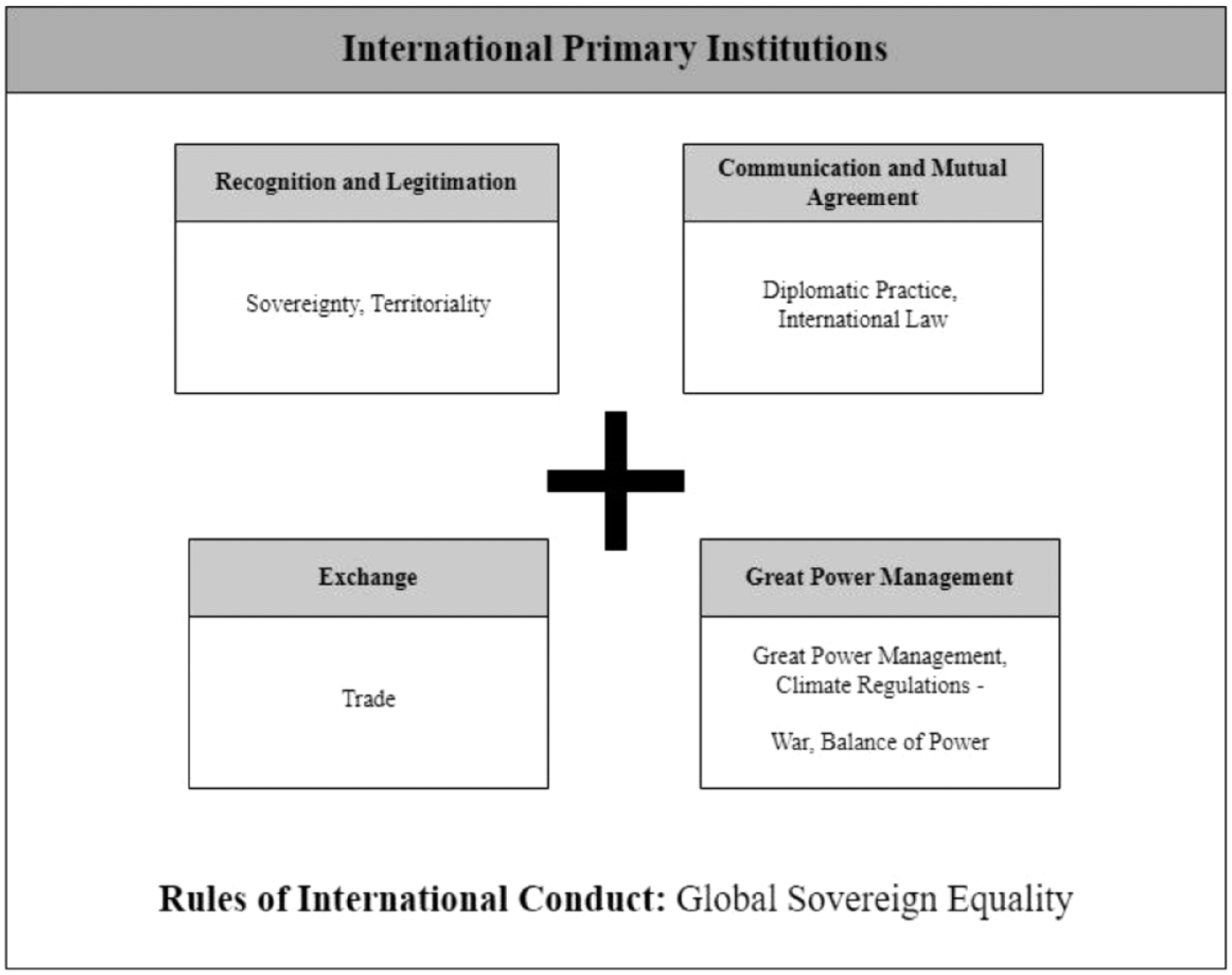
Rules of international conduct.
These four categories of primary institutions combine to form the rules which are the basis of international society. Similar to the previously outlined domestic primary institutions of the state, these primary institutions are co-constitutive of each other, and no particular category of primary institution has primacy over the other. The combination of the domestic and international primary institutions form the “Logic of International Society” (Figure 3). This represents the sum total of the norms and practices that define what a legitimate actor is within international society (in the contemporary era, the state) and how those actors should interact with one another. This highlights that international society has expectations both for state behavior (domestic and international) as well as how a state should be constituted, and these expected norms and practices form a coherent network of norms and practices that states are expected to fulfill in order to be part of international society. When the particulars of the primary institutions of international society significantly change, then international society is operating under a new systemic logic.
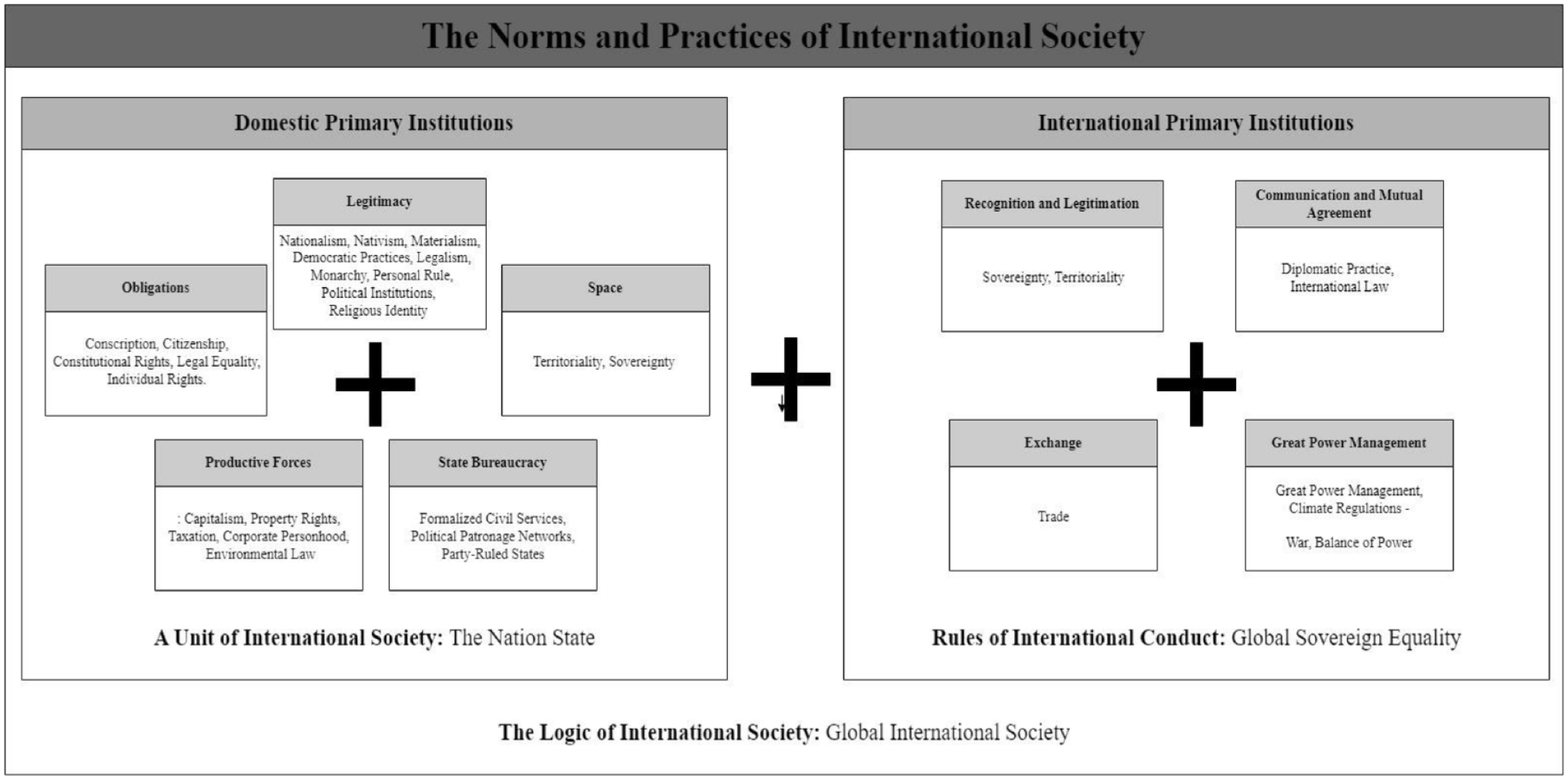
The Complete Representation of international society.
Differentiation from prior English school theorists
Where then does the model proposed above differ from earlier models of primary institutions given by the key figures of the English School? I have assembled the primary institutions of international society given by Bull, Wight, Holsti, Mayall, James and Jackson in Figure 4, categorized into the four categories given above. The two notable omissions from my own conception of primary institutions are the exclusion of the Balance of Power and Warfare as primary institutions of international society (highlighted in red in Figure 4). Neither of these institutions are recognized by all six authors, although a sufficient plurality of preceding theorists recognize them as primary institutions of international society that they are worth addressing.
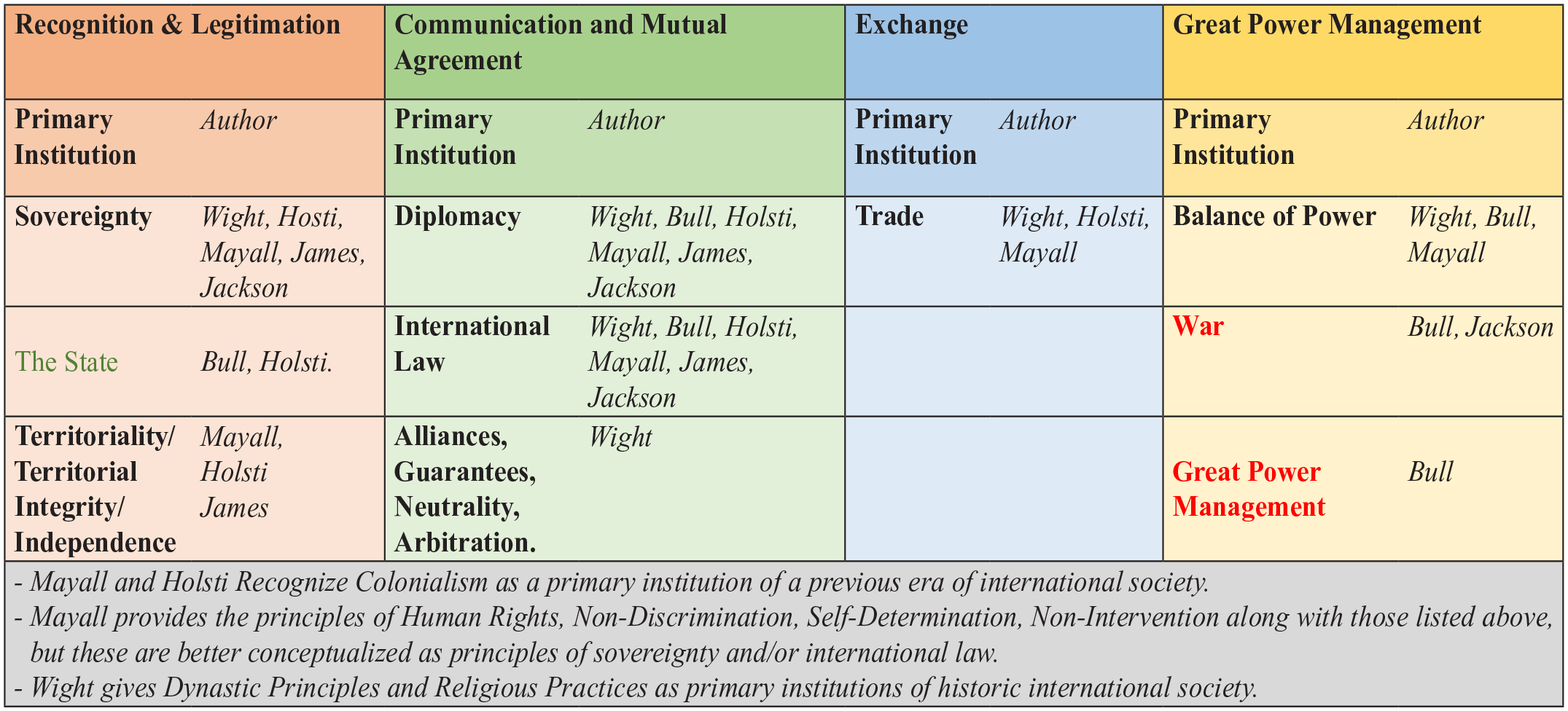
Existing English School primary institutions categorized.
The choice to avoid the inclusion of war as a primary institution returns to the social goal of primary institutions as norms and practices for regulating the interaction between states such as to create an ordered international system. Order is not necessarily the same as justice, and the exclusion of war as a primary institution is not to adopt a pacifist position that all wars are illegitimate in international society. There are often reasons to prefer war over peace on the grounds of justice (humanitarian intervention to halt a genocide, wars of national liberation, etc.). However, that does not detract from their destabilizing nature in international society. This work rejects the notion that war can be used as a tool with which to limit the expansion of the great powers in the international system, particularly in the modern era in which these states have access to nuclear weapons. Bull would raise concerns about the operability of War as a tool of great power management in the era of the Cold War, with a possible replacement of it as a primary institution with deterrence. However our Post-Cold War experience has shown that deterrence is rarely effective when wars are often either internal, or involve a super-power warring against a small state that has no reasonable capacity for deterring the other. The wars of our contemporary era fall into two major camps, internal civil conflicts (which have often received outside intervention from great powers) and expansionistic (Kuwait (1990), Ukraine). Neither of these types of war have contributed to the stability of international order. The destabilization of states engaged in warfare, arms flows out of warzones, the radicalization of combatants who then move to other active warzones and the upsetting of established regional practices of order created by wars all go to create further international instability. In some occasions (such as in Kosovo or Kuwait) it may be preferable for an intervention to occur in order to punish further norm breaking (much as there are cases in which one might be justified in breaking societal norms for a greater purpose) but this does not promote a general doctrine of the use of force as norm or practice that creates order in international society. The regular resort to even handed condemnations of war on both sides of conflicts by the international community and calls for immediate ceasefire appears to be further empirical evidence of there being little acceptance of general support for a normative intervention, as was the majority rejection of the final pillar of R2P among the general assembly members of the UN.
This conception also excludes the balance of power as a primary institution of international relations. Firstly, there remain empirical questions about whether or not states engage in balancing behavior, particularly when alternative drivers of alliance structure such as ideology, nationalism, religious and cultural identity and the historic relationship between states, play an equal if not greater role in how states choose to structure their alliances as balancing. The archetypical form of balancing behavior is the European great powers of the nineteenth century, an era in which there were (relatively) low levels of ideological diversity between the actors that allowed alliances to be formed and dissolved easily. Following the highly ideological wars of the twentieth century, conflicting states appear to have far less room to maneuver when balancing and still remain within their ideological position. There is also questions as to what constitutes balancing as a practice. Turkey, a NATO state has arguably engaged in “Soft Balancing” against both Greece and the United States without taking hostile steps such as leaving the alliance raising further questions about what constitutes balancing behavior. Finally, different states empirically seem more or less inclined to engage in balancing behavior for reasons that have little to do with state capacity. For example, France and Britain, both states of similar power in the international system, adopt different postures toward the United States, with one having historically adopted approaches closer to soft balancing (particularly during the De Gualle NATO Crisis and the Second Iraq War) while the United Kingdom adopts a bandwagoning approach. Balancing is also far more structural of a concept than the other primary institutions. It lacks clearly understood social norms, which would explain the differentiation in states willingness to pursue balancing as a behavior. Balancing, unlike adherence to international law or state sovereignty, is not a socially expected category of behavior among the international community (and it can often involve actions that are condemned by international society, e.g. funding terror groups or proxy wars). It may possibly describe a pattern of behavior by certain states in international society, but it is neither universal enough, nor containing the normative element necessary to be considered a primary institution.
The concept of the State as a primary institution has here been developed into its constituent elements which can themselves be considered primary institutions. This may at first appear as a divorce from the traditional English School focus on international society, but it is very much in the tradition of work such Mayall (1990c) and Jackson (2000c) who both interrogate deeply the nature of the state units within international society as well as the states’ relationships to each other. Where this work moves beyond authors is to recognize the pluralism that exists within the state structure and the way in which these norms and practices are co-constitutive with those that set the rules of state interaction in international society. Authors in the English School have largely either discounted the differentiation of states and viewed them as identical Weberian national units (i.e. Bull), or the focus has been on those states that fail to reach “the standard” of the nation state and how they should be managed as part of international society. (i.e. Mayall & Jackson). Instead this work recognizes differentiation within the structures of the nation states as an inevitable part of pluralistic international society, and we should consider how the differentiation of the units drives competing goals within the international system that can change the norms of international society. It is in fact the differentiation between the primary institutions of the state units which create competing state interests even within an international society that has generally accepted the impermissibility of conquest. For example the differentiation in levels of national development produce competing interests in the arrangement of the global international trade system, which manifested itself in the competition between Western norms of free-trade and developmentalist norms from the Global South of tariffs and cartel export pricing (i.e. OPEC) in the 1970s.
Conclusion
This article has sought to provide an opening for a reassessment of how the English School conceives of primary institutions in two major areas. The first has been a return to Bullian notions of necessity as a model for providing a functional typology of primary institutions. This functional typology seeks to firstly provide a framework for the expansion of thinking about primary institutions beyond our contemporary global political context. By having a functional typology, research into alternative historical and regional international societies can be grounded in the same English School language of primary institutions as those analyses of our contemporary international order. Secondly, it clarifies the social purpose of the wide ranging sets of primary institutions that have been designated by other authors and allows for a more contextualized understanding of their social function and historical development; this is particularly true given the comparative possibilities this functional typology offers. For example, the possibility for comparing alternative models of recognition and legitimation between different historical international societies, clarifies the historical development of the particular form of recognition and legitimation practiced in contemporary international society and decenters it as just one of a number of possible normative frameworks for achieving the same social function.
The second major intervention of this piece has been to provide a model for investigating the domestic norms and practices of a state which shape the socialization of their respective foreign policy practitioners, and interrelating them with the primary institutions which are the traditional subject of concern for English School analysis. This clarifies the ability for the development of international norms and practice to be driven by domestic contexts. It also highlights the domestic practices which have both socialized international relations practitioners, and which play a constitutive role in international society, as certain expectations about domestic state structures are necessary for a political entity to be recognized as a member of international society.
This work is thus an attempt to create an opening for the further study and conceptualization of primary institutions. It seeks to open space for considering alternative modes of international society, and for understanding our contemporary international society with greater understanding of both historical context and social function. This work aims therefore to be an opening of a conversation and a point of departure for further research within the English School. It seeks to provide a framework for further thinking about the social function of primary institutions, as well as work in conversation with the existing literature on both primary institutions and regional/historical international societies.
