




Abstract
The paper assesses the questions if and, if yes, how the republican conception of free statehood can and should inform a compelling understanding of a legitimate post-Westphalian political order. To answer these questions, it, first, reconstructs the foundational arguments of republican internationalists in favour of free states and, second, assesses the points of contention republican cosmopolitans raise. Third, it develops an alternative approach, a republicanism of plural polities: Based on a relational and multi-dimensional understanding of citizenship, the paper questions the strong internationalist reliance on the citizenship-state-nexus and on statehood in general, but also takes issue with cosmopolitans’ neglect of the boundedness of democratic self-determination. A republicanism of plural polities as a multi-perspectival approach to democratic institution-building in and beyond the state is open to constellations of plural polities of different forms and on different political levels while simultaneously recognising the particularity of each ‘free polity’. It thereby adds a new dimension to debates on the political forms legitimate institutions can assume under post-Westphalian conditions and opens avenues for research on inter-polity relations, on more complex constellations of self-rule and shared rule as well as of multilateral decision-making, on sovereignty and independence. The latter are exemplified by reference to the European context.
Under conditions of globalisation and Europeanisation, the ‘Westphalian mapping of political space’ (Fraser, 2009: 4), of exclusive and sovereign territorial (nation-)states, comes under stress. These developments question the status of states as the sole locus of individual freedom and democracy, the congruence of social and political spaces and the effectiveness and legitimacy of democratic political rule. New forms of interconnectedness and inter-, trans- or supranational decision-making, in turn, open avenues for new post-Westphalian forms of governance beyond the state (e.g. Scheuerman, 2018). Against this political backdrop, theoretical debates ensue regarding the changing nature of sovereignty, its future tenability and about alternative forms of democratic self-determination and patterns of legitimate political institution-building (e.g. Kalmo and Skinner, 2010; Macdonald, 2018). One linchpin of these debates is the role of the state and its consequences for broader patterns of politics and institution-building. Answers to the question of whether the state can and should be conceptualised and justified as the central form of legitimate political rule and the only context of freedom and democracy, imply consequences for democratic institution-building within as well as beyond the state and for the meaning and institutionalisation of citizenship, polities and their borders.
This is particularly true for recent debates surrounding the notion of free states in republican thought. Republican thinking links individual freedom to institutional settings in both domestic and international contexts. More particularly, republican contributions reflect on the interrelations between different analytical levels of political order while foregrounding democratic institutions and practices. They thereby offer distinct perspectives on the links between individual freedom and self-determination on the one hand, and the domestic and international levels on the other (see also Slaughter, 2018). Consequently, this tradition of political thought is particularly suitable for assessing the political form of the state and its normative underpinnings and functional justifications. It offers valuable insights for negotiating principles of legitimate political institution-building within as well as beyond the state. As Skinner argues: ‘Just as it is possible to live and act freely if and only if you are a freeman [. . .], it is possible to live and act as a freeman if and only if you live in a free state’ (Skinner, 2010: 99). Recently, this notion of free states as a core tenet of contemporary neo-republicanism has gained additional traction as the building-block of a ‘republican law of peoples’ or republican internationalism (Laborde and Ronzoni, 2016; Pettit, 2010a). Republican internationalists defend states as the sole context of citizens’ freedom and democracy, maintaining that international politics is necessarily shaped by inter-state relations. International institutions are considered necessary to guarantee non-domination among states, but they need to conform to state control (e.g. Laborde and Ronzoni, 2016; Ronzoni, 2017). Yet, this strong focus on free states is contested. Republican cosmopolitans question statist and internationalist understandings of democracy and global order and argue in favour of more flexible, polyarchic and/or global patterns of deliberation and decision-making, even a world federation (Bohman, 2007; Martí, 2010). There are, however, hardly any accounts which advance into the grey area between these established positions – that is, accounts which foreground the institutional conditions of republican freedom and democracy and which are simultaneously open to adapting the institutional set-up of democracy to the challenges that globalisation implies. This paper therefore searches for more nuanced alternatives between state-focused republican internationalism and cosmopolitan republican governance of global scope. In doing so, its focus is on legitimate institution-building and the question which institutional set-up or constellation of polities can be expected to promote non-domination under post-Westphalian conditions.
The notion of free states provides a gateway for examining possible avenues for institution-building which link notions of individual freedom and citizenship to broader institutional settings within as well as beyond the state. Without taking the necessity of the state as a given, I therefore take it as my starting point for assessing republican perspectives on democratic institution-building. To tackle the broader issue of what form a post-Westphalian republican political order can and should assume, the fundamental questions to be answered are whether the neo-republican conception of and argument for free statehood can and should inform a compelling understanding of a legitimate political order and if so, how? To answer these questions, I first reconstruct the neo-republican understandings and justifications of free statehood and an internationalist global order by reference, mainly, to Pettit’s contributions. In doing so, I foreground the conceptual hinges between different analytical levels and normative dimensions that underlies this conception. In the second part of the paper, I discuss Bohman’s republican cosmopolitanism as a critique and counter-model to the internationalist approach that challenges the close conceptual connection between citizenship and statehood as well as bounded jurisdictions in general. Yet, I also show that the institutional consequences of this approach lack precision. I then develop a third, alternative republican approach to democratic institution-building which negotiates the strengths and weaknesses of established forms of internationalism and cosmopolitanism.
Based on a methodological choice which facilitates a multi-layered and multi-perspectival approach as well as on a multidimensional understanding of citizenship, I put forward a democratic argument in favour of the boundedness of citizenship and, consequently, of demoi and polities, but reject the notion that they are necessarily exclusive. Consequently, I propose to replace the notion of free states with the notion of free polities. This change recognises the complex interdependencies of individual, jurisdictional/collective and inter-jurisdictional levels but does not replicate the tight citizenship-state nexus and state-centred understandings of international politics republican internationalists advocate. It therefore allows us to negotiate more complex patterns of democratic institution-building suitable under post-Westphalian conditions. Free polities, I argue, are open to more complex constellations of plural polities which offer new ways to prevent forms of unjustified exclusion and to better guarantee individual freedom and self-determination under conditions of globalisation. However, they also necessitate that specific conceptual, theoretical and institutional challenges be faced. In the final part of my paper and with reference to the European Union, I therefore sketch avenues for future research. To conceptualise free polities convincingly as bounded and autonomous entities, yet also as building-blocks of broader constellations of polities, we need not only to renegotiate understandings of sovereignty and independence but also to assess different ways of conceptualising and institutionalising their interrelations. This entails developing conceptions of self-rule and shared rule which encompass polities of different kinds as well as more complex, possibly transscalar conceptions of multilateralism. Beyond the supposed statist-cosmopolitan divide, this paper therefore opens up the debate to diverse forms and for the (gradual) pluralisation of free polities.
Republican internationalism: Justifying and warranting free states
Neo-republicanism offers a justification of free states as the locus of individual and collective freedom and democracy. 1 By reconstructing the argument in favour of free states, I will map the central conceptual hinges that support the conception of an internationalist constellation of sovereign states. These are the citizenship-state nexus, the justification of civic as state borders and the clear distinction, yet mutual support of analytical and political levels.
The argument in favour of free states is based on the principle of freedom as non-domination characterised by the absence of the power of arbitrary interference (Pettit, 2010a: 73–75). Domination – ‘the relatively unrestrained and systematic (even if unexercised) ability of group [sic] or individuals to exert power over others in pursuit of their own interests at the expense of those subordinate to them’ (Laborde, 2010: 54) – can and does exist even if a person is not actually interfered with. Simultaneously, non-domination is compatible with, even dependent on, non-arbitrary forms of interference and regulation. If these non-arbitrary forms of interference counteract arbitrary forms of power, they do not impede but promote freedom as non-domination (Bellamy, 2011: 132). These arguments underly the republican premise that being a free person depends on a social and political setting in which individual freedom is constituted and guaranteed (Bellamy, 2011: 132, 133; Laborde, 2010: 59). The status of citizenship in a free state is thus taken to be constitutive of individuals’ freedom because a free state ‘institutionalises a form of republican rule that unlike monarchy includes checks against domination’ (Bellamy, 2011: 133). More specifically, a ‘free state’s’ institutions can provide the conditions for non-domination if the state is ‘an internationally undominated, domestically undominating defender of its citizens’ freedom as non-domination’ (Pettit, 2012: 19, 181).
Domestically, a free state prevents domination of citizens by citizens as well as domination by the state itself by means of an internally diversified, but externally unified structure (Pettit, 2006, 2012: chs 3–5): To guarantee civic influence and control, electoral and contestatory institutions need to be embedded within a mixed constitution in which political powers are separated, shared and balanced and thereby made subject to constitutional and institutional constraints. In turn, an active and vigilant citizenry needs to make use of these institutions and of their electoral and particularly their contestatory opportunities (Pettit, 2012: 220–229). Thereby, republicanism aims to balance the three desiderata of avoiding excessive concentrations of power, bringing information and asymmetrical power under institutional control and furthering an active, vigilant citizenry (Ronzoni, 2017: 194–199). Importantly however, this internally differentiated, institutional set-up is framed by the boundaries of citizenry and state: ‘The advantage of states is that they are uniquely able to combine the rule of law, democratic control and relational equality under the same institutional structure.’ (Laborde and Ronzoni, 2016: 288) Pettit (2010a: 71, 72) even suggests that the relation between citizens and the state is exclusive: ‘if a state is effective and representative of its people, [. . .] [s]uch a state will look after its own members [. . .] and it would be objectionably intrusive of other agents in the international order to assume responsibility for those individuals’. 2
The strong nexus between citizenship and statehood is supported by the claim that a sovereign state, which has the supreme and exclusive authority to impose its rule over its territory and jurisdiction, is functionally necessary to establish a system of justice (Pettit, 2012: 132, 133, 161–164). It is furthermore justified by Pettit’s identification of state and people. The members of a self-determining political community ‘combine to act together’ (Pettit, 2010a: 76) and it is the state as a ‘conversable body’ which allows the people to operate as a corporate entity. What is more, Pettit attributes fundamental importance to constituted peoples. He claims the priority of the constituting people (plural!) – ‘the members of the population acting as citizens to determine how things are set up and run’. Yet, he states that it is the constituted people (singular!) – ‘the people in incorporated form: the people, operating in the manner of a singular, corporate entity’ who he identifies with the state –, that provides the underlying framework and thus the boundaries for the constituting people (plural!) (Pettit, 2012: 281–290). The plurality and diversity of the citizens as constituting people (plural!) only exists within the boundaries set by the constituted people and the state. Thus, ‘there can be no people [. . .] without a state. And on the natural way of elaborating on that conception, there can be no state without a people’ (Pettit, 2016: 51).
Consequently, the link between citizenship, a constituted people and a state justifies the distinction between inside and outside of a political order, forms the basis for drawing civic, collective and institutional boundaries (which are implied to adopt the form of the state border) and provides the frame for shaping relations among states and peoples. Individual non-domination is not only linked to collective practices and institutional settings, but the individualist quest for non-domination translates into the logic of collective non-domination and self-rule within a statist frame of reference. The boundaries of the citizenry as the boundaries of the constituted people are imagined as state borders; citizenship is state-bound.
The external dimension of ‘free statehood’ builds upon these considerations and leads to an institutionalised model of inter-state politics between sovereign states: ‘No matter how free a people is on the inside [. . .] a people can only be free insofar as an outside condition is satisfied too. That condition is that the space it inhabits is curved to the requirements of the freedom of the body that its members constitute. The other bodies in that space must be sufficiently restricted by a common international order to let the people enjoy security in the exercise of its sovereign liberties.’ (Pettit, 2016: 60, 61; see also Laborde, 2010: 63)
The implications of this strand of argument are threefold. First, states as representatives of their peoples are each to be recognised as independent entities and central building-blocks of the international order. In the international arena, a state as an agent or agency is coherent, contestable and ‘conversable in the manner of an individual human being’ (Pettit, 2012: 133, see also 134, 282, 283) and holds a claim to the exclusive authority to use coercion within its jurisdiction. Second, states are to enter into non-dominating relations with each other and to uphold relations of equal sovereignty to guarantee that they – and their peoples – do not become subject to the arbitrary will of other bodies. The ideal of ‘globalised sovereignty’ is meant to be extended to every people on earth prohibiting them and their individual citizens, qua members of the respective peoples, from being dominated by foreign states or agencies (Pettit, 2014: 153–155; Slaughter, 2018: 629). This is why republican internationalists stress the importance of sovereign liberties, which need to be co-enjoyable by all states, as well as of balancing or countering power between sovereign states within multilateral forms of action and cooperation (Laborde and Ronzoni, 2016: 292; Pettit, 2010b: 158–160, 2014: 162–165). Third, relations of non-domination and sovereign equality between states require institutionalisation. Pettit (2006: 315–321, 2010a: 82–85, 2014: 165–170) promotes international institutions and effective international law, supported by ‘common global reasons’ and open, to some degree, to individual and group contestation. The core aims are to prohibit domination of states by states as well as by other actors and also to enhance citizens’ opportunities to contest dominating state laws and policies. International institutions’ legitimacy is however conditioned on states’ rights not just to contest them, but also to exit them (Pettit, 2010b: 156). The unilateral decisions of states trump multilateral ties. While institutionalisation beyond the state is recognised as important for states’ and peoples’ non-domination, international organisations and the structure of the inter-state order in general remain derivative of and controlled by free states.
Other republican internationalists deviate more clearly from the Westphalian setting than Pettit. Firstly, Erez and Laborde (2020: 198–201; see also Laborde, 2010: 58) stress that citizens (as well as officials and corporations) are co-responsible for their state’s contributions to global injustices and for the institutional structures they and their states uphold. Slaughter (2014), in turn, distinguishes constitutional and discursive aspects of democracy and advocates transnational activism as a critical complement to constitutional democracy. Again, citizens are meant to be concerned, both, about domestic as well as about trans- or international domination. These contributions show how citizens can and should engage with a republican internationalist political order to further non-domination. Democratic decision-making among equal citizens, which is necessary to affect change, however, remains set within the boundaries of ‘their’ free states. Secondly, Laborde and Ronzoni (2016: 287–293) promote stronger supranational institutions, some global constitutionalism and restraints on sovereignty as well as the possibility for non-arbitrary interference in the affairs of states – if these fail to guarantee or severely endanger their citizens’ non-domination, for example in cases of oppressive regimes. By relating international politics to the logic of individual non-domination, Laborde and Ronzoni arguably perforate the distinction between individual and state level and open a door for individualist arguments on the international level. Nevertheless, the main aim of the international order remains the non-domination of states’ (and peoples); their control over international institutions remains intact (see also Laborde, 2010: 61–63; Ronzoni, 2017: 207, 208).
Some methodological reflections help to systematise the argument (see also Figure 1): Republican internationalists’ proposals introduce a multi-layered argument which links individual and collective non-domination and thereby the different normative ideals of individual freedom, democratic self-determination and sovereignty. The argument in favour of free states and a republican internationalist order spans different analytical levels – ranging from the individual via the collective/jurisdictional to the international or global (as inter-jurisdictional) level. Citizenship, with its intricate relation to the notion of ‘free states’, forms the central hinge between the individual and the collective/jurisdictional levels. At the same time, the close institutional link between citizenship and statehood provides a means of keeping the different levels analytically separate. Individual non-domination of citizens is the aim and task of the domestic order of free states. Collective non-domination, in turn, refers to the level of peoples and states and, subsequently, conditions their relations among each other. Thus, the justificatory argument spans different analytical levels. Yet, not only jurisdictions and people but also the different levels, once established, remain conceptually and institutionally clearly distinct. This neat distinction between levels is promoted by a logic of argumentation that moves from the inside out. The argument progresses from the fundamental value of individual non-domination and citizenship which translates into collective non-domination in republican, internally and externally defined free states to an international or global order. Due to this unidirectional mode of argumentation, the strong citizenship-state nexus, the civic, collective and jurisdictional boundaries between inside and outside which coincide with state borders and the neat distinction between individual and collective levels stabilise each other and form constitutive components of republican internationalism. While republican internationalists question the notion of unconditional external sovereignty, state borders continue to delimit the central spaces of individual non-domination and the sole spaces of democratic decision-making; political independence translates into the non-domination of free states and (states-)peoples. Individual and collective non-domination remain bound to ‘free states’ and are secured in an inter-state state-controlled order.
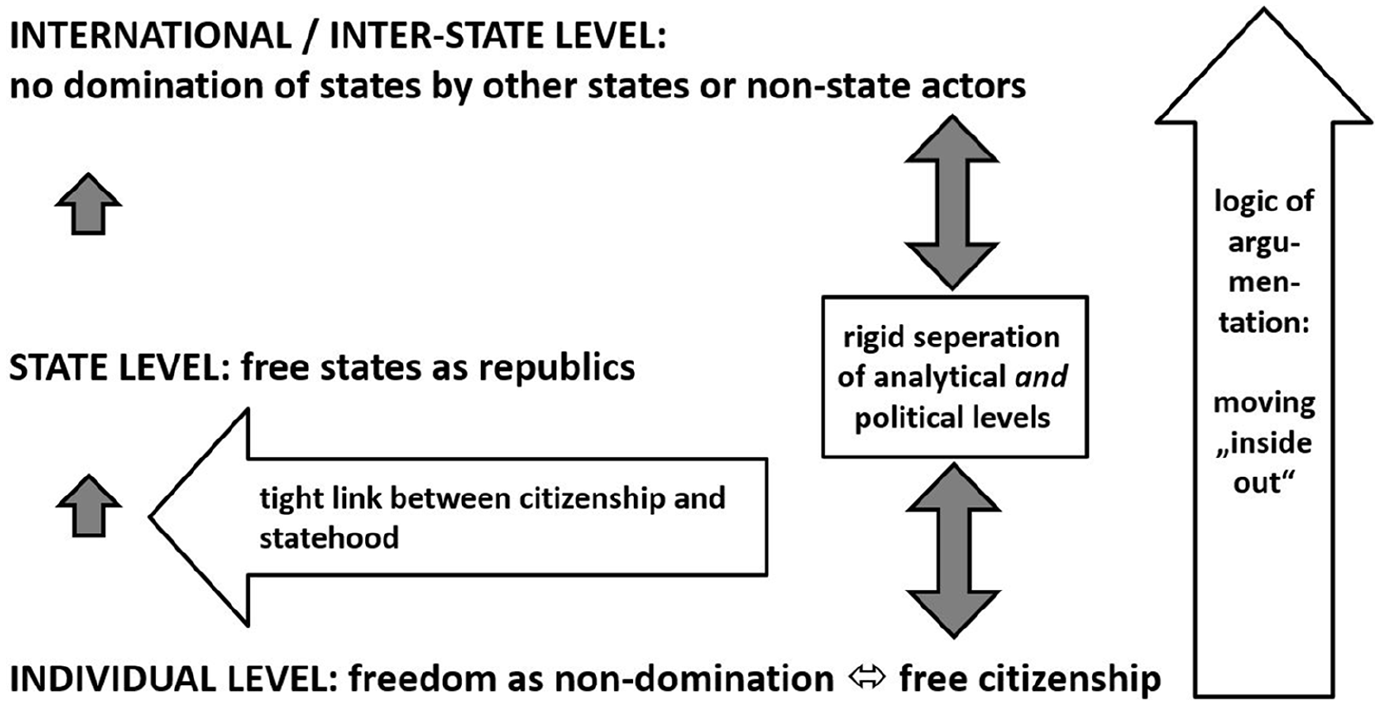
Structure of the republican internationalist argument in favour of free states.
Republican cosmopolitanism: Challenging jurisdictional, interpersonal and conceptual boundaries
Bohman’s republican cosmopolitanism poses a challenge to the central hinges within republican internationalism and to the very concepts that underpin the multi-level argument in favour of free statehood. While the main thrust of his criticism pertains to existing forms of territorial nation-states, fundamentally, he disputes citizenship’s strong link to statehood as well as the ideas of bounded citizenship and of boundaries between inside and outside of demoi and polities in general (Bohman, 2007: 2–11, 190). He foregrounds individual non-domination in and across borders and thereby disputes the state focus of the proposed internationalist order. Instead, Bohman sketches a polyarchic political order of plural trans- and supranational publics and political institutions which is meant to allow citizens to reflexively democratise this order by means of Democracy across borders.
Bohman (2007: 8, 9, 27) advocates a normative conception of freedom as non-domination and foregrounds the importance of an individual political status as a position of normative powers which enables individuals to engage in processes of deliberation, decision-making and contestation in order to not be ruled by others. While citizenship and freedom as non-domination therefore constitute each other, Bohman breaks with the strong association of citizenship and statehood and the identification of civic with territorial and state boundaries. Citizenship can thus assume various forms and exist in diverse contexts. This is possible because he defends a deliberative notion of democracy and develops the idea of a democratic minimum as the competence to initiate deliberation, not only on issues of policy but also on constitutional questions – and thus on the framework of democracy itself (Bohman, 2007: 2, 47–57, 94–97). The democratic minimum is especially important under conditions of globalisation, characterised, according to Bohman (2004: 340), by differential and indefinite interdependencies and forms of domination which require ‘a new form of membership and citizenship that permits the ongoing negotiation of conflicts and cooperation sufficient to secure human rights against domination across borders.’ Bohman thus circumvents the notion of a constituted people as a necessary framework of democratic decision-making and argues that an exclusive relation between a state, its citizens and the territorial (and national) boundaries which result from this nexus potentially endanger individual non-domination
On these grounds, he argues against firmly bounded states-peoples as political subjects as well as against a state-centred international order (Bohman, 2004: 338–340; see also Martí, 2010: 46, 58–64). Bohman instead opens up the possibility of a decentralised system of potentially numerous, reflexively interlocking publics, a polyarchic system of political institutions and plural citizenships. Plural citizenships in publics and institutions enable individuals to engage with an institutional order from a variety of perspectives, to discover jurisdictions’ and boundaries’ blind spots and to contest domination even across borders (Bohman, 2007: 11–13, 36, 126–128, 157, 158, 176). What is more, by conceptualising human rights as political rights, Bohman aims to abolish the dependence of members’ normative powers on particular jurisdictions and demoi. A ‘common civic status in a republic of humanity’ (Bohman, 2007: 131) is meant to provide an additional and encompassing vantage point from which democracy between non-exclusive demoi can be understood, assessed and reflexivised. The plurality of citizenships thus allows for ongoing processes of deliberation within and across jurisdictions and demoi.
In such an order, the meaning of boundaries and relations between inside and outside of a polity changes: First, Bohman highlights the exclusionary consequences of rigid borders and demands recognition of critical external perspectives on jurisdictions, demoi and particularly their boundaries. Second, the neat translation of claims to individual non-domination into claims to collective (and states’) non-domination is challenged. Bohman’s criticism of the strong citizenship-state-nexus and his sensibility for external criticism undermine the distinction between individual and collective/state level which internationalists advocate. Third, Bohman does not stop here but tends to question any strict distinction between inside and outside of a democratic jurisdiction or demos: ‘It is not democracy beyond borders but across borders; democracy across borders means that borders do not mark the difference between the democratic inside and the nondemocratic outside of the polity, between those who have the normative power and communicative freedom to make claims to justice and those who do not. It is not a democracy of a single community, but one of many different communities.’ (Bohman, 2007: 12, italics in the original)
Boundaries between demoi and jurisdictions are not meant to permanently determine who is to participate and who is not. Bounded citizenships in plural demoi exist, but Bohman aims at opening democratic processes of will-formation and decision-making to transnational influence. He sketches a dynamic order in which boundaries exist but shall not exclude and can constantly be turned into a subject of debate. Their existence is continually linked to the possibility of them being overcome. As Bohman thereby questions the distinction between inside and outside of political jurisdictions and demoi, the links between individual and collective non-domination, between individual non-domination and bounded jurisdictions not only lose their statist form, but they loosen altogether. While boundaries and inside-outside distinctions do not disappear altogether, their distinct contribution, their worth and value becomes difficult to ascertain.
This is a consequence, not least, of alternative methodological choices. Bohman recognises a multiplicity of perspectives on political institutions and publics and particularly highlights individualist and external points of view within a global sphere. His focus is on individual non-domination, especially of those who are excluded by established forms of political order. He questions the analytical distinction of individual and jurisdictional/collective levels. Permanent distinctions between inside and outside of a political order therefore appear faulty. Consequently, the political form of modern nation-states, the notion of free statehood and an internationalist approach to political rule beyond the state are not only subject to selective criticism but appear as anachronistic altogether – as a ‘methodological fiction’ (Bohman, 2007: 3; also Martí, 2010: 56, 67). As an alternative, Bohman opens up a space of possibilities for negotiating flexible and fluid non-dominating forms of democracy in and across borders (see also Ronzoni, 2017: 201, 202). While he values democratic citizenship, the specific institutional form of political order(s) and democratic decision-making, the role of democratic boundaries and thus the meaning and tenability of bounded citizenships, jurisdictions and demoi are pushed into the background (see also Lafont, 2010: 17, 18).
A republicanism of plural polities: Conceptualising constellations of plural citizenships, jurisdictions and demoi
A republicanism of plural polities recognises the importance of bounded ‘free polities’ for individual freedom and is, simultaneously, open to more complex constellations of plural polities as well as cognisant of the complex interdependencies between them. It therefore constitutes a third model of democratic institution-building that combines elements from both internationalism and cosmopolitanism. In parallel to the internationalist argument, a republicanism of plural polities advocates for a link between citizenship and bounded polities. It thus values individual as well as collective non-domination and takes citizenship(s) to entail more specific institutional requirements than Bohman does. At the same time, and in line with Bohman’s argument, it aims to keep the individualistic foundation and purposes of the political order visible on all political levels and to foreground citizenship as fundamental element of republican thinking. Thereby, it offers a distinct proposal for balancing republicanism’s three desiderata as distinguished by Ronzoni (see above).
Notes on methodology
It is further characterised by two methodological choices which are particularly relevant in the post-Westphalian constellation. Against the background of the internationalist and cosmopolitan positions, I propose to follow a logic of argumentation that is multi-perspectival and multi-directional and deliberately spans different analytical (and political) levels. First, as Bohman makes clear, a unidirectional logic of argumentation which relies heavily on the perspectives of insiders and moves solely inside out is unconvincing. At the same time, simply reversing the logic of argumentation – moving outside in – and focussing heavily on external perspectives on different polities does not, by itself, provide a compelling answer. Rather, a multi-directional logic of argumentation is advisable which recognises different internal and external points of view on demoi and democratic jurisdictions and thereby is able to complement, confront and negotiate distinct perspectives on political institutions. Second, taking up elements of neo-republican thinking, approaches which recognise the multi-layered logic of conceptualising democratic institution-building in terms of (a) individualist foundations (e.g. freedom and citizenship), (b) jurisdictional structures and collectives/demoi (e.g. free states/polities) and (c) inter-jurisdictional relationships (e.g. international relations) provide valuable insights. A compelling republican account of democratic institution-building therefore needs to account for the distinction between the different individual, jurisdictional/collective and inter-jurisdictional analytical levels and their interdependencies.
Therefore, it is important to confront and complement the perspective moving inside out with inverse or external perspectives as well as individual points of view with bounded polities’ perspectives. As I will show in the following passages, acknowledging the boundedness and particularity of citizenship corresponds to the perspective of participants and relies on the logic of constructing the argument inside-out. This logic is indispensable to accounts of democratic institution-building. But, by itself, it tends to neglect cross-border interdependencies and the exclusionary characteristics of particular polities and towards short circuiting the relation between citizenship and specific polities, for example, states. Consequently, argumentations which justify the distinction between different political levels should not lead to separating them completely and to sealing them off against each other. The voices of those excluded and thus also the individualist foundation of republican thinking need to remain visible even when discussing the jurisdictional/collective and inter-jurisdictional levels in order to challenge illegitimately exclusionary distinctions between inside and outside – without abandoning the multi-layered logic of thinking about democracy and political institutions altogether. Such a multi-layered and multi-perspectival approach to questions of democratic institution-building is a balancing act. The following passages outline core ideas about how to apply these methodological assumptions and thereby sketch core characteristics of a republicanism of plural polities.
Citizenship: Bounded and particular, yet not exclusive and state-bound
A closer look at citizenship offers a compelling starting point for negotiating perspectives for democratic institution-building under post-Westphalian conditions. It acknowledges the individualist foundation of republican arguments but is also inherently linked to collective non-domination and self-determination and its institutional contexts. The ensuing argument thus rests upon the republican premise that freedom is a social and political condition and linked to citizenship. It is therefore compatible with the notions of freedom put forward by Pettit (2012) and Bohman (2007), but it can also be linked to the ideal of freedom as autonomy (Celikates, 2014). It sheds light on the relations between different analytical and political levels as well as between inside and outside of different polities.
Citizenship is relational and multi-dimensional. It spans the interlinked elements of individual rights and duties, belonging, participation and status. Status implies a position of political power and freedom among equals. This position is brought alive by political participation and bears the potential for political and institutional change. Belonging refers to underlying social and political relations and identities, while rights and duties characterise the foundation of individuals’ rule-based relations to each other and, importantly, to the political institutions (see also Bellamy, 2008: 12–17; Bosniak, 2006: 18, 19). Thus, citizenship connects interpersonal relations between members of a demos on the one hand and their relations to the political institutions on the other (Dobson, 2006: 3). In particular, the elements of status and participation link interpersonal processes of will-formation and decision-making among equals to political institutions which shape these processes and are shaped by these decisions in turn.
From the perspective of individuals as participants, this conception provides the fundamental insight that citizenship and, consequently, demoi and democratic jurisdictions are necessarily bounded and particular. Citizenship’s particularity is grounded in the underlying logic of democratic decision-making among the members of a demos (Meine, 2017: ch 4.3) 3 : Informal and discursive forms of will-formation are not bound to specific institutions and contexts. However, any vote, election or referendum must link the interpersonal relations between citizens, who participate in processes of decision-making as equals, to the relations between individual citizens and the political institutions. The connection between interpersonal and individual-institutional relations presupposes boundaries; democratic decision-making presupposes a bounded demos. Because, for citizens as equal participants to consider a process of decision-making as legitimate, they have to be convinced (at least temporarily) that those who participate in this process do so legitimately – as opposed to those who do not. Consequently, the distinction between inside and outside and the boundaries of citizenship are not expendable.
While citizenship is thus bound to particular polities, jurisdictions and demoi, insisting on citizenship’s boundedness must neither be equated with supporting communitarian or statist positions nor with understanding citizenship as necessarily exclusive. While the interpersonal and individual-institutional relations citizenship encompasses are bounded and particular, they are, from a conceptual vantage point, neither bound to specific communities nor to state institutions. The argument originates in individuals acting together and shaping their relationships – and not in some pre-conceived conception of a political collective or community. In parallel, the state is not the given, only or theoretically necessary institutional form that processes of will-formation and decision-making need to assume. Moreover, there is no reason inherent to the logic of democratic decision-making or citizenship which causes them to be exclusive. This is not to say that if citizenships are multiplied, their particularity does not cause tensions and even contradictions. On the contrary, as soon as one individual holds plural democratic memberships, they are confronted with different contexts and boundaries of democratic decision-making which contradict each other even if each is valid democratically. From the perspective of citizens who are participating in a democratic decision-making process, being part of one self-governing demos, that is of one bounded group of equals with whom they interact as co-citizens, contradicts – for the time of decision-making – being part of other self-governing demoi. Nevertheless, the boundedness of citizenships is compatible with its pluralisation. If different citizenships correspond to distinct interpersonal and institutional contexts in such a way as to recognise and respect each citizenship’s, jurisdiction’s and demos’s particularity, one person can hold plural citizenships. If contexts are distinguished institutionally and interpersonally as well as territorially and/or functionally, they demarcate the scope of each citizenship and thus the frame within which the political status of and processes of participation among equal citizens are set. Thus, pluralising citizenships implies individual and institutional challenges, but citizenship is neither necessarily exclusive nor state-bound.
Pluralising citizenships is furthermore justified and, on the institutional conditions just specified, advisable if plural citizenships convincingly complement each other (Meine, 2017: ch 5.1). Particularly under post-Westphalian conditions, individuals’ freedom and self-determination can depend on being citizens in more than one polity. If individuals relate to different demoi and jurisdictions, to different polities, in a way that significantly influences their present and future lives, holding plural citizenships can be justified, sometimes even necessary for individuals to live politically self-determined lives (see Bauböck, 2015, 2018). This is true for plural state citizenships. But, if new institutional contexts, for example the EU institutions, constitute a distinct jurisdiction and assume the character of political rule, additional nested citizenships like EU citizenship can become necessary to provide for non-domination and self-determination in these contexts as well (e.g. Habermas, 2012). If, under conditions of globalisation and Europeanisation, social, territorial and political spaces are no longer congruent, when new interdependencies and possibly new forms of governance and political rule, clinging to exclusive state citizenships can endanger individual non-domination and self-determination. Constellations of plural citizenships provide possible and justified alternatives for guaranteeing individual freedom and self-determination as well as preserving the legitimacy of the distinct polities and of the overarching political order in its entirety.
The theoretical possibility of plural citizenships however only becomes a relevant and compelling institutional option if one not only considers participant insiders’ perspectives and not only pursues a logic of argumentation which moves inside out. We only recognise individuals’ relevant relationships to different states or (new) political jurisdictions and collectives if we take a step back and consider other perspectives as well. Only if we weigh different internal and external perspectives does it become visible that pluralising citizenships and thereby giving individuals the opportunity to participate fully in distinct polities that impact their lives is a valid and important option. This does not mean abandoning the boundedness and particularity of citizenships and of their interpersonal and institutional contexts. It means, however, that we should be receptive to their potential exclusionary consequences and target the blind spots that every citizenship, demos and polity has. From this vantage point, deviations from the Westphalian frame can open up avenues to better realise individual freedom and autonomy under post-Westphalian conditions.
Free polities and their boundaries
This account of plural citizenships provides a gateway for re-appraising the consequences of republicanism for democratic institution-building on the state level and beyond. It questions Bohman’s cosmopolitan position insofar as he neglects that bounded polities provide the indispensable interpersonal and institutional contexts of democratic decision-making among equal citizens. Simultaneously, a republicanism of plural polities differs from the internationalist account as it does not identify states and constituted states-peoples as the sole context of democratic self-determination and individual non-domination. To account for the plural forms that democratic polities can assume, as well as for their possible pluralisation, I therefore propose to replace the concept of free states with that of free polities.
Mirroring the conception of citizenship outlined above, free polities constitute an ensemble of a bounded demos or citizenry and political and legal institutions that hold authority over a jurisdiction. In parallel, Bauböck (2015) speaks of a prolity as an ‘ensemble of territory, citizenry, and government institutions’ (p. 822). For the purposes of this paper, I bracket the question whether polities need to be bound to territorial spaces or can also assume non-territorial forms. Elsewhere I argue that there is no theoretical necessity for democracy to be linked to territory or territoriality but that territory fulfils a number of functions for democratic rule for which, so far, it has proven difficult to find functional equivalents (Meine, 2019).
The political and legal institutions of a polity provide the institutional frame for citizens’ will-formation, decision-making and contestation to take place. Principles of political legitimacy, that is democratic decision-making, the rule of law and the separation of powers, need to obtain to guarantee non-domination. In turn, the demos is a political collective of citizens who can participate in the formation, making and contestation of political decisions as free and equals within this institutional setting. As a result, polities can assert a claim to recognition of their authority within their boundaries and to non-domination and to the recognition of their integrity, by external actors and other polities. In contrast to the more flexible notion of publics, demoi are relatively stable interpersonal associations and relate to a set of political institutions. In contrast to the notion of sovereign states, polities do not need to be conceptualised as uniform, comprehensive or exclusive structures of supreme political rule. They can assume different forms – the state form being one of them – and they can be pluralised to form building-blocks of more complex constellations of polities. The latter requires that the different polities within a constellation have territorially and/or functionally distinct spheres of authority. For example, we can understand the European order as a multi-level order of plural polities: Each member state can and should constitute such a polity, some autonomous regions within member states constitute free polities in their own right with their own competences – and, despite what internationalists argue (Bellamy, 2019), it is also possible to consider the EU institutions and the EU citizens as a (nascent) demos to constitute a polity in its own right (e.g. Habermas, 2012; Meine, 2021). Each polity forms a building block within the European constellation of polities that needs to be recognised in its integrity. Which constellations of free polities – nested or also different kinds of overlapping polities – are generally possible is a question for future research. Importantly, however, the notion of free polities foregrounds that they and, more particularly, their status, their personal and jurisdictional boundaries and their interrelations are the institutionalised result of political decisions and, as such, can be contested and changed over time.
Methodologically, this conception of free polities relies, on the one hand, on a multi-layered argument that moves inside out, from citizens to polities to their interrelations. It thereby accounts for the boundedness and particularity of citizenships and of free polities as their contexts. On the other hand, it takes seriously external points of view and highlights that internationalist republicans tend to move to quickly from the individualist foundations of their argument for bounded jurisdictions and demoi to a statist logic. Particularly under post-Westphalian conditions, it is advisable to keep the individualist foundation of republican arguments present and vivid beyond single polities and reflect on the consequences of institutional constellations of polities on individual freedom and non-domination. The multi-layered argumentation, while important, must not lead to the reification of the distinct analytical and political levels.
This line of argument also means explicitly facing the question of how to legitimately decide on democratic boundaries. On the one hand, contemporary efforts of democratic institution-building need to recognise individual non-domination of those living within, but also of those living outside particular free polities and be cognisant of the exclusionary consequences of bounded forms of non-domination. Contra Pettit, the constituting people should not necessarily be delimited by one specific constituted people and jurisdiction. On the other hand, democratic decisions on the boundaries of the demos remain bound to democratic decision-making by existing demoi. They face the so-called boundary paradox (e.g. Fraser, 2009: 15; Näsström, 2007). Individual (juridical) challenges to existing political structures and borders as well as deliberation in transnational public spheres are possible starting points for overcoming this legitimatory gap and for rectifying exclusionary practices and institutions (e.g. Bohman, 2007; Pettit, 2006; Slaughter, 2014). However, neither solve the boundary problem and it remains questionable if they effectively translate into democratic decisions.
Constellations of plural polities do not overcome the theoretical paradox of constituting the demos either, but they do provide opportunities for improving the institutional structures of decision-making about boundaries. Each of the plural, overlapping or nested polities provides a distinct perspective on specific boundaries which results from decision-making of a distinct set of citizens – and relies on a different distinction between inside and outside and has different blind spots. Confronting these perspectives within an institutional setting should improve the democratic legitimacy of the respective boundaries. What is more: To reflect on and potentially overcome the different polities’ blind spots, it is necessary for the individuals who participate in will-formation and decision-making about boundaries to take a step back and consider different relevant points of view. Constellations of plural polities improve the possibilities for this kind of reflection and its translation into democratic decisions. Within them, plural citizens act within institutional structures that invite them to become conscious of different political perspectives – internal and external, individual and collective – and can develop a reflexive understanding of the demoi’s and polities’ respective blind spots as well as their interplay. Individuals can then introduce their insights or voice their protests in different contexts. In the European constellation, while states’ perspectives remain predominant, citizens are also addressed as Union citizens and urged to consider other states or Union citizens’ perspectives, especially when considering boundaries and their consequences. Indirectly, such structures open up new arenas for transnational public debate by confronting different perspectives within the institutional architecture of the EU. By incorporating and strengthening possibilities for critical engagement with the existing institutional set-up by institutional means, constellations of free polities do not render the engagement of active and vigilant citizens redundant. Citizens’ motivations and virtues – in the sense, possibly, of a cosmopolitan patriotism – remain indispensable (see Erez and Laborde, 2020). At the same time, constellations of plural citizenships and polities provide institutional support for transnational debate and activism to take place as well as different avenues to translate discursive engagement and transnational activism into democratic decisions (Laborde, 2010: 50; Slaughter, 2014: 312).
In sum, republicans should disregard neither the particularity of citizenships and the integrity of polities nor the exclusionary consequences of their boundedness. Free polities are contexts of freedom and democracy. But, the logic of individual freedom does not translate completely into the logic of collective non-domination in particular free polities. Under post-Westphalian conditions, individuals depend on the interplay of different polities and citizenships for their non-domination and self-determination to be secured as well as on the possibilities to contest and renegotiate their boundaries time and time again. The conceptual change from free state to free polity helps to conceptualise these insights.
Institutionalising constellations of plural ‘free polities’: Challenges and perspectives
An understanding of political institution-building along the lines of a republicanism of plural polities thus reaches beyond the internationalist constellation of sovereign states but is not as flexible as Bohman’s cosmopolitanism as it still relies on the particular institutional form of free and bounded polities. To fathom the institutional possibilities of constellations of such polities, research in political theory needs to further develop our conceptions not only of the individualist contestation of boundaries (see above), but also of the relations between free polities as building-blocks of broader constellations. While all free polities need to be recognised as particular and, to some degree, autonomous entities, they also stand in relation to each other and interact. As plural polities also entail plural possibilities for dominating each other, their interdependencies need to be negotiated, their interactions and interplay shaped and institutionalised – to secure the conditions of democratic decision-making and individual freedom in and across plural polities. Even if free polities are pluralised, the internationalist argument for institutionalising inter-polity relations still holds. Within the EU context, this applies to relationships between member-states and their relations to the European institutions. It could also possibly apply to the respective interplay of the state and European institutions with the regional political level. I will indicate three interrelated focal points for negotiating these interdependencies and avenues for future research.
Firstly, political theory needs to inquire into possible constellations of self-rule and shared rule between free polities that reach beyond the internationalist framework (see Oldenbourg, 2019: 338–343). Under post-Westphalian conditions, free polities might hold political competences to self-rule in some areas, have no competences in others and share competences with other polities in a third set of areas. Importantly, shared rule between free polities is not limited to cooperation between states. Shared decision-making does not only work between political entities of the same kind but across levels: From one angle, the EU can be considered to constitute the inter-jurisdictional institutional setting for the relations between its member states. This is compatible with the position of republican internationalists (Bellamy, 2019). Yet, the account proposed here goes further. As the collective of Union citizens can be considered to constitute an additional (nascent) demos, the European constellation, also, provides a framework within which, in certain instances, states-peoples do not only share political rule with each other but also with the collective of EU citizens as a distinct demos. On the European level, the inter-state perspective, represented by the Council is confronted with the perspective of all EU citizens expressed by the Parliament. This does not mean that the supranational institutions supersede state jurisdictions and demoi, but it allows us to acknowledge a dual character of European institutions (Habermas, 2012). This institutional structure allows distinct, yet equally valid democratic perspectives to be recognised. Thus, between the fundamental individual and the overarching inter-jurisdictional (or global) levels, a space of possibility for more complex constellations of particular and interdependent polities opens up. 4
Secondly, we need to assess more complex notions of multilateralism and multilateral decision-making as elements of democratic institution-building. As constellations of plural polities result from the fact that unilateral decision-making within single polities reaches its limits, unilateral control of the relationships between polities can endanger the legitimacy of these constellations. Understandings of multilateralism that highlight generalised rules of conduct and ‘diffuse reciprocity’ as guiding principles for states’ conduct, indicate principles for institutionalising the relations between plural polities (Ruggie, 1992). The republican perspective developed here, supports the institutionalisation of multilateral relations. Simultaneously, it encourages us to specify which modes of decision-making are advisable to guarantee non-dominating relationships within constellations of plural polities and thereby to further concretise not only the generalised rules of conduct but also the conditions for reciprocity to remain non-dominating. It furthermore entails that principles of multilateralism and transscalar forms of multilateral decision-making could also apply to (nested) polities on different political levels, for example between member states and the encompassing EU institutions in the European constellation. Framing inter-polity decision-making in these terms is demanding. But it might turn out to be the most promising approach for structuring democratic decisions on cross-border issues as well as constitutional questions such as boundaries themselves. It allows for multi-perspectival negotiations of questions which would have exclusionary effects on individuals and polities if decided unilaterally. Following a more multilateral trajectory can help to diminish the blind spots and thus the dominating consequences, bounded forms of decision-making entail.
Thirdly, setting the course in this way implies conceptual challenges to notions of sovereignty and independence. While the distinction between inside and outside of free polities as well as the distinction of political levels remain valid, sovereignty can no longer be understood as a form of supreme power or unilateral control. Compelling conceptions of sovereignty – or post-sovereignty – thus need to take into consideration inter-polity relations beyond the statist or international constellation (e.g. Laborde, 2010: 63; see also Geenens, 2017; MacCormick, 1999; Ruggie, 1993). In parallel, the idea of political independence needs to be adapted. While abandoning the notion of independence prematurely is not advisable because the particularity of autonomous polities remains a core component of a republicanism of plural polities, it can no longer be understood as binary or exclusive. The difficulty lies in defining the threshold which allows us to consider a polity a ‘free polity’ within different constellations of polities. The possibility of institutionalising constellations of plural polities thus urges us to re-negotiate (post-)sovereignty and political independence in conjunction with their ‘counterparts’, that is with conceptions of interdependence and union, in order to develop more nuanced guiding-principles appropriate for democratic institution-building under post-Westphalian conditions.
Conclusion
In sum, if one takes citizenship as the republican focal point for discussing political institution-building in as well as beyond the state, the strong connection between citizenship and the political form of the state as well as the resulting state-focused conception of international politics, which republican internationalism advocates, become questionable. Neo-Republicanism’s core contribution to the general debate on post-Westphalian political institution-building thus turns out not to be the specific political form of a free state, but the multi-layered and multi-dimensional justification of free polities which exposes the interrelations between individual, jurisdictional and collective, as well as inter-jurisdictional levels of a political order. As a result, a republicanism of plural polities advocates that while democratic decision-making in free polities is always bounded, particular free polities can, and sometimes should, be building-blocks of more complex and encompassing political orders – in order to better realise individual non-domination. It shows that democratic institution-building in and beyond the state is a balancing act that needs to be open to contestation and re-negotiation. However, even new forms of plural still need to adhere to the institutional and interpersonal requirements of non-dominating and non-dominated polities and their interrelations need to be deliberately institutionalised. A republicanism of plural polities is a cautious pluralism and, as of yet, it is open how far a pluralisation of free polities can, should or will go.
Yet, to negotiate these changes and ask these questions in the first place, we need a conceptual framework that is not pre-set on the statist answer but open to different institutional options to ponder and assess. A republicanism of plural polities provides a distinct vocabulary to negotiate different possible forms of legitimate and democratic institution-building. It offers a theoretical horizon within which the interplay between individual freedom and democratic self-determination, the political institutions of single polities as well as their broader constellations and interplay can be conceptualised and debated. Negotiating and weighing different individual and polity perspectives is the sole way for democratic theory to meet the current challenges of democratic institution-building and to transcend the statist-cosmopolitan divide. Under post-Westphalian conditions, political orders in and beyond the state do not constitute single unified entities, but complex constellations of polities. Their interplay provides the frame for realising individual freedom and democratic self-determination as well as the legitimacy of the political order in its entirety.
Footnotes
Acknowledgements
I would like to thank the participants of the MANCEPT-Workshop on “Independence, self-determination and secession” as well as the two anonymous reviewers for their constructive discussion and valuable comments on earlier versions of this paper.
