




Abstract
In recent decades, decisionmakers have increasingly faced conflicts juxtaposing demands for self-determination and inclusion. Political theorists term this juxtaposition “the boundary problem.” They have offered normative solutions, especially for “just inclusion,” proposing what states owe to exogenous individuals like migrants and refugees. Meanwhile, as I show, legal scholars have developed parallel observations regarding what I term “just exclusion,” concerning how self-determination by sub-state collectives, such as minority nations, interacts with the inclusion rights of members of the majority. I make, first, a descriptive contribution, showing decisionmakers how political theories of “just inclusion” and legal theories of “just exclusion” are complementary, uniting to frame the boundary problem. Second, I make a prescriptive contribution, deploying this frame to lay out a stepwise approach so decisionmakers can more logically work through boundary-problem conflicts.
Introduction
Who is included in “we, the people”? Who is excluded, and on what grounds? What territory is ours versus theirs? These determinations, though esoteric, are elemental. They are like the forces in the atom, so constitutive of the world around us they hide in plain sight. They separate domestic politics, which happens within polities, from geopolitics, which happens between them. Hence, these determinations undergird politics, constituting its foundations. They hide because, usually, those foundations appear inherent. We normally think of polities and their boundaries as natural and permanent. In fact, they are artificial and tenuous. They rest on contestable claims about who “we, the people” are and what is rightfully ours. If these foundations erode, or are subverted, “we” may be no more.
If boundaries are foundational to politics, what rules should shape boundaries? In contemporary political thought there have been two prime candidates: collective self-determination and the rights of individuals to political inclusion. Both have intuitive appeal. Yet when juxtaposed, they present a dilemma—the vexing “boundary problem” (Whelan, 1983). 1 Though the boundary problem has been framed in various ways, I distill it to this: (How) may a collective self-determine such that none are wrongfully excluded? The problem is vexing because neither liberalism nor democracy seem able to solve it. For democrats it poses a chicken-and-egg dilemma, pithily stated by Jennings (1956): “[T]he people cannot decide until someone decides who are the people” (p. 56). For liberals the question is no easier: Political membership disfavors non-members, and thus seems inherently illiberal. 2
The boundary problem is not just academic. It has real-world urgency. Inspired by this urgency, political theorists have lately generated an extensive literature on the boundary problem, proposing a range of solutions (e.g. Abizadeh, 2012; Arrhenius, 2005; Bauböck, 2017; Cabrera, 2014; Goodin, 2007; Miller, 2020; Owen, 2012; Song, 2012; Whelan, 1983). These solutions have especially focused on “just inclusion”—on identifying states’ responsibilities toward exogenous individuals such as migrants and refugees. Rather than joining their theorizing, my aim in this article is to first make a descriptive contribution, stepping back from the normative literature to trace out the political and legal space the boundary question appears to inhabit. I believe that space is bigger and busier than most scholarship suggests.
This space has lacked a cognizable framework—it has been, at best, hazy. In my view, it encompasses not only recent boundary-question research on “just inclusion” but other, seemingly disparate subjects of scholarly concern. Students of these subjects have tended to be not political theorists but rather legal theorists. Their subjects include “sovereignty studies” (Aleinikoff, 2000), the “law of democracy” (Issacharoff et al., 2002), “mega-politics” (Hirschl, 2004, 2008), consociational governance (Graziadei, 2016; McCrudden and O’Leary, 2013), and Indigenous decolonization (e.g. Berger, 2010, 2013, 2019; Gover, 2015, 2017; Rohrer, 2016; Spitzer, 2019a, 2019b, 2019c). Uniting their work has been a common focus on what I call “just exclusion,” concerning how the self-determination claims of sub-state collectives, such as minority nations, interact with the inclusion-rights of members of state majorities.
I suggest these legal theories of “just exclusion,” and political theories of “just inclusion,” in fact all grapple with the boundary problem. They simply approach it from opposing directions, examining obverse sides of the same coin. In this article I will show how “just inclusion” and “just exclusion” may be seen as yin and yang, forming a unitary framework, interlacing self-determination and inclusion.
Having sketched out this framework, I will then strive to make a second contribution, this one prescriptive. I will propose an approach by which liberal-democratic decisionmakers—legislators, judges, citizens—might more logically and productively analyze boundary-problem conflicts. I will illustrate this approach by applying it to several examples from constitutional caselaw, showing how salient boundary-problem conflicts were—and might more logically have been—decided. I hope this approach will provide decisionmakers with new paths forward in unpuzzling conflicts between self-determination and inclusion.
Literature: The boundary problem, “just inclusion,” and “just exclusion”
The boundary problem has lately become salient. Not long ago, the international order was rigidly framed. Clearly bounded states, ruling “historically given” (Whelan, 1983) territories, related to one another primarily through power politics. Insiders were distinct from, and not responsible to, outsiders. But globalization has made those lines fuzzier. Observes Benhabib (2004), “We are at . . . a historical juncture where the problem of political boundaries has once more become visible” (p. 18).
This problem of boundaries is evidenced by the recent proliferation of cross-border justice claims. Refugees plead for asylum, migrants appeal for foreign work, islanders protest climate change, peasants seek trans-boundary water rights, and so forth. In all of these cases, outsiders push to have their interests counted by insiders. They demand consideration according to the norms of liberal democracy, irrespective of Westphalian borders. They seek “just inclusion” (Bauböck, 2017: 3).
Hence, political theorists have tackled the boundary problem, proposing “just inclusion” solutions. These solutions generally follow one of three principles. According to the first, the “all-affected principle,” inclusion is owed to all outsiders affected by state decisions. In the second, the “all-subjected principle,” inclusion is owed to all those subject to state coercion. In the third, it is owed to all within state borders. Yet whichever view scholars take, they seem animated by the same concern: That the traditional integrity of states not overshadow non-citizens’ pleas for justice (Benhabib, 2004; Fraser, 2009).
However, “just inclusion” is only half of the boundary problem—the back half. The above-mentioned solutions address only the problem of how outsiders should be fairly included. What about the front half of the boundary problem? May a collective self-determine? Whom may it exclude? These are questions of “just exclusion.”
As with “just inclusion,” “just exclusion” was long of little import. In the same way Westphalianism framed the international order, it also structured domestic politics, making states rigid containers (Shaw, 2008; Walker, 1993). Here too, particularly in the Global North, recent decades have been disruptive. But unlike in the international arena, where boundaries have weakened, the domestic pressure has been for new boundaries (McCrudden and O’Leary, 2013)—for additional federal units, autonomous zones, consociational arrangements, co-management regimes, devolved powers, or for outright secession.
These appeals for new boundaries come from sub-state actors—from Catalonians, Quebecois, and Indigenous peoples, for example. These actors have emerged, or are finally being recognized, as internal collective rights-bearers. They challenge the holism of the state in which they are imbedded (Benhabib, 2004: 82; Issacharoff, 2008). I suggest this disruption of the internal order has led to the obverse of the disruption of the international order. It has spurred claims for “just exclusion.” To self-constitute and self-determine, sub-state actors seek to bound non-members out.
Under what conditions may they do this? May Catalonia secede? May Quebec limit the use of English? May Indigenous peoples bar non-natives from reservations? As with questions of “just inclusion,” certain “just exclusion” questions have received recent scholarly attention. As noted, this attention has come primarily from legal thinkers, especially constitutional lawyers and group-rights scholars. Though tackling divergent subjects, in important ways their insights overlap.
Among these scholars, those addressing group rights have grappled with “just exclusion” in the course of investigating specific justice dilemmas. For example, students of consociational governance have shown how individual electoral rights may endanger minority power-sharing (McCrudden and O’Leary, 2013; Graziadei, 2016). Scholars focusing on Indigenous rights have noted how tribal self-government may be challenged as illiberal toward non-natives (see e.g.Berger, 2010, 2013, 2019; Gover, 2015, 2017; Rohrer, 2016; Spitzer, 2019a, 2019b, 2019c). And, those studying postcolonial land redistribution have detailed resistance by rich landowners asserting equal protection (Hirschl, 2004, 2008). In each of these cases, it is not powerful states but vulnerable minorities who seek the right to exclude.
Constitutional lawyers, meanwhile, have contributed to “just exclusion” scholarship more overtly, sketching out connections between individual inclusion rights, which are often legally prominent, and collective rights of peoples, which are often hidden. For example, Aleinikoff (2000) has critiqued the tendency in U.S. constitutional law to “assume the state” and thus overlook constitutional questions concerning the state’s demotic and territorial parameters. Partially answering this challenge has been Issacharoff et al.’s (2002) “law of democracy”, a field of U.S. constitutional inquiry that, among other things, explores the relationship in American caselaw between familiar individual political rights and less-familiar arrangements of self-determination.
As I see it, the efforts of these constitutional and group-rights scholars are motivated by a shared concern. They worry that, contra the fears of most “just inclusion” theorists, the pleas of individual-rights claimants are in some cases taken too seriously, while the interests of collectives are not taken seriously enough. Issacharoff (2008) cautions against “impulses to treat . . . conflicts about the structure of political systems as familiar claims of individual rights” (p. 231). These scholars suggest that, despite majority protests, under appropriate conditions—conditions of “just exclusion”—minorities may comprise a legitimate polity, and can rightly fence non-members out.
So how might understandings of “just inclusion” and “just exclusion” fit together? How do they interact in a liberal-democratic framework of the boundary problem? To explore this, I will begin with the basics.
Describing the structure of the boundary problem
The political world is commonly understood to comprise two sorts of rights-bearing agents. One sort are individuals, owed political rights such as democracy and liberal justice. The other sort are collective peoples, who assert self-determination.
Self-determination means the right of peoples to choose their political status. It is not only a key precept of international law but is perhaps the most universally cited collective political right. Yet if self-determination sits on a pedestal, controversy envelops its base. The phrase “self-determination,” Bucheit (1978) observes, “gives no clue to the nature of the self that is to be determined; nor does it provide any enlightenment concerning the process of determination or the source and extent of the self’s putative right to this process” (p. 9–10). Operationalizing the right of self-determination is difficult in part because it is predicated on self-constitution—on defining, legitimizing, and maintaining the collective political self (Tierney, 2012: 58). Yet frustratingly, as I have shown, self-constitution clashes with the norms of liberalism and democracy. This clash results in the boundary problem.
Yet despite the boundary problem, boundaries crisscross the globe. Humanity is—illiberally, undemocratically, but nonetheless inescapably—divided into nearly 200 states, each at least in theory a discrete sovereign exercising self-determination. Often these state boundaries filtered down from the pre-liberal past, were forged in violence, or were instantiated in the extra-legal vacuum of a “constitutional moment.” Though illiberal and undemocratic, these events were nonetheless foundational, supplying answers to that elemental question, who are “We, the people”?
Yet of course, boundaries exist not just between states, but within them. As with external bounding, internal bounding may be necessary to protect the self-determination of constituent sub-state peoples. In a state comprising such peoples, Van Dyke (1985) observes, “it is as inappropriate to think of majority rule as it would be in the world as a whole” (p. 172). Hence most liberal democrats tolerate not just Westphalian statehood but also internal non-universalism (Kymlicka, 2012). As noted, federal, consociational and other internally “compound” arrangements are common and getting commoner. These arrangements, too, must be instantiated outside liberal democracy. For example, in the classic American case, the federal units were identified, and their powers allotted, by the Great Compromise—a pragmatic bargain between the large and small states, hammered out in a “constitutional moment,” apportioning Senate representation qua state and House representation qua population.
Demotic and liberal-democratic arrangements
Bounding, then, can be both external and internal. It demarcates self-determining collectives. Yet it contravenes liberal democracy. Hence, bounding is what I call a “demotic arrangement.” Bounding establishes the “structure of democracy,” so must be considered in a manner “constitutionally prior” to liberal democracy itself (Issacharoff, 2008: 231). This means bounding comes first—it must be temporally prior. Bounding is politics’ original event, instantiating the demos. But it also means that for self-determination to endure, the boundaries of a people must remain under their control. In this way, bounding is existentially prior. It must be provided for not just at the outset but perpetually. Benhabib (2004) seems to discern this when she observes, “Defining the identity of the democratic people is an ongoing process of constitutional self-creation” (p. 21). If at any point exogenous actors subvert demotic arrangements, self-determination ends and control by others begins.
After a self-determining people establish the boundaries of their demos, and while maintaining those boundaries in perpetuity, they must also grapple with the interests of the aforementioned other category of moral agents, individuals. Of course, individuals are widely considered to deserve, and increasingly demand, liberal rights and democracy. Operationalizing liberal democracy occurs through what I will call “liberal-democratic arrangements.” Liberal-democratic arrangements recognize and protect “natural,” or “negative,” individual rights such as speech, worship, and mobility. They also enact “positive,” or “political,” rights, such as those that fall under the “law of democracy” (Issacharoff et al., 2002)—the guidelines of the democratic process. These guidelines govern practices and procedures related to, for example, electoral districting, candidacy, campaign funding, and of course voting.
I suggest that in the framing of the political world, liberal-democratic arrangements typically are nested within, and complement, demotic arrangements. Again, unlike demotic arrangements, I see liberal-democratic arrangements as applying to individuals, not polities. Rather than enshrining collective self-determination, liberal-democratic arrangements guard individual rights. Liberal-democratic arrangements are not “constitutionally prior” but “constitutionally post.” This means that they are not just temporally post but also, and more importantly, existentially post. They rest on the foundation of, and thus are contingent upon, constitutional decisions relating to bounding. 3
Transboundary conflicts and balances
It can be seen, then, that in the political world there are two categories of rights-bearing agents, collectives and individuals, and that honoring their rights requires two orders of arrangements, demotic and liberal-democratic arrangements. Typically these orders are complementary and nested. Demotic arrangements relate to the establishment and preservation of demotic boundaries, thereby enshrining self-determination for collective peoples. These demotic arrangements are “constitutionally prior,” and, as noted, tend to hide in plain sight. Liberal-democratic arrangements, meanwhile, operationalize liberalism and democracy for individuals within a constituted polity. Liberal-democratic arrangements are thus “constitutionally post,” and are relatively conspicuous in everyday civic life.
Yet despite the typically complementary and nested relationship between demotic and liberal-democratic arrangements, the two may come into conflict. These conflicts juxtapose exclusion and inclusion. They are thorny due to the boundary problem. Among the first scholars to explore such conflicts was Kant (1795 [2015]), who recognized that because the political world has two categories of moral agents, individuals and polities, it has three potential axes of rights-conflicts. Each of these rights-conflicts involves what Kant saw as a distinct kind of rights. The first two kinds of conflicts are familiar: conflicts between co-citizens, juxtaposing liberal-democratic rights, and conflicts between polities, juxtaposing demotic rights.
Kant’s third kind of justice conflicts are in effect boundary-problem conflicts, juxtaposing demotic and liberal-democratic rights—the conflicts relevant to this article. Kant called the individual rights at stake in such conflicts weltbuergerrecht, or world citizenship rights. He conceived of them as rights of hospitality owed to travelers visiting foreign countries. In effect, they are rights of inclusion. Conflicts over weltbuergerrecht differ from Kant’s first two rights-conflicts as they take place not within the demotic or liberal-democratic orders, but across them. That is to say, they take place across boundaries, hence encountering the boundary problem.
Transboundary hydraulics
Resolving transboundary rights-conflicts is particularly challenging for a reason inherent to the boundary problem. The reason relates to what I call “transboundary hydraulics.” Again, boundary-problem conflicts involve complex interactions between “constitutionally prior” demotic arrangements, protecting collective self-determination, and “constitutionally post” liberal-democratic arrangements, guarding individual rights. These interactions exhibit “transboundary hydraulics,” involving “downstream” and/or “upstream flows.”
First, let’s look at “downstream flows.” As noted earlier, in practice liberal-democratic arrangements protecting individual rights typically complement, and are nested within, antecedent, demotic arrangements protecting self-determination. Hence, self-determination typically conditions individual rights. I conceive of bounding decisions as “flowing downstream,” acting on individual rights. This dynamic is depicted in Figure 1.
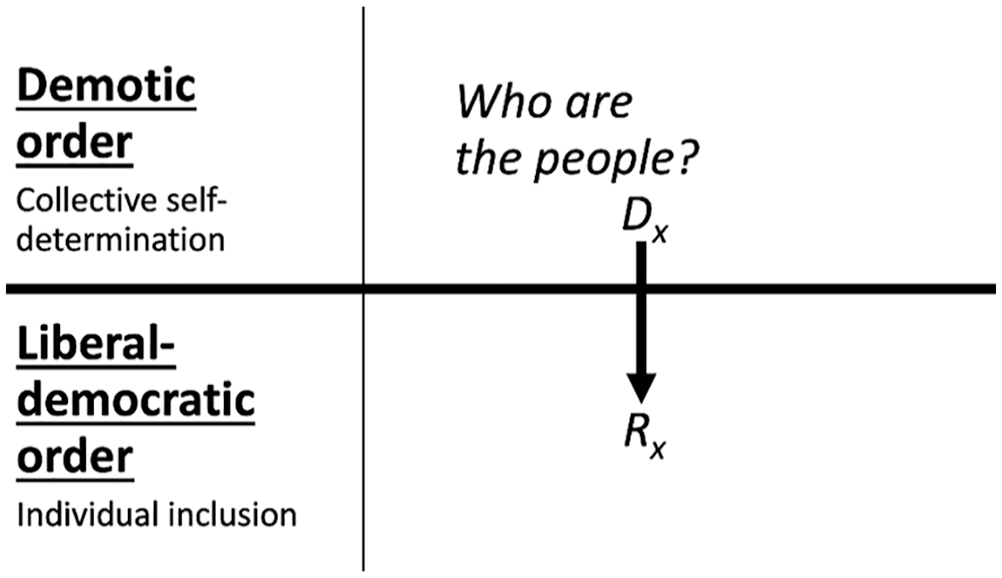
The “downstream flow” of “transboundary hydraulics”. Collective-boundary-making facilitates self-constitution and self-determination, addressing the matter of “who are the people” by bounding the demos (DX). This bounding decision can be understood to “flow downstream,” from the “constitutionally prior” demotic order to the “constitutionally post” liberal-democratic order, acting on individual rights (RX).
As noted, in my conception this “downstream flow” takes place across borders—across international borders and, in “compound” states, also across the boundaries of constituent peoples and/or subunits. Internationally, an example involves immigration and voting. When an outsider appeals to immigrate to the United States, that is a transboundary appeal. Like in most countries, U.S. citizens possess liberal-democratic rights, enshrined in the constitution, to move and vote anywhere domestically. Also as with most countries, the U.S. values its self-determination, so employs demotic arrangements protecting its boundaries. The outsider will be allowed to vote (i.e. to be included in the American demos) only after meeting the requirements of U.S. citizenship. Hence, until they are naturalized as a citizen, the U.S.’s demotic boundary regime will place “downstream” limits on their liberal-democratic inclusion.
As noted, it is not just when traversing international borders that demotic arrangements condition inclusion. Such conditioning occurs within states that are federal, consociational, or otherwise “compound.” Take the case of U.S. federalism. Federalism is a demotic arrangement, designed in part to protect the self-determination of constituent polities. This has staggering consequences “downstream,” on liberal-democratic individual interests. In the U.S., small polities are overrepresented vis-à-vis large polities. Hence in Wyoming it takes just one sixty-eighth as many voters to elect a federal senator as it does in California. Denied “one person, one vote,” Californians are thus excluded from full political equality. In this manner, America’s internal federal structure, just like its external boundaries, places downstream limits on individual rights.
One of Kant’s key innovations was to resist this downstream flow, championing individual rights that push “upstream.” In effect, he condemned certain illiberal outputs of self-determination, challenging the conditioning of individual rights he felt should be inviolable not just domestically but abroad. Kant maintained that weltbuergerrecht should resist the standard transboundary current, conditioning the self-determination of foreign sovereigns. In this way, he imagined a world in which the liberal-democratic order might condition the demotic order—in which collective boundaries would bend to the exigencies of individual inclusion.
Yet Kant did not take this too far. Observes Benhabib (2004), Kant’s “right of hospitality . . . does not entitle one to plunder and exploit, conquer and overwhelm by superior force those among whom one is seeking sojourn” (p. 40). Otherwise, individual rights would push all the way upstream. Inclusion would not merely condition but quash collective self-determination. Kant does not question the legitimacy of polities, or seek to undermine them by denying their interests in exclusion. Rather, he seems to call for what I term a transboundary balance—an equilibrium between individual weltbuergerrecht and self-determination.
Prescribing an approach to boundary-problem conflicts
As can be seen, boundary-problem clashes are vexing. They involve transboundary hydraulics—dynamic interactions between demotic and liberal-democratic arrangements. Typically, arrangements guarding self-determination “flow downstream,” acting on individual inclusion. However, inclusion rights such as Kant’s weltbuergerrecht press upstream, conditioning collective self-determination. Unrestrained upstream flows may obviate self-determination; unrestrained downstream flows may quash inclusion. Discerning the appropriate relationship between the two is a core challenge of working through boundary-problem disputes.
Sometimes, of course, the existing transboundary relationship may be relatively unproblematic. For example, the relationship between self-determination and inclusion may be clear, stable, and uncontested. In such cases, the transboundary relationship can be said to be “entrenched.” Transboundary entrenchment exists when a transboundary balance is constitutionally enshrined and/or broadly politically accepted. For example, in federal or other “compound” states, collective self-determination, and certain dimensions of the bounds of that self-determination, are often constitutionalized or otherwise accepted as fixed.
Take again the case of U.S. federalism. Wyoming, California, and all the other states are protected demotic-order polities. Thus, as noted, Wyoming residents enjoy per-capita overrepresentation in the Senate. But this imbalance is moderated by Californians’ per-capita equal representation in the House of Representatives. Wyoming’s collective self-determination thus conditions the inclusion of individual Californians but does not quash it. Wyoming’s self-determination flows downstream, Californians’ rights flow upstream, and the U.S. constitution prescribes where, approximately, the two currents meet. In this way, federalism establishes a transboundary balance. This dynamic is depicted in Figure 2.
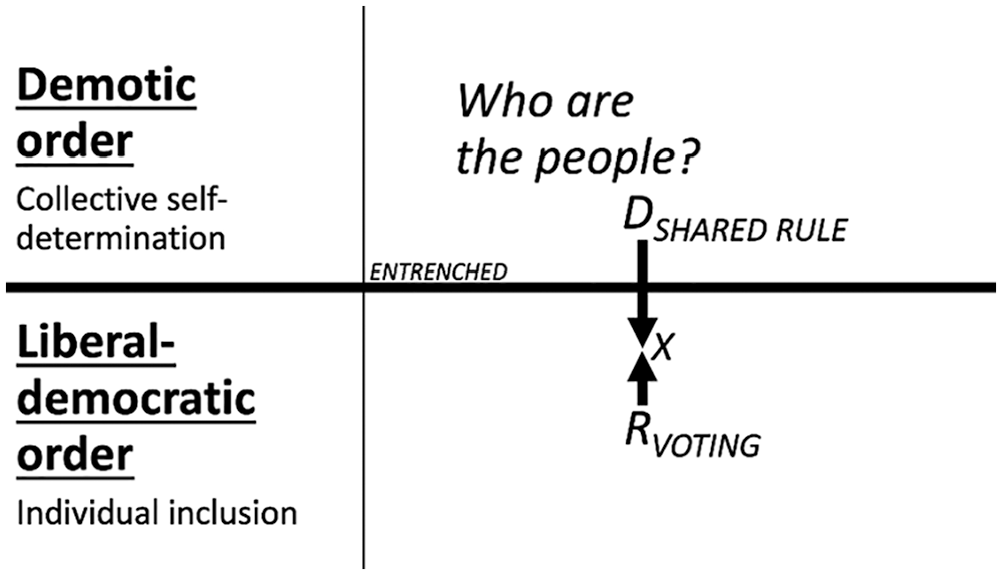
The “entrenched” transboundary balance of U.S. federalism. In federal systems like the U.S., constitutional bounding decisions enshrine the sovereignty of subunits, such as Wyoming, and provide their demoi with a measure of shared rule (DSHARED RULE). Hence, Wyoming’s constitutionalized demotic boundaries “flow downstream,” acting on the voting rights of individuals in other subunits, such as California (RVOTING). These downstream flows condition—but do not quash—individual Californians’ voting rights. Rather, there exists an entrenched transboundary balance (X), prescribed by the constitution.
Perhaps frustratingly, most transboundary balances are not so straightforward. Often constitutions provide little guidance in reconciling self-determination and inclusion, and/or disagreements abound. This is of course a problem internationally, in the legal vacuum of geopolitics, but it may also be a problem domestically. Transboundary contestation may result, necessitating more rigorous inquiry.
The orientation of inquiry: Employing “abnormal justice”
In my view, working through boundary-problem conflicts is facilitated by both a distinctive orientation and a distinctive process. I will first discuss the distinctive orientation. As I see it, boundary-problem conflicts should be approached through the lens of what Fraser calls “abnormal justice” (Fraser, 2009). I think of normal justice, unlike abnormal justice, as analogous to a soccer match, with the decisionmaker as referee. In a soccer match the referee’s task is to determine a winner based on agreed-upon rules. In this way, a soccer match is clearly bounded. But abnormal justice is maddeningly different. In abnormal conditions, the rules of the game—its boundaries—are in dispute. Achieving abnormal justice is like refereeing a contest between a team playing soccer and a person playing chess. In such a contest, determining the winner hinges on two difficult prior determinations.
First, the referee must recognize abnormality: They must be on the lookout for a soccer-versus-chess match. If they assume they are refereeing a familiar game of soccer, they will also assume that winning means goal-scoring, and the soccer team, rightly or wrongly, will win. Unfortunately, it may be difficult to recognize when a conflict involves the boundary problem, allowing abnormality to go unnoticed. This is because conflicts involving transboundary claims may be hard to distinguish, or disentwine, from more familiar intrapolity clashes over liberal-democratic rights. Especially where collective-rights claimants are internal minorities, boundary-problem conflicts may look like, or even be strategically disguised as, normal conflicts between co-citizens (see e.g. Spitzer, 2019a, 2019b, 2019c).
Because of the abnormality of boundary-problem conflicts, legal scholars have urged judges to proceed cautiously, avoiding automatically approaching such conflicts through the lens of liberal-democratic individualism (McCrudden and O’Leary, 2013; Pildes, 2004; Spitzer, 2019a, 2019b, 2019c). Conversely, political theorists championing the rights of migrants and refugees have called for decisionmakers to avoid allowing the foundational integrity of existing polities to overshadow individuals’ pleas for justice (Benhabib, 2004, 2006; Fraser, 2009). Either way, boundary-problem inquiry must begin with meta-questions. Is the conflict a normal intrapolity case or an abnormal transboundary one? What is the appropriate “scale of justice” to use? How should justice be framed?
The process of inquiry
Once decisionmakers recognize a rights-conflict as abnormal, the next requirement is no easier: determining the rules of the game. In effect they must decide, does the chess player belong on the field? If so, does winning still mean goal-scoring, or checkmating, or is it some balance of the two? Indeed, interrogating transboundary conflicts is facilitated not merely by a distinctive orientation—by approaching such contests through the lens of “abnormal justice”—but also by following a distinctive process. As noted, the boundary problem has a front half and a back half. Thus, boundary-problem inquiry should proceed in a two-stage fashion. Decisionmakers must ask, first, is the demotic claimant legitimate? If yes, they must next ask, how should that claimant self-determine such that none are wrongfully excluded—that is, how far do their rights flow downstream?
The first question: May the collective self-determine?
The first step of boundary-problem inquiry interrogates whether a collective claimant has demotic-order status—whether it is the sort of group owed self-determination. If the answer is definitely no, there is no need to progress to the second stage: There is no collective “self” to self-determine. If, conversely, the answer is definitely, or even possibly, not no, the inquiry must proceed to the second stage.
Firmly resolving the first stage of boundary-problem inquiry is difficult. Again, few questions are so hotly debated as who may self-determine. It is beyond the scope of this paper to join that debate. Still, I think decisionmakers can pare the question down a bit, in two ways. First, they can eliminate from consideration groups that are clearly not owed self-determination. For example, some groups eschew self-determination, such as integrationist minorities. Meanwhile, other groups, though desiring self-determination, seem clearly undeserving—for example, “outlaw” polities like the Islamic State, which trample the demotic and liberal-democratic arrangements of others. Neither outlaws nor integrationists need be considered for demotic-order status.
Second, beyond the aforementioned exceptions, decisionmakers ought not place the burden of proof on demotic-order claimants to justify their right to self-determination (Kymlicka, 1995: 125–126). As noted, the bounds of Westphalian states commonly lack moral grounding. Hence the self-determination claims of minority nations, such as Catalans, Quebecois, or Indigenous peoples, are unlikely to have less moral grounding than Westphalian states, and may have more. This seems especially likely in cases involving historical injustice, such as forcible annexation or settler colonialism.
Given this fact, and given the aforementioned warnings that “abnormal justice” conflicts should be navigated with caution, I suggest decisionmakers should at least give demotic-order claimants consideration. By this I mean collective claims should not be quashed unless they clearly fail demotic-order criteria. Certainly, such claims should not be quashed pro forma simply because, at the time of state-making, internal minorities were denied constitutional recognition. Nor should they be quashed simply because their claims today run afoul of the entrenched liberal-democratic rights of individuals. To quash minority demotic claims for either of these reasons would, in my view, put the liberal-democratic cart before the demotic horse, allowing historical contingency to decide who may self-determine.
I will showcase the difficulties of first-stage boundary-problem inquiry using a recent example from U.S. caselaw. The Pacific island of Guam is the homeland of the Indigenous Chamorro people. The U.S. assumed control of Guam in 1898. Since 1946, Guam has been on the United Nations’ list of colonized territories owed self-determination. In 1950, the U.S. acknowledged its “international obligations” to facilitate the island’s self-determination (Davis, 2017c). At the time, nearly 99% of islanders were Chamorro (Davis, 2017a). Since then, in part due to a large U.S. military presence, the Chamorro proportion has dropped to 37% (United States Government Central Intelligence Agency, 2021). In 2000, Guam began enrolling voters for a planned decolonization plebiscite (Torres, 2012: 187). In keeping with their ambitions for self-determination, Chamorros were in effect the only Guam residents permitted to enroll.
Excluded from enrollment, a white U.S. military retiree filed Davis v. Guam, citing violation of his Fifteenth Amendment right to vote regardless of race (Davis, 2017b). In 2017 the district court of Guam found in his favor. The court stated it lacked evidence of international obligations concerning Chamorro self-determination—and that, even if such obligations existed, the plaintiff’s constitutional rights must nonetheless prevail (Davis, 2017a: 24). Guam appealed to the Ninth Circuit Court, stating, “This case is a wolf in sheep’s clothing. Although styled as a reverse discrimination case . . . [t]his case seeks to deny the native inhabitants of Guam” . . . from effectively exercising their right to express by plebiscite their desires regarding their future political relationship with the United States” (Davis, 2017d: 8). That appeal, and a subsequent one to the U.S. Supreme Court, were rejected. As a consequence, Guam’s decolonization plebiscite has not been held.
As I have suggested, to logically work through Davis, decisionmakers would have needed to approach the case using both a distinctive orientation and distinctive process. Concerning the orientation, they would have needed to be on the lookout for an “abnormal” case, involving not a conventional intrapolity clash between American co-citizens, but rather a potential transboundary clash between an American citizen and a purported polity, the Chamorro people. Then, concerning the distinctive approach, decisionmakers would have needed to proceed by way of the first step of transboundary inquiry, interrogating whether the Chamorros’ claims to demotic status were indeed valid.
In this case, the district court for the most part did neither, alternately ignoring or dismissing the relevance of any possible Chamorro demotic status. Contra logical boundary-problem inquiry, Chamorro demotic claims were quashed pro forma, because they lacked existing domestic constitutional recognition, and because they ran afoul of the entrenched liberal-democratic rights of individuals. The sole possible subject of justice was deemed to be the individual voter, owed inclusion in the plebiscite registry. Restated in terms of abnormal justice, the referee treated the competition as a normal soccer match, dismissing the notion of a chess-playing competitor. The soccer team, facing no discernable opponent, won resoundingly. The dynamics of Davis are depicted in Figure 3.
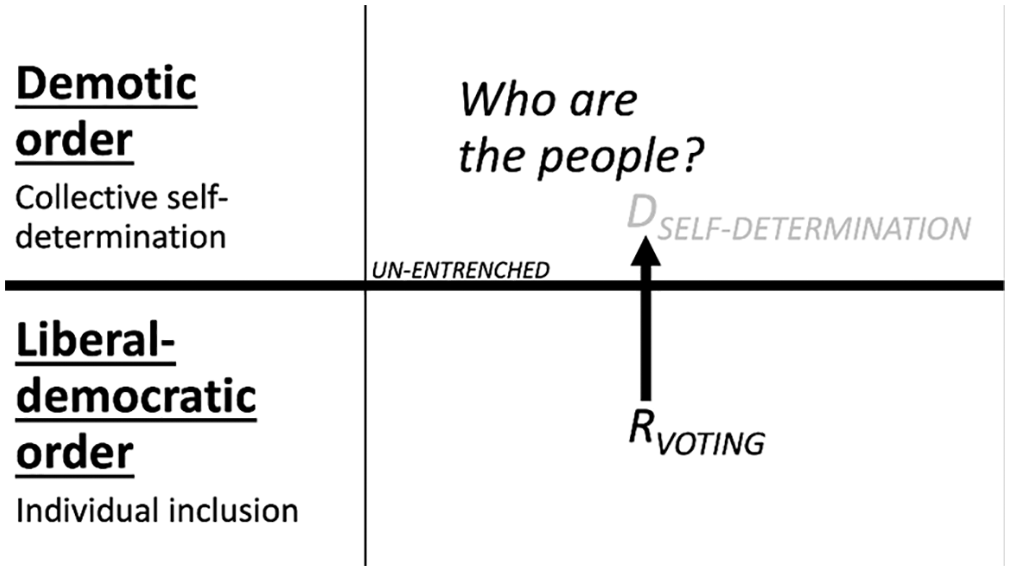
The “abnormal justice” challenge of Davis v. Guam. Colonized demoi, such as Guam’s Chamorro people, are widely considered to be owed self-determination (DSELF-DETERMINATION). This demotic bounding decision would “flow downstream,” impacting non-members’ individual rights, potentially including their right to vote (RVOTING). But in Davis v. Guam, decisionmakers deemed Chamorro demotic interests irrelevant and individual voting rights inalienable. Voting rights thus “flowed upstream” unimpeded, obviating the possibility of Chamorro decolonization.
The second question: Where is the transboundary balance?
As can be seen, in unpuzzling boundary-problem conflicts, the first step of inquiry is not about where but whether—not about where to strike the balance between demotic and liberal-democratic arrangements but about whether a demotic claimant is present and, if so, whether their claims are legitimate. If the answer to both questions is no—if there is no purported demos, or if the demos is found to be illegitimate—the case is open-and-shut. There is no need to progress to the second stage of inquiry.
If, however, the answer to the first stage of inquiry is not negative—if the collective claimant is definitely, or even possibly, a legitimate polity—then the navigation of the boundary-problem conflict must progress to the second stage. The second stage interrogates appropriate inclusiveness, asking, “How may the collective self-determine such that none are wrongfully excluded?”
Blanket solutions are lacking. Most thinkers would agree that even legitimate polities should not be omnipotent: Some degree of inclusive consideration should be granted. For example, whatever its self-interest, a state should not trample the interests of innocents abroad. At the same time, few would suggest that individual inclusion be unconditional. To argue that would be to at once recognize a collective but deny it self-determination. Most thinkers seem to tacitly agree with Kant, that a transboundary balance is required. But where should this balance lie? I will showcase the challenge of second-step inquiry using a case not from the U.S. but Canada.
Founded in 1867, Canada was the first country to employ federalism to provide self-determination to a discrete internal minority, Francophones. Canada did this by crafting a predominantly Francophone subunit, Quebec, whose provincial sovereignty was etched in the constitution. Regardless, French Quebecois long felt dominated by Anglophones—by the wealthy Anglo minority within the province, and by the vast Canadian majority beyond. To bolster Francophone sovereignty, Quebec in 1977 passed Bill 101, requiring that commercial signage in the province be in French only. Quebec sought, in effect, “just exclusion”—to strengthen its self-determination at the expense of liberal-democratic inclusion. In 1982, in a bid to combat Francophone nationalism by propogating a spirit of universalist individualism (Choudhry, 2007), Canada adopted the Charter of Rights and Freedoms. In 1988, Anglophones charged that Bill 101 violated their Charter right to individual freedom of expression. They filed Ford v. Quebec.
In its ruling on Ford, the Supreme Court of Canada of course recognized Quebec as a legitimate polity. Yet it found in the Anglophones’ favor. Quebecois were outraged. The ruling sparked the 1990s séparatisme crisis, the closest Canada has come to breaking up (Smithey, 1996: 83). Did the court decide Ford correctly? Certainly it was correct, in the first step of its inquiry, to treat Quebec as a demotic-order rights-bearer. There was no contestation on that point. The dilemma in Ford was at the second step of inquiry. Did Bill 101 rightly protect the boundaries of Quebec sovereignty, or did the bill’s impacts flow too far downstream, infringing the individual inclusion-rights of Anglos? On this sliding scale of self-determination and inclusion, the Supreme Court of Canada chose a point that proved explosive. Its choice was condemned by scholars who felt it had been seduced by the dangerous siren-song of individual rights. Smithey, for example, maintained that “the Court’s evenhanded approach to the Charter’s language rights has . . . added to the centrifugal forces at work in Canada” (Smithey, 1996: 100).
Let me restate Ford in the terms of abnormal justice. The court’s first challenge was to notice that the contest was abnormal—a soccer-versus-chess match. Having done so, it was then compelled to determine the rules. Did the chess player belong on the field? Was their presence legitimate? Yes, the court acknowledged, Quebec is a demotic-order polity, with a constitutional right to self-determine. So, given this, what are the rules of the game? Does goal-scoring matter, or checkmating, or a balance of the two? If, as the Anglophone plaintiffs claimed, the contest required guarding liberal equality, then Bill 101 clearly broke the rules of the game. If instead the contest required what Quebec demanded—enhancing the self-determination of Canada’s Francophone minority—then Bill 101 was arguably proper. The constitution provided no guidance. Again, the court picked rules that were much to Quebec’s displeasure, amplifying its campaign for secession. The dynamics of Ford are depicted in Figure 4.
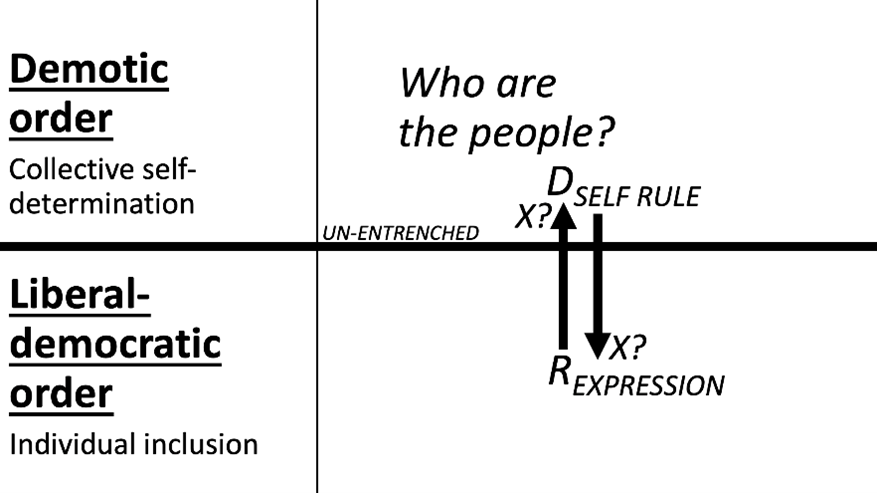
The transboundary balancing challenge of Ford v. Quebec. Federal systems insure each subunit enjoys not just shared rule but also self-rule (DSELF RULE). This demotic bounding decision “flows downstream,” impacting individual rights, potentially including rights to freedom of expression (REXPRESSION). Canada’s constitution gives little clue as to the appropriate transboundary balance (X) between subunit self-rule and individual expression. Thus, in Ford v. Quebec, decisionmakers faced a challenge. How far could Quebec self rule “flow downstream” without abusing the rights of Anglos? How far could Anglos’ rights push “upstream” without undermining Quebec self-rule?
Conclusion
To sum up: In this article, I aimed to help decisionmakers (legislators, judges, citizens, etc.) unpuzzle conflicts involving the boundary problem. I did so in two ways. First, I sought to make a descriptive contribution, displaying the logical unity of theories of “just inclusion” and “just exclusion” and mapping their places within the framework of the boundary problem. I then sought to make a prescriptive contribution, proposing an orientation toward, and stepwise procedure of, boundary-problem inquiry, so such conflicts can be more logically and productively confronted.
Descriptively, I suggested that in the political world there are two categories of moral agents, collectives and individuals, and that honoring the rights of these agents requires demotic and liberal-democratic arrangements. In the practice of state-making these two orders are complementary and nested. Demotic arrangements relate to the establishment and preservation of demotic boundaries, thereby enshrining self-determination for collective peoples. These demotic arrangements are “constitutionally prior” and tend to hide in plain sight. Liberal-democratic arrangements operationalize liberalism and democracy for individuals within a constituted polity. They are “constitutionally post” and are conspicuous in everyday civic life.
Yet despite the complementary, nested relationship between demotic and liberal-democratic arrangements, the two may come into conflict when they interact across boundaries. These conflicts are thorny due to the boundary problem. Because of the boundary problem, such conflicts involve transboundary hydraulics. Typically, arrangements guarding self-determination “flow downstream,” acting on individual inclusion. However, rights-claims such as Kant’s weltbuergerrecht press upstream, pushing back against self-determination. Unrestrained downstream flows may quash inclusion; unrestrained upstream flows may obviate self-determination.
Prescriptively, I suggested that discerning the correct balance between these flows is the task of boundary-problem inquiry. I proposed such inquiry be conducted using both a distinctive orientation and process. The appropriate orientation, I suggested, involves the lens of “abnormal justice.” This requires, first, that decisionmakers recognize the possibility of an abnormal, transboundary conflict. It requires, second, that they ask meta-questions, seeking out the appropriate “subject of justice”—be it the collective that seeks to exclude, the individual that seeks inclusion, or both.
Meanwhile, I suggested that the distinctive process of boundary-problem inquiry consists of two steps. The first step of inquiry examines whether a collective claimant is a legitimate demotic-order polity. If decisionmakers conclude not, as the court ruled in Davis v. Guam, the inquiry is closed. If decisionmakers conclude the answer is, conversely, not no, the inquiry must proceed to the second step. At the second step, a transboundary balance must be sought, as occurred in Ford v. Quebec. An appropriate balance is one that best solves the boundary problem: (How) may a collective self-determine such that none are wrongfully excluded?
So, what is the solution to the boundary problem? Again, in this article I did not aim to provide an answer. I have simply tried to describe the framework of the boundary problem, capturing the structural relationship between self-determination and liberal-democratic rights. I have tried to show how “just inclusion” and “just exclusion” are two sides of the same coin. While “just inclusion” grapples with the back half of the boundary problem, focusing on how to fairly bound exogenous individuals into the consideration of Westphalian states, “just exclusion” grapples with the front half, concerning how to identify a legitimate demotic-order claimant, often at the sub-state level, and provide it with self-determination.
I have further tried to prescriptively show that addressing such questions requires attention to abnormal justice. Decisionmakers must recognize the potential presence of both demotic and liberal-democratic claimants, and avoid seeing justice through the lens of only one claimant or the other. Moreover, they must avoid being captured by the status quo—by the Westphalian tendency to see foreigners demanding “just inclusion” as lacking liberal-democratic rights, and the tendency to see emergent internal polities claiming “just exclusion” as lacking demotic rights. I suggest, because of abnormality, deciders would be wise to give both sorts of claimants the benefit of the doubt, and negotiate boundary-problem conflicts with care.
