



Abstract
Accurate and reliable performance monitoring is crucial in elite team sports, where wearable technologies, such as GPS systems, are widely utilized. However, the impact of Bluetooth transmission distance between wearable devices and receiver units on measurement quality has received limited attention. This study aimed to evaluate the reliability and validity of running distance data collected using the Polar Team Pro GPS at three different Bluetooth connection distances—20 m, 50 m, and 100 m—during a standardized 20-meter shuttle run test in elite youth football players (n = 20). Participants were randomly assigned to perform the test at each of the specified distances. Reliability was assessed using intraclass correlation coefficients (ICC), coefficient of variation (CV%), standard error of measurement (SEM), smallest worthwhile change (SWC), and minimal detectable change (MDC). Validity was evaluated through Mean Absolute Percentage Error (MAPE), Mean Absolute Error (MAE), Mean Squared Error (MSE), Root Mean Square Error (RMSE), and Bland–Altman plots. Results showed that data reliability and validity declined substantially as the Bluetooth distance increased, with the highest ICC (0.73) and lowest measurement error occurring at a distance of 20 m. These findings underscore the importance of maintaining close receiver proximity to ensure the accuracy of GPS-derived data in both research and applied athlete monitoring settings.
Keywords
Introduction
In recent years, advancements in wearable technology have revolutionized the way training loads are monitored and performance is evaluated in field-based team sports, such as football, rugby, and hockey. Among these technologies, global positioning system (GPS) devices have emerged as a cornerstone in applied sports science, enabling the continuous collection of external load metrics, including total distance covered, velocity zones, accelerations, and decelerations during training and match play.1,2 Their integration into high-performance environments has allowed coaches and sport scientists to make more informed decisions regarding player workload, fatigue management, and injury risk mitigation.3,4 Importantly, many of these decisions are made during training sessions and are therefore dependent on real-time data streamed live to the coach’s tablet rather than post-session analyses.
One of the most used systems in elite football is the Polar Team Pro, which combines GPS technology with inertial sensors and Bluetooth-based data transmission. 5 This hybrid system offers practitioners real-time tracking via mobile applications—where Bluetooth-streamed distance values are displayed live on the coach’s tablet—as well as retrospective analysis through cloud-based platforms. The system can capture various performance variables, such as heart rate variability, speed distribution, and total distance, providing a comprehensive picture of player output. 6 However, as these technologies’ usage expands, so does the need to scrutinize their technical limitations—particularly under field conditions where the spatial dynamics of play and environmental factors can impact signal transmission and data integrity. Different models of various GPS brands have been tested for validity and reliability under different conditions.7–9 While prior studies have validated the general accuracy and reliability of GPS units during straight-line sprints or small-sided games,10,11 there are no studies investigating the effects of Bluetooth signal strength and transmission distance on the validity of collected data. This omission is notable, given that Bluetooth is the primary means of transmitting real-time data from athletes’ wearable units to the receiver (typically a tablet or mobile device). Signal attenuation, packet loss, and latency are all known challenges associated with Bluetooth communication, especially when the receiver is placed at extended distances from the transmitters
In practical terms, this technological gap has critical implications for athlete monitoring. During full-field training sessions or tactical drills (friendly or tactical match), it is not uncommon for players to be situated well beyond the recommended Bluetooth range (typically under 30 m). Suppose such distances lead to reduced data reliability or delayed transmission. In that case, the decisions made by performance staff—such as adjusting session intensity, managing workload ratios, or triggering recovery protocols—may be based on compromised information. Although data integrity may be restored once Bluetooth-streamed distance values are fully uploaded to the cloud after the session, such corrections do not mitigate the potential consequences of inaccurate or delayed information on real-time coaching decisions. Furthermore, the impact of such transmission distances on key GPS-derived metrics, such as total distance covered or high-speed running distance, has yet to be systematically evaluated under controlled experimental conditions. Moreover, in research settings, data integrity is paramount. As wearable technologies increasingly inform evidence-based practice, ensuring the reliability and validity of every step in the data acquisition becomes essential for reproducibility and methodological transparency. 12 This issue includes not only the calibration and sampling rate of the GPS device, but also the environmental setup—such as the placement of the receiver relative to athlete activity zones. The findings of this study will provide valuable insights into the practical implications of Bluetooth transmission distance on athlete monitoring, informing best practices and enhancing the quality of data interpretation in both research and applied settings.
This study aims to address this overlooked issue by investigating the effect of Bluetooth transmission distance on the reliability and validity of performance metrics collected via the Polar Team Pro system. It is essential to clarify that the primary objective of the present study is not to question or reevaluate the GPS accuracy of the Polar Team Pro system. Previous research, including two validation studies5,13 conducted by our group, has already demonstrated that Polar Team Pro devices provide valid and reliable GPS-based distance measurements under standard field conditions. Instead, the current study focuses specifically on the quality and continuity of real-time data transmission displayed on the coach’s tablet during training sessions. While GPS distance is calculated internally within the device and is not influenced by Bluetooth communication, the live values shown to practitioners depend on the stability of Bluetooth transmission. In applied practice, coaches frequently rely on these real-time outputs to make immediate adjustments to training loads. Therefore, the purpose of this study is to determine whether increasing Bluetooth transmission distance affects the accuracy and consistency of real-time data, independent of the underlying GPS computational accuracy of the device. Using a controlled protocol involving a standardized 20 m shuttle run test, we examine how increasing the distance between the GPS units worn by athletes and the Bluetooth receiver (20 m, 50 m, and 100 m) influences measurement outcomes. By isolating Bluetooth distance as a variable—while holding all other testing conditions constant—this study offers novel insights into a practical limitation that has been largely neglected in manufacturer specifications and academic literature. The findings of this study have the potential to significantly enhance the accuracy and reliability of athlete monitoring systems, thereby informing best practices for device configuration in applied settings and guiding data interpretation strategies in research.
Material and Methods
Participants
Twenty elite male football players (age: 18.5 ± 0.4 years; height: 178.3 ± 4.2 cm; body mass: 70.4 ± 5.6 kg) were recruited from a professional U-19 academy competing in the top-tier youth league. All participants were injury-free for at least three months before testing, and none had a history of cardiovascular, neuromuscular, or metabolic disorders. Inclusion criteria included: (1) a minimum of five years of structured training history, (2) regular participation in team training (≥4 sessions/week), and (3) prior exposure to standardized field-testing procedures. All players and their legal guardians provided written informed consent. The study protocol was approved by the Institutional Ethics Committee of Afyon Kocatepe University and conducted in accordance with the Declaration of Helsinki. The Afyon Kocatepe University approved the research as ethically appropriate (Approval Date: 05.05.2023, Approval Number: 2023/11).
Experimental Design
The football field was divided into three areas corresponding to distances from the tablet application: 20 m, 50 m, and 100 m. Each participant (n = 20 elite male U-19 football players) performed a standardized 20 m shuttle run, covering a total distance of 1000 m, at all three Bluetooth distances in randomized order. GPS-derived running distance was recorded in real time and uploaded to cloud software. Although the Polar Team Pro system also integrates inertial sensors, only the GPS-derived total running distance was considered in this study. Inertial sensor data were not included or analyzed. The measured distances from each Bluetooth connection range were compared with the actual distance covered on the field to assess the impact of Bluetooth range on data reliability and validity.
Although GPS data are stored locally on the device and later uploaded accurately to the cloud platform, the real-time data on the tablet depends entirely on the quality of Bluetooth transmission. In practical coaching environments, momentary delays, partial packet loss, or temporary transmission drops may affect the precision of real-time distance values even though the internally recorded GPS data remain accurate. Therefore, our analysis focuses specifically on the validity and reliability of the real-time data, which represents the information used by coaches during on-field decision-making.
Session 1 and Session 2 were conducted on the same day using the identical 1000 m shuttle protocol. A standardized passive recovery period of 12 minutes was provided between the two sessions, based on previous test–retest reliability procedures in shuttle-based field tests. To minimize sequencing effects, the order of sessions was counterbalanced across participants. A familiarization session with the 1000 m shuttle protocol was conducted one week before testing to eliminate potential learning effects. Before each session, athletes completed the same standardized warm-up, and perceived exertion was monitored to ensure that participants did not begin the second session in a fatigued state. Environmental conditions, course markings, and running surface were kept identical for both sessions.
Data Collection
Submaximal 20m Shuttle Run Test
This test was developed to determine the cardiovascular endurance of athletes at increasing speeds over a 20 m distance. The athletes performed the first five minutes of the 20 m shuttle run test. The run started at 8 km/h and ended after six minutes and 20 seconds at 10.5 km/h. The total reference distance at the end of the run was 1000 m to ensure that each athlete covers the same distance. The athletes were required to cover the same distance using the BEEP TEST audio file. All audio warnings were instantly transmitted to the athletes via loudspeakers. The athletes’ instant speed organization was coordinated with the help of sound. To increase the reliability of the test, researchers controlled the athletes’ tapping and tempo as soon as the beep was heard.
The 1000 m reference distance was established using a standardized 20 m shuttle configuration based on the methodology described by Léger and Lambert. 14 Two boundary lines separated by 20 m were measured using a calibrated 20 m fiberglass measuring tape and marked on the field with paint. Cones were placed at both ends to clearly indicate the turning points. Athletes completed 50 × 20 m shuttles to achieve a total running distance of 1000 m.
To minimize variability associated with turning and deceleration mechanics, participants were instructed to use a consistent foot-plant turning technique as recommended in the original shuttle run protocol. An experienced researcher observed every turn to ensure consistent turning radius, deceleration behavior, and foot placement. All trials were completed on the same running surface under stable environmental conditions. All athletes were fitted with Polar Team Pro GPS sensors before the test. As shown in Figure 1, the athletes were randomly divided into groups, and each group performed the test in the designated test area (20-50-100 m) located at varying distances from the field. Testing was conducted on a FIFA-standard natural grass field under stable meteorological conditions (temperature: 20–23°C; wind speed < 2 m/s).
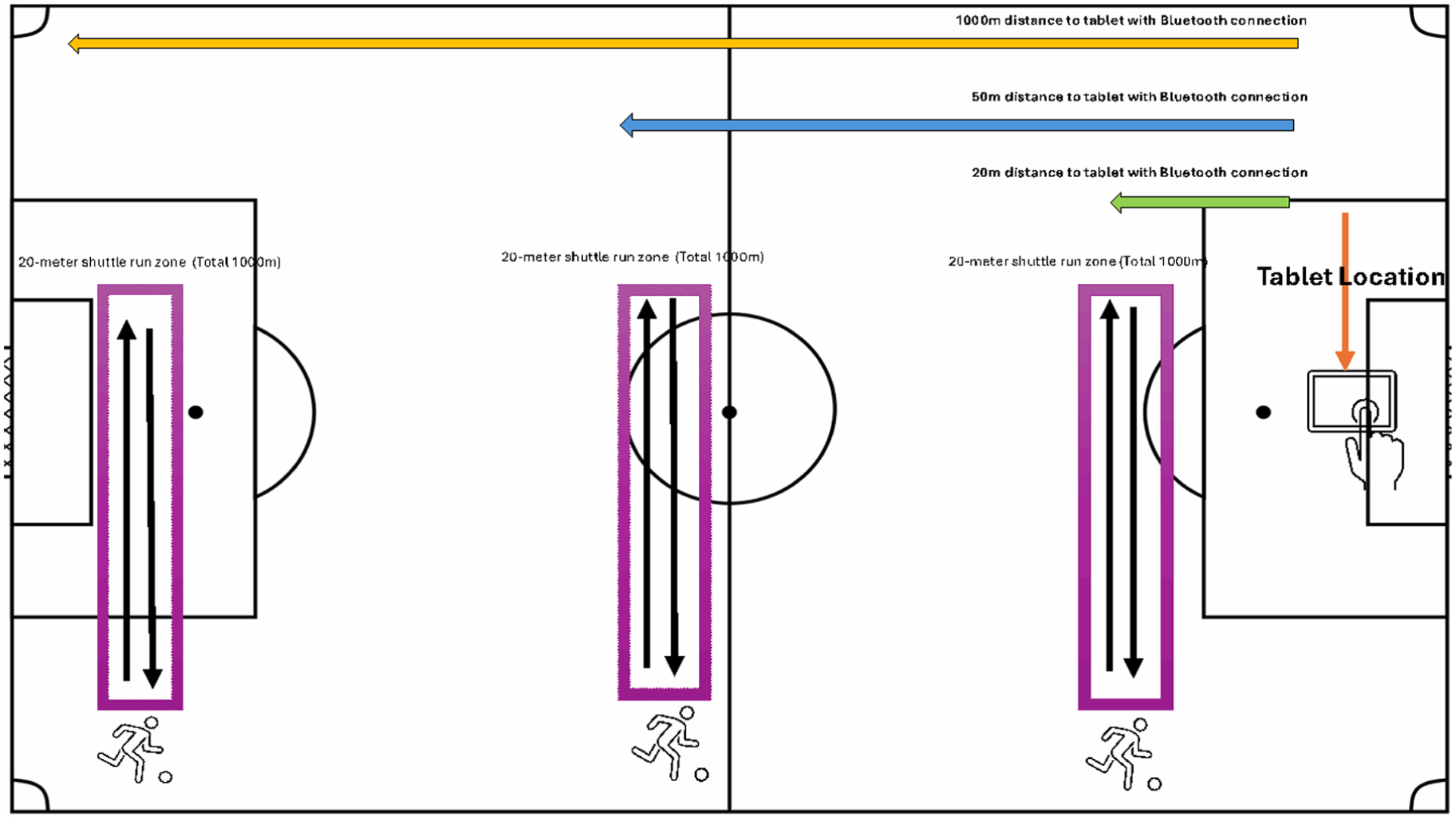
Protocol Design.
Polar Team Pro GPS unit
Player movements were monitored using a commercially available 10-Hz GPS device (Polar Team Pro GPS, Polar Electro Oy, Kempele, Finland). The unit integrates a 10-Hz GPS sensor and a 200-Hz MEMS motion sensor, including a 3-dimensional accelerometer, gyroscope, and magnetometer. The device supports Bluetooth Low Energy connectivity with a transmission range of up to 200 m and encrypted live data transmission.
Real-time data were received and monitored using an Apple iPad (Apple Inc., Cupertino, CA, USA) via the Polar Team Pro application. Following testing, raw 10-Hz GPS data were uploaded to the manufacturer’s proprietary cloud-based platform (Polar Team Pro web service, Polar Electro Oy, Kempele, Finland; www.teampro.polar.com) for storage and subsequent analysis.
Statistical Analysis
Normality of the data was assessed using the Shapiro–Wilk test. A one-way ANOVA was used to detect differences between distances. For reliability analysis, the intra-class correlation coefficient (ICC) was calculated using a two-way random-effects model (absolute agreement, average measures) with 95% confidence intervals. ICC values were interpreted as <0.50 = poor, 0.50–0.75 = moderate, 0.75–0.90 = good, and >0.90 = excellent reliability. The coefficient of variation (CV%) was calculated by dividing the standard measurement error by the mean, expressed as a percentage (× 100), following established reliability procedures. The smallest worthwhile change (SWC) was calculated as 0.2 × between-athlete SD. According to reliability classifications, CV values <5% were considered good, 5–10% moderate, and >10% poor reliability. For validity analysis, the mean absolute percentage error (MAPE%), mean absolute error (MAE), mean squared error (MSE), and root mean square error (RMSE) were calculated. Interpretation of MAPE followed Lewis’ classification: <10% = highly accurate, 10–20% = good, 20–50% = reasonable, and >50% = inaccurate. 15 Statistical significance was set at p < 0.05. All analyses were performed using JASP software (Version 0.19.3).
Results
The study’s results revealed that the reliability of data collected via Polar Team Pro GPS units varied depending on the distance between the athletes and the Bluetooth tablet receiver.
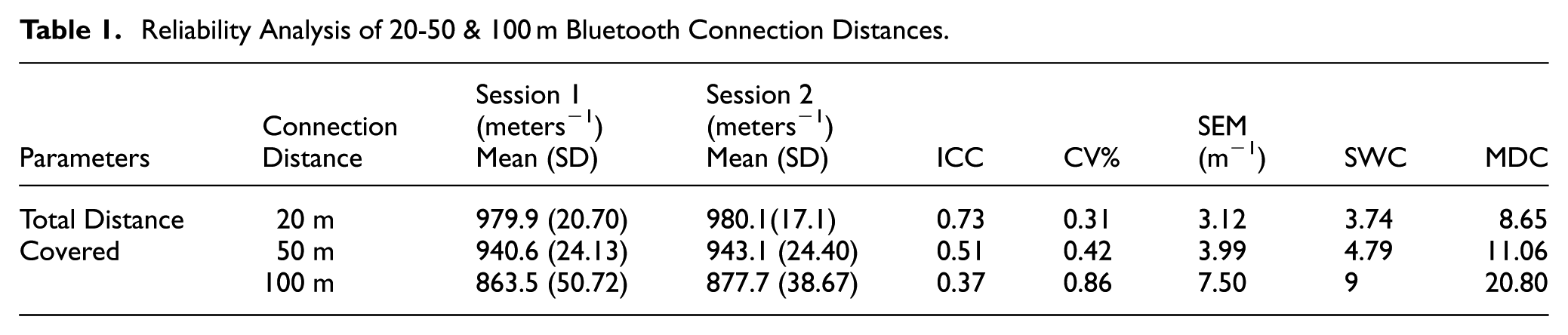
Table 1 presents the intraclass correlation coefficients (ICC), coefficient of variation (CV%), standard error of measurement (SEM), smallest worthwhile change (SWC), and minimal detectable change (MDC) for the total distance covered at three different connection distances (20 m, 50 m, and 100 m). The ICC values decreased as the distance increased: 0.73 at 20 m, 0.51 at 50 m, and 0.37 at 100 m, indicating a decline in measurement reliability. Similarly, the CV% and SEM increased with distance, showing reduced measurement consistency and greater error at longer distances.
Reliability Analysis of 20-50 & 100 m Bluetooth Connection Distances.
Figures 2 and 3 visually support these findings with Raincloud and Bland-Altman plots. The Raincloud plots demonstrated increasing discrepancies between measured and reference distances as the connection distance increased. The Bland-Altman analyses in Table 2 further confirmed systematic bias and wider limits of agreement at longer distances, indicating poorer agreement between measured and actual distances as the Bluetooth connection range extended.
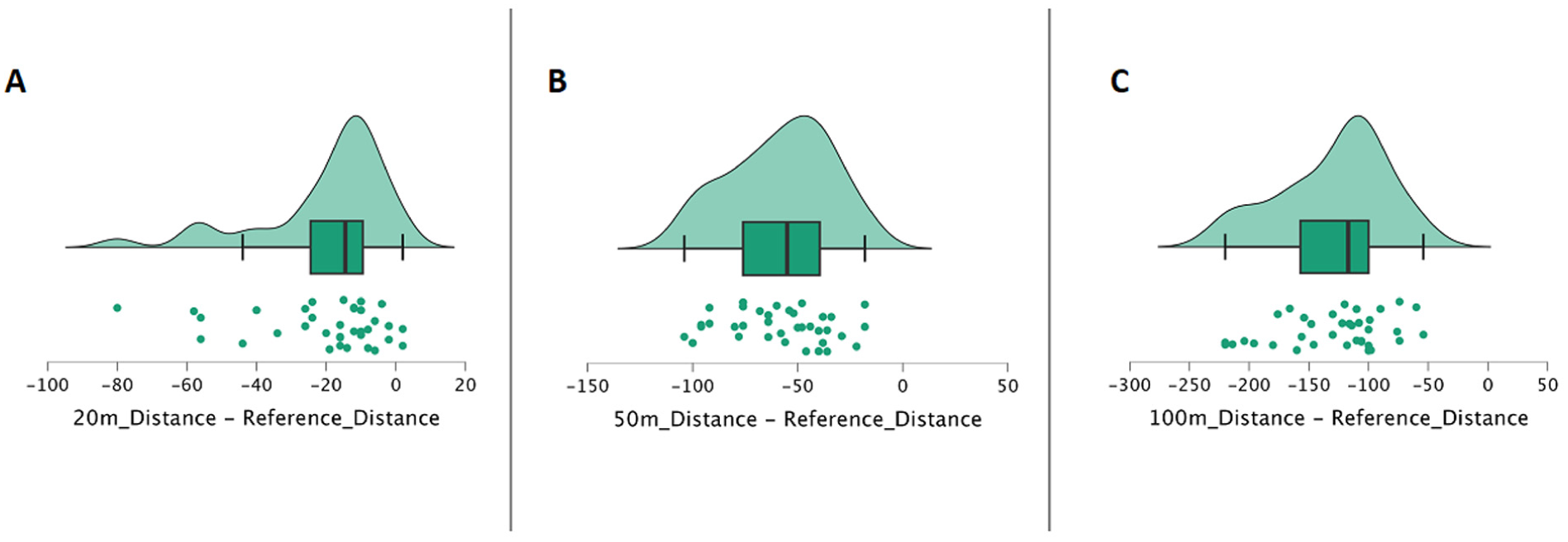
Raincloud Plots Displaying the Distribution of Differences Between GPS-Derived and Reference Distances. (A) Differences for the 20 m distance. (B) Differences for the 50 m distance. (C) Differences for the 100 m distance. Each raincloud plot combines a density distribution (cloud), individual data points (rain), and boxplots showing the median (central line), interquartile range (box), and adjacent values (whiskers). The systematic bias (mean difference) and precision (typical error) for each condition are provided.
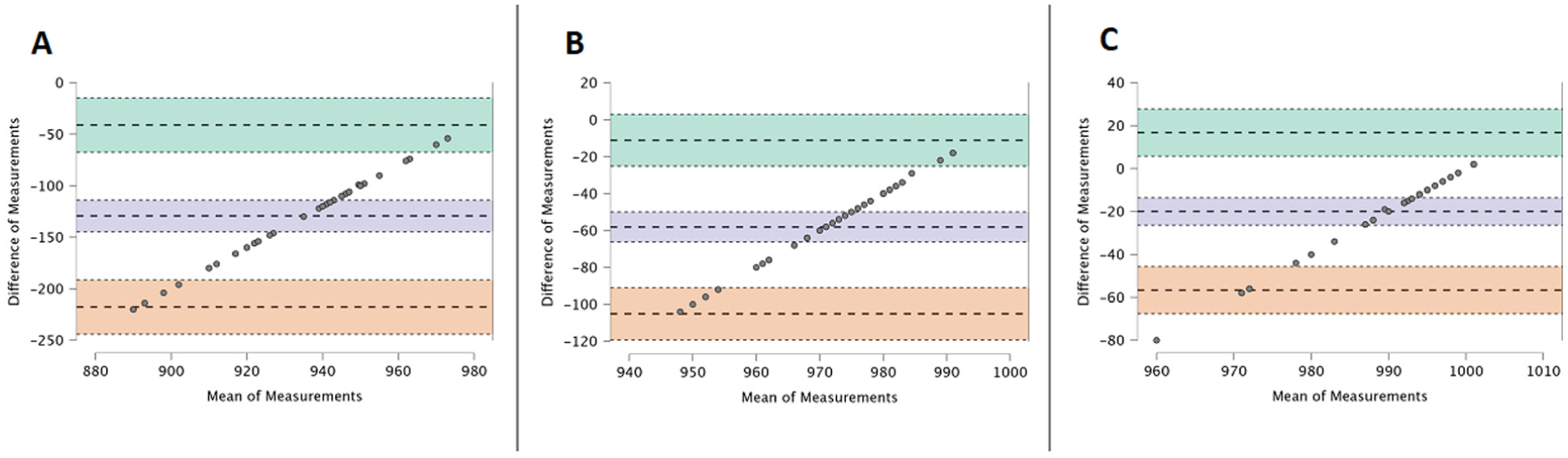
Bland-Altman Plots Assessing the Agreement Between GPS-Derived and Reference Distances. Plots display the difference between the two measures (GPS-derived distance minus reference distance) against their mean for each distance condition: (A) 20 m, (B) 50 m, and (C) 100 m. The solid central line represents the mean bias (systematic difference). The upper and lower dashed lines indicate the 95% Limits of Agreement (Mean Bias ± 1.96 Standard Deviation of the differences), which define the range within which most differences between the two measurement methods are expected to lie. The shaded band around the mean bias line represents the 95% confidence interval (CI) for the mean bias.
Bland-Altman Analysis for Differences Between Bluetooth Connection Distance and Reference Distances.
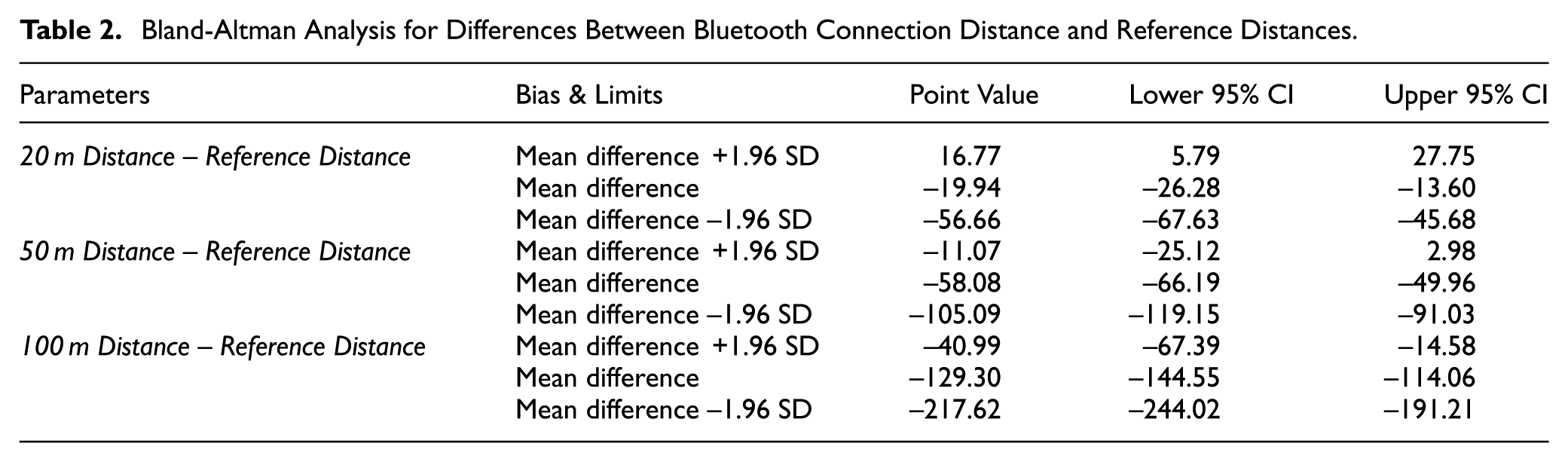
Table 3 compares the data provided by the reference value and GPS units. The measurements obtained at the shortest Bluetooth distance (20 m) were closest to the reference value, with progressively larger deviations observed at 50 m and 100 m, respectively. MSE, RMSE, MAPE%, and MAE values increase as the connection distance increases. These results demonstrate that the connection distance has an impact on real-time data. The results suggest that shorter Bluetooth distances (20 m) provide more reliable and accurate measurements with Polar Team Pro GPS units. In contrast, data obtained at greater distances (50 m and 100 m) show reduced accuracy and consistency.
Validity Analysis for Differences Between Bluetooth Connection Distance and Reference Distances.

Discussion
The current study examined the reliability and validity of running performance data obtained via Polar Team Pro GPS units at varying Bluetooth connection distances (20 m, 50 m, and 100 m) during a submaximal shuttle run test in elite youth football players. The findings demonstrate a significant influence of Bluetooth connection distance on the consistency and accuracy of the collected data, with notable degradation in data quality as the connection distance increases. These results have critical implications for research settings and applied sports environments where GPS-based technologies are employed for training load monitoring and athlete evaluation. It is essential to note that GPS accuracy in the Polar Team Pro system is determined by GNSS-related factors, such as satellite geometry, horizontal dilution of precision (HDOP), and environmental obstructions, and is not influenced by Bluetooth transmission distance. The present study does not aim to evaluate GPS accuracy; this has already been confirmed in previous research,5,13 including two studies conducted by our group. Instead, the purpose of this study was to examine whether the real-time transfer of GPS-derived data to the coach’s tablet is affected when athletes move farther from the receiver.
The analysis revealed that the intraclass correlation coefficients (ICCs) for total distance covered were highest at 20 m (ICC = 0.73), indicating moderate to good reliability. However, reliability significantly declined as the connection distance increased to 50 m (ICC = 0.51) and 100 m (ICC = 0.37). This trend aligns with findings by Buchheit et al., 16 who reported that signal quality, satellite availability, and system configuration can impact GPS data reliability in team sports. While not “excellent,” an ICC of 0.73 indicates that data collected at 20 m can be reasonably used for applied monitoring of total distance in training sessions. In contrast, ICCs at 50 m and 100 m suggest reduced measurement consistency at greater distances. The decline in ICC suggests that the Polar Team Pro system’s data capture becomes increasingly inconsistent at greater distances, potentially due to Bluetooth signal degradation, latency, or environmental interference.17,18 The similar magnitude and direction of deviation across Session 1 and Session 2 at each Bluetooth distance indicate that the measurement error is systematic and repeatable. Thus, the ICC values reflect the repeatability of the device’s real-time transmission performance rather than athlete-related variability, supporting the interpretation of these values as legitimate test–retest reliability indicators.
Mean Absolute Percentage Error (MAPE) values increased substantially with Bluetooth connection distance, from 2% at 20 m to 15% at 100 m. A MAPE of 2% at 20 m indicates high accuracy suitable for practical decision-making in athlete monitoring, whereas 15% at 100 m represents a considerable deviation from actual distances. Such deviations could meaningfully affect training load assessment, session planning, or athlete evaluation. These findings emphasize the importance of maintaining short Bluetooth distances (ideally within 20 m) to ensure that GPS-derived data are reliable and actionable for coaches and sport scientists.
The increase in standard error of measurement (SEM), coefficient of variation (CV%), and minimal detectable change (MDC) with distance further indicates declining precision and growing noise in the data. When practitioners rely on such data for decision-making in elite sports settings, minor errors can accumulate, leading to flawed training adjustments, recovery scheduling, or inaccurate estimates of injury risk. 3 Another consideration is the Polar Team Pro system’s architectural structure, which integrates GPS and inertial sensors but relies on Bluetooth for real-time data syncing. While Polar provides accurate data in proximity scenarios, this limitation underscores the importance of monitoring system setup and field configuration in training and research applications. Moreover, the study contributes to an essential and often underreported area in sports science—the effect of signal infrastructure on the fidelity of digital tracking systems. Most existing GPS validation studies focus on accuracy during motion (e.g., linear vs. curvilinear, high vs. low speed), whereas the present study uniquely isolates Bluetooth proximity as a variable. This finding has practical implications: placing the receiver too far from the playing area in large-sided games or expansive field settings could compromise data quality, undermining longitudinal athlete monitoring efforts. 1
In practical terms, sports scientists and coaches using Polar Team Pro or similar GPS-based platforms should be mindful of device placement, ensuring that receiver units are within a 20 m range from the athletes during monitoring. The motivation for this study stems from the fact that coaches and performance analysts often rely on real-time distance values during training to adjust intensity, volume, and tactical constraints. When athletes move 50–100-meters away from the receiver during large-area drills, practitioners frequently report temporary freezing, delayed updates, or partial data on the live interface. These issues may resolve once data are uploaded to the cloud; however, coaching decisions depend on instantaneous values, not post-session data. Therefore, understanding how transmission distance affects real-time accuracy is crucial for the practical application of the system. This setup is vital for tests that require fine-grained distance, acceleration, or velocity data. While reducing the Bluetooth distance between the receiver and the athletes appears to be the most straightforward approach to preserving real-time data quality, this strategy may not always be feasible in applied settings such as full-sized training fields, large-sided games, or competitive environments. In such cases, alternative and complementary strategies may be cautiously considered to mitigate real-time transmission issues without altering Bluetooth distance. Cross-referencing real-time GPS-derived metrics with internal load indicators (e.g., heart rate or perceived exertion) may also provide contextual support for decision-making when live distance data appear unstable. These strategies should be interpreted as exploratory and context-dependent rather than definitive solutions; nevertheless, they may offer practical avenues for managing real-time data limitations in environments where short Bluetooth distances cannot be consistently maintained.
Additionally, practitioners should consider cross-validating GPS data with internal load metrics (e.g., heart rate, RPE) when signal reliability is questionable due to spatial constraints. Future studies should extend this work by exploring the effects of signal distance in more dynamic sport-specific contexts (e.g., small-sided games, tactical drills) and by evaluating other systems that use Bluetooth, ANT+, or Wi-Fi-based telemetry. Therefore, any decreases in measurement stability observed at longer Bluetooth distances should be interpreted as transmission-related variability in the real-time display, not as deterioration in the GPS signal or positional calculation. The underlying GPS data remain unaffected; instead, the live transmission of these values may exhibit latency, packet loss, or incomplete updates when the Bluetooth signal weakens. A better understanding of technological boundaries will enable more informed system selection and protocol design in applied sports environments. The present study was conducted with a homogeneous sample of elite male U-19 football players. This design enabled control over confounding factors, including training experience, tactical behavior, and physical fitness, which can influence GPS-derived metrics. However, this sample characteristic may limit the generalizability of the findings to athletes of different sexes, age categories, competitive levels, or sporting contexts. GPS trajectory data were not collected because the study aimed to examine the stability of real-time distance transmission rather than GPS positional accuracy. Future studies may incorporate GPS movement paths to further contextualize variations related to transmission. Future research should investigate whether Bluetooth transmission distance similarly affects data accuracy in female athletes, in other team sports (e.g., basketball, rugby), and among recreational participants.
Conclusion
This study examined the effect of Bluetooth connection distance on the reliability and validity of running performance data collected by the Polar Team Pro GPS in elite youth football players. The findings demonstrated an apparent degradation in measurement quality as the Bluetooth distance increased from 20 to 100 m. Specifically, the reliability (ICC) and accuracy (based on mean difference and Bland-Altman analysis) of the total distance covered were significantly compromised at distances beyond 20 m. The results underline the importance of minimizing the spatial separation between athletes and receiver devices during data collection using GPS-based systems. Shorter Bluetooth distances—specifically around 20 m—provided more reliable and valid data, making them preferable for real-time monitoring in training and performance assessments. Considering these findings, researchers and practitioners should take into account the technological constraints of wireless data transmission when designing monitoring protocols and interpreting GPS-derived metrics. Ensuring optimal receiver placement can enhance data accuracy and reduce the risk of misinformed decisions based on unreliable performance outputs.
Practical Application
The findings of this study offer several practical insights for sports scientists, coaches, and practitioners who rely on GPS-based monitoring technologies such as the Polar Team Pro system. It is evident that maintaining a short Bluetooth connection distance—ideally within 20-m between the receiver device and athletes is essential for ensuring accurate and reliable performance data collection. In training environments where players move across large spaces, such as full-sized football fields, it is recommended to strategically position receiver units in proximity to areas of highest player density to maintain data fidelity.
Moreover, in scenarios where data collection occurs at distances exceeding 50 m, practitioners should carefully interpret the output metrics. The decline in measurement reliability at greater distances may lead to misleading performance evaluations, particularly when assessing sensitive variables such as distance covered, acceleration, and velocity. This consideration is critical when the data inform individualized training load decisions, return-to-play assessments, or injury prevention protocols. Awareness of the technical limitations inherent to Bluetooth-based GPS systems is essential to applied settings. Training staff should be educated in data interpretation and system configuration, including optimal device placement and the impact of environmental factors on signal quality. By understanding the operational constraints of these systems, practitioners can take proactive steps to enhance data integrity and minimize measurement error.
Footnotes

Funding
The authors received no financial support for the research, authorship, and/or publication of this article.
Declaration of conflicting interests
The authors declared no potential conflicts of interest with respect to the research, authorship, and/or publication of this article.