



Abstract
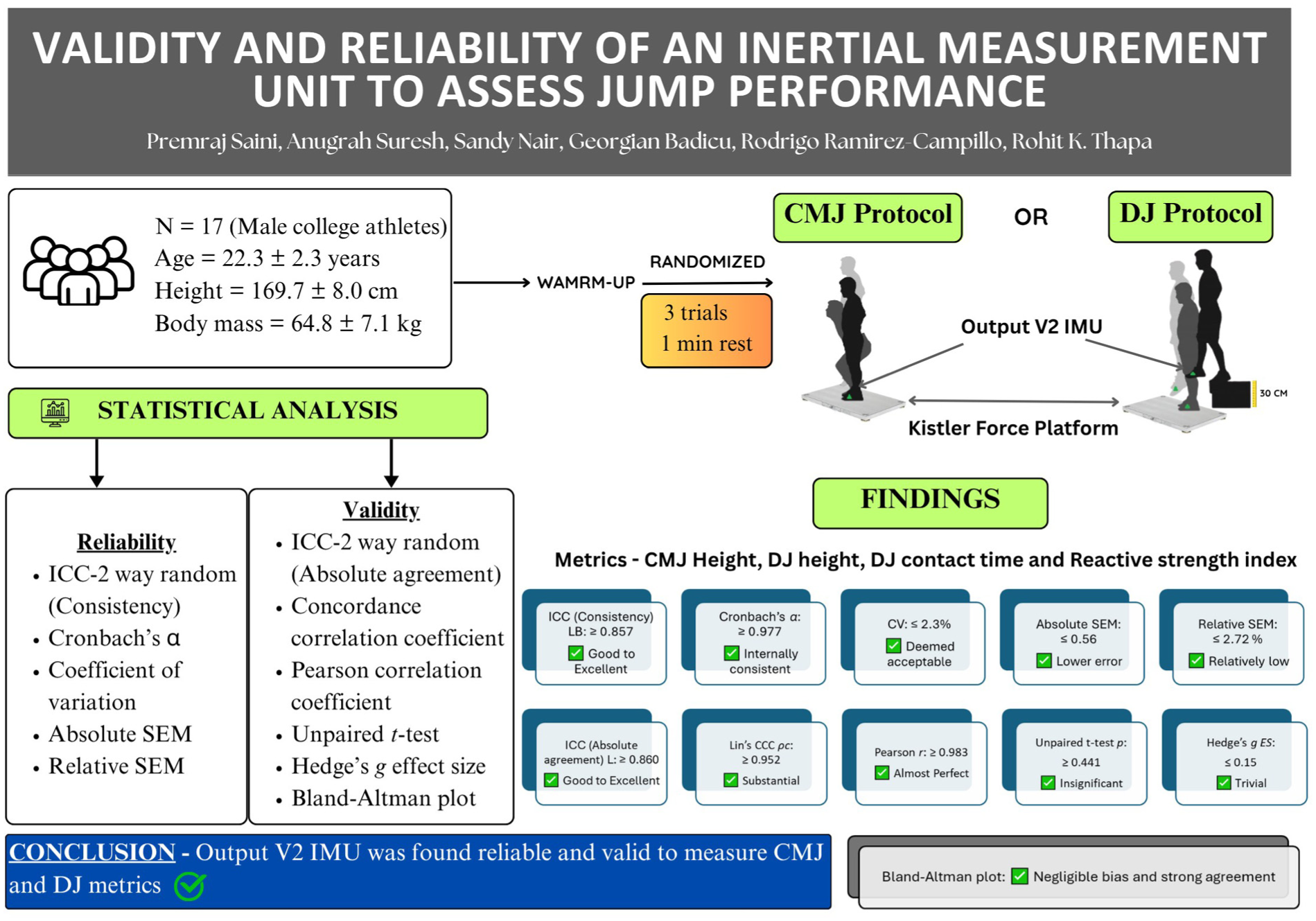
The aim of this study was to investigate the validity and test-retest reliability of an IMU (Output V2) compared to a force plate (Kistler, Winterthur, Switzerland) for measuring countermovement jump (CMJ) and drop jump (DJ) performance metrics. In a randomized crossover study design, male athletes (n = 17; age: 22.3 ± 2.3 years) performed three CMJ and DJ maximal effort trials, with the force plate and the IMU concurrently recording jump performance data. The intraclass correlation coefficient (ICC (consistency)), Cronbach’s alpha, coefficient of variation (CV), and standard error of measurement (SEM) were calculated to determine test-retest reliability. Validity (i.e., between-instruments comparison) was assessed using unpaired t-test, Pearson correlation, ICC (absolute agreement), concordance correlation coefficient (CCC), and Bland-Altman plots. Test-retest reliability of IMU was good to excellent for both tools (ICC lower limit ≥ 0.857, Cronbach’s α ≥ 0.977, CV ≤ 2.3%, relative SEM ≤ 2.72%). Compared to the force plate, the IMU measured similar (between-instruments p > 0.05) CMJ height, DJ height, reactive strength index, and DJ contact time, with almost perfect Pearson correlations (r ≥ 0.983), substantial CCC (ρ c ≥ 0.952), and good to excellent ICC values (≥0.860). Bland–Altman plots showed negligible bias and strong agreement. The IMU Output V2 was found to be valid and reliable when compared to a force plate for measuring CMJ and DJ performance metrics. The Output V2 IMU’s cost-effectiveness, portability, and ease of use via mobile devices make it a practical alternative for field assessments.
Keywords
Get full access to this article
View all access options for this article.
References
Supplementary Material
Please find the following supplemental material available below.
For Open Access articles published under a Creative Commons License, all supplemental material carries the same license as the article it is associated with.
For non-Open Access articles published, all supplemental material carries a non-exclusive license, and permission requests for re-use of supplemental material or any part of supplemental material shall be sent directly to the copyright owner as specified in the copyright notice associated with the article.
