




Abstract
Recent advances in technology have enabled the development of instrumented equipment, which estimate the head impact kinematics of athletes in vivo. One such headband-mounted impact sensor is the SIM-G (Triax Technologies, Norwalk, CT, USA), which has been previously used to investigate the biomechanics of soccer heading by human subjects. Previous studies have evaluated the accuracy of the SIM-G for pure rotation and pendulum, impulse hammer and drop rig impacts. The current study used a soccer ball heading model to evaluate the accuracy of the SIM-G. A soccer ball was projected at the head of an anthropomorphic test device (ATD) representing a 10-year-old to replicate the heading maneuver at various impact sites, angles and speeds previously identified in youth soccer. Linear regression revealed that the SIM-G sensor overestimated the peak angular velocity and linear acceleration recorded by the ATD headform by approximately 44% and 105%, respectively. Tests in which the ball directly contacted the SIM-G sensor resulted in the largest peak linear accelerations. Glancing impacts were significantly associated with a decrease in percentage error of the SIM-G sensor peak angular velocity data relative to the ATD reference data. While it may not demonstrate accuracy in estimating the magnitudes of head impacts, the SIM-G remains a useful tool to provide estimates of head impact exposure for soccer players.
Introduction
In 2016, U.S. Soccer mandated that players aged 10 years or younger were prohibited from heading the ball, 1 which supported the opinions of some researchers.2,3 However, inconsistent and limited evidence exists regarding the association between heading in soccer and clinical measures.4,5 Therefore, there is a need to relate the head impact exposure and biomechanics of youth soccer players to objective clinical measures. Recent advances in technology have enabled the development of instrumented equipment, which estimate the head impact kinematics of athletes in vivo. A wide variety of head impact sensors is currently available, such as instrumented helmets, headgear, headbands, mouthguards, and skin patches.6,7 The absence of helmets and the preference of soccer players not to wear mouthguards make a headband-mounted impact sensor ideal for studying soccer heading. One such headband-mounted impact sensor is the SIM-G (Triax Technologies, Norwalk, CT, USA), which has been previously used to investigate the biomechanics of soccer heading by human subjects.8–14
Laboratory studies of the SIM-G have not used soccer ball impacts, but have evaluated the accuracy of the SIM-G for pure rotation, 15 as well as pendulum,16–18 impulse hammer, 19 and drop rig 20 impacts. The developers of the SIM-G head impact sensor assessed accuracy using a pendulum to impact the Hodgson-WSU headform in 11 locations. 16 Peak angular velocity measured by the SIM-G correlated strongly with the headform data; however, correlations were not as strong for peak linear and angular accelerations. Oeur et al. 20 replicated frontal and lateral head-to-ground and head-to-ball impacts using a drop rig with a Hybrid III headform wearing the SIM-G. All 12 impacts were recorded by the SIM-G and it was concluded that the sensor was reliable for counting centric and non-centric impact events. Karton et al. 17 performed pendulum impacts to a Hodgson-WSU headform wearing the SIM-G at seven unique impact sites and three energy levels. For peak linear acceleration, a significant difference was found for the high energy impacts between the headform and SIM-G, but not for the low or medium energy levels. For peak angular acceleration, a significant difference was found for the medium energy impacts between the headform and SIM-G sensor, but not for the low or high energy levels. Similarly, Tyson et al. 18 performed pendulum impacts to a Hodgson-WSU headform wearing the SIM-G at four unique impact sites at targeted accelerations from 25 to 100 g. Compared to the headform, the SIM-G exhibited high standard error for linear and angular acceleration, whereas angular velocity demonstrated the best correlation. Tyson et al. 18 attributed the systematic underprediction of peak kinematics recorded by the SIM-G sensor to the sampling rate of 1000 Hz and short duration of impact events. Sampling rate has been identified as an important consideration when selecting a head impact sensor for on-field data collection. 21 Cummiskey et al. 19 evaluated various head impact sensors using an impulse hammer to deliver impacts to a headform. In terms of root mean square error, the SIM-G sensor out-performed helmet-mounted sensors, but not a skin-patch sensor. More recently, Huber et al. 15 used a pure rotational loading device to evaluate the reproducibility and accuracy of the SIM-G sensor when securely mounted during rotational events relevant to soccer heading. Peak angular velocities recorded by SIM-G sensor pairs were found to be strongly correlated with each other and the reference, but the SIM-G consistently underestimated the peak angular velocity recorded by the loading device by approximately 15%.
While these tests provide an evaluation of the SIM-G in carefully controlled impact conditions, they do not evaluate its performance under head kinematics that more closely mimic use in situ (i.e. actual soccer heading). The performance of other head impact sensors has been explored in soccer ball heading test conditions. Funk et al. 22 impacted the headform of a seated 50th percentile male Hybrid III anthropomorphic test device (ATD) with a soccer ball to validate an instrumented bite block, which was shown to accurately measure linear acceleration compared to the reference data. Nevins et al. 23 assessed the validity of the xPatch head impact sensor by affixing it to the approximate location of the mastoid process on a 50th percentile male Hybrid III ATD head- and neck-form. Soccer balls were projected at the headform across a range of impact speeds and sites. The xPatch consistently under-predicted the peak linear and angular accelerations of the reference. Sandmo et al. 24 investigated the accuracy of the MV1 in-ear sensor using an ATD headform. In comparison to tests using a linear impactor, soccer ball impacts resulted in overestimations of peak kinematics by the MV1 sensor compared to the reference data. Wu et al. 25 evaluated the accuracy of the xPatch, in addition to an instrumented skull cap and mouthguard, in vivo using high-speed video tracking of soccer ball heading by human subjects. It was found that the instrumented skull cap grossly overestimated the peak head accelerations, which was attributed to poor skull coupling and out-of-plane motion. The findings supported the results of a previous laboratory study of a helmet-mounted head impact sensor that found the headform-helmet interface had a significant effect on the relationship between the sensor and headform reference data. 26
When evaluating the accuracy of kinematics recorded by head impact sensors in laboratory studies, it is important to use impact scenarios that represent conditions that occur on-field. Therefore, the aim of the current study was to evaluate the kinematics recorded by the SIM-G head impact sensor against ATD reference data for soccer ball heading impacts.
Methods
A soccer ball was projected at the head of a Large Omni-Directional Child (LODC) ATD to replicate the heading maneuver in youth soccer. The LODC is an ATD representing a 10-year-old developed as part of the continued research activities of the National Highway Traffic Safety Administration (NHTSA) to improve the performance of, and address biofidelity concerns surrounding the Hybrid III 10-year-old ATD.27,28 The LODC ATD has several key design differences compared to the Hybrid III 10-year-old ATD, including a modified headform with inertial properties matching pediatric specimens and a neckform that permits elongation and lateral rotation at the atlanto-occipital joint. The LODC ATD headform was instrumented with a triaxial linear accelerometer (model 7264, Endevco, Depew, NY, USA) and a triaxial angular rate sensor (model ARS18K, Endevco, Depew, NY, USA).
Size 5 Brine Phantom (Warrior Sports, Warren, MI, USA) and Nike Strike (Nike, Beaverton, OR, USA) soccer balls were inflated to a pressure of 82.7 kPa, which is within the range of acceptable pressure according to the International Football Association Board. 29 The ball launcher comprised a polyester material pocket threaded with two synthetic latex resistance bands that was attached to a vertical frame at four points. The soccer ball was placed in the pocket of the ball launcher and manually pulled back to a premeasured distance from the frame. Upon release, a high-speed video camera captured an orthogonal view of the inbound ball at 1000 fps to determine ball speed using a calibrated background. Preliminary launches were performed to determine the relationship between pull-back distance and ball impact speed. Ball speeds ranging from 15 to 25 m/s were achievable, which fall within the range of ball speeds from instep kicks by youth male soccer players 30 (Supplemental Table) and previous laboratory studies of soccer ball impacts to ATD headforms.31–33
The LODC ATD was positioned in a seated posture in the seat of a stationary sled, 34 the base of which was rotated for frontal, lateral, and occipital impacts to the ATD headform. For all impact sites, the ATD headform was a distance of 1.3 m from the point at which the ball separated from the ball launcher pocket to the impact point on the ATD headform. The height of the ball launcher and position of the ATD were adjusted to achieve the desired impact angle, which was geometrically measured as inclination from the ATD perspective. The ATD headform was fitted with a headband-mounted SIM-G head impact sensor. The SIM-G device comprised a triaxial gyroscope and high- and low-g triaxial accelerometer with a measurement range of 3–150 g and a trigger threshold of 16 g. 16 For each impact, the sensor recorded linear acceleration and angular velocity time histories at 1000 Hz in all three unique axes and stored time series data from 10 ms pre-impact to 52 ms post-impact. The sensor device was mounted in a neoprene headband (size medium), which can be worn in helmeted and unhelmeted sports. For the current study, the headband was positioned as it would be on a human head (i.e. with the headband positioned just below the hairline of the forehead and the sensor located just above the greater occipital protuberance). Data were transmitted from the sensor via Bluetooth to the SKYi box. A view of the impact from the perspective of the ball launcher was captured by a video camera (MotionXtra HGTH, Redlake, San Diego, CA, USA) at 60 fps to determine the impact site. After each test, the ATD and SIM-G headband were repositioned.
Impact tests were conducted with the two soccer ball models across a range of impact sites, angles, and speeds. Direct impacts were to the mid-plane and glancing impacts were offset from the mid-plane. For frontal impacts, glancing impact sites were approximately 50 mm left or right of the sagittal mid-plane. For temporal impacts, glancing impact sites were approximately 50 mm anterior of the coronal mid-plane. For occipital impacts, glancing impact sites were approximately 50 mm left or right of the sagittal mid-plane. An impact test was repeated if the ball did not impact the LODC ATD headform or data was not recorded by the headform instrumentation. An impact test was excluded from analysis if it did not impact the desired site on the LODC ATD headform. Therefore, the number of tests varied for each condition.
Linear regression was used to compare peak kinematics recorded by the SIM-G sensor and LODC ATD headform during soccer ball impacts. The slope and standard error were calculated for linear acceleration and angular velocity, which were compared to previous laboratory studies. Angular acceleration is not directly measured by the SIM-G sensor and, therefore, was not compared to angular acceleration of the headform due to errors associated with numerical differentiation of gyroscopic impact data. 35 For both peak linear acceleration and angular velocity, multiple linear regression was performed with the percentage error of the SIM-G sensor data relative to the ATD reference data as the dependent variable and impact site (categorical: frontal, crown, temporal, occipital), glancing (categorical: yes, no), impact angle (continuous), impact speed (continuous), and ball type (categorical: Brine Phantom, Nike Strike) as independent variables. An alpha value of <0.05 was used for determining statistical significance.
Results
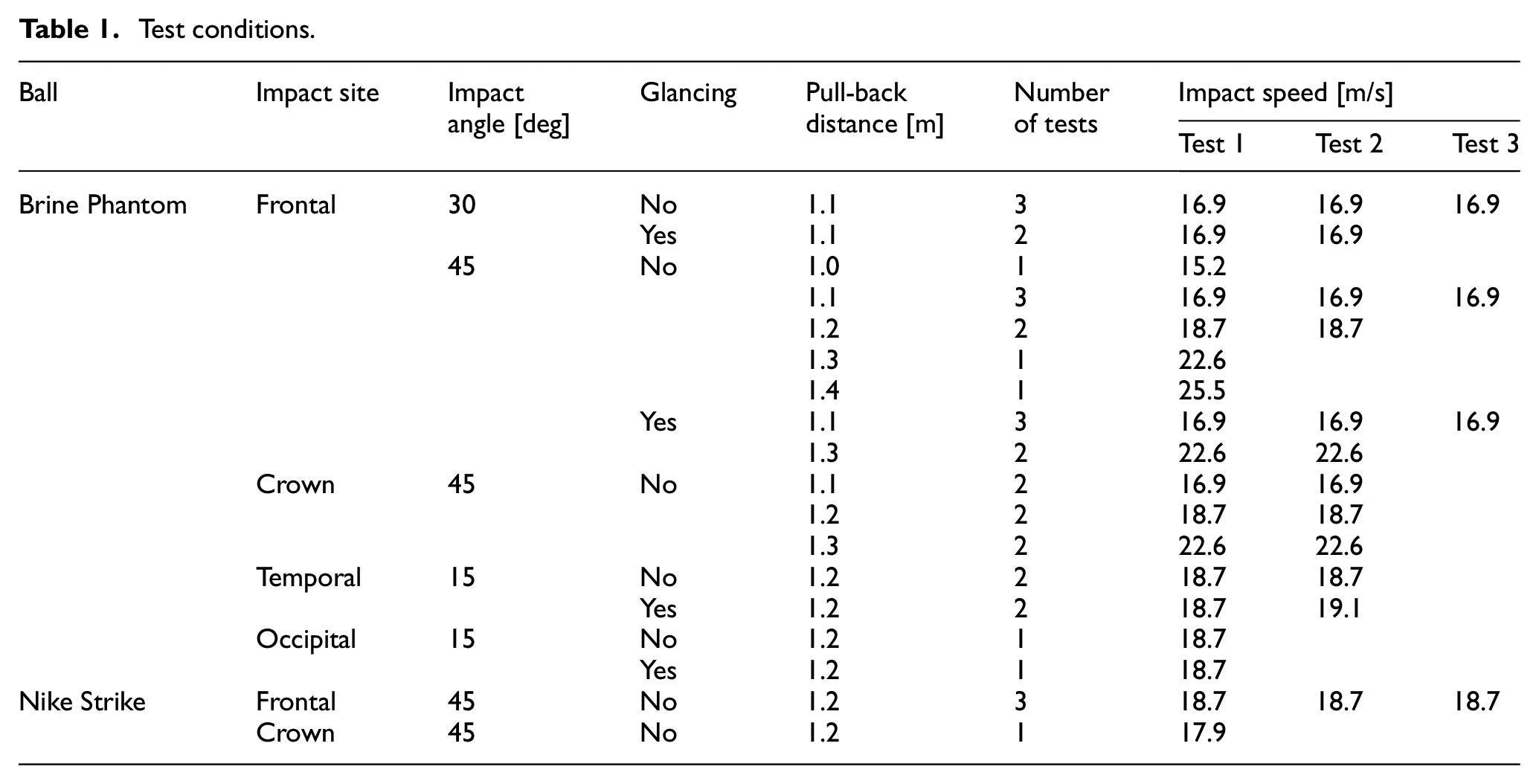
A total of 42 soccer ball impact tests were performed, all of which were recorded by the SIM-G sensor and LODC ATD headform. For eight tests, the soccer ball did not impact the desired site on the LODC ATD headform and thus were excluded from analysis. Therefore, a total of 34 tests were included in the analysis. For the LODC headform, peak linear acceleration and angular velocity ranged from 16.8 to 34.21 g and 2.7 to 18.8 rad/s, respectively. Impacts had a mean duration of 16.0 ± 4.0 ms, as recorded by the LODC headform. For the SIM-G sensor, peak linear acceleration and angular velocity ranged from 29.8 to 64.4 g and 5.0 to 27.0 rad/s, respectively. An additional two impact tests involved the ball directly contacting the SIM-G sensor, which were excluded from analysis, but interestingly had the largest peak linear accelerations recorded by the SIM-G: 80.4 and 98.5 g (Table 1).
Test conditions.
Linear regression comparing peak linear acceleration recorded by the SIM-G sensor and the LODC ATD headform found a slope of 2.05 with a standard error of 0.39 (Figure 1). Linear regression comparing peak angular velocity recorded by the SIM-G sensor and the LODC ATD headform found a slope of 1.44 with a standard error of 0.18 (Figure 2).
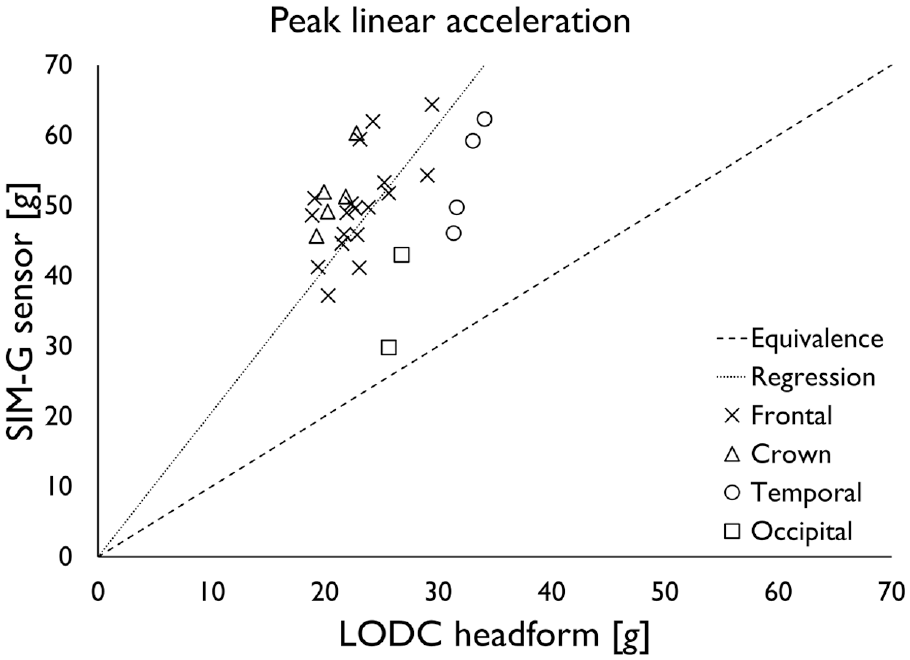
Linear regression of peak linear accelerations recorded by the SIM-G sensor and LODC ATD headform, which had a slope of 2.05 and a standard error of 0.39.
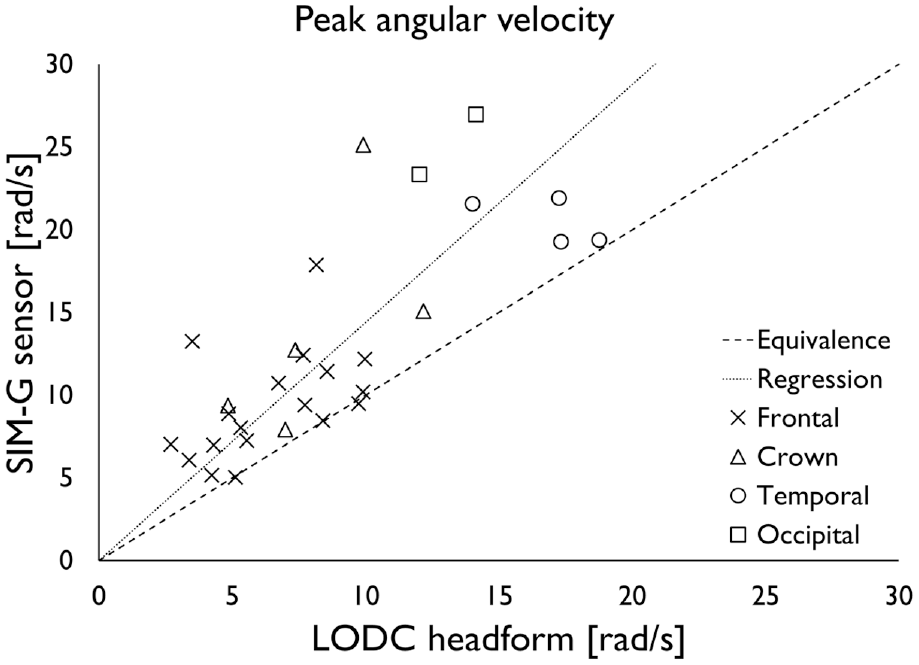
Linear regression of peak angular velocity recorded by the SIM-G sensor and LODC ATD headform, which had a slope of 1.44 and a standard error of 0.18.
For peak linear acceleration, multiple linear regression found no independent variables to be significantly associated with percentage error of the SIM-G sensor data relative to the ATD reference data (Table 2). For peak angular velocity, glancing impacts were significantly associated with a decrease in percentage error between the SIM-G sensor data and the ATD reference data (p = 0.02).
Multiple linear regressions of percentage error of SIM-G sensor data relative to ATD reference data.
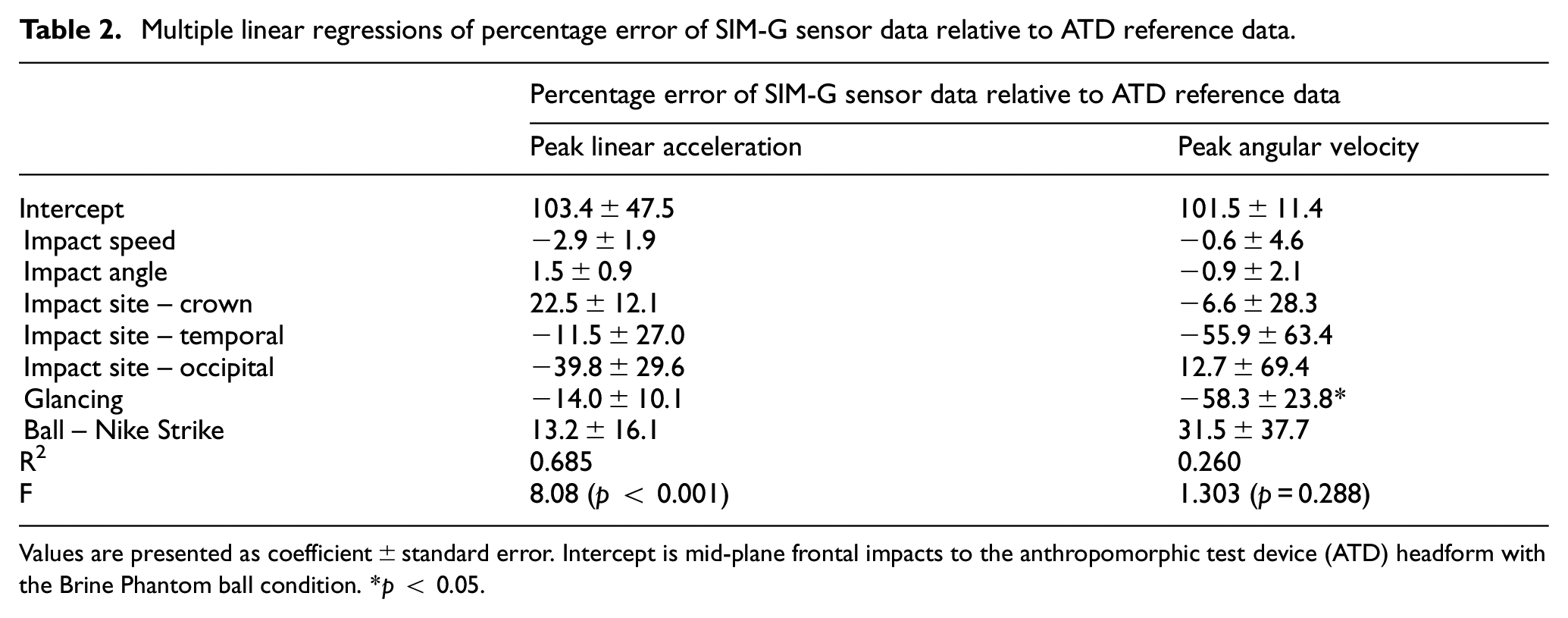
Values are presented as coefficient ± standard error. Intercept is mid-plane frontal impacts to the anthropomorphic test device (ATD) headform with the Brine Phantom ball condition. *p < 0.05.
Discussion
Heading in youth soccer is a controversial issue3,5,36 and current field studies use head impact sensors to investigate the head impact biomechanics of youth soccer players to develop appropriate policies regarding heading at the youth level.8–10,12,13 The headband-based SIM-G is particularly useful in the game of soccer, as headbands are more commonly worn than other sensor-mounted equipment (e.g. helmets and mouthguards). The accuracy of the SIM-G has previously been assessed for pure rotation 15 in addition to pendulum,16–18 impulse hammer, 19 and drop rig 20 impacts. The current study impacted a pediatric ATD with a soccer ball to compare the SIM-G sensor kinematics with the headform reference.
The SIM-G sensor recorded peak linear accelerations that were approximately double the values recorded by the LODC ATD headform. In addition, the overestimation was associated with a relatively large standard error (0.39) and was therefore inconsistent. In contrast to the current study, Tyson et al. 18 reported that the SIM-G sensor underestimated the peak linear acceleration recorded by the headform reference during pendulum impacts. The level of underestimation varied depending on the headform condition (i.e. helmeted, padded, or bare) and was attributed to the short impact durations and sampling rate of the SIM-G sensor (1000 Hz). Sampling rate has previously been identified as an important consideration when selecting a head impact sensor for on-field data collection. 21 However, the current study had a mean impact duration of 16.0 ms, which is longer than the mean impact durations reported by Tyson et al. 18 that ranged from 3.6 to 12.5 ms. In addition, peak linear acceleration of the headform ranged from 18 to 35 g in the current study, whereas the Tyson et al. 18 study targeted headform accelerations of 25–100 g, which may also be responsible for the difference in correlations between Tyson et al. 18 and the current study.
Caccese et al. 11 used a skullcap-mounted SIM-G sensor to measure the peak head kinematics of youth soccer players age 12- to 14-years-old during controlled soccer ball heading trials with a ball speed of 11.2 m/s. A mean peak linear acceleration of 38.5 g was reported. In the current study, ball speeds ranged from 15 to 25 m/s with peak linear accelerations of 43.5–52.1 g recorded by the SIM-G. However, the results of the current study indicate that the peak linear accelerations reported by Caccese et al., 11 in addition to field studies using SIM-G sensors,8,9,13 may be overestimations of the true peak linear head accelerations during soccer ball heading impacts. The SIM-G is headband-mounted and, therefore, may suffer from similar sensor-skull suboptimal coupling as a skullcap-mounted sensor. Wu et al. 25 found that the skullcap-mounted sensor overestimated the peak head linear acceleration of human volunteers measured with a mouthguard sensor by approximately three-fold, whereas in the current study, the SIM-G headband-mounted sensor overestimated the peak head linear acceleration of the ATD reference by approximately two-fold.
Similar to Tyson et al., 18 the current study found that peak angular velocity recorded by the SIM-G sensor had a better correlation with the headform reference compared to linear acceleration. The peak angular velocity regression slope had a standard error of 0.18, and therefore, the overestimation was more consistent compared to the peak linear acceleration value of 0.39. Tyson et al. 18 reported that the SIM-G sensor underestimated the peak angular velocity recorded by the headform by 19% for the padded condition. Similarly, Huber et al. 15 performed rotational events relevant to soccer heading and found peak angular velocity recorded by the SIM-G sensor had a strong correlation, but consistent underestimation of 15%, with the reference sensor on a pure rotational loading device. In contrast, the current study found the SIM-G sensor overestimated the peak angular velocity recorded by the LODC ATD headform by approximately 44%. In the study by Huber et al., 15 the SIM-G sensor was rigidly coupled with the pure rotational loading device; however, the current study attached the SIM-G sensor to the headform with the headband, which provided suboptimal coupling.
Glancing impacts were significantly associated with a decrease in percentage error of the SIM-G sensor angular velocity data relative to the ATD reference data. Such glancing impacts increased transverse rotation of the headform compared to impacts in the anatomical mid-planes (i.e. sagittal and coronal). As the headband was positioned approximately in the transverse plane on the headform, the association may be a result of relatively better coupling in the transverse plane. Heading the ball in a game of soccer results in complex motion involving kinematics in all three anatomical planes; 37 however, the tests in the current study are idealizations of soccer heading. For example, the presence of hair and/or perspiration may affect the head-sensor coupling. 26
Although heading with the occipital region of the head is not common during skillful heading in soccer, incorrectly executed heading and unintended ball-to-head impacts can occur to the occipital region. In the current study, the SIM-G sensor was contacted by the ball during two tests to the occipital region, for which the SIM-G recorded extremely high peak linear acceleration values of 80.4 and 98.5 g; however, the LODC ATD headform recorded 29.9 and 21.7 g, respectively. Such findings suggest that if the SIM-G sensor is directly contacted, the kinematics measured by the sensor grossly overestimate the reference data.
All impacts for which the ball contacted the headform were recorded by the SIM-G sensor, which supports the findings of Oeur et al. 20 who concluded that the SIM-G sensor is reliable for recording impact events in a laboratory setting. A recent study by Kiefer et al. 38 developed a two-phased approach to quantify head impact sensor accuracy using laboratory and on-field methods. Instrumented mouthguards were found to have the best laboratory performance, which was attributed to good sensor-skull coupling via the dentition. For on-field studies, 3.6%–18% of recorded events from instrumented mouthguards were identified as false positives based on video review. The use of instrumented mouthguards is largely limited to sports in which players are required to wear mouthguards (e.g. rugby). 39 Therefore, other sensor systems, such as headband-mounted sensors and skin patch sensors, have utility in providing estimates of head impact exposure for athletes who do not typically wear mouthguards, such as soccer players. In a field study using the SIM-G sensor, Patton et al. 13 identified that less than 10% of sensor events recorded in high school soccer games were false positives suggesting the SIM-G can provide an accurate estimate of head impact exposure on field. However, false negatives (i.e. SIM-G sensor fails to record a real impact that was above the recording threshold) associated with the SIM-G sensor have yet to be investigated.
There were several limitations to the current study. A single headband size (medium) was used on the bare headform of the LODC ATD, which may not be generalizable to the fit of headbands on the heads of human subjects (e.g. headband tightness, hair types). Therefore, the hypothesis that a tighter headband would lead to better coupling was not investigated. Similarly, the presence of hair was also not investigated, which has been found to reduce the static and dynamic scalp-liner coefficient of friction in helmeted cadaver impact tests. 40 In addition, a previous laboratory study of a helmet-mounted head impact sensor found that the headform-helmet interface has a significant effect on the relationship between the sensor and headform reference data. 26 Another limitation is that size 5 soccer balls were used, which are recommended for players older than 12 years of age. 41 In addition, ball speeds of 15–25 m/s were used in the current study, which represent the upper bound of dominant leg instep kicks by male youth soccer players; 30 however, slower speeds may be more representative of other game situations, such as throw-ins. 42 Lastly, angular acceleration was not assessed in the current study. Similar to most head impact sensors, the SIM-G sensor tested in the current study comprised a triaxial gyroscope to directly measure angular velocity, 7 but errors are associated with numerical differentiation of gyroscopic data to obtain angular acceleration. 35 However, peak resultant angular velocity has been found to be a good predictor of concussion in unhelmeted sports. 43 Therefore, it was assessed in the current study.
In summary, the current study used a soccer ball heading model to evaluate the accuracy of the SIM-G. The SIM-G sensor overestimated the peak angular velocity recorded by the LODC ATD headform by approximately 44%. In addition, the SIM-G sensor recorded peak linear accelerations that were approximately double the values recorded by the LODC ATD headform. Tests in which the ball contacted the SIM-G sensor resulted in the largest peak linear accelerations. Glancing impacts were significantly associated with a decrease in percentage error of the SIM-G sensor angular velocity data relative to the ATD reference data. Such findings suggest that peak head kinematics recorded on-field by the SIM-G sensor may overestimate the actual peak head kinematics experienced by a soccer player when heading the ball, and therefore require careful interpretation. However, all impact tests were recorded by the SIM-G sensor, which supports previous on-field research that the SIM-G sensor is a useful tool to provide estimates of head impact rates for soccer players.
Supplemental Material
sj-docx-1-pip-10.1177_17543371211063124 – Supplemental material for Laboratory assessment of a head impact sensor for youth soccer ball heading impacts using an anthropomorphic test device
Supplemental material, sj-docx-1-pip-10.1177_17543371211063124 for Laboratory assessment of a head impact sensor for youth soccer ball heading impacts using an anthropomorphic test device by Declan A Patton, Colin M Huber, Ethan C Douglas, Thomas Seacrist and Kristy B Arbogast in Proceedings of the Institution of Mechanical Engineers, Part P: Journal of Sports Engineering and Technology
Footnotes
Acknowledgements
The content of this manuscript is solely the responsibility of the authors and does not necessarily represent the official views of the Pennsylvania Department of Health and/or the National Institutes of Health. The authors thank Umar Saaba for his assistance with data analysis.
Declaration of conflicting interests
The author(s) declared no potential conflicts of interest with respect to the research, authorship, and/or publication of this article.
Funding
The author(s) disclosed receipt of the following financial support for the research, authorship, and/or publication of this article: The current study was funded by the Pennsylvania Department of Health (SAP100077078) and the National Institute of Neurologic Disorders and Stroke of the National Institutes of Health (R01NS097549).

Supplemental material
Supplemental material for this article is available online.
References
Supplementary Material
Please find the following supplemental material available below.
For Open Access articles published under a Creative Commons License, all supplemental material carries the same license as the article it is associated with.
For non-Open Access articles published, all supplemental material carries a non-exclusive license, and permission requests for re-use of supplemental material or any part of supplemental material shall be sent directly to the copyright owner as specified in the copyright notice associated with the article.
