




Abstract
This paper reconceptualises evaluative processes pertinent to empathy as empathic perception: an evaluative, dynamic, and embodied process that provides morally neutral information as a perception to guide action and manage relationships. Traditional models often treat empathy as prosocial, yet it can enable both cooperation and exploitation. Empathic perception addresses this complexity by reframing evaluative processes used to understand another as a means of gathering intelligence rather than as an inherently benevolent force. Drawing on psychology, neuroscience, and social theory, we develop a model of empathic perception and an empathic perception–action matrix that shows how sociocultural context and personal motivation shape outcomes. This reconceptualization advances theoretical understanding by positioning empathic enquiry not as a moral virtue, but as a perceptual process that informs decision-making across contexts.
Introduction
Empathy is often portrayed as a moral force, celebrated for promoting cooperation, altruism, and prosocial behaviours such as organisational citizenship, leader–member exchange, commercial exchange, helping, and even reductions in racial bias (Bove, 2019; Cropanzano et al., 2017; Lamm et al., 2007; Patané et al., 2020). Researchers now recognise that empathy is complex and multidimensional, encompassing processes that range from affective contagion to perspective-taking, and outcomes that span empathic distress, compassion, and moral judgement. Yet despite this recognition, it is still widely assumed that cultivating empathy, and especially cognitive empathy, will reliably produce prosocial outcomes (Cuff et al., 2016).
This assumption masks a deeper problem. Definitions of empathy are inconsistent, sometimes describing the processes by which people understand others and at other times the outcomes of those processes, such as emotions, congruence, or actions. Empathy is often equated with benevolence, but it can also be tactical or parochial, shaped by the biases of the empathizer and deployed to exclude, manipulate, or harm (Bloom, 2016; Prinz, 2011). Hall and Schwartz (2019) surveyed definitions of empathy and found striking contradictions, recommending that the broad construct be set aside in favour of more precise, lower-level concepts. Main et al. (2017) similarly argued that empathy should be studied in terms of its relational and contextual functions rather than as an abstract form. Without resolving these inconsistencies, empathy research risks misrepresenting how empathic processes shape social life.
In response, we reconceptualise the processes by which one evaluates (examines in order to discern) another to understand their lived state as empathic perception: an evaluative, embodied, and dynamic process that provides morally neutral information for action and relationship management. Drawing on Copi and Cohen's (1990) method of definition, as adapted by McGrath and Whitty (2015), we refine understanding of empathy by removing moral assumptions and repositioning empathic enquiry as a process of perception rather than as a moral force. We then develop a layered model of empathic perception and an empathic perception–action matrix to illustrate how empathic processes, shaped by motivation and context, yield outcomes across a spectrum from predatory manipulation to altruistic care. We promote that the processes by which a perception of another is achieved are the same, whether the intention is for care and compassion or for selfish gain and predation. The embodied, dynamical, sensory processes by which one evaluates and perceives the lived state of another, disclosed by empathy research, do not predicate an outcome that corresponds to the various definitions of empathy related to care and compassionate action. This parallels broader accounts of empathy as an ability to understand another person's emotions, thoughts, and internal state (Gamble et al., 2024; Zaki & Ochsner, 2016).
This reconceptualization advances the field by clarifying empathy as a neutral evaluative process. It explains how the same underlying capacities can support cooperation or exploitation, depending on the goals and ethical stance of the empathizer and it provides a clearer framework for future research on how empathy informs decision-making in complex social contexts. It clarifies the impact of reflective cognitive empathy on action as increased intelligence and is ethically neutral.
Empathy as a Process
Empathy can involve both relatively automatic processes and more controlled, reflective processes. It is often discussed in relation to emotion, because another person's affect can be highly salient and socially informative. However, empathy is not necessarily limited to emotion alone. In this paper, empathic perception is used to describe evaluative understanding of another person's lived state, which may foreground emotion, cognition, intention, appraisal, or action-tendencies, depending on the context. Emotion is therefore a frequent target of empathic perception, but not a defining requirement in every empathic episode.
Empathy has been found to integrate emotional appraisal and resonance (Zaki, 2014), cognitive role-taking which involves imagining yourself in another's situation using one's own experiences and viewpoint (Lamm et al., 2007), and perspective-taking which involves suppressing one's own viewpoint to appreciate another's (Shamay-Tsoory & Lamm, 2018; Walter, 2012). Prior experience and sociocultural context can influence these processes (Amiot et al., 2020; Zaki & Ochsner, 2016). Put simply, “understanding another person by imaginatively ‘feeling oneself’ into that person's subjective inner perspective” (Murphy et al., 2022, p. 167). This process is central to social life (Main et al., 2017; Main & Kho, 2020). It allows people to connect both emotionally and cognitively, not only to recognise another's state but also to appreciate why that person is in that state (Batson, 2009; Davis, 2018; Main et al., 2017; Main & Kho, 2020; Murphy et al., 2022). In this sense, empathy is conceived less as a single act but as a dynamic process. It is this dynamic quality that creates both its promise and its ambiguity.
As a dynamic process, empathy links perception and emotion to action. The empathizer's emotional response fuels motivation and acts as the bridge between what is perceived and what is done (Scarantino, 2016). Empathic episodes often involve evaluation of another person's emotional or cognitive state, interpreted through the empathizer's experiences and knowledge (de Waal & Preston, 2017). The resultant experienced perception is predictive, shaped not only by current sensory input but also by prior knowledge (Barrett, 2017; Seth, 2021). Understanding empathy in this way highlights it as a process of gathering and interpreting information resulting in an experienced perception, rather than as an outcome.
Emotions experienced from the perception of another can motivate very different actions: prosocial helping, avoidance, or even harm, depending on the context (Bloom, 2016; Spaulding, 2024; Zaki, 2014). For example, empathic distress felt when seeing another in extreme pain may result in motivation to assist and alleviate the other's distress or to turn away and alleviate the observer's distress. This emotional dimension of empathy shapes moral judgment and cooperative behaviour at the intrapersonal level. At the same time, empathy is also an interpersonal process. It influences not only how the empathizer approaches or avoids others, but also how those being perceived respond in turn (Davis, 2018; Main et al., 2017; Marsh, 2022; Murphy et al., 2022). In this way, empathy becomes a two-way dynamic that guides interaction rather than a fixed moral force. For example, when observing a colleague being publicly humiliated by a senior leader, an observer may use their empathic perception to understand their humiliation and anger. The processes to perceive that humiliation and anger are the same whether the response of the empathizer is with compassion and the action of intervening to alleviate the colleagues distress; or to remain as an observer quietly feeling schadenfreude because they had recently humiliated the empathiser.
The Embedded and Dynamical Nature of Empathic Processes
Empathy is demonstrated to exhibit an embedded and dynamical structure as an embodied process that integrates autonomic responses, meaning physiological arousal mediated by the autonomic nervous system, alongside automatic and controlled responses. Panksepp and Panksepp (2013) describe three primary processes:
Primary-process empathy (Emotional contagion and care) involves immediate, subcortical responses such as contagion, fear, and caregiving instincts. These reactions are deeply rooted in evolutionary biology and form the foundation of empathic engagement (Panksepp & Panksepp, 2013). Secondary-process empathy (Empathic habit) consists of conditioned responses shaped by learning and socialisation. These habitual patterns are governed largely by the basal ganglia and limbic system, reflecting how past experience influences current empathic behaviour (Davis & Panksepp, 2018). Tertiary-process empathy (Full cognitive empathy) encompasses higher-order regulation. Cortical processes allow reflective thought, complex moral judgment, and deliberate engagement. At this level, empathic responses are consciously moderated by the empathizer's goals and values (Panksepp & Biven, 2012).
These empathic processes are nested. Primary processes of affective empathy are triggered automatically and experienced as embodied sensing. They occur in every interaction and provide the foundation for secondary processes of empathic habits, or trait empathy, which operate without cognitive effort. Both primary and secondary processes usually precede tertiary cognitive empathy. Cognitive processes, when used, are effortful and applied to moderate secondary responses, reflect on past interactions, and plan for future ones. The three levels therefore work together rather than in isolation.
Primary processes supply the first information, which conditions and shapes secondary habits. These habits then influence cognitive reflections and plans. In turn, cognitive reflection regulates both habits and autonomic reactions. The result is a continual feedback loop in which embodied perceptual processes generate knowledge, experienced as feelings and emotions that motivate action (Damasio & Carvalho, 2013; Panksepp & Panksepp, 2013). Deliberate planned actions can influence and establish empathic habits which, in turn, influence autonomic reactions (Panksepp, 2011; Panksepp & Panksepp, 2013). Tertiary processes require cognitive effort and therefore can be influenced by ego depletion (Wang et al., 2024). These processes are influenced by the empathizer's lived experience, capabilities, embodied state, and cultural context.
Within this dynamic, cognitive role-taking and perspective-taking are often described as cognitive and affective theory of mind, the use of deliberate reasoning to understand another's emotional state (Dvash & Shamay-Tsoory, 2014). Schurz et al. (2020) describe a spectrum with affective processes at one end and cognitive processes at the other, with many instances in practice combining both. Developmental studies reinforce this view: affective empathy emerges early in childhood and forms the foundation for later, more complex cognitive processes, which begin around age three and are typically established by age six or seven (Decety & Holvoet, 2021).
Taken together, these findings show that empathy is a layered and interactive system, not a linear sequence. This interplay of automatic, habitual, and cognitive processes is central to the reconceptualization of empathy as empathic perception.
Empathy's Response Dimensions
Empathy is deeply shaped by sociocultural norms and personal motivations. These factors influence not only who is deemed worthy of attention but also how empathic responses are expressed and endorsed within groups (Lavenne-Collot et al., 2022). Wartime propaganda, for example, often dehumanises the enemy, suppressing empathy for out-groups while fostering it within the in-group. In extreme cases, harming and killing the out-group becomes normalised (Amiot et al., 2020). Such examples show that although empathy is often linked to cooperation, altruism, and moral decision-making, it also has darker sides (Breithaupt & Hamilton, 2019).
On the prosocial side, empathy is closely tied to compassion and sympathy, which in turn drive helping behaviours (Gamble et al., 2024; Klimecki, 2019). Bloom (2017, p. 30) however, argues for rational compassion as an alternative, suggesting that affective empathy can at times make us “morally worse”. A misplaced sense of empathy, for instance, might lead the empathizer to side with the wrong party. Empathy is also linked to relationship building and social construction (Hollan, 2019; Main & Kho, 2020; Rimé, 2020). Yet, as Prinz (2011, p. 219) notes, information perceived of another's internal state may generate other moral emotions such as anger or disgust, raising the question of “if this isn’t empathy, then what is it?”
On the antisocial side, empathy can be tactical. It can be used to manipulate or control others, especially in competitive or adversarial contexts (Bubandt & Willerslev, 2015). Machiavellians have been shown to be skilled in affective empathic perception (Bagozzi et al., 2013), while psychopaths often display cognitive empathy (Maibom, 2009, 2022). Empathy can also be parochial, extending more readily to those who are perceived as similar or part of the in-group. This bias undermines fairness and impartiality and can lead to exclusion, bullying, or domination of out-groups (Breithaupt, 2018). In its most extreme forms, parochial empathy fuels dehumanisation, bigotry, and radicalisation (Fleischacker, 2019; Lavenne-Collot et al., 2022). When guided by personal goals, empathy can also be selectively deployed, distorting the moral judgments of the empathizer (Zaki, 2014). For example, Breithaupt (2012) describes a scenario where someone is viewing a conflict where they are on the side of one person in that conflict and therefore has the tendency to empathize (understand) the person they are on the side of and not the other protagonist. In this example, the goals (side-taking) of the empathizer influence selective deployment of their empathic evaluation capabilities (Söffner, 2012; Woodward et al., 2024).
These social dimensions reveal the moral complexity of actions that arise from empathic perception. The same perceptual processes can generate prosocial or antisocial outcomes, depending on the context (Chen et al., 2021). Empathic processes unfold within spatiotemporal, physiological, and sociocultural settings, all of which shape how a perception leads to action (Hollan, 2019). Empathy is therefore a motivated process: the empathizer weighs the costs and benefits of engaging, and regulates their response accordingly (Spaulding, 2024). Factors that influence this motivation range widely, including proximity (Forman-Barzilai, 2005); temperature and climate (Luo et al., 2018); time (Warner et al., 2024); testosterone levels (Bos et al., 2012); personality traits such as the Dark Triad (Maibom, 2009, 2022; Turner et al., 2019); apathy and motivating goals (Spaulding, 2024); ego depletion (Wang et al., 2024); belief (Mooijman & Stern, 2016; Watanabe et al., 2022); attention (Wilterson et al., 2020); group membership (Carriere et al., 2024; Lavenne-Collot et al., 2022; Varaine et al., 2024); reputation (De Buck & Pauwels, 2022); feedback loops (Hilbe et al., 2018); experience (Barrett, 2020; Hoffer et al., 2018); competition (Warner et al., 2024); collective emotion (Thonhauser, 2022); similarity to self (Gamble et al., 2024); and biases (Bloom, 2017; Warner et al., 2024).
In Summary
The field of empathy research is marked by competing discourses and conceptual confusion. Hall and Schwartz (2019) argue that the broad definition of empathy is incoherent and should be replaced with lower-level constructs that better capture its operationalisation. We take up this challenge by introducing the model of empathic perception. This framework shows how empathy informs decision-making across a spectrum of outcomes and redefines the appraisal processes of understanding another as a neutral and evaluative rather than a moral force. This conceptualisation of empathic perception upholds the broad conception of empathy as the ability and capability of understanding another.
Redefining Empathic Evaluative Processes
A key problem in empathy research is definitional confusion. Copi and Cohen (1990) classic work on the logic of definitions offers a method for creating clear concepts. McGrath and Whitty (2015) applied this method successfully in project management, and we use it here to reconceptualize empathic evaluative processes as empathic perception.
The process involved six steps.
The result is a reconceptualization of empathic evaluative processes as empathic perception:
This definition positions empathic perception as an evaluative process rather than a moral force. It integrates affective and cognitive capacities, recognises the role of embodiment and context, and makes explicit empathy's dual potential to support either prosocial or antisocial outcomes. It recognises the complexity of the dynamical intrapersonal and interpersonal biological and sociocultural systems that result in propensities and tendencies rather than predictive outcomes. In doing so, it represents a significant shift away from traditional, value-laden accounts.
Empathic Perception
To guide the discussion, we first present the dynamics of empathic perception, building on Panksepp and Panksepp (2013) model of layered processes. We then introduce a matrix showing how empathic perception provides intelligence for actions ranging from predatory to benevolent, situated between automatic embodied reactions and deliberate cognitive evaluation. Finally, we describe how empathic perception is deployed in practice, where perception provides information for decision-making that can lead to positive or negative outcomes, whether intended or unintended.
The Embodied, Dynamic Processes of Empathic Perception
Empathic perception operates at multiple levels, from affective sensing to reflective cognition (Dvash & Shamay-Tsoory, 2014; Schurz et al., 2020). Each layer influences the next, so they function together rather than in isolation. Figure 1 illustrates how autonomic reactions, habitual responses, and cognitive reflection form a dynamic system.
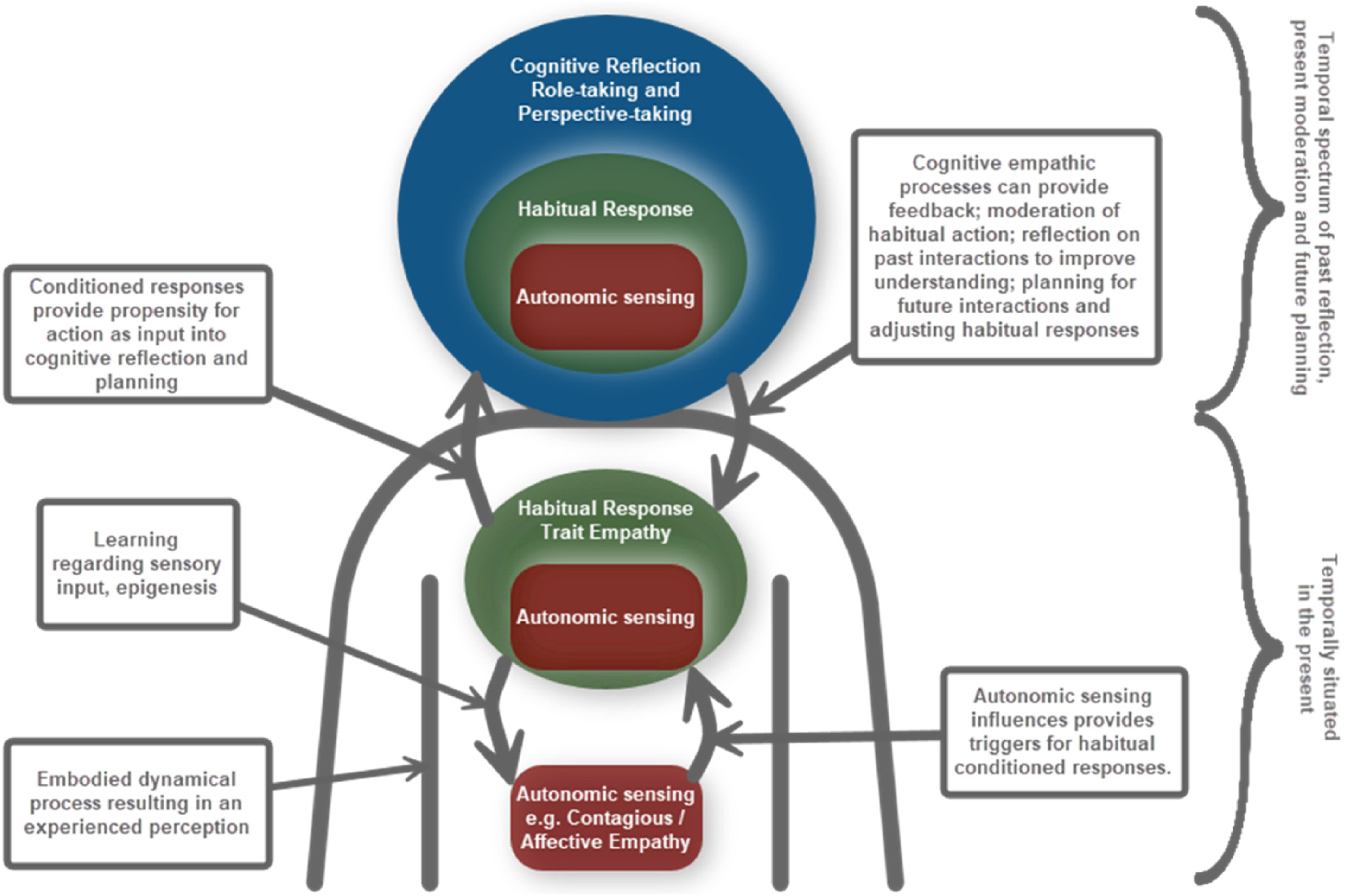
The embodied, dynamic processes of empathic perception.
Autonomic, Foundational Sensing (Contagious or Affective Empathy)
At the base are rapid, embodied responses such as emotional contagion and fear reactions. These subcortical processes are evolutionarily rooted and provide the first layer of empathic engagement (Clark et al., 2019; Damasio & Damasio, 2016; Walter, 2012). They are automatic, experiential, and not subject to conscious control (Damasio, 2001, 2021).
Habitual Response (Trait Empathy)
Through repeated interactions, social learning, and conditioning, autonomic sensing is shaped into relatively stable empathic habits (Panksepp & Panksepp, 2013). These patterns operate reflexively and predictably, often without cognitive load (Davis, 2018). Over time, habits are embedded in sociocultural contexts, creating a system of responses that adapt through complex feedback, regulation, and deliberate action based on planning (Damasio, 2018; Damasio & Damasio, 2016; Lloyd et al., 2001).
Cognitive Reflection (Cognitive Empathy)
This is the most effortful level where the empathizer deliberately adopts the perspective of another. This involves role-taking, perspective-taking, and long-term planning, supported by prefrontal cortical processes (Panksepp & Panksepp, 2013; Shamay-Tsoory & Lamm, 2018). Cognitive empathy moderates emotional responses, adapts habits, integrates past learning, and guides future interactions. Its effectiveness depends on time, attention, and the empathizer's current state, and it can be impaired by factors such as ego depletion (Lin et al., 2020; Wang et al., 2024).
In practice, these layers are encapsulated within one another. Autonomic sensing shapes habits, habits shape cognition, and cognition in turn regulates both habits and autonomic reactions. The system is also influenced by the empathizer's embodied state. For example, anxiety, fatigue, or confidence, and by their personal history and cultural context.
The Social Context of Empathic Perception
Empathic perception is not only intrapersonal but also interpersonal. It functions in relationships where both parties simultaneously act as empathizer and as the object of empathy. Their perceptions shape each other's actions and reactions in a continual exchange.
The broader sociocultural context also matters. Group norms and cultural expectations shape who is perceived as worthy of empathy and how empathic responses are expressed (Main, 2022; Main et al., 2017). Empathy unfolds within overlapping systems such as families, workplaces, and social groups, where personal histories and collective dynamics intertwine. These contexts continually evolve, creating emergent complexity in how empathic perception is motivated and enacted.
Taken together, this framework highlights empathy as a dynamic, embodied system that operates across multiple levels and within multiple contexts. It provides the groundwork for reconceptualizing empathy as empathic perception: a process that yields information for action but does not prescribe its moral direction.
Empathic Perception Informs Action: From Predation to Benevolence
The outcomes of empathic perception do not follow from the process itself, which only provides evaluative and morally neutral information. They depend on the empathizer's cognitive and emotional drivers. Using cooperation as a conceptual axis, we can map a spectrum of actions ranging from predation, through cooperation, to benevolent altruism Figure 2 illustrates this spectrum. Empathic perception may lead to antisocial outcomes such as planned predation or to prosocial outcomes such as considered altruism. Cognitive empathy often produces denser information, which can make actions more effective from the empathizer's perspective, but not necessarily more ethical.
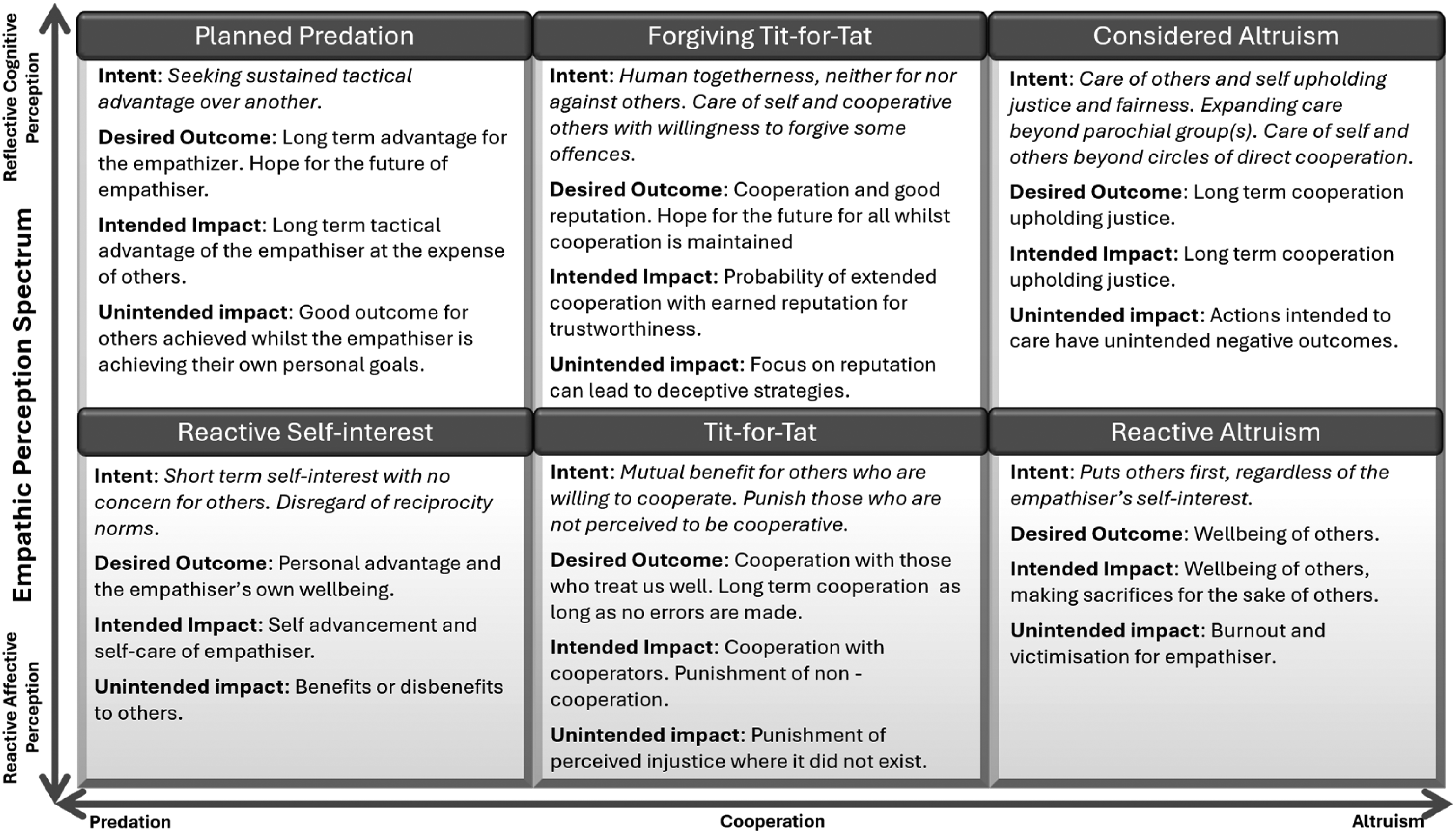
Empathic perception informs action from predation to altruism.
This spectrum helps explain how individuals move between self-serving and altruistic actions. The balance between automatic and reflective processes of perception determines the effectiveness of action, but not its moral value.
Planned Predation: Cognitive Empathy for Selfish Gain
At the predatory end, empathic perception is used to exploit others. A negotiator, for instance, may anticipate a rival's weaknesses to secure an advantage. Cognitive empathy provides rich information, but here it is harnessed for manipulation and control (Bloom, 2016; Breithaupt, 2018; Breithaupt & Hamilton, 2019; Bubandt & Willerslev, 2015).
Reactive Self-Interest: Emotional Responses Without Cognitive Moderation
Reactive self-interest sits at the lower affective end. The empathizer acts on immediate emotional contagion, prioritising personal gain without reflection. The result may be short-term benefit for the self but missed opportunities for longer-term cooperation (Davis, 1983; Mäthner & Lanwehr, 2017; Rand & Nowak, 2013).
Tit-for-Tat and Forgiving Tit-for-Tat: Cognitive and Emotional Balance in Cooperation
In the middle of the spectrum, cognitive and emotional processes combine to support cooperation. Tit-for-Tat mirrors another's behaviour, while forgiving Tit-for-Tat allows for reconciliation and longer-term stability (Nowak & Highfield, 2011; Rand & Nowak, 2013; Sapolsky, 2017). Yet cooperation is not always prosocial. As Harari (2015) notes, concentration camps required cooperation, but to destructive ends.
Considered Altruism: Prosocial Behaviour Informed by Cognitive Empathy
At the benevolent end, empathic perception guides actions aimed at fairness, justice, and care beyond immediate circles. Reflective thinking tempers emotions with long-term moral consideration (Batson, 2011; Greene, 2014). This can foster human flourishing but may also expose the empathizer to burnout or exploitation (Neff & Pommier, 2013).
Reactive Altruism: Emotionally Driven Self-Sacrifice
Reactive altruism arises when affective empathy drives the empathizer to prioritise others without reflection. These acts can be highly prosocial but are often unsustainable, leading to exhaustion or vulnerability to manipulation (Bloom, 2017; Bruneau et al., 2017).
Relationship Between Empathic Perception and the Empathic Perception-Action Matrix
Figure 3 integrates the layered model of empathic perception (Figure 1) with the action spectrum from predation to altruism (Figure 2). It clarifies a central claim of the paper: empathic perception yields information for action, but it does not determine the moral direction of that action. Cognitive role-taking and perspective-taking can broaden and deepen the information available for decision-making, which can make action more effective, without making it more ethical. Movement along the spectrum therefore depends on the empathizer's motivations, values, and situational goals, shaped within interpersonal and sociocultural contexts, rather than on the perceptual mechanisms themselves. Figure 3 also retains the point that reactive processes are nested within reflective cognition, because autonomic sensing and habitual response remain present even when deliberative perspective-taking is engaged. These intrapersonal dynamical systems for information gathering provide intelligence used for action choice that is situated within more dynamical sociocultural systems that further influence action choice for an individual navigating life seeking to survive and thrive.
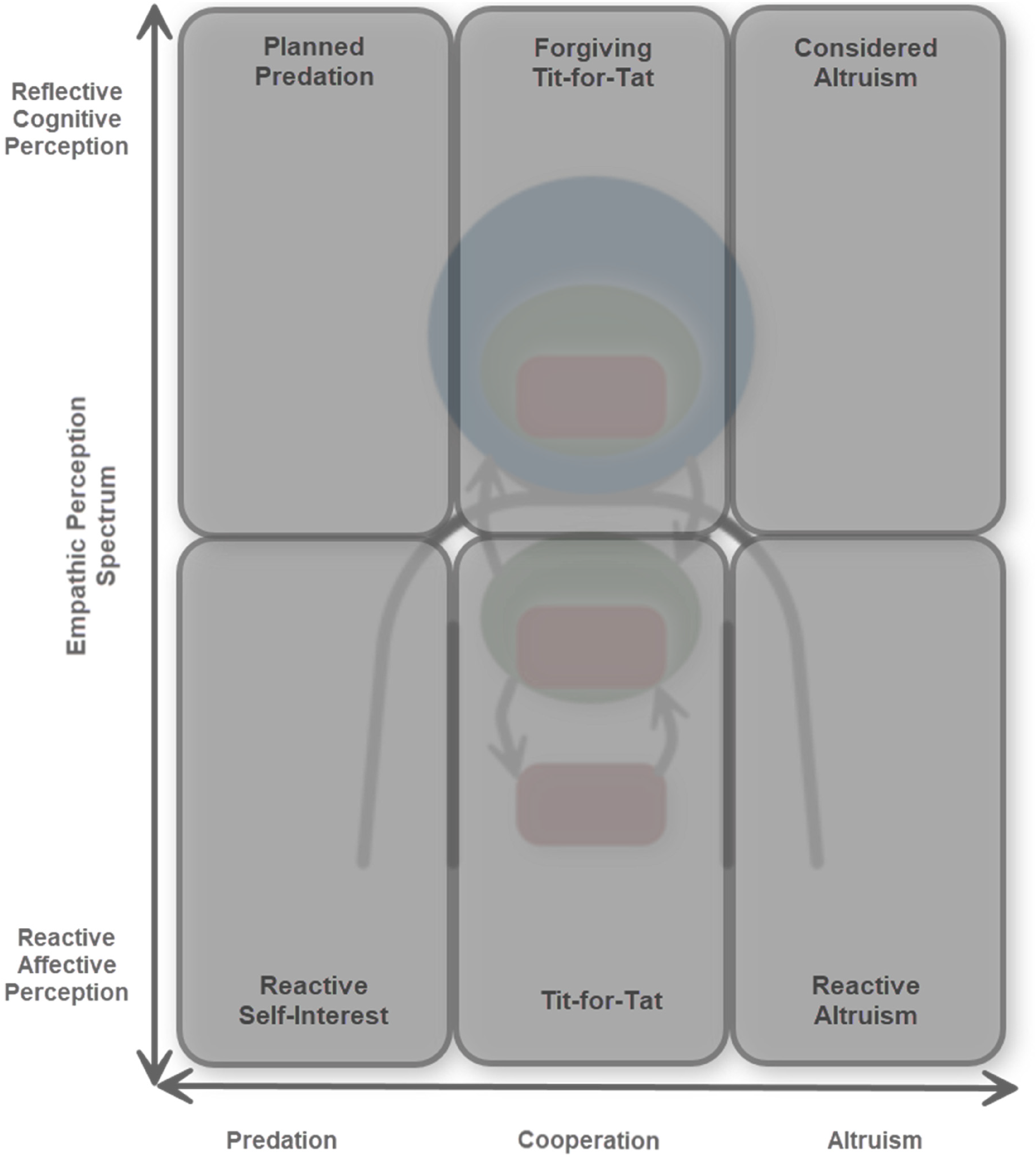
Relationship between empathic perception and the empathic perception-action matrix.
To sum up, empathic perception is best understood as the information-gathering stage within a wider action sequence. Cognitive reflection can enrich this information by providing more intelligence on context from varied points of view, but it does not determine what will follow. As Sapolsky (2017) and Panksepp and Biven (2012) note, behaviour does not flow linearly from emotion or cognition. It is shaped by a web of intentions, predispositions, and contextual influences. This complexity is captured in the behavioural spectrum, where the same empathic processes can produce outcomes ranging from predation to altruism.
Empathic Perception-Action Sequence as Informative, Not Determinative
Empathic perception explains how the empathizer gathers information about another's emotional and cognitive state. This information is filtered through the sociocultural context in which the interaction takes place and becomes part of the empathizer's lived understanding (Davis, 2018; de Waal & Preston, 2017). It is then available for use in decision-making, whether the outcome is prosocial or antisocial.
This does not cause action. Instead, it feeds into a decision-making process shaped by the empathizer's goals and motivations. These may be altruistic, self-serving, or strategic (Damasio, 2021; Mooijman & Stern, 2016). The process is also influenced by embodied emotional reactions such as sympathy, anger, fear, or disgust (Decety, 2021; Decety & Holvoet, 2021; Prinz, 2011; Scarantino, 2016). Cognitive reflection can moderate these emotions, but the final course of action depends on how the empathizer interprets both emotional and cognitive input within the context of their aims. This variability explains why empathy has been so difficult to define consistently (Cuff et al., 2016; Hall & Schwartz, 2022).
Outcomes may also diverge from intentions. An action meant to help can produce harm, while self-serving goals may sometimes benefit others. Labroo and Goldsmith (2021) cobra effect illustrates this. In colonial India, people were rewarded for killing cobras, a measure intended to reduce human deaths. Instead, some bred cobras to collect the reward, ultimately worsening the problem. Prosocial intent does not guarantee prosocial outcomes. By the same logic, it is misleading to define empathy only by its beneficial effects. The perceptual processes remain the same whether they result in care, compassion, manipulation, or harm.
Conclusion
Empathy has often been framed as a moral force, yet the same capacities that support care and cooperation can also enable coercion, manipulation, and harm. Even well intended empathic engagement can generate unintended negative outcomes.
This paper addresses that problem by reconceptualising empathy as empathic perception. We define Empathic Perception as a dynamic, embodied, and evaluative set of processes that yields morally neutral intelligence about another's lived state, without prescribing what ought to be done with that intelligence. The central contribution is the separation of perceptual access from moral direction. Building on this distinction, the Empathic Perception Action Matrix clarifies how different empathic processes, from affective contagion to cognitive perspective taking, can feed either prosocial or antisocial action depending on the purposes, norms and power relations that govern their use.
This reconceptualization advances the field in three ways. Firstly, it resolves a persistent conceptual inconsistency by explaining empathy's dual potential without treating harmful outcomes as anomalies or ‘failures’ of empathy. Secondly, it offers an integrative approach that aligns understandings of empathy across psychology, neuroscience, and social theory by locating them within a single perception-to-action architecture. Thirdly, it clarifies what cognitive empathic perception adds, namely richer and more plural intelligence that can improve the effectiveness of an intended outcome, while not implicating moral value alone. Empathic perception is best understood not as a virtue itself, but as intelligence for action. Whether that intelligence supports human flourishing or produces harm depends on the ends it serves for the empathizer and the conditions under which it is mobilised.
Footnotes
Acknowledgements
The authors gratefully acknowledge the early guidance, insight, and encouragement provided by Dr Bronte van der Hoorn during the initial stages of this research. Her contributions to the early development of the ideas and discussions that informed this study were gratefully appreciated.

Funding
The authors received no financial support for the research, authorship, and/or publication of this article.
Declaration of Conflicting Interests
The authors declared no potential conflicts of interest with respect to the research, authorship, and/or publication of this article.