




Abstract
Drawing on the ability, motivation, and opportunity framework ( Boxall & Purcell, 2011), we describe individuals’ emotionally intelligent behavior (EIB) in organizations as emerging from the interaction of emotional intelligence (EI) ability, motivation for EIB, and the opportunity to engage in such behavior at work. EI ability encompasses the capacity to perceive, use, understand, and regulate emotions. Motivation for EIB or the impetus to use the abilities is based on expectancy of success (emotional self-efficacy), valence (intrinsic value of EIB), and instrumentality (belief that such behavior helps achieve desired outcomes). Opportunity refers to the contextual influences of organizational culture, team climate, and leadership processes on EIB. These factors and the mechanisms through which they interact are discussed through a multilevel perspective.
Emotional intelligence (EI) is the ability to solve problems involving emotions (Mayer & Salovey, 1997). Crucially, EI ability does not equal behavior. Whereas ability is a potential to process information related to emotions and reason about emotions, emotionally intelligent behavior (EIB) manifests in observable actions that apply this reasoning in everyday, multiply determined situations (Boyatzis, 2018). In discussing EI at work in Emotion Review, Lopes (2016) noted, “Behavior can be influenced by many factors beyond intelligence, including personality, motivation, and contextual factors” (p. 317). Lopes called for theory and research to shed light on how EI ability interacts with other individual and contextual factors to result in EIB in organizations. This article responds to this challenge by presenting an integrative model which proposes building blocks of EIB and processes by which it emerges.
Research on EI in organizations has garnered controversy over the last 2 decades (see Antonakis et al., 2009; Dasborough et al., 2022). Critics have raised concerns about its meaningfulness and the predictive validity of measures associated with it (Antonakis et al., 2009). Proponents, however, have pointed to meta-analytic evidence that employees’ work attitudes and job performance are positively related to different measures of both their own EI (Miao et al., 2017a, 2017b, 2020, 2021) and their supervisor's EI (Miao et al., 2016, 2018). Ashkanasy and Daus (2005) attempted to settle the controversy, by distinguishing three streams of EI research: ability, trait, and mixed models, which are conceptually distinct and have different predictive power in relation to outcomes (especially when controlling for relevant variables of personality and general cognitive abilities; see also Lopes, 2016). Boyatzis (2018) added behavioral EI as the fourth stream.
In this article, we offer a three-pillar model of individual EIB in organizations (depicted in Figure 1). Drawing on the ability, motivation, and opportunity (AMO) framework (Boxall & Purcell, 2011), we posit that EIB in organizations emerges from three factors: (a) EI ability (individual capacity to effectively perceive, use, understand, and regulate emotions; Mayer & Salovey, 1997), (b) motivation for EIB (individual impetus to engage in such behavior), and (c) the opportunity to enact emotionally intelligent actions, facilitated by contextual factors. We describe how these building blocks influence EIB both directly and through moderated relationships (see Figure 2). First, we build on previous research to delineate distinct and complementary roles for EI ability and motivation for EIB. Next, we discuss the interactions between individual-level factors and contextual factors (i.e., opportunity) in shaping EIB. The final section explores directions for future research to advance both theory and practice in the field of organizational behavior.
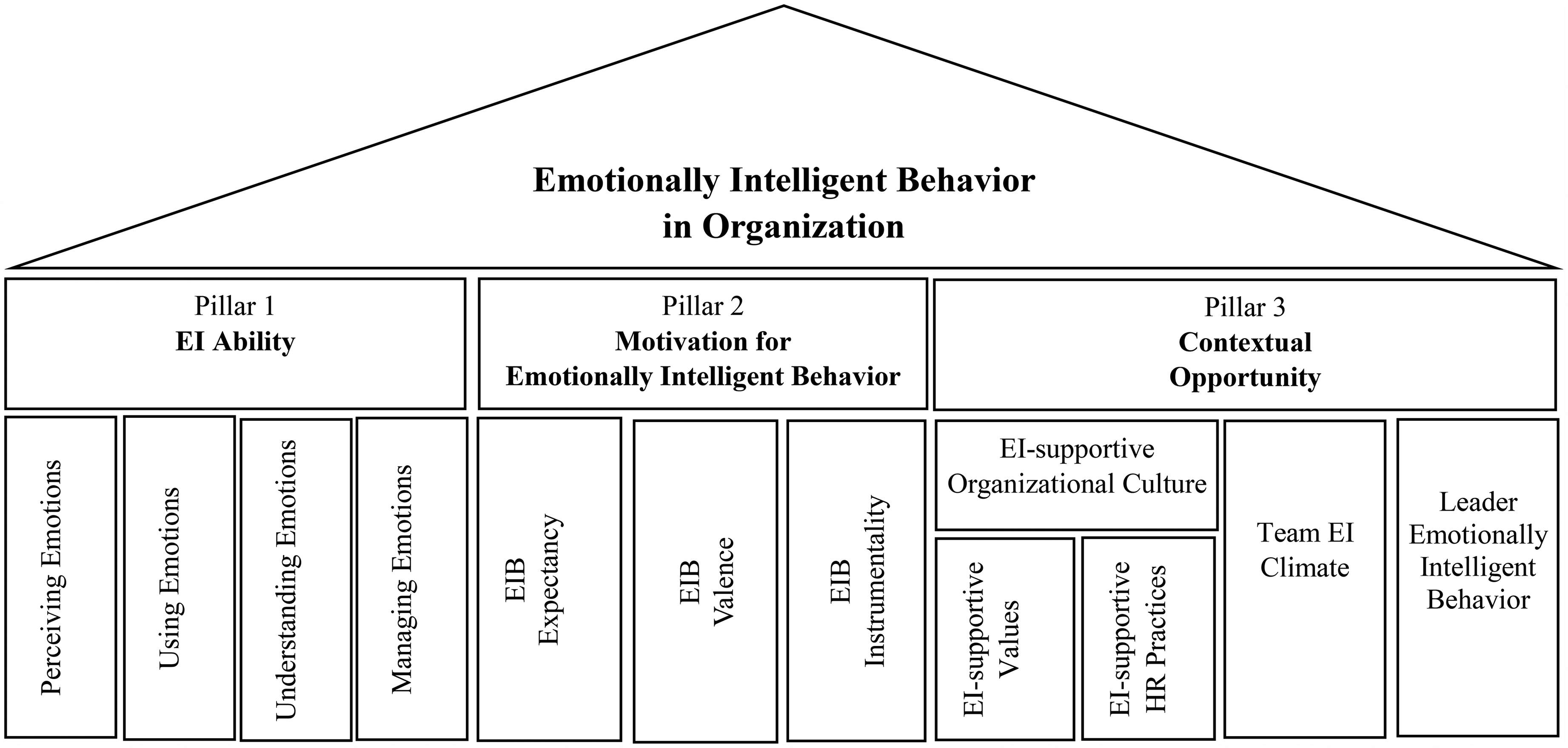
The ability–motivation–opportunity pillars of emotionally intelligent behavior in organizations.
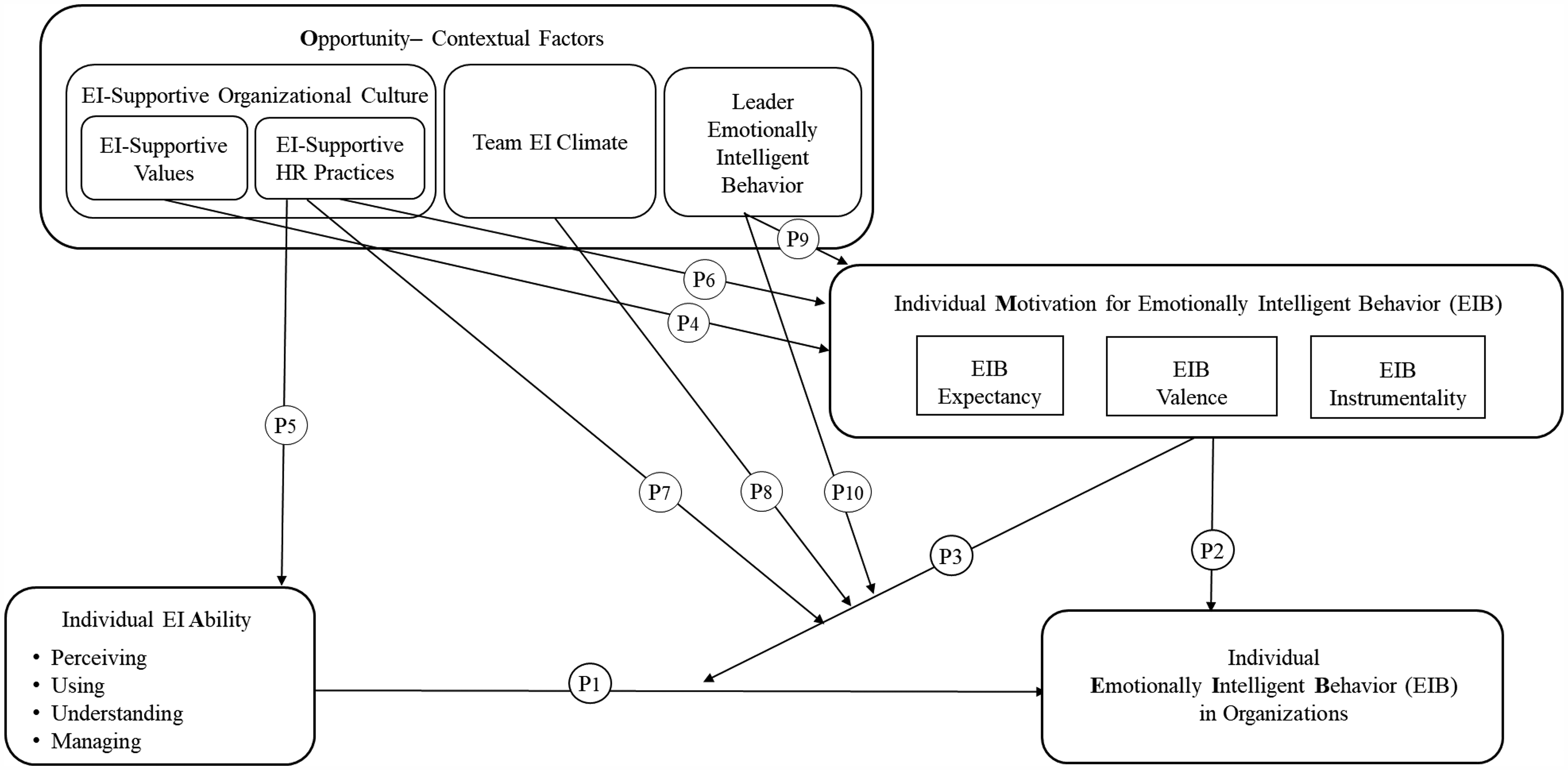
Proposed influences on emotionally intelligent behavior in organizations.
EI Ability and Motivation: Individual Potential for EIB
In this section, we define EI ability and motivation for EIB as individual attributes of potential for EIB. EI ability provides the know-how necessary for EIB and motivation creates reasons to enact behavior for which one is capable. Whereas the theory of EI has its origins in the ability model (and is backed by extensive research), motivation for EIB draws on distinct lines of work in the trait stream of EI research and emotion beliefs.
EI Ability
EI ability is the capacity to reason with and about emotions and includes four specific abilities (Mayer & Salovey, 1997; Mayer et al., 2016): (a) The ability to accurately perceive emotions in oneself and others (e.g., by interpreting facial expressions, body language, tone of voice); (b) The ability to use emotions to aid thinking and problem solving, such as when capitalizing on mood-congruent thinking; (c) The ability to understand typical causes and consequences of emotions, how emotions change over time, and how emotions blend to form complex experiences; and (d) The ability to regulate emotions—influencing the course of one's own and others’ emotions toward achieving goals, including well-being and performance goals. Top of form these abilities proceed hierarchically from simpler information processing (perceiving emotions) to complex strategic reasoning (understanding and regulating emotions; Joseph & Newman, 2010; Mayer et al., 2016). Furthermore, each EI ability delineates a set of skills that evolve developmentally, advancing from simpler to more complex tasks (Mayer et al., 2016). For example, perceiving emotions begins with the fundamental skill of identifying emotions in one's physical states, feelings, and thoughts and progresses to more nuanced tasks, such as discerning between authentic and deceptive expressions of emotion. Similarly, understanding emotions has a developmental progression from the ability to label basic emotions to complex tasks such as understanding how emotions transition from one to another (Mayer et al., 2016).
The ability model of EI draws on the social-functional theory of emotion, which posits that emotions play an essential role in coordinating social behavior (Elfenbein, 2022; Frijda & Mesquita, 1994), as well as the feelings-as-information (Schwarz, 1990, 2001, 2012) and mood-as-input models (Martin et al., 1993), which posit that emotions provide information relevant to evaluate internal and external events and that people attend to and use this information in directing their thinking and action. Importantly, it is possible that EI is used toward “dark” goals, such as manipulating others or advancing self-serving goals (Côté et al., 2011). However, a meta-analysis shows that EI is negatively related to manipulation-related traits (e.g., Machiavellianism; Miao et al., 2019), suggesting that the dark uses of EI are likely an exception, rather than a rule.
Ability EI is a maximal performance attribute. Accordingly, performance tests are used to measure it. EI ability tests such as the Mayer-Salovey-Caruso Emotional Intelligence Test (MSCEIT) pose problems requiring respondents to demonstrate understanding of the nature of different emotions and reasoning about different affective events in personal and work life, with performance evaluated against relatively objective criteria of correctness or response quality based on expert judgments (Mayer et al., 2012).
EI ability is considered to be relatively stable across time, similar to general cognitive ability (Mayer et al., 1999). Individual EI ability is expected to remain relatively constant as people move between different situations, jobs, and organizations, suggesting that it influences behavior with some consistency. Despite its stability, EI theory predicts that ability EI evolves with age and accumulation of life experiences (Mayer et al., 2016). While some studies provide evidence of a linear effect of age on EI ability (Extremera et al., 2006; Mayer et al., 1999), others have found an inverted-U curve pattern across the adult life span, indicating that EI ability increases to some extent with age, after which it plateaus and even declines (Cabello et al., 2016; Rivers et al., 2012).
Interindividual differences in EI ability have been extensively studied in relation to general cognitive ability, gender, and personality. Meta-analytic evidence indicates that cognitive ability is most closely associated with the understanding emotions ability (see Joseph & Newman, 2010). As for gender, women tend to score significantly higher than men on total ability EI, as well as on each of the four abilities (Brackett & Mayer, 2003; Day & Carroll, 2004; Extremera et al., 2006), with effect sizes ranging from small (Cabello et al., 2016; Fernández-Berrocal et al., 2014) to medium (Farrelly & Austin, 2007). Among the frequently studied Big Five personality traits, EI ability is positively related to openness, agreeableness, and conscientiousness (Brackett & Mayer, 2003; O'Boyle et al., 2011), and negatively with neuroticism (O'Boyle et al., 2011).
Accumulating empirical evidence shows that EI ability is a reliable predictor of work-related outcomes in three domains: performance, interpersonal effectiveness, and well-being. A positive relationship between EI ability and performance has been consistently found for a broad range of indicators—objective metrics (e.g., sales performance, salary, percent merit pay increase, company rank; Lopes et al., 2006), peer and supervisor ratings of performance, follower ratings of leader performance, and 360° ratings of performance (Lopes et al., 2006; meta-analysis: O'Boyle et al., 2011). The EI ability-performance associations remain significant after controlling for a host of relevant variables—age, gender, education, verbal ability, personality traits, and trait affect (Lopes et al., 2006; Mayer et al., 2008). Furthermore, EI ability moderates the relationship between cognitive intelligence and performance, such that high EI compensates for lower cognitive skills (Côté & Miners, 2006).
In the domain of interpersonal effectiveness, EI ability is positively associated with employees’ sociability and contribution to a harmonious work environment, as evaluated by both peers and supervisors. This relationship remains significant when controlling for verbal ability and personality traits (Lopes et al., 2006). Furthermore, EI ability is associated with leaders’ effectiveness in cultivating productive working relationships (Dabke, 2016), even after taking into account general intelligence and personality (Rosete & Ciarrochi, 2005).
Finally, EI ability is related to well-being. People with high EI ability report higher levels of psychological well-being (Brackett & Mayer, 2003; Brackett et al., 2006) and job satisfaction (meta-analysis: Miao et al., 2016). Conversely, EI ability is negatively associated with burnout (Brackett et al., 2010). Similar findings extend across different levels of analysis. Managers’ EI is positively associated with subordinates’ job satisfaction, even after controlling for leaders’ personality and cognitive ability, as well as subordinates’ EI (meta-analyses: Miao et al., 2016, 2018). Based on the above bodies of work, we propose: Proposition 1: EI ability has a positive influence on EIB.
Motivation for EIB
Motivation to engage in EIB has yet to be defined. We draw on Vroom's (1964; Vroom et al., 2015) valence-instrumentality-expectancy (VIE) model, which is commonly used to explain work motivation and its role in workplace behavior (Van Eerde & Thierry, 1996). According to the VIE model motivation is based on individual perceptions of the environment and the expectations derived from these perceptions (Fudge & Schlacter, 1999). Behavioral intentions are influenced by three subjective evaluations: (a) valence—personal importance and desirability of the behavior or performance, (b) instrumentality—probability of behavior to achieve desired outcomes, and (c) expectancy—likelihood of successfully enacting a behavior or reaching a certain performance level with effort. These evaluations interact to shape the motivational strength of particular goals and actions (Kanfer et al., 2017).
The VIE model aligns with the AMO framework in three ways. First, it builds on the assumptions that motivation, in conjunction with ability, shapes behavior. Second, it acknowledges that motivation is influenced by perceptions of the environment and the expectations derived from those perceptions, emphasizing the need to create an environment that fosters the desired behavior (i.e., opportunity). And third, it complements the AMO framework by describing specific components that create motivation. We, accordingly, posit that motivation for EIB stems from EIB expectancy, valence, and instrumentality.
Elements of Motivation: EIB Expectancy/Efficacy
Expectancy refers to self-perceptions that people can enact a certain behavior (Baumann & Bonner, 2017; Vroom, 1964). EIB expectancy is the belief that people can successfully behave in an emotionally intelligent manner, specifically perceive, use, understand, and regulate emotions effectively in everyday actions and interactions. Being a belief, EIB expectancy is a subjective perception of ability. Thus, it may not be an accurate indicator of the potential to reason about emotions and to solve emotion-related problems, but rather an over- or underestimation of EI ability (Brackett et al., 2006).
EIB expectancy has been examined in studies focusing on emotional self-efficacy in the trait approach to EI, which utilize self-report scales to assess perceived EI ability (O'Boyle et al., 2011; Wong & Law, 2002). Measures such as the Wong and Law Emotional Intelligence Scale (WLEIS; Wong & Law, 2002) and the Emotional Self-Efficacy Scale (ESES; Kirk et al., 2008) ask respondents to appraise their EI abilities (e.g., “I have a good understanding of my own emotions” in WLEIS; “Realize what causes another person to feel a negative emotion,” in ESES).
Self-efficacy is a significant predictor of domain-specific functioning in a variety of realms (Bandura, 1997). Emotional self-efficacy tends to be positively, yet modestly correlated with ability EI, pointing to the distinct nature of the two constructs (Brackett et al., 2006; Kirk et al., 2008). Similarly, Law et al. (2008) found that emotional self-efficacy and EI ability can be described by two separate factors and that emotional self-efficacy predicted positive mood beyond EI ability.
EIB expectancy can be conceptualized both as a (relatively) stable trait-like attribute and as a state-like one. Research on emotional self-efficacy has focused on asking about beliefs around emotion-related abilities in general (e.g., “I have a good sense of why I have certain feelings most of the time”; Wong & Law, 2002). However, in Bandura's (1997) social-cognitive theory, self-efficacy is explicitly defined as a dynamic attribute that should be assessed in relation to specific tasks and contexts or situations. In the realm of emotions, this situation-specific nature of expectancy can refer to either discrete emotions (e.g., anger vs. sadness, Rivers et al., 2007) or social contexts (e.g., interactions with teammates vs. leaders).
Interindividual differences in EIB expectancy have been linked to demographic variables, personality traits, and aspects of motivation. Adult groups have higher EIB expectancy than adolescents (Kong, 2017) and men report higher EIB expectancy than women (Kong & Zhao, 2013; Mikolajczak et al., 2007). Furthermore, EIB expectancy is positively related to extroversion, openness to experience, agreeableness, and conscientiousness, and negatively related to neuroticism (meta-analysis by O'Boyle et al., 2011). Because general self-efficacy has a top-down influence on specific self-efficacy beliefs (Miyoshi, 2012), we can expect general self-efficacy—the confidence in one's ability to effectively handle unfamiliar tasks and navigate through various challenging situations (Luszczynska et al., 2005)—to be a significant antecedent of EIB expectancy.
There is strong evidence that EIB expectancy is related to three groups of work outcomes: performance, interpersonal effectiveness, and well-being. Employees with high EIB expectancy deliver better service quality (Levitats & Vigoda-Gadot, 2017), receive higher ratings of performance from peers and supervisors (Wong & Law, 2002), exhibit positive outcomes in 360° performance evaluations, and attain higher objective performance (O'Boyle et al., 2011). Individual EIB expectancy predicts performance even when controlling for personality traits and cognitive ability (meta-analyses by Joseph & Newman, 2010; O'Boyle et al., 2011). Furthermore, managers’ EIB expectancy is positively associated with subordinates’ project success (Rezvani et al., 2016) and task performance (meta-analysis by Miao et al., 2018).
The benefits of EIB expectancy further extend to interpersonal effectiveness. Employees with high EIB expectancy engage in more organizational citizenship behavior (i.e., helping colleagues; Levitats et al., 2019) and foster higher-quality work relationships (Schröder-Abé & Schütz, 2011). Managers with higher EIB expectancy are perceived by their employees as more effective leaders, as evidenced by followers’ job satisfaction (Miao et al., 2016; Sy et al., 2006) and trust in managers (Rezvani et al., 2016).
EIB expectancy is also positively associated with subjective well-being (Sánchez-Álvarez et al., 2016), job satisfaction (meta-analyses: Miao et al., 2017a, 2017b), work engagement (Levitats et al., 2019), and organizational commitment (Levitats & Vigoda-Gadot, 2017; Miao et al., 2017b). Conversely, it is negatively related to mal-being indicators, such as burnout (Mérida-López & Extremera, 2017), turnover intentions (Nizielski et al., 2013), and job stress (Rey et al., 2016). Notably, EIB expectancy holds incremental validity in predicting job satisfaction, organizational commitment, and turnover intentions, beyond cognitive ability and personality traits (Miao et al., 2017b).
Elements of Motivation: EIB Valence/Intrinsic Value
Valence refers to attractiveness and desirability of behavior because it affirms a valued aspect of one's identity. Values have been long recognized to shape behavior and direct action toward goal attainment (Rokeach, 1973; Schwartz, 2016). Consistent with this perspective, we propose that EIB valence is the intrinsic motivation that inclines individuals to utilize EI abilities to guide their conduct and decision-making. Accordingly, individuals high in EIB valence may be expected to place high value on EIB.
Valence, much like EIB expectancy, can be described as having both trait-like and state-like aspects, and may vary both between individuals and across time and situations within individuals. Since EIB valence has not been previously studied, there is no prior evidence explicitly addressing individual differences in this aspect of motivation for EIB. Findings about its cousin—need for affect—offer clues into its importance. Need for affect is one's desire to approach emotion-inducing situations, and to experience and understand emotions (Maio & Esses, 2001). Individuals high in need for affect permit emotions to influence their perceptions, attitudes, and behavior (Conner et al., 2011; Zhang et al., 2021) and exhibit higher congruence between their affective evaluations of behaviors and their intentions to perform those behaviors (Appel et al., 2012). Likewise, we expect that those who have high EIB valence to be more likely to act in an emotionally intelligent manner.
Elements of Motivation: EIB Instrumentality
Instrumentality is the belief that engaging in a behavior will result in the successful attainment of desired outcomes or extrinsic rewards (Graen, 1969; Vroom, 1964). Once a behavior is assumed to promote desirable outcomes, motivation for that behavior increases, thereby enhancing the likelihood of exhibiting such behavior. Conversely, once a behavior is assumed to increase the chance of undesirable outcomes, motivation for that behavior decreases (Galbraith & Cummings, 1967; Haworth & Levy, 2001). We define EIB instrumentality as perceived effectiveness of EIB in achieving desired work goals. In organizational settings, these outcomes typically encompass both tangible and intangible rewards from various sources, including the organization (e.g., pay increases, promotions, bonuses), immediate supervisors (e.g., positive performance evaluations, mentorship, career growth opportunities), and peers (e.g., social recognition, assistance and support, collaboration). Because instrumentality is shaped by prior experience (Quratulain et al., 2021), individual differences in EIB instrumentality are likely to emerge even within the same organization, based on specific personal histories with EIB and its consequences (i.e., reward, disinterest, or discouragement of acknowledging emotions at work).
Although research to date has not explicitly examined the role of EIB instrumentality in behavior, there is evidence supporting the link between instrumentality for other kinds of work-related behavior and relevant outcomes, including job performance (e.g., Haworth & Levy, 2001; Quratulain et al., 2021), organizational citizenship behavior (Haworth & Levy, 2001), training implementation behavior (Quratulain et al., 2021), ethical behavior in teams (Dasborough et al., 2020), and ethical leadership (Osafo et al., 2021). This body of literature has consistently demonstrated that when individuals perceive a strong connection between their actions and the attainment of desired outcomes, they are more likely to engage in those behaviors. Thus, we posit that organizational members would be motivated to exhibit EIB in the workplace if they anticipate that such behavior will aid them in achieving outcomes to which they aspire, such as increased monetary compensation, recognition and praise, or opportunities for advancement. Based on the above, we propose: Proposition 2: Motivation for EIB has a positive influence on EIB.
The Role of EI Ability and Motivation for EIB in Predicting EIB
Theory, supported by empirical evidence, has long described behavior and performance at work as determined by a combination of ability and motivation (Campbell & Wiernik, 2015; Cascio & Aguinis, 2008; Dalal et al., 2014). Ability provides the means to successfully reason about problems and evaluate most effective courses of action (Blumberg & Pringle, 1982; Kim et al., 2015; Marin-Garcia & Tomas, 2016). And motivation, “an unobservable force that directs, energizes, and sustains behavior” (Diefendorff & Chandler, 2011, p. 66), guides decisions about whether to expend effort in performing a task or behavior, the level of that effort, and persistence of effort (Campbell, 1990).
The impact of ability and motivation on behavior is best described by a multiplicative model (Van Iddekinge et al., 2018), which posits that motivation moderates the relationship between ability and behavior. Relatively high levels of both ability and motivation are necessary for optimal performance (McCloy et al., 1994; Sackett et al., 1998; Vroom, 1964). Empirical evidence supports the multiplicative model of ability and motivation as they relate to EI-relevant outcomes. Rode et al. (2007) found that conscientiousness (a motivation-related trait) was significantly related to individual behavior (academic achievement and public-speaking effectiveness) and moderated the relationship between EI ability and performance. The relationship between EI ability and performance was stronger for high (vs. low) levels of conscientiousness. The authors concluded that individuals need to not only possess high EI ability, but also be driven to apply it. Côté (2007) similarly argued that high-performing groups are characterized by a combination of high EI ability and collective motivation.
EI ability is a necessary, but insufficient foundation of EIB (Cho et al., 2015; Lopes, 2016; Mayer et al., 2016; Mayer & Salovey, 1997). EI ability is a maximal performance attribute; it describes the best performance individuals can achieve when exerting their utmost effort, unaffected by other psychological and situational forces. In addition to ability, EIB is influenced by the motivation for such behavior. Furthermore, EI ability and motivation for EIB are not necessarily aligned. Empirical evidence shows that individuals may possess high EI ability, but under- or overestimate it (Brackett et al., 2006). In the case of underestimation, they will not be likely to choose to deploy the ability and in the case of overestimation, they might have an intention, but not know how to effectively apply it. Based on the foregoing bodies of work, we propose: Proposition 3: Motivation for EIB moderates the relationship between individual EI ability and EIB, such that EIB is most likely when both ability and motivation are high.
Opportunity for EIB: Contextual Supports or Constraints on Individual Behavior
Opportunity refers to contextual or environmental factors that either facilitate or hinder behavior (Demortier et al., 2014; Denison, 1996). According to the AMO model, for a behavior to occur, AMO must all be present to some extent (Blumberg & Pringle, 1982). The influence of ability and motivation in accruing certain behavior is contingent upon the extent to which contextual factors constrain or support such behavior (Boxall & Purcell, 2011; Lepak et al., 2006).
Contextual factors have been long recognized to shape members’ behavior via top-down mechanisms (Xu et al., 2019). Scholars have argued that EI ability explains outcomes when the organizational context supports its utilization, but not when such opportunities are lacking (Côté, 2014; Lievens & Chan, 2010). Drawing on the AMO model, we propose that contextual factors either facilitate or impede employee use of their EI ability and motivation to behave in an emotionally intelligent manner. In this section, we discuss three major EI-related contextual factors respectively at the macro -, meso-, and microlevels: EI-supportive organizational culture, team EI climate, and leader EIB. We propose that each factor moderates the mutual impact of organizational members’ EI ability and motivation for EIB on their EIB.
Organizational Culture
Organizational culture encompasses deep values and beliefs, as well as practices and procedures in an organization (Ployhart et al., 2014). Values are the invisible part of culture (Quinn & Rohrbaugh, 1983). They operate as general principles that an organization considers important for its aims which can guide members in their selection and evaluation of behavior (Bourne & Jenkins, 2013). An important way for values to become manifested is for them to be embedded in an organization's practices—tangible and observable behaviors and procedures that direct everyday behavior within the organization (Hofstede, 1998).
Elements of Culture: EI-Supportive Organizational Values
Values become integrated into organizations through top-down (i.e., adopting the vision and values of the company's CEO, executive board, etc.) and bottom-up mechanisms (dissemination of individual members’ personal values). These processes result in a significant alignment between organizational values and those of its members (De Cooman et al., 2009). The top-down influence of organizational values can be attributed to two primary mechanisms: (a) a socialization process where employees adopt the prevailing values of the organization, and (b) an attraction–selection–attrition process, where individuals decide to stay or leave the organization based on the degree to which they perceive the organization as aligned with their values.
Socialization is the process through which individuals acquire the attitudes, knowledge, and behaviors necessary to participate effectively in an organization (Harris et al., 2014). Newcomers learn about and internalize organizational norms and values, potentially adjusting their own values to align with those of the organization (De Cooman et al., 2009). Members are particularly inclined to internalize organizational values when they are communicated consistently and repeatedly through various channels (Killingsworth, 2012). The more consistent and widespread the messaging within an organization about the importance of EIB, the more likely it is that employees will internalize these values, perceive EIB as important (i.e., acquire intrinsic and instrumental value), and put them into action.
Another mechanism through which organizational values influence members’ values is by attracting, selecting, and retaining employees who hold a (relatively) similar set of values (George, 1990, 2002; Schneider, 1987). Individuals are attracted to organizations based on shared values and goals (self-selection); person-organization congruence is reinforced through the selection of candidates in hiring decision (employer selection); and ultimately, individuals who do not fit the organization end up leaving voluntarily or are asked to leave (attrition). The employees who remain typically exhibit alignment between their personal values and organizational values (Barrick & Parks-Leduc, 2019; De Cooman et al., 2009).
Once organizational culture supports EIB values, it signals the importance of emotions in everyday functioning and the value of perceiving, using, understanding, and regulating emotions at work. Due to processes of socialization and attraction–selection–attrition, individuals with high motivation for EIB will be attracted to and remain in organizations with EI-supportive values. EI-supportive organizational values will boost members’ motivation for EIB by positively influencing their EIB valence. Conversely, in organizations lacking or demonstrating little support for EIB, employee motivation for such behavior is likely to be diminished. Proposition 4a: EI-supportive organizational values positively influence motivation for EIB. Proposition 4b: EI-supportive organizational values most strongly influence the valence component of motivation for EIB.
Elements of Culture: EI-Supportive Organizational Practices
Organizational practices take many forms, including formal human resource (HR) practices, local management practices, and informal social practices (Rousseau & Greller, 1994). Of them, HR practices—recruitment and selection, orientation and onboarding, training, and performance management programs—have the most visible and far-reaching roles in creating and perpetuating organizational values (Chen & Huang, 2009; Kehoe & Wright, 2013). Furthermore, HR practices influence employee ability and motivation for specific behavior (Appelbaum et al., 2000; Lepak et al., 2006; Mcclean & Collins, 2019; meta-analysis by Subramony, 2009).
EI-supportive HR practices cover four key areas: recruitment and selection, performance management, compensation and rewards, and training and development (Levitats et al., 2022). Developmental HR practices like training, job enrichment, and coaching are often aimed at improving employee skills (Chuang et al., 2016; Gardner et al., 2011; Jiang et al., 2012). EI ability can be improved through targeted training interventions (Hodzic et al., 2018; Mattingly & Kraiger, 2019), suggesting that organizations can enhance EI abilities in employees. Additionally, organizations can strategically recruit and select for high EI abilities. This dual approach of selection and development can create a systematic pathway for HR practices to enhance members’ EI ability.
EI-supportive HR practices may additionally influence members’ motivation for EIB, particularly by enhancing EIB instrumentality. HR practices, such as pay for performance, developmental performance management, rewards and incentives, and job security, enhance employee extrinsic motivation to engage in organizationally valued behavior (Appelbaum et al., 2000). When organizations implement HR practices with explicit recognition of EIB through performance-based compensation, developmental performance management systems, and strategic reward structures, they create clear instrumental links between EIB and valued outcomes. As organizational members observe EIB being rewarded through tangible incentives (e.g., promotions, financial rewards) and intangible benefits (e.g., flexible work arrangements, growth opportunities), they are likely to develop stronger perceptions of EIB instrumentality, enhancing their motivation for such behavior.
Preliminary support for the above arguments comes from a recent study examining the relationship between EI-supportive organizational culture and EIB at work (Levitats et al., 2022). The results showed that EI-supportive HR practices were positively associated with supervisor EIB, whereas values reflecting low regard for emotions predicted supervisor emotional misbehavior, manifested in emotional harshness and poor emotional regulation. Proposition 5: EI-supportive HR practices positively influence EI ability. Proposition 6: EI-supportive HR practices positively influence the instrumentality component of motivation for EIB.
In addition to the direct effects of EI-supportive HR practices on employee EI ability and motivation for EIB, we draw on the theoretical reasoning of the AMO framework to posit a three-way interaction between EI-supportive organizational culture, individual EI ability and motivation for EIB. We propose that: Proposition 7: EI-supportive organizational culture moderates the influence of motivation for EIB on the relationship between EI ability and EIB. Specifically, when EI-supportive culture is strong, motivation for EIB will more strongly influence the relationship between EI ability and EIB than when EI-supportive culture is weak.
Team EI Climate
Team climate, and its underlying norms, shapes members’ behavior (Xu et al., 2019). Drawing on the ability model of EI, we propose that team EI climate creates the conditions that enable and support expression of individual potential for EIB by setting norms about: (a) Perceiving emotions—expectations that employees’ emotions will be noticed and acknowledged by others, including supervisors and leaders; (b) Using emotions—drawing on emotions to motivate each other and ensuring that decisions take into account both positive and negative feelings (e.g., satisfaction and disappointment); (c) Understanding emotions—expectations that attention will be paid to how decisions and events influence emotions; and (d) Managing emotions—expectations that team members will create a buffer between emotion-eliciting events and habitual reactions, expressing emotions in a manner that takes into account both one's reputation and the effectiveness of the reaction.
Ayoko et al. (2008) defined team EI climate as composed of team empathic concern (attention to and understanding of others’ feelings), emotion management skills, and team conflict management norms. Teams with poor EI climates showed increased task and relationship conflict and increased conflict intensity. Moreover, the relationship between task conflict and destructive responses to conflict was moderated by team EI climate, especially conflict management norms, such that teams with fewer conflict management norms experienced more destructive reactions to conflict. This evidence supports the established notion that team norms about the appropriateness of expressing emotions at work shape team members’ expression of emotions (Barsade & Gibson, 2007) via an emotion contagion process (Elfenbein et al., 2007).
Hence, we propose the following: Proposition 8: Team EI climate moderates the influence of motivation for EIB on the relationship between EI ability and EIB. When team EI climate is strong, motivation for EIB will more strongly influence the relationship between EI ability and EIB than when team EI climate is weak.
Leader Emotionally Intelligent Behavior
The leadership literature has consistently offered empirical evidence indicating that team leaders significantly impact members’ behavior and performance (see meta-analysis by Burke et al., 2006). This influence is frequently attributed to leaders’ impact on members’ emotion (McColl-Kennedy & Anderson, 2002; Pirola-Merlo et al., 2002), with scholars proposing that leader EI is a key element of effective leadership (e.g., Ashkanasy, 2003; Ashkanasy & Ashton-James, 2005; Ashkanasy & Dorris, 2017; Daus et al., 2012).
We propose that leader EIB can boost employee motivation for EIB and facilitate its positive influence on the relationship between their EI ability and EIB. Leader EIB augments follower EI-expectancy through four social learning mechanisms: vicarious experience, verbal persuasion, enactive mastery, and affective arousal (Bandura, 1997). Followers who observe their leaders modeling EIB engage in vicarious learning which strengthens their own confidence about being able to exhibit such behavior. This observational learning process is particularly impactful when the models are perceived as having high status and competence (Weiss, 1977).
Leaders who show EIB convey positive emotions to followers and express their belief in employee abilities (George, 2000), which is a form of confidence-boosting verbal persuasion (Eden & Ravid, 1982). Although the direct impact of leader EIB on follower EIB has not been examined, there is evidence showing a connection between supervisor EIB and the affective and behavioral outcomes for employees. Ivcevic et al. (2021) found that employees who described their supervisors as exhibiting high EIB—noticing and acknowledging staff emotions, understanding the impact of decisions on employees, and assisting in managing emotions during challenging situations—reported greater growth opportunities, more positive emotions, and higher creativity and innovation at work.
Because leaders have a prominent role in shaping organizational culture and articulating organizational values (Miao et al., 2016), as well as in setting team EI climate (George, 2000; Taggar & Ellis, 2007), they will influence employee EIB valence. Employees perceive leaders as an embodiment of organizational values (Van Knippenberg & Hogg, 2003), and may therefore be especially influenced by their actions. Middle managers (e.g., team or unit leaders) exert a significant influence over team climate and behavior of team members, through norms reflected in their decision-making behavior and in their interactions with team members (Härtel & Ganegoda, 2008).
Leaders who act in emotionally intelligent ways can also enhance employee EIB instrumentality by extending acknowledgement and rewards for EIB beyond those provided by HR practices to incentivize employees. This may include offering verbal recognition and praise for instances of EIB during team meetings or individual performance reviews. Additionally, they may provide opportunities for skill development and advancement to employees who consistently demonstrate EIB in their interactions with colleagues, clients, or customers. In addition to the direct impact of leader EIB on employee motivation, we draw on the theoretical reasoning of the AMO framework to argue for a three-way interaction of leader EIB, employee motivation and EI ability in influencing employee EIB. Thus, we propose as follows: Proposition 9: Leader EIB positively influences motivation for EIB. Proposition 10: Leader EIB moderates the positive influence of employee motivation for EIB on the relationship between their EI ability and EIB. When leaders act in emotionally intelligent ways, motivation for EIB will more strongly influence the relationship between EI ability and EIB than when leaders do not act in emotionally intelligent ways.
Directions for Future Research
The theoretical model presented in this article applies the AMO framework (Boxall & Purcell, 2011) to the study of EI in organizations and delineates the individual and contextual building blocks of EIB in organizations. In order to test the central tenets of the proposed theoretical model, new empirical work is required along three key research lines. The first line could examine how the three elements of motivation for EIB develop and interact with EI ability in accruing individual-level EIB. The second line could examine how individual EI ability and motivation combine to create EIB at dyadic, team, and organizational levels and how EIB can be built and spread in organizations. And the third line could examine top-down processes by which EI-related organizational factors shape behavior both by directly influencing individual EI ability and motivation, and by moderating how they affect employee EIB. Together, these lines of research could advance a multilevel understanding of emotions in organizations (Ashkanasy, 2003; Ashkanasy & Ashton-James, 2005; Ashkanasy & Dorris, 2017).
Motivation-Ability Dynamics in EIB
We propose that EI ability is necessary, but not sufficient for EIB; beyond EI ability, EIB is influenced by EIB expectancy (i.e., emotional self-efficacy) and intrinsic and extrinsic motivation for such behavior. While prior evidence supports the distinct nature of EI ability and emotional self-efficacy, as well as their unique contribution to emotional functioning (Kirk et al., 2008; Law et al., 2008), scholars also might examine their impact on the proximal outcome of EIB.
Another research direction at the individual level concerns understanding of motivation for EIB. Despite extensive meta-analytic evidence on the relationship between EI efficacy and work outcomes (Joseph & Newman, 2010; Miao et al., 2017a, 2017b, 2018; O'Boyle et al., 2011), we know little about how it develops. Kanfer's (1992; Kanfer et al., 2017) distal-proximal model provides a framework for the causal ordering of motivation constructs based on their proximity to behavior. It describes that trait-based variables provide foundational influences (although they do not necessarily mobilize effort or direct behavior), whereas more proximal factors influence intentions and behavioral choices. Supporting this framework, research shows that trait-like variables (e.g., general self-efficacy and cognitive ability) affect performance through state-like motivational mediators, such as self-efficacy for a specific behavior (Chen et al., 2000; Judge & Ilies, 2002; Van Iddekinge et al., 2018). Similar research is needed to examine how distal traits shape the development of EI efficacy and its subsequent influence on EIB.
Beyond EIB expectancy, our model identifies valence and instrumentality as components of motivation for EIB. Although valence and instrumentality are well-established motivational constructs in other domains (see Eccles & Wigfield, 2020; Kanfer et al., 2017), they have not been examined in the context of EIB. Research on emotion beliefs has shown that perceptions of emotion utility influence regulation strategies and behavior, with individuals viewing emotions as helpful employing more adaptive strategies than those viewing emotions as harmful (Becerra et al., 2024; Karnaze & Levine, 2018, 2020; Tamir et al., 2015; Tamir & Gutentag, 2017). Future research could explicitly assess all components of motivation for EIB and test direct and moderating paths from motivation and ability to behavior.
Complementing psychometric approaches, experimental studies can manipulate different components of motivation for EIB. For instance, EI efficacy can be manipulated by mock test performance feedback and EIB instrumentality by providing participants with descriptions of benefits of EIB for career outcomes (e.g., performance appraisals, promotions). Such studies could help establish what external incentives enhance individual motivation to engage in EIB.
Building and Spreading EIB in Organizations
Another line of research could examine how individual-level EIB translates to group-level attributes that enable dyads, teams, and organizations to function in emotionally intelligent ways. Côté (2007) proposed that this question can be addressed by applying Steiner's (1972) typology of group tasks to EI in organizations. Previous research has addressed how EI ability and efficacy on the individual level translate to group-level outcomes. For instance, at the dyadic level, relationship quality depends on maximal EI ability (Brackett et al., 2005), with one member's high EI ability being sufficient for effective emotion coregulation (Fernández-Berrocal et al., 2014), though both parties need some degree of motivation for EIB. At the team level, average EI ability correlates with group achievement and retention (Elfenbein, 2005), whereas high average EIB expectancy promotes superior performance, innovation, and cohesion (Jordan et al., 2002, 2006; Lee & Wong, 2019). However, despite these insights about EI ability and efficacy, additional research is needed to better understand how individual behavior, assessed through observations and informant-reports, translates to group behavior and how such behavior predicts downstream outcomes. Collectively, this research will be able to address the broader question whether EI can be considered a group attribute (as suggested by Giorgi, 2013; Menges, 2012; Menges & Bruch, 2009).
Future studies should also examine processes by which EIB develops and spreads through organizations. Although meta-analyses demonstrate the effectiveness of EI training programs at the individual level (Hodzic et al., 2018; Mattingly & Kraiger, 2019), more research is necessary to determine how these individually acquired capabilities propagate through teams. Specifically, there is a need to investigate whether and how individual learning impacts the skill development and/or motivation of team members who have not undergone training. Understanding these dynamics of knowledge transfer and skill diffusion within teams is crucial for evaluating the overall effectiveness and sustainability of EI training initiatives in organizational contexts.
Organizational Influences on EIB
Another major line of research could investigate the interplay between contextual and individual elements in shaping member EIB. Drawing on organizational socialization theory (Nohria & Ghoshal, 1994), we can hypothesize that organizational values influence members’ motivation for EIB through value internalization. Scholars could assess shared values (Bourne & Jenkins, 2013; Gopinath et al., 2018) through surveys assessing commonly held beliefs about EIB, rather than relying on formal value statements or leadership declarations.
Furthermore, we argue that HR practices should be studied to map which ones discourage EIB and which promote EIB. Building on Levitats et al.’s (2022) findings linking EI-supportive HR practices to supervisor EIB and employee work outcomes, longitudinal research should track how such practices shape employee EI ability and motivation over time. This research could guide organizations in developing targeted initiatives that reinforce EIB, such as workshops and individualized development plans for managers and employees, assessing candidates’ EI ability and motivation, and setting EIB-related objectives as criteria for performance assessments and promotion.
We hypothesized that team EI climate moderates the relationship between individual attributes (ability and motivation) and EIB. Testing this hypothesis could show whether a strong team EI climate amplifies the positive effects of individual EI ability and motivation on EIB, or potentially compensates for individual deficits in these components, thereby providing alternative pathways to EIB. Additionally, research could investigate whether team EI climate and organizational culture independently influence individual behavior. Specifically, studies could examine if a strong team EI climate can help protect against the harmful effects of working in an organization that doesn't value or support EIB, helping explain why teams within the same organization exhibit different behavioral patterns (see Ayoko et al., 2008).
Finally, future research could examine how leader EIB influences employee EIB. Research on the role of leaders in shaping follower behavior (Burke et al., 2006) suggests that when leaders model EIB, employees will be more likely to utilize their potential for EIB (based in ability and motivation). Leaders can signal that EIB is not only acceptable, but valued, and can provide both implicit and explicit permission to employees to act in emotionally intelligent ways. Additionally, studies can address whether leader EIB may compensate for deficits in employee EI-related attributes.
Although this paper focuses on individual and organizational factors, we acknowledge the significant impact of local and national culture on emotional behavior (Vitolla et al., 2019). Cross-cultural studies comparing Western and Eastern cultures reveal fundamental differences in how emotions are experienced and expressed (Turner & Stets, 2005). Given that organizational cultures often mirror broader societal values (House et al., 2004), future research should investigate how national cultural values (e.g., affective autonomy, egalitarian commitment, and harmony values; see Ashkanasy et al., 2000; Sagiv & Schwartz, 2022) shape both individual motivation for EIB and EI-supportive organizational culture.
Conclusion
This paper advances our understanding of EIB in organizations through three key contributions. First, by proposing a comprehensive model that draws on the AMO) framework (Boxall & Purcell, 2011), we provide a framework for explaining how EIB emerges in organizational settings. The proposed model moves beyond existing streams of EI research by describing EIB as resulting from individual factors of ability and motivation, as well as contextual factors of organizational culture, team climate, and leader behavior that either support or constrain individual action.
Second, we advance the ongoing debates about different streams in EI research by distinguishing between individual potential for EIB and actual behavior and by proposing that EI-related variables studied in different research streams independently and jointly contribute to behavior and have distinct relationships with relevant contextual variables. We propose that EI efficacy is a component of motivation for EIB and that future research should be extended to also include valence and instrumentality components for a comprehensive picture of individual motivation for EIB.
Third, our model acknowledges the multilevel nature of emotional processes in organizations and provides a roadmap to examine individual-level processes and top-down contextual processes (how EI-supportive organizational culture, team climate, and leader behavior shape individual EIB). This agenda spans three key research lines: individual-level processes focusing on ability-motivation interactions, bottom-up emergence of emotional behavior across organizational levels, and institutional factors creating opportunities and constraints. Research on these proposed relationships would provide practical insights for organizations seeking to cultivate EIB across organizational levels. We hope this theoretical framework will stimulate new research directions in the study of EI in organizations, while offering guidance for practitioners working to develop more emotionally intelligent workplaces.
Footnotes
Authors’ Note
Work on this article was supported by a gift to the Yale Center for Emotional Intelligence by The Faas Foundation (Emotion Revolution in the Workplace project).
Declaration of Conflicting Interests
The authors declared no potential conflicts of interest with respect to the research, authorship, and/or publication of this article.
Funding
The authors received no financial support for the research, authorship, and/or publication of this article.
