




Abstract
The enjoyment and pleasure derived from sad music has sparked fascination among researchers due to its seemingly paradoxical nature in producing positive affect. Research is yet to develop a comprehensive understanding of this “paradox.” Contradictory findings have resulted in a great variability within the literature, meaning results and interpretations can be difficult to derive. Consequently, this review collated the current literature, seeking to utilize the variability in the findings to propose a model of differential sad states, providing a means for past and future findings to be interpreted. The proposed model is based on theoretical understanding, as such it requires full empirical support. Comparisons to alternative models, theoretical, clinical, and cognitive implications, as well as future directions are discussed.
Introduction
“Music can lift us out of depression or move us to tears – it is a remedy, a tonic, orange juice for the ear.” - Oliver Sacks (deceased), professor of neurology in School of Medicine, at New York University.
Paradoxical in nature, the enjoyment of negative emotions has long been a topic of debate. While it is simplest to assume that negative emotions are only implicated in negative experiences, psychological research has demonstrated that negative emotion is implicated in positive and pleasurable experiences. Many aspects of society channel negative emotion to induce enjoyment, with sad music becoming an intriguing area of research, as many individuals can achieve enjoyment from experiencing negative emotions in sad music (Garrido & Schubert, 2011). Particularly evoking sad music can strongly influence certain individuals, such as those with high empathy (Eerola et al., 2016; Huron & Vuoskoski, 2020). However, research suggests a difference between the emotion that music expresses and induces (Gabrielsson, 2001), with sad music being found to induce negative (Garrido & Schubert, 2013) and positive experiences, such as pleasure (Sachs et al., 2015). The nature of sad music and its ability to produce positive affects in individuals has sparked philosophical discussions (Hindemith, 1961) and is still explored now through psychological research. The nature of and interaction between sad music and sad mood is unique among other emotions (Sizer, 2019), thus the complexity and importance of this topic warrants greater investigation.
Philosophical discussions of sad music focus on whether true sadness is experienced in response to sad stimuli. Two philosophical camps are considered: the “cognitivists” and the “emotivists.” “Cognitivists” claim that sad music would not elicit real emotion due to a lack of real-life consequences (Kivy, 1991), while “emotivists” believed that music-induced sadness was genuine sadness (Levinson, 1990)—perhaps an adaptive strategy for experiencing catharsis, understanding feelings, and emotional assurance, an idea supported by the presence of physiological responses to sad music (Garrido, 2017). While considering this as a discussion of absolutes may oversimplify a complex issue, it suggests that sad music is a deeply affective tool. Though these philosophical arguments may be reductionist, they may act as a framework to explore sadness, as we contemplate the possibility of varied, differential existences of “sadness.”
A common division utilized within music research is the separation of the emotion expressed by music and the emotion induced (Evans & Schubert, 2008; Juslin & Sloboda, 2001). Some research has suggested that emotions induced from music listening are congruent with emotions expressed by the music, as rated by musical features (i.e., sad music was given a slower tempo), and by participant ratings (Hunter et al., 2010; Lundqvist et al., 2009; Song et al., 2013). However, other research reported discrepancies between expressed and induced sadness (Hunter et al., 2010; Kawakami et al., 2013; Schubert, 2016). It has been suggested that sad music does not elicit basic emotions, such as sadness, but creates feelings of “being moved” (Vuoskoski & Eerola, 2017) and “aesthetic awe” (Konečni et al., 2008). Non-genuine sadness may be experienced because the emotions experienced from music are vicarious and non-threatening (Kawakami et al., 2014). This supports cognitivist beliefs that music does not induce “real” emotion, as the sadness from listening to music is lacking real-life consequences. Alternatively, sadness may require context, and thus relevance to the listener is key for emotion to be induced (Schubert, 2016; Vuoskoski & Eerola, 2012, 2015).
With this debate in mind, researchers sought to elucidate the outcomes of listening to sad music. Typically, individuals seek positive affect when experiencing negative affect (Weth et al., 2013), yet many seek sad music when low in mood (van den Tol, 2016), potentially paired with adaptive behaviors to achieve positive outcomes and mood enhancement (van den Tol, 2016). However, maladaptive tendencies in individuals listening to sad music, such as rumination, are associated with maintaining negative mood and emotions (Schubert et al., 2018) and are more evident in sadder individuals and those experiencing major depressive disorder (MDD; Garrido et al., 2017; van den Tol, 2016). Sad music can intensify negative emotion perception (Baranowski & Hecht, 2017; Lawrie et al., 2019), meaning a desire to listen to sad music may produce increased perception of negative stimuli, representing a cycle where sad individuals listen to sad music, thus perceiving more sadness in subsequent events/stimuli. There currently lacks a comprehensive understanding of why sadness associated with music can attenuate both positive and negative moods (Campbell et al., 2020). Additionally, individuals have different preferences, with some favoring music associated with sadness (Eerola & Peltola, 2016), while others exhibit different adaptive and maladaptive behaviors in response to sad music (Garrido & Schubert, 2013). As such, it is difficult to comprehensively understand the varying outcomes of listening to sad music.
Over time, the literature has shifted toward understanding multiple sad states—enabling the interpretation of sad emotion more formulaically, reducing the variability within the literature. For instance, Taruffi and Koelsch (2014) suggested that nostalgia was more commonly experienced, rather than the overarching category of “sadness.” However, a comprehensive breakdown of states is far from agreed upon. Peltola and Eerola (2016), for instance, observed via three large samples that nostalgia was not the primary label encompassing sad experiences related to music. They broke sadness down into three categories: grief, melancholia, and sweet sorrow through exploratory and confirmatory factor analyses. These states were largely negative experiences for participants. However, sweet sorrow was a positive experience. These states indicate a proposed structure for music-induced sadness, and the separation of grief and melancholia has been further supported (Warrenburg, 2020). Eerola and Peltola (2016) expanded upon this initial structure of sadness, identifying three emotion categories to further explore the effects of sad music listening: sublime, comforting, and grief-stricken sorrow. These studies provide a range of differential sad states but do not propose an integrated model through which the sad states can be explored. Developing this understanding into a more comprehensive model of music-induced sadness will help to elucidate the variability in the literature of sad music. Warrenburg (2020) claimed that further classification of music-induced sad states is required, even considering an infinite spectrum of states. While this is not yet possible, there is an abundance of literature alluding to a range of emotions regarding sad music. The more of these that can be identified and understood, the greater the understanding of sad music and its effects will be.
With these categorizations in mind, the aims of this review are:
Using existing literature, we will provide theoretical support for the current classification of music-induced sad states. We will devise further classification of music-induced sad states, using existing literature to evidence the need for further classification. We will present the overall classification in an integrated model, with dimensions of valence, arousal, and psychological affect, accompanied by a hierarchal decision tree portraying context and personal meaning dependence of the proposed states. We will review the theoretical, cognitive, and clinical implications of a new classification of sadness, as well as considering future directions for studies to not only support this classification, but of ways to build upon and develop this classification.
Current Classifications
While others’ approaches have consisted of exploring how exactly sad music induces emotion by identifying underlying mechanisms (Juslin & Västfjäll, 2008), the approach taken here differs. As opposed to having a sole focus on the mechanisms underlying emotions being induced, it is the goal hereby to identify the differences that such mechanisms have on emotion induction. Specifically, it is the aim to understand how a different amalgamation of underlying mechanisms—in this case consisting of valence, arousal, context, processing depth and personal meaning—contribute to a range of differential sad states, all differing in their characteristics and impact they have on individuals.
To classify the sad states exhibited, 90 studies within the extant literature were analyzed. Subsequently, the type of sadness exhibited within each study was classified into different states (see Appendix 1). Within previous classifications, discussed above, some overlap exists between the suggested states (Eerola & Peltola, 2016; Peltola & Eerola, 2016). Grief-stricken sorrow was likened to grief; thus, one is redundant. Similarly, though three “sorrow” states were identified, due to differing definitions it remains possible to classify these separately without overlap. Thus, current classifications indicate five music-induced sad states: grief, melancholia, sweet sorrow, comforting sorrow, and sublime sorrow. These will be discussed below with respect to existing literature that retroactively supports the inclusion of these states into our model.
Grief
Grief was characterized as a high arousal and negative valence emotion, associated with loss and negative outcomes (Warrenburg, 2020). Despite this, there is a subcategory of grief (cathartic grief) that may result in feelings of relief. These emotions are linked to extreme physiological reactions such as: crying, erratic breathing, and increased heart rate (Frick, 1985; Urban, 1988). Associated with extremely sad events, grief is a music-induced sad state resulting from memory triggers from sad events and is implicated in negative outcomes for listeners. Individuals experiencing interpersonal loss prefer mood-congruent music, indicating that when in grief, individuals seek music that is congruent with this feeling (DeMarco et al., 2015; Lee et al., 2013). Additionally, grief is associated with increases in epinephrine, cortisol, and prolactin (Warrenburg, 2020). Huron (2011) put forward a conjecture that sad music could increase levels of the hormone prolactin, which are typically low in those with MDD. Huron described this as a homeostatic function and believed that prolactin resulted in a consoling psychological effect. However, Warrenburg (2020) stated that higher levels of prolactin indicate grief. Thus, if sad music is capable of increasing levels of prolactin, this may be by inducing a state of grief. The consoling psychological effect cited by Huron may be present in some, fitting into the “cathartic” grief category (Peltola & Eerola, 2016). However, Ladinig et al. (2019) did not find congruent results regarding the prolactin-based theory. As such, prolactin may not be a reliable indicator of grief. This said, the separation of grief as its own state was well supported by various research. Research has shown that valence and arousal for grief differed from other affective states (Peltola & Eerola, 2016), while other research utilized musical passages that reflected grief and found that participants perceived more grief within these passages compared to other passages designed to reflect melancholia (Warrenburg, 2020).
Melancholia
Melancholia is also a negative valence emotion but, dissimilarly to grief, has low arousal (Warrenburg, 2020). It is associated with rumination and indicative of maladaptive music-use. Thus, for melancholia, research indicating sad music resulting in negative mood will be considered. While grief is likely a product of sad events and may therefore be less in one's control, melancholia may be indicative of maladaptive behaviors, such as seeking out sad affect. For example, MDD and certain personality traits, such as high levels of acceptance or low extraversion, contribute to enjoying music that increases feelings of sadness (Ladinig & Schellenberg, 2012; Martin et al., 1993). Consequently, the desire to feel sadness, to ruminate, or to focus on the negative things in your life—as in line with the self-pity subcategorization of melancholia (Peltola & Eerola, 2016)—supports the classification of this music-induced sad state. Research suggested participants listen to sad music when feeling sad, then perceive more sadness in subsequent stimuli (Hunter et al., 2011), highlighting the maladaptive nature of seeking out sad affect as it influences subsequent perceptions to be negatively framed. Research also suggests that those who feel sadder and are more depressed were more likely to show a preference for sad music (Hogue et al., 2016; Xue et al., 2018) and that higher rumination predicts sad music preference (Chen et al., 2007; Garrido & Schubert, 2015b; Sachs, Damasio, et al., 2020). Paired with findings from Garrido et al. (2017), who identified that those with MDD were more likely to ruminate, this highlights the maladaptive tendencies which are symptomatic of Peltola and Eerola's (2016) melancholia.
However, Hogue et al. (2016) noted that sad states were accompanied by emotional potency: a psychological “reward” in which the matching of mood between listener and song allows listeners to experience genuine emotion, in alignment with emotivist's arguments (Levinson, 1990). Though this may be considered a reward, there are two caveats noted. Firstly, the intensifying of emotions experienced because of this “reward” may not always be positive. For example, ruminators, who are linked with maladaptive behaviors and sad music, exhibit increasingly negative sad responses from sad music over time (Garrido et al., 2016). Secondly, Hogue et al. (2016) highlighted that this was concluded via self-report measures, which may not perfectly reflect reality, and that there may be a difference between participant's perceptions and their actual responses concerning their liking of sad music. While individuals may believe, and thus self-report, that they benefit from sad music, research has shown that greater rumination predicts greater liking of sad music (Schubert et al., 2018). Rumination can amplify negative affect and thus this fits the melancholic state. Additionally, self-report findings revealed that younger people report preferring sad music and that it makes them sadder (ter Bogt et al., 2019). Such findings highlight conscious awareness of using sad music for maladaptive behaviors and may support the separation of this music-induced sad state. While grief is typically caused by low mood or sad events, melancholia represents a state in which individuals maladaptively seek sad affect.
Sweet Sorrow
Sweet sorrow, associated with positive psychological outcomes, was centered around self-reflection, and adaptive coping mechanisms. Adaptive coping mechanisms, such as solace, validation, and reflection were found to be helpful when experiencing negative life events (Hanser et al., 2016; van den Tol et al., 2016). Whereas other “sorrow” states consist of true expressions of positivity such as “joy” or “elation” (Eerola & Peltola, 2016), sweet sorrow instead is more focused on reducing sadness by coping with negative events. This may suggest that sweet sorrow is the lesser of the three sorrow states in valence, while the thoughtful nature of regulating and processing one's emotions might reflect a low arousal. Further, adaptive uses of sad music, possibly utilized in the sweet sorrow state, consist of cognitive and social strategies for mood enhancement in the domains of (re-)experiencing affect, retrieving memories, and mood enhancement (van den Tol & Edwards, 2013). Moreover, high absorption levels, which predict an individual's tendencies to be deeply impacted by music (Sandstrom & Russo, 2013; Wild et al., 1995), also predict sad music-liking due to its ability to regulate and enhance positive emotions (Sachs, Damasio, et al., 2020b), a trend that is possibly more present among those experiencing deeper sadness (Matsumoto, 2002).
Another example of the adaptive behaviors indicative of sweet sorrow was evidenced in a neuroimaging study. Oetken et al. (2017) identified that participants induced into sad moods via sad music subsequently assigned themselves fewer negative characteristics (compared to other mood states) in what was described as a compensatory mechanism to maintain a positive self-image, despite their sad mood. This claim was supported by limbic and fronto-temporal cortex activation, identified by using functional magnetic resonance imaging (fMRI), as these regions are implicated in the process of positive self-evaluation (Öngür & Price, 2000; Pauly et al., 2013). This could reflect sad music's adaptive capabilities, via compensatory mechanisms, resulting in improved mood.
Comforting Sorrow
Comforting sorrow was described as a positive valence music-induced sad state. Individuals experiencing comforting sorrow are thought to feel “sad but elated,” experiencing feelings of comfort, tenderness, and peacefulness (Eerola & Peltola, 2016), suggesting it to be a low arousal state. Aspects of this description devised by Eerola and Peltola (2016), have been found in previous literature, such as sad music producing feelings of comfort (Hanser et al., 2016) and peacefulness (Vuoskoski et al., 2012). Evidence of this comforting effect can be seen in the ability of sad music (rated by observers) to reduce state anxiety in individuals (Biller et al., 1974). Another aspect of comforting sorrow is memory, with this contributing to the highly pleasurable experience of listening to sad music and positive outcomes associated with this state (Eerola & Peltola, 2016). Literature also highlighted sad music's role in producing feelings of nostalgia (Mori & Iwanaga, 2017; Weth et al., 2015), highlighting an interconnectedness between sad music and memories. Mori and Iwanaga (2017) investigated the phenomenon labeled “Tears” (weeping, lump in the throat), a peak psychological response to sad music involving pleasure from sadness, thought to be psycho-physiologically calming. Experiencing “tears” seems to be in line with this music-induced sad state, as it produces both calm/comforting effects while producing happiness from sadness.
Sublime Sorrow
Sublime sorrow was described as the most positive valence state and involves positive feelings and outcomes. Described as being accompanied by feelings of transcendence, wonder, satisfaction, joy, and pleasant melancholia (Eerola & Peltola, 2016), sublime sorrow encapsulates an intriguing aspect of sad music. Existing literature has generally supported the idea of achieving multifaceted, pleasurable experiences from listening to sad music (Taruffi & Koelsch, 2014), and has previously used terms such as “wonder” when investigating joy from sad music (Vuoskoski et al., 2012).
Eerola and Peltola (2016) characterized sublime sorrow with terms such as aesthetic, beauty, and pleasure. This is akin to earlier research describing sad music as creating feelings of being moved (Vuoskoski & Eerola, 2017) and aesthetic awe (Hanser et al., 2016; Konečni et al., 2008). The experience of “being moved” is well encapsulated by experiencing “chills”. Mori and Iwanaga (2017) investigated the phenomenon of “chills” (goosebumps and shivers). Chills are another example of a peak psychological response and is referred to as an aesthetic experience (Silvia & Nusbaum, 2011) associated with sad music. This is in line with sublime sorrow, which has been considered an aesthetic emotion (Eerola & Peltola, 2016; Juslin, 2013), and its effects are somewhat similar to chills, leading to the assumption that chills may be tied to sublime sorrow. Chills result in increased dopamine (Salimpoor et al., 2011), thus producing high psychological reward and arousal, potentially explaining the positive feelings and outcomes exhibited by sublime sorrow. Sublime sorrow's association with chills is further supported by the concept that sublime sorrow is heavily linked with experiencing the music (Eerola & Peltola, 2016) rather than the personal meaning of music. Consequently, it is logical that the state in which one is heavily engaged with the music is likely to also produce music-induced chills. More evidence for this comes from Weth et al. (2015) who looked at how familiarity, and thus perhaps greater engagement in the music, contributed to experiencing chills, and how this contributed to feelings of happiness. This perspective of aesthetic reward, deeper engagement in the music, and avoidance of personal meaning depicts experiences described by the cognitivists.
This also aligns with past models of musical emotion, such as the Geneva emotional music scale (GEMS; Zentner et al., 2008), consisting of wonder, transcendence, tenderness, nostalgia, peacefulness, power, joyful activation, tension, and sadness, which separated musical emotions from “everyday-life” emotions. Such a division may be seen in sublime sorrow given that it is considered absent from personal meaning, and instead focused on aesthetic reward. It is important to note that while terms such as wonder were separated from sadness in the GEMS, Zentner et al. (2008) acknowledged the likelihood that such terms could overlap, with both being experienced in tandem. Thus, in our model, we do not reject the notion that terms such as “wonder” may be separate from the traditional experience of sadness (as in other models), but rather explore how such terms are experienced specifically through the lens of sadness.
New Classifications
States
With the current proposals of different states in place, further sad states are required to improve our understanding of sadness, with some researchers suggesting a spectrum of sad states (Warrenburg, 2020). While a spectrum may be currently unachievable, further classification is possible. Using existing literature, we will investigate effects and outcomes of sad music that are otherwise unexplained by the existing classification and will consequently posit novel sad states. We will consider the valence and arousal of different states, given their relevance to emotion literature (Russell, 1980) and implication in producing varied outcomes when listening to sad music (Anuharshini et al., 2019).
Surface Level Sadness
We propose that this state of surface level sadness will encapsulate shallower levels of sadness. This will explain how some music may not produce genuine sadness, as cognitivists suggested (Kivy, 1991), due to a lack of real-life consequences and personal meaning. Consequently, surface level sadness will thus be limited in the extent to which it is negatively valenced. This state may arise when individuals recognize the music as sad but attach little emotional meaning to the music thus avoiding the attachment of real-life consequences. Etzel et al. (2006) suggested that featural-level components of music, such as tempo, have a greater effect on physiological reactions to music, over emotional reactions. This supports the idea that when the main contributor to the “sadness” of the music is individual components of the music (i.e., tempo), shallower sadness is experienced. This separation reflects the division recognized in the literature as the difference between expressed and induced emotion from music (Evans & Schubert, 2008). The identification of featural-level components may initially better reflect music emotion-recognition rather than inducing that emotion. However, through emotional contagion, emotion expression has been exhibited to directly affect induced emotion (Egermann & Mcadams, 2013). As such, surface level sadness may occur when the music's emotion expression is recognized and subsequently induced, via emotional contagion. This may be less deeply processed due to factors previously discussed, such as a lack of personal meaning.
Many studies have shown various musical features’ role in inducing sad mood, such as melodic components, modality, tempo, tonality, tone, timbre, register, dynamics, and number of musical voices (Bakker & Martin, 2015; Broze et al., 2014; Eerola et al., 2013; Gagnon & Peretz, 2003; Gregory et al., 1996; McPherson et al., 2014; Sousou, 1997; Webster & Weir, 2005; Wu et al., 2013), and how these act as acoustic cues to judgments of sad emotions (Lantz & Cuddy, 2002). Ribeiro et al. (2019) exhibited, via self-reports and physiological responses, that both sad and happy music (as determined by changes in tempo and tone) induced the intended mood. Additionally, an individual's perception of music's emotion can change throughout the song, an effect which was attributed to structural changes in the music throughout the excerpt (Schubert et al., 2013). This highlights the importance that such features can have in perceptions of music's emotion. Tekman (1998) also considered how features, such as pleasantness, melodic nature, familiarity, and sentimentality might contribute to individuals’ enjoyment and music preferences. This aligns with surface level sadness as it potentiates that featural-level components of music, sad or happy, can produce enjoyment. This supports the idea that surface level sadness is experienced when focus is given to the musical features of an excerpt.
One consideration required with this state, is that sublime sorrow is also based around the music, rather than emotional/personal meaning. Thus, other factors may alter whether individuals experience sublime sorrow or surface level sadness, such as the familiarity of the music. Kim (2011) suggested that familiarity of music may be more influential than the music's mood. Garrido et al. (2016) concluded that non-self-selected music, and thus unfamiliar music, was less effective at producing mood changes. This supports surface level sadness, as unfamiliar music is less likely to produce deep emotional experiences compared to familiar, self-selected music. Furthermore, Weth et al. (2015) suggested that familiarity of the music led to greater “chills,” contributing to the idea that when mood induction from music is reliant on the featural-level components of the music as opposed to deeper personal meaning, a lesser emotional reaction is triggered. This may reflect the limited capacity of surface level sadness to produce significantly valenced psychological effects. A similar result was exhibited when identifying the role of lyrics. It was found, via fMRI, that lyrics result in different brain recruitment compared to instrumental music (Brattico et al., 2011), as well enhanced levels of emotional experience (Ali & Peynircioğlu, 2006). This suggests that, when music lacks personal emotion, the surface level state of sadness may be induced. The surface level state is only slightly negatively valenced, while the arousal intensity of the state may be dependent on the musical features of the music. Tempo and mode, for instance, have been shown to affect levels of arousal (Husain et al., 2002), meaning slow tempo may contribute to lower arousal and vice versa.
Empathic Sadness
Empathic sadness is a sad state devised to encapsulate the process of feeling emotions vicariously. Personality factors are thought to be influential in determining outcomes of sad music-listening, with high levels of empathy predicting the liking of unfamiliar sad songs (Eerola et al., 2016). This indicates that an empathic individual may find sadness in songs with little personal meaning, perhaps due to tendencies to empathize with others and their sadness through other-orientated behavior (Batson & Shaw, 1991). Trait empathy has been shown to correlate with increased within-group synchronization in the left dorsal medial prefrontal cortex (DMPFC) when listening to sad music (Sachs, Habibi, et al., 2020). The DMPFC is involved in empathy-related skills, such as recognizing the emotional states of oneself and others (Schnell et al., 2011). This suggests that highly empathic individuals engage with brain regions responsible for empathic processes when listening to sad music, thus entering a state of empathic sadness.
Another aspect of empathic sadness may encompass the maladaptive behaviors that occur in groups. For instance, those with MDD are more likely to ruminate with sad music, which is especially true in group situations and group rumination, which can amplify negative effects (Garrido et al., 2017). If group rumination with sad music amplifies negative affect, this might point toward an empathic sadness in which the sadness of friends and those around you amplifies your own negative emotions. This may be induced by the act of listening to sad music within a group, resulting in emotional contagion within group members (Barsade, 2002). Given rumination's potential implication in empathic sadness, a feature of melancholia, this may suggest that empathic sadness is similar to melancholia, in arousal and valence. However, psychological outcomes may differ from person to person depending on trait empathy.
Bleak
The Bleak state is a proposed state focused on hopelessness. Perhaps not caused by a specific negative event (grief) or maladaptive behavior (melancholia), bleak is a state whereby there is a lack of things to feel hopeful about. Bleak may act as a further subcategorization of melancholia, due to similarities in the proposed descriptions and outcomes, or at least possesses similar valence and arousal ratings. Bleak's existence is supported by research that suggested when individuals listened to sad music, this was often motivated primarily by the desire to avoid happy music due to it feeling inappropriate and unlikely to improve their mood (Friedman et al., 2012; Taylor & Friedman, 2015). This might highlight a pessimistic viewpoint, similar to that intended to encompass the bleak state of sadness and may indicate MDD. Considering Beck's cognitive theory on MDD and the negative triad (|Beck, 1967, 1987), an important aspect of MDD is not only the negative outlook on one's life and relationships, but also their future. This is in line with both the description of the bleak state, and the suggestion that this state may be a subcategory of melancholia. This “bleakness” and negative outlook on one's future may result in maladaptive behavior exhibited in sad music listening (Peltola & Eerola, 2016), and the fact that sad individuals avoid happy music (Taylor & Friedman, 2015).
Additional support for this state comes from observing alternative effects of sad music, such as sad music making individuals feel older (Dutt & Wahl, 2017). In a recent review investigating subjective age and depression (Debreczeni & Bailey, 2021), it was found that older subjective ages were associated with lower life satisfaction, lower levels of optimism (Ambrosi-Randić et al., 2018) and greater depression scores (Spuling et al., 2013). Thus, sad music can make individuals feel older, which may subsequently worsen their well-being and outlook on life, including reducing feelings of optimism (as in Beck's negative triad concerning negative thoughts on the future; 1967;1987), thus contributing to a bleak state of sadness.
Processes
In conjunction with the sad states above, we also considered processes that may lead to the inducing or maintenance of different sad states, how and when these processes may be active, and how these may work to produce differential psychological outcomes in individuals.
Sad Mood-Maintenance
The sad mood-maintenance process was devised to reflect the experience of individuals when adaptive emotion regulation cannot be achieved. Likened to how sweet sorrow relies on adaptive tendencies to produce positive affect from sad music, the sad mood-maintenance process highlights a similar experience, differentiated by unsuccessful adaptive tendencies.
The debate of sad music and its paradoxical effects is often restricted by over-reliance on retroactive self-report measures. However, participants do not always possess conscious awareness of their own emotional states when listening to sad music and cannot, therefore, always report honestly (McFerran et al., 2015). White and Rickard (2016) found that self-report measures and physiological responses to music were only partially synchronized. Given this, it is fair to suggest that self-report measures do not always capture the complex and “true” outcomes. The sad mood-maintenance process gives thought to when individuals report reasons for their sad music preference as mood enhancement, despite showing signs of maladaptive behaviors. This idea arose following McFerran et al. (2015) finding that younger individuals claimed they liked sad music and reported no expected negative affect. The authors claimed that methodologies did not allow this to be confirmed, thus raising questions about whether individuals are truly conscious of the negative effects the sad music had. Therefore, sad mood-maintenance represents a process whereby individuals wrongly believe their music-listening will aid their emotion regulation and instead maintain negative emotions.
Moreover, research suggests that individuals with MDD often seek to maintain or increase their sadness (Millgram et al., 2015; Werner-Seidler et al., 2013; Yoon et al., 2020). A mechanism for this may be sad music, under the guise of “(re-)experiencing affect” which is a self-reported justification often given for listening to sad music (Garrido & Schubert, 2015a, 2015b). Furthermore, Arens and Stangier (2020) found that people with MDD seeking sadness and sad music believed this was done for self-verification, which may have maladaptive outcomes such as stabilizing negative self-schemas. Sad mood-maintenance was well encapsulated by Garrido and Schubert (2015a), who found that individuals reported mood enhancement as their primary motivation for sad music listening before subsequently showing increased MDD scores after listening to self-selected sad music. Taken in isolation, these findings may contradict studies that have found adaptive behaviors associated with sad music. However, when considering the wider spectrum of sad states, perhaps this becomes more explainable, by considering the varying outcomes as attributable to different states. This highlights how such an approach could aid the understanding of how these adaptive behaviors and positive outcomes can more effectively and reliably be achieved. Through doing so, targeted interventions that promote these behaviors can be most effectively aimed at those who need them most.
Further, van den Tol and Edwards (2015) found that people select music based on self-regulatory goals and those motivated by mood enhancement often achieve the desired enhancement. One explanation for this, allowing for the existence of both sad mood-maintenance and for the findings by van den Tol and Edwards (2015), is that researchers have over-estimated people's consciousness of their own emotions and self-regulatory goals. This was evidenced by findings highlighting that, although individuals who listen to music for emotion regulation report directing more attention to their emotion regulation strategies, it was happy music listeners who reported stronger tendencies to repair their mood (Shifriss et al., 2015; Tahlier et al., 2013). These findings suggest that some participants who want to use sad music for adaptive behaviors often believe that this works, yet this is not always the case when non-self-report measures are taken. In summary, we believe that this behavior is indicative of sad mood-maintenance. Given the similar focus of sad mood-maintenance and sweet sorrow of using sad music to regulate mood, it is reasonable to suggest that these possess similar valence and arousal but, whereas sweet sorrow is associated with positive outcomes, sad mood-maintenance is associated with negative outcomes. The determinants of experiencing sad mood-maintenance rather than sweet sorrow may be factors such as baseline happiness/sadness (Shifriss et al., 2015; Tahlier et al., 2013), as well as personality factors such as higher levels of acceptance or low extraversion, which are implicated in the preference for music that induces greater feelings of sadness (Ladinig & Schellenberg, 2012; Martin et al., 1993).
Mind-Wandering Sadness
The proposed mind-wandering sadness is a process whereby individuals become very engaged with their own thoughts, representing a deeply thoughtful and thus low arousal experience. An example of this self-thought is mind-wandering (James, 1890), which often involves individuals giving thought to problems in their life, such as self-importance, social relationships, future planning, and one's own memories (Baird et al., 2011; Mar et al., 2012; Smallwood et al., 2011; Smallwood & O’Connor, 2011). Brishtel et al. (2020) found that sad music increased rates of mind-wandering in participants. Thus, when listening to sad music, individual's thoughts can turn inwards and begin the process of mind-wandering (Taruffi et al., 2017). It was found that mind-wandering in an unhappy mood led to more thoughts on past-events as well as increases in MDD (Smallwood & O’Connor, 2011). Martarelli et al. (2016) identified a complex interplay of mind-wandering and music, finding that the valence of daydreams mediated an individual's reaction to different music. These results highlight that listening to sad music can result in negative mind-wandering, focused on past events, while negative mind-wandering can influence an individual's perception of music and potentially other stimuli. This ties into the finding discussed earlier, whereby sad music was found to intensify negative emotion perception (Baranowski & Hecht, 2017; Lawrie et al., 2019). Using these findings once more, it may be logical to propose that sad music that induces negative mind-wandering, may also reflect a cycle of negative emotion, potentially entangling the “mind wandering sadness” process in negative psychological outcomes.
As such, “mind wandering sadness” reflects an experience in which sad music can induce deep thought, which may focus on negative past events, though not exclusively. However, this is linked to increased MDD scores (Smallwood & O’Connor, 2011), thus implicating the “mind wandering sadness” in the negative outcomes of listening to sad music. Recent research supports this claim, suggesting that sad music may contribute to more depressive thoughts (Koelsch et al., 2019). Thus, “mind wandering sadness” may act as a mechanism by which negative outcomes are produced in other states, such as grief and melancholia.
An Integrated Model of “Music-Induced Sad States”
With the pre-existing and newly posited sad states considered, a model was formulated (see Figure 1) utilizing the two-dimensional space seen throughout emotional literature, referred to as the circumplex model of emotion (Russell, 1980). To combat the restrictive limitations of the circumplex model's overreliance on two dimensions (valence and arousal), additional dimensions were incorporated into the model. A state's valence, arousal, and processing depth are displayed on the circumplux model, determined by the literature above. Meanwhile, context dependence and personal meaning are determined by the hierarchal decision tree. Context dependence refers to whether that state is determined by pre-existing sadness in the individual's life. Grief, for instance, is associated with feelings of loss and real-life challenges. Meanwhile, personal meaning refers to whether the state is induced by music that the individual has a connection to, or personal meaning. For example, states such as sublime sorrow and surface level sadness were both associated with the features of music rather than the personal meaning attached to a particular song.
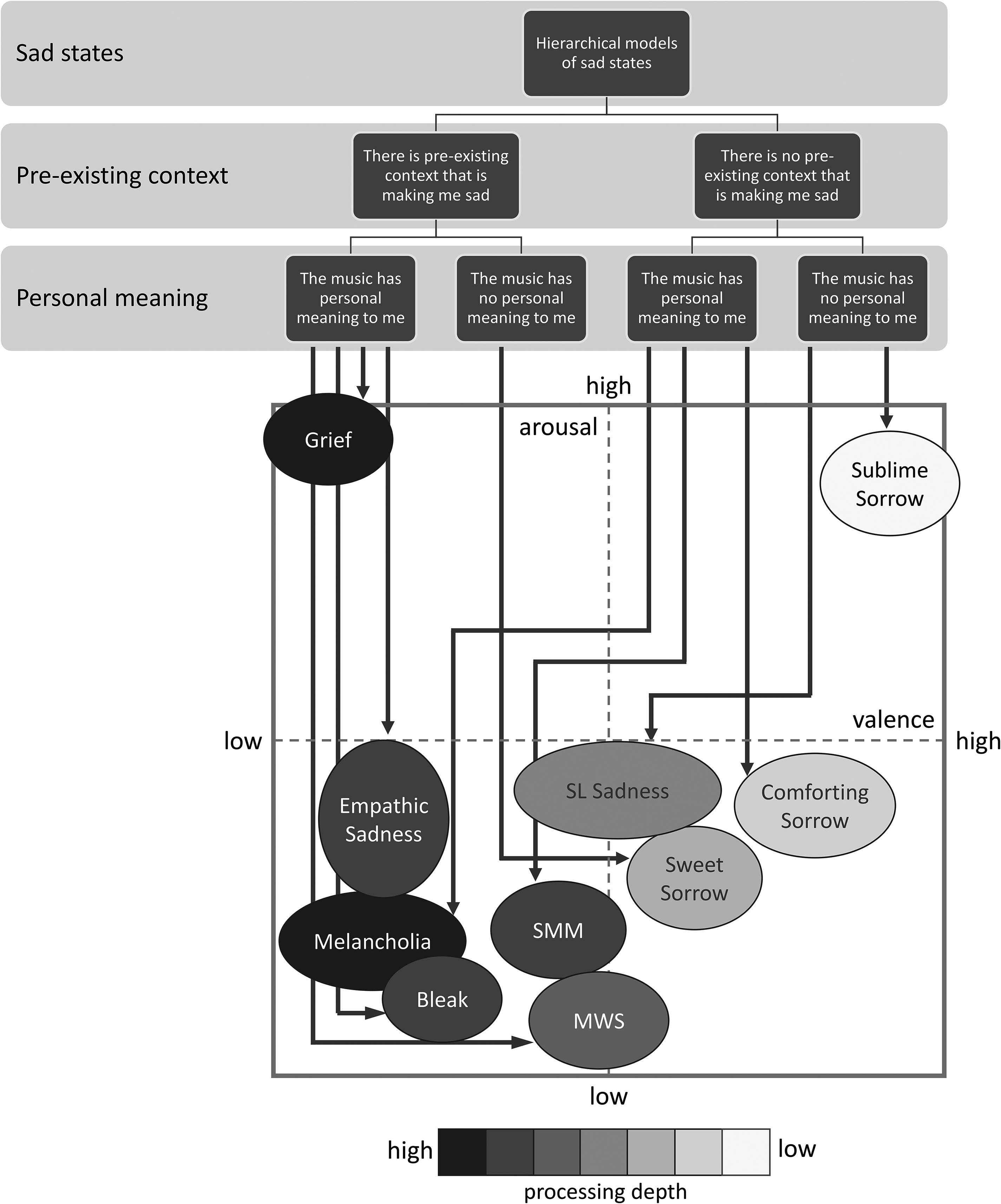
The proposed multi-dimensional model of sad music-induced sad states, using valence, arousal, and psychological effect, accompanied by a hierarchal “decision tree” determining the context and personal meaning dependence. Note: SL = Surface Level; MWS = Mind Wandering Sadness; SMM = Sad Mood-Maintenance.
This model was devised to be specifically applied to sadness within musical contexts. This was done as a result of sadness having been more thoroughly and open-mindedly explored within musical contexts prior. However, the authors speculate that while such states are hereby induced and manifested as a consequence of listening to sad music, it is reasonable to believe that such experiences of sadness could be had outside of this context. This, as a notion, is supported by literature suggesting that mechanisms that induce sadness are the same both in and outside musical contexts (Juslin & Västfjäll, 2008). Thus, while the authors propose that this model is initially considered a model of music-induced sadness, there may be scope for the model to be developed outside of a music context in future research.
Discussion
Across this review, various literature within sad music research has been analyzed to inform an integrated multidimensional model, whereby sadness has been divided into differential sad states (see Figure 1). While this model will aid the development of our understanding of sad emotion within music, full empirical validation is required. Though the division of sadness into different states will allow us to greater understand an individual's relationship with sad music and emotion, there remains a plethora of factors that are attributable to changes in outcome within each state. For instance, biological, psychological, and social factors may all play a role in determining the inducing and outcomes of specific states. For example, neuroimaging revealed that the brain recruitment for musical emotion may be discerned from musical enjoyment (Brattico et al., 2016). As such, musical enjoyment could be explored as a variable for these mood states, separately from measures of emotion. This could potentially introduce another dimension into the model through future research. Also, music genre may influence psychological outcomes (Lee et al., 2016) and social settings (Zhang et al., 2018) may compound the negative effects of certain states. These examples highlight how biopsychosocial factors are likely involved in how different individuals behave, interact with, and respond to sad music and emotion.
Other Model Comparisons
Models of basic emotions often place sadness as a single construct, relevant to feelings associated with the loss of loved ones (Ekman & Cordaro, 2011; Levenson, 2011; Tracy & Randles, 2011). According to Levenson (2011), basic emotions are evolutionarily shaped and biologically hardwired as solutions to pre-set prototypical experiences. While understanding sadness as a basic emotion may offer advantages to understanding its development and original functionality, it may not comprehensively explain the full range of complex sadness experienced in modern-day society. This is evidenced by the large variability exhibited within the outcomes of the sad music research field. As such, trying to understand sad music and the full depth and complexity of sad emotion through the lens of basic emotions becomes difficult. Consequently, adopting a more complex model of sadness, one that possesses more than one place on the affective circumplux (Russell, 1980), may enhance the understanding of sadness and its outcomes. Our model of sad emotion encompasses a range of different feelings and experiences, potentially far more capable of delivering a more comprehensive understanding of sad emotion that is not limited to the prototypical, evolutionarily derived issues discussed by Levenson, but rather the wider range of issues that are present for individuals in today's world.
While the GEMS (Zentner et al., 2008) provided a reasonable overview of musical emotions, it could be argued that its utilization of sad emotion was somewhat reductionist, as its sadness factor was only represented by simplistic “sadness” items: sadness and sorrowful. Furthermore, this was paired with tension and represented by a secondary factor labeled unease. What this approach fails to recognize is the complex nature of sadness and its ability to feed into a wider range of emotions and experiences. Our model will expand the approach to specifically sad emotion, looking to build upon our understanding of the different sad-associated experiences. Another model, suggested by Egermann and Reuben (2020) and measured by the Aesthetic Emotions Scale (AESTHEMOS) questionnaire (Schindler et al., 2017), looked to understand musical emotion through aesthetic judgments. The model suggests that aesthetic judgments play a strong role in determining the emotions felt by the music-listener. While this provides a suitable explanation for some musical emotions, it may not comprehensively explain them all. The reliance on aesthetic judgments in determining emotional response may imply a lack of personal meaning, focusing instead too strongly on the purely aesthetic value (beauty) of the music. This is suitable for states such as comforting sorrow where there is a high focus on the music and its aesthetic value. However, it may not help to explain states such as grief or melancholia, which are described as being deeply sad emotional experiences, potentially more heavily impacted by “emotional” meaning and factors, rather than aesthetic judgments.
Our model provides an in-depth description of specifically sad emotions. For instance, though sublime sorrow is a positive experience, this model will look to observe the experience specifically when arising from sad music and emotion. Thus, the individual's experience of associated terms, such as “wonder,” may be different when taking this perspective compared to alternative approaches, such as the GEMS, that consider this as a component of positive affect only. By delving into one state of emotion so deeply, we can begin to posit explanations for an array of differential sad experiences exhibited by individuals. Furthermore, we can utilize this depth to build upon previous understandings of sad emotion, looking to explore and differentiate each aspect under greater scrutiny.
Implications
Theoretical Implications; The provision of this model of sad states offers a framework through which past and future findings can be better understood. By approaching “sadness” in such a manner, we begin to disentangle the variability witnessed throughout the literature over the past decades, meaning we can better understand sad music and emotion. Moving forward, empirically supporting the division of these states will allow us to begin using this model in research, measures can be developed to help identify which state an individual occupies, and predictors and outcomes of each state can be explored. When taken together, this will help to elucidate an individual's experience of sadness, allowing a greater understanding of what induced that state, the consequences of that state, and what behaviors can help to negate any negative outcomes of their sadness. Before such theoretical implications can be considered, however, this model of sadness must first be empirically validated. Future work should begin by solidifying the sad states as conceptually sound factors via data reduction techniques such as confirmatory factor analysis. Subsequent studies can then use such a basis to develop a stronger understanding of the individual states which will allow researchers to empirically examine the individual states through experimental manipulation-based laboratory studies. For instance, by understanding the underlying mechanisms of sad music that induce a specific state, researchers can aim to experimentally induce a specific state, subsequently measuring the resultant impact on mood and emotion regulation, comparing this to expected impacts as per the theoretical model.
There are, however, some disadvantages to the model proposed that need to be addressed. While these developments may work toward supporting the model in its current form and language, an issue of language and culture needs to be considered. The titles of sad states are derived from the English language which means that the model would likely experience issues with translations. While the model itself could be examined for cross-cultural validation, the titles themselves may still be problematic, holding different meanings within different languages and cultures. As such, future iterations of this model could adapt more descriptive titles that will be less open to issues of interpretation or translation.
It is also important to consider the implication of subdividing emotions. A growing taxonomy of emotions may become difficult to truly conceptualize and utilize in the field. However, sadness’ importance may justify this specific division. The sad states discussed here hold important implications in one's mood and emotion regulation. These are two important components to one's mental health, specifically through mental health issues such as MDD. As a result, advancing the understanding of sadness and emotion regulation through the further division of sadness as an emotion (into differential sad states) may represent a window of opportunity with regards to aiding those with MDD. Ameliorating sadness to the degree whereby clinicians are able to induce adaptive (as opposed to maladaptive) sad states, for instance, has the potential to form incredibly helpful interventions, thus justifying the exploration of sad states discussed in this paper.
Cognitive Implications; Once this model is established empirically, the exploration of how each state affects cognition can ensue. While cognitive effects, such as mood and emotion, have been discussed in this review, future implications may include other aspects such as memory or cognitive enhancement. One such example arises from the “Mozart-effect,” through which individuals experience temporary enhancement in cognitive performance after listening to music (Schellenberg, 2012). However, later research has suggested that this enhanced cognitive performance is stronger when participants were exposed to affect-matching: the matching of music mood to one's own mood (Franco et al., 2014). Franco et al. (2014) stressed that both valence and arousal were important to this effect. Thus, understanding the relationship of valence and arousal with the sad states, as displayed in our model, may help affect-matching music to mood which may produce cognitive benefits.
Additionally, given music's ability to produce strong positive emotions, there is scope to utilize this field of research to potentially produce interventions that aid mood regulation and can induce strong, intense, positive emotions. For instance, descriptions of sublime sorrow, such as transcendence and wonder, overlap with the described experience of listening to drops in electronic dance music (EDM)—a phenomenon in which musical patterns suddenly deviate as the song transitions from the build-up to the drop (Turrell et al., 2019), creating anticipation, tension, and release. This transition from negative tension to positive release is thought to result in amplified positive emotions due to contrastive valence (Huron, 2006), eliciting high arousal and excitement, as well as positive emotions (Turrell et al., 2019). This poses some similarities to sublime sorrow. As EDM encompasses both sad and happy music, future research could explore whether EDM with negative lyrical themes, melodic patterns, tonalities, and modalities can still produce the intense, positive emotions associated with EDM drops and sublime sorrow. The effect of contrastive valence may additionally apply to other genres, such as rock music, which can also consist of similarly structured deviations in musical patterns. As such, drops and contrastive valence may reflect a mechanism through which sublime sorrow can be achieved.
Clinical Implications; This model of sadness may help understand people's relationship with sad music, especially those from clinical samples such as MDD. By better understanding the emotion of sadness, we can better utilize sad music and emotion in therapies to promote adaptive tendencies. This approach could be guided by our division of sad states, by offering a framework from which the states most associated with positive psychological effects can be identified and achieved in individuals. The applications of which will be most beneficial for those who struggle to regulate their emotion already, such as those with MDD who show intensified responses to sad music in line with a cognitive bias for sad cues (Bodner et al., 2007). Sadness is deeply implicated in MDD, and sad music preference within those with MDD is associated with lower energy music (Yoon et al., 2020). This finding was attributed to those with MDD experiencing “calming” effects from this low energy, sad music. Explorations into this model may reveal a sad state that best produces this calming effect. Subsequent investigations could explore the predictors and inducers of this state, which could inform researchers and clinicians which state is best advised for those with MDD, and how to achieve this state through targeted interventions.
Such enhancements to the understanding of sadness may also benefit other interventions. For instance, MDD-associated tobacco dependence may be reduced by breaking associations between “adverse” sad states and smoking, thus improving therapeutic success (Hogarth et al., 2017). In this case, understanding individual depressive triggers and sad mood inducers within clinical samples helped to achieve therapeutic success. As such, better understanding one's sad mood via our multidimensional model may aid the therapeutic targeting of interventions within clinical samples. Other clinical samples may also benefit from the better understanding of sad music and sad states, such as in treatments for individuals with substance abuse disorder (Short & Dingle, 2016), as a tool for helping individuals with Alzheimer's disease recall memories (Garćia et al., 2012), or in helping terminally ill patients more effectively express catharsis, communication, and experience vitality (Norton, 2011). These examples highlight the potential positive impact that sad music can have. However, the sensitive nature of these samples also serves to emphasize the importance of first comprehensively understanding sad music, sad states, and the effects these will have on individuals both in the general as well as clinical populations.
Future Directions
Future research should consider interpreting their results through the proposed model (see Figure 1) to aid their understanding of variability between their findings and the literature. This said, our model is theoretical, thus future research could aim to empirically support the division of states. This will enable its use within the field, as well as its continued investigation, through the observation of predictors and outcomes of each state.
Past neuropsychological studies have tried to elucidate the patterns of brain region recruitment in relation to sad music. However, many studies have simply explored how different emotions are processed, such as sadness, happiness, and fear (Bogert et al., 2016). For example, Okuya et al. (2017) identified the left thalamus being heavily involved in responses to sad music. However, with consideration to our model of sad states, having one categorization of “sad” will not produce a comprehensive understanding of the neurological behavior in response to sad music. Furthermore, electroencephalography (EEG) research has considered the lateralization of negative (right lateralization) and positive (left lateralization) valenced emotions in response to music (Tandle et al., 2016). Khalfa et al. (2005) found that brain regions recruited for detecting emotional differences between featural-level components (mode and tempo) did not fit the lateralizations as highlighted prior (Schmidt & Trainor, 2001; Tandle et al., 2016). A potential explanation for this is that detection of negative and positive valence in a holistic sense, differs from noticing changes in the individual musical features, as highlighted by surface level sadness. As such, exploring these states will help to understand variability in these findings. This concept could be utilized by future researchers, to confirm our estimations of each state's valence by exploring the differential lateralization between valences and states.
The investigations of brain recruitment in sad states could also aid the targeting of interventions by identifying an individual's maladaptive sad state and promoting the relevant adaptive behaviors. Thus, if future research can identify interventions that work more effectively for certain states, this would represent the ability to target and increase the efficacy of that intervention. An example of this comes from looking at the brain recruitment involved in cognitive reappraisal—a cognitive intervention, often paired with music, which recruits frontal and parietal control regions (Buhle et al., 2014). As the intervention promotes an adaptive coping mechanism, it might be expected that this aligns with the brain recruitment for sweet sorrow. As such, if confirmed by future research, it may reveal that cognitive reappraisal is particularly effective for those experiencing sweet sorrow. Equally, it may be able to provide better help for those experiencing sad mood-maintenance or melancholia, given that those individuals may struggle with emotion regulation. This highlights how future investigations, using this model, could help the targeting of future interventions.
As seen in an integrative review (Eerola et al., 2018), there are levels of mechanisms that may influence an individual's experience of sad music at a given time. In the review, Eerola et al. (2018) considered a biopsychosocial and cultural approach. Future research could look to combine such an approach with our multidimensional model of sad states, but instead explore how these factors might act as predictors and inducers of these states, helping to elucidate the nature of sadness and its varying, associated states, experiences, and outcomes.
Conclusion
In summary, through using past literature on sad music and its range of outcomes on individuals, sad emotion was divided into different states, each possessing their own characteristics and their proposed outcomes. The different states were devised with the aim of explaining the range of negative and positive outcomes associated with sad music, attributing these outcomes to different states, according to the literature. These divisions are represented visually (see Figure 1), plotted on five dimensions (valence, arousal, processing depth, context dependence, and personal meaning dependence), and present the proposed multidimensional model of sad states. This model may serve to inform music and emotion literature alike, potentially representing a paradigm shift in how sad emotion is approached in research. The breakdown of sad emotion into multiple states may prove to aid researchers in their understanding of negative emotions and sadness in respect to providing explanations for varied outcomes in past and future findings. While this model requires empirical investigation, we believe it can provide a framework through which studies can begin to explore sad emotion in greater depth and understanding. In time, research could look to explore predictors and outcomes of these states under laboratory manipulations, as well as exploring other variables such as personality, social factors, and neural activity. Findings on such studies could provide the ability to target tailor-made music therapies and interventions to individuals, based off this new understanding of sad emotion and its interplay with sad music.
Glossary
Footnotes
Declaration of Conflicting Interests
The author(s) declared no potential conflicts of interest with respect to the research, authorship, and/or publication of this article.
Funding
The author(s) received no financial support for the research, authorship, and/or publication of this article.

Appendix
Summary of the publications studying different aspects of Music-induced States of Sadness.