




Abstract
A widespread perspective describes emotions as distinct categories bridged by fuzzy boundaries, indicating that emotions are distinct and dimensional at the same time. Theoretical and methodological approaches to this perspective still need further development. We conceptualize emotions as overlapping networks of causal relationships between emotion components—networks representing distinct emotions share components with and relate to each other. To investigate this conceptualization, we introduce network analysis to emotion research and apply it to the reanalysis of a data set on multiple positive emotions. Specifically, we describe the estimation of networks from data, and the detection of overlapping communities of nodes in these networks. The network perspective has implications for the understanding of distinct emotions, their co-occurrence, and their measurement.
Emotion research has for a long time faced a conundrum. In a dominating school of thought, emotions are discrete and evoked by independent mechanisms, causing various component changes (e.g., cognitions, facial expressions) that the respective emotion entails (Levenson, 1994). From this perspective, emotions are distinct because multiple components are uniquely tied to them (Ekman & Cordaro, 2011), allowing to measure a particular emotion by assessing its specific changes. However, research converges on the conclusion that all emotions share multiple component changes with other emotions (e.g., Ellsworth & Scherer, 2003; Siegel et al., 2018; Witkower & Tracy, 2019), implying that few components are indeed unique indicators of specific emotions. Such observations led to the widely shared perspective that emotions are distinct categories with fuzzy boundaries between them (e.g., Cowen & Keltner, 2017; Fehr & Russell, 1984)—emotions are distinct, yet they share various components. A theoretical approach explaining this perspective is not yet available.
In the present article, we provide such a theoretical approach. Specifically, we conceptualize emotions as networks of causally connected emotion components, and we argue that the causal networks of different emotions overlap. From this perspective, emotions are distinct, while they also share components with and relate to other emotions. Our goal is (a) to provide a theoretical conceptualization accounting for the nature of distinct emotions and (b) to introduce methodological tools to investigate overlapping causal networks.
Conceptualizations of Emotions
Traditionally, theories conceptualized emotions as discrete (for a review of an alternative tradition, see Gendron & Barrett, 2009). In these conceptualizations, distinct innate mechanisms (e.g., neural programs or appraisal patterns) trigger emotions, causing unique changes in the person (e.g., Ekman, 1999; Ekman & Cordaro, 2011; Panksepp, 2007). Accordingly, research demarcated emotions from each other by testing whether they differ on specific vocalizations (Cordaro et al., 2016; Sauter et al., 2010), action tendencies (Frijda et al., 1989), physiological changes (Ekman et al., 1983), or, most prominently, facial muscle contractions (Cordaro et al., 2018; for a review on multiple components, see also Lench et al., 2011). For instance, research suggested that the appraisal of goal obstruction uniquely signals anger (Ekman & Cordaro, 2011), lower somatic activity uniquely signals fear (Levenson et al., 1991), or tears uniquely signal sadness (Cordaro et al., 2016).
Even though each emotion may have a distinct mechanism, emotions are not entirely independent of each other. Specifically, in daily life, people frequently experience blends of distinct emotions (Scherer et al., 2004) that can even be of opposite valence (Larsen & McGraw, 2014; Moeller et al., 2018; Trampe et al., 2015). Moreover, some theorizing argues that nonbasic emotions (e.g., shame, guilt) are constructed from or accompanied by basic emotions (Oatley & Johnson-Laird, 1987). Relatedly, measures of different emotions are oftentimes positively correlated at both the state (e.g., Weidman & Tracy, 2020) and trait level (Diener et al., 1995), and these correlations between emotions or their components map onto a lower dimensional space, specified, for instance, by valence, arousal, or potency (e.g., Fontaine et al., 2007; Russell, 1980; Wundt, 1887). Put to the extreme, the same emotion words sometimes measure different emotions (Weidman et al., 2017). These findings imply that multiple distinct emotions relate to each other, while certain dimensions can represent these relationships (for a stricter understanding of dimensions as biological primitives, see for instance, Russell, 2003).
The perspective that emotions may be simultaneously distinct and nevertheless arranged on multiple dimensions is widespread. Notably, in a survey among established emotion researchers, the majority endorsed this view (Ekman, 2016). Such a position also prevails in specific emotion theories (Plutchik, 1982) or measurement tools (Scherer, 2005). Recently, studies with ratings of thousands of representatively sampled emotional videos, vocal bursts, or emotional expressions indeed supported the perspective (Cowen et al., 2019), even across cultures (Cowen et al., 2020). The emotional stimuli were clustered together, and participants consistently labeled these clusters with respective emotion terms. Yet most emotional stimuli elicited states that participants labeled with different emotion terms. In line with such findings, it is reasonable to argue that the boundaries between emotions are fuzzy, defined as conceptual overlap of emotions that manifests in shared (i.e., nonunique) components (Fehr & Russell, 1984; Russell & Fehr, 1994). For instance, multiple emotions share appraisals (Ellsworth & Scherer, 2003; Kuppens et al., 2003), have physiological changes in common (Siegel et al., 2018), or include similar expressive displays (Witkower & Tracy, 2019). These findings indicate that many—if not all—emotional experiences are in fact combinations of multiple emotions in terms of shared components.
A satisfactory theoretical conceptualization of how emotions can be distinct and dimensional at the same time is still lacking. Such a conceptualization must account for two observations. First, emotions are distinct in the sense that they have at least some characteristics that distinguish them from other emotions. Second, emotions have fuzzy boundaries in the sense that they share components with each other. We aim to provide one theoretical conceptualization that accounts for these observations (for a discussion of other models that could be extended to alternative conceptualizations, see Lange et al., 2020; see also Barrett, 2011; Coan, 2010; Schmittmann et al., 2013).
Emotions as Causal Networks
We base our argument on a definition of emotions as synchronized changes in multiple components. That is, when people experience an emotion, this changes their feelings, cognitions, physiology, motivations, and expressive behaviors (e.g., Moors, 2009; Niedenthal & Ric, 2017). In fact, most emotion theories share the notion that emotions entail changes in multiple components (e.g., Coppin & Sander, 2016; Izard, 2010; Russell, 2003), even though different theories emphasize different components. Not all emotions entail changes in all these components, but all emotions entail changes in at least some of them (Fehr & Russell, 1984).
A central finding is that the component changes of an emotion cause each other. Specifically, multiple theories of emotions in general (Lewis, 2005; Scherer, 2009) or of specific emotions such as shame (Gausel et al., 2012), envy (Lange et al., 2018), or kama muta (Fiske et al., 2019) at least indirectly rely on the notion of causal relationships between emotion components. Moreover, research implies that there are causal relationships between cognitions and all other components (Scherer & Moors, 2019), between motivations and feelings (Carver & Scheier, 1990), or between expressive behaviors and feelings as well as physiological changes (Coles et al., 2019).
Based on this central finding, we propose to conceptualize emotions as networks of causally interacting emotion components (Lange et al., 2020; see also Bringmann et al., 2016). According to this conceptualization, emotions are dynamical systems that evolve over time (for similar theoretical conceptualizations, see Izard et al., 2000; Lewis, 2005). They are episodes or events that unfold along the causal relationships in the network. In line with common terminology, emotion components are then called nodes, and their causal connections are called edges. In this conceptualization, a network that entails causal connections between, for instance, physiological arousal, aggressive thoughts, frowning, and attack motivation would constitute anger. In a relevant situation, physiological arousal may increase aggressive thoughts, mediating an effect on attack motivation and frowning, while frowning could further increase physiological arousal via facial feedback. As components of one emotion typically cohere strongly with only some components of the same emotion but weakly with others (e.g., Evers et al., 2014; Mauss et al., 2005), one emotion likely entails groups of components that are more tightly connected to each other than to other components (Lange et al., 2020). For instance, theories of specific emotions such as awe (Yaden et al., 2019), envy (Lange et al., 2018), or shame (Gausel et al., 2012) are based on the notion that subgroups of components of the respective emotion (e.g., some thoughts and motivations) cohere more strongly with each other than with other subgroups of components of the same emotion.
If emotions are causal networks of emotion components, various networks of distinct emotions probably overlap—they share various nodes and are related to each other. This proposition directly follows from the observation that emotions have fuzzy boundaries. Despite such overlap, there can nevertheless be distinct components or distinct relationships between components for each emotion (Campos et al., 2013). For instance, in both awe—the emotion experienced when trying to accommodate vastness (Keltner & Haidt, 2003)—and admiration, the emotion experienced in response to other’s excellence (Schindler et al., 2013), people may wonder about something they observe. Yet awe entails passive contemplation and freeze reactions (e.g., time slowing down), which directly opposes the improvement motivation and activation that admiration entails (Onu et al., 2016). Moreover, awe and gratitude—the feeling that one has been the beneficiary of another individual’s moral deeds (McCullough et al., 2001)—both entail prosocial behavior towards other people and are regarded as self-transcendent emotions, but feature different appraisals, subjective feelings, and facial expressions (Campos et al., 2013; Stellar et al., 2017). Notably, even when the networks representing different emotions share nodes or are related to each other, the components of one emotion should be more tightly connected to each other than to the components of another emotion, allowing to distinguish emotions from each other.
These arguments lead to a conceptualization of emotions as overlapping causal networks of emotion components (see Figure 1), accounting for the two observations about emotions. First, each emotion constitutes a causal network of partly connected emotion components. These patterns of components can account for the observation that emotions are distinct. Second, some emotion components belong to the networks of multiple emotions or relate to components of other networks. Such network overlap accounts for the observation that emotions have fuzzy boundaries. Moreover, network overlap provides an explanation for why emotions are correlated and, hence, why different emotions can be arranged on dimensions. Thus, conceptualizing emotions as networks (Lange et al., 2020) may explain how emotions can be distinct with fuzzy boundaries, combining central insights from distinct emotion and dimensional approaches.
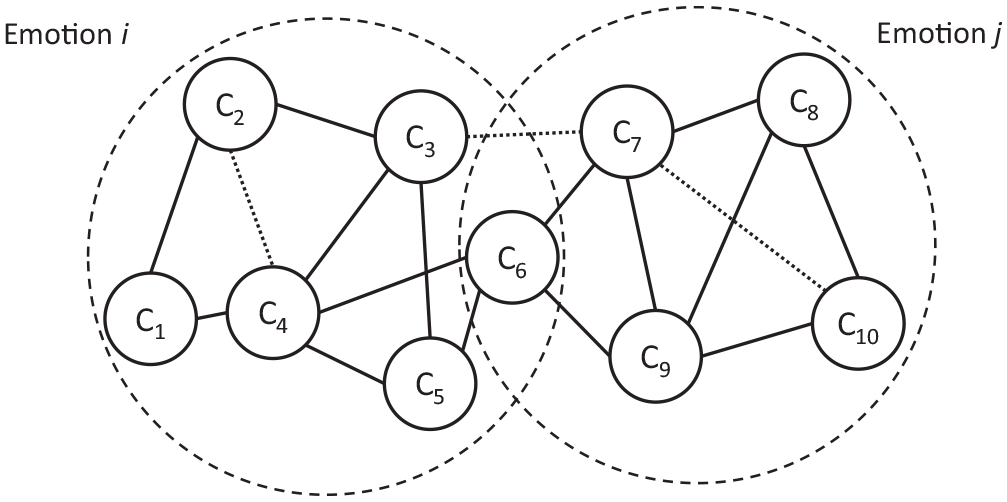
Hypothetical display of overlapping networks of two emotions, i and j.
Methodological Approach to the Investigation of Overlapping Emotion Networks
Even though previous research already emphasized that emotions are dynamical systems of interacting components (e.g., Izard et al., 2000; Lewis, 2005), a lack of methodological approaches hindered the investigation of such a perspective. We want to introduce tools to emotion research that help testing a conceptualization of overlapping causal emotion networks, that is, tools allowing to gain deeper insight into direct relationships between multiple emotion components representing one or more emotions. First, one needs to estimate a network of emotion components from data. Second, one needs to analyze the structure of this network. To familiarize emotion researchers with this methodological approach, we introduce network estimation, as well as one algorithm to identify network overlap and apply it to an openly available rich data set on a multitude of positive emotions (Weidman & Tracy, 2020).
Network Estimation
Network analysis in general facilitates the analysis of systems of relationships between multiple entities. In emotion research, network analysis enables the analysis of direct relationships between multiple components of an emotion and the investigation of properties of the entire network structure. In an investigation of a conceptualization of emotions as overlapping causal networks, the nodes represent the components of one or multiple emotions and the edges represent relationships between the components. For instance, a researcher could have measurements of all feelings, cognitions, physiological changes, motivations, and expressions of admiration, awe, and gratitude for multiple participants in response to a specific situation. Network analysis provides methods to estimate the relationships between all the components, to investigate how certain components group together, or to determine which components are more central (i.e., more strongly connected) and thereby potentially have stronger influence on all other components.
Recent developments offer several ways to estimate networks from multicomponential data. Most commonly, researchers estimate networks via pairwise Markov Random Field Models. For continuous data—for instance, when multiple participants rate how much each component of the three emotions applied to them during an emotion episode on a scale from 1 (not at all) to 5 (very much)—the corresponding Markov Random Field Model is the Gaussian Graphical Model (Epskamp, Waldorp, Mõttus, & Borsboom, 2018). In the Gaussian Graphical Model, two emotion components are (not) connected by an edge if they are conditionally (in)dependent given all other components in the network. One way to estimate such conditional (in)dependence relationships are partial correlations (Epskamp, Waldorp, et al., 2018). A partial correlation between two emotion components means that the components are correlated with each other after controlling for all other components in the network. Even in networks with only a few components, this strategy leads to the estimation of many partial correlations, potentially increasing the number of nonzero partial correlations that are actually zero (i.e., false-positive partial correlations). One way to reduce the number of false-positive partial correlations is regularization. Regularization is a statistical technique that decreases the size of all partial correlations and sets small, likely false-positive partial correlations to exactly zero. It is then possible to visualize the entire set of regularized partial correlations between a multitude of emotion components, representing a visual depiction of the estimated network of emotion components (Epskamp, Borsboom, & Fried, 2018; Epskamp, Waldorp, et al., 2018).
Conducting the estimation of the Gaussian Graphical Model is straightforward. All popular statistical programs allow estimating partial correlations between variables. However, applying regularization and visualizing networks is not conveniently implemented in most software environments. One software environment that makes network estimation easily accessible is R (R Core Team, 2019). For instance, the estimation and visualization of a network of regularized partial correlations requires only two short lines of code. Beyond this, dedicated software packages in R provide numerous additional features around network estimation. A tutorial on central steps in network estimation is available in Epskamp, Borsboom, and Fried (2018; for an extensive discussion of the applicability of the Gaussian Graphical Model to different kinds of data, including mathematical details, see Epskamp, Waldorp, et al., 2018).
Identifying Overlapping Causal Networks: Community Detection
After the estimation of the network, the investigation of a conceptualization of emotions as distinct with fuzzy boundaries based on overlapping networks requires another step. Specifically, one needs to investigate whether there are indeed strongly connected substructures of multiple components in the full component network that could represent distinct emotions. Moreover, one needs to investigate whether these substructures indeed overlap. For instance, in a network of regularized partial correlations between emotion components of admiration, awe, and gratitude, are there groups of components that are more strongly related, representing the three emotions? And do these groups of components share components with each other such that the three emotions overlap? For these purposes, the methodological toolbox of network science offers additional algorithms.
Multiple algorithms exist that can detect strongly connected substructures of multiple components in a network, called communities (Fortunato, 2010). These communities, hence, represent distinct emotions. That some components of an emotion are more tightly connected to each other than to other components of the same emotion (Lange et al., 2020) should also lead each emotion to include multiple smaller communities. Hence, estimating overlap in a large network representing different distinct emotions requires to identify multiple smaller communities within and across emotions that share components with each other.
Community detection algorithms developed in network science are differently equipped to fulfill this requirement. A limitation of most community detection algorithms is that they allocate each node to only one community, precluding nodes from being shared between multiple communities. In contrast to this forced allocation of nodes, a few community detection algorithms can account for overlapping community structures, such that nodes may belong to multiple communities at the same time. One such algorithm is the clique percolation algorithm (Adamcsek et al., 2006; Farkas et al., 2007; Palla et al., 2005; see also Blanken et al., 2018). For networks such as the kind estimated via the Gaussian Graphical Model, the clique percolation algorithm first detects k-cliques—fully connected subnetworks with k nodes—if their intensity (i.e., the geometric mean of the absolute partial correlations) exceeds a specified threshold I. This implies that when a node does not belong to a k-clique, it would be isolated (it would never belong to a community). Second, two k-cliques are called adjacent if they share all but one (i.e., k − 1) nodes with each other. A set of adjacent k-cliques then forms a community. As such, the algorithm, by definition, allows overlapping communities.
As a concrete example, consider the nodes C1 to C6 in Figure 1. They form multiple k-cliques with three components (i.e., triangles; 3-cliques), namely, C1-C2-C4, C2-C3-C4, C3-C4-C5, and C4-C5-C6. Assuming that all 3-cliques are sufficiently strongly connected, such that their intensity exceeds I, the clique percolation algorithm subsequently checks whether the 3-cliques share k – 1 = 2 components with another 3-clique. Indeed, all of the 3-cliques share two components with one of the other 3-cliques. For instance, the 3-cliques C1-C2-C4 and C2-C3-C4 share the components C2 and C4. Consequently, components C1 to C6 belong to the same community, collectively constituting Emotion i. Similar considerations allocate components C6 to C10 into one community, collectively constituting Emotion j. Thus, the algorithm identifies two communities (i.e., two emotions) that share the component C6—the two communities (i.e., two emotions) overlap—and, in the current case, no component is isolated.
The clique percolation algorithm is also implemented in R. Specifically, we developed an R package—CliquePercolation—that facilitates running the algorithm and visualizing its results. For more details on the algorithm (including information on how to derive optimal values for k and I as well as how to decide in favor of a community partition) and its application, the package includes an extensive vignette that is accessible via the Comprehensive R Archive and Network (CRAN; https://cran.r-project.org/web/packages/CliquePercolation/vignettes/CliquePercolation.html).
Reanalysis of Weidman and Tracy (2020)
To showcase network analysis with the subsequent application of the clique percolation algorithm, we reanalyzed a recently published data set targeting subjectively distinct positive emotions (Weidman & Tracy, 2020; available at https://osf.io/fj527/). We focus on the emotions categorized by Weidman and Tracy (2020) as other-appreciating, namely, admiration, awe, and gratitude. The proposed methodological approach investigates whether the components of the three emotions form an interconnected network of relationships and whether there is evidence for overlapping communities representing the three emotions. In their Study 2, Weidman and Tracy asked participants to report emotional situations in which they experienced these emotions. In total, we collapsed across 267 participants who recalled situations for two or three emotions (i.e., the network is based on 573 observations). Participants subsequently rated 56 nonredundant items taken from another study in which lay people’s task was to list feelings, thoughts, and action tendencies of each of the three emotions. The items should therefore assess most of the emotions’ central components. Yet, a limitation is that these items primarily refer to components of subjective experience and, hence, may underestimate the influence of physiological or expressive changes. Additional information about the sample and analysis is available in the supplemental material.
We estimated the component network and applied the clique percolation algorithm. Figure 2 shows the results in two complementary ways. Panel A shows the estimated network of the 56 items, colored according to the communities they belong to. We assigned a color to each of the three emotions. When an identified community entailed items from only one emotion, we assigned the pure color to its nodes, shaded towards white for smaller communities. For communities entailing items from multiple emotions, we assigned proportionally mixed colors to their nodes. Shared nodes have multiple colors in pie charts and isolated nodes are white. Hence, if distinct emotions are identifiable in the overall network, we expect to see various shades of the original colors we assigned to the emotions, as compared to a uniform mixed color that would result when the components of an emotion are as strongly connected to each other as they are to components of another emotion. In Panel B, the so-called community graph, a node represents a community, and an edge represents the number of nodes the two communities share. The more nodes a community includes, the larger its size. Hence, if distinct emotions overlap, we expect communities including components of different emotions and many edges in the community graph.
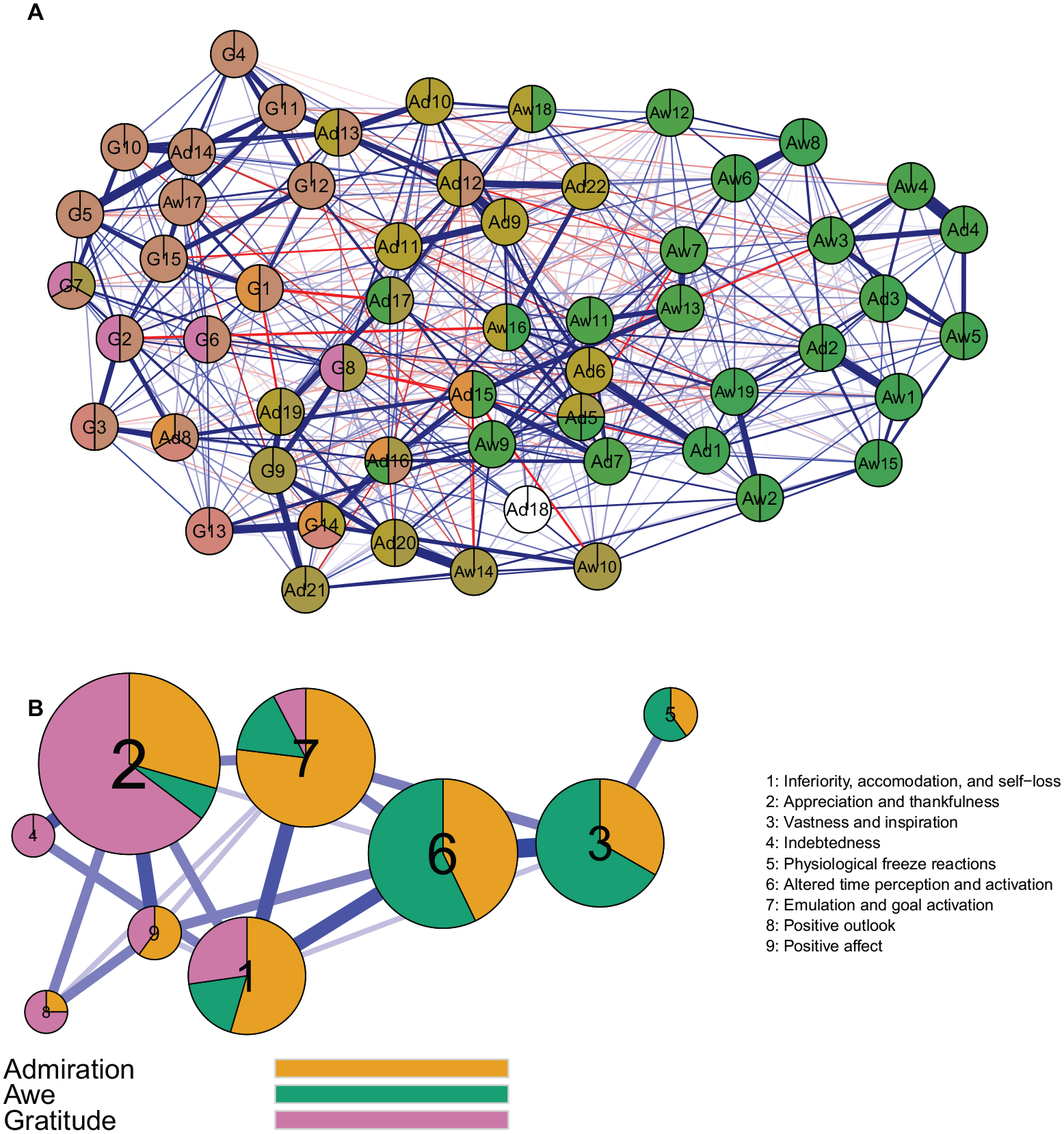
Panel A: Colored estimated network for admiration (Ad), awe (Aw), and gratitude (G) items from Weidman and Tracy (2020, Study 2). Blue edges represent positive relationships. Red edges represent negative relationships. Table S1 (supplemental material) lists all items. Panel B: Community graph for the same network with nodes representing communities, and edges representing the number of nodes the communities share. Larger nodes represent communities that include more nodes. Spatial arrangement of the nodes aligns with the location of the communities in the colored estimated network. Descriptions of the content of the communities are depicted on the right. The basic colors assigned to the a priori items of the three emotions in both networks are presented at the bottom.
Across both networks, the analysis supports a conceptualization of the three emotions as overlapping networks. The areas in the colored shades of admiration, awe, and gratitude were pronounced, yet less so for admiration. There were nine communities, of which, only one gratitude community was pure. The other communities entailed items from multiple emotions but were often largely dominated by items from one emotion. Moreover, 23 nodes were shared among communities. For instance, the admiration item “I had a great deal of respect toward a specific person” was shared between admiration and gratitude, or the awe item “I was inspired by what I saw” was shared between awe and admiration. Finally, one node was isolated (“I felt humbled”). We share the data and reproducible code for this example on OSF (https://osf.io/b2y3x/).
Theoretical Implications and Future Research Directions
A conceptualization of emotions as overlapping causal networks constitutes a theoretical approach explaining why emotions are distinct, with fuzzy boundaries between them. Network estimation, alongside the identification of overlapping communities using the clique percolation algorithm, provides the methodological tools to investigate this conceptualization. As a first example, we applied the methodological approach to the reanalysis of a data set of component measures of admiration, awe, and gratitude. The reanalysis indicated that despite tight interconnections between the three emotions, all of them had partly unique patterns of relationships among their components. However, there was also a substantial amount of mixed communities and overlap, suggesting that the three emotions share various components with and relate to each other. Thus, it is reasonable to consider admiration, awe, and gratitude as three distinct emotions bridged by fuzzy boundaries.
Conceptualizing emotions as overlapping causal networks contributes to resolving theoretical disagreement on the question of whether emotions are distinct or dimensional. In line with evidence (e.g., Cowen et al., 2019; Fehr & Russell, 1984) and surveys among popular emotion researchers (Ekman, 2016), emotions may be distinct and dimensional at the same time, captured in a conceptualization of emotions as overlapping causal networks. Specifically, the communities in a network of emotion components can represent distinct emotions, and the communities’ overlap may represent dimensions. We showcased overlapping networks by investigating admiration, awe, and gratitude. As these emotions are similar on important dimensions (e.g., valence), their networks were likely to be overlapping. Future research should investigate emotions with varying similarity on different dimensions, testing whether higher and lower similarity indeed align with more or less network overlap, respectively.
Moreover, if causal networks of different emotions overlap, the amount of overlap could be a predictor of the probability that these emotions co-occur. So far, research documents that emotions co-occur frequently (e.g., Larsen & McGraw, 2014; Moeller et al., 2018; Scherer et al., 2004; Trampe et al., 2015), but it is less clear how this comes about. From the current perspective, activation of the causal network representing one distinct emotion may spread via shared nodes to causal networks representing other distinct emotions. For instance, when being inspired by a person, this may activate parts of the awe network, such as the motivation to accommodate what is happening, and this may also activate parts of the admiration network, such as emulation and goal activation. The stronger the overlap of two emotions, the more cross-activation is possible, rendering co-occurring emotions in any situation more likely. If, however, different emotions do not share components or do not relate to each other, cross-activation is less likely. From a conceptualization of emotions as overlapping causal networks, there should be hardly any emotional event that will elicit only one emotion at a time, which has been supported by recent evidence (Cowen et al., 2019). Thus, the amount of network overlap should relate to the probability of two emotions co-occurring, a testable prediction when using the presented methodological approach.
Furthermore, conceptualizing emotions as overlapping causal networks provides new perspectives on the variability of emotions. Evidence widely supports that emotions are experienced and expressed differently across and within individuals, cultures, and historical time points (e.g., Averill, 1983; Crivelli et al., 2016; Jack et al., 2012; Kuppens & Tong, 2010; Russell, 1994). From a network perspective, this could imply that relationships between emotion components vary across or within contexts and persons (Lange et al., 2020)—fuzziness among emotion networks may differ across and within situations, cultures, and individuals. For example, awe and admiration might share more edges in some contexts, whereas admiration and gratitude might be more strongly connected on other occasions, and these differences are likely influenced by cultural and social norms, as well as personality traits. When researchers complement the estimation of networks and the clique percolation algorithm with cross-cultural comparisons as well as manipulations of central contextual variables, or when they relate it to expressions of personality characteristics across and within persons, they can approach such questions. It would even be possible to investigate how individuals with different network structures interact with each other over time, combining psychological networks with social networks.
Finally, when a conceptualization of emotions as overlapping causal networks allows emotions to be distinct and dimensional at the same time, it may further contribute to integrating insights from affect program theories and constructionist theories (see also Lange et al., 2020). Consider for instance the activation of emotions in a situation and subsequent attempts to put the experience into words. People may go through a distinct emotion episode, in line with affect program theories, in the sense that the network representing the emotion is activated. Spreading activation to overlapping networks will most certainly activate additional distinct emotion episodes. The process of putting the overall experience into words may then be a conceptual act, as outlined in constructionist theories (e.g., Barrett, 2014; see also research on affect labeling, e.g., Torre & Lieberman, 2018). That is, people may recognize patterns of component changes in an emotional episode and label the collective experience with a respective word. How this process unfolds could depend on internal factors, including the amount of overlap between the activated emotions. Or the words used to categorize the experience may depend on contextual cues and attributions. People should then more frequently assign the same label to patterns of component changes of multiple emotions that share more components with each other. Network analysis shows promise in contributing to address such fundamental issues.
Methodological Challenges of Network Analysis
The theoretical implications and future research directions suggest that network analysis can move the field forward theoretically. But the application of network analysis also has a few challenges that researchers should consider. In what follows, we describe three such challenges and how to address them.
Selection of Components and Component Operationalization
As a first challenge, researchers should carefully think about the emotion components they want to assess in their study. This consideration includes two tasks. First, the researcher needs to identify all nonredundant components of the involved emotion(s). The goal of network analysis as used for component networks is to test causal network theories. Not assessing a central component in the network can lead to false conclusions about the network structure. Relatedly, when including redundant measures of a component, any relationship between these components results from their redundancy and not from a causal relationship. Thus, the goal should be to assess components that exhaustively capture the emotion (for a discussion, see Christensen et al., 2020), which is a challenging goal to accomplish.
Strict criteria for choosing the components are difficult to propose. Which components are important will depend on the research context (for a discussion, see Lange et al., 2020); and some emotions will not have certain component changes (e.g., guilt has no known facial expression). Hence, researchers will need to decide from study to study. Nevertheless, we think that theorizing and evidence can and will inform comprehensive lists of components for multiple emotions. There are comprehensive lists of component changes for emotions such as awe (Yaden et al., 2019), envy (Lange et al., 2018), or shame (Gausel et al., 2012). Moreover, lots of research used prototype approaches for specific emotions (e.g., Luo et al., 2020; Shaver et al., 1987), which results in an exhaustive list of central and noncentral components. Research in the distinct emotion tradition often aimed at identifying shared and unique components of multiple emotions (e.g., Campos et al., 2013). Or research showed how different contexts may require different sets of components for the very same emotion (Boiger et al., 2018). Turning the logic around, it may even be possible to not start from an emotion label but to first investigate (causal) relationships of numerous components and look for densely connected patterns (exemplified in research on kama muta; Zickfeld et al., 2019).
Second, the researcher needs to operationalize the components. For instance, participants may work on questionnaires to assess feelings or thoughts, specific devices may assess physiological changes, or EMG recordings may track facial expressions. However, it is challenging to combine such multimodal measurements in one study, yet previous research already succeeded in creating solutions for this challenge (e.g., Mauss et al., 2005; Reisenzein, 2000). Alternatively, it is also imaginable to assess all components only with self-report, as in the reanalysis (for a discussion of the advantages and disadvantages of using self-report, see Mauss & Robinson, 2009; Scherer, 2005; Weidman et al., 2017). Deciding which operationalization is preferable may be similarly challenging. Eventually, this decision will hinge on the validity of different measurement approaches for the specific study.
Sample Size
As a second challenge, researchers need to collect rather large sample sizes. Simulations can provide insights into the number of participants needed for common kinds of networks (for a tutorial and the example, see Epskamp, Borsboom, & Fried, 2018). In such simulations, researchers created a network and generated numerous fictitious random samples in which this network should actually be true. They then tested how well the networks estimated in each sample mapped onto the true network they created, and how this fit changed depending on the number of nodes and the size of the sample. For instance, in a simulation with a network of 20 nodes, 250 participants led to satisfactory results. Larger sample sizes would even improve the fit, yet they are more challenging to collect, especially with multimodal measurement approaches. Alternatively, if the network included fewer nodes, the fit would probably be higher, even for 250 participants.
Causality in Network Analysis
As a third challenge, it is difficult to infer causal relationships between emotion components from regularized partial correlation networks alone. In line with the goal to estimate causal networks and test causal network theories, conditional (in)dependence relationships (e.g., partial correlations) are indeed consistent with causal structures (Epskamp, Borsboom, & Fried, 2018; Epskamp, Waldorp, et al., 2018). Yet, it is important to point out that an edge, as represented by a conditional dependence relationship (e.g., a partial correlation), does not equate a causal relationship between two nodes (Epskamp, Borsboom, & Fried, 2018; Epskamp, Waldorp, et al., 2018). An edge between two nodes (A and B) is consistent with a causal effect of A on B, a causal effect of B on A, a bidirectional causal effect, or a collider pattern in which A and B cause a third node (C; if A and B have no zero-order correlation). The absence of an edge, when there has been a zero-order correlation, is consistent with a mediation of A via C on B, the reversed mediation, or a common cause pattern in which C causes both A and B. Furthermore, testing causal network theories with partial correlations requires that the nodes exhibit change during the assessment and that the nodes change roughly on the same time scale. If changes of a node proceed more quickly than those of other nodes, or if certain nodes do not change at all during the assessment period, the estimated partial correlations will be biased.
Therefore, a researcher should be cautious when drawing conclusions about relationships between specific components in a regularized partial correlation network. Such networks represent one way to investigate causal network theories, but the estimation of causal structures remains challenging. Ideally, researchers should investigate all edges of a causal network theory experimentally. However, already in networks with few components, this quickly leads to an unmanageable amount of experimental variations and required measurements. Moreover, it may be hard to design experimental interventions that target only one component at a time. A somewhat easier approach may be to investigate just one particular causal relationship between two components in an experiment (for a review, see e.g., Scherer & Moors, 2019), yet such experiments potentially underestimate the effect of nonincluded components. Thus, addressing the challenge of causal conclusions will be an important task for future research.
Comparison of Network Analysis With Other Methods
Despite its challenges, we argue that network analysis substantially expands the methodological toolbox of emotions researchers. In fact, the methodological approach we propose extends and complements more traditional methods, especially (exploratory and confirmatory) factor analysis. On a conceptual level, network and factor models are radically different. The factor model conceptualizes emotions as latent (i.e., unobservable) mechanisms that cause emotion components, while the components themselves have no causal relationships among each other. In contrast, in the network model, the components have direct causal effects on each other. These differences in the theoretical interpretations of both models lead to a number of diverging implications (for an extended discussion, see Lange et al., 2020). One central implication of the factor model is that if one latent variable causes all components, changes in these components will (ideally) be identical. If one component gets activated by the latent emotion, all other components must as well. The components therefore provide redundant information. Accordingly, when using factor analysis during the development of questionnaires to measure emotions, researchers often include rather redundant items, assessing the same component in slightly different ways. Assessing multiple components becomes challenging, potentially explaining why many questionnaires focus on single components, most frequently feelings. This recommendation stands in direct opposition to the recommendation for the network model, for which researchers should assess all (nonredundant) components of an emotion. Put to the extreme, different contexts or cultures may require to measure partly different components, such that across contexts or cultures, some parts of the network are universal and others vary (for a related example, see Jackson et al., 2019).
Nevertheless, network and factor analyses are complementary. For instance, to control for measurement error, a researcher can include multiple redundant measures of each component (e.g., multiple items asking for the same cognition; multiple items asking for the same feeling) and model them as latent variables. The latent variables can then be the nodes in network analysis (Epskamp et al., 2017). Moreover, a community in a network can be indicative of a factor, allowing community detection algorithms to achieve similar goals as factor analysis (Golino & Epskamp, 2017).
As another method, instead of using network analysis, researchers could also apply structural equation modeling. Structural equation modeling is a large class of methods broadly concerned with relationships between multiple (latent) variables. Most commonly, researchers specify theoretically predicted, directed relationships between variables. This specified model implies a certain pattern of correlations between all the variables. Several techniques then allow testing whether the implied correlations of the specified model are in line with the observed correlations in the data. Accordingly, it is possible to use structural equation modeling to investigate specific theoretical models outlining relationships between different emotions or emotion components (e.g., Gausel et al., 2012; Leach & Spears, 2008). In such models, a causal interpretation of the relationships between emotions or emotion components is indeed feasible (Bollen & Pearl, 2013), making them comparable to network analysis. However, structural equation modeling can hardly incorporate feedback loops between different variables, and one specified model can have an almost infinite number of equivalent models, that is, models that look entirely different yet predict the same correlations among the variables (Kline, 2011). In contrast, a specific Gaussian Graphical Model has no equivalent models (Epskamp, Waldorp, et al., 2018). Moreover, it can incorporate feedback loops, which emotion networks realistically have. However, specifying a theoretically predicted network model and testing whether it is in line with the observed correlations is still challenging. So far, network analysis is largely exploratory. Yet, inspired by methods from structural equation modeling, some confirmatory approaches are already available (e.g., Kan et al., 2020).
Conclusion
Emotion research for a long time faced the conundrum that specific emotion components are not uniquely tied to distinct emotions, even though this was implied by the dominant theoretical model. Instead, substantial evidence suggests that emotions are both distinct and dimensional. However, there were neither a theoretical approach explaining how emotions can be distinct but have fuzzy boundaries nor corresponding methodological tools to investigate this perspective. Conceptualizing emotions as overlapping causal networks and investigating them with network estimation and the clique percolation algorithm contributes to advancing research on emotions in this area.
Supplemental Material
sj-docx-1-emr-10.1177_1754073920988787 – Supplemental material for Emotions as Overlapping Causal Networks of Emotion Components: Implications and Methodological Approaches
Supplemental material, sj-docx-1-emr-10.1177_1754073920988787 for Emotions as Overlapping Causal Networks of Emotion Components: Implications and Methodological Approaches by Jens Lange and Janis H. Zickfeld in Emotion Review
Footnotes
Author note:
The research reported in this article was supported by grants from the German Research Foundation (DFG) awarded to Jens Lange (LA 4029/1-1, LA 4029/2-1).
We thank the members of the Amsterdam Interdisciplinary Centre for Research on Emotion at the University of Amsterdam, the members of the Group for General Psychology II at the University of Cologne, the members of the Group for Social Psychology at the University of Jena, and the members of the Affective Sciences Group at the University of Oslo for valuable feedback. Jens Lange presented parts of this research at the conference of the International Society for Research on Emotions in Amsterdam, 2019.

Declaration of Conflicting Interests
The author(s) declared no potential conflicts of interest with respect to the research, authorship, and/or publication of this article.
Funding
The author(s) received no financial support for the research, authorship, and/or publication of this article.
Supplemental Material
Supplemental material for this article is available online.
References
Supplementary Material
Please find the following supplemental material available below.
For Open Access articles published under a Creative Commons License, all supplemental material carries the same license as the article it is associated with.
For non-Open Access articles published, all supplemental material carries a non-exclusive license, and permission requests for re-use of supplemental material or any part of supplemental material shall be sent directly to the copyright owner as specified in the copyright notice associated with the article.
