




Abstract
We conducted an integrative data analysis to examine the hedonic character of nostalgia. We combined positive and negative affect measures from 41 experiments manipulating nostalgia (N = 4,659). Overall, nostalgia inductions increased positive and ambivalent affect, but did not significantly alter negative affect. The magnitude of nostalgia’s effects varied markedly across different experimental inductions of the emotion. The hedonic character of nostalgia, then, depends on how the emotion is elicited and the benchmark (i.e., control condition) to which it is compared. We discuss implications for theory and research on nostalgia and emotions in general.
Nostalgia is attracting growing theoretical and empirical attention in psychology, and not only. Nostalgia is an emotion defined as “a sentimental longing or wistful affection for the past” (“Nostalgia,” 1998, p. 1266). This and similar dictionary definitions converge with lay conceptions of nostalgia in the UK and the US (Hepper et al., 2012). Nostalgia is experienced frequently, typically once or twice a week (Hepper et al., 2020; Wildschut et al., 2006), across ages (Hepper et al., 2020; Madoglou et al., 2017) and cultures (Hepper et al., 2014). In nostalgic reverie, individuals revisit fondly meaningful events from their childhood or relationships, and often yearn for a return to this cherished past (Batcho, 1995; van Tilburg, Bruder, et al., 2019; Wildschut et al., 2006). The emotion is often triggered by sensory stimuli, including music (F. S. Barrett et al., 2010) and scents (Reid et al., 2015), as well as by adverse psychological (e.g., loneliness; Zhou et al., 2008) and environmental (e.g., inclement weather; van Tilburg et al., 2018) stimuli. Research over the last decade has further established that experimentally induced nostalgia contributes variously to psychological well-being (Baldwin & Landau, 2014; Routledge et al., 2013; Sedikides, Wildschut, Routledge, Arndt, et al., 2015). Yet, the hedonic character of nostalgia has received comparatively little empirical attention. How does thinking about a nostalgic event make one feel? Does one feel happy because one is transported to a positive, meaningful event from one’s past? Or does one feel sad because those good times are in the past and therefore out of reach? We examined the possibility that nostalgia increases both happiness and sadness, implying that the hedonic character of nostalgia can best be described as ambivalent.
Historically, nostalgia has been regarded as a negative emotion, but recent views endorse the emotion’s positive aspects (for historical reviews, see Batcho, 2013; Dodman, 2018; Sedikides et al., 2004). In nostalgic reverie, people generally reflect on positive events from their past that are particularly meaningful to them (Abeyta et al., 2015; Routledge et al., 2011; Wildschut et al., 2006). The typical warmth, intimacy, and personal significance of nostalgic memories is appraised positively. There is, however, a different side to nostalgia. The pleasant memory is accompanied by an awareness that the remembered event is in the past and can never be revisited. The ensuing sense of loss and yearning can engender sadness (Beiser, 2004; Hepper et al., 2012; Iyer & Jetten, 2011; Sedikides, Wildschut, Routledge, & Arndt, 2015). This apparent “joy tinged with sadness” (Werman, 1977, p. 393) in the experience of nostalgia has important implications for the vibrant debate centering on the dimensionality of affect (J. T. Larsen, 2017; Watson & Stanton, 2017).
The Dimensionality of Affect
Several theories on the affect system, such as the circumplex model (Russell, 1980) and the valenced core affect model (L. F. Barrett, 2006), locate emotions in a two-dimensional space, consisting of valence and arousal dimensions. The valence dimension refers to the pleasantness of the emotion, whereas the arousal dimension refers to the activation level associated with the emotion. These models conceptualize happiness and sadness as opposites of a bipolar valence dimension (L. F. Barrett, 2006; L. F. Barrett & Bliss-Moreau, 2009; Russell, 1980; Watson & Tellegen, 1985). As Russell and Carroll (1999) put it: “Bipolarity means that when you are happy, you are not sad and that when you are sad, you are not happy” (p. 25). The circumplex model illustrates this idea. According to this model, emotions fall in circular pattern around the perimeter of a space defined by the bipolar valence dimension of core affect (seen as stretching between pleasant and unpleasant) and an orthogonal dimension of arousal (reflecting a subjective sense of activation of a particular affect). At any moment, an individual’s affective state falls at a single discrete point along the circumplex.
Not all affect models incorporate a single bipolar valence dimension, however. The evaluative space model (Cacioppo & Berntson, 1994; Cacioppo et al., 1999) posits that positivity and negativity of affect are separable and partially distinct components of the affect system. This theoretical formulation predicts that experiencing valence represents the integration of two separate, partially distinct affective components: an appetitive and an aversive one. Positive affect and negative affect are usually reciprocally activated (i.e., as one type of affect strengthens, the other weakens), but sometimes are coactivated (i.e., positive and negative affect strengthen concurrently). Coactivation of positive and negative affect creates emotional ambivalence (J. T. Larsen & McGraw, 2011). For example, J. T. Larsen et al. (2001) asked undergraduate students to complete measures of happiness and sadness on a typical day on campus, and after their graduation ceremony. Few students reported feeling both happy and sad on a typical day, but 50% of them felt happy and sad on graduation day. Graduates are happy about their accomplishment, but sad knowing that a special time of their lives has come to an end (Ersner-Hershfield et al., 2009; Ersner-Hershfield et al., 2009). These findings are consistent with the evaluative space model, in that positivity and negativity are coactivated on graduation day. People can also experience emotional ambivalence when watching poignant movies, such as La Vita è Bella (J. T. Larsen et al., 2001), after winning less than expected (i.e., a disappointing win), or after losing less than expected (i.e., a relieving loss; J. T. Larsen et al., 2004).
The hierarchical model of affect (Watson et al., 1999) also allows for coactivation of positive and negative affect (or cross-valence mixed emotions; Watson & Stanton, 2017). According to this model, systematic interrelations among specific affects at the lower level of the hierarchy give rise to broader dimensions or factors at the upper level of the hierarchy. A key feature of the model is that within-valence correlations (e.g., between pride and enthusiasm) are higher than between-valence correlations (e.g., between pride and fear). This closer grouping of specific same-valence affects produces several distinct, higher order positive and negative dimensions. Theory and research within this framework have focused on two of these higher order dimensions, labeled positive activation and negative activation. The former captures “a state of high energy, full concentration, and pleasurable engagement,” whereas the latter denotes “subjective distress and unpleasurable engagement” (Watson et al., 1988, p. 1063).
The distinctness of positive activation and negative activation permits mixed emotional states involving blends of positive and negative affect. Such cross-valence mixed emotions are thought to be rare, however, because episodes of intense negative affect tend to arise during emergency situations that are incompatible with positive affect. Accordingly, the inverse correlation between negative and positive affect is strengthened during intense emotional experiences (Diener & Iran-Nejad, 1986; Watson, 1988). Notwithstanding, Watson and Stanton (2017) demonstrated that mixed-valence emotions occur with some regularity. In a sample of 361 participants, each of whom provided mood ratings on multiple occasions, 5.1% of all reports (658 out of 12,788) revealed mixed-valence emotions.
Scholars on different sides of the debate agree that individuals typically feel either good or bad, but not both. Differences of opinion pertain to specific mixed-valence or bittersweet emotions, such as nostalgia, that involve apparent blends of positive and negative affect. By investigating the hedonic character of nostalgia, we aim to achieve the dual objective of informing the dimensionality debate and integrating nostalgia in existing models of affective experience.
Varieties in the Hedonic Character of Nostalgia
Constructionist theories conceptualize emotions as a sense-making process in which sensory input (i.e., core affect and exteroceptive sensations) is combined with conceptual knowledge to create the phenomenological experience of emotions (L. F. Barrett et al., 2015; Lindquist, 2013). According to this perspective, emotion categories, such as “happy” and “sad,” contain a range of specific instances, each with unique affective, cognitive, and behavioral associations. Hence, constructionist theories allow for different varieties in the hedonic character of nostalgia. We examined four potential sources of systematic variation in the hedonic character of nostalgic (compared to control) experiences: induction type, culture, gender, and age. The former two are experiment-level (Level 2) moderators, and the latter two are participant-level (Level 1) moderators.
Induction Type
Does nostalgia that stems from autobiographical recall have the same hedonic character as nostalgia that arises when listening to music or reading lyrics? Different inductions may give rise to differences in the hedonic character of nostalgia. To examine this, we compared the hedonic character of nostalgia produced by four experimental inductions: event reflection task (ERT), prototype task, lyrics, and music. We were not guided by a specific hypothesis.
The ERT is the most commonly used nostalgia induction. In ERT experiments, participants receive a dictionary definition of nostalgia (i.e., “a sentimental longing or wistful affection for the past”) and are instructed to “think of a nostalgic event in your life. Specifically try to think of a past event that makes you feel most nostalgic.” Participants list four keywords capturing the gist of the event and typically spend a few minutes writing about the event. In the control condition, the procedure is the same, only participants write about an ordinary (e.g., regular) event. Control participants are instructed to “Please bring to mind an ordinary event in your life. Specifically, try to think of a past event that is ordinary. Bring this ordinary experience to mind.”
The prototype task is based on a prototype analysis of nostalgia (Hepper et al., 2012). A prototype is “a collection of the most typical or highly related features associated with a category” (Cantor & Mischel, 1977, p. 39). Hepper and colleagues instructed participants to list all features of nostalgia that came to mind. Two independent judges coded the resulting 1,752 features into 35 categories. A different set of participants then rated how central each of these 35 higher order features was to nostalgia. A median split on these centrality ratings resulted in a list of 18 central features and 17 peripheral features. Prototype experiments use this list of features. In the nostalgia condition, participants are provided with 12 central features. In the control condition, they receive 12 peripheral features. Then, they are instructed to
[B]ring to mind an event in your life that is relevant to, or characterized by, at least five of these features whereby at least five of the features either were part of the event, and/or describe your experience as you think about the event. (Hepper et al., 2012, p. 111)
A third nostalgia induction uses lyrics (e.g., Cheung et al., 2013, Study 4; Stephan et al., 2015, Study 4). Lyrics experiments involve two parts. In a preliminary session, participants list three songs that make them feel nostalgic. The researchers then retrieve the lyrics of these songs. In the experimental session, participants in the nostalgia condition receive the lyrics of a song that they listed as nostalgic. Participants in the control condition receive the same lyrics as one participant in the nostalgia condition (yoked design), ascertaining that the control participant did not list that song as nostalgic in the preliminary session. The yoked design assures that the content of the lyrics is identical in both conditions.
A fourth nostalgia induction is based on music. Music experiments have been conducted exclusively among Dutch participants, who were randomly assigned to listen to one of two pretested songs by the same artist, Wim Sonneveld. In the nostalgic song, “Het Dorp” (“The Village”), the nostalgic theme of longing for the past figures prominently. The control song “Nikkelen Nelis” (“Nickeled Nelis”) has a cheerful, tongue-in-cheek theme. As intended, the nostalgic song evokes more nostalgia (Cheung et al., 2013, Study 3).
Culture
A cross-cultural study on prototypical features of nostalgia showed high consistency across 18 countries from five continents (Hepper et al., 2014). Participants from these countries rated the prototypicality of 35 features of nostalgia (identified in Hepper et al., 2012). The prototypicality of these features correlated highly across cultures, indicating shared lay conceptions of nostalgia. However, consistent with a constructionist perspective, some cultural differences also emerged and are relevant to the current analysis. In East Asian countries, negatively valenced features were considered more prototypical of nostalgia than in Western countries. This suggests that the hedonic character of nostalgia may be more negative and/or ambivalent in East Asian cultures.
Gender
No systematic research on gender differences in the experience of nostalgia exists. The extant literature on gender differences in the experience of affect indicates that women report higher intensity of positive and negative affect (Brebner, 2003; Diener et al., 1985; Fujita et al., 1991). This implies that nostalgia may evoke stronger positive and negative affect, as well as higher ambivalence, in women than men.
Age
Research indicates that older (vs. younger) adults rate songs from their youth as more emotional (Schulkind et al., 1999), have more positive memories of their childhood (Field, 1981), experience more positive emotions when reminiscing (Pasupathi & Carstensen, 2003), and evince a stronger association between nostalgia proneness and positive psychological well-being (Hepper et al., 2020). These findings suggest that the hedonic character of nostalgia may be relatively more positive and less ambivalent among older (compared to younger) adults.
Method
Identification of Experiments and Affect Measures
We aimed to assemble the raw data from all experiments on nostalgia and affect published before October 2017 (one included experiment [Hepper et al., 2020] was submitted for publication before but accepted after this date). We first compiled a list of all published experiments that used one of the four previously described nostalgia inductions. We asked authors if they included self-report affect measures and, if so, to share their raw data. All authors did so. We requested the raw data because the calculation of ambivalence scores required participant-level positive and negative affect ratings. We collected all relevant affect measures that were included in individual experiments. Many experiments measured affect with the Positive and Negative Affect Schedule (PANAS; Watson et al., 1988). Others included an assortment of positive and negative emotion items.
Our final dataset consisted of 4,659 participants (2,800 women, 1,783 men, 76 unidentified; Mage = 29.32, SDage = 13.98) nested in 41 experiments. Of these, 2,389 participants were assigned to the nostalgia condition and 2,270 to the control condition. Thirty-five experiments used Western participants (n = 4,321) and six experiments used East Asian participants (n = 338). All 41 experiments included measures of positive affect, and 32 experiments also included measures of negative affect. Thirty-five experiments used the ERT to induce nostalgia, one used the prototype task, three used the lyrics induction, and two used the music induction. We present details of included experiments in Table 1.
Study details.
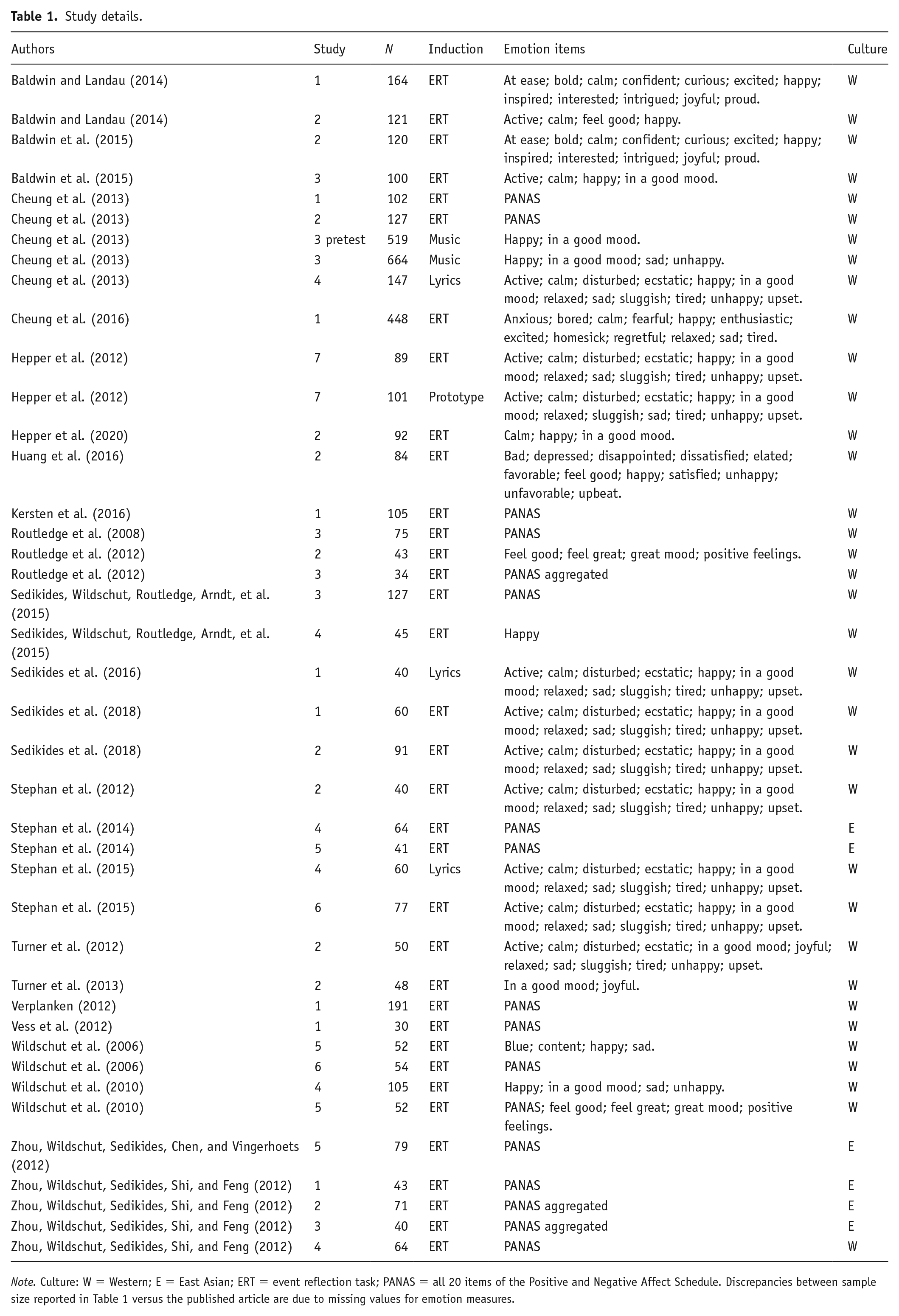
Note. Culture: W = Western; E = East Asian; ERT = event reflection task; PANAS = all 20 items of the Positive and Negative Affect Schedule. Discrepancies between sample size reported in Table 1 versus the published article are due to missing values for emotion measures.
Integrative Data Analysis
Our data have a nested structure; participants (Level 1 units) are nested in experiments (Level 2 units). This data structure is amenable to integrative data analysis (IDA). This meta-analytic technique combines the raw data from a set of studies into a single, larger dataset on which multilevel models are subsequently fitted (Curran & Hussong, 2009; see also Hussong et al., 2010; Lorenz et al., 1997; McArdle et al., 2000). IDA has several advantages over effect-size meta-analysis (Lyman & Kuderer, 2005), two of which are especially pertinent to our investigation. First, IDA permits researchers to conduct analyses on data that were unreported in the original article. None of the published experiments reported effects on affective ambivalence. Hence, in order to study potential effects of nostalgia on ambivalence, we required participant-level data (rather than aggregated data over conditions and/or experiments). Second, IDA has more statistical power than an effect-size meta-analysis (Lambert et al., 2002). In light of the postulated elusiveness and brief duration of ambivalent affect (J. T. Larsen et al., 2001; Watson & Stanton, 2017), the effect of nostalgia is potentially small. In this context, the added statistical power offered by IDA is a welcome advantage.
Construction of Indices
For each participant, we created indices of positive and negative affect. We primarily focused on the emotions “happy” and “sad.” These emotions are considered to be most directly relevant to tests of affective ambivalence because they anchor the opposite ends of the valence or pleasantness dimension (J. T. Larsen et al., 2001; Russell, 2017). For experiments that administered the PANAS, we calculated averages for the Positive Activation and Negative Activation subscales. Furthermore, we created aggregate measures of positive and negative affect by averaging, respectively, all available positive and negative emotions in a certain experiment. Given that studies used different response scales, we transformed all indices to a 10-point scale following Aiken’s (1987) formula.
We assessed ambivalence with the MIN measure (Ersner-Hershfield et al., 2009; J. T. Larsen, Hershfield et al., 2017; Schimmack, 2001), which operationalizes ambivalence as the smaller value of a participant’s positive and negative affect scores (e.g., if positive affect = 4 and negative affect = 3, then MIN = 3). The MIN score reflects coactivation, as it indexes the degree of simultaneously experienced positive and negative affect. Given that calculation of MIN is based on positive and negative affect scores, we could only test the effect of nostalgia on ambivalence in experiments that assessed both. We calculated three MIN variants:
The first was a MIN score based on ratings of “happy” and “sad.” Happiness and sadness feature prominently in descriptions of nostalgia (Sedikides, Wildschut, Routledge, Arndt, et al., 2015), and most research on emotional ambivalence operationalizes it in terms of coactivation of happiness and sadness (J. T. Larsen & Green, 2013; J. T. Larsen et al., 2001; J. T. Larsen, Hershfield et al., 2017). We refer to this gold-standard index of ambivalence as MIN[happy,sad]. Thirteen experiments measured both “happy” and “sad.”
We calculated a second MIN score based on the Positive Activation and Negative Activation subscales of the PANAS. We refer to this index as MIN[PANAS]. We calculated this index only for participants who gave responses to all 20 PANAS items. The PANAS was included in 17 experiments, all of which used the ERT induction. The Positive Activation and Negative Activation subscales share an activation component. Russell (2017) proposed that this shared component may produce covariance between the two subscales and therefore render the PANAS unsuitable for tests of ambivalence. From a different vantage point, Watson and Stanton (2017) argued that affective ambivalence often involves a combination of fear and nervousness (negative activation) with alertness and attentiveness (positive activation), and the PANAS is well suited for detecting this. In our view, the PANAS is informative. Positive activation is associated with approach behavior, and negative activation is associated with avoidance behavior (Watson et al., 1999). Nostalgia, in turn, has been implicated in both approach (Sedikides & Wildschut, 2020; Stephan et al., 2014) and avoidance (Iyer & Jetten, 2011; Wildschut et al., 2019) motivation. We therefore calculated MIN[PANAS] to test whether nostalgia increases ambivalence as measured by the PANAS, which could point to conflicting approach and avoidance tendencies.
We calculated a third MIN score for aggregate positive and negative affect, and we refer to it as MIN[pos,neg]. We were able to calculate this measure in 32 experiments. Given that the item content of these aggregate affect measures varied across experiments, the relevant results should be interpreted with caution.
Moderators
We included four moderators. First, we recorded which of the four nostalgia inductions (i.e., ERT, lyrics, prototype, music) was used in each experiment. Second, we coded the cultural background of participants in each experiment and dichotomized culture into Western (samples consisting of participants from Australia, The Netherlands, the United Kingdom, and the United States) and East Asian (samples consisting of participants from China). Induction type and culture varied between experiments and, accordingly, we treated them as experiment-level (Level 2) moderators. We also retrieved participants’ gender and age as coded in the original dataset, and we treated these as participant-level (Level 1) moderators.
Model Specification
We tested the effects of nostalgia (and moderators) on affect indices with multilevel models, using SAS Proc Mixed Version 14.1 (SAS Institute, 2015). We modelled the dependence among observations within the same experiment by treating the intercept as a random effect. We additionally modelled variation in the effects of participant-level (Level 1) predictors across experiments (Level 2 units) by treating slopes as random effects. This is analogous to a test for heterogeneity of effect sizes in meta-analysis (as indexed by Q or I2 statistics). The participant-level predictors were nostalgia, gender, and age. Following an iterative approach, we first estimated models with variance components for intercepts and slopes. We then trimmed random slopes when there was insufficient variation in the effect of the predictor, as indicated by a variance estimate of zero (accompanied by a warning message that the covariance matrix G is not positive definite). We used a general Satterthwaite approximation for the denominator degrees of freedom (Fai & Cornelius, 1996). Finally, we estimated variance components with the maximum likelihood method.
Effect Size
Consistent with recommendations by the APA Task Force on Statistical Inference (Wilkinson & the Task Force on Statistical Inference, 1999), we report the unstandardized mean differences between conditions as a measure of effect size. Unstandardized effect sizes are parsimonious, do not make assumptions about the variance of the observations, and aid interpretation as they retain the original metric (rather than being standardized to a pooled standard deviation metric; Baguley, 2009; Pek & Flora, 2018). We denote effect sizes as Δ.
Results
Publication Bias and Evidential Value
None of the 41 included experiments had the hedonic character of nostalgia as its primary focus. Hence, researchers had no incentive for selectively reporting significant nostalgia effects on affect measures, and we therefore did not expect publication bias to distort our sample. As a formal test for publication bias, we conducted a p-curve analysis (Simonsohn et al., 2014) of the nostalgia effects on “happy,” which supported the evidential value of the included experiments. Additionally, we calculated the replicability index for nostalgia effects on “happy” and “sad” (Schimmack, 2020). We report the details in the supplemental material (Tables S1–S3, Figure S1).
Positive, Negative, and Ambivalent Affect
We tested the effects of nostalgia on indices of positive, negative, and ambivalent affect. Table 2 presents least squares means (i.e., estimated marginal means) and inferential statistics. We ran models with nostalgia as categorical fixed effect predictor, and included random intercepts for experiments and random slopes for nostalgia. Nostalgia significantly increased “happy,” positive activation, and aggregate positive affect. Nostalgia did not significantly alter “sad,” negative activation, or aggregate negative affect. Thus, results for indices of positive and negative affect revealed a consistent asymmetry: nostalgia increased positive affect, but had no significant impact on negative affect. This asymmetry suggests that nostalgia-induced rises in positive affect are not necessarily accompanied by commensurate drops in negative affect. Still, examining ambivalent affect at the sample level can be misleading, and a valid test should focus on individual-level ambivalence scores. We did so next, by analyzing MIN scores.
Nostalgia main effects on affect indices.
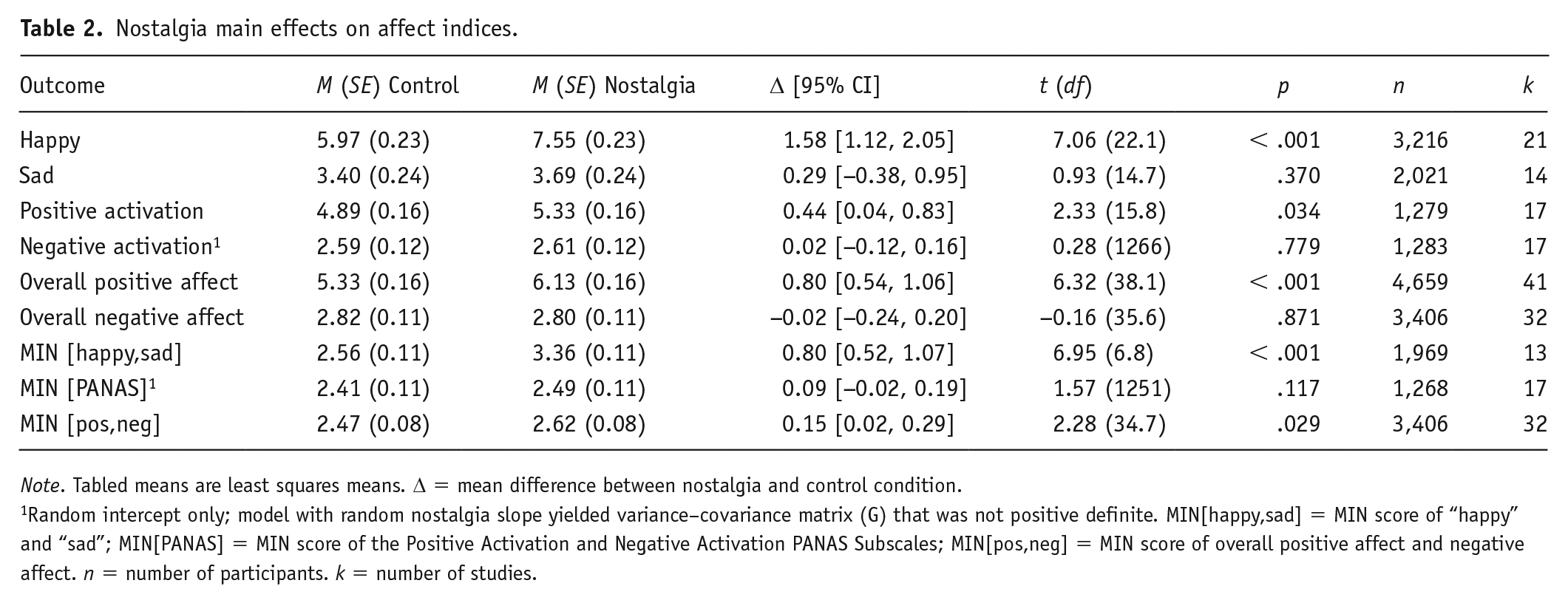
Note. Tabled means are least squares means. Δ = mean difference between nostalgia and control condition.
Random intercept only; model with random nostalgia slope yielded variance–covariance matrix (G) that was not positive definite. MIN[happy,sad] = MIN score of “happy” and “sad”; MIN[PANAS] = MIN score of the Positive Activation and Negative Activation PANAS Subscales; MIN[pos,neg] = MIN score of overall positive affect and negative affect. n = number of participants. k = number of studies.
We first tested the effect of nostalgia on MIN[happy,sad]. Nostalgia (compared to control) significantly increased MIN[happy,sad] scores. There was no significant effect of nostalgia on MIN[PANAS], indicating that nostalgia (compared to control) did not involve the co-occurrence of positive activation and negative activation. Finally, nostalgia (compared to control) significantly increased affective ambivalence scores based on the aggregate measures of positive and negative affect.
Discrete Emotions
We proceeded to analyze the effects of nostalgia on discrete emotions. We ran models with nostalgia as categorical fixed effect predictor, and included random intercepts for experiments and random slopes for nostalgia. Nostalgia significantly increased 24 of the 30 positive emotions (see Table 3 and Figure 1). Nostalgia did not decrease any positive emotion. We also evaluated the effect of nostalgia on these 30 positive emotions using a Bonferroni-corrected α = .0016 (.05 / 30). Using this stringent criterion, nostalgia significantly increased 13 of the 30 discrete positive emotions (and did not decrease any positive emotion). Figure 1 (left panel) presents these results in descending order of effect size.
Nostalgia main effects on positive emotions.
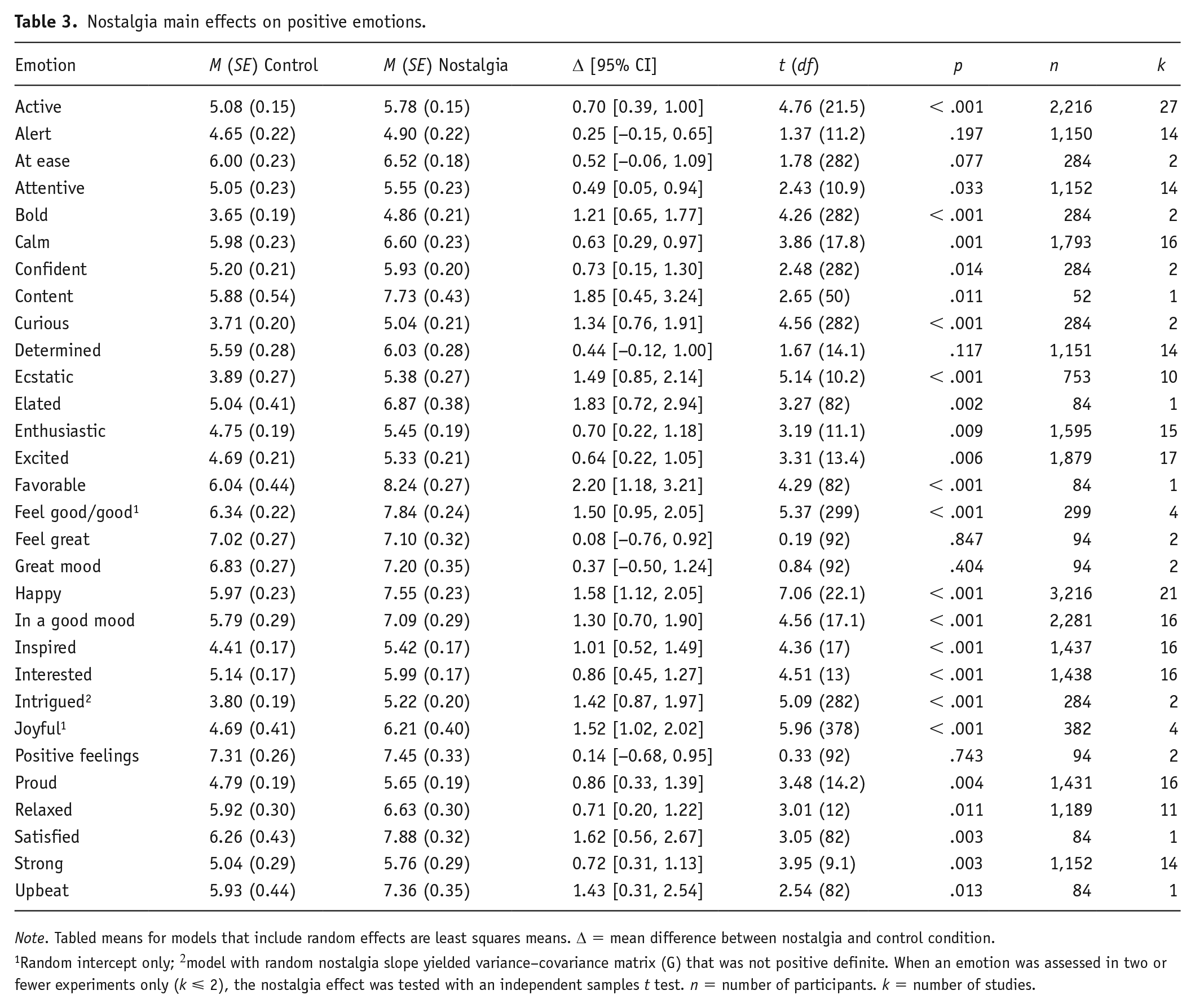
Note. Tabled means for models that include random effects are least squares means. Δ = mean difference between nostalgia and control condition.
Random intercept only; 2model with random nostalgia slope yielded variance–covariance matrix (G) that was not positive definite. When an emotion was assessed in two or fewer experiments only (k ⩽ 2), the nostalgia effect was tested with an independent samples t test. n = number of participants. k = number of studies.
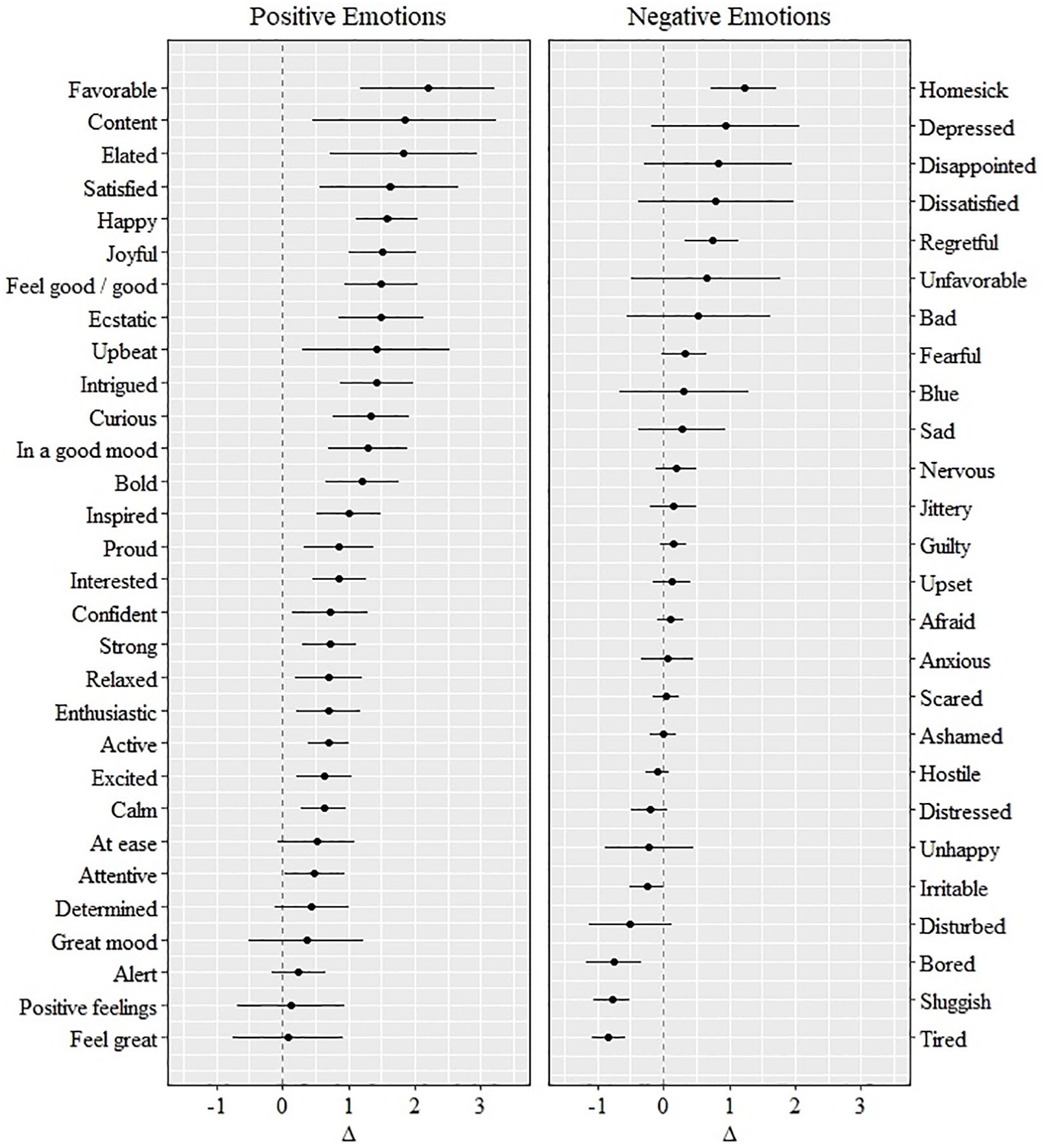
Effect sizes (Δ) and 95% CI for effects of nostalgia on discrete positive (left panel) and negative (right panel) emotions.
The effect of nostalgia on negative emotions was significant only for six of the 26 negative emotions (five effects remained significant with a Bonferroni-corrected α = .0019), and the direction of these significant effects varied (see Table 4). Figure 1 (right panel) orders these results by effect size. Nostalgia (compared to control) increased “homesick” and “regretful,” which were administered in a single study only (Cheung et al., 2016). Indeed, laypersons view regret and homesickness as prototypical features of nostalgia, albeit peripheral ones (Hepper et al., 2012). In contrast, nostalgia (compared to control) decreased “bored,” “irritable,” “sluggish,” and “tired.” With the exception of “irritable,” the latter are deactivated negative emotions. The reduction in these deactivated negative emotions is consistent with nostalgia’s ability to foster an approach orientation and intrinsic motivation (Sedikides & Wildschut, 2016, 2020).
Nostalgia main effects on negative emotions.
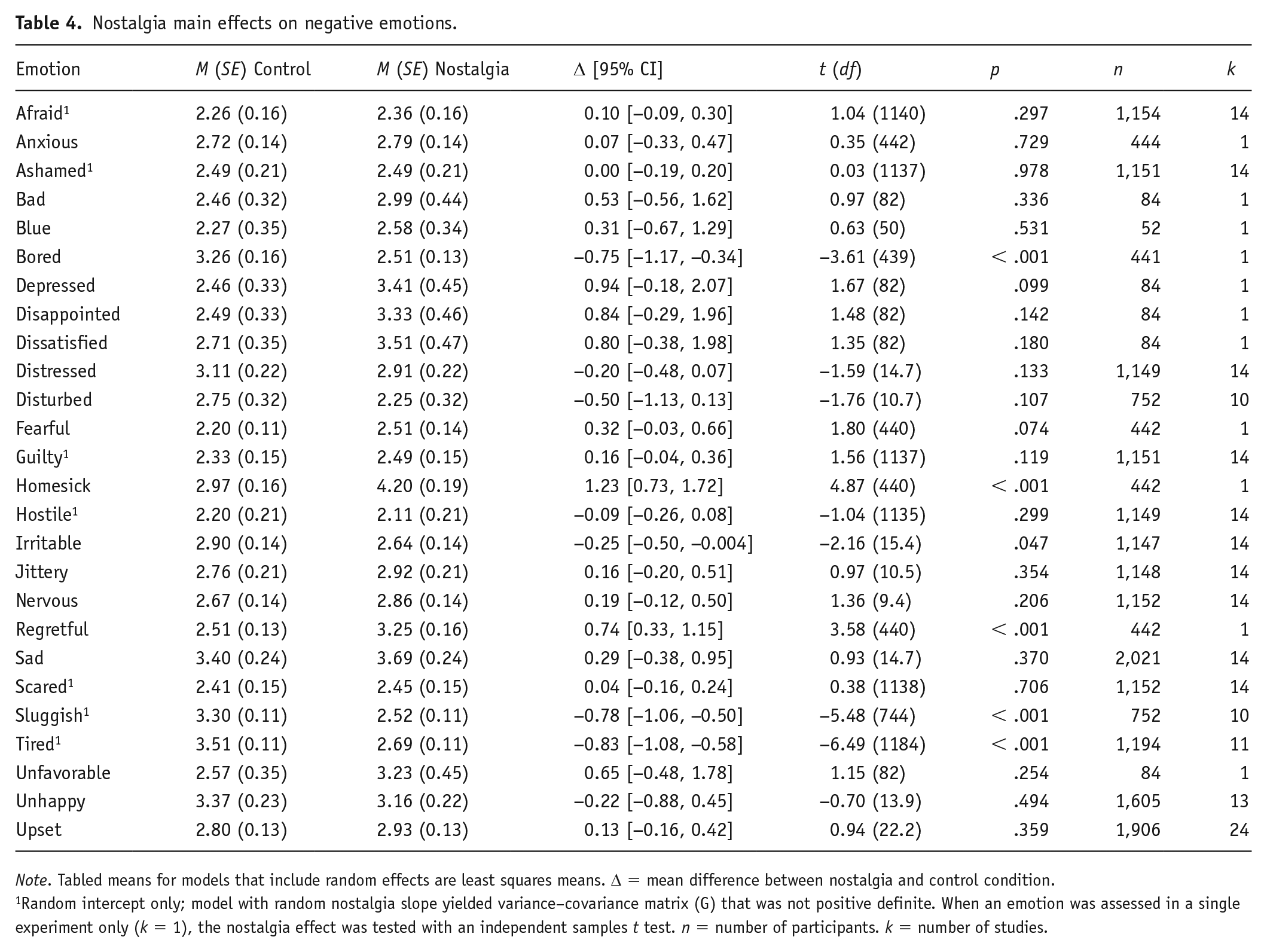
Note. Tabled means for models that include random effects are least squares means. Δ = mean difference between nostalgia and control condition.
Random intercept only; model with random nostalgia slope yielded variance–covariance matrix (G) that was not positive definite. When an emotion was assessed in a single experiment only (k = 1), the nostalgia effect was tested with an independent samples t test. n = number of participants. k = number of studies.
Overall, results for discrete emotions (again) show a clear asymmetry. Whereas nostalgia consistently elevated a wide range of positive emotions, its effect on discrete negative emotions was variable and, in most cases, not statistically significant.
Moderation
Induction type
First, we tested whether induction type moderated the effect of nostalgia on “happy,” “sad,” and ambivalent affect (MIN[happy,sad]). We ran models with nostalgia, induction type, and the Nostalgia × Induction Type interaction as categorical fixed effect predictors. We included random intercepts for experiments and random slopes for nostalgia. Results revealed significant Nostalgia × Induction Type interaction effects on “happy,” F(3, 18.4) = 6.62, p = .003; “sad,” F(3, 2006) = 29.18, p < .001; and ambivalent, F(3, 1953) = 5.38, p = .001, affect.
To examine the moderating role of induction type in detail, we probed the significant Nostalgia × Induction Type interactions with tests of simple effects (see Table 5 and Figure 2). Nostalgia (compared to control) increased happiness in ERT, lyrics, and prototype experiments, but it had no significant effect on happiness in music experiments. Nostalgia increased sadness in ERT and music experiments, but decreased sadness in lyrics and prototype experiments. Finally, nostalgia increased ambivalent affect in ERT and music experiments, but it had no effect on ambivalence in lyrics and prototype experiments. Induction type moderated the magnitude and, for sadness, even the direction of nostalgia’s effects. 1
Simple nostalgia effects on “happy,” “sad,” and ambivalence (MIN[happy,sad]) within induction types.
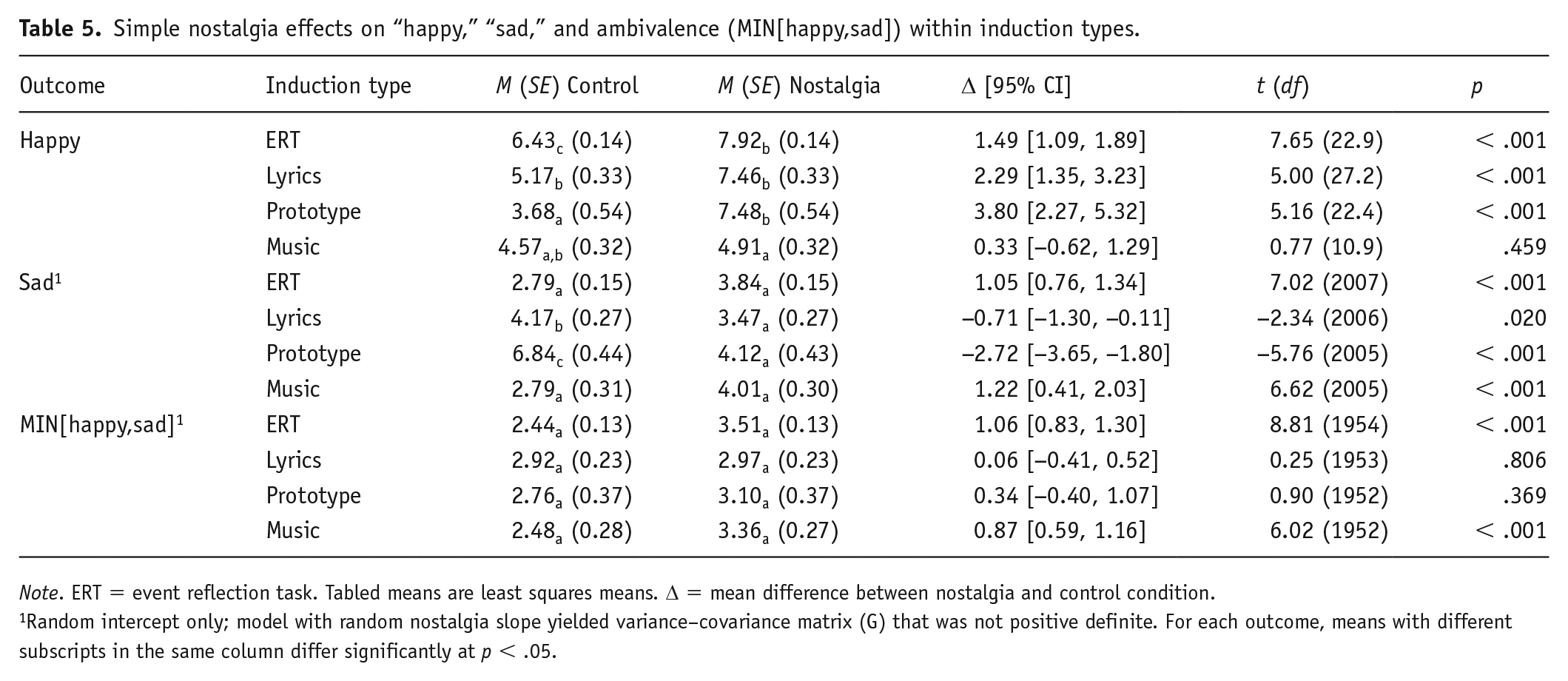
Note. ERT = event reflection task. Tabled means are least squares means. Δ = mean difference between nostalgia and control condition.
Random intercept only; model with random nostalgia slope yielded variance–covariance matrix (G) that was not positive definite. For each outcome, means with different subscripts in the same column differ significantly at p < .05.
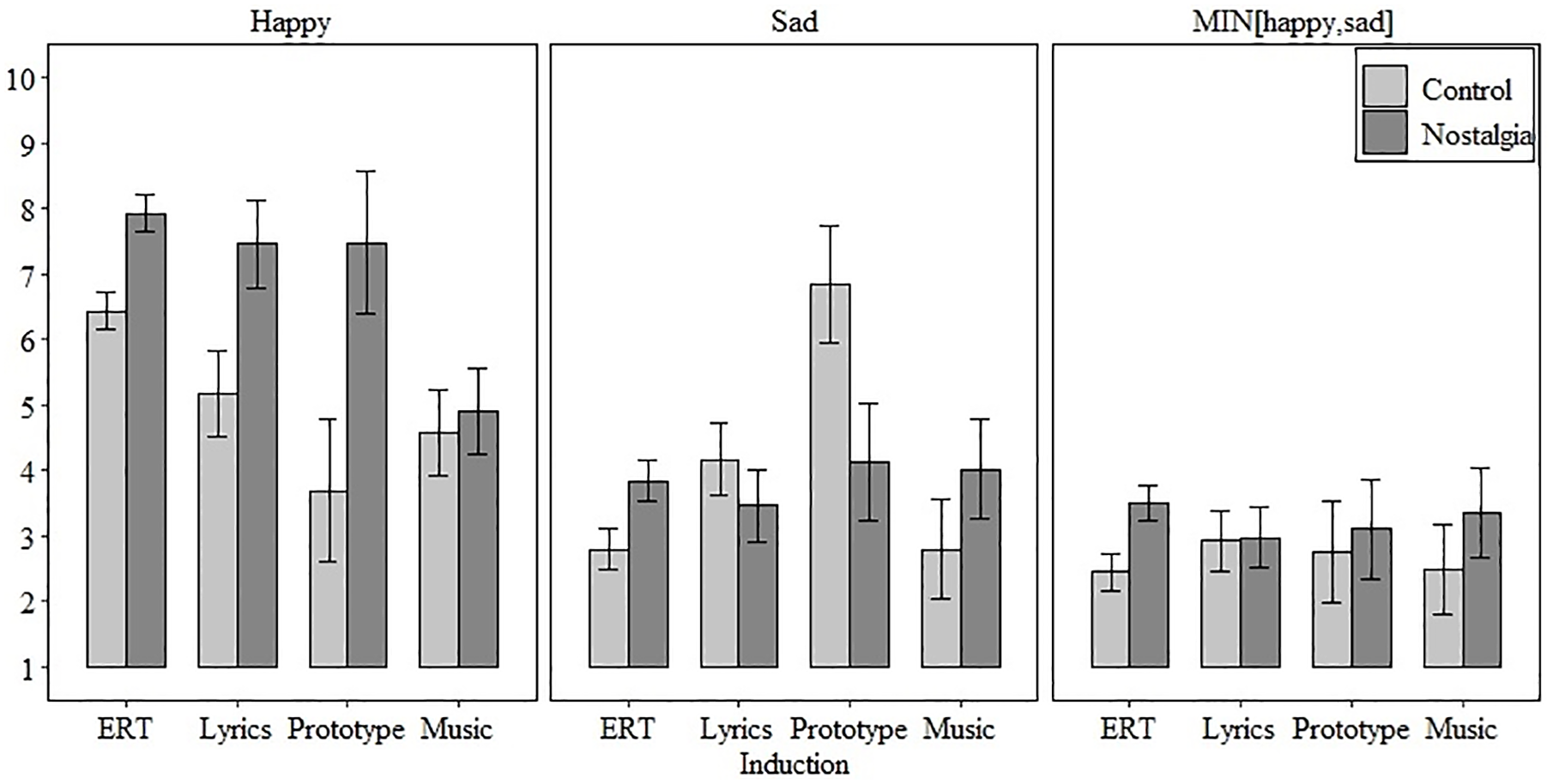
Mean levels of “happy” (left panel), “sad” (middle panel), and affective ambivalence (MIN[happy,sad]; right panel) in the nostalgia and control conditions as a function of induction type (least squares means).
We also tested the simple effects of induction type separately in the nostalgia and control conditions (see Table 5 and Figure 2). We did so with the proviso that, because participants were not randomly assigned to experiments, these results do not support causal inferences. Happiness varied significantly as a function of induction type in both the nostalgia, F(3, 36.5) = 24.76, p < .001 and control, F(3, 37.5) = 17.54, p < .001 conditions. In the nostalgia condition, the music induction was associated with lower levels of happiness than the other three inductions, which did not differ significantly from each other. In the control condition, the ERT and prototype inductions were associated with particularly high and low levels of happiness, respectively. The lyrics and music inductions were intermediate and did not differ significantly from each other. Sadness did not vary significantly as a function of induction type in the nostalgia condition, F(3, 13) = 0.87, p = .482, but did so in the control condition, F(3, 13.7) = 30.12, p < .001. In the control condition, the prototype induction was associated with the highest level of sadness, followed by the lyrics induction. The ERT and music inductions, in contrast, were characterized by identically low levels of sadness.
Ambivalence did not vary significantly between induction types in either the nostalgia, F(3, 11) = 1.55, p = .256 or control, F(3, 11.5) = 1.18, p = .359 condition. The pattern of means indicates that in the nostalgia condition, ambivalence was relatively higher with the ERT and music (than the lyrics and prototype) inductions. In the control condition, this pattern was reversed. The net result of these contrasting patterns was a stronger (and significant) effect of nostalgia (compared to control) on ambivalence with the ERT and music inductions, as reported before (see Table 5 and Figure 2). 2
The distinctions between induction types are brought into clear view when examining the difference between ratings of “happy” and “sad” (“happy” – “sad;” Table 6). 3 We entered the difference score as dependent variable in a model with nostalgia, induction type, and the Nostalgia × Induction Type interaction as predictors. This analysis revealed significant nostalgia, F(1, 9.09) = 63.98, p < .001 and induction type, F(3, 10.3) = 21.09, p < .001 main effects, which were qualified by a significant Nostalgia × Induction Type interaction, F(3, 6.49) = 22.69, p < .001. Happiness generally exceeded sadness. Following Cacioppo and Berntson (1994), we label this difference positivity offset. Tests of simple nostalgia effects revealed that nostalgia (compared to control) increased the positivity offset in lyrics and prototype experiments, but not in ERT or music experiments. Tests of simple induction-type effects showed that the positivity offset varied as a function of induction type in both the nostalgia, F(3, 17.2) = 7.98, p = .002 and control, F(3, 17.9) = 35.40, p < .001 conditions. In the nostalgia condition, the music induction was associated with a smaller positive offset than the other three inductions, which did not differ significantly from each other. In the control condition, the prototype induction was associated with a significant reversal of the positivity offset (i.e., negativity offset). The other inductions each showed a significant positivity offset, with the ERT exceeding the lyrics and music inductions, which did not differ from each other. These findings (a) cast doubt on the suitability of the control condition in prototype experiments, and (b) indicate that nostalgia and control conditions are closely matched on positivity offset in ERT and music experiments.
Simple nostalgia effects on the difference between “happy” and “sad” (positivity offset) within induction types.
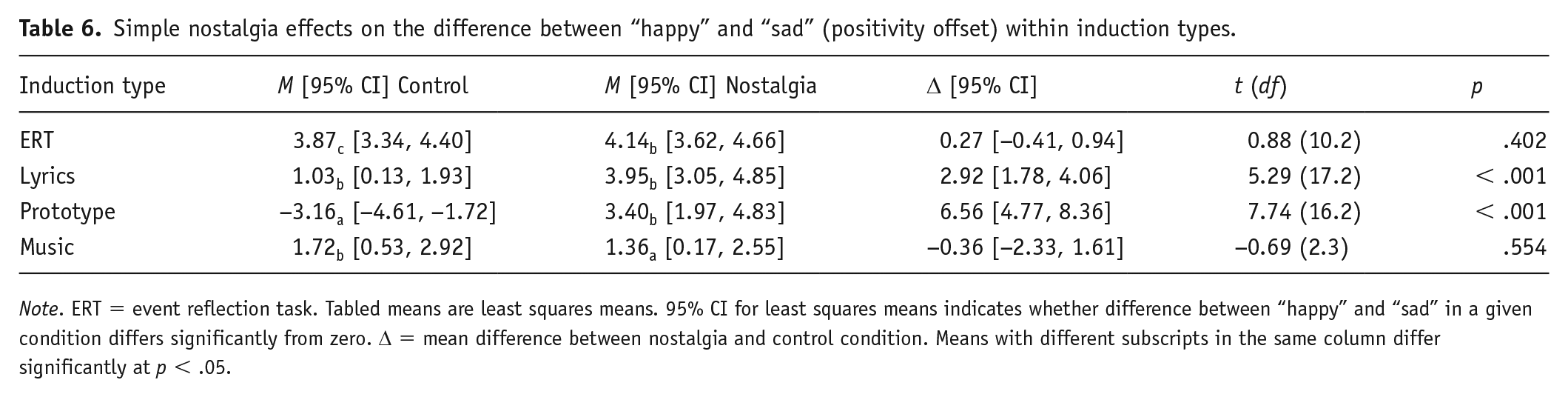
Note. ERT = event reflection task. Tabled means are least squares means. 95% CI for least squares means indicates whether difference between “happy” and “sad” in a given condition differs significantly from zero. Δ = mean difference between nostalgia and control condition. Means with different subscripts in the same column differ significantly at p < .05.
Culture
All six experiments with East Asian participants (East Asian experiments) used the ERT induction and administered the PANAS only. To keep induction type and item content constant, we compared these East Asian experiments to the 11 Western ERT experiments that administered the PANAS. We included nostalgia, culture, and the Nostalgia × Culture interaction as categorical fixed effect predictors. We included random intercepts for experiments and random slopes for nostalgia. Culture did not significantly moderate the effects of nostalgia in ERT experiments. The Nostalgia × Culture interaction was not significant for positive activation, F(1, 17.1) = 0.67, p = .425; negative activation, F(1, 1266) = 0.49, p = .482; or ambivalence, MIN[PANAS]; F(1, 1251) = 0.65, p = .456. In addition, results did not reveal any significant culture main effects (Fs < 1). Within the set of ERT experiments that administered the PANAS, we found no evidence of cultural differences.
Gender
The distribution of gender across induction types was unbalanced, χ2(3, N = 4,583) = 88.76, p < .001, ϕ = .14. That is, gender was associated, or confounded, with induction type. We therefore included nostalgia, gender, and the Nostalgia × Gender interaction as categorical fixed effect predictors, and controlled for induction type and the Nostalgia × Induction Type interaction (also as categorical fixed effects). We modelled random intercepts for experiments and random slopes for nostalgia and gender. 4 Gender did not moderate the nostalgia effect on “happy”—the Nostalgia × Gender interaction was not significant, F(1, 3130) = 0.70, p = .402. However, gender did moderate the nostalgia effect on “sad,” F(1, 1960) = 3.95, p = .047. Men reported significantly less sadness in the nostalgia than in the control condition. Women, however, did not report less sadness in the nostalgia than in the control condition. From a different angle, women reported more sadness than men in the nostalgia condition, but not in the control condition (see Table 7). Gender also moderated the nostalgia effect on ambivalence (MIN[happy,sad]), F(1, 1906) = 4.23, p = .040. Nostalgia increased ambivalence for both women and men, but the effect was stronger for women. In alternative terms, women reported greater ambivalence than men in the nostalgia condition, but not in the control condition (see Table 7). 5 The greater sadness and ambivalence (but not lower happiness) experienced by women (compared to men) in the nostalgia condition is consistent with extant evidence for greater sadness among women but equal happiness across genders—a pattern of findings that may derive from women’s higher emotional intensity (Brebner, 2003; Fujita et al., 1991). The absence of gender differences in the control condition suggests that, as intended, this condition generally did not evoke strong emotions.
Simple nostalgia effects on “happy,” “sad,” and ambivalence (MIN[happy,sad]) within gender, controlling for induction type.
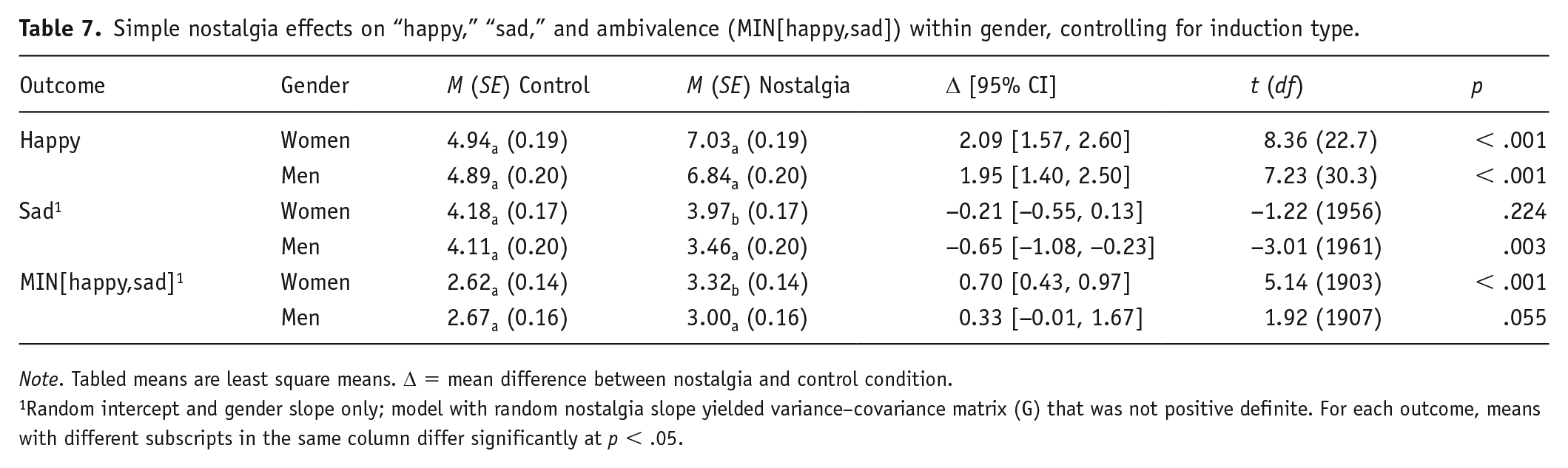
Note. Tabled means are least square means. Δ = mean difference between nostalgia and control condition.
Random intercept and gender slope only; model with random nostalgia slope yielded variance–covariance matrix (G) that was not positive definite. For each outcome, means with different subscripts in the same column differ significantly at p < .05.
Age
The distribution of age across induction types was severely unbalanced. To illustrate this, we divided the sample into younger adult (< 35 years; n = 3,037), middle aged (36–55 years; n = 204), and older adult (> 55 years; n = 101) groups (135 missing age information). Age group was strongly associated with induction type, χ2(6, N = 4,524) = 1,554.82, p < .001, ϕ = .59. The combined ERT and music experiments, for instance, comprised nearly all (89%) older adult participants. To control for the association between age and induction type, we followed the same analytic strategy as for gender (see previous lines). We included nostalgia, age (mean-centered), and the Nostalgia × Age interaction as fixed effect predictors, and controlled for induction type and the Nostalgia × Induction Type interaction. We modelled random intercepts for experiments and random slopes for nostalgia and age. Age did not significantly moderate any nostalgia effects. The Nostalgia × Age interaction was not significant for “happy,” F(1, 1919) = 1.73, p = .188; “sad,” F(1, 1907) = 0.00, p = .987; or ambivalence, MIN[happy,sad]; F(1, 1854) = 0.31, p = .579. However, results revealed significant age main effects. Age was positively associated with happiness, B = 0.015, SE = .003, F(1, 2397) = 20.66, p < .001; negatively associated with sadness, B = −0.009, SE = .004, F(1, 946) = 4.83, p = .028; and negatively associated with ambivalence, B = −0.008, SE = .003, F(1, 715) = 6.60, p = .010. These findings offer qualified support for the prediction that nostalgia is relatively more positive and less ambivalent for older (compared to younger) adults. Whereas older participants indeed reported more happiness, less sadness, and less ambivalence in the nostalgia condition, they also did so in the control condition. This suggests that older (compared to younger) adults find greater enjoyment in both nostalgic and nonnostalgic evocations of the past, which could be one reason why positive affect in daily life stays constant (Carstensen et al., 2000; Charles et al., 2001) or even increases (Mroczek & Kolarz, 1998) with age.
Discussion
We combined data from 41 experiments to examine the hedonic character of nostalgia. Nostalgia increased happiness and ambivalent affect, but did not significantly alter sadness. Our findings are consistent with the evaluative space model, which allows for the coactivation of positive and negative affect (i.e., ambivalence; Cacioppo et al., 1999), but not with the circumplex model, which conceptualizes valence as a bipolar dimension (L. F. Barrett & Russell, 1999). The magnitude and direction of nostalgia’s effects, however, were qualified by induction type and, to a lesser extent, participant gender. These moderations are consistent with constructionist theories of emotions, which propose that any given emotion can have many different forms (L. F. Barrett et al., 2015). According to the constructionist perspective, emotions involve sense-making processes in which sensory input and conceptual knowledge jointly result in the phenomenological experience of emotions (Lindquist, 2013). These processes can give rise to subtle variations in nostalgia.
Variations in Nostalgia
The primary source of systematic variation in nostalgia’s hedonic character was induction type. Nostalgia (compared to control) increased happiness in ERT, lyrics, and prototype experiments, but not in music experiments. Furthermore, nostalgia (compared to control) increased sadness in ERT and music experiments, but reduced it in lyrics and prototype experiments. Most importantly, given our key objective, nostalgia (compared to control) increased affective ambivalence in ERT and music experiments, but not in lyrics and prototype experiments. Yet, certain regularities can be discerned. Tests of simple induction-type effects within the nostalgia condition revealed that differences were often small and nonsignificant. Irrespective of induction type, nostalgia was associated with moderate levels of sadness (range: Mlyrics = 3.47 to Mprototype = 4.12) and ambivalence (range: Mlyrics = 2.97 to MERT = 3.51). Furthermore, irrespective of induction type, nostalgia was associated with a significant positivity offset (although its magnitude varied as a function of induction type; range: Mmusic = 1.36 to MERT = 4.14). Even for happiness there was considerable consistency; nostalgia was associated with high levels of happiness in ERT, lyrics, and prototype experiments (range: Mlyrics = 7.46 to MERT = 7.92). We discuss the surprising exception to this happiness pattern in music experiments in what follows. In all, these findings indicate that, for all its diversity, nostalgia is a predominantly positive and moderately ambivalent emotion.
We acknowledge two caveats. First, participants were not randomly assigned to experiments, reducing the reliability of differences (or the absence thereof) between induction types. Second, nostalgia conditions do not exist in isolation, but acquire meaning in comparison to control conditions. These control conditions elicited variable levels of sadness and happiness as a function of induction type. Much of this variability was attributable to the control condition in the prototype experiment, which was associated with the most sadness and least happiness, and yielded a significant negativity offset. Accordingly, the large nostalgia effects on happiness and sadness (and nonsignificant effect on ambivalence) in the prototype experiment should be interpreted in light of the unusual control condition.
Our findings spotlighted two atypical cells within the Nostalgia × Induction Type “design”: the nostalgia condition in music experiments (compared to other nostalgia conditions) and the control condition in the prototype experiment (compared to other control conditions). Both music experiments used the same two songs to manipulate nostalgia (Cheung et al., 2013). In the nostalgic song, “Het Dorp” (“The Village”), the nostalgic theme of longing for a lost past is prominent. The control song, “Nikkelen Nelis” (“Nickeled Nelis”), has a cheerful theme. The emphasis on irretrievable loss (i.e., wholesome village life erased by urbanization) may account for the relatively low levels of happiness associated with the nostalgic song. More important, by relying on a single song to operationalize music-evoked nostalgia, these experiments are subject to the perils of insufficient stimulus sampling (Judd et al., 2012). A single song cannot adequately capture the theoretical domain of interest (music-evoked nostalgia) and, hence, results are inevitably biased by idiosyncratic aspects of the selected stimulus. This is compounded by the fact that the control condition also relied on a single song only. Nevertheless, music is a potent nostalgia trigger (F. S. Barrett et al., 2010; F. S. Barrett & Janata, 2016), and we recommend that researchers continue to use and refine music-evoked nostalgia inductions. Incorporating extensive stimulus sampling in these procedures is a high methodological priority.
Our collection of experiments included a single prototype experiment (Hepper et al., 2012). Participants in the nostalgia condition were provided with 12 central features of nostalgia, and those in the control condition received 12 peripheral features. Participants were then instructed to recall and describe an autobiographical event that was characterized by at least five of the features in their allocated set. Inspection of these features suggests a possible confound between centrality and valence, such that the peripheral (compared to central) set included several unmistakably negative features (e.g., “feeling sad,” “bad memories”). It is perhaps not surprising, then, that this control condition was associated with a negativity offset. The prototype induction has strengths (e.g., it does not require participants to be familiar with the word “nostalgia”) but requires further improvement. For example, participants could be presented with feature sets that are smaller and matched in valence.
A second source of systematic variation in the hedonic character of nostalgia was participant gender. Gender did not moderate the effect of nostalgia on happiness. For both men and women, nostalgia (compared to control) increased happiness. From a different angle, there was no gender difference in happiness in either the nostalgia or the control condition. Gender did, however, moderate the nostalgia effect on sadness. Whereas nostalgia (compared to control) reduced sadness for men, it did not have this beneficial effect for women. In alternative terms, women reported more sadness than men in the nostalgia condition but did not differ from them in the control condition. These results are compatible with prior findings that, compared to men, women experience similar (Batz-Barbarich et al., 2018) or higher (Blanchflower & Oswald, 2004) levels of happiness, but are more prone to sadness and negative affect (Feingold, 1994; Zuckerman et al., 2017). These asymmetrical gender differences may stem from women’s higher emotional intensity (Diener et al., 1985). Emotional intensity refers to one’s strength of response to emotional stimuli, and pertains to both positive and negative emotional experiences (R. J. Larsen & Diener, 1987). Fujita et al. (1991) proposed that women’s more intensely felt happiness balances their higher levels of sadness. To the extent that emotional intensity entails coactivation of positive and negative emotions, women’s greater emotional intensity is consistent with our finding that nostalgia (compared to control) evoked higher levels of affective ambivalence for women than for men.
Ambivalence and the Function of Nostalgia
The ambivalent hedonic character of nostalgia can provide clues to its functional value. The dynamic model of affect (Zautra et al., 2000) and the coactivation model of health (J. T. Larsen et al., 2003) point to the resilience and coping functions of ambivalent affect. According to the dynamic model of affect, positive and negative affect function to provide information about one’s immediate environment that is relevant to one’s well-being. In calm and predictable times, positive and negative affect are relatively independent. However, during times of stress, an attentional shift occurs where negative affect gains priority, resulting in a stronger inverse association between positive and negative affect (Davis et al., 2004; Zautra et al., 2002). The key to maintaining psychological well-being during times of stress is the “uncoupling” of positive and negative affect (Reich et al., 2003, p. 77). This uncoupling allows one to experience positive and negative affect simultaneously, and this emotional complexity is a key driver to cope with stressful life circumstances. For example, dispositional resilience is positively associated with emotional ambivalence (Ong & Bergeman, 2004), emotional ambivalence is positively associated with resilience during bereavement (Coifman et al., 2007), and emotional ambivalence is positively associated with psychological well-being during psychotherapy (Adler & Hershfield, 2012). The coactivation model of health similarly proposes that ambivalent affect facilitates coping with stressful life events (J. T. Larsen et al., 2003). The results of a 10-year longitudinal study are consistent with the idea that ambivalent affect is positively associated with well-being (Hershfield et al., 2013). The ability to tolerate and harness emotional ambivalence, then, is a resource for coping with stressful life experiences (Lindquist & Barrett, 2008; Ong et al., 2009).
Research on the psychological functions of nostalgia dovetails with the demonstrated benefits of emotional ambivalence. Ambivalent affect could influence cognitive flexibility (Mejía & Hooker, 2017; Rothman & Melwani, 2017). Ambivalent affect facilitates contradictory appraisals of a situation (e.g., certain and uncertain, under control and not under control). This, in turn, may activate a wider range of (atypical) information, give awareness to new priorities, and encourage the pursuit of novel options (Mejía & Hooker, 2017; Rothman & Melwani, 2017). Indeed, emotional ambivalence (e.g., recalling an event such as a graduation) fosters creativity (Fong, 2006). This literature is in line with findings illustrating that nostalgia boosts inspiration (Stephan et al., 2015) and creativity (van Tilburg et al., 2015). In addition, emotional ambivalence (i.e., the blend of positive and negative emotions) enhances judgmental accuracy (Rees et al., 2013). Nostalgia may do the same. By extrapolation, nostalgia may also aid in decision making by reducing susceptibility to biases such as anchoring, escalation of commitment (Rothman & Melwani, 2017), or risk aversion (Zou et al., 2019).
Nostalgia is triggered by stressful experiences, such as loneliness (Zhou et al., 2008), meaninglessness (Routledge et al., 2011), and identity discontinuity (Sedikides, Wildschut, Routledge, & Arndt, 2015). In turn, nostalgia restores a sense of social connectedness (Sedikides & Wildschut, 2019; Wildschut et al., 2011), meaningfulness (Leunissen et al., 2018; Sedikides & Wildschut, 2018), and identity continuity (Sedikides et al., 2016; van Tilburg, Sedikides, et al., 2019). Nostalgia has a similar function in the workplace, counteracting the deleterious effects of low procedural justice on cooperation (van Dijke et al., 2015), and the detrimental effects of low interactional justice on intrinsic motivation (van Dijke et al., 2019). In all, the extant literature supports the notion that nostalgia acts as a coping resource for stressful life experiences. A key direction for future research is to substantiate the postulated role of affective ambivalence in mediating nostalgia’s capacity to enhance cognitive flexibility and foster resilience to adversity. Testing such mediational models poses theoretical and methodological challenges (Spencer et al., 2005), not least because the effect of nostalgia on affective ambivalence was relatively small, even at its strongest point (i.e., in ERT experiments). Nevertheless, even small, short-term effects can produce larger, long-term benefits (Cohen & Sherman, 2014; Walton & Wilson, 2018).
Concluding Remarks
The recent accumulation of quantitative data allowed us to assess empirical support for the notion that nostalgia is an ambivalent emotion, thus addressing its hedonic character. Our work highlights the ambivalent, yet predominantly positive, character of the emotion. Nostalgia is a bittersweet emotion, but more sweet than bitter.
Supplemental Material
Supplementary_Materials_Nostalgia_IDA_2nd_revision_V2 – Supplemental material for The Hedonic Character of Nostalgia: An Integrative Data Analysis
Supplemental material, Supplementary_Materials_Nostalgia_IDA_2nd_revision_V2 for The Hedonic Character of Nostalgia: An Integrative Data Analysis by Joost Leunissen, Tim Wildschut, Constantine Sedikides and Clay Routledge in Emotion Review
Footnotes
Declaration of Conflicting Interests
The author(s) declared no potential conflicts of interest with respect to the research, authorship, and/or publication of this article.
Funding
The author(s) received no financial support for the research, authorship, and/or publication of this article.
Supplemental Material
Supplemental material for this article is available online.
Notes
References
Supplementary Material
Please find the following supplemental material available below.
For Open Access articles published under a Creative Commons License, all supplemental material carries the same license as the article it is associated with.
For non-Open Access articles published, all supplemental material carries a non-exclusive license, and permission requests for re-use of supplemental material or any part of supplemental material shall be sent directly to the copyright owner as specified in the copyright notice associated with the article.
