




Abstract
Background
Sufficient exposure to rarer medical problems around pregnancy is a challenge during short rotations in obstetric medicine (OM). A Canadian research group created online clinical cases, the CanCOM cases, to overcome this.
Methods
We conducted an exploratory study to document the use and perceived utility of the CanCOM cases. 77 residents doing an OM rotation participated in our study. We used a survey to document their perception of CanCOM cases (12 items, 7-point scale), clinical exposure to several conditions (pre and post rotation; 41 items, 7-point scale) and use of the educational tool (1 item, 4-option scale).
Results
CanCOM cases was perceived as an accessible and useful tool. Participants completed a median of 6/20 cases (range 1–20), and highly recommended the cases (6.48 ± 0.73 SD on a 7-point Likert scale).
Conclusion
Despite some technical limitations, CanCOM cases was shown to contribute to clinical exposure to rare but essential medical conditions.
Introduction
Over the last few decades, conditions around pregnancies have greatly changed and have resulted in a considerable evolution to the care provided to pregnant women, particularly in developed countries.1–3 Obesity, advanced maternal age above 40 years-old, and the use of assisted reproductive technologies, among others, are associated with higher risks of medical complications during pregnancy.4–8 As a result, medical causes such as cardiovascular disease are responsible for 75% of all maternal deaths in the developed world.5–8
It is unsurprising that medical conditions in pregnancy are considered an essential component of the curriculum of health care providers caring for high-risk pregnant women in several countries including Canada and the United Kingdom.3,9 In a previous survey-based study, Canadian general internists in their first decade of practice identified a large difference between training in medical problems of pregnancy (26% in agreement) and importance in practice (61% in agreement). 10 A subsequent survey targeting a similar group of Canadian general internists showed that a majority considered obstetric medicine as an area that required proficiency rather than expertise. 11 The Royal College of Physicians and Surgeons of Canada (RCPSC) has since defined which obstetric medicine competencies are required in general internal medicine (GIM) residency programs. In parallel, a national validation of curriculum content was undertaken by the Canadian Consensus for a curriculum in Obstetric Medicine in Canada (CanCOM), subject-matter experts and other stakeholders.12–14
Specialists in obstetric medicine (OM) have observed difficulties exposing residents to all the essential conditions of obstetric medicine through the short 1–2 months rotations they have in their 2 years GIM training. Given the limited exposure to medical problems around pregnancy, members of the CanCOM group agreed that extra learning opportunities need to be provided to trainees. The development of a web-based educational tool to optimize the teaching of medical problems around in pregnancy to residents in GIM was informed by several considerations. 15 E-learning interventions have the potential to provide an authentic and experiential learning opportunity to increase the effectiveness of educational interventions and improve patient care.16–19 Previous work has suggested that learners with a divergent or balanced learning style displayed the greatest gain in knowledge in a high-fidelity simulation activity during nursing studies. 20 Thus, a web-based educational learning tool was created, the CanCOM cases, in order to increase trainees’ exposure to medical problems around pregnancy during their OM rotations.
Objective
The overall purpose of this study is to describe whether the CanCOM cases present an added value to increase residents’ clinical exposure. Our specific objectives are to document (1) exposure to essential medical conditions in pregnancy; (2) perceived accessibility and flexibility of the educational tool; and (3) achievement of personal learning objectives related to the rotation.
Methods
We conducted a multi-site (n = 7) exploratory study. Ethical approval was obtained with the University of Sherbrooke (REB approval #2016-32) as well as in participating sites. Participant consent was obtained for this study.
Study sample
Our study population was composed of residents doing a rotation in OM in one of seven tertiary care centers with over 2000 deliveries/year (Université de Sherbrooke (CHUS), Université de Montréal (CHU Ste-Justine and CHUM), McGill University (MUHC), University of Alberta (Royal Alexandra Hospital), University of Calgary (Foothills Medical Center) and University of British Columbia (BC Women's Hospital from January 2017 to January 2019. Residents were invited via email to participate in the study with administrative support from their program. OM rotation directors at each site gave their agreement for this recruitment, explained the research project to the residents, and answered their questions.
Development of a web-based educational tool- the CanCOM cases
The CanCOM cases is a web-based educational tool that includes 20 different clinical vignettes. Case content was aligned with the essential content items that were identified in the OM curriculum content blueprint by subject-matter experts during the validation phase. 15 The cases were conceived by ten pairs of Canadian specialists in OM.
According to the template created by conceptors of the CanCOM cases, each clinical case provides an inpatient or outpatient evolving scenario that allows the resident to receive information while performing their case analysis.
All information related to diagnostic tests requires the interpretation of raw results to better simulate a real clinical case. Each stage of the case is accompanied by specific learning objectives. In addition, multiple choice and open-ended questions assist the resident in their diagnostic reasoning process. A marked response to the multiple choice questions is provided once the user has selected an answer so that immediate feedback can be given. When relevant, one or more references are provided to give residents the opportunity to acquire knowledge related to the questions and take their learning further.
The creation of the web-based educational platform was informed by a review of other initiatives that highlight technology at the service of medical education.21–23 These studies and the New England Journal of Medicine Interactive medical cases were used as models to develop our web platform and case format.
Questionnaires
Sociodemographic questionnaire
A socio-demographic questionnaire was used to document year of training (Post-Graduate Year 4 or 5 (PGY4-5); timing of their rotation (before or after their certification examination); and motivation towards using the CanCOM cases and towards the OM rotation.
Perceived usefulness questionnaire
Twelve statements with a 7-point Likert scale (from 1 completely disagree to 7 completely agree). 24
Clinical exposure questionnaire
Residents had to indicate which clinical conditions they have been exposed to from a list that mirrors the CanCOM blueprint, as well as the type or setting of exposure (inpatient, outpatient, journal club, CanCOM clinical cases, independent reading, etc.).
Data collection
Data collection occurred from January 1, 2017 to January 31, 2019. One week before the start of their rotation, residents received an invitation to participate in the study. It provided the project's objectives, the hyperlink to the CanCOM cases, as well as a user code, and a link to the socio-demographic questionnaire. If interested, they signed the electronically consent form. The clinical supervisors in OM had the opportunity to discuss this project with their residents.
The week before the end of their rotation, a second email was sent to the respondents of the socio-demographic questionnaire to invite them to complete the clinical exposure and perceived usefulness questionnaires. Two reminders were sent, spaced between 15- and 25-days post rotation.
Statistical analyses
We performed basic descriptive statistics including means, standard deviations and percentages. When the distributions were skewed, we also presented the median values.
Results
Seventy-seven residents agreed to participate from one of the seven sites targeted by the study. A majority of 86.9% were from three participating sites in Quebec. One study site did not recruit during the study period. Sociodemographic data are presented in Table 1.
Sociodemographic data of 23 participants who completed Q1, Q2 and used CanCOM cases.
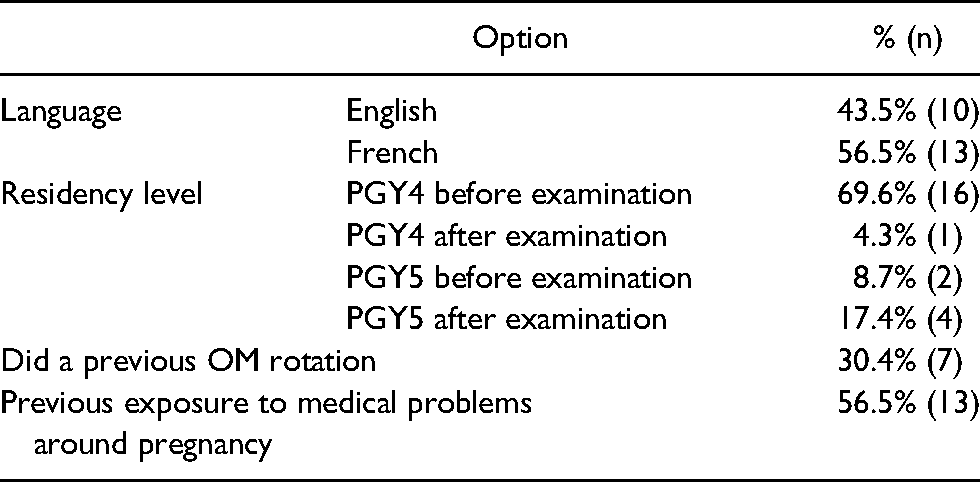
Most participants (69.6%) were PGY4 level residents that had not completed their certification examination. Only 30.4% of them had done a previous Obstetric Medicine rotation. 13 residents (56.5%) had some previous exposure to medical diseases in pregnancy in other non-OM rotations.
At the end of their rotation period, 84.4% (65) of the participants answered to the “perceived usefulness questionnaire” and 42.9% (33) answered both (perceived usefulness and clinical exposure). 74.0% (57) consulted the CanCOM clinical cases and 29.9% (23) of participants completed all questionnaires and consulted the CanCOM cases during the study (Figure 1).
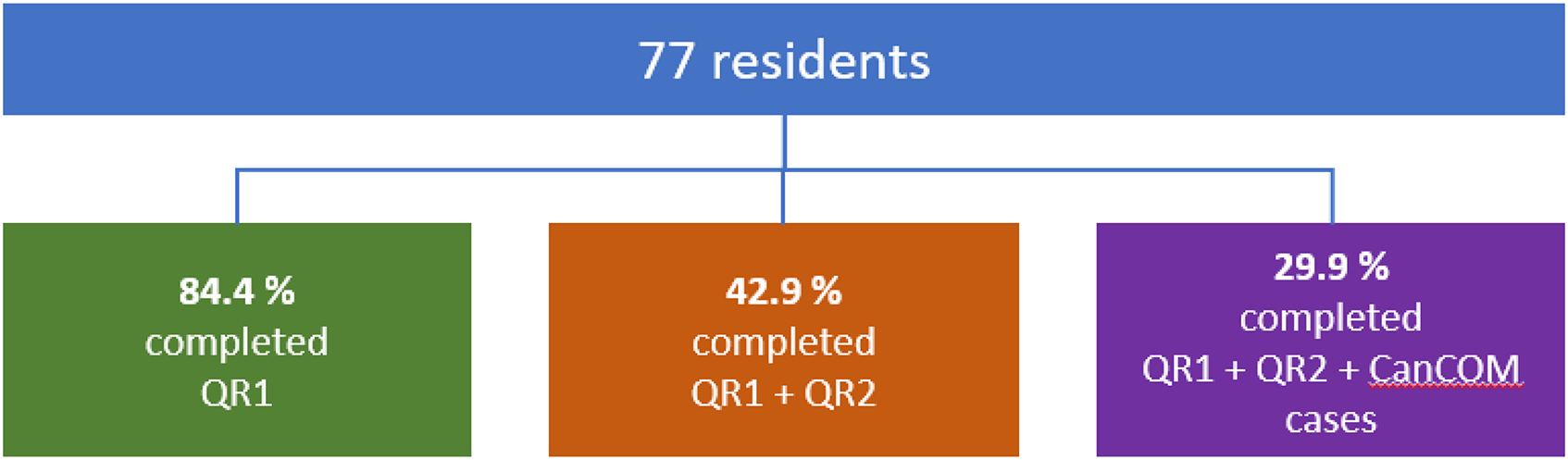
Outline of level of participation in the study.
The participants who completed both exit questionnaires (perceived usefulness and clinical exposure questionnaires) reported having completed a median of 8/20 cases. This estimation was compared to actual case completion according to CanCOM cases platform. We recorded a median of 5/20 completed cases.
Self-reported clinical exposure to a selection of clinical conditions from the CanCOM essential curriculum blueprint is presented in Table 2 highlighting exposure through the CanCOM cases. The majority of exposure to medical problems around pregnancy came from the current rotation followed by CanCOM cases and independent reading. Other sources of exposure were also documented.
Excerpt of reported clinical exposure to different conditions.
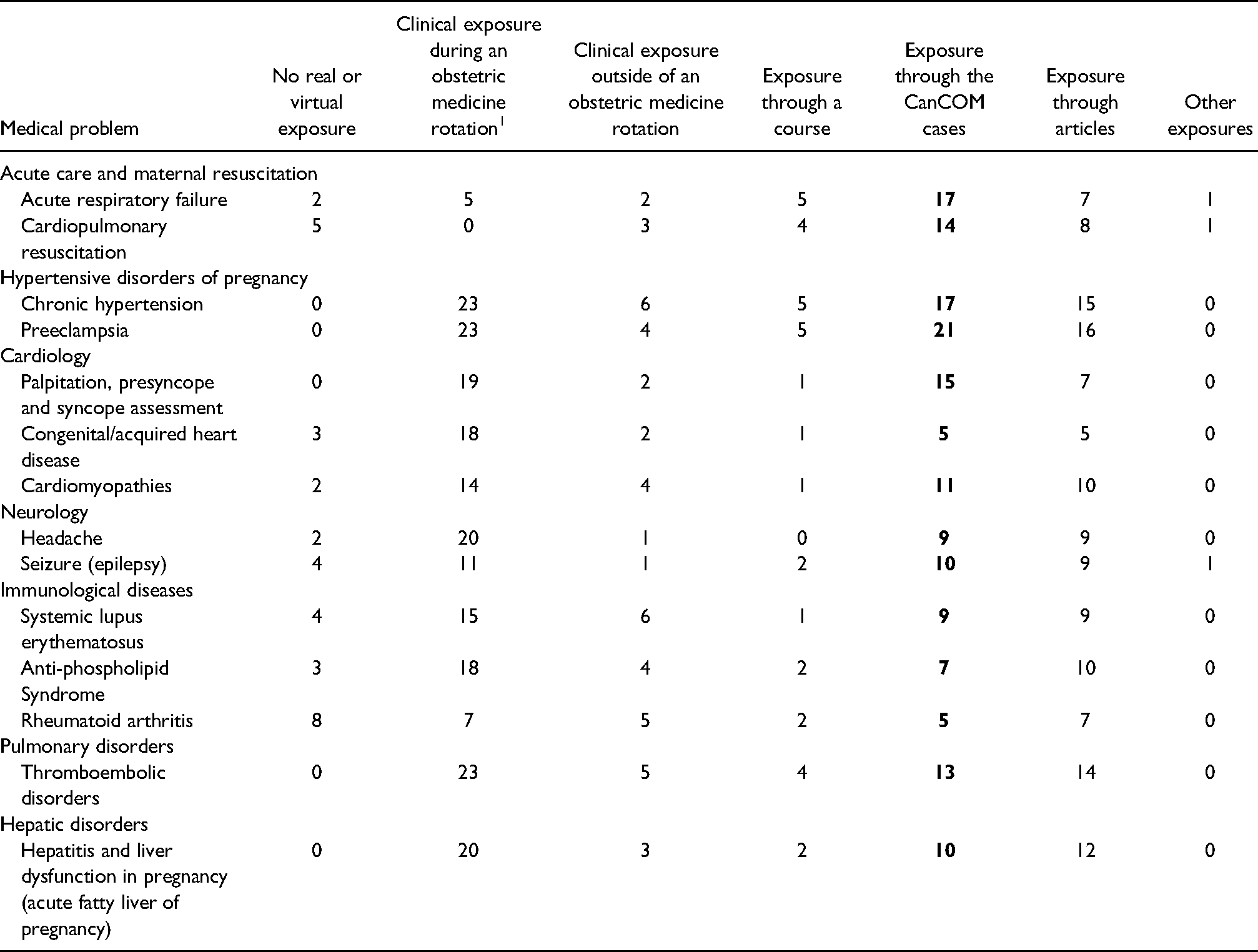
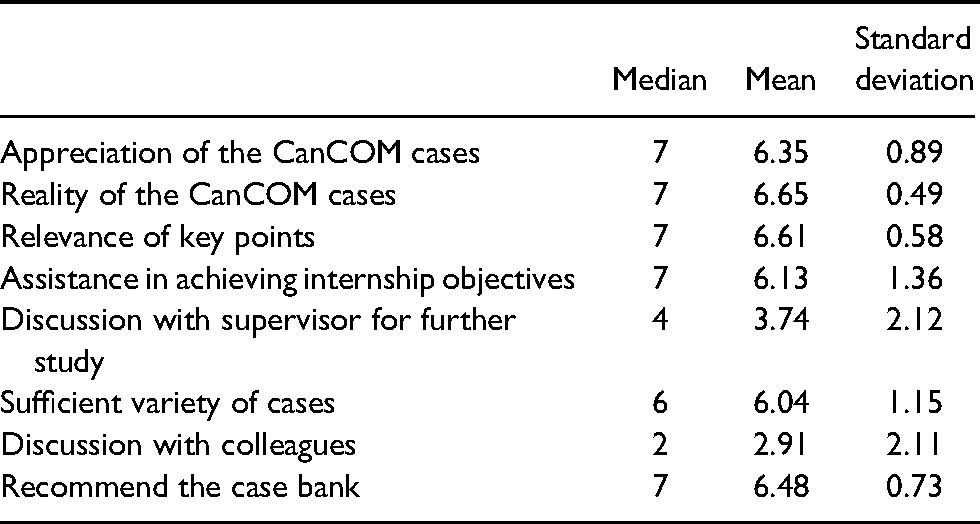
Table 3 details the results from the perceived usefulness questionnaire. CanCOM cases was received favorably with 95.6% of participants indicating they were motivated to very motivated about using the CanCOM cases. Participants did not feel the need for further discussion with supervisor or colleagues, with mean results of 3.74 ± 2.12 and 2.91 ± 2.11, respectively.
Residents’ perception of the CanCOM cases on a 7-point Likert scale (from 1 completely disagree to 7 completely agree).
Participants were also asked to provide feedback on the web platform. Many residents think that the platform should be improved and 43.5% of them had technical problems (for example with firewalls). The most common suggestion for improvement was to be able to interrupt and resume cases without having to start from the beginning.
Discussion
This multi-site study provides us with observational data on current clinical exposure in OM rotations in several Canadian training sites as well as participants’ feedback on the usefulness of an online educational tool to support additional clinical exposure.
Analysis of clinical exposure from the rotation alone confirms the anecdotal evidence that these short 1–2-month clinical rotations will provide a variety of clinical exposure with reliable exposure to certain conditions (for example hypertensive disorders of pregnancy, management of headache and palpitations) and less exposure to rare but important conditions (for example acute fatty liver of pregnancy and cardiomyopathy). Our data underlines the importance of multiple sources of educational interventions including Journal Clubs, dedicated teaching sessions, and independent study.
Participants in our study gave very positive feedback on the CanCOM cases as a Supplementary educational intervention. The cases were deemed sufficiently varied, realistic, and relevant. There did not appear to be a single pattern of use. Of interest, the CanCOM cases related to hypertensive disorders of pregnancy were amongst the most popular cases completed even though residents were most certainly exposed to the topic in many ways.
While the CanCOM authors believe in the added value of exchange between learner and supervisor, the participants reported little necessity for a discussion with a supervisor or with colleagues. Bligh and Bleakly remind us of the importance that the simulated learning activity be well structured, well managed with planned opportunities for reflection and feedback. 25 Our cases were structured around a template with built-in moments for reflection and some, albeit limited, feedback (for example around the multiple-choice correct and wrong answers). This simulation activity has the potential to act as a bridge between class-based learning and the complex clinical environment. We can raise the question of whether our participants had sufficient experience with a more hybrid use of the web platform to be able to fully judge the potential usefulness of an active discussion with a supervisor or colleague about cases. Nonetheless, these high-level learners are well on their way towards autonomous continuing professional development and the CanCOM cases could be a useful additional tool for self-directed learning.
This study has limitations. While the results are positive with high levels of perceived usefulness and exposure to obstetric medicine clinical situations, the response rate is low with only 23 participants completing all three questionnaires which limits the strength of our findings. In addition, the residents that did participate in the study had very high levels of motivation towards the OM rotation and the CanCOM cases. Their perceptions therefore might not fully represent the views of other, less motivated residents.
Our observational study was focused on perceptions and did not measure impacts. In Jeffries’ simulation framework, 26 five potential impacts are proposed: acquisition of knowledge, skill performance, learner satisfaction, critical thinking and self-confidence. Despite the fact that some of these learning outcomes still require substantial validation, 27 it would be interesting to determine whether our participant satisfaction might have reflected one or many of these dimensions.
Conclusion
This article presents the added value of the CanCOM cases to support residents’ clinical exposure during OM rotations. Indeed, these high levels of satisfaction lead us to believe that this additional learning tool may prove useful and practical for senior residents or junior doctors in practice in other regions or countries. Factors associated with motivation to use such a tool could be further explored. Future work could also investigate the impact of learning style on perception of usefulness and actual use of the CanCOM cases.
CanCOM simulation still has a few technical challenges including keeping the platform at optimal performance and updating the links and references. Consultation with stakeholders should be performed on a regular basis to add new content for other essential conditions including emerging diseases (for example, COVID-19) or conditions that are endemic in other geographic contexts.
Supplemental Material
sj-docx-1-obm-10.1177_1753495X211045614 - Supplemental material for Canadian general internal medicine residents’ perception of a pedagogical tool of online cases in obstetric medicine
Supplemental material, sj-docx-1-obm-10.1177_1753495X211045614 for Canadian general internal medicine residents’ perception of a pedagogical tool of online cases in obstetric medicine by Annabelle Cumyn, Nadine Sauvé and Christina St-Onge in Obstetric Medicine
Footnotes
Acknowledgements
We are very grateful to our Canadian colleagues who have participated to the CanCOM research group over the years with a special thanks to CanCOM members that have participated in the development of the cases. We would also give our warm thanks to Josée Lamoureux who assisted with the conduct of the study and to Mariem Fourati who helped us with the preparation of the manuscript.
Declaration of conflicting interests
The author(s) declared no potential conflicts of interest with respect to the research, authorship, and/or publication of this article.
Funding
The authors received funding from the Fonds d’innovation pédagogique de l’Université de Sherbrooke and from the North American Society of Obstetric Medicine for the development of the cases and from Fonds de développement pédagogique de la Société des médecins de l’Université de Sherbrooke for the conduct of this study. The author(s) disclosed receipt of the following financial support for the research, authorship, and/or publication of this article: This work was supported by the Fonds de développement pédagogique de la Société des médecins de l’Université de Sherbrooke.
Ethical approval
Ethics approval was obtained from Sherbrooke University's Comité d’éthique de la recherche en Éducation et Sciences sociales (projet 2016-32-ESS). Informed consent was obtained from all participants before the study. Consent was documented by the completion of the initial sociodemographic questionnaire.
Guarantor
Annabelle Cumyn.
Contributorship
All authors meet the ICMJE criteria for authorship by contributing to the study design, data analysis and interpretation, and drafting and revision of the work. AC, NS and CSO have given their final approval for publication.

Supplemental material
Supplemental material for this article is available online.
References
Supplementary Material
Please find the following supplemental material available below.
For Open Access articles published under a Creative Commons License, all supplemental material carries the same license as the article it is associated with.
For non-Open Access articles published, all supplemental material carries a non-exclusive license, and permission requests for re-use of supplemental material or any part of supplemental material shall be sent directly to the copyright owner as specified in the copyright notice associated with the article.
