




Abstract
Dear Sir,
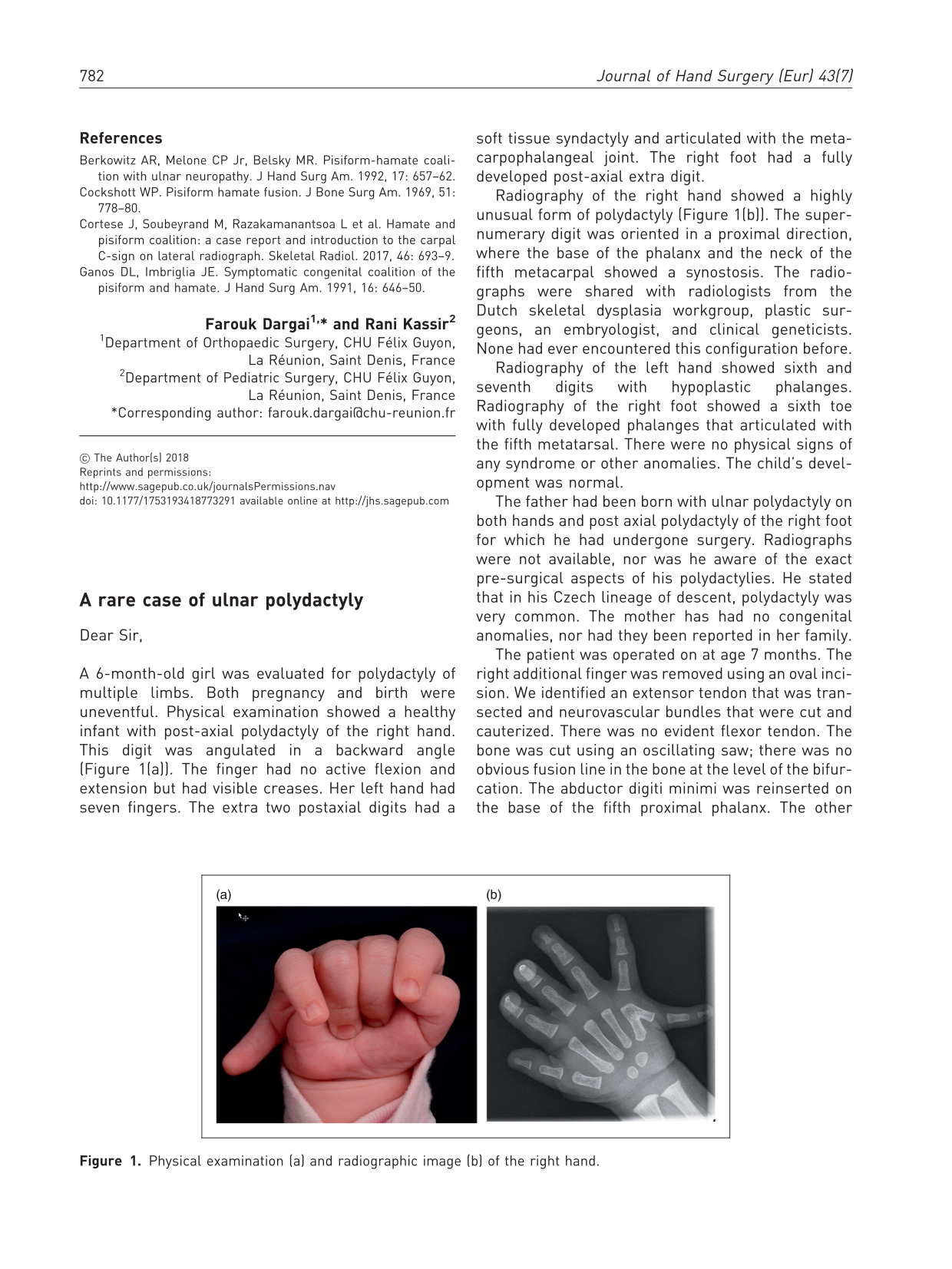
A 6-month-old girl was evaluated for polydactyly of multiple limbs. Both pregnancy and birth were uneventful. Physical examination showed a healthy infant with post-axial polydactyly of the right hand. This digit was angulated in a backward angle (Figure 1(a)). The finger had no active flexion and extension but had visible creases. Her left hand had seven fingers. The extra two postaxial digits had a soft tissue syndactyly and articulated with the metacarpophalangeal joint. The right foot had a fully developed post-axial extra digit.
Physical examination (a) and radiographic image (b) of the right hand.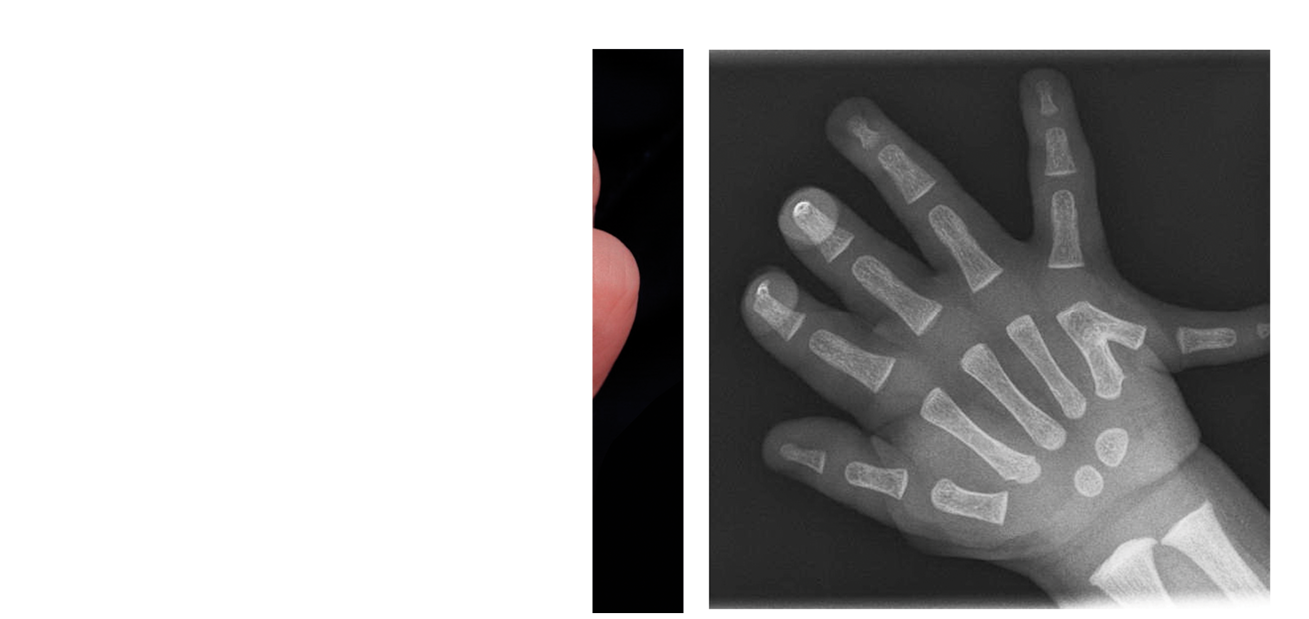
Radiography of the right hand showed a highly unusual form of polydactyly (Figure 1(b)). The supernumerary digit was oriented in a proximal direction, where the base of the phalanx and the neck of the fifth metacarpal showed a synostosis. The radiographs were shared with radiologists from the Dutch skeletal dysplasia workgroup, plastic surgeons, an embryologist, and clinical geneticists. None had ever encountered this configuration before.
Radiography of the left hand showed sixth and seventh digits with hypoplastic phalanges. Radiography of the right foot showed a sixth toe with fully developed phalanges that articulated with the fifth metatarsal. There were no physical signs of any syndrome or other anomalies. The child’s development was normal.
The father had been born with ulnar polydactyly on both hands and post axial polydactyly of the right foot for which he had undergone surgery. Radiographs were not available, nor was he aware of the exact pre-surgical aspects of his polydactylies. He stated that in his Czech lineage of descent, polydactyly was very common. The mother has had no congenital anomalies, nor had they been reported in her family.
The patient was operated on at age 7 months. The right additional finger was removed using an oval incision. We identified an extensor tendon that was transected and neurovascular bundles that were cut and cauterized. There was no evident flexor tendon. The bone was cut using an oscillating saw; there was no obvious fusion line in the bone at the level of the bifurcation. The abductor digiti minimi was reinserted on the base of the fifth proximal phalanx. The other supplementary digits on the left hand and right foot were removed during the same surgical session.
Due to the recommendation to perform a further work up in Caucasian patients with ulnar polydactyly, genome sequencing was offered (Dy et al., 2014). Unfortunately, this was not approved by the patient’s parents.
Today’s understanding of limb embryology is based on the three axes system (Dy et al., 2014). The limb develops from proximal to distal under the influence of the apical ectodermal ridge. Polydactyly is classified as a disruption of differentiation in the radial–ulnar, or anterior–posterior, axis (Tonkin, 2017).
Based on current knowledge of embryology of the extremities, this case of polydactyly on the right hand is difficult to comprehend. Since this case of polydactyly does not fit into any classification described in the literature, interesting questions arise about its aetiology. We considered that this case of polydactyly could be a split metacarpal since three fully developed phalanges were present in the extra digit. However, the theory of a split metacarpal seems less likely due to its proximal, sharp, and spur like angulation. A different and, in our opinion, more likely suggestion is metacarpophalangeal synostosis.
Ogino and Ohshio (1987) provide a pathophysiological explanation; they suggest that fusion between metacarpals occurs due to a disorder in the interaction between ecto- and mesoderm, and a deficit of mesenchymal cells in the developing limb. Since polydactyly is also described as a disruption of differentiation of the ectodermal ridge, this suggests that it could be related to the fusion of metacarpal or carpal bones.
Thus, this rare case of ulnar polydactyly may be a case of metacarpophalangeal synostosis, a rare limb anomaly that is not compatible with any classification system, nor described in any recent literature.
Footnotes
Declaration of conflicting interests
The authors declared no potential conflicts of interest with respect to the research, authorship, and/or publication of this article.