




Abstract
Layered structures have found tremendous applications in tribology due to their ability to ease the sliding motion between the sliding bodies. Tribology plays a crucial role in various fields such as the automotive industry, bearings, space technology, sports, food processing, health, and renewable energy. Enhancing the tribological properties of materials through surface modification of layered structures is an area of significant interest. In this study, we report the synthesis of highly active and stable nanosheets of polymeric graphitic carbon nitride (g-C3N4) modified with zinc sulphide (ZnS) particles under hydrothermal conditions. Analytical techniques, including scanning electron microscopy (SEM), X-ray diffraction (XRD), Fourier transform infrared (FT-IR) spectroscopy, and Thermogravimetric analysis (TGA), were employed to confirm the purity and establish the surface morphology of the synthesized ZnS@g-C3N4 composite. The tribological properties of the composite as a lubricant additive in paraffin oil (PO) were investigated using a four-ball tester at optimized concentrations. The results revealed that the introduction of ZnS@g-C3N4 nanocomposites into paraffin oil, at an optimized concentration of 0.05% w/v, significantly reduced the Mean Wear Scar Diameter by 28% and the Coefficient of Friction by 40%. These findings suggest that the composite is highly effective as a lubricant additive for enhanced tribological performance.
This is a visual representation of the abstract.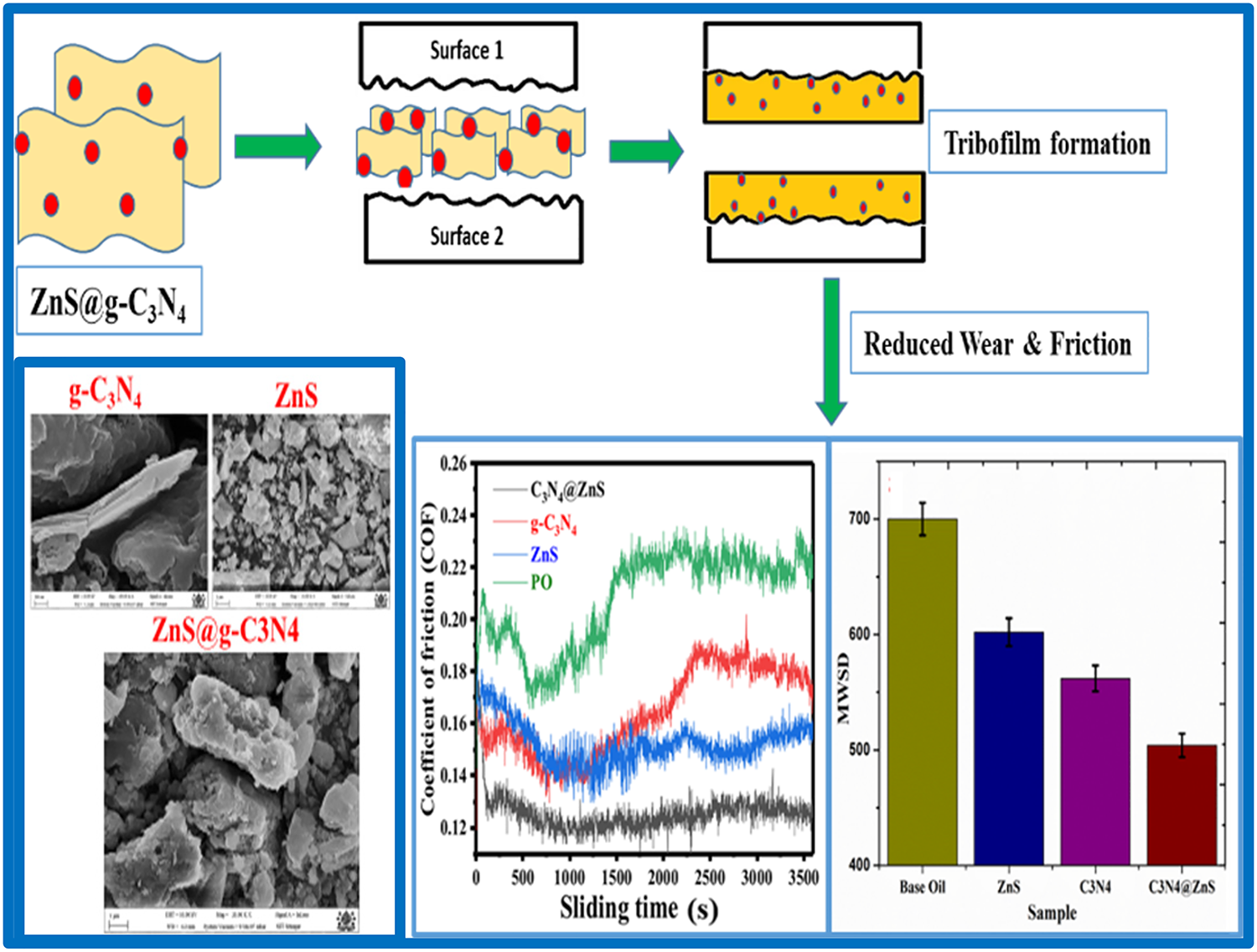
Get full access to this article
View all access options for this article.