



Abstract

Background
Status Epilepticus (SE) is a common medical emergency and it can occur both in patients with and without a history of epilepsy. Morbidity and mortality is high and increases with duration of uncontrolled seizures which necessitates early active treatment. 1 Despite this there is significant variation in the way SE is treated between centres and no nationally agreed guidelines for the management of SE in critical care. 2
These guidelines are based on multi-speciality consensus agreement between acute medicine, neurology, intensive care and emergency medicine. The critical care pharmacy group provided input on pharmaco-therapeutics.
Purpose, objective and scope
Purpose
The purpose of this document is to provide guidance on the management of adult patients with SE in hospital. It provides a framework for management of SE on the acute hospital ward and Intensive Care Unit (ICU). Successful treatment of SE, especially refractory SE, requires management of the underlying cause, therefore, a significant part of this guideline is devoted to investigation and diagnosis.
Objective
This document aims to facilitate early management and provide an investigative framework to determine the underlying aetiology of seizures.
Scope
This document pertains to the management of SE in patients over the age of 16 years. It excludes the obstetric population, for whom there are other guidelines available. 3 It includes guidance on management of SE in terms of initial stabilisation, investigation, pharmacological treatment, use of sedation and transfer to critical care. We have used the International League Against Epilepsy (ILAE) definitions and classification of status epilepticus in this guideline. 4 We have also proposed a definition for levels of neurocritical care and we advise on indications for referral between these care levels.
This document is a guideline and outlines perceived best practice. It is in line with the NICE, 5 European Federation of Neurological Societies, 6 The American Epilepsy Society 7 and the Neurocritical Care Society 8 clinical guidelines for epilepsy but takes into account recently published clinical and experimental evidence regarding the pharmacological management of SE. As the evidence base in this area is evolving, we aim to update the guidance (please check The Intensive Care Society website for the most up to date version). The document is not intended to be a universally applicable protocol to all patients with SE owing to the broad range of conditions that can result in seizures. It does, however, provide a guide to the acute management of SE in the majority of patients. This guideline has been produced by clinicians in the United Kingdom and we acknowledge that there will be geographical variation in perceived best practice.
This guidance should be adopted jointly by all stakeholders involved in the acute care of patients presenting with SE. No guideline can be exhaustive or replace sound clinical judgement. Each patient should be treated as an individual, with early and clear communication between the multidisciplinary team members being the key to achieving the right outcome.
The working group suggest that research funders consider a best practice implementation project using a step-wedge or cluster-randomised design to evaluate uptake and efficacy of the guidelines.
Definitions
Status epilepticus (SE)
This is defined as five or more minutes of either continuous seizure activity or repetitive seizures with no intervening recovery of consciousness. SE was previously described as seizure activity or repetitive seizures lasting more than 30 min. The timeframe for the definition of SE has been revised to emphasise that prognosis worsens with increasing duration and that treatment must be started early. 9 SE is further classified as either generalised convulsive or non-convulsive in nature. Generalised convulsive SE is the more common type of SE.
Convulsive status epilepticus (CSE)
This is defined as seizures with generalised rhythmic jerking of limbs and conscious level impairment which fulfil the criteria for status epilepticus. This is an emergency and requires immediate medical attention.
Non-convulsive SE (NCSE)
The diagnosis of NCSE can be difficult due to the diversity in clinical presentation and is dependent on EEG findings. NCSE is defined as SE without a prominent (clinically obvious) motor component. NCSE with impaired consciousness has a high mortality and should be treated as CSE. NCSE can follow CSE and is an important treatable cause of coma.
In NCSE presenting as a change in mental status or behaviour from baseline, the risks are less clear and in most cases admission to critical care is not necessary. The consensus view remains that early active treatment is desirable in these patients and the majority of the recommendations in this guideline still apply.
Refractory status epilepticus (RSE)
SE that does not respond to initial pharmacological therapy (one benzodiazepine and one non-benzodiazepine anticonvulsant medication). Treatment requires admission to critical care and intravenous anaesthesia to suppress seizures.
Super-refractory status epilepticus (SRSE)
SE, which continues or recurs despite an adequate continuous infusion of intravenous (IV) anaesthetic agents for more than 24 h. Genuine super-refractory SE often occurs with underlying neurological disorders for example, autoimmune encephalitis.
New-onset refractory status epilepticus (NORSE)
A clinical presentation, rather than a specific diagnosis, in a patient without pre-existing epilepsy or relevant neurological disorder. Consists of new-onset RSE without clear structural, metabolic or toxic cause. This includes patients with viral or autoimmune causes. If no cause is found after extensive evaluation, this is defined as ‘cryptogenic NORSE’ or ‘NORSE of unknown cause’. 10
Febrile infection-related epilepsy syndrome (FIRES)
FIRES is a subcategory of NORSE requiring a prior febrile illness, with fever onset between 1 and 14 days prior to onset of RSE. Fever may be absent at the time of seizures. 10
Non-epileptic attack disorder (NEAD)
NEAD (also known as dissociative seizures) is a condition where individuals experience episodes that resemble epileptic seizures but do not have a physical cause related to abnormal electrical activity in the brain. The term can lead to confusion but it is a well-recognised and common disorder that affects many patients presenting to epilepsy clinics. The dissociative seizures are often triggered by trauma or stress and the mainstay of treatment is psychological therapy. 11 These seizures can also be termed psychogenic non-epileptic seizures (PNES) or simply non-epileptic seizures (NES). The term ‘pseudoseizures’ is obsolete.
Definitions of neurocritical care provision
Neuro-critical care is devoted to the comprehensive care of critically ill patients with neurological or neurosurgical disease. There is no current consensus definition for levels of neurocritical care within the UK and the authors believe a UK consensus statement would be beneficial. In the interim we propose the following levels of care, taking into account existing international definitions, 12 as well as the availability of resources in the UK hospital system.
Tertiary neurocritical care service
Tertiary receiving centres for complex neurological emergencies. These are specialist neurocritical care services, able to provide definitive care for a wide variety of neurocritical care emergencies with access to advanced monitoring techniques and on-site neurosciences and neurosurgical support.
Secondary neurocritical care service
Able to stabilise acutely ill neurological emergencies and safely manage stable neurocritical care disease processes, whilst having an established advice, referral and transfer pathway for patients who require Tertiary Neurocritical Care. This level encompasses the majority of critical care units in the UK.
Primary neurocritical care service
Suitable for the stabilisation and subsequent transfer of acute neurocritical care emergencies. There is limited access to specialist investigations or interventions and timely referral to a Secondary or Tertiary Neurocritical Care service should be considered if needed.
All levels of neurocritical care service should be able to initiate management of acute status epilepticus as per Figure 1.

At a glance guide to the management of adult patients with convulsive seizures in the acute hospital setting-applicable to all levels of neurocritical care service. 13
General recommendations
Critical care review should be sought early if the patient fails to stop seizing following maximal dosage of benzodiazepines and an adequate dose of a non-sedating anti-seizure medication.
Continuous electroencephalogram (cEEG) is advised for patients with ongoing depressed consciousness or for patients in refractory status epilepticus (RSE) or super-refractory status epilepticus (SRSE). Advice should be sought from a regional neurosciences centre on management and transfer of the patient if cEEG is not available in your institution.
Long term anticonvulsant medication should be given in parallel with emergency treatment. Any pre-existing therapy should be continued at full dose and any recent reductions reversed.
If possible, please take medication levels on admission; this will help with establishing usual levels and confirming concordance. Do not omit doses whilst awaiting level to be reported. Failure to take medication as prescribed is a common cause of a patient with epilepsy developing SE. If non-concordance with a medication is suspected then consider reloading with one of the emergency agents as per the algorithm. For information about route adjustment, and/or levels please contact your pharmacist.
In patients with RSE or SE of unclear cause, a neurological opinion should be sought. This should, ideally, be obtained within 24 h of admission to the critical care unit.
Patients with SRSE should be discussed with a tertiary neurocritical care unit and transfer should be strongly considered.
Those patients with SE requiring investigation or management that cannot be safely provided in a secondary neurocritical care unit should be considered for transfer to a tertiary unit.
Further management of seizures
Patients who present to hospital with SE will require admission to allow for a period of observation and to plan ongoing care. Specialist neurological opinion should be sought to advise on ongoing requirements for appropriate dosing or weaning of anti-seizure medications. A plan should be instituted for additional specialist investigations and referral to a higher level of neurocritical care service should be sought.
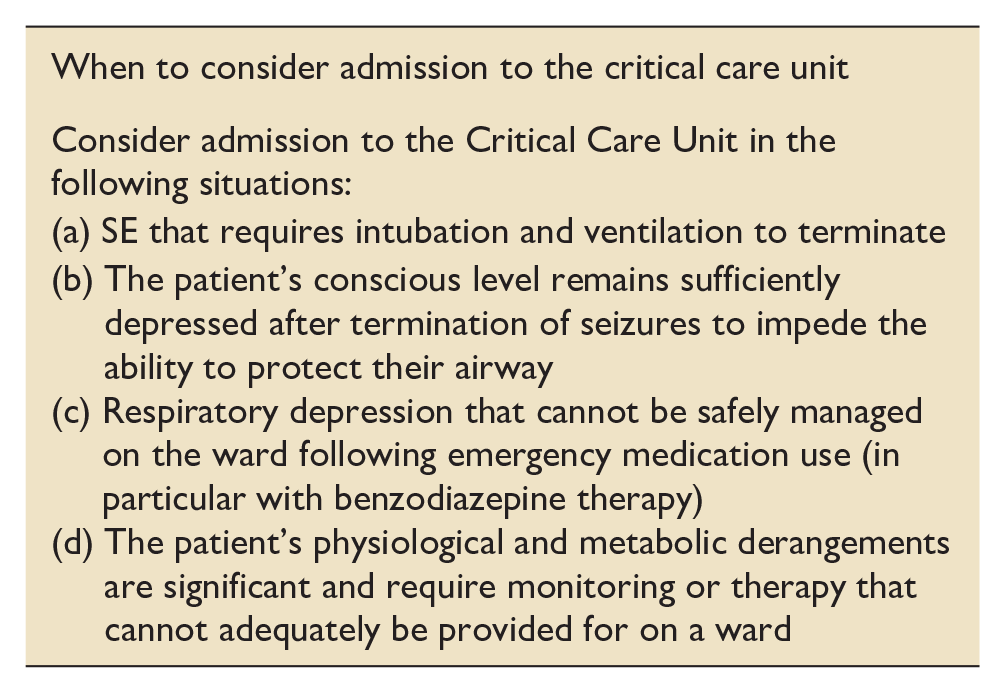
Critical care management process


Additional investigations to be considered for patients admitted with status epilepticus in the absence of seizure history
The list of conditions that have been identified as possible causes of status epilepticus is extensive. No list can be completely exhaustive, however, a recent review provides a comprehensive account. 18 Liaise with a higher level of neurocritical care service for guidance.
Additional investigations include the following:
Ammonia levels, urinary organic acids and blood amino acids
Vasculitic screen • Anti-Nuclear Antibody (ANA), Extractable Nuclear Antigen (ENA), Anti-Neutrophil Cytoplasmic Antibody (ANCA) • Complement • Serum Angiotensin Converting Enzyme (ACE)
Autoimmune Encephalitis Screen (if no other evident aetiology) • N-Methyl-D-aspartate receptor (NMDAR) antibodies • LGI1 and CASPR2 antibodies (part of voltage gated potassium channel complex) • Gamma-aminobutyric acid B receptor (GABABR) antibodies • α-amino-3-hydroxy-5-methyl-4-isoxazolepropionic acid receptor (AMPAR) antibodies • Gamma-aminobutyric acid A receptor (GABAAR) antibodies • Glutamic acid decarboxylase (GAD) antibodies • Anti-neuronal (paraneoplastic) antibodies – Hu (ANNA1), Yo (PCA1), Ri (ANNA2), Ma2, CV2 (CRMP5), amphiphysin, SOX1, Titin, Zic4 and DNER (Tr) • Thyroid Peroxidase (TPO) antibodies
CT Thorax, abdomen and pelvis (CT TAP) with contrast to look for evidence of occult neoplasia, and indirect evidence of paraneoplastic limbic encephalitis.
Anticonvulsant drug levels if on anticonvulsants to assess the adequacy of and concordance with therapy. • Tests which are not available locally can be sent to the National Drug Monitoring Laboratory, Chalfont Epilepsy Centre. Liaise with the biochemistry or pathology helpdesk of your hospital.
Please also see Appendix 2 for a summary list of conditions and relevant investigations.
Continuous electroencephalography (cEEG) monitoring
Where available, cEEG is advised for patients with an ongoing depressed conscious level or for patients in refractory or super refractory SE. The authors recognise that the availability of cEEG monitoring is very limited and that transferring ventilated patients to a tertiary centre poses significant logistical challenges, requiring substantial manpower, time, and resources; however close collaboration with a tertiary neurocritical care centre is strongly recommended.
The person reading the EEG should have specialised training in cEEG interpretation, including the ability to analyse raw EEG data as well as quantitative EEG tracings.
Reduced montage (8-channel EEG) is an acceptable modality for continuous monitoring provided that a sufficient area of the brain can be monitored. Bispectral index (BIS) monitoring is not a suitable alternative to EEG, as it will miss focal seizure activity.
In patients being treated with continuous infusion AEDs, in which most or all convulsive activity resolves, cEEG is the only way to know if treatment is successful. 8
cEEG is used to determine whether there is cerebral seizure activity or evidence of subclinical SE. Ideally, cEEG monitoring should be continued for at least 24 h after resolution of seizure activity, while sedated. If it is not feasible to maintain cEEG throughout sedation, then it should be maintained until seizure control is achieved to rule out ongoing subclinical SE.
Treatment goals include seizure suppression, resting the brain to reduce focal EEG abnormalities and burst suppression.19 –21
Management should be overseen by both the critical care consultant and consultant neurologist, due to the potential risk of harm from prolonged sedation and ventilation.
A cEEG may not currently be available in all critical care units; however, we recommend that all clinical neuroscience centres urgently assess how they could provide this standard of care.
Where cEEG is not available, extended duration intermittent EEG could be performed to look for resolution of seizures
Continuing or recurrent status epilepticus despite appropriate general anaesthetic therapy for over 24 h (super-refractory SE)
The general anaesthetic agent should be tapered after a minimum of 24 h and if seizures recur either clinically or as evidenced on the EEG, the agent should be recommenced.
There is limited evidence to support any single intervention to control super-refractory seizures so therapy must be directed at treating the underlying cause where possible. Treatment should involve collaborative decision making between consultants in critical care medicine and neurology. Ideally, these patients should be managed in a tertiary neurocritical care centre. A treatment delay reduces the efficacy of the drugs used. Continue treatment as long as there is no evidence of devastating brain injury on MRI (NB significance of high cortical signal on MRI is uncertain as this can be a reversible effect of seizure activity). A favourable recovery can happen weeks to months after super-refractory SE.
The interventions below may be considered22 –26:
Repeat the continuous infusion of general anaesthesia for 48 h using an alternative agent such as thiopentone to suppress pathological changes in the EEG recording.
Consider other anaesthetic agents such as intravenous ketamine infusion or volatile inhalational anaesthesia using an agent such as isoflurane.
Consider additional anti-seizure medication, for example, lacosamide or phenobarbitone.
Ensure magnesium level is within normal range, some units have given additional infusions and aimed for serum level of 1.0–1.5 mmol/L.
Consider autoimmune encephalitis, immune-mediated refractory SE, New-Onset Refractory Status Epilepticus (NORSE) or Febrile Infection Related Epilepsy Syndrome (FIRES).
Second line therapies which may be recommended include:
Rituximab (CD20 monoclonal antibody; 375 mg/m2 weekly IV infusion for 4 weeks or in adults can also be used as 1 g infusion for two doses, on days 1 and 14)
Cyclophosphamide (500–1000 mg/m2 monthly for 3–6 months)
Tocilizumab (monoclonal antibody against Interleukin-6 receptor; 8 mg/kg monthly for two or more cycles)
Anakinra (Interleukin-1 Receptor antagonist; up to 5 mg/kg BD)
Cannabidiol
Bortezomib (Proteosome inhibitor, especially in NMDAR encephalitis)
Continuing status epilepticus despite the above therapies
Re-image the brain for an underlying brain injury.
If SE is due to a focal target lesion then consider neurosurgical referral.
Interventions occasionally used in tertiary centres.
• Ketogenic (high fat, low carbohydrate, controlled protein) diet. 28 Liaise with a dietician and pharmacist who are knowledgeable in this area. Ketogenic diets should be used with caution in patients on a propofol infusion since fatty acid oxidation is impaired, potentially leading to an increased risk of propofol infusion syndrome. 29
• Single-photon emission computed tomography (SPECT) scanning to evaluate areas of reduced blood flow in the brain.
• Vagal nerve stimulation in conjunction with specialists in neurology and neurosurgery. 30
Common causes of treatment failure
Continuing NCSE, often due to under-monitoring of EEG or inadequate pharmacological suppression.
Failure to establish appropriate maintenance anticonvulsant therapy before the withdrawal of continuous anaesthetic infusion. Hence, ensure maintenance therapy is commenced early in the illness. Particular care should be taken to avoid subtherapeutic phenytoin levels which often occurs in the first few days after the loading dose – see Appendix 3.
Rapid weaning of continuous anaesthetic infusion causing rebound seizures after achieving control of SE. If this is the case, a more gradual taper should be attempted.
Dosing of anticonvulsant medications
There are no prospective head to head studies comparing different doses of benzodiazepines and the suggested doses in this document can lead to prolonged periods of somnolence and respiratory depression. Giving lorazepam in titrated aliquots to high risk patients can minimise the risk of these side effects occurring. If the patient is actively, visibly seizing despite maximum dose benzodiazepine commence anticonvulsants as per doses detailed in Appendix 1.
Where possible the recommended dosing has been taken from the ESETT study. 13 Levetiracetam, fosphenytoin and valproate have been shown to be equivalent. The dosing is for SE only and dosing information continues to evolve. Patients with liver and severe renal impairment were excluded and the trial contained only a small number of patients over 65 years old.
Discussions around which weight to use are ongoing as increasing numbers of patients present at the extremes of the body weight scale. Many of the drugs used have significant drug interactions, including other anticonvulsants and key antibiotics and antifungals. Please consult your pharmacist for assistance with this.
Footnotes
Appendix 1 – Detailed Notes on the Acute Management of Seizures in a Hospital Setting
Appendix 2 – Differential Diagnoses and Investigations
Many of the following are rare causes of Status Epilepticus. Specialist investigations should be arranged following discussion with the Neurology team.
Appendix 3 – Anti-seizure Medication Doses in Status Epilepticus 31 - 34
Appendix 4: Intravenous Anaesthetic Therapy in Status Epilepticus 35,36
Unless stated and to ensure rapid treatment use patient estimate/actual body weight upto 80kg then use ideal/adjusted body weight.
References
Correction (May 2025):
Article updated to include footnote on page 249.
Collaborators
The Collaborators reviewed and edited the document:
Dr Chris Hodcroft, Consultant in Acute Medicine, Cwm Taf Morgannwg University Local Health Board
Dr Dan Beckett, Consultant Acute Physician, NHS Forth Valley
Dr Nicholas Talbot Consultant in Intensive Care Medicine, University Hospitals Birmingham NHS Foundation Trust
Prof Tony Whitehouse, Professor of Intensive Care Medicine, University Hospitals Birmingham NHS Foundation Trust
Prof Fang Gao-Smith, Professor of Intensive Care Medicine, University Hospitals Birmingham NHS Foundation Trust
Prof Julian Bion, Professor of Intensive Care Medicine, University of Birmingham
Dr Gregory Packer Consultant in Intensive Care and Acute Internal Medicine, University Hospitals Birmingham NHS Foundation Trust
Dr Max Damian Consultant Neurologist, Cambridge University Hospitals NHS Foundation Trust
Prof Saiju Jacob, Professor of Neurology, University Hospitals Birmingham NHS Foundation Trust
Reena Mehta, Consultant Pharmacist Critical Care, Kings College Hospital NHS Foundation Trust
Greg Barton, Senior Critical Care Pharmacist Whiston Hospital
Dr Mark Tomlin, Clinical Trainer. Consultant Pharmacist Critical Care, University Hospital Southampton NHS Foundation Trust
Abbreviations
ADR adverse drug reaction
IV intravenous
IM intramuscular
IO intraosseus
NG nasogastric
ml millilitres
mmol millimole
L litre
kg kilogram
g gram
mg milligram
mcg microgram
min minute
h hour
kPa kilopascal
cmH2O centimetres of water
ECG electrocardiogram
EEG electroencephalogram
cEEG Continuous EEG
CT scan computed tomography scan
MRI scan magnetic resonance imaging scan
T tesla
CSF cerebrospinal fluid
PE Phenytoin Equivalents
PEEP positive end expiratory pressure
PRES Posterior Reversible Encephalopathy Syndrome
PRIS Propofol-related Infusion Syndrome
RCVS Reversible Cerebral Vasoconstriction Syndrome
Declaration of conflicting interests
The author(s) declared no potential conflicts of interest with respect to the research, authorship, and/or publication of this article.
Funding
The author(s) received no financial support for the research, authorship, and/or publication of this article.
