




Abstract

We are writing to share our experience of using name/role stickers to improve team working and communication on our Intensive Care Unit (ICU) during the COVID-19 pandemic. Like all ICUs, we faced many challenges during the past months: working with large numbers of non-ICU staff (‘side skillers’); working while wearing personal protective equipment (PPE); communicating while caring for patients in isolation rooms; high levels of anxiety amongst staff associated with caring for patients with a previously unknown disease.
Knowledge of a team’s first names is known to improve teamwork, communication and staff morale, and to ‘flatten the hierarchy’ within the team,
1
with the UK national COVID-19 airway guidelines recommending the use of name stickers during airway procedures.
2
We introduced specially designed staff name/role stickers in our ICU, using an idea and the experience of an ICU sister at a neighbouring hospital with her permission. The stickers are colour-coded according to staff group, with designated role clearly visible and space to hand-write the staff member’s name (See Figure 1). We chose disposable stickers that were easily replaceable, cheap and suitable for wearing both on daily scrubs and applied over PPE prior to entering isolation rooms. We conducted a survey two months later. One hundred and thirty ICU staff responded: consultants (4); ICU junior doctors (12); registered ICU nurses (48); reservist ICU nurses (21); healthcare assistants (16); physiotherapists (7); ward clerks (8). Several challenges of working in PPE were reported: feeling hot and uncomfortable (91%); difficulties in hearing what other staff were saying (91%); difficulties in your team members being able to hear you (85%); difficulties in identifying who a team member is when wearing PPE (72%).
Staff name/role stickers for ICU staff.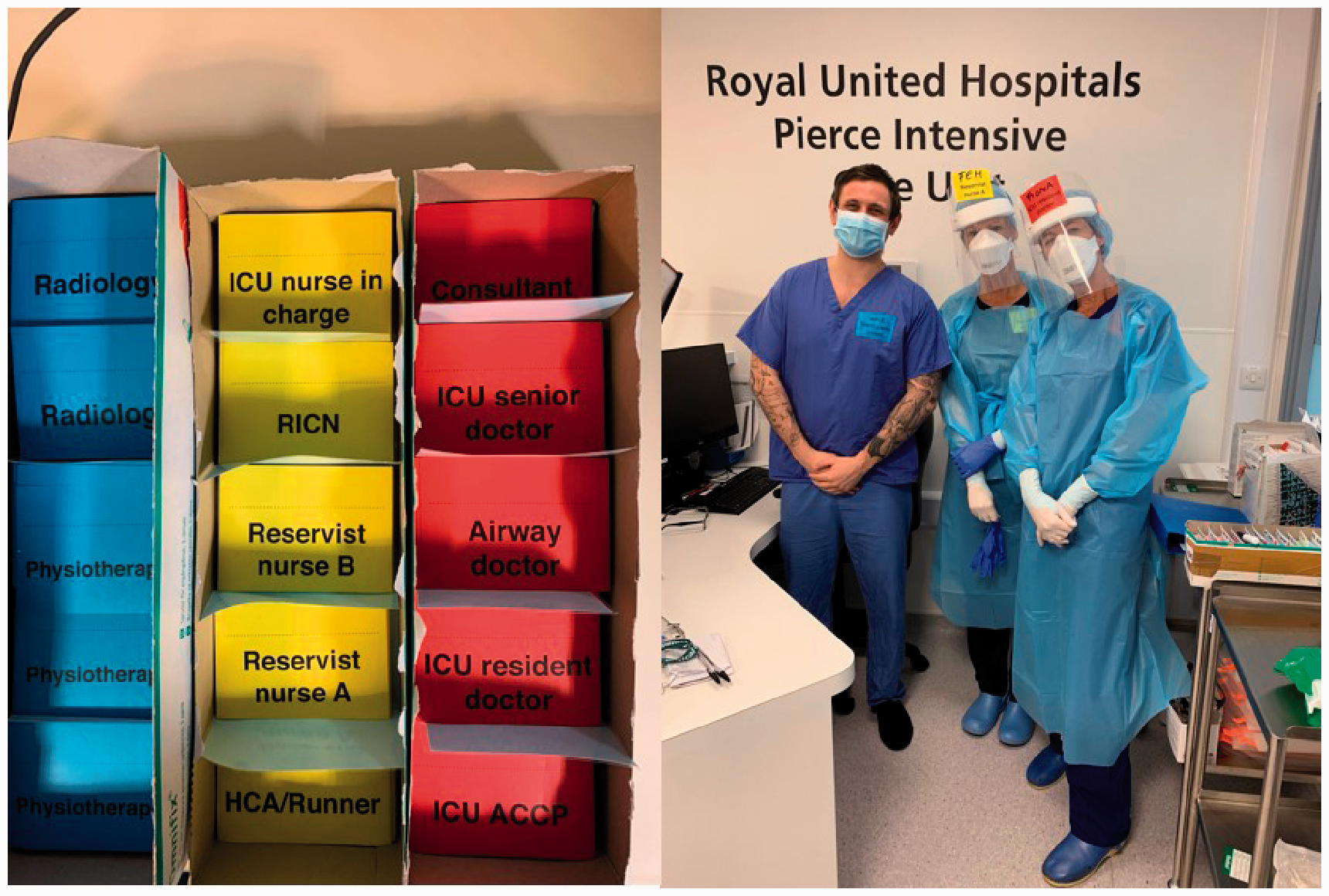
When questioned about statements regarding the name/role stickers, the following staff reported that they strongly agreed/agreed as follows: the stickers make it easier to identify the roles of team members (98%); knowing the names and roles of other team members has improved teamwork (98%); the stickers made it easier to remember their team’s first names (96%); communication between team members is improved by wearing the stickers (94%); the stickers made it easier to identify staff wearing PPE (92%); the stickers have improved patient safety (88%). Ninety-eight percent agreed that it would be worthwhile continuing using the stickers, 89% reported that they would recommend the use of these stickers to other departments within the hospital and 95% to other hospitals.
Free comments described advantages over traditional name badges, including being easier to read and colour-coded according to role, reducing anxiety of working in a new environment, making senior staff seem more approachable, making it easier to integrate reservist nurses into the ICU team and making the team atmosphere more friendly. Five respondents highlighted that the stickers had resulted in improved communication and teamwork during clinical emergencies.
In conclusion, our survey suggests that introducing specially designed name/role stickers for ICU staff has been a simple and inexpensive method of improving communication, teamwork, morale and patient safety on our ICU. Other ICUs may find the introduction of similar stickers useful.
Footnotes
Declaration of conflicting interests
The author(s) declared no potential conflicts of interest with respect to the research, authorship, and/or publication of this article.
Funding
The author(s) disclosed receipt of the following financial support for the research, authorship, and/or publication of this article: This project was funded by the Royal United Hospitals Bath NHS Foundation Trust innovation fund.
