




Abstract

Central venous catheters (CVCs) are routinely required in the intensive care unit (ICU) for infusion of drugs, often concurrently with central venous dialysis catheters (CVDCs) for renal replacement therapy (RRT). Increased clearance of drugs, due to direct aspiration via the CVDC, has been reported when both catheters were inserted into the same internal jugular vein.1,2 This prompted a call to place catheters always in different veins.
We hypothesised that in patients requiring a CVC for infusion of drugs and a CVDC for RRT, their insertion in opposite internal jugular veins may not necessarily increase the distance between the line tips, and therefore may not prevent the direct aspiration of drugs. We conducted a review of chest X-rays performed between 30 May 2018 and 30 July 2018 of 23 patients with a CVC and CVDC within the same or opposite internal jugular vein (Figure 1). The distance between the tips was measured. STATA v 15 (STATA Corp, USA) was used for analysis.
Chest X-rays demonstrating central venous catheters and dialysis catheter tip positions.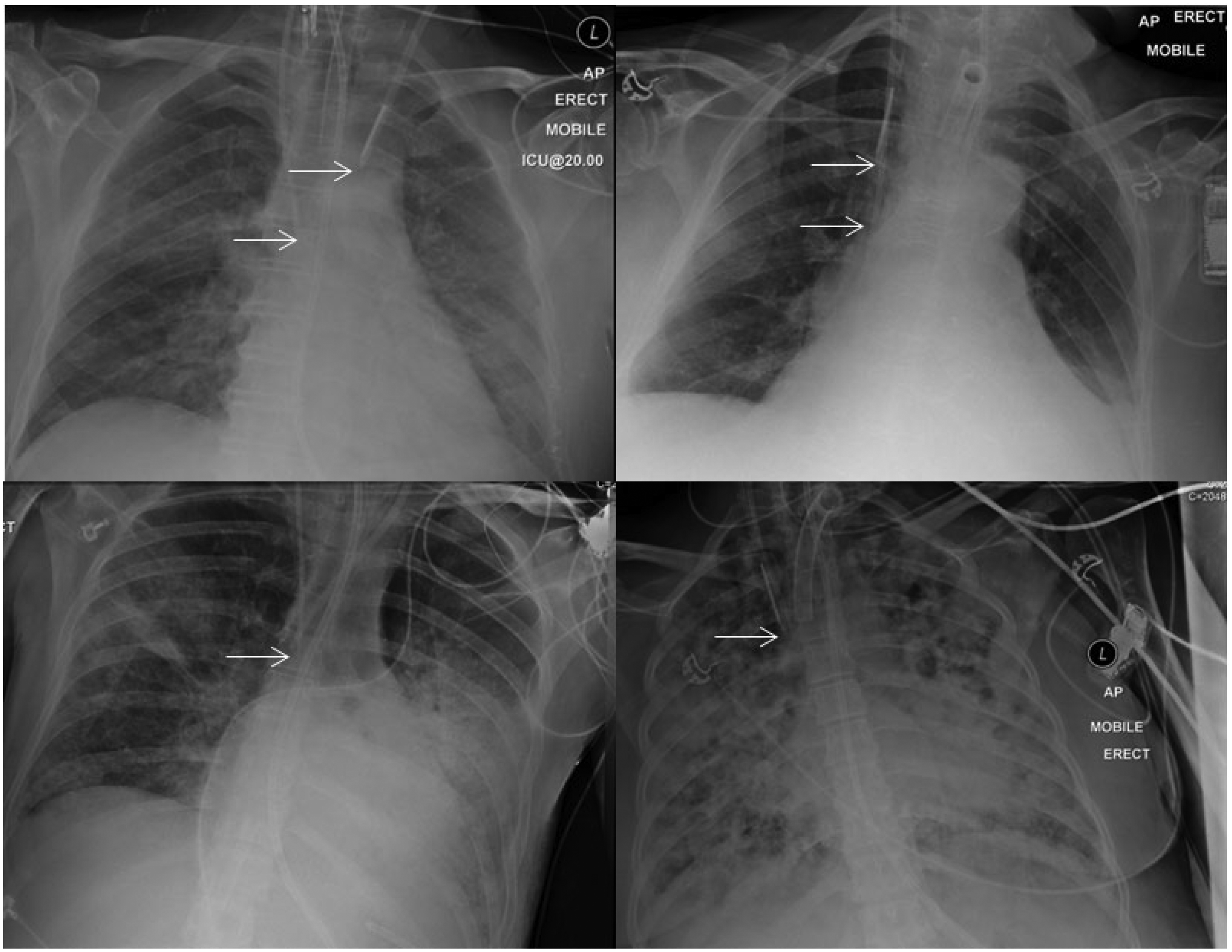
Among 23 patients, 60.9% had catheters inserted in the same vessel and 39.1% had catheters inserted in opposite sites. For catheters inserted in opposite sites, the mean distance (SD) [range] between the tips was 31.4 mm (18.4), [7 to 58.4 mm] compared to 37.3 mm (24.7) [5 to 93.5 mm] for catheters inserted into the same vein. The mean difference was −5.8 mm (95% CI: −25.8 to 14.2); p = 0.55 (Figure 2).
Box plot showing tip to tip distance for central lines inserted on the same site and opposite site.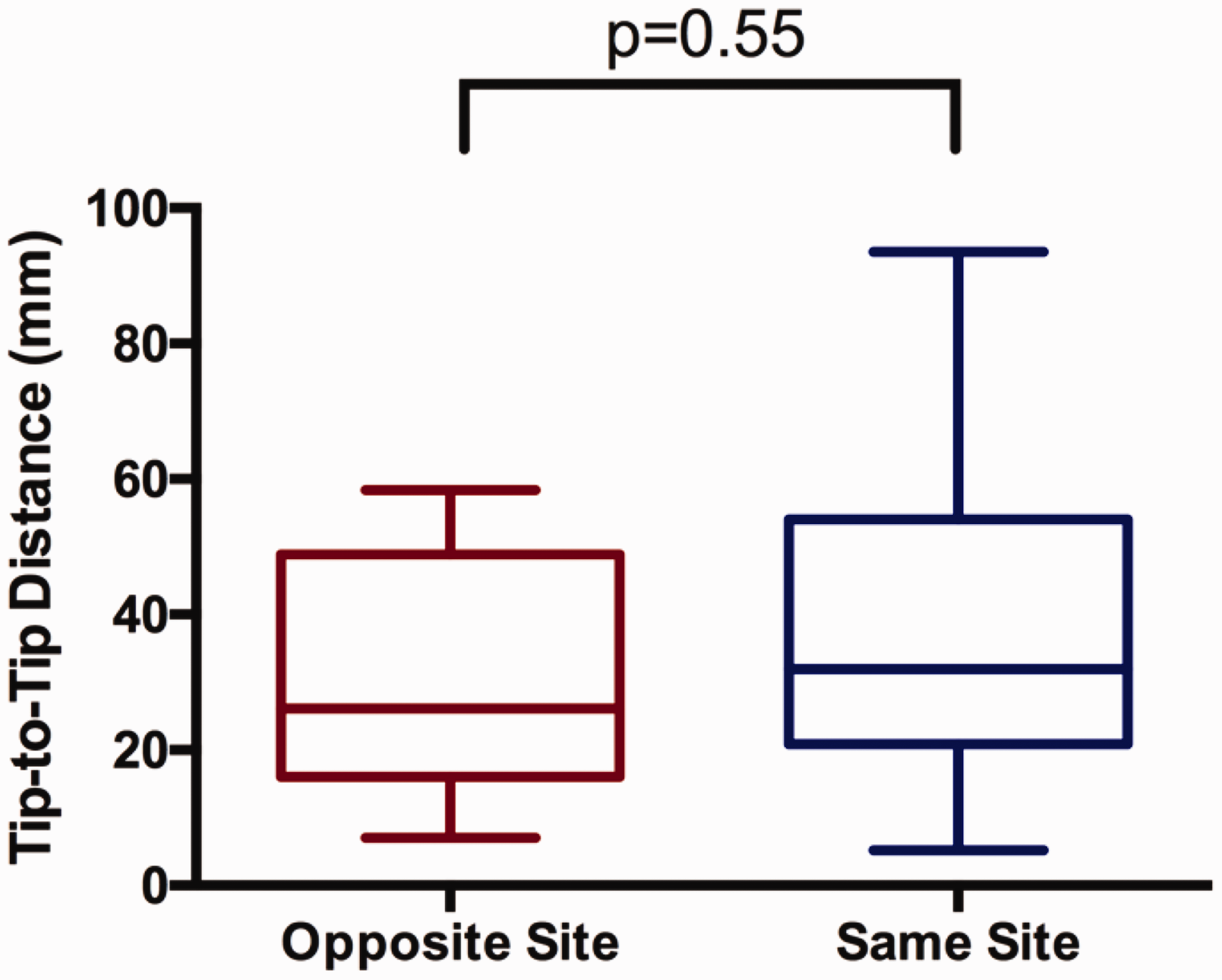
There was no statistically significant difference between the tip-to-tip distance of catheters inserted in the same central vein or opposite sites.
Literature regarding access site of CVDC in the ICU is limited. The right internal jugular is recommended as first-line access. 3 When inserting two central catheters (CVC and CVDC), additional factors to consider are the practicalities of line insertion, risk of recirculation, vessel size (a small vessel will increase the risk of recirculation) and risk of vein thrombosis. The American Society of Anaesthesiologists advises that the decision of placing two catheters in a single vein should be made on case by case basis. 4 Based on our results, we suggest that attention needs to be paid to the distance between the line tips and that this is independent of the site of insertion.
Additional important questions that further studies should address are the optimal distance between catheter tips which minimises risk of direct aspiration of drugs 5 ; the assessment of the risk of thrombosis, recirculation and infection secondary to inserting a CVC and CVDC in a single vessel versus separate vessels.
Ethics approval and consent to participate
The project had institutional approval from Guy's and St Thomas' NHS foundation Trust.
Footnotes
Authors’ contribution
SB and LC participated in the design of the study. LC performed the statistical analysis. SB carried out the data collection and wrote the first draft of the manuscript. MC and LC reviewed and edited the manuscript. All authors read and approved the final manuscript.
Declaration of conflicting interests
The author(s) declared no potential conflicts of interest with respect to the research, authorship, and/or publication of this article.
Funding
The author(s) received no financial support for the research, authorship, and/or publication of this article.