



Abstract
The present moment marks a generational threshold in the collective memory of World War II. First, regarding this period, we are in transition from the realm of “communicative memory” to that of “cultural memory.” Second, the globalization process has an immense impact on how we imagine the past. How do these developments influence young people’s perception of historical exhibitions? The article discusses the results of a qualitative audience research realized in three museums in Poland and Germany dedicated to people who aided Jews during the Holocaust: the Tadeusz Pankiewicz’s Pharmacy in Krakow, the Ulma Museum in Markowa, and the Museum Otto Weidt in Berlin. The objective of the study, conducted among local and international students, was to capture possible differences in perceptual and conceptual priming between young adults socialized in different (national) memory cultures and to analyze how these narrative and visual templates influence their reading and viewing of the exhibitions.
Keywords
Introduction
Over the past three decades, the subject of aid provided to Jews during the Holocaust has attracted growing attention from the general public in Europe and beyond (Aleksiun et al., 2024). This interest has been stimulated by the mass media, most notably Steven Spielberg’s Schindler’s List. The politics of remembrance, led by various state and civil society actors at both the national and transnational levels, also played an important role in bringing this topic to the limelight.
According to researchers, the emergence of a “cosmopolitan memory” was driven by the development of the human rights discourse and the trend toward the universalization of history (Levy and Sznaider, 2006). Holocaust memory became more “future-oriented.” As a result, the past is increasingly viewed as a source of role models. This shift also helps to explain the interest for the Righteous, who provide compelling moral exemplars. However, as Aleida Assmann (2021) observes, the national perspective remains prevalent in Europe, particularly in the right-wing memory discourse. Also in relation to the memory of individuals who aided Jews during World War II, in some European countries efforts to emphasize their legacy were a direct response to academic and public discussions about collaboration (Gensburger, 2015, 2016). Focusing on rescuers was intended to neutralize difficult debates about the past. In Poland in particular, the growing interest in this aspect of history came in response to debates about Polish complicity in the murder of Jews following the publication of Jan Tomasz Gross’s Neighbors in 2000 (Nowicka-Franczak, 2017; Podbielska, 2021). The “cult” of the Righteous reached its peak in the years 2016–2023, under the Law and Justice (PiS) government, which pursued a nationalist memory politics, highlighting Polish victimhood, innocence, and heroism. The situation in Germany is different. The Federal Republic in the 1980s and united Germany in the 1990s and 2000s were characterized by an intense reckoning with the Nazi past. This found expression in public debates on the Wehrmacht exhibitions (1995–1996, 2001–2004), on the compensation for forced labor (1998–2000) and on the Holocaust Memorial in Berlin (unveiled 2005). It was in this context that the rescuers gained a growing public attention from the mid-1990s onwards. However, unlike in many other countries, the debates in Germany focused primarily on the helpers’ exceptionality. Consequently, aid providers were and are used to demonstrate “what most Germans could, but did not, do to help Jews” (Kabalek, 2025: 135). At the same time, though, a 2019 survey showed that over 30% of respondents believed that their family members had helped victims of persecutions during Nazi times (Papendick et al., 2020). This confirms, as demonstrated already by Harald Welzer et al. (2002) that the acknowledgment of collective German guilt and responsibility for World War II and the Holocaust does not always go along with awareness of one’s own family’s implication in Nazi crimes.
Depending on how the rescue stories are being told, they can not only enhance dialog and reconciliation between formerly hostile ethnic or religious groups but also contribute to strengthening nationalism and perpetuating negative national stereotypes. In the past quarter century, over 10 museums and permanent exhibitions dedicated specifically to this aspect of Holocaust history have been opened or totally refurbished in several European countries, including Poland and Germany, but also Bulgaria, France, Latvia, Lithuania, and the Netherlands. Further museums are under construction. But what is their impact on visitors? In order to check this, we conducted qualitative audience research in two “Righteous” museums in Poland and one in Germany.
The fundamental assumption of our analysis is the existence of a close connection between memory culture and visual culture. Nicholas Mirzoeff (2015) defines visual culture as “the relation between what is visible and the names we give to what is seen. It also involves what is invisible or kept out of sight” (p. 11). Consequently, both narrative patterns and visual habits acquired during socialization in a community shape collective memory (Erll, 2022). Museum exhibitions are highly complex and multilayered creations, conveying meaning through various media—including textual, visual, spatial, auditory, and other sensory tools. Therefore, it is particularly important to consider both their narrative and visual aspects when researching how historical museums are perceived by visitors.
We currently stand at a threshold in terms of the development of collective memory. First, with regard to World War II, we are inevitably transitioning from the realm of “communicative memory” to that of “cultural memory,” the primary carriers of which are symbols and signs, such as texts, images, monuments, museums, and rituals (Assmann, 2007: 51–54). Second, as Nicolas Mirzoeff (2015) observes, “the emerging global society is visual” (p. 6). Until recently, images circulated primarily through print media, film, and television. However, the advent of the World Wide Web and the proliferation of digital photography in the 1990s have multiplied the number of images and significantly accelerated their dissemination rate, resulting in the globalization of visual culture. These developments have also had a significant impact on our understanding of the past. Wulf Kansteiner (2017) posits that in the near future, collective memories, including those of war and genocide, “will be generated in thoroughly interactive, immersive, and counterfactual narrative worlds” (p. 331).
Finally, the globalization processes, including mass migration, mass tourism, and the development of mass and social media “are loosening the national framework” (Levy and Sznaider, 2006: 26) of collective memory and fostering “mnemonic processes unfolding across and beyond cultures” (Erll, 2011: 9). This does not imply that nation states have lost their power to shape memory and identity. Indeed, there is an increasing tendency for national governments to assume an active role in shaping memory and identity in Europe and beyond. Nevertheless, as Aleida Assmann and Sebastian Conrad (2010) assert, “today, memory and the global have to be studied together, as it has become impossible to understand the trajectories of memory without a global frame of reference” (p. 2).
The impact of these changes is twofold, encompassing both the representation of history and its reception. The issue of reception is of paramount importance to the field of memory studies as “no mediation of memory can have an impact on memory culture if it is not ‘received’” (Törnquist-Plewa and Sindbaek Andersen, 2017: 3). However, until lately, research on Holocaust memorials and museums focused primarily on exhibition history and analysis. Only in recent years, there has been a shift in this field toward research on the visitors’ experiences (Popescu, 2022). Reception studies are conducted using existing data, such as guestbook or TripAdvisor entries (Jaeger, 2022; Noy, 2018; Wóycicka, 2024), or elicited data, such as questionnaires, individual interviews, or participant observation (Gensburger, 2017; Katharaki, 2022; Macdonald, 2009; Pastor, 2022). However, few studies focus on how design and architecture influence the museum experience (Popescu, 2020; Souto, 2018; Tsifitsi, 2022). Our study contributes to Holocaust and Museum Studies by examining how international audiences perceive museums dedicated to the increasingly relevant subject of the help delivered to Jews during the war. We conducted individual and group interviews in combination with photo elicitation to find out how the different ways in which rescue stories are presented influence visitors’ perceptions. We also wanted to ascertain the extent to which individuals’ upbringing in diverse memory and visual cultures, and their familiarity with different Holocaust narratives determine their reading of the exhibitions, and the extent to which globalization and the development of mass and social media have led to a convergence of perception. Thereby, we focused equally on the content and the visual aspects of the exhibitions.
The studied museums
The first museum we analyzed is the Tadeusz Pankiewicz’s Pharmacy in Krakow. Pankiewicz was a Polish gentile who ran a pharmacy in the Krakow Ghetto. The pharmacist and his staff helped the ghetto inhabitants in various ways and the pharmacy became an important meeting point. The first, modest exhibition opened in the pharmacy’s former premises in 1983 (Gryta, 2020). In 2013, the display underwent a major reconstruction. The main goal of the exhibition, as defined by its head curator Monika Bednarek (interview conducted by Z. Wóycicka and M. Musielak, Krakow, January 10th, 2023), was “to provide information about the history of the ghetto and its inhabitants. [. . .] The second goal was [. . .] to commemorate the figure of Tadeusz Pankiewicz.” Financed by the city of Krakow under the long-standing presidency of the left-leaning Jacek Majchrowski (2002–2024), the museum represents a more open approach to Poland’s history, albeit not a particularly critical one.
Our second case study is the Ulma Family Museum of Poles Saving Jews in World War II in Markowa. Józef and Wiktoria Ulma, a peasant couple from the small village in southeastern Poland, gave shelter to their Jewish neighbors. After a Polish policeman denounced them to the gendarmerie, the Germans murdered the whole family, including the children, and the people in hiding. In 2023, the Church beatified the Ulmas. The museum opened in 2016. Originally a local institution funded by the Subcarpathian Voivodeship Assembly, it went under the auspices of the Ministry of Culture in 2017. The museum’s mission is to “present the history of rescuing Jews by Poles during World War II, show Polish–Jewish relations during the Holocaust, and disseminate knowledge about the fate of the Ulma family” (BIP, 2019). Indeed, the exhibition tells the story of the Ulmas and other people from Subcarpathia who aided persecuted Jews. However, this story serves as a synecdoche for the stance of the entire Polish population. This internal contradiction is reflected in the interviews with the curators, who confirmed that the idea for the museum changed during its development, but that the exhibition scenario could not be fully adapted to the new concept (Elżbieta Rączy, interview conducted by Z. Wóycicka, Rzeszów, March 29th, 2023; Mateusz Szpytma, interview conducted by Z. Wóycicka, Warsaw, July 18th, 2024). The museum is emblematic of the view of history promoted by national conservative politicians and historians in Poland (for the broader political context of the museum’s establishment see Grabowski and Libionka (2017) and Wóycicka (2019)).
Finally, we researched the reception of the Museum Otto Weidt’s Workshop for the Blind in Berlin (MOW). Otto Weidt, who was visually impaired himself, protected mostly blind Jews by first employing them in his factory. When that was no longer possible, he and his collaborators provided them with hideouts. After most of his Jewish employees were deported, the network sent food parcels to Theresienstadt. Sadly, only very few of the help-receivers survived until the end of the war. The exhibition opened in 1999 in the original workshop premises in Berlin Mitte (Gruzdz and Kwasigroch, 1999). Originally a students’ grassroots initiative, it was taken over by the German Resistance Memorial Centre in 2005, which opened there a new permanent exhibition. In 2023, the display underwent a major refurbishment. It tells the stories of Weidt, his help network, and the Jewish employees of the workshop. As formulated by the head of the MOW Karoline Georg (interview conducted by Z. Wóycicka, online, October 22nd, 2021), for the museum employees it was important to stress that this story “was an absolute exception and that one should not assume that such things happened in every factory in Berlin.” They also wanted to “present the persecuted as active personalities.”
The three museums differ both in narrative and design. The museums in Krakow and Berlin were established in situ and stress the historicity of their premises, but they use different modes of authenticity. In Krakow, the curators decided to reconstruct the pharmacy’s likely interior of the 1930s–1940s. The exhibition also extensively uses multimedia. Thus, the pharmacy draws on the tradition of experiential museums, which became very fashionable in Poland in the mid-2000s (Kobielska, 2020). Its specificity is that it displays few curatorial texts. Instead, the curators introduced numerous written eyewitness accounts.
The MOW stands in stark contrast to such a concept of authenticity. Rather than reconstructing the premises of the former brush workshop, its creators tried to uncover and expose its remaining historical traces, for example, by showing the layers of paint and tapestry discovered during conservatory works. The museum is representative of the “documentary-argumentative” exhibitions on World War II (Knigge, 2005). According to this approach, which is prevalent in Germany, exhibitions should avoid “emotionally overwhelming learners” (Pastor, 2022: 26), for example, through atmospheric ambience or mimetic scenography.
By contrast, the museum in Markowa occupies a new building, designed by Mirosław Nizio together with the exhibition. Nizio is famous for theatrical museum displays, such as the one at the Warsaw Rising Museum. However, in this case, the designer and architect abandoned historical re-enactments in favor of a more abstract but still very atmospheric display.
Method and research group characteristics
We conducted a comparative study among local and international university students from Berlin, Krakow, and Rzeszów. Our research group comprised people from Generation Z, who were born in 1996 or later. They grew up in an era of globalization and are “immersed in a world of media” (Black, 2012: 37). As such, they are the age cohort most affected by recent changes in the way social memory functions. For most of them World War II belongs already to the realm of cultural memory rather than communicative memory. The individual in-depth interviews (IDIs) revealed that only half of the participants had firsthand knowledge of their family’s history during World War II, whereby the relatives they spoke to experienced the war as children.
The local groups comprised people who spoke Polish or German as their native language and had participated in the local schooling system for at least 6 years. The international groups included students from European countries who had been living and studying in Poland or Germany for up to 2 years and spoke fluent English. 1 This composition of the research groups enables us to compare and analyze the extent to which exhibition interpretations are similar and therefore transnational and globalized, and the extent to which local students are influenced by national memory and visual cultures, resulting in differences with their international colleagues.
The call for research participants included information about the study of contemporary historical museums, but did not specify which museums were involved. This was done to avoid attracting only interviewees interested specifically in World War II and the Holocaust. The groups comprised BA and MA students of social sciences, humanities, fine arts, and technical subjects. In total, we recruited 23 local and 20 international participants; in each museum, the sample counted 13–15 students (Table 1).
The research participants’ field and level of study.

UG, undergraduate; PG, postgraduate.
As shown by the IDIs, the differences in the participants’ profile and level of studies found a reflection in their knowledge level and critical apparatus for analyzing museum exhibitions. The Berlin group mainly comprised MA students specializing in Eastern European studies and cultural studies. In Rzeszów, the research participants, even those studying social sciences and arts, attended mostly practical courses, such as cultural management or film production. The participants also varied in their interest in museums. The students from Rzeszów visited fewer museums, mostly during school trips, while those from Berlin and Krakow were more likely to have visited many different museums, often during trips to other cities or countries.
The research comprised the following:
IDIs conducted online prior to the museum visits;
An organized but individual visit to the exhibition followed directly by post-visit group interviews conducted by professional moderators from the Shipyard Foundation (Fundacja Stocznia);
Post-post-visit focus group interviews (FGIs) conducted online 1 month later.
The IDIs provided insight into the transmission of intergenerational memory within the students’ families, as well as their historical knowledge, museum experiences, and preferences. This helped us to better understand the students’ backgrounds and, consequently, the differences in how they received the exhibitions. The post-visit group interviews provided insight into exhibition reception. 2 Using Dixit cards allowed the study participants to project their feelings after visiting the exhibition onto a chosen image, which made it easier to discuss emotions. We also applied the photo elicitation method. Students were asked to record the most interesting or impressive parts of the exhibition using their mobile phones. The images served as a trigger for discussing the visitors’ experience and in particular the impact of design and architectural elements. The post-post-visit group discussions were to assess the long-lasting impact of the museum visit. This article focuses on the results of the post-visit group interviews, but also refers to the outcomes of the IDIs, as these two parts of the study were the most relevant to the research questions posed.
We made full transcriptions of the interview recordings and coded and analyzed them thematically using the MAXQDA software, which is a very convenient tool facilitating qualitative text analysis. We analyzed the interviews in their original languages: Polish, German, and English. We then translated the selected quotations for the purpose of this article.
Results
Part one: similarities
The groups showed quite a uniform reading of the museum narratives on the rudimentary level. The study participants also shared many observations related to the exhibitions’ visual aspects. Regarding the MOW, the students saw it primarily as a place dedicated to Weidt and the people associated with him, who helped to protect Jews from Nazi persecutions. However, they thought the exhibition also showed Jewish life under National Socialism. They stressed that the workshop’s Jewish employees were its heroes on a par, “all the one [!] that fought to survive and [. . .] did not give up [. . .].” 3 The photo elicitation confirms such a common understanding of the exhibition’s heroes as encompassing both the Jewish workers and their mostly non-Jewish helpers. Over half of the interviewees photographed a group picture of the workshop’s staff presented in the exhibition (Figure 1). Commenting on the photograph, one local interviewee said she found it “really great that you can [. . .] read people’s stories, and not just about [. . .] Otto, but also about the employees.” 4

Photograph of the group portrait of the workshop employees taken by one of the study participants [5_L_B_04].
Both the local and the international study participants appreciated that the museum operated in historic premises and that the exhibition highlighted the parts that had remained unchanged. They cited the creaky floor and the paint layers on the walls as physical reminders of “authenticity.” As the exhibition’s most evocative part, the students named the original hideout.
The perception of the Ulma Museum was quite different. Most participants saw it primarily as a place dedicated to the Ulma family and other people who aided Jews. Only in the second place did the students state that the museum told the story of Jews during the Holocaust. However, while some interviewees saw Markowa rather as a local history museum, others highlighted that the Ulma family served merely as an example of “many such Poles” 5 who helped the persecuted Jews. According to a student from Ukraine, it was actually an exhibition “about how Poles help Jewish people from German criminals.” 6 Some of the local students also saw the museum as telling the story of a national dimension: “I think that the museum expresses acknowledgement for Poles, or people from the countryside, who risked an awful lot [. . .]” 7 Others, highlighted Józef Ulma as exceptional among other peasants living in interwar Poland. One student felt “captivated by the fact that he was such an artistically gifted person [. . .] . [He must have been] a very sensitive person, which allows me to better understand why he took [people] in, risking his life.” 8
The modern look and minimalism of the Ulma Museum met the expectations of the local and international students. When describing the building and the space, the interviewees often employed metaphors, interpreting the dark interior, lined with gray concrete, as a “hideout” 9 and the backlit milk glass cuboid symbolizing Ulmas’ house as a “safe haven,” 10 a representation of “purity and innocence.” 11 The contrast of the gray and white colors evoked associations with a “monument” 12 and appeared as a metaphoric representation of the contrast between war and peace: “I think it was done this way because it demonstrates their previous life before the war [. . .] We have a workshop [. . .] and a living room. Then we leave home and [. . .] We have war reality.” 13
The students perceived the Pankiewicz Pharmacy primarily as a place showing everyday life in the Krakow Ghetto. The interviewees named the ghetto inhabitants and other people connected to the ghetto as the exhibition’s main protagonists. They highlighted the diversity of the Krakow Jewish community and their different stances toward the German occupiers. Among the protagonists, the students also listed Pankiewicz and the pharmacy’s female staff, adding that they did not feature very prominently in the exhibition. “I think it’s [. . .] more about the ghetto’s life and not especially about the pharmacy,” 14 said one of the Erasmus students. Another interviewee argued that although Pankiewicz was the owner of the pharmacy, “everybody is the main hero” 15 in the exhibition.
According to most participants, the reconstructed interiors evoke the feeling of entering an old pharmacy. The students also appreciated the exhibition’s elements that enhanced an immersion into the story, such as the witness accounts played upon picking up a period telephone: “When you dial, you feel like you are using this telephone [. . .] You are in character.” 16 However, the interviews revealed that the heavy text load and the lack of a linear narrative made the exhibition challenging to comprehend. The interviewees compared the museum with a video game, an escape room, or a “puzzle,” 17 where you need “some minutes to understand what this room is about [. . .] search and dig, and dig, and dig,” 18 as if “thrown into some random chapter in the game.” 19
Part two: differences on the narrative level
Hero-centered and victim-centered narratives
The differences between people coming from various countries became apparent only when we went deeper into the discussion and asked about their assessment and expectations of the exhibitions. One discrepancy concerned the attitude toward hero-centered and victim-centered narratives, and the inclusion of multiple viewpoints on history. International students at the Ulma Museum missed other perspectives on war than those of the Polish rescuers. One interviewee said the museum “really just focused on [. . .] the heroes [. . .], but not on victims.” 20 The foreign students also agreed that the museum did not pay accurate attention to the history of the Ukrainians living in this region.
The local students shared the opinion that the museum displayed mainly the Polish perspective on war. According to one interviewee, the exhibition “focuses more on those who helped Jews than on the Jews themselves. [. . .] Even when they talked [. . .] about Jews, it said much more about the person talking than about the rescued people.” 21 Although none of the local study participants overtly criticized such a narrative choice, many seemed to read the exhibition against the grain. Instead of the helpers’ stories, their interest focused on local history, in particular the fate of Jews during the Holocaust. As an example, the photo elicitation revealed that one of the exhibition’s most attractive elements was an interactive wall with photographs of the hiding places in Subcarpathia. In particular, the study participants were interested in the story of an oak tree where two Jewish men were hiding. 22 One interviewee “was standing there for a good couple of minutes trying to imagine [. . .] how they were hiding there and how they survived, because usually such a tree is quite small and narrow.” 23 She also reflected on how desperate the two men must have been to seek shelter in such a place (Figure 2).
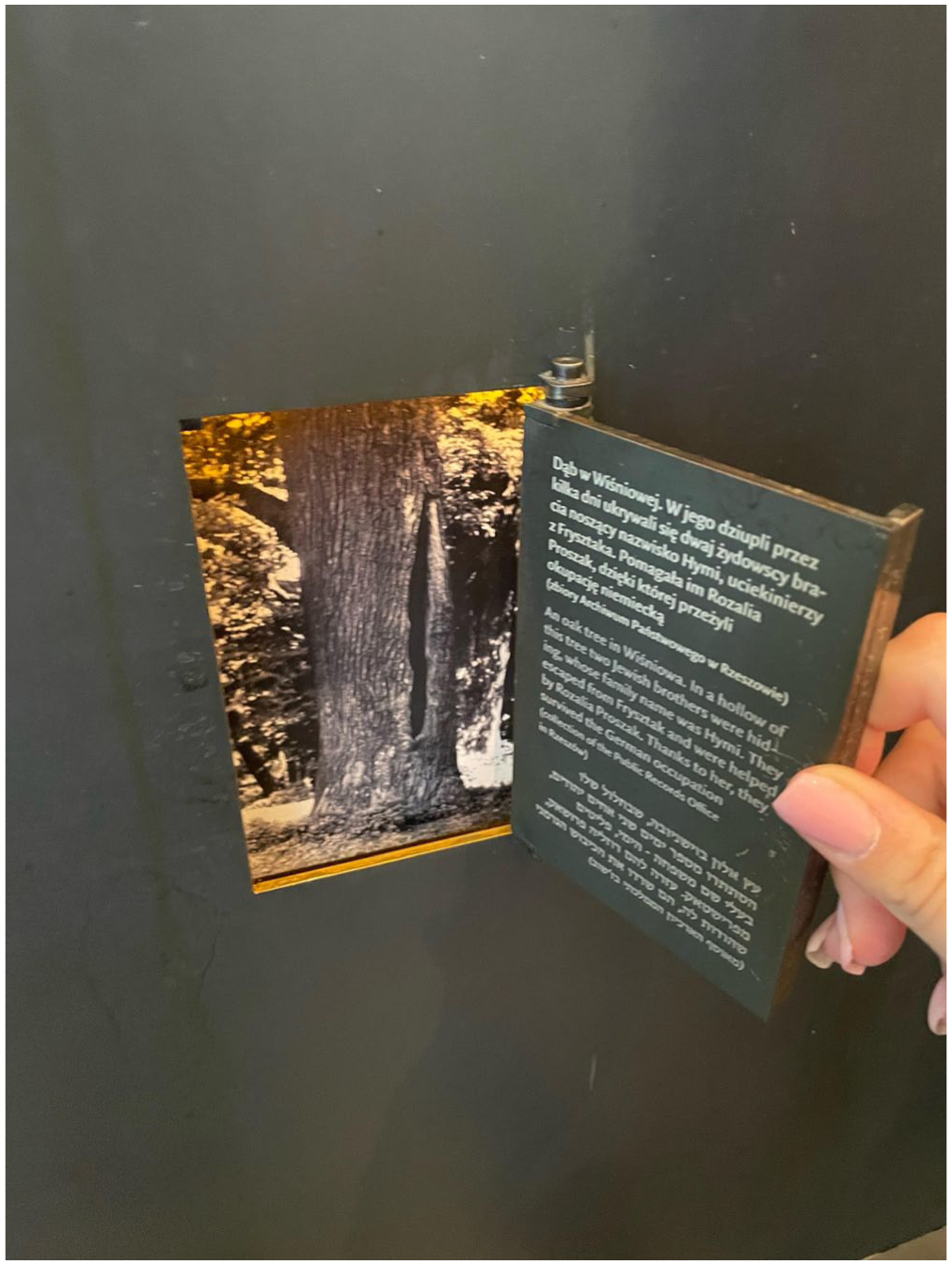
Photograph of the oak-tree hideout taken by one of the local study participants [2_L_M_01].
By contrast, in the Pankiewicz Pharmacy, some interviewees were even disappointed not to learn more about the pharmacy’s history and employees. Nevertheless, the international respondents appreciated that the museum paid so much attention to what it meant to have lived in the Krakow Ghetto. “I really like that they try to center the victims and survivors of the ghetto,” 24 said one student from Germany. Other interviewees also highlighted that the exhibition helped to better understand the life of Jews in the ghetto by “putting faces” 25 to their stories and showing them as “real people.” 26
A critical versus an affirmative approach to history
A further difference in the exhibitions’ assessment among the groups pertained to a more critical versus a rather affirmative approach to history. This was particularly evident at the generally well-received MOW. Some of the local interviewees expressed concern that by stating that each person in hiding required a whole network of aids, the exhibition falsely suggested that “half of the city were [. . .] anti-fascists.” 27 As a remedy, the participants suggested that the curators should display a table stating that “there was maybe 0.3 percent of Germans who helped Jews.” 28
International students in Berlin did not seem to share the concerns of their German peers. On the contrary, they appreciated that the exhibition showed them new perspectives on history. In response to the interviewer’s question whether they had learned something new from the exhibition, one student said, “Maybe about the German perspective, because we were usually taught about Polish perspective, Polish Jews. [. . .] Polish are great and the Germans are bad and they killed everyone.” 29
In Markowa, the exhibition provoked a more ambivalent response among the international students. One interviewee from Germany highlighted the museum’s problematic generalizations regarding the heroic stance of Polish society toward the Holocaust: “I think it’s more about the people were very brave that did this. But [. . .] I think [it’s] a little bit weird to generalize something like this.” 30 Another student in this group agreed: “in Poland, they like [. . .] the idealization [. . .], the heroism. [. . .] And so, yeah, I think it fits a bit in this way, how to build up museums, how to design them.” 31
Local study participants were less critical toward the exhibition. They generally agreed that “most of the stories cited here are rather heroic.” 32 However, they did not consider such a narrative as problematic. They were aware that “one cannot say that every Pole was a hero” 33 and that “apart from those who aided, there were also those who did other things.” 34 Nevertheless, a common understanding emerged that the museum presented a relatively balanced perspective on Polish–Jewish relations during World War II, and that “despite everything, there were more such places where [Poles] actually helped.” 35 The students from Ukraine did not object to the museum’s heroic narrative either. They considered it natural that the exhibition in Markowa cantered on the Polish helpers, while “in Ukrainian museums we can also see such examples of how Ukrainians help Jews.” 36
Both the local and international students at the Krakow museum wished they would have learned more about the pharmacist and his female staff. However, the international study participants appreciated that the exhibition refrained from heroizing Pankiewicz. One German interviewee liked “that the museum did not try to force a narrative on you. [. . .] I don’t want to say that he was not a very good person, but it [. . .] wasn’t like a hero story.” 37
National attributions
Another important thread in the group discussions was the manner in which the museums treated national attributions. At the Ulma Museum, the students from Germany said they felt moved by the presentation and expressed a sense of responsibility for their compatriots’ crimes. However, they also indicated unease about the black-and-white picture of the Germans in the museum. One interviewee stated that the exhibition evoked in her feelings of guilt and shame: And like, also when there was [. . .] the other big group [. . .] Because [. . .] I for sure have the responsibility that this is never gonna happen. But I normally don’t feel, like, this guilt. But when I was with this other group [guided tour in Polish not connected to the research], I was really, like [. . .] Because there was so often, like, the Germans, the Germans, Germans. And [. . .] I was kind of feeling, oh, I don’t [. . .] want that the others know that I’m German.
38
The interviewee’s strong emotional response to the Ulma Museum may be interpreted as a reaction to being confronted directly with German guilt. While in recent years a number of World War II and Holocaust museums and memorials in Germany have included exhibitions dedicated specifically to Nazi perpetrators or problematizing broader the implication of the German society in Nazi crimes 39 until lately, most of these institutions used to predominantly focus on the victims and their suffering. Therefore, the interviewee may have been unsettled by the explicit’s focus on German culpability. More likely, however, it was not the mere act of displaying Nazi perpetratorship that caused her distress, but the manner in which it was done: by essentializing national belonging and generally attributing guilt to “the Germans” and heroism to “the Poles”. This is confirmed by the fact that international students coming from other countries also thought that the exhibition portrayed Germans in a very one-sided way—as criminals only. The local students did not articulate such direct criticism toward the way in which the museum portrayed the German occupiers, but they also evaded simple national attributions, especially with regard to the perpetrators: “At first, I felt some sort of bitterness toward the Germans. But then I realized that this is the past, and that one should not lump everybody together.” 40 In another group, one student reflected on how the temporary exhibition 41 used white, gold, and black colors to contrast the Ulma family with the German perpetrators: “On [the] one hand, this is understandable. But on the other hand, it was not the fault of individuals. [. . .] Here the real culprit is [. . .] simply the war.” 42
The local and international students at the Pankiewicz Pharmacy emphasized that the exhibition drew no distinctions between good and evil along national lines and did not explicitly condemn the Nazi perpetrators and their collaborators. The Erasmus students noted that the exhibition devoted little attention to German perpetrators. However, the local participants also appreciated such a non-divisive narrative. One local interviewee said, “I also really liked [. . .] that, [. . .] when they talked about people who [. . .] collaborated [. . .] with the German administration, they were not [. . .] demonized.” 43 He thought that this gave visitors “a greater opportunity to understand these people.”
The local students also believed that the exhibition offered a novel way of presenting the Holocaust victims by foregrounding their individual identity over their national or ethnic identities: “I think this exhibition didn’t accentuate so much that they were Jews; it was just that they were human beings.” 44 Later in the discussion, this interviewee deemed it good that the exhibition “shows these Jews as people, as residents of Krakow, as Poles, and it doesn’t create [. . .] a boundary that would immediately make people think that this is not really their problem, and that it doesn’t really concern them.” 45
Part three: differences on the visual level
Cognitive learning versus experiential knowledge
Divergences in the exhibitions’ assessment also concern their visual and emotional appeal. One issue that emerged during the group discussions was whether a history museum should be a place of cognitive learning or one that evokes emotions and fosters experiential knowledge. The students also had different views on what type of material and form of presentation elicit (stronger) emotional responses. The museum in Markowa is an excellent example of diverging positions. “I’ve not learned so many new facts here, so it’s not affecting my intellectual knowledge, more my emotional knowledge,”
46
said an interviewee from Germany. One thing that he thought helpful in creating a more vivid picture of the rescuers was a display of artifacts related to Józef Ulma’s hobbies: “[I]f you just have learned how they rescued the Jews, it wouldn’t be that effective if there wouldn’t be the facts about their hobbies [. . .] a better imagination of them.” The atmosphere created by the original artifacts and their arrangement was crucial to the museum experience. The in-scale model of the Ulmas’ house enhanced the visitors’ historical imagination. One local student said: And when you enter this sort of white block, [. . .] I felt something like a sense of security. [. . .] I started to imagine that there was this house and they had these books on the shelves and they were pulling them out, reading, using the camera [. . .] there was this album [. . .] such love, family, peace, safety.
47
However, other local study participants saw the Ulma Museum as rather factual: “Somehow it’s not a very emotional place; it’s more like an informational place.” 48 As another interviewee noted, the museum differed from other facilities he had visited before: “In the kind of museums I’ve been to [. . .], which included places where one could sort of get into the characters a bit, it was always a very cool experience.” 49 According to him, due to the lack of mimetic “scenography,” the exhibition “doesn’t stimulate the imagination so much.” 50 As a remedy, the study participants suggested recreating the hideout in the attic of the Ulmas’ house and including play elements, such as information cards for people to search.
At the MOW, we also observed substantial differences between the groups. The international study participants claimed the exhibition “didn’t tell anything about emotions,” 51 was rather “informative,” and presented history “in a very, like, formal way.” 52 However, the local participants noticed the subtle curatorial narrative, which unfolded from a rather factual approach to a more affective one, including the last room dedicated to failed rescue attempts which features the preserved hiding place. According to a local interviewee, “the second part of the exhibition [. . .]where you realize [. . .] you are here in these rooms where the workshop was [. . .] opened up a whole new part of the installation,” 53 evoking a strong emotional response, including physical sensations such as the feeling of “stifling cold.” 54
In Krakow, despite its seemingly experiential character, with a careful recreation of the pharmacy’s interior, most interviewees, both local and international, described the museum as “not dramatic.”
55
The combination of abundant written content with the lack of a clear storyline has made the museum seem more tedious: “I just missed some kind of narrative [. . .]. I was interested in the visuals, for example, but what happened next somehow didn’t quite satisfy what I was expecting.”
56
Some international students even saw the Pharmacy as a failed attempt to deliver an experiential exhibition as they would expect from a Polish museum. “You are moved. But not as much as in other museums here,”
57
said a student from France, comparing it to other museums she had seen during her stay in Poland. Another Erasmus student said that the lack of a clear narrative was a major obstacle to engaging with the exhibition: [H]ow you are supposed to be, like, very touched by something that you don’t really understand. [. . .] I feel that if we really understand [. . .], what was happening there [. . .], you can be like, oh, my God [. . .]. But we didn’t have this feeling because [of] the way the museum is.
58
Perception of the authenticity of the site
A further issue that emerged in the discussions was the students’ perception of the authenticity of the site and the exhibition artifacts. Local and international students alike felt that the display at the MOW did not give a proper idea of what the brush workshop really looked like. However, their ideas of how to highlight site historicity differed significantly. The local students questioned the authenticity of architectural elements and artifacts and scrutinized the use of historical sources. They suggested that more original artifacts and additional information would enhance the museum experience. This stands in stark contrast to the approach of the international students, who thought the place would seem more authentic if the exhibition designers had reconstructed the old interiors and furnishing. A student from Italy expressed surprise that the hideout was empty, “because normally in museums they always [. . .] leave kind of how they were living there.” 59 She added that she would prefer, if the room had furnishings “to see that they were really [. . .] hiding there.” Other international study participants also said they did not feel the “vibe” of the former workshop and that the place felt more “just like read and go.” 60 A student from Poland suggested the museum should try to create a more immersive environment. To achieve this, he said, “it would have to set up so many more props around it because there are just three tables [with the brush maker machines], and they feel, like, so sterile.” 61 In response to a comment by another student that the curators may have lacked knowledge of what the workshop looked like exactly, he replied that in such a case they should “set up the evidence [. . .] to create a better story. [. . .] sometimes the storytelling means that you have to lie.” 62
Most of the study participants regarded the Pankiewicz Pharmacy as a successful mise-en-scène, allowing one to “imagine that you are in the place.”
63
The pharmacy counter, historical artifacts, and interactive elements enhanced this impression. However, two students from Germany deemed the idea of recreating the pharmacy’s former premises as “superficial.”
64
They questioned the sense of such an arrangement, in particular that the exhibition narrative focused more on the history of the Krakow Ghetto than on the pharmacy itself. According to one of the interviewees, none of the exhibits reflected the site’s uniqueness. He also noted that for him, “the only thing which connects the topic directly with the place”
65
and that made him realize he was on a historic site was simple plaque informing visitors about the location of the pharmacy’s former backdoor, through which the ghetto inhabitants escaped the roundups (Figure 3): And then I read the text and it reminded me that I am standing in the historical place in the pharmacy, and that this is not just a museum somewhere, but this is [. . .] the place where many things written in the exhibition really happened. [. . .] I was standing there. [. . .] And it was a moment for me. It opened my eyes.
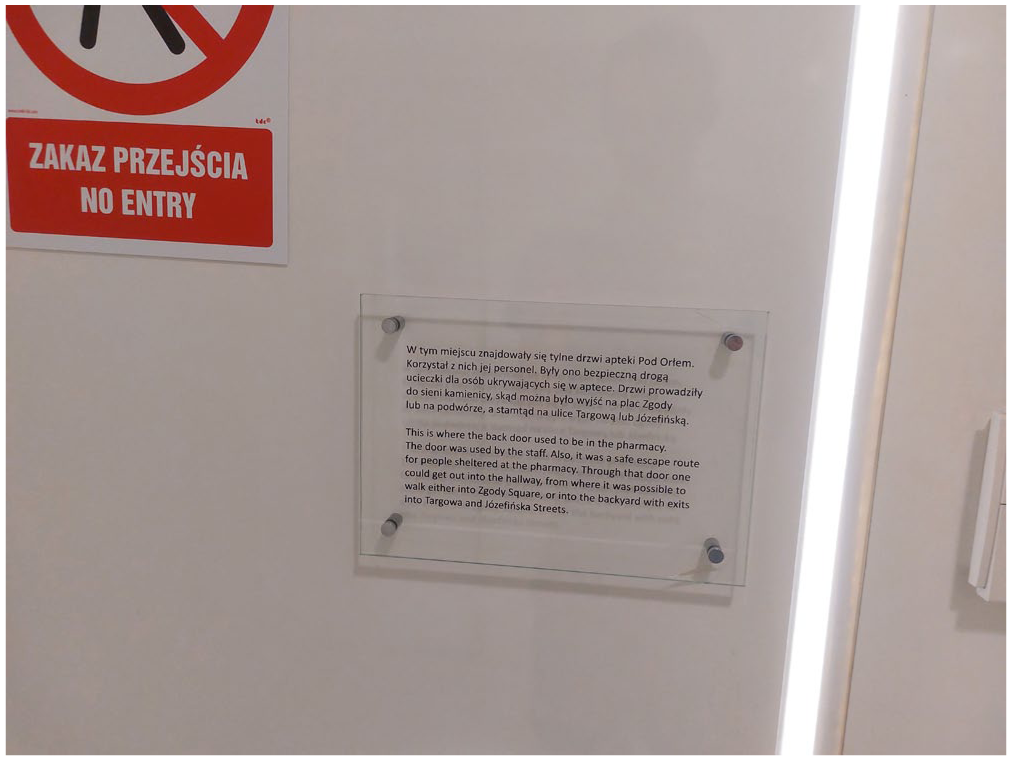
Photograph of the plaque informing visitors about the location of the pharmacy’s former backdoor taken by one of the study participants from Germany [1_M_K_05].
Documentary versus experiential exhibitions
As demonstrated above, ideas about the desired form of a history museum diverged significantly among the study participants and influenced their perception of the exhibitions. For almost all local participants in Krakow and Markowa, the main point of reference is the experiential exhibition at the Warsaw Rising Museum, perceived as the ultimate realization of a memorial museum. They describe it as mimetic, with environmental sounds and “one coherent story through the whole museum.” 66 Conversely, the local study participants compared the Markowa museum, with its minimalistic exhibition style, to contemporary art museums. Meanwhile, the local students in Berlin saw the “white cube” style as the “standard model” of historical exhibitions: “I think many state museums [. . .] feature a very cold white color, are always rectangular and illuminated and things like that.” 67 However, our research also showed that the preferences of museum visitors do not always rely on what they got used to. As an example, the international students at the MOW appreciated the museum’s weaker emotional appeal and its cognitive character as a welcome change. One interviewee from France reflected, “[T]hese days on social media, you can see [. . .] horrifying things every day, so it’s a bit sad that you get more used to it.” 68 Against this backdrop, the Berlin museum “didn’t feel so much uncomfortable.” Likewise, at the Pankiewicz Pharmacy, a local student said that she liked this exhibition as, contrary to what she had experienced elsewhere, “its emotional load was not so strong.” 69
Conclusion
While the participants’ understanding of the exhibitions was broadly similar across the groups, their assessment of the museums varied. The majority of local students in Berlin and students from Germany in Poland appeared to adopt a “cosmopolitan” mode of remembering. Consequently, these students expected the exhibition to focus on the victims of the Holocaust and to be self-critical about the history of their own communities.
The local students in Markowa were less explicit in their criticism of the exhibition. They acknowledged that the museum tended to highlight positive examples of Poles’ stance toward the Jews during World War II. However, they agreed that it generally presented an accurate picture of the past. This complies with the dominant Polish historical narrative, in which the rescue stories serve as an argument to refute allegations of Polish antisemitism and complicity in the Holocaust. Nonetheless, local students also seemed to read the exhibition in a manner that diverged from what they themselves perceived as the curatorial intent. They showed particular interest in the Jewish experience during World War II and questioned the binary division between bad Germans and good Poles. In a similar vein, the students from Ukraine did not mind the exhibition’s heroic tone as they thought each country had the right to praise its own heroes. However, they also questioned attributing characteristics to nations. Likewise, at the Pankiewicz Pharmacy, some of the local interviewees praised the museum because, unlike their schools, it did not “demonize” the Germans.
The students also differed in their understanding of “authenticity.” Crew and Sims (1991) argue that the rise of social history and the problems of unrepresentative museum collections have led to the emergence of authority-based authenticity, which differs from the artifactual one, and in which the artifact becomes less “preeminent” in the exhibition display. Such understanding of authenticity matches the unfulfilled expectations of the international students in Berlin, as well as some local students in the Ulma Museum and the Pankiewicz Pharmacy, where they said they lacked the “vibe” and wished for more reconstructions. This tendency is most evident in the abovementioned statement of the Polish student at the MOW, who even justified historical fabrication. By contrast, the local students in Berlin and the students from Germany in the Pankiewicz Pharmacy suggested highlighting site “authenticity” by adding more original artifacts and more information.
Finally, we found that while experiential exhibitions may be generally better at eliciting emotions, the affective responses triggered by museum displays also depend on the visual habits and previous museum experiences of the study participants. In the case of Polish students, accustomed to highly experiential museums, the level of sensory stimulation needed to evoke emotions seems higher than, for example, in the case of students from Germany.
In summary, our study confirms the hypothesis that “cultural codes that visitors subscribe to” (Pastor, 2022: 11) impact their interpretation of exhibitions. These codes appear to be still largely shaped within national frameworks. This is also true for young people. Their socialization in different memory cultures and visual cultures influences how they perceive the museum presentations. However, it is evident that European integration and the globalization process have also influenced their reception of the displays. Many of our interviewees, particularly the Erasmus students but also local students from major cities such as Krakow and Berlin, had visited numerous museums internationally. These visits formed part of their perceptual priming. The students demonstrated familiarity with diverse modes of exhibiting history and realized the existence of alternative perspectives of the past. Our research also showed that the preferences of museum visitors do not always rely on what they are used to. Some of our study participants clearly distanced themselves from what seemed most familiar to them. This was evident in their appreciation of the Pankiewicz Pharmacy’s less emotional appeal as a pleasant change to what they knew from other Polish museums, or, conversely, in their description of the sober “German” exhibition style as “boring.” 70
In an attempt to refine the concept of “cosmopolitan memory”, which has been criticized for being more programmatic than analytical, Levy et al. (2011) proposed the term “reflexive particularism.” This concept also aligns well with our findings. While it is not possible to speak of a common reading of the exhibitions among students coming from different European countries, many of them demonstrate, when discussing the museums, a “disposition to (ex)change perspectives and recognize the claims of Others” (Levy et al., 2011: 139).
Footnotes

Funding
The authors disclosed receipt of the following financial support for the research, authorship, and/or publication of this article: This text was written thanks to a grant from the National Science Centre Poland (Narodowe Centrum Nauki, NCN) OPUS22 “Help Delivered to Jews during World War II and Transnational Memory in the Making” (Grant No. 2021/43/B/HS2/01596). The project is being carried out at the Faculty of Sociology, University of Warsaw.
Declaration of conflicting interests
The authors declared no potential conflicts of interest with respect to the research, authorship, and/or publication of this article.