




Abstract
This article examines the growing importance of path dependence in the field of collective memory research. Its primary aim is to analyse how the concept is used and its potential relevance within this area of study. The review assesses the prevalence of the concept in different disciplines and academic discussions, emphasising the need to capture its diverse applications and theoretical developments. By examining the historical spread, variation and proliferation of path dependence, the article identifies several promising directions for future research. It points to previous instances where the concept has been applied to studies of collective memory and proposes additional avenues for investigation. Ultimately, the findings suggest that insights from other areas of research could enhance the understanding of collective memory, leading the article to argue for a broader integration of path dependence concepts in the field.
Keywords
Introduction
The concept of path dependence is inextricably linked to the past, as is the concept of memory. Despite this commonality, path dependence has originally received relatively little attention in memory research. However, an interesting trend is emerging, as evidenced by the increasing use of the term ‘path dependence’ to describe collective memory. Collective memory research explores how groups – such as communities, members of organisations, societies or nations – collectively create and share memories of historical events, experiences and cultural phenomena over time. This process underpins identity, historical understanding and cultural heritage across generations. Recently, several studies within this field of research have explicitly invoked the concept of path dependence. Such studies include analyses of the portrayal of Second World War in Russian textbooks (Ehrlich, 2021), the collective memory of Mozambique’s war of liberation (Bueno, 2023), the memory-informed transnational practices of Armenian Americans (Sarkissian, 2024), and the placement of war memorials in Ukraine (Glew, 2021). A recent monograph on collective memory includes over 30 references to path dependence (Dimbath and Henlein, 2022). Recognising the increasing use of the term as an opportune moment for a comprehensive investigation, this article embarks on a multifaceted exploration of path dependence in the context of memory studies.
In order to examine the various dimensions of this concept in depth, this article seeks to shed light on its theoretical foundations, its historical development and its broad implications across different disciplines. It will examine the origins and development of the concept, tracing its integration into various academic fields and analysing how it has been transformed through reinterpretations and extensions. In addition, this article aims to highlight the versatility and applicability of path dependence within memory research by presenting examples of its successful application. By exploring these applications, this article will highlight promising analytical avenues for a deeper understanding of memory dynamics.
Tracing the concept of path dependence
The basic idea underlying the concept of path dependence is that the trajectory of processes can be shaped by past events. Depending on the context of the discourse, various facets arising from the historical nature of processes are singled out as instances of path dependence (cf. Beyer, 2026; Mahoney and Schensul, 2006: 457; Pierson, 2000: 253), including the following:
The significant influence of events at the outset of path-dependent processes (‘initial conditions’).
The potentially momentous role of minor or even random occurrences (‘small events’).
The inexorable progression of processes bound by path dependence (‘self-reinforcement’).
The inherent openness of outcomes and the diversity of potential pathways of path-dependent processes (‘nonergodicity’).
The moulding or branching of developmental trajectories at crucial moments in time within path-dependent processes (‘critical juncture’).
The challenge of deviating from once-established equilibrium states (‘lock-in’).
The potential persistence of suboptimal equilibrium states (‘inefficiency’).
The formulation of the concept of path dependence can be attributed to two economists, W. Brian Arthur and Paul A. David. Arthur, in particular, provided theoretical evidence that processes can exhibit path dependence. Arthur’s now famous example, the Polya urn model, illustrates how successive random draws of different coloured balls from an urn or lottery drum can result in a path-dependent process if an additional ball of the same colour is reintroduced each time a ball is drawn (Arthur et al., 1987). Over time, the probabilities of drawing balls of different colours change, and a relatively stable colour composition gradually emerges after many draws. Arthur refers to this stochastic process as path dependent, because initial draws from the urn have a greater effect on the course of the process than subsequent draws (initial conditions). While each individual draw is a ‘small event’ in itself, it contributes to the path dependent trajectory. The process is self-reinforcing, as the influence of individual draws on the percentage distribution of colours decreases as the number of draws increases. If the whole process is repeated, starting with two balls, there is a high probability of obtaining a unique colour composition that cannot be predicted beforehand (non-ergodicity). By contrasting different path dependent trajectories, it is possible to determine when, with a given assumed probability, a uniformly distributed colour composition within the urns is no longer probable (critical juncture). Once a significant number of draws have occurred, subsequent random draws are unlikely to substantially alter the colour distribution (lock-in). It is uncertain whether competition will always lead to efficient states, if one assumes, as Arthur (1989) does, that under certain conditions economies reflect the properties of the Polya urn model (inefficiency).
The prominence of the path dependence concept owes much to the work of the second path dependence pioneer, David (1985, 2007). He brought the concept to life by analysing the example of the arrangement of keys on computer keyboards, showing how a technological solution to a dilemma can persist over time, even when the original rationale for its development has disappeared and alternative paths of optimisation could be pursued. The arrangement of letters on modern computer keyboards, with QWERTY on the top row, is the result of trial and error to overcome the mechanical obstructions of bar-type typewriters. As technology progressed to ball-head typewriters and computers, the original basis for the key arrangement became obsolete, allowing ergonomically oriented alternatives to replace the established norm. Nevertheless, according to David (1985), path dependence prevents a departure from the QWERTY arrangement.
Initially, the concept was primarily aimed at explaining the adoption of technologies. An extension and reinterpretation of the path dependence concept came from the institutional economics studies of Nobel laureate Douglass C. North. For North, the concept evolved into an explanation of institutional differences at the societal level (North, 1990). North explains the existence of path-dependent developments with the interplay of institutions (‘institutional matrix’), which then contributes to the coexistence and persistence of different efficient institutional systems (e.g. different national contexts with different growth prospects). In contrast to a focus on reproducing the identical (e.g. reaffirming the same key arrangement), North’s considerations now include gradual institutional shifts. North sees institutional change as an ongoing, incremental process, driven by individual and collective actors. However, North contends that innovative learning and adaptability to successful institutional systems remain limited because actors consistently align their behaviour with existing institutions. Moreover, actors’ cognitive frameworks (‘mental models’) are path-dependent and predisposed by past events, favouring incremental adaptation over radical change (North, 1998: 252).
From its origins in economic research, the concept of path dependence has evolved into an explanatory framework used in numerous scientific fields, including political science (Pierson, 2000), law (Hathaway, 2000), sociology (Mahoney, 2000), geography (Martin and Sunley, 2006), management research (Sydow et al., 2009) and education (Feeney and Hogan, 2017). As it has travelled in time (Erll, 2025) through different fields, the rationale for the existence of path dependence has become more diverse. As a result, it is now recognised that a variety of path dependencies exist (Beyer, 2010; Brenner and zu Jeddeloh, 2024). In addition to the increasing economies of scale, positive feedback loops, and institutional linkages that are emphasised in economic research, factors such as event sequences, unequal power dynamics, veto positions, and beliefs in functionality and legitimacy have been identified as triggers of path dependence. Furthermore, the introduction of derivative concepts such as path creation (Garud and Karnøe, 2001) or path clearing (Hogan et al., 2022) reflects the increasingly diverse and detailed application of the concept in different scientific fields.
Plurality of perspectives
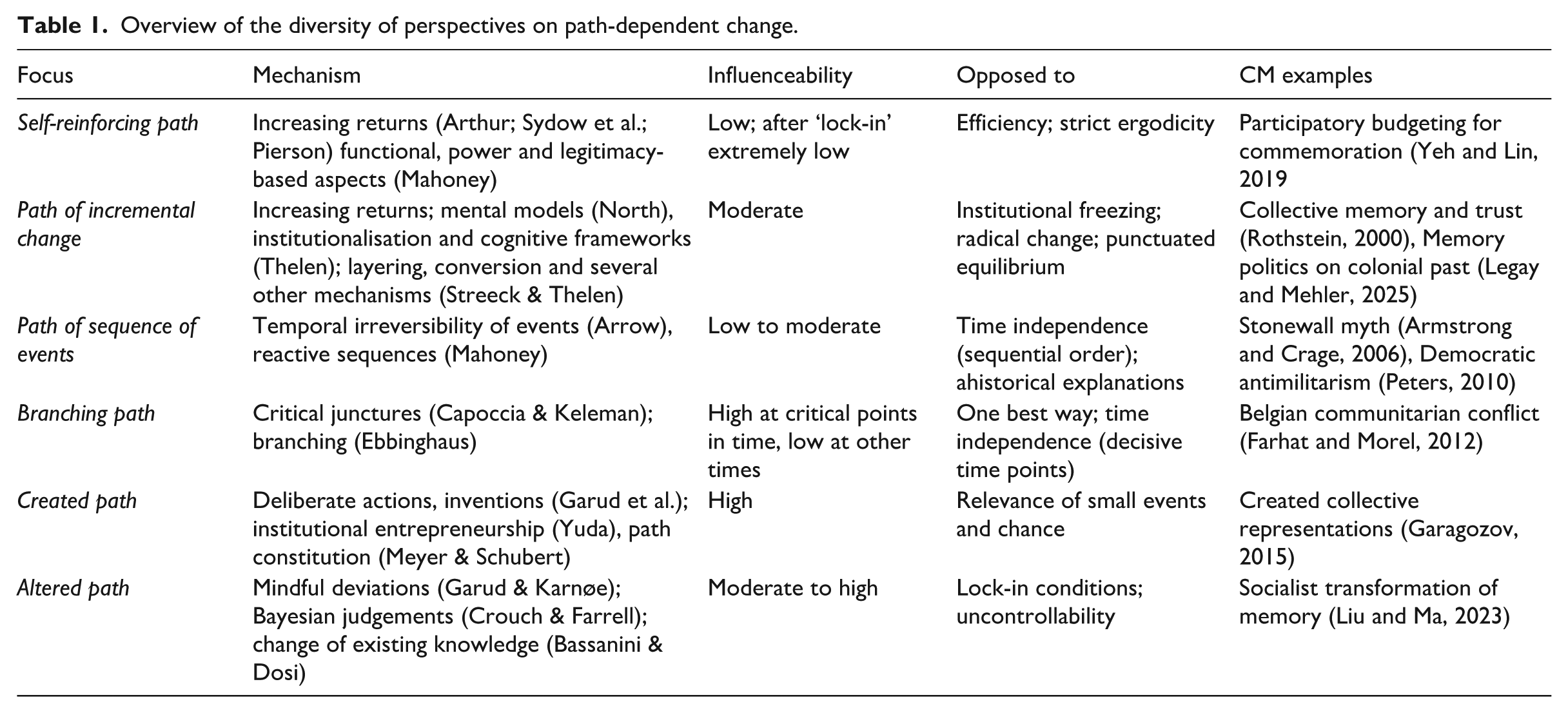
To illustrate the plurality of the concept of path dependence, six different perspectives are described below. Each is based on different assumptions about the focus of the concept of path dependence, the underlying mechanisms, the opposition to other concepts, and the possibilities for actors to consciously influence the course of path-dependent processes (see Table 1):
Overview of the diversity of perspectives on path-dependent change.
Self-reinforcing path
Understanding path dependence as a self-reinforcing process helps to explain how a particular outcome can become increasingly likely over time, even when other potential outcomes offer equal or greater benefits. This effect arises from positive feedback loops in which an initial decision or investment in a particular path increases its attractiveness for continued pursuit. Arthur (1989) was one of the first to formalise the concept of self-reinforcing path dependence. He suggested that in industries or markets characterised by increasing returns, small and seemingly arbitrary initial advantages can eventually develop into significant benefits. Positive feedback loops can create a scenario where the more agents adopt a particular option, the more attractive it becomes. The political scientist Paul Pierson extended the concept of increasing returns and applied it to political institutions and policies. Pierson (2000) argued that institutional and policy designs tend to follow self-reinforcing trajectories, making it difficult to deviate significantly from established paths. He emphasised that policy decisions create vested interests and constituencies that are resistant to change. Consequently, even when alternative policies might be more effective or efficient, existing arrangements persist because of their reinforcing nature.
In the organisational context, Sydow et al. (2009) examined self-reinforcing path dependence and found that it can lead to organisational inertia. Organisations can become so entrenched in their existing methods that adapting to change becomes difficult. This perspective generally assumes that path-dependent processes are difficult to influence, particularly once a lock-in state has been reached. While self-reinforcing path dependence is typically associated with increasing returns, historical institutionalist approaches have broadened the study by identifying other mechanisms – functional, power and legitimation – that can perpetuate these processes (Mahoney, 2000). In the context of collective memory research, Yeh and Lin’s (2019) analysis of participatory budgeting for commemoration serves as an example of path-dependent, self-reinforcing processes. Similarly, Erll (2022) discusses mechanisms of self-reinforcement to explain the latent power of implicit collective memory, albeit without engaging directly with the discourse on path dependence.
Path of incremental change
An alternative perspective, notably advanced by North (1990) and historical institutionalists, emphasises the gradual nature of path-dependent processes. This view suggests that change is constrained but not entirely prevented, and focuses on explaining enduring differences rather than merely the persistence of suboptimal conditions. Historical institutionalism examines the origins, transformations and meaning of institutions, proposing that actors’ decisions are shaped by earlier processes of institutionalisation. Terminology in the field has evolved, with ‘route’ and ‘trajectory’ giving way to ‘path’, establishing path dependence as central to historical institutionalism (Pierson and Skocpol, 2002; Thelen, 1999; Torfing, 2009). In particular, Thelen’s work has been central to the study of incremental institutional change. Together with collaborators such as Hacker, Pierson and Streeck, she has identified different types of incremental change, allowing for detailed analysis in different institutional contexts (Hacker et al., 2015; Streeck and Thelen, 2005). Beyond mechanisms such as increasing returns, mental models and cognitive frameworks that explain incremental change (North, 1990; Thelen, 1999), they highlight mechanisms such as ‘displacement’, ‘layering’, ‘drift’, ‘conversion’ and ‘exhaustion’ that define different paths of change. These mechanisms show that the motivations for departing from established institutions and the forms of change can vary considerably, underlining the complexity of institutional evolution. The concept of incremental change contrasts with views suggesting the possibility of institutional freezing, as well as ideas of radical change, as the capacity to influence social change towards radical outcomes is perceived as limited. North’s (1990) concept of incremental change was linked to collective memory by Rothstein (2000), for example, and Legay and Mehler (2025) explicitly refer to social science historical institutionalism in their study on memory politics on colonial past.
Path of sequence of events
Another variant of path dependence emphasises reactive sequences, a concept introduced by Mahoney (2000). According to Mahoney, reactive sequences are temporally ordered and causally linked chains of events in which each event both reacts to preceding events and influences subsequent events. Typically, the last event in the sequence is the outcome being studied, and the entire sequence of events can be seen as a path leading to that particular outcome. The initial event that initiates the sequence of reactions is contingent in nature. Reactive sequences follow a familiar logic in which event A leads to event B, which leads to event C, and so on, culminating in the final event. In contrast to self-reinforcing paths, which involve the reinforcement of early events, reactive sequences are characterised by counteractive processes that potentially alter or reverse early events. In essence, they encompass a cascade of events that follow the initial action (Falleti and Mahoney, 2015). These events that make up a reactive sequence are tightly linked by causal links that scholars Griffin and Ragin (1994) call ‘inherent sequentiality’. These sequences carry considerable weight in the study of historical trajectories, as they illuminate the complex and interactive nature of causal relationships from multiple dimensions. Furthermore, an analysis of individual steps reveals that different sequences can lead to different developmental outcomes. Arrow (2003) highlights the quasi-irreversibility of decisions as a crucial element of path dependence, challenging the notion that increasing returns are obligatory for this phenomenon. This perspective is analogous to following a cooking recipe, where the order and timing of the addition of ingredients has a significant impact on the outcome. Similar patterns emerge in social development, where different sequences can produce divergent trajectories (Beyer, 2012; Collier, 1993). The study of path dependence through sequences of events contrasts sharply with ahistorical explanations and underlines the importance of the temporal dimension in social analysis. Given that social change often lacks a precise ‘recipe’, this perspective suggests that the degree of intentional influence on path trajectories is generally moderate to low. In collective memory research, the analysis of events and their sequential order has been used, for example, to explain the Stonewall myth (Armstrong and Crage, 2006).
Branching path
Scholars such as Giovanni Capoccia, R. Daniel Keleman and Bernhard Ebbinghaus have contributed significantly to an alternative understanding of path dependence that emphasises the branching of trajectories at crucial moments. In contrast to previous perspectives on path dependence, the concept of branched paths does not focus on replicating paths, but rather on their divergence and evolution after pivotal events. At the heart of branched path dependence is the concept of critical junctures. These critical junctures, as defined by Capoccia and Keleman (2007), encompass relatively short periods of time during which the likelihood of agents’ decisions influencing the desired outcome is significantly increased. These junctures are important because they set institutional arrangements on trajectories that are difficult to change. Such junctures mark pivotal instances where choices have far-reaching consequences that shape the future trajectory of institutions and societies. Capoccia and Keleman’s (2007) research provides a theoretical framework for understanding critical junctures and their role in shaping institutional change. The study also draws on analyses of critical junctures in different contexts, such as Collier and Collier’s (1991) study of labour movements and regime dynamics in Latin America and Hacker’s (1998) examination of the historical rationale for national health insurance. Ebbinghaus (2005) examines bifurcation through the lens of welfare state reform. The study argues that there are no predetermined outcomes in welfare state reform and shows how different countries can take different paths to achieve analogous goals. The direction of welfare state reform varies according to historical and political contexts, as well as the choices made at critical junctures, resulting in different trajectories across countries. The branching path perspective challenges one-size-fits-all and time-independent views of development and highlights the vulnerability of trajectories to choices made at critical junctures. While the possibility of influence is pronounced at these key moments, it tends to be minimal at other times, underscoring the importance of timing and context in social and institutional development. Using the example of the Belgian communitarian conflict, Farhat and Morel (2012) demonstrated the significance of ‘critical junctures’ in collective memory research.
Created path
Another view of path dependence emphasises the potential for the deliberate creation of path-dependent developments. Proponents of this view argue that paths are not simply the result of random events or external shocks. Instead, they are the result of deliberate actions taken by actors to shape the future. This perspective recognises the importance of history, while leaving room for proactive choices. These paths, although newly created, may still be influenced by the historical trajectory, requiring path makers to navigate within the constraints imposed by existing structures. While the conventional discourse on path dependence assumes that initial conditions are given and contingencies are exogenous and unpredictable, the created path perspective posits that initial conditions are constructed, contingencies emerge and serve as embedded contexts for ongoing action, self-reinforcing mechanisms are strategically manipulated by actors, and lock-in is a temporary stabilisation of paths in the making (Garud et al., 2010). The path creation perspective emphasises the role of inventors, institutional entrepreneurs (Yuda, 2023) and innovation pioneers, focusing on their influence in achieving critical mass and creating new pathways (Simmie, 2011). In addition to the concept of path creation, related ideas such as path constitution (Meyer and Schubert, 2007) can also be attributed to the created path perspective. The created path perspective is clearly distinct from notions that emphasise the relevance of minor events and contingencies at the onset of path-dependent processes. In this interpretation, pathways are consciously initiated and deliberately designed to shape long-term development. While the influence on path-dependent developments is considered significant, it requires strategic or entrepreneurial skills. In the field of collective memory research, Garagozov (2015), for instance, has examined how collective representations of the past are created.
Altered path
Proponents of the altered path perspective have sparked critical discussions about deliberate deviation, revised path dependence, and the complex processes involved in breaking and changing paths within societies and modelled scenarios. Garud and Karnøe (2001) argue for a strategic approach to deviating from established trajectories, emphasising that conscious and deliberate choices can reshape outcomes. They argue that this mindful deviation is crucial to discovering new insights and opportunities, while remaining aware of the historical contexts that inform current decisions. The idea is that deviating from conventional paths can lead to previously unexplored areas of discovery. Similarly, Bednar et al. (2012) highlight the transformative potential of disrupting established sequences, arguing that by dismantling existing path dependencies, one can create revised dependencies that steer future developments towards different outcomes. In addition, Beyer (2010) points out that there are countermeasures to all the mechanisms of path-dependent continuity discussed in the literature that can eliminate lock-in situations. Crouch and Farrell (2004) further argue that path dependencies should not be viewed as fixed constraints. Instead, they suggest that such dependencies are malleable and can be strategically altered by Bayesian decision makers to facilitate new directions. In a related notion, Bassanini and Dosi (2001) note that learning within an existing trajectory can alter existing knowledge and allow deviations from established paths. Although the different approaches differ in their rationales, they share a belief in the possibility of changing paths or ending a path-dependent trajectory. This perspective encourages a proactive stance in recognising and modifying the factors that create dependence, asserting that paths can be reshaped to align with evolving goals and aspirations, thereby breaking free from the constraints of history. Consequently, these approaches are at odds with the notion that path-dependent processes inevitably lead to an unchangeable, locked-in situation. Depending on the rationale for the change in path perspective, a moderate to strong influence on path-dependent developments is assumed. An example of the altered path perspective in collective memory research can be found in the study by Liu and Ma (2023), which deals with strategies for deliberately influencing memories in China.
Path dependence and collective memory research
Collective memory research examines how groups and societies remember and engage with their histories. As mentioned in the introduction, the intensive scholarly debate surrounding the theoretical concept of path dependence in collective memory research is a relatively recent phenomenon. On average, the most frequently cited journal articles featuring ‘collective memory’ as a keyword in the title and referencing ‘path dependence’ were published approximately 30 years after David’s (1985) seminal text, Clio and the Economics of QWERTY. Therefore, it is worthwhile examining this emerging interest in the concept of path dependence and the findings that have already resulted from its application.
The current body of research remains diverse, and studies within collective memory research do not always engage consistently with mainstream path dependence literature. This is evident in the authors cited as references for the first mention of the term in relevant journal articles. Figure 1 presents a breakdown of these cited authors and shows which additional names are significant enough to be cited alongside the initial reference to the term ‘path dependence’. The range of first mentions is quite broad, with some articles introducing the term ‘path dependence’ as self-explanatory without any source reference. Jeffrey K. Olick is by far the most frequently cited author in connection with path dependence in collective memory research, while names typically associated with the general path dependence debate, such as David, Arthur, North or Pierson, appear much less frequently as references in the analysed journal articles.
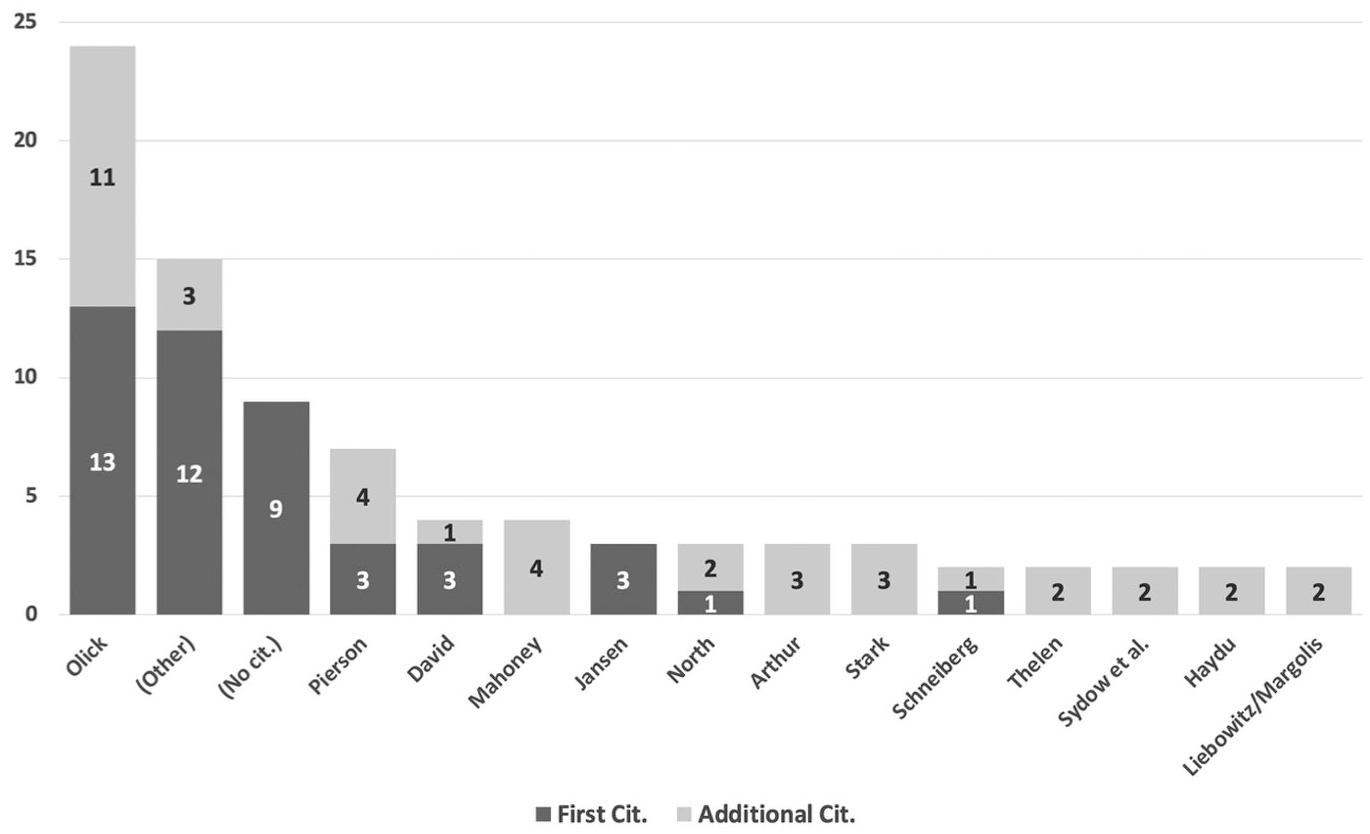
Authors cited for path dependence in journal articles on collective memory research.
Olick (1999) is indeed the key figure who first systematically introduced the idea of path dependence into collective memory studies. Olick defines path dependence as the notion that individuals and collectives are influenced by significant historical events, though not always in obvious ways. He proposes a process-relational framework that views memory not as a static entity, but as a dynamic process that connects the past to the present in a dialogically contingent manner. Olick focuses his analysis on the dialogical nature of memory and the idea that memory is only possible in dialogue with the accumulated sequence of previous memories. 1
This perspective suggests that significant historical events, the evolving interpretations of those events at particular moments, and the various ways in which those interpretations are expressed in later contexts all play a role in shaping the present. Understanding this requires historical context and an awareness of the unfolding of events and decisions over time. Empirically, Olick applies this framework to show how the political identity of post-war West Germany was shaped and constrained by processes of Holocaust remembrance, analysing public discourses of German guilt in the decades that followed. In his seminal article on the commemoration of 8 May 1945 in the Federal Republic of Germany, Olick argues that commemorative representations of the past are not merely reflections of the events commemorated or of the contemporary context, but are also path-dependent outcomes of earlier commemorative practices.
Drawing on Olick’s study, several studies have addressed how commemoration practices are characterised by path dependence. Saito (2010) notes that the repetitive nature of commemoration creates intricate temporal dynamics. As with other institutionalised practices, commemorative rituals become increasingly difficult to alter over time. Nevertheless, certain aspects of commemorations do change in response to new social, cultural and political developments. Saito suggests that it is analytically helpful to consider the temporal dimensions of commemoration as comprising age, period, and cohort effects. Period effects arise when changing historical contexts alter the nature of rituals. Cohort effects emerge when new generations reinterpret commemorations based on their unique experiences and priorities. Age effects describe how individuals’ approaches to commemoration change over the course of their lives. Taken together, these effects demonstrate how commemorative practices undergo gradual, path-dependent change.
Other studies extend this perspective. For instance, Bogumił and Voronina (2020) analyse the Russian Orthodox Church’s centenary commemorations of the 1917 Revolution. They argue that these were path-dependent products of earlier landmark events, namely the martyrdom of the New Martyrs and the restoration of the Patriarchate. In this case, the clergy play an active role in shaping collective memory by proposing various interpretations and activating different mnemonic narratives, thereby demonstrating the ongoing impact of history on contemporary commemoration. Similarly, Glew (2021) explores how Soviet memorials to the Great Patriotic War influenced the placement and symbolism of subsequent war memorials in central Ukraine. By examining factors such as site availability and symbolic resonance, Glew demonstrates that earlier Soviet memorials continue to influence the commemorative landscape, affecting the spatial arrangement of new monuments and ongoing debates about current conflicts.
Whitlinger (2023) adopts a different approach, examining commemorations as critical junctures within a path-dependent history. She focuses on the remembrance of the 1964 ‘Mississippi Burning’ murders. Her analysis reveals that commemoration can catalyse social change by creating opportunities for positive intergroup contact, cooperation, equality, political support, and storytelling. Whitlinger thus frames commemorative practices as potential turning points in broader societal trajectories. Finally, Edy and Adams (2023) describe the gradual evolution of commemorative practices surrounding 9/11 in the United States from 2002 to 2019. While rooted in the original narrative of unity and resilience established by the Bush administration, the politics and meaning of 9/11 remembrance have subtly shifted over time in response to changing contexts and leadership, illustrating both the continuity and gradual transformation inherent in collective memory.
Together, these studies emphasise the significant impact of historical events and cultural memory on commemorative practices and highlight the usefulness of Olick’s path dependence framework. However, most research in this area remains largely rooted in Olick’s interpretation and seldom engages with alternative concepts from the wider debate on path dependencies. Only Whitlinger (2023) addresses the notion of critical junctures, though she too relies primarily on Olick’s conceptualisation.
Cultural constraints and institutional legacies (Kay, 2012; Olick and Levy, 1997) form another strand of research that highlights the path dependence of collective memory, emphasising how these factors can perpetuate certain historical interpretations while marginalising others. In this line of research, there are particular references to historical-institutionalist interpretations of path dependence, which emphasise the gradual nature of change. References include North (1990), Pierson (2000) and Stark (1992). For example, the institutionalisation of collective memories of hate in Germany and the United States, as explored by Savelsberg and King (2005), shows how Germany focuses on the Holocaust and its link to the destruction of democracy, while the US dehistoricises individual victimisation and avoids addressing domestic atrocities. These differences, together with state organisation and global influences, result in path-dependent variations in hate crime legislation, affecting aspects such as internationalisation, minority and democracy protection, individual versus group rights, and the specialisation of control agencies. Rother (2012) argues that a collective identity within ASEAN states fosters distinct cultures of conflict or cooperation, highlighting norms shaped by interactions and domestic events, influenced by cultural path dependencies deeply rooted in regional memory. This highlights the importance of area studies in understanding enduring cultural influences.
The path dependence of social capital in Russia is discussed by Schrader (2004), who links it to society’s collective memory and experience of power structures. Social capital exists at both network and societal levels, with fragmented societies often lacking robust societal social capital. In Russia, despite the transition to a market economy, weak social capital at the societal level contrasts with strong personal capital at the network level. This mismatch undermines the functioning of new institutions as informal norms overshadow formal ones, hindering the development of a solidary civil society. Ehrlich (2021) examined the reflection of the Second World War in Russian textbooks of the 1990s and found that these textbooks retained a ‘schematic narrative template’ similar to Soviet-era texts, emphasising the expulsion of foreign enemies. Although the portrayal of Stalin’s crimes was severely criticised, the basic structures of the teaching of history remained unchanged. This continuity contributed to the near failure of efforts to come to terms with the past during the Yeltsin era.
Analysing how resource policies affect the development of a mining community, Van Assche, Gruezmacher and Granzow (2021) argue that the boom-bust cycles of mining have shaped social identities and governance, complicating the articulation of alternative futures. They describe collective trauma and the path-dependent replay of scenarios of hope and disillusionment. The analysis suggests that key events influence community development and politics beyond conscious memory, limiting reflexivity and adaptation in resource-based communities.
A third cluster in the discussion of path dependencies and collective memory concerns the issue of community formation and cultural identities. This cluster explores how historical relationships, grievances, and collective memories shape cultural identities (Assmann and Czaplicka, 1995; Wang, 2008) and perpetuate conflict. Farhat and Morel (2012) delve into the Belgian communal conflict through the lens of path dependence, analysing the historical relationship between linguistic communities. The persistent grievances of the Dutch-speaking population under Francophone dominance have fuelled demands for autonomy. Through an examination of Flemish collective memory, their study shows how enduring causes and reproduced social phenomena explain the persistence of political instability and linguistic conflict, highlighting the roots of ethno-nationalist movements in Belgium. Continuing this exploration, Zaichenko (2021) focuses on the socio-cultural integration of minority teachers in post-Soviet Estonia, where parallel education systems exist and minorities make up 26% of the population. Using expert interviews, the research examines the cultural-cognitive institutional dimensions and collective memory associated with annexation and its traumatic events that impact on teachers’ professional agency. The findings suggest that this dimension is path-dependent and significantly influences the socio-biographical journeys and integration paths of minority teachers. Expanding on the theme of community formation and collective identities, Sarkissian (2024) examines the connections and disconnections within the Armenian transnation, particularly the relationship between Armenian Americans and Armenia. Sarkissian illustrates that the relationship between a diaspora and its homeland does not follow a smooth, linear trajectory. The ebb and flow of history changes both the nation-state and its exile community, affecting the ties they maintain. This analysis highlights how historical contingencies and path-dependent processes influence the evolving relationship between diasporic communities and their homelands.
The theme of the memory politics (Hodgkin and Radstone, 2003; Lebow et al., 2006; Verovšek, 2016) is explored in another important line of research that focuses on the political influence on the trajectories of social change. Cossu (2011) examined the appropriation of the memory of the Italian resistance by the Italian Communist Party between 1943 and 1948. He highlighted that the consolidation of this memory was influenced not only by the political culture of the organisation, but also by the internal dynamics and the specific genre of communist commemoration. Cossu illustrates how the party strategically used the memory of the Resistance, showing how commemorative practices can be selectively mobilised and contested within specific cultural contexts. In the same vein, Jansen’s (2007) research highlights how the Zapatistas and Sandinistas differed in their rhetorical approaches to historical revolutionary leaders, who were defined by distinct reputations shaped by earlier memory conflicts. These differing trajectories create unique inherited conditions that limit the movements’ ability to effectively align with these historical figures. The study proposes a path-dependent model of memory work that illustrates how past memory initiatives influence and limit current possibilities for memory engagement. Furthermore, Prylutska (2020) analyses the dynamics of the development of historical memory in independent Ukraine, noting that the experience of the Second World War was the most complex and ambiguous in terms of interpretation. These conflicting interpretations of the past were systematically used by politicians during election campaigns, hindering the creation of a national consensus. This underlines how political actors instrumentalise historical memory to gain short-term political advantage. In Mozambique, the shaping of memory also played a central role, as described by Bueno (2023) in his examination of transitional justice mechanisms. Following the General Peace Agreement of 1992, the Frelimo-led government implemented the Amnesty Law 15/92 in an attempt to leave the past behind. In contrast, President Samora Machel (1975-1982) revisited the colonial past through a quasi-truth commission. Despite different approaches, both strategies resulted in a celebratory reproduction of the liberation war narrative. Bueno uses the concepts of path dependence and critical junctures to explain how this narrative became hegemonic over the last four decades. Interestingly, while the research field of memory politics focuses predominantly on critical junctures, it makes surprisingly little reference to path creation and altered path literature, despite this being an apparent connection.
Finally, in the field of organisational memory research (Walsh and Ungson, 1991), a group of scholars draws on both Olick’s studies of collective memory and various strands of general and management-specific path dependence research, such as path creation (Garud and Karnøe, 2001) and organisational path dependence (Sydow et al., 2009). They combine conceptual elements to develop an innovative concept called the mnemonic field, an extension of organisational field theory. Organisational memory refers to the knowledge accumulated from past experiences within an organisation that can be used to make decisions (Bhandary and Maslach, 2018). Coraiola et al. (2018) argue that memory is crucial in defining organisational fields, which combine structural elements (places) and ideational elements (systems of meaning). They introduce the concept of mnemonic fields, highlighting that organisational fields are historical accumulations of shared memories that are reproduced and objectified over time. This creates path dependence as these memories shape and constrain future structural and cognitive relationships within the field. Similarly, Foster et al. (2016) argue that firm-specific resources, particularly historical narratives, are socially constructed and operate primarily on external stakeholders. These social memory resources can create competitive advantage, highlighting the importance of collective memory in strategic management.
The review of research on the application of path dependence in collective memory studies highlights its effectiveness in addressing a variety of issues and questions. Despite the overall fruitful use of the concept, there is also considerable variation in the ways in which different approaches within collective memory research relate to the original foundational research and broader discussions of path dependence. The most substantial connections to the various interpretations of path dependence are found in organisational memory research, while other segments of collective memory studies make only selective references to the broader debates and foundational aspects of the path dependence concept. Many studies tend to refer only selectively to the origins of the path dependence discourse, or to omit it altogether, along with the various conceptual variants that have emerged in the course of the ongoing debate. This situation is not entirely uncommon, as concepts that seem self-evident are often used in academic discussions without proper reference to their theoretical origins (Zuckerman, 2011).
Potential inspirations from the path dependence debate for collective memory research
The following section suggests ways in which collective memory research could benefit from acknowledging the nuanced and differentiated debate on path dependence that is taking place in other fields of research. It will show how the concept of path dependence could potentially further enrich collective memory research.
One approach is to use established concepts from the path dependence debate more as a comparative heuristic than has been done so far. The concept of path dependence can be used as a counter-heuristic to ideas that, in the tradition of Halbwachs (2020; Gensburger, 2016), interpret collective memory essentially as a reconstruction of the past in the light of the present. The concept of path dependence, which covers the spectrum between ‘lock-in’ and bounded gradual change, offers the possibility of interpreting memory formation as a cumulative, constantly evolving process, for which many points in time and space (e.g. sequences), certain points in time (e.g. critical junctures) or definable trajectories (e.g. increasing returns) are important, but which also makes clear that collective memory cannot completely override history. The heuristic differentiation of the concept of path dependence from other possible interpretations of social change, such as the shadow of the past (Assmann, 2016), the laying of traces and trajectories (Sebald et al., 2023) or transmissions (Eyerman, 2019), has hardly been completed in memory research. 2
The use of path dependence as a heuristic could be useful, even if the aim is merely to differentiate one’s own analysis from these concepts, thus allowing for a more precise description of the empirical case and a clearer definition of one’s own understanding. One theorist from whom collective memory research might seek to distance itself is W. Brian Arthur. A key figure in the development of the concept of path dependence, his ‘increasing returns’ logic is rarely addressed in collective memory studies. Distancing oneself from his interpretation might help to clarify that one’s own description of the process is fundamentally different. Nevertheless, the fact that some organisational memory researchers have found Arthur’s concepts useful (Coraiola et al., 2018) suggests that investigating the origins of this concept might still prove valuable in exploring further applications in collective memory research.
Researchers studying commemoration have primarily drawn on the work of Olick (1999) to explore path dependencies. However, the broader heuristic potential of the concept of path dependence could also be used effectively in this area. For example, in cases of commemorations that have become rigid in their rituals and show little change over time, a path dependence interpretation similar to that proposed by David (1985) may be relevant. Conversely, for ceremonies that break sharply from tradition, the path creation heuristic outlined by Garud et al. (2010) may be applicable.
Furthermore, it may be useful to examine whether Pierson’s (2000) article on path dependence serves as a complementary or contrasting heuristic, particularly since it is sometimes cited alongside Olick’s work – often as a ‘necessary reference’ due to its prominence in the path dependence discourse – despite describing a mechanism quite different from Olick’s interpretation. Interestingly, Mahoney’s (2000) sociological approach to path dependence has exerted less influence on collective memory research, even though it accommodates various mechanisms of path generation, with Mahoney distinguishing between utilitarian, functional, power, and legitimation explanations. Moreover, his concept of ‘reactive sequences’ offers a mechanism much closer to Olick’s conception of path dependence. In conclusion, the diversity of concepts associated with path dependence has yet to be thoroughly examined for their heuristic value in comparative analyses and distinctions.
A second way in which the concept of path dependence can be effectively applied is by transferring key sub-concepts from the path dependence debate to the empirical realities of memory research. For example, a significant link can be made to minor events (referred to as ‘small events’, see Arthur, 1989), which may be more vividly retained in collective memory than major events (Bondebjerg, 2020). The term ‘small events’ has particular resonance in path-dependent research, where seemingly minor events at the onset of path-dependent processes (such as early typing contests on typewriter keyboards, see Brown and Rivers, 2016) can have lasting effects. In addition, the concept of ‘critical junctures’ (Collier and Collier, 1991) may be useful in exploring the specific moments or reasons for the divergence of collective memories between different social groups. For cultural trauma experiences (Alexander et al., 2004) with lasting effects that are embedded in collective memory, parallels can be drawn with the concept of ‘lock-in’ (Sydow et al., 2009) from path dependence theory, particularly with regard to deviations from the ‘lock-in path’ during memory processing (Saito, 2006). Furthermore, experiences that are reinforced by repeated recall may be consistent with the phenomenon of self-reinforcement (Arthur, 1989). Thus, there are several points of reference for a stronger link between memory research and the concept of path dependence.
A potential third approach to engaging in discussions of path dependence might be to directly adopt, or metaphorically apply, the perspectives of self-reinforcing, sequenced, branched, created and altered paths to collective memory. These perspectives derived from path dependence research can serve as a guide for alternative interpretations of how groups such as communities, organisational members, societies or nations collectively shape and transmit shared memories of historical events, experiences and cultural phenomena over time. As mentioned above, Table 1 shows that links to the various facets of path dependence research are already evident in certain methodologies. For example, Yeh and Lin (2019) highlight that emotions associated with places can have a self-reinforcing effect, increasing individuals’ willingness to contribute to commemorating the past. Boonstra and Nguyen’s (2010) discussion introduces the concept of reactive sequences in relation to collective memory, providing insights into the social dynamics that foster non-compliance in Vietnamese marine fisheries. Conversely, Peters (2010) has analysed the reactive sequences that enabled collective memory to support democratic antimilitarism in post-war Japan. Research on branching memories – in line with the branching path perspective – has also been explored. For example, He (2009) conducted a comparative study of reconciliation processes by examining Sino-Japanese and German-Polish political relations. In addition, Mekonnen (2013) explored divergent memories in ‘Contested Versions of Collective Memory in Postindependence Eritrea’, focusing on political responses to divergent memories. The created path perspective is particularly evident in studies of myth. Notable examples include studies of the impact of the media on memories of the assassination of John F. Kennedy (Zelitzer, 1992), the often embellished narratives surrounding celebrities such as Muhammad Ali (Smith, 2017), and the framing of certain events as pivotal or unique, as seen in studies of the Stonewall myth (Armstrong and Crage, 2006). The notion of an altered path is highlighted when history is actively reinterpreted. For example, Malinova’s (2021) analysis looks at the reframing of collective memory of the Yeltsin era, which has helped to legitimise the Putin regime. However, memory transformation can also occur through the process of ‘silencing the past’ (Trouillot, 2015), in which certain painful, shameful or challenging aspects of history are deliberately excluded, overlooked or suppressed from a society’s collective memory. To date, references to self-reinforcing, sequenced, branched, created, and altered paths in collective memory research have rarely been explicitly integrated into the justification and delineation of the underlying concept of path dependence. A more deliberate engagement with these conceptual distinctions could therefore enrich the field of collective memory studies.
Additional options for integrating collective memory research into discussions of path dependence could be identified. In concluding our discussion on this point, it is important to highlight one such possibility: the idea that ‘travelling concepts’ (Bal and Marx-MacDonald, 2002), such as path dependence, inevitably change as they are applied in different contexts. As concepts traverse different fields, they may require adaptation or modification due to variations in terminology, theoretical frameworks or methodologies. Such adaptations can lead to subtle shifts in the concept, thereby fostering its evolution. As a result, a distinct interpretation of path dependence may develop – or has already developed – within memory research that is distinct from how path dependence is understood in other fields of research. This potential is supported by Olick, who first introduced the path dependence theorem into memory studies, and who suggests that path dependence ‘does not necessarily operate in obvious ways’ (Olick, 2007: 40) in his exploration of collective memory and historical responsibility. He uses the example of German memory culture, where he observes a path dependence that distinguishes a particular year’s commemoration not only as different from those of previous years, but also in the way it relates to those previous commemorations. He thus frames path dependence as a process characterised by ongoing constitutions and reconstitutions. This perspective on path dependence may differ markedly from North’s view of gradual change driven by slowly evolving ‘mental models’ (North, 1998) or Mahoney’s concept of path dependence based on ‘reactive sequence’ (Mahoney, 2000), and may constitute a unique variant of path dependence. For the sake of clarity in communication, it may be beneficial for the field of collective memory research to articulate this specific understanding of path dependence clearly, perhaps by adopting a unique term, such as ‘reminiscing path dependence’, or by emphasising the originator’s perspective, as in ‘path dependence in the sense of Olick’.
Conclusion
This article examined the concept of path dependence, which has recently emerged as a important topic in the field of collective memory research. The primary goal of this study was to illuminate both the conceptual applications and the future relevance of the path dependence framework within the field. This article identified five key research areas within the current exploration of path dependence in collective memory studies: commemoration, cultural constraints and institutional legacies, community formation and cultural identities, memory politics, and organisational memory. Within these areas, there are varying degrees of connection to the broader research on path dependence that has been developed across several scientific disciplines. The most substantial connections to the various interpretations of path dependence are found in organisational memory research, while other segments of collective memory studies make only selective references to the broader debates and foundational aspects of the path dependence concept. To address this, this article traced the evolution of the path dependence discourse, highlighting opportunities for future scholarly engagement. The interdisciplinary dialogue on path dependence has become increasingly rich and nuanced, suggesting a significant potential for invigorating collective memory research. Moreover, this article suggests several ways in which insights from the general debate can be integrated into collective memory studies, even if the goal is merely to differentiate from existing considerations. Finally, this article calls for a more rigorous application of path dependence theory within collective memory research, emphasising the need for clearer conceptual precision to avoid misunderstandings and facilitate better comprehension across different research disciplines. Thus far, despite some criticism regarding its perceived ambiguities (Kay, 2005; Rixen and Viola, 2015), the path dependence concept has demonstrated considerable resilience. It stands out as one of the few travelling concepts that has showcased its ability to inspire inquiry across a range of scientific fields and debates, to fit seamlessly into existing discussion frameworks, and to demonstrate that innovative research can continue to emerge even after extensive engagement. This phenomenon is particularly evident in contemporary research on collective memory.
Footnotes

Funding
The author received no financial support for the research, authorship, and/or publication of this article.
Declaration of conflicting interests
The author declared no potential conflicts of interest with respect to the research, authorship, and/or publication of this article.