




Abstract
This article examines the evolving collective memory of the Alta controversy, a civic conflict in Norway spanning from 1978 to 1982, using a combination of natural language processing (NLP) and qualitative analysis of newspapers. By exploring a comprehensive corpus (N = 82,528), we analyse the transformation of the Alta controversy’s representation – from an environmental conflict to its current framing as a pivotal event in Sámi rights history. The findings reveal a dual trajectory: a gradual dominance of Sámi contextualization alongside conflicting narratives that persist in public discourse. Methodologically, this study highlights the utility and limitations of NLP in memory studies, offering innovative solutions for handling large datasets while emphasizing the necessity of qualitative inquiry to interpret narrative shifts. Beyond the Alta controversy, the article contributes to broader debates on how recent past and contested histories are mediated through journalistic memory practices such as commemoration, historical contextualization, and the use of analogies, thereby nuancing the role of newspapers as agents in shaping and reflecting collective memory.
Keywords
Introduction
The Alta controversy was a much-discussed civic conflict from 1978 to 1982 revolving around the building of a hydro-powerplant on the mountain plateau of Finnmarksvidda, the submerging of a Sámi village, as well as the loss of pastoral land and the consequent civil unrest. As one of Norway’s few large-scale contemporary disturbances, it is mainly remembered today for its significant impact on the Sámi community and the advancement of Sámi rights.
This article examines how the memory of the Alta controversy has evolved in newspapers from the time of the event to the present, using both quantitative and qualitative analyses. Utilizing a corpus of 82,528 excerpts from Norwegian newspaper articles, we demonstrate how Natural Language Processing (NLP) can provide insights into representations of past events and their changes over time. 1
We present solutions for researchers of collective memory dealing with vast amounts of data. By avoiding quantitative limitations on our material, we can better generalize how the Alta controversy is referred to or framed in newspapers over time, thus more precisely discussing collective memory and its evolution.
Background and earlier research
Computational analytics has increasingly been used to investigate media representations of the past and collective memory, uncovering patterns in large historical and contemporary datasets. Early studies used text mining of news archives to explore national recollections and evolving collective memories (Au Yeung and Jatowt, 2011). Recent works examined historical newspapers to uncover changing societal dynamics (Huet et al., 2013; Huijnen, 2024; Lie et al., 2022), while others focused on contemporary online media (Barna and Knap, 2023) and digital-native sources, like Twitter, for real-time memory practices (Sumikawa and Jatowt, 2021).
While many of these studies employ computational tools such as n-grams, named entity recognition, collocation analysis and topic modelling, they often offer limited insight into how specific terms are contextually framed over time. Our use of Natural Language Inference (NLI) addresses this limitation by inferring more about the context surrounding our search term – the Alta controversy – allowing for a nuanced analysis of how it is mentioned and reframed over time.
Earlier research on the Alta controversy often focuses on how the event initiated the progression of Sámi rights. Minde (2005) notes that the conflict shifted from an environmental struggle to an indigenous one, suggesting the controversy was predominantly framed as a Sámi issue during the event. This view has become dominant in scholarly literature (Andresen et al., 2021: 370–390; Selle et al., 2015: 64–71). However, other studies and contemporary surveys indicate that factors like the need for electrical power were equally important, leading to a majority supporting the damming at the time (Nyhamar, 1990: 328; Valen, 1983: 159–170).
In current popular presentations, the Alta controversy is portrayed as related to the Sámi minority (Sælthun, 2025a). However, conflicting narratives exist on whether the Alta controversy marked a true change in the relationship between the State and the Sámi, as the minority still faces various issues regarding land development. Notably, the Fosen controversy involves the Supreme Court ruling that building 150 wind turbines makes reindeer herding impossible, violating Norway’s human rights commitments (Høyesterett, 2021).
Research aim
This article examines how past societal conflicts are represented in newspapers and how these narratives evolve and become connected to present-day concerns. We adopt a twofold approach, reflecting that the article is both an empirical investigation into the representation of the Alta controversy and a methodological contribution addressing critiques that memory studies can be reductive or insufficiently collective in scope (Confino, 1997; Kansteiner, 2002).
Earlier research indicates that the Alta controversy is predominantly framed as a Sámi rights issue, but when and how this association emerged remains unclear. Did the shift occur during the controversy itself – as Minde (2003) suggests – as a decisive change in public opinion, or did it take place later, as Sámi political and legal recognition expanded? Our first research aim is to trace narrative shifts over time and to determine when the Alta conflict became primarily associated with the Sámi minority through newspaper representations.
Second, we aim to evaluate the potential of recent advances in natural language processing (NLP) to assist historians and memory scholars in identifying and interpreting patterns in large-scale media corpora. Our second research aim is thus to use and assess NLP techniques in the analysis of narrative framings of historical events, in combination with qualitative interpretation.
To guide the analysis, the article addresses the following research questions:
How has the Alta controversy been discursively framed in Norwegian newspaper discourse over time, and when did it become primarily associated with Sámi rights?
How do newspapers shape collective memory of the Alta controversy, and how do journalistic memory practices contribute to the evolution of its meaning?
What are the methodological potentials and limitations of using Natural Language Processing in the study of collective memory?
While this twofold approach allows for both empirical and methodological contributions, it also imposes limitations. Due to space constraints, we do not offer a full technical account of the NLP pipeline, nor do we aim to present an exhaustive history of the Alta conflict. Furthermore, we argue that newspaper corpora cannot be analysed in isolation: they are embedded in a wider media and knowledge ecosystem, shaped by academic discourse, television, political memory practices and broader cultural dynamics.
A short resumé of the controversy
In 1968, the Norwegian Department of Water Resources and Electricity announced plans to dam the Alta-Kautokeino River due to a projected power deficit and inquiries from local authorities (Eikeset, 1998: 368; Nilsen, 2006: 149–155). Sponsored by the Labour Party at all governmental levels (Hjorthol, 2006: 80–82), the original project included a large reservoir that would flood the Sámi village of Máze and significant parts of Finnmarksvidda, essential for reindeer pastoralism (Hjorthol, 2006: 16–17). It also threatened the town of Alta and jeopardized the river’s status as Norway’s premier salmon river (Andresen et al., 2021: 370–371; Eikeset, 2003: 368–369).
Although Máze was spared in 1973 and plans were reduced in 1975 by removing large reservoirs, the damming became a major conflict from 1978 (Hjorthol, 2006: 188–189; Nilsen, 2006: 149–155). Key events include a Sámi hunger strike and protests outside the Norwegian Parliament in 1979, and a major protest where 800 participants blocked access to the construction site and were forcefully removed by the police during the midst of the winter in a remote location in northern Norway, called ‘the battle of Stilla’. A subsequent second hunger strike and the occupancy of the prime minister’s office by 14 Sámi women followed (Hjorthol, 2006: 102–114, 127–133). While the dam was completed, these actions led to the establishment of public committees to secure the Sámi minority’s future (Andresen et al., 2021: 386–388; Minde, 2003: 112–113, 122).
Theory and direction
Methodical issues of the term ‘collective memory’
A common methodological issue in memory studies is the validity of research in accurately describing collective memories of groups. While a traditional take on the term has been to see national collectives as groups with shared visions of the past, recent literature problematizes such a view. Kansteiner (2002: 193) emphasize that the likelihood of a completely uniform view of the past within a group decreases as the group’s size increases. In this sense, it is problematic, or even impossible, to speak of a singular collective memory in our case regarding the Alta controversy, as the Norwegian nation is built up by several groups, such as the ethnic majority population and the Sámi minority. In addition, such groups are neither internally coherent. This poses a fundamental challenge to the operationalization of ‘collective memory’ as an analytical concept.
Given these limitations, this article adopts a more pragmatic and explicitly constructivist approach. Collective memory here is understood not as the sum of individual recollections, but as a shared narrative framework that is socially constructed and culturally mediated. As suggested by Halbwachs (1980 (1950) 68–71), and further developed by Olick (2007: 85–91) and Rigney (2005: 24–26), collective memory is treated as a dynamic process shaped by representation, circulation and narrative form, rather than as an organic act of remembering. The ‘collective’ in this context refers to the Norwegian public sphere as articulated through mainstream national newspapers, which we analyse as discursive arenas where dominant memory narratives are both produced and reflected. While acknowledging the absence of Sámi-language media as a methodological limitation – due to language model constraints – we approach the selected corpus as indicative of majority discourse, and aim to nuance, contextualize and explain the evolution of this discourse in light of later societal developments.
NLP as a way to make studies of newspapers more valid and representative of collective memories
An ongoing challenge in memory studies is therefore how to make studies valid and representative for large and internally diverse collectives, such as a national public sphere. Mass media in general, and newspapers in particular, have long been deemed decisive in shaping national identities and collective memories and are autonomous producers of historical meaning (Anderson, 1983; Wertsch, 2021). However, they can also be seen as mirrors reflecting societal memory (Erll, 2022: 6–8; Rigney, 2005: 14–20). In this article, we consider newspapers as a discursive arena that reveals the boundaries and dominant framings of collective memory surrounding the Alta controversy (Zelizer and Tenenboim-Weinblatt, 2014: 6–9). Rather than assuming that newspapers simply mirror public opinion or produce a unified narrative, we approach them as sites where competing interpretations of the past are articulated, negotiated and shaped into socially recognizable stories. These stories both reflect and reinforce the narrative frameworks through which the event is remembered and made meaningful in contemporary society.
However, in his seminal article, Confino (1997: 1393–1395) highlights the problematic practice of equating representations of the past with their reception. He argues that scholars often focus on memories produced by elites or political figures, risking the conflation of institutional or discursive framings with popular or lived memory. This concern is echoed in more recent work by Kligler-Vilenchik et al. (2014: 495), who demonstrate how individuals actively resist, reinterpret or ignore media narratives – particularly when such narratives clash with personal experience, group identity or political positioning. These perspectives raise important questions about the epistemological status of media sources in memory research: to what extent do they reflect ‘collective memory’, and to what extent do they simply circulate intended framings?
This article does not fully resolve this tension; however, it explicitly addresses it by conceptualizing newspapers as playing dual roles – as mirrors and producers of collective memory. The breadth and heterogeneity of our corpus – comprising approximately 82,500 newspaper excerpts over four decades – allow us to trace not isolated representations, but dominant discursive patterns that have persisted and evolved within the public sphere. Through a combination of quantitative NLP-based analysis and qualitative close readings, the study offers a more reliable basis for understanding how collective memory is structurally produced and sustained over time. We explicitly refrain from treating media narratives as evidence of collective memory experienced at an individual level; rather, we analyse them as mediated cultural products reflecting institutional sedimentation and transformations of meaning.
This quantitative approach is made possible by natural language processing (NLP). NLP is theoretically grounded in distributional semantics, as proposed by J.R. Firth and Zellig Harris. 2 Within this framework, it is assumed that one can infer meaning from the mathematical relationships between words. Language models like those utilized by services like ChatGPT demonstrate the impressive capabilities of this approach. Similar models can also be employed to analyse language, providing us with valuable tools for examining large textual corpora.
Newspapers and collective memory
However, quantitative analysis alone cannot capture how meaning is produced or transformed within specific societal contexts. For this reason, we complement the NLP-based pattern detection with qualitative close readings of selected articles and concordances. In these readings, we treat newspapers more explicitly as producers of collective memory. This hybrid approach allows us to examine both the structural distribution of memory framings and their narrative articulation.
This qualitative reading pays particular attention to how newspapers actively work as agents and shape collective memory. In this context, Jill Edy’s distinction between three different categories through which newspapers engage with the past is useful: as commemorations, as historical analogies, or providing historical context, each influencing how events are remembered (Edy, 1999, 2006).
Scholars highlight that contextualizing current events by referencing the past offers journalists a powerful framework for interpreting contemporary issues (Edy, 2006: 106–111; Schudson, 2014: 90–93; Zelizer, 2008: 381–385). This enables newspapers to extract historical events from their temporal confines, significantly impacting contemporary perceptions of their meaning and significance. Barbie Zelizer characterizes journalism as a distinctive means of connecting past and present, establishing journalists as ‘memory agents’ who wield significant interpretative authority and selective capacity (Zelizer, 2008: 381–383).
Historical analogies suggest that current circumstances resemble specific past events or conditions. Such analogies imply that lessons from the past are applicable due to their similarity; thus, journalists have considerable influence in selecting past events invoked as analogies. Employing the past as an analogy wields interpretive power, establishing predictive frameworks for future outcomes based on historical precedents (Edy, 2006: 93–96).
Commemorations do not inherently assert the immediate relevance of the past to the present but utilize anniversaries as opportunities for historical reflection. Jill Edy highlights their role in negotiating historical meanings and forging unified narratives, facilitating re-examination and synthesis of divergent narratives (Edy, 2006: 93–97, 1999). Edy’s view on memory-making in newspapers serves both as a guide and as a polemic to our research presented in this paper.
Methods and material
Norway’s media landscape is characterized by a high number of newspapers relative to its population (Syvertsen et al., 2014: 25–29). This abundance is partly due to the general press subsidies provided by the Norwegian government (Høst, 2010). During the last century, there has been a notable shift in the Norwegian newspaper industry, transitioning from predominantly political party press to becoming largely independent editors, though often retaining a discernible political bias. In addition, there is also a shift from printed newspapers to digital editions, which resulted in lower circulation but a stable number of publications (Høst and Østbye, 2010: 416–419).
The data for this study consists of a comprehensive corpus of printed Norwegian newspapers, spanning from 1978 to 2023, that reference the Alta controversy either directly or through synonymous terminology. This extensive dataset has been enabled by Norway’s ‘lov om avleveringsplikt’, a legislative requirement mandating the submission of a copy of all publicly available documents to the Norwegian National Library (NB). Consequently, the NB has compiled a vast collection of materials, including a near-complete series of newspapers from the last century. These have been digitized and made available for scholarly research, providing a rich resource for examining the media portrayal and public discourse surrounding the Alta controversy over several decades. 3
These newspapers have been scanned and processed for machine readability by NB, facilitating textual analysis (Nasjonalbiblioteket, 2024). Our study utilizes the NB’s publicly available APIs to systematically construct our corpus, to streamline the extraction reliably.
Unfortunately, the inclusion of Sámi-language newspapers in our corpus was constrained by the limitations of the language models available, which are primarily designed for North Germanic languages. As a result, we were only able to include content from Sámi newspapers when they were published in Norwegian. Nevertheless, many of the included Norwegian-language newspapers – particularly regional titles – regularly cover issues affecting the Sámi population and reach out to a Sámi audience.
Search strategy and corpus construction
To construct our corpus, we developed an iterative search strategy aimed at capturing as many references to the Alta controversy as possible. The search terms were refined through multiple rounds of qualitative validation, in which we manually reviewed both concordances and full articles. This process helped identify noisy search terms that were subsequently removed, and revealed relevant expressions that had initially been overlooked. Although we did not conduct a formal statistical audit, our checks suggest that false positives are rare (estimated at fewer than 1 in 50). A full list of search terms is provided in the project repository (Sælthun and Sandring, 2024). 4
The refinement process was guided by insights from the qualitative readings themselves, ensuring that the final dataset was both broad and thematically targeted. The resulting corpus includes approximately 82,500 newspaper excerpts published between 1978 and 2023.
Extraction methods and data cleaning
After crafting our search strategy, we used it to fetch the unique IDs of all the newspapers where the search terms occurred. We then extracted the words surrounding our search terms. We tested two different methods for this extraction, both originating from the National Library. The first search method is designed by the digital humanities research department (DH-lab), which extracted 12 words before and after the search term. The second method utilizes the API of the search engine found on the National Library’s webpage, which extracted 100 characters surrounding the search term. While these methods yielded somewhat different results when applying analytical tools to the excerpts, we found that the overall trends were similar. However, the extraction method provided by DH-Lab provided more accurate results, as it was better suited to extract complete sentences. Therefore, we chose to utilize this method in our work. However, data from 2023 could only be extracted using the general search API; thus, the figures incorporating data from this year (Figures 5 and 6) are based on data generated through this search method.
Despite using the API function that appeared to best extract complete and contextually meaningful strings, we found that the excerpts varied considerably in length. This was due to unpredictable behaviour in the National Library’s API, which at times returned shorter or irregular sentence fragments around the search term. For example, in the following string, where the search term is in bold and the returned context is in italics: ‘and as a PR trick in the
While this inconsistency affected a portion of the data, we assessed a sample of excerpts manually during the data-cleaning phase. These checks indicated that only a relatively small number were truncated to the extent that they distorted meaning. In most cases, even shorter excerpts contained enough contextual information to allow for accurate semantic classification. Through our qualitative analysis, we found that these truncated excerpts often still retain enough syntactic and semantic value for the NLI model to accurately classify their content. In addition, we removed approximately 4000 excerpts only containing the search word and no additional context. We therefore consider the effect on overall results to be limited. However, we acknowledge that having access to larger context windows would likely enhance the richness and accuracy of our analysis, provided the NLI model could handle the increased input size.
Figure 1 demonstrates the number of references to the Alta controversy distributed by year. The figure shows that the Alta controversy is repeatedly considered relevant in posterity. It is important to keep in mind that these aggregated trends obfuscate the varied nature of our data. Some days, the Alta controversy is talked about everywhere, other days – nowhere.
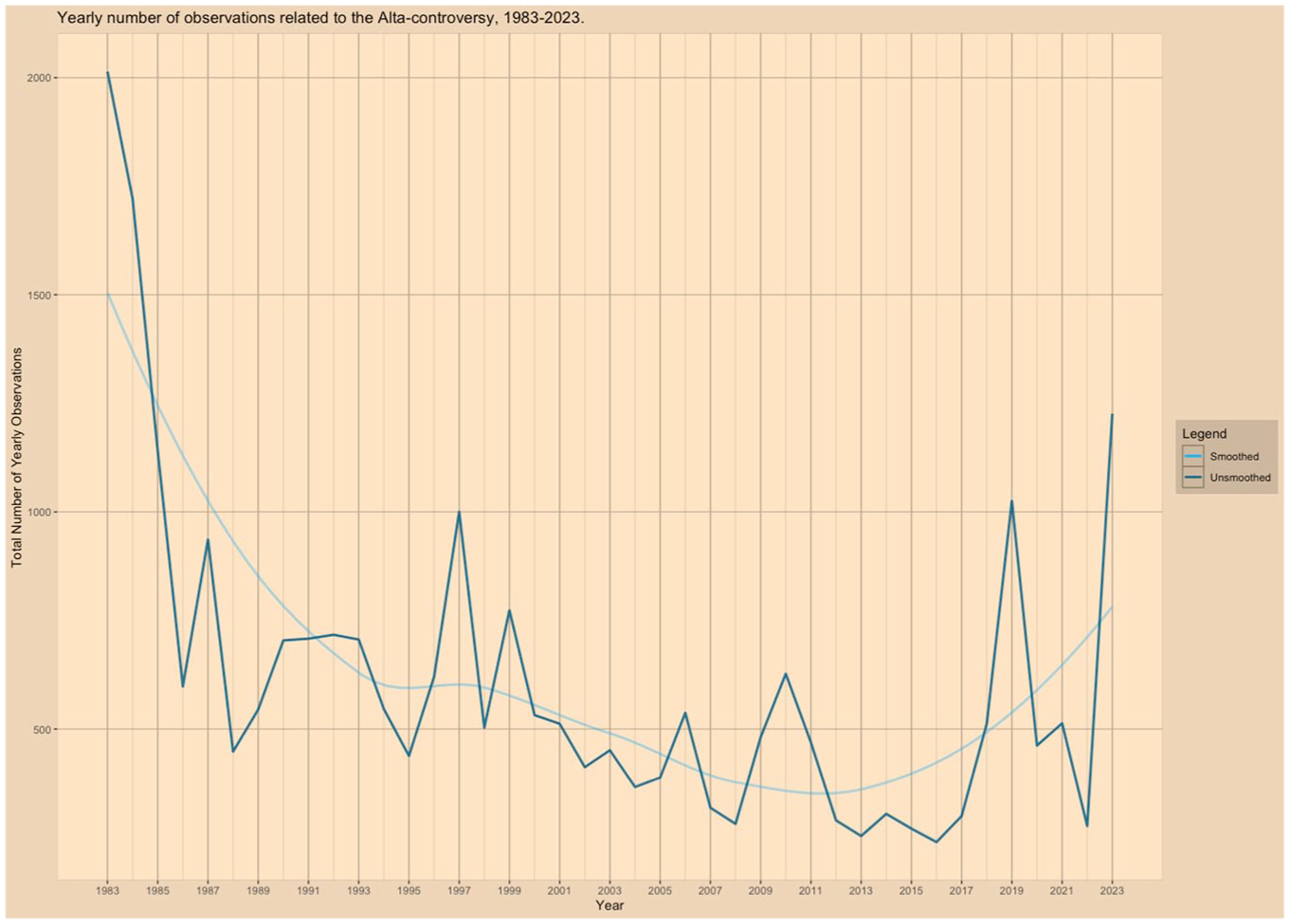
Here is an overview of the total number of times the Alta controversy has been mentioned each year from 1983 until 2023. The table demonstrates an initial decline in references after the event, followed by stochastic variations and a final increase.
Modelling meaning with BERT and NLI
We are trying to detect changes in how the Alta controversy has been talked about in the Norwegian press. A traditional way of doing this kind of quantitative analysis could be to manually read and code the data and then aggregate the data in various forms. Another way could be to do an n-gram and colocation analysis (Johnsen, 2021; Lie et al., 2022). These approaches, although tested and tried, have several limitations (Jurafsky and Martin, 2024: 27).
In our initial experiments, we employed collocation analysis to identify frequently co-occurring word pairs. Although useful for detecting fixed expressions and lexical patterns, this method proved inadequate for our purposes in tracking change in how the Alta controversy was framed over time.
To address these limitations, we adopted more advanced techniques grounded in distributional semantics. Our approach uses a fine-tuned model of natural language inference (NLI), namely ScandiNLI (Alexandra, 2023), which is itself based on NB-BERT – a BERT model developed by the Norwegian National Library and specialized for the Norwegian language (Kummervold et al., 2021). BERT (Bidirectional Encoder Representations from Transformers) is a deep learning language model that processes text bidirectionally, allowing it to read an entire snippet simultaneously rather than word-by-word in a fixed direction (Devlin et al., 2018; Vaswani et al., 2017). This enables the model to infer word meanings from full contextual information, including relationships between words that may be distant from one another in the sentence. 6
More importantly for our purposes, BERT models represent words as context-dependent vectors, which allows them to recognize semantic similarity between different expressions – even when those expressions do not share the same wording. This capability enables us to move beyond keyword-based approaches. Instead of relying on fixed terms or syntactic proximity, the NLI model evaluates the semantic compatibility between a candidate sentence and a predefined label statement. This makes it possible to identify thematic content even when it is phrased in varied or indirect ways – unlike classical n-gram analysis, which only detects exact lexical matches.
Scoring, label application and temporal trends
The specialized language model we are using, ScandiNLI, is a zero-shot classification model (0shot-tc), which means that the model can classify text in accordance with the labels that we have provided (Yin et al., 2019). Our implementation evaluates how well a given label matches the semantic content of an excerpt, producing a score from 0 to 1, where 1 indicates a perfect match. Rather than relying on fixed terminology or lexical proximity, the model assesses whether the excerpt semantically entails the label statement. For instance, references to ‘the hunger strikers’, ‘the protestors’ or ‘the Sámi activists’ may all support a label pertaining to Sámi rights, even if the word ‘Sámi’ is not explicitly mentioned. This contextual flexibility is key to identifying recurring framings of the Alta controversy that are expressed through varied linguistic forms.
To develop the label set, we began with a manually generated list of candidate labels based on prior reading and our contextual knowledge of the Alta controversy. These labels reflected known positions from the conflict, such as environmentalist concerns, demands for energy security and so forth. We then used an iterative testing process in which we evaluated 50 randomly sampled excerpts against this label set. Labels that failed to generate consistent matches, produced ambiguous results or overlapped semantically with others were discarded or revised, while new ones were continuously added. This process was repeated until we reached a stable set of 66 labels that provided meaningful and distinct classification across the corpus. 7 We only retained excerpts that scored 0.5 or higher on at least one label – approximately 2.5% of the corpus fell below this threshold and was excluded from the final analysis. This low exclusion rate suggests that the label set is broad and functionally comprehensive, even if it cannot be considered theoretically exhaustive.
A central label in this analysis is ‘The Sámi issue’ (original: Samesaken), which captures excerpts where the Alta controversy is framed within the broader struggle for Sámi rights. This label is particularly important because it relates directly to the overarching research question of this article: how and when the Alta controversy came to be framed as a Sámi issue. The example below illustrates how the label functions in practice. The model assigns a high score to this excerpt, indicating strong alignment with the ‘Sámi issue’ label – even though the formulation is contextual rather than declarative:
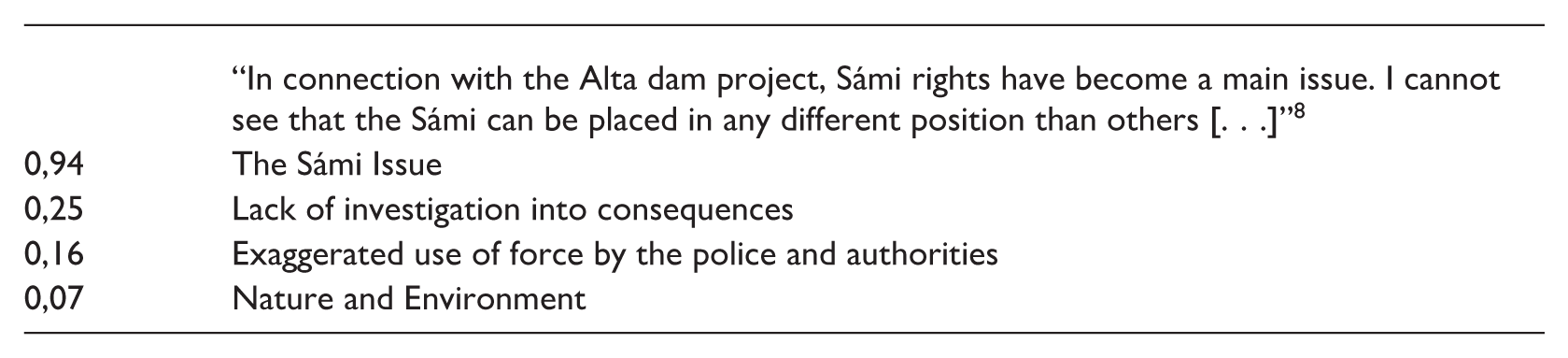
We have used the average yearly match scores for different labels to compute diachronic trends. In the figures, the labels are represented as the mean NLI score per year, where a score of 1 would indicate that all excerpts from that year fully matched the label. This value is calculated relative to the number of excerpts published each year, rather than reflecting raw frequency. This allows us to analyse not only how often a theme appears, but also how strongly it is articulated in a given year. However, it also means that years with relatively few excerpts – but a high proportion of strong matches – are weighted higher in the figure.
Qualitative interpretation and quantitative limitations
While NLP-based scoring allows us to detect when discursive shifts occur, it does not, in itself, explain why they happen or what they consist of. To address this, we conducted qualitative analyses of the relevant excerpts, including close readings of full articles, with particular attention to how the Alta controversy was made relevant to contemporary news coverage – especially during periods where average label scores changed significantly. This approach allowed us to assign interpretive meaning to statistical variation. To assist in this, we developed several tools, such as one that generates lists of the highest scoring labels each year, and another one that visualizes the distribution of a label’s score across the year and juxtaposes it to the overall number of references to the Alta controversy. 9 The output of this latter tool is illustrated later in Figure 4 in the analysis section. By pinpointing whether a rise in references corresponded with a particular date or event, we could systematically link discursive change to real-time political or cultural developments. For transparency, we have added examples from the source material when such findings are discussed; however, reading these newspapers requires both skills in Norwegian language and digital access to NB’s digital archives. In general, references to Alta appear stochastically across the material and are often associated with either contemporary events or commemorative moments.
Our model does not differentiate between types of authorship or format. It treats all textual units equally, regardless of whether they appear as journalistic reporting, editorials or letters to the editor. It also treats short mentions inside notes the same as headlines, and local newspapers the same as national ones with wide circulation. As such, we do not weigh references according to their visibility or audience reach.
The quantitative NLP analysis, by treating all textual units equally and focusing on broad discursive patterns, therefore tends to view newspapers more as reflectors of collective memory, capturing the aggregate trends and dominant framings that emerge over time. In contrast, the qualitative close readings, by attending to the specific narrative strategies and rhetorical devices employed in individual articles, are more attuned to the active role of newspapers in constructing and transforming collective memory
We still believe that the use of a large, varied corpus makes the findings more representative of collective discursive trends than narrower methods such as interviews or surveys. Still, future iterations of this approach could incorporate metadata – such as circulation numbers or article prominence – to better reflect the relative weight of different contributions.
Although it may seem as if the quantitative method provided the results and the qualitative interpretation followed, the reality is more entangled. The qualitative work actively shaped the construction of the dataset at multiple stages, such as informing the iterative refinement of search terms to ensure the corpus was comprehensive and precise, and guiding the removal of noisy or irrelevant results to improve data quality. Moreover, the development and calibration of the NLI labels were deeply informed by qualitative insights, with close readings of representative articles helping identify salient themes and narratives that were then translated into machine-readable labels. The label set was continually refined based on qualitative assessments of their performance and conceptual fit. Thus, rather than a linear progression, the two methods were mutually constitutive throughout the research process, with the qualitative and quantitative dimensions in constant dialogue, shaping and informing each other at every stage. This iterative, reciprocal relationship is central to the methodological innovation and explanatory power of the article.
The reliability concerns usually associated with manual coding are largely mitigated in our approach. Because the model applies the same parameters consistently, the classification is stable across runs. However, this consistency also poses a validity risk: if a label is poorly formulated, the model will apply it systematically – even when it fails to capture the intended meaning. This makes the initial label design phase especially critical, and one that must be guided by both theoretical and interpretive judgement.
Our work process and analysis were primarily conducted in R, with the ScandiNLI model implemented in Python. Label testing and model calibration were carried out in Google Colab, while the final analysis was executed locally on an M1 Max MacBook. All scripts and datasets used in this analysis are available in a condensed and commented format via the project repository. 10
Analysis
Figure 2 delineates the narrative shift within the Alta controversy’s coverage from environmental concerns (‘Nature and environment’ 11 ) to an intensified focus on Sámi rights (‘The Sámi issue’). Initially, environmental issues dominated, but as the controversy unfolded, there was a clear shift towards the Sámi context. Notable surges appear in 1979 and 1981. This coincides with key moments such as the first hunger strike in 1979, the second hunger strike and the ‘Battle of Stilla’ in 1981. These events signal a substantial shift in public focus towards the Sámi minority’s role in the conflict. The plot of the label ‘Sámi Issue’ depicts when and how the Alta controversy’s portrayal as a Sámi event evolved and will, therefore, serve as the basis for the discussion of this article.
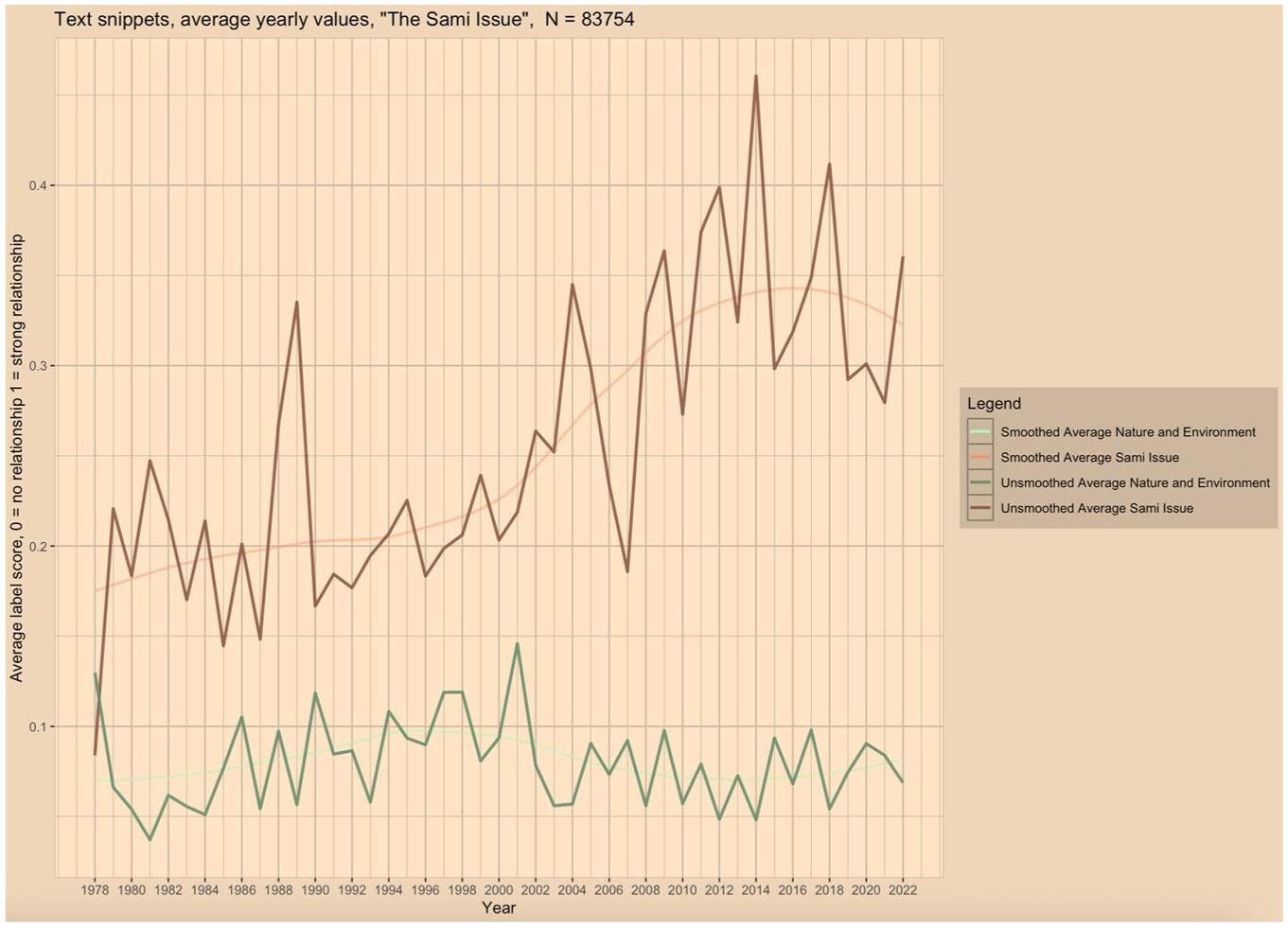
Shows the average label score of ‘Sámi Issue’ and ‘Nature and Environment’ by year. The plot shows the actual average and a smoothed curve. After an initial rise of the label ‘The Sámi issue’, the graph remains stable before a gradual increase starting in the late 1990s. ‘Nature and environment’, on the contrary, show a strong initial decline before stabilizing at a lower average score. While the smoothed graph implies a gradual change, we can see from the actual average that the yearly variation is large.
This shift aligns with the findings of Minde (2003, 2005), who documented a critical transition from environmental to Sámi rights discussions during the event. By employing natural language processing (NLP), our analysis supports Minde’s observations, providing a preliminary confirmation of these methods’ utility in tracking narrative changes within media discourse.
Furthermore, our analysis brings additional insights into the evolution of the Sámi framing, observing a significant intensification starting around two decades after the event. This reflects a retrospective enhancement of the Sámi perspective in public and media discourse. From the year 2000 onwards, there has been a marked and consistent increase in the portrayal of the Alta controversy within a Sámi context, suggesting that the narrative’s persistence and growth are influenced by developments beyond the immediate context of the controversy.
The Alta controversy as an excessive use of force and a mistake
Our quantitative analysis reveals that from the conflict’s inception until around 2000, references to the Alta controversy in relation to ‘The Sámi issue’ averaged a relevance score of 0.2 out of 1. This suggests that while Sámi contextualization is present, it accounts for a limited portion of the discourse. Most newspaper references during the first 20 years did not focus on the Sámi issue but highlighted a diverse array of themes. In particular, two of our other labels yielded higher scores for references to the Alta controversy during this period, namely ‘Excessive use of force by the police and authorities’, and ‘Lack of investigation into consequences’, as demonstrated by Figure 3.
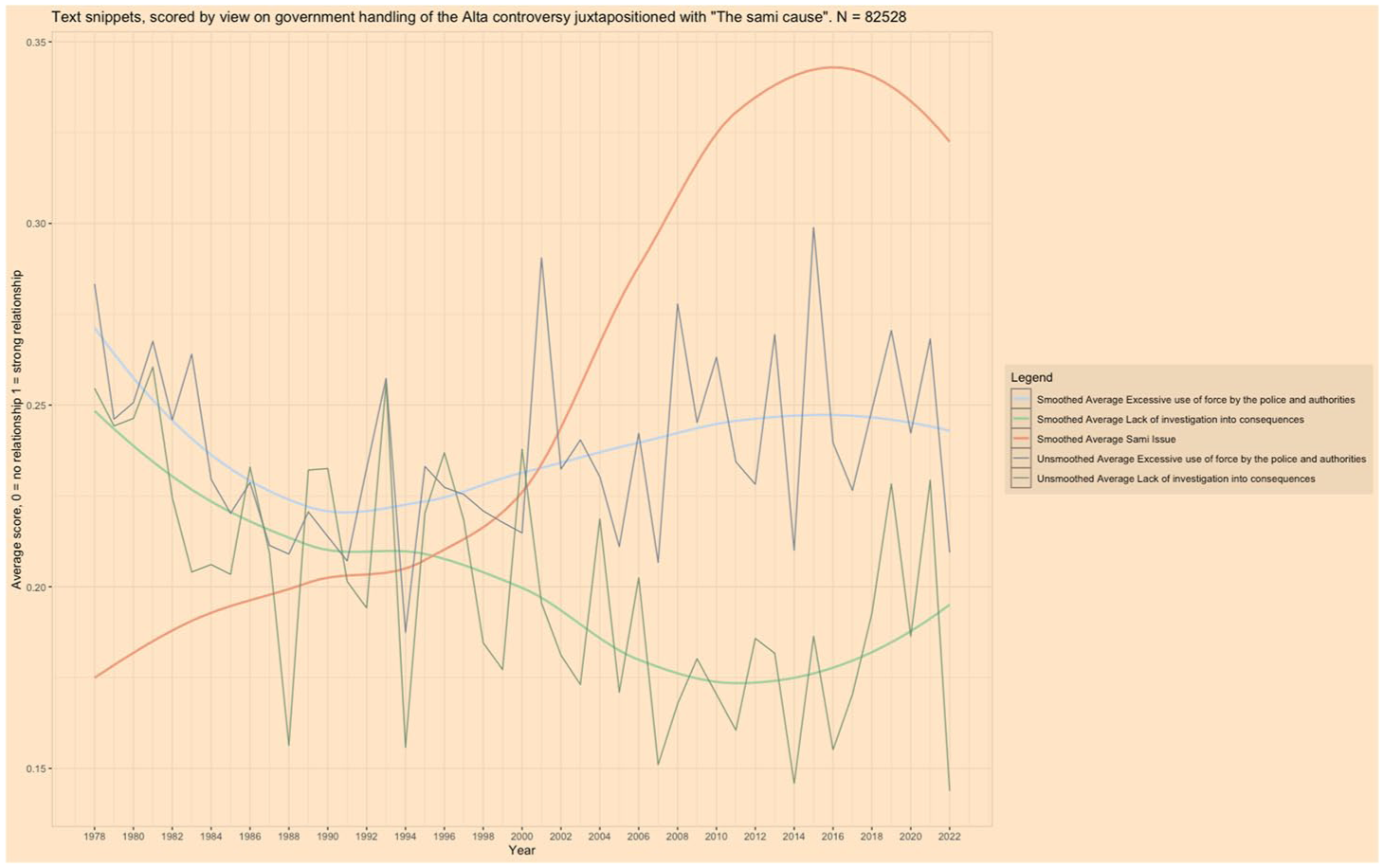
Displays the labels ‘Excessive use of force by the police and authorities’, and ‘Lack of investigation into consequences’, juxtaposed with the smoothed curve of ‘Sámi Issue’. These three labels remain equally relevant in our corpus until approximately the year 2000.
Our qualitative analysis of these findings shows that these two high-scoring labels were in fact often related to the same discursive framing of the Alta controversy about attributing blame to the authorities as responsible for the conflict and its escalation, rather than viewing it primarily as a Sámi struggle. Authorities attempted to frame the controversy as a necessary development due to electricity needs, portraying protesters as opposing democratic will, but this narrative did not persist in newspapers. Instead, many references presented the controversy as a leadership error, as illustrated in Figure 3.
An example of this framing is the coverage of the 1983 trial against protest leaders. Although they were found guilty of insurrection, newspapers continued to portray the event as a governmental mistake, interpreting the trial as further excessive force against peaceful protesters. The leaders were seen as visionary and morally committed rather than culpable. 12
Criticism of authorities intensified in 1987 when revelations emerged that electricity from the Alta dam was less crucial than previously asserted by the Labour Party government. This challenged the government’s narrative and reinforced the notion of the controversy as a fundamental misstep underscored by miscalculations. This is reflected in our data, with the label ‘Lack of investigation into consequences’ scoring highest that year. Interestingly, while the label was originally intended to detect references to the event focusing on negative environmental consequences, it also captured discussions of the erroneous premises for the damming – particularly perceptions of faulty power calculations. This outcome demonstrates the model’s capacity to identify semantically related topics beyond the coders’ initial intent, while also underscoring the necessity of qualitative interpretation to ensure conceptual precision.
Efforts by authorities to change the narrative did not alter its portrayal in the media. In 1990, Prime Minister Gro Harlem Brundtland admitted that the dam was based on erroneous energy projections and was unjustifiable. While she attempted to distance herself and the Labour Party by blaming the projections, however, the prevalence of the mistake/blame discourse demonstrates that these statements were interpreted as a concession of responsibility for the controversy. 13
This framing of the Alta controversy as a Labour Party mistake became dominant in newspaper discourse, serving as a cautionary tale against repeating similar errors, particularly in environmental policy. Throughout the 1990s, it became a standard reference point; proposed and controversial Labour Party projects were often compared to the Alta controversy, highlighting the risk of becoming a ‘new Alta controversy’. This analogy was notably applied in debates over gas power plants, where the Labour Party’s support met significant environmental opposition, and in broader critiques of potential missteps by the party, including their advocacy for EU membership in the 1994 referendum. 14
The convergence of several labels up until 2000 suggests that the Alta controversy had not yet stabilized around a single dominant narrative in public discourse but remained open to multiple and competing framings. This diversity of context which the Alta controversy is placed into confirms Edy’s observation that the aftermath of social conflicts often features multiple, sometimes contradictory, narratives in newspapers (Edy, 2006: 96–100). Yet, it also reveals that the emergence of Sámi-related discourse can be traced to specific events – most notably the Sámi protests of 1979 and 1981. This example illustrates how NLP-assisted classification, combined with qualitative interpretation, can be used to trace the emergence of distinct discursive framings within public discourse.
The Alta controversy as contextualization of Sámi rights?
During the late 1990s and into the 2000s, our analysis shows a marked increase in the Sámi framing of the Alta controversy through the ‘Sámi issue’ label. Following the conflict, Sámi rights and institutions were progressively strengthened, partly due to public committees formed during the controversy and heightened interest in Sámi issues (Andresen et al., 2021: 386–388; Selle et al., 2015: 64–71). Following Edy’s typologies, one might expect that the Alta controversy would serve as a narrative framework for understanding the expansion of Sámi rights during the late 1980s and 1990s – functioning as a contextualizing device that links past conflict to present institutional change (Edy, 1999, 2006; Zelizer, 2008).
However, our quantitative data, shown in Figure 2, do not confirm that the Alta controversy was widely used to contextualize the institutional gains of the Sámi during this period. While the majority of such rights discussions happened within the first 15 years after the Alta Controversy and were well debated both in national and local media, the major increase in the label ‘Sámi Issue’ in contextualizations of the Alta Controversy does not occur until approximately 20 years later, around the year 2000.
Targeted qualitative readings from periods of key institutional development confirm this pattern: even during pivotal moments, such as the 1984 Sámi Rights Committee proposal and the 1988 amendment of the Sámi into the constitution, newspapers rarely linked these developments explicitly to the Alta controversy, even though both these processes were initialized by the public comitees established during the Sámi hunger strikes of 1979 (Andresen et al., 2021).
A significant narrative shift occurs in 1989, as the label ‘The Sámi issue’ peaks dramatically, which coincides with the first Sámi Parliament election and inauguration (Figure 2). Here, the Alta controversy is cited as a backdrop to this establishment, indicating a stronger link between the event and Sámi political advancement. 15 Although this quantitative peak suggests increased media linkage between Alta and Sámi political advancement, closer readings of news coverage show that explicit references to the Alta controversy were sporadic at best. When mentioned, it was mainly because Sámi artist Mari Boine dedicated a joik 16 to the 1979 hunger strikers, who were, strikingly, not invited to the inauguration. 17
After the Parliament’s opening, Sámi contextualization drops again. This suggests that the Parliament’s establishment did not immediately cement the Sámi narrative as the dominant media lens. Despite the progression of Sámi rights, the Alta controversy was minimally used to contextualize contemporary debates in newspapers. For example, in 1990, during the Norwegian Parliament’s ratification of ILO Convention 169 – an international agreement recognizing indigenous peoples’ land rights and deeply connected to the Alta controversy in scholarly discourse (Minde, 2005: 25–29; Zachariassen et al., 2021: 418–420) – newspaper coverage scarcely mentioned the controversy, framing it instead as a broader enhancement of general rights. 18
Subsequent debates on Sámi rights – such as those surrounding the 1997 report on land use and the Finnmark Act of 2005, which returned land ownership to the population of Finnmark – seldom explicitly linked these developments to the Alta controversy in newspapers. This omission might reflect tacit knowledge or the assumption that Alta’s significance was self-evident, given its temporal proximity to these developments. However, close readings suggest that, paradoxically, the recency of the Alta controversy made it harder for journalists to articulate clear causal links to current policy debates.
In line with the insights of Adams and Edy (2021: 1426), the Alta controversy at this stage had not yet been narratively positioned as part of ‘the past’. Rather, it remained within the flow of contingent events that constituted an ongoing political and cultural struggle. As long as the outcome of that struggle remained unresolved, the controversy lacked the narrative closure necessary for reflective distance. In their terms, a ‘reflective space’ – in which past events are reconsidered from a temporal and moral distance – had not yet emerged. The absence of such space made it difficult to frame Alta as the beginning of a resolved story about Sámi rights. These findings therefore nuance Zelizer’s (2008: 381–382) description of journalists as memory agents who interpret recent events in light of the present, by showing that temporal proximity and narrative incompletion may in fact inhibit such memory work.
Conversely, discussions on advancing Sámi rights more commonly referenced the assimilation policies of the late nineteenth and early twentieth centuries, highlighting historical injustices needing redress. This indicates a preference for linking contemporary Sámi rights developments to broader historical contexts rather than recent events like the Alta controversy. The memory of the Alta controversy was more likely invoked as an analogy to present events, serving as an experience to learn from – especially concerning the Labour Party – rather than being directly linked to the progression of Sámi rights.
Contextualization through commemoration
If the rise in the ‘Sámi Issue’ label in newspapers cannot be explained primarily by the institutional development of Sámi rights, then what accounts for this discursive shift? A plausible explanation lies in the various commemorations of the event, notably the anniversaries of the 1979 hunger strike and the 1981 ‘Battle of Stilla’. According to Edy, such moments serve as pivotal junctures for reevaluating the event’s significance and its long-term societal implications (Edy, 1999).
Examining these commemorative moments quantitatively, we observe a noticeable increase in the ‘Sámi Issue’ label around the year 2000. To understand what this increase reflects, we conducted a close qualitative reading of anniversary-related newspaper coverage.
In 1991, the 10-year anniversary predominantly portrayed the Alta controversy as an environmental conflict, with limited mention of Sámi involvement – even though the Sámi Parliament had opened just 2 years earlier. By contrast, the 1999 commemorations marked a discursive turning point: the controversy was increasingly framed as a formative event in the development of Sámi rights and identity. Several newspapers referred to Alta as ‘a turning point for the Sámi question in the Norwegian debate’, 19 reflecting a retrospective revaluation of its significance.
This trend continued with subsequent commemorations. For instance, the 25th anniversary of the 1979 hunger strike in 2004 was predominantly framed around Sámi participation. This year saw one of the highest yearly scores for the label ‘The Sámi Issue’ in our dataset (Figure 2). Analysing the distribution of references to the Alta controversy throughout this year, illustrated by Figure 4, it becomes evident that most mentions were tied to this anniversary in October.
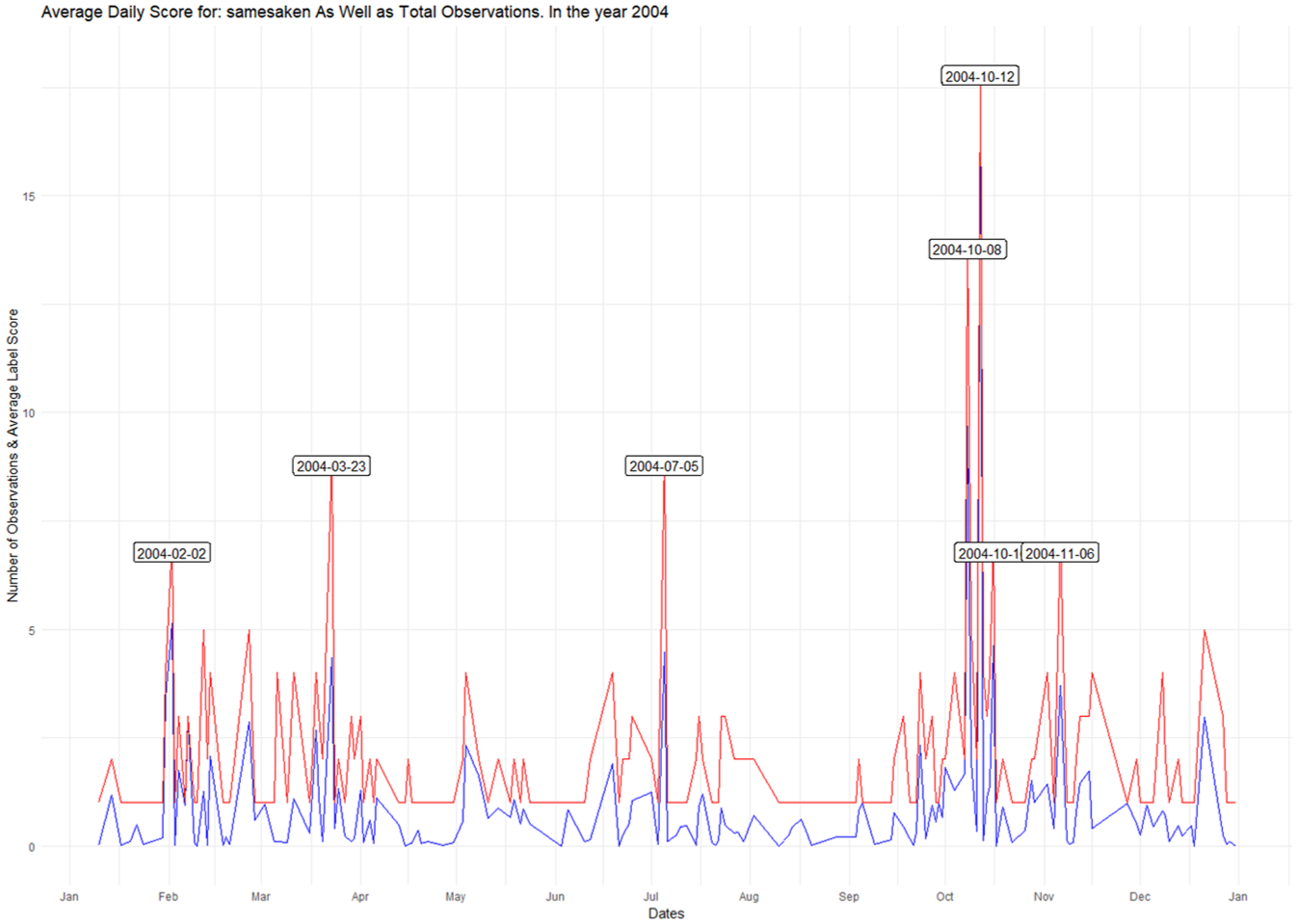
Shows significant peaks in both overall references to the Alta controversy (red) and references associated with the label ‘Sámi Issue’ (blue), coinciding with the 25th anniversary of the hunger strikes in October 2004.
Conversely, close readings of articles on the 2006 commemoration of the 25th anniversary of the ‘Battle of Stilla’ reverted to emphasizing themes such as excessive use of force by authorities and flawed environmental impact assessments, as this event was more associated with clashes between authorities and environmentalists in Stilla.
Generally, commemorations capture the link between the Alta controversy and the introduction of Sámi rights, often citing the controversy as the origin of these developments. In contrast, when Sámi rights were actually being introduced, journalists seldom made this connection. One likely reason is that, at the time of the institutional changes, the outcomes of the rights struggles remained uncertain. This made it less natural – both journalistically and politically – to frame Alta as a conclusive turning point while the issue at hand was still an ongoing and unresolved process. In addition, tight deadlines limit in-depth historical analysis, so coverage focused more on immediate stakeholders and current events. As noted by Edy, unlike daily news, commemorative articles are not bound by the same time constraints, allowing journalists more freedom to explore and present alternative explanations for the evolution of Sámi rights beyond the immediate debate (Edy, 2006: 74–76).
Both our quantitative and qualitative findings suggest that the rise in the Sámi framing of the Alta controversy did occur as a way of explaining Sámi rights development – but that this connection was established retrospectively through commemorations, rather than contemporaneously through contextualization. Edy (2006: 68–72) rightly emphasizes that policy change can function as a form of redressive ritual, allowing societies to symbolically resolve past injustices. Drawing on narrative theory, she invokes the idea that the significance of an event can retroactively reshape how its earlier elements are understood (White, 1974). However, our findings suggest that such retrospective coherence is not predetermined; it must be discursively constructed – often through commemorative practices.
During these reflective moments, information is synthesized to appreciate the long-term impacts of the controversy, and the meaning of the event is negotiated, distinct from when it is used to contextualize the present event or as an analogy for similar issues (Edy, 1999, 2006). Commemorations thus provide a structured setting in which the meaning of past events can be negotiated and realigned with present-day understandings.
This cementation of a Sámi framing of the Alta controversy is underscored by the 30th anniversary of the hunger strike and the ‘Battle of Stilla’ in 2009 and 2011, respectively, where the label ‘Sámi Issue’ hits new record peaks (Figure 2). Qualitative analysis of these commemorations demonstrates a clear focus on the Sámi dimension emerges for both events, whereas earlier, the ‘Battle of Stilla’ had been primarily associated with the environmentalist faction. A significant factor contributing to this shift may be the passing of the Finnmark Act in 2005, which addressed the core demand of the hunger strikers – rights to land and water for the Sámi minority. 20 In narrative terms, the Finnmark Act serves as a resolution – or narrative closure – to the struggle that began with the Alta protests. Following Adams and Edy (2021: 1421–1422), this narrative closure opens up what they call ‘reflective space’, enabling retrospective interpretation and evaluation of the Alta controversy as a completed historical event. Yet, this closure does not materialize immediately in public discourse, but is articulated in hindsight during the 2009 and 2011 commemorations.
Qualitative analysis of the commemorations further reveals the integration of two narratives: the Alta controversy as both the inception of Sámi rights and an unnecessary government-imposed project. Since both perspectives stem from opposition to the construction, they are not mutually exclusive but rather complementary. Through commemorative journalism, the controversy is portrayed as an unwarranted build-out that paradoxically catalysed significant advances in Sámi rights. This narrative transformation reframes what might be seen from an environmental perspective as a loss into a significant victory for the Sámi minority, highlighting the controversy’s positive long-term outcomes. Moreover, the retrospective depiction of the controversy as a leadership error with limited immediate relevance becomes intertwined with the Sámi narrative, which suggests a more profound and enduring impact of the event on later societal developments.
This combined narrative also explains why the Alta controversy continues to be associated with lacking investigations and governmental misuse of force even when the Sámi framing becomes dominant – as these elements remain relevant to the Sámi rights narrative. Therefore, labels associated with the leadership error narrative decline only marginally after the Sámi rights narrative becomes dominant, as illustrated by Figure 3.
Another peak in the overall number of references occurred in 2019 (Figure 1), coinciding with the 40th anniversary of the hunger strikes and initial protests. More than two-thirds of these references originated from Altaposten, the local newspaper, which published a series of commemorative articles. While the environmental impact and the clash between protesters and authorities have historically been emphasized as the most significant aspects of the conflict for the residents of Alta (Eikeset, 2003; Hjorthol, 2006), our analysis shows that the label ‘Sámi Issue’ emerged as the most prominent in 2019 (Figures 2 and 3). This suggests that local memory has increasingly converged with the national trend of framing the event within the context of Sámi rights development – corroborating Edy’s (2006) assertion that newspaper narratives tend to coalesce into more coherent storylines over time.
While the quantitative findings highlight the importance of the period from around 2000 in reshaping the collective memory of the Alta controversy as fundamentally a Sámi event, the qualitative analysis sheds light on the specific narrative strategies and rhetorical devices used in commemorative newspaper articles to frame the event as a turning point in the history of Sámi rights. However, it is important to acknowledge that newspapers do not operate in isolation but are part of a broader media and cultural ecosystem. During our research, we observed instances where television broadcasts coincided with key anniversaries and where commemorative articles appeared to align thematically with recent scholarly works, such as Minde’s (2003, 2005) research and the ‘Sápmi – Becoming a Nation’ exhibition (2000). While these observations suggest potential connections between different media forms and cultural artefacts, it is beyond the scope of our study to make causal arguments about their influence on newspaper coverage. Future research could explore these dynamics more fully, employing methods that are better suited to tracing the complex interplay between journalism, popular culture and academic scholarship in shaping collective memory.
The Alta controversy as an unresolved struggle
In recent years, the Alta controversy has increasingly been remembered not as a resolved conflict or turning point, but as a symbolic parallel to ongoing disputes over Sámi rights. This framing is marked by a shift from instrumental readings (focusing on outcomes) to affective and analogical uses of the past, particularly in relation to the Fosen controversy and the film La Elva Leve. The result is a discursive reframing where Alta no longer represents a change but signals repetition and enduring injustice.
This section combines quantitative insights from our label analysis with close qualitative readings of media coverage and film narratives to examine how the Alta controversy is reactivated in relation to current conflicts. In our quantitative data, the absolute number of references to the Alta controversy reached a top level in 2023, as displayed in Figure 1. A closer examination of the label frequency data for this year reveals that these references are overwhelmingly concentrated in two periods. The first peak, occurring at the beginning of February, is associated with the release of the film La Elva Leve – Ellos Eatnu (Let the River Flow) by director Ole Giæver, which coincided with the Sámi National Day on February 6th. La Elva Leve is a historical drama about the Alta controversy; while not based on actual characters, it closely resembles the events and focuses strongly on the Sámi perspective.
The second peak coincides with a period of intensified media attention to the Fosen controversy, spanning from the end of February to the beginning of March, during which the Alta controversy regained relevance due to its similarities with current events. This recent conflict revolves around two of the largest windmill parks in Europe, located on lands traditionally used for Sámi reindeer herding. Although the Fosen controversy is one of several recent disputes between the Sámi minority and the state – arising from green transition initiatives and land-intensive projects on Sámi territories – it stands out due to its legal significance. The Norwegian Supreme Court ruled that the wind parks violated Norway’s obligations under the Human Rights Convention to protect Sámi culture. This led to a wave of protests on the 500-day anniversary of the judgement, as no substantial measures had been taken by the government to address the rights violation. The political and mnemonic continuity between Alta and Fosen, and the activist practices through which this linkage is maintained, are examined in greater detail elsewhere (Sælthun, 2025b). 21
Our qualitative reading of the film La Elva Leve and accompanying reviews provides further insight into how the Alta controversy is emotionally and politically reframed. La Elva Leve gained critical acclaim and attracted a significant audience, by Norwegian standards, of 97,000 viewers during its theatrical run (Pedersen, 2023: 11). The film focuses extensively on the perspective of Sámi activists and the traumatic experiences of the Sámi population regarding discrimination by the majority and the state’s assimilation policies. Notably, the movie does not include the aftermath of the Alta controversy but rather ends with the removal of protesters in Stilla and the defeat experienced by both the Sámi and the environmentalists. This narrative framing is notably different from earlier commemorations, which tended to portray Alta as the starting point for Sámi rights progress. Instead, La Elva Leve ends with unresolved trauma and defeat – suggesting a return to a more sceptical, even disillusioned, memory of the event.
Figure 5 illustrates how the Alta controversy has been increasingly contextualized as a traumatic event. This suggests that Alta is now more likely to be remembered in terms of emotional rupture and harm than it was during the original controversy. Although the Alta controversy can be considered traumatic from multiple perspectives – such as its impact on national unity, the local population or environmentalists – the recent focus on Sámi perspectives in La Elva Leve and the Fosen protests suggests that the trauma is now understood primarily in relation to Sámi experiences of marginalization and repression.
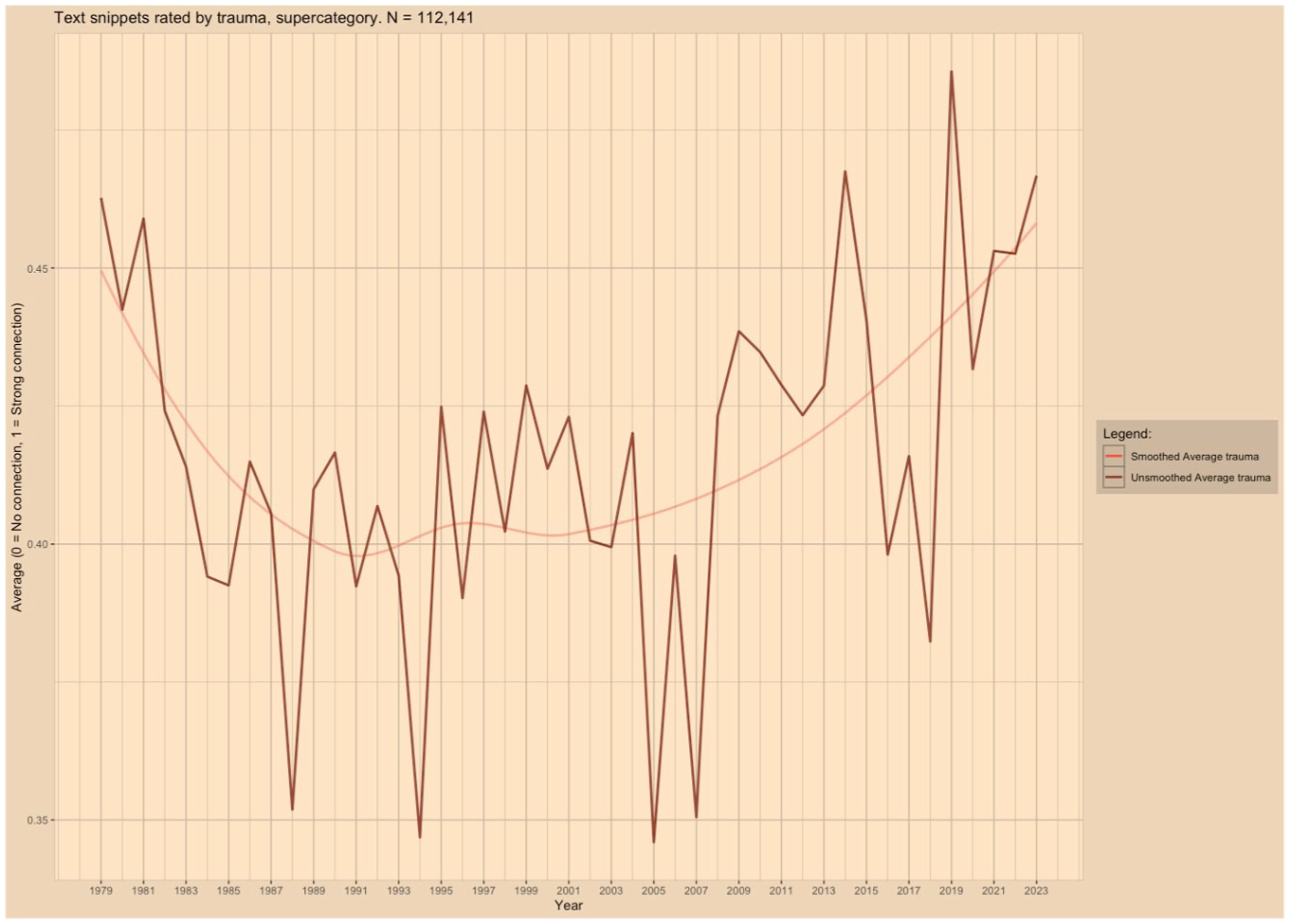
Yearly average score for the label ‘Trauma’,a showing increased prominence in recent years.
Memory scholars Astrid Erll and Jeffrey Olick have emphasized that film is a particularly powerful medium for shaping affective understandings of the past, especially through its ability to dramatize human vulnerability in stories of injustice (Erll, 2011: 140–141; Olick, 2007: 99–199).
In this sense, the film reorients the memory of the Alta controversy – from a story of instrumental struggle and political change to one of lived trauma and unresolved injustice. Reviews and commentaries on La Elva Leve frequently draw parallels to the present, most notably the Fosen case. The dominant reading is that the film reflects contemporary conditions, where Sámi rights are again perceived as under threat and neglected by state authorities. 22
Less than a month after the release of the film, on the 500-day anniversary of the Supreme Court judgement, Sámi activists and environmentalists made headlines by blocking the entrances of several ministries in Oslo, vowing to remain until the wind turbines were dismantled. The timing of these protests – closely following the film’s release – and the activists’ use of the slogan ‘Let the mountains live’ (a nod to the Alta protesters’ ‘Let the river live’) underscored clear parallels between the two events. This connection was further highlighted by the high number of references to the Alta controversy in newspapers during the Fosen protests, as also reflected in our dataset for 2023 (see Figure 1). 23
The similarity between the present and past was further reinforced by Ella Marie Hætta Isaksen, the lead actress in La Elva Leve, who portrayed a Sámi activist during the Alta controversy and also emerged as a leading figure in the Fosen protests. Images of Hætta Isaksen being carried away by the police both in the film and during the present-day demonstrations epitomize the parallels between past and present activism. These developments not only highlight the enduring nature of the activist perspective from the Alta controversy but also demonstrate how it has been re-invented and made relevant again in the context of current struggles. Instead of being solely remembered as a watershed event that improved Sámi rights, the Alta controversy now serves as a symbol of the ongoing struggle against overwhelming force. This bidirectional use of analogies – where lessons from the past inform the present, and current events reshape how the past is understood – illustrates the dynamic nature of collective memory (Edy, 1999: 77).
To explore how Alta is used as a discursive resource in current debates, we compare the two labels ‘Threat to Sámi culture and livelihoods’ and ‘Sámi special privileges’ in Figure 6. While the first expresses concern that Sámi traditions, reindeer herding and cultural practices are under pressure from state policies and industrial development, the latter conveys the opposite framing: that the Sámi enjoy undue advantages or ‘special rights’, often portrayed as coming at the expense of others or as obstacles to regional development. Although these two perspectives are not direct opposites, they represent competing ways of framing the Sámi position in Norwegian public discourse – either as a vulnerable minority facing existential threats or as a group perceived to receive excessive benefits. 24
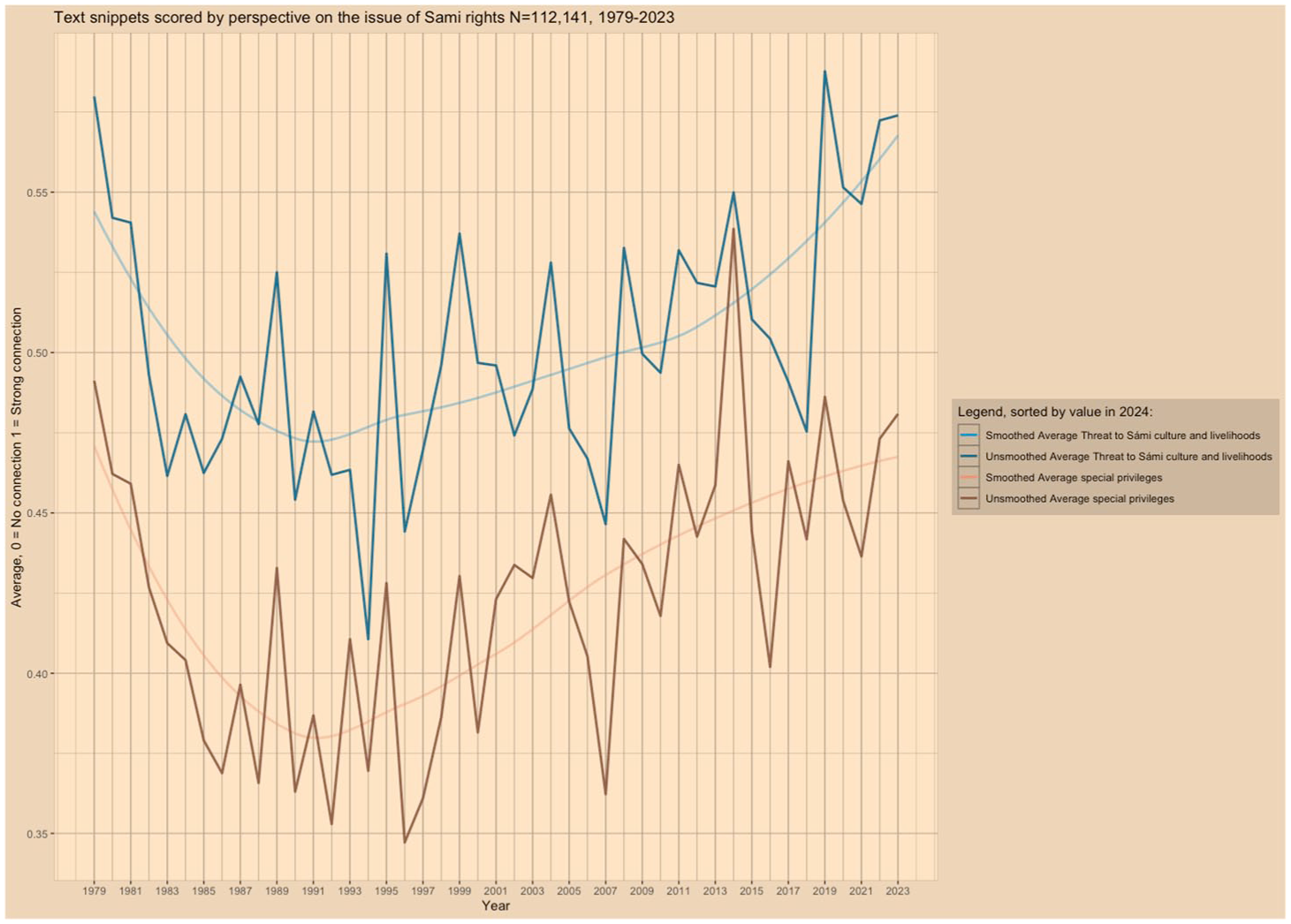
Compares the two labels ‘Threat to Sámi culture and livelihoods’, and on the other hand, ‘Sámi special privileges’.
Figure 6 compares the two labels ‘Threat to Sámi culture and livelihoods’ and ‘Sámi special privileges’. The figure shows that explicit references to these competing framings declined after the controversy itself but began to rise again around the year 2000, peaking in 2023 in response to contemporary developments. It also indicates that these two perspectives have closely followed each other throughout the period, with the viewpoint sympathetic to Sámi culture and livelihoods being more prevalent, though not exclusive. Taken together, these patterns illuminate how the Alta controversy continues to serve as a framework for interpreting present-day events.
Using the Alta controversy as an analogy to contemporary issues challenges the notion that it was a decisive turning point that significantly improved Sámi rights. Instead, such comparisons create a narrative where Sámi rights were insufficiently considered in both past and present events. The issues today are perceived as identical to those during the Alta controversy, suggesting that little has changed over the past 40 years concerning Sámi rights.
Despite the commemorative narrative portraying Alta as a catalyst for Sámi rights, most newspaper references in 2023 do not revisit this political trajectory. Instead, they focus on similarities with current events, reinforcing our earlier observation: newspapers are more likely to draw parallels with the past than to establish causal relationships. In addition, portraying the Alta controversy as the origin of Sámi rights seems contradictory in the context of the Fosen controversy, where such rights are perceived as absent. This narrative strategy reflects the need for coherence in both newspaper discourse and collective memory (Edy, 2006: 146–150) and helps explain why the idea of Alta as a turning point is omitted when drawing parallels to the present.
In addition, Edy (2006: 78) suggests that creating analogies creates expectations for the future based on past outcomes. Thus, even if the wind turbines are not removed, the implication – based on the Alta experience of a short-term loss leading to long-term victory – is that a similar positive outcome may eventually occur for the Sámi community. Paradoxically, this expectation endures even though the political gains historically associated with the Alta controversy are rarely acknowledged in current coverage – suggesting that the analogy draws more on symbolic resonance than on historical precision.
Conclusion
In response to our first research question, this section outlines how the event has been discursively reframed over time – first as a governmental mistake, later as the origin of Sámi rights and more recently as an unresolved struggle. The first framing presents the controversy as a governmental mistake, serving an instrumental function by explaining why the conflict occurred and who was to blame. This followed by a phase which sees the event as the origin of Sámi rights, which also establishes the Sámi framing of the event. Here, similarly, the event fulfils an instrumental function focusing on political impact of the past onto the present. The third pattern, while still situated within a Sámi framing, shifts the event from an instrumental reference to an affective resource – used to mobilize emotions and highlight ongoing injustice. Here, the event is posed as an unresolved issue, where the efficacy of previous rights development is questioned by current societal conflicts, thus dramatically changing the role of the Alta controversy. Although these framings appear to succeed one another chronologically, our findings indicate that they also overlap, coexist and, to a certain extent, converge across different periods and genres of reporting.
Another overlap between the ‘meaningful loss’ and ‘meaningless loss’ narratives is that they both frame the Alta controversy as a Sámi-centred event, drawing on the same key episodes such as the 1979 hunger strikes and the protests at Stilla in 1981. While the ‘meaningful loss’ narrative interprets these moments instrumentally – as the catalyst for institutional change – the ‘meaningless loss’ narrative shifts towards an affective register, emphasizing unresolved injustice and trauma. Yet even in this shift, the overall significance of the event is not necessarily diminished: the controversy continues to function as a decisive reference point in the Sámi struggle with the state and in the formation of contemporary Sámi identity, as discussed in more detail elsewhere (Sælthun, 2025b). In this sense, the narrative is not overturned but revised and reinterpreted, echoing Jill Edy’s (2006) observation that ‘reform is more common than revolution, even when present circumstances offer opportunities for either’ (pp. 202–203).
Turning to the second research question – how newspapers shape collective memory of the Alta controversy – we find that format and journalistic genre play a crucial role. The discursive transformations can largely be explained by the forms through which newspapers relate the past to present societal developments. While the institutionalization and advancement of Sámi rights eventually underpin the dominant Sámi framing of the Alta controversy, this association is notably absent at the moments when these rights are actually debated or implemented.
This absence can be explained by what Adams and Edy (2021) describe as the open-ended nature of historical contextualization, where ongoing developments hinder the formation of a retrospective narrative. Instead, the link between Alta and Sámi rights is primarily established through commemorations, which provide the reflective distance necessary for retrospective meaning-making. From the vantage point of commemoration, the Alta controversy emerges as a clearly defined narrative with an identifiable beginning and ending – allowing it to be positioned as the origin point for the development of Sámi rights. These findings underscore the decisive role of commemorations in crafting coherent historical narratives in newspapers (Edy, 1999, 2006), while also qualifying the often-emphasized role of historical contextualization in linking present events to recent pasts (Schudson, 2014; Zelizer, 2008).
However, while our findings nuance the potential of newspapers to employ the past as context, they also highlight how journalists are significantly more likely to perceive immediate relevance when past events closely resemble current situations. This pattern is clearly demonstrated through the analogical references made between the Alta controversy and contemporary conflicts, such as the recent Fosen protests. Here, the Alta controversy is not framed through commemorative reflective distance but rather is presented as an ongoing and unresolved struggle, closely mirroring present events. As Edy (2006: 111–114) notes, analogical uses of history emphasize continuity, thereby collapsing temporal distance and suggesting that the struggles and injustices of the past persist into the present. In this analogical framing, the previously established reflective space from commemorations is effectively closed, and the Alta controversy is transformed back into an unresolved, ongoing narrative. Consequently, the prior interpretation of the Alta controversy as the origin of a completed and successful narrative of Sámi rights development is increasingly absent from contemporary media representations. This shift underscores newspapers’ demand for narrative coherence: once historical analogies highlight continuity and ongoing injustice, earlier narratives depicting progress and closure become contradictory and lose their journalistic appeal. These findings extend previous analyses of the Alta controversy as a site of mnemonic negotiation between narratives of progress and loss (Sælthun, 2025a) and intersect with more recent research examining how this mnemonic tension is reactivated in contemporary Indigenous and environmental activism (Sælthun, 2025b).
This shift, from a narrative of progression which highlights the event as the origin of Sámi rights, into an analogy that suggest continuity and repetition, is also likely prompted by the rising levels of conflicts between the minority and majority. Demands of a green shift increasingly encroach upon Sámi lands and resources, giving the impression that Sámi rights have either stagnated or regressed, a development often referred to as green colonialism within Sámi and activist discourse. This shift aligns with broader transformations in what is sometimes dubbed identity politics, where grievance and injustice increasingly gain traction in public discourse, which enables rights-oriented and emotionally charged activist discourses to significantly affect mainstream journalism.
Finally, in response to our third research question, we reflect on the methodological contributions and limitations of using NLP to study collective memory. Natural language processing has shown that it is possible to analyse large-scale newspaper corpora with a high level of consistency. In this context, NLP implicitly conceptualizes newspapers as mirrors of collective memory, where shifts in narrative framings can be tracked over time as measurable patterns. From this perspective, newspapers are treated as aggregated reflections of how society remembers.
This quantitative perspective has yielded valuable insights. Some patterns were anticipated – such as the emergence of a Sámi framing during the conflict itself – while others were less expected, including its relative absence when later Sámi rights were implemented. However, statistical patterns alone are not sufficient to understand how collective memory is shaped. To explain and contextualize these findings, we relied on qualitative close readings, which approach newspapers not merely as mirrors but as producers and agents of memory, actively shaping public narratives through framing, selection and interpretation.
The qualitative component was not only essential for interpretation, but also directly informed the design of the quantitative method. Search terms, label formulation and model calibration were all shaped through iterative close reading. In this sense, the two methods do not merely complement each other – they co-construct both the dataset and its meaning. The project has therefore relied on a truly mixed-methods approach, in which different epistemological assumptions – reflection and construction – are held in productive tension.
It is important to stress that this methodology remains interpretive. The NLI model does not discover patterns autonomously – it classifies data based on predefined labels created by the researchers. These labels do not emerge organically from the corpus but reflect theoretical and empirical assumptions. Similarly, the limited size of the concordances – fixed at 25 words due to the infrastructure of the National Library – affects the contextual depth available to the model. Larger excerpts would allow for richer analysis, although this might also reduce classification accuracy.
While the approach yields promising results, further refinement is needed. Some improvements – such as better model tuning and more comprehensive concordance extraction – will depend on infrastructure and resources. Others can be achieved through continued iterative use. Future developments might include weighting by newspaper circulation or type, tracking regional variation in how the past is remembered, or exploring intertextual relationships between newspapers and other formats, such as television coverage, documentaries or academic publications. Key principles for successful application of NLP in memory studies include (1) iterative and collaborative development of search terms and labels, (2) transparency about data extraction and preprocessing steps, (3) acknowledgement of limitations and potential biases and (4) integration of quantitative and qualitative analysis at all stages of the research process. Our findings demonstrate that NLI can be productively applied in historical memory research on large datasets but that it should be seen as an enhancement of qualitative analysis – not a replacement for it.
Footnotes
Acknowledgements
We would like to express our gratitude to the National Library of Norway for providing digitized newspapers in complete volumes and to the Department of Digital Humanities (DH-Lab) for their support in accessing and processing the data.

Funding
The authors received no financial support for the research, authorship, and/or publication of this article.
Declaration of conflicting interests
The authors declared no potential conflicts of interest with respect to the research, authorship, and/or publication of this article.
Data availability
The data used in this study is shared in a publicly available repository, as listed in the reference section.