



Abstract
Border Sounds is a virtual reality film created during an outreach project by Northern Ireland’s national archive, PRONI, and creative media centre Nerve Centre in 2021. It features memories from 21 participants aged 20–60s who live near the invisible border line that divides the island of Ireland into two jurisdictions. This article uses Border Sounds as a case study to explore how sound, memory, and immersive technology can be combined to reimagine contested border spaces and to discuss the potential of participatory archives to reflect diverse voices in postconflict Northern Ireland. Through a content analysis of the film’s haiku poems and soundscapes created by the participants and a reflective analysis of the filmmaking process, we examine how borders shape identity and memory, and question whether memory-based projects such as Border Sounds can challenge dominant narratives, promote understanding across divides, and help archives become inclusive, collaborative spaces for diverse voices.
Introduction
Border Sounds is an 11-minute virtual reality film, produced by the authors while working with the creative media centre, Nerve Centre, and the national archive for Northern Ireland, PRONI (Public Record Office of Northern Ireland) in 2021. Through haiku poems and sounds about meaningful places of memory written and recorded by the project’s participants, the film captures the stories of those who live near the border between Northern Ireland and the Republic of Ireland.
This invisible 310-mile divide was established by the Government of Ireland Act (1920) to separate two sovereign states. Unlike conventional borders, ‘a line on the sand’, the Irish border cuts through towns, rivers, farmlands and even homes, shaping economic, political, and social divisions (McCall, 2021: 22–23). Created to secure a Protestant-Unionist majority in Northern Ireland, the border was a compromise to end the Irish War of Independence but ultimately sowed the seeds for future conflict (Dawson, 2007: 210). By reinforcing a binary between Irish nationalists (mostly Catholic) and British Unionists (mostly Protestant), the border has helped fuel tensions that led to the conflict euphemistically called The Troubles (1969–1998), a violent period leaving nearly 4,000 dead, tens of thousands injured, disablement, high levels of posttraumatic stress disorder (PTSD) and intergenerational trauma (Bolton, 2017; Commission for Victims and Survivors, 2015; Ferry et al., 2017; McKittrick and McVea, 2001). While the border has remained ‘invisible’ since the peace process of the 1990s (McCall, 2021: 15–16), Brexit has reignited debates over its future, whether as a ‘hard border’ or a reunified island, and Northern Ireland finds itself at the centre of trade, security, and sovereignty disputes. As Cormac Moore notes, the border has ‘strangled politics’ on the island of Ireland and to this day, ‘it still is greatly misunderstood. Even if unloved, the border has proved incredibly resilient throughout its existence’ (Moore, 2019: 189).
This brief summary demonstrates how the island of Ireland has experienced various processes of bordering and debordering with Brexit being its latest iteration. While historical studies have focused on the political processes behind partition, the lived experiences of border communities are increasingly receiving more attention. Books such as Partitioned Lives (2013), oral history projects such as Borderlines (2006) and Borderlives (2015) and films such as BBC’s When Ireland was Divided: Border Country (2019), to name a few, are creating a body of work that captures how people’s everyday lives have been shaped by partition.
Given its ‘intensely political symbolism’ (Nash and Reid, 2013: 3), it is not surprising to see how the Irish border offers a fertile ground to explore issues of collective memory, archive practice, and digital technology. In this article, we take a mixed method approach – reflective analysis and content analysis of Border Sounds – to explore the following questions:
What memories are recalled when people are asked to select a spot on the border, write a haiku poem about it, and think about the sounds associated with it?
How can personal memories expand collective memory beyond the official accounts commonly found in national archives?
Can personal memories, when combined with virtual reality, really offer opportunities to interact with opposing perspectives and reimagine contested spaces–two much needed steps in postconflict societies?
As a film made for Northern Ireland’s national archive, we begin our article with a discussion on the role of archives in shaping and preserving collective memory. We then outline how Border Sounds was designed and delivered and draw on the content analysis to examine the types of stories participants shared. We particularly look at the significance of sound and geographic spaces in evoking place-based memory. The next section draws on a reflective methodology to examine the role of immersive technology in reimagining contested spaces, such as borderlands, including its strengths, challenges and limitations. We conclude with a discussion on the importance of integrating personal and community memory into national archives and its role in postconflict societies such as Northern Ireland. We hope to demonstrate how projects such as Border Sounds can offer an inclusive model of widening representation, reflecting diverse voices, and filling gaps in archives.
Archives and memory
As Elizabeth Jelin notes, ‘just as there are significant dates, there are also significant sites of physical markers’ (Jelin, 2003: 38–39) and Border Sounds captures these markers which have personal and historical meaning. Indeed, borders can create what Edward Said calls ‘imaginative geographies’, that is, ‘’mental boundaries’ that differentiate our space from their space’ (Dawson, 2007: 209). It is through this inclusion and exclusion, marking who belongs and who is considered an outsider, that borders shape collective memory. As sites of trauma, borders can carry intergenerational memories of displacement and violence, shaping national narratives through education, media, and archives. For those who live near this line, whether visible or invisible, ‘the border is also a matter of the ordinary efforts of dealing with its practical presence in everyday life’ (Nash and Reid, 2013: 9). Therefore, if we truly want to understand the significance of borders for people, it is essential to pay attention to their individual and collective stories.
Archives play a crucial role in capturing and preserving the history of borders by documenting the political, social, and cultural dynamics that shape these spaces over time. They document historical events, government policies, official procedures, and cultural heritage. They support research and education and provide valuable insights into how borders have been created, contested, and experienced by those affected by it. By safeguarding a myriad of historical materials, archives have an important role to play in contributing to a more nuanced and comprehensive understanding of the complexities of border regions. Brendan Hamber and Grainne Kelly highlight archives’ dual ability ‘to reinforce social hegemonies and to be sites of resistance’ and argue that if they are utilised in particular ways, they can ‘re-orientate the moral compass of the society and provide an opportunity to change attitudes and humanize “the other”’ (Hamber and Kelly, 2016: 29).
As Northern Ireland’s national archive, PRONI holds official records related to the border and the partition of Ireland, including court files, maps, photographs and government documents. 1 Indeed, PRONI is a ‘child’ of partition: it was established in 1924 and given legislative responsibility to acquire, preserve and provide access to official records related to the six counties of Northern Ireland. In addition, and unlike traditional state archives, PRONI holds private collections from individuals, organisations (e.g. churches, landed estates, clubs, etc) and businesses. With over three million records in its care, PRONI has been part of a shifting archival landscape since the 1980s, when the traditional view of archives as institutional and bureaucratic treasures responsible for storing and preserving official history began to move towards a view that better reflects the diversity of the societies that create them (Benoit and Eveleigh, 2019; Lewi et al., 2020; Popple et al., 2020). While this evolution has been slower than in museums, archives are increasingly reimagining their role and slowly transforming from ‘closed or elite spaces’ into ‘collaborative spaces that bridge traditionally segregated institutions and communities of users’ (Popple et al., 2020: 10).
Archives have long been intertwined with power. As Jacques Derrida reminds us, even the word itself reveals this: the Latin word archivum derives from the Greek arkheion and refers to the home or office of the archons–those in authority (Popple et al., 2020: 9). Whether representing the state, the church, businesses or people, archives have the capacity to both privilege and marginalise, serving as tools of hegemony or resistance (Benoit and Eveleigh, 2019: 5). Over the centuries, archives have been used to control narratives and uphold colonial authority, justify government policies, and reinforce inequalities through omissions. Furthermore, traditional archives have tended to prioritise written records while excluding other formats such as oral histories and performance, thereby overlooking the experiences of marginalised communities, including ethnic minorities, disabled people, and LGBTQI + individuals (Benoit and Eveleigh, 2019; Popple et al., 2020).
As an official state archive, PRONI has been criticised for a ‘stated policy of risk aversion and [an] excessively bureaucratic and legalistic approach’ (Hamber and Kelly, 2016: 38). However, over the past decade, PRONI has demonstrated awareness, through its outreach programmes, that official records often reflect state-centric narratives and has made efforts to include more diverse voices and make their collections more reflective of today’s society. One notable gap has been the everyday experiences of rural communities, particularly those living near the border, and hence the motivation to capture them through Border Sounds. As Elizabeth Miller et al. rightly noted: ‘The stories may be personal but the emotions they convey have social import, reflecting readings of the world that are embedded in collective history, and group experience’ (Miller et al., 2011: 65).
Border Sounds was produced during a cultural project called Making the Future (2018–2021). Supported through €1.82 m of European Union funding under the PEACE IV Programme, 2 Making the Future brought together four partner organisations–PRONI, the Nerve Centre, National Museums NI and the Linen Hall Library–to harness the power of archives and museum collections to improve cross-community relations and reconciliation. Border Sounds was one of the 30 creative outreach projects delivered by PRONI and the Nerve Centre during Making the Future. These projects focused on either uncovering and bringing forward hidden stories from the archives or capturing new stories and adding them to the archives.
Prior to Making the Future, PRONI had already engaged in various outreach activities through schools, universities, and occasional external partnerships. However, the substantial funding provided by Making the Future allowed PRONI to establish a more sustained, creative, and participatory engagement programme, expanding its reach to new audiences, including border communities. The project was delivered by a small team comprising of an archivist from PRONI and the authors who worked as creative producer and media trainer at the Nerve Centre at that time. Additional external facilitators were also used as needed. Together, the team successfully developed and delivered two exhibitions, a series of events, and 30 outreach programmes, engaging over 600 participants from diverse backgrounds, including the 21 that took part in Border Sounds. We move now to a discussion on the importance of integrating personal and community memory into national archives. While official records often reflect state perspectives, participatory projects such as Border Sounds can offer alternative histories and ensures that diverse voices are heard, preserved and made accessible.
Designing and delivering border sounds
The aim of the Border Sounds project was to capture border stories for the archives and turn them into a virtual reality experience to enable viewers to feel as if they were present at the chosen spots. The project was delivered over three weeks in April 2021 with all the workshops taking place online via Zoom as Northern Ireland was still emerging out of lockdown and there were social distancing restrictions. Participants were recruited via an open call through the partner organisations social media channels and 21 people registered for the project. Ages ranged from 20 to 60, with different backgrounds and occupations represented, though the majority who responded to our open call were women. However, before recruiting them, the team established some parameters:
The project would be participatory, with stories coming directly from the participants. They would select a meaningful location and the sounds associated with it and write a haiku poem. Haiku was selected for its power to express depth and emotion succinctly. The project team, in turn, would handle the technical aspects, that is, filming and editing.
The film would be 10–12 minutes long, adopting an observational documentary style. Each location would feature one or two 360° images, offering a ‘fly-on-the-wall’ perspective. While viewers could look around and hear the sounds, there would be no movement within the virtual space.
Each participant received a Google Cardboard headset by post, attended a series of workshops and completed weekly tasks. While the haiku workshop taught participants how to turn a story into a short poem, and the audio recording workshop provided the technical skills to record their poem, the VR workshop introduced them to immersive storytelling. The project team then spent a few weeks travelling along the border to capture the 360° videos, inviting participants to join the shoot at their chosen spot if they wished.
Once all content was gathered, it was sent to a freelance editor who assembled the final 11-minute version. With Covid restrictions easing in the autumn of 2021, the film was screened twice at PRONI, allowing participants to meet in person for the first time. Border Sounds is now available online via the Nerve Centre’s YouTube channel and it is safely preserved by PRONI 3 .
Memory, place, and archives
As Border Sounds was delivered by the authors within a professional context, rather than as part of a research project, we draw on a mixed method approach to look at the intersection of memory, place and archives: reflective creative practice and content analysis. While creative practice research can take many forms and terminology–e.g. practice-led, practice-based, participatory action research, and practice as research–we use the term here to describe our ‘research through doing’ in which the knowledge acquired from the creative practice informs our subsequent critical explorations (Skains, 2018; Smith and Dean, 2009). As we no longer have access to the participants’ evaluation forms (due to General Data Protection Regulation [GDPR]), we use our journal notes which documented the development of the project, relationship-building, and decision-making.
While journals can be valuable creative tools for data collection in reflective research, Lyle Skains reminds us that reflection often relies on memory, and when conducted retrospectively, rather than during or immediately after the creative process, it ‘can be an unfortunately fallible method’ (Skains, 2018: 87). Therefore, we complement our reflective analysis with a thematic content analysis of the film. This helps us better understand the memories that are recalled, the significance of sound in evoking place-based memory and how these types of stories can add to the official border stories already held by PRONI. Content analysis is a helpful method to count the frequency of elements in a clearly defined sample and then analysing those frequencies (Rose, 2007: 61). While the reflective analysis sheds light on the decision-making process, content-gathering approach, and chosen output format (VR), the content analysis provides insight into the stories shared by participants, highlighting their potential to support PRONI’s efforts towards greater inclusivity.
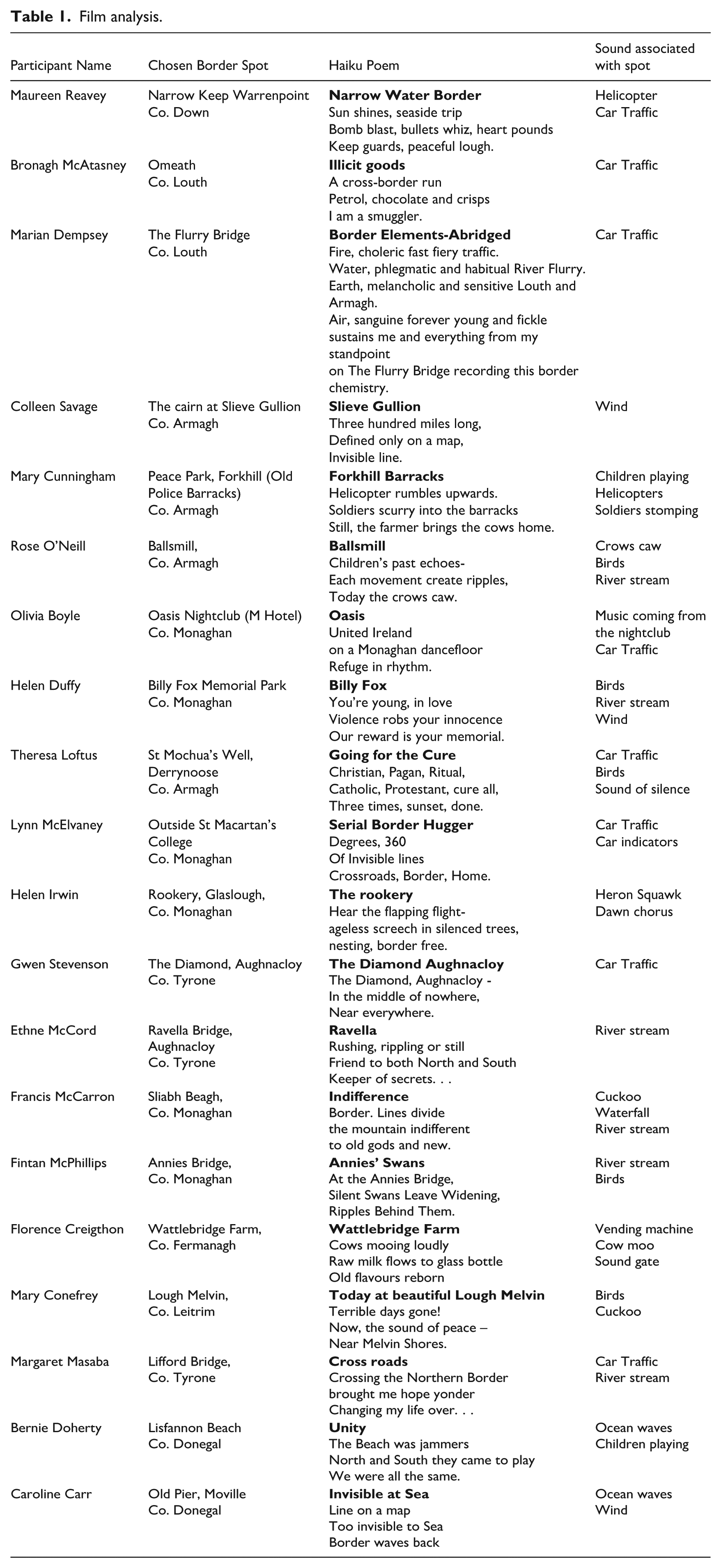
A close analysis of the film’s places of memory, sounds and haiku poems (Table 1) reveals four recurring themes–Troubles; Everyday Life; Nature; Invisible Border Line–and we examine each in the next section.
Film analysis.
Troubles
It is very difficult to work on a storytelling project in Northern Ireland and not see any reference to the Troubles, whether direct or indirect. John Hill once observed how the conflict has been ‘the distinctive feature’ of films about Northern Ireland, making it difficult to not deal with its impact ‘in some way or other’ (Hill, 2006: 242). Despite the peace process that put an end to everyday violence, the legacy of the conflict remains visible: there is still over 20 miles of ‘peace’ walls, street murals and flags dividing communities (BBC, 2015: n.p); segregated housing estates and schools in every city or town; the psychological scars that left one in five people suffering multiple experiences relating to the Troubles, including posttraumatic stress disorder (Muldoon et al., 2005: 87–88); at least 100,000 people who have been directly affected by imprisonment (Sullivan, 1999: 11); disagreements over the Irish language (McBride, 2025: n.p.) and intergenerational trauma (Walsh et al., 2025).
This sensitive context can sometimes lead to tensions, particularly when participants may have been on opposing sides during the Troubles (McLaughlin, 2010: 144). Fortunately, this was not the case here for several reasons. First, the project was delivered by a mixed team (a Catholic, a Protestant, and a foreigner all in their 30s) which helped create a sense of balance. Second, safekeeping guidelines were shared from the outset, including the importance of respecting different viewpoints and experiences and not sharing personal material outside the project. Finally, the project focused on what united participants (their border lives) rather than what divided them (their political backgrounds).
The memories shared by the participants included the presence of soldiers, the sound of helicopters and bombs, checkpoints, religious differences and the murder of local politician Billy Fox. However, the Troubles did not feature as heavily as one may expect in a film made in Northern Ireland. While this may seem surprising, the ‘geography’ of the Troubles can explain this lack of focus. Researchers have found that nearly half the population in the nine cross-border counties ‘had little experience of being affected by the Troubles’, with only around 6% of their sample reporting being ‘extremely bothered’ by symptoms of PTSD. These symptoms were found to be twice as prevalent in the North compared to the southern border counties (Boydell et al., 2008: 14). The study also notes that ‘social cohesion, trust, safety, and a sense of participation in broader society’ were among the factors most likely to have been affected in the border regions during the Troubles (Boydell et al., 2008: 17). For Border Sounds participants, thus, the border has other stronger associations.
Everyday life
Borders have ‘traditionally been studied in terms of the territorial nature and practices of the state’, but we are starting to see more attention being paid to their impact on everyday life as it is experienced on the ground (Nash and Reid, 2013: 9). Border Sounds demonstrates how everyday places, such as beaches (Lisfannon, Donegal), play places (Ballsmill), nightclubs (Oasis, Monaghan), and places of worship (St Mochua’s Well) can offer important meeting points for people who live very segregated lives. Crossing the border to smuggle goods or buy cheaper petrol is a common occurrence. Farmers look after their cattle and produce milk even when their farmland is split into two different jurisdictions. Crossroads such as county Tyrone’s The Diamond and Lifford Bridge and their traffic illustrate the constant movement of people and goods between border towns.
Sound is particularly used to denote a past that no longer exists and highlights how everyday border life has changed: the muffled beat of a nightclub recalls a lively venue now a derelict hotel in Monaghan, while helicopter sounds over a peaceful lough in Warrenpoint or a children’s playground in Forkhill hint at a life under military occupation. These everyday memories remind us that borders do not exist within a vacuum and instead must be viewed within a wider social perspective. It is important to bring these uneventful and overlooked aspects of border history into visibility as they can provide a more plural reading of the impact of partition on people’s lived experiences. As Stephen Johnstone notes, ‘the everyday might be the common ground experience that allows people to understand the effects of history on the private lives of those who were usually overlooked’ (in Aguiar and Murphy, 2019: 60).
Hearing everyday stories is important in postconflict societies. Claire Hackett and Bill Rolston remind us that political transitions can often shape official narratives that erase, minimise, or sideline the experiences of certain victims (Hackett and Rolston, 2009: 357). Storytelling projects, such as Border Sounds, thus, can potentially amplify stories that may not be shared through mainstream channels. When based on memory, these stories can have a valuable place in history re-writing because ‘the emotions they convey have social import, reflecting readings of the world that are embedded in collective history, and group experience’ (Campano cited Miller et al., 2011: 65). Memories are plural and more than mere recollections of our past and can potentially be ‘the history we expect for the present’ (Maltby and Keeble, 2007: 19). Therefore, it could be argued that personal memories can, and should, become an important tool for humanising the politicised official history of borders.
Nature
References to nature featured often in the haikus and sounds. Border Sounds illustrate well Cathal McCall’s point about the key feature of Ireland’s partition: while state borders commonly function as ’lines in the sand’ dividing nations into different jurisdictions, the Irish border is like ‘the line in the bog, the field, the lough, the town, the townland, and even the house that divided the island of Ireland economically, politically, and socially’ (McCall, 2021: 22–23). The film takes viewers on an immersive journey across rivers, bridges, farms, loughs and farmlands and the sounds associated with these natural spaces: the dawn chorus in Glaslough’s rookery, the sounds of water on Ravella Bridge, Annies Bridge and Lough Melvin and cows mooing loudly at Wattlebridge farm. These sounds remind us of the similarities across the island (the rural landscapes) and not the divisions (visual markers such as flags and wall murals).
Highlighting commonalities is important, particularly when territorial borders tend to ‘attempt, but never succeed, in simply demarcating neat geographies of identity, belonging and allegiance either side’ (Nash and Reid, 2013: 7). In a place where inhabitants have defined themselves ‘not by what they shared in common but by what set them apart’ (Little and Scott, 2009: 26), films need to help people to ‘transcend their difference and create a public sense of ‘sheer human togetherness’ (Arendt cited in Jackson, 2002: 193). Border Sounds illustrates how making a film in a participatory way with people from different backgrounds can organically do just that.
Invisible border line
Travelling between the two jurisdictions today often makes it difficult to guess which side of the border one is on. The primary indicators are the changes in mobile phone signal and the shift from miles to kilometres. However, this ‘invisibility’ has not always been the case. As Cathal McCall observes, Ireland has gone through various processes of bordering and debordering, with bordering beginning in the 1920s with the construction of customs infrastructure and in the 1970s and 1980s to counter Irish paramilitarism insurgency. The 1990s saw the beginning of debordering as a result of the strengthening of the European Union and the Irish peace process (McCall, 2021: 15–16). However, Brexit has brought new debates on the state of the border, whether through the adoption of a ‘hard’ border by land or a united Ireland (no border).
An analysis of the haikus reveal that the most common theme was the invisible nature of the border. Participants highlighted how that line is only visible on a map, but not when standing at the top of mountains, such as Slieve Gullion (Armagh) and Sliabh Beagh (Monaghan), or at a pier in Moville (Donegal) or when picking kids up from St Macartan’s College (Monaghan). The absence of physical markers demonstrates that while the ‘drawing of boundaries on maps in the state rooms of governments is an act of power [. . .] borderlines never fully seal off what they try to contain’, rather they are fluid spaces and they may necessarily never ‘coincide neatly with social and cultural categories’ and are ‘rarely tightly geographically bounded’ (Nash and Reid, 2013: 7).
Scholars and practitioners have pointed out that understanding ‘the other’ is crucial for Northern Ireland’s transition from violence to peace (Dawson, 2007; Hackett and Rolston, 2009; McLaughlin, 2010). As geographic spaces have ‘a strong connection to stories, triggered by the cultural or symbolic influence of place to the storyteller’ (McRoberts, 2016: 81), films that highlight commonalities – the invisibility of the line, the nature sounds and everyday experiences – can play an important role in reducing the sense of otherness that continues to permeate Northern Ireland. We turn now to a discussion on whether Border Sounds, through its use of VR’s immersive techniques, provides greater opportunities than traditional films for individuals to engage with opposing perspectives and reimagine contested spaces, such as borders.
Immersive technology and reimagining contested spaces
As seen above, the stories shared by the participants ranged from everyday memories, such as childhood play places, dance floors and smuggling products, to well-known Troubles-related events. Capturing stories and adding them to the archives is one thing, packaging them in a way that the public engages with them is another. After all, what is the point of capturing and preserving stories if no one will engage with them?
We chose VR as the medium for two reasons: first, even though the Troubles have featured prominently in Irish cinema, the border remains, surprisingly, under explored (Fox, 2020; Hill, 2006). While Ken Fox has identified some of the ways the border has featured on screen – e.g. as a geographical backdrop in Accelerator (Murphy, 2001), a character in Black Ice (Gogan, 2013), a metaphor in Puckoon (Ryan, 2002), or as a representation of themes such as conflict, confinement, and loss (Fox, 2020: 3) – to our knowledge, no filmmaker has used virtual reality to bring (Irish) border stories to life as of 2021.
Second, we were keen on experimenting with virtual reality after working with more traditional storytelling formats such as photography and films. As a cross-border, cross-community project, we were particularly interested in exploring its immersive power and potential to start conversations and have an impact on viewers. As VR director Doug Liman notes, ‘VR should be more emotionally involving, but that doesn’t happen automatically by just taking a VR camera and sticking it onto what would be a traditionally blocked scene for 2D’ (Zheleva et al., 2021: 46). Therefore, for someone to ‘really feel as if they were there’, good stories are needed and we felt that our haikus and sounds provided just that.
Sound is particularly crucial here and its use goes beyond building atmosphere and creating a sense of presence. The captured ambient sounds act as subtle cues to add depth to the stories shared in the haikus and visuals. For example, the faint sound of a nightclub in Olivia Boyle’s story recalls a lively space now replaced by a derelict hotel. The playful sound of children makes the now-empty Lisfannon Beach feel bustling again. The same sound is used in Fokhill, but these happy sounds are mixed with the sombre noises of helicopters and stomping soldiers, highlighting the transformation of an army barracks into a children’s playpark. Thus, sound in Border Sounds is not just supportive: it is central to how meaning is created, felt and understood.
Experiments with the sense of ‘being there’ and immersion are not new and have been conducted for centuries, through optical illusions in paintings and drawings in the late 1880s and 1900s, 360° panoramas, and head-mounted display (HMD) systems in the 1960s (Greengard, 2019: 1). Today virtual reality is everywhere and its application is diverse, from games and military to industrial settings, and cultural and arts organisations. It has evolved from being a niche technology ‘often relegated to gaming, to mainstream platforms that are radically changing the way we think about computing – and the way we use devices’ (Greengard, 2019: xvi). Since 2016, significant investments from tech corporations, such as Facebook and Apple, and the establishment of dedicated film festivals or dedicated strands within major festivals such as Venice, Cannes and Sundance, have fuelled its resurgence.
Despite the decreasing costs of hardware and software, access to VR technology remains limited. For instance, producing high-quality immersive content can be expensive, as it requires specialised expertise, skills, and technical infrastructure. A high-end production can cost around $500,000 (Pavlik, 2019: 288). While free VR content is available on platforms such as YouTube, and headsets can now be found for under $100, premium devices remain out of reach for most consumers, with headsets costing hundreds (Meta Quest, $500) or thousands (Apple Vision Pro, over $3k). As a result, it remains unclear whether VR will evolve into a lasting storytelling medium or become a passing trend (Uricchio et al., 2016: 5). Whether VR is here to stay or not, we ask here: can it really facilitate interaction with opposing perspectives better so than traditional films? What role can virtual immersion play in postconflict memory work?
Immersive storytelling is a growing field of study and there is a well-documented debate on its strengths and limitations (Dieck et al., 2021; Greengard, 2019; Pavlik, 2019; Rodriguez, 2022; Uricchio et al., 2016). Scholar William Uricchio and his colleagues at MIT’s Open Documentary Lab, for instance, have been bringing academics and practitioners together to discuss the role and challenges of collaborative, interactive, and immersive storytelling. In a 2016 conference, for instance, questions about its potential for activism, ethical implications, psychological impact and agency role were debated (Uricchio et al., 2016). Neuroscientists, for example, suggested that VR is processed as an experience rather than a representation, which may potentially fuel the ‘empathy machine’ argument, ‘Our ideas regarding narrative, point of-view, presence, and even subjectivity have been fundamentally challenged by VR development’ (Uricchio et al., 2016: 4). Similarly, and a few years later, scholar Jeremy Bailenson noted how things change when someone puts a headset on and steps into a virtual world: VR [virtual reality] takes all the gadgets away, it takes all the multitasking away and you actually feel like you’re with someone. We call this social presence – you see their emotions, you see their gestures and it feels just like you’re in the room with them. It takes what is typically seen as something that’s unemotional and distant and makes it feel like somebody’s right there with you (Greengard, 2019: xiii).
This sense of presence is also highlighted by Oscar Raby (studio VRTOV9) when he says that ‘You understand the character, you understand the story, by doing things’ (Greengard, 2019: 10). Indeed, when we showed Border Sounds publicly (first at its launch event, then to undergraduate film students and third during the Memories Studies Conference in Lima, Peru in 2024), users reported feeling as if they were standing in those border spots. Users in Peru, particularly, welcomed the opportunity to visit Ireland virtually and got a good idea of what the country looks and sounds like.
Debates around VR’s empathy potential are particularly relevant. Bailenson’s research on ageism, racism, and disability, for instance, suggests that VR can counteract negative stereotypes by guiding users through simulations that highlight strengths rather than reinforce biases. But he warns that empathy is not fixed and can be shaped by culture and media and that the impact of VR on empathy is complex – while it can increase understanding, it can also have unintended effects (Greengard, 2019: 87). He uses his experiment simulating blindness to illustrate how immersion led some participants to become more discriminatory, as they focused on the trauma of sudden blindness rather than the lived reality of being blind.
What his experiments demonstrate is that the empathy potential of VR should not be a given, ‘a magic bullet’, as he calls it, as it is difficult to predict how the mind will react to virtual stimuli (Greengard, 2019: 88). It may be more productive, instead, to challenge the idea that VR can simply recreate lived experiences and advocate for critical thinking over assumed empathy. As MIT Professor Fox Harrell rightly points out, VR cannot fully replicate a person’s lived experience and personal history and allow users to truly experience another person’s life: users cannot ‘actually walk in somebody’s shoes without the potential of physical repercussions or violence of the real world’ (Uricchio et al., 2016: 19). For Sam Gregory (WITNESS Programme Director), ‘empathy does not necessarily motivate people to take action’, and he suggests shifting the focus from ‘the sense of being somewhere’ to ‘the sense of being somewhere together with other people’, for example through frontline activists broadcasting via live 360 video (Uricchio et al., 2016: 18).
The above debates about VR’s empathy potential are particularly relevant when making a film about a contested topic such as the Irish border. The haikus and sounds illustrate how partition affected people’s everyday lives, whether in a political, economic, social or cultural sense. The partition of Ireland was ‘the most significant moment in modern Irish history’, leading to violence, displacement, job losses, two distinct justice systems, difficult border crossings and significantly influenced religious and educational policies in both jurisdictions (Moore, 2019: 191). Although the peace process of the 1990s helped cease daily violence, Northern Ireland has yet to pass the ‘post’ of the term ‘postconflict’ as disputes over housing, education, services, customs checks, and ‘dealing with the past’, particularly, remain (BBC, 2021; Dawson, 2007).
In a place where one person’s ‘victim’ may be another’s ‘perpetrator’, a careful approach to empathy is needed as well as sensitivity and an understanding of people’s unique circumstances. While there is a well-documented discussion around the (important) role of storytelling in transitional societies and its paradoxical potential to both heal trauma and to open old wounds 4 , we have yet to understand the effects, both short-term and long-term, that immersive experiences have particularly on users (Uricchio et al., 2016: 17–18).
As mentioned earlier, Border Sounds was only shown a couple of times: at a launch event for project participants (2021), to film students at University of Ulster (2023/24) and at the Memory Studies Conference in Lima (2024). Therefore, this scarcity of public screenings makes it difficult to evaluate its empathy potential and assess how to use VR sensitively. However, it clearly highlights a limitation of using VR as a postconflict storytelling tool: how challenging it is to organise VR events. Unlike traditional films, VR films require headsets and often powerful computers or standalone devices, which limits audience capacity and makes simultaneous viewing difficult (and consequently low return of investment). The immersive nature of VR also demands dedicated physical space and specialised technical support to ensure a smooth experience for attendees. These logistical demands, combined with varying levels of audience familiarity with the technology, make VR screenings more complex and resource-intensive to organise. While VR developers have constantly looked into improving limitations, such as wearability, usability, fatigue, and motion sickness (Dieck et al., 2021) and VR continues to grow and enter the mainstream, more work is needed to help creators avoid shaping potentially distressing experiences for users and better understand the user experience.
Conclusion
As David Newman has rightly observed: ‘If we really want to know what borders mean to people, then we need to listen to their personal and group narratives’ (Nash and Reid, 2013: 9). This article took Border Sounds as a case study to examine the intersection of personal memory, geographic space, archives and immersive technology. As discussed, borders can shape collective memory by influencing how communities define identity, remember, and interpret history. They reinforce inclusion and exclusion, marking who belongs and who is considered an outsider and as sites of trauma, borders can carry intergenerational memories of displacement and violence, shaping national narratives.
While official records in national archives, such as PRONI, often reflect state perspectives, community-focused participatory projects like Border Sounds can offer alternative histories, ensuring diverse voices are heard. Given the contested past in Northern Ireland, it is crucial to ‘ensure that no one narrative should dominate the archive and that efforts be made to ensure “balance” in terms of both the number and types of stories gathered or deposited in the archive’ (Hamber and Kelly, 2016: 36). As Lorraine A. Dong note, while ‘archivists have always been facilitators of community engagement with archival materials’ now it is the ‘how, why and who can interact with what materials’ that are expanding (Benoit and Eveleigh, 2019: 93). Through Border Sounds, and indeed Making the Future, PRONI has demonstrated increased awareness of – and commitment to embracing–this shift.
As discussed earlier, understanding ‘the other’ is still much needed in Northern Ireland today despite the absence of daily violence. As cultural memorial practices have often fostered division, we need films that promote shared spaces and experiences to help reduce, rather than reinforce, the sense of othering. Not to create a homogenised narrative, but a multiplicity of narratives that reflect the varied, but shared, experiences of border life that can only be found when we look at memory-based everyday stories.
In postconflict societies, even after physical barriers are removed, psychological divisions can endure. While ‘there is no easily available blueprint [. . .] to realize the potential benefits of storytelling in transitional societies’ (Hackett and Rolston, 2009: 372), the analysis of Border Sounds demonstrate two things: First, it shows how poetic reflection can bridge divides: haikus, with their brevity and emotional precision, allows participants to reflect on complex memories and experiences in a contained way. When paired with sound–whether ambient recordings or people’s own voices–these poems take on a deeper resonance, evoking a strong sense of place and humanity. In the context of postconflict storytelling, this approach offers a subtle yet powerful means of expression.
Second, it reveals the potential of immersive storytelling in documenting and reimagining border spaces, shaping how societies remember and engage with their past. While more work needs to be done on the potential impact of engaging with VR films, the project shows how archives can leverage memory and virtual reality technology to become collaborative (and creative) spaces that capture, reinterpret, and share everyday life. Through public co-creation, archives, including state ones, can provide an inclusive approach to broadening representation, amplifying diverse voices, and addressing gaps in their collections. And memories can give that much needed human touch to the official history held in the archives.
Footnotes
Acknowledgements
Not applicable.
Ethical considerations
This article did not require ethical approval, as it did not involve the collection of data from human participants. The research is based solely on content analysis of a film that is publicly and lawfully available online:  .
.
No interviews, surveys, or other forms of direct interaction with individuals were conducted. The film analysed is a published work in the public domain, and the study engages only with its content as a cultural and media text.
Consent to participate
Not applicable (see above statement).
Consent for publication
Not applicable (see above statement), though organisations PRONI and Nerve Centre (Making the Future convenors) are aware of the publication and have given consent.
Funding
The authors received no financial support for the research, authorship, and/or publication of this article.
Declaration of conflicting interests
The authors declared no potential conflicts of interest with respect to the research, authorship, and/or publication of this article.