




Abstract
From early 1944 until 1946, more than 25,000 refugees from Yugoslavia, mostly from the Dalmatian coast and islands, stayed in refugee camps in Egypt at El Shatt. Located on the shores of the Suez Canal, this complex of tented camps on desert sands was jointly run by the British military, Yugoslav Partisans and international humanitarian organizations. After the war, most of the refugees returned to their homes and only a five-pointed star-shaped cemetery overlooked by the statue of a grieving Mother remained on the spot. This article shows that unlike most refugee camps, El Shatt was not forgotten after its closure, but instead memorialized from the very beginning. Based on extensive research in United Nations, British and Croatian archives, we ask how the camps in El Shatt were memorialized in changing circumstances from their closure to today. How was their memory integrated into dominant historical narratives and practices, and what roles did local, intimate individual and family experiences and practices play in this? Reasons for not forgetting El Shatt start with the extraordinary documentation of these camps because they stood at the beginning of the UN-centred international humanitarian regime and the founding of Socialist Yugoslavia. For the continuous memorialization, however, it was important that the refugees returned as a large group to Dalmatia, the same region where they had come from. The local communities of memories provided the foundation for the abundant movement and communication of memories of El Shatt across different registers, spaces, genres, times and media.
Introduction
In October 1944, Mate Biočina wrote a memo to the Yugoslav Central Refugee Committee (Centralni odbor zbjega, COZ), the central authority administering the complex of camps in El Shatt in Egypt: We cannot and should not allow that the issue of building the cemetery of our refugee camp is approached carelessly. This cemetery is to be a lasting monument to the suffering of a part of our people, which will speak to future generations about their suffering, and which will take its honourable place on the pages of our and world history. It is my heartfelt wish that you succeed in this matter, and I ask the dear God to assist you in this endeavour. DEATH TO FASCISM – FREEDOM TO THE PEOPLE.
1
Biočina came from a family of stonemasons and was responsible for the cemetery in El Shatt. In this memo and elsewhere, he insisted on the need to take care of the resting places for the hundreds of deceased and argued in addition, that the cemetery should be a monument dedicated to the life in exile in El Shatt as well. With this wish for a lasting imprint, the refugees implicitly opposed the idea spelt out in a report on El Shatt by the United Nations Relief and Rehabilitation Administration (UNRRA), who were officially running the camps, according to which: ‘The camp is desert and will return to desert. There is no such place. It is but a latitude and a longitude’. 2 The cemetery was finished shortly before the refugees returned to Yugoslavia and renovated several times over the next decades, indeed ensuring that something remained of the El Shatt camps and not everything became desert again. The five-pointed star-shaped refugee cemetery on the eastern banks of the Suez Canal remains in place until today and is an elaborate early example of Yugoslav ‘revolutionary memory’. It is thus part of a larger landscape of monuments built in memory and honour of the socialist revolution and the Yugoslav People’s Liberation Struggle during the Second World War mainly in Yugoslavia itself (Horvatinčić and Žerovc, 2023). Until today, students, filmmakers, individuals, diplomats and high-ranking state delegations visit the cemetery occasionally. As such, it serves as a focal point for the memorialization of the transcontinental escape from fascist terror during the Second World War.
El Shatt certainly found its place in the ‘pages of history’ as Biočina argued in his memo, even though, until recently, refugees were short-changed in historical accounts (Banko et al., 2022). On the question of why refugees are rarely part of historiography, Philip Marfleet writes: ‘Historians construct narratives which continue to exclude those not allocated roles in the usual national dramas’ (Marfleet, 2007). In contrast to this, El Shatt was firmly inserted into different histories. The most prominent and foundational of these was the local Dalmatian history and the history of the Socialist Federal Republic of Yugoslavia. As noted in 2007 in the catalogue accompanying the El Shatt exhibition in Zagreb ‘this was no ordinary refugee camp’ but ‘represented a genuine part of the country from which the people had come’ (Mataušić, 2007a: 93). In a similar manner, El Shatt was perceived by contemporaries beyond the country’s borders. In 1944, an English writer told the BBC after visiting the camp that the Partisans there ‘weren’t refugees’ but had ‘come to prepare for the future of their own country; just as much a part of the war as the Partisans fighting in the mountains’. 3 A German communist poet who had been to El Shatt described it as ‘a centre of the Yugoslav liberation fight outside its homeland’ and part of the ’battle against fascism’ (Fürnberg, 1960: 5). The insertion of this exile experience into Yugoslavia’s foundational history shares some similarities with the experience of Jewish displaced persons (DPs) after the Holocaust. Forced to stay in DP camps in Germany and Austria some of the survivors used their time to prepare and fight for the eventual migration to Palestine/Israel (see, for example, Baumel, 1997; Gatrell, 2013: 123). In both cases, the period of involuntary encampment was understood as preparatory for the founding of a new state leading to a spirit of activism and anticipation in the camps. And in both cases, their ordeal became part of the state’s founding history.
Two strands of literature have dealt with the history of El Shatt thus far. One is more recent and located within contemporary studies of refugee history, while the other goes further back and is related to the Yugoslav and Croatian history of the Second World War. Recently, these two strands have been slowly coming closer together, which is also what we aim for in this article. In the history of refugee camps and the UN system of relief established around the UNRRA, El Shatt is an early example (Lingelbach, 2023; Proudfoot, 1956: 142; Woodbridge, 1950: II, 81ff). More precisely, El Shatt was one of the first refugee camps officially run by UNRRA’s first field mission based in Cairo alongside camps for Greeks and Poles (Lingelbach, 2022; Robson, 2023). While the history of El Shatt and the other UNRRA camps in the Middle East and Africa is overshadowed by the organization’s much larger operations in post-war Europe, it formed a prelude that was taken seriously by UNRRA officials at that time and documented accordingly. Recently an increased interest in the history of refugees including a special focus on Europeans, who found refuge in Asia and Africa during the Second World War, triggered an interest in El Shatt beyond national research frameworks (Bieber, 2020; Mackinnon and White, 2023). Long overlooked in the historiography of the UN-centred international refugee regime, the Middle East and African camps are slowly getting more attention.
This complex of camps played a more prominent role in the Yugoslav and later Croatian context where it served for decades as an example of outstanding resilience, discipline and creativity of civilians in the Second World War under the leadership of Tito’s Partisans. In this context, major historiographical works about El Shatt were released in the form of a series of newspaper articles based ‘exclusively on archival materials’ published on the occasion of the 30th anniversary of the refugees’ arrival in the Sinai Desert, 4 academic articles and commentaries (cf. Ćurin, 1974; Mrduljaš, 1983; Palavršić, 1969; Plenča, 1965, 1967). In addition, edited volumes (Pivac, 1980), catalogues of exhibitions including a pivotal one from 2007 (Mataušić et al., 2007) and recently, a comprehensive full-length monograph was published (Radonić, 2023). Over the last decades this research was broadened by insights into Allied sources and Egyptian government perspectives (Ajlec, 2013, 2014), questions of refugees’ perception of Africa (Petrović Teodosijević, 2008), discussions about the heterogeneity and contradictions inherent in the movement (Bratanić, 2011, 2016), the production of memories (Abramac, 2018; Mustapić and Dergić, 2023) or printed materials (Hameršak, 2019a, 2019b).
Building on both strands of literature and archival sources, in this article we address the history of the memorialization of El Shatt in the international, the local Dalmatian and national Yugoslav and Croatian contexts. In doing so, we leave out important, but for us inaccessible, perspectives related to the perception of the camps: the perspectives of locals and residents in the direct vicinity and cities of Egypt as well as other groups, such as British and African colonial soldiers, diplomats, embassies’ local employees, Croatian citizens in Egypt, or citizens of other former Yugoslav countries. We start with the historical episode of its existence in the first part, before we focus on the production of the sources, providing the raw material for its continued memorialization. We argue that El Shatt’s importance as the starting point of new developments led to meticulous and variegated documentation by both already mentioned camp administrations: UNRRA and COZ. Pivotal moments in the memorialization are connected with UNRRA and international humanitarian organizations’ involvement in the maintaining of refugee camps in Africa and the Middle East, on the one hand, and, on the other, the Yugoslav socialist state-building and changing international relations in the context of the political configurations of the post-war era, including the Non-Aligned Movement, the Israel-Palestine conflict and shifting geopolitical alliances. Throughout, personal memories and localized memorialization were of utmost importance. It was crucial for the memorialization that the refugees returned as a group to Dalmatia, the same region where they had come from. Their memories could thus live on locally and, as we will show, support and boost the rich, long-lasting, transcontinental travelling of El Shatt memory. All this enabled the memory of the Yugoslav refugee camp to travel from the Second World War to the present day, or as suggested by the title of this article, from Africa or North Africa – the terms used by the refugees for the El Shatt area – to present-day Croatia, as one of Yugoslavia’s successor states. 5
Following Astrid Erll’s (2011) notion of ‘travelling memory’, we will try to trace the multi-layered and changing memorialization of refugee displacement in El Shatt by looking for mnemonic movements across space, time, media, languages, states, as well as axes of individual and collective, national and transnational etc. Our focus will thus be on the mnemohistory of El Shatt, as we trace the ways it was constructed and reconstructed over time and across different geographies and communities. If memory, according to Erll (2011: 15), ‘fundamentally means movement’, what happens to memory that involves movement across seas, to other continents, to the desert, under the command of several authorities, during the war, in search of refuge and safety? How does the traffic between local and national, individual and state, personal and collective levels of remembering, as well as the circulation among social, medial, and semantic dimensions, operate (Erll, 2011: 15) in the flight of refugees from the eastern Adriatic to Egypt and back again?
From the Dalmatian coast to the Sinai Desert
To understand the memorialization of El Shatt we first need to know how people from Dalmatian villages and towns came to Egypt, how they lived there and what their further trajectory was. They did not escape on their own, but their movement was a planned evacuation initiated in late 1943 by Partisans who gained control of the area after Italy’s capitulation in the same year. To escape the arrival and reprisal of German troops, civilians were evacuated to the island of Vis that was still held by the Partisans with British support (Bieber, 2020: 303; Mataušić, 2007a; Plenča, 1967; Radonić, 2023: 11–86). Typical for that era and seen as a lesson from the chaotic Fall of France where refugees had been ‘clogging . . . Allied communications’, their evacuation was part of military operations. 6 It was no humanitarian endeavour, but a strategic necessity to get the civilians away from the military area. The British Navy, in close cooperation with Tito’s Partisans, evacuated people via Southern Italy, already controlled by the Allies, to Egypt where the British military had a strong presence and a refugee administration in place.
Refugees were settled in different camps in Egypt, all of which are often, especially in Yugoslav historiography and twentieth-century popular culture subsumed under the single term ‘Zbjeg’ (Eng. flight, exile or refuge) or, as it is today, ‘El Shatt’ (cf. Mataušić, 2007b: 102–103). To be more precise, more than 6000 refugees from Yugoslavia stayed in Khatatba, north of Cairo, 2000 in Tolumbat, near Alexandria, and 400 in El Arish, a port city on the Mediterranean side of the Sinai Peninsula. 7 Tolumbat was mainly for the ‘political bad hats’, and divided into five sub-camps: one for ‘neutral’ Yugoslavs, two for Chetnik royalist Yugoslavs, one for Greek ‘trouble-makers’ who had refused to be transferred from Nuseirat to Moses Wells and one for refugees of other nationalities. 8 In Tolumbat there was less self-organization and British and international officials were more involved with the internal management in contrast to the other largely Partisan-run camps. Later, under UNRRA, the royalists were moved to El Arish (opened in September 1944) and Tolumbat became a convalescent camp for the sick from El Shatt. 9 However, the vast majority of around 25,000 refugees from Yugoslavia stayed in the complex of camps at El Shatt, located in the Sinai desert next to the Suez Canal.
El Shatt was set up in an area where the British military was strong and had special rights as they safeguarded their interests in controlling the Canal as a strategically vital connection to the Indian Ocean. The British still held a powerful position in formerly colonized Egypt making the whole situation quasi-colonial. Hosting Yugoslavs in El Shatt was part of larger efforts of British imperial refugee hosting and could build on the already established refugee administration in Cairo, the Middle East Relief and Refugee Administration (MERRA), responsible for hosting Greek and Polish refugees throughout the British colonies in East and Central Africa, India, Palestine, Syria and Egypt (Lingelbach, 2023). When El Shatt opened in early 1944, the MERRA-run camp Moses Wells was already hosting Greek refugees since July 1942, located less than 15 miles away. 10 El Shatt had been used as a military camp before and since all the MERRA camps were supplied by the British military and many of its technically civilian staff were in fact British or South African military personnel, the site was ideal. The accessibility for transport at this main shipping route close to a ferry and the railways might be another factor leading to the decision. El Shatt was thus rather isolated from Egyptian society but integrated into the British military complex. The close integration even led to incidents where the British Air Force accidentally dropped bombs on El Shatt. In May 1945, this resulted in the death of two refugees. 11 The isolation of these and other camps from the Egyptian population centres was another factor making them seem perfect to British and Egyptian officials, 12 echoing approaches of today’s peripheral placement of refugee camps (Turner, 2016).
The camps at El Shatt were administered by a mixture of British, ‘international’ and Yugoslav officials. They were set up and supplied by the British military coordinated under the MERRA, financed by the British Foreign Office. It was a civilian organization but supplied and staffed by British army members and thus characterized as ‘para-military’ (Woodbridge, 1950, II: 83). While the British camp commandant had the supreme authority, everyday life was internally and in many aspects autonomously run by the Yugoslav camp committee. In fact, the refugees arrived in already organized groups under the Central Refugee Committee, COZ (Plenča, 1967: 350; Mataušić, 2007b: 103) and promptly organized the bureaucracy which ‘was a kind of government in miniature’, as pointed out by Katherine Mackinnon and Benjamin Thomas White (2023: 15). The overall responsibility for El Shatt and the other camps changed in May 1944 from MERRA to the UNRRA Balkan Mission, but its staff and procedures remained largely the same. 13 It only grew in size and additional ‘internationals’ from the emerging UNRRA and voluntary associations joined in the running and support of the camp. However, in contrast to other camps for European refugees, there were, according to official sources, only a few Egyptian workers employed and UNRRA’s Chief Welfare Officer, estimated the ‘refugees performed 98% of the manual labour in the camp’. 14 Whatever the actual numbers, it was a contrast to other European refugee camps in Africa where thousands of colonized labourers did most heavy work (Lingelbach, 2020a: 232–235, 2022).
When the refugees arrived, El Shatt was still under construction and consisted of only a few brick buildings for the central facilities and British military tents for accommodation. As described in the literature (Mataušić, 2007a, 2007b; Plenča, 1967), it was divided into three – later four – sub-camps. 15 With only burlap floors first, the tents were gradually improved with cement grounds. The camp hospital was enlarged and schools and recreational rooms were established in improvised connected tent constructions. The refugees ran a range of workshops from toymaking to cobblers, dressmakers and barbers as well as discussion, reading, writing, painting, theatre, singing and other groups. 16 With basic needs secured, the presence of intellectuals, teachers, and artists among the refugees, along with organizational and political autonomy, as well as the need for self-definition and representation, provided a foundation for vibrant social and cultural activities in the camps. After the war, UNRRA started repatriation transports back to Yugoslavia and the refugees gradually left El Shatt. Starting in 1945, they returned to Dalmatia and until August, some 15,000 had already left the camp (cf. Mataušić, 2007c: 123). However, it took until March 1946 for the remainder to be repatriated, leading to anxiety among those remaining longer. 17 El Shatt was closed, but it was never forgotten. On the contrary, after the first decades of relative silence about El Shatt, the refuge in the Sinai Desert became a rich point of reference, evolving in various contexts, from historical works to popular culture.
Documenting new beginnings
As Michel-Rolph Trouillot (1995: 26) puts it, history writing begins in ‘the moment of fact creation’ that is the making of sources. The original documentation and personal memories form the base upon which archives, historical narratives, history writing and memorialization can be built. They form, what Aleida Assmann (2006: 220) calls the ‘archival memory’, the stored material that can be retrieved and brought into the wider circulation if it fits the circumstances. In contrast to other refugee camps, El Shatt was meticulously documented during its time of existence already. Moreover, this rich material is still accessible today in the archives in Split, Zagreb, Belgrade, London, New York and Washington and is increasingly available online. The main reason for the surprisingly good documentation of the camp is that El Shatt stood at the beginning of two historical projects: the UN-centred international humanitarian system emerging during and after the Second World War and the establishment of the Socialist Federal Republic of Yugoslavia in the same period. Officials involved in these projects were aware of their position and took care of documenting their activities accordingly, leaving rich archives behind. In this way, they were involved in the memory making of El Shatt lasting until today.
Documenting the beginning of the UN humanitarian system
In the history of the UN-centred international refugee regime, El Shatt was part of a larger system of refugee camps throughout the Middle East run by UNRRAs very first field mission. It was here that UNRRA could demonstrate and practice a new way of international cooperation in the care for the displaced. The Cairo-based Middle East Mission of UNRRA emerged out of the British imperial refugee regime around MERRA which itself grew out of refugee relief efforts in the British Embassy and military officials in the Middle East (Lingelbach, 2022). When UNRRA absorbed MERRA and its camps in May 1944, it was the first mission where the organization could do practical work apart from planning and preparing for the moment when they would finally enter the liberated territories. It is not surprising that during the heightened days of the war, many looked sceptical at this new organization set up in Washington and supposed to rebuild the war-ravaged liberated territories and take care of the millions of displaced persons after the war (see Reinisch, 2011; Robson, 2023; Salvatici, 2012; Woodbridge, 1950). Its proponents saw UNRRA as the vanguard of the new international order to emerge from the ruins of war. Herbert Lehman, UNRRA’s Director General told recruits in a speech in Cairo in June 1944: ‘We are also pioneers in demonstrating that whole-hearted cooperation between nations and peoples can be made to work. You probably realize that UNRRA is the first operating international organization’. 18 In contrast to earlier intergovernmental institutions around the League of Nations, UNRRA was not only policy-making but also working on the ground. The UNRRA camps in Egypt and Palestine were the sites where this new world in the making could be shown and experienced first.
The importance of El Shatt and the other camps for UNRRA’s publicity and history led to a systematic compilation of documentation. UNRRA sent historical records officer Elizabeth King Simeon from the United States to Cairo to document the mission’s activities and establishment. 19 While the records of the British imperial refugee relief activities under MERRA were rather sketchy and haphazard, Simeon went to great lengths to document its coming into being. From late 1944 to early 1945, she compiled a detailed account, based on official and private documentation and conducted interviews with British officials to document the emergence of the UNRRA mission. 20 Her reports and documents were explicitly produced to provide lessons for the future development of the international system around the emerging United Nations. 21 These documents were either directly sent to the UNRRA headquarters in Washington or later transferred and eventually taken over by the UN Archives in New York. In recent years, important parts of it were digitized and made available online for everyone, including the descendants of former refugees.
Next to the internal UNRRA documentation, there was a constant production of news items to display the organization’s achievements. UNRRA’s Cairo mission had a public relations officer who produced press releases and photographs and guided reporters to the camps, noting: ‘The Yugoslavs with their forthright methods of self-government are always a big news pull for correspondents and photographers, and there has consequently been a stream of visitors going into the camps with passes authorized by this division’. 22 Reportedly, Arab, English and French newspapers showed a great interest in the camps. The PR division’s job was to showcase UNRRAs achievements in caring for the displaced and El Shatt was the best-organized and presentable to a global audience sceptical of this new international organization. One example of the reporting is a front-page article in the New York Herald Tribune titled: ‘U.N.R.R.A Camp in Egypt Sets Pattern to Help Distressed European Peoples’. 23 Including three photographs of El Shatt, the article describes the camps for Greek and Yugoslavs in Egypt as ‘dress rehearsal for a greater drama to come when Western Europe is liberated’ and the organization’s ‘first venture’. While acknowledging the Partisan self-organization, the larger story was the UNRRA support for Europe’s displaced. In the Yugoslav and Croatian context, the foreign press interest and writings about El Shatt were regularly cited as a sign of the broader international significance of the humanitarian and refugee structures developed there and as a recognition of the role of Tito’s Yugoslavia.
Voluntary organizations assisting the refugees in El Shatt produced additional sources in their reporting. The Mennonites, for example, sent relief workers to the Middle East who reported regularly to their congregation back in the United States. They worked under UNRRA leadership and closely with the British military but had their own views on ‘smoking, drinking, dancing and clean language’ in contrast to soldiers and others in the camps. 24 The Quakers operating the ‘Friends’ Ambulance Unit’ wrote about their experiences in El Shatt in their newspapers, to headquarters and later also in memoirs (e.g. Wriggins, 2004). Additional voluntary organization staff came from the Near East Foundation, British and American Red Cross or Save the Children and worked under UNRRA in the camp producing their own paper trails. 25
The Allied media and information departments produced a range of visual documents, films and photographs, some of them circulating until today. For example, photographer Otto Gilmore took pictures of everyday life scenes in El Shatt in September 1944 for the US Office of War Information. Via the Library of Congress website, they are freely available online and some were in 2014 exhibited in Split, the regional centre of Dalmatia. 26 An important documentary film, combining British, international and Yugoslav interests and perspectives was ‘The Star and the Sand’ produced by British director Arthur Calder-Marshall with support from UNRRA and the Partisan Refugee Committee. 27 The British camera crew shot the film on location in late 1944 and distributed it via British, Canadian and US government channels. 28 Reportedly, Calder-Marshall was a pre-war member of the Communist Party of Great Britain and the film was full of praise for the industriousness of the Partisans and the support by the British and UNRRA. Already in August 1944, another film on El Shatt was shown in the UNRRA headquarters in Washington as part of an ‘All-UNRRA Evening Program’ for up to 850 employees and guests. 29 In February 1946, as part of a farewell event prepared by Yugoslav refugees in the American University’s Ewart Memorial Hall in Cairo, the Calder-Marshall movie was shown after dances and songs performed by some 250 – mostly children – refugees. 30 Scenes from the same movie feature in most of the later produced documentaries about El Shatt in Yugoslavia and Croatia, sometimes significantly altered. In Aleksandar Stasenko’s (1987) movie ‘Zbjeg’ many scenes are taken from this movie, but accompanied by a substantially different narrative. 31 Where in the original film, UNRRA’s achievements were pointed out, for example in the scenes from hospitals, Stasenko’s film praised the self-organization and skills of the refugees, illustrating how the travelling of memory across time, space and populations can take unexpected directions.
There are many other examples of the travelling memory of El Shatt involving international actors and former refugees. Particularly interesting are the attempts of non-Yugoslav soldiers or medical workers to get in touch with former refugees they had met in El Shatt. In 1965, a British soldier wrote directly to ‘Marshal Tito’ to express how he missed his Yugoslav friends and offered to donate a collection of ‘very interesting photographs’ he took in El Shatt. 32 In 1981, two nurses who probably worked for UNRRA in the camp placed a newspaper advertisement in an attempt to get in touch with their former students. 33 Two years later, one of them arrived in Split from the United States to meet with her former student ‘girls’ some of whom were already grandmothers at the time. Their emotional reunion was covered by the local newspapers. 34
Documenting Yugoslav socialist state-building in exile
El Shatt was also a training ground and showcase of the achievements and prospects of the Partisans and Yugoslav antifascists led by Josip Broz Tito. From the beginning, they conceived and evaluated life in El Shatt, as spelt out in 1946 in a commentary about the return of the last group of refugees, as a ‘constant preparation for returning to . . . the homeland. Everyone was aware that it was necessary to learn a lot in order to preserve the hard-earned freedom’. 35 El Shatt was an ideal training ground for the post-war socio-political order because, in contrast to the situation at home, where the war was still ongoing, only in the safety of Egypt ‘could a social community develop similar to the one the communists aimed to create in Yugoslavia after the war’ (Radonić, 2023: 3).
In the ‘microcosm of early Yugoslav state-building’ in the sand (Bieber, 2020: 302) an impressive number of registers, reports, memos, and other administrative documents related to all aspects of life in the camps were created and brought to Yugoslavia after the war. First, the material was stored in various archives, but in 1952, most documents relating to El Shatt were transferred to the State Archive in Split, which remains until today the referential point for this topic. Documents were handed over in an unorganized state and were carefully examined, selected, ordered and inventoried in the next few years. The last major reorganization of this archival material took place in 2021, underscoring its importance and relevance until today. It is now stored in a separate collection titled ‘Yugoslav Refuge in Egypt’ (HR-DAST-23), consisting of 454 volumes and 99 boxes. 36 During the organization of this ‘archival memory’ (Assmann, 2006), the principles of provenance and original order were applied, meaning that documents were classified according to their original serial numbers or chronologically, and based on whether they pertained to the central administration of the camps or its sub-bodies, like the camp and district committees with administrative, economic, educational, cultural-informational and other departments (Mataušić, 2007b; Plenča, 1967). Working with this material, researchers gain insights into El Shatt’s systematic and extensive administrative apparatus and the importance placed on documenting every aspect of life in the camps. For example, correspondence between COZ and British authorities is saved and stored in this collection next to a memo about a boy who, during a visit to the nearby American military base, left ‘two blankets and a small package’. 37 In the following decades, the original collection grew through private donations, but also through materials from ‘dissolved’ institutions, such as the Museum of the People’s Revolution in Split, which, like other comparable museums, was dismissed and repurposed in the 1990s following the end of the Yugoslav socialist project. In a bitter irony of fate, the collapse of institutions that were built on the foundations of El Shatt resulted in the enrichment of the camp’s central archival collection.
Besides written documents, thousands of photographs from El Shatt were unloaded when the refugees landed at the eastern Adriatic ports. Some of them, especially those made by the El Shatt Photo Section found their way to museums and archives in the homeland. Established already in April 1944 as part of the refugees’ cultural and social activities, the Photo Section acted as an expression of the ‘will to remember’ (Nora, 1989: 19). It documented key events such as exhibitions, theatre and folklore performances, sports meetings, excursions, the work of schools, hospitals, and soap production facilities, as well as portraits and everyday scenes (Ivanuš, 2007). Besides documenting crucial moments of life, the goal of the Photo Section was, as summarized by Ante Palavršić, ‘to use the recorded material to inform the Allies and the rest of the world about the peoples of Yugoslavia and their flight’. 38 Some printed documents, for example, an elaborate coloured primer (Hameršak, 2019a) had a comparable goal, as did other sections or groups active in El Shatt such as theatre or choir. The publication of the primer was ‘a cultural event’ for El Shatt 39 and meant to be an example for contemporaries and a reminder for future generations. Decades later, print in El Shatt in general and especially the coloured primer had a prominent role in representing the life and work of refugees in El Shatt in the exhibitions and documentaries. Theatre and choir performances by refugees were also strategically staged to show the resilience, culture and potential of the Yugoslav people under Partisan leadership to both the Allies and the local elites in Cairo and Alexandria (cf. Mataušić et al., 2007: 101; Plenča, 1967). Some of these representational activities, such as exhibitions or theatre performances turned into mnemonic activities immediately with the return to Dalmatia. The ballet troupe and one of the six theatre groups from El Shatt, for example, were supposed to perform directly upon their arrival in Split in May 1945 to celebrate their return. 40
An especially interesting example of representational efforts used later for memorialisation is the so-called ‘Great Refugee Exhibition’ or, as it was officially called, the exhibition of ‘Yugoslav Folk Arts and Artisan Trades’. The exhibition toured in Cairo and Alexandria in 1944 and 1945, and upon repatriation in Zagreb and Split (Pavičić, 2007). On a floor space of 1800 square metres, there were more than 1200 exhibits of all kinds: handcrafts, toys, photos, books and prints, posters etc. Some of the objects preserved in museums today could have been part of this exhibition. Examples are handmade bags with an ‘El Shatt’ inscription (cf. Mataušić et al., 2007, exhibit 171) or a decorative pillowcase with the more explicit inscription ‘Memory of El Shatt’ (cf. Mataušić et al., 2007, exhibit 822), a tapestry with dates, the name of a refugee and El Shatt camp (cf. Mataušić et al., 2007, exhibit 842) or dishes engraved with ‘El Shatt’ and ‘People’s Liberation Army’ (cf. Mataušić et al., 2007, exhibit 277). These objects are instances of vernacular memorialization and signs of the awareness of refugees for the historical significance of the moment and the desire to preserve its memory. Many of the surviving memorabilia from El Shatt followed the same function, like flags with embroidered references to El Shatt, flight, etc. (Mataušić et al., 2007, exhibit 122), or children’s toys such as a wooden airplane with engraved scenes from life in the desert featuring palms, tents and the sun (Mataušić et al., 2007, exhibit 221).
The memorialization of El Shatt through exhibitions continues to this day. Apart from local or travelling exhibitions organized from the 1960s to the 2010s (Makarska, 2003; Podgora and Split, 2014; Split, 1984; Zadar, 2006), a major exhibition was set up in the Croatian capital Zagreb in 2007. The Zagreb exhibition was generally recognized and as such reported in media as the return of topics related to the Partisans into museums after the disintegration of Yugoslavia in the 1990s war. 41 Nevertheless, this exhibition’s focus on the prominent artists and intellectual figures in El Shatt and on the artistic and artisanship achievements today seems to be a departure from the political framework of the People’s Liberation Struggle that was at the forefront of Yugoslavia’s memory landscape. By shifting its frame from the founding of the socialist state to the achievements and resilience of individuals and collectives, the Zagreb exhibition, despite bringing back the antifascist fight into museums and featuring a red five-pointed star on the invitation, also contributed to the depoliticization of El Shatt remembrance which until recently dominated the memorialization after the break-up of Yugoslavia.
On the site in Egypt, the only visible structure reminding visitors of the tent city is the cemetery. The refugees were buried in several cemeteries, but the El Shatt cemetery took on a crucial memorial role as envisaged by cemetery administrator Mate Biočina, cited at the opening of this article. In the beginning, people who died in El Shatt were buried in the nearby Greek refugee cemetery, but in May 1944 the central refugee cemetery was established close to the camps where it still stands today (Radonić, 2023: 425). By the fall of the same year, discussions had already begun on how to organize this cemetery as an architectural whole with an explicitly articulated double goal: commemorating the deceased, many of whom were children, and leaving a material trace of the huge, elaborated refugee settlement in the desert. According to the El Shatt press at the time, the idea was that by building the cemetery, we will repay our dead and earn the respect of those whose land we will forever leave them in. We will show that even in the hardest times, we knew how to honour the sacrifices in the fight for human rights and the freedom of our peoples. Let the El Shatt cemetery be our sanctuary. (Naš list 1945, cited in Radonić, 2023: 435)
From the beginning, the Yugoslav post-war press acknowledged this dual function of the cemetery. As stressed in a newspaper article from 1946, refugees in Egypt ‘in their pursuit to leave a trace’ in the desert ‘dedicated special attention to the cemetery. Everyone worked hard at this task, especially those who had left their children in the sand. They reinforced each grave, and built a wall so that the sand would have a harder time covering the cemetery’. 42
A lot has been written about the construction of the cemetery, from the making of plans to the supply of building materials. As contemporaries have noted, the construction materials were partly provided by the Allies, partly stolen, and partly improvised, as in the case of the central statue called Mother (later Grieving Mother, Mother Dalmatia, Mother Yugoslavia or Mother Homeland). It was allegedly made from a mixture of clay brought from the Suez Canal and rations of margarine (Radonić, 2023: 436). Based on the plans of architect Helen Baldasar the construction of a 240-m-long outer wall around the cemetery was done in the shape of a five-pointed star, with a monumental statue of the Mother, made by sculptor Ante Kostović, placed on a several metres-high pedestal in the centre of the cemetery. The cemetery wall—increased in height during the renovation of the cemetery in 1985 43 —also gained a strong demarcating function. Today, almost anyone can see on online satellite images a five-point star-shaped cemetery that stands out in the Sinai Desert, next to the banks of the Suez Canal. Echoing emblematic Dalmatian cemeteries that are usually located on the hills and surrounded by cypresses, making them additionally tending towards heights, the gigantic statue of the grieving Mother stands out from afar. The statue’s height was meticulously planned by the sculptor, with ‘an English officer, looking from the ship in the canal, calculating the height that would ensure the monument could always be seen from the ships’ in the Suez Canal (Kostović according to Radonić, 2023: 436).
Built with significant energy, time and material investments, El Shatt cemetery differed significantly from the ‘immediate monuments’ as Sanja Horvatinčić (2023: 119) calls the simple, minimalistic, memorial markers originating during state of emergency or war periods. At the same time, the cemetery had parallels with early post-war monuments which ‘were very much in keeping with the traditional, religiously influenced European funeral culture for memorializing the war dead, which dates back to at least the start of 19th century’ (Karge, 2023: 97). However, in contrast to the focus of these early monuments on mourning, local and individual experiences, the El Shatt cemetery was early on envisaged as a monument to the antifascist struggle for which the dead gave their lives (for the memorial function of refugee cemeteries, see also Lingelbach, 2017: 88). Visiting the cemetery became part of the standard itinerary for groups before they left for repatriation. As written in the last issue of Naš list (Eng. Our Newspaper; published daily in El Shatt), before the last group left the Sinai Desert ‘people of flight, members of the people’s government and National front gathered to bid farewell to our deceased’. 44
Political and social memory
El Shatt was from the beginning firmly inserted into the history of Yugoslavia and its foundational narratives. In other words, it was part of what Aleida Assmann defined as ‘political memory’ that institutions, like states, ‘make’ for themselves to construct an identity (Assmann, 2006: 216). El Shatt was never memorialized in the same spectacular way as some other historical events of the Yugoslav People’s Liberation Struggle, in particular Partisan battles like Sutjeska or Neretva. However, as we show in this article, and contrary to claims that the camps were forgotten, marginalized or silenced, El Shatt was consistently present and addressed as a foundational site of Yugoslav history and the struggle for freedom. Its memorialization travelled and changed but showed a remarkable resilience and adaptability to different political circumstances. Also, unlike other emblematic places of the People’s Liberation Struggle of ‘general Yugoslav significance’ such as places of the mentioned battles, or Jasenovac and Kragujevac, El Shatt was far from the homeland and difficult to visit. Although detached from the majority of the population in terms of geography and experience, El Shatt played a significant role in what Paul Connerton (2004: 8, 51) called ‘shared memory’ or a ‘new beginning’.
As formulated in one of the latest editions of the Encyclopaedia of Yugoslavia (Guberina, 1986), the refuge in the Sinai Desert was seen as an ‘integral element’ of the People’s Liberation Struggle. As such it was mentioned regularly in collections of documents, broader narratives or multivolume documents on the history of the People’s Liberation Struggle in Dalmatia and personal accounts and memoirs of high-ranking Partisan leaders (e.g. Jakšić, 1980; Krstulović, 2013; Velebit, 1983, 2016), intellectuals, politicians and cultural workers active in Egypt (e.g. Barbić, 1975; Franičević, 1983; Nola, 1988; Palčok, 1951). In line with the understanding of the refuge in Egypt as a training ground for the future, throughout the entire period of Yugoslavia El Shatt was perceived and addressed as ‘Yugoslavia in miniature’. 45 In that context, it is not surprising that the cemetery was managed by the Yugoslav and later the Croatian embassy and became a place of regular official visits and commemoration. Already a few weeks after the final group of refugees left for Europe, the Chief of the Yugoslav Military Mission in Cairo laid down a flower wreath to make sure that it remained a Yugoslav memorial site. 46 Almost 10 years later, while passing through the Suez Canal on his journey to India, Josip Broz Tito went out onto the main deck when his official vessel, the Galeb (Eng. Seagull) approached the site where El Shatt used to be. According to the press, the flags on the ship were lowered to half-mast, a salute was ordered, and the ship’s crew, facing El Shatt, rendered military honours while the ship’s band played a funeral march. 47 Thus, although Tito did not visit the cemetery, he and his crew paid tribute to the dead from a distance or, more precisely, in sight of El Shatt. Exactly 30 years later, amid renewed interest in El Shatt – about which more will be said – it was proposed, without mentioning Tito, the Galeb, or the year 1955, that all Yugoslav ships passing through the Suez Canal should pay tribute to the deceased and the cemetery. 48
Except for the time of the Israeli takeover of the Sinai Peninsula during the Suez Crisis of 1956/1957 and between the Six Day War in 1967 and Operation Badr in 1973, when Egypt regained most of the east bank of the Suez, there were always Yugoslav visits to the cemetery. In the periods of ceasefire, Yugoslav diplomats from Cairo and officers of the Yugoslav People’s Army, who were in Sinai as part of the United Nations Emergency Force (UNEF), were also regular visitors to the cemetery. These visits were reported in the Yugoslav press 49 and whenever possible references were made to the officers’ personal and family connections with El Shatt. 50 As the cemetery was in a military zone, they had to be organized. In general, these visits to the cemetery were related to Yugoslavia’s revolutionary calendar. In the first decades, prominent visiting days were Veteran’s Day and the Day of the Uprising of the People of Croatia, both in July. On these days, visits to graves, the unveiling of monuments and other commemorative acts were done in the homeland to honour the memory of the fallen soldiers and victims of the Second World War. At least in 1974, wreaths featured the Yugoslav flag. 51 Later, in the 1980s, Victory Over Fascism Day in May was established as a memorial day in El Shatt. 52 The commemoration involved an on-site ‘history class’ for the pupils of the correspondence school for the children of employees of Yugoslav companies in Cairo. As part of renewed economic and political relations between Egypt and Yugoslavia in the 1980s, the Yugoslav President visited Egypt in 1986 and paid homage to the El Shatt cemetery as well. 53
Tito never visited El Shatt, but Egyptian president Gamal Abdel Nasser came to Yugoslavia in 1958 and participated in the commemoration of the historical Bitka na Sutjesci (Case Black) at the Tjentište memorial together with the Yugoslav political leadership and some 70,000 people. With Nasser’s presence, as one of the founders of the Non-Aligned Movement, at this commemoration ‘Yugoslav foreign policy was justified as a continuation of revolutionary thought and struggle for the new world’ (Đorđević, 2023: 348). The rebuilding of El Shatt cemetery, which was destroyed by grenades during the fighting between Egypt and Israel, was also done in the spirit of the Non-Aligned Movement and the ‘nonalignment business’ that went with it (Spaskovska and Calori, 2021). In the 1980s, after Israel’s withdrawal from the entire Sinai Peninsula, Hosni Mubarak’s rise to power and the renewal of Yugoslav-Egyptian relations, a significant number of Yugoslav citizens arrived in Egypt with Yugoslav infrastructure companies, giving a push to rebuild the cemetery. Following a series of articles in the Yugoslav press and in response to repeated appeals from the Yugoslav ambassador in Cairo and a war veteran organization from Dalmatia, the central government in Belgrade secured funds and accepted a plan for the renovation of the cemetery. Based on the motto ‘Jubilees are not always a reason for celebration, but they are an opportunity for remembrance’, 54 the cornerstone of the renovated cemetery was laid down in 1985 and its opening was several months later. 55 The renovated cemetery was in line with the dominant socialist doctrine, so the cross was no longer placed at the entrance of the cemetery. Instead, an Egyptian flag was embedded on one side of the entrance and a Yugoslav flag on the other, symbolizing the renewed friendship between these two central founding members of the Non-Aligned Movement, as pointed out in the press at the time. 56
After the disintegration of Yugoslavia, the responsibility for the cemetery passed on to Croatia. Official visits continued but they were no longer based on the narrative of El Shatt as ‘Yugoslavia in miniature’ or a perception of the camp as an integral element of the People’s Liberation Struggle. Instead, the focus was placed on the hard life in the desert, the enduring memory of flight, the resilience and adaptability of the refugees in difficult circumstances. In the first years, during the war in Croatia (1990–1995), visits of Croatian diplomats from Cairo continued to be on Victory Over Fascism Day, while the focus of speeches and messages shifted to the ongoing war, refugees in Croatia and military attacks by former comrades. 57 With the new Croatian ambassador appointed in the mid-1990s, regular visits to the cemetery started to be at the Catholic All Saints Day – traditionally observed by visiting cemeteries. In these years, visits to the El Shatt cemetery featured in the Croatian newspaper on the same page with the laying of wreaths at the central cemetery in Zagreb, the memorial cemetery in war-devastated Vukovar or the newly established Croatian memorial site at Medvedgrad castle. The wreaths laid on the pedestal of the statue of the Mother took the shape of the Croatian coat of arms, the lighting of candles became an element of official commemoration and a Catholic mass was organized. 58 In short, Croatian media of that time erased references to Yugoslavia. The same happened in the context of the last renovation of the cemetery, which took place in the following decade. The cemetery now has the name Hrvatsko spomen groblje (Eng. Croatian Memorial Cemetery), the Croatian flag is integrated into the wall and on the pedestal of the statue of the Mother stands a cross. Croatian delegations, including several Croatian presidents and prime ministers, visited the cemetery, paying tribute to the deceased and the memory of El Shatt. The last official visit was as recently as 2025, preserving the memory of El Shatt and ensuring its presence in the media, official narratives and the public sphere.
Besides the mentioned official channels and initiatives, the memory of El Shatt was developed and sustained through mundane, vernacular, everyday interactions and situations, forming what Aleida Assmann called the format of ‘social memory’ (Assmann, 2006: 213). In this format, memories are intergenerationally transmitted through a variety of elements and dimensions, even personal names. In line with traditional patterns of naming in outstanding circumstances, some of the 481 children born in El Shatt got specific names, such as Zbjegan (male from Flight), Zbjeganka (female from Flight), Elšatka (female from El Shatt) or Sinajka (female from Sinai). These anthroponyms inspired by the toponyms evoked and revealed circumstances of one’s coming to the world. Apart from the names, the most important local, vernacular transmission of memories were, of course, oral narratives about life in refuge, personal experiences and anecdotes that used to circulate widely, especially in Dalmatia. The memory and postmemory, meaning the memories passed on through the generations (Hirsch, 2012), of El Shatt, are recently attracting the increasing attention of researchers (Abramac, 2018; Mustapić and Dergić, 2023; Radonić, 2023), as well as filmmakers (Ivan Ramljak movie from 2023) who are trying to capture today’s echoes of past experiences.
Objects that refugees brought back with them to Dalmatia played a prominent role in memory transfers as well. Many objects stayed in the old homes after their owners moved elsewhere leaving behind handcrafted objects, memorabilia from the refugee camps – such as those presented at exhibitions – utilitarian items like a blanket, a piece of clothing, or photographs. For example, a school friend spontaneously shared with us several photographs, saved in her grandparents’ home, after she heard we were writing about El Shatt. 59 These photographs show the Sphinx, a couple in love, a girl in front of a tent, refugees with local residents, a group of young people with a British and a Yugoslav soldier. Other images show the same group laughing with the British soldier’s cap on the head of one of the girls in the group and young men at the cemetery in the desert. The significance of the photographs is also revealed by the fact that when in 1985 a group of former refugees went to visit El Shatt some of them embarked on their journey with yellowed photographs as cherished treasures they kissed and tucked close to their hearts. 60 In contrast to this almost divine attitude towards photographs from El Shatt, Radonić (2023: 490) observed that some former refugees, even years after returning, ‘would cut out their portrait from a group photo and paste it into a personal document . . . They had no other option, as they had no other way to obtain their own photograph’.
A digitized collection of more than 300 photographs of the cemetery done by the Photo Section is archived today in the Croatian state archive in Zagreb. 61 Each of them serves as a reminder of the grief and personal losses of the El Shatt refugees, especially the photos that show people of different ages, supposedly family members gathered around the tombstones of loved ones. Children and women are dressed in their best clothes and men in uniforms, often with hands clasped and eyes with a distant gaze ahead or below, frozen in movement and expression. Several photographs show women dressed in black traditional clothes in a posture identical to that of the statue of the Mother in the centre of the cemetery. They all stand or kneel with the right arm holding the left arm at the elbow. These and other cemetery family portraits were taken with the idea of providing a memory of the dead. Upon the return home, these photos were supposed to secure the connection with the deceased, buried thousands of kilometres away.
Photographs also reveal that graves and tombstones at El Shatt’s central refugee cemetery were initially as diverse as graves in any civilian cemetery. They had plaques or crosses in all possible sizes and materials, some made of wood and others of stone, some with inscriptions in Latin script, others in Cyrillic, some only with the names of the deceased, others also with dedications from those who had erected them, for example, a grieving mother, mourning parents, a grieving mother to her son. Some had palm leaves, flowers in tins, flower wreaths or paper flowers placed on the graves. Archival sources show that the authorities made plans for identical tombstones, 62 but it seems that the image of rows of identical tombstones, which we associate with the cemetery today, is actually a result of the 1985 restoration when individual graves became, as formulated by Zlatko Dizdarević, ‘white soldiers in line’. 63 The unification of graves fostered a transformation of the cemetery from a place of individual mourning to a site of collective remembrance. In the latest renovation of the cemetery, which took place 20 years ago, plinths were removed and the human remains were transferred to the ossuary. Through this transfer, the cemetery became a site of collective remembrance.
El Shatt in popular culture
Popular culture has been an important domain of remembering El Shatt ever since the publication of the famous comic series Partizani (Eng. Partisans, Đorđe Lebović and Julio Radilović Jules, 1977/1978). The first episode of this comic series about the adventures of a British soldier in Yugoslavia during the Second World War was ‘Convoy for El Shatt’, although the episode itself focused on the evacuation, not the time in the camps. The 1983 Split Festival of Popular Music, where the song El Shatt was performed, perhaps best illustrates how the camps became anchored in the popular culture of the country that was experiencing economic and cultural flourishing, embracing consumerism, and to paraphrase the title of Igor Duda’s (2010) book, found prosperity. In this song, the refugee odyssey in the Sinai Desert is conveyed through the following slightly pathetic melodies, simultaneously modernizing and reifying a heroic historical episode from the Second World War:
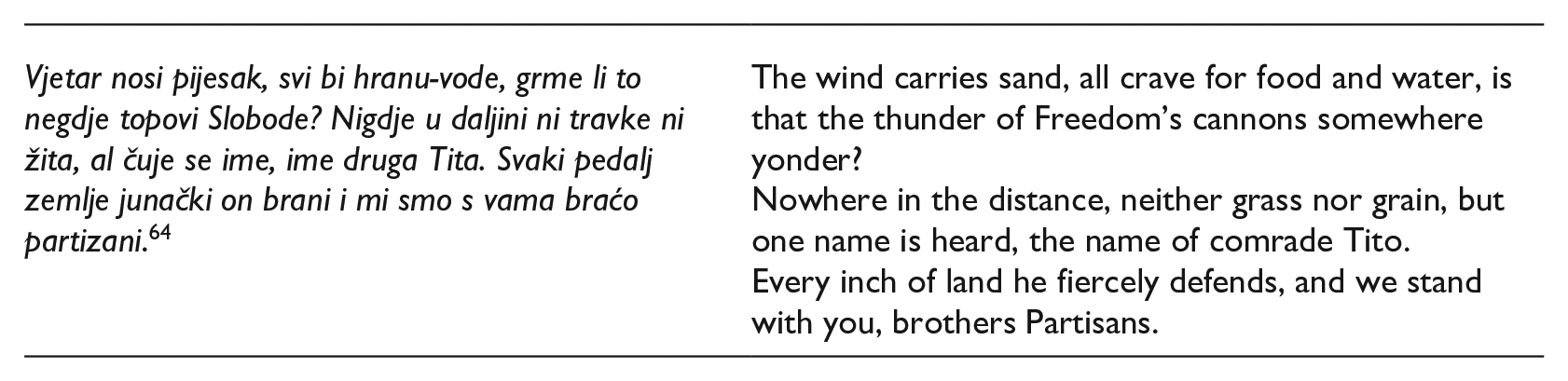
In the comic, as well as in the popular song, the official mainstream interpretation of El Shatt was transferred, giving it additional popularity, but without any significant changes in the narrative, the leading actors, or themes. In contrast, popular media, especially journalistic publications from the same period, proved to be a generator of new perspectives and actors.
It is interesting to note that the first widely resonating call for the renovation of the devastated cemetery in El Shatt was published in Start, a popular magazine that was widely read throughout Yugoslavia. 65 In 1974, Start reported on the completely devastated cemetery, with hundreds of damaged graves and the decapitated statue of the Mother in the centre of the cemetery. The article was illustrated with plenty of photographs and the first in a series of calls for action that would culminate in the early 1980s when the fate of the ‘killed cemetery’ 66 became top news in the Yugoslav press. The Split-based, regional Dalmatian newspaper Slobodna Dalmacija (Eng. Free Dalmatia) provided the most persistent coverage of the topic. Following up on the series of articles and reportages, this newspaper organized a charter flight from Split to Egypt on the occasion of the opening of the renovated cemetery in El Shatt. In this context, in 1985 Slobodna Dalmacija also initiated a readers’ competition for free travel places to visit the opening of the cemetery. Flights and competitions were framed in line with the official discourse and questions focused on the history of the People’s Liberation Struggle and accompanied by narratives about El Shatt as an extraordinarily difficult and complex task, the fulfilment of which required political and diplomatic maturity from the military and civil bodies of the People’s Liberation Movement, courage and exemplary self-discipline.
The newspaper competition provoked an enormous interest and almost 20,000 people applied for the 20 free travel places. The organization of a collective visit to El Shatt cannot be understood only in the context of the 1980s expansion of transcontinental travelling from Yugoslavia or as an echo of ‘dark tourism’ to sites of suffering as widely discussed in memory and tourism studies (see Miles, 2024 for a recent example). While later repetitions of the competition with visits to El Shatt or Southern Italy were more aligned with these phenomena, the first organized charter flight to Egypt was strongly related to individual experiences among the former refugees from El Shatt, who started sharing their perspectives in letters to the editors. The idea of organizing a collective visit to Egypt emanated from a letter to the editor by a mother who had buried her son in El Shatt. Her letter, published in Slobodna Dalmacija and formatted as an article under the title ‘Take us there’ was illustrated with 40-year-old family photo portraits at the cemetery – resembling the ones described in the previous section. Her biggest wish, she shared without results with the veterans’ organizations and others two decades ago, was to visit the cemetery in El Shatt and part with her son. 67
For decades, the public memory of El Shatt was dominated by accounts of distinguished members of the camp authorities, teachers, artists and other respectable actors of the camp’s universe. The newspaper competition and the opening ceremony of the renovated cemetery with hundreds of former refugees in attendance paved the way to bring a greater variety of individual perspectives to the public. The preparations for the journey, the farewell at the airport, the flight and especially the opening ceremony at the cemetery received extensive media coverage. In this, accounts of ‘ordinary people’ and especially former refugees came to the centre of media interest. Among them is the following account of the oldest participant in the journey who was 76 years old at that time: ‘Since I returned from El Shatt 40 years ago, I have constantly thought about how I would visit the grave of my daughter Marija, who died there when she was 6.5 years old. In these years of mine, I have even overcome my fear of flying just to fulfil this wish’. 68 Other accounts bring emotions, details of everyday life, perspectives and materialities of the former refugees to the fore as well. Names of the deceased, many of them children, their personal stories, as well as the stories, hopes and wishes of their beloved ones were shared with readers. Scenes from the cemetery itself and less from the official opening and commemoration dominated the newspaper articles and accompanying illustrations. 69
In these articles full of pathos, sadness and farewells, the cemetery was not predominantly approached as a site of collective memory. It was not only described as a ‘monument full of pain’ that will ‘forever connect El Shatt with Yugoslav history’ 70 or as a ‘persistent reflection of the artistic strength of our [Yugoslav] people and a convincing symbol of the cult of the deceased sons’ and an ‘enduring testimony of one Golgotha but also of a great victory’. 71 Names of the deceased were not merely mentioned as ‘eternal witnesses to the great adventure and the remarkable success of the El Shatt camp’, 72 but instead as the names of sons, brothers, sisters, mothers and fathers, friends and comrades. The reporting emphasized this personal remembrance and less the collective nature of the memorial. Therefore, as highlighted in several articles, many former refugees who came to the opening ceremony of the renovated cemetery were disturbed by the fact that the new uniform graves did have no names inscribed on them. 73 Nevertheless, since the new tombstones were put in the place where the old tombstones used to be, they still marked the places of the buried remains of the deceased. Grieving relatives did their best to locate the graves of their loved ones and leave a letter, a postcard, or some soil or pebbles brought from home, suggesting the attribution of agency to the deceased (Harper, 2010: 318) and making a bridge between the continents, the living and the dead. Two documentaries about El Shatt from the 1980s followed this line of representations, featuring emotionally charged scenes from the opening of the restored cemetery that transformed El Shatt from a monument of heroic history into a site of personal grief. 74
Visits to the cemetery took place in the last decade of Yugoslavia. After the dissolution of Yugoslavia, El Shatt lost its position in the foundational narrative, but it was not forgotten. Apart from being, as mentioned, largely nationalized and stripped of its Yugoslav and Partisan legacy, El Shatt was integrated into the broader Croatian memorial landscape, with occasional diplomatic and presidential visits until today regularly reported in the national media. In addition, it continued to be an integral part of local, family and personal memory cultures and popular culture in the broadest sense. Individual accounts of life in El Shatt started to flourish in the decades after the break-up of Yugoslavia. Some were fictional (Bremer, 2013) but most were autobiographical, especially the memoirs of refugees who were children in El Shatt (e.g. Božanić-Milić, 2007; Nižetić, 2007; Srhoj, 2000). Some of the autobiographies voiced explicitly anti-Yugoslav and anti-communist attitudes (Talaich, 2019) and were written by former refugees who did not come back to Yugoslavia after the war but were resettled abroad.
The fusion of individual experiences, now in the form of postmemory of the second or third generation and popular genres continues until today. A recent example is the 2023 released song ‘Chile’ by Gdinjko, featuring El Shatt in the chorus with the fictional but for many Dalmatians also autobiographical line: ‘Je li znaš, je li znaš u El Shattu mi se rodila mater?’ (Eng. Do you know, do you know, my mother was born in El Shatt?) 75 The same applies to two recent documentaries about El Shatt made by Croatian filmmakers, El Shatt: Blueprint for Utopia by Ivan Ramljak and Chasing the Sun: El Shatt by Ana Bilankov, both realized in 2023. Although based on different poetic and political scripts – one portraying El Shatt as a utopian place where socialist discipline and self-organization were achieved under the dire circumstances of war, and the other exploring connections between the history of Yugoslav refugees and today’s migrants crossing the Mediterranean – both documentaries mobilize elements of local, personal and family history. Both are rooted in archival research, utilize the rich photographic archive of El Shatt and feature the cemetery as a memorial site and material trace of life in the camps, revealing its mnemonic resilience and relevance until today. In the comic El Shatt: Fragments, likewise published in 2023, author Helena Klakočar combines her family history, which was partly in El Shatt, with her own experience of exile in the 1990s. The memorialization of El Shatt is thus ongoing and lends itself to comparisons, referencing and connections to manifold histories.
Conclusion
A last moment leading to a renewed interest in El Shatt is connected to the reactions to the so-called ‘European migration crisis’ of 2015. The arrival of larger numbers of refugees in Europe led to an increasing interest in refugee history in general, accompanied by a revived interest in earlier refugee movements from Europe to Africa (Lingelbach, 2020b; Michailidis, 2018; Shilliam, 2016). The mass movement of refugees from the Middle East through Croatia in the period of the Balkan corridor (e.g. Bužinkić and Hameršak, 2017; Kasparek and Speer, 2015), made the El Shatt story an obvious reference point for some who pointed out that refugees were simply fleeing in another direction than before. One commentator in Slobodna Dalmacija made this connection in 2015 when discussing the fears prevalent in Croatia as larger numbers of Muslim refugees arrived in the country. Describing Laith, a fictional, exemplary Arab refugee he wrote: ‘I, for example, see in Laith’s eyes the gaze of my late grandmother, and in his embrace, my mother and her brothers, when – not long ago, a little more than 70 years ago – they fled from the barbarism-ravaged Europe by ship to the Egyptian refugee camp El Shatt, just a gunshot away from the Syrian desert’.
76
Former El Shatt refugees themselves drew the same parallel when they were interviewed by Gabi Abramac in 2015 arguing that they ‘should be helped and offered refuge just as they once were in Africa’ (Abramac, 2018: 106). Given different meanings according to the prevailing topics and interests over the decades, El Shatt became, as Branko Radonić summarized, an important point of collective memory for Dalmatian women and men in the second half of the 20th century and the first decades of the 21st century, especially on the islands and in the coastal areas, from where most of the refugees came. Although some details of this historical event have been forgotten, a significant number of Dalmatians still know the toponym ‘El Shatt’, with which the noun ‘refugee camp’ is often associated. (Radonić, 2023: 1)
In terms of the natural conditions, as a tented camp in the desert with few permanent buildings, El Shatt was predestined to be forgotten. However, through the construction of the cemetery, local, vernacular memorial practices, the reuse of written and visual materials made by the refugees, humanitarian and other actors and constant visiting and rebuilding of the cemetery, quite the opposite happened. El Shatt became a central trope in Yugoslav, Croatian and especially Dalmatian wartime history. Throughout, the memory of El Shatt was firmly anchored in the history of Yugoslavia and its foundational narratives, but unlike the remembrance of other events from the national liberation struggle, it did not fade into oblivion after the dissolution of Yugoslavia. Having in mind that Yugoslavia disintegrated more than three decades ago, it is obvious that the Yugoslav memory framework and foundational narrative were not the only reasons for the persistence of El Shatt in popular Croatian memory until today. Moreover, since El Shatt did not, unlike many other founding events of Yugoslav history (cf. Horvatinčić and Žerovc, 2023), fade into oblivion after the country’s dissolution in war, one could say that El Shatt is remembered despite its role in that history. However, even this would be an oversimplification ignorant of the historical complexities. Reasons for El Shatt’s memorial resilience need to be found in the interplay of different political and social, national, supranational and local practices, ideas and efforts, as well as individual and collective mnemonic practices or meeting points between political and social memories, family anecdotes and popular culture. In Erll’s (2011: 14) terms, it was the ‘fuzzy trajectories of cultural remembrance and forgetting’ we tried to outline in this article.
Over the decades, memories of El Shatt travelled and were nurtured and crafted in ever-changing ways in different contexts and among different groups. The contrast between the camps’ location in the desert and the coastal homes of the refugees as well as the homogeneity of the population who nearly all came from Dalmatia and returned collectively to the same region contributed to the local prominence of the memories. In contrast to other refugee groups, they were not dispersed after the war. It is exactly this community of over 20,000 repatriated people that fostered and sustained the communicative memory of El Shatt across regions and generations until today. Oral narratives, names of children born in Egypt, material objects handmade in the Sinai desert and the visits to the El Shatt cemetery created a web of references, sites, peoples and narratives that secured the prominent memorial position of the experience despite radical historical changes. The political inclusion of El Shatt into the national narrative was of great importance, but without local, vernacular, oral and popular culture enactments of mnemonic practices it would have been forgotten after the dissolution of Yugoslavia and its political structures and ideologies that had kept this memory alive.
Footnotes
Acknowledgements
We started to work on this article during our fellowships within the research group ‘Internalizing Borders: The Social and Normative Consequences of the European Border Regime’ at the Center for Interdisciplinary Research (ZiF) at Bielefeld University 2023–2024. We are grateful to the group conveners and fellows for the fruitful discussions and exchanges that helped lay the foundation for our collaboration.
Declaration of conflicting interests
The author declared no potential conflicts of interest with respect to the research, authorship and/or publication of this article.
Funding
The author disclosed receipt of the following financial support for the research, authorship and/or publication of this article: M.H.’s work on this article was carried out as part of the Institute of Ethnology and Folklore Research (Zagreb, Croatia) project Poetics and Politics of Ethnography Today (European Union – NextGenerationEU). J.L.’s work is the outcome of research conducted within the ‘Africa Multiple’ Cluster of Excellence at the University of Bayreuth, funded by the Deutsche Forschungsgemeinschaft (DFG, German Research Foundation) under Germany’s Excellence Strategy EXC 2052/1–390713894.
