




Abstract
Museums, memorials and interpretation centres increasingly address histories of exploitation and oppression as part of their efforts to commemorate past traumas through memory work. This article examines how the Aapravasi Ghat in Mauritius and the 1860 Heritage Centre in South Africa produce memories of indenture. Indentured labour was a particular form of contract labour that spread African, Chinese, European and Indian populations and others across four continents. This article analyses these sites as opportunities for connective memory through a transnational oceanic framework. The article’s focus is a comparative analysis of the exhibition content at both centres, showing how current exhibitions foreground memory narratives tied to the formation of democratic and postcolonial nation-states and considers the possibilities for viewing new diasporic memory networks across the Indian Ocean. This includes the network of connections due to colonial practices and machinery, a focus on the cultural memories of diasporic networks and the possibilities of contemporary interpretations of historical materials. Taking a transnational oceanic perspective adds a layer to interpreting the possible representations of memories of indenture and how we can imagine these connections differently. This layer of transnational memory of indenture is already evident in other scholarly and artistic instances where indenture is represented. The article proposes that museums should begin to engage with the implications and possibilities for their exhibitions and practice to consider representing memories of indenture differently.
Keywords
Introduction
This article considers the connections between the representation of indentured labour across the Indian Ocean at two sites, one in Mauritius and the other in South Africa, and how we can understand the exhibitions dedicated to histories of indenture as forms of transnational memory that may productively be read from an oceanic perspective. At present, museum practices at both locations fail to engage with transnational memories and their potential adequately. This article suggests that adopting a transnational oceanic perspective as an extension of transnational memory practices can offer museums new opportunities to address the connections with Indian diasporic communities. With the abolition of slavery, British colonial rule was forced to look for an inexpensive workforce to sustain the existing plantations and related industries across the empire. As Nalini Mohabir (2017: 81) explains, ‘the purpose of contractually bound labour was explicitly to undercut emancipated labourers’ abilities to negotiate fair wages and to provide planters with a substitute controlled labour force (indentureds were bound to labour on the plantation for a period of five to ten years)’. In the case of both Mauritius and South Africa, indentured labourers were brought predominantly from British colonial India after the abolition of slavery in British colonies. This article focuses on the establishment of interpretation centres approximately 200 years later in the respective periods of independence for Mauritius and South Africa. The establishment of these centres is linked to the descendent communities of those indentured in both locations and commemorates their experiences and contributions. The Aapravasi Ghat is located in Port Louis on the island of Mauritius in the Indian Ocean and is identified as where the modern indentured labour diaspora began. The 1860 Heritage Centre (n.d.) is found on another coast of the Indian Ocean in Durban, South Africa, and includes a permanent exhibition that tells the story of Indenture in South Africa. Both sites utilise historical records, material artefacts, displays, oral histories and photographic documentation to produce evidence of the shared cultural identity of the communities of descendants of the indentured. Through these measures, both sites articulate the role of indentured memory, which is tied closely to nation-states and national belonging. This article suggests that this current articulation takes little cognisance of the developments of contemporary scholarship on indenture (Claveyrolas, 2012; Gosine, 2017; Mishra, 2009; Mohabir 2017) that underscore diasporic connections, ways of place-making and identity formation in how memories of indenture are portrayed. As such, the article proposes using a transnational oceanic framework to extend the representation of memories of indenture across both sites to read existing exhibition practices and suggest how these practices may be extended in orientation. The article contends that a transnational oceanic perspective can shed light on these connections to shared histories of oppression. The focus on the Indian Ocean and its ‘ability to complicate’ (Hofmeyr, 2012: 584) affords museum stakeholders the chance to write, think and develop aspects of the current exhibition practice that is in keeping with how memories of indenture are currently being envisaged in other forms of cultural production and scholarly debate, offering a valuable extension of the place and significance of memories of indenture.
The affordance of using an oceanic perspective is tied to its use of the Indian Ocean and its ability to connect these two sites of indenture directly. It also underscores the value of this orientation to see connections afresh. The article uses Isabel Hofmeyr’s (2012) articulation of the Indian Ocean as a method to orient the comparison of these sites on different shores of the Indian Ocean. The thematic clusters of scholarship that focus on the Indian Ocean region, as indicated by Hofmeyr (2007, 2012), signal the value of work that resides at the intersections of these areas. This article furthers a consideration of the intersections of these categories (like indenture, islands and slavery) and demonstrates how the exhibition space offers a chance to bring those existing histories of indenture into a transnational memory focus with one another when oriented towards the ocean. The intersections also complicate the existing categories of identity, place and belonging and, as such, demonstrate the Afro-Asian histories of connection and contradiction. This methodological use of the ocean is thus connected to transnational memory approaches, which Alieda Assmann (2014: 546) sees as ‘foster[ing] a rethinking and reconfiguring of national memories in the context of transnational connectedness . . . [which] go beyond national borders and interests to conceptualise new forms of belonging, solidarity and cultural identification’. Alongside this approach, the article uses Jan Assmann’s (2008: 111) definition of cultural memory identified as an institution that is ‘exteriorised, objectified and stored away in symbolic forms’. This article is interested in the transmission of cultural memory via the interplay of external symbols (read in the exhibition displays) and personal interaction of the exhibition narratives, objects and curatorial choices. Kaguria’s (2018) use of theories of cultural memory offers an additional perspective in considering a connective memory discussion related to the Indian Ocean. Kaguria (2018: 331) suggests that connective memory highlights the tracing of multiple sites of memory across different nation-states with an attempt to reconnect ‘fragmented histories [and analyse] memories that transcend the logic of the local, the national, and the regional as these are usually defined’. He underscores the value and complexity of multiple memory connections and their ability to produce alternative imaginaries (Kaguria, 2018: 334). The article utilises these theoretical approaches to consider the exhibitions at both centres, analysing the recurring visual and exhibition language employed at both sites. The article suggests that the sites contain connective possibilities related to memories of the indenture and proposes that a transnational oceanic framework has the potential to extend the presentation of current exhibition content, making explicit the transoceanic and transnational memory connections in terms of representing these histories and providing possibilities for alternative imaginaries related to the trauma of indenture. Data were collected at both sites through short-term field research in Port Louis and Durban.
The trauma of indenture
The history of indenture has yielded a range of engagements about memory and trauma. For Mishra (2007: 106), connections between diasporic memory and aesthetics need to be established, particularly through questioning ‘whether memory or the fantasy of memorialisation, in as much as it surfaces in the aesthetic, is a consequence of traumatic recall’.
Rajkomar (2018) has considered the place of literature as an alternative site for reading histories of the indenture, particularly the possibility of memorialising indenture and its psychological impact in the case of the Mauritian novel. She does this because of the dearth of archival material that enables the engagement with the memory of indenture in Mauritius, making access to ‘the impact of indenture on the labourers psyche difficult’ (Rajkomar, 2018: 453). Rajkomar (2018: 454) demonstrates that the novel Suers de Sang locates the trauma of indenture as present in two realities that are interconnected, namely, institutionalised violence within plantations and the loss of connection that results from not being able to return to the Indian homeland. These two sites of trauma, Rajkomar (2018: 457) illustrates, reside on the protagonist’s body and result in a fractured psyche. The author proposes through their study that the trauma of indenture is accessible via literary expressions and that further consideration of areas of ‘intergenerational trauma . . . the interplay between trauma and gender, case and religious affiliation, and the larger corpus of Mauritian narratives on indenture’ (Rajkomar, 2018: 464) still require additional investigation. Mishra’s (2007: 116) The Literature of the Indian Diaspora suggests that writing bears the imprints of trauma, and the unrepresentable nature of trauma emerges through the act of writing itself, manifesting in its traces and inherent contradictions. Transnational oceanic approaches to memory studies, particularly as they intersect with trauma and transnational memory, afford opportunities to examine these intergenerational legacies of indenture that Rajkomar refers to and the potential unrepresentable aspects of the trauma discussed by Mishra, which nevertheless emerge in aesthetic responses.
Transnational memory practices
Approaches to transnational memory studies consider how interpretative frameworks exceed ideas of bounded nations and groups and tend to highlight shared collective political projects and concerns that memory offers. Wüstenberg (2019) has noted that some of the critique of Pierre Nora’s lieux de mémoire relates to ‘its tendency to canonise and homogenise national memory’ (Berger and Sieffert, 2014: 33 cited in Wüstenberg 2019: 375). Sundholm (2011), in his article Visions of Transnational Memory, offers a summary of developments in the field of memory studies as they relate to transnationalism, focusing on the turn away from the nation-state as the dominant frame of analysis. He refers to the work of Rousso (2007) and Winter (2006) as examples of the critique of Pierre Nora’s ‘sites of memory’ as contested as ‘an exponent of classical national(ist) historiography’ (Sundholm, 2011:1). These developments in transnational memory practices signal how memory research focuses on the complexity of transnational forms of remembrance, its multi-directionality and mobilities, and movements (Wüstenberg, 2019: 272). Currently, museum practice at both sites does not sufficiently engage with these transnational memories and their possibilities. As such, the article proposes that utilising a transnational oceanic perspective as an extension of transnational memory practices provides opportunities for museums to do so. Reading the exhibition practices as engaging with transnational memory practices is valuable as the diasporic communities of indenture extend worldwide. Reading about the connectivity of memory regions of Mauritius and South Africa is a further example of the possibilities of this connective work that Kaguria (2018) develops, which focuses on the Afrasian region and its memory politics and complex sense of national belongings. This multidirectional memory (Rothberg, 2014) is also the subject of diasporic literature and artistic production related to indenture in the Caribbean. As Nalini Mohabir (2017: 90) notes, ‘Being in the diaspora is not a unidirectional relationship–reversions to memory and a return to place contribute to this visual composition of dwelling in a “third space”. One might imagine a negotiation with an invisible past and present. . .’ There are elements of global histories of indenture that are foregrounded in both exhibitions that focus on the shared trauma of indenture and the connections resulting from British colonial brutality. There is, however, room to extend the connective experience of descendants of the indentured and their respective and shared cultural memories. This potentiality is extended by the dynamics of the ‘complicating Indian Ocean’.
Using ‘The Complicating Sea’
While some critical responses to regional perspectives of indenture within gallery spaces and artistic responses exist about the Caribbean (see Gosine, 2017; Mohabir, 2017), far less work on memory and indenture has been conducted that links Mauritius and South Africa in the aesthetic space of the museum or gallery. 1 Focusing on the Indian Ocean allows for a different regional orientation of these two locations, which has already been established in other disciplines, such as literature and social sciences 2 . Isabel Hofmeyr (2012: 584) argues that the study of the Indian Ocean has brought to the fore the range of lateral networks exceeding the domain of ‘templates of the nation-state and area studies’. She further indicates that historically, there has been a thematic organisation of scholarship focused on the Indian Ocean region, which includes the themes of islands, slavery and indenture. Drawing on her earlier work, which explicates these thematic concerns, Hofmeyr (2007) adeptly demonstrates the complicated discourses that tie Afro-Asian relationships together via the Indian Ocean network. These complications extend to unsettling and relativising some existing Black Atlantic categories that have become normalised in scholarship, such as the idea of ‘people and passages’ and ‘investigates the movement of slaves, indentured labourers, settlers and free migrants’ (Hofmeyr, 2007: 10). Hofmeyr (2007: 11) offers a summation of the history of indentured labour in the Indian Ocean region and challenges the popular image of being able to recognise who was enslaved or indentured simply from appearance noting that the ‘distinction between indentured labourer and setter is blurred, [as is] between slave and free’. As evidenced later in this article, the language of complication is not necessarily the language employed in the exhibitions where the image of who the indentured were is visually reinforced and considered stable and therefore easily recognisable for viewers. This is an opportunity for a transnational oceanic framework to render more visible and, in so doing, extend a range of potential cultural memory connections. These complications are already available in the existing cultural studies and social sciences scholarship, such as Hofmeyr’s (2007) where the account of how the Indian Ocean became a space for ‘colonial experimentation in the control of unfree labour, whether it be slave, convict, indentured or apparently “voluntary free” migration’ (p. 12) allows for the consideration of how these histories of labour may be represented within the museum space and to read these representative practices across the Indian Ocean too. The respective centres could use this critical insight to extend their exhibitions and education programmes. The discussion that complicates the understanding of who was enslaved or indentured also extends to reconsidering who was free or a settler. Hofmeyr (2007: 16) demonstrates that ‘indentured workers often became settlers and attempted to insert themselves into the discourses of settlerdom’. Hofmeyr’s discussion on the theme of diaspora is another example that demonstrates the complex articulation the Indian Ocean introduces. She notes that the term itself has largely been theorised on the movement and experience of middle-class migrants instead of the nineteenth-century movement of indentured labour but that in ‘the Indian ocean’ context ‘the term sits uneasily’ (Hofmeyr 2007:18). Through her summary of the work of Patrick Eisenlohr (2006), she notes that the use of the term diaspora in Mauritius and the Indian ocean tracks somewhat differently with Eisenlohr identifying three different stages of how the analyses of Indian diaspora have developed, namely, (1) focused on migration from India and its attendant questions of survival and tracing, (2) focused on diasporic communities and their development, and (3) focused on diasporic communities as produced by colonial and postcolonial conditions (Eisenlohr cited in Hofmeyr 2007: 19). Vishay Mishra (2007), in his discussion of the literature of the Indian Diaspora, proposes the term ‘old Indian diaspora’ to refer to ‘early modern, classic capitalist, or more specifically, nineteenth century indenture’ (pp. 2–3) and further suggests that the subjects of the ‘old Indian diaspora’ experience ‘complex relationships of power and privilege with other colonised peoples’ (Mishra, 2007: 3). These approaches to the Indian diaspora reveal the complexity of the experiences and their entanglements with topography, geopolitical forms and colonial power and legacies. These ideas are currently not extensively used or explored in the exhibition narratives. They are potentially new ways to frame the legacies of indenture and its cultural memories for visitors that underscore the connections across transoceanic and transnational memory networks.
Beekrumsingh Ramlallah Interpretation Centre at The Aapravasi Ghat
Mauritius, a densely populated island in the Indian Ocean, was subject to successive colonial occupations. During that time, enslaved people were imported from parts of Africa and Madagascar, and enslaved labour was used to establish the sugar cane industry. Dutch colonial rule was in place from 1658 to 1710, followed by French occupation between 1715 and 1810 (Claveyrolas, 2012: 54). Mauritius gained independence in 1968 after more than 150 years of British occupation. During this latter period of occupation, the British introduced indentured labour. The Aapravasi Ghat, a recognised UNESCO World Heritage Site since 2006, is located in Port Louis and is identified as where this history of indentured labour began (World Heritage Convention, UNESCO, n.d.-a). Indentured labour was introduced after the abolition of slavery by the British. The occupied island of Mauritius was identified as the site for the first use of this labour practice – approximately ‘half a million people arrived, via the Aapravasi Ghat (“immigrant’s dock”) as indentured labourers from India to work on the sugar plantations of Mauritius’ (World Heritage Convention, UNESCO, n.d.-b) before being transported to other British occupied territories.
The Aapravsi Ghat site includes the original buildings and an interpretation centre which houses a permanent exhibition. The history of its development as a centre and prominent memorial site for the Mauritian nation is detailed by Corrine Forest (2013). She notes that the Beekrumsing Ramlallah (journalist and member of parliament in the 1970s) was central to the recognition of the site for a broader Mauritian public – his role is subsequently captured and memorialised in the foyer of the interpretation centre. Forest further suggests that the centre’s development coincided with the ‘memorial processes undertaken to respond to nation-building dynamics’ (Forest 2013: 22), where the site transitioned from only symbolically belonging to Indian identity to that of the broader Mauritian society.
Her argument proposes that ‘Mauritian identity [continues to be] established through acts of memory . . . tangible elements as symbols of the nation’s past’ (Forest, 2013: 22). The paper proposes that the museum exhibition space offers engagements with these symbols of the nation’s past and suggests that these engagements should be extended. As an ongoing heritage site, the Aapravasi Ghat is also read in light of the Mauritian Truth and Justice Commission (MTJC) recommendations. The MTJC was constituted in March 2009 and had as part of its mandate to
(a) assess the consequences of slavery and indentured labour during the colonial period up to the present, (b)conduct inquiries into slavery and indentured labour in Mauritius. . .(c) determine appropriate reparative measures to be extended to descendants of slaves and indentured labourers. (Mauritius Truth and Justice Commission report, 2011: 1)
Focused on the historical continuities between the periods of colonial occupation to the present, the commission’s work concentrated on thematic investigations into ‘colonialism, the slave trade slavery, indenture [and the implications] from an economic and social perspective’ (MTJC report, 2011: 1). Much of the report details the long-lasting and specific negative impacts of the systems of slavery and indenture in Mauritius with current descendant communities of the enslaved and indentured bearing the brunt of this in terms of education, economic and other limited opportunities. The specific recommendations related to acknowledging the harm done, memorialising the contributions of all sectors of the Mauritian population and developing concrete policies and actions that would enable Mauritius to become a more democratic society in which there is less racism and elitism. Many of these recommendations focus on developing a more inclusive and diverse national history, identity, culture and heritage. The report and its recommendations enable a focus on how indenture is memorialised, which is tied to the broader histories of oppression in the country. Eriksen (1992: 164) has noted that Indo-Maurtians (referring to the descendants of Indian indentured labourers) now account for a large percentage of the population, proving advantageous socio-politically. This legacy of the history of indenture is an important reminder that reduces the risk of overlooking the importance of museums and interpretation centres dedicated to minority groups in postcolonial nations.
The 1860 Heritage Centre
According to S.A. History online, ‘the majority of Indian South Africans are descendants of indentured workers who were brought to Natal between 1860 and 1911 to develop the sugar industry in the region’. The 1860 Heritage Centre was established in Durban, South Africa, to represent the histories of Indian South Africans and was officially launched in May 2017. The centre honours historically marginalised community histories. It describes itself as part of the landscape of other museums established during South Africa’s democratic period to diversify the representation of South Africa’s citizens. The museum comprises a permanent exhibition that tells the story of indenture in South Africa and temporary exhibitions geared to the centre’s archival function to document, preserve and record important moments of the South African Indian community. Its vision statement is oriented towards South African national policy on arts, culture and heritage, which firmly locates the function of museums within national priorities of developing a cohesive nation in democratic South Africa. The centre’s establishment aligns with the presentation of ‘new’ histories of indenture in South Africa’s history.
The centre houses a permanent exhibition entitled The Story of Indenture 1860-1911, curated by Selvan Naidoo, who is responsible for much of the curatorial input of the centre. Focused on offering a framework for the narrative of the arrival of the indentured to South Africa, the account produced is thematically and chronologically organised. It includes text, visual and material artefacts to provide a nuanced portrayal of the extent of the lives and histories of those who were indentured. The centre includes visual art, prose and poetry interspersed with historical descriptions of indenture. This intervention provides various opportunities for visitors to consider the place, meaning and memory of indenture.
Comparing representations of indenture
Since museums are locations where memory is stored (Gibbons, 2008: 118), it is valuable to consider how memories of indentured labour and its histories are presented at the two sites. Currently, the two locations present the memory of indenture similarly: first, as nation-bound and relevant to how the democratic nation-state is formulated and what memories it draws on. Second, histories of indenture are presented as historically and culturally valuable. Finally, indenture is represented in line with developments in new museology, including the use of art, archival materials, artefacts and interactive displays. In suggesting that a transnational oceanic perspective be incorporated into how exhibition material is organised, presented, and extended, the article contends that this affords the interpretation centres and their visitors’ new opportunities to represent memories of indenture. This layer of the memory of indenture is already evident in literature and visual arts that explore the subject of indenture and its representations (Gosine and Mohabir, 2022) and other disciplinary scholarship (Claveyrolas, 2012, 2017, Cowaloosur, 2020; Ghosh, 2023). Museums should begin to engage with the implications and possibilities for their exhibitions and practice and consider how memories of indenture may be further represented. Below then, the article details how a transnational oceanic framework offers additional perspectives of memory that relate to (1) the historical experiences and contemporary identities of indentured communities, (2) the location of indentured history as invaluable to contemporary issues and debates, and (3) consideration of intersectional relationality and the place of everyday moments, memorialisation practices in current museum exhibits, extending readings of indentured memory into its diasporic networks.
Aapravasi Ghat exhibition
The Aapravasi Ghat is a site actively engaged in practices of memory-making, forging connections between histories of indenture and its relevance for collective Mauritian identity from the physicality and geography of the site through to the decisions about representation and curatorial choices in the exhibitions themselves. Visitors are encouraged to experience the range of material artefacts and historical accounts as symbolic evidence of the cultural memories of indenture. The site itself encourages this interplay, as Erll (2011: 2) suggests of ‘present and past in socio-cultural contexts’. This interplay, in conjunction with a transnational oceanic framework, extends the locality of this consideration of a range of cultural contexts across the oceans.
The site comprises a series of renovated empty stone buildings, which are representative of the kitchen, hospital and registration office, critical points for the newly arrived indentured labourers. The Beekrumsingh Ramlallah Interpretation Centre (BRIC) houses a permanent exhibition focused on the establishment and development of indentured labour as a system and the experiences of those indentured in Mauritius through the exhibition narratives and material artefacts developed across nine rooms. The project’s development is based on the renovation work to the original buildings, the interpretation centre, and its research work into collecting oral history testimonies (Claveyrolas, 2012: 64). Each of the rooms offers a range of display materials – text, visual materials and artefacts (the latter are either from the excavation or are replicas). The exhibition entitled ‘Indentured Labour’ focuses on the global nature of the system. Given the focus on the recurring visual language employed in the exhibition and how these links to aspects of transnational memory, the following section details the implications of this framing.
The visual language at the exhibition is composed of images and text (usually in both English and French), with the exhibition not text-heavy, relying on the relationship with the images to orient the visitor into the historical event of indenture. The images themselves are comprised of a range of types, including documentary photographs of indentured labourers – sourced from a range of archives in South Africa, the United Kingdom, India, Trinidad, and Tobago (see Figure 1); sketches and drawings of life on the island, maps and cartographic details (see Figure 2); and timelines and copies of archival documents. Along with these images, digital screens provide additional information and opportunities for visitors to explore more specific information.
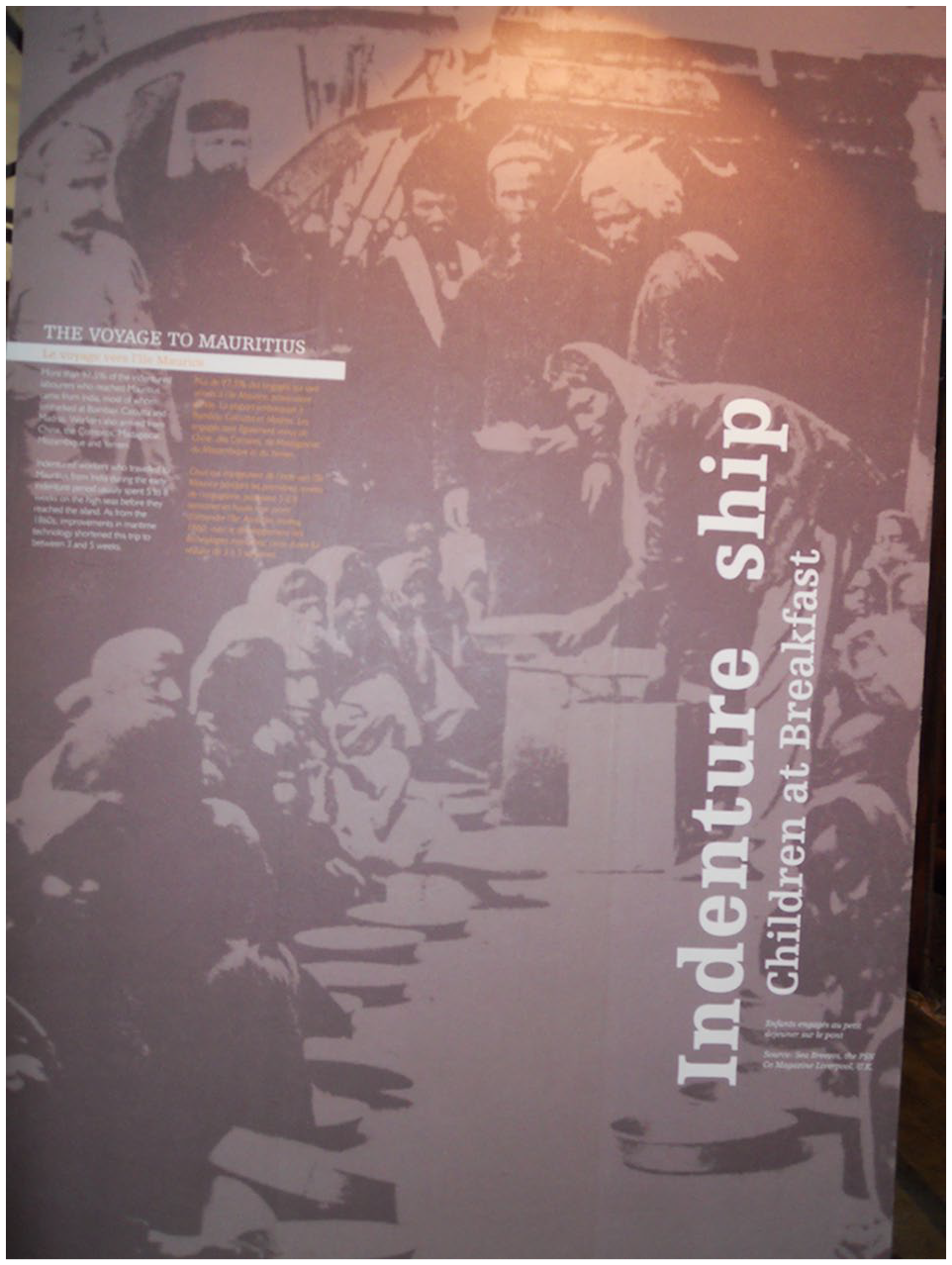
Wall panel ‘Indenture Ship Children at Breakfast’ text and archival image of indentured passengers aboard ship (image by author).
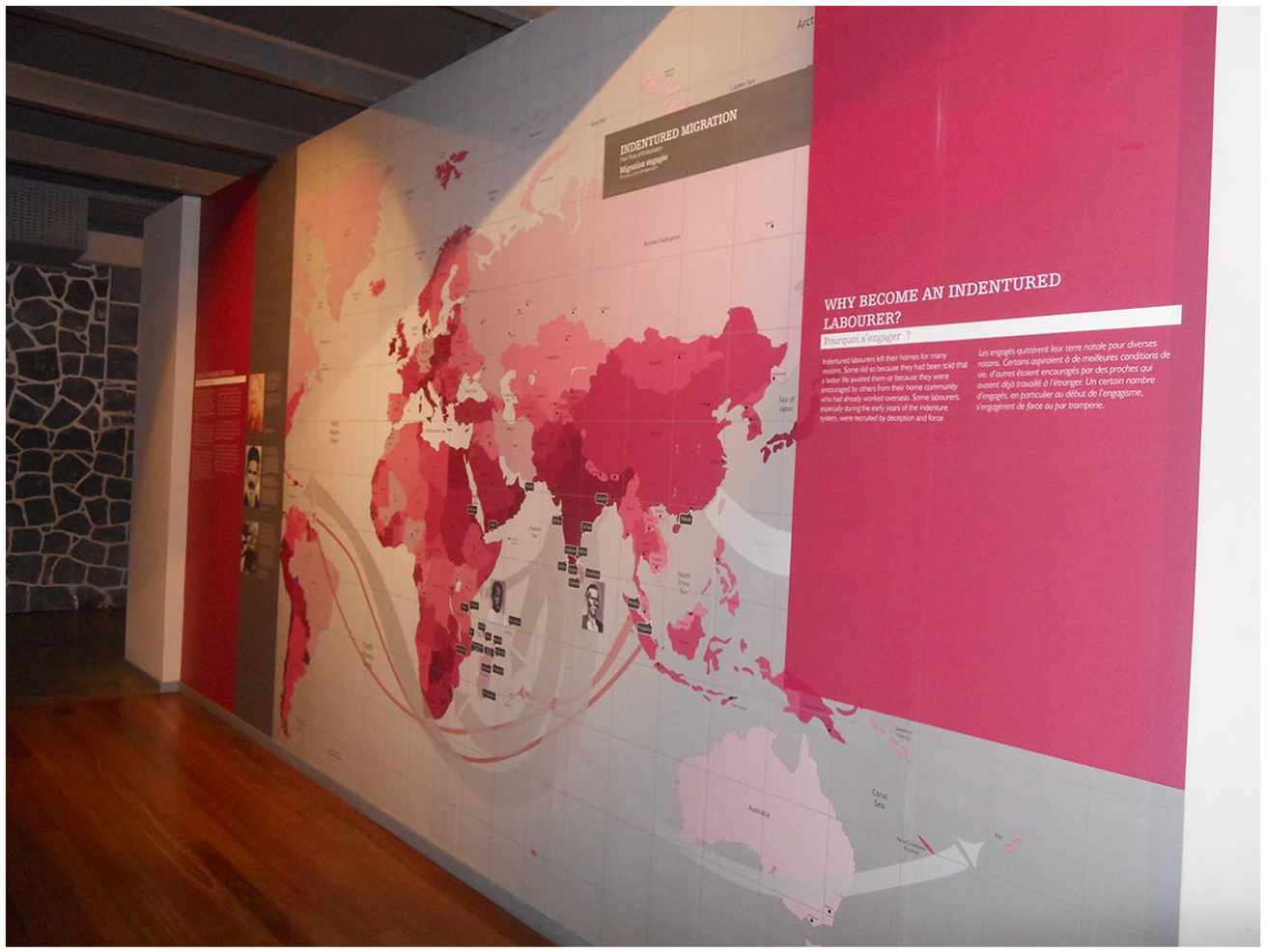
Wall panel ‘Why become an indentured labourer?’ map and text showing indentured migration (image by author).
The range of materials used and the variety of places they are drawn from can be helpful if reorienting towards a transnational oceanic perspective to consider the extent of cultural memory of indenture. While the materials used are placed within the specifics of the Mauritian context (and the narrative developed by the texts anchors this reading), the fact that the materials themselves are drawn from various contexts related to British colonial practices underscores the extent of the practice of indenture that can easily be highlighted when employing a transnational oceanic perspective. The mapping of British colonial control via the Afrasian Sea (see Figure 2) could link the materials and the associated cultural memories for the viewers through a networked reading to extend the connective memory practices, as Kaguria (2018) notes. These connections are partially visible or implied if visitors pay careful attention to information related to where materials and information were sourced from. This detail currently needs to be recovered in the extent of information available. There is value in making these connections explicit and utilising transnational oceanic perspectives to elevate these connections within the current display context to reveal the ongoing memory landscapes, overlaps and networks between and for descendent communities.
The narrative framing is almost identical with the 1860 Heritage Centre (see Figure 3) – with both sites marking a linear development of indenture – its origins, the voyages, the arrival, life upon arrival, the nature of indenture and its injustices, and humiliations as an exploitative labour practice. The narratives both end with the legacies of the indentured and their contributions to their contemporary societies – with emphasis placed on living and cultural memory as vital to the respective nation-states. These similarities indicate the framing of social history centres and museums dedicated to the subject matter and offer a valuable overall understanding of the history of indenture. The exhibitions do not currently maximise the existing material’s potential for a different reading − one that foregrounds connective memory. Using a transnational oceanic framework to revisit the current exhibition materials would hone in on the similarities, connections and dissonances of indenture and present them within a more extensive diasporic network. Highlighting, for example, the British colonial practices of historical archival record keeping as a practice throughout the colonies where indentured labourers were moved could be framed as offering connective memory possibilities – in their current formulations, they remain firmly tied to the discussion of nation-state and memory of indenture.
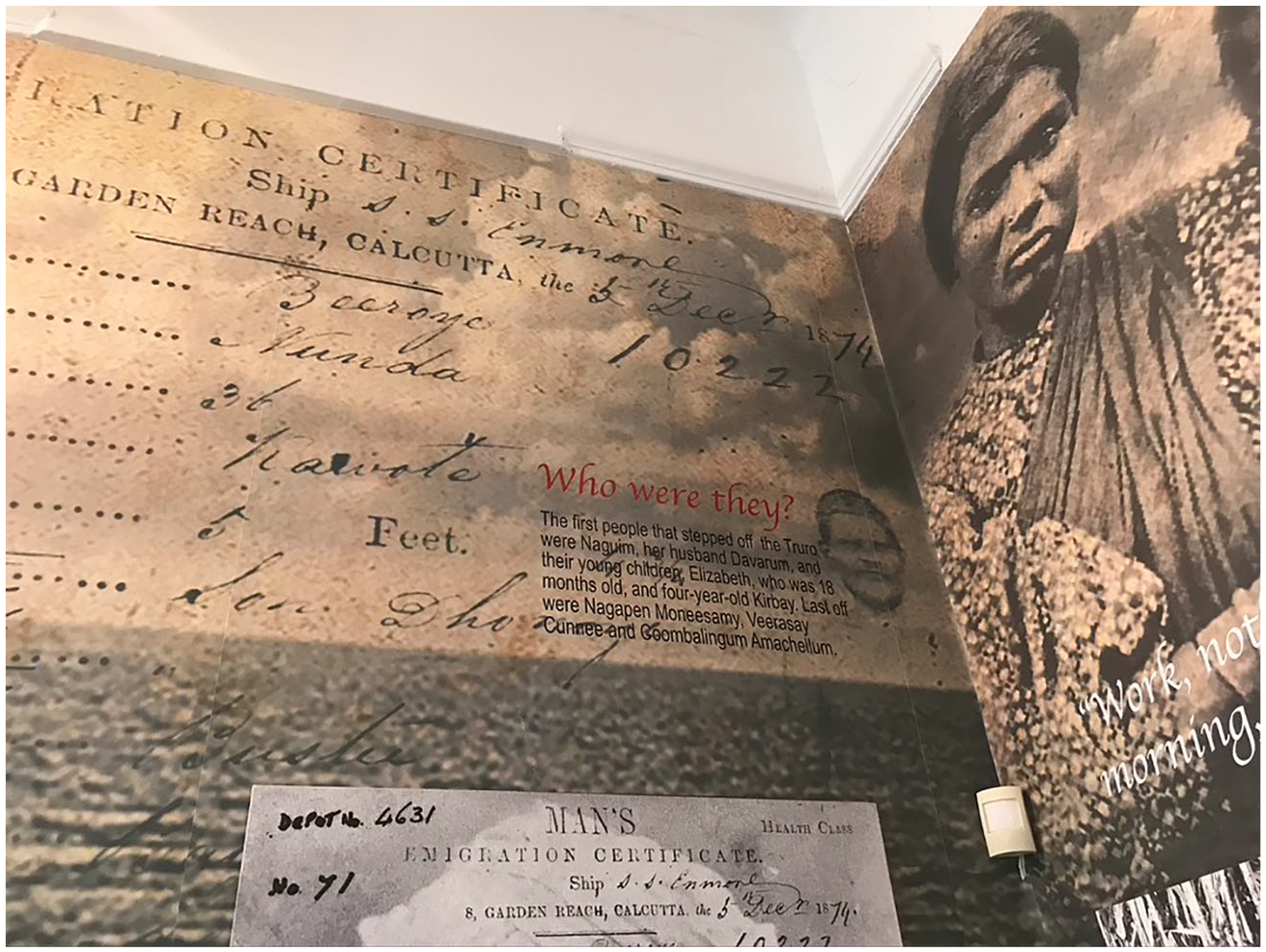
Wall panel detailing who the indentured labourers were; copy of an immigration certificate and photographs of indentured labourers (image by author).
1860 Heritage Centre –The Story of Indenture
The 1860 Heritage Centre provides a regionally focused account of indenture, complementing the discussion of the Aapravasi Ghat. While there is information about the place and legacies of indenture throughout the centre (including along passage walls and in other dedicated exhibition spaces), the narrative of indenture is most fully composed in the gallery room dedicated to the period 1860−1911. The exhibition is mounted on the four walls of the space, each dedicated to a specific narrative aspect. Each wall is dedicated to one aspect of indenture: (1) the logistics of the indenture, (2) the experience of those indentured once they had arrived in Natal and the conditions they faced, (3) the places of work and types of employment the indentured labourers had access to (along with a mention of the arrival of passenger and ‘free’ Indians) and (4) history of indenture as a new form of slavery. The last wall panel also includes references to the cultural practices of the indentured and the legacies that are now prevalent in South African society. Considering one brief example of the display, the article illustrates how the exhibition uses text, visuals and artefacts to confirm the place and meaning of the memory of indenture as part of South African national history.
One of the first panels visitors encounter is an archival document, an extract from the newspaper The Natal Mercury, and the article is titled ‘The Cooles Here’ [sic], dated Thursday, 22 November 1860. The article details the arrival of the first indentured from the perspective of the colonists. It is, as a result, filled with the expected biases and privileges that present the indentured merely as a labour solution and offer ongoing criticism of the government of the time for poor preparation ahead of the arrival. This historical account is immediately juxtaposed with the exhibition text, Hindi words, a collation of large archival photographic images and maps showing the details of the arrival of the indentured. The opening text details the number of ships, individuals, and the historic period of indenture. In doing so, it alludes to the humanity of indentured people and indicates how the rest of the narrative is presented. Thematically, the visitor is provided information under the following headings: The ‘coolie’ immigration (archival document detailing the advertisement of indentured Indians which was penned by the immigration officer and appeared in the Natal Mercury newspaper); Before indenture (provides information about the ongoing need for labour on sugar plantations and how the case of Mauritius was used as a successful example for the introduction of Indenture to Natal and details the introduction of the Natal Coolie Law 14 of 1859 and the first arrivals of indentured Indians in November 1860). The details of Recruitment and placement are complex and identify ‘the brutality of British rule, famine and poverty in rural areas’ as significant factors that led to forced migration in India: The arrival, The journey on the day, and conditions upon arrival. This narrative text offers greater detail about the economic situation that led to the introduction of indentured labour to the region and the need for cheap labour on sugar plantations in Natal, as was the case in Mauritius. This textually presented information is paired with archival images and colonial maps. The former allows the visitor to visually trace the journey (with details of the names of places where the indentured were from and the distances their journeys included), and the latter provides evidence and insights into who the indentured were, what they looked like and what they brought with them. This visual process allows the visitor to envision the indentured as more than simply labour. The success of the current exhibition formulation is achieved mainly by composing the display in specific ways – using colonial archival documents and traces to provide alternate ways to read and interpret historical documentation. The possibilities of a transnational oceanic approach would be to extend these contemporary interpretations of the historical material, examining how the display’s oral histories and photographic documentation could map experiences across the diaspora of indentured labour.
For example, the 1860 centre (see Figure 4) includes a display panel of a series of photographic images of indentured labourers and their respective colonial numbers assigned to them as part of the identification process. A similar display is included at the Aapravasi Ghat (see Figure 5), which provides information about the indentured labourers who arrived in Mauritius between the 1830s and the 1920s. The portraits included are similar in profile to the ones from the 1860 centre and include identification numbers and cursory details of the individual captured in the image. Both sites utilise photographic documentation to detail the arrival and processing experiences of the indentured labourers. The use of a transnational oceanic perspective could enable the positioning of these examples as evidence of the network of colonial machinery that produced similar artefacts of indenture and, in so doing, provide connection points into a diasporic engagement with the implications of these artefacts for memory work and how indenture is represented. It also opens the possibilities for how indenture may be re-imagined outside of the dominance of the archival traces produced by these displays.
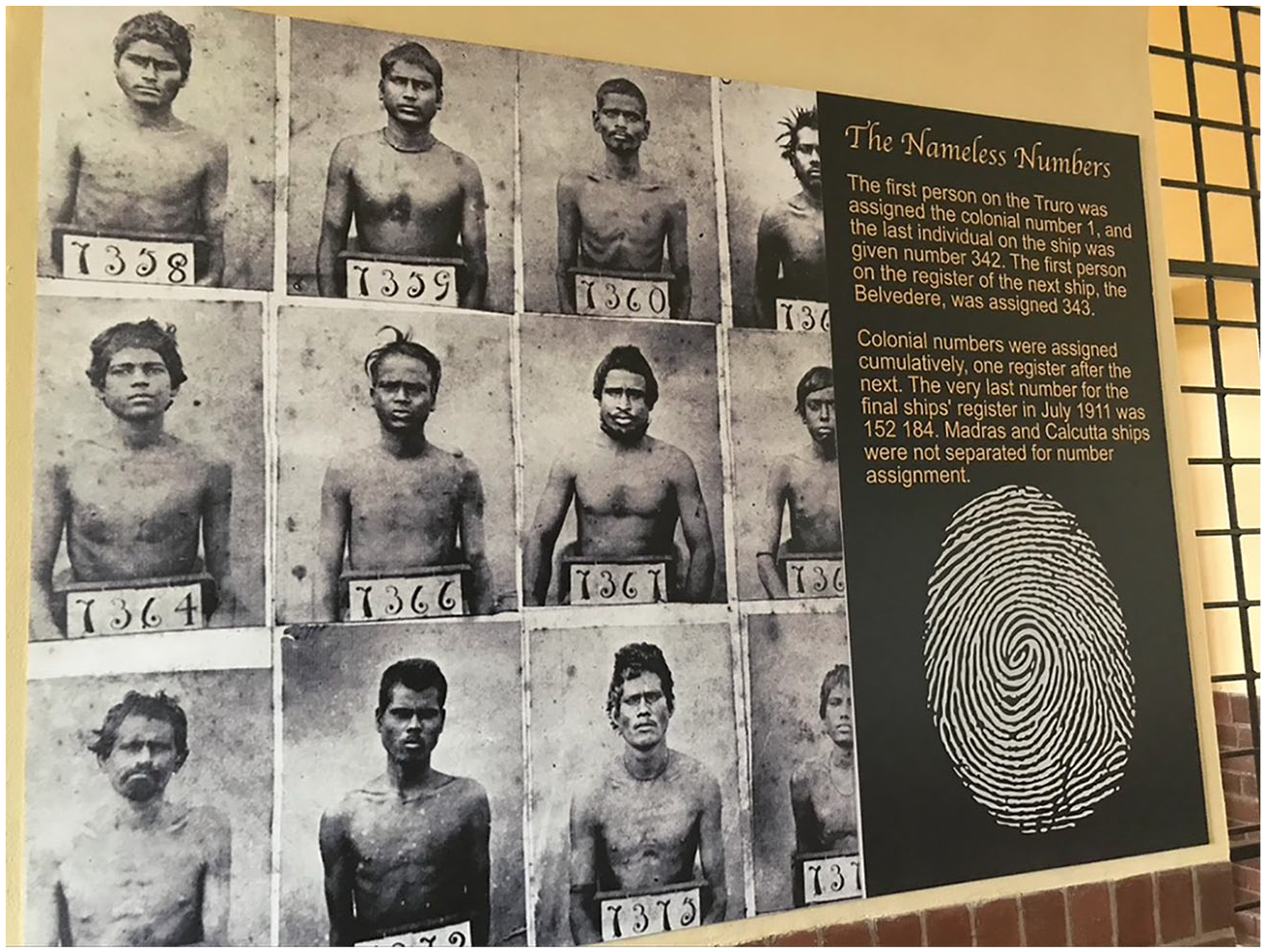
Wall panel including portraits of the indentured labourers and text explaining the colonial numbers assigned to them on the ship (image by author).
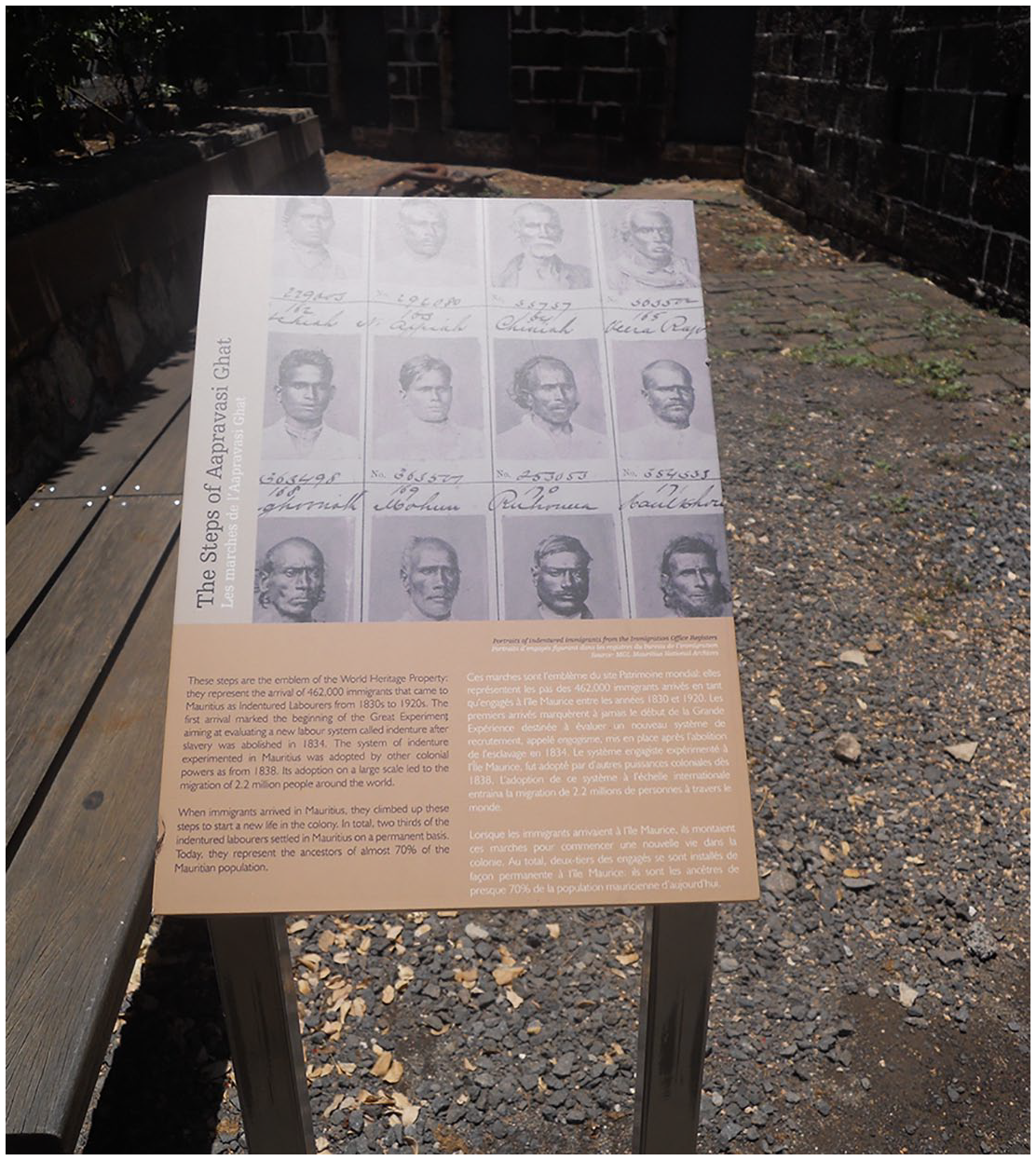
Display board outside BRIC detailing information about the Aapravsai Ghat steps representing the 462,000 indentured labourers who arrived in Mauritius between the 1830s and the 1920s. Portraits of indentured immigrants included (Image by author).
Considering that both centres represent the complex histories of indenture in similar ways despite their differences in location and the specifics of their histories, what can we make of how indenture is imagined in these respective spaces and collectively? Given the history of both sites, it is arguable that the curatorial decisions are partly influenced by the broader political imperatives underpinning the centres. For the 1860 Heritage Centre, the curator Selvan Naidoo is credited for the permanent exhibition. Naidoo also writes extensively on the centre’s site and undertakes additional research related to the history of those who were indentured and their descendant communities as part of the centre’s focus to document and record the place and contribution of the indentured community to the South African historical landscape and present more broadly. The Aapravasi Ghat Trust Fund manages the interpretation centre for Aapravasi Ghat. As a government organisation, the balance of the exhibition narrative remains in keeping with the site’s symbol as a place that can produce and foster national identity and pride (Claveyrolas, 2012; Forest, 2013).
Mohabir (2017: 81) has noted that ‘visual imagination is not outside of history’. In their chapter ‘Picturing an Afterlife of Indenture’, which takes the Indo-Caribbean as its context, the author shows ‘the power of ethnic identity over ethnicised/racialised subjects’ of indenture is dominant, explaining the challenge of ‘disentang[ling] the visuality of Indianness with the visual logic of indentured contractual migrancy (where visual markers of ethnoracial difference were exacerbated by the physical control over indentured bodies)’ (Mohabir, 2017: 82). In a different but equally challenging context of slavery, Wood (2000: 7) in his book Blind Memory considers what the adequate or decent tools are for memorialising slavery given that
the experiences of millions of individuals who were the victims of slavery are not collectible; it is unrecoverable as a set of relics. There can be no archaeology of the memory of slavery that corresponds to an emotional identification with a lost reality.
His consideration of the visual and linguistic recording of transatlantic slavery in Western society reveals that art can rethink history and transform disaster. The range of interpretations of indentured histories and memories on display at the two interpretation centres echo these concerns and similarly focus on the ‘traumatic consequences are still actively evolving . . . in today’s political, historical, cultural and artistic scene’ (Wood, 2000: 11). Here both centres make an attempt to imagine indenture differently – occasionally resisting the focus on the image of the indentured labourer in ethnoracial terms as Mohabir has cautioned against. This different imagining extends the reach and potential of cultural memory for visitors. There is an inclusion of artistic interpretations, poetry, and diary accounts that help the viewer imagine indenture in alternate ways. For example, curator Selvan Naidoo has included one of his art pieces, ‘ I am an African’ (2010 mixed media with oil on canvas), commemorating the 150th anniversary of Indian arrival in South Africa. The work comprises 15 panels, which are representative of Indian life and culture in South Africa specifically. Beneath the panels are the names of 484 people who were officially recorded as having committed suicide between 1880 and 1911. As noted by the artist, ‘this series . . . [is] a reflection of the many Indian lives that were lost in the cane fields of Kwa-Zulu either through suicide or murder and subsequently through in the struggle for freedom’ (I am an African display panel).
At the Aapravsi Ghat, visitors have a similar opportunity to experience a strong visual aesthetic of indenture through a collage of portraits of the indentured. In this instance, the curators have used existing photographic images of those who were indentured and repositioned them to extend beyond their original intended use. In this way, they offer a potential to reflect on Gosine’s (2017a: 87) position about the photographic representation of indenture, ‘The photographic representation reveals another layer of violence, not only through the past lense of a colonial gaze but also in its present-day uptake (for instance as archival artefact viewed by the author, a descendant of indentured persons’. This repurposing of the original materials in a new context within a different narrative framing through the use of the display text allows for new imaginings of indenture which is in part what Gosine (2017) asks of artists and heritage workers (p. 105). As such, they begin to extend the forms of representation available regarding the history of indenture. However, they continue to miss opportunities to connect to diasporic experiences and networks and consider what these connective memory opportunities present to imagine alternatives (Kaguria, 2018).
How might we further imagine the depiction of the legacies of indentureship? The work done by Mohabir reminds us of the legacies of the violent visual histories surrounding the documentation of histories of the indentured system and those forced into that system. We must think carefully about how those histories are represented within new spaces. The comparative approach to reading these instances of memory work explored briefly above reveals insights about existing memory narratives in both sites, which are historically tied to the formation of their respective nation-states. Both sites present similar narrative arcs focused on the regional histories of indenture and foreground the vital cultural contributions of the descendent communities to their respective nation-states – here, material objects, traditions, and food practices are often underscored. The existing cultural memories related to specific histories of indenture are thus re-inscribed and cement the place of descendants’ communities historically and presently as firmly placed within the nation. This affords these communities a strong sense of belonging, confirms identities, reveals immense contributions to the nation-state over time and articulates historical significance.
Considering transnational oceanic memory practices in these existing exhibitions would reveal that narratives are connected and possibly transformed through their relationality. The transnational oceanic perspective might signal alternate articulations and connections for sites of cultural memory. As seen in the examples of the similarities in narratives and the sources for much of the documentary materials, the possibility of shared readings exists. Possibilities also exist to expand existing exhibitions – life as an indentured person, for example, could be considered from various geographic regions and the particularities of each location discussed. This could extend how visitors encounter the history and cultural memories associated with indenture today. Ideas of connection via geography, journey and embodiment suggest that containment by these can help imagine indenture differently and, by extension, the range of cultural memories available. Therefore, the visual language and framing can be used to imagine indenture across the ocean and in ways that complicate their existing use.
Conclusion
The two sites discussed, the Aapravasi Ghat and the 1860 Heritage Centre, imagine indenture and its legacies in ways that fit within traditional expectations of social history museums and their representational practices. This is in and of itself not a negative; both centres have made significant contributions to making histories of indenture more publicly visible and ensuring that those histories are understood as significant to their respective nations. The cultural memories of the descendants of indenture play a vital role in this regard – visitors come to understand the extent of the shared histories (through artefacts, documents, rituals, and traditions) as well as the long-lasting impact this has had on how the nations develop its respective identities as these memories are more widely integrated into the respective national identities.
The exhibitions, however, tend to emphasise this national, regionally specific narrative of indenture and miss out on opportunities to extend how we imagine memories of indenture today. Jordache Ellapen’s (2018) Queering the Archive: Brown Bodies in Ecstasy is one such example – a visual art project that works in similar logic to extend memory and diasporic reimaginings of colonial histories, including indenture. The article has argued that a transnational oceanic framework (that broadens and complicates the transnational focus and connective memory approach) can extend how memories of indenture are represented. The construction of a shared past that currently exists through local communities might be usefully read via transnational oceanic connections that could be integrated into current exhibition practices. The Indian Ocean potentially complicates our understanding of memory and place at each site – it moves the visitors’ attention away from the specific nation-states – extending how the connections across the ocean could be understood. The current narratives are connected via indenture as producing diasporic communities (Kaguria, 2018) but also transform them, providing a reconsideration of the extent of ‘a shared past’ via cultural memory. The place of indentured labour within the nation-state is firmly established. However, the possibilities of other connections still need exploring and can be done in specific ways in the exhibition practices. Transnational oceanic perspectives offer new networks of memory in both locations by extending the contact zone of the memorial space of indenture and connecting the sites, revealing their relationality as part of the indentured diasporic network. Further research on how visitors perceive these connections and the possibility of temporary exhibitions that focus on these areas should be examined. This article has demonstrated that an attempt to see how the histories that connect us but also contain us can take place differently; that the cultural memories that reside in archival materials can be repurposed, away from the violence that they document to imagine the legacy and cultural memories of indenture alternatively.
Footnotes
Funding
The author(s) disclosed receipt of the following financial support for the research, authorship, and/or publication of this article: This research was partly funded by the Andrew W Mellon Foundation. Grant number Ref G-41500688.
