




Abstract
This article draws on interviews with people from striking families who remember the 1984–1985 UK miners’ strike as children. It considers how proximity to the strike is often understood as participation in picket lines and in other forms of activism most commonly used to represent the strike in the media, film and television. However, the accounts reveal that, in contrast to the solidity of these images, memories of the strike’s children are characterised by a sense of knowing and not knowing. Family stories and family secrets, located in the home, are vital to the management and negotiation of the strike and these omissions and absences continue to characterise the memories of the strike in adult retellings. This article considers the context of family stories and the importance of family secrets in adult memories of childhood experiences of the strike, suggesting that looking at absences, silences, secrets and the known and unknown can reveal the many ways in which the strike was experienced and is narrated and remembered.
Introduction
At the height of the UK 1984–1985 Miners Strike, 142,000 mineworkers were striking, albeit with great regional variation in its observation (Phillips, 2012; Richards, 1996). The years that followed the strike saw mine closures across the United Kingdom, with the last deep pit mine – Kellingley Colliery – closing in December 2015. The events of the strike and its aftermath have been told through media, theatre, film and documentary, archives and exhibitions, academic and popular literature.
This range of voices is important for countering and challenging dominant narratives of the strike. Shaw (2012) looks to strikers’ poetry as a way of contributing to the ‘incremental history’ of the strike and challenging dominant narratives. Shaw (2012) argues that, in the process of creating their own representations of the dispute, strikers were writing against or engaging with dominant media discourses of individualism. Publishing preferences in the decades following the strike, Shaw observes, meant that it was either the ‘factual’ accounts of the strike that detailed its economic and political trajectory or the stories of individual miners that found an audience. This left writing – such as strike poetry – that documented a collective voice, outside of the dominant discourse of individualism that was apparent in published accounts and media representations. Stephenson and Spence (2013) also turn to personal writing from the period, in this case by women, to consider how it challenged dominant narratives perpetuated by the media and political establishment at the time. This writing expressed emotional experiences of the strike and the significance of collective support and organisation to the survival of it. It charted the shifts in personal identities and relationships in ways that not only celebrated notions of a mining community but also resisted romanticisation of it.
These accounts tell personal and political stories about the strike and its impact on individuals, families and communities, contributing to collective and personal narratives and memories. As Freeman (2010) writes, What we remember about the personal past is suffused with others’ memories – which are themselves suffused with other others’ memories. Consider as well the fact that much of what we remember is also suffused with stories we have read and images we have seen, in books and movies and beyond. (p. 263)
Recollection beyond the immediacy of the moment is an interweaving of multiple stories and has, Freeman (2010) argues, a revelatory power that can offer insight and understanding into an experience that is not accessible when living through it. This article draws upon the narratives and memories of individuals from striking families who were children or young people at the time, to understand how the strike was experienced and is remembered by them. It explores themes of proximity and distance, knowing and not knowing through the lens of family stories and secrets. Through the accounts discussed here, the household emerges as a key site for the management of the strike, and childhood memories of it. Before presenting the data, this article considers some pertinent narratives of the strike and the intergenerational impact of it. It then considers the picket line and home as important sites of memory and explores the significance of secrets to family stories and memories.
Remembering the strike
Gildea (2023) has identified two competing narratives in his oral histories of the strike. The first is that the strike and its aftermath decimated communities, put families under intense stress and resulted in the loss of an organised working class. The second is that, in the aftermath of the strike, those involved found a passion and energy for education, politics and for celebrating and ensuring the memorialisation of the industry. These competing narratives operate differently at individual and regional levels, with stories of ‘triumph’, ‘regeneration’ and ‘fragmentation and failure’ deployed in various ways. Aspects of these narratives are of particular relevance to this article. First, the notion of a traditional mining community that was mobilised throughout the strike and in representations of it and, second, the location of the politics and activism of the strike in the public rather than private domain, as expressed through the accounts of women’s politicisation and symbolised by an apparent move from the home to the picket line. These are considered in more detail here because they are examples of ways of remembering the strike that have depended on static or binary retellings (isolated, place-based communities or linear transitions) and have been complicated through the close reading of personal narratives, each of which appears in narratives collected in this research.
Measham and Allen (1994) noted a tendency for mining communities to be characterised by physical isolation, close-knit social relations, a shared sense of community roles and highly differentiated gender roles. These accounts locate the mining community geographically; however, as Spence and Stephenson (2007b) discuss, even by the 1980s, a ‘mining community’ centred on a geography was precarious as miners increasingly travelled to, or for, work as a result of an increase in mine closures between 1931 and 1981 (Hudson and Townsend, 2005). The connection between work and place used to characterise the mining community was increasingly a romanticised memory or idea, rather than material reality (Spence and Stephenson, 2007b; Stephenson and Spence, 2013).
This is not to argue that place is not important in understandings of community, and that a connection to place is not evident in creative writing from the period (Spence and Stephenson, 2009), but that the notion of an isolated, homogeneous geographically determined mining community was not reflective of the geographical and economic patterns of the mining industry by the time of the strike. Scholars have challenged the idealisation of this type of mining community and instead adopt expansive conceptualisations of place as relational; intersecting networks of work, family, kin, friendship and place in ways that are much more complex than the nostalgic vision of mining communities evoke (Beynon, 2015; Beynon and Hudson, 2021; Kelliher, 2021; Spence and Stephenson, 2009; Strangleman, 2001).
While recognising the dangers of nostalgic retellings of, and revisits to, the industrial past as a form of ‘smokestack nostalgia’, Strangleman (2013) argues that nostalgia is rarely an uncomplicated celebration of the past, but actually a site for reflection and critique that can communicate something about the concerns of the present. The nostalgic notion of community, and the work that this can perform, is evident in the reanimation of mining histories through community events, where nostalgia is evoked as a way of sustaining a collective community identity and repairing and processing loss (Bennett, 2009; Stephenson and Wray, 2005). These events draw upon collective memory to regenerate a sense of community in the post-industrial context of high levels of long-term unemployment, poverty and social exclusion (Stephenson and Wray, 2005). However, nostalgia also relies on the exclusion of narratives that deviate from a particular version of the past. For example, at the annual mining gala at Wheatley Hall, Bennett (2009) argues, the representations of women are largely stereotypical and tied to the domestic, and the pains of the closure of the pits is largely avoided or erased.
The concept of community was mobilised during the strike, which was called in part as a defence of working-class community (Spence and Stephenson, 2009). Evoking the idea of community was also a means of generating material and emotional support and solidarity, epitomised by the slogan ‘Close a Pit, Kill a Community’ (Gildea, 2023). As Spence and Stephenson (2009) explain, this was a political framing: ‘engagement in strike activism drew upon political and historical imagination to construct community with reference to the political ideals associated with socialism and working-class cooperation, which were pitted against the political and historical imaginations of nation promoted by Thatcherism’ (p. 6). The efforts of activists in recruiting national and international support in defence of community included inviting visitors into the coalfields to gain an understanding of a particular ‘way of life’ (Kelliher, 2021). The significance of community was also emphasised through women’s activism, meaning that through the practices that politically conscious women invested in collectively, ‘community’ retained meaning and importance, even during a period when the traditional notions of community as strictly and narrowly defined were in flux (Spence and Stephenson, 2007b).
The narratives surrounding women’s involvement in the strike are relevant here, not because this research focuses on women, but because the dominant narratives present a shift from the home as a private depoliticised sphere, to the public, political arena. The notion of community as organised around a masculinised workplace positioned women as adjacent to this. This ignores the small scale and emotional political work women did that occurred within and between homes and the significance of their emotional and interpersonal work to surviving the strike (Spence and Stephenson, 2007a). In dominant narratives of the strike: Organisation remained privileged over small kindnesses, public speaking over quiet sympathy in leftist and popular media images of the strike. It is this dominant and ultimately traditionally masculine view of what counts as political activism which remains the over-riding image of the transformation of activism for women during the strike. (Spence and Stephenson, 2007a: 6)
This echoes the importance of home, and also the overshadowing of certain types of activism (presence on the picket line) over others (emotional and material management in the home) in my participants accounts.
Spence and Stephenson (2007a, 2007b) have argued that, in fact, women’s preexisting political work and identities were legitimised through the strike – rather than moving from apolitical to politicised, the strike made explicit the ways women’s personal work is political and brought the significance of community and family to waged work into the public sphere (Spence and Stephenson, 2007b). Shaw and Mundy (2005) also complicate and nuance the role of women’s activism in the strike, suggesting that establishing and sustaining solidarity within and beyond families, communities, unions and other campaigns, was at times challenging and precarious, something also echoed in this research. The changes in gender relations that are often attributed to the process of politicisation are, in the accounts of Shaw and Mundy (2005), more readily attributable to changes in the labour market following the pit closures.
Intergenerational impact
The rapid closure of collieries instigated during Thatcher’s government, and continued by its successors, happened with no meaningful or effective regeneration plan in place (Beynon and Hudson, 2021). This left areas that depended on the industry facing economic decline and long-term un- and under-employment, with poorly paid and often precarious work in call centres, warehouses and factories taking the place of collieries (Beynon and Hudson, 2021). The process of deindustrialisation and economic decline has been shown to have had a multi-generational impact, shaping experiences of, and opportunities for, education and employment (Robinson and Clark, 2024), creating a sense of loss of community organised around the industry and of focal points of cultural and social life, such as shops, working men’s clubs and community pools, as they slowly closed (Gildea, 2023; Phillips, 2016; Waddington, 2005).
Many young people from these areas would have had an expectation of entry into reliable and relatively well-paid employment upon leaving education, what Roberts (1993) described as ‘anticipatory socialization’. This describes an expectation of a relationship between being part of a community and working in the related industry. This transition from education to industry was not always enthusiastically encouraged and many sons of miners recall their parents’ reluctance that they enter the industry, given experiences of death, injury or illness (Strangleman, 2001). Nonetheless, entry into mining was something that felt for many like a reliable and inevitable next step, as well as a way of confirming masculinity (Strangleman, 2001). Consequently, the closure of the industry was keenly felt by younger generations, who experienced a sense of scepticism and demotivation (Beynon and Hudson, 2021) in ways that impacted their sense of self, identity and place.
The effects of deindustrialisation are still felt in many of these areas today and have been conceptualised as a form of industrial ‘half-life’ or sociological haunting (Bright, 2021; Robinson and Clark, 2024) whereby the social and cultural memories of deindustrialisation and of the strike are felt across generations, even by those born decades after the events (Bright, 2021; Gibbs et al., 2023; Robinson and Clark, 2024). Bright (2016, 2021) has argued convincingly that the strike and its aftermath have a continuing presence in the deindustrialised social, cultural and economic landscape of the United Kingdom and is affectively felt by thousands of young people from the former coalfields. These young people, as Bright (2016: 144) argues, demonstrate a form of ‘knowing without knowing’ and are haunted by a past that is still active in the present in complex and multifaceted ways (Bright, 2018). Robinson and Clark (2024) also use the concept of sociological haunting (Gordon, 2008) to consider how deinstitutionalisation, the 1980s and the figure of Margerat Thatcher haunt the education and employment narratives of a group of young men from the Northeast of England.
Gildea (2023) has characterised the children and grandchildren of the strike as ‘casualties, survivors, heirs and redeemers’ (p. 378), recording accounts of drug and alcohol issues, mental health problems and suicide as manifestations of living through industrial closure, as well as efforts by some to memorialise the strike and industry through organising and supporting events, fundraising for local community and celebrating local history and culture. Others, Gildea notes, returned to work in mining communities in health, education or local councils. The grandchildren in Gildea’s research speak with pride and admiration for their grandparents’ role in the strike, and of the influence it had on their own political awakening and activism.
Artists and filmmakers Debbie Ballin and Esther Johnson’s (n.d., 2017a, 2017b) exhibition ‘Echoes of Protest’ documented some of the material ways in which the strike was experienced by the children of striking families, finding that it was a pivotal experience in the lives of their contributors. The audio-visual exhibition combined oral history, archival material and film to explore themes of politicisation, solidarity, generosity, empowerment, family and tradition (Ballin and Johnson, 2017a, 2017b). Trounce’s (2015) collection of strike memories include some from children of striking families, that similarly remember events such as community Christmas dinners, festive celebrations and family picket days in positive terms. However, Trounce’s collection also includes accounts of children written at the time of the strikes, rather than retrospectively, that focus on their financial struggles, experiences of police violence, distress, stress and anxiety. In each of these accounts, there are often focal points and activities that stand out in children’s memories, the Christmas of 1984, the sponsored trips, food parcels and family days on the picket lines, but the stories written in the moment include more reflection on the challenges of the time (Ballin and Johnson, 2017b; Trounce, 2015).
From the picket to the home
I explore in this article the ways proximity to and distance from the strike, and childhood knowing and not knowing, feeds into the perceived value and authenticity of childhood memories. Proximity is often measured by connection to certain political spaces – most notably, the picket line. In contrast, the experience of the strike through the home is viewed as something that cannot quite be known and is characterised by omission, secrets and hushed conversations.
The pickets, alongside the visible activism like marches, are often seen as the epicentre of the strike, perhaps for quite obvious reasons. The boundaries of the strike were physically and metaphorically maintained at the picket line; it was here that striking miners and police came face to face, and where the strike, families and friendships, were actually and symbolically broken or threatened. The pickets were also the focus of a lot of the mainstream media coverage during the strike, and the place where media narratives were played out. Images of the picket line are frequently invoked in memories, discussion and creative representations of the strikes. For example, Danny Mellor’s energising one person show, Undermined (2014), follows the protagonist’s experience of the strike through his activity on the pickets. The expression and negotiation of friendship and family takes place on the picket line, with poetry and other testimony from the period emphasising a movement from the home to the picket line, and on to education and political engagement (Shaw, 2012).
This emphasis on particular types of action – most often, picketing – as being recognisable as political activism and given visibility in cultural representations of the strikes has been noted by Spence and Stephenson (2007a) who argue, with particular reference to women’s involvement, that this generates simplistic trajectories from individual concerns to collective political consciousness. The availability and dominance of the imagery of pickets or community kitchens obscured the quieter forms of activism and acts of care during the strike, or the non-activity of many members of mining communities (Measham and Allen, 1994; Spence and Stephenson, 2007a; Sutcliffe-Braithwaite and Thomlinson, 2023). Measham and Allen’s (1994) work on the ‘inactive majority’ also suggests that conceptualisations of activism, politics and feminism need to be broadened to understand involvement and engagement with the strikes. For many members of striking families, managing the strike did not involve presence on the pickets and in soup kitchens, but managing the home and working elsewhere to earn money.
This is reflected in the interviews I consider here, where the home and, to a lesser extent, school are the location of many of the memories discussed. The home is a complex site loaded with meaning and emotion and it emerges in the interviews as a key site for the experience, management and emotion of the strike. Household management during the strike included both striving for material survival – having enough money for food, heating costs and so on – and for personal and family survival – retaining a sense of dignity and unity within the family and navigating the affective experience of the strike. In the accounts discussed here, the effort to maintain both material and familial survival required, in some cases, the keeping of family secrets, or the omission of details about the strike from children by parents. This practice of secret keeping as a means of managing the strike necessitated a particular way of being in and around the home. This involved, for example, the concealment of material items such as overdue bills, or the management of how or who received information about the strike (through conversation, media, etc.). The movement around and use of the home is shaped by the attempts for material and emotional management of the strike.
The strategies for management were not simply a private, family matter. External forces, as will be illustrated, shaped how the family managed the impact of the strike in the home, and how this was remembered by the interviewees. Since the industrial revolution, the spaces between home and paid work have been seen as increasingly distinct and broadly organised along the public/private binary (Massey, 1994). However, this distinction is never entirely complete, and the demarcation of the home as ‘private’ space occupied by groups of agentic individuals does not reflect the ways in which social norms and practices shape the experience and perception of the home, and the activities that take place therein.
For children, the home is a space where they have some agency and are active in shaping practices within it (Del Busso et al., 2018; Korpela et al., 2002). However, children are also always less powerful than the adults in the home and experience ‘spatial marginalization’ (Holloway, 2014: 5) where they are occupying a space that is their own, but largely controlled by adults. We see this in these accounts, where the children in the home are both drawn into secrets and excluded from them as a means of surviving and managing the material and emotional experience of the strike. They are simultaneously afforded power and disempowered as the adult decides their role in and knowledge of the family secret. Management activities that take place within the home are therefore also constitutive of the relationships within it. The home both shapes and is shaped by the experience of the strike and, for some of the interviewees, the home and the set of relationships formed within it, is a key unit in how the memories of the strike are retold.
In dominant narratives surrounding the role of women in the miner’s strike, home is a site that women are seen as moving away from (Shaw, 2012) into spaces of work and political comradeship, such as the picket line, that were demarcated as the men’s domain (Stephenson and Spence, 2013). Considering the significance of the home blurs the boundaries of public and private political space in the management of the strike (Spence and Stephenson, 2007b). It is important to consider the home, not just a site of women’s experiences, or that which is symbolically left behind as part of the process of politicisation, but as the place that men, women and children were negotiating and managing the everyday experience of living through the strike and developed various strategies for doing so.
Family stories, family secrets
Jones and Garde-Hansen (2012) suggest that, by exploring family stories and attending to the ‘specific, intimate, private (and at times banal) memories of individuals and families’, we can better understand how individual and family memories are constitutive of experiences and retellings in the present (p. 6). Family stories are co-constructive of family memories and explore, often in great detail, the everydayness of family life and family practices, while situating these in familial and social histories (Morgan, 2011). Family stories are entanglements of past and present relationships, inherited practices, memories and social norms and expectations. Smart (2011) suggests that families can in fact be understood to be made up of a collection of memories, as much as they are collections of related people.
Smart alerts us to the significance of family secrets in the telling of family stories, in ways that are useful to the reading of the accounts discussed in this article. Secrets are constitutive of the family and individual identities, in particular, Smart suggests, for bridging the gap between the idealised families we live by and the families we live with (Gillis, 1997). Keeping secrets serves a function in creating a family story that is closer in appearance to the mythical ‘families we live by’ (Gillis, 1997). Kuhn (1995) similarly suggests that secrets function in creating the family’s public face. The breaking and keeping of family secrets, therefore, is not only based on internal family dynamics, but documents social norms and social change across time, revealing the types of events and actions that are thought to be necessary to keep hidden from view. As Valdivino Silva et al. (2023) write, ‘social norms contribute to defining, with cultural and historical anchorage, the subjects to be avoided due to the risk of moral judgement: that is, the events worth keeping a secret’ (p. 3). The events deemed necessary to keep from view shift and change across time and so secrets form ‘important observatories’ of shifting social and cultural norms (Valdivino Silva et al., 2023).
The breaking and keeping of secrets illustrates the ways that power works within the family, defending some family members and empowering others, and often protecting the family and its members from forms of social governance and judgement from outside of the family (Smart, 2011; Valdivino Silva et al., 2023). Family secrets are a way of cementing bonds between some family members, and excluding or managing others (Smart, 2011). Smart suggests that secrets are often kept through omission, silences and ‘active not-knowing’ in ways that sediment the secret across time, whereby secret and shameful events simply stop being talked about within the family. Children are, she argues, the most powerless in these acts of suppression and concealment, often confused by an increasing awareness of the awkwardness and silences around the secret (Smart, 2011). The revealing of family secrets, which often happens in uneven ways among family members (Smart, 2011; Valdivino Silva et al., 2023), can have negative consequences for a family, the stories it tells about itself and its ‘memory inheritance’ (Valdivino Silva et al., 2023). The affective moments, therefore, that might occur between family members when secrets are revealed, are only experienced as such because of the layers of family stories, memories and histories that animate affective encounters in the present.
Methodology
This article draws on interviews that were conducted in 2018 with individuals from striking families who remember the 1984–1985 miners’ strike as children. It focuses on the interviews where the theme of family secrets and omissions were particularly prominent, and where the household emerged as a central space through which the strike was managed. From a total of eight narrative, photo-elicitation interviews, two of which incorporated a walking interview, this article focuses on the accounts of five individuals (see Figure 1). All the interviews discussed were photo-elicitation narrative interviews; for this reason, the walking interviews are not considered here.
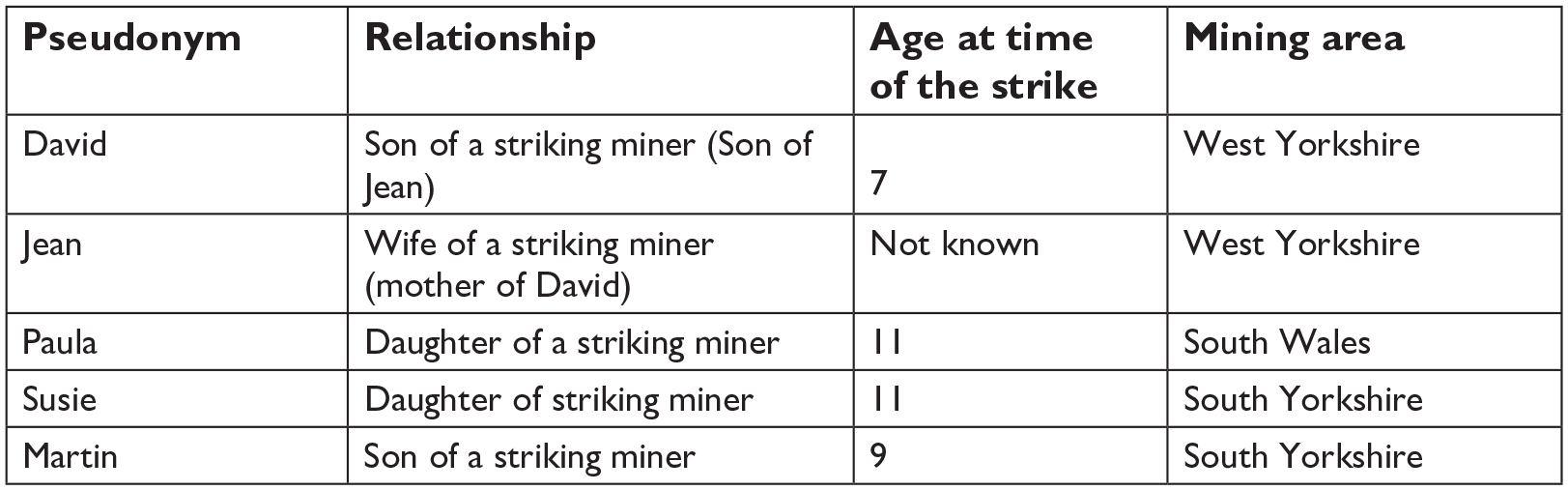
Details of the interviews.
The interviews took place in locations across the United Kingdom and venues convenient to the interviewee. This included their own homes, private rooms in libraries and community centres. With the exception of Susie and Martin, who were living and interviewed in London, all the interviews took place in the vicinity of where the interviewee had grown up. The interviews followed a photo-elicitation and narrative interviewing method. Following the Biographical Interpretive Narrative Method (BNIM) interview method (Wengraf and Chamberlayne, 2006), I asked each interviewee to tell the story of their experience of the strike and listened without further questions while they spoke for as long as they wanted, before asking questions about their account. Following this, I asked them to share any photographs they had brought to the interview and explain its significance. Although the images and objects are not discussed in this article, they were central in prompting and shaping the narratives under discussion.
Researchers across disciplines have used visual methods to explore multiple layers of experience. Visual methods offer interviewees a means of narrating experiences that can extend and supplement their verbal account. The photographs (and in some cases, objects) interviewees share can act as prompts for memory, leading interviewees to offer further or new detail. The inclusion of photographs and objects can also illustrate how the selection, recall and retelling of experiences are central to the construction of identity. Kuhn (1995) has argued that the production, content, reception and organisation of photographs are a form of narrative expression and tell personal, social and cultural stories. Interviewees might use photographs to reorder, retell or ‘repair’ the past in the present narration of events. The photographs and objects that interviewees brought to the interviews varied; some shared personal, family photographs, others publicly available images. In doing so, the interviewees blurred the distinction between public and private, as personal photographs were given social and cultural significance, and public images were given personal meaning.
Visual methods can facilitate contact with different memories and feelings and extends an invitation to take an imaginative leap back into childhood worlds. This is not to collapse the distance between then and now, but to sit with it, recognising what we did not know as children about adult lives, and what we do not know as adults about children’s lives. Jones (2003) and Philo (2003) argue that children connect with the adult world without fully occupying it. Children use imagination as a mechanism for transforming everyday spaces and making the adult world comprehensible when negotiating emotional experiences (Del Busso et al., 2018). Jones (2003) has argued that to explore the worlds of children through adult memories requires ‘entering into a state where feelings and emotions are more to the fore’ (p. 34). This can allow for exploration of the ‘fragments of connection’ between childhood and adulthood to emerge (Philo, 2003: 9–10). Sharing photographs and objects from the past can offer a means of entering this state, of engaging with the affective dimension of experience and attending to the emotional processes of remembering. While narratives can often follow familiar scripts, the inclusion of photographs in the interview process can encourage affective story-telling that intervenes into the familiar, rehearsed narratives. This is not to suggest that such methods produce a more ‘real’ or ‘authentic’ narrative, but that they can potentially access a different, affective dimension of experience.
All the interviews were one-to-one, with the notable exception of Jean and David, who were mother and son. This joint interview was not planned as such – the interview request had been responded to by David, who said that his mother would also be interested in taking part. The impact of this distinctly different, intergenerational interview is discussed in the analysis. Intergenerational interviews will produce different data than if either participant were interviewed alone and, in the case of Jean and David, their joint interview gave insight into how and when secrets are concealed and revealed within the family. For the joint interview, I followed the same approach described above. The initial narrative differed from the individual interview as Jean and David had a conversation with each other as they co-constructed their account, rather than an individual monologue that occurred in the individual interviews. The intergenerational interview illustrates the co-construction of family memories and how personal memories are shaped by other family members. As Freund (2009) observes, family memories are not shared by ‘the old handing preserved memories down to the young. Rather, these memories are constructed through communicative interaction’ (p. 2). The intergenerational interview is, as Freund (2009) argues, invaluable for understanding and studying the transmission of family memories – they do not simply reveal additional information that would be missing from an individual interview, but demonstrate how memories are constructed and negotiated through the family. So, while the joint intergenerational interview undoubtedly differs from the individual interviews, it offers invaluable insight into the co-construction of family memories of the strike.
The area in which the interviewees lived during the strike will have had an impact on their experience. As Richards (1996) has documented, there were regional differences in participation in the strike and the notion of a mining ‘community’ is also regionally variable (Strangleman, 2001). Phillips (2012) has argued that, at least in Scotland, pit-level support for the strikes was shaped by material resources achieved through the wages of women in the household and the deferral of council housing rents. These variables, combined with individual pits’ histories of industrial action, shaped the levels of observation of the strike in Scotland (Phillips, 2012).
To retain anonymity, the specific town or village in which the interviewee lived during the strike has been omitted, but in recognition of the significance of the coalfields to experiences of the strike (Gildea, 2023) the general region has been included. Of these regions, two participants lived in West Yorkshire, two in South Yorkshire and one in South Wales. While each of these areas had high levels of participation in the strike (Richards, 1996), this did not mean there was an inevitable sense of being part of a mining community for the interviewees. As Gildea (2023) has discussed, the concept of the ‘pit village’ as the centre of the mining community should not be assumed to be static as miners would move between pits for work, especially following pit closures, and this sometimes also meant moving houses and communities at the same time.
Despite all the participants discussed here coming from areas that would be considered to have had strong support for and observation of the strike – with large numbers of miners going out and staying out on strike for the year (Richards, 1996) – this did not necessarily translate into a sense of being part of a mining community for all the participants. There is a stark contrast, for example, between Martin and Susie, who both tell stories that are very much located in the mining community, and Paula, who did not live in a mining village and was one of only a handful of children in her school from mining families. Similarly, the varied ways in which the areas were policed shaped the memories of the strike for the interviewees, with memories of the police being more prominent for Martin, who lived in an area that had experienced heavy police deployment, in comparison to Paula, who did not live in a ‘mining community’. The impact of these differences in place is seen in the discussion of the interviews that follows.
Analysis
This analysis considers how family stories and secrets shape narratives of proximity and distance and knowing and not knowing, absence and losses in the participants’ accounts. This analysis considers the role of family stories and secrets, and concludes by focusing on the ghostly figure of the scab, who appears across the accounts in particular ways.
Proximity and distance
In these accounts, the notion that proximity to particular spaces or actions, such as picketing, indicates involvement in the strike and membership of a mining community is salient. In some cases, participants used proximity as a barometer of the value of their memory, or absence from the pickets as requiring explanation. Several people who expressed interest in participating referred to not having been very involved in the strike, because their dad had not picketed, or their mum was not involved in women’s activism. Interestingly, the picket still held significance for people who were children during the strike and is a meaningful site in many accounts, particularly for describing their parent’s participation and assessing whether they have ‘enough’ to contribute to the project.
The assessment of proximity to the strike as presences on picket lines and in soup kitchens is evident in David and Jean’s interview. David was seven at the time of the strike and living with his striking father and his mother, who worked several jobs throughout to support the family. David’s memories of the strike echoed familiar accounts of children’s experiences – the holidays funded by supporters, the donations of toys at Christmas and memories of coal picking with friends – an activity that saw three teenagers die during the year (Beynon, 2015).
During the interview, a visit to a family picket day is briefly mentioned, but David’s own memories of pickets and marches are otherwise absent from his verbal account, although he does share some secondhand stories about his dad’s experiences on the picket line. Despite this absence in the verbal account, David’s visual narrative was dominated by photographs of pickets and marches, images sent to David by his dad’s friends. In sharing these, David pointed out people he knew and recounted stories about them told to him by his dad, piecing these together with his mum Jean during the interview.
The dominance in David’s visual account of the pickets and marches he had rarely attended reflect the nature of childhood memories as borrowed stories and images and illustrate the intergenerational nature of remembering. David’s dad did spend much of his time on the picket lines, as David and Jean recall:
And then that were it, kind of thing, it were just how it were but, but erm obviously then suddenly he, he’s there, well he wasn’t there most of the time because he were off.
He was, on a morning and disappeared.
Yeah, but um.
Picket lines.
Yeah, I think he were down Nottingham for 3 days a week, wasn’t he, most of the time?
David’s memory of the strike is co-constructed with Jean, his dad’s stories and the photographs shared by his dad’s friend. David uses images from the strike that feel very familiar and speak to a collective memory of it. This might afford David an ‘authentic’ experience amid memories that are often partial, fleeting or difficult to pin down, lending a solidity to memories that are often marked by absence. This search for authenticity can lead us to the rehearsed, familiar and dominant narratives. Jean notes the ways in which viewing accounts of the strike on the television shaped and prompted her own memories of it: I mean, even to this day when you, it still takes you back when you see, when things come on the telly, you still go back to that, um, remember sort of the times and what you were doing when that happened.
Drawing on a cultural narrative of what the strike was and where it was centred brings David’s narrative to the picket line through the photographs he shares, despite that not being a place of activity and action in his own experience.
Elsewhere, Jean reinforces the idea that presence on the picket line is an indicator of having been ‘involved in the strike’, noting her regret that working meant she was not able to join the picket: In a way I wasn’t involved as much as I would have liked to have been because some of the girls that weren’t working went, I mean, not on the staunch picket lines when there were trouble but on, on some of the picket lines the, the wives were there . . . I couldn’t get involved in that because to me my main priority was to put food on table.
Jean’s regret at her perceived lack of involvement locates the strike on the picket line and positions any experience that does not fit into the transformation narrative – so readily shaped and reproduced in accounts of the women’s involvement in the strike (Measham and Allen, 1994; Spence and Stephenson, 2007a; Sutcliffe-Braithwaite and Thomlinson, 2023) – as lacking.
Knowing and not knowing, absence and losses
While memories of the picket line offer a solidity to childhood memories of the strike, this contrasts with the theme of knowing and not knowing, absence and loss, present throughout the interviews. Each interviewee spoke about a loss and absence of community, employment, investment and opportunity following deindustrialisation. Except for one participant, all had also lost their fathers, each having died in their late 50s or early 60s from illnesses likely to have been a result of their work – an example of how the mining industry is marked on the body.
Absences and losses were also marked by references to what interviewees did not know, were not told, or could not remember. As David illustrates, memory is collectively formed, through others’ accounts, family stories, media representations, intermingled with personal recollections. In ways that Smart’s (2011) work on family secrets can help us understand, experiences of the strike were also shaped by and remembered through what was not said and kept hidden from children. Across the accounts, silences and omissions characterise the childhood experience of the adult world. These silences persist in our adult memories. As Smart (2011) argues, memory ‘meshes together adult memory and sensibilities with childhood memory and forms of understanding’; in remembering, we are trying to understand childhood experience from an adult perspective (p. 543).
Paula, who was 11 at the time of the strike and who lived with her father, a striking miner, her mother who worked and her older sister, reflects on what she and her sister were not told about the strike, and how much of what she did know came from fragments of overheard conversations: In fairness to our parents they were very, very good at kind of hiding any difficulties from us so, you know, we weren’t made aware of problems. It wasn’t that widely spoke about in our house, erm, they were quite protective parents, but there were little giveaways, such as, you know, children walking in on conver- conversations, erm, those type of things.
Valdivino Silva et al. (2023) argue that the practice of keeping secrets ‘performs specific functions that contribute to creating intimacy, maintaining cohesion, protecting the family structure and safeguarding families and individuals from disapproval or social rejection’ (p. 2). This is evident in the withholding of information by Paula’s parents; concealment and omission were used to maintain a sense of normality in the home, a form of protection and means of managing the emotional impact of the strike. As Smart (2011) suggests, family secrets – including omission, silences and ‘active not-knowing’ – are formative of family memories. Paula and her sister were shielded from the difficulties of the strike through whispers, concealed conversations and withheld information and so many of her memories are marked by things she did not know and ‘little giveaways’ that indicated something was not being said.
Paula’s dad was on strike for the year but, as he did not attend pickets or the miner’s welfare club, Paula said she did not remember being part of a mining community and most of her memories of the strike are located in the home. Paula referred to being one of the few children in her school from a mining family and remembers her father’s refusal to let her have free meals or trips provided for children of striking families. Her father was a proud man, she explains, he did not want to accept charity. This means that her memories of the strike do not draw on the dominant collective memory of social and community support that appears in many childhood memories (Ballin and Johnson, 2017b; Trounce, 2015).
The hushed tones in which the strike was discussed echo the ways in which Paula’s parents, according to Paula, managed the year on strike as a family unit and without the collective support of a mining community. Paula and her family’s experience and management of the strike is characterised not by proximity to an apparent epicentre, but by the negotiation of emotions and feelings, of pride and protection and the maintenance of a ‘normal’ family life. The concealment of the impact of the strike from the children within the home is an echo of the family’s distance from the mining community more broadly. Paula gives an account of the strike as managed within the family, rather than as part of a broader community. Her reference to her father’s pride perhaps signals how this contained approach was part of a strategy to safeguard the family ‘from disapproval or social rejection’ (Valdivino Silva et al., 2023: 2).
Family secrets
Secrets were not only kept by parents from children. Here, Susie recalls being asked to keep secrets about mounting debt from her father, as an attempt by her mother to, again, protect her father’s pride: I always remember my Mum saying, erm, ‘any white letters, erm, hide them’. Erm . . . I wasn’t entirely comfortable with the idea but I used to do it and I used to hide the white letters, erm, behind the encyclopaedias. And eh, and then I used to give them to my Mum. And, then it all came out that, obviously, erm Mum was going . . . Or the account was going overdrawn and then these were, you know, letters from the bank and she was just probably protecting my dad, you know, the stress, his pride.
Again, it is the absence of things, things that are concealed, that go missing and are kept secret, that shape Susie’s memories of the strike. Susie was involved in the management of the household during the strike, without fully understanding what was happening. She is part of, but also shielded from, the implications of the strike as it was experienced through the home. As Smart suggests, not all family members are party to the same secrets, and here Susie colludes with her mum to conceal something from her dad but does not herself have full understanding or awareness of the purpose of hiding the envelopes. Smart (2011) argues that part of growing up is ‘learning what not to know’ and that children are often aware of, and bewildered by, the partial knowledges they have access to (p. 549). Secrets are part of the operation of power within the family on a micro- and macro-level (Smart, 2011). Susie’s mum is active in protecting her husband’s pride and stress, by concealing the financial situation from him and enlisting Susie’s help in doing so.
Memories characterised by a sense of not knowing or having only partial understanding were not only remembered through the home. Martin, who was nine at the time, remembers the Metropolitan Police occupying his village. For two days, no one was allowed in or out and Martin witnessed significant violence and police brutality during that time. He recalls a time his uncle carried him on his shoulders, running with him into the woods away from police in formation and running after the striking miners. Despite being in the midst of what is often portrayed as the epicentre of the strike, Martin’s memory is still one of knowing and not knowing: ‘And obviously, as a kid, I . . . I knew, I could see it all happening. And I didn’t really know what was happening. You know, the, but that shaped me, that scarred me as a kid, I think’. Martin’s village had been transformed into something strange and unknowable. He reported his sense of being part of something but both knowing and not knowing what was happening as having enduring impact – it was this that shaped and scarred him, rather than the events themselves, he suggests. In recounting experiences that are only partially understood, to allow not knowing to be at the centre of the retelling, the accounts do not become fixed in a familiar and uncomplicated narrative but speak to the uncertainty and unknowability of the strike as children, and the precarity of remembering as adults.
While, in Paula’s account, the strike is an absence that is not talked about other than in hushed conversations, for Martin it is a presence that is not fully understood. Susie also had a quieter, more shielded experience than Martin, but one that also involved a process of trying to understand things not fully explained. Her memories are of a sense of something happening, but not being directly drawn into it. Jones (2003) suggests that there are ‘distances and intimacies’ between children’s and adult’s worlds and this is evident in the memories recounted, many of which were built around knowing and not knowing, albeit in different ways, but each resisting the nostalgic and uncomplicated retellings often seen in representations of the strike (Bennett, 2009).
Remembering and forgetting the scab
What children knew and did not know was frequently managed by the adults in their lives, often in the form of family secrets. Family secrets shape family memories in particular ways. Events are revealed and concealed within families as a way of cementing or demarcating loyalty and maintaining or sacrificing certain relationships.
For Kuhn (1995), family secrets are hauntings: secrets haunt our memory-stories, giving them pattern and shape. Family secrets are the other side of the family’s public face, of the stories families tell themselves, and the world, about themselves. Characters and happenings that do not slot neatly into the flow of the family narrative are ruthlessly edited out. (p. 2)
This haunting is evident in the figure of the scab. In the strike retellings, the scab is in many ways hyper-visible, a figure against which the striking miners position themselves. The scab is not only a seemingly unambiguous figure, but also an unforgettable one, shunned by the local community, his actions never forgiven or forgotten. Images of graffiti from the period not only identified scabs by name, but reminded them that the community will never forget, for example, graffiti in Abercarn, South Wales warned ‘SCABS LOOK AROUND FOR THE NEXT 50 YEARS WE BE THERE ONE DAY’ (Museum Wales Archive, n.d.) and John Sturrock’s (1985) photograph shows children walking past hangman graffiti in Armthorpe, Yorkshire, accompanied by the words ‘WE WON’T FORGET THE SCABS’ (Sturrock, 1985). Both offer bold visual indications of the feelings of hurt, anger and bitterness that marked the experience of the strike for many.
This unambiguous figure appears in Martin’s memory of seeing working miners bussed across picket lines while at school. Martin remembers his teachers taking himself and his classmates out to the school yard to throw stones at the busses as they drove past: [The teachers] you know, they’re lining up nine-year-olds to throw stones at white wagons . . . I mean that’s weird . . . Surely they wouldn’t get away with it now . . . But like, then it were just normal. You just went ‘right, get out, scab van’. ‘Scabs, scabs’.
And recalling the songs from the strike: Yeah, ‘Jingle bells, jingle bells, jingle all the way. I’d rather be a picket than a scab on Christmas day’. And like, so you went and, and that were like a big thing. You went, everyone was singing it.
Like the picket line, opposition to the scab can serve to cement and solidify memories of the strike and community membership. However, the scab is a more shadowy or ambiguous figure when he appears in a familial context and, as Kuhn (1995) suggests, haunts memory-stories. This is apparent in Jean and David’s account where the scab is a family member.
David’s dad, Jean’s then husband, was on strike for the whole year. His uncle, Jean’s sisters’ husband, returned to work, creating, as Jean described it: divided families, because I, my younger sister was married to a miner as well . . . he was a scab . . . my mum and dad wanted to stand by the daughter whose husband had gone back to work, mine was on the picket line, in the thick of it . . . he wanted to do what was right by his own little family . . . my husband disowned him.
It damaged almost irreparably her relationship with her brother-in-law. Smart (2007) draws on Seale to argue that family narratives express and build emotional bonds ‘but also create a sense of duty or a sense of doing “the proper thing”’ (pp. 83–84). In this account of a scab within the family, Jean signals the competing bonds and loyalties between the family and ‘the rest of us that were, the lads were on strike and everything, there was communities . . .’, and describes the emotional strain this created. She is clear that she and her husband’s loyalties were with the community of strikers, no matter the family difficulties this created.
However, this unequivocal loyalty is complicated when it is revealed that Jean only told David this secret a few days before our interview. Jean, and other family members, had kept this secret for over 30 years. She explained why:
Yeah, yeah, because I know in some way it would have an effect on him, even now all this time after, I think he now looks at his Uncle Tony in a different light, which is not, not good really um or . . .
Shouldn’t, shouldn’t have gone back to work then should he.
Well, he shouldn’t and, and at the time that, that’s what was, well in our family, it was hard because, it’s a hard word to say, but I hated him for it.
As Smart (2011) suggests, secrets are kept in order to sustain familial relationships; ‘many families seem to realise that the only way to keep a relationship going is to ignore the very thing which would make it impossible to sustain bonds of affection or filiation’ (p. 494). Despite Jean’s identification with the community of strikers, in keeping this secret from David, Jean also committed to maintaining some form of social, if not political, solidarity within the family, that required keeping secrets.
Kuhn (1995) writes that ‘characters and happenings that do not slot neatly into the flow of the family narrative are ruthlessly edited out’ (p. 2). However, the uncle was not written out, but refigured. Jean acknowledges that repairing and maintaining familial relationships, keeping family secrets and sustaining an alternative, if unspoken, narrative of the striking uncle, was difficult. This family secret complicates the unequivocal condemnation of the scab and illustrates how the management of the strike within the home was one of negotiation, concealment and omission as attempts were made to maintain family bonds. Jean tells certain stories and conceals others, as a way of perhaps protecting her son, but also her brother-in-law, by maintaining a particular family narrative. Through her secret-keeping, Jean is maintaining, for her son at least, the idealised notion of the family he lives by Gillis, (1997).
Not all family members are told the same stories, or keep the same secrets. Family secrets are ‘omitted, hidden or differently shared among other relatives’, and are used to maintain certain relationships and family narratives (Smart, 2011; Valdivino Silva et al., 2023: 2). It is only with the passing of time – as Jean states, ‘there’s different times, things move on’ – and circumstance – through taking part in the interview – that David learns of this family secret. The telling of family stories operates as a process of inclusion and exclusion; in excluding David from this secret, Jean is ensuring that his uncle is included in the family, maintaining bonds, although in a very precarious and emotionally demanding way and one that challenges her desire to maintain loyalty to a mining community.
The revealing of this secret is impactful, despite the passage of time. Exposing secrets can necessitate the rewriting of the family story and characters within it; ‘the respectable image of ancestors can be shattered and the moral values, which were presumed to reflect the character of a particular family and its lineage, can be reinterpreted as mere hypocrisy’ (Smart, 2011: 544). This shattering of the image of his uncle is evident in David’s anger when he says, ‘Shouldn’t, shouldn’t have gone back to work then, should he’. Following the exposure of the secret, David is reconstructing his family narrative in ways that lead to the ‘re-evaluations of kith and kin’ (Smart, 2011: 544), rewriting his family story of the strike in new and different ways.
This account of the scab as embedded in, but also partially excluded from, the family – the container of heightened emotions, divisions, split loyalties and family secrets – is a more complex and nebulous figure than the one that appears in dominant narratives that Martin draws on in his memory of throwing stones. When the scab figure haunts the family, its proximity might also be experienced as a threat to the narrative of the family and its members as committed to the strike and mining community, explaining why the figure is so readily othered in ways that situate it on the outside of the striker narrative and enemy to community.
Later in Jean and David’s interview, they discuss how the pit their husband/dad had worked in had in fact voted to return to work on the Friday before the strike was called off, demonstrating the regional variation in the strike dates (Gildea, 2023):
They were going to go back.
They were going to go back to work.
They were talking about going back on the Monday, they’d had meetings and everything.
And they called the strike off.
But then the strike was called off.
Which was a. . .
A good. . .
A good thing, really.
Yeah, because they’d have been a scab pit then if they’d have gone back.
Sutcliffe-Braithwaite and Thomlinson (2023: 130) have commented on how dominant narratives have obscured the experiences of strike breakers, but that men did return to work across the year, something that ‘became more thinkable during the final months of the strike as desperation grew’ and, ‘in early 1985, with no sign of movement from the NCB, and Nottinghamshire producing large quantities of coal, the drift back to work that had begun in autumn started to turn into a flood’ (p. 179). Accounts from women whose husbands returned to work also reveal greater variety in responses from the community than the dominant narrative of the unequivocal rejection and ostracisation of the scab suggests (Sutcliffe-Braithwaite and Thomlinson, 2023). The scab in the family is not only a figure that breaks solidarity and creates division but is also a reminder of the proximity to, and possibilities of, becoming a scab oneself. It was a coincidence of timing that meant Jean’s husband did not occupy the scab position, something both Jean and David reflect on with relief.
Conclusion
Misztal (2003) has argued that family memories constitute a ‘specialised circle of memory’ as the family is (often) the primary site for developing memories (p. 95). Memories of the miners’ strike discussed here are located in the family and shaped by family stories, secrets and silences. These memories of the strike do draw on dominant narratives, particularly of the significance of community, the proximity to the picket line as an authentic experience and the unambiguous figure of the scab. However, they also reveal the significance of the circulation of knowledges within the family to the management of the strike in ways that complicate the certainty of dominant narratives. The home is a central site to childhood memories of the strike, the place where many strategies for material, personal and family survival were performed. The narratives illustrate how the home is a place of political significance, rather than an individual, private space. Family secrets, silences and omissions were also central to the management the strike, with family loyalties, material implications and affective experiences managed and negotiated through the revealing and concealment of secrets, or the omission of knowledge about the strike. Being alert to the absences, silences and secrets in childhood memories of the strike reveals that, while the dominant narratives are active in how the strike is narrated and remembered, a sense of knowing and not knowing characterised the childhood experience of the strike and the adult remembering and narration of these experiences.
Footnotes
Funding
The author(s) received no financial support for the research, authorship and/or publication of this article.
