




Abstract
This article explores how memory practices at sites of historical injustice are shaped by authenticity and absence. It explores a case study of a weeklong bus tour which visited over 15 historic sites dedicated to memorializing the internment of Japanese Canadians during the Second World War. Drawing on the concept of dark tourism, this article explores how the bus tour was simultaneously a planned pedagogical experience, and part of a larger and sustained set of memory practices dedicated to maintaining and cultivating the cultural memory of injustices faced by Japanese Canadians. The article illustrates how these memory practices helped establish a pedagogical authority for some attendees and facilitated certain ethical engagements with the difficult past while avoiding and excluding others. It also demonstrates how the practice of dark tourism is implicated in larger conversations about the erasure of settler colonialism at sites of memory in Canada.
Keywords
Lemon Creek, British Columbia
It was the morning of day 3 on the “internment era bus tour” when our group of 50 arrived at an overgrown pasture near the small community of Lemon Creek, British Columbia (BC). Hidden in the Selkirk Mountains, about 6 hours east of Vancouver, this place once served as home to 1860 Japanese Canadians who had been forcibly removed, relocated, and dispossessed of their homes on BC’s west coast in 1942 (Reid and Carter, 2016). Almost 80 years later, light summer rain fell as our tour group, ranging in ages from 19 to 94 years, made our way across the field toward a decommissioned railway, now transformed into a recreational trail. Among us were internment survivors and their families, tourists, academics, graduate students, and teachers. What we shared, if anything, was an interest in the history and memory of Japanese Canadian internment during and after the Second World War.
We stood surveying the pasture; some read a plaque erected by a local Japanese Canadian heritage society, while others looked at the inscription on a memorial bench donated by one of the families on the trip. This place felt both heavy with memory, but also absent and cleared of it. Even for those who knew what to look for, it was difficult to imagine the over 260 internment homes that once sat here. In the distance I heard yelling which grew closer and louder as a group of cyclists came barreling toward us. Confusion briefly ensued as our slow-moving tour group made way for the cyclists, their voices growing annoyed at our inability to clear the path of what I assumed to them felt like “their trail.” A brief feeling of rage swept over me as in what I perceived as an action of arrogance and disrespect toward the memory of internment and the former internees standing on the trail. Were these cyclists unaware of what this field once was? Could they not have imagined what we were doing there? Such questions turned my attention to how I might possibly answer these questions. What were we doing staring at this “empty” field? Was this an act of tourism, a pilgrimage, a field trip, a history lesson? What cultural memories continue to be made present here and what continue to be silenced?
This story from my field notes at Lemon Creek illustrate one brief example of collective remembering enacted at sites of historical injustice during a weeklong bus tour. It can also be understood as a case of “dark tourism.” The global rise of dark tourism to places of historical injustice such as former concentration and extermination camps, internment camps, and sites of genocide and atrocity has produced and enabled a wide range of memory practices, including mourning victims, listening to and learning from survivors, grieving, remembering and reflecting, and even inspiring social action to prevent injustices from happening again (Sharpley and Stone, 2009). However, dark tourism can also be voyeuristic. It can potentially depoliticize and commodify sites of historical injustice, which in turn can reinforce or uphold the status quo (Afanasiev and Afanasieva, 2018). Understanding how cultural memories are established, developed, and transformed through dark tourism requires us to interrogate and reflect upon what practices and techniques are employed, who they benefit, and who they silence or forget. It also requires a discussion of the limitations of these practices for promoting historical empathy and social or political activism.
In this article, I explore a historical bus tour as a case study, read through the lens of dark tourism (Collins-Kreiner, 2016; Lennon and Foley, 2000; Olsen and Korstanje, 2020; Sharpley and Stone, 2009). I aim to shed light on how memory practices on this trip were shaped by authenticity, absence, and pedagogy. In the summer of 2019, I voluntarily participated in a university sponsored “field school” that also functioned as a sustained set of memory practices organized to commemorate and educate about the forced relocation, internment, and dispossession of Japanese Canadians during and after the Second World War. As part of a group of internment survivors and their families, tourists, university students, teachers, and academics, I took part in the bus tour which visited over 15 historic sites dedicated to memorializing the internment era and its aftermath. Five years later, I continue to reflect on this experience and what it reveals about the purposes and practices of tourism to sites of historical injustice and the production of cultural memory.
This case study provides insight into the ways authenticity and absence function at sites of memory where limited physical evidence of what is being commemorated remains. As Marita Sturken (2007; 2011) writes, tourism to places of atrocity and violence is often driven by the tourists’ desire to experience something authentic, feel close to an event, cultivate empathy, engage in mourning, and educate themselves toward an ethic of “never again.” Yet, despite these desires, research also tells us that dark tourism often does not generate empathy, but rather allows the tourist to feel better about themselves while commodifying the suffering of others (Bowman and Pezzullo, 2009; Handayani, 2018; Tucker, 2016). Likewise, sites of historical injustice can also be co-opted by those with political or social power to reinforce certain historical narratives that help maintain the status quo and sidestep more difficult conversations about ongoing and related structural injustice and inequalities (Sather-Wagstaff, 2016). While advocates of dark tourism aim to provoke a dialogue between the present and the past over the ethical and political meanings of historical injustice, the impact and often unexplored political motivations of such tourism remain contested.
To engage this past–present dialogue and the contested nature of dark tourism, I analyze a bus tour of internment sites organized in collaboration by a national Japanese Canadian cultural center and a major university research project. I studied this bus tour as part of a larger comparative case study research project which investigated the teaching and learning of historical injustices in multiple contexts across Canada (Miles, 2021). Using research methods including participant observation, artifact collection, and semi-structured interviewing (Parker-Jenkins, 2018), I explore how the bus tour was simultaneously an example of dark tourism, but also a pedagogical experiment and part of a larger set of memory practices dedicated to maintaining and cultivating the cultural memory of the injustices faced by Japanese Canadians during and after the Second World War.
Place and cultural memory
To examine how sites of memory shape and are shaped by tourism requires a grounding in the relationship between place and cultural memory. Memory studies scholars have long argued that memory is strongly tied to place, and that place is essential for understanding how memory functions and is constructed (Hoelscher and Alderman, 2004). Writing about Canadian identity and belonging, Osborne (2006) argues that places are always infused with meanings and feelings and that space is transformed into place by “living in place, memorizing place, narrating place, and creating symbolic landscapes” (p. 150). For Osborne, places are “emotional entities” and are always socially meaningful in that “people produce places and they also derive their identities from them” (p. 149). Osborne further argued that it is important to remember not what landscapes mean, but what they do as cultural practices.
Alderman and Inwood (2013) argue that places of memory “anchor and bring legitimacy to the identities of social groups, but they also serve as a conduit for debating what (and whose) view of the past should be remembered” (p. 189). In the case of the places of historical injustice, such landscapes don’t necessarily celebrate the nation state in an explicit way, instead they can challenge it by reminding us of the injustice the state is capable of enacting. At the same time, such places can also legitimize and uphold the state’s authority and reinscribe its power, through a presumed demonstration of its ability to acknowledge and work through or redress difficult pasts, in a form it deems acceptable.
Sites of memory have great importance both beyond and within the nation. Opp and Walsh (2010) have explored local sites of memory across Canada, showing how local places are “made meaningful by memory and commemorative practices” (p. 4). Opp and Walsh demonstrate the diverse ways that Canadians make and remake places through commemorative acts, performances, and memories. Likewise, Turkel (2011 [2007]), in The Archive of Place, examines the power of the materiality found in a rural region of BC. Turkel demonstrates the different ways people interpret material traces of the past and how these interpretations shape historical consciousness and cultural memory. In explaining how people retrieve the past from a place, choosing to learn some things while forgetting others, Turkel (2011 [2007]) offers us a helpful explanation that when “usable pasts are drawn from material substances at particular places . . . that binding of history and memory and landscape—constitutes the present” (p. xxiv). In other words, Turkel argues that places and their materiality provide the building blocks for the present to be made, remade, or incorporated into what comes next.
Writing on places of Japanese Canadian internment, McAllister (2010) argues that the internment camps “are mythic sites in the memoryscape of Japanese Canadians” (p. 220). McAllister draws on archival photographs to show how the internment camps make and remake specific memories and narratives of the internment era for different parts of the Japanese Canadian community. She explains that the camps are understood by some through a more positive lens of communal living and resilience, while for others they symbolize the destruction of community, with novelists such as Joy Kogawa and Kerri Sakamoto imagining the camps as “damaging psychic spaces that continue to trouble the community today” (p. 220).
McAllister’s depiction of how memory is put to work at the former internment camps shows the possibilities of how multiple overlapping memories are used to make sense of the difficult past in Canada. In her book Terrain of Memory, McAllister (2011) suggests that such places of memory also provide a place for everyone affected by internment both Japanese Canadian and not, “to grieve, recall, and question the past” (p. 6). All three of these functions that McAllister identifies point to different purposes for visiting sites of internment. Grieving the past suggests an emotional attachment that might support empathy and feed into the personal significance of a place, recall the past indicates a straightforward retrieval of memories or stories available to all, and finally, questioning the past implies a critical engagement with the past—all memory practices that were at play during the internment era bus tour.
Scholars have also explored the various ways that tourism and historic sites in Canada have often erased, silenced, and commodified Indigenous histories and presence on the land. Lemelin et al. (2013), for example, have examined colonial battlefields and other warfare tourism sites in Australia and North America. They demonstrate that despite reforms in recent years, such sites still prioritize colonial perspectives and silence or minimize Indigenous voices. Hvenegaard et al. (2016) have also examined the contested Batoche National Historic Site in Saskatchewan designed to commemorate a battle in the Indigenous led North-West Resistance of 1885. Using David Uzzel’s (1989) notion of “hot interpretation,” that explores how historic sites facilitate affective and human responses, they analyzed how the interpretations offered at this contested historic site have changed over time from a “one-truth” colonial narrative to a “many voices” and hot interpretation of the past, aimed at fostering new kinds of civic participation and dialogue. This research demonstrates both hopeful possibilities for sites of local memory in Canada, but also cautions that historic sites created by and for settler colonial states continue to misrepresent, erase, and appropriate Indigenous voices, histories, and sovereignty.
Dark tourism and the desire for authenticity
The concept of dark tourism is also useful for understanding how memory functions at places of historical injustice. Dark tourism refers to the act of traveling to sites of death, disaster, atrocity, and injustice that are often considered sacred (Collins-Kreiner, 2016; Lemelin et al., 2016; Olsen and Korstanje, 2020). Tourists traveling to sites of dark pasts seek to learn about, empathize with, and make meaningful connections to the past, but they are not necessarily driven by a search for roots to their own cultural identity. As Sturken (2011) argues, such tourists tend to embody a detached subject position, imagining themselves as “innocent outsiders, mere observers whose actions we believe have no effect on what we see” (p. 282). Tourists’ practices are primarily about having what is believed to be an authentic experience in a foreign place and documenting that experience through photographs and the collection of souvenirs or artifacts which in turn often leads to commodification and voyeurism of otherness. These tourism practices are just as true for dark tourism as they are for regular tourism.
According to Collins-Kreiner (2016), dark tourists seek a mythical or mystical experience that will be life changing, transformative, or consciousness altering. In many ways, we might imagine this type of tourism as an educational experience, one in which the tourist walks away wiser, more knowledgeable, and more empathetic. It is also important to remember that the motivations and experiences of those who undertake dark tourism are never homogeneous and always diverse. Likewise, while dark tourism may be driven by a desire for meaningful self-change or consciousness raising, this may not mean it is actually occurring or that this process is not itself leading to a romanticization, commodification, or depoliticization of sites of state violence.
While the past can never fully be retrieved or accessed at sites of memory, a goal for visitors to such sites remains a search for the true or authentic past. This search for the real, the authentic, and the true at sites of historical injustice is perhaps a core practice of dark tourism. As Farley (2010), building on Kirshenblatt-Gimblett (1998), argues, memory tourists tend to locate truth not in the material traces of the past, but in their absence or what cannot be seen. In this view, we can consider how “the truth of internment,” for example, is not to be found in material remnants of the internment camps, but in their absence. This material and physical absence can then be populated with the presence of authentic memories, or what Kirshenblatt-Gimblett (1998) calls “the heart and soul of the site” (p. 168). The idea that tourists get to determine the heart and soul of a site of historical injustice of course raises a panoply of difficult questions about the various subjectivities and positionalities at play.
Accepting and acknowledging authenticity in what cannot be seen then enables a writing and rewriting of memories onto sites, a process not of mis-remembering, but remembering in an iterative and palimpsestic process. As Kirschenblatt-Gimblett (1998) argues, heritage sites cannot fully tell their own story, and this inability authorizes the visitor to interpret and remember the site as they wish and for their own purposes. And yet the nature and substance of these interpretations are not fully open to all nor should they be seen as completely relativistic. They are shaped both by the intentions and interpretations offered by the site and its curators, but also by the visitor and their interests. There are clear cultural and identity-based factors which shape and regulate who can tell internment stories and what stories should be trusted, listened to, and remembered at sites of internment; though what memories a tourist leaves with are always just their own. Tourism to sites of memory is deeply tied to cultural and social identity. For some, sites of memory often connect directly to their cultural identity and the practice of visiting a site of memory helps further establish, expand, or maintain their sense of self and community. In this case, the act of Japanese Canadians visiting former sites of internment might enable a deeper cultural connection to a wider sense of the Japanese Canadian experience even if the individual does not have direct ties to the internment era. As McAllister (2011) argues, many Japanese Canadians visit sites of internment in a search for their roots, but as McAllister warns, it is easy to romanticize this “pilgrimage in search of collective identity and heritage” and the identity focused connection Japanese Canadians seek at sites of memory is “sometimes troubled and always complex” (p. 229).
On the surface, the subject position of a dark tourist with no explicit identity connection to a site of historical injustice seems to have a less meaningful relationship to the past in question, despite any expressed personal concern or interest. For some tourists there may even be a desire to empathize with or experience the suffering of others. Sturken (2007; 2011) calls this desire to be personally connected to experiences of historical injustice “trauma envy.” Likewise, the tourist also participates in a form of trauma voyeurism, hoping to experience and potentially commodify some form of self-transformation through witnessing the suffering of others. This critique is relevant to this bus tour in which many of the people onboard, including myself, did not have family or cultural connections to internment, but nonetheless sought a powerful experience with memory of internment.
While trauma envy, commodification, and voyeurism are clearly risks of dark tourism, this is only part of the story. While the tourist might imagine themselves as an outsider or innocent observer, and can easily be critiqued as such, they more often than not share an indirect connection with the site of memory that also implicates or makes them complicit in that injustice. Perhaps, tourists should not just be viewed as outside observers, voyeurs, or bystanders to historical injustice with “trauma envy,” and the tourists’ desire to reject or ignore any personal connection to difficult pasts often reveals more than it conceals. I argue that the tourists at sites of injustice always occupy a subject position similar to what Michael Rothberg (2019) calls the “implicated subject.” The implicated subject position is one in which the individual can trace their privilege or positions of present-day power to histories and structures of injustice that have traces at sites of dark tourism. In other words, dark tourists often do not occupy simplistic positions of victim or perpetrator, yet they are deeply implicated in the legacies of injustice which emanate from sites of former injustice. My point here is that dark tourists and their cultural identities are connected to sites of difficult memory in complex and intersecting ways, and any instances of voyeurism and trauma envy must be read through that lens which further complicates their implication and potential complicity.
Japanese Canadian internment, dispossession, and deportation
While I do not intend to provide a full account of the internment era, or its historiography, it is important to outline a few key elements to provide context to the bus tour. At the outbreak of Canada’s involvement in the Second World War in 1939, approximately 23,000 Japanese Canadians were living in Canada, primarily on the west coast in the province of BC. Roughly 75% of this population was born in Canada or are naturalized Canadian subjects of the British Empire. In 1942, the Canadian federal government, claiming they were a potential security threat due to their ethnic origin, forcibly uprooted approximately 22,000 Japanese Canadians on the west coast and relocated them primarily to internment camps in the southern interior of BC, but also to farms in the provinces of Alberta, Manitoba, and Ontario (Oikawa, 2012; Sunahara, 1981). Following forced relocation and internment, the Japanese Canadian community was then dispossessed. Japanese Canadian property and chattel including farms, fishing boats, cars, and furniture were seized by the government and eventually sold (Stanger-Ross, 2020).
At the end of the war, the Japanese Canadian population, already uprooted, incarcerated, and dispossessed, was then pressured by the government to either immigrate to Japan or move east of the Rockies. A total of 3964 people were deported to Japan, 66% of whom were subjects of the British Empire, with the remainder dispersed thinly across Canada, destroying communities that in some cases had already been relocated multiple times in the preceding years (Stanger-Ross, 2020). It wasn’t until 1949 that Japanese Canadians were given the right to move freely in Canada and to vote. After a decades-long fight by Japanese Canadians, in 1988 the federal government acknowledged wrongdoing and agreed to a redress agreement with the National Association of Japanese Canadians, which included symbolic payments to direct survivors of internment (Miki, 2004). Like other redress settlements in Canada, this agreement has been critiqued for not fully addressing many of the racist formal and informal practices, policies, and structures experienced by Japanese Canadians in Canada that were ultimately designed to protect and uphold white supremacist ideology (McAllister, 1999; Matsunaga, 2021).
A wide array of commemorations, memorials, and museums about Japanese Canadian internment have been established across Canada. For example, the Nikkei National Museum and Cultural Centre was opened in Burnaby, BC in 2000, and the Nikkei Internment Memorial Centre in New Denver, BC at the site of a former internment camp was designated a national historic site in 2007. It is important to note that both the redress process and different forms of cultural remembering, including the sites visited on the bus tour remain contested among both scholars and Japanese Canadians. For example, Mona Oikawa’s (2012) innovative work on the memory of internment for a group of Japanese Canadian women explored how Japanese Canadian experiences and voices have been appropriated in service of white supremacy and the settler state. Thus, the memory practices discussed in this article are deeply embedded in ongoing conversations and debates over the discursive and physical power of internment sites in what McAllister (2011) calls Canada’s memoryscape.
The internment era bus tour
The internment era bus tour I attended in July 2019 had approximately 50 attendees including Japanese Canadian internment survivors and their families, tourists, graduate students, school teachers, and academics. This 5-day bus trip through the southern interior of BC was partially sponsored and organized by a national museum of Japanese Canadian history and culture, in collaboration with a major research project at a larger public university in western Canada. While not the focus of this article, the university students, teachers, and academics that participated in the bus tour were simultaneously taking part in a “field school” at the university with some student and teacher participants attending the bus tour for credit and others attending voluntarily and not for credit, such as myself.
Across 5 days, the bus tour visited over 15 sites of cultural memory including former internment and relocation camps, community-based museums, historical highway markers, and other important places of remembrance related to the internment era. These sites of memory offered a number of overlapping interpretations of internment era history and its significance today. While it is not possible to generalize the nature of interpretations across these sites or to describe the types of interpretations offered at each, there were some striking similarities that are revealing and important to note. The interpretations offered at the sites were primarily communicated in non-sequential ways (signs, displays, plaques) and were aimed at educating visitors on the harmful consequences of internment for the Japanese Canadian community and its significance for all Canadians, often through a human or civil rights lens. The tour itself on the other hand was organized as a sequential interpretation by its planners and guides, as they offered the attendees a narrative arc of the internment era as the tour group moved from Vancouver to sites across BC’s interior retracing the forced relocation of Japanese Canadians in the early 1940s.
It is important to note too that the interpretations offered by the tour guides and those at each site were not designed by one organization or group, and they did not share a consistent approach to communicating the meaning or significance of the internment era. With this caveat in mind, the tour itself and many of the sites were designed to facilitate an emotional engagement in this history in particular to encourage feelings of empathy, sympathy, and outrage for the injustices perpetrated on Japanese Canadians. Across the sites and tour, a cautionary moral narrative was also embedded in the interpretative communications, which promoted values of tolerance, multiculturalism, and human rights within a national framework. In other words, the historic sites, using curated artifacts, images, captions, signs, displays, and plaques, offered interpretations of internment that were intended to communicate a message that addressed Canada’s responsibility for this historical injustice, while also promoting the nation state’s ability to reconcile this past through the 1988 redress agreement. In this message, the lesson offered to visitors was that the collective racialized injustice endured by Japanese Canadians required official redress (which has been successfully implemented) and this injustice had repercussions for all Canadians that ought to be learned to protect against future injustices. However, this is not to say that this lesson was embraced by those attending the bus tour or its organizers.
The bus tour was organized and planned by two Japanese Canadian community members and sponsored by a national Japanese Canadian museum and cultural center. While not designed as a pilgrimage, the organizers understand that for many participants it has become one, with one organizer saying that “they always have some pilgrims,” including some individuals who have attended the bus tour at least three times. Throughout the trip, the two organizers acted as tour guides offering both historical and personal context to each site of memory. Upon approaching a new site, the two guides would also invite community members or survivors who had personal experiences with internment to speak about their memories and the internment era’s legacy for their family. The bus itself then became a very active and intimate space of collective remembering as we wound our way through the interior of BC. Yet, I do not intend to romanticize the experience or ignore that certain aspects of voyeurism, “trauma envy,” and commodification of suffering were also present throughout the experience. As at most sites of cultural memory connected to historical injustices, these practices were all present. While the bus tour could be understood through the lens of pilgrimage, due to my positionality as a white Canadian with no direct family links to the internment era, I focus here instead on the idea of dark tourism.
Methods and positionality
This case study of an internment bus tour was analyzed as part of a larger comparative case study project (Bartlett and Vavrus, 2016). My data collection on the bus tour included interviewing, participant observation, artifact collection, and photo documentation (Parker-Jenkins, 2018). At each site I collected tourist brochures, hand-outs, and so on, wrote detailed field notes of my observations and reflections, and extensively documented the experience through photographs. I also invited bus tour attendees to participate in a semi-structured interview to gain insight into their purposes and experiences. Seven participants agreed to be interviewed, including the bus tour’s primary guide who was instrumental in designing the experience, an attendee of the tour who had a family member who was interned in the 1940s, a historian and university professor who had organized the involvement of teachers and graduate students, three secondary school teachers, and one graduate student.
The semi-structured interviews took place both during and after the bus tour and were designed to explore these attendees’ experiences in relation to their identity and positionality and also their purposes of being there, including how the tour might shape their future pedagogical uses of internment history and memory as educators. To maintain the anonymity and confidentiality of the participants I have removed all identifiable information, including the names of the museum and the research project. As a doctoral candidate and a teacher at the time of the tour, I participated in the bus tour as both a researcher and as an educator, viewing the trip as one aspect of my dissertation research project, which sought to understand different pedagogical engagements with historical injustice and redress across Canada.
My data analysis process focused on identifying themes across the data in an iterative process using methods outlined by Charmaz (2006). In this process the identification of “individual cases, incidents, experiences are used to develop progressively more abstract conceptual categories to synthesize, to explain and to understand the data and identify patterned relationships within it” (p. 497). Using NVivo software, I undertook a line-by-line analysis of the interview transcripts, textual artifacts, and field notes using an inductive process keeping in mind questions of cultural memory, place, and dark tourism central to this study. My first round of analysis identified three larger themes, including authenticity, absence/presence, and moral lesson learning. I then used these themes as codes in subsequent rounds of analysis to categorize all instances across the data and to identify illustrative examples.
Before exploring these themes in more depth, I want to also address my own implication, participation, and positionality in the bus tour. Given the concepts under discussion, my positionality in this process requires further scrutiny and discussion. I participated in the bus tour as a secondary school teacher, teacher educator, and educational researcher interested in how Canadian institutions, governments, and cultural groups are imagining public education as essential for working toward historical redress and justice. As such I had some motivations for the tour being an impactful and meaningful education experience, though my study in no way was seeking to find only success or evidence of historical empathy, which I discuss in more depth below. While I have no vested interest in or prior relationship with the museum or the research project that was organizing and sponsoring the trip, I was and am interested in the work they do and its potential for reshaping history teaching and learning. My research was also shaped by my identity as a white, non-Japanese Canadian and my status as an outsider to the memory of the internment era. As I discuss my findings below, I seek to practice reflexivity and draw attention to how my positionality might both limit what I might see and what conclusions I might draw, while also offering a perspective that may offer insight for educators thinking through how to best orient history teaching and learning toward more just and equitable futures.
Bus tour memory practices
The internment era bus tour included many acts, practices, and expressions of collective remembering designed not to just recall and retell existing memories, but to establish, co-create, and maintain certain cultural memories about the internment era. The bus tour’s memory practices echo Opp and Walsh’s (2010) claim that “sites are made meaningful by memory practices and in return placing is critical to memory’s making and to its memory’s social, cultural, and political power” (p. 4). Opp and Walsh’s formulation on the relationship between memory, power, and place raises several research questions for the bus tour: What was the purpose of the memory practices enacted throughout the bus tour? How did the attendees experience and navigate the bus tour experience? How did the bus tour reflect or reveal the relationship between place and memory’s social, cultural and political power? With these overarching questions in mind, I now turn to three themes that emerged across the experience of the bus tour.
Pedagogical purposes: learning history’s lessons?
One stated purpose of the bus tour was to offer an educational experience aimed at educating non-Japanese Canadians about the history, memory, and legacy of the internment era. To support this goal the trip sought to make the history of internment and its legacies present and relevant for the participants and to encourage them to share this knowledge with others. In doing so, the organizers of the tour wanted to ensure that the internment era remains recognized as both a trauma experienced by Japanese Canadians and also a violation of civil rights relevant to all Canadians. In particular, during the tour, cultural memories were mobilized by both the organizers and the participants to challenge uncritical visions of Canada as a nation built upon ideals of constitutionally protected rights and freedoms and to confront the notion that most non-Japanese Canadians were innocent or unimplicated in internment era policies and practices.
At the same time, there were clear limits to this pedagogical intervention, including little discussion or focus on the relationship between settler colonialism and the history and cultural memory of Japanese Canadian internment. In other words, as is common in educational settings specific historical injustices like internment tend to be siloed, removing their relations to structural or systemic injustices (Miles and Thind, 2022). The injustice of the internment era cannot be fully understood separately from Canada’s attempts to establish and maintain a white settler colonial state on Indigenous land (Ishiguro et al., 2017), though this was rarely the case on the bus tour or at these sites of memory. While the social justice-oriented goals of the organizers were clear, this also does not mean that this was the nature of the learning that participants derived from the experience and took into their lives or teaching practices. As with any pedagogical encounter, the learning outcomes are often unpredictable and fail to align with stated expectations. With all of these caveats in mind, the pedagogical objectives of the bus tour included the aspiration to create a more reflective and just society in Canada capable of working through the legacies of historical injustices while also guarding against their proliferation or repetition.
This type of preventive or “never again” focused history learning, commonly imagined in cultures of redress around the world (Miles, 2024), was an explicit objective of the museum which was co-sponsoring the tour. One of the tour’s organizers told me that the goal of the bus tour was to “teach the lessons of Japanese Canadian history,” which are understood as moral lessons about the violation of human and civil rights. The tour organizer explained that teaching the “violation of civil liberties is the biggest takeaway message” of the tour. In both these cases the pedagogical objectives leading the bus tour had a clear and consistent moral message. This interpretation of internment was also present at the historic sites written into narratives on plaques and captions.
The tour employed a wide range of pedagogical interventions to communicate the importance of heading these ethical lessons from the past. Following McAllister’s (2011) description of the three functions of places of internment, the bus trip encouraged a recall of difficult memories, a space to grieve the past, and a questioning of the past and its meaning for the present. For example, the bus trip made multiple stops along highways to newly added signs that pointed to the often-forgotten history that much of BC’s interior highway system was built in part by Japanese Canadian internees in the 1940s. The highway memorial signs act as visible reminders of this forgotten past, but our brief presence at these signs also helped to legitimize them and enables a recall and questioning of the province’s historical development and its relationship to historical injustice. In other words, the bus tour taught participants that internment policies produced a labor force to create infrastructure in once remote regions that continues to benefit Canadians today. Visiting commemorative sites does some of the pedagogical work of reasserting this history for public acknowledgment and consumption while also potentially ignoring more complicated questions about ongoing resource extraction, migrant labor, and settler colonial capitalism in contemporary Canada.
The pedagogical goal of the bus tour was not just to place memories onto landscapes, but to transform the participants through an interactive and embodied educational experience. The attendees were expected to gain a core knowledge, or in the words of the tour organizer “a fluency” in internment history and go on to share it through their connections to schools, universities and communities. Each evening of the trip, most of the participants gathered to reflect on and share what we had learned that day, and also discuss how it might be shared with others. In my interviews with teacher participants who attended the tour, there was a clear sense that the bus tour was a powerful experience. For example, one teacher remarked,
The bus tour really made it for me. Just having people who have direct histories, sharing their stories, being willing to do so, like theoretically everything that we have visited is available online or in a book. But those stories, those personal connections, those memories, those are very real like emotional moments. Those relationships. I think that that really made it and that I think is by far the most powerful thing. And you realize like, wow, this might not necessarily be directly related to me, but I can see the value with this and why it’s so important. I can see why this is so powerful. (Interview, 21 July 2019)
For this teacher, the impact of being at these places and learning from survivors was significant and this was a common response across my teacher interviews. In particular, interviewees noted that the embodied and experiential nature of the trip was the most impactful aspect.
The hopes of the trip’s organizers were that the participants would leave the trip carrying stories, images, and sounds of the internment era that could be replicated, repeated, and retold to others with some level of authenticity and empathy because of our experience of being at these places. As one of the tour organizers stated,
I think there’s a lot to be said about a full body experience of going on the bus, winding through those roads, and getting sick . . . And you know, seeing the conditions . . . speaks volumes. I think really putting yourself in the experience, which is what I guess I hope the teachers are trying to do is get the kids to somehow put themselves into the experience. (Interview, 14 July 2019)
In other words the experience was intended to encourage and facilitate the teacher participants, among others, to become internment educators and ambassadors. However, whether these teachers, including myself, were/are qualified or competent to act in such a role is complicated and fraught with contestation over experience and identity. Debates over whether educators who have been on immersive history/heritage trips and “learned history’s lessons” are qualified or responsible for teaching certain histories are not what interests me here. Rather, I argue that this type of memory tourism already enables some form of moral authority for the tourist, which has educational implications. In other words, teachers who attend this type of experience often embrace a level of pedagogical authority from just being there, that then can be used in educational spaces like K-12 classrooms. How this authority is developed and what are its limits are where I turn to next through a discussion of the ways that authenticity functions at sites of dark tourism.
Authenticity
Authenticity at historic sites is often associated with the nature of the sites themselves. In this view, authenticity is accepted or denoted often as a product of research into the provenance of material traces and remnants, or the ability to tie objects, including buildings, directly to an event. However, the concept of authenticity that was at play on the bus tour was the authenticity of the tourist’s experience and its relationship to pedagogical authority. In this view, the question of authenticity becomes less about how accurate or truthful the site is, such as whether an internment home had been altered or whether the artifacts inside were original and unaltered, but instead authenticity becomes about the tourist’s claim to “being there” and understanding “what it was like.” As one of the tour’s organizers told me the tour’s moral message can’t simply be taught in the classroom; she added that “you can’t express the emotions behind it if you haven’t heard it or witnessed it, or spent time with someone that has.” This was echoed across the interviews as participants and organizers alike suggested that the experience of being at the real sites of internment would enable them to teach about the internment era with a firsthand knowledge that can’t be learned through formal education or media. One of the tour organizers explained to me that certain artifacts at some sites, like pieces of baggage that interned Japanese Canadians were allowed to bring with them, help visitors emphasize with the experience saying,
Putting yourself in the experience is so important so when you think about the baggage restrictions for people who were coming to the camps . . . it makes you think what would you take with you? (Interview, 14 July 2019)
Here, the organizer directly appeals the provocation of empathy with the internees that the trip aimed to inspire in the attendees.
As Sturken (2011) argues, tourism to sites of collective trauma is guided by the belief that visiting these sites of trauma allows tourists to feel like they have a connection to the trauma and gain “a trace of authenticity by extension” (p. 283). This authenticity then becomes pedagogical as it lends a sense of authority to the teacher, researcher, professor, or teacher educator in order to teach about cultural memories in the classroom and impress upon students the ethical meanings of the internment era with more force and legitimacy. This in turn suggested that the interpretations offered by the sites of internment imbued with their sense of legitimacy would then be transmitted perhaps in modified forms to other students.
However, despite claims to authenticity, we need to be careful not to romanticize the ability of dark tourism to produce an empathy for the suffering of others and an authentic experience for the tourist. As Tucker (2016) writes, while there is a possible connection between developing historical empathy and social justice, tourist claims to empathy can quickly devolve into an appropriation of the suffering of others. In this case, a problematic example would be if a teacher on the bus tour embraced a notion of authenticity of “being there” to claim to their students that they know what it felt like to be oppressed, interned, and dispossessed.
Relevant to the bus tour, Tucker (2016) argues that while empathetic identification has its risks and limitations, working toward an “unsettled empathy” that grapples with the colonial appropriation of empathy, still holds great potential. However a great deal of existing research on empathy and authenticity in educational settings already demonstrates that both are often “nebulous virtues” with limited understanding on how they are actually developed and taught in schools (Bialystok and Kukar, 2018). In other words, it is easy to advocate for the teaching and learning of empathy for others, and imagine it happening, yet challenging to enact and realize. Simply visiting sites of historical significance and seeing with your own eyes is not in itself enough and can lead to what Megan Boler (1999) calls a “passive empathy,” which is often voyeuristic in nature. Shifting from passive empathy to an active “a pedagogy of discomfort” through implicating oneself in the suffering of others is one promising alternative that Boler’s work speaks of more directly. Evidence of passive empathy or discomforting experiences on the bus tour are difficult to ascertain from the data I collected. This is an important topic, though it would require further research into how this type of experience shaped the participants’ future beliefs and actions, including their teaching in the months and years that followed.
Absence
The role absence plays at Japanese Canadian internment memory sites also reveals the cultural, political, and symbolic power of places of historical injustice. At many of the former internment sites we visited on the bus tour, there were few material remnants from the internment era. At some sites, former internment homes have been transformed into summer cabins, such as at the vacation community of Christina Lake, and in many cases, whole sites of internment have been dismantled or destroyed with no physical traces remaining, except for the odd stone foundation or perhaps commemorative signs marking what once was there, as at Lemon Creek. It is at these sites dominated by absence, that the tourist takes on a greater role in the interpretive and memorial act representing not only a possibility of producing an important presence through their embodied experience but also a continued erasure. It should be noted that this absence is not unique to internment sites in Canada, with scholars including Tseti (2019) exploring how the absence of ruins also shapes certain sites of Holocaust memory.
The relationship between memory’s absence and presence at sites of difficult memory of internment can be seen in our group’s visit to the remote rural community of Lemon Creek discussed in the opening of this article. At Lemon Creek, our tour group surveyed the grassy field noticing that there were no visible indicators that this was a historic place, except for the informational heritage sign (see Figure 1). After a few moments of reflection marking the memory of this place, we returned to the bus and headed onto our next stop. There was no didactic history lesson here, nor any attempt or desire to analyze evidence or material traces left over from the internment era. An interpretation was offered on the sign about both injustices experienced and the resilience of those interned, but its message was largely ignored by our group and likely assumed to corroborate our prior knowledge cultivated by the intentions and objectives of the bus tour.
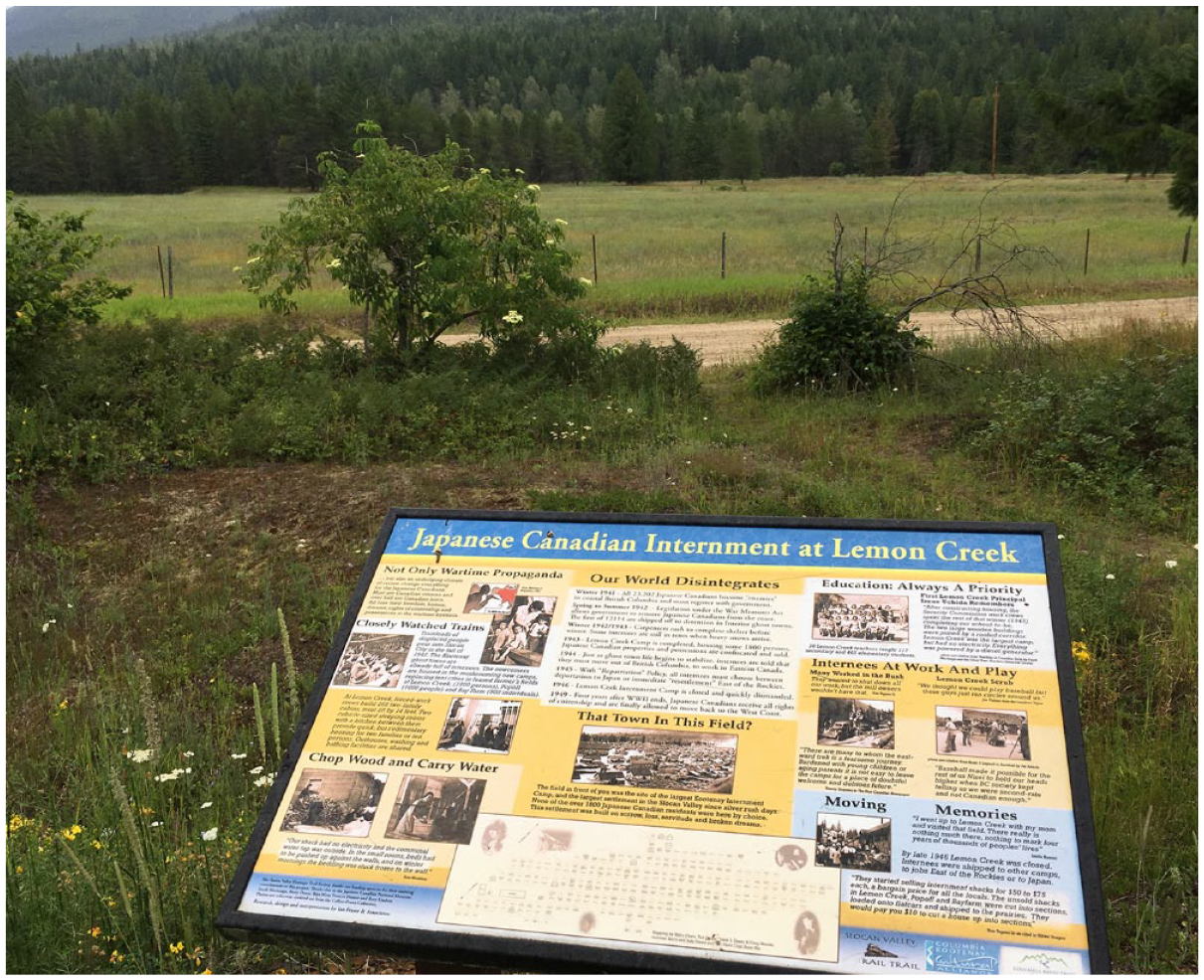
The former site of Lemon Creek Internment Camp.
Reflecting on my notes from that afternoon, it was clear I was trying to untangle the purposes and interpretations of these types of places that now are often characterized only by natural beauty, recreation, and leisure tourism. Of course, this place holds significance for family members and survivors who have direct connections to it, but what of the memory tourists like myself? What are we to understand or experience in visiting a site dominated by material absence and perhaps a yearning for memory’s presence? What are we hoping might be witnessed or experienced? And finally and perhaps most troublingly, what are the ethics of transforming or commodifying these dark tourist experiences into a form of performative and passive empathy as we use them to generate academic knowledge and/or further careers (as in this article)?
Throughout the bus tour, the interactions and significance between place, memory, and identity were made clear by both the tour organizers and the participants. The presence and stories of internment survivors at the sites in particular ensured that a perceived absence and invisibility of the internment era was disrupted. Many of the sites’ meanings and new functions as places of recreation and leisure potentially become troubled, if only temporarily. This disjuncture between the past and the present at these sites does have in my view the possibility to produce a cognitive dissonance among both the tour group, but also possibly the current visitors to these places that can be generative or productive for thinking through the ongoing implications of historical injustice and what it might mean for contemporary understandings of Canadian identity, memory, and place.
In thinking about what narratives of belonging and identity are made present at these sites, it is also important to return to what narratives are made absent or silenced. The history of Japanese Canadian internment in many places has been erased or silenced, but this erasure does not exist in isolation from ongoing settler colonialism erasures of Indigenous presence on the land. The sites we visited were not empty and absent places—formerly internment sites and presently waiting to be developed or settled. They were and are Indigenous homelands. Describing Lemon Creek as an empty field calls to mind the colonial notion of “terra nullius,” or nobody’s land, open for settlement and development. Such thinking continues to erase not just the internment camps from the landscape but also makes absent Indigenous peoples and nations. Memories and histories of Japanese Canadian dispossession and displacement are laid upon settler colonial displacement and dispossession of Indigenous peoples (Ishiguro et al., 2017). These layers of injustice in the landscape both necessarily complicate the story and demonstrate the ways in which the memory of these injustices cannot be separated in their telling and interpretation at historic sites.
While many important stories were absent from the tour, and the absence of those stories was at times glaring, the memories of internment that were co-constructed, placed, and made present through the bus tour were certainly not uniform in nature. The cultural memories shared by Japanese Canadian community members reflected the diverse experiences of those who lived through internment. While the internment era taken as a whole can be seen as a traumatic experience endured by Japanese Canadians, many memories of the camps shared on the bus tour were told with an emphasis on community resiliency and joy. Before each site visit, it was common for an internment survivor to share memories from the internment era using the bus’s public address (PA) system. The survivor’s memories were not about white supremacist policies or cold-hearted racist bureaucrats unquestioningly carrying out state power, those stories were noticeably absent.
Rather the stories were moments of escape, resilience, and community in difficult circumstances. As one descendant of an internment survivor explained to me: “The bus tour is really about community and the resilience of the Japanese Canadian community.” Stories of resilience were also stories of joy. As many of the internment survivors on the bus were young children when they were in the camps, many of their memories revolved around playing with their friends in the wilderness. Survivors who talked about their positive experiences were not diminishing the greater injustice experienced by Japanese Canadians, rather they demonstrated the resilience and presence of the community to rebuild amid unjust and challenging conditions and the complexity of understanding the full internment experience.
Internment survivors on the tour often discussed these memories using the expression “Kodomo No Tame Ni,” which translates to “for the sake of the children” and refers to the fact that many of their positive memories were a product of the sacrifices, suffering, and silence that was endured by their parents and/or grandparents. As one of the tour guides explained to me,
It’s just so mired in layers and layers of complexity. Not every story is alike, you can’t generalize. You just can’t, it’s so hard to generalize. Every town or almost every person you know, has their own personal story of what happened, how it happened and what happened to them. (Interview, 11 July 2019)
This explanation provides a powerful reminder of the folly of trying to generalize cultural memories of the internment era for the Japanese Canadian community, which will always hold multiple layers of meaning, including resilience and trauma. My hope here has been to avoid these generalizations while recounting a small fraction of my own experience and those related to me by other participants.
Discussion and conclusion
The internment era bus tour enacted a wide range of memory practices ranging from survivor storytelling, acknowledgements of injustice and trauma, grieving, voyeurism, commodification of other’s suffering, trauma envy, empathy, and promises of social action. In total, all of these practices co-construct and reinforce powerful cultural memories of the internment era. The bus tour also worked to disrupt any notion that tourists on the trip with no familial or personal connections to internment were outsiders, disconnected from this history. Instead, it aimed to reveal how all of the attendees were implicated in the memory and legacy of internment, which comes with certain obligations and responsibilities.
The bus tour also sought to disabuse the attendees of simplistic or romanticized notions of the experience of Japanese Canadians who were the victims of internment era policies. The bus tour’s organizers and facilitators did this carefully and thoughtfully across the trip providing and curating various examples, experiences, and feelings to communicate a clear message. The driving political and ethical lesson of this trip was to demonstrate how and why a democratic nation-state, that claimed to protect its citizens’ civil rights, was able to remove fundamental protections and persecute a social group during wartime only because of their ethnic origin and racialized identity. While more legal protections and rights have been introduced in Canada since the internment era, the goal of the trip’s organizers was to make clear that the process of dismantling and suspending civil and political rights during societal crisis or emergency remains possible, and that without an emphasis on the history and memory of internment and other similar historical injustices, it also perhaps becomes more likely.
With these hopeful possibilities in mind, it is also important to remember that this type of dark tourism may also lead to the commodification, appropriation, and depoliticization of sites of historical injustice. Dark tourists may see sites of injustice as places to be consumed for social capital, which grant the visitor a form of trauma authenticity, which might then be used to demonstrate some form of cultural or pedagogical authority. Likewise, visits to sites like these can suggest that the historical injustice in question has been adequately and fully redressed, justice has been served, and that the causes of the injustice are no longer contemporary threats. In a time of increasing anti-Asian discourse and state violence and persecution of undocumented immigrants and asylum seekers, these types of trips need to keep to the forefront the ways in which discourses of white supremacy and racism enabled internment to unfold and continue to harm racialized and marginalized communities.
The trip also revealed the tenuous and provisional nature of memory practices that are so reliant on the work of survivors, family members, and community volunteers. As shown through the example of the Lemon Creek Internment Camp, the physical reminders and remnants of internment sites can easily recede, fade away, and lose their power over time. Many farmers’ fields and vacation cabins of BC’s interiors have important stories to tell, but those stories and their implications are not permanently inscribed at these sites. The continuance of cultural memories of internment requires the continuance of memory practices like the bus tour and financial and political support for the memory work of the Japanese Canadian community. This caution about the impermanence of internment sites is not to suggest that these places of memory ought to be turned into permanent national historic sites with commodified and formalized tourism experiences. Rather, it is a reminder and a reflection on how cultural memories of injustice have important ethical, political, and cultural lessons to communicate, but they require committed and implicated visitors to maintain this function.
Footnotes
Funding
The author(s) disclosed receipt of the following financial support for the research, authorship, and/or publication of this article: This article draws on research supported by the Social Sciences and Humanities Research Council of Canada.
