




Abstract
Powerful prosthetic memories of the Titanic story have circulated in popular culture for more than a century and have become the focus of several experiential museums and Titanic-focused heritage sites on both sides of the Atlantic, most notably in Belfast, Northern Ireland, where the doomed liner was built. Drawing on recent field work, this article analyses the ways in which a series of engaging, multisensory and three-dimensional spatial narratives have been deployed within the new Titanic Belfast signature attraction and the surrounding memoryscape to make the absent ship present for visitors once more. These spatial narratives inform an affective heritage approach that focuses, not on the tragedy of Titanic’s sinking, but on feelings of awe and wonder at the scale and grandeur of the great ship, allowing memory managers to tell a celebratory, Belfast-focused origin story for this internationally renowned ‘ship of dreams’.
Introduction
Patently destructible in life, the Titanic has proved indestructible in memory.
Titanic. The name alone conjures vivid images of a placid sea, a hulking berg, and a doomed ship in distress, resolute crewmen ushering women and children into lifeboats as stoic band members reprise their repertoire one final time. For many, the 1912 disaster marked ‘the emergence of the modern world’ – a tragedy that exposed and accelerated growing anxieties about modernity’s technological hubris, even as the ensuing media uproar revealed the power and reach of an emerging global communications network (Biel, 1997: 8; Lennon and Foley, 2000). Almost immediately popular culture went to work on the disaster, spawning an enduring, mythic narrative that has circulated and accreted in prose and verse, paint and pixel, tabloid and celluloid, for over a century now, confirming Maxstone-Graham’s (1992: 9) jest that the ‘indestructible’ memory of Titanic has far surpassed her brief, ill-fated turn as a working ocean liner.
The Titanic phenomenon exemplifies the formation of what Landsberg (2004) has termed prosthetic memory, ‘a new form of public cultural memory’ that encourages consumers to ‘suture’ themselves into compelling historical narratives and achieve ‘a more personal, deeply felt memory of a past event through which he or she did not live’ (p.2). While cinema has done the most to shape our prosthetic memories of the past over the last century, Landsberg suggests that the more immersive, multisensory, and narrative-driven ‘experiential museums’ that have emerged in recent decades have also become powerful vehicles for generating prosthetic memories. Indeed, while more than a century’s worth of literature, artwork, and, especially, film has produced a wealth of prosthetic memories concerning Titanic, this tragic narrative has been increasingly enshrined in a global network of monuments, museums, and heritage attractions – many of which were established or enhanced in 2012 to mark the centennial anniversary of the disastrous maiden voyage, most notably in communities with a tangible historical connection to the world’s most notorious ship.
One such community is Belfast, Northern Ireland, home to the Harland and Wolff shipyards where Titanic and her sister ships were built and launched in the early years of the 20th century. Shipbuilding was Belfast’s signature industry for nearly two centuries and Harland and Wolff was the city’s most prominent enterprise until a recent decline prompted the company to sell off much of its property in the docklands of east Belfast. It was here, in the heart of the former shipyards, that Titanic Belfast first opened its doors in March of 2012 and this signature heritage attraction became a major success story over the ensuing decade, welcoming over seven million visitors to date and generating more than £430 million in direct spending for Northern Ireland (Titanic Belfast, 2023; Young, 2022), while also being crowned the World’s Leading Tourist Attraction in 2016 (Department for the Economy, 2021). Titanic Belfast has also helped rehabilitate east Belfast’s historic docklands into a rebranded Titanic Quarter – a new residential, commercial, and recreational district intended to both celebrate and commodify the city’s rich maritime heritage while helping it pivot to a post-industrial and post-conflict future built on tourism and culture (Alexander, 2014). Titanic is an ideal vehicle for these ambitions, as it offers a familiar, compelling, and highly marketable story that still resonates with international tourists, but which can also be leveraged to foreground a celebratory Belfast origin story focusing on the design, construction and heroic departure of this internationally renowned yet locally built ‘ship of dreams’.
As Strange and Kempa (2003) remind us, however, heritage sites associated with notorious figures and celebrated tragedies are ‘easy to market but tricky to interpret’ (p. 389). Indeed, one of the major challenges facing Belfast’s heritage purveyors is how to make the absent ship present in meaningful and compelling ways for visitors who have come to commune with this potent object of desire. After all, the liner’s broken wreck lies under nearly 4 kilometres of water in the distant North Atlantic, along with many of the authentic artefacts that would serve as the conventional focal point for Titanic-themed heritage displays. Without this material heritage to draw on, Belfast’s memory managers have sought creative ways to ‘perform, texture, and materialize’ (Meyer, 2012) the lost liner for visitors. In particular, they have developed a series of three-dimensional spatial narratives (Smith and Foote, 2017) designed to invoke and venerate Titanic’s (at the time) unsurpassed size and splendour – characteristics that have long been central components of her enduring mythos. In this article, I will explore how these spatial narratives have combined in situ heritage elements, innovative architecture, and new experiential storytelling approaches, both within Titanic Belfast and in key locations in the surrounding memoryscape (Edensor, 1997), to make the absent ship present in creative and tangible ways for visitors, thereby evoking Titanic’s fabled grandeur and honouring her enduring legacy as the epitome of Edwardian Belfast’s shipbuilding prowess.
Making the absent present: spatial narratives and affective heritage
A fascinating literature has emerged in recent years, examining how museums and heritage sites offer visitors evocative experiences through which people, objects, and places of the past are ‘made present in their absence’ (Meier et al., 2013: 426). As Hetherington (2004) suggests, ‘social relations are performed not only around what is there but sometimes also around the presence of what is not’ (p. 159). This ‘presence of absence’ (Frers, 2013: 434) requires what Meyer (2012) terms a ‘relational ontology of absence’ (p. 107), which regards absence ‘not as an existing “thing” in itself but as something that is made to exist through relations that give absence matter. It means seeing absence as something performed, textured and materialized through relations and processes’. Of course, this materiality also implies a spatiality: ‘like a well-placed pause in a speech, [absence] is a material space filled with affect’ (Ott et al., 2011: 217). Hetherington (2003) concurs, noting that ‘the absent has a geography – a surrounding that implies both presence and present’ (p. 1941). Meyer (2012) adds that ‘even though absence escapes – and can only ever be partially and temporarily contained in – certain places, it is within these places and through leaving various kinds of traces that absence comes to matter’ (p. 109). This suggests that places dedicated to materializing absence are culturally important and, as Meyer and Woodthorpe (2008: 139) argue, museums and cemeteries are especially significant places where absence occupies space, noting that ‘both spaces are shaped by – and built upon – a specific practice, that is, the practice of making the absent present’ (see also Goulding et al., 2018).
Making the absent present is especially important at Titanic Belfast, since Titanic herself – rather than the passengers, crew, and even those who designed and built her – is the central character in the narrative and the object of visitor desire. As such, a set of rich and three-dimensional spatial narratives have been created around and within the new attraction to render the lost liner present for visitors in tangible and compelling ways. A term first coined by Azaryahu and Foote (2008), spatial narratives describe how many museums and heritage sites combine ‘a complex configuration of geographic elements including buildings, markers, memorials, and inscriptions positioned with great care to provide a spatial story-line or to capture the key locational and chronological relations of an historical event’ (p. 180; see also Foote and Azaryahu, 2007; Ryan et al., 2016; Yanow, 1998). A burgeoning literature has subsequently emerged, exploring the configuration and interpretive significance of spatial narratives in a variety of commemorative settings, including museums and exhibition spaces (Brasher, 2021; Chronis, 2012b; Reeves, 2018; Rowley, 2020; Smith, 2019; Smith and Foote, 2017; Wineman and Peponis, 2010), heritage plantations (Hanna et al., 2019; Potter et al., 2021), and national military parks (Chronis, 2012a, 2015; Chronis and Hampton, 2008). A crucial element of this approach is to recognize and attend to the three-dimensionality of spatial narratives in heritage settings, as Smith and Foote (2017) underscore: ‘museum discourses – alongside numerous other discursive formations – take place within three-dimensional space. This means that the spatial arrangement, layout, and positioning of these presentations often contribute significantly to their meaning’ (p. 132, emphasis in the original).
Crucially, as Smith (2019) emphasizes, these three-dimensional spatial narratives generate mobile and embodied experiences for visitors, thereby ‘extending the work of memory into bodily performances of moving through exhibits’ (p. 5). This makes museums vivid ‘experiential landscapes’ that ‘engage visitors not only on a symbolic level through the practices of collection, exhibition, and display, but also on a material level by locating visitors’ bodies in particular spaces’ (Dickinson et al., 2006: 29). Spatial narratives thus offer visitors mobile, embodied, and dynamic heritage experiences, making them important vehicles for what Micieli-Voutsinas (2017) has dubbed ‘affective heritage’, where, she argues, ‘the impetus is for visitors to feel meaning as it is produced through embodied encounters with and within memorial spaces’, ultimately producing ‘a kind of “feeling truth” for visitors’ (p. 94; see also Micieli-Voutsinas, 2021; Micieli-Voutsinas and Person, 2021; Waterton, 2014). This chimes with Sumartojo’s (2016) concept of the ‘commemorative atmospheres’ produced by heritage sites, where atmosphere is defined as the ‘dynamic combination of space, sensory experience, affect, individual memory and experience, and the material environment’ (p. 541; see also Schorch, 2013; Waterton and Dittmer, 2014). Ultimately, as Smith (2019) notes, ‘this affective dimension of museum presentation can powerfully enhance visitors’ experiences’ (p. 4), making spatial narratives fundamental vehicles for the forms of affective heritage that experiential museums like Titanic Belfast are keen to offer visitors.
In the remainder of the article, I seek to add to these important discussions by highlighting the three-dimensional spatial narratives deployed around and within Titanic Belfast to make the absent ship present for visitors – thus offering them a dynamic and multisensory embodied experience designed to elicit feelings of wonder and appreciation for Titanic’s vaunted scale and grandeur. To analyse these spatial narratives, I have heeded Smith and Foote’s (2017) call to employ a geographically sensitive discourse analysis exploring how particular heritage narratives are conveyed through three-dimensional museum space (see also Smith, 2019; Yanow, 1998). In particular, I have attended to the ways in which spatial narratives have been authored by Titanic Belfast’s designers and other ‘memory managers’ in this heritage district, drawing largely on the evidence provided in Cattermole (2013) and other souvenir resources available for purchase at Titanic Belfast (Costecalde and Doherty, 2012; Titanic Belfast: City of a Thousand Launches, 2014). In addition, given the embodied, experiential nature of spatial narratives and affective heritage, I have pursued a form of sensory (auto)ethnography (Pink, 2015) during my field work, using my own body as a research instrument (Longhurst et al., 2008; Waterton and Dittmer, 2014; Yanow, 1998) and focusing on the ‘sensoriality’ of my own experiences (Sumartojo, 2016: 543) around and within Titanic Belfast. The majority of this field work was conducted in Belfast in September 2022 and May 2023, while a previous research trip in July 2017 generated abundant field notes and photographs that I have consulted during my analysis, primarily to assess the evolution of these heritage sites and their spatial narratives over the last 6 years.
Making the absent present around and within Titanic Belfast
In order to make the absent ship present for visitors, Titanic Belfast’s design team initially considered constructing a full-scale Titanic replica (or a portion thereof), on the original slipway where she was built. However, this ambitious design was quickly dismissed as both uneconomical and narratively challenging; after all, while Titanic was the largest ship of her day, she had long since been dwarfed by modern cruise ships. Indeed, as Cattermole (2013) notes, ‘to build a full-sized replica revealing the old liner’s true scale might well diminish the great ship and undermine the legend. Though physically overshadowed by her successors, Titanic looms largest in the imagination’ (p. 33). Moreover, chief designer Eric Kuhne was concerned that a replica ship might destroy ‘the vital authenticity of place’ if it were built on the ‘hallowed ground’ of Slipway No. 3 (Cattermole, 2013: 34). Instead, the designers elected to create a more conceptual signature building at the head of the heritage slipways, adjacent to the former Harland and Wolff headquarters, using innovative architectural form and eye-catching materials to pay homage to the site’s shipbuilding heritage. The star-shaped final design features four prominent points, resembling ships’ prows, clad in an interlocking series of faceted aluminium ‘crystals’ and emerging from a central glass core, with a recessed fifth point in glass aligning with the heritage slipways (Cattermole, 2013).
Around Titanic Belfast
These unique and eye-catching architectural details are a main focus of Titanic Belfast’s hour-long guided Discovery Tour, which also highlights the new attraction’s strategic positioning at the heart of an extensive and tangible Titanic memoryscape brimming with place authenticity (Grek-Martin, 2024). In addition, the tour repeatedly accentuates the ways in which Titanic Belfast’s designers deployed carefully calibrated depictions of scale to evoke the lost liner in all of her three-dimensional grandeur, both inside and outside the building. The clearest illustrations of scale are offered from the historic slipways that extend northward from Titanic Belfast to the waters of the River Lagan. Here, the embedded (and, at night, illuminated) outlines of Titanic and her sister ship Olympic offer visitors a clear sense of the lateral scale, proportions, and positioning of the ships as they took shape on these slipways, beneath the massive frame of the Arrol Gantry. Titanic’s outline lies to the left as you approach from Titanic Belfast, and much of her forward third is traced over the exposed concrete of Slipway No. 3, inviting visitors to walk the original ground where the great ship was constructed. In contrast, the sternward two-thirds of the outline is embedded within a new surface of paving blocks and contains a plan of the ship’s upper deck, using a series of carefully placed and appropriately scaled rectangles, circles, and ovals to demarcate the size, shape, and position of Titanic’s bulkheads, funnels, benches, and lifeboats. As one tour guide suggested, this plan marks ‘the only terrestrial place on earth where you could authentically walk Titanic’s deck’, emphasizing not only the slipway’s unparalleled place authenticity but also the sensation that the long-lost ship is present once more on the very site where she was first built.
Meanwhile, the adjacent sternward portion of Olympic’s outline also deploys a three-dimensional spatial narrative to mark a different kind of absent presence – one focused on the victims of the Titanic disaster (Figure 1). Here, visitors encounter an understated yet poignant memorial garden, comprising four sections of slatted timber decking, each alternating with four expanses of turf as one moves towards the stern of the outline. The timber closest to the bow represents the first-class passengers who survived the sinking and made it to the safety of the rescue ship Carpathia’s deck, while the turf immediately behind represents the first-class passengers who perished. This same pattern repeats for second- and third-class passengers, and finally for the ship’s crew, each time with greater proportions of turf installed (Cattermole, 2013). As one moves sternward, then, the human scale of the tragedy is clearly revealed, as a spatial narrative of timber and turf conveys the differential, class-based impacts of the disaster. Nearby, the names of the 1512 victims of the disaster – along with eight workmen who lost their lives during Titanic’s construction – are etched into the tall glass plates that clad the bow blocks embedded within the two slipways, adding to the memorial landscape.
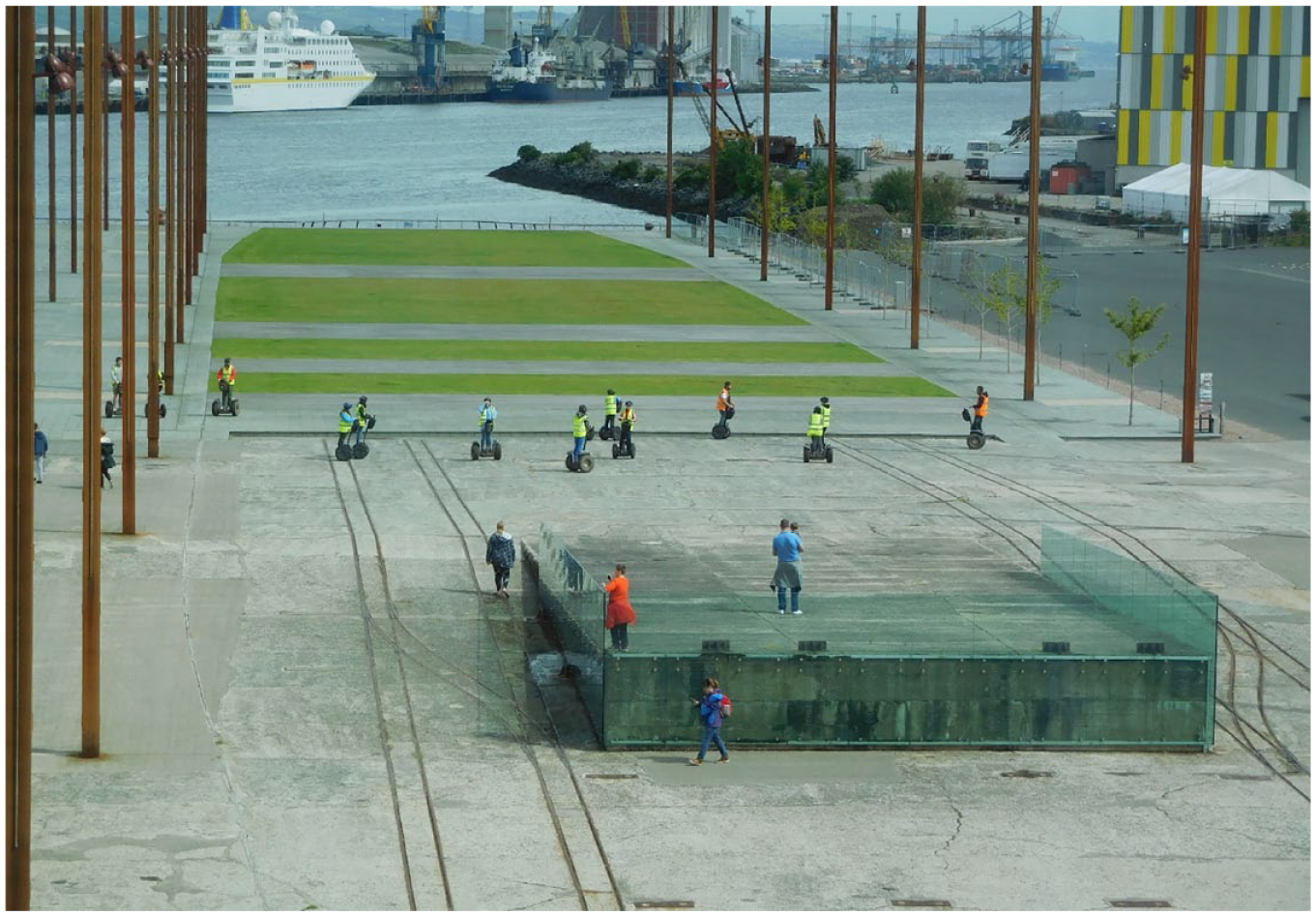
A 2017 view of Slipway No. 2, showing the outline of Olympic. The original surface of the slipway is visible in the foreground, complete with embedded bogie rails and the elevated bow block – now clad in glass panels etched with the names of the Titanic victims. In the background, beyond the Segway tour group, the Titanic memorial is visible, with its alternating pattern of timber decking and turf (representing lives saved and lost, respectively) for (from front to back) first-, second-, and third-class passengers, followed by the crew. Photograph by author.
The guided tours also evoke the vertical scale of these Olympic-class ships – and of the Arrol Gantry that once towered over these slipways – in multiple ways for visitors. From the slipways, guides draw attention to the height of Titanic Belfast, from ground level to the top of the ‘prows’ that extend from the centre of the building, indicating that this distance is equivalent to the height of Titanic from her keel to the Promenade Deck (Figure 2). Guides also highlight the glass windows embedded near the top of the aluminium cladding on both of the ‘hulls’ protruding from the building’s north side, which, we are told, approximate the height of the infamous iceberg above the waterline. The guides’ next point to the rusty metal stanchions arranged in four tidy rows, two on either side of each slipway. These support the light fixtures that illuminate the slipways at night but, at one-third the height of the former Arrol Gantry, they also provide a useful visual yardstick for the structure that once soared over these slipways and which made construction of these immense ships possible. Through the spatial narratives articulated on these guided tours, then, visitors come to appreciate the multiple ways in which the lateral and vertical scale of Titanic and her sister ships have been overtly incorporated into the material landscape of the slipways and the physical form of Titanic Belfast itself in order to render the absent present once more.
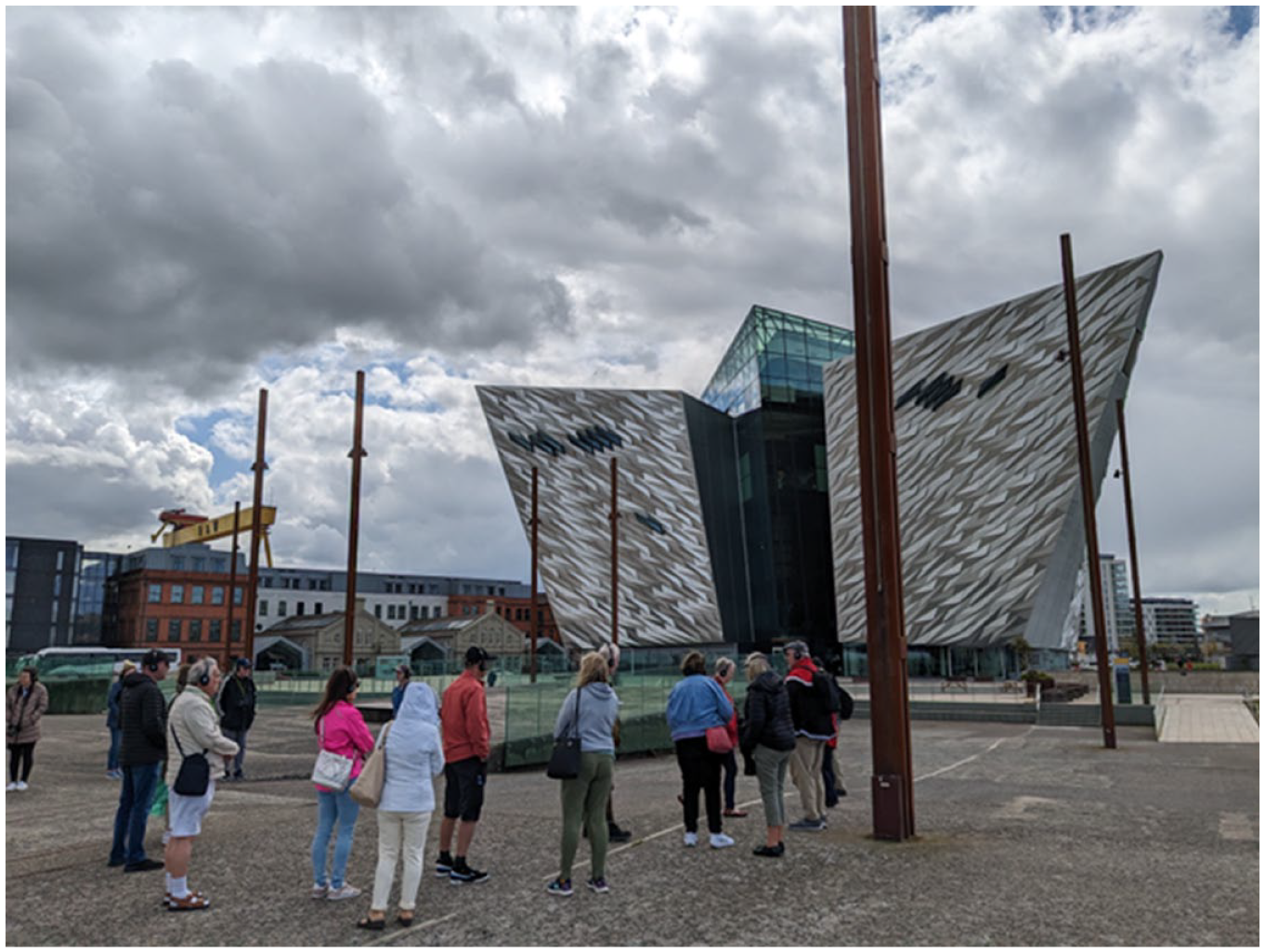
A guided tour at the edge of Slipway No. 3, with two of Titanic Belfast’s aluminium-clad ‘prows’ visible in the background and the former Harland and Wolff Headquarters beyond. Also visible are several light stanchions, which stand at one-third the height of the Arrol Gantry that once towered overhead. Photograph by author.
Other elements of spatial narrative can be found in the exterior plaza immediately surrounding Titanic Belfast. Most notable is an extensive map of the northern hemisphere covering the entire exterior plaza and centred on the ornate compass rose embedded within the floor of Titanic Belfast’s interior public atrium. The map is oriented so that Belfast is depicted near Slipway No. 3 and an inlaid track traces Titanic’s initial journey to Southampton before inscribing her maiden voyage with stops at Cherbourg and Cobh. Further on, a small, engraved plate inscribed with latitude and longitude coordinates marks the sinking location, beyond which a dashed line completes what would have been the remainder of the journey to New York. As such, the map tells a spatial narrative in its own right, documenting Titanic’s brief existence after departing Belfast on 2 April 1912. The scene is completed by a series of square and rectangular wooden benches intentionally positioned throughout the plaza, representing the dots and dashes of the morse code message ‘CQD CQD SOS SOS CQD DE MGY’: the distress code transmitted as the ship sank in the early hours of 15th April, combining the old maritime distress signal CQD with the newly adopted SOS, along with Titanic’s call sign MGY (Cattermole, 2013). Such details are easy to miss at ground level, however, so guides make sure to point them out during the tour, either by moving visitors across the plaza itself or by taking them to an elevated vantage point on the third floor of Titanic Belfast, where massive windows afford a commanding view of the spatial narrative inscribed in the plaza below.
A similar sense of three-dimensional scale is provided to visitors who take the time to follow the riverside pathway north from the historic slipways to the Thompson Graving Dock. Completed in 1911 and built to accommodate the great length of the Olympic-class ships, this dry dock is, in part, where Titanic was fitted out in preparation for her maiden voyage. As such, this heritage site was also considered a strong potential location for the new signature project early in the design process, with some considering it a more appropriate location than Slipway No. 3, since it was here that Titanic took her final form. Eager to unlock the narrative potential of this authentic heritage element, the design team envisioned a full-scale replica ship resting on the dock floor, with a partial replica of the Arrol Gantry overhead. A different design looked to convey Titanic’s size by installing a full-scale ‘ghost ship’ light sculpture within the dock, comprising an illuminated cage of light-emitting diode (LED) strips outlining her hull and superstructure (Cattermole, 2013). As with the early plans to build on the historic slipways, however, the design team decided that these replica attractions would prove too expensive, too underwhelming, and too disrespectful of the authentic place heritage still palpable at the Thompson Graving Dock. Ultimately, the dry dock and adjacent pump house remained a separate, unaffiliated, and somewhat neglected heritage site once Titanic Belfast took shape further up the harbour.
Nonetheless, the Thompson Dock has come to be promoted (occasionally under the moniker ‘Titanic’s Dock and Pump-House’) as a key element of the Titanic Quarter memoryscape over the years, since this massive excavated dry dock offers another way to appreciate the three-dimensional footprint and volume of Titanic and thus make the absent ship present for visitors. Guided tours have been sporadically offered by various heritage purveyors over the years, most recently by Titanic Distillers, who have opened a whiskey distillery in the pumphouse and who now offer tours of the dock as either a stand-alone, hour-long heritage experience or as a component of one of their packaged distillery tours. In May of 2023, I took part in one of their first tours of the dock and our guide explicitly emphasized a three-dimensional spatial narrative to underscore Titanic’s historic connection to this site and to make the absent ship present for participants. We were initially led around the upper tarmac apron encircling the recessed dry dock below, stopping at various heritage signs installed along the tour route. Many of the signs incorporated historical photographs of the Olympic-class liners lying within or being manoeuvred into the dry dock – most often Olympic, since she was built first and because her longevity meant she made greater use of the dry dock over the years. Our guide made repeated reference to these photographs to emphasize the great length and towering height of the Olympic-class liners, noting how they utterly filled the dry dock cavity and towered high above the upper apron on which we stood. Moreover, these signs were carefully positioned to approximate the vantage point of the original photographer, prompting us to conjure the absent liner by visualizing Titanic resting in the dock before us (Figure 3).
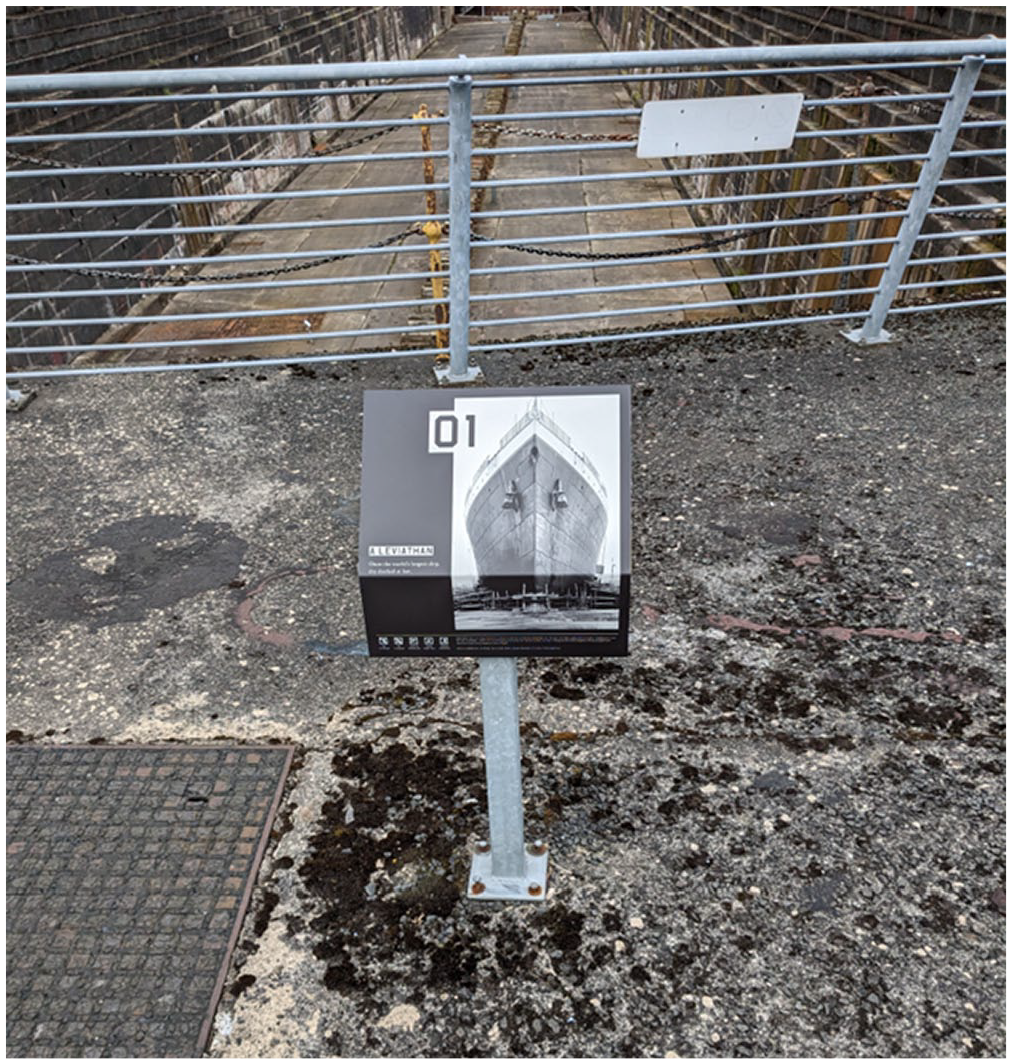
A tour sign positioned at the head of the Thompson Graving Dock, near the location where the embedded historical photograph of Olympic (not Titanic) was taken. The caption reads, ‘A leviathan: once the world’s largest ship, dry docked at last’. While misleading this is technically correct: Olympic was briefly the world’s largest ship until surpassed by her younger sister. Photograph by author.
With these beguiling historic images still fresh in our minds, we descended the six flights of stairs (44 feet) to the floor of the dry dock itself, where the engineering prowess required to carve out and regularly drain this massive subterranean space could be truly appreciated. Next came the embodied experience of following the long row of original keel blocks down the 850-foot length of the dry dock, pausing only to register a sign showing Olympic’s dark hull propped up on these very blocks and looming over the concrete floor on which we stood. The guide’s commentary diminished as we advanced, allowing a more contemplative experience as our movements generated a visceral appreciation for the immense, three-dimensional scale of the Olympic-class liners that once filled this cavernous space. By the time we reached the mossy and water-stained end wall, I could fully understand why this capacious dry dock has been marketed, not only as the ‘site where Titanic last rested on dry ground’, but also as the place where visitors can fully ‘absorb the authenticity of her physical footprint in history’ (Titanic’s Dock and Pump-House, 2021). Perhaps even more than the historic slipways, then, the Thompson Graving Dock offers visitors an embodied experience whereby the lost liner can be imaginatively encountered in her full, three-dimensional grandeur.
Within Titanic Belfast
Efforts to make the absent ship present in tangible, three-dimensional, and scale-specific ways are also apparent inside Titanic Belfast. Entering the building, the visitor’s eye is first drawn to the massive feature wall framing the east side of the soaring atrium. Comprising acid-treated, orange and black steel plates installed in horizontal courses, the wall is meant to evoke the ship’s rust-coated hull during initial construction (Cattermole, 2013). This feature wall overhangs a portion of the ground floor and forms a substantial ceiling for the ticketing area and gift shop. Indeed, the overlying hull appears to be propped up by the ticket booths themselves, rendered as thick, blackened timber boxes resembling the keel blocks that once bore the considerable weight of Titanic and her sister ships. While the feature wall defines the east side of the atrium, its western side contains several escalators and elevated walkways that pay homage to the narrow gangways that once traversed the Arrol Gantry. Beyond its eye-catching design, the atrium is also intended to offer guests ‘a tangible sense of Titanic’s scale’, as this tall, narrow void has been created to signify the space between the hulls of Titanic and Olympic as they took shape beneath the gantry (Cattermole, 2013: 103).
Titanic Belfast’s main attraction is the ‘Titanic Experience’, which encompasses 10 galleries over four floors. In contrast to an object-focused museum, this is a narrative-driven experience (Cattermole, 2013) designed to make the absent ship present in a rich and immersive way in order to tell a compelling, Belfast-focused Titanic origin story. Indeed, the first and largest gallery, Boomtown Belfast, is dedicated to manifesting the city’s industrial glory days as context for the Titanic-focused narrative to come. Here, visitors stroll through a projected, sepia-toned Edwardian streetscape bustling with activity, as shadowy silhouettes march across historical photographs and film reels – some undoubtedly on their way to work at the Harland and Wolff shipyards. Visitors eventually follow, progressing through a set of original shipyard gates and entering a scaled-down replica of the firm’s drawing offices. Here, a sequence of Titanic deck plans is projected on the floor, evoking the space of the mould loft, where to-scale chalk drawings of the Olympic-class ships were inscribed on the floor in order to fine tune the designs. From here, visitors follow a passageway to reach the bottom of a tall shaft framed in riveted steel scaffolding. Benches, tools, and workmen’s caps are positioned to represent a ground-level workstation beneath an ersatz Arrol Gantry. Nearby, a pair of elevators carry visitors three stories upwards, to wooden gangways positioned near the top of the replica gantry. Simulated steel girders overhead and alongside the walkway add to the atmosphere, as do the massive reproductions of period photographs taken from the top of the gantry, which fill the outer walls of the space. From this elevated position, visitors can peer over the railing to the workstation they encountered below, although, as the audio guide emphasizes, this distance represents only a quarter of the original gantry’s actual height.
Visitors have now reached Gallery 2 – The Shipyard – with its central focus: the shipyard ride. Six-seater gondolas hang suspended from a motorized track, carrying passengers on a low-speed journey through a darkened simulation of the yard during Titanic’s construction. Making full use of two floors, the gondolas descend into, sweep through, and climb out of the shipyard, while voice actors with distinct working-class Belfast accents narrate the various scenes. The goal is to showcase the considerable labour required for Titanic to take shape and the ride employs a combination of three-dimensional dioramas and projected video reenactments to show key facets of the work, including scenes of the ship’s framing being bent into shape and red-hot rivets being hammered into place by teams of riveters. Beyond the narration, the ride offers a raucous soundscape of clanging and hammering, along with blooms of heat, blasts of air, and the gentle jostling of the gondola to complement the scene at appropriate junctures. As a result, some of the facts conveyed by our narrators are easily lost amid the cacophony of the shipyard’s soundscape but these details are elaborated at length and in more conventional museological ways in the next section of the gallery. The source of considerable critical ire for its ‘disneyfied’, ‘edutainment’ approach to heritage (Neill et al., 2014), the ride nonetheless offers visitors a fully immersive, embodied, and multisensory experience designed to convey a feeling for the scale and vibrancy of the shipyard (Bauer, 2015). The ride also provides visitors with their first proper encounter with Titanic inside the exhibit space, as replica framing bars, hull plates and rudders begin the work of making the lost ship present once more, rendered as a massive, complicated feat of engineering and skilled craftsmanship.
Visitors next enter Gallery 3, the smallest of the 10 galleries and the one most devoted to underscoring the attraction’s place authenticity for visitors (Grek-Martin, 2024). The gallery’s objective is to recreate the ebullient mood of Titanic’s launch day on 31 May 1911, when large crowds gathered to watch the new liner – at this stage still an empty shell – slide the length of the great slipway and enter the River Lagan for the first time. As an audio reenactment of the festivities is piped into the room and as large screens on either wall project animations of the launch, visitors are drawn to the floor-to-ceiling windows framing extensive views of the historic slipways four stories below, where the outlines of Titanic and Olympic are clearly discernible. In addition, the floor of the room is covered in a historical map of the Belfast docklands as they looked in 1911, with the portion depicting the Harland and Wolff shipyards also reproduced on the surface of a large table standing in the centre of the room, which serves as an elevated inset map to offer visitors a closer look at the heart of Belfast’s shipbuilding industry. Rendered in charcoal resin, several low, raised rectangles have been added to the elevated map’s two-dimensional surface, highlighting Harland and Wolff’s extensive network of machine shops, plating sheds, and other infrastructure at the time of Titanic’s creation. Overshadowing all other map elements is a clear resin scale model of the Arrol Gantry encasing a model of Titanic’s hull, ready for launch from Slipway No. 3. Immediately adjacent sits a white resin scale model of Titanic Belfast, anachronistically inserted into this representation of the 1911 shipyard to remind visitors that they are standing on the very threshold of Titanic’s place of birth. Beyond emphasizing Titanic Belfast’s place authenticity, however, these scale models allow visitors to easily compare the height of the building to both the Arrol Gantry and to Titanic herself, thereby reinforcing the three-dimensional spatial narrative provided by the tour guides outside and thus encouraging another imaginative invocation of the absent liner, this time focusing on how she would have appeared on her celebrated launch day (Figure 4).
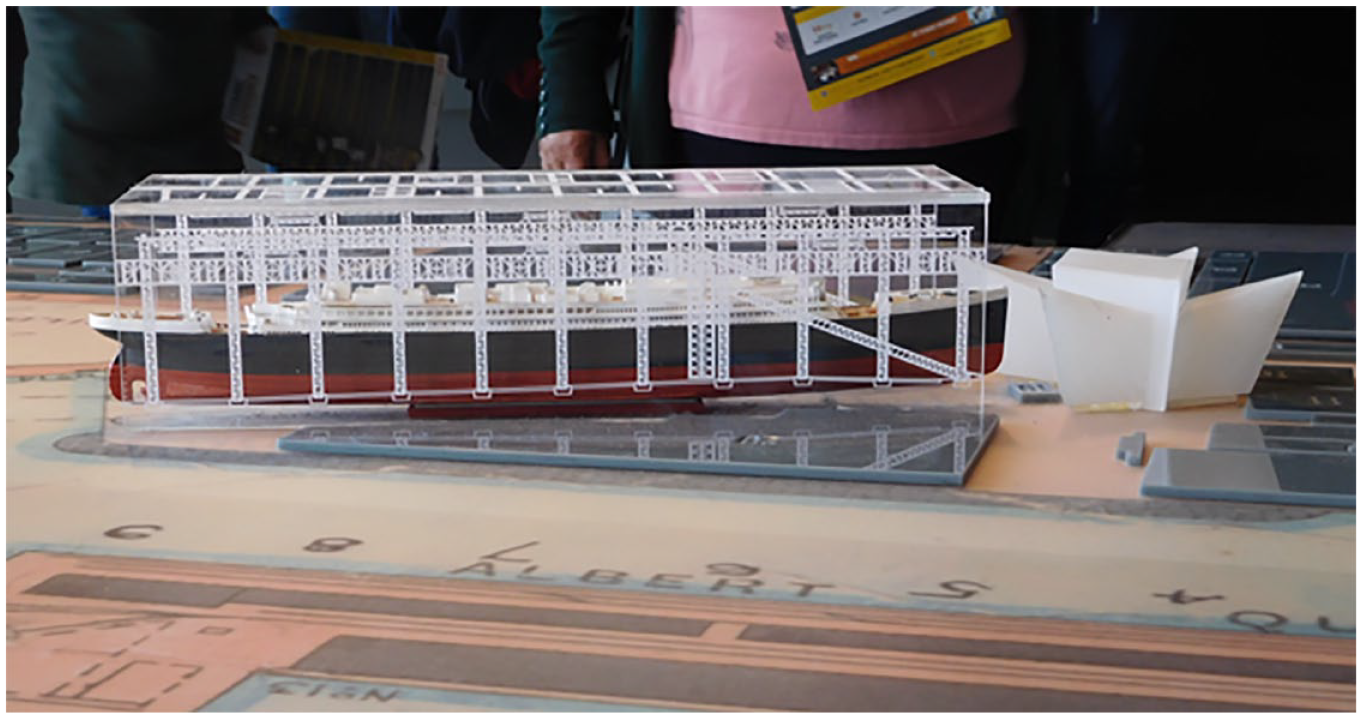
A table-top map of Harland and Wolff’s shipyards in 1911, positioned at the centre of Gallery 3, within Titanic Belfast’s ‘Titanic Experience’. A scale model of the partially completed Titanic rests beneath the Arrol Gantry, with Titanic Belfast anachronistically positioned at the head of the Olympic-class slipways. Photograph by author.
As visitors progress to Gallery 4, the spatial narrative pivots away from an emphasis on the engineering prowess and shipyard elbow grease that produced Titanic’s colossal shell on Slipway No. 3. Here, the focus shifts to the extensive fitting out process undertaken after the ship’s launch, as the yardmen completed the inner workings and interior refinements that gave rise to Titanic’s enduring reputation for stateliness and grandeur. One of Gallery 4’s main attractions is the digital animation cave, offering a 4-minute, drift-through tour of Titanic’s interiors, from engine room to bridge, projected on a three-sided, wrap-around screen and accompanied at turns by the sounds of thumping engines, silverware clinking, and the cries of gulls as you emerge on the Boat Deck. This animation provides visitors with their first experience of Titanic’s renowned opulence, an impression reinforced by the replica samples of beautifully crafted wood panels, carpet swatches, upholstery and more found throughout the rest of the gallery, most of which can be touched to provide a haptic experience for visitors.
The gallery’s literal and symbolic centrepiece, however, is a large, free-standing glass cube, divided into three unequal compartments. The largest compartment contains a full-scale replica of a first-class cabin appointed in the Old Dutch style (one of several themed options for first-class passengers). The replica second-class cabin, meanwhile, is depicted as the quarters of bandmaster Wallace Hartley, complete with musical accompaniment piped in from recessed speakers above. The final compartment contains a replica third-class cabin and includes a projection of a young woman sitting on top of the bunk bed inside, mending an article of clothing. Signs highlight the amenities contained within each cabin, while also emphasizing that Titanic’s accommodation options were more spacious and comfortable than comparable quarters on rival passenger liners. By providing tangible and authentically detailed reproductions of these cabins, Gallery 4 thus evokes the impression of a well-appointed and welcoming inner sanctum for each of Titanic’s passengers, regardless of their social status. Yet, what makes this installation most interesting is its attention to scale: by reproducing all three cabins within the footprint of the same glass cube, visitors can circle the installation and comparatively assess the size of each cabin as a proportion of the whole. Indeed, attentive visitors may discern that the first-class cabin is as large as the other two cabins combined, while the second-class cabin is itself a third larger than the adjacent third-class cabin. Thus, in one efficient installation, the spatiality of Titanic’s well-known class distinctions is underscored for visitors – distinctions that would ultimately play a large role in determining who survived and who perished on the voyage to come.
The shift from Gallery 4 to Gallery 5 marks the moment of Titanic’s departure from Belfast and the start of her maiden voyage. From this point, the tone of the narrative changes from an unrelentingly celebratory Belfast origin story to a more reflective and solemn account of the sinking and its aftermath – an account I will analyse in detail in a subsequent paper. Not surprisingly, the spatiality of the narrative changes accordingly, with far less effort made in the remaining galleries to call forth the absent ship in all of her grandeur and glory. Still, there are a couple of notable moments where this approach reappears. The first comes in Gallery 5, which narrates Titanic’s maiden voyage and includes a truncated replica of the First-Class Promenade Deck, complete with shuffleboard, ornate benches and projected sea views beyond the railing. The menu for a first-class luncheon is posted on the wall behind, along with a window into the Palm Court, where a projected attendant is ready to wait on patrons. Here, visitors are offered another embodied and three-dimensional engagement with a familiar and coveted area of the ship, where first-class passengers could enjoy the invigorating sea air before retiring to the warmth and conviviality of the adjacent café. Yet, the celebratory mood of the early galleries has been replaced by something decidedly more pensive and foreboding; here, ‘at sea’, visitors know that the story is about to take a tragic turn, and many are subtly bracing for what is to come.
Unsurprisingly, there is no meaningful attempt to make the absent ship present in the next three galleries, which address the sinking and its aftermath. Yet, it is also clear that these galleries are not especially focused on rendering the absent victims of the disaster present for visitors. Indeed, while the names of all survivors and victims are projected on the two-story wall at the back of Gallery 6 and while touchscreens nearby allow visitors to access a database with information about individual passengers, only a few cursory details concerning the fate of only a handful of victims are highlighted within the interpretive panels at the end of the gallery, which are otherwise devoted to explaining how news of the sinking spread and how recovery efforts were coordinated. This dispassionate treatment makes clear that the stories of individual victims are not the narrative focal point of these galleries.
With the sinking and its political fallout addressed, Gallery 9 offers visitors their final opportunity to come face to face with the absent ship once more. Until a recent gallery re-fresh made substantial changes to the layout and narrative in the final third of the Titanic Experience, Gallery 9 focused on Robert Ballard’s 1985 discovery of, and subsequent dives to, Titanic’s wreck. This aspect of the story was presented through an elevated theatre where visitors could watch footage of one of Ballard’s dives projected on a two-storey screen. A staircase led to the lower floor of the theatre, where visitors could stand on a large glass floor and watch float-over footage of the wreck’s bow and tail sections shot by Ballard and his team. When taken together, the film and the float-over footage offered visitors rare glimpses of Titanic on the ocean floor – another way in which the absent ship was made present at Titanic Belfast. Notably, this footage was presented, not as a source of sorrow, but as a source of excitement and wonder, placing appreciative emphasis on the evolving science of oceanographic exploration as a means to locate and commune with the great ship once more.
Thanks to an extensive gallery re-fresh in the Winter of 2023, however, the content and configuration of Galleries 7 through 9 have been altered considerably. Robert Ballard’s extensive quest to find Titanic is now the focus of Gallery 8, which celebrates both the man and the mission through a detailed chronological sequence of text, video and interactive display. This sets the stage for a completely reimagined Gallery 9, now focused on Titanic as ‘The Ship of Dreams’ – a moniker made famous by a pivotal line in James Cameron’s 1997 blockbuster film. The two-tiered structure of the gallery has been maintained but the theatre has been replaced by a small upper landing and a winding staircase carrying visitors down to a collection of newly acquired and noteworthy Titanic artefacts displayed on the lower level, as projected images on the surrounding walls tell a condensed version of the Titanic story. These visuals are accompanied by a moving musical score that embraces the changing emotional beats of the narrative while perpetually resolving to a celebratory melodic denouement that reflects the overarching commemorative atmosphere of Titanic Belfast as a whole.
I will have more to say about the affective heritage deployed in this revamped gallery in a subsequent paper, but I wish to conclude by focusing on two pivotal elements that underscore the theme of making the absent ship present. The first is the glass floor, which, tellingly, has been retained in the new gallery. Indeed, as before, visitors can position themselves above the same float-over footage of the wreck, watching as first the bow and then the stern sections drift into view below. This view from above is crucial because it offers visitors the sensation that they too are drifting with the currents and floating slowly over the wreck – a virtual yet peculiarly embodied experience made all the more poignant by recent events, where the implosion of the Titan submersible serves as a reminder that the unforgiving conditions of the deep ocean mean that this is as close as most people can reasonably expect to get to Titanic’s haunting remains. Meanwhile, a giant scale model of the ship has been suspended from the ceiling of the revamped gallery. Extending 7.6 metres and rotating 360° in the space of 90 seconds, this replica liner dwarves the more conventional models found earlier in the exhibit and at other Titanic heritage sites. The model is an integral part of the narrative being conveyed on the surrounding screens and through the accompanying soundtrack, using coloured LED lights to match the palette being projected on the walls and to highlight different aspects of the ship – the boiler rooms, the passenger cabins, the damaged starboard hull – at appropriate points in the narrative. Crucially, as a massive, three-dimensional model suspended and slowly spinning in the very centre of the room, this replica ship can be surveyed by visitors from many angles as they descend the spiral staircase and move about the gallery space, eventually replacing a bird’s eye view of the funnels and upper decks with an unsettling angle of the ship from below. This encircling journey thus produces an embodied sensation of extended encounter with the lost ‘ship of dreams’ – a final opportunity to feel the absent ship’s presence within the climactic narrative heart of this reimagined Titanic Experience.
Conclusion
Dwarfed though it would be by today’s passenger liners, Titanic nonetheless looms large in the collective imagination still (Cattermole, 2013), as the enduring symbol of both Edwardian grandeur and melodramatic tragedy. The Titanic mythos thus poses a double challenge for Belfast’s memory managers: on one hand, the tragic tale of her sinking remains internationally resonant more than a 100 years after the fact, drawing tourists to the city, yes, but also requiring a heritage approach that acknowledges the tragedy while also highlighting a more celebratory Belfast origin story (Grek-Martin, 2024). On the other hand, the sinking also deprived Belfast of the opportunity for a tangible Titanic homecoming, requiring the city’s heritage planners to devise compelling spatial narratives that allow this absent ‘ship of dreams’ to be imaginatively perceived once more in the venerated place of her birth. Yet, unlike most difficult heritage sites, where spatial narratives attempt to call forth absent people and key events, Titanic herself is the object of tourist desire in Belfast and this has challenged local memory managers to develop spatial narratives on an unprecedentedly grand scale in order to make the absent ship present once more for visitors.
Moreover, what makes this Belfast case study unique is the recent addition of a new-build, signature tourist attraction in the midst of an extensive memoryscape filled with authentic heritage sites, each claiming a meaningful association with the world’s most famous ocean liner. While there has been no coordinated, master spatial narrative imposed on all of these heritage elements, each in its own way attempts to make the absent ship present for visitors in a manner that evocatively reinforces her fabled size and majesty. Because of the profound three-dimensionality, vast aerial extent, and diverse multi-platform structure of this shared spatial narrative, this study highlights the importance of scale when considering the power of spatial narratives in heritage settings. For instance, while it is certainly true, as Smith and Foote (2017) assert, that all spatial narratives unfold in three dimensions, it is nonetheless clear that the scale at which such narratives have been constructed within Titanic Belfast and accentuated in the surrounding memoryscape far surpass what is found at most other heritage sites. Inside the building, architecture and technology combine to immerse visitors in an immense, multi-story diorama of the working shipyard, before offering them engaging encounters with life-sized passenger cabins, an ersatz promenade deck, and one of the largest and most sophisticated scale models of the lost liner ever built. Meanwhile, the authentic heritage sites surrounding the new attraction offer visitors equally compelling opportunities to apprehend the considerable scale of Titanic and her sister ships. Whether pausing on the floor of the Thompson Dry Dock to appreciate the substantial volume of the Olympic-class ships it was built to contain, or using the roofline of Titanic Belfast itself to visualize Titanic’s great height as she was launched from Slipway No. 3, visitors are repeatedly and meaningfully invited to conjure the full extent, height, and volume of the absent ship in their minds.
Crucially, this distributed spatial narrative does not unfold solely within the confines of an interior museum experience, or as a guided tour, or as a sequence of interpretive panels along a heritage trail. Instead, it combines each of those elements into something experientially dense yet spatially diffuse; something embodied and multisensory yet narratively coherent; something historically patinaed yet architecturally avant-garde and technologically mediated; something palpably authentic yet quite consciously simulated. Given these nuances, Titanic Belfast must be considered the epitome of what Dickinson et al. (2006) call a ‘diffuse’ rather than ‘discrete’ heritage text (p. 29; see also Grek-Martin, 2024). And, while a number of critics feel that this new signature attraction’s ostentatious design and ‘disneyfied’ approach to experiential storytelling has ‘coarsened the texture of memory’ within this preexisting heritage landscape (Neill, 2014: 73; see also Coyles, 2013; Hodson, 2019; Neill et al., 2014; Ramsey, 2013), this wide-ranging and emotionally resonant approach clearly works for many visitors, illustrating the capacity of spatial narratives to be scaled up to Titanic proportions in order to render even the grandest lost objects of desire ‘present in their absence’ (Meier et al., 2013: 426).
Footnotes
Funding
The author(s) received no financial support for the research, authorship, and/or publication of this article.
