




Abstract
This article studies the interrelations of memory work and activism in the Iranian context by focusing on the way remembering victims of state violence informs political activism. Due to constant repression, the recurrence of state violence and the criminalisation of oppositional activities and non-conforming lifestyles, the Iranian context is saturated with contentious memories that cannot be brought into public space. Oppositional memory work, especially regarding the victims of direct state violence, has thus become dangerous, counts as defiance and requires alternative spaces for taking shape. This article maps out and explains how activist memory work in this context entails carving out activist memoryscapes and intertwines personal suffering with acts of remembering the other and how memory is used as a resource in broader modes of oppositional politics, justice-seeking and endeavours towards social change. Examples of activist memory work in the Woman, Life, Freedom protests, a short documentary film and a commemorative exhibition are analysed in the article to showcase the different mnemonic dynamics at stake and to highlight the importance of mediation and cultural forms in the formation of activist memory work.
Keywords
Introduction
How is memory shaped, activated and utilised under constant repression? How do the dynamics of remembering and forgetting play out in societies with recurring phases of state violence, where there is too much to remember and where there are too many to seek justice for? This article addresses these questions by focusing on the role that the memory of victims of state violence plays in political activism in Iran, where public secrets and silenced memories of unredressed injustice abound, and alleged perpetrators are in positions of power. The article explores how victims of direct state violence are remembered under repression and how their memory is mobilised in political contention with causes broader than justice-seeking for the victims. I argue that while constant repression and the criminalisation of non-conforming civic engagements in Iran have rendered memory work dangerous and high risk, memory has nonetheless been put to work as ‘transformative in and of itself’ (Gutman and Wüstenberg, 2022: 1075) and has led to various types of mobilisations, turning into ‘activist memory work’. The persistence of justice-seekers and activists, the growth of an expanding, widespread Iranian diaspora and the potential of digital media are significant drivers in this process and have created spaces for activist memory work to take shape. Two recent examples of activist memory work are analysed to provide a concrete basis for the argument: She Remembers, a short documentary film (2019), and Memories Left Behind (2023), an exhibition.
The evolving, complex and diverse entanglements of memory, protest and justice-seeking in Iran provide an extremely rich field for looking at how activist memory work, however firmly tied to grief and suffering, can be geared towards hope and future-making. A crucial aspect here is the fact that the Iranian context is not post-conflict or in the phase of transitional justice but showcases a hope for going past state violence ‘in the interim’ and not after the fact. Therefore, it provides a hands-on and unique example of memory regarded as a resource for forming hope as ‘an anticipatory logic’, based on ‘mere possibility’ that ‘indicates an enduring attachment to something of value in the face of its present absence and past denial’ and ‘informs civic action and motivates the struggle for a better life’ (Rigney, 2018: 370–371).
Despite the differences and specificities of the Iranian context, which will be touched on in the next section, it is important not to consider it to be an exception but rather as an extreme example in which more widespread activist and mnemonic practices play out. By looking at mobilisations of memory in Iran, it becomes possible to test the viability of notions that are mainly developed in relation to democratic states and challenge and expand their analytical vigour. The Iranian context is underrepresented in the studies on the memory–activism nexus (Rigney, 2018) generally due to the ‘basic problems of inequality and the reproduction of existing knowledge structures in memory studies’ (Gutman and Wüstenberg, 2023: 10), and more specifically due to the country’s specific position in the region which even makes it fall outside of studies on the Middle East where the focus is mainly on ‘Mashriq’, namely, Arab countries (see Nikro, 2023). Moreover, an analytical and systemic view of the complex dynamics of resistance and remembering in the Iranian context is much needed regionally to better connect the Iranian struggle for social justice to broader frames of political contention. With this article, I thus seek to find a middle ground for understanding activist memory work in Iran within the frame of global and transnational studies on the memory–activism nexus.
Throughout the article, I use the phrase ‘the Iranian context’ as a dynamic, broad and intentionally vague frame that blurs strict geopolitical borders. What I mean by ‘the Iranian context’ encompasses Iran as a recognised sovereign state and its residents – who might or might not consider themselves as Iranians or might or might not be officially documented as such – the Iranian diaspora and the digital activities of those affiliated to Iran, in one way or another. The article is also shaped by my own positionality as a Persian-speaking, female Iranian citizen, with no direct connection to repressed ethnic nations and communities, residing in the diaspora. As Jelin (2003) states in her study on repression and the labours of memory, ‘the researcher cannot avoid being involved, incorporating his or her subjectivity, experience, beliefs, and emotions, and incorporating as well his or her political and civic commitments’ (p. xvi). In the same vein, many of the descriptions and propositions of this article have an autoethnographic quality. I am by no means a neutral bystander and have been an active, ordinary agent in some of the protests and an ‘implicated subject’ (Rothberg, 2019) in sufferings that I have been exempt from, mostly due to my not being part of an ethnic or religious minority and my living in the diaspora. A crucial aspect left out of this article, due to my linguistic and cultural limitations, is the rich heritage of activist memory work and political contention by repressed nations and communities in the region, most notably the Kurdish resistance. Still, I hope this article marks a first step towards further joint and intersectional studies that can capture the diversity of these dynamics, heritages and discourses more comprehensively.
In what follows, I will first contextualise activist memory work in the Iranian context by discussing the relations between state violence and memory that render oppositional memory work a dangerous task to take up. In the second section, I lay out the main body of my argument, which is to recognise and conceptualise ‘carving out spaces of remembrance’ and ‘remembering the other’ as the two main dynamics of activist memory work in the Iranian context. This section includes further historical contextualisation and short discussion of examples, as the reader might not be familiar with many of the article’s historical references. It is, however, crucial to emphasise that the aim of the article is not to provide a comprehensive historical outline of repression and activist memory work and it should not be read as such. I dig deeper into the discussed mnemonic dynamics by analysing my two cases in the third section and present a short comparison of the two, before closing with some final remarks in the conclusion.
Remembering as dissidence: dangers of remembrance under repression
In Politics of Mass Violence in the Middle East, Robson (2020: 7) argues that violence has historically been a constitutive part of the statehood over the pluralistic populations of the region. While Robson’s study mainly concerns the Arab countries of the Middle East (Mashriq), her broader argument also seems relevant to Iran, which has been affected by various forms of overt and covert state violence in different historical periods. This includes the period since the 1979 revolution and the establishment of the Islamic Republic (IR) that is the focus of this article. What can be identified as state violence ranges from direct political violence, like the elimination and displacement of citizens, to structural inequalities, like the implementation of citizen surveillance technologies (see Merrill, 2024) and the state’s exit from the provision of social services (Torres, 2018: 318–382).
Violent repression of social protests, the murder of dissidents and the execution of political prisoners are a few examples of direct violence in the Iranian context. In addition, various types of ‘slow violence’ (Nixon, 2011), that is, gradual and often invisible violence, are imposed on citizens of the country via, for example, the criminalisation of non-conforming lifestyles (e.g. not wearing hijab for women) and the denouncement and repression of identities and ways of being (e.g. the LGBTQIA+ community). The recurrence of such violence in its diverse forms is further intensified by various modes of censorship, leading to forgetting as ‘repressive erasure’ (Connerton, 2008: 60), which raises the cost of addressing memories of violence. The accumulation of suffering and unredressed injustice that has resulted from this multi-layered repression feeds a constantly growing anti-establishment desire for social change that determines the way activism is conceptualised and practised.
In her work on political and social activism in Iran, Rivetti (2012, 2017) argues that in response to the state’s repression and securitisation, political and social activism has moved towards informal, fragmentary and individualised modes of activism that depend on the initiatives of individuals and small groups rather than recognised structures of social protest. Such ‘agentic activism’ (Fridman, 2022: 20) has to further include the task of creating a space for oppositional politics. As most expressions of social dissent are criminalised, activists must constantly develop new survival strategies and tactics for sidestepping repression. Rivetti’s argument can be put into the broader picture that Bayat (1997, 2013) conveys in his work on social movements and activism in the Middle East, proposing that political protest in the region is, to a great extent, interwoven with the everyday lives of ordinary people.
Oppositional politics in the Iranian context are thus scattered, dynamic and entangled with daily life. The English term ‘activism’ is used unchanged in Persian and refers to more organised and self-recognised types of activity towards social change with specific causes (human rights, gender equality, ethnic rights and more), while the word Mobārezeh, denoting fight and struggle and connoting a constant resistance and combat against oppression, also captures these more scattered and personal modes of striving for social change. The two notions are, however, interwoven in the lives and work of many people for whom the boundaries between life and protest are increasingly porous. In such a context, sharing memories of state violence and its victims is already an act of resistance.
Interrelations of memory and activism should thus be understood in light of the recurrent and multi-faceted state violence and specificities of activism in the Iranian context. Memory work, in the sense of critical engagement with the past in the present and with regard to the future (Daphi and Zamponi, 2019: 405), abounds and is often intertwined with political contention. It is rendered ‘activist’, as it plays a significant role within the political processes of ‘conflict, transformation, resolution and reconciliation’ (Merrill et al., 2020: 3), and emerges as a context or condition shaping contention. It functions as an important cultural resource that, when recognised as part of ‘repertoires of contention’ (Tilly, 1993), expands the horizon of mobilisations across historical events, generations, collective identities and emotions (Berger et al., 2021).
In the Iranian context, activist memory work emerges in various shapes and comprises a significant but often implicit part of oppositional acts. This, I argue, stems from the dangerous character of activist memory work in Iran and the lack or inexistence of associated spaces for non-conforming commemoration under repression. To enable a systemic understanding of this covert complexity, it is crucial to recognise the various levels of informality, fragmentation and ephemerality through which activist memory work can emerge, as Gutman and Wüstenberg (2022) do when they acknowledge ‘one-off, spontaneous and ephemeral efforts to engage public memory’ (p. 1071) alongside more structural memory work in defining the figure of the memory activist.
Under repression, non-conforming memory work becomes dangerous, and consequently, is considered as dissidence. Dangerous remembering functions as ‘an antidote to forced forgetting’, by peeling away ‘the silence around public secrets’, and ‘modelling the forms of solidarity and ethical communication needed to contest a totalitarian version of the present’, which is at least partially the outcome of forced forgetting (Hartnett and Dodge, 2021: 686, 688). Dangerous remembering is geared towards liberatory activist memory work (Gould and Harris, 2014: 4) and involves the development of strategies and tactics for sidestepping repression. Concrete examples of the dangers of remembering and public commemoration in Iran emerge in the way anniversaries of victims of state violence are banned, controlled or attacked by the state forces, many times accompanied by the so-called ‘preventive arrest’ of victims’ family members. 1
In such a context, making space for remembering and commemoration becomes a key objective of activist memory work and a part of the labour of combining memory and activism. Furthermore, activist memory work that can mobilise communal causes entails going against the privatisation and individualisation of grief and suffering under repression and embracing the memory of other people and their pain, especially those who have been ‘othered’ through implicit and explicit mechanisms of repression. These two dynamics, namely, creating spaces for remembrance and communalising the memory work through remembering the other, are further explained in the next section. As the following section demonstrates, the potential of digital media, the formation and expansion of the Iranian diaspora, and the persistent initiatives of survivors and families of victims have created ‘activist memoryscapes’ (Wüstenberg, 2023) and enabled new forms of activist memory work.
Untangling activist memory work in the Iranian context: carving out spaces of remembrance and remembering the other
Activist memory work needs space in order to form and circulate. Access to spaces, as the material and physical domains that bear and shape the symbolic process of memory work (Till, 2003: 290–291), shrinks under repression. When it becomes too dangerous to practice memory work in public, ‘clandestine spaces’ such as funerals, private face-to-face chats, or private and anonymous digital media spaces are used to guarantee ‘safety, privacy, and trust’, and a relative amount of freedom for those involved (Mpofu, 2023: 275, 277). Authoritarian city management in the Iranian context is shaped by a dual approach of ‘absence\total appearance’ which ‘tends to totally reframe the socio-spatial manifestation of a specific narrative of the past while excluding alternative narratives’ (Golrokh, 2022: 4037). Consequently, on-site oppositional memory work takes the form of fragmented contestations, while more organised and enduring types of activist memory work are enabled in alternative spaces that make it possible to sidestep authoritarian interventions. In the case of Iran, not unlike other contexts of ongoing conflict, diaspora and digital media spaces are two crucial extensions of the activist memoryscape, as they are ‘socially-constructed arenas through which memory practices and communities are bounded and equipped with particular purposes and characteristics’ (Wüstenberg, 2023: 221).
Memory has been considered a fundamental driver of the formation of diasporic communities, and diasporic memory is suggested to take shape at the intersection of simultaneous processes of ‘remembering and forgetting and memorialising and marginalising’ (Lacroix and Fiddian-Qasmiyeh, 2013: 685). Diasporic memory highlights the relations between private experience and national and global events, as well as the intergenerational quality of memory and memory work (Hirsch and Miller, 2011: 6). As such, diasporic memory can be mobilised to negotiate and improve access to certain rights in the hosting context or the place of origin (Lacroix and Fiddian-Qasmiyeh, 2013). The Iranian diaspora is transnational, formed mainly as a consequence of the 1979 Islamic revolution and through several waves of emigration affected by political, economic and cultural turbulences like the cultural revolution (1980–1983), the 8-year Iran–Iraq war (1980–1988) and several periods of political oppression and repression of social protests (Mobasher, 2018; Mousavi, 2021: 74).
In her study of social justice and the resistant subject in Iran, Sakhi (2017) points to the important position of Iranians living in exile to document injustice and pursue redress, especially former political prisoners whose ‘personal accounts of interrogation, torture, and life in prisons during the 1980s’ (p. 154) have provided survivors, families of the victims, and activists with evidence and support for justice-seeking. Sakhi’s observation resonates with what Karabegović (2020) states in her review of research on diaspora, memory and transitional justice: ‘conflict-generated diaspora, invested heavily in their communities back home, have demonstrated their willingness to take part in transitional justice processes utilizing the resources they have learned or imported from their host countries’ (p. 1912). Karabegović (2020) suggests ‘coordination’ to be the main contribution of diaspora, namely ‘planning, execution, or implementation of particular events and initiatives that can help shape dominant and strengthen alternative memory narratives by providing support through memorialization initiatives’ (p. 1915). One prominent example of such an initiative is the creation of the ‘Iran Tribunal’ as a non-binding legal and international people’s tribunal that was founded in 2007 to investigate allegations of human rights violations in the IR. The tribunal hosted a truth commission between 18 and 22 June 2012 and collected witness statements of survivors and family members of the victims of the oppression and mass executions of the 1980s (Akhavan, 2018; Nice et al., 2019).
The advent of digital media and the unprecedented potential provided by the Internet augmented the role of the diaspora while changing the nature of social protest and activist memory work (see Smit and Van Leeuwen, 2024). The new possibilities of digital media facilitated the publication and circulation of testimonial and autobiographical narratives across the diaspora as well as within the Iranian borders (through clandestine and unofficial channels). Furthermore, digital media offered new modes for more structured and accessible documentation and for archiving human rights violations and life narratives of the victims of state violence. For instance, in 2002, the Abdorrahman Boroumand Centre for Human Rights in Iran initiated the ‘Omid (hope) Memorial’, an online archive of names and life stories of victims of human rights violations in Iran. The Boroumand Centre is itself a diaspora initiative and a product of commemoration, as it is a non-governmental organisation founded by the daughters of Abdorrahman Boroumand, who was a member of the National Resistance Movement in Iran, allegedly assassinated by IR agents in Paris on 18 April 1991. As a living archive, the Omid Memorial is constantly updated and at the time of writing it includes 26,413 narratives.
The development of Web 2.0 and the emergence of social media transformed the dynamics of activist memory work and protest in Iran. The Iranian Green Movement in 2009 was one of the first examples of ‘networked protests’ (Tufekci, 2017) in which street protests were entangled with digital practices in such a way that social media became a space for performing, coordinating and representing protests. IR’s reaction to these technopolitical developments was to adopt widespread Internet censorship, on which it still relies strongly today. Many social media, entertainment platforms and messenger apps such as Facebook, Instagram, YouTube, Twitter, WhatsApp, Telegram, Blogger, HBO and Netflix are officially blocked in Iran and users need to navigate across various proxies and VPNs to be able to use them. During the past decade, the state mechanisms of Internet censorship have gradually evolved more complex and difficult to overcome procedures, leading to complete shutdowns of the Internet across the country during protests in 2019 and 2022 (Grinko et al., 2022). Despite difficulties of access, the digital sphere, including social media platforms, provides those residing in Iran as well as in the diaspora with a shared discursive space. The possibility for anonymous resistance afforded by digital activism makes it an appealing way for shaping counternarratives and protest movements, especially for those inside the country who are at greater risk and need to carve out clandestine spaces for various types of activism, expressing contention and doing activist memory work.
A contextualised understanding of digital activism highlights the intertwinement of the technological infrastructure of activism, namely ‘the combination of networks, code, applications, and devices’ with ‘the economic, social, and political context in which such technology use occurs’ (Joyce, 2010: 2). The state control and manipulation of technological infrastructure in the Iranian context not only politicises technology but also leads to high degrees of technological and platform awareness among citizens using social media. Consequently, it is not only the case that life turns into media-life, to the degree that a life outside media becomes unimaginable (Deuze, 2011), but also that citizens become accustomed to constantly developing tactics to sidestep oppression and censorship within the digital sphere. What happened recently with #MahsaAmini is perhaps one of the clearest instances of digital activism that actualised the context-specific material and political complications of media-life and repression in Iran.
Ignited by the murder of the 22-year-old Jina Mahsa Amini in 2022 while she was in the custody of Hijab police, the Woman, Life, Freedom protests gained momentum on the streets and on social media platforms in an entangled manner, targeting compulsory hijab for women in the first place and spreading to other causes thereafter (Bayat, 2023; Beatrix, 2022; Khatam, 2023). The hashtag, #MahsaAmini, itself did mnemonic work by extensively and expansively repeating the victim’s name. It also became a powerful conjunctive and rhetorical element that materialised ‘connective memory’ (Hoskins, 2011a, 2011b) and the ‘irreducible communicative hybridity’ (Merrill et al., 2020: 14–16) that characterises the intersection of memory work, social protests and digital activism. Furthermore, the memory work in Woman, Life, Freedom was especially striking in performances of collective mourning and protest on Instagram. Many personal Instagram pages of the victims’ family members turned into spaces where ‘private and public, individual and collective memories’ were connected and converged (Smit et al., 2018: 3121). With their possibilities for combining text, image, video and voice, the mourning family members began exhibiting aspects of the lives of the victims, especially related to happy occasions such as birthdays and weddings – them dancing and smiling – and framed them with narratives about their personalities and life stories. In addition, the interactive potential of the platforms created a broader space where other social media users got the chance to join, extend or contest the affective, mnemonic or political dynamics at stake.
Memory hashtags were also employed as a mnemonic tactic to both foreground remembering as a political act in itself and as a resource in dissidence and to address ‘forbidden ideas, banned commemorations, disputed memories and terminologies, silenced memories, and topics of concealed pasts’ (Fridman, 2023: 399). Alongside #MahsaAmini, other hashtags appeared and trended, some with a clear mnemonic impetus, including the Persian equivalents of ‘Remember’ (Yād ‘ār) and ‘We won’t forget’ (Yādemun nemire), as well as others with mnemonic functions such as hashtags with the names of other victims of recent or distant past state violence. Consequently, in the heated protests, victims of state violence from earlier periods were repeatedly remembered and mentioned, framing the present as part of a longer history of repression. In this way, the accumulation of suffering and the extension of state violence to various social groups, as well as the evolving potential for making connections between different social groups, led to a strain of activist memory work in the Iranian context that I call ‘remembering the other’.
The ‘other’ in the contested contexts of remembering and justice-seeking, and especially in post-conflict societies, is usually defined in an oppositional, binary relation. The other can be the colonised othered subject (Fabian, 1999) or its total opposite, for instance, the perpetrator whose right to narrate and be remembered would be a point of contestation (Demaria and Panico, 2022). Remembrance of the colonised by the coloniser, or vice versa, can turn into ‘commemorative solidarity’ (Athanasiou, 2017; Fridman, 2022) and make it possible to move on from the violent past. What I propose as remembering the other in the Iranian context of ongoing repression draws on but diverges from these conceptualisations, mainly in the sense that it is not defined in the opposition between the state and the people, but rather, is constructed within the population through various dynamics, such as religious and ethnic conflicts and state interventions. For IR, isolating, hence ‘othering’ the families of political prisoners and executed dissidents has been a frequently used strategy. This is, for example, evidenced by the way parents of political prisoners during the 1980s were left to their own devices when it came to acting on behalf of their imprisoned children who were subjected to the ‘juridico-political exclusion’ of any dissident who ‘fell out with the IR-camp’ (Sakhi, 2017: 152).
My conceptualisation of remembering the other thus entails including the excluded and resonates with what Hirsch (2001) calls the ‘ethical remembrance of the other’. Hirsch (2008: 114) explains that this can extend to ‘adopting the other’s memory’ and their traumatic experiences as ‘experiences that we might ourselves have lived through’, inscribing them in our own life story. Ethical remembrance of the other also entails a collective and social endeavour to go against repressive frames that isolate those affected by state violence. Such endeavours can engender ‘possible feedback into public memory at large whereby the memory of civil resistance and advocacy becomes an integral part of “collective” identity’ (Rigney, 2021: 303), or, in other words, can turn the isolated memory of an excluded group into everybody’s memory.
Carrying out activist memory work in contested and volatile spaces: two examples
In this section, I introduce and analyse two cultural products that represent the dynamics explained in the previous sections in various ways. First, She Remembers (2019) is a short, amateur documentary film that captures an instance of remembering together in a contested space. Second, Memories Left Behind is an exhibition that showcases a temporary, communal performance of activist memory work that is further mediated in a journalistic account. The two cases exemplify ways in which different cultural forms and media are used to open up spaces for dangerous, communal remembering and turning personal experiences into ‘shareable and shared representations’ through (re-)mediation (Rigney, 2015: 69). Both cases capture the ‘presence’ of an activist memory work while also extending its afterlife using the tools provided by digital media and Internet platforms.
She Remembers (2019)
Parastou Forouhar is a visual artist based in Germany and the director of the short documentary She Remembers (2019). She is the daughter of Parvaneh Eskandari and Daryoush Forouhar, who were stabbed to death in 1998 in their home in Tehran by agents directly under the command of official security authorities. The assassination of Forouhar and Eskandari was one in a series of state-backed political murders, known more commonly as the ‘Chain murders of Iran’, that, from 1988 to 1998, mainly targeted dissident intellectuals in and outside the country (Boroumand, 2007; Fowler, 2018).
Following the horrid assassination of her parents, Parastou Forouhar became a vocal justice-seeker, using various judicial, cultural and artistic modes to claim justice for her parents while constantly connecting her practice to the concurrent state of affairs. Forouhar interwove her journey of seeking justice with different mnemonic practices, such as preserving the parental home and the scene of violence and arranging collective and on-site commemorations on each anniversary of the assassination until today. In addition, she manifested other forms of entangled justice-seeking and activist memory work in her writing (Forouhar, 2002) and art-making (Barberis-Page et al., 2005; Kane, 2018). She Remembers, however, is not a commemoration of her own parents but an act of witnessing a representative of another collective that holds a pioneering position in the Iranian movement of justice-seeking.
She Remembers (2019) was filmed at one of the most contested places in Tehran. Khavaran, the setting of the film, bare land covered with dust, gravel and wild bushes of thorn, is an unmarked cemetery where executed prisoners affiliated with the Marxist left were secretly buried during the 1988 massacre (Makaremi, 2014: 195). Mass imprisonment of oppositional groups and individuals began early on after the revolution in 1979, leading to a series of political executions in 1981 (Nasiri and Faghfouri Azar, 2022) and culminating in the 1988 massacre (Enayat, 2023; Shahrooz, 2007) in prisons. During these periods of intense violence, large groups of political prisoners were executed without proper trials (Abrahamian, 1999; Robertson, 2011), and the executed bodies were buried in unmarked, mass graves in unofficial or ostracised cemeteries across the country. For those affected, places like Khavaran turned into a ‘wound’ in the city, structured by ‘a particular history of physical destruction and social trauma’ (Till, 2012: 6). At the same time, this deeply wounded place, which bears evidence of the 1988 massacre, has been a space for collective grieving and protest among the families of the victims, who, during the years, have adopted the collective identity of ‘Mothers and families of Khavaran’. The families of victims of the 1980s massacres were and are still significant agents in performing activist memory works and forming a justice-seeking movement. Like other, similar iconic groups such as the Mothers of the Plaza de Mayo in Argentina, the Mothers of Khavaran have extended the ‘primal wound of mourning the unjust killing of their children’ (Akhavan, 2018: 74) into a long-standing act of resistance. Mothers of Khavaran created the schemata for the activist figure of the justice-seeking mother in the Iranian context (Khosravi Ooryad, 2024) that continues to emerge and perform political contention in formal and informal ways under new waves of state violence in the country (Seddighi, 2014; Tafakori, 2023).
In She Remembers, Forouhar’s camera follows Mansoureh Behkish, a human rights activist and a prominent member of Mothers and Families of Khavaran, who lost six members of her family in the 1980s massacres. During the 13 minutes of She Remembers, Forouhar and Behkish walk together in this wounded landscape while Behkish retells how Khavaran has been preserved as a living memoryscape. The film portrays her as she places flowers at different points on the bare land that are marked by families as the potential graves of their deceased loved ones (see Figure 1). Giving an example of such marking, Behkish retells how a now-deceased Mother of Khavaran told her that while walking on the cemetery, she felt fixated on one specific point like she could feel her son underneath. She chose that piece of land and began nourishing it with plants and flowers until the end of her life. Though brief and fragmented, Behkish’s retelling portrays a vivid image of how, over decades, the justice-seeking families of Khavaran have performed an organically shaped and affectively charged form of activist memory work in direct interaction with the contested land of Khavaran, while facing constant violence from the authorities.
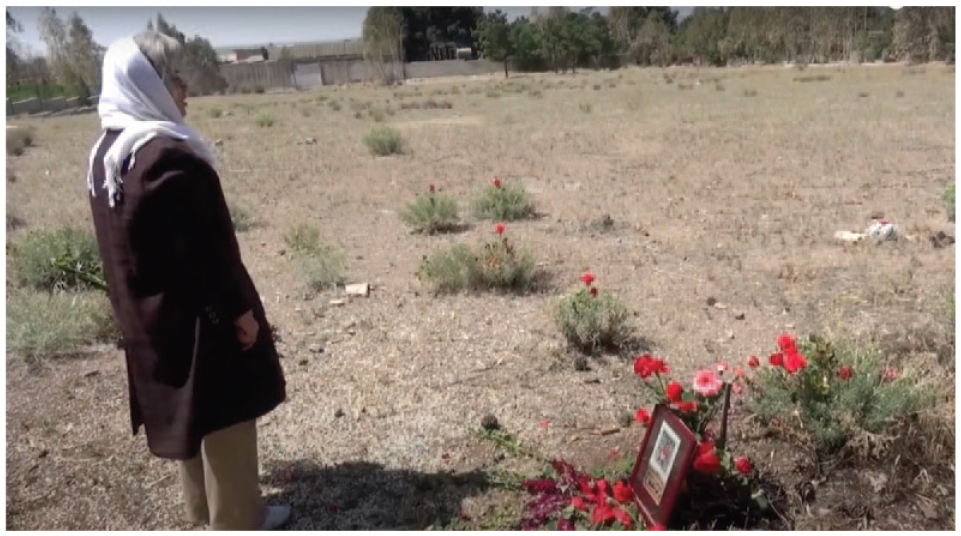
Mansoureh Behkish visiting Khavaran and putting flowers on unmarked mass graves (Forouhar, 2019: 00:02:25). Published with permission from the director, Parastou Forouhar.
She Remembers is not publicly available yet but was screened in Berlin on 27 October 2019 in a session titled ‘Justice-seeking and Memory Work’ (Zamaneh Media, 2019). The documentary represents a symbolic act of listening to the memory of the other and at the same time is a medium of activist memory work in itself. Through mediation, She Remembers lets its viewers witness the way social memory and social space are conjoined at the intersection of the material memory of the 1988 massacre and the agency of the resistant subject, turning the contested cemetery into a ‘site’ for the production and contestation of identities and memories (Hoelscher and Alderman, 2004: 348–350).
Memories Left Behind (2023)
In September 2023, a 1-day exhibition, entitled Memories Left Behind, was held at the ABF 2 cultural centre in Stockholm. The exhibition presented photos and material remnants of victims of state violence in Iran and was organised by a heterogeneous group of family activists in the diaspora ranging from families of Khavaran to families of the Ukrainian flight, 3 The Bloody November, 4 and other events of protest and state violence. Extensive video and photographic documentation of the exhibition is available online on Zamaneh Media 5 (Seifikaran), and this also includes interviews with various organisers of the exhibition. What was exhibited were not just objects evoking the memory of victims who had families among the organisers and participants but also of many other victims. As one organiser explains, the belongings of many of the victims who did not have a family member in the diaspora were also transferred to Stockholm by supporters travelling from Iran to Europe. Photos of numerous victims, most of them with smiling faces, were printed on boxes that were hung from the exhibition hall’s ceiling. On the floor, tables were arranged with objects placed on them for each victim: clothes and accessories, photos, letters, handwritten notes, wills, newspaper clippings with news of their execution (especially from the victims of the 1980s) and many other artefacts bearing the traces of the victims (Figure 2). The exhibition was accompanied by several speeches from family members of various groups and affiliations and was documented by several Persian-speaking news agencies in the diaspora.
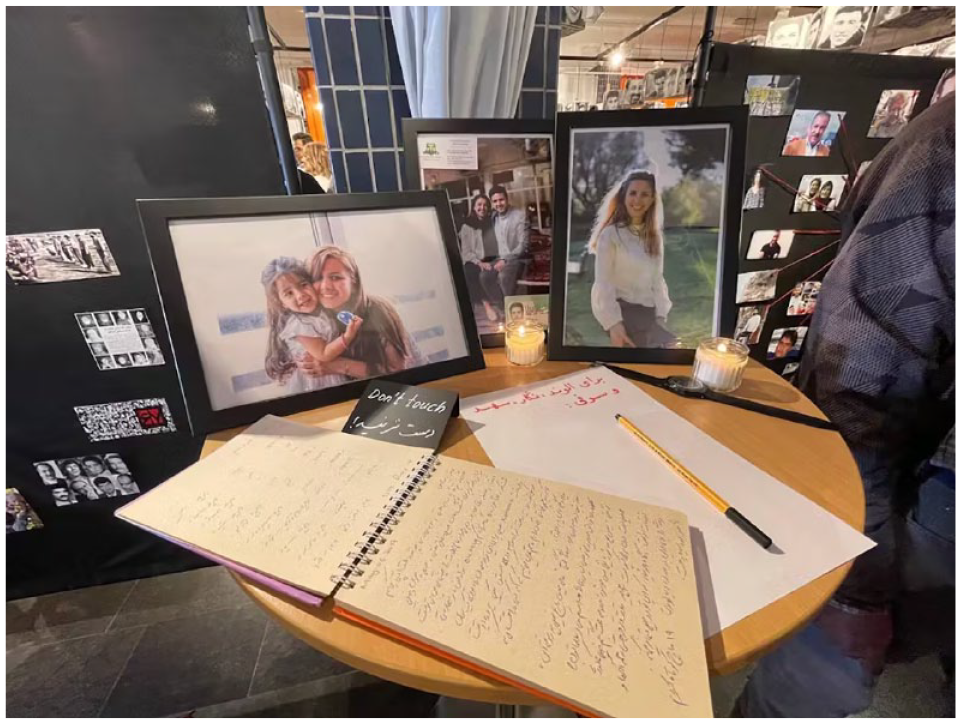
Memories Left Behind. Published with permission from Zamaneh Media (see Seifikaran, 2023).
In the interviews published on Zamaneh Media, organisers sat in pairs in front of the camera to talk about the exhibition and their personal and collective experiences of memory and mourning. Interestingly, in most of the interviews, the two people who are interviewed each belong to a different generation of state violence. During the speeches and the interviews, the sentence ‘we won’t forgive and we won’t forget’ gets repeated while the speakers emphasise their anti-violence stance and insist on remembering as a means for resisting and contesting state violence. One of the organisers, the sister of a victim of the 1988 massacre, suggests that memory is their only weapon for justice-seeking and for seeking social transformation. The exhibition demonstrates how the two goals of justice-seeking for specific victims and seeking broader social transformation are tied together and how activist memory work functions as the connecting ligature between the personal wound and the collective desire for change.
Two recurrent points emerge in the speeches and interviews of Memories Left Behind. First is the significant role of pioneering groups of justice-seekers formed in the 1980s and their difficult task of cultivating a collective memory before the advent of digital media and in a hostile cultural and political context that ignored their sufferings. Second is the importance of Woman, Life, Freedom in creating a unified frame for contention. Speaking about ‘the family of justice-seeking in Iran’, which has grown over the years, the interviewees re-define ties of kinship in a way that also includes those with no blood connection to the victims. Two young women from the organising group are specifically interviewed by Zamaneh journalists because of their lack of familial connection to any of the victims. In their response to why they engaged in organising this exhibition, they emphasise the importance of expanding the discourse of memory and justice-seeking beyond blood connections while also suggesting themselves to be self-claimed families for those victims who do not have a family to keep their memory alive. The family terminology that Hirsch (2008) used in suggesting ‘adopting the other’s memory’ as a site for ethical remembering of the other resonates with the discourse of the exhibition where the logic of adoption is embraced to facilitate a more inclusive remembrance. In fact, in this exhibition, various groups of justice-seekers and survivors joined in remembering and mourning each other’s wounds and people outside the circle of survivors also became listeners to and then agents in disseminating the memories they adopted.
In the temporary memoryscape of the exhibition, the connections made between people with differing political and ideological affiliations over their wounds from state violence created an affectively charged space for mourning as much as remembering. Many of the interviews and speeches are broken with bursts of tears and gestures of care and comfort. As the daughter of one of the victims killed during Woman, Life, Freedom protest states, the exhibition feels like visiting the graves of the victims, especially for those who could not mourn the death of their loved ones on-site, either because they were exiled or because they could never know where their loved one is buried. This point shows the interplay of the absence and creation of space and, in turn, activist memory work at its best. Memories Left Behind was displayed one more time in Oslo, in December 2023, parallel to the Noble Prize ceremony in which the imprisoned Iranian activist, Narges Mohammadi, was awarded the Peace Prize. The organisers’ commitment to repeat the exhibition, in the form of a nomadic temporary memoryscape and adjacent to another event that highlights Iranian politics, augments the activist quality of their memory work. At the same time, repetition per se can lead to the accumulation of memories and the reshaping of collective memory and can turn the short-lived exhibition into a more solid structure for activist memory work.
Conclusion
The Iranian context provides a rich and complex setting for studying the interrelations of memory and activism as they play out under constant repression and state violence. The activist memory work that takes shape in this context is a point of encounter between the personal experiences of pain and grief caused by state violence and broader, communal endeavours for social and political change. In the shadow of recurrent, unredressed injustice, the remembrance of state violence and its victims has primarily had a practical and judiciary function in preserving the evidence of past violence. This activist memory work, however, exceeds its testimonial value in also being used as a resource for oppositional politics in such a way that it has become interwoven with the collective desire for social change.
She Remembers and Memories Left Behind illustrate how different mnemonic dynamics unfold across various interactions between physical and virtual spaces and personal and shared experiences and how these interactions turn into specific instances of activist memory work via (re-)mediation in various cultural forms. The documentary film represented the contested space that bears material traces of repression and memory work, and frames this communal space as an encounter between two resistant subjects, before extending it for activist memory work amid the diaspora. The exhibition similarly created mnemonic spaces and encounters but from another direction. Its memoryscape was created in the diaspora and then its range and functions were extended through media documentation and repetition.
In a setting where oppositional memory work is dangerous, remembering becomes resistance in itself. Repression and authoritarian control of public space shrink the actual and virtual spaces for non-conforming practices, and it becomes imperative for the agents of activist memory work to create and carve out other spaces for remembrance. In this way, the diaspora and digital media become highly important. The accumulation of suffering and the re-occurrence of protest and resistance have created diverse groups of dissidents and justice-seekers, all of whom use memory work as a cultural resource in one way or another. Remembering the other, as ethically embracing the memory of other people’s pain as one of your own, is an approach that has become more visible and organised in recent years, enabled by the resistant subjects in the country, the connectivity of digital media, and diasporic agencies. As demonstrated in this article, activist memory work in general and ‘remembering the other’ in particular can help to create shared memories and communal memoryscapes wherein a sense of collectivity can emerge to counter the fragmentation caused by repression.
Footnotes
Acknowledgements
I would like to thank Parastou Forouhar for her generosity in sharing her work with me and the anonymous peer-reviewers for their constructive comments and suggestions, and the editors Ann Rigney and Samuel Merrill for their extensive help and support throughout the process.
Funding
The author(s) received no financial support for the research, authorship and/or publication of this article.
