




Abstract
We live surrounded by sites of memory, and are broadly aware of their existence, sometimes their significance. But what often goes unremarked in the memoryscape – the spaces and places of memory that make up a geographic or abstract area – are the monuments, memorials and museums that are partial, missing or never existed. This article proposes a new type of monument – the ‘nonument’ – as a site of both remembering and forgetting that is yet a key contributor to latent narratives of cultural, individual and collective memory. The article proposes five categories of nonument – the Rejected; the Removed; the Ruined; the Rebuilt; the Repurposed – and demonstrates these categories primarily through the development of the urban memoryscape of Paris since the French Revolution (1789), founding event of the French nation, and key contributor to ideas of a French collective and cultural memory.
What happens when a museum is planned, but never built? What happens when a monument is contested, but not removed? When a statue is removed, what remains of the memories for which it once stood? And what should we make of the gaps in a memoryscape, whether concrete and physical, or discursive and representational? We might gain an abstract sense of the lacunae and overlaps in memory that are created through evolutions of monuments within our lifetimes, or through our lived experience of places and spaces of memory. But this often does not render evident the extent of the debates involved in proposing such edifices in the first place, nor does it always bear clearly the marks of trauma and triumph that encapsulate their removal. This article proposes an exploration of the memoryscape through missing or overlooked narratives. Society accepts and recognises that monuments, memorials and museums are sites of remembering; this article provokes consideration of the paths of memory not taken.
The present article establishes a theory around a new concept, that of the ‘nonument’. The article will first define the concept, and then lay out five types of nonument that constitute the initial form of the theory: the Rejected; the Removed; the Ruined; the Rebuilt; the Repurposed. The article focuses on the post-Revolutionary (1789) French-speaking world, and particularly Paris, as an iconic yet fragmented memoryscape that has undergone much debate, and yet which lacks somewhat in identification of missing and latent narratives of memory. These nonuments are united by a sense of contestation and vary by their degree of survival within this spectrum of presence to absence. They are often, but not always, sites of trauma or difficult history; it is not the intention of this article to equate the monuments to each other in this way. 1 The article limits its discussion to physical monuments; the role of inherently ephemeral digital memory is a story for another day.
A nonument is a structure whose relationship with the memoryscape is characterised by absence. This is not to say that it must be completely removed from physical form on the ground. The important determining factor is the interaction of the edifice with latent narratives of memory; structures whose own narrative is latent, and yet which are important contributors to the more inherently manifest nature of surviving, more mainstream places of memory. The nonument may be a commemorative structure, or a notable building that, though not designed for memorial purposes, has come to represent an event that anchors its role in the memoryscape as such. Pascal Moliner and Inna Bovina (2023; referencing Riegel) note that ‘a commemorative monument differs from a historical monument insofar as the former is the result of a deliberate intention to introduce an evocation of the past into the present’ (p. 3). This difference is key to the examples of the Bastille, Notre Dame and Oradour-sur-Glane, none of which were initially built as memorial monuments, but have come to occupy that role in their absence. A memorial site may also be an alternative form such as an archive, as we will see through the category of the rejected, and particularly through the forgotten memorial museum to the French Revolution.
The typology of nonuments is not a rigid structure; edifices can sit across categories, or indeed change categories over time or for different groups or communities. A nonument can of course be partially removed, and therefore considered ruined. And clearly what is considered a repurposing of a space by one community may be perceived as a removal (of an existing ideology or value) by another. Its designation is never final; such sites will always be subject to social construction and context, and the uses thereof will evolve with values and needs over time. A summary of the nonuments typology can be found below.
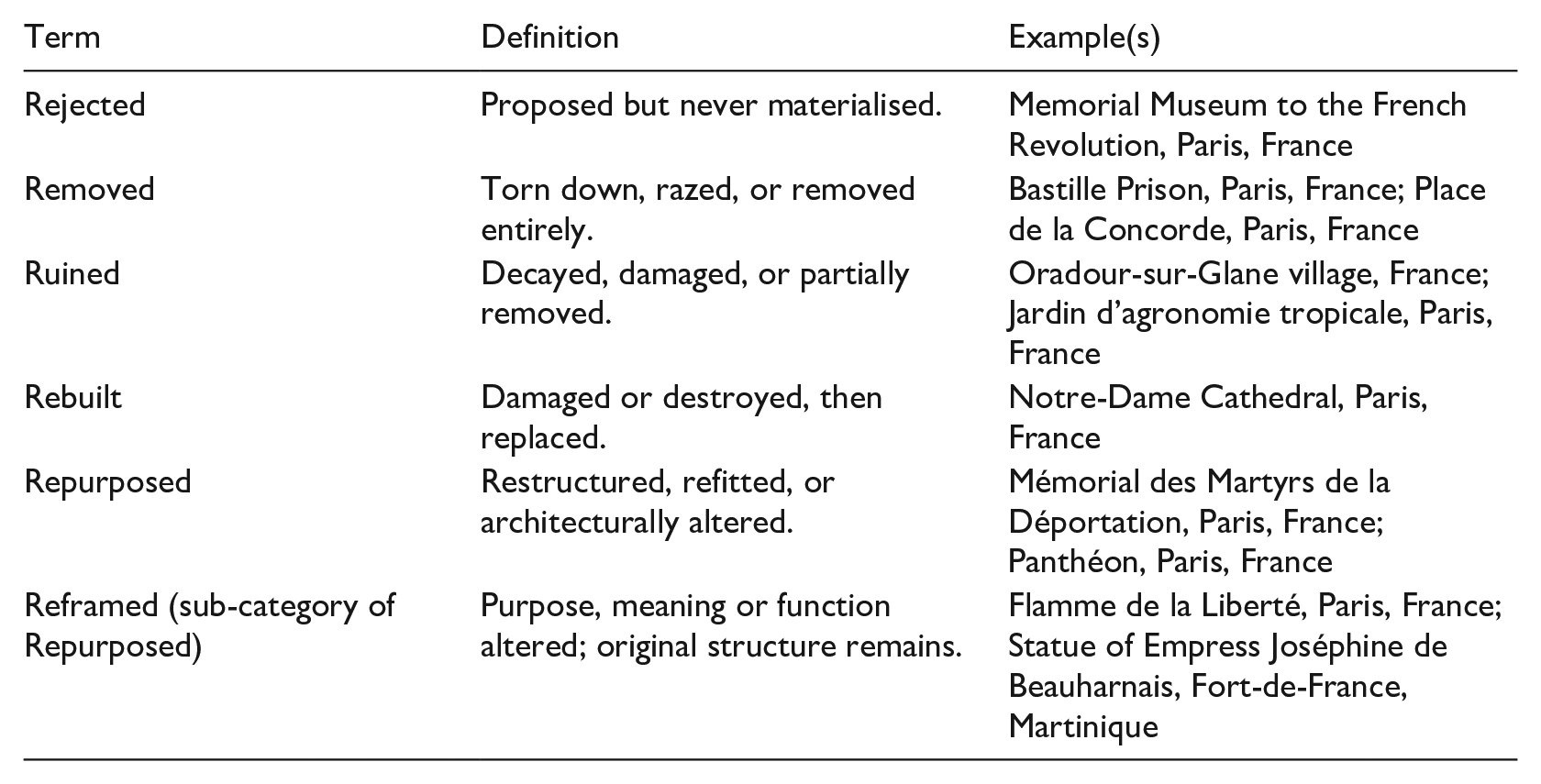
An example of shifting categories is London’s Fourth Plinth, which has embraced its unusual status in the memoryscape, and lent into the limbo that has emerged. Originally designated to hold a statue of William IV (which failed to be completed due to insufficient funds), the plinth sat empty for 150 years while its contents were debated. From 1999 to 2001 it was the home of the Fourth Plinth project, in which a new artwork would occupy the plinth each year. From 2005 onwards this was replaced by the Fourth Plinth Commission, whose resulting works have remained in place for 1–2 years. A range of proposals have been made for permanent works but have so far not gone ahead. Aside from this, the plinth has been used for unapproved installations, as well as for projects with school children. The Fourth Plinth thus allows for the exploration, celebration and replacement of artistic and memorial values, and brings together the categories of rejected, removed and the repurposed.
Or take the Elephant of the Bastille (1813–1846), which was designed and built to full scale in plaster, only to rot and become rat-infested, and eventually removed when it was not pursued to its bronze version after the fall of Napoléon. It thus brings together the categories of the ruined and the removed (and, eventually, the repurposed, through its remaining site). The Elephant of the Bastille has gained relatively considerable fame, yet only lives on in fictional form, through cultural artefacts (most notably through Victor Hugo’s Les Misérables and the consequent musical and film versions). These two examples, as I will also demonstrate through detailed discussion of the nonument, highlight the strong relationship (as determined by Halbwachs (1992)) between memory and its communities, between sites and their users (see also Russell, 2006).
The nonuments typology situates itself in existing theories of remembering and forgetting, as well as cultural memory, and the French cultural context. First, Paul Connerton’s (2008) seven types of forgetting (repressive erasure; prescriptive forgetting; forgetting that is constitutive in the formation of a new identity; structural amnesia; forgetting as annulment; forgetting as planned obsolescence; forgetting as humiliated silence), as well as the debate created by this model (notably Erdelyi, 2008; Plate, 2017; Singer and Conway, 2008; Wessel and Moulds, 2008). My own framework describes the ways a memoryscape is shaped by narratives of forgetting in the forms of its monuments. I position the nonument as occupying a liminal space between forgetting and remembering, a place that I will argue represents a key (and often missing) step in French political and social memory and in memory studies more broadly. Connerton’s work has been criticised (primarily by Ramadanovic, 2018) for its discussion of forgetting only ever in relation to its opposite; my own work deliberately embraces this opposition. I do not seek to posit the nonument as exclusively binary (as terminological opposite to ‘monument’), but happily lean into the appositional potential to be derived from the similarity of the terms.
Second, Kenneth E. Foote’s (2003) categories of modifications to the landscape as a response to acts of violence and its commemoration (or lack thereof): sanctification, designation, rectification and obliteration. The nonument builds upon these categories, particularly those of rectification and obliteration, where traces are removed to respond to the needs of users and memory communities. We will thus see alignments of Foote’s theory in the categories of the removed and the repurposed, though where Foote argues that in the case of rectification and obliteration, no traces remain of the original event or its ideologies, the nonument framework seeks out instances where liminal narratives somehow endure. In addition, Foote’s work focuses on markers (or lack thereof) of violence; the nonument is not limited to sites of violence or tragedy.
The work builds on notions of collective memory, particularly Halbwachs’s (1992) recognition of the socially constructed nature of this type of remembering, applying this to the evolution of group and individual relationships with their memoryscapes. Likewise, the concept of the memoryscape sits in the context of Myriam Jansen-Verbeke and Wanda George’s work, wherein ‘The interpretation of the sites gives the landscape a meaning and reconstructs the memories of events connected with that place’; such monuments become ‘anchor points in preserving and protecting memories’ and, as such, ‘serve as markers in the landscape and tools to keep memories alive’ (Jansen-Verbeke and George, 2012: 275). The nonuments framework establishes the important contribution of latent and missed narratives to collective memoryscapes.
The French context is central to the development of cultural memory, including discussions of nostalgia and memory politics/policies (see, for example, Cassin, 2013; Gensburger, 2017; Nora, 1997), and thus its use as a focus for the development of this typology is particularly apt. Questions of belonging and nostalgia have framed French political–cultural debate (Cassin, 2013) and, more recently, questions relating to how we create cultural policy based on memory have been raised (Gensburger, 2017). This article thus brings together a dual context: on the practical level, the use of French monuments and culture; on the intellectual, the use of French memory studies theory. The term ‘site of memory’ stems from Pierre Nora’s lieu de mémoire concept. Nora’s work ‘sought to offer nothing less than a vast reordering of France’s relationship with its past’ (Hazareesingh, 2016: 280), including a ‘powerful ideological undertone’ in Nora’s selection of sites (Hazareesingh, 2016: 281). Nora (1997) feared a ‘rapid disappearance’ of national identity that required an ‘inventory of places where it is embodied’ (p. 15). Nora’s academic and ideological panic times exactly with the bicentenary of the Revolution, as well as coming hot off the heels of the dismantling of the former French Empire, so his analysis reads as a need to reimpose (metropolitan) France’s sense of national identity on the global stage.
This article engages with but also problematises Nora’s (1997) theory of lieux de mémoire, particularly in the context of his concern that ‘the inherent risk in the study of lieux de mémoire remains that of privileging by definition that of the marginal and the minority as natural sanctuaries of memory under threat’ (p. 19), even though he admits that his own choice of lieux ‘remains, in part, arbitrary’ (p. 21). Nora (1997) acknowledges the risk of a gallocentrist bias in his approach, but flippantly suggests that ‘for the moment, let’s forget about it’ (p. 20), going so far as to suggest that we must, despite these issues, ‘find in it, above all, an innocent reading’ (p. 29). The present article will demonstrate that there is no such thing as an innocent reading, as all monuments (and nonuments) are socio-politically charged, and we should treat them as such. This approach sits alongside Achille et al.’s (2020) aim to ‘contribute to mapping the territory, generating the resources and setting the agendas that allow us to prise open France’s multidirectional pasts and mobilize their postcolonial afterlives in a more productive way’ (p. 16). It is precisely the multidirectionality of the past that analysis of the nonument seeks to reactivate.
The call to overlook the problematic elements of history feeds into (or directly provokes) the notion of ‘social forgetting’, and Guy Beiner’s (2018) argument that ‘there is an evident need for major historical studies of lieux d’oubli to counterbalance the studies of lieux de mémoire’ (p. 29). Through my own analysis of monuments, as well as actively engaging with notions of forgetting and denial through the concept of the nonument, I propose that, in part because of Nora’s oversight, sites can at once be lieux de mémoire and lieux d’oubli.
I make no claim, through this typology, to comprehensiveness, and would be glad to hear of other types. There is no particular attachment to the number five; these types were the fruit of research on the topic while wishing to avoid becoming contrived. The article is an invitation to engage with the typology of the nonument, which will be discussed next.
The Rejected
The first category of nonument is the Rejected. This is an idea, design or plan for a monument, memorial, or museum that was proposed to the relevant authorities but was rejected and thus never materialised. Motives for this rejection may vary, including economic, moral, contextual or aesthetic objections. These are the monuments likely to go forgotten in the deepest sense, in that they may not have entered the public consciousness in the first place, especially when not physically marked in the landscape. Their persistence in the presence depends on the will to record (creating a ‘paper trail’ of the discussion or debate surrounding their proposal), and the will to transmit knowledge of their details (through orality or physical archiving of evidence). This type maintains an ambivalent relationship with the memory of that which it was designed to commemorate. Unless the proposal process is deliberately incorporated into the legacy of the event, rejected suggestions may become completely disconnected through being displaced by the successful edifice. In this respect they also test the relationship between memory and history, in that firsthand experience of the failed proposals is so limited, and thus memory thereof dies out promptly and easily; they sit more easily in the realm of written history (if they make it into the records). As a result, they also highlight the degree that memory is disseminated, and the extent to which it is retained in the purview of a limited number of experts.
The Rejected thus enter memory in a liminal sense, as traces, background or subjects for the lone researcher, but they are effectively sidelined from collective memory; they do not enter into commonly known or accepted versions of, the past. In some respect, this aligns with Connerton’s analysis of John Barnes’s (1947) notion of structural amnesia, wherein ‘a person tends to remember only those links in his or her pedigree that are socially important’ (Connerton, 2008: 64); this type of forgetting, Connerton (2008) notes, ‘results from a deficit of information’ (p. 64). This is particularly strongly felt in today’s age of information, an age of overload or surfeit that the hyperconnected self is both subject to and dependent upon (see Hoskins and Tulloch, 2016; Jenkins et al., 2013; McCullough, 2013).
Examples of Rejected nonuments are edifices or ideas that form part of competitions to be part of official commemorations. The very creation of a competition for such a memorial inherently creates lost memorials, a whole category of Rejected nonuments. This might take the form of entire monuments that did not go ahead at all (in this case this may entail an annulment of any commemorative gesture), or versions of a monument whose idea was not deemed appropriate, engaging or inclusive enough to be designated the winning entry. Such competitions are neither new nor rare, with contemporary examples ranging from the competition to design the monument to the victims of the 2001 attacks on the World Trade Centre, to the Chungji National Heritage Museum Competition for the heritage of the Korean Peninsula, to be opened in 2026 (Competitions.org, n.d.).
Although monuments, memorials and museums have existed for much longer, in France there is a particularly strong culture of the memorial, in the sense that we understand it through contemporary memory studies, in the wake of the 1789 Revolution. Indeed, Nora (1997) saw this historical event as a threshold, an irrevocable break with the past that radically changed the way history is perceived and studied. It is no surprise that this moment of great social upheaval should mark the years following it, buts its political impact has translated into a change in remembrance culture only rivalled by the Shoah.
At the centenary of the French Revolution, conversations began around how to mark this moment of temporal significance. The idea of how to commemorate this event was put out to competition, which attracted a diverse array of suggestions, ranging from a museum to a square, or a monument of varying forms. One particularly audacious participant suggested, oddly pre-emptively of the modern-day Louvre, ‘an immense granite pyramid, with a bronze altar to the homeland at its summit’ to be built on the site of the former Tuileries palace, with statues along its tiers (Société de l’histoire de la Révolution française, 1886b: 9). Perhaps most notably, a memorial edifice was proposed by Revolutionary publicist Louis Chassin. This was the most successful of the proposed commemorative gestures outlined in this debate, and was extensively discussed, albeit for a short time, in La Révolution française: revue historique – journal that dedicated its pages to the official documenting of the Revolution and its legacy (Société de l’histoire de la Révolution française, 1881–1936). Chassin’s design included a museum and library of the Revolution, as well as a conference hall. These plans were gradually scaled down and eventually dropped. Despite the relatively well-developed nature of Chassin’s proposal, it did not end up going forward in any of its forms.
Reasons for the failure of the proposed project appear to include: insufficient time available to complete the project between proposal and the centenary; insufficient funds available for the project (as well as, counterintuitively, accusations of not asking for enough money); lack of agreement on clear purpose and practical arrangements for the museum; competition with similar local sites (musée Carnavalet, museum of the history of Paris); competition with other contemporaneous events (the Universal Exposition); rival ideologies and petty politics (see Société de l’histoire de la Révolution française, 1884–1886).
Chassin’s project was immediately symbolically couched in revolutionary ideals, in its aim ‘to honour with dignity the memory of our forefathers’ (Société de l’histoire de la Révolution française, 1886a: 673), as well as the imagination at the core of collective memory, in claiming that ‘We need to strike at the heart of the popular imagination’ (Société de l’histoire de la Révolution française, 1886a: 673). Furthermore, its clear interaction with the importance of location suggests a strong awareness of the politics of memory. Chassin initially proposed that his edifice be situated on the Champ de Mars, later changing his mind in favour of the former site of the Tuileries palace. These were two primary sites of memory in Paris, both physically as well as for their abstract and symbolic qualities. The Champ de Mars, home of the École Militaire [Military School], was the site of the first Fête de la Fédération [Festival of the Federation] in 1790, what is now Bastille Day, the French national holiday. The Tuileries palace was traditionally the residence of the monarchs of France and was directly in front of the Louvre; it was burned by the Paris Commune in 1871. Symbolically, housing a memorial museum to the Revolution on the former core site of the monarchy would have been very on-the-nose.
Within this Rejected monument, there is an element of desire to transform memory of the past; using an existing monarchical site would, on one hand, have allowed more memory of the unwanted past to endure; on the other hand, this enforced co-habitation of conflicting memory would project a reminder of the new order achieved by this historical overturning of regime. In this respect, the memorial museum to the Revolution also represents a missed opportunity to create a Repurposed or Reframed space of remembering. The proposed memorial museum to the French Revolution poses an interesting question for the Parisian memoryscape. First, because the failure of the project leaves a literal, and very visible, gap in the landscape, since the site was never filled (and since the Louvre site is quite obviously now left as three sides of a rectangle). Second, because although Paris was a (or even the) major site for the Revolution, there is now no museum to the Revolution in the capital. The only such museum is then displaced, for better or worse, to elsewhere in France (Vizille, near Grenoble).
The failed memorial museum also aligns somewhat with Foote’s categories, particularly through its location. The burning of the Tuileries palace effectively makes it an obliterated site in the truest sense of Foote’s term, as it was removed so as to leave no trace (see, for example, Foote, 2003: 25). The rejection of an alternative – effectively a second obliteration, in a more abstract sense – maintains the break in the visual continuity of the cityscape that very much aligns with Foote’s comparison of obliterated sites and linguistic features. ‘Perhaps’, he notes, ‘these obliterated sites are like pauses in speech – empty of sound but resonant with meaning – and just as hard to ignore’ (Foote, 2003: 181).
In terms of memory, the failure to build a Paris-based museum to the Revolution represents a lack in terms of what is widely considered to be the founding event of the modern French nation; the memorial museum exists only as a footnote to history. The streets of the capital remain sites of social protest, yet do not formally, specifically acknowledge this historical moment. This nonument is one that is lost to the archives, existing most fully in its discussion in the pages of La Révolution française (and the contemporaneous newspapers it cites). Its own narrative remains latent, and yet the discussion of its purpose, practicalities and downfall will have had a lasting impact on the relationship between the city, its authorities and its communities.
The Removed
Second only to the museum, monument or memorial that never came into being, in terms of absence, is the Removed nonument. This can be classified as a memorial edifice that once stood (in contrast with the Rejected), but that was torn down, razed or removed entirely, to the extent that we can say that it no longer exists at all. The Removed is probably the best-known type of nonument, particularly in the wake of statue removal during protests as part of the Black Lives Matter (BLM) movements. The removal of monuments is a gesture that is often very visible, obvious and deliberately provocative, and that explicitly engages with the idea that an edifice is culturally, socially, politically or ethically, inappropriate. Its removal becomes as important to be remembered as the monument itself. In some cases, the monument is replaced; in others, the plinth (or location more broadly) is left empty. The tearing down of monuments is often strongly cathartic; leaving plinths empty gives a sense that it is important not to fully obliterate in such cases. We need to know about both the event that led to the monument, and the reasons behind its removal. As Foote (2003) notes, in obliteration, ‘Survivors are caught between conflicting desires, both to efface and to memorialize’ (p. 180). The act of removal, especially if partial, creates a clear sense of memorial politics that endures, and yet might still go unremarked upon.
Perhaps the most obvious Removed nonument in Paris is the (site of the) Bastille prison. We saw in the previous section that a result of the failure to build a commemorative museum or memorial at the centenary means there is now no museum to the Revolution in Paris. The Bastille itself, key site of the originating events and mythology of the Revolution, also does not exist. What is left is both figurative and literal. The site is empty of the monument, torn down in its entirety, though its original outline has been (physically) highlighted to remain visible. The site now holds the July Column, a memorial to a slightly different period (the 1830 revolution), a shifted set of ideals. Ideologically speaking, the ghost of the Bastille is very much still alive. Its storming, and associated date, 14 July, form the basis of French national identity. Physically, although the prison itself was torn down, and as such, no longer exists, its stones are dispersed around the city (as well as further afield), including making up some of the structures of the city to this day (for example, parts of Pont de la Concorde bridge; Bastille metro station). What is more, keys to the prison are still in existence; in 2022 they were on display at the National Archives’ city centre site.
The site of the Bastille, now Place de la Bastille, thus today plays the role of the void, through obvious lack of the original prison, and bears marks of the desire and constant pressure of urban development. This includes re-urbanisation of the space, as well as the building of the new opera house in the twentieth century. The Bastille prison thus represents a Removed nonument, and the square that remains, as well as the structure(s) that replaced it, represent the replacement of ideas and thus rendering the square a Repurposed nonument. The multifaced nature of the site also makes it sit unusually with Foote’s categories. The original site falls almost into the category of obliteration, through the very symbolic act of the storming of the Bastille prison. The demarcation of the edges of the original site aligns with the category of designation, which, as Foote (2003) notes, ‘lies squarely between active veneration and direct effacement’ (p. 18). And yet these edges, when combined with the newer column, as well as the exhibition of the keys, stray into sanctification, which ‘occurs when events are seen to hold some lasting positive meaning that people wish to remember’ (Foote, 2003: 7), and whose sites ‘mark the traumas of nationhood and from events that have given shape to national identity’ (Foote, 2003: 10).
In other cases, we see a variation on (or sub-category of) the removed in its original form, that is, the replacement of ideas and edifices. For example, what is now Place de la Concorde, a square in central Paris, once named Place Louis XV, and which became Place de la Révolution, used to hold statue of Louis XV but was replaced with guillotine (itself a tool of removal). The revolution of ideas clearly seen here has now been replaced by a revolution of traffic, in one of the more dangerous squares of the city from a pedestrian perspective. Its monuments are now either physically abstract (the Luxor Obelisk), but not entirely devoid of politics (in terms of the geopolitical relations behind their existence and location), or human statues (of non-specific individuals) dedicated to the major cities of the mainland, arranged around the square to reflect their geographic positioning on the map of France, and which remain relatively politically neutral. This is with the exception of the statue to Strasbourg, which became the site of Parisian nationalism in the nineteenth century, in the wake of the Treaty of Frankfurt, through which France was made to cede Alsace (and in it, Strasbourg), to Germany. Aghulon notes that this made the statue ‘a statue of mourning and regret, and a rallying point for demonstrations of patriotic protest’ (in Nora, 1997: 4608). In the case of the statue to Strasbourg, a key part of the identity of the statue was removed (i.e. the status of city itself belonging to France), while the statue remained unscathed.
The memorial trace of the Removed nonument is mixed. The removal is usually a deliberate act, often violent and frequently political. It demonstrates the frustration of a population, a protest against the meaning of the monument, and a refusal to allow others to identify with, or glorify, the subject of the monument. In the case of the leaving of an empty space, this gives a striking gap for memory practices to fill in. In the case of building over, this shows a desire to move on, as well as blocking of use of the monument or its placement as a site of pilgrimage. We see this particularly clearly in such sites as the Munich Documentation Center, former site of the Braune Haus (NSDAP headquarters), whose location and design were planned specifically for this reason (Sierp in Europe Now, 2017: n.p.). In this respect, there is an important difference to be made between the partially and fully removed. The partially removed retains its potential to be a site of reframing or reparation, but also for abuse (and continued ability to harm); the fully removed is able to refuse, but carries more risk of forgetting.
The Ruined
A step along from the Removed, in terms of absence, is the Ruined. This is a former site of memory that has been allowed to decay, be damaged, partially or mostly removed, and remains in this damaged or disintegrated form. These may then be maintained in such a state, ignored or lie anywhere in between. One of the most instructive aspects of the Ruined nonument is access. Whether for reasons of safety or more ideological motivations, the Ruined sit on a spectrum of integration into daily life. This might range from small vestiges (bricks, tiles, etc.) that can be experienced, walked upon or touched, through being visible but beyond reach, for protection and preservation of the site, to protection of users.
The process and result of leaving sites to decay has an impact on the lived experience thereof. A clear example in the French context is the site of Oradour-sur-Glane, a village destroyed during the Second World War with the 1944 massacre of 643 of its inhabitants. Not only has the site been deliberately preserved in its ruined state, but a new village was also built nearby, allowing the original site to be maintained as a permanent memorial to this historical period. Nevertheless, what is ruined will decay, without careful maintenance work. When dealing with sites of trauma, this raises difficult questions of the ethics of restoration. Is it more morally sound to allow such a site to decay fully, to allow its physicality to be lost to the past? Is it better to maintain the site in its current state, so as never to forget the event that led to its creation through destruction? What is even the best way to maintain a state of partial decay, certainly without re-enacting or reinforcing the violence with which it came about in the first place? Furthermore, this site is a space of memory but also a place of tourism. What is the impact on the inhabitants of the new village that shares its name?
Oradour sits in an unusual position in terms of memorial culture. The original site was not designed with memorial purpose. Its damage was part of the event that is memorialised, but the subsequent decay is part of its status as nonument. It is only through its damage that we can fully access and appreciate its narrative; its decay is what concretises, but also problematises, its place in conversations around conservation. It also illustrates, within the nonument typology, how nonuments and their specific categories are never value neutral but are open to different value judgements; in this case this is quite counter-intuitive, in positioning the ruin as a positive aspect of cultural memory.
A second example of the Ruined nonument is the Jardin d’agronomie tropicale de Paris. A haunting site of contested memory, the Jardin was originally a place to grow tropical plants such as bananas and vanilla for their potential exploitation in the colonies and was converted into a colonial village for the 1907 International Colonial Exhibition. The use of the space as an ethnological display for human exhibits (and their study by tourists and researchers of the time) is a clearly traumatic moment for concerned communities, as well as an overtly shameful part of the French past. After the closing of the Exhibition, the site was gated off and abandoned to rot and be reclaimed by nature and was off-limits to the public until 2007. Its buildings remain off-limits, due to dangerous degradation, except for the Indochina Pavilion, which has been converted into an exhibition space, and the Tunisia Pavilion, which was converted into a centre for the neighbouring Cirad (French Agricultural Research Centre for International Development) organisation (see, for example, Duffé, 2019). Today it is possible to wander the grounds as a park, even if it is not possible to enter or approach most of the buildings. Its new signage is one of the only marks of the twenty-first century’s engagement with it.
The problem here is that razing the gardens could be seen as tantamount to covering up the past – indeed, it is the only such site that has not been completely removed – but restoring them could be equated to rejuvenation of narratives of colonial history. Instead, they remain in a state of festering limbo, ‘deemed as unsuitable for destruction as they are for repair’ (King, 2013), a lieu de mémoire ‘suspended between ruin and repair, past and present, shame and pride, memory and forgetting’ (King, 2021: 4).
This site raises important questions around how to display, frame and contextualise, or dispose of, monuments that testify to traumatic and undesirable pasts. The degrading vestiges of the Colonial Exposition and the use of human beings as tourist attractions sit uncomfortably in the present without being able to serve a purpose of re-education or reparation. The crimes of the past are effectively frozen in an unresolved state. We might recall several of Connerton’s categories of forgetting here; the choice by the state to predominantly disengage from this site and its past effects a structural amnesia, through cutting off the line of memorial heritage (the country’s shameful past), planned obsolescence, through the eventual disappearance of the site by its reclaiming by nature, and humiliated silence, through the continued existence of the site combined with the refusal to combat (or contribute to) its demolition. France’s colonial past is not unknown; this is a deliberate choice to not engage with it.
The ruined show us vestiges of memory, traces of the past that endure in the present. These are traces that linger in the everyday, lived experience of the memoryscape. Whether they are naturally obvious or highlighted to be so, or so subtle as to be part of the paving that we tread on our quotidian commute, ruins demonstrate the importance of curation of memory, the framing of the past in lived experience of the present. The deliberate engagement with, and maintenance of, ruins in their ruined state, can be seen through the example of Oradour-sur-Glane, raising questions about how to fight the ravages of time without erasing the original damage. The almost complete lack of engagement with the past, and the deterioration thereof in the present, shown through the Jardin d’agronomie tropicale, illustrates an unwillingness to take responsibility for lasting damage of the original. In this sense, Oradour and the Jardin sit at opposite ends of the Ruins spectrum. Oradour is an example of how traumatic past can be frozen in the present for productive engagement into the future; the Jardin shows how an accidental freezing can demonstrate an unwillingness to engage that continues to inflict damage in the present. The sites create elements of conflicted or unresolved meaning (see also Foote, 2003: 322).
The Rebuilt
The Rebuilt nonument is perhaps a more innocuous – and yet still impactful – alteration of the cityscape, in terms of the monument whose restoration is desired. This would be an edifice that was damaged or destroyed, whether intentionally or not, and was then rebuilt with the intention of replacing the original under the same ideological terms. What proves important with the Rebuilt are the discussions around the process of reconstruction. Like the Rejected, these nonuments often provoke debate through competition, as multiple options for commemorating a single event, person or entity, or replacing something deemed lost through destruction.
Perhaps the clearest example of the rebuilt is Paris’s Notre-Dame Cathedral, specifically in relation to the 2019 fire that unexpectedly destroyed its spire. In the spirit of the nonument, what is most important about this rebuilding is not the edifice itself, but the debate surrounding it. This is particularly pertinent in relation to the building’s designated purpose (active site of worship), and its secondary purpose (tourist hotspot). Notre-Dame also feeds into memorial culture through its role as a museum; indeed, Agnès Poirier (2020) notes that, because of its choice as location for the display of the Mays paintings, Notre-Dame was ‘France’s first unofficial museum, the first place where the people could admire art for free’ (p. 53). It was therefore already an active site of memory from at least the seventeenth century. The 2019 fire becomes part of the memory of the space, especially for its status as historical monument.
Hot on the heels of the fire itself, President Emmanuel Macron promised that the cathedral would be rebuilt within 5 years (2019–2024). His (perhaps rash) promise seemed to offer to give back to a grieving nation what it had lost. The burning of Notre-Dame was, among other things, proof of the ongoing attachment of the French, in the outwardly secular state, to the Christian history of the country (see, for example, Poirier, 2020). This sat uneasily with debates around national identity, as well as better uses of the billions of Euros rapidly raised for the building’s restoration.
The rebuilding of Notre-Dame sits within the complexities of its history. The edifice was already under renovation at the time of the fire; there was some suspicion that the fire was caused by equipment being used on scaffolding surrounding the cathedral. It had previously been rescued from descent into ruin by Victor Hugo’s eponymous novel. The nineteenth-century restoration project introduced an instructive element of nostalgia, and even false heritage, when the architect responsible for the reconstruction of the spire, Eugène Viollet-le-Duc, decided to attempt an exact copy of the thirteenth-century original. This not only provoked criticism of historical pastiching, but also went on to create a sense of nostalgia for the nineteenth-century version itself. This is the version to which those who, in 2019, were hoping for a like-for-like rebuilding aspired.
Instructively, the conception of the reconstruction of Notre-Dame’s spire was put out to competition, as we saw with commemoration of the centenary of the Revolution. And, as with the memorial efforts of 1889, the results were a curious admixture of nostalgia and drastic forward-thinking (see, for example, Bodeving, 2019: n.p.). A significant number of proposals were put forward that departed radically from the nineteenth-century replica of the thirteenth-century original. The narrative Macron wove into his speeches seemed to fuel this outpouring of response. His promise that, through links to the past, the future would be rebuilt better, can be seen in both the traditional proposals and the more radical. Rebuilding an exact replica of the spire would allow the past to better endure into the future (maintenance of heritage in the more general sense), whereas the more technically advanced suggestions pushed for embracing the challenges faced by the twenty-first century city, retaining the relevance of the monument in both its past and future state (evolution on-site).
Rebuilding awakens narratives of nostalgia, which in turn provoke the question of how to evoke a lost past, but also move into the future. It carries a risk of entrenching mainstream narratives and closing off potential for alternatives and forces us not to forget the dominant discourse. The debate over Notre-Dame’s spire effectively creates a sense of nostalgia for a Paris that does not exist, an empty memory for an ideal of an abstract national identity that can be called upon to defend outlooks and actions. Notre-Dame’s post-fire reconstruction shows how ideas of a lost past can be quite rigid and unmoving, even when the ideal is one that is demonstrated to be ‘fake’ or misaligned, and yet also how ideas for pushing forward the past into the future remain prolific.
The Repurposed
A Repurposed nonument is a monument, memorial or museum that exists due to an extant structure being restructured, refitted or architecturally altered to house or accommodate a new memorial edifice. This might involve substantial changes to the original site, while its underlying structure remains intact. The ways these spaces are made transforms the original monument to suit new purposes and needs. This in turn creates an ideological impact on the new monument’s surroundings. A sub-category of Repurposed nonument is the Reframed. Closely linked to the Repurposed, we might define the Reframed as a monument, memorial or museum whose primary received purpose has been altered to reflect a change in ideology, without fundamentally altering the structure of the location. These nonuments allow societies to explore potential for reframing and contextualising monuments, to reverse, replace or realign previous narratives to better suit a contemporary environment. The significant potential for overlap between the Repurposed and the Reframed makes them useful to analyse together. The aspect of adjusting the ideological profile of a site shares characteristics with Foote’s rectification category, although in contrast to Foote’s designation, in which rectified sites seek to completely erase traces of the original event, Repurposed and Reframed sites instead build on top of the original function. In some cases, this is because subsequent ideals may be positively aligned, effectively updating the site; in others, the visibility of conflicting views is an important part of the process.
A first area we might find the Repurposed is the creation of a memorial in an existing site. An example of this in Paris is the Mémorial des Martyrs de la Déportation, a memorial and museum exhibition space housed in the site of the former morgue of Paris (for more on the Mémorial des Martyrs de la Déportation, see Benjamin, 2021). This project converted a defunct, non-memorial site that nonetheless engaged with the idea of memorialisation through its status as receiving the dead and preparing them for burial. While the site retains no elements of its original purpose (and is certainly not identified or identifiable as a morgue, though nor has this purpose been systematically erased), its architectural features contribute a chilling and claustrophobic atmosphere. This nonument effectively converts one site of death into another, but in terms of narrative, juxtaposes a site of inevitable end (death) with one of human-made demise (mass atrocity).
Paris’s Panthéon shows another key site of Repurposed memory. Originally designed as a church dedicated to Paris’s patron saint, Sainte Geneviève, its construction was coming to its completion during the French Revolution, whose secular stance led to the edifice being repurposed as a ‘Temple of Liberty’. By the time it opened, its purpose was to house the remains of great contributors to the nation, a mausoleum of thinkers but also of an ever-evolving narrative of French identity. Like the Mémorial des Martyrs de la Déportation, the Panthéon retains some thematic continuity (through its placing on high intellectuals where before it would have been God), but where the Mémorial’s link to its past purpose is passively hidden, the Panthéon is clearly a religious building in both name and visual qualities. In some respects, this nonument deliberately superimposes its ideals while knowingly asserting them as a variation on the former set.
There are sites that sit between Repurposed and Reframed. One such example is Place de la République. This large public square, dedicated to the first three Republics of France, is an inoffensive site of generic French identity, with its bronze statue of Marianne, who holds a copy of the Declaration of the Rights of Man and of the Citizen (for more on Place de la République, see Benjamin, 2021). This square, once described by a journalist as a ‘glorified roundabout’ (Willsher, 2013), was pedestrianised as part of a renovation project completed in 2013 to give the square back to the people. A result of this process has been reclaiming as a site of protest, demonstration and memorial, including to the 2015 terror attacks, the 2016 Nuit debout movement, and in 2019 to the Gilets Jaunes movement (which originated in 2018).
An example of a Reframed nonument is Paris’s Flamme de la Liberté, whose original purpose was a symbol of Franco-American friendship (the monument was a replica of the flame held by the Statue of Liberty, itself a gift from France to the USA). Following the death of Diana, Princess of Wales, this monument was co-opted by mourners to become a memorial site to Diana, because of its proximity to the site of the car crash in which she died. Since then, the square on which the monument sits has also been renamed Place Diana. The reframing then co-opts a site of positive memory to a site of mourning, with two types of monuments – the physical and the abstract – competing for space.
We have seen the importance of the removal of statues being brought to the fore with the events of 2020 and the destruction of monuments to slavers. We have also seen the importance of rebuilding, and the narratives created through the results as well as the process itself. A final, but perhaps most impactful example, is when statues are damaged (in terms of their original form) and not repaired. This performs a powerful reframing. We can see this very clearly in the memorial statue of Empress Joséphine de Beauharnais, first wife of Napoléon Bonaparte. Situated in Fort-de-France, Martinique (where Beauharnais was born), the statue was beheaded in 1991, and symbolically daubed with red paint. A year later, the statue was recognised as a French National Heritage site, and therefore should have been repaired (Curtius in Achille et al., 2020: 167–185). Despite receiving renovation in 2010, the head was neither located nor reinstated, nor was the paint removed. In 2020, the statue was finally torn down by anti-racism protesters as part of the global BLM protests following the murder of George Floyd. It had thus stood for nearly three decades in its decapitated state.
The events of the statue to Joséphine show an evolving narrative: while the protesters decided that ultimately, this statue must fall, previously it had been seen as appropriate to keep the statue up but defaced (literally). This demonstrates a violent and frustrated re-mediation of a monument. It was clear from the beheading (and the red paint), as well as the renovation, that the beheaded version was important to changing the conversation around the historical period. Before the statue was torn down, as Curtius states, the memorial strove ‘not to make slavery an event that happened too long ago to remember, but to excavate the trauma of slavery and ultimately foster instead a constructive solidarity and awareness of a painful history’ (in Achille et al., 2020: 185).
We can see that the Repurposed and Reframed, already a joint category, is the most shifting and liminal of the typology. This is because the types of memory and events that they seek to capture are themselves evolving, and sometimes sit uneasily on top of their original purpose, unable (or unwilling) to completely usurp them. This category is perhaps also the most useful or interesting; it is through tracing changing memorial practices in communities that we can measure their needs.
Conclusion
This article proposes a new concept, the nonument, defined herein as a memorial structure whose relationship with the memoryscape is characterised by absence, and in turn to problematise structures of reminding and remembering. The nonument typology offers a way of analysing latent narratives in the memoryscape to make them more manifest, and to demonstrate their role in our memorial past, present and future. The nonument – the monument that has been rejected, removed, ruined, rebuilt or repurposed – makes this debate visible. Sometimes this is in obvious ways: the very physical gap left by the Rejected Memorial Museum to the French Revolution, when re-evoked, leaves a void of contestation at the heart of Franco-Parisian geopolitics. Removal, as both a process and a result, can be enacted for great impact, providing its traces are used productively (as we saw in the streets surrounding the Bastille prison). Engagement with Ruins, extending their narrative and maintaining their reduced presence as ruins, can be used to educate and to keep trauma contained. Rebuilding invigorates debate over the purpose of places and spaces of memory, revealing nostalgias but also a desire to repurpose the act of remembering. Repurposing demonstrates the malleability of memory sites and the push to reframe societal values, and reframing encourages the evolution of such values. The situating of all these sites as nonuments provokes the questioning of ways of remembering, as well as the consideration of best means of tackling memorial injustice.
There has been an increase in the building of new monuments in recent decades, particularly in the wake of 9/11, leading to what Erika Doss (2010) has called ‘memorial mania’. But examining the memorials that are not there (or are absent in another way) reveals latent narratives in the contemporary memoryscape. Absence can signify not only loss but also the desire to remove and reframe monuments, to address and attempt to repair wounds made by both history and memory. In this way, the nonument exposes hidden facets and alternative narratives of the evolving memoryscape. While Connerton’s work disentangles forgetting through its processes, the nonuments typology invites a re-valuing of the remains, traces and the otherwise lost aspects of narratives of memory. Similarly, unlike Foote’s categories of obliteration and rectification, which focus on the complete removal of traces of past events, the nonuments typology seeks to highlight these traces for their inherent value as interrogations of memory and its continued impact. Furthermore, while recognising the continued value of Nora’s lieux de mémoire framework as a paradigm in the history of memory studies, the nonuments typology also seeks to strongly counter the national bias of Nora’s process of foregrounding of mainstream French identities in his continual highlighting of dominant voices and long-enduring monuments. By focusing on the final edifice, we often forget the plethora of voices that were overlooked, shut down or supressed during the debate; the nonuments typology showcases the range of voices in the construction of memorial narratives to better represent the diversity of the mainland and its capital.
The typology does not claim to be the final means of classifying the memoryscape, but rather a foundation for a greater discussion. The use and refinement of the framework will allow researchers to better define, analyse and categorise memorials and the scope of memorialisation. Drawing attention to sites in such a way challenges the relationship between dominant narratives and those that might otherwise be ignored or marginalised, as well as to allow spaces of memory to be adapted to purposes of memory communities. This endeavour raises the need for further debate and consideration in building new monuments, as well as increasing awareness of the way that existing sites are remembered and recorded. In turn, the problematising of the tension between memorial discourses and memorial experiences offers better balance between national history and collective and cultural memories, as well as negotiating the interaction with monuments as tourist attractions and as part of the quotidian experience of our cultural context.
Footnotes
Funding
The author(s) received no financial support for the research, authorship and/or publication of this article.
