




Abstract
How members of perpetrator groups engage with their ingroup’s negative history has received increasing attention over the past years. Yet, little research has addressed how people psychologically negotiate multiple past ingroup transgressions. Across two studies (n = 362), we exposed German participants to information about two ingroup transgressions, the Holocaust and the colonial genocide in former South West Africa, to test ideas of a multidirectional memory (= one memory productively informs another) versus a competitive memory (= memories stand in competition) effect. Along six indicators of memory (negativity and significance, acknowledging responsibility, collective guilt and shame, willingness to make reparations), we find that people build small memory hierarchies when given the opportunity. Overall, however, it seems that most people show similar levels of history engagement for different transgressions. We discuss how our findings relate to the public discourse on multiple memories.
‘What happens when different histories of extreme violence confront each other in the public sphere? Does the remembrance of one event erase others from view? When memories of colonialism, occupation, slavery, and the Holocaust bump up against one another in contemporary multicultural societies, must a competition of victims [/history] ensue?’
These questions first advanced by Michael Rothberg (2009) in his book Multidirectional Memory became quite concrete in summer 2020 when the Black Lives Matter (BLM) protests and accompanying calls for a more critical commemoration of colonial history had reached Europe. In Germany, these protests sparked a public debate about racist attitudes and structures in Germany but also on the role Germany’s colonial past should and could play in its collective memory. Germany is often praised for its coming to terms with the past (Neiman, 2020; Schwarz, 2020). And indeed, unlike many other nations that rely more often on glorifying narratives about their history, the Holocaust occupies a dominant position in Germany’s national narrative and is remembered in schools, museums and commemoration ceremonies. This critical reflectivity, however, does not equally apply to Germany’s colonial past, which has been much less present in Germany’s collective memory (Krüger, 2003). This also refers to history teaching in schools, where it is often up to the teachers’ discretion how critically the subject is discussed (Hille, 2020), and schoolbooks suggest that negative and supposedly positive sides of colonialism could be weighed against each other (Ziai and Marmer, 2016). While more and more civic initiatives reflect and inform about the consequences of colonialism, 1 learning about Germany’s colonial past remains voluntary. With the BLM protests in 2020, this institutional neglect was made visible again by activist groups and scholars. Quickly, people also debated how a memory of colonial crimes would relate to the memory of the Holocaust.
The past is marked by different histories of violence that negotiate their place in the public sphere. Psychological research on competitive victimhood (Noor et al., 2008, 2012) and inclusive victim consciousness (Vollhardt, 2012, 2015) provides important insights into the negotiation of different histories of victimization, showing that groups can exclude other victim groups by claiming that their group has experienced unique suffering or include other victim groups by acknowledging similarities between their own experiences and those of others (Vollhardt, 2012; Vollhardt and Bilali, 2015). With regard to perpetrator perspectives, research has mostly focused on representations of single memories and their effect on group members’ identity, attitudes and emotions. One exception that approaches the idea of perpetrators’ dealings with multiple memories is comparisons of ingroup acting with harmful transgressions committed by other groups (see Dresler-Hawke and Liu, 2006). To our knowledge, however, there is no empirical research that addresses how members of the (historical) perpetrator group psychologically engage with multiple ingroup transgressions.
In the past decades, growing attention has been paid to victim groups and their recognition claims, with an increase in political apologies addressing past transgressions (Barkan, 2000; Schaafsma and Zoodsma, 2021). To better understand the psychological mechanisms and consequences of these trends and to better reflect the complex relationships between different histories (and different memories), it is important to not only study how perpetrator groups respond to single events representing past transgressions, but also how they engage with multiple memories.
In this research, we take work on competitive and multidirectional memory from the field of Holocaust Studies as a starting point to explore the following research question: How do members of the perpetrator group negotiate multiple memories of ingroup transgressions? We are particularly interested in exploring whether a more dominant memory (e.g. the Holocaust memory) promotes or inhibits other memories (e.g. colonial crimes). For this, we study different indicators relevant to the psychological engagement with the past: perceptions of the respective event’s negativity and significance (study 1), collective shame and guilt, commemorative and realistic reparations (studies 1 and 2), as well as acknowledging responsibility (study 2). We also explore possible implications of psychological engagement with the past for present-day attitudes towards racism and antisemitism.
Competitive versus multidirectional memory
In the literature on memory culture, two frameworks oppose each other in their assumptions about the relationship between multiple memories.
A competitive memory framework follows a zero-sum logic according to which, first, dealing with one historical event and its victim group(s) reduces resources and capacities to deal with other memories, potentially leading to comparative victimization and competition (Rothberg, 2009). Indeed, studies on competitive victimhood show that victim groups can experience such relative deprivation of victimhood recognition which can then foster negative intergroup attitudes between victim groups (De Guissmé and Licata, 2017). This research, however, does not make any assumptions about perpetrators’ capacity to address multiple past transgressions. Second, it is argued that an equal treatment of different events may diminish the significance of one event. For instance, comparisons or analogies to the Holocaust are often rejected with reference to the Holocausts uniqueness (singularity argument; Katz, 1994, cited in Rothberg, 2009: 8) or argued to relativize the Holocaust (Rothberg, 2009).
Rothberg (2009) challenges this zero-sum logic and advocates a multidirectional memory perspective, which considers memory as working productively. Remembering one event, so his argument, does not prevent us from remembering other events; rather, different memories can inform and borrow from each other, so that ‘the result of memory conflict is not less memory, but more – even of subordinated memory traditions’ (Rothberg, 2011: 523). This way, memory is not exclusively tied to specific (victim) identities but can be used as a resource for other groups to seek recognition for their collective victimization (Rothberg, 2011). Relatedly, how we remember an event in our collective memory is argued to be informed by previous history and our memory thereof. Rothberg (2009, 2014) demonstrates how the memory of the Holocaust has contributed to the commemoration of other moral transgressions but also how the commemoration of the Holocaust was facilitated by ideologies of decolonization.
Based on these theoretical accounts, we can derive different potential mechanisms for the psychology of multiple memories. First, following a competitive memory logic, people may create hierarchies between different historical events and distribute memory in the sense of a scarce resource predominantly to one event (e.g. domination effect of the Holocaust memory). In addition, people may engage in relativization practices that either strengthen the dominant event or weaken the less prominent event (e.g. in the presence of colonial crimes, the Holocaust is considered even more important vs colonial crimes are mitigated in the context of Holocaust crimes). Second, following a multidirectional memory approach, one would expect that the memory of one transgression facilitates confronting a second (e.g. memory of the Holocaust increases people’s willingness to confront colonial crimes). In this study, we test these opposing ideas against each other.
The present research
We exposed German participants to information about the Holocaust and the genocide of the Herero and Nama in former South West Africa in 1904. While the Holocaust is a well-known and well-remembered historical event, people in Germany are usually less familiar with the nation’s colonial transgressions. From 1884 to 1915, Germany colonized German South West Africa, today’s Namibia, where its troops fought the local population who resisted the foreign rule and human rights violations, and finally committed the first genocide of the twentieth century against the Nama and Herero people between 1904 and 1908. It is estimated that about 100,000 people were killed, with many being driven into the desert and cut off from drinking water, so that they died of thirst. Others died in concentration camps. Only in 2015, the German Federal Foreign Office acknowledged the genocide and the government finally announced in May 2021, after negotiations with the Namibian government, that it would pay 1.1 billion in ‘reconstruction and development work’. The agreement was criticized for excluding members of the actual victim groups from the negotiations and for obviating reparations (Bundeszentrale für politische Bildung, 2021).
In study 1, we investigated several hypotheses among university students. As indicators of a hierarchy of memories, we reasoned participants would consider the Holocaust (compared to the Herero genocide) as more negative and more significant, that they felt more guilt and shame, and were more willing to make reparations (H1). In addition, we predicted that participants would show even higher values on these measures for the Holocaust memory when they considered the meaning of the Holocaust in comparison to the Herero genocide (‘double down effect’, H1a), and lower values on these measures for colonialism memory when considered in comparison with the Holocaust (relativization effect, H1b), as compared to evaluating the events independently. Alternatively, as indicators of a multidirectional memory effect, we reasoned that the memory of the Holocaust would productively inform the memory of colonial crimes so that participants ‘spend more resources’ when the memory is evaluated in the context of the Holocaust (H2).
In study 2, we tested whether we could replicate findings from study 1 with a community sample. We hypothesized a memory hierarchy effect (H1), and a relativization of the colonial memory in the context of the Holocaust (H1b). We further explored whether and how different subgroups in our sample vary in their psychological responses to multiple memories.
Study 1
Method
Participants
A total of 153 students from a German university participated in a multi-study project that was part of the introductory social psychology lecture. Sample size was given by students’ participation in the lecture. One participant was excluded from the analysis as there was strong indication that the participant did not complete the survey appropriately (see Supplementary Material). The final sample consisted of N = 152 participants (117 women, 26 men, 1 diverse, 8 people did not indicate their gender). Participants’ age ranged from 18 to 35 (M = 21.60, SD = 3.40). As common for university student samples, our participants leaned towards the political left (M = 2.77, SD = 1.51, on a scale from 0 = left to 10 = right).
Design and procedure
Participants were told that they would read different texts about German history. They were then randomly assigned to one of two experimental conditions. In each condition, they were presented with the same two short texts about past ingroup transgressions; only the order in which the texts were presented was different between conditions. One text addressed crimes committed during the Holocaust, and the other described crimes that took place during Germany’s colonial rule in former South West Africa, today’s Namibia. Both texts focused on the racial ideology and supremacy ideas, and the territorial interests underlying the transgressions. We described the severity of harm and assigned responsibility to Germany for initiating each genocide. The texts were similar in length (184 vs 170 words) and were modelled after historical representations found in textbooks and news articles. Participants first read one text and then answered the dependent variables, before reading the second text and then answering the same variables again (rephrased to match the event and victim group).
Survey measures
Participants indicated their gender, age and political orientation (‘Where would you place your political ideology on a scale from 0 = left to 10 = right?’).
Participants were asked to indicate the significance of the event on a slider ranging from 0 to 100 how insignificant versus significant they evaluate the event.
Participants were asked to indicate the negativity of event on a slider ranging from 0 to 100 how negative versus positive they evaluate the event.
Four items borrowed from Rees et al. (2013) measured on a 6-point scale ranging from 1 (do not agree at all) to 6 (completely agree) to what extent participants felt guilty for their ingroup’s transgression (collective guilt) (e.g. ‘When I think about what Germans have done to Jewish people/the Herero, 2 I feel guilty’; α = .960 (Holocaust), α = .952 (Colonialism)).
Three items adapted from Rees et al. (2013) measured on a 6-point scale ranging from 1 (do not agree at all) to 6 (completely agree) to what extent participants felt shame for their ingroup’s past transgression (image shame) (e.g. ‘I feel ashamed when I realize that other countries might think about Germany negatively because of the Holocaust/its colonial past’; α = .925 (Holocaust), α = .911 (Colonialism)).
Three items adapted from Allpress et al. (2010) measured on a 6-point scale ranging from 1 (do not agree at all) to 6 (completely agree) to what extent participants endorsed reparations in the form of financial reimbursement and an apology (e.g. ‘I think the German government should compensate Jews/the Herero through material reparations’, ‘The German government should apologize for the crimes committed against the Jews/the Herero in the past’; α = .824 (Holocaust), α = .839 (Colonialism)).
Five newly designed items measured on a 7-point scale ranging from 1 (completely against) to 7 (completely in favour) to what extent participants endorsed different ways of commemoration such as teaching about the event in school or installing a local plaque that informs about the crimes.
Results
Initial analysis
We analysed the data using jamovi (The Jamovi Project, 2022) and R (R Core Team, 2021) (for a list of packages, see Supplementary Material). Correlative associations between people’s responses to the Holocaust and colonial crimes are displayed in Table 1.
Means and correlation matrix of the dependent variables, study 1.
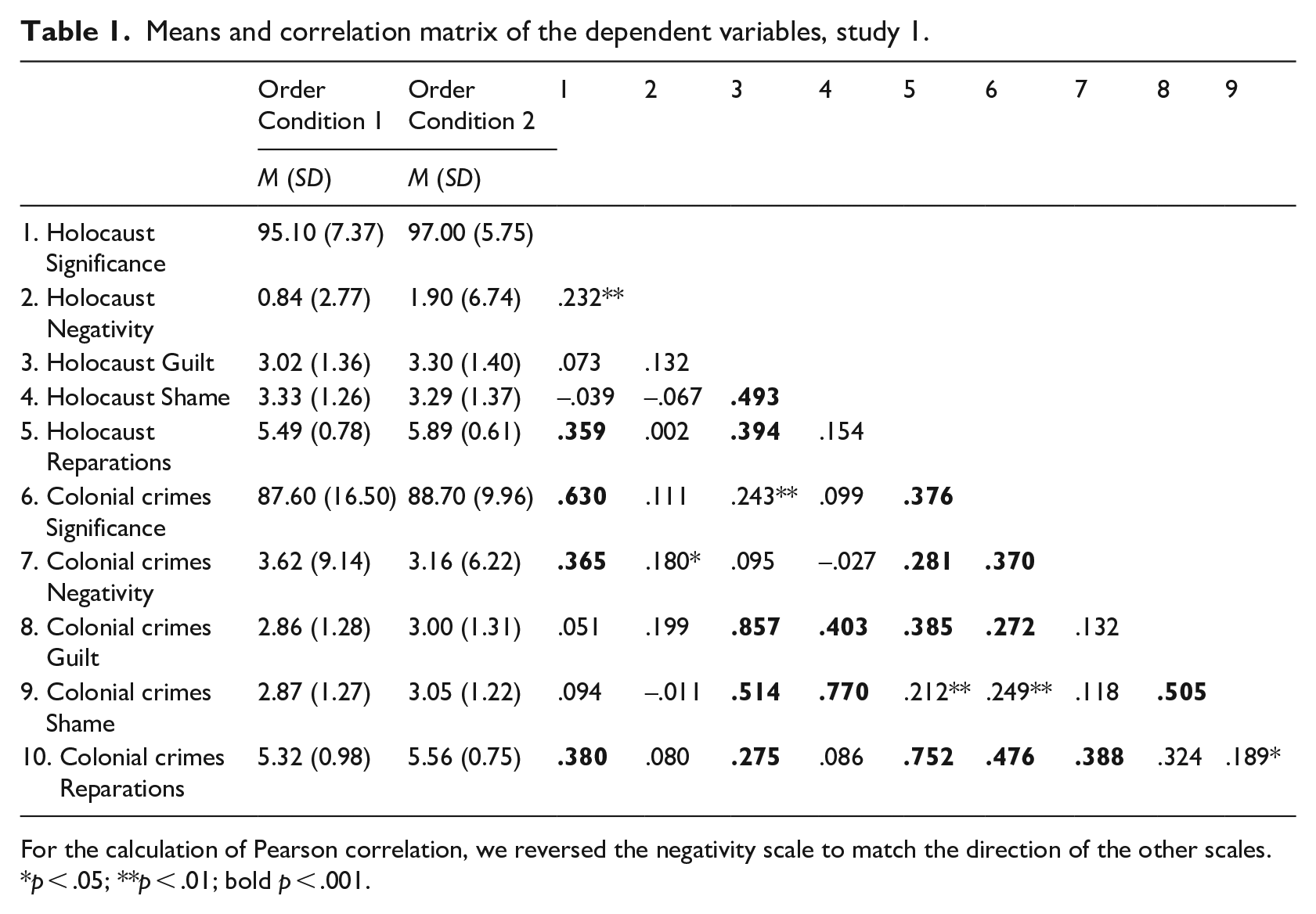
For the calculation of Pearson correlation, we reversed the negativity scale to match the direction of the other scales.
p < .05; **p < .01; bold p < .001.
Main analysis
To test whether the event and the order of presentation influenced people’s responses, we conducted a 2 (event: Holocaust vs colonial crimes) × 2 (order: Holocaust first vs colonial crimes first) mixed-model analysis of variance (ANOVA) with the first factor varying within participants. The analysis revealed a significant main effect of event on guilt (F(1, 150) = 15.28, p < .001, ηp² = .092), shame (F(1, 150) = 25.21, p < .001, ηp² = .144), significance (F(1, 146) = 83.86, p < .001, ηp² = .365) 3 and negativity (F(1, 148) = 12.66, p < .001, ηp² = .079). Participants displayed a general tendency to feel more guilt (M = 3.16, SD = 1.38 vs M = 2.93, SD = 1.29) and shame (M = 3.31, SD = 1.32 vs M = 2.96, SD = 1.25) about the Holocaust and to evaluate the event as more significant (M = 96.10, SD = 6.65 vs M = 88.10, SD = 13.5) and negative (M = 1.07, SD = 3.63 vs M = 3.39, SD = 7.78) compared to the Herero genocide. For the remaining dependent variables, there was no statistically significant main effect for order condition or the interaction between event and order (ps > .05).
For reparation intentions, there was a significant main effect for event (F(1, 150) = 29.05, p < .001, ηp² = .162), a significant main effect for order (F(1, 150) = 2.27, p < .01, ηp² = .046) and a marginally significant interaction effect for event and order (F(1, 150) = 3.24, p = .074, ηp² = .021). 4 Simple main effects showed that people’s willingness to make reparations for the Holocaust was significantly higher in the second condition (M = 5.49, SD = 0.78), where the Holocaust followed the colonial crimes confrontation, compared to the first condition in which the Holocaust was presented first (M = 5.89, SD = 0.61) (t(150) = –3.58, p < .001) (Figure 1).
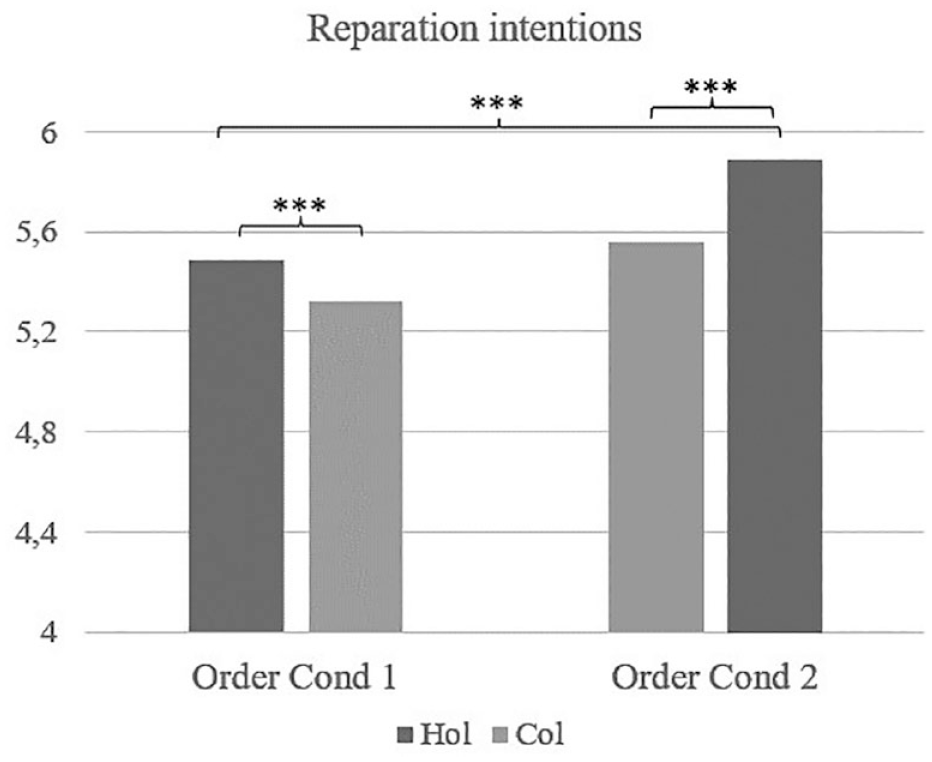
Willingness to make reparations by order and event, study 1.
Next, we tested whether responses to the Holocaust and colonial crimes differed when the events were considered independently (Holocaust and colonial crimes at position 1, between-subjects comparison). There was a significant effect for significance (t(146) = 3.71, p < .001) and negativity (t(148) = –2.35, p = .020), but not for the other variables (ps > .05).
Discussion
Participants in this study created a hierarchy of memories by evaluating the Holocaust as more negative and significant than Germany’s colonial crimes, and by reporting higher levels of collective shame and guilt and more reparation intentions for the Holocaust. Given the prevalence of the Holocaust in Germany’s collective memory, this does not seem surprising and is in line with previous research which finds that German citizens most often name National Socialism when asked which historical event future generations must remember (Papendick et al., 2022: 9). However, participants in this study were not asked to establish a hierarchy. In fact, participants indicated similar levels of collective shame, collective guilt and willingness to make reparations when the events were treated as independent memories (first position) but created hierarchies in their responses when considering the events in each other’s context. It is important to note, however, that the responses to the crimes of the Holocaust and colonialism did not differ strongly and people therefore do not seem to assign resources to primarily one event as a competitive memory framework would suggest. This may also explain the somewhat contradicting finding that responses to colonial crimes did not differ across conditions; the relativization that occurred when participants evaluated colonial crimes in the context of the Holocaust was too small to produce a statistically significant difference between the two colonialism evaluations. The same applies to the evaluation of the Holocaust, except here, we found a marginally significant ‘double-down effect’ for willingness to make reparations: People’s willingness to repair the Holocaust was significantly enhanced in order condition 2, where the Holocaust confrontation followed an exposure to colonial crimes. Above, we considered this a competitive memory approach, where the memory of colonial crimes motivates people to ‘double-down’ on the Holocaust memory to ensure that its primacy is not threatened. However, it could also be interpreted as a productive memory effect in that the memory of colonial crimes further enhances people’s willingness to make symbolic and realistic reparations for the Holocaust. The second interpretation would indeed run counter to the concern voiced by opponents of a multidirectional memory that an engagement with colonial history would reduce resources from the Holocaust memory.
Interestingly, we found strong positive correlations between evaluations of the Holocaust and the colonial genocide, suggesting that the more critically people engage with one event (feel guilty, ashamed, etc.), the more critically they also engage with the other, which rather speaks for a multidirectional memory effect. To better understand these (somewhat contrasting) findings, we conducted a second study with a more heterogeneous sample of participants.
Study 2
In study 2, we wanted to replicate study 1 with a community sample that better represented the German population with regard to migration background, education, age, gender and residency in former East versus West German territory. For the general population, we expected to replicate a memory hierarchy effect (Hol > Col, H1). Beyond that, we also hypothesized a relativization of the colonial genocide memory in the context of the Holocaust memory (H1b). In a second step, we sought to better understand the correlative relationship between the two events and considered the possibility that people differ in their response pattern. For this, we applied a latent profile analysis (LPA) to our data and examined various predictors (demographic differences, blind and constructive patriotism (Schatz and Staub, 1997), and political ideology) and rationales (open responses) for different response patterns. Since previous research has suggested that people’s approach to the past influences their attitudes towards related socio-political issues in the present (e.g. Sibley et al., 2008), we also gathered data on people’s attitudes towards racism and antisemitism in present-day Germany and tested whether the latent profiles predict different outcomes on these measures. We preregistered the replication of study 1 (https://osf.io/mbtwg/) but not the LPA, which was exploratory.
Method
Sample
We recruited a community sample of 210 German participants (101 females, 109 males, mean age = 45.3, SD = 15.7) via the survey provider Respondi, ensuring a balance in age, gender, education level, migration background and current place of residency (East-West Germany). We pre-defined too fast completion time and the failing of two attention checks as exclusion criteria. 5 On a political spectrum from 1 (extremely left) to 10 (extremely right), participants’ mean score was 4.99 (SD = 1.71).
Design and procedure
First, participants indicated their age, gender, religious affiliation, place of residency, their migration and educational background. They were then forwarded to the experiment, which was in its procedure identical to study 1: Again, we assigned participants to one of two order conditions and asked them to read a short text and to answer the dependent variables about the Holocaust (Hol) and colonial genocide (Col). Extending study 1, we then asked all participants directly whether they thought ‘Germans should remember and compensate the colonial period just as much as the Holocaust’ and to explain their reasoning. Next, participants answered questions about present-day racism and antisemitism in Germany, and indicated their orientation along blind and constructive patriotism and their political orientation.
Main measures
In study 2, we replaced the measures on significance and negativity with a scale on acknowledging ingroup responsibility, as we considered this to be psychologically more relevant. Perceived negativity and significance provide information about the perception of the events but tell us less about the meaning these events have for the own (perpetrator) group.
Two items adapted from Čehajić-Clancy et al. (2011) measured on a 6-point scale ranging from 1 (strongly disagree) to 6 (strongly agree) to what extent participants acknowledged their ingroup’s responsibility for the respective crimes (e.g. ‘I recognize that Germany is responsible for the crimes committed’; α = .853 (Holocaust), α = .867 (Colonialism)).
As in study 1, all participants responded to the same measures of collective guilt, collective shame and reparation intentions. We reversed one collective guilt item (but then excluded this item due to many erroneous responses).
Additional measures (latent profile analysis)
We asked participants to indicate their highest level of education. We organized responses into four categories: 1 (up to Hauptschule, secondary school, ends after ninth grade), 2 (Realschule = secondary school, ends after 10th grade), 3 (Abitur/university-entrance qualification) and 4 (university degree).
Participants were asked to indicate their current place of residency by federal state. We grouped states according to their membership in the former Federal Republic of Germany (FRG) and German Democratic Republic (GDR). We were interested in whether participants living in the former GDR held different representations of Germany’s past from those living in the FRG as indicated by previous research (Dresler-Hawke, 2005).
We assessed whether participants or one of their parents were born abroad (migration background). 6 All participants in this study had German citizenship.
To measure political ideology, we asked participants where they would place their political orientation on a scale from 1 (extreme left) to 10 (extreme right).
We measured participants’ constructive and blind patriotism orientation (Schatz and Staub, 1997) using the 12-item scale by Cohrs (2003) that was developed for the German context (e.g. ‘As a citizen, one has a duty to monitor and critically question political developments in Germany’ (constructive patriotism), ‘There is already too much criticism of Germany in the world. We, as its citizens, should not criticize it as well’ (blind patriotism)), with response options ranging from 1 (completely disagree) to 6 (completely agree). Constructive patriotism is characterized by a critical loyalty towards the own group. People who score high on this measure tend to react less defensively to information about ingroup wrongdoing and seek to better the group via social change. Blind patriots, in contrast, tend to defend their ingroup against criticism and to exercise blind loyalty towards their ingroup.
We explored participants’ attitudes towards present-day racism and antisemitism in contemporary Germany with the following questions: (1) ‘On a scale of 1 to 7, where 1 = not at all serious and 7 = very serious, how would you rate antisemitism/racism currently in Germany?’; and (2) ‘On a scale of 1 to 7, where 1 = completely unimportant and 7 = very important, how (un)important do you think it is that a) anti-racism/antisemitism offices are funded by the state? b) Black people/People of Jewish faith are protected in Germany?’
We asked participants directly whether they thought ‘Germans should commemorate and compensate the colonial period just as much as the Holocaust’ and asked them to explain their reasoning in an open response box. We coded the responses and report them by profile (for coding procedure, see Supplementary Material).
Statistical analysis: LPA
We used the R-packages ‘tidyLPA’ (Rosenberg et al., 2019) and MPlus 8.1 (Muthén and Muthén, 2017 [1998]) environment via ‘MplusAutomation’ (Hallquist and Wiley, 2018) to calculate an LPA within the jamovi software (The Jamovi Project, 2022). Rosenberg (2021) describes LPA as a statistical modelling approach (para. 1) that groups and divides people based on their responses across different variables. LPA is similar to cluster analysis but more flexible and rigorous because group membership is based on probabilities and the number of groups is based on model estimates and statistical tests (Magidson and Vermunt, 2002). Even though LPA attempts to detect ‘true’ group profiles hidden in data and our sample is sufficiently heterogeneous, we adopt a more cautionary, exploratory approach and interpret our profile solution as a model of possible profiles that may be expanded or further differentiated in other contexts and with larger samples (see also Bauer, 2019: 30f).
We used the same data and indicators of collective memory as before, but this time differentiated reparation intentions into commemoration (commemorating the event via memorials, history teaching etc.) and realistic reparations (financial reimbursement and public apology) to gain a more fine-grained picture.
Results
Initial analysis
Across all dependent variables, we found medium to strong positive correlations between people’s responses to the Holocaust and colonial crimes (see Table 2).
Means and correlation matrix of the dependent variables, study 2.
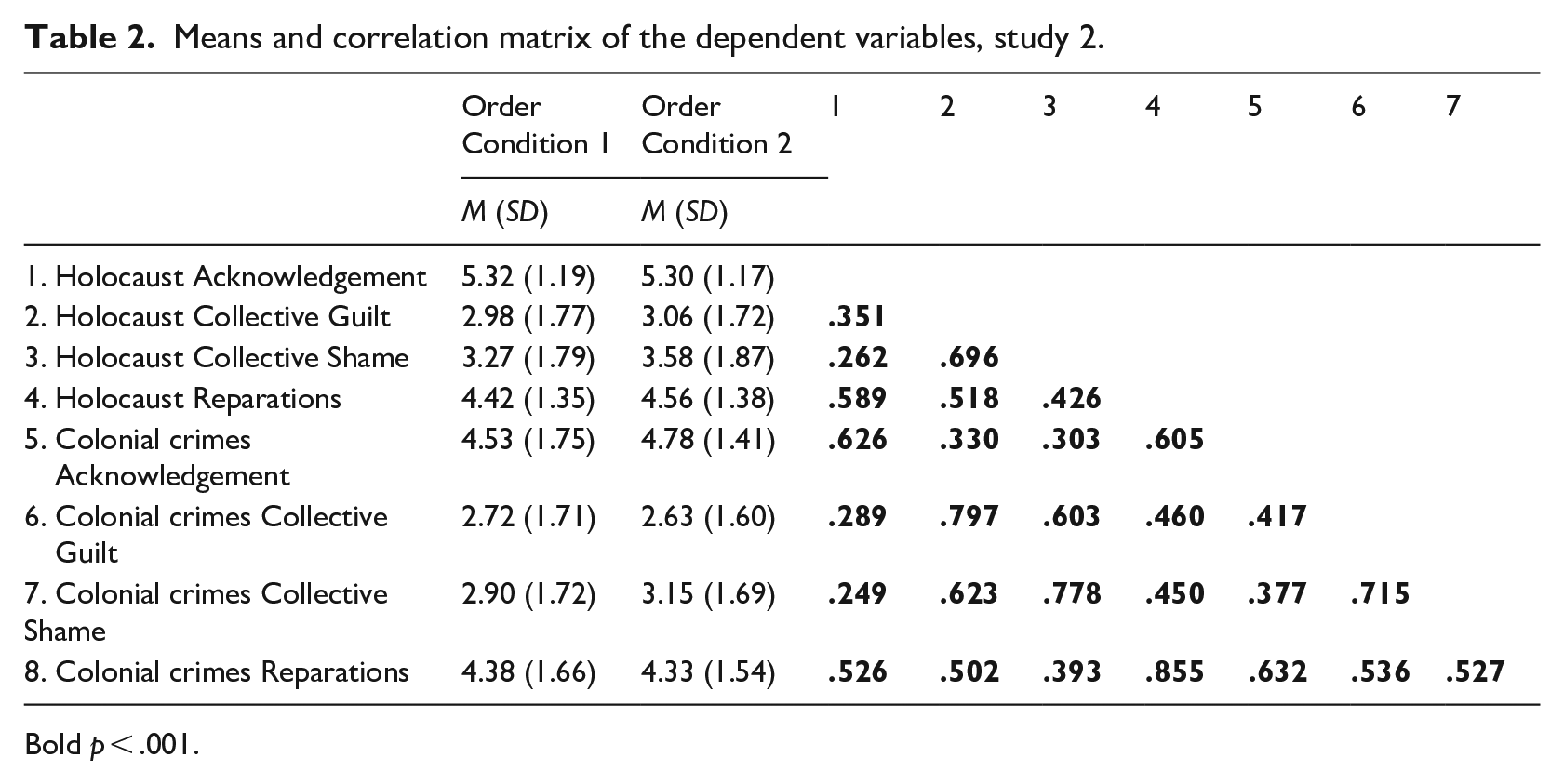
Bold p < .001.
Analysis of variance
We conducted a 2 (event: Holocaust vs colonial crimes) × 2 (order: Holocaust first vs colonial crimes first) mixed-model ANOVA with the first factor varying within participants. There was a significant main effect for event on acknowledging ingroup responsibility (F(1, 208) = 57.72, p < .001, ηp² = .217), 7 guilt (F(1, 208) = 21.70, p < .001, ηp² = .094), shame (F(1, 208) = 23.75, p < .001, ηp² = .102) and willingness to make reparations (F(1, 208) = 5.71, p < .018, ηp² = .027). Participants displayed a general tendency to acknowledge the responsibility their group carried for the Holocaust more strongly (M = 5.31, SD = 1.18 vs M = 4.66, SD = 1.58), to feel more guilt (M = 3.02, SD = 1.74 vs M = 2.67, SD = 1.65) and shame (M = 3.43, SD = 1.84 vs M = 3.03, SD = 1.70) about the Holocaust than the colonial genocide, and reported greater willingness to make reparations for the Holocaust (M = 4.49, SD = 1.36) than for the colonial genocide (M = 4.35, SD = 1.59). Across all variables, there were no significant main effects for order or interaction effects between event and order (ps > .05).
We tested whether people differentiate between the two memories when they are presented independently (at position 1). Only people’s acknowledgement of responsibility for the Holocaust crimes and colonial genocide differed at position 1 (t(208) = 2.78, p < .01). For the other dependent variables, there were no statistically significant differences at position 1 (ps > .05).
Preliminary discussion
Again, we find that people differentiate between the memories of the Holocaust and colonial crimes when given the opportunity. The overall difference, albeit significant, is small. As with study 1, we find medium to high, positive correlations between Holocaust and colonialism memory. To gain a better understanding of this relationship and to explore the possibility of different psychological responses towards multiple memories, we added an LPA to our analysis.
Latent profile analysis
A four-profile solution showed the best model fits (see Supplementary Material) and suggests different levels of history engagement and qualitative differences in shape (see Figure 2). In the following, we review each profile by providing an overview of their history engagement profiles, their rationales (open responses; see Table 3), characteristics (age, education, residency, migration background, political orientation) and attitudes towards present-day racism and antisemitism.
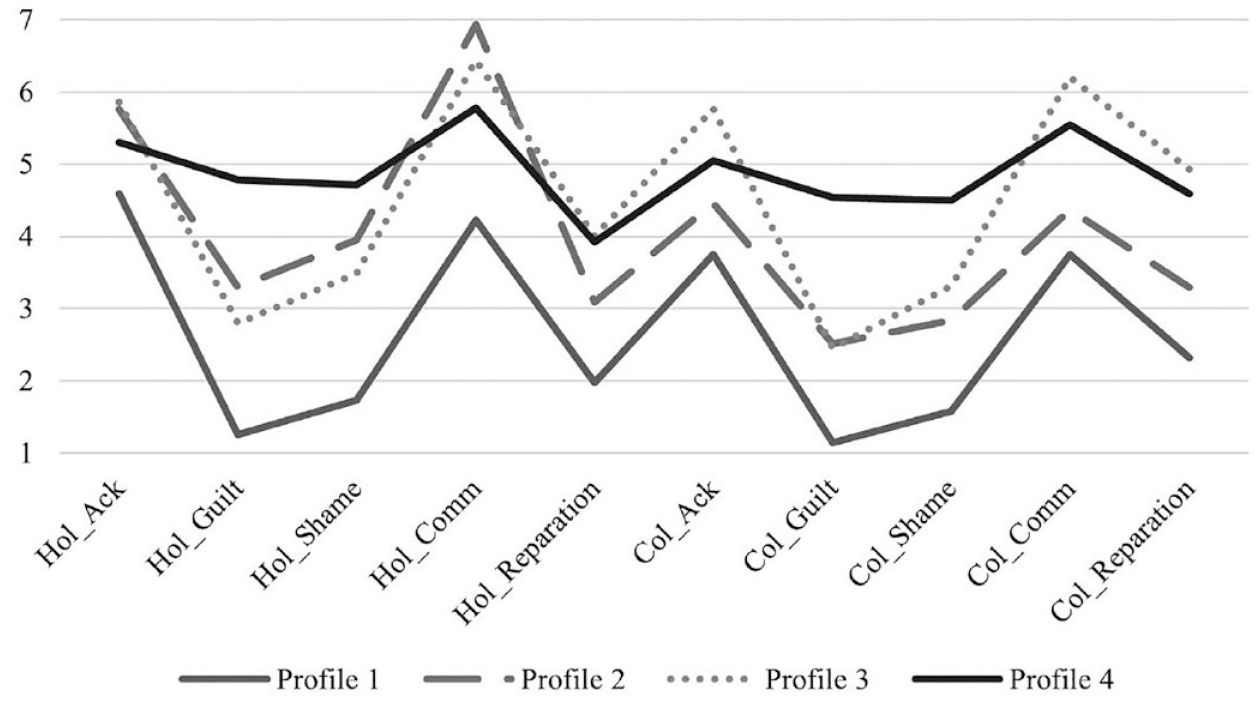
Plot of means across profiles.
Coding distribution per profile in percent.
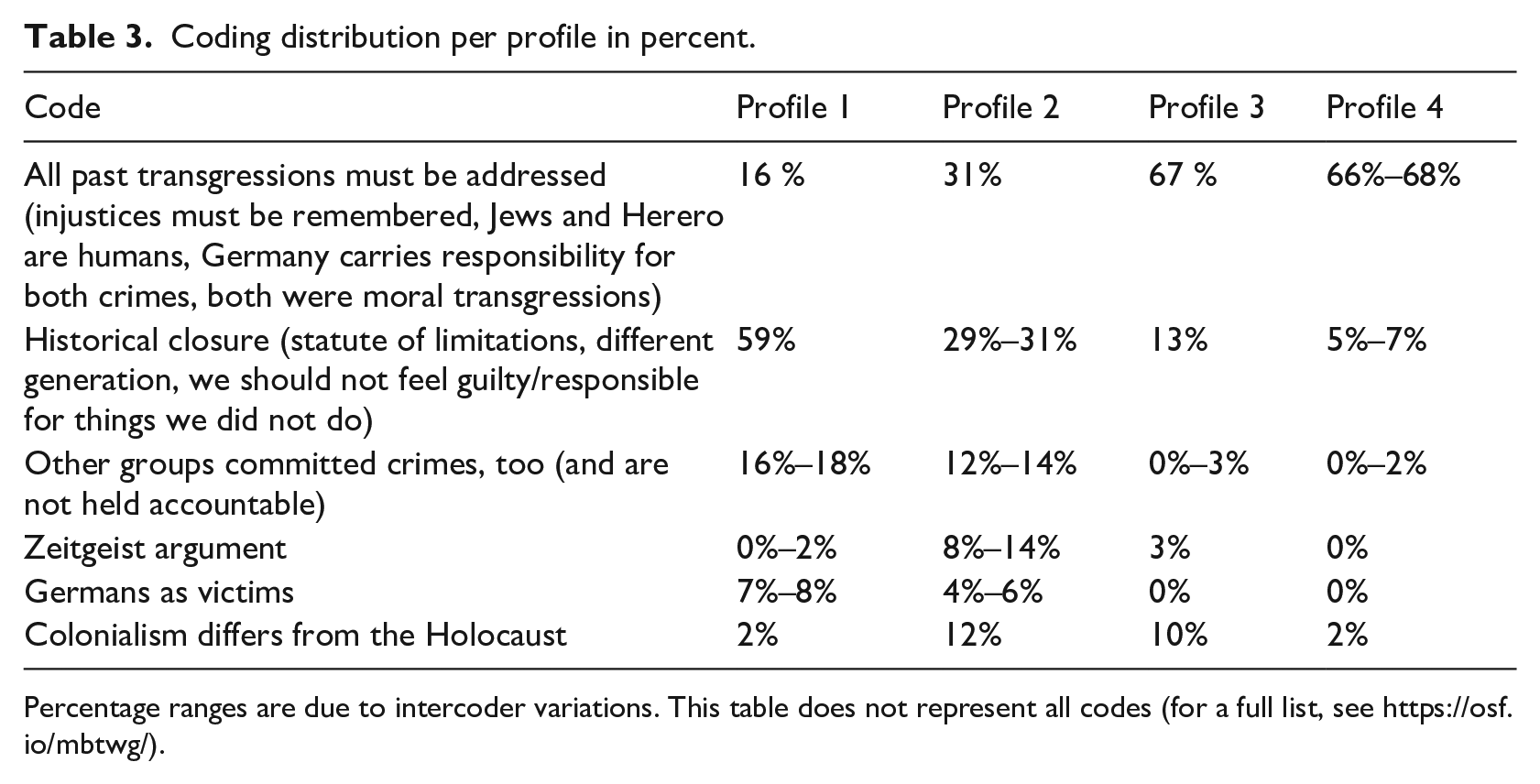
Percentage ranges are due to intercoder variations. This table does not represent all codes (for a full list, see https://osf.io/mbtwg/).
History engagement profiles and rationales
Profile 1: the minimalists/low recognizers (N = 61)
This profile stands out due to its overall low level of history recognition. While people in this profile acknowledge Germany’s responsibility for the Holocaust (M = 4.59) and to some extent colonial crimes (M = 3.75), they strongly reject feelings of guilt (Hol M = 1.24, Col M = 1.14) and shame (Hol M = 1.73, Col M = 1.58). They are neutral or somewhat agree to commemorate both events (Hol M = 4.23, Col M = 3.75) and unwilling to make realistic reparations (Hol M = 1.97, Col M = 2.32).
The open responses showed that people who fall into this profile often demanded historical closure (59%) and argued that other groups have committed crimes, too, without being held accountable for them (16%–18%). More than other groups, they referred to their ingroup’s victimhood (7%–8%) (see Table 3).
Profile 2: the hierarchizers (N = 51)
People in this profile show higher levels of acknowledgement, guilt, shame, commemoration and reparation intentions for the Holocaust than for colonial crimes. They only tentatively acknowledge Germany’s responsibility for the colonial crimes (M = 4.46) and express low feelings of guilt (Hol M = 3.29, Col M = 2.51) and shame (Hol M = 3.95, Col M = 2.84) for both events. More than any other profile, they seek to commemorate the Holocaust (M = 6.93), but much less Germany’s colonial crimes (M = 4.37). They also tend to reject realistic reparations (Hol M = 3.09, Col M = 3.29).
About 30% of people in profile 2 argued that historical crimes should be remembered but the same number made demands for historical closure. Some people in this group brought forward a Zeitgeist argument which considers colonialism as a practice that was ‘common’ for Western nations (8%–14%). This argument was often linked with the claim that the two events are different; colonial crimes were perceived as less relevant and ‘further away’, while the Holocaust was described as uniquely cruel and not comparable (12%).
Profile 3: the advocates (N = 39)
People in profile 3 are highly willing to acknowledge Germany’s role in the Holocaust (M = 5.86) and colonial genocide (M = 5.77) and seek to commemorate both events similarly strongly (Hol M = 6.44, Col M = 6.20). They report relatively low levels of guilt or shame (Guilt: Hol M = 2.80, Col M = 2.45; Shame: Hol M = 3.49, Col M = 3.31). Interestingly, people in profile 3 seek to pay reparations for Germany’s colonial crimes (M = 4.93) more so than for the Holocaust (M = 3.92).
Many people in this profile argued that both events were moral transgressions against humans for which Germany bears responsibility (67%). Fewer demanded historical closure (13%). Somewhat surprisingly, about 10% argued that colonial crimes and the Holocaust differ. These people suggested that both events should be commemorated and repaired, but especially the Holocaust.
Profile 4: the holistic memorizer (N = 59)
While people in the other profiles show drops in emotions compared to other appraisal forms, people in profile 4 show similar means across indicators of memory. They show slightly lower values for Holocaust reparation (M = 3.92), compared to the other indicators and thus also in comparison to colonialism reparations (M = 4.59).
Many members of profile 4 argued that Germany must address all past transgressions (66%–68%). Few called for historical closure (5%–7%).
Demographic and psychological characteristics
Analysis of variance/ contingency
There was no statistically significant difference between the profiles regarding order condition (χ2(210,3) = 4.03, p = .259).
Regarding age, profile 1 contains the oldest people (M = 49.77, SD = 13.46), closely followed by profile 2 (M = 47.39, SD = 15.11), then profile 4 (M = 43.42, SD = 15.56) and finally profile 3 (M = 38.15, SD = 16.15). Profile 3 is significantly younger than profile 1 (p < .01) and profile 2 (p < .05).
Profile 3 shows the highest education level with about 40% holding a university degree. Profiles 1 and 2 show a higher percentage of the first two (lower) education backgrounds. However, education differences between profiles were not significant (χ2(210, 9) = 11.2, p = .264).
There was no statistically significant difference between the profiles concerning participants’ place of residency (former GDR vs FRG, χ2(210,3) = 2.39, p = .495).
Profiles also did not differ significantly in terms of participants’ migration background (p = .172), even though in profile 1 only 4.92% had a migration background, whereas profiles 2 to 4 ranged from 15.25% (profile 4) to 15.38% (profile 3) and 17.65% (profile 2).
Regarding ideology, profile 3 (M = 4.10, SD = 1.89) was the furthest to the left, followed by profile 4 (M = 4.69, SD = 1.76). Profile 3 differed significantly from profile 1 (M = 5.46, SD = 1.76, p < .001) and profile 2 (M = 5.45, SD = 1.64, p < .001).
Profile 1 shows the lowest levels of constructive patriotism (M = 4.12. SD = 1.01) and differs significantly from profile 3 (M = 4.62, SD = 0.86, p < .05) and profile 4 (M = 4.70, SD = 0.87, p < .01). Profile 2 (M = 4.53, SD = 0.86) lies between profile 1 and profile 3. Profile 3 shows the lowest levels of blind patriotism (M = 2.65, SD = 1.00) and differs significantly from profile 2 (M = 3.52, SD = 1.11, p = .001) and profile 4 (M = 3.57, SD = 1.03, p < .001). Profile 1 (M = 3.12, SD = 1.07) did not differ significantly from any of the other profiles.
Multinomial logistic regression
We additionally used multinomial logistic regression to explore which variables best predict group membership. The results are displayed in Table 4.
Multinomial logistic regression: model coefficients (parameter estimates).
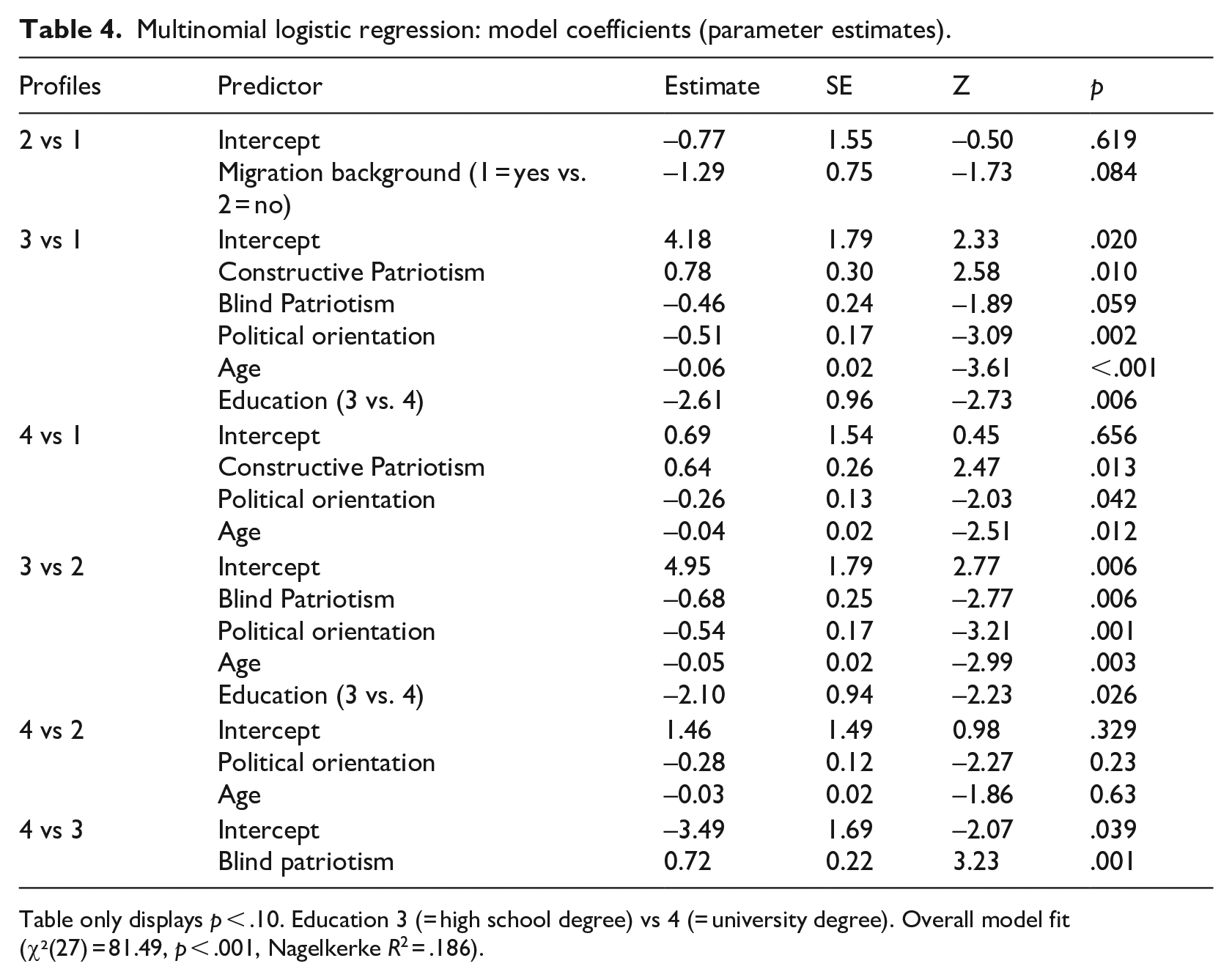
Table only displays p < .10. Education 3 (= high school degree) vs 4 (= university degree). Overall model fit (χ²(27) = 81.49, p < .001, Nagelkerke R2 = .186).
Attitudes towards present-day racism and antisemitism
Compared to profiles 3 and 4, people in profile 1 evaluate racism and antisemitism in present-day Germany as less serious (p < .01). Concerning antisemitism, profile 3 also differs significantly from profile 2 in this respect (p = .049). Concerning the protection of Black lives and the support of Anti-racism offices, profile 1 shows significantly less support than the other clusters (p < .01), and profile 3 reports significantly more support than profile 2 (p < .01). The same picture appears for the support of Antisemitism offices (p < .01), and the protection of members of the Jewish community (p < .001), although here, the difference between profiles 2 and 3 is not significant (p > .05) (see Figure 3, and for exact means and standard deviations Table 6 in the Supplementary Material). 8
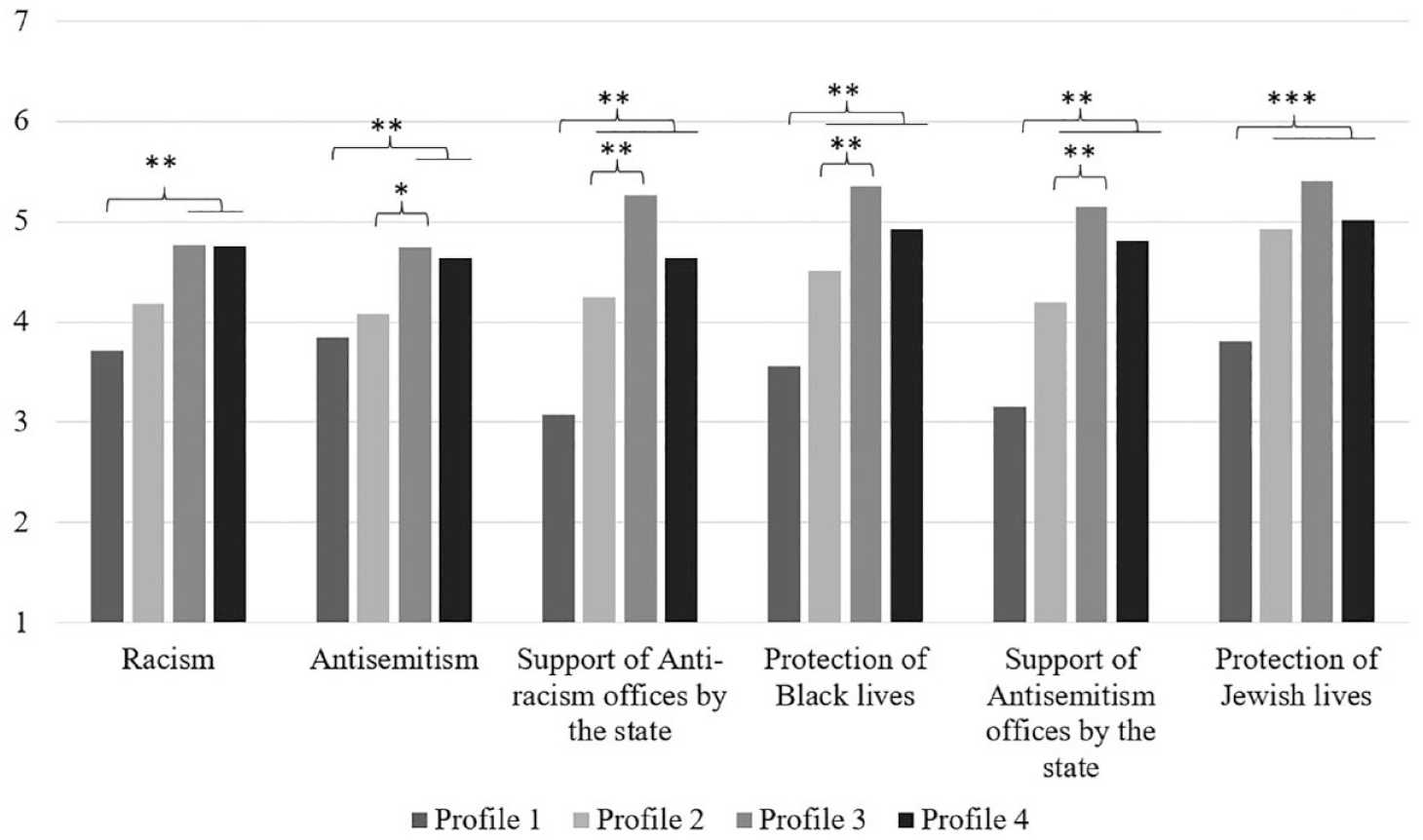
Means across clusters for present-day attitudes towards racism and antisemitism.
Discussion
Findings from the LPA suggest that people’s approach to one past ingroup wrongdoing may translate to other memories of violence. In three out of four profiles, people engaged with the Holocaust and Colonialism memory with similar criticality. While profile 1 showed low levels of history recognition for both events, profiles 3 and 4 showed high levels and only profile 2 differentiated between the Holocaust (high engagement) and colonial crimes (medium to low engagement) more strongly. These findings can explain our previous results of strong correlations between the two events and an (overall small) hierarchy effect. The open responses indicate that profiles 3 and 4 make multidirectional connections between the two transgressions by focusing on their genocidal nature and victims’ suffering. While many people in profile 1 call for historical closure, profile 2 more strongly distinguished between the two events based on their perceived relevance and uniqueness. Interestingly, this group still performed primarily symbolic redress for the Holocaust (acknowledgement of responsibility and willingness to commemorate) and rather rejected realistic reparations. Moreover, they were neutral towards measures to counter antisemitism in the present. Further research is needed to understand the motivation that drives the responses of profile 2.
It is noticeable that, across three profiles, people showed lower levels of collective emotions than acknowledgement or commemoration intentions. A large body of research has studied ways to enhance feelings of collective guilt (Branscombe and Doosje, 2004). We find that people do not necessarily have to experience guilt or shame to acknowledge and commemorate ingroup transgressions or to support reparations (though this item in general received lower values), nor that it affects their evaluation of antisemitism and racism in the present. This might indicate that emotions play a less central role in critical history engagement (more than 75 years after the transgression). This is also reflected in a speech by Germany’s former federal president Joachim Gauck who suggested that the generations that followed the perpetrators are ‘. . . not guilty, neither morally nor legally, but they experience something like a sense of responsibility not to forget the crimes of the past and to address them’ (Gauck, 2013, own translation). In addition, other emotions, such as regret (Bilewicz et al., 2017: 183) or anger (Leach et al., 2006), may more effectively facilitate historical reappraisal. Finally, the comparatively higher willingness to acknowledge responsibility and to commemorate past ingroup crimes could reflect different levels of personal involvement. That is, it may be easier to support an institutional acknowledgement and commemoration of past ingroup wrongdoing than to experience feelings of guilt and shame personally or to commit to more concrete measures like financial reparations and public apologies. 9
What determines the affiliation to different profiles? Our data suggest that age, political orientation and group identification differentiate well between different forms of history engagement. Age may be linked to generations and an exposure to different representations of ingroup history as well as closeness to the perpetrator group (Licata and Klein, 2010). Concerning ideology and identification, studies on identity attachment suggest that people who glorify their nation (similar to blind patriotism) show more defensive reactions when they are confronted with (past) ingroup wrongdoing (Roccas et al., 2006). Our research extends these findings to the field of multiple memories and demonstrates that political orientation and the affirmation or rejection of blind patriotism can, next to age, potentially differentiate between a more competitive (profile 2) and a multidirectional (profiles 3 and 4) approach to ingroup wrongdoing.
General discussion
How perpetrator groups engage with their negative history has received increasing attention in psychological science. Yet, little research has addressed the question of how people psychologically negotiate multiple past transgressions of their ingroup. In the present study, building on scholarship from Holocaust studies, we sought to examine how the memory of one ingroup transgression psychologically informs the memory of another. Specifically, we exposed German participants to two transgressions of their ingroup, the Holocaust and the colonial genocide against the Herero and Nama in former South West Africa, in varying order, to test ideas of a multidirectional memory (= one memory productively informs another) versus a competitive memory (= memories stand in competition) effect.
Overall, the data rather suggest a multidirectional memory effect. Across two studies, we find strong, positive relationships between the psychological engagement with the Holocaust and colonial genocide memories. Results from an LPA confirm similar levels of history engagement for three out of four profiles. Nevertheless, we also find some indications of competitiveness in our experiments. In both studies, people build memory hierarchies when evaluating the Holocaust and colonial crimes in each other’s contexts along measures of negativity and significance (study 1), reparation intentions, collective guilt and shame (studies 1 and 2), and acknowledgement of ingroup responsibility (study 2). This differentiation, however, is small and may be driven by a subgroup which shows very high levels on Holocaust memory and lower willingness to engage with Germany’s colonial past (profile 2, study 2). While this pattern hints to a competitive memory effect, people do not mention any concern about the Holocaust being replaced or minimized by the memory of colonialism. Some refer to a Zeitgeist of colonial practices which, so their argument, makes colonial crimes less relevant for German collective memory (see Licata and Klein, 2010: 53, for similar findings in the Belgian context). As such, the profile could also be interpreted as a defensive approach to avoid the engagement with further historical transgressions or represent a gap in historical knowledge (see below). The different motives underlying competitive patterns may thus go beyond the theoretical framework that we presented in the introduction of this article.
Several limitations must be considered. To our knowledge, this study is the first to examine the psychology of multiple memories. Given the relatively small samples, it is important to replicate the profiles of history engagement with different, larger samples as well as with memories of other historical events. Specifically, future research should test whether similar profiles of history engagement occur for other memories of ingroup transgression and whether the findings of this study are truly representative for multiple memories or rather an account of the specific relationship between the Holocaust and colonial crimes memories in Germany. It is also worth considering how critical historical knowledge may impact people’s approach to multiple memories. As we note in the discussion of the first study, a differentiation between the memories of colonialism and Holocaust may reflect different levels of critical history knowledge. Previous research shows that critical knowledge of history influences people’s understanding of structural racism in the present (Bonam et al., 2019), and that learning about the ongoing negative consequences for the victim groups weakens the rejection of feelings of guilt, which then influences reparation intentions (Imhoff et al., 2013). Interestingly, study 1 suggests that people’s perception of the historical event as significant also plays a role in how people feel about it and whether they are willing to make reparations. Future research should consider this potential influence of critical historical knowledge and historical significance on people’s engagement with multiple memories. Second, our experimental design may not have been ideal for the study of multiple memories. Due to its omnipresence in Germany’s collective memory, it is possible that the memory of the Holocaust is always salient when people are exposed to other historical transgressions, which would have weakened our manipulation. In addition, while the memory of the Holocaust holds a central place in Germany’s official narrative, a considerable percentage of participants sought historical closure (Imhoff, 2010). Competitive or multidirectional effects, however, can only emerge when people are willing to engage with (at least one) memory. Third, the present research can only make limited claims as to whether it is indeed the memory of the Holocaust that guides individuals’ approach to other pasts – or whether people are guided by a more general ideological/identity orientation.
What practical implications can we draw from the present research? In Germany’s so-called ‘Historikerstreit 2.0’ (Historians’ Debate 2.0), opponents of Michael Rothberg’s Multidirectional Memory idea suggest that the memory of the Holocaust could be relativized when Germany’s colonial crimes are placed in relation to it. One key finding of our research, however, is that zero-sum thinking is rare when it comes to multiple memories of ingroup transgressions, as people who ‘spend memory resources’ on colonial history do not show any reduction in their engagement with the Holocaust past. There also seems to be a group that holds the Holocaust memory high while showing lower willingness to engage with the colonial past. While our study provides first insights into the underlying rationales, more research is needed to better understand the motives of those ‘defending’ the Holocaust memory against other memories to reach a more constructive debate.
On a final note, while we find indications of a productive memory effect at an individual level, it is important to consider that, on a collective level, this multidirectional impact remains limited. Only in 2021, the German government was willing to issue an apology, while ‘reparations’ is a term it still seeks to avoid in the context of the Herero and Nama genocide (Bundeszentrale für politische Bildung, 2021).
Supplemental Material
sj-docx-1-mss-10.1177_17506980241247269 – Supplemental material for How do members of a perpetrator group negotiate multiple past ingroup transgressions? A German case study
Supplemental material, sj-docx-1-mss-10.1177_17506980241247269 for How do members of a perpetrator group negotiate multiple past ingroup transgressions? A German case study by Carmen S Lienen, Frank Eckerle and J Christopher Cohrs in Memory Studies
Footnotes
Acknowledgements
We would like to thank Katherina Hildebrand, Victoria Le and Rosa Huber for their help with coding qualitative data and Tamino Konur for his help with data collection. The article was presented at the Scientific Meeting of the German Political Psychology Network conference in 2021 and the Annual Meeting of the International Society of Political Psychology in 2022.
Authors’ note
The article is based on the first author’s doctoral dissertation.
Declaration of conflicting interests
The author(s) declared no potential conflicts of interest with respect to the research, authorship and/or publication of this article.
Funding
The author(s) received no financial support for the research, authorship and/or publication of this article.

Supplemental material
Supplemental material for this article is available online.
Notes
Author biographies
References
Supplementary Material
Please find the following supplemental material available below.
For Open Access articles published under a Creative Commons License, all supplemental material carries the same license as the article it is associated with.
For non-Open Access articles published, all supplemental material carries a non-exclusive license, and permission requests for re-use of supplemental material or any part of supplemental material shall be sent directly to the copyright owner as specified in the copyright notice associated with the article.
