




Abstract
This conversation explores themes of memory, activism, and the arts through the scholarship, poetry, and practice of Nayahamui Rooney. In a range of interdisciplinary work, Rooney, a Papua New Guinean woman, has analyzed key issues of power, violence, justice, and voice in Papua New Guinea. In this interview, Rooney reflects on how her journey to become a maker of baskets on Manus Island informed her understanding of the political and social dynamics of memory, especially in the context of Australia’s decision to base a regional processing center for asylum seekers on Manus Island in the first decades of the twenty-first century. The interview explores how the relationships among basket-making, collective memory, interdisciplinary scholarship, and political activism can emerge in non-linear and recursive ways in response to changing political discourses. It concludes by reflecting on how the scholarship of today can lay the groundwork for a more inclusive collective memory that will be needed in the future.
I am delighted to be hosting a conversation with Dr. Nayahamui Rooney from the program in Gender, Media and Cultural Studies in the School of Culture, History and Language, College of Asia and the Pacific, at the Australian National University. I’d like to acknowledge the traditional custodians of the lands we are meeting on, the Ngunnawal and Ngambri people, and pay respects to elders past, present, and emerging. I’d like to extend those respects to the traditional custodians of your community where you conduct your research, and I’m hoping we’ll have the chance to reflect today on knowledge-making practices that have long been important within different First Nations communities. This conversation began with an event that we called “Loops of Memory,” which invited reflection on ways that the communal and recursive practices of handwork and textiles could advance our understandings of memory in Australia, Asia, and the Pacific. At that time, we were also fortunate to be in dialogue with our colleague Carol Hayes, Professor of Japanese Studies. Carol has since passed away, so I’d like to recognize her work in this area (Hayes, 2019; Seaton and Hayes, 2023). I feel that her spirit is with us today.
Nayahamui, your work in Pacific Studies has invited us to understand political economy, economic anthropology, and human geography through a wide range of lenses, including basket-making, a significant practice in the Pacific. So, I’m wondering if you could tell us a little bit about how you became a maker of baskets.
Thank you very much Shameem, and again, like you, let me acknowledge Ngunnawal and Ngambri people, where you and I are working and meeting today, and also Indigenous people all over the world. This is a space that we will come into. And also thank you very much for inviting me to reflect on these issues. We often write and we don’t really realize that the work that we do takes on a life of its own, and so I’m really delighted that I’ve been invited to reflect on my work in this space.
You asked me how did I begin making baskets. In my case, my memories of childhood are filled with people making things, specifically to basket and specifically to fabric, making fabric. My mother is a Manus woman, she’s a prominent politician (was, she passed away now, Nahau Rooney, in Papua New Guinea, she’s from Manus Island)—and on her side, we grew up around women who make baskets. So basket-making in my memories of childhood is a very, very important part—it is very vivid, all the way through adulthood and now, so whenever I return home, if you go around the Pacific, or to Manus, making baskets is something that’s just everywhere. Everyone’s doing it. So you grow up around basket-making. On the Australian side, my father is a white Australian man, and his mother loved weaving and knitting. For some time, I went to school here in Australia, living with my father’s family, and so her home was filled with all the materials of fabric-making: knitting, weaving, she had a loom, she had unspun and spun wool in her house, so hanging around with her I also began picking up the craft of knitting and weaving. I think, maybe by accident, or by fate, I’ve just grown up around these amazing women who love, who use this knowledge of fabric-making.
So let me just return back to the Manus space, because that is where my scholarship is. When I talk to people now and say I’ve made a basket, or they see a basket I’ve made, many women who have—and it’s a craft dominated by women—some men do it, but by and large it’s dominated by women (we’ll come to the cultural significance of that in a bit), one of the things that people remark on when I say that I’ve made this basket is that “oh, I never learnt to make a basket.” So this is among Manus women who might have gone on to school. My own mother, when she saw me making it, said, “you know, I didn’t learn how to make a basket because I went to school.” So the idea of knowledge that can be lost, or can be erased through these processes that we are all experiencing, migration, an education system that privileges Western forms of education such as numeracy and literacy, and as a result, devalues traditional forms of knowledge like basket-making.
The basket process I recall sitting next to family members and picking up what they were weaving and them teaching me. I recall as a child learning the very beginning of the basket and trying to create the base of it, but with schooling and me moving around and working, eventually I lost that, I lost that too, into memory and into the past. And then I think it was migrating to Australia, and living here in Australia, and beginning to appreciate the value of Indigenous knowledge from an intellectual lens, and understanding that the further away we are removed from our ancestral homes, from our ancestral cultures, we lose. We lose these knowledges and we also lose the embodied presence where you do learn, just simply by living and being part of community and being part of culture. You pick up other skills for life, but you lose certain others. And basket-making was one among many things.
In this issue, we are exploring interconnections among creative and performative acts, memory, and activism. Could you reflect on some of these interconnections in your work?
I think the turning point for me was arriving in Australia as a new migrant, taking up citizenship and becoming a voter in Australia around 2010–2011. And that time, as you will remember, the debates around Australia’s asylum seeker detention processing centre began to heat up again, because of another wave of asylum seekers arriving by boat, and again, this is driven by global processes, war and famine, and so forth, which drive people to move, to seek a better life. But this debate I began to realize was very very central to Australian politics (see Rooney, 2022 for discussion on Australian political discourse). As someone coming from Papua New Guinea, we often hear that Australia is this development partner, and Australia is going to develop Papua New Guinea; we have this kind of starry-eyed image of Australia as this developer, with, of course, the colonial history there making it a very dominant player. But sitting in Australia, now a voter, made me—it dawned on me just how central certain issues were in Australian politics. And so, at that time, my mother was still alive then, and so when they announced that the Australian government would fund and open the Regional Centre (to process asylum seekers) on Manus Island, in agreement of course with the Papua New Guinea Government, that was a shock to many people. It was a return to the old days, a return to the colonial period. And of course, there was uproar from people who knew Papua New Guinea, who knew that this was not going to work. There was no way that this policy—it didn’t make any logical sense. But nevertheless we all found ourselves in this very, very powerful stream of narratives.
The reason I started writing about it was because I was worried, I was anxious. Now, I would sit here, caught between Australia’s debates about “we need to support the rights of asylum seekers” and “we need to secure Australian borders.” And yet it was very, very difficult to try to talk to anyone in Australia and say, “but there is another very powerful part of this political discourse, and that is the Papua New Guinea side and the Manus side, and the colonial history, and the power that Australia has.” So I was, I was worrying a lot, I was worrying about family, because as time wore on, we began to see news, newspaper story after newspaper story of maybe showing how the vulnerability of asylum seekers on Manus Island, experiencing violence within the detention center, and eventually as the Papua New Guinea Government ruled that this, the Detention Center, wasn’t Constitutional, they closed it down. So asylum seekers and those who had been granted refugee status began to immerse into the community. The stories in Australia were very much about the violence perpetrated on asylum seekers. Yet you could see another narrative on my Facebook page and in conversations with people, this concern about the impact on the local community. And so, that’s just the long way of telling you how, that journey of, arriving at the paper “As Basket and Papu” (Rooney, 2021) (see Figure 1).
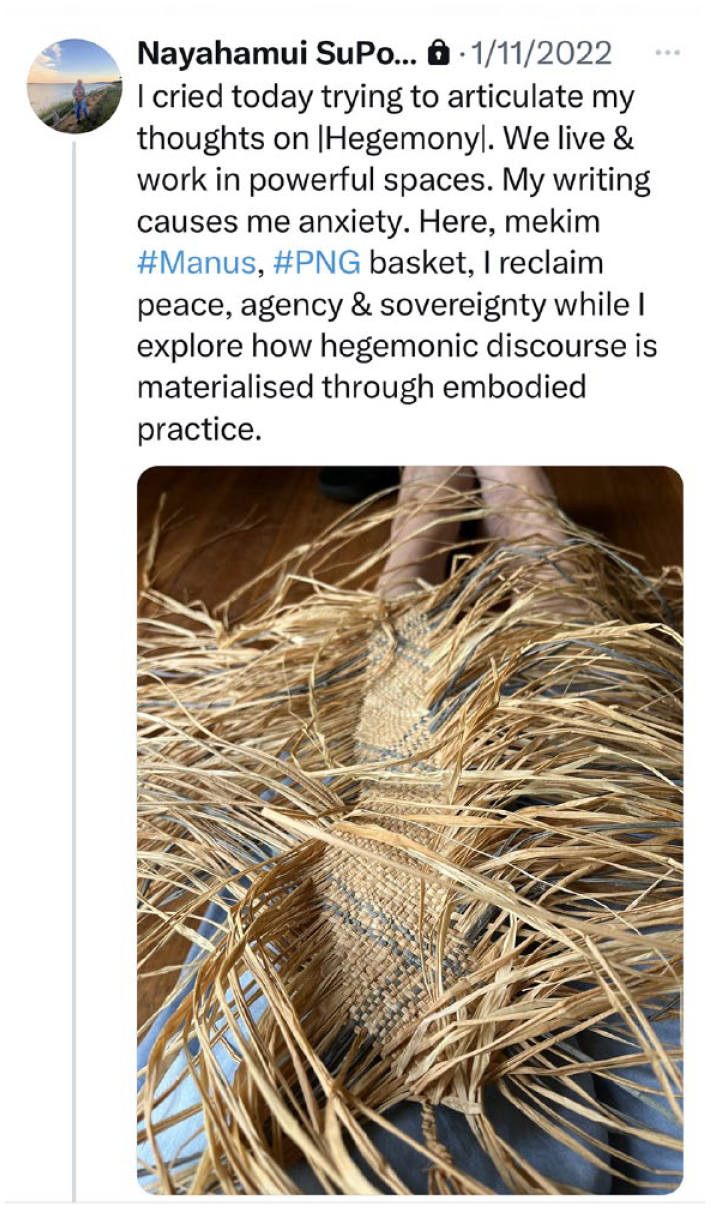
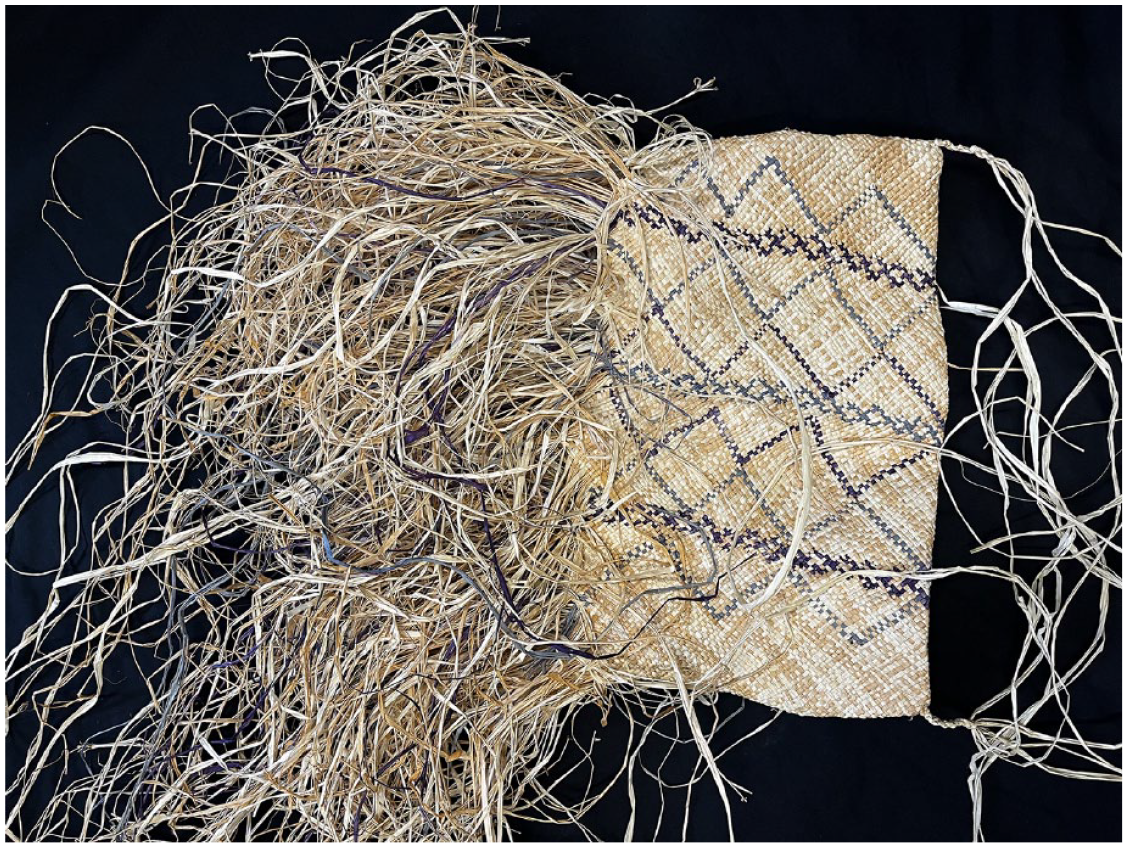
Project titled |Hegemony|. Forming as basket. Manus basket made from raffia. Completed and gifted to my mother’s sister in Manus in December 2023.
So a couple of things—my mother aging, and being curious about what’s happening at home—led me to begin to think about how do we think about this in a little bit more intentional way. To say, there’s part of this story that actually is a very sad part of Australia’s history, sad and horrible part of Australia’s history. But there’s a missing part of this that needs to be included in the narrative of Australia’s offshore detention centers and policies for asylum seekers. And so I began this process of thinking through, how do I understand this issue from a Manus perspective, specifically?
And so, journeying home to see my mother, and visiting home, was an opportunity for me to say, to think about it, “okay, so what is it?” When I was home I’d look around, and I was very intentional about not overlaying the narrative I knew that was powerful in Australia into my conversations when I returned home, as in, “what are the rights of asylum seekers?, and what do the—what is it about the government policy?” Instead I would sort of sit and listen and immerse myself in with family, and listen to what they were talking about, listen to what things concerned them, and usually for Manus people during those years, it was, “the roads are not good,” “the hospital is run down,” “the education system is—needs improvement,” and “the cost of living was very high.” And—so you have this people who—and the Regional Processing Center itself—is located at—was located at Lombrum Naval Base, which is now the naval base, or has always been, and it was located at the Lombrum area there. And, so, in the day-to-day lives, unless you were someone directly living near it, who’s, who’s part of the land negotiations, the rest of the people were more interested in their own lives, you know? How do we live, live our lives, and try to improve our lives and our food, things? and so forth (see also Figure 2 for discussion).
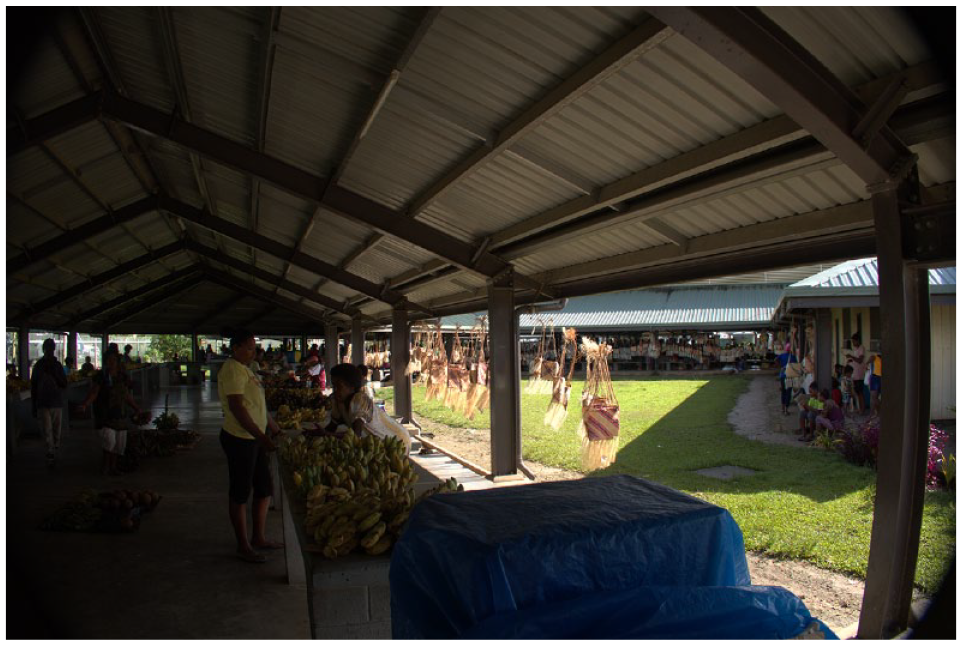
The “main Lorengau market is arguably the most visible outcome of the development that was promised by the RPC” (Rooney, 2021: 98). This is a picture taken in 2018 of areas denoted by A and B in Figure 6 of As basket and Papu (Rooney, 2021). Over the years, “I have come to interpret the lawn, the curtain of displayed baskets, and the women making baskets as symbolic of the material and social Manus as basket. The changes that have occurred around it represent the powerful external forces that have come to bear on Manus society in recent times” (Rooney, 2021: 102).
So you have this disconnect between what is important for people in your community and yet this very, very powerful process happening internationally, which to—you know, portrayed Manus people as violent, portrayed Manus Island as this kind of hellhole—and in many ways, all those portrayed in the media by the Australian government were aimed at making Manus a, what’s the word? A prevention? So that when people who want to seek asylum, they know that they might end up in Manus Island, they’ll think twice, so “I don’t want to end up in that hellhole.” In many ways, the portrayal of Manus Island and Manus people was constructed in a way to prevent—deter, deter the would-be asylum seeker from coming to Australia, which is where they wanted to go.
So, at home, that was the first trip in 2017, and then went back in 2018, and thinking through all these issues, thinking about what would be a—if we had to convince—and again these conversations continue to be difficult. In Australia, when you try to talk about it, people go blurry eyed. They’re not interested in Manus Island, or in Manus Island people. All people are interested in is the rights of asylum seekers and secure borders. So far, I found myself caught between this powerful discourse on rights, and security, and so forth.
And yet, over time, we began to see more and more stories emerging in the mainstream media, well, not among our social feeds or our conversations (which many of us were already seeing), but emerging in mainstream media about the kind of now more gendered dimensions of the presence of these men on Manus Island, either entering into relationships with Manus women, or stories of alleged assault, and court cases. And so this made me begin to think—and I had already seen that earlier on, as time wore on—there’s this big contradiction in Australian government policy here. Because on the one hand, Australia is by far the biggest contributor of aid to Papua New Guinea, and Australia’s aid dwarfs other development partners. And then the very, very important part of that development discourse is security. Security and gender. Empowerment of Papua New Guinean women, and preventing and eliminating gender-based violence. Because these were issues where there’s enough evidence around that shows that gender-based violence in Papua New Guinea is a very serious issue. And so I began to see this kind of contradiction in discourse, from where I was sitting, that was—on the one hand they’re talking about development and addressing women’s empowerment and gender equality and so forth, and on the other hand, you’ve placed all these men from very different cultural backgrounds onto a small island. It seemed, like, the logical outcome was going to be gendered dimensions, whether nice relationships forming, or some form of gendered violence.
So you began to see this—at least from where I was sitting, someone new to voting in Australia and someone with very strong connection to Manus Island, personal connection, so anxious and worrying about family, and someone who’s also interested in migration processes and issues around gender and so forth. All of these things for me, from where I was sitting and listening and watching and experiencing, this discourse, it seemed this huge contradiction. It’s almost obvious that anyone who cared to see it, would see that this was not something that made any sense at all, in terms of Australia’s bilateral relationship with Papua New Guinea. And yet on the other hand, another very interesting thing was, even among people who work in this space, there seemed to be a lack of—I would say—there seemed to be a silence around it too. So the silence wasn’t just from the political, Australian domestic political discourse, but even among people who work in Papua New Guinea. Not very many people spoke out about it. I found it very difficult, a difficult space to think about and to write about and to speak about. I had by then begun to write a few blog articles, but I also realized that policy and political discourse is fast-paced and fast-moving, and often focused on the now.
Which is why this idea of memories and creating space for remembering the past began to become something I felt was important. To say, we’re going to be moving on to the next crisis, the next policy issue, this will be forgotten and repeated again. Also, I felt that I couldn’t occupy a place at the ANU without talking on its importance, I had a job here, your voice can be amplified in ways that, can, you know, reach, reach people. So I began to think a little bit more intentionally about writing, and saying how do I document, how do I write this in a way that privileges a Manus perspective, and can also attract the attention of someone based in Australia, or globally. To say, hang on a sec, there is this other dimension of this political discourse that requires us to know, and to remember.
So that was happening alongside other work, and I had written poetry about it, but that poetry was drawing on the Manus bird, Chauka. So again this is another important dimension in terms of trying to capture a Manus perspective. At that time, when the detention center was in full swing, and you had all these reports of violence happening on Manus Island. News also began to emerge of these isolation cells within the center, where asylum seekers who were a little bit misbehaving or not, not following rules or seen as troublesome were put in these isolation units. And one of them was called Chauka. And I saw this on Facebook, and I ended up posting on social media, as in asking why on earth would you call a very sacred animal—something that’s so sacred to Manus Islanders, that is a matter of our pride, the Chauka bird is, has a beautiful call. You will sit from morning until night, and this Chauka is calling. So it has this very important symbolism for us, for our identity, and it’s—to me, it was something to celebrate, something joyful, it marked the kind of character that Manus people often take pride in, as being, you know, speaking your mind, being part of a conversation. And yet another contradiction is you make naming these secret cells, where anyone who speaks up out of turn, gets put in. So from there, my response began—I began writing “Chauka, yu we? [Tok Pisin: Chauka, where are you?]” (Rooney, 2018a, 2018b).
But I also began to see emerging another narrative of Chauka by Behrouz Boochani, who was an asylum seeker within the detention center. And he filmed, using a (phone) camera, a film within the center about Chauka, named, Chauka, Please Tell Us the Time (Boochani and Sarvestani, 2017). As someone who’s from Manus—it was, I went to watch that movie here in Canberra, I came out of that movie feeling nauseated. Because it, it was a kind of truth right here under our very eyes we are all witnessing actually something quite horrific, that the Australian government could cage all these men on Manus Island and it’s almost invisible, but for the efforts of someone like Behrouz Boochani.
And so again another contradiction in the kind of silencing. Even the Australian policy was highly militarized, and, you know, the whistleblowers—and policies were brought in. So this veil of secrecy—you’re not allowed to talk about Manus Island. So that made it also hard to talk about. And for me then, it was acknowledging, saying to myself, giving myself permission to say, “if I don’t get this kind of work out there, the only discourse we’re gonna know about Manus Island is what comes out from Australian government policy about its security, and what comes out from advocates for asylum-seekers rights,” all of which are very very important, but both of which work to erase Manus Island and Manus Island people out of the equation. So that was my dilemma. So that “Chauka, yu we” was published, talking about the Chauka bird (see also Figure 3 for discussion).
Your work is very interested in pushing back on national memories that are being formed in selective rather than inclusive ways. In your past research, you’ve connected the making of baskets in Manus to broad questions of how diverse people are socially incorporated into Manus society. Could you talk a little about this research—how do baskets bring people into new orbits of collective memory?
So let me come back to the issue of basket-making. So when I began returning, and by this time, it was 2019 and I had thought I would now try to write something that’s reviewed, you know, a little bit more in that scholarly tradition that passes through reviews and all that. I was finding that I can blog, I can write posts on Facebook, but in the world I currently occupy, if I don’t publish, sometimes it all is not taken seriously. That is, again, sadly, the reason why I write the way I do. So I went home in 2019, that was my third visit home, and had in my mind now again a gendered understanding of what’s going on, observing place and—I hadn’t quite made the connection yet, but I had also wanted to pick up learning basket-making. So that visit involved learning how to make the basket and having lots and lots of wonderful conversations with family and sisters and so forth. And coming back to Australia and sitting down and thinking through all these different processes, eventually led me to write “As Basket and Papu” (Rooney, 2021).
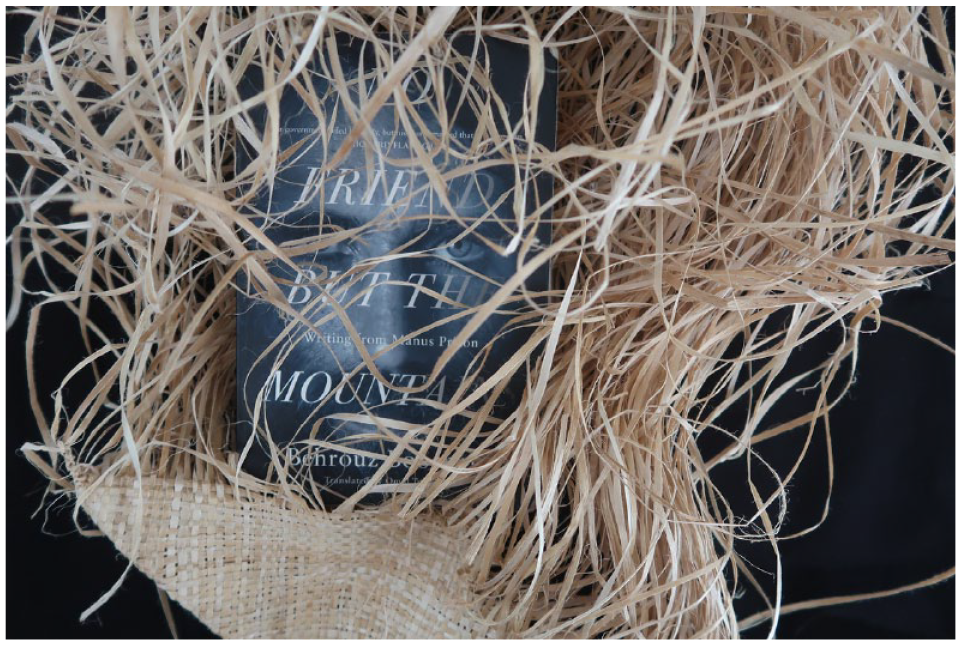
Cover image of Nayahamui’s blog review (Rooney, 2020) of Behrouz Boochani’s book, No Friend but the Mountains (Boochani, 2018), is her photograph of Boochani’s book wrapped in one of her basket works in progress.
And the idea there is that the Manus basket, predominantly made by women, is a very, very important cultural and social material item. It holds significance for Manus people, and particularly the social relationships and gendered relationships between people. Manus is a very, like elsewhere in the Pacific and Papua New Guinea, social relationships are important. So relationality with others and exchange relations are important. There is an idiom called “as basket,” which is if a man, or someone wants to enter into an exchange, usually it’s bride price, for his wife, or political, contest elections or so forth, he’ll often get asked, “wanem as basket blo yu?”—“where’s your as basket?” “what’s your as basket?”? And that is, in a way, challenging him to think about all of his relationships. Where is he going to get the support from? From the past, into the present, and so forth. Because without a social base that is strong, and that you can carry—everything is collective and relational, so if you do not have a strong social base to carry out the work you want to do, you’re likely to fail. It won’t, it won’t, you won’t get very far. And usually women, sisters, your sisters, and the women in your family, your wife, and daughters, are the ones who’ll make the basket for you, the ones who’ll bring your food in a basket, and so on.
So, the connection—when I saw this, I was like “ok, there’s a connection between the material basket and Manus social fabric and political fabric.” And so that’s where you see for me, over time now, the basket has become this kind of way of thinking, a way of understanding, how power—and the idea of not just the day-to-day embodied experience of making a basket, but the bigger political processes that go on around. So you could see that this has had a very big impact on me, and I notice that you’ve got art, the word artistical here. It’s interesting because I never viewed it as art, in that sense, but I suppose in this context that we’re talking about it might be, and me being removed from Manus Island and me using it as a form of, a way of helping me to think, it might be considered artistic? And having a good basket that’s aesthetic and nice is important, but as you can see from everything I’ve just explained, the basket does hard work. Like everything in the social fabric! It’s this idea that the social or the artistical, the political, and the gendered are all woven together in a basket.
And that’s where—since that time, the other thing is we get part of making the basket is—there’s some really great work around the idea of relationality, and so a European lady, Sylvia Ohnemus, has documented, and in her work, she talks about how the fibers represent the social relationships and the woman weaves them together (Ohnemus, 2003). And so I hadn’t heard about her, and when I submitted my paper in for review, which I talked about, the symbolism of the basket, and the social relations and the fibers, they were like “you have to go and read” and I’m like “all right, I have to go and read!” But again, it was a bit—it was interesting because again, in anthropology, it’s like the knowledge we might already know and hold is erased because we have to cite somebody who’s written it, you see (see also Figure 4 for discussion).
Can I just say one thing for people who can’t see us here? You have a basket here, and we could hear a little bit of it because you were picking it up when you were talking and it was giving a little bit of that sound. The basket is here and speaking with us. And it’s one that you’re in the process of making so we can see how there are certain elements of it that are very very tightly woven with incredible designs. Having taken a basket workshop with you I know how incredibly difficult and full-body this is! It takes many, many hours and months and years to come to be able to, to do this. And then we see these incredible strands that are coming out of it that have yet to be woven in, and the rustling is coming from that side. So I think there’s also something fabulous we can draw out of the physical place here, about the strands that are woven tightly here together and the strands that are in that process, that are social and political as well as fiber.
That’s a great point because that brings me back to one of your questions about, you ask about connecting the making of baskets to broad questions about how do you incorporate people from outside, places or diverse people. One of the reasons why I found this so incredibly important for my thinking once I began to start making it was, what the Australian government was obviously, well, maybe not obvious, but you could see this very powerful policy of saying, these people are going to be settled in Papua New Guinea, they’re never going to come to Australia, so, this was a very very powerful imposition of people onto place. And saying, “you’re going to settle these people here.” And when I was making the basket, as Shameem has just said, if we think about each of these strands as a person, to make a whole basket, social fabric, requires quite a forceful process. It’s powerful. When you are pulling these strands, individual or quite rough, all over the place, they appear unorganized. And then to pull them into a basket, or society, social fabric, requires work. It requires labor, and women are a very important part (see also Figure 5 for discussion).
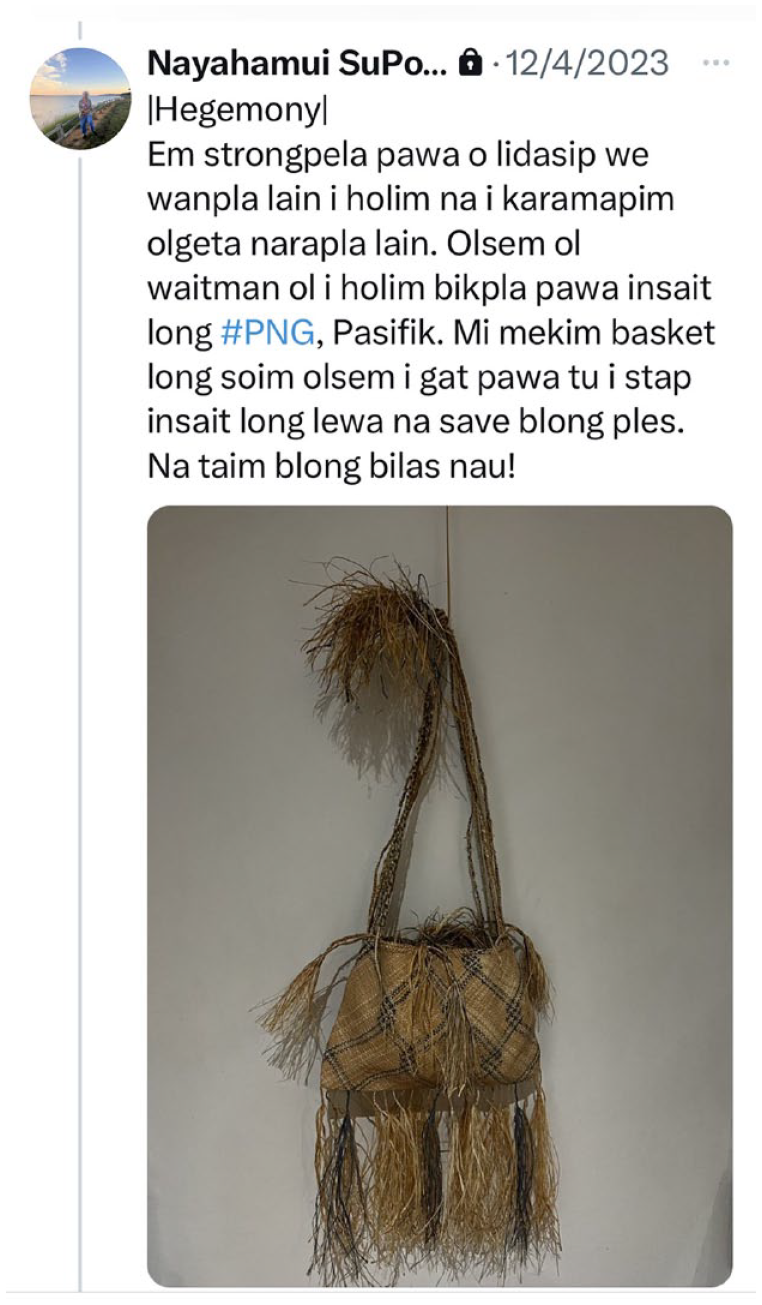
Project title: |Hegemony|. Completed Manus Basket in raffia. Gifted to Nayahamui’s mother’s sister in Manus in December 2023. NR: Naming this basket project |Hegemony| helped me to reframe my practice of knowledge production away from dominant Western textual forms of knowledge and discourse towards embodied Indigenous more relational practices such as mekim basket, or basket-making.
Project title: Presence Joy.
And then everyone in society has to form society, and so you could see what I was seeing, was thinking about—it’s really important to note that I’m writing from sitting here in Canberra intellectually, but what seemed to me was that Australia was trying to impose some kind of readymade basket on people when we all know that any society, any community requires day-to-day work to keep things safe, to moderate conflict, to reach consensus. It’s a time-consuming, and it’s intentional. There’s always leaders or people in a community. Someone might be quietly doing their thing but that whole community is brought together by hard work. Somebody, people, have a shared interest, and they work at it every day. But they don’t just say, “here we go, we’re a community.” And so again there was this contradiction in this very powerful idea that “oh, we can just go and settle these [asylum seekers on Manus].” And another very important part of this was—this was in a different paper—
As they say, we’ll put these in the show notes!
So part of the discourse, if you go analyzing the Australian discourse on it, Australian debates were full of concerns about “oh, it’s not safe.” Papua New Guinea’s not safe for asylum seekers to go, it’s not safe for women. It’s not safe for Papua New Guinean women. So this whole thing about whose safety was at stake here, led, and I’ve tried to capture some of that discourse in another paper here (Rooney, 2023a), that shows how, I think it was the UN High Commission for Refugees, visited Manus a couple of times during those early days and, you know, made these recommendations that women and families are not safe on Manus Island. Over time, you could see that the Australian government made decisions not to send any women and families to Manus Island, and only men, to Manus Island. So you see this kind of masculinization of this Regional Processing Centre.
If you think back to what I’ve just said about gender, and gender violence, you’re overlaying these gendered layers, including an increasing masculinization of the Center itself, which was dominated by asylum seekers—male asylum seekers—by workers who were predominantly male, in the security industry in Papua New Guinea. So you had this—it’s a—I don’t think the violence that was reported from that period could have been avoided. It was going to happen, because that is just the way human nature, you know, this is just the way life is. And so the issue becomes, coming back to why I found these issues very difficult to talk about and to write about, I found great understanding and help in my thinking about it through the process of basket-making. Because, just simply by thinking about not only the labor, the gendered social relationships, from this process, into and the formation of social fabric, but also the power, as someone who’s making the basket, you are powerful. You’re the person who decides who forms the basket. So bringing these individual strands together to form a basket gave me some, a little bit of insight into the Australian government’s power, which had it all wrong. They tried to form this basket, but they did not have the knowledge or the technique of Papua New Guinea at all. And I think it was a huge mistake.
I think this raises some really interesting questions about how a basket is made and how it’s both quite literal and quite metaphoric, the making of social fabric. Piece by piece, putting together the terms on which you might understand something like collective memory, or a sense of a shared society. And that can’t just be imported, externally, from afar. It has to be built from within in this incredibly painstaking process that is here led largely by women. And so I think there’s something really generative about the way in which the baskets are both a sign of these different strands coming together and they’re also the methods that are necessary to be able to understand how the different scales are all connected.
Absolutely, and I—for me, personally, I can’t speak for anyone else, but for me personally, I don’t think I could have written some of the things I’ve written without the basket. Without literally making the basket and thinking intellectually or thinking experientially about what is it that I’m making, and how is this connected to the big picture, how is it connected to the body, the embodied sense of it all. Yes, so in that sense, the basket’s just become vital for me, on this project at least, and also because it’s been very helpful for me in terms of a calming effect. It has been a difficult space to write in; it’s a very powerful space, this is the heart and soul of Australian politics, and there’ll be people who don’t want someone like me writing about it. But I’m really grateful for people who have read it and valued it, and said ok, there is—there is something here that makes sense for people.
And in other work that I’m doing that includes—so I talked about the Chauka bird, I’ve talked about the basket-making, we often talk about plants, or language, and another space I’m currently interested in is mortuary time—so all of these are connected in terms of social fabric. The idea of memories as something embodied, making the basket is embodied, you can’t make the basket unless you’re physically present, it’s a material process, embodied material process. And so thinking about these layers of discourse, political discourse, from the embodied and local, and being there present to witness—so the telling, or the remembering, the memory of an event that we might think about, and there’s some great scholarship on this. I think about the entire period of the Regional Processing Center as one moment in history, that in Australia might only include asylum seeker rights’ advocates and the right and wrong discourse of what the Australian politics, mainly the security discourse and rights of asylum seeker discourse, border security discourse. If you—if you just said that’s Australia’s moment in history, that would be it. And we’d all go home and recycle it the next time. This issue becomes, emerges, resurfaces in our political imagination, our journey, and maybe in Australia now, having lived here over 10 years, it’s the political cycle, it’s the election cycle, and these memories become important. We remember.
So, so, but what my work—you talk about activism, you talk about memory—I guess it’s a kind of quiet way of being in an activist space, to say, this is adding another dimension to that memory, that national memory. And that is the bilateral—the long-term colonial relationship that Australia has with Papua New Guinea, the bilateral relationship, the emphasis on gender, development and so forth. And sort of subjugated beneath all of that is the gendered dimensions of the Manus Island Regional Processing Center. So, the idea of memory, and who is telling our national story, and whose story matters—you know, there are as many, I often say there are as many truths as there are witnesses to an event. That’s why memories are in our minds, and so, if we are there and we witness an event, whether it’s witnessing the politics in Australia, as I have been and as a scholar, whether it’s embodying it on the ground, as Manus people experienced it, that memory, that notion of memory, has to be an important part of the entire discourse on asylum seekers in Australia, and often that’s missed.
So I think it’s really important in some ways to see how the basket is this alternative form of political history that’s being told, and it’s doing so in this, creating these conditions or a framework for a very different way of understanding these memories. Because, as you say, each witness will have their own truth, but often these are placed into broader frameworks, and one framework would be coming from a government discourse, or from a rights-seeking discourse, but baskets offer another frame to understand these experiences and memories and the changes in social fabric that Manus is engaging with.
Exactly. And probably—you know, I’m just one person, now, I just write, and it’s helped to bring a marginal voice at least into a conversation. It remains marginal. If tomorrow this issue spikes again in Australian politics, it will not—likely not—appear as something important, though in my mind, I think many people’s minds, it should. It should be there, so part of the, that’s where the idea of, I guess, I guess there is activism in the embodied, slow-paced activism. Yeah? Because, you know, basket-making, unless you’re doing it every day, it’s slow. Even if you are doing it every day. If you were at home, you would be talking from growing the plants, extracting the fibers, splitting them, all the way to making them. So it’s a long process. Just to make social fabric, just to weave all these different strands of ideas, discourse, people, together, is not something we just go “today,” and that’s it. And so I think, for me, why I am grateful you’ve asked me to reflect on this, is because I don’t view myself as an activist in the sense of being loud and in the media, or—and I don’t sense that there’s a large crowd of activism around this kind of narrative, or memory in this time, this event or this period in history—but I feel it’s important. And I feel that maybe—yes, I like to think of writing, basket-making, even if it’s slow, as a form of activism. And getting it into a room where it might be heard, taken notice of.
One very important issue that came out of all of this—and again, I think this is what really drew me to it—was we began to see, of course relationships form. That’s social fabric. And so we began to see stories emerging of asylum seekers or refugees entering into relationships with Manus women, and these beautiful children being born out of it, and so what I’m interested in, that is part of that memory. That is the embodied, and that is the experience that will form part of this story, will form part of this memory of something that wasn’t nice, nice in a political sense. Right? It led to other stories emerging out of it. And so the other reason why this idea of memories resonates is because, in another paper, this one “Storying Manus Women and Girls” (Rooney, 2023b), when I was trying to unpack the idea of rights discourse, who’s talking about whose rights, human rights and so forth, and seeing that the rights of Manus women as a category fell out of the discourse. I had to—I had to go through—in order to write the paper, to convince that this is worthy of publication, I had to sort of—I call it “activation.” I had to “activate”—is that what I called it?—yes. I say, “this article activates Indigenous narratives of human mobility in order to centre a feminine Manus perspective in relation to rights discourse” (Rooney, 2023b: 42). I had to think about, where can I find the evidence to justify that what I’m saying here is right, that it’s worthy of being heard?
So of course that requires going through the past and finding out stories from the colonial discourse and so on and so forth. And this is really important because one of the impacts on the Pacific is that a lot of our material culture—baskets have survived, but carving, a lot of Indigenous material cultural items were destroyed when Christians arrived. Because, you know, the idea that there’s only one god and so forth. A lot of history has been erased for Indigenous peoples. For me to make the case that the kind of things I’m doing have important bases requires me to somehow activate the past, activate an Indigenous narrative of women, being embodied, women’s roles in basket-making. So I drew on a Manus story—I took a storytelling kind of approach there—to talk about, again, a story that involves a basket.
But the why I wanted to highlight this is, part of the process was, these children being born, between asylum seekers/refugees and, and local women. And you know I thought, one day, say twenty, thirty years from now, when we’re all gone, a child is going to arrive and want to understand what happened during this period. So again this idea of us creating the memory, the memory of the nation, whose memory are we talking about? And that memory isn’t just something about the past—the idea of multiple memories, depending on who it is, the idea of creating a basis for someone in the future to be able to, to have an understanding. I think that’s where I’m—you know, I often think about what I write, and I think I could be wrong, what I’m writing might not make sense, but at least if one of those children that was born out of this whole period in the future might turn back and say “what was, what was going on here?” maybe they might find something that makes sense for them in what I’ve written. That might help them to understand their own journey, their own place in this story. That’s another way of thinking about memory.
Absolutely, the power of thinking about—what will the future want to know? And what we are creating as scholars now.
And so I was like, I don’t want a child to look back, to know that they might have been born during this period, and that the only documentation they have available is, say, for example, Chauka. The only thing they could see available was the Chauka movie made by an asylum seeker. But Chauka is a very important cultural symbol that had an impact. So to balance all of these stories about our pasts that, that make them available. That’s part of the reason, what makes me keep going. I was very—I think there was once I saw a Facebook post on Chauka and I thought, that looks familiar, and when I went onto it, they had basically cut and paste my writing onto—and I thought, actually, that’s the ultimate compliment. Because it meant something to that person, you see? That was the person I was trying to write for, from PNG. I thought, that is—if it means something to that—to Papua New Guineans, I feel it’s valuable, and I hope especially people in Australia, I hope they can understand it a bit more.
I feel in a lot of ways your scholarship is an extension of your basket, and these are very rich projects that provide these incredibly important perspectives on these major issues.
So my challenge right now is a book, where each of these papers is like a strand, and now I’m like—how—if I had a message, one key message that covers these different strands in discourse, whether it’s Australian political discourse in the media, whether it’s human rights discourse, or security discourse, or, you know—they all have different strands, and even when we talk in terms of our disciplines, when we talk to someone in the security space, they don’t really think about the rights space. So these are different strands of discourse that need to be woven together into a basket. A book!
Well, I definitely will look forward to seeing the book when it comes out! Thank you so much for sitting down and having this conversation to explore these incredible strands in your research and in your practice. I think this has been a fantastic way to think about some of these key themes through a really important lens. So thank you so much.
Thank you, my pleasure.
Footnotes
Acknowledgements
The authors would like to thank MemoryHub@ANU, the Gender Institute, and the School of Culture, History and Language in the College of Asia and the Pacific for supporting the “Loops of Memory” workshop at the Australian National University that led to this conversation. Special thanks to guest editors Lia Kent and Rosanne Kennedy and the editors of Memory Studies.
Funding
The author(s) received no financial support for the research, authorship, and/or publication of this article.
