



Abstract
Drawing on life history interviews conducted with former fishers and other older residents in Great Yarmouth – one of the 20% most deprived districts in England – this article explores how memories of a once flourishing fishing industry are used to make sense of the decline that followed the end of the industry in the 1960s. Focusing on the material and affective constituents of people’s memories, embodied in three categories of fishing-related objects (boats and quay, nets and fish) through which their stories are told, I explore how those formerly involved in fishing-related activities understand and experience the past and their world in the present. Using biographical and historical memories to reclaim their role in the making of a town that they consider to ‘have missed the boat’, they are able to make sense of the transformations that occurred and to reclaim their role as place makers.
Introduction
Drawing on life history interviews conducted with former fishers and other older residents in an English coastal town in the early 2000s, this article explores memories of a formerly prominent fishing industry as a ‘living’ and dynamic process (Mah, 2010) through which people make sense of the transformations that have occurred in town since the end of the industry. Rather than being situated in the irreversibility of temporality or representing a nostalgic and painful feeling of impossibility of return to the past (Angé and Berliner, 2015), the memories analysed in this article do not materialise a desire to that return. Instead, made of tangible material objects and things, as much as of immaterial affects and emotions (Hill, 2013), these memories allow former fishers and older residents to retrieve their key role as place makers and make sense of what has been destroyed.
Great Yarmouth, a seaside borough in Norfolk, UK, with a population of 90,803 in 2001 and 97,277 in 2011 (the period within which the data analysed in this article were collected) (Norfolk County Council, 2001; Office for National Statistics, 2021) was an important touristic resort and fishing port in the nineteenth and early twentieth centuries. The herring industry reached its peak at the start of the twentieth century, when the port was the second in the country in terms of fish landings and the region was at the forefront of English fishing (Thompson et al., 1983: 183). The outbreak of the First World War caused a decline in landed herring when drifters were requisitioned to other duties. Since then, pressure on the fish stock continued to cause the industry’s decline, with former fishers’ memories highlighting the transition from smaller drifters to more modern and bigger ships and trawlers, and the consequent capturing of immature herring, as the main reason for overfishing and for the destruction and fragmentation of the herring industry. The Second World War introduced a new level of devastation and destruction. Although beyond the focus of this article, some interviewees refer to childhood memories of the bombardment of the rows, where they lived, and to the rebuilding of offices and corporation houses as one of the earliest transformations they remember. 1
The Yarmouth herring fishery saw a decisive end in the 1960s. In the 1970s and 1980s, the introduction of low-cost package holidays abroad started to cause a decline in the tourism industry too. These two events are remembered by Great Yarmouth older residents as the reason for the loss of prestige of this coastal location. By the end of the fishing industry, the oil and gas industries had started to explore and invest in the region, providing employment for some former fishers. The offshore energy sector has developed more recently, and investment in oil and gas has in the meantime been replaced by renewable energy projects in the area, with large wind farms becoming operational since 2004 (Great Yarmouth Borough Council, 2016).
Although these projects introduced a renewed hope in a revival of the town’s socioeconomic landscape and recent regeneration initiatives from the local council created an expectation of new jobs from the energy sector (James, 2016), Great Yarmouth is still one of the 20% most deprived districts in England (Public Health England, 2020), with life expectancy, health, and education indicators reported as significantly worse than the English average in recent years and residents expressing concern with its socioeconomic inequalities and deprivation (Abranches and Theuerkauf, 2021). While, at the time of data collection, the future effects of the changes in town resulting from the renewable energy sector were still unfamiliar for its residents, memories of the town’s perceived prominent past during its fishing years contrasted, already then, with high levels of deprivation. A widespread sense of depletion and loss is materialised in former fishers’ narratives, who describe the landscape transformations thus far as having left only ruins where ‘there’s nothing of the original left, well, a few fragments, a few bits and pieces here and there but nothing which held the real character of the town’ (David Howes).
In this article, I use people’s memories of a fishing landscape materialised in the fish, boats, quay and nets and characterised by rituality and movement, as well as what Walkerdine (2016) has named the ‘affective histories’ of post-industrial communities, to explore how former fishers understand and experience the transformation of their habitual space and their role in it (Angé and Berliner, 2021). The focus is therefore on movement and transformation, rather than on the fixity of what is lost or what remains of the destruction. As a considerable amount of literature on memory and nostalgia emphasises (Blunt, 2003; Bonnett and Alexander, 2013; Legg, 2005; Mah, 2010), embodied and multi-sensual memories are situated in the present as much as in the past, since they involve consciousness of how history influences connection to places. This article contributes to this academic debate by focusing on the experience of actors who, like those once involved in the fishing industry in Great Yarmouth, hold the last living memories of a noteworthy past and the power to make transmission possible.
Material and affective memories of a fishing landscape
Great Yarmouth, as other towns affected by processes of de-industrialisation in the UK (cf. Mah, 2010), is perceived by its residents as a victim of poor governmental strategies and positioned at the losing end of competition for government funds (Abranches et al., 2021). The social and economic deprivation that characterises the town in the last decades contrasts, however, with its older residents’ memories of a vigorous and thriving past to which their hard work in the herring industry contributed. The material and affective constituents of these memories are examined here in relation to the decline that occurred between the 1960s and the 2000s and to how these transformations are understood by those who experienced them. The interaction between past and future, which Hill (2013) has addressed as ‘spectrality’, is integral to the experience of place, an experience that is simultaneously present and absent, material and intangible, as well as flowing, dynamic and contextual (Wetherell et al., 2018).
In line with what Bear and Eden (2011) also found in the context of recreational angling, the narratives explored in this article will reveal Great Yarmouth older residents’ material and affective engagement with herring, with movement and rhythm at the centre of the encounter. The human–herring relationship continues to this day, even in the current absence of its locally based fishing, caused in part by new technology and overfishing that the interviewees describe as a result of ‘the greed of men’. However, inanimate objects are also part of these assemblages, understood here as dynamic sets of relations between human and non-human actors that compose space, which can be disrupted and reconfigured at any time (Anderson et al., 2012; Sjöholm, 2022). Objects such as boats, quay and nets are particularly important in people’s narratives of transformed landscapes in Great Yarmouth. Not only are memories profoundly material, but the materiality of those objects is also embedded in the rituals that used to constitute people’s working lives – the rhythmic movement of the drift nets, the boats landing in the quay or filling the barrels on the sale ground. The sea is at the centre of these stories. Described by one interviewee as something that ‘gets into your blood’, the sea is, like the wild rivers analysed by Slater (2013), an active participant in remembering and therefore sustaining particular worlds.
Just like everyday repetition of movement and action shapes the life of individuals and groups in industrialised spaces (Edensor, 2010), the rhythmic structuring of fishing relies upon the synchronisation of practices. The repetitive rhythms of fishers’ quotidian tasks consolidate the spatialised order of coastal landscapes, becoming part of people’s social memory (Connerton, 1989; Edensor, 2005). These normative ordered processes, however, have the potential to be disordered by counter rhythms of destruction and disruption, transforming the once spatialised sequence of production into empty spaces (Edensor, 2010). I use the concept of ruination here to refer not only to the dismantling of those assemblages that came with the end of the fishing industry in the 1960s but also to the visceral and strategic ways through which the effects of that dismantling remain (Stoler, 2008). I therefore draw on the rituality and movement of fishing-related material and affective memories to explore how the ruins of those spaces, materials and other living forms (fish) are used to make claims by the actors involved.
Focusing on the emotional and affective constituents of memory alongside the material, although more difficult to conceptualise, allows for a deeper understanding of how people develop attachments to the past and how these are negotiated in the present. The routinised fishing-related activities that will be described in this article embody particular meanings and bodily sensations (the physical work, the hardship, the sight of the quay full of boats, the movement and pace of the activities) that can be either valued or discounted. These memories are full of emotional attachment and are negotiated in complex ways to help people make sense of the present, constituting what Wetherell et al. (2018) have named ‘affective practice’. Due to the problematic distinction of traditional definitions of affects as the embodied state, and emotions as the processing of that state in familiar categories, I use both terms interchangeably in this article, recognising both as embodied and semiotic (Wetherell et al., 2018: 1).
With the end of the fishing industry in Great Yarmouth, the fullness of the movement and rituality of the past – described by interviewees as an art where everything and everyone had a well-defined cadenced function – give way to emptiness and devastation. In this context, former fishers and other older residents are displaced from the centre of a particular landscape and, therefore, use their stories to reclaim a role in the making of history. Following a description of the methods used in the research, the remaining of the article draws on three key categories of objects where material and affective memories are embodied – the boats and the quay, the drift nets and the fish itself – to explore such transformations.
Life histories and fishing narratives
Memories of the fishing industry in Great Yarmouth are held by people now in their late 70s and above. A sample of those who participated in or have memories of the town’s fishing landscape of the past – fishers, curers, gutters, drivers and others with related activities, or their relatives – had their life histories recorded between 2002 and 2007 for the ‘Great Yarmouth Voices, Our Town’ project. The project was part of a community consultation process led by the now Time and Tide Museum of Great Yarmouth Life, as the museum was about to be set up in the building that had operated as the Tower Curing Works when the fishing industry was still active. 2 It included a wider collection of life histories with residents of different ages, focusing on their general experiences and perceptions of life in Great Yarmouth. Through archival research conducted in the Sound and Image Moving Catalogue of the British Library, with files located in the Norfolk Record Office, nine interviews were selected from the collection.
The following criteria were used for the initial selection: (1) interviewees’ date of birth (since younger interviewees would not have memories of the fishing industry); (2) reference to fishing, fish, coastal life, boats or sea in the item description or file summary; (3) a representation of different genders whenever possible. Once selected, the recordings were made available by the Norfolk Record Office and transcribed verbatim by a professional transcription service.
A few limitations were encountered during the selection process, namely the fact that not all files had information about the interviewees’ basic characterisation (e.g., age) and that the level of detail regarding other information (e.g. people’s employment history in the industry) varied significantly between interviews. Some interviews were therefore selected despite not entirely meeting the initial criteria (e.g., David Howes was born in 1955 and therefore not old enough to remember the booming fishing period of Great Yarmouth, but his narrative offers rich insights provided by the imaginary of a past transmitted by others; Mary Fox and Robert Brown have not directly worked in the fishing industry themselves but were selected due to their memories of the fishing landscape and experience of hosting Scottish women gutters and packers). Representation of different genders also encountered limitations. Although expected, due to the prevalence of men in the sector, only three out of the final interviewees are women. Their known details are provided in Table 1. Finally, it is important to note that in the 15- to 20-year period that spanned between the moment of data collection and writing, important events have taken place in Great Yarmouth. The construction of the outer harbour, for example, mentioned by one interviewee as a plan that would never materialise, happened between 2007 and 2009. Likewise, renewable energy projects and the large wind farms that are now part of the landscape were not operational before 2004. In the political arena, the austerity cuts of the last decade (Barford and Gray, 2022), as well as the rise of a nationalist defensive discourse and the tension that followed the results of the Brexit Referendum, where Great Yarmouth had the fifth highest proportion of ‘leave’ supporters in the country (Abranches et al., 2021), are examples of events that occurred after data collection. As this later period is not included in the analysis, ‘the present’ in this article refers to the time of interviewing. While it is important to acknowledge this contextual gap, it is also critical to note that oral histories are always partial, subjective and reflexive (Riley and Harvey, 2007) and that the intention of this analysis is to contribute to understand people’s self-conscious relationship with history (Bonnett and Alexander, 2013). The analysis followed an inductive thematic approach, which resulted in the identification of material and affective memories embodied in three categories of fishing-related objects (boats and quay, nets and fish), through which former fishers and older residents told their stories.
Interviewee details.
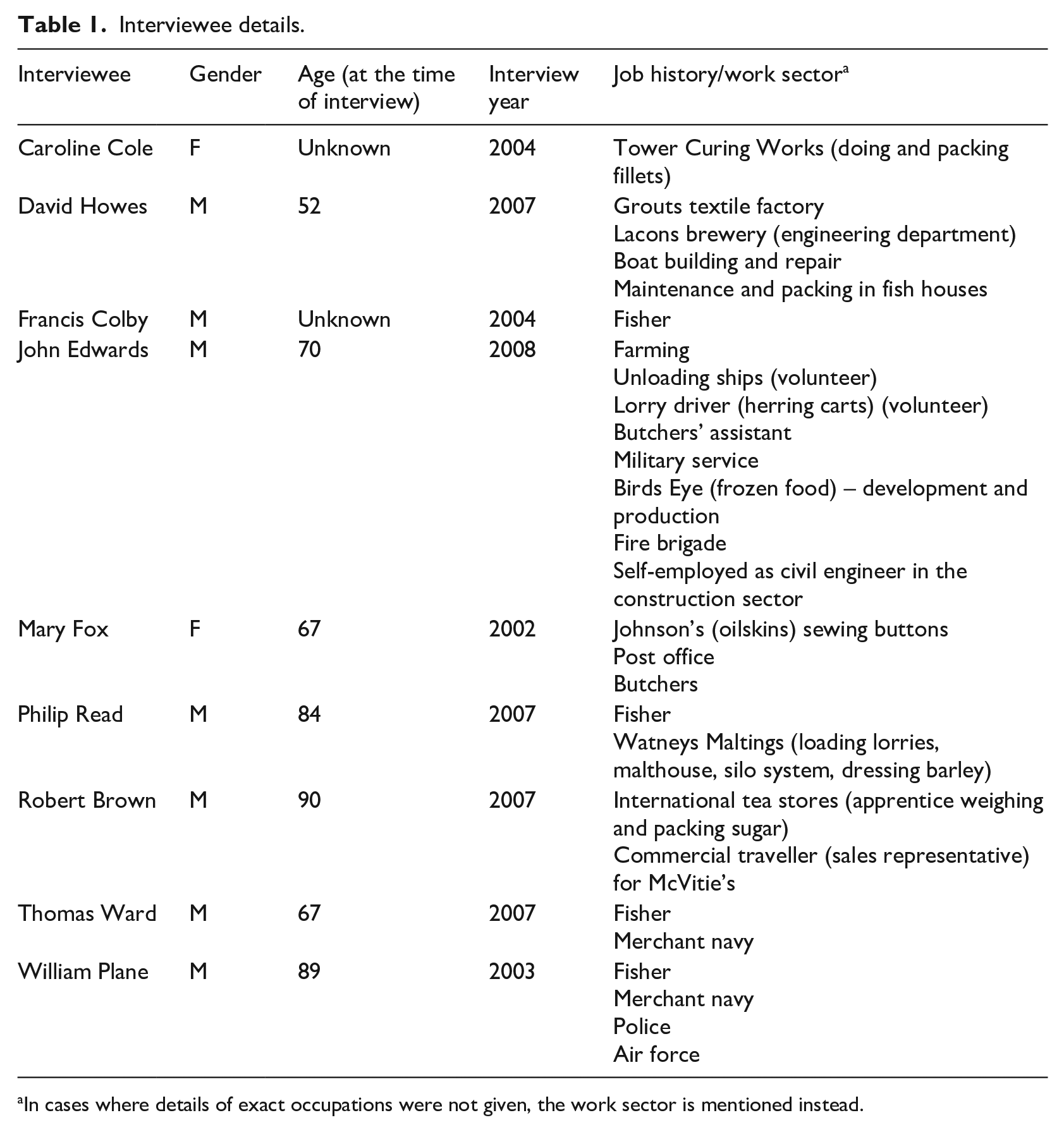
In cases where details of exact occupations were not given, the work sector is mentioned instead.
In the recordings, some interviewers (who were involved in the museum-development project) also share their own memories or understandings of the past of fishing in Great Yarmouth, indicating, in parts of the conversation, a mutual desire to make these stories heard, in a process where the relational function of communicating about the past helps to confirm the existence of a social group (Welzer, 2010). This intention may have been heightened by the materiality of some of the interviews’ location – the old Tower Curing Works itself, where the smell of smoked fish could (and still can) be sensed and memories and emotions embedded in them could more easily be triggered. Like the life histories collected by Thompson et al. (1983) in the 1970s, the material gathered here therefore attempts to simultaneously make sense of the history of fishing in Great Yarmouth, and how to capture this history, with interviewers often bringing in their own knowledge and passion into the interviews (cf. Taylor, 2021: 6). Permission for the use of interviews for research purposes had been given by those interviewed through signed consent forms. However, despite a clear desire for these stories to be heard, I have not had access to interviewees’ anonymisation preferences. All interviewees have therefore been anonymised.
The boats and the quay
The herring season was considered in older people’s narratives as ‘wonderful’ and providing ‘a magnificent sight’ in town. Philip Read referred to the quay during those months with an emotive ‘oh God, it was full’ and described the arrival of the ships and the loading of the swill baskets on the horse carts as ‘pretty to watch’, an aesthetically ordered activity, centred on movement, where ‘they were all lined up, and then as the ships came in, they landed the fish into the swill baskets’. David Howes, despite being younger, had a brief experience of employment in maintenance and fish packing in fish houses on the quay and refers to his own memories of the harbour as ‘certainly busier then than it is now’. He also re-narrates heard stories of the harbour’s past fullness, although it is possible that their elements are adjusted to create his own narrative of ‘cumulative heroisation’ (Welzer, 2010: 8), a process whereby narratives are reshaped and enhanced:
It’s been said, although I never actually saw it myself, but I’ve heard it being said, that at one time you could cross the river by just travelling from one boat to another. There were so many drifters in Yarmouth, so many drifters in the river, and you could literally step across the river from one boat to another.
After unloading, the boxes were washed down and the nets pulled back, ready to be thrown out at night, when the boats would go out again, creating a constant, cyclical and rapid movement. Thomas Ward explained:
You’d haul the herring, and you would then rush to Yarmouth to land them, and you’d get them out and you’d pull your nets down – you’d pull your nets on the way in. You see, this is another thing, you’d finished hauling and you’d probably go and have some breakfast, the cook would throw a load of herring in the pan, which was fried, all clean and all ready for the cook. And you’d go and have some herring for your breakfast, a cup of tea, and you’d be back out on deck pulling the nets up all ready for landing, and then you’d land, quick as you could, pull your nets down and get back to sea again. That would be like that all the week.
Memories of spending whole days fishing were associated with a sense of stable routine. John Edwards contextualises those days as ‘a habit of trying to keep ourselves busy’, a sense of fullness where ‘work always seem to have figured’. These habitual routines and their rhythms are ‘a cyclical ordering which organises, apportions, schedules and coordinates activities’ (Edensor, 2010: 7). Narratives of movement and fullness embodied in the quay and boats, as spaces and materials that constitute people’s past experiences (and imaginaries) of fishing, demonstrate how people’s memories are embodied in physical acts on the sea and shore that contribute to ‘make’ fishers and spaces of fishing (Nightingale, 2013) and in bodily experiences of being and moving in material space. They emphasise the connection between the temporal rhythms and flows of ecological and social life (Jones, 2010), here understood not as an abstracted de-territorialisation but as opposed to an absolute fixity.
The fish curers on the sale ground would also collect the herring baskets directly from the boats, after an initial negotiation that took place during the brief stay in land. As William Plane described:
They then would take a sample . . . of the herring . . . up to the sale ground . . . then the fish curers would say, ‘alright, yes, I’ll have them’, maybe 30 crowns. A crown was about a thousand herring, and that was four baskets. And then they’d say, ‘yes, I’ll have them’, and so that was that. And he then knew where the boat was lying, and his van would come up, whatever it was, would come collect them there, and in baskets they would be unloaded from there, and that was that. . .. It was just as long as it took you to unload, literally, and away you’d go out again. So, on the river, you’d find a lot of movement like that, the Yarmouth river.
The cyclical nature of the movement was also embedded in the seasonality of herring. The bustling Yarmouth quay was remembered between September and May. At the beginning of May, the ‘Scottish voyage’ would commence. ‘You usually went for 14–16 weeks fishing . . . My first voyage was down to the Shetland Isles’, Philip Read explained.
When they returned home, at the end of August into September, the ships were repaired and repainted, ready for home fishing until the following May. The home fishing season, providing the magnificent sight described earlier, consisted of 3 to 4 days on the North Sea initially, followed by shorter periods with fishers ‘gone to sea one day, coming back the next day with your catch’ as the herring moved inshore by October or November. 3
William Plane’s parents, originally from Scotland, used to come to Great Yarmouth every year during the herring season, when they were still in their 20s. His mother and two other women worked together in gutting and barrelling the herring, a women’s activity that took place on the quay, usually in groups of three, and was similarly dependent on movement and rapid pace:
These three girls, they were a crew . . . there were two gutters and one packer . . . and they were absolutely experts. They would size . . . say that was two herring, one was that size, and one was this size, they would size them as they were throwing them. There were three baskets there, and they were going in the right basket. It was incredible, the speed they used to work.
On Sundays, a decrease in fishing activity, resulting from Scottish fishers and their boats’ stay in land to fulfil religious obligations, was replaced by animated religious services in the quay area, as well as a changed landscape with the boats in sight. William Plane recalls seeing all the boats leaving ‘a minute past Sunday . . . a fair minute into Monday’ and then returning on Tuesday as ‘really, really a sight worth seeing, right from the top, from the town house, from Yarmouth all the way down the wharfs, all the boats coming in at once, into Yarmouth’.
Between mid-May and September, the holiday season replaced the herring rhythms. It
built up to a crescendo . . . into the two peak weeks which were the end of July and the first week in August . . . And that would be the way it worked, and the town was absolutely choc-a-bloc. The beach itself was full of people enjoying themselves, which you don’t see these days (John Edwards).
The current lack of satisfaction that contrasts with the appreciation of the past described earlier is supported by David Howes, who describes the town nowadays as a ‘concrete jungle’, alluding to the lack of order and aesthetics of the current landscape. ‘The Great has gone out of Yarmouth’, he maintains, ‘it’s just now concrete’. He refers to the then planned outer harbour as something that ‘[was] never going to happen’:
4
It’s just a non-starter. For a start off you haven’t got adequate communications, transport. You’ve got the Acle Straight, which is a single carriageway, which is going to remain a single carriageway for a long time yet, as far as I can see. They’ve been pushing to dual it for many years now and it still hasn’t happened. There’s no rail linking down to the harbour. There was the rail line down to Fish Wharf but of course they pulled it all up. It was about 1970s when they stopped using it . . . I think if you compare the situation in Yarmouth, as far as the outer harbour is concerned, compare that with, say, Felixstowe, there’s just no comparison. Felixstowe has got the A14, which takes traffic right into the Midlands. It’s got a rail link right down to quay side. It’s got all the infrastructure; it’s got a natural deep-water harbour and Yarmouth is trying to compete with that . . . I think Yarmouth, as usual, has missed the boat.
Similar views about the lack of investment in improving the town were shared by others. John Edwards, for example, notes that Yarmouth is not using ‘the assets that it has to its best ability’. Referring to the town’s current degraded landscape, he recalls the ‘shows down and around the town’ during the summer season in the past, as opposed to the current lack of facilities. He points to the changed layout of the town and describes it as not as ‘tidy’ as it used to be, which denotes the same sense of order and aesthetics brought by memories of the past.
Alluding to the stigma of difference and disreputation around Scottish fishers, Nadel-Klein (2003) observed that fisherfolk were associated with dirt and disorder by outsiders. In line with the ordering of timespace that characterises industrial spaces (Edensor, 2005), however, Yarmouth former fishers see their past of fishing, instead, as ordered and the end of the industry as what challenged and upset that order. Francis Colby expresses a sense of sadness surrounding these changes and the loss of the industry, maintaining that ‘it’s sad because it was a lovely industry for Yarmouth, the herring, you know. Well, it was exported all over, exported all over the world, the herring business from Yarmouth was’. With a sense of pride for Great Yarmouth’s fishing past, he continues:
There used to . . . always be a big Russian ship coming to Yarmouth during the herring fishing season, and she would take barrels of herring, you see. She would load up with barrels of herring, you see. The Scots girls gutted and barrelled the herring, and then they were craned aboard the Russian ship till she was full, you see, and then . . . Finnish boats used to come too, but mostly Russian, Russian boats, big Russian ships came.
Now, instead, there is a sense that the future of town is dependent on the council’s willingness to invest in a way that does not disrupt the order (cf. Edensor, 2010), but the fact that ‘too many things have been destroyed’ makes it more difficult for Great Yarmouth to ‘get back to where it was’ (David Howes).
Drift netting
Alongside the boats and the quay, nets are another important part of the fishing-related assemblages that also embody rituality and movement. Drift netting was described as a lengthy activity involving repeated rhythmic movement such as ‘shooting’, ‘hanging’ or ‘pulling’ the nets:
Used to take all night to do it, because you had about two to three miles of net each time to haul, you see, and that was a slow business, especially if the nets were full. Sometimes, like, be 12 hours-odd job of hauling, you see, when you started, if you started six o’ clock at night, it’d probably be about six, eight in the morning before you finished hauling if you had a big shot of fish (Francis Colby).
The fullness of ecological and social life at the time – experienced through a continuous ritual of hauling that kept people busy – contrasts with what former fishers now perceive as an empty landscape, cleared of herring, which can confuse people’s past and understanding of place (cf. Smith, 2008). Memories of fullness are materialised not only in the river covered with drifters, the barrels filled with herring on the quay or the heavy nets loaded with fish but also in a temporal rhythm that did not allow for rest pauses. The rapid pace embedded in this lengthy activity is described by William Plane as including the need to repair and clean the nets between each catch:
Then after they’d finished hauling, had their breakfast, and back they go, and they pull those nets out on each side, so many on each side, and take all the herrings, and then they had to keep the nets clean, and any holes that were in the nets, they would pull that bit out, and then have to fix them during the day.
Fullness is, in this case, embodied in flows – understood as the movement of the nets, the sea and fishers’ social and working life – as opposed to fixity. Within the literature on ecologies of place, Jones (2010) focused specifically on the temporal rhythms of tides and their effects on the flow of everyday life, hence contributing to understand how economy, ecology, culture and identity intersect and change in coastal landscapes. Bull (2009) also explored waterscapes as associated with turbulence, change and flow, where bodies are affected by currents. Similarly, the memories analysed in this article emphasise the movement of the sea, which kept people pacing quickly along with the drift nets, described as long nets that drifted with the tide, with no anchors on them, simply accompanying that movement. This material constituent of the sea and the nets, which is embodied in rhythmic movement, is directly related to the fast pace of the livelihoods and way of life associated with fishing, hence emphasising the intimate connection between the temporal rhythms and flows of ecological and social life (Jones, 2010). As William Plane goes on explaining,
[i]f you appreciate that the tide goes one way, and then stops and goes the other way, you know, ebb and flow, as it were. But between that there’s about maybe three or four minutes of what they call slack tide, and that’s the time then that that herring would come up.
Alluding to the order and aesthetics discussed previously as a key part of the organisation of the quay and boats, but also to the skills needed to catch the fish more efficiently, the same interviewee describes the ritual of hauling as having ‘an art in it’, done in such a precise way that ‘the herrings would just drop out’:
The nets were always thrown overboard on the right-hand side, and they reckon that goes back to the bible, when Peter was told to cast his nets over the right side. And that was that, and then it started. The wind was blowing, yeah, and you’d start, the first one went out, and then they’d just have a steady stream, it would probably last for two miles, that stream of nets.
The cyclical rhythm of drift netting activities also affected women who worked in the holiday industry during the summer and in net mending in early December, when many boats would return home from Scotland. ‘[A]t home then, all the nets were dried and brought into the house . . . There was a room in the house specifically for mending nets, and that was the next job, was mending the nets ready for the next season’ (William Plane).
The abandonment of these activities meant, for Great Yarmouth older residents and former fishers, the abandonment of a key livelihood, way of life and sense of place, the memories of which are brought forward not through internal images stored in mind but through sensations and emotions embodied in the materiality of those remembered places and objects. While some of these places and objects are still present or transformed (the sea, the quay), others are absent and lost (the boats, the nets), 5 and it is precisely the ‘spectrality’ comprising both presence and absence that allows Great Yarmouth older residents to make sense of their world in the present (Hill, 2013).
While several events are narrated in these interviews as responsible for the destruction of a once ordered and aesthetical rhythmic activity – the First and Second World Wars and the development of profit-driven systems that led to the introduction of gas and oil industries and to overfishing – it is on the latter that most narratives are centred. In these narratives of ruination due to pressure on the fish stock, former Yarmouth fishers remove themselves from its centre, holding others responsible for the decline, in which the change in the type of nets plays a key role.
Like the Scottish creelers studied by Nightingale (2013), Great Yarmouth former herring fishers view trawling as a different type of ‘fishing space’. When trawlers started to replace drifters, allowing for an indiscriminate type of fishing, not only was the herring killed but a whole habitual space destroyed. Drawing on the boundaries created between himself as a local, small-scale fisher and others who used different boats and techniques, Philip Read describes the way the fishing landscape started to change, in line with what the Scottish fishers studied by Nightingale (2013) saw as ‘greedy, unsustainable outsiders’ (p. 2370):
I think the Scottish people were a great people at experimenting and they went in for ring netting and things like that with bigger ships, far bigger than what we went to sea in, and not only them, the Norwegians, the French, they all went in for this type of fishing and I think they caught everything . . . Norwegians and Danes, they went in for it in a big way and it was just colossal the amount of fish they used to catch. One modern drifter now, he’d go out for a week, and he would catch enough in a week what the entire fleet, and I’m talking of hundreds of ships, that would catch in a whole voyage.
Nets therefore formed an essential part of the assemblages that create a particular fishing landscape. Formed around the nets and their use, a community organisation was essential for the success of the catch, where ‘every man knew his job aboard the ship’, as well as to make the hard work bearable: ‘It was very hard work, but well, you made light work of it because . . . when you all come together, it becomes easy’ (Francis Colby). This community-based economy is usually described as eroded and displaced by capitalist forms of organisation. Indeed, Great Yarmouth former fishers view modern, individualist ways of fishing as what destroyed the rhythms that animated the herring industry, as well as their lifeworlds.
Yet forms of community organisation remain central in fisheries and fishing landscapes (Nightingale, 2013; St. Martin, 2006) and can be reimagined in cases where, as in Great Yarmouth, drastic change led to the end of fishing (cf. Nadel-Klein, 2003). This re-imagining involves, for the former fishers whose stories are analysed here, placing themselves and their stories of self-worth at the centre of the town’s heritage, not as a popular device for economic resource, but as representing the strength and possibility to make sense of an indetermined and precarious present and future. It is therefore through the narration of their memories, rather than through the events themselves, that they make sense of the ruination process that occurred by reclaiming their role as place makers (cf. Bull, 2009; Hoskins, 2010).
The fish
Herring is perhaps the key element in the assemblages that shaped this fishing landscape. It is first appreciated for its nutritious qualities. The fish not only represents the strength associated with what is described as hard work in these narratives, but it also embodies a ‘good, healthy, strong life’. Interestingly, however, the masculine conception of fish, described in the literature through characteristics such as fight and resistance to the tension in the line or the mesh of the nets (Bull, 2009), is in this case left to other fish species. Herring, instead, is described in former fishers’ narratives as a beautiful fish, ‘ideal for everything: curing, kippering . . .’, and ‘gentle’ in the way it did not damage the net with its soft gills, as opposed to mackerel, whose hard gills and the force with which it went into the net would break the mesh, or to dogfish, described as a ‘nasty’ and ‘destructive’ fish that went straight through the net in order to get the herring. Other species – like pilchards and garfish – were also remembered as part of the ‘all sorts’ that would get in the nets. Thomas Ward describes sitting and picking them out from the nets because ‘if you got them, you couldn’t shake them out’.
All interviewees spoke passionately about herring as a differentiated species. Fishing it was therefore a ‘holistic environmental immersion’ (Bear and Eden, 2011: 344) where full engagement with the space and rhythm of the environment was necessary, and bodily and behavioural characteristics of the fish had to be understood in a way that required fishers to ‘think like fish’ or, as Bear and Eden also argue, ‘become fish’. Herring’s central importance in people’s lives was, thus, not only as a source of economic activity but also as a part of the rituality of fishing and of food consumption and preparation. Herring was cooked for breakfast, following the long hauling process, and was taken home for family consumption. ‘Every household used to have a barrel of salted herring, you know . . . Saturday’s lunch, that was’ (William Plane). Caroline Cole recalls regularly taking herring home from Nutmans, the Tower Curing Works where she worked, and the cooking process that followed:
Oh, yes, yes, we used to take so many home [laughs]. Yes, we were allowed to take some herring home, and I used to like the hard . . . I never used to like the soft ones; I used to like the hard ones. And then, because we had a stove like that, with a fire, we used to have a fire where we were working, and then some of us used to bring some potatoes in and we used to put them underneath the fire, and they used to cook [laughs].
Another example of material and affective memories of herring and its catching is when, on occasion, an exceptionally large and heavy sample was caught. Thomas Ward remembers catching what is known as ‘king of the herring’ in one of his voyages to Scotland and describes it as a ‘[b]eautiful looking fish that was silver, like pug faced, bright silver and these two fins, one on its back and one on its belly, really scarlet’. ‘The Norwegians call it a conger seal, king of the herring’, he explains, ‘and by the time we laid it out on the quay we’d cut it up in three pieces to come through the pump, and Tommy laid it on, I think it was 16 ft long’.
Handling herring was, unlike catching it, mostly a female activity. As mentioned earlier, memories of the rituality and order of fishing-related materials and activities such as the boats departing and returning, or the hauling of the nets, were also embedded in the way women would fill in the empty barrels. William Plane describes it as ‘absolutely amazing’. ‘They used to lay them, a layer like that, and each layer would come up actually perfectly balanced, you know, head tail sort of thing’. Following that, the fish was salted, ‘and that was it, and then as soon as this barrel was full, she would just move on to the next one’.
In addition to fish salting, fish smoking was embedded in similar rhythmic movement. Following barrelling, the fish was taken for smoking in the Tower Curing Works, not far from the quay. Caroline Cole describes it as ‘quite a happy yard’ and emphasises endurance and durability as a highly valued aspect of the work: ‘I used to love it. I used to thrive on it. I used to have all the scales up my arms [laughs]. Yes, that was really great’. John Edwards recalls bringing herring into the Tower Curing Works in a lorry, using his heavy good vehicle licence to assist a friend who had a haulage business. The rituality of this activity consisted in
cart[ing] many lots of herring from the fish market up into here that they’d bought during the day . . . I used to then bring in the raw materials and over a period they would process them here at the Time and Tide . . . and they would box them up and I would then come back at some time or another and pick them up, take lorry loads of them from the curing works here to the railway station at Vauxhall and they used to go in railway trucks, and they would go on to various points of . . . on the continent.
Living in the rows, as most interviewees did, was associated with communal life set around herring. Most families living in the rows ‘worked on the boats, loading and unloading different boats’. Childhood memories also included going down from the rows to the wharfs with a piece of string to pick herring up, ‘you know, pick them up, and then we’d dry them and smoke them . . . They were really lovely, then, in those days’ (Robert Brown).
Discussion and conclusion
Memories of a now-gone prominent fishing landscape are shaped in ways that allow the last survivors of that past to reclaim their role as ‘stoic’ and ‘durable’ in the present, not in reference to their permanence in the industry (Gustavsson and Riley, 2020), but to their survival among its ruins. Memories of self-worth and of the rigours of their occupation (Nadel-Klein, 2003) are a way to re-imagine the past in face of drastic change and to make sense of the town’s present decline. These memories, which are simultaneously material and affective, formed through embodied spaces and objects and through the emotions that those spaces and objects entail, allow people to make sense of the transformations that occurred. They are therefore ‘productive’ (Bonnett and Alexander, 2013) through their capacity to affirm people’s role in the making of history. Considering memories’ production of a recuperative outcome, instead of unpacking what they might mean, allows us to understand how place is made and experienced by people as they remember their past (Hoskins, 2010).
The process of ruination that came with the end of the fishing industry in the 1960s evoke different narratives that are reworked and negotiated in the present (Jones, 2012). The narratives analysed in this article are juxtapositions of hardship and glorification, with interviewees emotively recalling that ‘the work was hard . . . but it was a good life’ (Philip Read) and positioning themselves at the centre of such juxtapositions. Yet poverty and socioeconomic deprivation – criticised in Great Yarmouth’s current social landscape – are rarely mentioned as part of their own past lived experience. One female interviewee refers to people being ‘very, very poor’ and recalls that, ‘I only had one tunic when I was at school and if I dirtied it or anything, mother used to have to just get it off with a bit of warm water . . .’ (Mary Fox). Most men, in general, reveal an overall sense of acceptance. The idea of knowing ‘nothing but herring’ was commonly expressed, as was in some instances a sense of moving forwards: ‘Part of the time I cycled, other times I went on my scooter and in the latter part I went in the car. So, somewhere along the line that’s probably some form of progress’ (John Edwards).
Through their emotional attachment to the fish and sea, and to the other material elements of the assemblages that constitute Great Yarmouth’s historic fishing landscape, they draw a boundary between them and the ‘outside fishers’ and ‘bad trawlers’ of the past, who contributed to the decay of the industry and of the town. A parallel is also drawn between the latter and the current local government, both lacking in effort and commitment to maintain or revitalise Great Yarmouth’s social and ecological landscape, which was transformed from an aesthetically ordered timespace into the chaos and destruction of what one interviewee compared to a ‘jungle’. As Nightingale’s (2013) analysis of ‘fishing socionatures’ in Scottish fishing villages has also shown, fishers’ relationships with the sea, fishery and fish are embodied, material, spatial and political.
In the context of fishing in Great Yarmouth, place and landscape are outcomes of intersecting flows (material and non-material, human and non-human) whose temporal rhythms connect social and ecologic life (Jones, 2010; Nightingale, 2013). With the disruption of the assemblages and flows of this fishing landscape, memories act as a way for former fishers to strategically rework and valorise the past, positioning themselves as detached from the origins of the depleted present. As Lummis (1977) had identified through his work with East Anglian fishers in the 1970s, skill and expertise become central in defining the group and determining status and prestige. Focusing on the memories of this group in the context of profound socioecological transformation that followed the period analysed by Lummis, this article has shown how such processes have contributed to condense the group’s biographical and historical memories (Angé and Berliner, 2021) and, consequently, to reclaim a role in the making of the town’s history.
Embedded in the materiality and emotions of the assemblages analysed here, memories are therefore used to make sense of a history of deterioration, and the past resurfaces even when it also involved some level of depletion: ‘I’d like to go back to the days in the rows when people were poor, and along the quay was the railway. And that used to have trucks full of coal, and I can remember the poor people in the rows about ten o’ clock when it was dark, would go get a bucket and pinch coal out of the trucks, to have a fire’ (Robert Brown). These memories, and the stories of actions, objects, places and feelings they embody, are the possibility that emerges from ruined landscapes. They bring the legacies of the past to the present (Walkerdine, 2016) and help understand how a community of former fishers and older residents make sense of the loss of a way of life.
Footnotes
Acknowledgements
I wish to thank my colleagues in the UK research team – Becky Taylor, Carole White, Natalie Djohari and Nitya Rao – and in the Heritage Working Group – Nataša Rogelja and Martina Bofulin – for the insightful discussions. I am also thankful to Nicole Hudson and Jonathan Draper in the Norfolk Record Office for their invaluable support in navigating the collection of audio archives; to Imogen Goulden for the help offered in selecting the interviews and to Colin Stott in the Time and Tide Museum of Great Yarmouth Life for allowing me to use the data collected for the museum-development project, as well as for the continuous collaboration and enthusiasm. Most of all, I am indebted to the Great Yarmouth residents who were willing to share their remarkable stories.
Data availability
Audio data used in this article can be accessed from the British Library catalogue. Original Location: Norfolk Record Office (NRO), Norfolk Museums and Archaeology Service: Great Yarmouth Museums–Great Yarmouth Voices. AUD 19/.
Funding
The author(s) disclosed receipt of the following financial support for the research, authorship, and/or publication of this article: This research was funded by ESRC grant ES/R010404/1.
