




Abstract
The article discusses the reparative textile-making practices of three women’s sewing collectives in Colombia. Textile making and crafting is also a memory work which intersects and negotiates with different geographies, temporalities and scales of human subjectivity, social interaction and ecological belonging. We approach textile memory work as a practice embedded in a complex net of other everyday practices, spaces, and human and non-human beings, enabling the production of collective memories, while facilitating transformational processes by which women materially resignify and recover their communities affected by war. Textile memory work is a socially and ecologically situated practice of repair and reparation from below.
Keywords
Introduction
Every year, the displaced population of Bojayá – a municipality in the Colombian Pacific region of Chocó inhabited mainly by Afro-descendant and indigenous communities – returns for the annual commemoration of the 2 May 2002 massacre. The Masacre de Bojayá (Bojayá Massacre) occurred amid the Colombian Armed Conflict in the rural town of Bellavista. During an armed confrontation between FARC and rival AUC paramilitary group, approximately 119 civilians died, and the entire community (an estimated 6,000 people) was displaced to the city of Quibdó (CNRR-GMH, 2010). 1
The annual commemoration of the May 2002 Massacre brings together local victims’ groups, supported by the Diocese of Quibdó, activists and NGOs. They participate in various testimonial activities, such as candle-lit processions, public speeches, plays, prayers, as well as traditional dances, and the famous chanting of the Musas de Pogue, a group of alabaoras from the village of Pogue, in the Bojayá municipality. In Afro-Chocóan spirituality and tradition, through their funeral chants and alabaos (praises), the alabaoras accompany the souls of the deceased in the journey to rest in peace and help the living to recover from the losses (Quiceno Toro et al., 2017). During the annual commemoration, they sing in memory of the victims of the massacre, who died for mala muerte (bad death). 2 Since the 2002 Massacre of Bojayá, the muses have also started composing and singing new alabaos to remember the victims and demand rights over lands and life. One of these alabaos, addressed to the then President Juan Manuel Santos, says: ‘Hey, Mr. President, put yourself in my place, we are told by Law 70 that this is our property, but if we don’t resist, we’re going to be left without land’ (Quiceno Toro et al., 2017). 3 In addition to group singing, women of Bojayá have also led other important memorial initiatives. For example, some muses of Pogue are also members of the Guayacán artisanal group and have created collective testimonial textiles of the victims of the conflict, such as large embroidered wall hangings. These textiles depict Chocó’s lands, rivers, plants, and animals, framing the names of the victims of the 2 May 2002 Massacre (Figure 1).
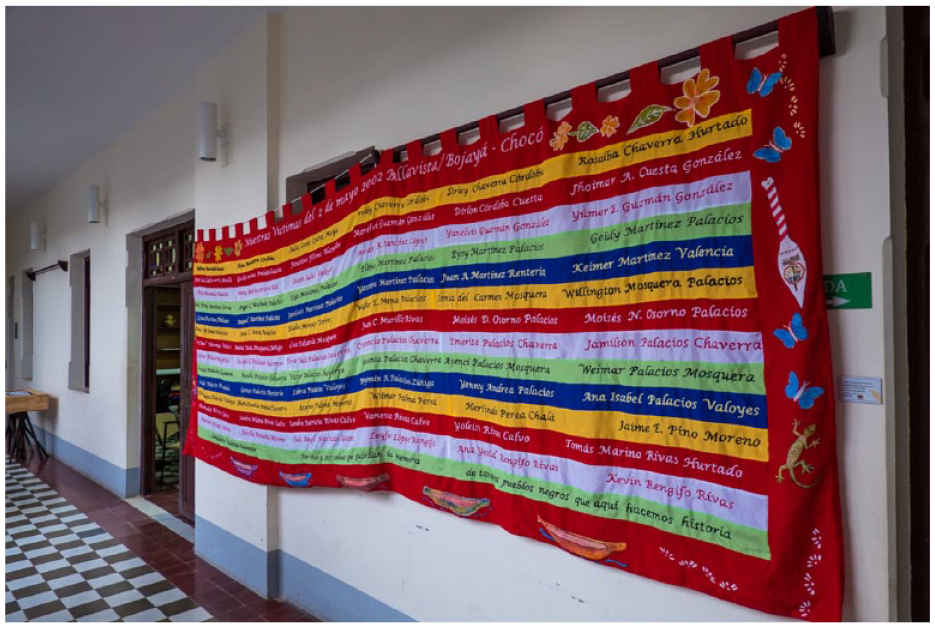
Telón de Bojayá. The textile panel has the following phrase embroidered at the bottom: ‘By river and by jungles/that keep the memory/of so many black towns/ that here we remember’. Picture taken by Dimitris Papadopoulos on 19 September 2019.
Several studies have highlighted how grassroots remembering and commemorating projects and events, which have continued to emerge in Bojayá and across other affected communities in Colombia, contribute to the construction of the collective memory of the Armed Conflict (Alcalá and Uribe, 2016; LeGrand et al., 2017; Rolston and Ospina, 2017; Ruiz Romero, 2012). 4 These projects challenge ‘official accounts’ by state institutions or armed actors, which have systematically silenced, marginalised or instrumentalised survivors’ memories to advance different political agendas.
The construction of the collective memory of the Armed Conflict from a victims’ perspective allows clarification and attribution of responsibilities for the atrocities committed. Thus, it constitutes a powerful tool and essential condition to claim reparation, in the development of transitional justice scenarios after the signing of the peace accord (Arboleda-Ariza et al., 2020; Tamayo Gomez, 2022). Local testimonies also constitute ways to expose whether more visible institutionalised forms of remembering and state reparation (such as public ceremonial commemorations, land restitutions, compensation, formal transactions between representatives of armed groups, rehabilitation programmes and guarantees of non-repetition, to name just a few examples) can be truly considered adequate and just. Indeed, no reparative measure can be understood to be successful (or even considered as ‘reparation’) if victims do not experience it as such (Perez Murcia, 2014: 197–198).
The political significance of grassroots commemorations also lies in enabling a particular form of reparation from below, beyond institutionalised measures. Grassroots forms of remembering enact reparation in two ways: reclaiming socio-ecological damages in their communities and repairing injured socio-environmental ecologies through mundane processes and practices of care and solidarity (Papadopoulos et al., 2023a; Tacchetti et al., 2022). This includes damages against humans, more-than-humans and the environment. During local commemorations, everyday communitarian life is recovered through different activities–such as the temporary re-occupation of original lands, the oral testimonies through traditional arts, rituals and customs, as well as the re-enactment of communitarian daily social interactions, like food making and sharing (Riaño-Alcalá, 2015). These ‘alternative infrastructures’ (Mora-Gámez, 2020: 10) enable community reparation and continuation through subtle acts of care and repair beyond state reparative and commemorative measures (de la Bellacasa, 2012; Denis and Pontille, 2019; Jackson, 2014; Mora-Gámez, 2016, 2020; Papadopoulos et al., 2023b; Valderrama, 2021).
This article explores how women in Bojayá and other Colombian communities damaged by the Armed Conflict resignify collective memory and reclaim their rights, while also materially recovering relations with themselves, each other, non-human beings, things, the environment and their cultural and spiritual heritage and traditions. In the struggle for memory and rights, Colombian women, particularly Afro-descendants and indigenous women, have been powerful but historically concealed actors (Meertens, 2012; Meertens and Segura-Escobar, 1996; Tovar-Restrepo and Irazábal, 2014; Wirtz et al., 2014). In general, women in post-conflict and transitional justice societies have suffered the effects of racialisation and gender-specific forms of harm and trauma. They are also underrepresented or victimised in court tribunals, the media, and academic debates (Crosby and Lykesy, 2011; Porter, 2016), where their testimonies are often limited to sexual abuse or other forms of gender-specific harm (Ephgrave, 2015).
In recent years, a growing number of studies have paid attention to the complexity of women’s experiences and testimonies as essential for an inclusive approach to post-conflict transitions towards justice and peace in Colombia (Bernedo Morales, 2011; Pérez-Bustos et al., 2019). This article focuses specifically on a particular form of memorial activism through textile making by groups of women from communities severely affected by the Armed Conflict (Arias López, 2015, 2017; Gonzáles Arango, 2015). Several women’s textile memory projects have emerged throughout Latin America and Colombia specifically to honour the victims of violent conflicts and seek historical clarification. 5
This article covers three important case studies of memorial practices of textile making and crafting by women in three sewing groups in the communities of Bojayá (Chocó), Mampuján (Montes de María), and Sonsón (Antioquia). These groups document the conflict through diverse textile forms and are all members of the national Red de Tejedoras por la Memoria y la Vida (Network of Knitters for Memory and Life), launched at the First Latin American Meeting of Knitters for Memory and Life in Medellín in 2016. For example, the sewing group Mujeres Tejiendo Sueños y Sabores de Paz (Women Weaving Dreams and Flavours of Peace) from Mampuján, an Afro-descendant community in the Montes de María region, has made several tapices (quilts), where textile figures depict the atrocities committed in their villages during the Armed Conflict.
Scholars who have engaged with these sewing collectives and other local expressions of Colombian textile activism have primarily viewed women’s testimonial textiles as instruments of oral history, telling the collective memory of the conflict from a survivor’s perspective (Del Socorro Ramos Díaz Granados, 2018; Gonzáles Arango, 2015, 2019; Rangel Barragán, 2016). These studies contribute to the autonomous memory initiatives by citizens, victims and their organisations, seeking to reconstruct and represent their memories with a sense of dignity for the construction of peace in their communities and prevention of future repetition (Grupo de Memoria Histórica, 2016).
Building on these insights, this article explores the creation of testimonial textiles as part of a complex net of practices, objects, makers, and spaces. This network enables the production of simultaneously collective memories and processes of community reparation from below. Our goal is to highlight the irreducible complexity and pervasiveness of women’s memory work through textile making and other material practices as labour that is entwined in a web of relationships through which all aspects of everyday life are transformed.
Recent work in the field of memory studies has rejected discursive views of memory as something ‘stored’ in the individuals’ consciousness, which can be accurately extracted and represented in personal accounts or artefacts. This novel approach to memory suggests that remembering is always a situated and collective activity, performed in interaction with others and the environment (Brown and Hoskins, 2010; Hoskins, 2016; Middleton and Brown, 2005). Following this network/materialist approach, this article explores the everyday material processes and practices, such as textile making, crafting, singing, cooking or housekeeping, through which women enable various forms of remembering that also constitute transformative processes of community regeneration from below.
Working with situated memorial accounts and practices that contribute to processes of daily reconstruction of life affected by the war entails ‘interrogating the specific conditions under which a particular strategy emerges as politically effective’ (Stephenson and Papadopoulos, 2006: 70). To understand the political impact of women’s memory work through everyday material practices in Colombia, we must examine the specific conditions in which these strategies emerge. Instead of just focusing on a single memorial practice or commemorative event, such as annual commemorations of massacres, we aim to highlight the everyday as the key location where women’s transformational memory work takes place.
According to Villamizar et al. (2019b), it is necessary to recognise the vital role of Colombian women in the preservation of both historical memory and communities in the country, by revealing the everyday forms of resistance and occupation that they have used to oppose war and other expressions of gender and racial violence. This is particularly significant for Afro-descendant and indigenous women, as it helps to recognise their many contributions to the struggle for liberation and dignity of Afro-descendants in the Americas.
Drawing from this body of literature and ethnographic visits in the communities of Bojayá, Sonsón and Mampuján, this article focuses on reparation – in its double meaning of reclaiming and repairing (Papadopoulos et al., 2023b: 4) – through the everyday practices of remembering and commemorating of the textile crafting collectives that we mentioned earlier. Fieldwork with the communities was conducted throughout 2019 as part of the 2-year research project Remendar lo Nuevo (Mending the New), led by research groups from Colombia and the United Kingdom (PIs are Tania Pérez-Bustos and Dimitris Papadopoulos). The project takes an interdisciplinary approach across the social sciences and digital design to show how textile craft work enables processes of reconciliation. The authors of this article have spent extended time with participant communities in many different instances throughout 2019. Quiceno Toro and Chocontá-Piraquive have conducted several fieldwork visits with them also prior to this project (2009–2017).
This article will draw similarities across various groups, but each section will focus on a distinct territory to avoid oversimplification. The goal is to emphasise the unique ways in which women’s livelihoods and environments have been affected by war and how they have been preserved and restored through remembering and community rebuilding. The first section will examine the experiences of Artesanías Guayacán (Guayacán Handicrafts) in the Atrato River basin. The second section will focus on the women of Mampuján in the Montes de María region and their sewing group, Mujeres Tejiendo Sueños y Sabores de Paz. The final section will explore the knitting collective, Tejedoras por la Memoria de Sonsón (Weavers for the Memory of Sonsón), in Antioquia.
In writing this piece, we acknowledge that we are located in different parts of Colombia and the Global North, away from the devastation caused by the Armed Conflict. However, we are committed to not only exposing the violence that women in these sewing groups have experienced but also to celebrating their role in defending life and repairing essential relationships for the survival of their communities. We do not want to erase their status as victims of severe violations of human rights, but rather resist reducing their identities to just victims and emphasise their important role in enabling reparative processes within their communities (Sundberg, 2015).
Everyday memory work as reparation
Women’s memory work in Bojayá is not limited to temporary memorial initiatives but inserted into daily practices within long-standing and pervasive female traditions. As Quiceno Toro (2016) observes, being an alabaora is a spiritual art, a journey and a role which binds women and is passed down within families. The alabaoras’s mortuary songs and the power of their voices are recognised in the Chocóan ancestral tradition and spirituality to enable the continued re-balancing of the spiritual-material connections and forces of their communities that have been abruptly damaged during the conflict (Quiceno Toro and Orjuela Villanueva, 2017). For example, the drastic modification of mala muerte in the Chocó region of Colombia for the unprecedented increase of unexpected violent killings of people who could not receive adequate funeral rituals, as in the 2 May 2002 Massacre. 6 Violent forced displacement amid the Colombian conflict constitutes one of the most substantial human rights violations in Colombia (Pécaut, 2000), which ‘signifies a rupture in the social fabric of communities and weakens the social structures and the community bonds that were historically forged’ (Perez Murcia, 2014: 194). The state’s plan for the construction of the New Town of Bojayá for the displaced population after the 2 May 2002 Massacre has resulted in the breaking down of another important spiritual equilibrium, as it has been erected upon the lands that were destined by the community’s ancestors to bury their dead (Quiceno Toro, 2016). In this context, the Musas de Pogue has been playing a crucial role in materially repairing socio-ancestral relations: as they travel across communities to perform their mortuary rituals, they embody a material re-connection and recovering of existing relationships between relatives and neighbouring communities, people and their territories and rivers, amid the Chocóan diaspora in the country (Quiceno Toro and Orjuela Villanueva, 2017).
As noted earlier, some Musas de Pogue are also members of the Guayacán sewing group in Bojayá, which has mobilised other knowledge and practices in their Afro-Atrateños traditions to sustain their community amid war (Quiceno Toro and Villamizar Gelves, 2020: 128). The Guayacán group originated in 1997 from a Comunidad Eclesial de Base (a grassroots Church community) formed at the end of the 1990s by Augustinian Missionary Sisters and Father Jorge Luis Mazo in order to bring women together to pray, read the Bible and experiment with collective projects of survival, especially in the face of the paramilitary advance, and the imminent confrontation announced with FARC-EP guerrillas, which will tragically materialise on 2 May 2002 massacre of Bojayá.
7
One such project was the establishment of the first community bakery in Bellavista. When paramilitary groups had intensified their presence and domination in the Atrato territories and blocked the free movement across the river, access to traditional forms of food sustenance, such as banana crops, became restricted, and so bread turned into a vital element in the Afro-Atrateños diet (Villamizar et al., 2019a). Moreover, the women of the group started their sewing project by making t-shirts with embroidered elements of the local landscape for sale and later on, they developed testimonial textiles to dignify the memory of their victims (Villamizar et al., 2019a). This is how the group emerged and consolidated as a space of care, community accompaniment and economic enterprise around embroidery and food preparation. In the following interview excerpt, Macaria, alabaora and member of Artesanías Guayacán, exemplifies the collective, processual, and interconnected aspects of the various ‘experimental practices’ (Papadopoulos, 2018) populating the textile collective:
One day at a mass Ursula
8
made the invitation. . . then I left. (. . .) And I left and I stayed, and I stayed again, with the women, to work together. We did the bakery course, I worked in the bakery also for a little time with the deceased Danielita – may she rest in peace – and with these young women, (. . .) and it was like the routine for the whole week, from Monday to Friday. I had that everyday routine, and on Saturdays or Sundays we were not working, and then we rotated. (. . .) And with embroidery work too, as we were perfecting it, we would bring it to our home. . . so that you could (. . .) follow it up in the house, and in the house, you would continue working.
9
Since the beginning, textile making has existed within the Guayacán collective as a material practice inseparable from others, such as bread making (i.e. the bakery project) and spiritual activities, which altogether have provided the means for the continuation of their community, literally so, as bread, t-shirts and prayers had been made in a moment in which war had deprived people of food, clothes and a holy place for worshipping (i.e. the Church of Bellavista). Crucially, as this extract of the interview shows, this repair work is carried out in daily activities, in dedicated collective sewing spaces, and at home, too, thus occupying a large part of women’s everyday life. This is visible in their houses, which can be viewed as ‘extensions of their sewing workshop’, inasmuch rooms, tables and common areas are full of textile tools, machines, threads, scraps and works in progress (Quiceno Toro and Villamizar Gelves, 2020: 123). The establishment of an ‘everyday routine’ revolving around textile, spiritual and bakery work has provided women and the sewing collective not only with the means to survive the war but also with strong foundations to develop their testimonial textile work, which emerged later on from the consolidation of these experimental practices and projects.
Testimonial textiles, such as the Telón de Bojayá (Figure 1), represent a powerful memorial and reparation tool. On the one hand, they record the atrocities of the war, dignify the memory of the victims and can be mobilised at public commemorations to reclaim historical truth against impunity. On the other hand, textile making forms part of an ‘everyday routine’ and is a situated and collective activity that, together with others, facilitates material processes of community regeneration from below. Following this network/materialist approach to textile-making practices, the next two sections explore women’s memorial work in the communities of Mampuján and Sonsón, with a focus on the interrelationship between craft-making and cooking-food, as well as the role of domestic spaces/households as activist spaces.
Cooking textiles, making communities
During an ethnographic visit to Mampuján in 2019, a rural village in the municipality of María La Baja, Chocontá-Piraquive and Tacchetti gathered with the sewing group Mujeres Tejiendo Sueños y Sabores de Paz in one of their regular meeting points, a community’s outdoor space owned by the local Church, to discuss and archive one of their undocumented tapices (testimonial textiles). After a round of votes, women picked Cartografía de Mampuján (Cartography of Mampuján, Figure 2), a large textile representing the houses and the natural landscape of Mampuján Viejo, the old village of Mampuján, as well as some of the people who used to live there and their occupations of the time. Some of the original makers attending the meeting explained that the hanging was made in 2011 for the 11th commemoration of the displacement of Mampuján. 10
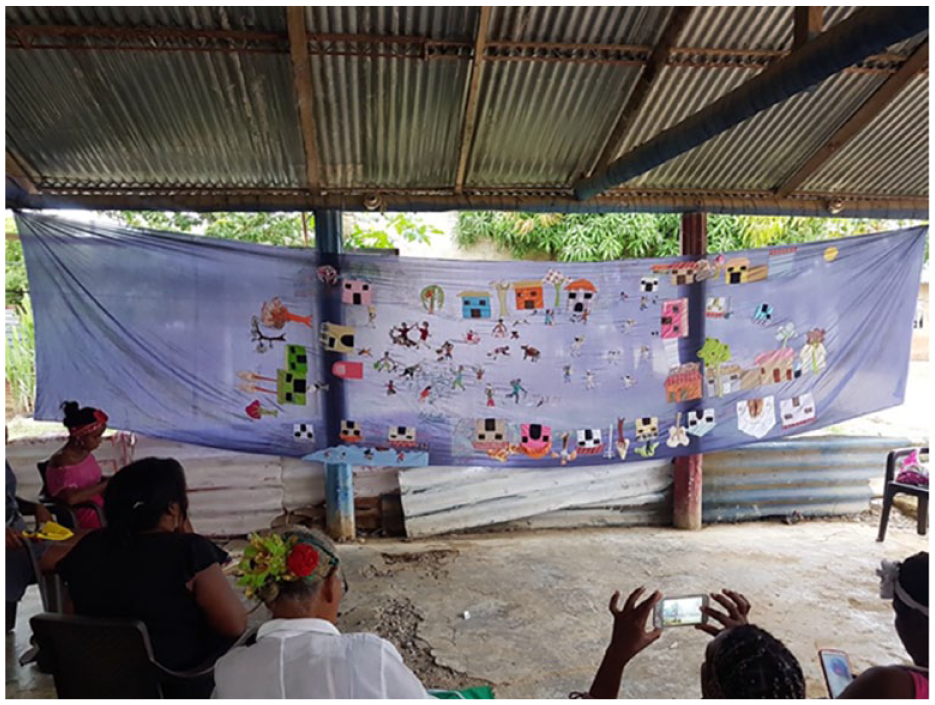
Cartografía de Mampuján (Cartography of Mampuján). Emblematic tapestry made by the collective Mujeres Tejiendo Sueños y Sabores de Paz of Mampuján; picture taken by Tacchetti on Thursday, 23 May 2019.
Unlike their characteristic memorial textiles, representing scenes of the war and for which they became famous as the wavers of Mampuján, Cartography of Mampuján is not a piece about sadness and pain but a tribute to the village, its beauty and happiness. Makers explained that the textile takes a bird’s eye view of the route to Mampuján Viejo so that if we look from the left-hand side, it is as if we are entering the old village following the old path that its inhabitants used to walk. The various depicted scenes reproduce collective memories of the landscape, such as different types of crops, vegetation, animals and dispositions of houses and streets. They also portray the people who lived there, their occupations and the neighbourhood relationships: the local team playing football, the man who sold the fritos (fried food, like corn or yucca, but also empanadas and arepas with fried eggs), the hunter of the village with his dogs.
While the conversations and documenting activities unfold, handmade hot empanadas and ice-cold tropical fruit juices are served to all the 18 participants and 5 researchers attending the meeting, by some women of the group, who had prepared and carried it all the way from their houses. The food and beverage trigger other memories and emotions about the food tradition in Old Mampuján: women recall the lost flavours of their village and their efforts to recover them in their dishes and textiles.
In her co-authored MA thesis, Juana Alicia Ruiz Hernández, social leader of Mampuján and of the Wavers’ group, develops the concept of sazón (food flavour or seasoning) to look at a key element in the shaping of their tapices (Ruiz Hernández et al., 2018). Food making and sharing are core in all the sewing groups that we have visited. During a sewing session, while women make their textiles, they also prepare food, which is then shared with others to take a break from textile labour and to socialise. Cooking and eating together is particularly important in the Mampuján sewing collective as reflected in their name, i.e. Women Weaving Dreams and Flavours of Peace. At each meeting with the research group, typical Mampuján dishes are shared, such as pato (milk with corn), fritos, sancochos (traditional soups) and different types of rice (coconut or chicken rice). Sociality, commensality and weaving all exist because of the other not being independent of them. The food is prepared before or during the meetings, the cosecha (harvesting) of tropical fruits is ideal for preparing marmalades and sweets, which women of Mampuján have specialised in over the years. Women take turns buying, harvesting, cooking or carrying the food to the sewing sessions. And there is no meeting without a cold or hot drink and meal, which are prepared not only for the weavers, but also for anyone – children, other neighbours and visitors – attending it. Leftovers are given to animal companions too.
It is in this continuous interaction that a collective narrative emerges in the material form of the tapiz (quilt). Weaving Mampuján in a tapiz entails stitching the flavours of its Afro-Caribbean tradition and ways of making it, for they have always played an important role in the life of the community and especially of women, given their traditional role of procuring, preparing and sharing food with their families. During a sewing session, memorial work is occasioned by the flavours of the food. Memories of traditional dishes and ways to prepare them are discussed among the makers and woven into the quilts as traditional food is prepared and shared.
Nonetheless, the relation with different foods also brings back the memory of loss and transformations brought by the war into their lives. As Juana Alicia remembers, the sweet fruits of the trees were the only food they had for days after the displacement. In the midst of terrible vulnerability and state abandonment, those fruits gave them the energy, the sweetness and the physical and mental strength to survive the exile. Palm oil monocultures of big agro-businesses occupy a large part of the land on the road from Mampuján Nuevo to Mampuján Viejo, with severe consequences for the agriculture of the areas as they dry out the soil and prevent other foods from being grown and marketed in parallel (Gaviria Mejía et al., 2020; Ojeda et al., 2015; Sánchez Mora, 2021). In this sense, the employment opportunities for Mampuján farmers have been increasingly reduced, and so have their capacities to maintain diverse food production and their subsistence economy. This is reflected, for example, in the change in the diet of the young children and grandchildren of the women weavers who, during the meetings we held, stated that they did not consume the traditional fruits of the region but preferred to consume highly sweetened and inexpensive artificial products for preparing drinks.
The landscapes of quotidian dispossession (Ojeda et al., 2015) that characterise territories such as the Montes de María, where Mampuján is located, affect the ways in which practices of subsistence, cultivating and feeding produced quotidian communities in these places. Thus, having access to rice harvests, fish shoals (subiendas) or growing food for their home are realities that now are yearned for and reclaimed through different doings and creations, among which the making of the textile and the permanence of the encounter through commensality (Figure 3).
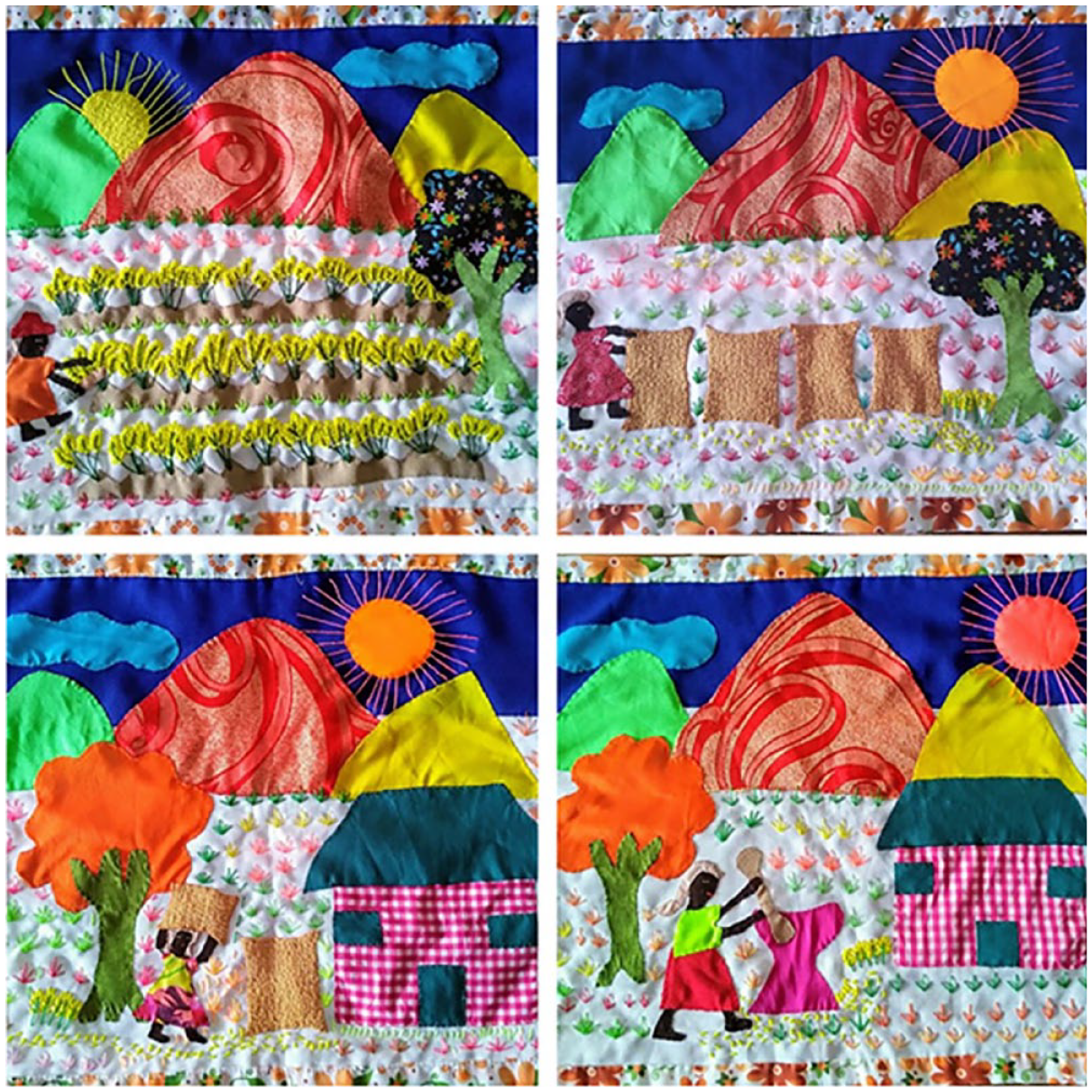
‘Tapestries in a sequence’ made by Marganis of the collective Mujeres Tejiendo Sueños y Sabores de Paz. Each tapestry represents a moment of the rice crop: cosecha, empacada, carga, and pilada (when the rice is ‘harvested, packed, loaded, and piled’). Pictures taken by Isabel González-Arango in 2019.
In this sense, the preservation of food and its preparation is a constant exercise of memory for women, parallel and embedded in their textile production. Similarly, women in the Guayacán collective maintain small domestic gardens, orchards and azoteas, a traditional way of growing edible and medicinal plants in old wooden canoes in the Pacific (Henríquez, 2018), which are also depicted in their textiles. This practice allows women to preserve food, recipes, remedies and knowledge of their tradition and everyday life by the river and selva, in the face of the displacement and relocation of their community in the town of Bojayá. It also reactivates relations between neighbours and with other rural communities nearby. For example, women exchange tierra de hormiga (excess soil from ant colonies), which is used to fertilise their gardens, azoteas, seeds and plants (Tacchetti et al., 2022). This can be viewed as a ‘kind of ‘archive’ of more-than-human memory’ preserving both traditional ‘soil practices’ of growing and the material soil, seeds, and plants (Millner, 2023: 27). In this way, reparation is enacted through daily material practices which reclaim and repair the connections between the territory and its inhabitants, broken down by war and inadequate reparative state interventions.
Making space for memory
In the Colombian Eastern Antioquia region three kilometres from the urban centre of Sonsón on the road that leads to Nariño a pine forest triangle known as La Pinera stands out from the top of a hill surrounded by the Páramo, the distinctive ecosystem of the Colombian Andes in this region. At the end of the nineties, La Pinera used to be the most popular natural and recreational park in Sonsón with ecological paths, wooded areas, sports courts, a restaurant, a cafe and a big modern swimming pool. When the Armed Conflict intensified in the region, it has suffered several armed incidents. In 2001, AUC paramilitaries from the group Autodefensas Campesinas del Magdalena Medio (Peasant Self-Defence Forces of Magdalena Medio) took the site and turned it into their headquarters for a month until 13 June 2002, when it was dismantled by the national army in a military operation that resulted in the killing of 18 young people suspected of being part of the paramilitary group (Otálvaro Vélez, 2016).
A few weeks after the massacre, a group of adults and children from Sonsón went back to La Pinera and painted colourful petals around the holes left by the bullets and grenades in the main building, which together formed many flowers. In the following weeks, dozens of people and children from various institutions and groups from the municipality (such as children from the Youth for Peace programme and a survival women group of mothers, some of whom had lost their children in the massacre) added their paintings and messages on the walls. The collective painting remained for only a few days, but it anticipated the institutional resignification of La Pinera from the place of death to memorial space. After more than six months since the massacre occurred, the municipal administration recovered the site, and in 2006, one area became the new campus of the University of Antioquia, intending to transform La Pinera into a space for memory and education. Since then, the area has hosted several memorial initiatives by local groups and institutions aimed at commemorating the victims of the conflict, celebrating the village resistance, and resignifying the space from the stigma of violence (Beltrán Hernández, 2019; Otálvaro Vélez, 2016).
During an ethnographic visit to Sonsón in February 2019, Tacchetti and other researchers of the project Mending the New accompanied the women of the Costurero de Tejedoras por la Memoria de Sonsón (Knitters for the Memory of Sonsón) to La Pinera to visit for the very first time a new permanent memorial that was recently erected there, to honour the work of their knitting group. Led by the anthropologist and textile artist Isabel González-Arango, the knitters of Sonsón are mainly old-aged and middle-aged white women of rural origin, some of whom have been displaced to Sonsón from the rural communities of Algeria, Nariño and Rio Verde and suffered familiar losses during the conflict. 11 The memorial stood in a hidden place of the park – difficult to spot and to reach through the winding rural path, especially for some of the elderly women in the group – and consisted of a large wooden structure displaying the individual embroidery works of some knitters (Figure 4).
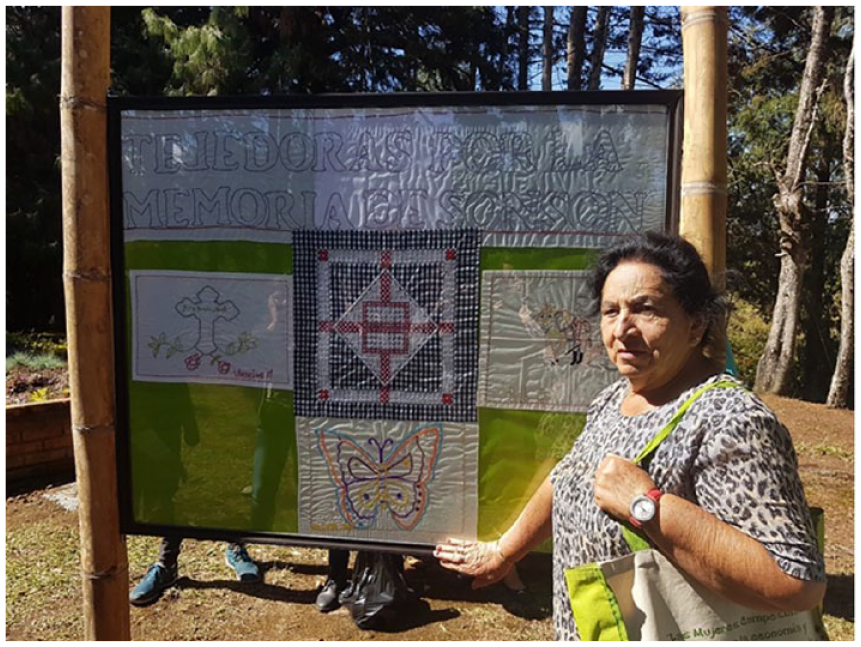
Ninfa in front of her artwork (the embroidered butterfly) in the memorial erected in honour of their sewing group, Tejedoras por la memoria de Sonsón. La Pinera, Sonsón, February 2019, Credit: Maddalena Tacchetti.
The knitters reacted with enthusiasm but also discussed ways to improve the memorial. Attending closely to women’s on-spot reactions allows us to appreciate what they regard as important aspects of their memory work through textile making. Several women thought that the memorial would make some reference to the victims, in the words of Alicia and Blanca, respectively: ‘What they said to us was that all the names of the victims were going to be there, could it be that they forgot it?’; ‘What I had understood was that they were going to put all the names of the victims, not only those of Sonsón, but also those of the nearby municipalities’.
Honouring the memory of the victims of the conflict is a foundational aspect of the Knitters of Sonsón sewing collective. Over time, women have experimented with and specialised in different textile techniques to craft their memorial artwork. Several have made false patchwork pieces representing their past peasant life with their beloved ones, animals, crops, and plants of their fincas (country houses) in the countryside, before the displacement to Sonsón. They have been making several fabric dolls too ‘as a remembrance of their own lives or the traumatic events that marked them and put them in the situation of victims’ (Blair, 2011: 68). The knitters of Sonsón have also made embroidered textile panels, cartografías (cartographies) which showcase main events that have affected the village of Sonsón throughout the conflict – including embroidered names or images of deceased or missing beloved ones, as well as memories of their lives in their rural villages of origin.
On the other hand, only a few textile pieces are exposed in the La Pinera memorial, which is very different from the testimonial textiles described above. They represent some beautifully embroidered figures, with no direct reference to their memory work and victims of the conflict. Ultimately, women agreed that if they had to make their own memorial, it would display different pieces and techniques collectively made by all women to remember the victims. It would also be a bigger monument, located in a more visible space of la Pinera, and ‘made of concrete or iron rather than wood, so that it could last in time’, as Olga pointed out.
As an example of an ideal way of preserving and commemorating their memorial work, several women referred to the Salón de la Memoria (Hall of Memory) of Casa de la Cultura (House of Culture) in Sonsón, where the sewing group’s meetings and a permanent exposition of their emblematic collective artworks are hosted. Casa de la Cultura is a characteristic colonial building which had been reconverted in the main cultural centre of Sonsón, in the heart of the town. In the Salón de la Memoria, one big cartography of Sonsón is hung on the wall in front of the entrance, whereas other textile hangings and crafts are displayed all around, such as the false patchworks and the fabric dolls, accompanied by letters telling the story of each one of them. 12
Beyond public spaces, however, the historical role of women in leading many memory grieving processes from domestic spaces through the reconstruction of their own homes has been little recognised. On the other hand, in our ethnographic explorations, we have observed that women across the various sewing collectives engage in continuous material modification of their households to make space for memory. Houses are constantly modified to accommodate their textile work through the creation of dedicated spaces for sewing. Indeed, the house is the space where much individual and collective textile work is carried out. Such private spaces are often decorated with memorabilia, altars, figures or statues of saints, or pictures of deceased or missing relatives, which accompany their daily textile work.
During a research interview at her house, Gloria, one of the knitters of Sonsón, invited us to her bedroom to have a look at her artworks, using these words: ‘I keep [my textile artworks] in my bags, and in little bags I keep like fabrics. . . Ouch! I keep such a mess. . . if you want, I invite you to come to my bedroom, so that you can look at my collection. . . my room is just like El Tesoro. . . [laughs]’.
El Tesoro (The Treasure) is the hotel-museum in Sonsón, which contains the most diverse and large collections of objects of the town from different periods of time: keys, sewing machines, records, books, statuettes, religious images, traditional farming and agriculture tools (such as for corn processing, the characteristic crop and symbol of Sonsón), dolls, magazines, encyclopaedias, toys and even an old machine for dental cleaning are scattered around the hotel’s communal areas as well as in private guest rooms. Indeed, Gloria’s room resembles El Tesoro for the great amount of ‘stuff’ that inhabits it (Figure 5).
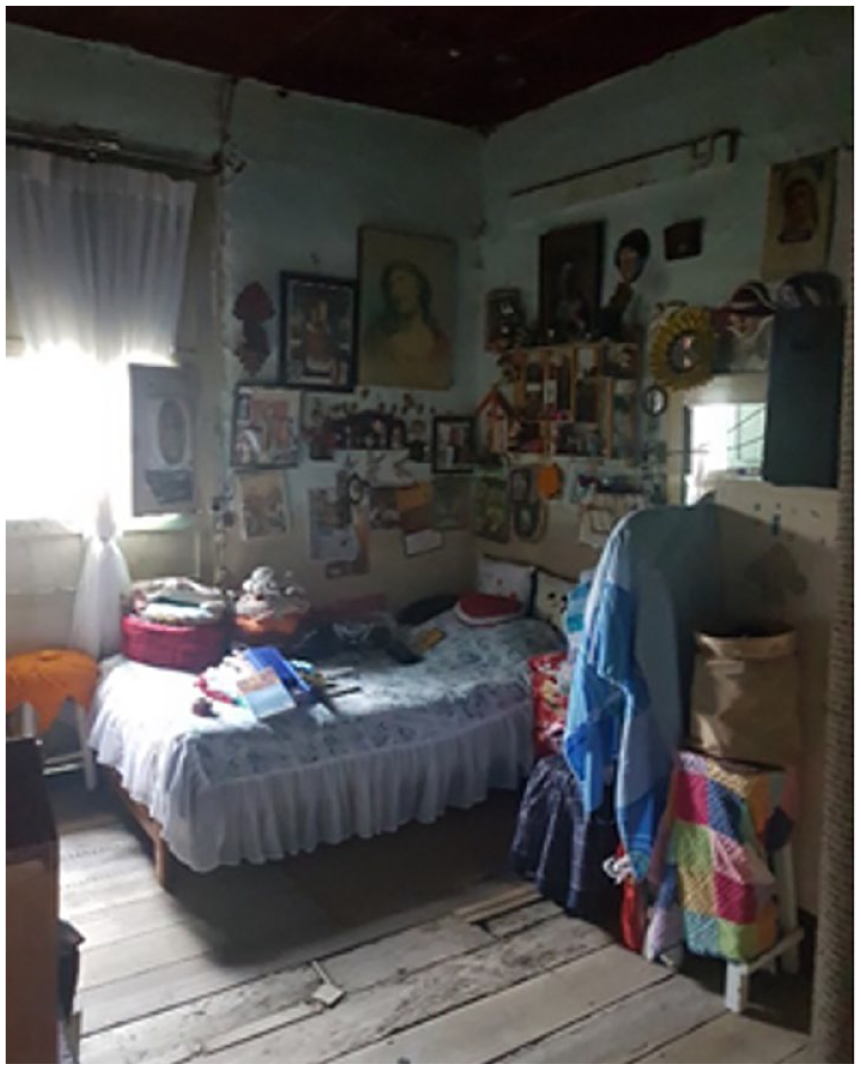
Gloria’s bedroom. Sonsón, February 2019, Credit: Maddalena Tacchetti.
Since her son went missing many years ago, Gloria has been rearranging the space of her bedroom (which she once shared with the son) so much that only her son’s keychain collection hung on a wall has never changed place. The remains of the son’s personal life coexist with Gloria’s crafting materials, tools and artworks that she invites us to examine as she explains their story. On the wall, next to her bed, a picture of her son is surrounded by many religious images, handcrafted textiles and objects. On top of the bed, there are the cushions, sheets and blankets that she gorgeously embroidered. All around, inside and on top of furniture, a myriad of other crafts as well as boxes, jars and bags, containing all sorts of textiles (finished or in progress), needles, threads, fabric strips, but also wooden sticks and matches for the construction of quitapesares (‘worry dolls’, one of the characteristic textile crafts of the Sonsón knitting group) and miniature crafted cradles.
Women’s everyday labour of memory materialises not only in the fine finished handcrafted objects or memorabilia but also in meaningful and sometimes drastic re-arrangements of the household to store or display them, as well as in the daily actions of care for their maintenance. These activities are carried out daily and constitute a core part of women’s everyday life. This is often reflected even in the final outlook and spatial configurations of their private space. Ninfa, for instance, another knitter of Sonsón, has created a personal hall of memory in her own house. The latter consists of a series of intimate, interconnected rooms, so that before reaching the hall of memory, one must walk through all of them. Each room is decorated with Ninfa’s textiles and crafts, such as colourful embroidered blankets and false patchworks, as well as religious images and pictures of her daughter, who was killed amid the conflict at the age of 15. Ninfa’s hall of memory hosts a greater collection of her handcrafted works and family photos, which are hung all around the walls and furniture. On one side of the room, a small altar with candles is set up inside an open closet. In the centre of the room, there is a table where Ninfa keeps her sewing diplomas and certificates of participation at various victims’ memorial events. Ninfa told us that her dream would be to have a ‘house of culture with a memory hall’ one day, just like the one where the sewing collective meets, but only for herself and her memories, to be able to exhibit all her works, diplomas, saints and pictures.
The ‘house-museum’ is a space to reconstruct the past, and work for the future from a situated present, so the houses are preserved and embellished. The materiality of that memory speaks to us of a future with hope but also of a healing space for themselves and their families: a memory that dignifies them (Quiceno Toro and Villamizar Gelves, 2020). This exercise of care and memory in the house museum can be understood as an activist practice with a political intention. The house becomes resignified: it is no longer (or not only) a space of subordination and submissive femininity, but it becomes a way for these women to resist and dignify themselves (Bratich and Brush, 2011: 237).
Although the home museum of memories is an individual expression, it is sustained through and sustains the collective work and exchange of the sewing circle, with the support and experimental interchanges among women. Textile pieces, whether collective or personal, are crafted at private houses and during the sewing collective’s group meetings too. The houses, as shown in the case of the Guayacán collective, become ‘extensions of sewing workshops’ (Quiceno Toro and Villamizar Gelves, 2020: 123).
Conclusions
The various case studies discussed throughout the article show how textile memory work transforms painful experiences of the past and simultaneously creates conditions for the reclaiming and regeneration of communities. Moving away from understanding textile making as isolated objects or practices testifying and protesting the effects of the Armed Conflict allows us to see them as embedded in everyday processes of community sustenance and regeneration.
The memory work, through textile making, by the women of Bojayá branches out and intersects with other everyday practices – such as bread making for the bakery project, exchanging soil to grow traditional herbs, or singing alabaos – that transform painful experiences of the past, while ensuring the living conditions for the community to regenerate itself again after the breakdowns created by the war and state reparative measures. Unlocking and illuminating this everyday aspect of women’s work is important, especially for Afro-descendant women, to recognise the vital role of black Colombian women in both preserving the historical memory of the conflict and ensuring the continuation of life in their communities. By means of mobilising knowledge and skills of their own Afro-descendant traditions, women in the sewing collectives of Bojayá and Mampuján have resisted war as well as racial and gender violence in their everyday lives. In particular, we have tried to highlight what each collective recognises as key aspects of their own traditions, such as singing alabaos in Bojayá and cooking traditional Afro-Caribbean dishes in Mampuján. These traditional practices become intertwined with new ones, such as textile making, which in turn becomes an innovative tool to remember, celebrate and reclaim their heritage, culture and territory. This is visible in their finished art products too, such as their testimonial textiles with colourful, detailed and beautiful embroideries of their everyday life with the animals, rivers and plants of the Chocó or the Montes de María territories.
In section four, we have focused on the Knitters of Sonsón collective to examine how women’s houses serve as spaces for material processes of repair. The house is where women in the sewing collectives discussed in this article spend much of their time performing various domestic tasks and memory work. The physical and spatial restructuring of the household to accommodate their memory work and craft shape their daily work of remembering, commemorating and mourning. The house museum allows women to meaningfully navigate their present while coping with their painful past. The material artefacts from the past help maintain and rebuild women’s relationships with loved ones no longer present. It is also a way for women to navigate their daily lives in the absence of their losses.
Finally, in this article, we have tried to show how the examined sewing collectives use textile making to repair relationships and rebuild communities through the performance of grief and the remembering of lived experiences of the Armed Conflict. Textile-making allows for the emergence and embodiment of personal and shared memories, contributing to the collective memory of the Armed Conflict. At the same time, these textile-making practices interact with others, enabling the remembering, repairing and reclaiming of territories, spaces, traditions, social and spiritual bonds and relationships with both human and non-human beings. From this perspective, memory is a collective transformative exercise by means of which women shape the entire ecosystem that sustains them and their communities, including living and non-living beings (objects and plants, but also the dead, saints and other spiritual forces) in public and private spaces.
Footnotes
Acknowledgements
The authors would like to thank all the women participants from the textile collectives Mujeres Tejiendo Sueños y Sabores de Paz, Artesanías Choibá, Artesanías Guayacán, and Costurero Tejedoras por la Memoria de Sonsón. The authors would also like to acknowledge all the scholars of the research project Mending the New: A Framework for Reconciliation Through Testimonial Digital Textiles in the Transition to Post-Conflict Rural Colombia.
Declaration of conflicting interests
The author(s) declared no potential conflicts of interest with respect to the research, authorship, and/or publication of this article.
Funding
The author(s) disclosed receipt of the following financial support for the research, authorship, and/or publication of this article: Dimitris Papadopoulos and Maddalena Tacchetti gratefully acknowledge the support of the Arts and Humanities Research Council and the UKRI Newton Fund (grant number AH/R013640/1).
