




Abstract
This article explores the echoes that resonate in the present of the embodied memories of the Spanish Hunger Years (1939–1952) during the post-war period of Franco’s dictatorship. More specifically, it analyses both the bodily and mental effects of those traumatic memories on the survivors’ subsequent dietary practices and their perceptions of the socio-political reality. For this purpose, the study relies on the first-hand personal memories of those who were children during the 1940s. It is argued that there are continuities between these embodied memories and the eating habits of the survivors and their attitudes towards subsequent periods of prosperity and crisis.
I don’t know who used to say in my house: you have to have memories. Living is not as important as remembering. How dreadful it was to have nothing to remember, leaving behind a tape without a trace. But how awful it is when memories rush at you and force you to look at them and bite you and wallow in your guts, which is the place of memory. – León (1970: 49)
As Roberta Culbertson (1995: 179–180) explained, extraordinary, extreme and traumatic situations that bring you to the brink of death ‘are remembered at the level of the body’. That is, they are recalled ‘by the body itself, or by the spiritual mind, the interior of the body’, and told in the form of ‘ascetics’ or mystics’ accounts’ in which reality is intermingled with reverie. As José Van Dijck (2004: 350) stated, ‘memory is obviously embodied’, since ‘personal memory is situated inside the brain, in the deepest, most intimate physical space of the human body’. Although logically all memories are embodied, as Colleen Johnson (2019: 59) explains, the concept of ‘embodied memories of lived experience’ is used to differentiate them from the ‘implanted prosthetic memories’ described by Alison Landsberg (2004). The latter category refers to memories that are not natural and do not come from lived experience – rather they are acquired from the mass media – but are perceived as real and have a great potential to generate empathy. However, following Johnson (2019: 47–48, 52), ‘embodied memories’ are those that are felt throughout the entire body (. . .) lived experiences never actually disappear, even if the specific information of the memory disappears from one’s consciousness. Rather, the physical experiences of the body remain evident within the body as feeling, emotion, affect, or even sensory instinct (. . .) memory informs identity and therefore determines future behaviour.
Thus, deep memories of suffering leave their mark on the survivors’ subjectivities and bodies and have implicit psychic and physical effects on their current everyday lives. In this way, the recent past survives in the present, so that both times coexist and are juxtaposed, as Jacques Derrida (1995: 63–89, 111–114) pointed out. Traumatic experiences may end up being embodied in the decisions or perceptions of survivors many years after they took place. As Sutton and Williamson (2014) put it, this phenomenon can occur unconsciously and involuntarily, since ‘I need not explicitly recollect any specific past events, or even recognise that I am remembering’. ‘Habit memory’ and ‘personal memory’ interrelate in the course of everyday life since the effects of embodied memories can be triggered by everyday physical sensations. As these authors explain: the body can also be a cue or trigger for personal memory experiences, where this can occur either deliberately or unintentionally. The involuntary activation of a particular memory by way of sensory triggers is most commonly associated with smells and tastes (. . .) [or] bodily sensations such as hunger.
Based on these theoretical assumptions, this article analyses the continuities of the ‘embodied memories’ of the traumatic Spanish Hunger Years (1939–1952). This food crisis during the first decade of Franco’s dictatorship (1939–1975) was mainly caused by the regime’s intense and prolonged commitment to an autarkic economic policy. As studies such as Del Arco (2021; Del Arco and Anderson, 2021) have shown, during the most critical years of that period (1939–1942 and 1946) there was a veritable famine. This is borne out by indicators such as the decrease in people’s purchasing power and deaths due to starvation or disease derived from malnutrition. Some researchers have estimated that 200,000 people died from these causes just between 1939 and 1944 (González and Ortiz, 2017: 26; Payne, 1987: 252). However, while this is the most widely quoted figure, other authors have suggested mortality ranging from 194,000 between 1939 and 1942 (Ortega and Silvestre, 2006: 76) to 600,000 between 1936 and 1942 (Maluquer De Motes, 2007: 150). 1 The consequences were particularly severe for the poorer classes in southern Spain (Ortega and Cobo, 2004; Rodríguez, 2013). To survive in such an extreme context, ordinary people resorted to subsistence strategies that included the preparation of ersatz products such as barley coffee or carob chocolate (Velasco, 1987). Or the consumption of food that was culturally inappropriate for human consumption (Conde, 2018: 346–357), in which women played a major role (Murillo, 2014). Despite the Franco regime’s attempts to draw a veil of silence over this period, the years of hunger have remained indelible in popular memory (Román, 2020a).
The issue of continuities between the past experience of starvation and the subsequent dietary practices of survivors has not been extensively studied to date. Some research has been published on Holocaust survivors who suffered starvation in Nazi concentration camps. They point to the correlation between past experience of deprivation and certain attitudes towards food in the present, such as binge eating (Favaro et al., 2000). They also mention other habits such as a refusal to throw food away, even when it is spoiled; excessive food storage; cravings for certain foods; refusal to queue for food; and anxiety when food is not available (Sindler and Wellman, 2004). Some recent studies have also referred, albeit briefly and tangentially, to the continuities in the present of the food discourses constructed by the European dictatorships of the 1930s and 1940s. In this regard, Garvin (2022: 76) points out how some rural women who, in their childhood and youth, were exposed to the fascist discourse that encouraged the consumption of locally produced rice and discouraged the consumption of wheat pasta, are reluctant to eat rice in adulthood. In the case of the Spanish Hunger Years, the topic has hardly been explored. In the mid-1990s, an anthropological study was published in which, although it was not the main topic, some references to continuities were included, including the preference among the elderly for quantity rather than quality in terms of food (González De Turmo, 2017 [1995]). It is only very recently that a study, also anthropological, has been published focusing expressly on the influence of post-war hunger on the subsequent eating habits of the elderly, in this case in the region of Extremadura (Conde et al., 2021). However, there are still many questions to be answered, including: To what extent can the conclusions of these studies be extrapolated to other Spanish regions? How long-lasting can these persistence effects be? What is more important in the dietary cultures of the elderly, the memory of hunger or the current medical-health discourse? This article therefore seeks to explore these debates in greater depth and to partially fill this gap. In this case, it is from a historical and Memory Studies perspective and for a very specific case study: eastern Andalusia, one of the regions most affected by post-war famine, along with Extremadura. This is mainly explained by communication deficits and, above all, by chronic social inequality in the region. In Andalusia, the imbalance in the structure of land ownership explains the existence of a large mass of landless labourers who, during the post-war period, saw their purchasing power drastically reduced due to the rise in prices and the fall in wages (Ortega, 2003: 80–94).
The aim of this article is, first, to examine the effects of the memory of the Spanish Hunger Years on the survivors’ subsequent eating practices and food choices. Secondarily, it aims to study how that traumatic memory conditioned the victims’ attitudes to subsequent periods of prosperity and crisis. To answer these questions the article is mainly based on two sources of information that allow the survivors’ subjectivities to be recovered. On one hand, it uses documentaries and written memoirs and, on the other, oral sources. These are of great interest to our understanding of the past and present subjectivities of historical subjects (Passerini, 1985) and for ascertaining to what extent the past is still present in their consciousness (Vilanova, 1998: 10). To this end, people who were raised during the post-war period were interviewed. The interviews were conducted using the ‘stories of life’ methodology described by Llona (2012). According to that methodology, interviewer and interviewee have a flexible and fluid conversation based on a previously prepared semi-structured questionnaire. This format allows the interviewee to recreate the most significant aspects of his or her life. The interviews were recorded and subsequently transcribed. The testimonies were then analysed from a qualitative point of view and suitably deconstructed (Llona, 2012: 35–87). In this respect, we were interested not so much in their accuracy with respect to the post-war reality, but rather in the significance the informants attached to their experiences during those years (Fraser, 1993; Portelli, 1989: 28–29). Following Thelen (1989: 1125), in a study of memory the important question is not how accurately a recollection fitted some piece of a past reality, but why historical actors constructed their memories in a particular way at a particular time.
Informants were found in the villages using the ‘snowball strategy’ (Bertaux, 1993: 27), whereby one interviewee leads to the next, and so on. In total, 29 interviews were held, some of them with couples. The sample was representative and included both men (24) and women (14) from rural Andalusia, one of the regions hardest hit by the famine. We also sought testimonies from different family and socio-economic contexts, including both the children of the ‘vanquished’ in the Civil War and those of the ‘victors’, given that their post-war experiences were very different in each case. The informants were interviewed between 2014 and 2017 in various villages in eastern Andalusia. The conversations were about different aspects of their daily lives during the Franco dictatorship (1939–1975). Many of the questions focused on food during the hunger years (1939–1952) with questions such as ‘Did your family go hungry?’, ‘What did you eat for breakfast, lunch and dinner on an average day?’ and ‘What was the quality of bread like?’. Questions were also asked about the improvements in nutrition since the 1950s and 1960s, when rationing ended and the country underwent significant economic growth. The interviews did not explicitly ask about continuities between the memory of hunger and later food practices. However, after analysing the implications of these conversations and deconstructing them, in at least 11 cases, it was found that such connections emerged between past scarcity and current food practices. The effect of past hunger on later eating habits was not the main focus of the research that motivated the fieldwork. It was a supervening theme that surfaced unexpectedly when analysing the results. This particularity could be interpreted as one of the main limitations to this study. Therefore, the conclusions will have to be corroborated and, if necessary, nuanced in future specific studies.
In the first section, the article explores the effects of the traumatic embodied memories of past hunger on the subsequent eating practices of survivors. In particular, their attraction to sweets, their nostalgia for certain attitudes at the table, and their tendency to eat in abundance are analysed. Special attention is devoted in this section to the continuities between the memory of post-war bread and later attitudes towards this food. In the second part, the article delves into the impact of famine memory on the later socio-political attitudes of those who were children in the post-war period, that is, how they perceived subsequent periods of prosperity and crisis.
‘Every kilogram gained was a just revenge for the hunger of the past’. The persistence of embodied memories of hunger on later eating habits
The last days of the month were spent feeding exclusively on the ration roll which I devoured in the mornings – it was about this time that Antonia caught me drinking the water from boiling the vegetables, but I was beginning to get used to it, and the proof is that as soon as I got my pay for March I spent it exactly the same. I remember feeling so extraordinarily hungry when I had the new money in my hands that it was a pungent and delicious feeling to think that I could satisfy it at once. More than any kind of food, I wanted sweets. (Laforet, 2004 [1945]: 85)
The traumatic memory of the Spanish Hunger Years (1939–1952) has remained indelible over time and is still felt today. As anthropology has shown, many of those who were children in the 1940s see their current eating habits and food choices as conditioned by the traumatic experience of post-war hunger. Thus, they take advantage of any leftovers, insist on overfeeding their children and grandchildren, eat in abundance themselves, or stockpile food ‘just in case’ (Conde et al., 2021). Many disdain wasting food, claiming ‘I like it all’, ‘I eat it all’, as well as eating what their young children leave on their plates to avoid throwing food away (Gracia, 2002: 145). Others reject certain foods because they take them back to the years of hunger and make them relive experiences they would rather forget (Conde, 2018: 414–415). Food taboos are a particularly long-lasting continuity, as evidenced by the testimonies of some residents of Barcelona who reject dishes such as capipota (based on pig’s trotters or pig’s cheeks) or feel repulsed by animals such as cats (which sometimes replaced rabbit in stews) (Gracia, 2002: 146 and 148).
The persistence of these effects years after the Hunger Years ended does not only affect post-war generations, but also their children and even their grandchildren. This phenomenon is explained by the transmission of memories that the first-hand witnesses’ descendants end up considering almost as their own. This is what Marianne Hirsch (2011) has called ‘postmemory’. The long-lasting effects of hunger memory can be explained by the centrality of food in everyday life, as well as by the role historically played by women in its intergenerational transmission. Thus, the memory of hunger is very present among those who were children in the 1960s, when the Spanish diet improved substantially, diversifying and increasing the average number of calories ingested. As Montserrat Huguet (2019: 117) explains, even in those years of ‘progress’ in which post-war hunger seemed to be far behind us, The Spaniards’ main link to leisure and rest was still in the form of food. To have had a good time on a feast day was the result of having eaten better than an ordinary day with unusual delicacies or simply in abundance. The Spaniards’ relationship to food was still reminiscent of deprivation. Joy was associated with food–the best thing in life was to be able to sink one’s teeth into it–and especially with sweets. Gluttony took the form of a huge cream cake. If children who had lived through the war had had their teeth chipped because of poor hygiene and lack of vitamins, those of the 1960s, with a poor calcium heritage and poor teeth-cleaning habits, had their molars decayed because they ate sweets, as many as their parents could give them, because, in the grandmothers’ opinion, sugar was good for the bones.
As this excerpt illustrates, one of the manifestations of embodied memories is the special fondness for sweets felt by those who came of age in the 1960s. Sugary foods were among those they most longed for in their childhood, when they became luxury items available only to the wealthy. Although the shop windows of patisseries in some cities such as Barcelona displayed cakes and tarts, these products were unaffordable for the majority of the population during the forties (Richards, 2003 [1998]: 143). Those who were children in the post-war period and had a monotonous diet based on substitutes and poor-quality food grew up with a craving for sweets. This preference is particularly significant among women (González De Turmo, 2017 [1995]: 67). Even for those who did not go hungry, such as Paca Romero, the daughter of a farmer from a small village in depressed Almería, items such as ‘an ice cream’ or ‘a chocolate’ were ‘whims’ that their parents could not afford.
2
Hence, sweets were the first thing many poor people bought when a few pesetas fell into their hands, as it was a way of simulating normality, forgetting their daily hardships and assimilating into the wealthier classes. This perception of sweets as a luxury item was widespread even among those who were children in the 1960s. This is the case of Francisca Fernández, born in 1966 into a large family of day labourers in Loja (Granada), who recalls that in her family chocolate was reserved for her older sister, who was the only one who worked. Moreover, when asked about the food she considered the most luxurious in her childhood, she answers without hesitation: ‘cakes’. The woman explains: They were very good and I couldn’t get those things, I had to make do with seeing them in the shop windows, poor me. If things were going a bit well for us, maybe my mother was able to buy some to make a bread roll [rosco] or some buns [mantecados] on certain occasions, but forget about going to a shop to buy cakes. We only saw them in the shop windows.
3
Hence, in the decade of economic ‘developmentalism’ (‘desarrollismo’), when things improved and people were finally able to buy or make these items, they did not skimp on quantity and included them in the celebrations of the most special occasions. The consumption of sweets in the 1960s occupies a common place in the memory of the Andalusian witnesses, who remember them as the star product of wedding celebrations, however modest they may have been. As explained by Pepe Berdugo and Antonia Romero, who did not go hungry in the post-war period and who married in Teba (Málaga) in 1967, at that time wedding celebrations like theirs consisted of ‘sweets and little else’.
4
For his part, their neighbour Cristóbal Escalante, whose family survived the famine years thanks to his father’s black market trading and the wheat and barley they grew in their vegetable garden, raised and fattened a pig for the whole summer to sell it and ‘be able to buy the rolls, sweets and clothes’ for his wedding, which he describes as a ‘common’ celebration. Encarna Lora, from a well-to-do family also from Teba (Malaga), takes the same view: In the past, weddings were based on olives and bread. And some sweets they used to make. (. . .) They put their wine, and that was for those who could afford it, their plate of olives with their bread. And that was the first thing. And they ate the sweets. And that was a very good wedding. That whoever made that wedding was a good wedding. Oh, it was a wedding. . .there were olives . . . so good.
5
Even when there was no celebration after the ceremony, an invitation to eat sweets was rarely missing. This is explained by Consuelo Castillo, a resident of Santa Fe (Granada) and daughter of a country-dweller with a relative repressed by the Franco regime. She tells us that wedding celebrations in the village consisted, in the best of cases, of an invitation to the bride’s house for a glass of aguardiente and homemade sweets prepared by relatives. 6 This was what happened at the wedding of Presentación Morales, a resident of Iznatoraf (Jaén), who did not go hungry as her father was a member of the town council with easy access to rationing. She married in 1957 7 and, in addition to eating meatballs, a chicken and a rabbit that had been slaughtered for the occasion, the guests drank aguardiente and ate doughnuts made by some of the family’s cousins. On other special occasions, such as Christmas, it was also customary to make homemade sweets. This is what Consuelo’s mother did; she ‘was very fond of sweets’ and used to prepare mantecados (butter buns) and polvorones (shortbread biscuits) made with lard. 8 Or the women of Constancio Zamora’s family, who made ‘special sweets’ such as biscuits or bread rolls. 9
Along with sweets, another foodstuff that took on a special meaning that transcended the merely nutritional and entered the cultural realm was potatoes. Potatoes, traditionally considered a basic part of the diet of the working classes, became more central during the famine years. During that period, they were an essential ingredient in many subsistence recipes, such as ‘patatas a lo pobre’ or ‘gachamigas’ (based on potato, flour, oil, and water) (Conde and Mariano, 2020). For this reason, for some people potatoes may have taken on symbolic connotations. This was the case of Joan Margarit, who associates their consumption with a specific place, which he links in turn with the happiness that comes from enjoying relative abundance – in this case of fruit and vegetables – when the days are spent in absolute shortage. This phenomenon has to do with the ‘body’s familiarity with certain places’ (Sutton and Williamson, 2014) that emerges in many personal memoirs. But it also concerns the fact that in extreme circumstances like those of the Spanish famine ‘symbols tend to actualise’ (Des Pres, 1976: 69): The Sanaüja vegetable garden, my discovery of wealth within misery (. . .) The revelation of basic potatoes. Steaming boiled potatoes will always be a symbol of joy for me. That is why among my most beloved pictures are the ones Van Gogh painted under the title The Potato Eaters: those peasants in the shadows around the table, showing their faces and hands in the light of the oil lamp hanging from the ceiling. Under the lamp smokes the most luminous point of the painting: the whiteness of the tray full of potatoes, from which they all eat directly, picking them up with their hands. (Margarit, 2019: 59)
Also significant is the phenomenon of nostalgia for certain attitudes to food and the dining table during the hunger years. As has been argued from the field of Memory Studies (Arold-De Simine, 2013: 67), ‘what attracts nostalgia for catastrophes, tragedies and wars situated in the past is a safe distance from something that is extreme and therefore perceived to be more real and true than a mundane everyday present, drained (empty) of intensive emotions’. Along the same lines, Gutiérrez Albilla (2018: 466) has argued that ‘the nostalgic subject (. . .) compulsively repeats pleasurable memories of an idealised space to compensate for the pain of displacement and not belonging’. Some witnesses from the post-war period feel nostalgia for the intra-family and intra-neighbourhood solidarity and empathy that existed during the famine. And they show a certain sadness at the individualism that prevails today when it comes to eating. These testimonies also reveal a certain longing for a time in the past when, according to them, there was greater respect for food and for people. This is the case of Francisca Fernández, a resident of Loja (Granada) and the daughter of post-war children. When asked about the current context in relation to that of decades ago, she explains, I think it’s worse now, because now there are no people but individualism. In the past, we used to go in groups, we helped each other, brothers and sisters, parents, uncles and aunts, grandparents, neighbours etc., whereas today that doesn’t happen. Now you set the table and everyone comes to eat without thinking about it and without seeing that there might be hungry people left at the table. In the past, people took longer to come forward to eat and preferred to eat less so that no one went hungry, whereas today they jump up and down to see who will be the first to eat. I have seen my mother take out food for everyone and see that there was not enough food to serve, and she always left her plate for last. Well, I’ve even said: ‘I have a tummy ache and I don’t want to eat’, so that my mother would take the plate of food that she was going to serve me and she would eat it herself. If I ate that plate, she wouldn’t eat. Nowadays, who would do that?
10
Another effect of past hunger manifested in the current eating practices of those who were children during the Civil War (1936–1939) and the post-war period (1939–1952) is overeating (Figures 1 and 2). One of those children, now an old woman, who embodied the memory of hunger was Julita Salmerón, the protagonist of Muchos hijos, un mono y un castillo. As the woman explains in one of the scenes, in her childhood she was fed on tasteless white rice that she had to eat with a shoehorn because she didn’t even have a spoon. Although the documentary does not make this explicitly clear, it is very difficult not to draw connections between that childhood trauma and her current attitude towards food. At the time of the film, which was released in 2017, Julita was an overweight octogenarian who was a compulsive eater. She dined on fried eggs to which she added all the oil left in the frying pan after frying and loves the daily pleasure of eating toasted bread for breakfast.
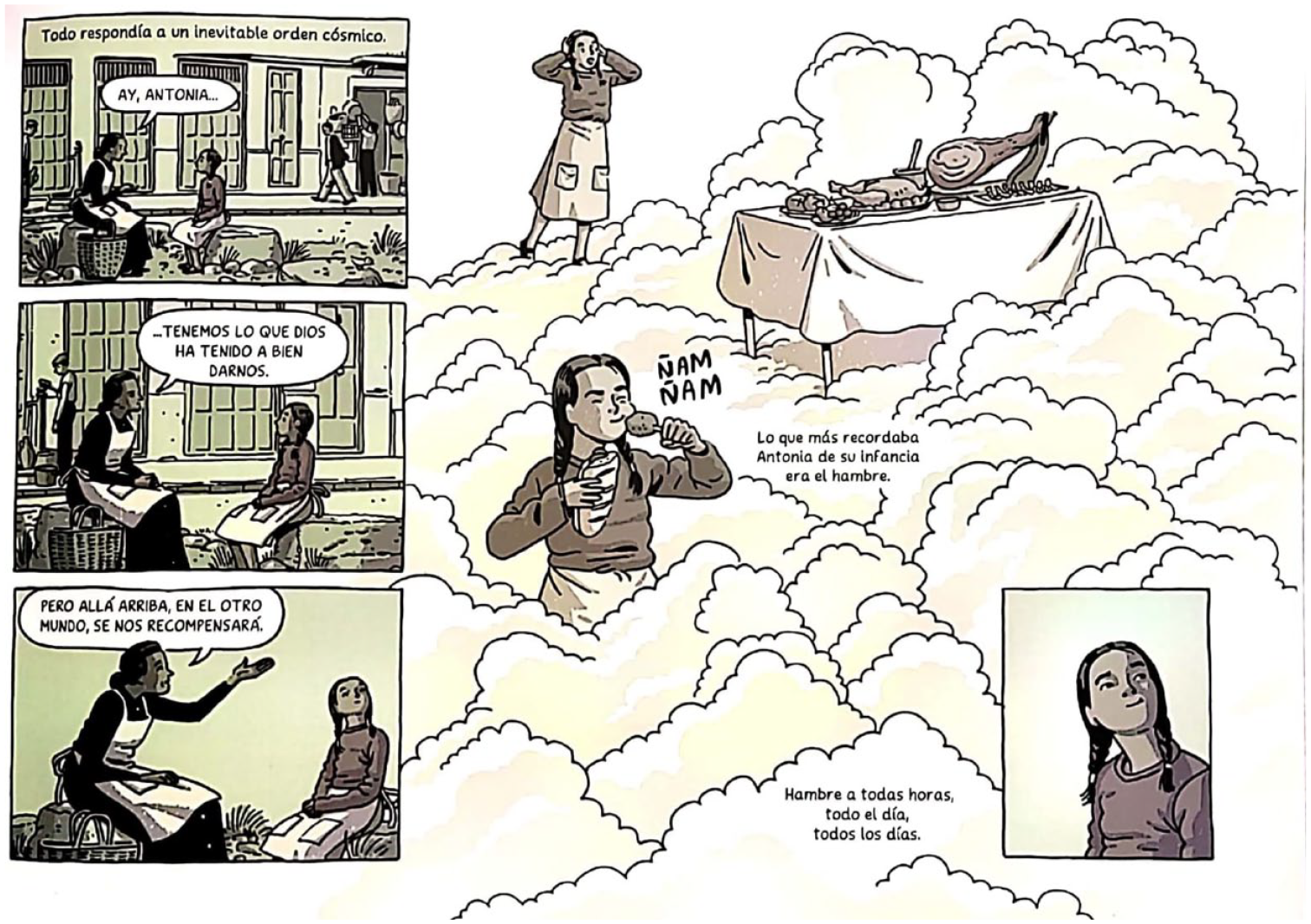
Antonia fabulating with a table of copious food during her childhood.
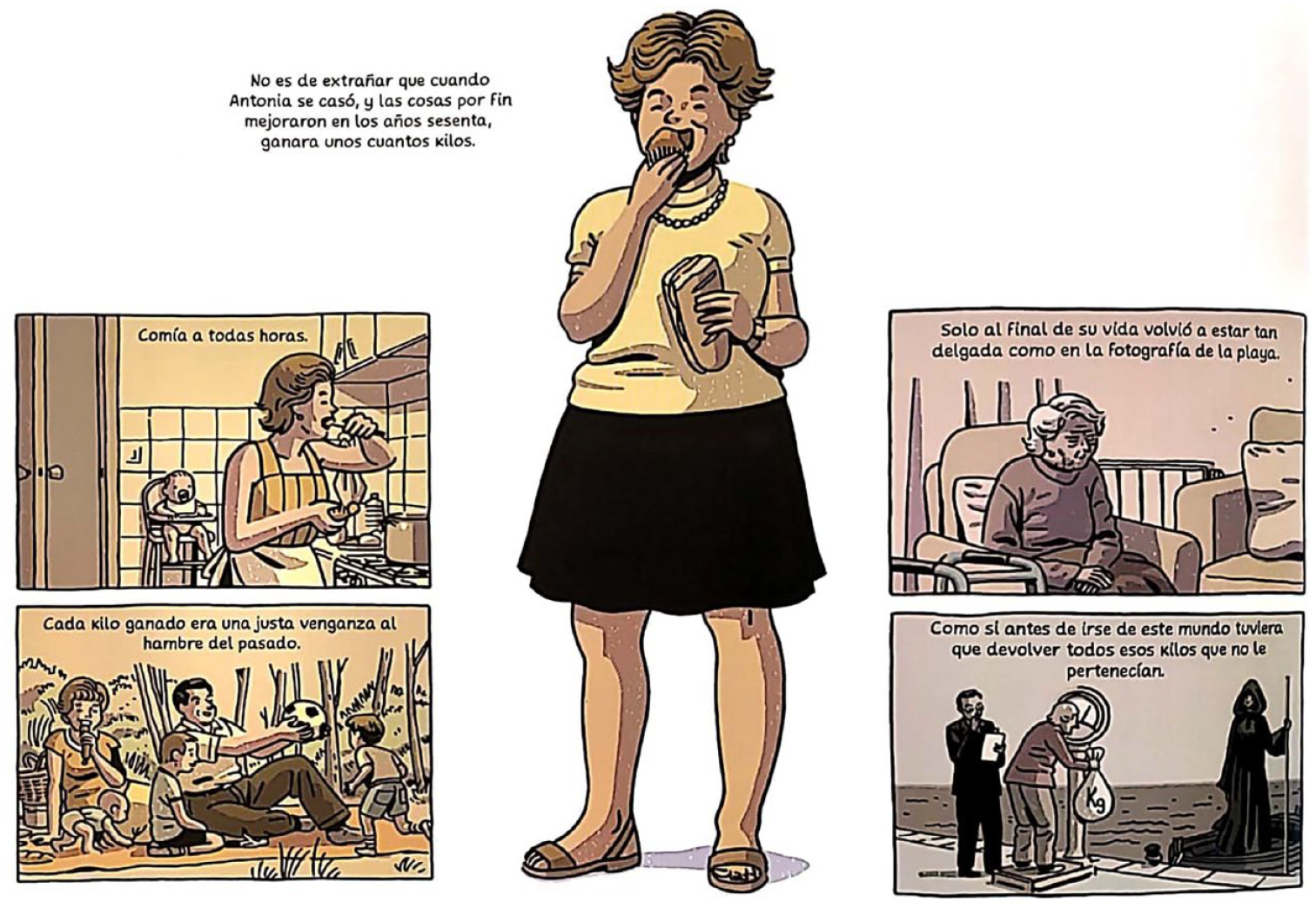
Antonia eating bread in adulthood.
This situation, which was taking its toll on her health, was a cause of argument with her children: ‘-You’ll see. If you want to die, keep eating [says one of them]. -I don’t want to die [she replies]. -Of course, but you don’t want to stop eating either. -Of course. (. . .) -You’ll burst any day now’. The family arguments did not seem to change Julita’s attitude, which suggests that the legacy of a context of deprivation may end up having more weight than the medical-health narrative. As some anthropological studies have argued, these traumatic memories of a past marked by hunger can undermine the effectiveness of the medical message (Rivero et al., 2020). Other witnesses, more receptive to medical instructions, lament that now that they can buy the food they like and missed most in their childhood, the doctor forbids them to buy it (Gracia, 2002: 150).
Julita was not willing either to accept her problematic relationship with food or to change her habits, as was evident when she convincingly tells her son who was reprimanding her: ‘But I don’t eat that much’. Nor does it go unnoticed that her husband, a thin man oblivious to his wife’s excesses, is accused by her at one point in the film of not having been deprived of necessities in childhood. It happens while they are both in the kitchen, when she tells him, reproaching him for his lack of empathy: ‘You didn’t go through such a bad war (. . .) You ate beef and pork. In Camporrobles [Valencia] you ate good ham. But what do you know, you’ve never been in need, you’ve lived like a gentleman. What do you know about suffering’ (Salmerón, 2017). This perception of a lack of understanding among others is common among survivors of other traumatic episodes such as the Holocaust, who resort to expressions such as ‘If you were not there, it is difficult to describe or say how it was’ (Langer, 1991: 21–22).
It seems as if Julita was trying to make up for all the deprivation and misery she had suffered during and after the civil war through food. The change in her body, evident when comparing her current shape with the one she had in the old photographs of her youth, when she was a slim woman, is a good example of this. Hence, she eats without remorse, despite constant warnings from both her children and her husband, who are increasingly concerned about her health as she gets older. Julita responds to them with a defensive attitude, reproaching her husband for not having been needy in his childhood, as if that in itself explains why he does not have the need she has to get up in the middle of the night to continue eating the bread she missed so much as a child.
‘How good this bread is’. Embodied memories about bread
Even more significant are the continuities of embodied memories in relation to bread, which has traditionally been so central to Spanish culture that some authors have spoken of a ‘bread culture’ in Spain (Velasco, 1990: 154). Hunger and bread have been exclusive antonyms: where there was hunger, there was no bread, and where there was bread, there was no hunger (Velasco, 1990: 161). As anthropologists such as David Conde (2018: 193–209) have shown, the importance of bread is not only nutritional, but also, and above all, cultural. Its symbolic power in the collective imagination has been reflected in popular sayings such as ‘earning one’s bread’ (‘ganarse el pan’) or ‘being better than bread’ (‘más bueno que el pan’); or in proverbs such as ‘bread for today, hunger for tomorrow’ (‘pan para hoy, hambre para mañana’) (Conde, 2018: 203–204). This foodstuff, which was and still is for many people the nucleus of the diet, would have been one of the ‘mediated memory objects’ described by Van Dijck (2004: 363, 350) that evoke feelings of the past within the body through sensory experience and ‘serve as a reminder of lived experiences’. As with other material objects with great social power, such as family photographs and letters (Moreno, 2018), bread would act as a ‘constitutive agent in the act of memory’ (Van Dijck, 2004: 370).
During the Hunger Years (1939–1952), these traditional connotations of bread were exacerbated and this food took on new meanings (Román, 2023). Constancio Zamora, a resident of Chiclana de Segura (Jaén), testifies to the centrality of bread during the forties. According to his account, ‘bread was the fundamental basis of the meal. I remember seeing my mother with some grapes: she would take a bunch of grapes and bread and she would eat. A little bit of something else was enough’. 11 During the post-war period white bread, made with wheat flour and exclusively available to those who could pay its high price on the black market, became the most longed-for and desired item. Black bread, made with poor-quality flour such as rye flour and consumed by the majority of the population, became the most paradigmatic food of scarcity. Rye bread has traditionally been perceived as a poor-quality bread, typical of animals and of periods of hunger. This perception is reflected in popular sayings such as ‘Rye bread is good for your enemy’ (‘El pan de centeno para tu enemigo es bueno’) (Velasco, 1990: 159). White bread soon became associated with the winning side in the Civil War, while black bread was the fare of the losing side. Among the latter was the family of the recently deceased Joan Margarit, who was born in 1938, in the midst of the civil war. The renowned writer who, although he did not go hungry was in need, illustrates in his memoirs how the ‘hard and tasteless’ black bread was the object of mythical constructions rooted in popular rumour, perhaps driven by the distrust born of the generalisation of fraud and corruption in the 1940s (Del Arco, 2018; Román, 2020b): ‘It was rumoured that they used lead to make it heavier, so we would remove the little dark balls we found in the crumb, convinced they were made of lead’ (Margarit, 2019: 96–97).
From this poor quality of black bread and the longing for white bread during the post-war period, at least four continuities in the later habits and attitudes of the survivors towards bread can be derived. First, people of Margarit’s generation who consciously lived through those years of black bread attach ‘a profoundly primordial significance’ to white bread (Margarit, 2019: 96–97). They even idealise and mythologise it. Margarit (2019: 96) admits this distortion of memory caused by scarcity: ‘He [his father] would climb the stairs holding up, trophy-style, a white, round loaf of bread, which in my memory will always be huge and luminous–like a big host–much bigger and whiter than it must have been in reality’. Constancio Zamora, a resident of Chiclana de Segura (Jaén) whose father had fought on the Republican side during the Civil War and who did not starve during the post-war period thanks to their leased land and the slaughter of animals, claims that ‘[white] bread was very good’.
12
Some witnesses go so far as to attribute better qualities to post-war white bread made at home than to today’s bread. So does Cristóbal Rodríguez, a resident of Alhama de Almería born in 1933 whose mother was involved in the post-war black market as a means of subsistence and who occasionally ate white bread. According to his account, this much-desired wheat bread, which was so hard to obtain, lasted in good condition for many more days than today’s bread: When we collected the wheat (from the field) we took it to the mill. There they would grind it and give you wheat flour. Then you, in your own house, in a kneading trough we had, [we made the dough]. My mother made the dough and took it to the oven where they baked it. She paid a canto and they baked her bread. And it lasted about fifteen or twenty days. You put it in a large box to preserve it. It’s not like now, when you buy the bread and the next day you can’t eat it [because it is stale]. [Then] you put it in your bread box, that square bread with edges.
13
Second, during the Hunger Years bread came to be imagined as an almost magical food. As such, it was considered sinful to throw it away, even if it was left over or had fallen on the floor. As the Granada-born Francisco López, whose family, although they managed, went through many hardships during his childhood in the 1940s, explains, ‘children would eat a piece of bread, it would fall on the floor, and because it had the drool and so on, the dirt from the floor would stick to it, and they would keep on eating’.
14
Agustín Castillo, a neighbour of the same generation from Santa Fe (Granada), corroborates this post-war custom: all the children, as they knew how scarce it was, would eat a piece of bread and, if they left half of it, they would put it on top of a window ledge (. . .) The bread would fall to the ground and they would kiss it. In other words, if the bread fell on the ground, everyone would pick it up, kiss it and put it in the window, so that – in that way – either someone else would eat it or they would take it away.
15
As López points out, that habit had to do with ‘respect for the poor and for bread’.
16
The custom of kissing the pieces of bread that fell to the ground before eating them derived from the concept of bread as a ‘sacred’ food (Velasco, 1990: 175) and was passed down from generation to generation, even to the present day. This is what Almudena Grandes (2015: 16–17) says in the prologue to her novel Los besos en el pan. In it, she refers to the custom that many adults who were children in the post-war period still have today of kissing the pieces of bread that fall on the floor before putting them back in the breadbasket or on the table. This practice was passed on by those who had gone hungry to their children, who were born from the 1950s onwards. In the novel, Grandes, who was born in 1960 and belonged to that other generation who had not known the post-war deprivation, refers to the persistence of the memory of hunger through small everyday gestures: We children who learned to kiss bread remember our childhood and remember the heritage of a hunger unknown to us, those disgusting French omelettes that our grandmothers used to make so as not to waste the beaten egg left over from battering the fish. But we don’t remember the sadness. (Grandes, 2015: 16–17)
Hence, third, both the survivors of the famine and many of their descendants refuse to waste this food. Some elders from Extremadura admit difficulties in throwing away bread because of memories of childhood hardship. Or they recognise their unease at the waste of bread and the undervaluing of this food in times of abundance such as the present day (Conde, 2018: 414). For his part, Francisco López has not been able to erase from his memory an unpleasant scene he witnessed when he was only 10 years old and the worst episodes of famine had already passed. He perceives it as a disrespectful and almost sacrilegious act towards bread: I once saw a large piece of a sandwich. It had chorizo, ham, and it had been thrown on the ground. I was walking down the street and I saw it, and a dog comes along, smells it, lifts its paw and urinates [on the sandwich].
17
Finally, bread now occupies a central place in the diet of the elderly who craved it so much during their childhood, when it became omnipresent in their thoughts and even in their dreams. Many of them even eat bread with their fruit and feel that they have not eaten unless they have a piece of bread on their plate. The powerful significance given to bread by elders who lived through the famine years can be traced in their current eating habits. One of those witnesses is Julita Salmerón, the eccentric protagonist of the documentary film Muchos hijos, un mono y un castillo, directed by her son Gustavo Salmerón (2017). The woman, who went hungry in the post-war period, attributes enormous symbolic power to bread. She finds eating bread one of her greatest daily pleasures. She is shown eating it at various points in the documentary, either on its own or toasted and spread with butter and jam, while commenting on how crusty it is. She even fantasises about the possibility of getting up in the middle of the night to continue eating it: ‘How good this bread is. Tonight I’m able to get up and eat this because this bread is so appealing to me that I can’t sleep tonight. And I have to get up’ (Salmerón, 2017).
Statistics seem to suggest that daily bread consumption in Spain today is more common among the elderly than among the young. According to the European Health Survey (Instituto Nacional de Estadística (INE), 2020a), 85.7% of the population over the age of 65 consumes bread on a daily basis, while the percentage among those aged 15 to 24 falls to 76.2%. Moreover, this trend seems to be peculiar to the Spanish case. The data for the rest of Europe show that fewer older people eat bread every day (59.6%) than younger people (73.6%). It therefore seems reasonable to consider the influence of the memory of the hunger years and the consumption of black bread – prolonged over almost a decade – on this current pattern of consumption among those who were children in the post-war period and their descendants. What cannot be concluded from the statistical sources is a correlation between bread intake and the geography of the famine: the proportional consumption of bread does not seem to be higher in the regions most affected by the famine, such as Andalusia or Extremadura.
A correlation could be suggested between the continued consumption of black bread during the post-war period, described by those who ate it as impure and earthy (for instance, Francisco López said about this kind of bread that ‘you couldn’t bite it with your teeth, because it had a lot of earth and grains’ 18 ), and the current consumption of wholemeal bread among the elderly. One might expect wholemeal bread consumption would be lower among the over-65s due to the influence of the negative memory of post-war black bread on them (a testimony in this regard in: Gracia, 2002: 152). However, this does not seem to be borne out by the statistics. According to household food consumption data, in 2020 the over-65s bought more wholemeal bread (including fresh, fresh mass-produced and dry mass-produced) per capita (5.12 kg) than those in the 50–64 age group (3.66 kg), the 35–49 age group (2.33 kg) and the under-35s (1.79 kg) (Ministerio de Agricultura, Pesca y Alimentación, 2020).
This tendency could be explained by the dissolution of the traumatic post-war memory, at least as far as bread is concerned. This would be broadly in line with what has been shown for other contexts by various studies that have argued that the ‘burden of traumatic memory’ lasts around fifty years (Jingxiong et al., 2007; Sindler and Wellman, 2004; Wansink et al., 2010). In the case of the memory of the Franco famine, Gil (2020: 39–40) has suggested that it lasted until the years of the transition to democracy, when austere attitudes could still be detected. This trend in wholemeal bread consumption could also be attributed to the phenomenon of nostalgia for post-war black bread, despite its poor quality. Some of the interviewees admitted their attraction to this type of bread when they were children (Román, 2020a: 348). Alfonso Roger from Santa Fe (Granada) explained that, despite the fact that ‘sometimes there were even threads in the bread from the sacks’, he liked it better than white bread. 19 María Cervilla from Tablones (Granada) expresses this in similar terms, remembering that when she was a child she was curious to try the black bread that her neighbour ate and that, when her mother gave it to her at her insistence, she liked it. 20
‘Only wanted to prosper’. Effects of embodied memories of hunger on subsequent socio-political attitudes
He only wanted to secure his future and to prosper in his work, because he had inherited an almost physical terror of misery and hunger: he immediately began to wear elaborate suits with wide shoulder pads, an infuriated head of hair with glitter and fine gold chains that tangled in the hair on his chest, which in summer he showed off with his white shirt unbuttoned. (Marsé, 1977 [1973]: 349)
Another recurrent trope in personal memories of post-war hunger is the importance attached by those who survived the famine to the subsequent prosperity they would experience in their daily lives. For these people, the evolution of their material living conditions from the early 1960s, when they began to eat and dress better after long years of hardship, was enormously valuable. The memory of post-war hunger facilitated the positive assessment of ‘progress’ in the 1960s (Román and Hernández, 2022). One of the symbols of that ‘progress’ was growing access – albeit in instalments – to consumer goods such as household appliances, including refrigerators, which would replace cupboards as a place to store food and would revolutionise the way food was consumed forever. Those years saw the spread of increasingly consumerist, materialistic and de-ideologised attitudes, which was a very positive factor for the political survival of the dictatorship. Hence, the regime itself encouraged this ‘culture of evasion’, which sought to promote football and television to distract the population from social problems (Alonso and Conde, 1994).
Finally, another echo of the embodied memories of the hunger years is the relativisation of the 2008 economic crisis by many of the survivors, whose lives had already cured them of all horror. This is the case of Rafael Pascual, a native of Alhama de Almería (Almería) who, during the post-war period, was able to eat the white bread made by his family, who were involved in barrel making, and had to emigrate first to Germany and then to Barcelona in the 1960s. He considers that ‘now, although it is said that we are very bad’, in reality it is nothing comparable to the post-war crisis, as shown by the fact that the bars were full or that many parents boasted of having sent their children to study abroad. ‘When there was hunger, that didn’t happen’, he concludes. 21 His wife, Carmina López, who refers to the post-war period as ‘a bad time’, adds that, although she did not go hungry in the post-war period, she has ‘gone through more than those who say they are having a very bad time’ (as a result of the effects of the 2008 economic crisis). 22 Almudena Grandes (2015: 18) also echoes this phenomenon in the prologue to her novel Los besos en el pan about the devastating social effects of the economic crisis. In it she states that ‘if our grandparents saw us, they would die first of laughter, then of grief. Because for them it would not be a crisis, but a slight setback’.
The intensity of all these manifestations of the embodied memories of post-war hunger seems to be directly proportional to the magnitude of the deprivation experienced in that period. The greater the suffering during the hunger years, the greater the echoes of that memory in current eating habits or in the perception of new crises such as that of 2008. Hence, this phenomenon is more evident among those who belonged to the poorest social sectors during the post-war period or those who managed to prosper in the 1960s and become part of the middle classes, than among the wealthier classes. As Huguet (2019: 118) notes in relation to the excesses of eating during special occasions in the 1960s, ‘unlike the majority of the country, the well-to-do partied without the need to gorge themselves. Perhaps hunger had no place in their memory’. This relationship is very evident in the case of Julita Salmerón and her husband, who lived through two very different post-war periods and who, not by chance, have very different attitudes to food today. While she, who experienced famine, now eats compulsively; he, who did not suffer the famine, does not seem to have this need (Salmerón, 2017). As the statistics appear to suggest European Health Survey (INE, 2020b), the daily consumption of bread, the most sought-after food in the post-war period – which in its black version has become the symbol of hunger – is now higher among the humblest workers (grouped in Categories IV, V, and VI) than among those in better paid occupations (grouped in Categories I, II, and III). González De Turmo also pointed to this food tendency in the case of some villages in western Andalusia (González De Turmo, 2017 [1995]: 52).
Conclusions
Dinner arrives and the two [Manolo Lindo and his roommate in hospital] eat it voraciously, between gasps because they are choking, without leaving a trace on the plate, sucking on the bones, with the impatience of dogs, as if they were still post-war children. – Lindo (2020: 21)
Despite the difficulties in tracing continuities and establishing cause–effect relationships, the examples of the personal memories presented in this article seem to indicate that the effects of a traumatic past of deprivation and hunger reach into the present. And they do so not only explicitly and consciously, but above all implicitly and unconsciously, conditioning current dietary practices or the socio-political attitudes of survivors. Many of those who were children in the post-war period and suffered shortages or went hungry have a predilection for sweets in adulthood. For others, such basic foods as potatoes still evoke feelings of happiness because they were among the few that were available in abundance during the post-war period. There are those who are nostalgic for the old attitudes at the table and therefore disdain today’s individualism. Others have a tendency to eat a lot of food to compensate for past hunger, with bread playing a particularly significant role. Many post-war witnesses today mythologise and feel nostalgia for post-war white bread, given that they ate it with such a desire that any bread they have eaten since then seems a poor substitute to them. Others preserve the custom of kissing the pieces of bread that fall to the ground as a form of respect for this foodstuff; they are repulsed by its waste; or cannot go without their daily ration of bread, to which they attach enormous symbolic value in their diet. As cases such as Julita Salmerón’s illustrate, the pieces of crusty toast act as triggers of (traumatic) memory, albeit unconsciously. Her case is also a good example of the effects of the memory of hunger on the body, which she has not ceased to overfeed since she left scarcity behind and embraced prosperity.
Moreover, the hunger they had suffered during their childhood led them to value in very positive terms the prosperity that came into their lives from the 1960s onwards and that would become the focus of their desires, interests and concerns. Likewise, the hardships experienced in the 1940s explain why many of them relativise the effects of the 2008 crisis in Spain. Through personal memoirs such as Julita’s or Cristóbal’s, we discover that the echoes of the memory of hunger still resonate in the present. They condition many of the choices and attitudes to food and the periods of prosperity and crisis of those who suffered from the famine. The memory of hunger is still very present among our elders. However, its echo seems to have been lost in the food modernity of the new generations, among whom it is increasingly absent.
Footnotes
Funding
The author(s) disclosed receipt of the following financial support for the research, authorship, and/or publication of this article: This research has been possible thanks to a grant IJC2020-046071-I funded by MCIN/AEI/10.13039/501100011033 and by the European Union NextGenerationEU/PRTR. It was also supported by the research projects ‘Heritages of Hunger: Societal Reflections on Past European Famines in Education, Commemoration and Musealisation’ (NWA. 1160.18.197; NWO; Radboud University / NIOD Institute) and ‘La hambruna española: causas, desarrollo, consecuencias y memoria (1939–1952)’ (PID2019-109470GB-I00; Spanish Ministry of Economy; Granada University).
