



Abstract
This study takes a socio-historical approach to analyze a case of how practical painting knowledge was historicized during nineteenth-century China. After the Taiping War (1850–1864), a civil war that left urban centers in the cultural heartland of China in ruins, scholars sought to recover and commemorate the past. The professional painter Dai Yiheng publicly engaged his traumatic war experience to cater to a new audience of foreign students in Shanghai. The tension between the commercial environment of Shanghai and his personal experience becomes visible in both his paintings and writings. Through a practice of temporal layering in his work, Dai managed to combine the demands of his profession and his personal trauma.
Introduction
In the middle of the nineteenth century, China faced unprecedented military challenges, both foreign and domestic. Domestic upheavals, the Opium Wars, and the Taiping War not only brought destruction to the south of China, but also challenged Confucian ideology and scholarly cultural standards. The Taiping movement began with Hong Xiuquan 洪秀全 (1813–1864), who believed he was the younger brother of Jesus Christ. He declared himself the savior of China and many heeded his call to overthrow the Manchu ruling house. Starting in 1850, Taiping forces engaged Qing imperial and local forces in one of the bloodiest civil wars in history, which only ended in 1864.
The catastrophic devastation of the civil war was especially felt in the Yangzi Delta—the cultural heart of China—where cities like Yangzhou, Hangzhou, and Nanjing were left in ruins. Not only were cities destroyed, but Taiping forces also massacred residents who failed to escape before the invasions (Meyer-Fong, 2015: 1726). Families of the southern Yangzi region suffered incredible material and human losses, while the war shattered intellectual communities, scattering those who shared cultural practices and their cultural capital. Following the war, sorrow over lost books and a past lifestyle overcame many scholars (Hu, 2010: 67).
Scholars had traditionally shouldered the responsibility of recording meaningful events, and it was part of the scholarly identity to maintain records about the past to instruct future generations (Huntington, 2005: 64). Many scholars therefore made efforts to recover the fragmented cultural legacy when the war was over. Numerous families recarved lost woodblocks and created records of what had been destroyed (Hummel, 1943: 64, 139, 338) while others reframed existing texts to mitigate past losses.
Survivors of the war made use of various platforms to express their grief, for example, by describing events of the war in novels and plays (Huntington, 2005; Meyer-Fong, 2013: 110). 1 The unique case of Dai Yiheng 戴以恆 (style Yongbo 用伯, 1826–1891) shows how practices of remembering loved ones and scholarly efforts to represent the past merged in the field of art; how a traumatic past was represented in a mnemonic painting treatise.
A native of the prosperous city of Hangzhou, Dai Yiheng watched his world crumble and his family perish when the Taiping armies took over his hometown. After the war, he moved to Shanghai and took up painting as a profession. Shanghai was home to a flourishing art scene that decisively shaped painting in the late nineteenth century. Commercial painters developed earlier commercial trends, especially those of Yangzhou, which had focused on creating a unique visual appeal and exploring compositional features for painting flowers and birds (Hsü, 2001: 8, 118; Karlsson, 2004: 76). Dai rejected these innovations and produced landscape paintings in the scholarly style.
Both Dai Yiheng’s paintings and his treatise illustrate a perceived disruption in the coherence of time and subjectivity. The abrupt loss of the elite cultural environment coupled with the bewildering social and cultural changes taking place in the treaty-port city of Shanghai created a visible tension in his work. His works were monuments to the past that framed lost practices and at the same time pointed to the present. Dai made use of the historiographical practice of temporal layering to highlight this disconnect and to come to terms with his traumatic past, while also catering to a new group of foreign students who hoped to appropriate the Chinese past. His personal grief and the demands of a new audience bestow meaning to his mnemonic manual.
This case study shows how cultural practices are not only sustained by inertia of bodily remembering, but also how they can be repackaged to thrive as commercial products. Elite cultural practices of pre-war society were preserved as relics as an individual explored his personal past and memories to cater to students’ expectations. Although he could not cultivate the same intimate relationship with them as he had with his master, his manual perpetuates this ideal. Mnemonic rhymes came to symbolize internalized practices and represent relationships of the past, not only transmit content. Personal memories became historicized and commercialized in the new urban environment of Shanghai, in which family ties no longer mattered as much as profitable interactions.
Tragic beginnings
On 21 March 1860, Dai Yiheng’s uncle, the retired scholar and painter Dai Xi 戴熙 (b. 1801) jumped into a pond in Hangzhou and drowned himself. Before ending his life, he left the world a resolute message in the form of a farewell poem: With a sick body, at the twilight of my life, the situation I encounter is distressing; For eight years now, the efforts I made to organize patrolling defenses leave me deeply ashamed. I let go [of this life] and withdraw into a heap of white clouds; I follow the [heavenly] command [to depart from this world], and would not be willing to return to the world of the living. (Li, 1861: 13a)
2
Dai Xi committed suicide 2 days after the invading Taiping army breached the city’s walls. He was a high-ranking official who had returned to his hometown of Hangzhou and organized volunteers to strengthen the city’s defenses (Hummel, 1943: 700). For a man of Dai Xi’s status, suicide was expected as a means to conserve one’s loyalty and honor in face of imminent defeat by rebels who opposed the Qing Empire (Meyer-Fong, 2013: 71–72). Dai Xi’s younger brother, renowned mathematician and painter Dai Xu 戴煦 (b. 1806, style Eshi 鄂士), on receiving news of his brother’s death, proceeded to commit suicide by throwing himself down a well (Zhao, 1977: juan 493, 13650). Although the Taiping army was driven out of the city 5 days after the occupation, Dai Xi’s act of loyalty was later officially acknowledged; he was buried as a martyr in Hangzhou.
However, his farewell poem reflects personal shame instead of the desire to be loyal to the Qing Empire. In the second line of his poem, he addresses his failure to suppress the Taiping rebels. In the last line of the poem, his bitter disappointment in himself is even more pronounced, as he claims he could not be prompted to return to the world in which he has played such a shameful role. The poem circulated in notes among local scholars, but was not included in the imperially sanctioned records that cast Dai Xi as a martyr. Compilations that were not produced under official auspices served as a medium through which opinions that differed from the official agenda could be circulated (Meyer-Fong, 2013: 133–135, 205). Private accounts show that among survivors, disenchantment with the government was not uncommon. Many survivors blamed the Qing government for creating the situation that led to the massacres and the loss of their relatives to either Taiping or Qing soldiers. 3
Dai Yiheng, Dai Xi’s nephew, was one of the survivors who did not perceive his suicide only through the lens of loyalty. To Dai Yiheng, the destruction of Hangzhou meant losing both his home and his loved ones, including his father Dai Xu. Yet, it was the loss of his role model Dai Xi that affected him most. He had received extensive training in orthodox scholarly painting from his uncle. Yiheng remained attached to Dai Xi, who had taught him the moral values and scholarly ideals that shaped him and his art, even after taking up commercial painting in Shanghai. To comprehend how his work and painting manual embodied a connection to the lost past, it is useful to discuss the personal bond he had with his uncle and master.
Remembering the master
Dai Xi recorded some of the interactions with his beloved nephew in his Remarks on Painting from the Studio of Being Accustomed to Hardship (Xikuzhai huaxu 習苦齋畫絮). The close relationship of uncle and nephew was built on personal affection and love for painting. Dai Xi vividly describes how he perceived Dai Yiheng’s attentiveness to painting materials and his willingness to preserve them as an act of purity of character (Dai, 1893: juan 2, 14b–15a). Dai Xi recounts their conversations on painting, writing: “Whenever Yiheng has free time from his studies, he investigates the Six Principles of painting. Under lamplight we discussed how the ancients applied ink” (Dai, 1893: juan 2, 6b). 4 The statement illustrates how the master transmitted his knowledge to his nephew in an intimate familiar setting, reflecting a scholarly tradition of cultivating “family learning” (Clunas, 2013).
The close relationship Dai Yiheng developed with Dai Xi is a continued theme in his works after the war, as attested by a close friend of the family, Wang Kun 王堃 (1815–1887): “[Yiheng] inscribed one of my painted scrolls, recounting his utterly genuine feeling that he could not forget his uncle. It was deeply touching” (Wang, 2000: 1649). In inscriptions written throughout his career, Dai Yiheng promoted his uncle as a model worthy of emulation.
He was perennially reminded of his uncle through the act of painting and the lessons he had embodied as habits through continued practice, as attested by another inscription: I feel his words still ring in my ears and his style continues to appear before my eyes; I often meet him below my brush. I fear that later generations will remove my name and sign his name in an inscription. If I tried to get rid of my habits, I would not succeed. (Original transcribed in Lu, 2019)
The style Dai Yiheng had incorporated during his youth accompanied him throughout his life. Both the content and the brushwork of his paintings greatly resembled his uncle’s, as shown in Figures 1 and 2. In these intimate landscapes, both artists make use of angular strokes in ink to depict flowering trees, which are then brought to life with diluted washes of color. Mountains in the distance are rendered without contours, in gradients of color that gently fade toward the horizon, alluding to the mist that rises from the damp shores. The presence of buildings in the mountains is subdued by the painters’ use of light ink to render the structures. The inscriptions on both paintings allude to poetry, while uncle and nephew often referred to earlier masters and their painting styles in their dedications.
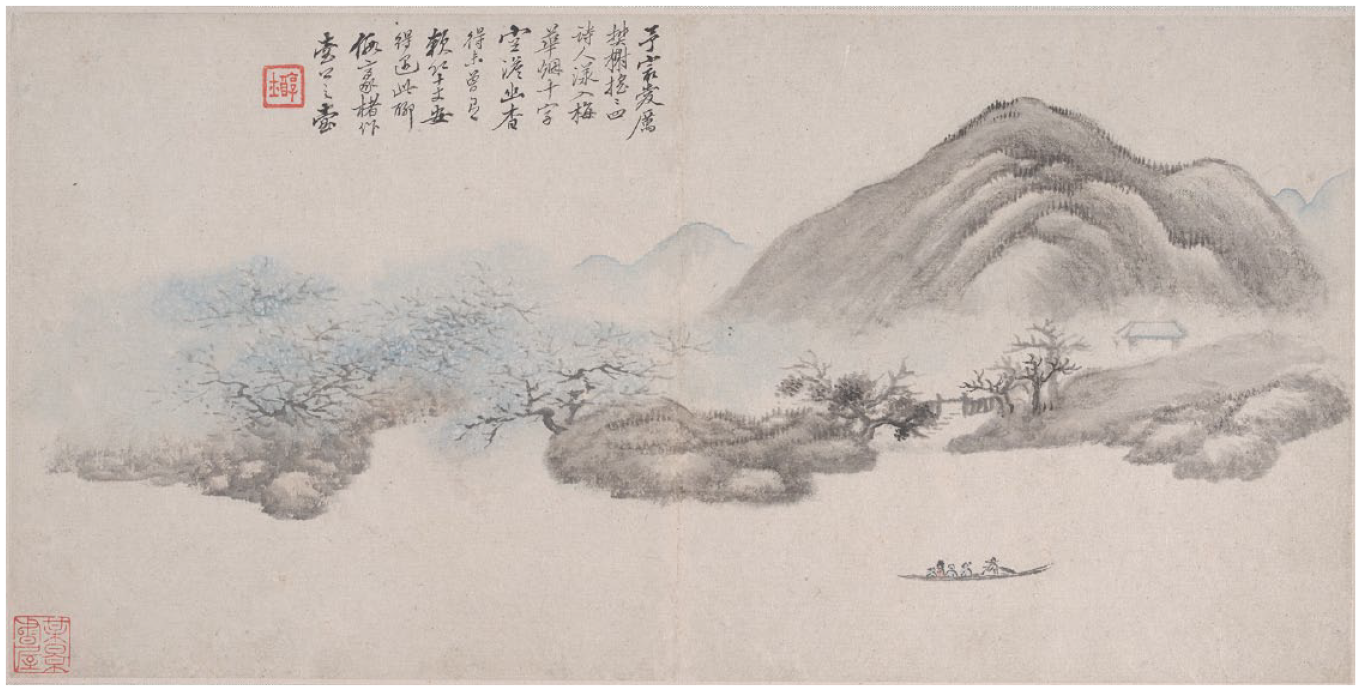
Album of landscapes by Dai Xi, Leaf C. 1848. Ink and color on paper. Image provided by the Metropolitan Museum of Art. Public domain.
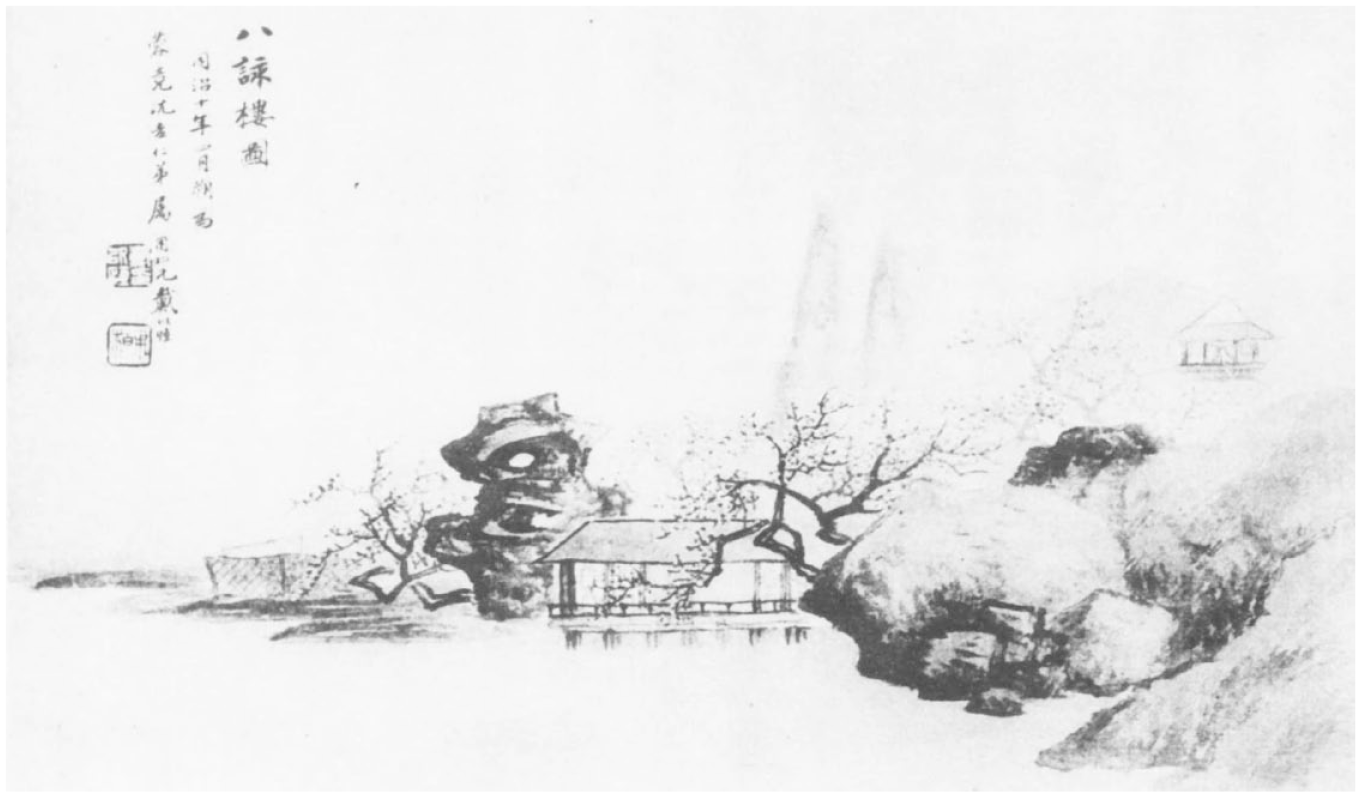
The tower of eight odes by Dai Yiheng. 1871. Ink and color on paper. From Kawai, 1937: 204. Image provided by the National Diet Library. Copyright expired.
The lessons and practices he learned from Dai Xi were embodied in Yiheng’s own style and habits; remembered in his hands and heart. He did not abandon these internalized practices even as his environment changed abruptly when he had to relocate to Shanghai.
The Shanghai art scene
Dai Yiheng most likely settled in Shanghai in 1862, the year following the second invasion of Hangzhou by Taiping forces. 5 Acclaimed artists who took refuge in the treaty-port city, such as Ren Bonian 任伯年 (1840–1896) and Yang Borun 楊伯潤 (1837–1911), were known for reshaping Chinese ink painting in terms of composition and embracing the consumers’ heterogeneous painting requests. Their art was captivating and could even be appreciated in public media. In contrast to Ren Bonian and Yang Borun, who are listed as famous painters with their specialties in guidebooks of the period, such as the Miscellaneous Notes on Traveling in Shanghai (Huyou zaji 滬遊雜記) of 1876, and the Record of Dream Images of Shanghai (Songnan mengying lu 淞南夢影錄), Dai Yiheng was not considered a “famous gentleman” (mingshi 名士) of the Shanghai art scene.
Juxtaposed with works from his Shanghai colleagues, Yiheng’s paintings exhibit an outdated style. Whereas his contemporaries opted for cropped, dynamic compositions that exuded “big-city edginess” (Hay, 2001: 87), Dai Yiheng continued to paint as he always had. Although landscape was not a dominant genre in the Shanghai art market, painters such as Wu Shixian 吳石仙 (d. 1916) and Ren Yu 任預 (1854–1901) introduced innovations like patterns and bold diagonals as well as influences from Western painting, such as atmospheric effects and stark contrasts that pleased consumers (Li, 1998: 24–25). In contrast, Dai’s landscapes on scrolls and fans are centered and enclosed within the visual frame; he relied on texture strokes and subdued color washes to create depth.
In an attempt to praise Yiheng’s achievements, an old friend of the Dai family said that his painting style “is one passed down for generations” (Wang, 2000: 1649). Yet, his outdated style translated into the relative unpopularity of his work among his countrymen and his portrayal as a painter who merely “follows the family’s tradition” in contemporary publications (Yang, 1989: 71). Dai’s skepticism toward commercial painters and their work was also connected to his perception of the declining moral behavior that some of his more avant-garde contemporaries exhibited. To him, landscape painting was still connected to self-cultivation and virtue.
An anecdote that describes an encounter between Dai Yiheng and the acclaimed painter Ren Bonian, published about 25 years after Dai’s death, illustrates Dai’s moral rectitude. The contrast between him and Ren, the central character of the anecdote, is striking. In the anecdote, Ren is caricaturized as a “distant and arrogant character”—an opium addict who fails to complete commissions. The anecdote recounts how Dai and Yang Borun passed by Ren Bonian’s studio and saw a boy sobbing by the door. They inquired about the cause for the boy’s tears and learned that Ren had failed to produce any paintings for the boy, who had in turn been accused of stealing the money for the paintings. Upon hearing this story, Dai reprimanded Ren Bonian and with the help of Yang Borun forced him to quit smoking, to get up from his daybed and paint, threatening: “You accept people’s money, yet you produce no paintings for them, causing a boy to cry at your door! How can that be?! If you don’t start painting fast, I will be forced to beat you.” There was no escape for Ren, so he immediately got up to paint. As for Dai and Yang, one stretched out the paper for him, while the other mixed the colors. (Xu, 1917: yishulei, juan 71, 97–98)
The exemplary behavior of Dai Yiheng and Yang Borun stands in stark contrast to Ren’s lack of propriety and abuse of opium, a direct criticism of his moral values. Yang Borun was known for his scholarly inclinations, avoiding discussions of business matters in writing and taking great pride in his poetry. He managed to balance tradition and new trends, being an active contributor to the press (Wue, 2014: 77–78). Dai Yiheng comes across as a stern man who enforces the values of the scholar.
The anecdote can be read as an allegory of the Shanghai art scene. Ren Bonian, a painter who quickly rose to fame, is given the central role in the story, despite being criticized by conservative scholars. The moral characters are placed below the eccentric painter and turn to menial tasks, grinding the ink and preparing the paper, leaving the creation of art to Ren. Commercial relations and new artistic standards have moved to center stage, overhauling moral values.
In another anecdote, Wang Kangnian 汪康年 (1860–1911) recounts that during a visit to Dai Yiheng’s home, he was shown a painting of a deity holding a sword in the right hand and a bleeding head in the left. The blood-dripping head, to his horror, was a self-portrait of Dai (Wang, 1997: 64). The anecdote describes Dai’s desire to admonish himself to adhere to moral conduct and avoid divine retribution in an extremely graphic way. In the urban context, however, most painters had no desire to create didactic or moralizing images, which were less attractive to consumers (Wue, 2014: 21). Dai’s moralizing self-portrait reflected values different from those held by his colleagues who employed portraiture as medium for satire and self-ridicule (Vinograd, 1998: 124–125). It was not only for moral reasons, however, that Dai was reluctant to abandon the orthodox style. He embraced the past to make a name for himself as an orthodox painter in a city racing toward the future.
Painting and publishing in Shanghai
During the nineteenth century, Shanghai became a bustling cultural center. Locals appropriated technologies and products from abroad and reconfigured urban spaces. Lithography became the main technology employed in commercial printing and newspapers and periodicals increasingly informed citizens about current events. As traditional social and commercial practices were disrupted with the war, the developing economy of the city attracted refugees of the Taiping War who hoped to establish themselves away from their devastated homes (Liang, 2012: Chapter 2). The multicultural center that appealed to collectors from abroad gave painters an opportunity to make a living through commercial painting. As artists gathered in Shanghai to secure patronage for their craft, they created bonds based on economic relationships and shared professional interests instead of official or familial ties (Wue, 2014: 10, 56). As Ge Yuanxu 葛元煦, author of the Shanghai travelog Miscellaneous Notes on Travelling in Shanghai, put it, artists were often “hand-tied by the costly living conditions in the city,” and there was little to do “about this commercializing trend” (Hong, 2012: 116).
Most painters of the period had “little reason to look back” (Hay, 2001: 93; Wue, 2014: 28). It was profitable to develop a public persona that looked to the future and to consumers when producing works for the Shanghai market (Hay, 2001: 85). Painters who had faced challenges during the war and had to move to Shanghai, such as Chen Yunsheng 陳允升 (1820–1884), took advantage of the possibilities presented by the urban publishing market to advertise their own works and prioritize commercial goals. 6
Dai Yiheng’s scholarly persona often clashed with the reality of the rapidly changing city and the commercial painters that inhabited it. Unlike others engaged in commercial painting, who made use of the printed media available in the city to construct a public image by publishing poems or advertisements in newspapers, Dai did not seek public exposure through printed media, and even his painting manual would not be published by him.
The 1887 reprint of the Mustard Seed Garden Manual of Painting (Jieziyuan hua zhuan 芥子園畫傳) illustrates how Dai Yiheng’s contemporaries repurposed the past to look to the future. The original manual, printed from woodblocks during the seventeenth century, presented a typology of different types of painting elements for landscapes, such as different types of leaves or trees, and relied heavily on descriptions of styles of ancient masters and illustrations.
The 1887 edition of the manual was the first reproduced by lithography, which allowed the editor, Chao Xun 巢勲 (1852–1917), to not only recreate the contents of the previous woodblock edition, but also to faithfully reproduce paintings by his contemporaries. Several painters from the area, not including Dai Yiheng, contributed 66 images to the volume on landscapes, which were appended to the end of the new edition. The manual thus came to serve not only as a reference for painting students, but also as a painting catalog for consumers to browse (Kobayashi, 2017: 713, n35).
According to Claypool, the inclusion of contemporary works next to the technical instructions from the original manual from the seventeenth century indicates that the editor viewed the past as raw material for a new publication. The edition emphasized “making the old into the new,” which was connected to lithographical printing of contemporary paintings, but also with garnering everlasting fame for the publishers (Claypool, 2001: 97–98). The lithographic edition of the manual thus projected an updated image of the past while merging it with the present.
Zhang Xiong 張熊 (1803–1887), who was Chao Xun’s painting master and also motivated him to reprint the manual, had also come to Shanghai during the Taiping war. His contemporaries described him as a conservative painter who preserved a “classical heritage” (Andrews and Shen, 2012: 5). In the postface for the manual, Chao describes his master’s obsession for ancient things, pointing out that his master’s reputation is acknowledged all over the world—hinting to his fame among Japanese consumers (Claypool, 2001: 95). Zhang was often a contact person for Japanese visitors looking to purchase antiques, and he was also one of the first painters to teach Japanese students who came to Shanghai the “literati style” of painting (bunjinga 文人画). Both Zhang and Chao thus knew that recycling the content of the manual would appeal to the foreign audience, and that including illustrations by contemporary painters would also boost the sales by attracting those who sought to purchase the work by famous painters.
New audiences to a foreign past
Like Zhang Xiong and Hu Gongshou 胡公壽 (1823–1886) who both enjoyed a high reputation among Japanese students (Lai, 2012: 64), Dai Yiheng also found that his past training in scholarly landscape painting attracted foreign audiences. Although he showed uneasiness in navigating the commercial currents in the bustling Shanghai of the late nineteenth century, he did adapt his mindset to cater to the demands of a new audience, especially when it came to accepting students. Dai Xi’s fame as a traditional master brought plenty of students to Dai’s doorstep.
Japanese painters had long been forbidden to leave Japan and visit China, and as soon as Japan began to reopen after 1860, many of them seized the opportunity to do so (Fogel, 2015: 193, 197). The Japanese admiration for Chinese traditions and antiquities was not a recent phenomenon and continued to develop during the years of restricted exchange (Chen, 2012: 14–15). The Taiping War led to the abundant appearance of antiques in the art market in Shanghai, which attracted businessmen from abroad (Hong, 2012: 118). In the second half of the nineteenth century, interactions between Chinese and Japanese elites reached an extraordinary level, and Shanghai became a hub for exchange and collaboration (Lai, 2012: 61–62).
One Japanese critic, Kishida Ginkō 岸田吟香 (1833–1905), disparages the works produced by Shanghai painters in the 1880s as overly commercialized (Chen, 2012: 22). However, Dai’s orthodox style continued to be admired by Japanese painters and attracted foreign students. Records show that many of Dai’s students were young men and women from Korea and Japan who hoped to learn the orthodox style of Qing masters (Shenbao, 1886; Zheng, 2017: 314). While it is not known how much Dai earned by accepting apprentices, his work as a teacher was a reliable source of income.
In 1886, on one of the rare occasions where Dai Yiheng was mentioned in the media, the newspaper Shenbao carried a thank-you note submitted by the father of one of Dai’s Japanese students for having mentored his son as an apprentice. The student, Koyama Shokei 小山松渓 (1863–1903), arrived in Shanghai in 1885, and studied with Dai for about 8 months. Koyama returned to China in 1887, where he met and traveled with his former teacher for a short period of time, exchanging inscriptions on paintings and poems in Chinese (Imaizumi, 1915: vol. 2, 196–198). Koyama was an avid student, even taking a manuscript of Dai’s treatise back to Japan, where colleagues copied it. 7
The relationship between Dai Yiheng and his students, however, differed greatly from what he and his uncle had shared. Dai was aware that his students, especially those from abroad, had few opportunities to gather with friends to discuss antique Chinese paintings. Foreign students did not intend to stay with him for long, and often traveled on their own to visit important sites. The traditional master–student relationship was cut short, and it would be unrealistic to expect them to spend their young years absorbing a single master’s instructions. Koyama Shokei, for example, had already studied under two Japanese painting masters before arriving in China. Those who came to Dai Yiheng saw painting as a profession and sought to learn quickly.
With this in mind, Dai condensed orthodox practices and customs into rhymes so they could be grasped by students who perceived the past he had lived as utterly foreign. In a dedication inscribed in Dai’s manual, one of Dai’s students commented that under his tutelage students became proficient in painting within a few months. He added that the rhymes helped students to recall the practices even if they stopped painting for a while. This format was chosen, the student noted, because Dai feared many did not engage the craft wholeheartedly and repeatedly abandoned it (Lu, 2019).
Dai Yiheng knew that students who sought to learn a craft quickly to make a living did not perceive painting as a means of self-cultivation. Although the students who came to him elected to learn the orthodox style associated with scholars, the intimacy and cultural practices shared by the scholars of the past were foreign to them. The new international audience led Dai to mediate his past experiences. To describe customs and practices instilled in him during his youth, Dai had to take a step back and scrutinize them with an objective eye. The result of this approach to the past was a commemoration and reconstruction of a lost tradition that should not be forgotten. His connection to the lost past and his uncle Dai Xi made his work economically viable because it met the expectations of his international audience. Thus, his profession led to the effective collapse of his individual memories and his creative output. Unlike the reproduction of painting techniques from the Mustard Seed Garden Manual that had become a commodity associated with the future, the techniques Dai Yiheng taught his students were entangled with the past.
Scholarly practices of layering time
Not only Dai’s understanding of landscape painting as an act of self-cultivation corresponded to elite values, but the way he presented his knowledge to the reader also has roots in scholarly practices. Scholars had long perceived the production of historical records and the creation of archives as their social duty to future generations. Their approaches to make the past and historical changes meaningful for the present were characterized by acts of layering that attempted to highlight temporal distances.
Strategies to represent distinct moments in time to highlight historical transitions were common in both visual and textual media. 8 A well-known example that highlights a turning point in history through layers is the Records of Metal and Stone (Jinshi lu 金石錄), compiled by the Song scholar Zhao Mingcheng 趙明誠 (1081–1129). Records of Metal and Stone presents three temporal layers: the inscriptions taken from ancient bronze vessels and steles, Zhao’s colophons to the inscriptions and his wife’s postface to the volume. While Zhao situates his own intellectual endeavors within the scholarship of epigraphy, he firmly locates the creation of the inscriptions in the past, hoping to equate their status to canonical texts (Moser, 2020: 159–163).
Zhao’s wife, Li Qingzhao 李清照 (1084-ca. 1150), created the third temporal layer. In her postface, dated 1132, she highlights how their collection was scattered and lost during the turmoil of dynastic transition, an experience that affected her view of the past (Owen, 1986: 83–88, 96–98). By consciously distinguishing three periods of time, the content of the inner layers is reinterpreted through the lens of the present. The content of composite texts exposes the awareness of creators that rhetorically establishing distance between different layers is an effective means to allow reinterpretation of past events. Assembling these layers allowed them to produce new meaning.
After the Taiping War, temporal layering continued to be a relevant strategy for reframing the past. The Mustard Seed Garden Manual was one example of editors repurposing a past publication. One volume republished in 1876 by the refugee Ge Yuanxu serves as another example contemporaneous with Dai’s manual. Ge decided to republish a collection of notes on painting by another author, Wu Xiu 吳修 (1764–1827), who composed his Poem on Painting from the Blue Cloud Pavilion (Qingxiaguan lunhua jueju 青霞館論畫絕句) with 100 quatrains on painting in 1824.
Ge expressed concerns about the disappearance of practices of connoisseurship that had been connected to the cultural environment of the cities destroyed during the war. He believed that Wu’s poem, which describes important artworks he had viewed during his lifetime as well as his interactions with collectors, was an important record of the past. Despite Wu Xiu calling his own work “crude” or “wanton” and deeming it appropriate only for light entertainment, Ge Yuanxu believed that Wu’s personal memories were worth reproducing for a post-Taiping audience. Ge, however, emphasized a different use for the volume, as he explains in his postface: [. . .] with the chaos of the [Taiping] war during the Xianfeng and Tongzhi reigns, the [book] collections [on painting] in the realm all perished in the great disaster. Now, for anyone who wishes to obtain and look at the written traces of the ancient worthies, how incredibly hard it is to achieve that! [. . .] Thus, I wanted to make it known to the world, so eyes could see it and hands could safeguard it. It can be relied on without a doubt, and when one reads what it describes, it is like meeting the ancients without meeting them; like seeing antiques without seeing them. (Ge and Wu, 1876: postface, 1a-1b)
Contrary to the entertaining nature of the content emphasized in the original author’s preface, Ge Yuanxu praised Wu’s poem as a source of information on lost social practices and works of art that had once been central to educated pastimes. The content could still be perceived as entertaining, but it had also become a critical means to understand nearly extinct practices of scholarly gatherings, of collecting, judging, and enjoying works of art. They could no longer sustain themselves as customs and had to be historicized.
Dai Yiheng’s paintings and manual, which relied on layers to highlight the distance of the past, not only helped him cope with his personal losses, but also presented painting practices to his foreign students. His individual memory was woven together with his prescriptive mnemonic rhymes to meet these challenges.
Consolidating memory through layers
Unlike the examples discussed above, Dai was not dealing with transmitted texts. His layers were produced consecutively, yet he rhetorically highlights a break to invest the content of his works with new meaning. Through the inscriptions and seals imprinted on his paintings, as well as the preface to his manual, Dai creates distance between his current situation and his painting style.
While the painting inscriptions he produced in Shanghai often referred to his departed uncle Dai Xi, his paintings also made reference to the loss of memory. On a hanging scroll with a landscape in the style of the master Wang Wei, dated 1886, Dai Yiheng describes his personal experience of viewing a painting and his effort to reconstruct it from memory (Chou, 1998: 163). The distance between a past viewing of the painting and his own painting is underscored by the unusual seal he adds to the inscription, which also speaks to the present instead of the past.
Seals were impressed onto paintings as a means of authentication and appreciation. The seals Dai used were mostly variations of his name and studio name, but one stands out, reading “Blame the empire” (qiaoguo 譙國). The inscription on the side of the seal reveals that it was given to Dai by Yuan Xin 袁馨 (fl. 1832–1873) 1 year after he arrived in Shanghai (Xu, 1993:19). Dai’s approval of the carved text is confirmed by his use of the seal on his painting. His grudge toward the government was captured in two characters and imprinted on his works like a motto that marked the paintings as distanced from the past of worthy men.
In a similar fashion, Dai layers the present over his mnemonic treatise that describes orthodox painting practices. The treatise epitomizes his unwillingness to forget the moral and cultural practices of the scholars who perished during the war, yet the preface highlights his awareness that he is describing the practices to a new audience.
Dai Yiheng’s treatise, the Painting Formula from the Studio of Being Awake from Drunkenness (Zuisuzhai huajue 醉蘇齋畫訣), with a preface dated 1880, circulated for at least 10 years as a manuscript before it was published by another Hangzhou native, Ye Ming 葉銘 (1867–1948), probably after Dai Yiheng’s death. 9 It is the longest known treatise on painting techniques written completely in rhymes. The title of his treatise contains his studio name, “Being Awake from Drunkenness,” which reflects Dai’s feeling of uneasiness in relation to his times and surroundings. Instead of choosing a studio name that celebrates whimsical obsessions and the intoxicated poets of antiquity, who were celebrated as free-spirited men detached from wordily concerns, he chose to deny these idealized figures and occupations in a name that is austere and unvarnished. The time for drunkenness and for dreams had passed; he was, willingly or not, sober and awake. The past, often described as a dream-like situation, could not be retrieved (Huntington, 2005: 66). The ideal of the drunken scholar could no longer be reached.
The treatise included no illustrations, which was surely tied to Dai’s conviction that students should not blindly copy models, a practice that hindered learning and would lead to mockery of one’s works. Continuous practice according to abstract standards instead of models, he believed, was the single most crucial principle for beginners (Dai, 1989: 538). This approach stood in stark contrast with the very popular Mustard Seed Garden Manual, in which illustrations, typologies, and descriptions of the styles of past masters were the main focus. Instead of relying on visual elements, Dai Yiheng discusses methods for painting the elements in a landscape, such as forests, different types of trees, buildings, mountains, and rocks in rhymes. Furthermore, he addresses a number of different methods and problems concerning the painting of landscapes, ranging from composition to the practice of adding inscriptions and a signature to a painting.
Practices and procedures for painting landscapes were topics rarely treated in rhymes by past painters. While the content of Dai’s treatise often addressed issues similar to those in earlier painting manuals, Dai’s rendition is much more precise and detailed when it comes to technical matters. In a section titled “Methods for Painting Dry Trees,” for example, Dai writes, With a firm base branches of dry trees must grow; one branch attaches to the next, between them no gap must show.
and, When painting thin twigs of dry trees, avoid crossing three; add one twig left or right if such a situation you see. (Dai, 1989: 530–531)
This unusual and straightforward format was most likely chosen by Dai because he was not addressing scholars with his treatise. His audience was composed of his multicultural students, who hoped to recover lost practices to become commercial painters abroad. The knowledge contained in the rhymes, although describing practices Dai had learned from his uncle, was subordinate to his identity as a scholar in the present. Dai’s preface makes it clear that the information he hoped to transmit related to his personal experience. His preface creates a layer that distances and memorializes the knowledge that his uncle had transmitted to him.
In the preface, following a scholarly practice, he apologizes for engaging in painting as a commercial activity (Dai, 1989: 529.). He explains that he spent years painting and mulling over written comments from master painters before writing the rhymes, describing the new challenges posed by the dire times: With time, I came to reflect on these [comments of the past painting masters] and get the gist of them. But after the catastrophe [of the Taiping War], nothing was left. In recent years, those seeking to learn the profession have increased. I would inform them with bittersweet words [about the art]. Because of their inquiries, I jotted down some informal ditties to respond to their requests. I only expected people to recite them and understand [the content], and assumed they would be forgotten as time went by. Yet, all my students copied them by hand and recited them aloud, taking this to be an urgent task. [. . .] May this [preface] serve as a golden mirror to my mind in bitterness. Do not make a laughing stock out of a leftover [man], for his suffering is deep. (Dai, 1989: 529)
Before signing the preface, Dai Yiheng refers to himself as a “leftover.” The term sheng 賸 (or 剩) was widely used in China during the early Yuan and Qing dynasties in the context of dynastic transition to refer to “leftover subjects” (shengmin 剩民) who continued to pledge their loyalty to an overthrown dynasty. Dai describes himself as a “leftover thing” (shengwu 剩物), “a surviving portion of a vanished whole” (Wu, 2003: 59). The rupture he witnessed, however, was not one of dynastic power, nor was he a loyal subject. Rather, he portrays himself as a man who still carries the cultural baggage and knowledge of an elite that perished with the war.
With his claim that after the catastrophe, nothing was left, his sorrow for the unfortunate loss of painting knowledge during the war is made clear. Overwhelmed by this feeling of loss, Dai Yiheng claims he set out to reconstruct this cultural good in a fully rhymed treatise with 15 sections. He hopes that writing this work will help his contemporaries understand and remember the practices of the past. Nevertheless, he seems incredulous that painting in this manner will be restored as an art of self-cultivation that goes beyond the understanding of its practical instructions.
Although he self-deprecatingly belittles the quality of his rhymes, Dai Yiheng infuses his painting instructions with the scholarly ideals he so cherishes. The descriptions value the use of ink gradations and are interspersed with historical information and references to key figures of landscape painting. Furthermore, the treatise describes practical matters that go beyond the history and composition of landscape painting itself. For example, Dai offers instructions on how to inscribe paintings with poems or personal accounts—a practice historically tied to the scholarly ideals he upheld. He further exhorts students to include in the signature information necessary for a painting to be correctly identified and dated by later connoisseurs. Dai claims that the calligraphic style of each inscription must match the painting style of the master that is being emulated, a rule his Shanghai colleagues did not follow. After urging students to sign their names, he writes about the visual format of the inscription in unusual detail: Many highs and lows create an ordinary guise; to thus lower the brush, painters would despise. Including only [heavenly] stem and [earthly] branch
10
is far too broad; not adding the reign name is awfully odd. [. . .] If inquiring when a person did in fact thrive; later connoisseurs at faulty conclusions could arrive. (Dai, 1989: 538)
This discussion of compositional conventions and content for painting inscriptions mark Dai’s manual as one steeped in a long tradition of scholars’ painting, but at the same time clashes with earlier discussions of landscape painting. The fact that he judged it necessary to introduce these practices to his students indicates that they were not familiar with them. He forcefully reminded students that landscape painting was an expressive art: “Imitate the ancients without comprehending their emotions and I fear; there will be serious talk for you to hear!” (Dai, 1989: 538)
As mentioned in his preface, most of his students sought to become professionals in the field, and Dai Yiheng had their expectations in mind when he wrote the treatise. The rhyme, which describes technical matters, conventions and beliefs related do landscape painting, encapsulated an orthodox tradition. It created a textual artifact, or a historical archive, that could be memorized and consulted in the present. Yet, by adding a second temporal layer to his text by means of a preface, Dai could combine the demands of his profession and his personal trauma. The preface makes clear that the mnemonic function of his painting rhymes spoke to the present, while the content relayed memories and experiences from a lost past that was foreign to his audience.
Conclusion
Dai Yiheng kept the traumatic past close at hand in both private and public life. However, he did not do so by altering his style or by adding defiant inscriptions to his works, nor did he engage in escapist dreaming, as was common for victims of traumatic experiences such as dynastic transitions (Struve, 2019: Chapters 3, 4). Instead of addressing the events of the war by depicting violence or hardship in his paintings, as his earlier contemporaries Ren Xiong 任熊 (1823–1857) and Su Renshan 蘇仁山 (1814-ca. 1850) had done (Erickson, 2007: 43–44; Koon, 2014: 154–157), Dai adopted the strategy of temporal layering in both paintings and text to cope with the transition and the new challenges it brought.
Many painters had been affected by the war and mourned lost ones, such as Ren Bonian did through portraits (Wue, 2014: Chapter 4). In Dai’s case, however, the multicultural and commercial environment of Shanghai and its new audiences led him to display his connections to the past publicly. His reconstruction of the past and the codification on his internalized knowledge became a profitable enterprise. Thus, although his style remained conservative, his mindset shows him to be a man who actively engaged affairs of the present.
This case study illustrates the rise of the social value of mnemonics after the Taiping War. In previous centuries, pedagogical manuals had focused on conveying craft-specific content. After the war, the author’s identity, shaped by scholarly and blood lineages, became a central concern in the mnemonic rendering of practices. Elite identity, a commercially accepted attribute of meaning, was lain over mnemonic painting instructions to shape the way they were perceived.
