




Abstract
The article proposes to pursue Memory Studies as Studies of Governmentality. It aims to demonstrate how an analysis of memory, undertaken from the perspective of governmentality, can provide an important diagnostic of our time(s) and its political conditions, while furthermore illuminating how these are derived from narratives about the past. For this, I put into dialogue theoretical considerations of the Foucauldian concept with findings from a study of the Canadian Museum for Human Rights. With a special focus on public memories that are performed and produced at the juncture of Holocaust memory and advocacy for human rights, this article puts forward an innovative approach to public memory’s entanglements with contemporary politics and subsequently argues that any public memory can in the broader context of governmental rationalities be understood as a technique of government itself.
Keywords
Introduction
The theoretical perspective of governmentality as it was developed by Michel Foucault in the late 1970s is not often applied in Memory Studies. Whereas, Foucauldian discourse theory can be found as a common reference, not many memory scholars turn to Foucault’s later work that offers crucial insights about the various mechanisms of power that direct human behavior. With this article, I therefore propose to advance the use of Foucault’s concept of governmentality in memory research, as it allows us to see political implications of public memory 1 in a new light. What I moreover seek to demonstrate is that certain forms of memory have themselves become a means of governmentality that aims to influence how people behave. Tony Bennett (1995) has developed a persuasive position, to which I will be frequently referring, that suggests that museums function as sites of government because, as he claims, “going to the museum [. . .] is an exercise in civics” (p. 102). By looking at the rather new phenomenon of human rights museums and their engagement in practices of Holocaust memorialization, I ask: in what way have mnemonic practices become such an “exercise in civics,” and how can my claim—that memory is a means of governmentality—be understood in theory and practice?
The Foucauldian notion of government is that which organizes “the conduct of conduct” (Foucault, 2007: 102). One of the most common examples of governmentality and the mentalities it creates has nothing to do with memory studies: It is the desire many people feel to practice health lifestyles. Keeping oneself fit is at the same time beneficial for individual well-being and for the health care system, because the risk of high costs caused by severe illnesses among the population is lowered—an effect achieved primarily by means of influencing the individuals’ ambitions for themselves. This form of government, thus, relies on people’s self-initiative, not on jurisdiction (Bröckling, 2015). In that sense, governmentality refers to [. . .] any more or less calculated and rational activity, undertaken by a multiplicity of authorities and agencies, employing a variety of techniques and forms of knowledge, that seeks to shape conduct by working through our desires, aspirations, interests and beliefs, for definite but shifting ends. (Dean, 2010: 18)
If we study forms of memorialization in the light of governmentality, meaning, as a part of these various techniques, we will find that, in certain constellations, public memory (indirectly) shapes citizens’ conduct, and thereby influences the ways in which they engage in society. References to the past become templates for how not to behave and thus go beyond commemorating or acknowledging certain events, crimes, or individuals. What is more, actively produced memories also help to set—and at the same time limit—political imagination and concepts of society. For the purpose of making the considerations underpinning this claim more tangible, I will, first, introduce the concept of governmentality, and second, by way of example, offer an analysis of some of the mentalities created by global public Holocaust memory at its intersection with human rights discourse 2 that I trace throughout global educational programs on the Holocaust and at the Canadian Museum for Human Rights (CMHRs). 3 This way, I hope to demonstrate that bringing together memory studies and studies of governmentality is an innovative approach that adds to a broader understanding of our times and political conditions. The apprehension of memory that I offer can furthermore improve upon the widespread assessment of memory as something either “good,” “used appropriately,” or “morally credible,” or, the opposite of that, as something that is “manipulated,” “highjacked,” or “utilized” in the wrong way and for the wrong reasons. That is to say: the theoretical perspective offered in this article allows us to think of memory not as something that is primarily instrumentalized by, say, the state or lobbyists, but that is instead conditioned by certain regimes of truth and that has, as I will demonstrate, its own function in the production of political rationale.
Let us, first of all, think of memory as a body of knowledge that needs narrativization and is “emplotted” (White, 2016: 55) in certain ways within various discourses. In the context of public memory, history is often invoked in a specific function: as the “final arbiter of right and wrong” (Scott, 2020: 1). It is, of course, far from easy to agree on where the “right side of history” might be located and how we might position ourselves on it, let alone what a “better future” might look like on the societal level (Scott, 2020: 1). Yet, in the realm with which this article is concerned, namely, the global human rights project
4
and its practices of memorialization, there seems to be a consensus that condemning the Holocaust and relating this condemnation to human rights activism does indeed position us on the desired “right side of history.” Politicians and state representatives from across the political spectrum employ Holocaust memory to show that they are on the right side and are legitimized by the course that history has taken.
5
This moral dimension of history (and memory) is based on the idea that our history is a universal phenomenon that follows a linear, progressive evolution. This ontology has been much criticized for its coloniality, especially the problematic references made to history that seem to lead us in a certain direction and to pursue specific ends (Allen-Paisant, 2020). In this regard, Foucault (1977) suggested that, instead of insisting on its linearity and presupposing a teleological evolution, we should contemplate the ruptures and contradictions of history: History becomes “effective” to the degree that it introduces discontinuity into our very being—as it divides our emotions, dramatizes our instincts, multiplies our body and sets it against itself. “Effective” history deprives the self of the reassuring stability of life and nature, and it will not permit itself to be transported by a voiceless obstinacy toward a millennial ending. (p. 153)
What Foucault calls “effective history,” and what we might understand as a more relational conception of histories, is something entirely other than a clear-cut case to which one can refer as an “arbiter of right and wrong.” This is because it denies reassurance instead of offering it, and thus falls foul of the project of transmitting its meaning for eternity. Yet, current hegemonic usages of history continue to look at the past as an instructive case instead of emphasizing its “discontinuity,” events in the past seem to unfold as a unidirectional chain that allows us to use history to guide our actions in the present. It is from what actually happened in the past that lessons can be learned, as the logic goes (de Certeau, 1988; Scott, 2020; White, 1990). According to this perspective, historians (and I would add memory activists and entrepreneurs) often create the past through their representations of history because they decide what to consider noteworthy and how to eventually turn it into a consumable story. This is especially pertinent in the context of public memory of the Holocaust, as I will show in the case study section of this article.
Governmentality, a fruitful perspective on memory?
Now, what exactly can be understood by governmentality and what do studies of governmentality look at? According to Walters (2012), governmentality is a [f]ramework for analysis that begins with the observation that governance is a very widespread phenomenon, in no way confined to the sphere of the state, but something that goes on whenever individuals and groups seek to shape their own conduct or the conduct of others (e.g., within families, workplaces, schools, etc.). (p. 11)
Many of Foucault’s deliberations were intended “to generate a novel perspective on the state,” a perspective that understands government in a “nominalistic” way (Foucault, 2008: 2–3, 76–78). Therefore, the analytical perspective of governmentality tries to grasp its [the state’s] history and existence at the level of the specific arts, practices and techniques that have combined in different ways and at different times to make something called “the state” thinkable and meaningful in the first place, and viable as a framework for conducting human behaviour. (Dean, 2006: 10)
With the concept of governmentality, Foucault analyzed a new way of governing that was linked to the institutionalization of specific regimes of truth, disciplines, tactics, and technologies that included in its broadest sense the governing of self, families, and the state (Dean, 2010). Foucault (2007) defined this new “art of governing” as a sort of complex of means and things. The things government must be concerned about [. . .] are men [sic!] in their relationships, bonds, and complex involvements with things like wealth, resources, means of subsistence, and, of course, the territory with its borders, qualities, climate, dryness, fertility, and so on. “Things” are men [sic!] in their relationships with things like customs, habits, ways of acting and thinking. Finally, they are men in their relationships with things like accidents, misfortunes, famine epidemics and death. (p. 96)
Government understood in this way is concerned about the management of human conduct, which includes “both the individual and the whole population and uses a wide range of technologies of power: law, discipline and apparatuses of security” (Foucault, 2007: 108). Therefore, any practices that motivate citizen-subjects to actively partake in the shaping of their lives and their society are important features of the conglomerate of techniques of government that exists in contemporary democratic societies. It is in this vein that I claim that public memory, in certain constellations, functions as one of the many means to direct, and thus govern, human conduct.
*
The governmental mechanisms relevant for this article emerged with liberal governmentality, which Foucault perceived as a specific art of government that was different to those that preceded it. For him, it was a manifestly new rationale for deploying power in Western societies because it was concerned with population as a new target, and it discovered the economy as a novel reality. Government, as it developed from the end of the eighteenth century, transformed into a distinctive activity that utilized the knowledge and techniques developed in the humanities and political economy. The specificity of liberal forms of government is that they “replace external regulation by inner production,” and liberalism, therefore, “organizes the conditions under which individuals can make use of their freedoms,” or, in other words, freedom is not contrary to liberal governmentality but is rather one of its tactical starting points for action (Bröckling et al., 2010: 5). To make use of freedom as a mechanism of liberal governmentality means comprehending the governed autonomous actors able to act and reason in numerous ways that are often unpredictable for the authorities. Governing oneself and others is always based on particular regimes of truth that regulate beliefs about life, existence, and what human nature is, and these regimes of truth include scientific and scholarly discourses such as medicine, psychology, education, demography, and so on in their attempts to rule over individuals, communities, or populations. According to Foucault (2002), this form of governing incites, it induces, it seduces, it makes easier or more difficult; it releases or contrives, makes more probable or less [. . .] but it is always a way of acting upon one or more acting subjects by virtue of their acting or being capable of action. A set of actions upon other actions. (p. 341)
Thus, to govern is to influence the field of possible action and involves reinforcing and modeling energies in both individuals and the population as a whole that otherwise seem to be unproductive or even self-destructive (Miller and Rose, 2010; Rose, 2005; Rose and Miller, 1992). This means, liberal governmentality embraces the idea of individuals problematizing their own conduct; it thus becomes clear that governmentality is not just about exercising authority over others but also implies the expectation that individuals will govern themselves. This is the ethical dimension of governmentality: the action carried out by the self on the self (Rose, 1993, 2005). Embedded within the idea of government are considerations about how to indirectly guide human conduct toward specific ends. This means that, instead of regulating behaviors by imposing laws, governments began to incentivize certain behaviors and de-incentivize others. Thus, governing increasingly became about influencing the context and environment in which individuals act, thereby making certain outcomes more probable than others. The focus of any analysis of governmentality is therefore “the interrelations between regimes of self-government and technologies of controlling and shaping the conduct of individuals and collectives” (Bröckling et al., 2010: 13), paying special attention to political rationality. Rationality is understood as a form of thinking about how things are and how they ought to be. Political rationality and expertise are intertwined and are part of state formations; they can be found in all the domains of those state formations as well as in what is known as civil society.
It becomes clear that democratic rationality targets not only the economy but also all spheres of politics and the everyday lives of governmental subjects. It promotes the individual’s capacity for self-care and, if possible, to voluntarily care for others as well. From this analytical perspective, any seemingly non-political act—charity, for example, or morally motivated volunteer work in the realm of civil society—is linked to power relations and is therefore political. As Brown (2006) has pointed out: this form of governmentality “dissimulates its politics through seemingly apolitical rubrics” (p. 142) such as benevolence and tolerance. These rubrics, as will become apparent in this article, are part and parcel of the bodies of knowledge disseminated within human rights discourse and very much rely on representations of the past. The aim to influence people’s conduct to a certain end is especially salient in memory politics today. Scrutinizing formations of public memory in accordance with the outlined understanding of an art of government makes it possible to see such (re)actions in a new light as emotions and affects that are deliberately produced by memories of past atrocities. Such affects, as I will show in due course of this article, aim to emotionally bind the individual to the project of (neo)liberal democracy and therefore enhance both its willingness to conform to democracy’s laws and values, and also its motivation to become actively involved in safeguarding the system itself. Accordingly, and more broadly speaking, public memories and their institutions are not only shaped by certain regimes of truth, but moreover regulated by a specific rationale that influences what we desire for ourselves and others, and which thus simultaneously excludes other political imaginaries.
Governmental rationale in memory politics
As mentioned in the “Introduction” section, I found that Holocaust memory at the crossroads with human rights discourse proves to be a particularly telling example of memory’s ability to direct us toward specific ends, in as much as it has become a tool that produces a certain type of citizen-subject and aims to disseminate this ideal globally. This citizen-subject that I propose calling the historically aware human rights advocate is produced precisely at the intersections between Holocaust memory and human rights discourse that transcend the particularity of the Holocaust and turn it into a universally applicable narrative. 6 To be more precise, by learning what is often called “the lessons of the Holocaust,” every citizen-subject is called upon to be alert and to protect, if necessary, the (neo)liberal democratic state. The reason for this, as I have already argued elsewhere (Antweiler, 2019, 2022), to put it in the most simple way, is that an active engagement in Holocaust memory is considered to be a sign of respect for democratic values and structures, and thus proves moral credibility. And, since in contemporary democratic discourse, human beings are called upon to become active citizens who are responsible for the moral well-being of society (Brown, 2015; Cruikshank, 1999), this means that each and every one of us is in charge of harnessing and protecting liberal democracy’s core values and achievements, which are generally associated with peace, tolerance and, above all, human rights. By turning to the Holocaust, every citizen-subject is at once reminded of the dangers of undemocratic behavior and consequently called upon to stay alert and to protect, if necessary, the democratic order. In this vein, education about the Holocaust is more and more frequently used to motivate those, who supposedly lack respect for liberal democratic values to “unlearn” their morally questionable believes (Antweiler, 2019).
Supranational organizations like UNESCO and the International Holocaust Remembrance Alliance (hereafter IHRA) similarly rely on memory of the Holocaust to foster democratic citizenship across the globe. The well-known UNESCO 2030 Agenda and its Sustainable Development Goals, for example, formulates as one aim the advancement of “Global Citizenship Education.” This educational format is being linked to education about the Holocaust and can give us a sense, not only of how memory is being “emplotted” within human rights discourse, but also underpinned by what political claim. UNESCO (n.d.) explains: While the world may be increasingly interconnected, human rights violations, inequality and poverty still threaten peace and sustainability. Global Citizenship Education (GCED) is UNESCO’s response to these challenges. It works by empowering learners of all ages to understand that these are global, not local issues and to become active promoters of more peaceful, tolerant, inclusive, secure and sustainable societies. [. . .] It aims to instil in learners the values, attitudes and behaviours that support responsible global citizenship [. . .].
The link between preventing violence and advancing active global citizenship is apparent in this quotation, and there can be found many more by UNESCO that all sound very similar. They are particularly rich in their emphasis on participation, on playing an “active part” in society. Examined from the analytical perspective of governmentality, the vocabulary employed by UNESCO is immediately reminiscent of “the will to empower” that Barbara Cruikshank (1999) has identified as inherent in contemporary democratic discourse. Wording such as “instil in learners” to influence their “attitude and behaviour” in particular exposes the governmental technique of influencing the subject’s conduct. The ideal of global citizenship is presented as being “naturally” affiliated with Holocaust education, as this passage from a policy guide on Holocaust education and preventing genocide shows: Learning objectives [of Holocaust education] align with approaches to Global Citizenship [. . .]. Many educators, scholars and advocates believe that studying the Holocaust can help students develop valuable knowledge, skills, values and attitudes. Intended outcomes can range from knowledge acquisition to behavioural change. (UNESCO, 2017: 38)
We can see that, according to UNESCO, the realms in which Holocaust education as global citizenship education is supposed to achieve the most are “cognitive, socio-emotional and behavioural” (Stevik, 2018: 8). The socio-emotional domain, which then impacts on the behavioral one, as the reasoning goes, stimulates “a sense of belonging to a common humanity, sharing values and responsibilities, empathy, solidarity and respect for differences and diversity” (UNESCO, 2017: 15). It moreover becomes apparent that UNESCO’s programs evoke a “sense of belonging” coupled with a feeling of responsibility for a “common humanity” by engaging with the history of the Holocaust and its lessons for humanity. Similar lessons are conveyed by the IHRA, which works in close cooperation with the UNESCO and is also devoted to, among other things, 7 the development of resources for educators that aim to motivate learners to reflect upon the prejudices and stereotypes they might hold and to ideally unlearn them. All these programs rely on the idea that Holocaust memory has the ability to strengthen democratic principles, as a statement published as a reflection on the implementation of the IHRA’s “Recommendations for Teaching and Learning about the Holocaust” shows: “After all, [. . .] Holocaust education remains fundamental to the preservation of democratic values and pluralistic societies” (IHRA, 2020). Notably, the IHRA (2020) also states that “[t]eaching and learning about the Holocaust can help learners to identify distortion and inaccuracy when the Holocaust is used as a rhetorical device in the service of social, political and moral agendas.” By identifying this advantage of Holocaust education, the IHRA is implying that its engagement is neutral and hence not something carried out “in the service of social, political, and moral agendas.” This assertion of non-alignment with any political agendas is a common assertion in the field of human rights education—the umbrella term under which many programs on the Holocaust are promoted, which present itself as being free from any power relations or ideological commitments (Coysh, 2018). This aspect is very important to my argument, because in this way, with their programs and resources being used as guidelines by many memory institutions, from national and private museums to education policy makers across the globe (Kaiser and Storeide, 2018), organizations such as UNESCO and IHRA not only promote memory, but also aim to disseminate specific norms.
*
Despite the many advocates of tolerance, according to Freedom House (2019), a US-based, non-governmental organization that conducts research on the current state of democracy, respect for human rights and political freedom has been in decline for more than a decade. Historians Gilbert and Alba (2019) as well as sociologists Gensburger and Lefranc (2020) assess the efficacy of memory policies in preventing an increase of intolerance as being rather low, since “[a]cts of intolerance, violence and racism have indeed increased significantly, both in number and intensity” whether in the European Union or the United States (p. 34). Of course, there are many different reasons for this decline, such as the rise of authoritarian regimes, which are now “banning opposition groups,” and a more general “breakdown of the rule of law” (Freedom House, 2019) or, as Wendy Brown (2006, 2015), for example, argues, neoliberalism and its systematic dismantling of all aspects of social life. The years of Donald Trump’s presidency in the United States even gave rise to the concept of the “post-human rights” age, which aims to grasp the decline of human rights enforcement architecture and humanitarian efforts more generally (Moyn, 2018). The Covid-19 pandemic only compounded this worrying trend further and made it even more complicated, with people in Germany (and some other European countries) protesting against the obligation to wear masks or keep their physical distance to others by displaying signs with yellow stars that, instead of “Jew”—like during the Holocaust—now have “German” written on them. Others who have “resisted” the measures taken to slow down the pandemic have compared themselves to well-known victims of the Nazi regime like Sophie Scholl and Anne Frank (Hasselbach, 2020). If it were only a few outsiders or “misfits” trivializing Nazi-era persecution, there would be no need to mention them here, but the movement is quite large and growing, which seems to suggest (though this needs to be closely monitored in the future) that Holocaust memory has become such a common argument that it now serves more as an empty signifier than as the warning sign against hatred that it is often used as, and that it is therefore being utilized even by the political far right. 8 Thus, it could be argued that the programs I discuss here are now needed more than ever and should be strengthened, despite some questionable ideas inherent in their teachings. Is it nonetheless useful in this situation to emphasize their political nature and ability to exercise power and (re)introduce hierarchies?
One reason to answer this question in the affirmative is that policymakers are still responding to reports like “Freedom in the World 2019” or the pessimistic rendering of our time as a post-human rights era not with critical inquiries into what is causing the increase in antidemocratic tendencies but by making recourse to long-standing “soft-reform” programs (Andreotti, 2014). Another even more important reason is that liberal democratic discourse, despite the various contestations of both its ideological underpinnings and its core features, continues to rely on the future-oriented notion that it is the only political system that can create and sustain the conditions for a better life. However, from early on, the discursively produced narrative of Europe’s rise from the ashes of the Second World War and its commitment to preventing crimes against humanity has usually excluded European colonialism and its dehumanizing practices, portraying European powers as guardians of “civilization” instead (Whyte, 2017). This began at the Nuremberg Tribunal, where—so that, the hegemonic narrative goes—history itself was on trial and the object of judgment, with the death sentences passed amounting to symbolic proof that justice had been delivered, with the imperative of “never again” promising that evil had been recognized and eliminated (Scott, 2020; Sznaider, 2008). Thus, the framing of liberal democratic discourse as the best possible aspiration for everybody’s future, whatever their geopolitical location or status within society, is often presented in comparison with the past or, more specifically, in comparison with times and events in the past that are denounced as having been bad or wrong and which should thus be prevented from ever occurring again. Such memory politics not only strengthen the idea that the liberal democratic nation state, together with supranational bodies such as the United Nations, is humanity’s highest achievement, but also treats ethno-nationalism and racism as the exclusive problem of undemocratic states, disregarding the colonial and racist past and present of European states, the United States, Canada, New Zealand, and Australia. Present-day injustices are thereby constantly being relegated to the past, which leads to the portrayal of the Western political order with its core principles as the only one worth aspiring to (Bevernage, 2015; Brown, 2004). In this way, the past moreover becomes the legitimizing argument for actions taken in the present because they are presented as the only options to safeguard us against repeating past wrongs. As a consequence, (neo)liberal rationale is not identified as intrinsic to the problems that need to be challenged because the focus on past wrongs often works to conceal what might be new forms of injustice resulting from the flaws within democratic discourse, which therefore cannot be alleviated by it. What is more, those who position themselves on “the right side of history” are not only authorized to educate those who are not yet on the same page but even have the power to speak to not-yet-historically-aware subjects from a position of moral superiority, and sometimes even to sanction them. For this reason, Samuel Moyn (2014) cautions us against a way of thinking that presumes that there is a causal link between the history of the Holocaust and the current future-oriented politics of universal human rights, writing, One of the worst outcomes of the imaginative linkage of the Holocaust and human rights is that it allows people to believe that the sole alternative to a humanitarian and human rights framework is genocidal violence or, at best, immoral complacency. (p. 97)
However, as Moyn (2014) continues, “the alternative to our contemporary humanitarian culture of human rights is not doing nothing. It is doing something else—and perhaps something better” (p. 97). Therefore, to get to the bottom of memory as a means of governmentality, to understand its political claims, we need to understand how the operation of history works and ask, how the past is meticulously distinguished from the present to create different (and better) futures. And what is more, what do these futures look like and to what political imaginaries do these future visions conform?
Memory politics, emotions and “Upstander”
It becomes clear that the model of (selectively) looking back at history and linking historical narratives with the present and future is ubiquitous in current memory politics. Engagement with past atrocities, so that, the logic behind the model goes, will promote the values of democracy, sustain peace, and moreover, create what Aihwa Ong (2006) calls “practitioners of humanity” (p. 198). In approaching the Holocaust–human rights nexus from the analytical perspective of governmentality, we can grasp how these desired outcomes are harnessed by techniques of “the self on the self” (Miller and Rose, 2010); techniques that are part and parcel of the current form of liberal governmentality and frequently disseminated via public memory. This is done through educational formats such as the aforementioned and supported by an emotive approach that can be found accompanying many of the educational endeavors. Another clear example of this emotive approach in memory work can be found in museum exhibitions, especially with so-called conscious museums. Conscious museums generally claim that they are trying to be self-reflexive and to employ their power carefully because they are aware of how “museums construct and present ways of seeing and understanding that not only reflect but also shape collective values” (Sandell, 2016: 135). Nevertheless, as mentioned above, it has always been an important task of museums to shape the conduct of their visitors in a certain way and in line with dominant political rationale (Bennett, 1995). There is, however, a noteworthy distinction between the ways in which traditional art or science museums act upon the souls of its visitors and the ways in which “conscious museums” do. Whereas, the former often creates a sense of “civilization” and its supposed assets more generally, the latter strongly relies on cultivating a sense of shared values by mobilizing affect and employing strategies of empathy (Carter, 2022). Interestingly enough, it is precisely the museums that “curate difficult knowledge” (Lehrer et al., 2011) and engage with “difficult heritage” (Macdonald, 2016) that are prone to adopting the ideal of the conscious museum and its affect-driven activist approach. In this vein, such museums add value to specific narratives about the historical events and victims being commemorated. They therefore have the ability to strongly influence formations of collective memory while revealing the memory politics at play in the respective contexts of a society or community (Williams, 2007).
Holocaust exhibitions can be found in many human rights museums all over the world, and many Holocaust museums now also have “human rights” or “tolerance” in their names, indicating that their exhibitions go beyond merely commemorating history and are thus relevant to the present and the future. It is thus safe to say that the Holocaust trope has become an integral part of the contemporary democratic imagination. This does not mean that it is necessarily being actively remembered across the globe, but it might, in some instances, serve as a metaphor for an abstract memory of the worst atrocities of which humans are capable. What is notable in this context is the progressivist thinking that is often involved, which makes use of events in the past to suggest that it is from this history that “a world learns how to move forward.” This title of an exhibition at the Dallas Holocaust and Human Rights Museum in the United States is just one example of many that put forwards and thereby constantly underscores the idea of history as a forward-moving set of instructive cases from which we can draw lessons for a better future. In this sense, the specific “emplotment” (White, 2016: 55) of a historical narrative gains importance as it serves to stimulate meaningful encounters and emotions.
One of the ways in which current governmental rationale materializes within a museum space can be observed at the 2014 opened CMHRs, to date the largest human rights museum in the world, which is located in the city of Winnipeg in central Canada. The CMHR was born out of a private initiative of Canadian politician, media mogul and entrepreneur Israel “Izzy” Asper, who, according to the website of the Asper Foundation (which he also founded), first had the idea for such a museum in the year 2000. Yet, Winnipeg-based Israel Asper did not initially have a museum dedicated to the history and celebration of human rights in mind. Instead, what he was first aiming for was to establish a large Holocaust museum like the United States Holocaust Memorial Museum in Washington, D.C., to which the Asper Foundation had been organizing trips for high school students for many years. The concept for the museum was inspired and motivated by the extraordinary impact of the Asper Foundation’s Human Rights and Holocaust Studies Program. Yet, the necessary state funding and prestigious national museum status were only made available in 2008, after Asper and his associates agreed to widen the scope of the museum to encompass human rights more generally (Moses, 2012). In a report by Arni Thorsteinson (2008), who chaired an assessment of the CMHR commissioned by the Ministry of Canadian Heritage, the CMHR was praised as the first of its kind for its “potential to serve as our national brain trust, intellectual fountain and knowledge depository for human rights - an institution that engages and empowers Canadians and visitors from all walks of life to combat prejudice, intolerance and discrimination” (p. 1).
Given the monumental as well as controversial nature of this project, the CMHR attracted scholarly interest even before its opening and has already been discussed in this journal by Dean and Failler (2019). As mentioned above, the CMHR was, from the outset, planned as a Holocaust museum. This aim, however, had to yield to the broader and more future-looking human rights framework. The decision about which human rights abuses to feature in the museum was made with this broader scope in mind and with the help of an independent advisory committee.
9
In due course, the committee recommended that the CMHR position the Holocaust as “a separate zone at the center of the museum, showing the centrality of the Holocaust to the overall human rights story” (Content Advisory Committee, 2010: 62). Similarly, a bill that was introduced by the Minister of Canadian Heritage to realize the cooperation between the museum and the Federal government determined that the CMHR would “house the largest gallery in Canada devoted to the subject of the Holocaust” (Mahabir, 2008, quoted in the work of Hankivsky and Dhamoon, 2013: 904). As soon as the first details about the museum’s content reached the public, various interest groups began criticizing the prominence of Holocaust content in comparison to other genocides (Moses, 2012). Therefore, unsurprisingly, the history of the CMHR is one of dispute and of passionate memory competition, where it seems that “memories crowd each other out of the public sphere” (Rothberg, 2009: 23) instead of informing each other. Of course, it is not the memories themselves that compete for recognition but the politics behind the decisions made to acknowledge some while discarding other historical narratives, which is why taking a closer look at how certain mnemonic content has been advanced is revealing. Moreover, it is precisely the selective usage of history which sparked controversy around the new museum, because many in Winnipeg’s Indigenous community were outraged over the museum’s decision to use the term “genocide” for five overseas genocides officially recognized by the Canadian government—including the Holocaust and the massacres in Rwanda—but not for the treatment of their people in Canada. (Porter and Austen, 2020)
In this context, it is particularly pertinent to keep in mind the impact of decisions to acknowledge or not acknowledge certain atrocities as genocide. There is, of course, a judicial component to such decisions because the genocides committed have legal consequences as well as financial ones, the latter stemming from claims for reparations that are only considered to be justified once the crime has been recognized as a genocide. Moreover, memory politics like those described above determine not only which histories are told, but also which lives are grievable and worth honoring—and therefore those which are not. This also influences decisions about what kinds of practices constitute genocidal violence, whether they have ceased or if they are still influencing the present (Glowacka, 2019).
Despite immense criticism, the CMHR has become home to the biggest exhibitions on the Holocaust in Canada (Lehrer, 2015), 10 while more hotly contested issues closer to Canada’s own history, like the genocide committed over the course of about one hundred years within the scope of the residential school system, are less prominent. So, rather than having a single exhibit to highlight the utter subjugation and killing of Indigenous peoples and detail its contemporary impact, the museum weaves such issues into broader narratives about a fight for justice. This leaves the Holocaust in a very prominent position within the museum, and invites further analysis of the narrative employed to tell its story and also contemplate how it fits it into the overall storyline of the museum. The CMHR describes its own dramaturgy as one descending from darkness to light (CMHR virtual tour, 2021). Starting on the ground floor, the visitor slowly makes her way up, either taking ramps or elevators that eventually end in the Izzy Asper Tower of Hope overlooking the city of Winnipeg and its surroundings. As had been advised, the “Examining the Holocaust” gallery is located at the heart of the museum. As visitors walk up the ramp that leads toward the Holocaust gallery, the path becomes narrower, the lights are dimmed, and the ceiling seems to become oppressively low. This effect is underscored by the sudden onset of music mixed with distant sounds from busy streets and horse-drawn wagons passing by, evoking the feeling of going backwards in time to a city somewhere in the Germany of the 1930s. The dimmed lighting also brings to mind the distinction between dark and better times, and seems to be in accordance with the overall motto of the Holocaust exhibit, which is “The Fragility of Human Rights.” The exhibition is moreover conceptualized to “bring to the fore aspects that can inspire consideration of broader human rights issues” (Maron and Curl, 2018: 3). As described above, the Holocaust gallery is the darkest place in the CMHR, and from here, visitors slowly ascend toward the promising light of a better future, a vision that is “as shared as the sky,” as it is expressed in an advertisement for the CMHR. I felt as if these curatorial and architectural means were reminding me that it is human rights that provide us with light, which have the power to lead us from darkness toward more hopeful futures.
The exhibition itself proved to provide informative documentation of Holocaust history, similar to what can be found in the many Holocaust museums across the world. The same iconic photographs and objects are displayed, and, at first sight, I would have concluded that this exhibition could be situated anywhere, with no special connection to the overall framework of the CMHR. However, I did subsequently find narrative strategies that specifically reflect the afore described approach peculiar to Holocaust memory at the intersection with human rights education, and its agenda to stimulate human rights advocacy rather than to teach historical contents or to commemorate the victims of the Holocaust. How the explicit link between the Holocaust and human rights is put to work can best be observed in the museum’s app, which serves as a guide through the museum once it has been downloaded to a smartphone. In the section on the Holocaust, app users follow a conversation between a man, a woman and Clint Curl, one of the two curators of the exhibition. Curl explains to them what it is they are seeing in the exhibition as well as what they are supposed to learn from it: As you look into this gallery, what you really see is the cost of human rights neglected: a really powerful lesson in the need for ongoing vigilance to guard against anti-Semitism, prejudice, persecution of minorities, and other human rights violations.
The narrative upheld here suggests that the Holocaust took place because human rights were neglected—a specific way of interpreting the Shoah that is not explained any further. In the app, our attention is instead brought to the “questions” this gallery might prompt. A female voice comes in to ask, “What can I do to make sure this never happens again?” A male voice skeptically responds, “How can one person even make a difference?” The answer to these difficult questions is provided once more by Clint Curl, who says: The best defence against the repetition of something like the Holocaust is a culture of human rights, where individuals really internalize the values of human rights and see that each one of us has a responsibility to be vigilant [. . .]. When we shoulder this responsibility, that’s the best thing we can do to make a future that we’re proud to pass on [. . .].
What Curl tells any doubtful but motivated app users sounds familiar, as it entails the same emphasis on individual responsibility and the importance of civic engagement as the UNESCO and IHRA programs I discussed earlier. However, at the CMHR, the strategy used to motivate such behavioral changes is different to that of UNESCO und the IHRA in the sense that it relies on taking the strong emotive approach often found in human rights museology. This we can see clearly in the next slide of the app, which presents an interactive mood map (Image 1).
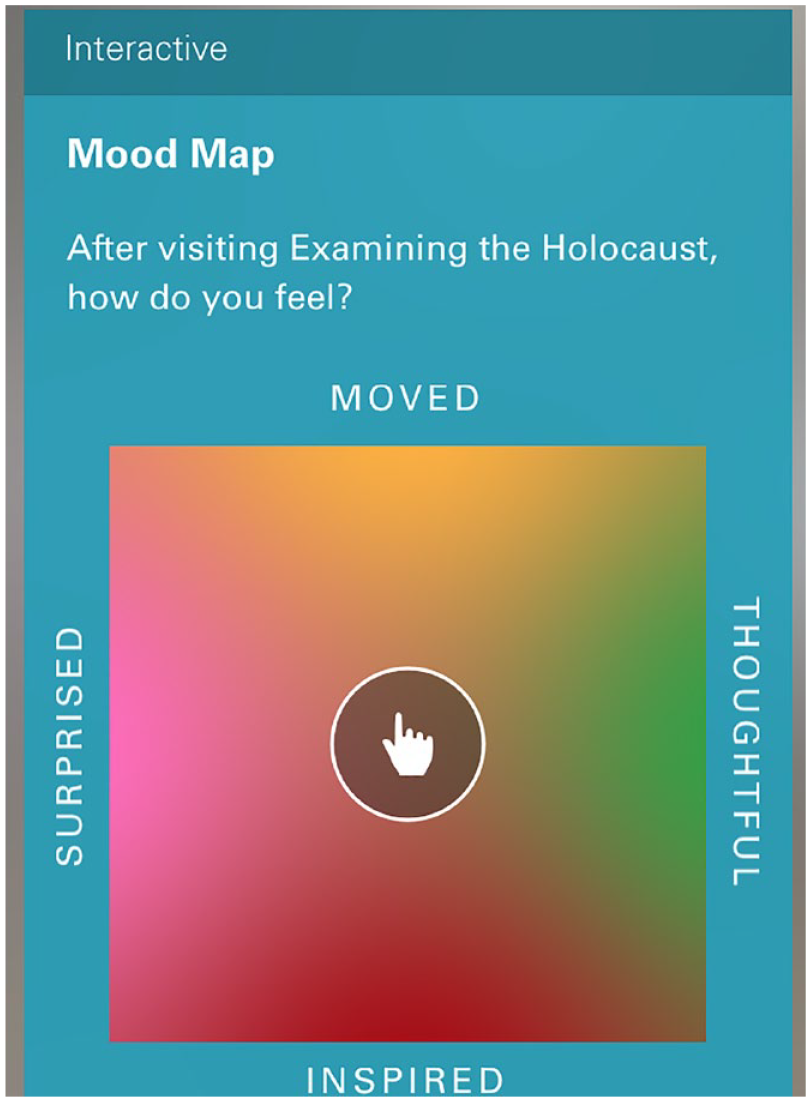
Image of mood map from Canadian Museum for Human Rights.
We are asked, “After visiting Examining the Holocaust, how do you feel?” The four options we are given in the mood map are “moved,” “thoughtful,” “inspired,” and “surprised.” These are the only choices, and all of them are positive. There is no option to feel sad, enraged, disgusted or terrified, or indeed any other negative emotion. Instead, the idea behind the mood map seems to be that positive emotions spark action, whereas negative emotions are believed to render people inactive (Lehrer, 2015). But as we learn if we continue to use the app, action is what the Holocaust gallery and its rooms are seeking to stimulate: once we enter the next room, which is dedicated to the “Turning Points of Humanity,” the narrator of the app encourages us to “think about a time you did something to support human rights. [. . .] Have you volunteered for human rights groups or causes?” With these reflections, not on the history of the Holocaust but rather on our own commitment to human rights, we are leaving “Examining the Holocaust” behind and moving on—we might even say, progressing—toward a stronger human rights culture.
As has become clear, it is the CMHR’s (2020) missions to motivate its visitors to become “Upstanders”; people who “use their personal strengths to take a stand to protect their rights and the rights of others”. Different narrative strategies and technologies are employed for this purpose, including the app, multiple interactive galleries under the motto “Action Counts,” and, of course, the specific emplotment of the Holocaust. All these means serve the ideal of the willingness to participate in the reduction of other people’s pain and suffering, which is assumed to be a vital quality of the historically aware global citizen and, moreover, part and parcel of what Didier Fassin (2012) calls “humanitarian reason”—a mode of government that depoliticizes the political because it relies on moral arguments to help others to reduce their suffering without addressing the political roots or causes of such suffering. Moral sentiments have become a central pillar of current memory politics and politics more generally—they underlie political discourses and legitimize political action carried out in the name of humanity and human well-being (Fassin, 2012). Thus, moral sentiments are combinations of affects and values such as the empathy and tolerance mentioned above (Feldman and Ticktin, 2010). Generally speaking, moral sentiments are understood as emotions that point us to the misfortunes of others and make us want to alleviate them. The combination of moral sentiments and the idea of the responsibility to protect democracy strongly underpins the idea of learning from difficult pasts not only to behave in line with democratic values but also, more than that, to champion humanist activism. As becomes clear, the continuous construction of the notion of a shared humanity that needs to be protected from its undemocratic “others” strongly relies on the memory of past atrocities. Such a moralization of political life replaces political responsibility for systemic change with moral responsibility for suffering individuals. In doing so, it risks depoliticizing inequality, conflict and violence by making them a problem of the individual subject and not of the political discourse that produces subjects and their experience of inequality in the first place (Çubukçu, 2017).
In the examples I have examined, the notion of the responsible subject is overt. It is marked by responsibility shifting from politically structured society to the individual that takes care of itself in the same manner as they might aspire to a healthy lifestyle. In this vein, what is being advocated by the memory authorities of UNESCO and the IHRA as well as the CMHR 11 is active citizenship, but always within the frame and language of (neo)liberal democracy and its human rights agenda. To emphasize this: this kind of attempt to engage others and oneself in such a manner might be neither a bad nor a good thing, but it is certainly political.
Conclusion
Overall, what I argued for in this article is the potential that an analysis of memory as a study of governmentality has for providing an important diagnosis of our time(s) and political conditions, and for illuminating how these are derived from narratives about the past. As maintained so persuasively by Foucault and many of the scholars who have followed him, power can best be grasped in terms of specific practices, and I suggest that one such practice is memory (conceived of as something you do rather than simply have). I paid special attention to a new global citizenship ideal that posits historical literacy, looking at difficult pasts, as the best foundation for active participation in society. Memory has become essential to the governmental practice that operates upon the souls of the subjects, to shaping their desires, their hopes for themselves and others, as well as their aversions. Taking a detour through the past provides access to the affects and values that are aspired to and advocated for across the political spectrum, while the vocabulary of suffering, compassion and tolerance is used to describe our present and to justify the choices made for the future. 12 It is in this context, my central claim, that memory has become a means of governmentality aimed at what Michel Foucault has called the “conduct of conduct” of individuals and even entire populations. Herein lies the highly political nature of this form of memorialization that I have been tracing throughout this article. And while it might have sounded paradoxical at first to critically examine modes of empowerment and moral education in the name of tolerance when we are moving toward a post-human rights age, it should by now have become clear that even emphasizing the need for active global citizenship in the name of human rights is a form of government that is deeply entangled with current political rationality that, though it proclaims otherwise, does not intend to fundamentally change the worlds we live in. Instead, in its fusion with the human rights project, global Holocaust memory risks functioning as precisely one of those means employed to provide lessons in “good democratic conduct” and to ensure the production of the “voluntarily compliant citizen” (Cruikshank, 1999: 19).
What is more, these memory politics have little in common with the once proclaimed ability of Holocaust memory to deeply unsettle and thus transform key assumptions about our world order. It does not pay attention to the rupture that philosophers such as Hannah Arendt, Jean Améry or Theodor W. Adorno had emphasized in response to the Shoah. The global trend toward turning to the history of the Holocaust for reassurance that we are standing on the right side of history seems to leave no room for doubt, nor the potential of memory to stir disobedience. This way, the memory-as-governmentality that I outlined here will not allow for a world of multiple perspectives and various responses to past and present, let alone alternative horizons of hope for the future. Yet, the unambiguous lessons that I traced could be contradicted by pointing to the capacity of memory to “lead us astray” (Todorov, 2003: 311). Looking at alternative, less agreeable approaches to Holocaust memory could then point us toward what might be done in addition to or even instead of the current practices of memorialization that I found to be so deeply entangled with governmental techniques. Thus, to close this article on a more hopeful notion, if we choose different forms of remembering, if we allow memory to take us to unexpected places and into unfamiliar times, it surely has the power to create new relations and maybe, one day, a more just world.
Footnotes
Acknowledgements
The author would like to thank Sarah Gensburger and Thomas Van de Putte for their encouragement to bring this text on its way and for providing many useful commentaries. She would moreover like to express gratitude to Thomas Foth and to the anonymous reviewers for their engagement and excellent feedback on earlier versions of this article.
