




Abstract
This article considers a Two-Spirit and Indigiqueer protest at the Canadian Museum for Human Rights as a flashpoint that exposes problems with how memory-making institutions are incorporating lesbian, gay, bisexual, trans and queer issues into their programming and/or collections. The protest brings into relief the museum’s investment in a homocolonial framing of remembrance for the way in which the telling of lesbian, gay, bisexual, trans and queer ‘progress’ is entangled with a settler colonial political economy wherein the tokenistic inclusion of some queers into the sexual citizenry happens alongside the dispossession, devaluing and criminalizing of others. I then undertake some preliminary ‘curatorial dreaming’ upon two other interventions–commentaries uploaded to a digital story bank by a Two-Spirit and an Indigenous queer museumgoer, and the short film Woman Dress by Plains Cree artist TJ Cuthand. Along with the protest, the commentaries and the film unsettle homocolonial frames of remembrance and provide critical openings towards decolonial queer memory work at the museum.
Keywords
On 1 May 2019, the Canadian Museum for Human Rights (CMHR) planned to hold an event celebrating the nation-wide release of a CA$1-coin commemorating the 50th anniversary of the so-called ‘decriminalization of homosexuality’ in Canada. Interrupting the fanfare, a group of Two-Spirit and Indigiqueer 1 community leaders gathered outside the museum in protest. They had not been invited to be part of the event with other local groups, and were signalling the museum’s failure to recognize their contributions to lesbian, gay, bisexual, trans and queer (LGBTQ) history (Two-Spirited People of Manitoba Inc., 2019; APTN, 2019). In response, the museum apologized for not being ‘inclusive enough’ and cancelled the programming portion of its ceremony (CMHR, 2019a). It went ahead, however, with a coin exchange facilitated by the Royal Canadian Mint, welcoming the general public into the main floor gallery to trade their regular pocket change for the special ‘gay loonie’. 2
In this article, I consider the CMHR’s event and the Two-Spirit protest a flashpoint that exposes problems with how some memory-making institutions (including but not limited to museums) are incorporating LGBTQ issues into their programming and/or collections in attempts to address diversity and inclusion. I argue, in particular, that the CMHR’s trade in queer currency backfires, retrenching long-held structures of privilege and exclusion. I use ‘queer currency’ here, both literally and symbolically, to name the museum’s coin exchange as a bid to gain cultural capital towards securing its authority to speak on issues of gender and sexual diversity. What the protest poignantly brings into relief is that the museum is invested in a story of LGBTQ rights that tries to foreclose Two-Spirit and Indigiqueer people from the museum’s frame of remembrance. I call this an investment in a ‘homocolonial framing of remembrance’ for the way that it primarily centres and makes memorable versions of queer lives closest to the White, cis-gendered, middle-class and Christian norm. This framing points to the entanglement of LGBTQ rights and notions of ‘queer progress’ with a settler colonial political economy wherein the tokenistic inclusion of some queers into the sexual citizenry happens upon the dispossession and marginalization of others. In the settler colonial context of Canada, these ‘others’, namely, Two-Spirit and queer and trans Black, Indigenous and people of colour, have been and continue to be subject to violence and attempted erasure for expressions of gender and erotic kinship that do not adhere to Euro-colonial, capitalist norms. The commemorative coin gesture forgets this ongoing history to produce a celebratory narrative of (homo)national pride and ‘arrival’, 3 covering over how queer lives remain conditioned by the systemic violence of White supremacy, settler colonialism and the empire-building of the Canadian nation-state. As an act of resistance, the Two-Spirit protestors expose a crack in the museum’s homocolonial framing of remembrance precisely by disrupting its celebration with their presence, refusing to be disappeared.
I am interested, then, in what can be learned from the protestors’ intervention about how Two-Spirit, Indigiqueer and LGBTQ lives might be remembered in and beyond museums without simply repeating the settler colonial status quo. In other words, I am curious about the possibilities that ‘cracks’ like the protest might yield in terms of re-framing queer memory in ways that do not foreclose and/or displace Indigenous people in the process of making room for queer histories to be heard. Alongside the protest, I foreground two other interventions: commentaries uploaded to an interactive digital story bank at the CMHR by museumgoers Lee Kamenawatamin, a Two-Spirit person, and Martini Monkman who identifies herself as an LGBTQ Aboriginal woman; and a film called Woman Dress by Plains Cree artist TJ Cuthand featuring a Two-Spirit storyteller. The CMHR, in fact, screened Woman Dress as part of a time-limited virtual film series, but does not include it in its on-site exhibits. Bringing the commentaries and film into focus alongside the protest, I then undertake some preliminary ‘curatorial dreaming’ towards envisioning how the CMHR could work with these critical interventions as openings to re-present LGBTQ histories not just ‘more inclusively’ but also in a way that unsettles homocolonial norms. This work, I argue, is vital if the museum is committed to engaging diverse communities beyond tokenism. The Two-Spirit and Indigiqueer subjects of the museum’s foreclosures have, through their own interventions, already provided pathways for doing so.
The museum and exhibitionary silences
The CMHR (Figure 1) is Canada’s newest national museum, located in the city of Winnipeg, Manitoba. Winnipeg sits on Treaty One Territory, ancestral lands of the Anishinaabeg, Cree, Oji-Cree, Dakota and Dene peoples, and the homeland of the Métis Nation. The Museum itself occupies an area referred to as ‘The Forks’ at the intersection of the Red and Assiniboine rivers. Noted as an ‘early Aboriginal settlement’, The Forks (n.d.) is currently one of the city’s most active tourist and commercial zones. The mandate of the CMHR as set out in the Museums Act is ‘to explore the subject of human rights, with special but not exclusive reference to Canada, in order to enhance the public’s understanding of human rights, to promote respect for others and to encourage reflection and dialogue’ (Government of Canada, 2008). A self-described ‘ideas museum’ (CMHR, 2009), the CMHR’s collection consists of some objects and artefacts but focuses on narratives and images presented by way of digital panels and interactive screens distributed across 13 thematic galleries. Its CA$350 million 260,000 square foot multi-level design has won several architectural awards. From its inception, the CMHR (2011) has also expressed a commitment to being part of the process of reconciliation with Indigenous peoples, including responding to calls by the Truth and Reconciliation Commission for it to address the intergenerational harm caused by Canada’s Indian Residential School system (Truth and Reconciliation Commission of Canada (TRC), 2015a, 2015b).
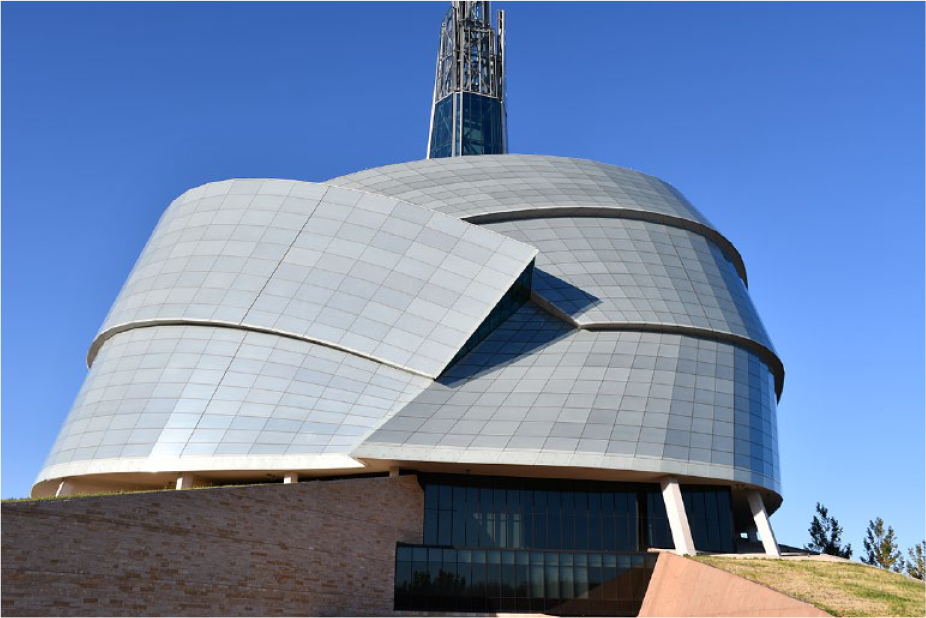
Canadian Museum for Human Rights (photo credit: author).
Praise, criticism and controversy have followed the CMHR since its opening in 2014. In June 2020, it came under fire when former employees spoke out publicly about their experience of anti-Black and anti-Indigenous racism at the hands of senior staff and managers (CBC, 2020a). These allegations prompted an external review and eventually the resignation of the museum’s then-President and CEO John Young (CBC, 2020b). The review itself found racism to be ‘pervasive and systemic’ at the museum (Harris, 2020: 1). It also documented instances where employees were directed to physically block the view of LGBTQ content for particular tour groups (pp. 44–45), noting further that there was no specific Two-Spirit content despite years of advocacy by the Two-Spirit community (p. 45).
The LGBTQ content that does exist in the CMHR starts in its introductory gallery, What Are Human Rights?, where a chronological timeline of ‘100 selected moments in human rights history’ marks a handful of LGBTQ-related dates such as the 1969 Stonewall Riots and the 2001 legalization of same-sex marriage in the Netherlands. The museum’s one stand-alone exhibit dedicated to sexual diversity, ‘Taking the Cake’, is on display in the feature Canadian Journeys gallery. This exhibit is built around the centrepiece of a three-dimensional, illuminated, white wedding cake composed of crowd-sourced photographs of newlywed couples, celebrating Canada as a global forerunner in the legalization of same-sex marriage (Figure 2). Buried in a computer station nearby is a story about Michelle Joseph, a transgender musician who fought legislation in the province of Ontario after its conservative government rescinded funding for gender affirmation surgeries mid-way through her transition. An exhibit on Protecting Rights in Canada recounts the case of Delwin Vriend, a lab instructor at Christian King’s College in Alberta who was fired from his job in 1991 for admitting to being in a same-sex relationship. Vriend went on to successfully challenge the Alberta Human Rights Code for failing to prohibit discrimination on the grounds of sexual orientation. A small display in the Examining the Holocaust gallery documents the persecution of homosexuals during the Nazi regime in Europe. Stories of Gay-Straight Alliances and pink shirt day anti-bullying campaigns in schools appear in yet another gallery called Actions Count.
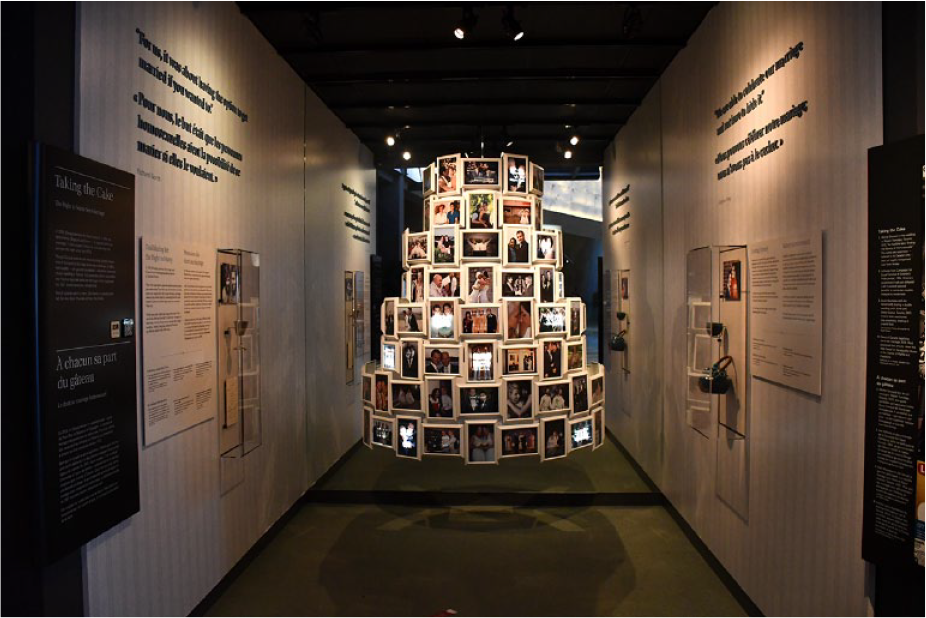
‘Taking the Cake’ exhibit detail (photo credit: author).
Among the LGBTQ-themed content scattered throughout the museum, few queer people of colour appear. When they do, they are generally depicted as having had to flee their homophobic countries of origin for the ‘safe haven’ of Canada. Two examples of this are Arsham Parsi, a gay Iranian man whose story appears in two places in the museum including an exhibit that explores ‘who gets in’ through Canada’s immigration and visa ports, and Gareth Henry, a Jamaican-Canadian HIV/AIDS activist and advocate for LGBTQ rights whose portrait appears on a banner hanging alongside other ‘Human Rights Defenders’. Both Parsi and Henry are portrayed as success stories that emphasize Canada’s role in liberating queer refugees and asylum seekers from human rights abuses elsewhere – a framing that critical race and sexuality scholar Amar Wahab (2015) calls ‘queerimperialism’. Through a queerimperialist lens, homophobia or queerphobia is projected elsewhere to construct the West as exceptionally tolerant and civilized in opposition to ‘the rest’ (Wahab, 2015: 45). This framing works to imply that homophobic violence is intrinsic to other (e.g. Arab, Muslim and/or Caribbean) presumed-to-be ‘less civilized’ cultures and nations, rather than inherited from the period of British colonial rule that imposed anti-sodomy laws and penal codes upon them – a legacy that continues to shape the former colonies in complex ways (Han and O’Mahoney, 2018). Failing to provide this context, the CMHR casts queer people of colour through the lens of a queerimperialist frame that envisions White-dominant nation-states (Canada, in this case) as their saviours. 4
At the same time, Two-Spirit and Indigenous queer people are not imagined here at all, either in the museum’s LGBTQ content or in its exhibits on Indigenous peoples. They constitute an ‘exhibitionary silence’, to borrow a phrase from queer theorist Jennifer Tyburczy (2016: 21–22), as if the museum could not conceptualize ‘Indigenous’ and ‘queer’ together, just like it did not think to involve local Two-Spirit and Indigiqueer community organizers in its commemorative gay coin event. What the museum’s approach to LGBTQ content and programming does, then, is legitimate queerness primarily when it is yoked to whiteness and to rights-based categories of legal subjectivity (e.g. marriage, citizenship, etc.) defined by the settler colonial nation-state. Moreover, it side-steps ongoing forms of discrimination faced by queer people by almost exclusively curating stories that can be counted as ‘wins’ – that is, where LGBTQ struggles in Canada appear to have been overcome, left to the past, safely sealed off from the present. As I have argued elsewhere, these kinds of representations foreclose potentially rich opportunities to learn from difficult knowledge when they ‘forget’ or leave out of the frame less cheerful memories and stories that expose the ways in which certain queer, refugee, Indigenous and other marginalized peoples continue to struggle (and resist), especially if they are not petitioning for inclusion within the terms of state-conferred rights but are instead advocating for their dignity and freedom precisely by challenging the settler state’s authority to adjudicate and bestow these rights in the first place (Failler, 2018: 14). Put slightly differently, the CMHR’s avoidance of ‘difficult knowledge’ and its preference instead for ‘lovely knowledge’ that works to shore up feelings of (homo)national pride by relying on simplistic progress narratives measured by the advancements of the most privileged, comes at a cost to its ability to engage museumgoers and the broader public in deeper, meaningful conversations about how to enact change. 5 The backfiring of the CMHR’s commemorative coin event is a case in point.
Memory entrepreneurship and the myth of 1969
The gay loonie – formally called the ‘equality dollar’– was first unveiled by Canada’s federal finance minister on 23 April 2019 at a ceremony in Toronto, Ontario, a week prior to the CMHR’s event. A spokesperson for the Royal Canadian Mint suggested that the coin marked ‘a key milestone for lesbian, gay, transgender, queer and two-spirited people in the country’ (The Canadian Press, 2019). Despite the celebratory tenor of the unveiling, news media reported that the loonie was being met with push back by both social conservatives and some members of the LGBTQ community. David Cooke from Citizen Go Canada (an outwardly homophobic anti-choice group), for instance, was offended at what he called the Mint’s attempt to ‘politicize’ Canadian currency to promote the prime minister’s ‘gay agenda’ (CBC, 2019). York University historian Tom Hooper, on the other hand, was critical of the coin on the basis that it misrepresented the amendments made to the criminal code in 1969, which he observed did not simply translate into decriminalization let alone ‘equality’ for 2S+LGBTQ people (CBC, 2019). He and other queer historians, legal scholars and activists assembled under the moniker ‘The Anti-69 Network’ note that the change to the criminal code in 1969 was limited to the addition of an exception to Clause 7 of the Criminal Law Amendment Act that made ‘buggery’ and ‘gross indecency’ allowable if committed ‘in private between (a) a husband and his wife, or (b) any two persons, each of whom is twenty-one years or more of age, both of whom consent to the commission of the act’ (Government of Canada, 1969). ‘Buggery’ and ‘gross indecency’ were not actually repealed by the Omnibus Bill and remained illegal if deemed to be committed in public, disproportionately targeting Two-Spirit and LGBTQ people and queer community venues (The Anti-69 Network, n.d.). In other words, even if the reform seemed to relax a small window of the law around certain sexual activities done in ‘private’, it did not prevent Two-Spirit and LGBTQ people in Canada from continuing to be criminalized through various other means as it left the door open to the ongoing surveillance and punishment of queers, sex workers, the unhoused and other marginalized people whose lives were/are not sheltered by White, middle-class, heteronormative and/or cis-normative privilege.
For Hooper et al. (The Anti-69 Network, n.d.), then, the notion that 1969 was the year that ‘ended laws against homosexuality’ or ushered in ‘equality/égalité’ 6 for Two-Spirit and LGBTQ people is a myth. Remembering a 50-year mythical milestone with a commemorative coin appears, in this light, to be less a genuine show of solidarity or remembrance than an investment in an obfuscated or whitewashed (homocolonial) version of history – one wherein the Canadian government and law-makers are credited for the ‘national achievement’ of strides made in relation to sexual freedoms, rather than Two-Spirit and LGBTQ community organizers and activists forced to advocate for the decriminalization of queer lives precisely because government sanctions and laws rendered non-normative expressions of gender and sexuality deviant in the first place.
Exposing the myth of 1969 thus makes apparent the way in which the endorsement of the coin is a form of strategic memory or, as Argentine sociologist Elizabeth Jelin (2003) might call it, ‘memory entrepreneurship’. Jelin (2003) uses ‘memory entrepreneurship’ to describe initiatives by groups or organizations that engage with memory and its representations to ‘seek social recognition and political legitimacy of one (their own) interpretation or narrative of the past’ (emphasis in original, pp. 33–34). According to Jelin, these initiatives can potentially create positive opportunities for communities to better understand and acknowledge the ways in which the past – including histories of violence and exclusion – continues to inform the present. In the case of the equality dollar, however, its sponsors (the Mint, the federal government and the museum) appear to act more like ‘memory empresarios’ in the business of memory for profit rather than collective understanding (Bilbija and Payne, 2011: 11). In the business of memory for profit, history and its representations become a commodity that legitimates a hegemonic narrative of the past for the sake of bolstering a salable image. 7 In an attempt to gain queer currency, the limits of the CMHR’s buy-in to memory entrepreneurship is revealed not only by its venture with the Royal Canadian Mint to host the commemorative coin event, but also by its response to the Two-Spirit protest that followed.
The protest and the apology
On the day of the CMHR’s event, the community-based not-for-profit Two-Spirited People of Manitoba issued a press release quoting one of its Co-Directors, Elder and Knowledge Keeper Albert McLeod, who organized the protest. In it, McLeod says that he was ‘very disappointed to learn about the planned coin exchange with two Crown corporations [the CMHR and the Mint] and LGBTQ representatives that do not include two-spirit people’ (Two-Spirited People of Manitoba Inc., 2019). He also recalls the House of Commons apology given just 2 years prior to victims of the ‘gay purge’
8
by Canadian Prime Minister Justin Trudeau who extended regrets for ‘Canada’s role in the systemic oppression, criminalization, and violence against the lesbian, gay, bisexual, transgender, queer, and two-spirit communities’, ending with a promise to ‘never let this happen again’ (Trudeau, 2017). Given the inclusion of Two-Spirit people in the apology, McLeod wonders why they were already being left out of initiatives like the coin commemoration at the museum, while Winnipeg Pride and the Rainbow Resource Centre (two other local LGBTQ organizations) were invited to be a part of it. ‘It makes us feel like we are not the right kind of gay, that we had no role in Canada’s history or the LGBTQ movement’, he explains, adding that Two-Spirit people existed in the Americas for thousands of years before colonization and we are still here . . . We don’t come as victims to be shunted aside or ignored, we come with gifts and knowledge, we are contributors to society. (Two-Spirited People of Manitoba Inc., 2019)
McLeod here not only points to the hypocrisy of being included in a public apology and then swiftly forgotten, but also situates the exclusion of Two-Spirit and Indigenous queer people in an ongoing history of colonialism that attempts to deliberately erase them from settler society. Alex Wilson, a Two-Spirit scholar from Opaskwayak Cree Nation, recounts that when Europeans arrived on what is now typically referred to as North America, they imposed heteropatriarchal structures and normalizing discourses of sexuality onto Indigenous peoples as a strategy to dismantle their kinship systems, with the ultimate goal of eliminating them to expropriate their land for development (Wilson, 2015: 2). Canadian policies, such as the Indian Act, were used to carry out this strategy, making Euro-Christian models of heterosexuality and sexist gendered distinctions (including patrilineal descent) compulsory within status Indian communities (Cannon, 1998). In this context, cross-gendered Indigenous persons (who might be called ‘Two-Spirit’ today) were seen as threats to colonial nation building and the growth of the capitalist economy, and were therefore subjected to regulations that denied them of the important roles they had held in their own communities (Cannon, 1998: 16–17). Canada’s Indian Residential Schools also imposed colonial norms on children and young adults, forcibly altering Indigenous expressions of gender and sexuality (National Inquiry into Missing and Murdered Indigenous Women and Girls, 2019: 448).
The colonial dismantling of Indigenous kinship structures also involved criminalizing non-monogamous relationships and plural marriages. Drawing on historian Sarah Carter’s (2008) The Importance of Being Monogamous: Marriage and Nation Building in Western Canada to 1915, feminist socio-legal scholar Suzanne Lenon (2015) cites an 1899 case where a man named Bear’s Shin Bone in Alberta was criminally charged for entering into a marriage with two Kainai women. Lenon explains that through the development of Canadian marriage legislation and criminal code provisions that prohibit polygamy, monogamy became naturalized as the marker of Western civility against a field of other so-called ‘uncivilized’ practices and customs. With the rise in Canadian settler society of what criminologist Mariana Valverde (2006) calls the ‘respectable same-sex couple’, the ideal of monogamy was eventually used to argue for the legalization of same-sex marriage where gay and lesbian couples perceived as being in committed monogamous relationships would be folded into the nation’s normative family-sexual structure and then held up as ‘exemplary of Canada’s latest iteration of sexual modernity’ (Lenon, 2015: 91). What unmitigated celebrations of the right to same-sex marriage (such as the CMHR’s ‘Taking the Cake’ exhibit) tend to foreclose, then, is the way in which this form of inclusion is implicated in histories of Indigenous erasure and, thus, exists in tension with a commitment to reconciliation with Indigenous peoples.
LGBTQ movements in North America have focused significant energies on achieving formal equalities and state recognition for LGBTQ people as protected citizens under federal (colonial state) laws. These movements, which also tend to be White-dominated, have alienated many Two-Spirit and Indigenous queer people who face anti-Indigenous racism and colonial violence not only at the hands of the state and its agencies, but within queer communities as well (Morgensen, 2011). Even though Two-Spirit and Indigenous queer people often participate in broader LGBTQ communities, many describe their experiences as distinct from those who identify with the Western/Anglo categories ‘lesbian’, ‘gay’ and ‘bisexual’ (and sometimes also ‘queer’). The self-naming gesture of ‘Two-Spirit’ in part signals this distinction, as do other expressions of what Cherokee Two-Spirit writer and performer Quo-Li Driskill (2004, 2011) calls ‘sovereign erotics’. For Driskill (2004, 2011), sovereign erotics are forms of decolonial resistance that work to reclaim sexual and gender fluidity as practised within Indigenous communities before contact with Europeans, while imagining new and future forms of kinship and belonging that challenge heterosexist notions of Indigeneity and colonial constructions of nationhood. When McLeod responds to the ‘forgetting’ of Two-Spirit and Indigenous queer people by the CMHR by asserting ‘we are still here . . . We don’t come as victims to be shunted aside or ignored, we come with gifts and knowledge, we are contributors to society’, he does so as an assertion of sovereign erotics, reclaiming the presence, continuity and inherent value of Two-Spirit and queer Indigenous people in the face of ongoing colonial erasure.
The human rights museum, for its part, posted the following response to the Two-Spirit protest on its public Facebook page later that day: We’ve cancelled the program portion of today’s coin-exchange event in response to concerns that it was not inclusive enough. We agree with that perspective and have reached out to apologize. The Mint will now simply conduct a coin exchange here. It was not our intention to exclude anyone, but to encourage public dialogue on the rights struggles, historical and contemporary, of those with diverse sexual orientation and gender identities. (CMHR, 2019a)
When the CMHR responds to the protestors with an apology for not being ‘inclusive enough’ but then carries on to ‘simply conduct a coin exchange here’ (business as usual?), it fails to recognize the inherent violence of its actions and the insufficiency of its mea culpa. Two-Spirit and Indigenous queer people are not calling for tokenistic inclusion within the national museum, the settler-nation or the homonation, as it were. Simply adding or including Two-Spirit and Indigenous queer people to/within what is already a colonial or homocolonial framing of queer lives – expressed here in terms of value as national currency – fails to address why they were unthought of or excluded in the first place. Two-Spirit and Indigenous queer people were unthought of and excluded in the first place because they do not easily fit within the commemorative framework of homonationalist or homocolonial pride that exclaims ‘look how far LGBTQ people in Canada have come!’ In fact, the achievements the museum wants to celebrate have, in many ways, come at the cost of Two-Spirit and Indigenous queer visibility and live-ability. Their exclusion is not an accidental or unintended oversight, as the museum’s apology would want to suggest. The removal or foreclosure of Two-Spirit and Indigenous queer peoples from the museum’s remembrance ceremony (and exhibits) is structurally consistent with the museum’s investment in both (homo)colonial and heteronormative frames of recognition – two sides of the same coin, so to speak – despite its stated commitments to reconciliation and to ‘encourag[ing] public dialogue on the rights struggles, historical and contemporary, of those with diverse sexual orientation and gender identities’ (CMHR, 2019a). The museum’s commemorative coin event, rather than encouraging public dialogue, merely trades in a tokenizing expression of queer currency (literally, a token), banking on it to pass as a show of support for diversity and inclusion. As the Two-Spirit protest makes clear, this capitalizing/capitalistic move had the opposite effect, instead repeating long-held structures of privilege and exclusion by failing to grasp how queer lives in Canada continue to be shaped by legacies of settler colonialism and White supremacy.
Curatorial dreaming with Two-Spirit and Indigiqueer interventions
What then, might a more meaningful commemoration of Two-Spirit and LGBTQ history look like at the museum? How could the museum engage Two-Spirit, Indigiqueer and LGBTQ people beyond assimilationist, homocolonial and queerimperialist frames of inclusion? Critical museologists Shelley Butler and Erica Lehrer (2016) have developed ‘curatorial dreaming’ as a method for museum critics to imagine exhibitions. They note that critics – including scholars like myself who write about museums but do not actually work in/for museums – are often good at raising critical concerns and pointing to the limits of existing exhibits, but do not necessarily have solutions to curatorial dilemmas. I do not pretend to have simple solutions to the dilemmas facing the CMHR (which extend well beyond those described in this article), but as a queer scholar and someone who often visits and pays close attention to this museum, it strikes me that there have been missed opportunities in its very midst that could be re-engaged towards bettering its approach to Two-Spirit and LGBTQ remembrance.
I begin this visioning by forefronting Nathan ‘Mudyi’ Sentance’s (2019) insistence that queering the museum needs to be anti-colonial. Sentance is Wiradjuri librarian, essayist and museum professional in Australia who wrote a rejoinder to ‘The KINQ Manifesto: KINQ=Knowledge Industries Need Queering’ (n.d.) penned by Queering the Museum (2020) authors Craig Middleton and Nikki Sullivan. Sentance intervenes in their manifesto to underscore what he perceives to be a lack of understanding of the way in which both heteronormativity and whiteness are undergirded by colonization. He points to natural history museums, for example, as sites where the linkages between these structures of domination are most obviously on display, relying as they do on portrayals of Black and First Nations peoples as savages and sexual deviants. These portrayals, he observes, have been used to justify the civilizing missions of colonial conquest. Given the inter-implication of colonization, White supremacy and the imposition of normalizing discourses of sexuality as such, Sentance argues that the work of queering knowledge industries (of which museums are a part of) cannot be separated from the work of either anti-racism or decolonization. To me, his analysis prompts key critical questions, and an opening for a curatorial dream: How can the CMHR begin to unpack the ways in which it assumes/reproduces homophobic, colonial and racist understandings of gender and sexuality within its own collections and exhibitions? And, more specifically, if the museum were to curate stories about Two-Spirit and Indigiqueer lives, how could they do so in a way that does not delimit or settle their meaning by imposing a homocolonial framework upon them but that, instead, might move towards dismantling it?
Share your story
Despite there being no intentionally curated representations of Two-Spirit or Indigenous queer people in the CMHR’s permanent exhibits, there is a notable exception to their altogether absence: two separate short commentaries uploaded by museum visitors Lee Kamenawatamin and Martini Monkman to a digital story booth that gathers audience-generated content. The booth, an 8 × 8 foot exhibit called Share Your Story, is easy to miss within the museum’s massive footprint. Located in a corner of the Canadian Journeys gallery near an exit ramp leading to the next floor, the booth contains a bench and a computer console with a video camera and microphone where visitors are prompted to make a brief recording on an issue of importance to them. Once recorded, a selection of the videos can be played back from a touch screen menu. Some also appear in an online version of the exhibit on the museum’s website (CMHR, n.d.).
The recordings by Kamenawatamin and Monkman are self-titled ‘Two Spirit Hope’ (Figure 3) and ‘LGBTQ Aboriginal Woman’ (Figure 4), respectively, both originally posted in 2015. They are each under a minute in length. In the first, Kamenawatamin describes their experience of workplace discrimination: Being Two-Spirited, it’s hard to find a job in today’s society where employers don’t want to take the chance on someone like me because they don’t want to deal with the prospect of making their customers uncomfortable even though, being Two-Spirited, I am talented in many ways and capable of doing hard work . . .. Dealing with that . . . is kind of disheartening to me as a person. I see myself as a human, I don’t see myself as a man or a woman. (Kamenawatamin, 2015)
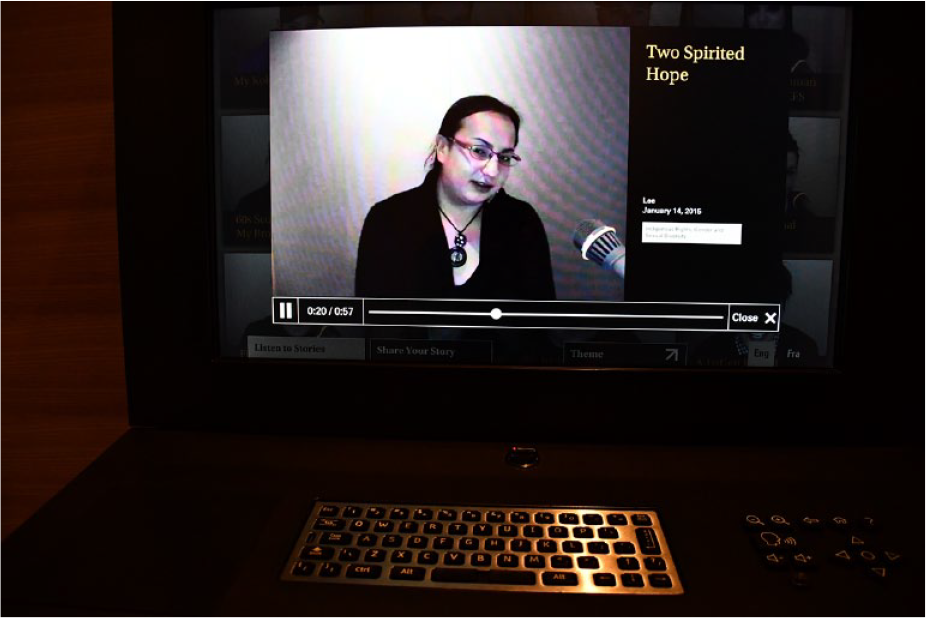
‘Two Spirit Hope’ by Lee Kamenawatamin, Share Your Story exhibit detail (photo credit: author).
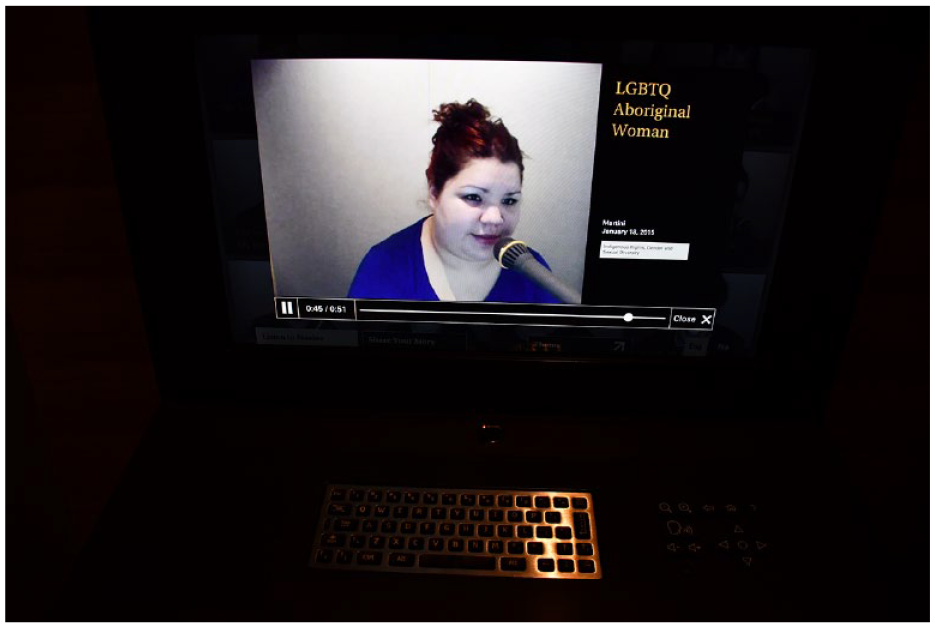
‘LGBTQ Aboriginal Woman’ by Martini Monkman, Share Your Story exhibit detail (photo credit: author).
In the second, Monkman conveys a sense of alienation amid what she knows to be a general lack of awareness that queer Indigenous people exist, and a specific lack of visibility at the CMHR: I would like people to be aware that there are Aboriginal LGBTQ people, and that we have rights too . . . because everybody is aware of people of colour being LGBTQ, people are aware of straight people, cis-gender people, but nobody is aware of the gay Aboriginal community . . .. I feel so alone. I just wish that people knew about us. I wish that the human rights museum had a booth dedicated to the LGBTQ Aboriginal people. (Monkman, 2015)
These two brief commentaries, quoted almost in their entirety here, speak powerfully of current struggles faced by Two-Spirit and Indigenous queer people, and their desire to be seen. Providing examples of being treated as undesirable workers and/or invisible members of society, Kamenawatamin and Monkman complicate the museum’s celebratory narrative of the achievement or arrival of LGBTQ rights and freedoms in Canada. They also point to ways in which Two-Spirit and Indigenous queer lives are devalued at the intersection of anti-Indigenous racism, queerphobia and colonial views of gender-as-binary. These are perspectives found nowhere else in the museum; however, their ability to reach most museumgoers is limited both because the likelihood of their being found among the rolodex of stories in the booth is left rather to chance, and because the exhibit itself provides very little in the way of curatorial framing to help visitors translate these stories into meaningful connections or opportunities for learning.
It is a trend in contemporary museums to include visitor-generated stories as part of exhibitions. This trend is a nod to the tenet of ‘new museology’, which aims to involve visitors in content creation as a way of breaking down the conventional hierarchy between presumed-to-know museum experts and presumed-ignorant visitors (Ross, 2004). While an important strategy, there is a curatorial challenge inherent to including visitor-generated content that requires more than simply providing a forum – or a booth, in this case – for people to tell their stories. Storytelling has to be framed as an invitation to participate in establishing new relations between words and things as well as between objects and their meanings (Failler and Simon, 2015: 166). In other words, the mere inclusion of diverse stories is not enough, especially if the museum hopes to inspire people to broaden their perspectives beyond familiar ways of thinking and acting in the world. In this particular instance, while the booth managed by happenstance to collect Kamenawatamin and Monkman’s accounts, the exhibit itself does little beyond posturing an embracement of different points of view on human rights. As such, it misses an opportunity to share their stories in a way that might amplify their voices in the space, or support other museumgoers with conceptual tools to better understand the experiences of Two-Spirit and Indigenous queer people.
I wonder, then, how else might these valuable commentaries be curated or cared for? 9 What if, with Kamenawatamin and Monkman’s consent, they were re-presented in the context of the museum’s other relevant exhibits on, for example, labour rights, employment equity, residential schools and/or in the gallery on Indigenous Perspectives? Such tie-ins could allow them to speak to and across exhibitionary silences elsewhere in the museum. Or, following Monkman’s suggestion, an altogether new space might be created, perhaps one wherein Two-Spirit and/or Indigiqueer curators lead an invitation to other Two-Spirit and Indigiqueer community members to respond to Monkman and Kamenawatamin’s original provocations, bringing them into dialogue with one another, or into what 2S/LGBT scholar Laura Hall (2020) calls ‘Indigenous inter-relatedness’ (p. 233), 10 rather than the one-way conversations/monologues that Share Your Story otherwise sets up.
It is telling that the museum forgot to invite Two-Spirit and Indigiqueer people to be involved in the commemorative coin event after Monkman and Kamenawatamin’s commentaries sat in its Share Your Story bank for years. It suggests to me that while their voices have been nominally ‘included’, they are not necessarily heard. And they are not necessarily heard because they are at odds with the museum’s narrative framing of what cultural studies and Black diaspora theorist Rinaldo Walcott (2015: vii-ix) calls ‘homosexual arrival’ – that is, the story of the good life presumed to come for queer people upon the bestowal of rights by the nation-state. The very presence of Two-Spirit and Indigiqueer people both befuddles and presents a challenge to this version of (LGBTQ) history, which seems to be why the museum has repeatedly foreclosed or tried to disappear them – either by curatorial choices that minimize their visibility, or by moves like the coin exchange that exclude them altogether.
Woman dress
The CMHR does have a thing for curating dresses, though. A headless mannequin dons a red prom dress alongside a tuxedoed dummy in the museum’s Inspiring Change gallery as part of an exhibit on student activism that led to the first racially integrated prom at a high school in Georgia (US) in 2013 (McRae, n.d.). An illuminated dress made of fibre optic fabric, laser wire and LED lights that change colour when you step on a hashtag was installed for an exhibit called Rights of Passage as part of the museum’s 2017 ‘Canada 150’ showcase celebrating the sesquicentennial anniversary of Canadian confederation, meant to represent something about ‘Canada in the contemporary age’ (CMHR, 2017). In the Canadian Journeys gallery, six uninhabited red dresses hang against a background image of white birch trees and more dresses, an iteration of Winnipeg-based artist Jaime Black’s The REDress Project. In the artist’s own words, The REDress Project is an aesthetic response to the more than 1000 missing and murdered Aboriginal women in Canada . . . to draw attention to the gendered and racialized nature of violent crimes against Aboriginal women and to evoke a presence through the marking of absence. (Black, 2020)
This haunting work, which has shown in many venues across North America, has been on permanent exhibit at the CMHR almost since its opening. Currently, the museum also hosts the travelling exhibit ‘Ododo Wa: Stories of Girls in War’, which tells the story of two Ugandan women who survived being forced into conjugal slavery by an insurgent group in Uganda. Hovering in a glass showcase above a reproduction of a grinding stone that, according to the museum label, was used by enslaved girls to prepare food during their captivity, is a modestly pleated green skirt with bullet holes worn by a woman who was captured during a military ambush (CMHR, 2019b).
In a short film that resists gendered tropes associated with the dress/skirt (such as female victimhood) while exploring its significance within traditional Plains Cree culture, TJ Cuthand 11 recalls the story of a Two-Spirit storyteller named Woman Dress (Figure 5). The CMHR screened Woman Dress (Cuthand, 2019) as part of an online series for Indigenous History Month in June 2021. It does not otherwise appear in the museum itself. The 6.5-minute film is narrated by Cuthand and his ‘Auntie’ (identified in the credits as Beth Cuthand) who he prompts to retell the story originally told to her by her grandfather. Auntie prefaces the story by signalling her use of ‘she’ and ‘he’ interchangeably when referring to the protagonist, Woman Dress – ‘much like Grandpa would do because his first language was Cree . . . Crees didn’t have gendered pronouns’.
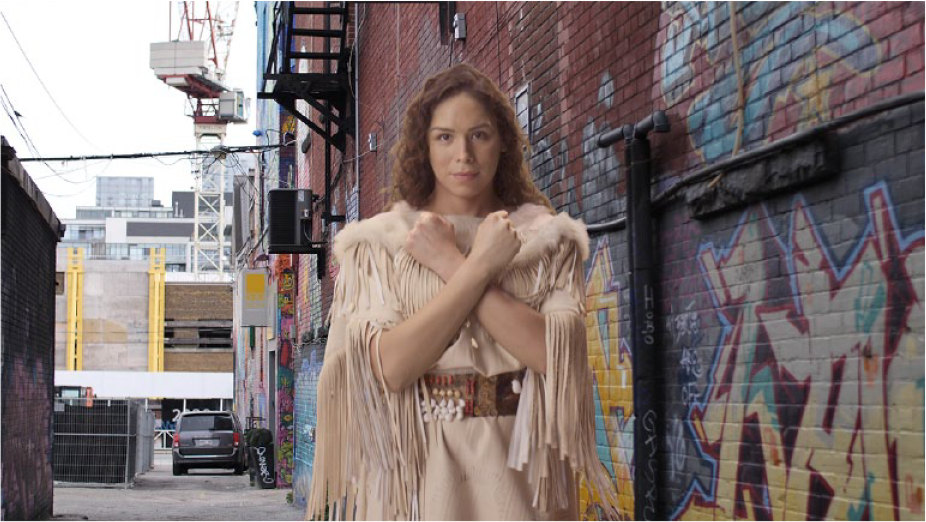
Film still from Woman Dress (reproduced with permission of artist filmmaker).
As Auntie tells it,
12
Woman Dress was once a young child who travelled on her own across the prairies, stopping in various camps where people would welcome him and take him in, and he would learn their stories. Though he was always invited to stay longer, the child would continue on her journey, moving ‘from camp to camp and tribe to tribe’. Along the way, the child is given a dress by an old woman. She puts the dress on, and from then on, every time he tells stories and learns new stories the dress ‘grows bigger and bigger and bigger’. Eventually, the child is grown, and people know when she is approaching their camp: because the dress is so long it’s raising up a cloud of dust. And the kids run out from the camp and they climb onto the dress and they get a ride into camp. And everybody comes to greet Woman Dress. That is how this person comes to become known . . . all over the plains.
Cuthand asks Auntie how ‘Grandpa’ came to know the story of Woman Dress. Auntie explains that her grandfather grew up when people ‘hunted the buffalo . . . [and] were still alive and still telling the stories’. He was reluctant, though, about sharing the story of Woman Dress. Auntie says, ‘I think he was kind of embarrassed to talk openly about [a] Two-spirited person like Woman Dress. I think it was the influence of Christianity’. This key moment in the film points to the chilling effect that Christianity had on Indigenous knowledge and cultures, including the way in which Two-Spirit people – once celebrated in their communities – began to be shamed and shunned.
At another juncture in the story, as the plains people gather in Cyprus hills to trade technology and stories, they say to each other, ‘you know, we should honor storytellers like Woman Dress because Woman Dress brings to us important news and really interesting stories’, concluding, ‘let’s agree that we won’t kill the storytellers’. This agreement not to kill the (Two-Spirit) storytellers is reminiscent of Michi Saagiig Nishnaabeg artist and writer Leanne Betasamosake Simpson’s call for Indigenous communities to welcome and nurture their queer and Two-Spirit kin as a critical practice of resurgence. Not to do so, she insists, is tantamount to ‘autogenocide’, for excluding them is to replicate settler violence and the ‘colonial hierarchy that heteropatriarchy embeds in us’ (Simpson, 2017: 127, 135). In other words, Simpson understands honouring queerness as a life and death matter that is essential to the survival of Indigenous communities precisely because settler power has relied on the maintenance of heteropatriarchal heteronormative gender order and the violent targeting of Indigenous women, Two-Spirit, and trans people to break down and de-legitimate Indigenous sovereignty, kinship and relationships to land (p. 127). Woman Dress teaches this history and survival strategy by portraying both the threat that settler colonialism poses to the Two-Spirit storyteller, and the plains’ peoples’ recognition of the need for collective resistance to keep the knowledge and gifts of their Two-Spirit kin alive.
In Woman Dress, the filmmaker constructs a sense of connection between past and present, alternating visually between new and old images, stills and moving footage of prairie landscape, buffalo, teepees, black and white photographs, and colour re-enactments. Past and present are not a binary but a fluid relation, similar to how gender is portrayed in the film. In this way, the film resonates with queer approaches to memory and temporality that challenge notions of their linearity or fixedness according to measures of the so-called progress that follow (hetero)normative expectations of reproductive futurity (Edelman, 2004; Freeman, 2007; Halberstam, 2005; Muñoz, 2009). Indeed, Woman Dress follows neither ‘straight time’ nor ‘settler time’, but activates Two-Spirit memory against the strictures of both. In doing so, it resists the colonial trope of the ‘disappearing Indian’ and the erasure of the Two-Spirit figure, conveyed brilliantly in the very final scene where the filmmaker himself appears on screen with the actor, Kiley May, who plays Woman Dress. The two stand together in a contemporary urban cityscape, exchange the gesture for ‘I love you’ in sign language, reach for each other’s extended hands and embrace. Linking the two in this way, the film’s ending is not an ending as much as it is an assertion of continuance, echoing McLeod’s response to the human rights museum’s absenting of Two-Spirit people from its historical memory: ‘Two-Spirit people existed in the Americas for thousands of years before colonization and we are still here . . .’.
Woman Dress does important work to challenge heterosexist and cis-normative depictions of Indigenous lives and homocolonial framings of queer lives by reclaiming and centering the Two-Spirit storyteller. For this reason, its inclusion in the museum’s film series might be read as a step towards redressing the near invisibility of these lives in its collections. However, limiting the film’s appearance to a temporary, virtual screening could also be seen as further evidence of CMHR’s lack of serious commitment to Two-Spirit and Indigenous queer representation, a means of avoiding having to provide an actual on-site space to enable museumgoers to grapple with the ways in which legacies of colonialism, racism and queerphobia intersect with one another and the idea of human rights. Would including Woman Dress in its permanent exhibits then mitigate this limitation? It might be a start. But it would also raise further questions for consideration. What curatorial decisions and supports would need to be in place for its inclusion to matter beyond serving a diversity checkbox for the museum? Would the filmmaker want it ‘permanently collected’? Again, while it is beyond the scope of this article to provide a fulsome curatorial vision for such a prospect, these sorts of questions are meant to convey that merely being included or added into the status quo is not sufficient. Inclusion, in other words, is not the only stake or aspiration.
Conclusion
‘Inclusion’ – while often assumed to be the desired strategy and/or outcome of advocacy for representation in cultural institutions – is a limited approach in and of itself. Inclusion creates a catch-22 for Indigenous and other minoritized communities because of its demand to assimilate or fit within the normative frameworks of institutions that are designed, in the first place, to hierarchize and exclude. Ho-Chunk scholar and author of Decolonizing Museums Amy Lonetree (2012) points out that national museums, in particular, have long served the colonial project of state formation and official memory (and, I would add, fantasies of a strictly hetero- and cis-normative polity) through choices about who and what belongs, and how. It is not surprising, then, that museums like the CMHR would be sites of ongoing anti-colonial and Indigenous protest, or that Two-Spirit and Indigiqueer people in particular might be cautious about (or altogether disinterested in) having Indigenous work and/or stories displayed in such contexts. Still, these institutions must strive to create the conditions to make better relationships to 2S+LGBTQ communities towards acknowledging our lives and memories in more meaningful ways. Doing so, I have argued through this article, requires a significant shift in framework and divestment from extractivist and tokenistic economies (economies that also undergird mainstream LGBTQ investments in the state and its institutions) – spectacularly emblemized in this instance by the CMHR’s fetishization of the gay coin. It also involves better listening to and learning from the Two-Spirit and Indigiqueer voices in our/their midst – embodied here by the protesters’ call-out, Monkman and Kamenawatamin’s commentaries and Cuthand’s retelling of Woman Dress.
The CMHR has been made an example in this discussion not because it is a particularly exceptional case (many institutions employ forms of tokenization), but rather for how clearly its desire to be seen as inclusive is undermined by its employment of homocolonial frames of remembrance that prevent it from making good relationships to some of the communities it claims to want to be in conversation with. And yet, opportunities for change continue to arrive on the museum’s doorsteps. With recent senior staff replacements, including the appointment of the newest President and CEO Isha Khan (who finally represents a break in the chain of the museum’s all-White, all-male former Presidents and CEOs), the CMHR is now tasked with responding to the 60 recommendations generated by the independent external review. Among them, #30 recommends that ‘a review take place with respect to Indigenous people’s content, Black Canadian content, and LGBTQ2+content, with particular attention paid to Two-Spirit voices’ (Harris, 2020: 58). 13 Another development worth following is the museum’s creation of an advisory council to plan what is being called ‘a major project on the LGBT Purge’ involving exhibitions and public education at the CMHR (2021b). 14 Few details about these exhibit plans have been made public to date, and so whether or not the CMHR improves its track record on 2S+LGBTQ issues through these initiatives remains to be seen.
What is certain is that the Two-Spirit protestors, museumgoers Lee Kamenawatamin and Martini Monkman, and filmmaker TJ Cuthand all recognize the power that commemorative practices and/or public sites of memory such as museums can hold. In these contexts, interventions like theirs have the potential not only to create positive opportunities for others to better understand and acknowledge how histories of violence and exclusion (and also desire, agency and resistance) continue to inform the present, but also to create new kinds of spaces for change. Within these new kinds of spaces, there is room for the contradictions and limitations of ‘inclusion’ to be exhibited as part of remembering queer history. There is also room for the museum’s own history of exclusionary practices to be displayed and learned from. In other words, if museums are to truly begin acknowledging their own implication in structures of colonialism and other systemic forms of domination beyond performative gestures of ‘reconciliation’ or ‘diversity and inclusion’ – and they should if they want to remain relevant and responsive to current social issues – they must do more in public than issue apologies and return to business as usual when faced with push back from communities who find themselves censored and/or ‘forgotten’ by them. How the CMHR takes up these and related challenges going forward will depend significantly on whether, to start, its curators are empowered to engage 2S+LGBTQ communities and the public beyond (homo)nationalistic approaches to representation that view tokenistic inclusion as enough. Transformation will cost more than a dollar, but would make the cost of admission worth it.
Footnotes
Acknowledgements
Thank-you to the editors of this special issue, the anonymous reviewers of my article, and Alyson Brickey, Dina Georgis, Pauline Greenhill, Sabrina Mark, Jayme Menzies and Heather Milne for offering careful feedback on draft versions. A special thanks to filmmaker TJ Cuthand for allowing me to reproduce the still image from Woman Dress.
Funding
The author disclosed receipt of the following financial support for the research, authorship, and/or publication of this article: This article was written with support from the Social Sciences and Humanities Research Council of Canada and the Canada Research Chairs Program.
