




Abstract
This article examines how the German radical-right populist party the Alternative for Germany (Alternative für Deutschland) and its politicians have engaged with the public memory of the East German past via Twitter and how this has impacted the use of social media as a tool of political commemoration in Germany. The article analyses the mnemonic wars over ‘anniversary tweets’ related to four events: the East German Uprising (1953); the construction (1961) and fall (1989) of the Berlin Wall; and German reunification (1990). The article surveys when and how Twitter became a platform for these events’ political commemoration and the role of the Alternative für Deutschland therein. It also outlines the mnemonic discourses that the Alternative für Deutschland has deployed on Twitter around these events’ anniversaries and explores the sorts of digital contestation and transnationalization evident at these times.
Introduction
The commemoration of key events related to the Nazi era, World War II, the German Democratic Republic (GDR) and reunification has become central to Germany’s modern political culture. These events have been publicly remembered as leading to the democratization and unification of Germany following the horrors of the Third Reich and Cold War division. Recently, however, this has been challenged by far-right actors like the radical-right populist party the Alternative for Germany (Alternative für Deutschland, AfD), which aims to reshape the country’s memory culture to celebrate national greatness rather than focus on atoning for past misdeeds. When the AfD entered the German Federal parliament (Bundestag) in 2017, Björn Höcke, leader of its most extreme faction, called for a ‘180-degree turn in memory policy’ and ‘a culture of remembrance that brings us in touch first and foremost with the great achievements of our ancestors’ (Höcke, 2017). The following year, party leader Alexander Gauland infamously dismissed Hitler and the Third Reich as a mere ‘speck of bird shit in the over 1000 years of successful German history’ (Harrison, 2019: 404). These and other provocative statements from AfD leaders about public memory prompted a backlash from the country’s other major political parties and even led to parliamentary hearings on the threat of the far right to ‘Democracy and Memory Culture in Germany’ (Harrison, 2019: 21).
The AfD has thus contested the predominantly consensual approach to the public remembrance of both the Nazi and GDR past within the country’s political mainstream. With the former GDR emerging as an important political recruiting ground, German far-right actors, including the AfD, have instrumentalized the memory of the 1989 peaceful revolution and fall of the Berlin Wall to portray themselves as champions of democratic freedom rather than revisionist enemies of liberal pluralism (Richardson-Little and Merrill, 2020; Wüstenberg, 2019). The party’s 2017 election manifesto states, ‘the recollection of the two revolutions of 1848 and 1989 drive our civic protest’ (AfD, 2017).
In emphasizing the failed nationalist revolts of 1848 alongside the collapse of state socialism, rather than the founding of the Weimar Republic (1919) or the Federal Republic (1949), the AfD produces a vision of democratic mobilization founded upon the idea of the people or Volk rather than liberal pluralism. More recently, AfD campaigns have drawn mnemonic connections to the period spanning the Wall’s fall and German reunification known as ‘the turn’ (Die Wende) through references to Wende 2.0 and slogans like ‘Complete the Turn’ (Vollende die Wende) that suggest the party will finally complete the revolution started in 1989.
Besides the Wall’s fall (9 November 1989) and Germany’s formal reunification (3 October 1990), other GDR-related events commonly commemorated within German mainstream politics include the 17 June 1953 Uprising (by East Germans against state socialist rule that was violently suppressed by Soviet military force) and the 13 August 1961 construction of the Berlin Wall. All four provide opportunities for the AfD to contest the country’s commemorative norms, making the anniversary sites of mnemonic conflicts. These mnemonic conflicts or battles (see Zerubavel, 1996) contribute to – in the terminology of this special issue – ‘mnemonic wars’, which connect, especially in this context, to what has been identified as a returning, even broader and polarizing ‘culture war’ between opposing political forces (see Davis, 2019). While it should be noted that the ‘culture war’ discourse itself is regularly deployed by contemporary far-right actors – originally in the United States, but increasingly in other countries including Germany – in general these wars, battles and conflicts are fought over cultural and mnemonic meanings and often rely on weaponized discourse; that is, discourse that intends to inflict harm and which, when originating from far-right actors, usually seeks to challenge ideological consensus or to ‘stigmatize or further marginalize a group, person, or agencies’ (Smith, 2019: 306). The mnemonic conflicts surrounding the anniversaries of these four events and the weaponized discourses therein no longer only unfold in traditional public forums and at memorial sites that have previously been inaccessible to far-right actors, but also on social media platforms like Twitter. In actuality, over the past few years, it has become almost obligatory for political parties and politicians to mark important historical anniversaries with tweets. Twitter has thus provided the AfD with new opportunities to challenge Germany’s dominant public memory culture.
Considering the above, this article explores how the AfD has engaged with GDR public memory on Twitter and how this has impacted the use of social media as a tool of political commemoration in Germany. In doing so, it is among the first to study Twitter as a contested site of German memory politics while further diversifying research into the AfD’s instrumentalization of the past by shifting focus away from the Nazi era towards the history of the GDR. In turn, it also extends the histories of commemoration that have been written about each of the four GDR-related events mentioned in the preceding paragraph and additionally contributes to the wider research agenda regarding the commemorative use of social media during anniversaries by connecting such matters to the field of political communication. In order to analyse the AfD’s Twitter commemorations of each of the four GDR-related events this article first establishes when and how Twitter became a platform for these events’ political commemoration and the role of the AfD therein. It then outlines the mnemonic discourses that the AfD has deployed around these events. Finally, it highlights the sorts of digital contestation and transnationalization that have been evident through the AfD’s Twitter commemorations of these events.
German far-right political memory and social media commemoration
The surge in far-right politics across the globe since the late 2010s has motivated new memory studies research into the remembrance of past fascism(s) but also the use of the past by contemporary far-right actors. Within a third wave of memory research concerned with transnationality (see Erll, 2011), this ‘memory of the right’ is paradoxical insofar as it is transnationally nationalist – drawing from transnational discourses, repertoires and connections, yet concerned with nationalistic objectives (Levi and Rothberg, 2018). Its study can thus spotlight the dual directionality of transnational memory where previous research has tended to emphasize the movement of memories beyond their national borders (see De Cesari and Rigney, 2014; Wüstenberg and Sierp, 2020) at the expense of understanding how transnational forces might also influence memories within these borders.
Unsurprisingly, given its historical experience of fascism and the returning influence of the far right in the country, Germany provides an important national setting for this research. Recent scholarship has addressed how German far-right and radical-right populist actors, including the AfD, have mobilized and revised memory of World War II and the Holocaust (see Audretsch and Gatzka, 2020; Bender, 2021; Deodhar, 2021; Schmalenberger, 2021). Researchers have also started to interrogate how such actors approach GDR memory (see Göpffarth, 2021; Richardson-Little and Merrill, 2020; Sabrow, 2019; Volk, 2020; Wüstenberg, 2019). Much of this research has stressed how different German far-right actors’ instrumentalization of the past has led to mnemonic conflicts about ‘the “correct” way to interpret the past’ (Zerubavel, 1996: 295) that have fractured what was otherwise a generally unified public German ‘memory regime’ – even if the commemorative consensus surrounding World War II and the Holocaust is arguably stronger than that which surrounds GDR-related events (see Art, 2014; Kubik and Bernhard, 2014; Volk, 2020). However, practically no research has examined Twitter as a battleground of such conflicts nor the weaponized discourses about the past that such actors deploy on this social media platform.
Studying Twitter in this respect connects to the literature on how social media more generally influences remembrance and commemoration practices through mediatization processes linked to their technical architectures, which in Twitter’s case include hashtags, likes, retweets, replies and mentions (Freelon, 2015; Hoskins, 2014). Some of this literature relates to the use of social media for anniversary-based commemoration and foregrounds journalistic and civil society initiatives (see Merrill, 2019; Merrill and Lindgren, 2020). Attending to the commemorative use of Twitter by political parties and politicians in turn diversifies this existing literature partly by exporting a mnemonic focus into the field of political communication where social media have long been an area of interest.
The general use of social media by Germany’s largest political parties, in parallel with those of other countries, grew in the early 2010s (Stieglitz et al., 2012). While the AfD was only formed in 2013, research shows how it quickly outperformed other German political parties in key measures on Twitter, and how this was likely a factor in its success during the 2017 election when it became the Bundestag’s third largest party (Serrano et al., 2019). Research has also shown how the AfD uses social media within a broader political communication strategy that deliberately attempts to create scandal through verbal attack and provocation of the party’s political targets and opponents, ultimately leading to greater media exposure (Maurer et al., 2022).
While the commemoration of key historical events by parties and politicians has been a mainstay of political communication in Germany (Olick, 1999), little research has considered how ‘anniversary politics’ (Millington, 2020) unfolds on social media. Investigating the role played by the AfD in this respect is valuable because far-right parties have traditionally been perceived to be early adopters and skilful operators of social media, which have been regularly considered to be an influential way for such parties to gain political influence and to normalize and transnationalize their associated discourses (Fielitz and Thurston, 2019).
Methodology
Each of the four GDR-related events that serve as case studies in this article has its own complex history of commemoration (see Art, 2014; Harrison, 2019; Millington, 2020; Sabrow, 2019) that have sometimes become entangled. For example, between 1954 and 1990, the anniversary of the East German Uprising was marked by a West German public holiday called Tag der Deutschen Einheit (German Unity Day). Following reunification, this holiday, unchanged in name, was transferred to 3 October, the date of Germany’s formal reunification in 1990. The chosen methodology sought to add to these histories by enabling the analysis of these events’ political commemoration on Twitter during their anniversaries between 2006 (Twitter’s launch) and 2021 with a focus on the AfD’s commemorative use of the social media platform following its formation in 2013. The methodological decision to sample Twitter content (i.e. tweets) for this timeframe was also analytically justified given that during this period each event experienced several major anniversaries, sometimes clustered across successive years (e.g. the 65th anniversary of the East German Uprising in 2018, the 30th anniversary of the Wall’s fall in 2019, the 30th anniversary of reunification in 2020 and the 60th anniversary of the Wall’s construction in 2021).
The article is based on a sample of 668 original tweets posted by 178 different political Twitter accounts (Table 1), referred to here as political ‘anniversary tweets’. These tweets were viewed via Twitter’s user interface and then manually copied to a local spreadsheet from accounts belonging to the six main German political parties or their politicians: the AfD; Free Democratic Party (FDP); Christian Democratic Union of Germany/Christian Social Union (CDU/CSU); the Greens, the Social Democratic Party (SPD); and the Left party. This allowed the contextualized analysis of AfD’s commemorative use of Twitter. German hashtags (#17Juni1953, #mauerbau, #mauerfall, #wiedervereinigung, etc.) and German key terms were used to locate these political ‘anniversary tweets’ using Twitter searches for the period of 2 days before and 7 days after each anniversary during each year between 2006 and 2021. Where applicable, year-dependent hashtags were also used. Snowballing methods were also used to check whether political accounts that were active during some anniversaries also contributed similarly to others.
The anniversary tweets.
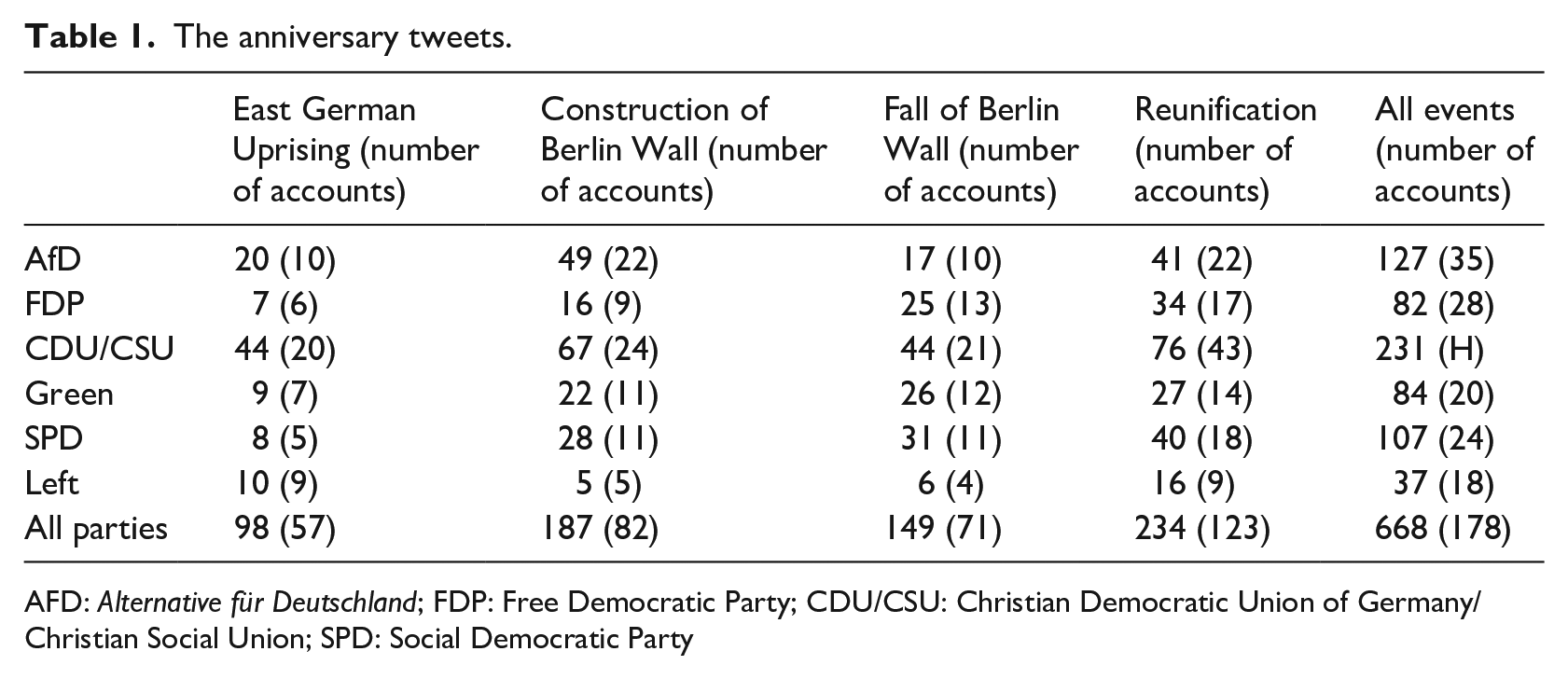
AFD: Alternative für Deutschland; FDP: Free Democratic Party; CDU/CSU: Christian Democratic Union of Germany/Christian Social Union; SPD: Social Democratic Party
In this article then, the term ‘anniversary tweets’ is used as shorthand for those original tweets posted by German political accounts within a 10-day period surrounding each anniversary. It excludes commemorative tweets from non-political accounts and does not include retweets or responses, although the latter do enter the analysis when considering the reception of specific tweets. This sample should not be considered fully representative but indicative of the political commemoration of the chosen events on Twitter during this timeframe. Tweets and accounts are likely to have been deleted and others missed by the sampling method. 1 The inherent dynamism of social media platforms like Twitter and the implications this has for their treatment as digital archives presents various challenges, but many of these can be addressed through pragmatic approaches that transparently embrace their complexity and messiness (see Merrill, in press). It should be noted, for example, that this article’s sampling method prioritized German political tweets even though the anniversaries of some of the events analysed are occasionally marked on Twitter by political parties and politicians beyond Germany, in other languages besides German. Overall, the sampling method reflected the complications surrounding the identification of political accounts over an extended timeframe spanning multiple government cycles.
The chronology and origin of the entire sample was quantitatively studied using descriptive statistics, while 127 tweets from 35 AfD accounts (Table 1) and the responses these generated were analysed using a variant of critical technocultural discourse analysis (Brock, 2018). This is a ‘multimodal analytic technique for investigating Internet and digital phenomena, artifacts and culture’ which simultaneously interrogates the discourses of user generated content and the social media architectures that influence their production and consumption (Brock, 2018: 1012). As a technique, it is influenced by Wodak’s (2001) discourse-historical approach, which is sensitive to the sociocultural contexts within which discourse is generated while also being compatible with Fairclough’s (1989) tripartite understanding of discourse as existing across the micro-level of the situation – texts of spoken or written language; the meso-level of the institution – interactions of discursive practice through which texts are produced and interpreted; and the macro-level of society – the context of wider sociocultural practices that condition the production and interpretation of texts. (Merrill and Åkerlund, 2018: 334)
The textual and visual content of the AfD’s anniversary tweets were analysed in a multimodal manner as illustrated through reference to different examples (sometimes via screenshots) that generated greater user engagement. While political party and politicians’ accounts have not been anonymized given their status as public figures and organizations, the anonymity of regular Twitter users has been prioritized and where their replies have contributed to the analysis, this has been communicated in ways that reduce their possible identification (see Williams et al., 2017).
The political commemoration of the GDR past on Twitter
The anniversary tweets’ temporal distribution indicates that German political parties and politicians did not use Twitter to commemorate the GDR past to any noticeable extent until 2009, coinciding with both the general growth in the platform’s popularity and the year of the 20th anniversary of the Berlin Wall’s fall (Figure 1). Mirroring others’ findings (see Stieglitz et al., 2012), the temporal distribution of the anniversary tweets suggests not only the growing political use of Twitter in the early 2010s but also the impact of the extensive commemoration of the 25th anniversary of the fall of the Wall from 2014. While the distribution of anniversary tweets differs across events, political anniversary tweets have generally become more common over the last 5 years, indicating their normalization. In many instances, there is also the suggestion that, as indicated by others (see Merrill and Lindgren, 2020), major anniversaries influence the extent of political commemoration, although this is less discernible for the 1953 Uprising and reunification in 1990. While the political commemoration of the Uprising has been known to be boosted by other events experiencing major anniversaries (see Millington, 2020), the peak in anniversary tweets for this case in 2020, when the other events seemingly experienced a dip in political anniversary tweets (including reunification during its 30th anniversary), also suggests the influence of other factors.
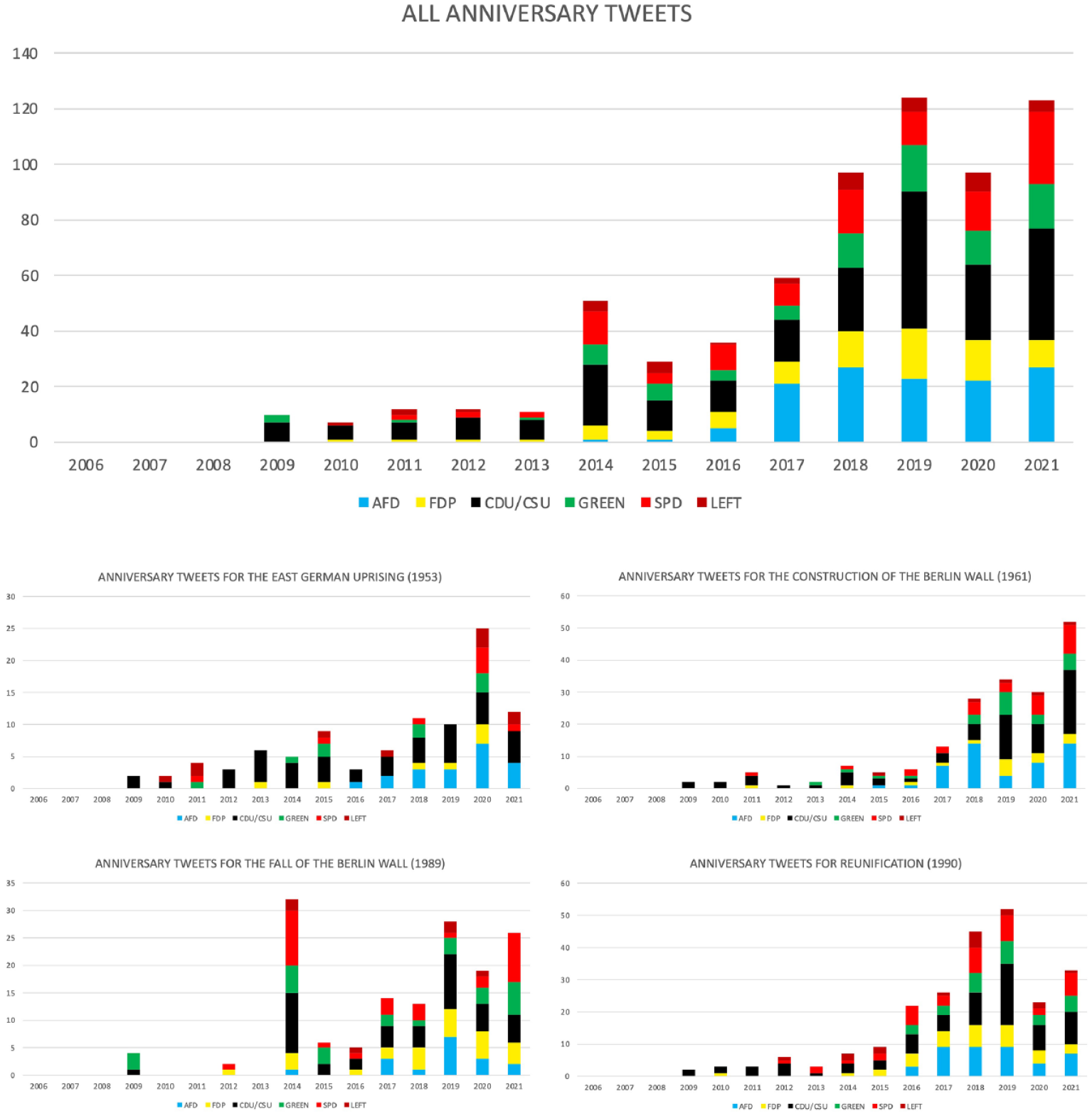
Anniversary tweets across the years by party and event.
The sampled tweets suggest that the CDU/CSU has driven the commemorative use of Twitter in relation to the four GDR-related events (Figure 1) by providing the largest share of the total anniversary tweets for each of the events (Table 1 and Figure 2). This might have been expected given that the CDU/CSU has a strong support base in the former GDR, led the country through reunification, and led the government between 2005 and 2021 under Chancellor Angela Merkel. Although differences between the six parties’ share of anniversary tweets can be detected across the events, the SPD and AfD have generally been more active than the remaining three parties. 2 Given that the AfD was only established in 2013, it has achieved considerable influence within Twitter’s commemorative space, especially after 2017 when it entered the Bundestag. While the AfD did not pioneer the use of Twitter to mark GDR anniversaries, nor is it the most active political party to do so, its enthusiastic adoption of the practice as compared to other older parties reasserts the importance it attaches to social media communication as a means to shape public memory beyond the traditional memorial venues from which it is normally blocked. Furthermore, while the sample shows that the CDU/CSU used anniversary tweets more often than the AfD in real terms, the ratio of AfD accounts to tweets is higher (Table 1), suggesting its more widespread and decentralized commemorative use of Twitter. 3
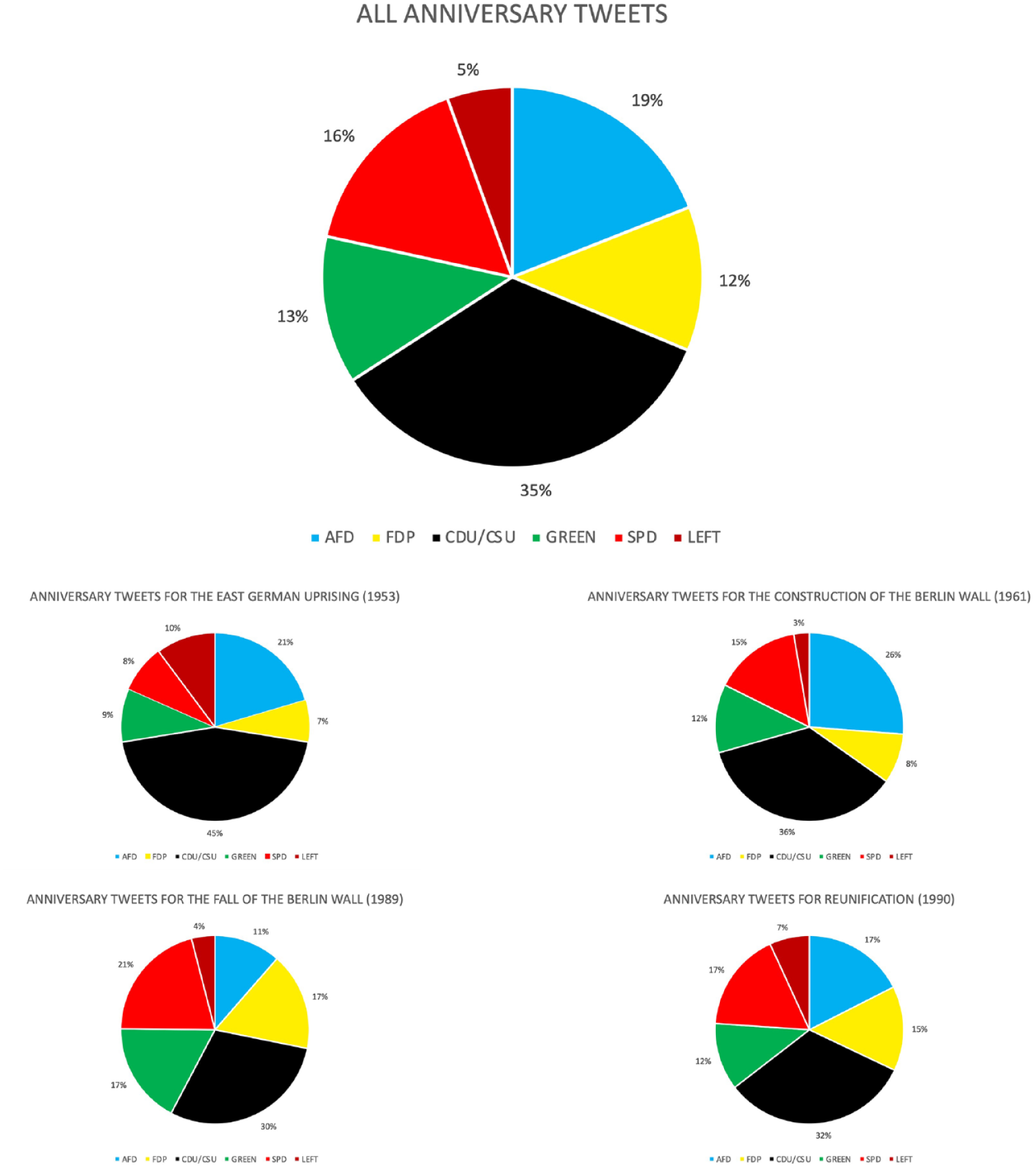
Anniversary tweets across parties by event (2006–2021).
While traditional formal commemorative events and broadcast media usually demand more centralized messaging, Twitter’s crowdsourcing structure allows for a wider range of mnemonic actors to experiment. As a result, AfD anniversary tweets convey an array of approaches to the GDR past that reflect the party’s own ideological inconsistencies. Some tweets include generic statements intended to convey political respectability. Others are more intentionally provocative and polarizing, containing radical-right populist discourses and direct partisan attacks. All AfD anniversary tweets provide the opportunity for the party’s supporters to respond in agreement (sometimes with more explicit attacks and extreme-right content) via Twitter’s reply function or to amplify the party’s discourses through retweeting. As further outlined in the next section, AfD anniversary tweets, for the most part, differ from those of the other parties which tend towards positive messages about freedom with some variation based on their own political ideology or favoured terminology around democracy, human rights or key historical figures. While the centre-right CDU/CSU earlier used anniversary tweets to either implicitly or explicitly critique its left-wing political opponents, during GDR anniversaries it now mostly uses Twitter in accordance with the norms of the country’s prevalent memory regime that discourage explicit partisan instrumentalization and primarily to amplify commemorations conducted through other more traditional means. This also holds true for the other parties, with the exception of the AfD.
The mnemonic discourses of AfD anniversary tweets
The mnemonic discourses deployed by the AfD on Twitter during the selected anniversaries generally align with the party’s broader attempt to radically revise the country’s consensual memory regime as outlined in the introduction. The AfD has sought to downplay the crimes of the Nazi regime as a central theme in modern German history and to replace the narrative of German guilt for crimes against humanity with one of national achievement and glory. In practice, this has meant an effort by the party to reframe events already commemorated by the democratic mainstream, particularly those surrounding World War II and East Germany. Although less established than the ritualized commemoration of the Holocaust and the widespread consensus around the central message of ‘never again’ (nie wieder), the memorialization of the GDR has also developed its own formalized discursive celebrations (Art, 2014; Kubik and Bernhard, 2014). Official events and memorials centre civic activism and German reunification as positive achievements in the history of Germany’s democratic evolution, while the Berlin Wall and the suppression of the Uprising are commemorated as counterexamples to highlight the crimes of dictatorships. This official memory culture shies away from direct comparisons or equations of GDR and Nazi crimes and aims to limit the emotive factor in denunciations of the Socialist Unity Party (Sozialistische Einheitspartei Deutschlands, SED) or state socialism as a system, albeit while condemning its systemic violations of human rights as a warning from history, echoing the imperative to remember the crimes of the Nazis to protect democracy in the present day. Although the AfD has been effectively prevented from enacting its agenda at official sites of memorialization, the AfD and other far-right actors have been effective at the margins by mobilizing some former East German citizens who seek a more forthright anti-communist memory culture that views the GDR primarily as an unjust totalitarian regime (Wüstenberg, 2019). The claim by radical-right populists from the AfD to represent the true legacy of the GDR opposition has been challenged by many former dissidents, but there is also a faction of those who resisted SED rule who do identify with radical-right populists, and have become more vocal in recent years (Von Hammerstein, 2018). 4
Against this background, AfD anniversary tweets reveal how the Uprising and the Wall’s fall provide a mnemonic source of heroic yet victimized protagonists to which the party can connect its own political efforts. Meanwhile, they also indicate how all four GDR-related events provide the party with different ‘villains’, including not only the GDR’s leading party, the SED, but also parties and politicians of different denominations, West and East, considered to have opposed national reunification. In turn, through the nominational, referential and perspectivation discursive strategies that are commonly used by far-right actors to label in- and out-group members and position themselves in relation to the discourses they produce and promote (see Merrill and Åkerlund, 2018), the AfD and its politicians have used anniversary tweets to profile themselves not only as victims of contemporary totalitarian forces but also as capable of heroically emulating those who have challenged and overcome such forces in the past. As illustrated by the more detailed analysis of individual examples below, the victim and hero perspectives were usually adopted by the AfD and its politicians in separate tweets although occasionally they also appeared simultaneously, albeit in rather subtle ways.
The AfD used the 1953 Uprising – the event marked by the fewest anniversary tweets – to imagine itself as a contemporary successor of those who resisted the violent intervention of the Soviet Union’s military forces. For instance, one tweet from the AfD’s central Twitter account marking the 2020 anniversary proclaims, ‘Never Again #Socialism!’ and includes an edited version of one of the most famous photos of the Uprising showing two men throwing rocks at Soviet tanks (AfD, 2020a). In the tweet, the men are tinted with the light blue of the AfD and the tanks in red and green to symbolize the combined ‘totalitarian’ threat of the SPD, the Left and the Greens (Figure 3). The accompanying quote from the party’s lead spokesperson, Tino Chrupalla – ‘the victims of 17 June 1953 died as martyrs for freedom’ – provides a good example of how AfD anniversary tweets sometimes associate its members and supporters with the uprisers in ways that simultaneously frame them as victims and heroes (martyrs). Although the CDU/CSU and the FDP have also used the ‘Never Again Socialism’ slogan in commemorations, they have celebrated the Uprising without appropriating its legitimacy or directly comparing their left-wing opponents to the Soviet Union.
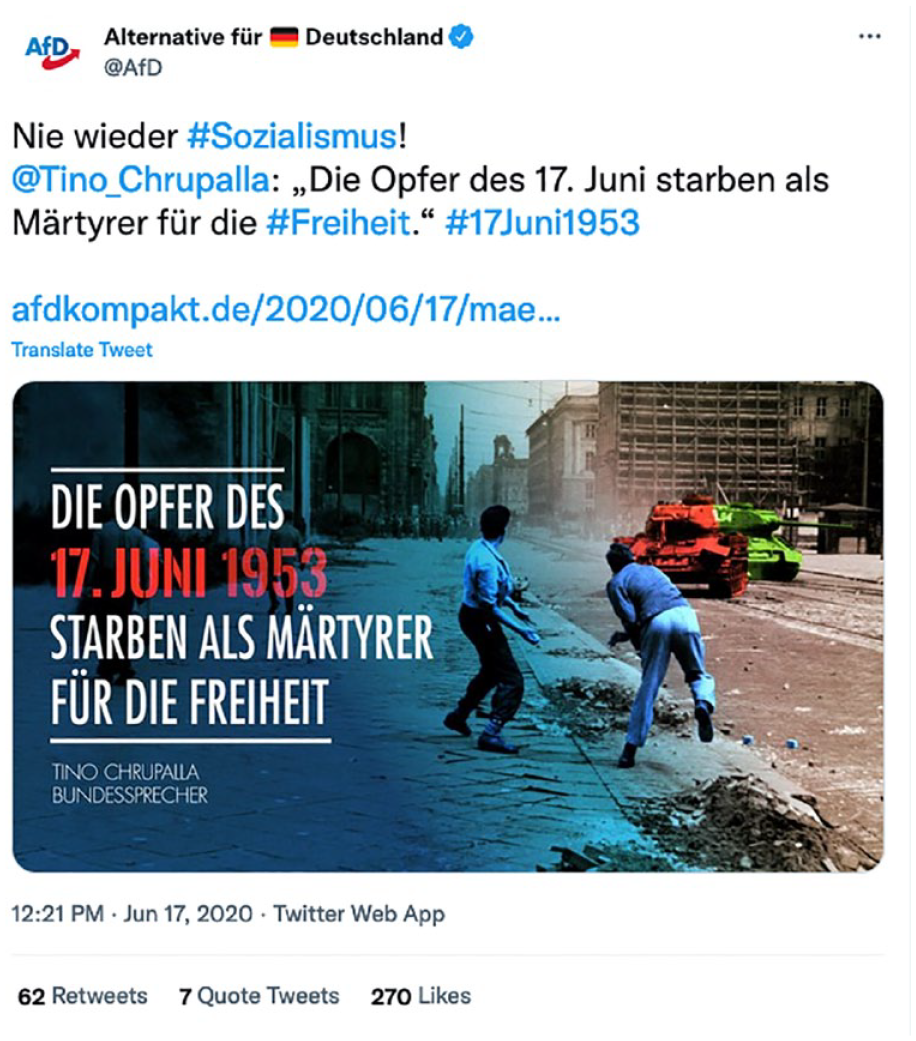
East German Uprising anniversary tweet.
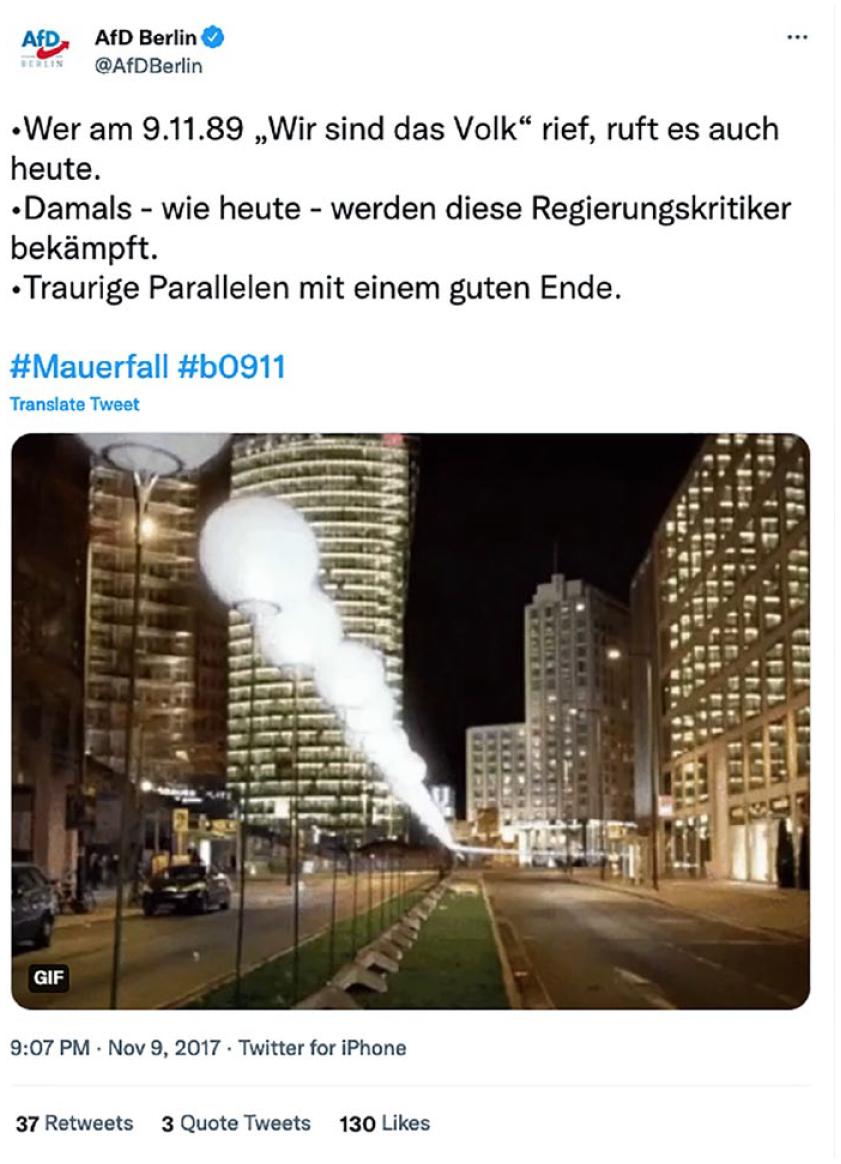
The anniversaries of the Wall’s fall have provided further opportunities for the AfD to portray itself as the heir to GDR dissidents. In 2017, during the first anniversary after its entry into the Bundestag, the AfD’s Berlin branch tweeted ‘Who on 9.11.89 cried “we are the people,” calls this out again today. Then – as today – those state critics were fought. Sad parallels with a good end’ (AfD Berlin, 2017a). In a reply to their own tweet, their claim is made more explicit: ‘We ARE the civil rights activists of the GDR’ (AfD Berlin, 2017b), suggesting that the contemporary opprobrium directed at the AfD is comparable to state socialism’s historical censorship and persecution. This tweet re-uses a generic gif featuring illuminated balloons from the 25th anniversary of the Wall’s fall in 2014, suggesting that the AfD were still learning how to best use Twitter in such moments and had not begun creating their own bespoke visual content (Figure 4).
Fall of the Berlin Wall anniversary tweet.
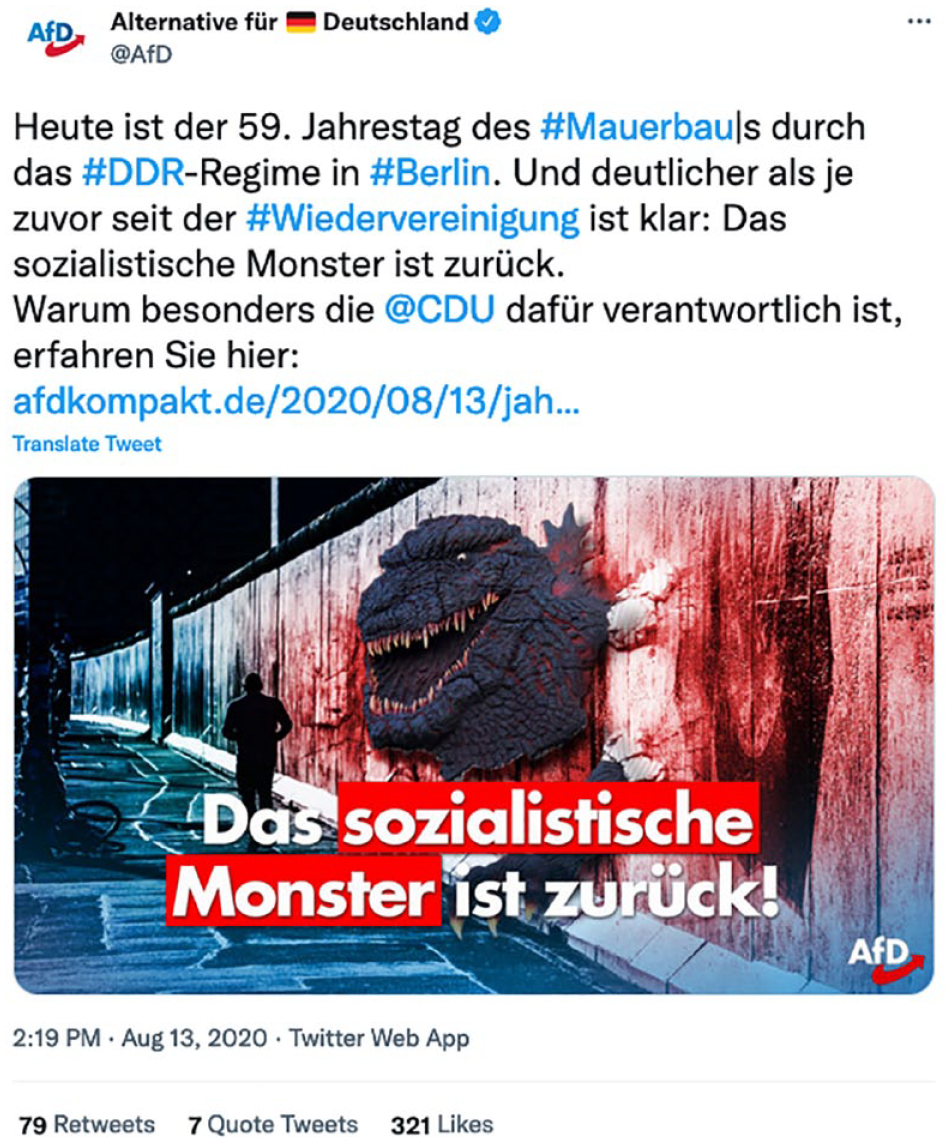
Other anniversary tweets demonize political opponents, most commonly the SPD, the Left and the Greens but also the CDU under Chancellor Angela Merkel – they are all discursively presented as part of the GDR’s dictatorial legacy. In 2020, the AfD’s central Twitter account posted ‘Today is the 59th anniversary of the #WallBuilding by the #GDR-Regime in #Berlin. And it is clearer than ever since #reunification: the socialist monster is back’ (AfD, 2020b). The tweet blames the CDU for this by @mentioning its Twitter account and linking to a blog post about Merkel’s GDR background. Its accompanying image shows a monster breaking through the Wall (Figure 5). Although the centre-right parties had previously used Twitter during GDR anniversaries to denounce socialism more broadly, the use of a historical event and Twitter architectures to directly attack political opponents and to associate all other parties with the SED dictatorship was new.
Construction of the Berlin Wall anniversary tweet.
Finally, the AfD has used these events to position themselves as the defenders of German patriotism and national pride in contrast to their opponents. This connects to their tactic of demonizing opponents by targeting the SPD and the Greens for failing to support reunification throughout the 1980s and the Left, as the democratic successor party to the SED, as unreconstructed communists. According to several tweets commemorating reunification, the ‘old parties’ of West Germany embraced ‘post-nationalism’, which has resulted in an inability to proudly embrace the ‘fatherland’. As one senior AfD Bundestag member tweeted in 2017, ‘NO to the flight from history and responsibility: YES to nation and fatherland!’ (Frömming, 2017). There are similar references to Volk and Vaterland from the CDU but accusations that the other parties are unpatriotic or reject German nationhood is a discursive tactic unique to the AfD.
The contestation and transnationalization of AfD’s anniversary politics
As evidenced, the AfD uses GDR-related anniversary tweets to discursively fuel a radical-right populist dichotomy between the people and the political elite. Identifying with the people allows the party and its politicians to segue from commemorative statements into anti-establishment denunciations of its political opponents – the political elite – as corrupt and unfit to govern. While other parties generally avoid direct partisan attacks in anniversary tweets to maintain a sense of propriety for the occasion, the AfD often explicitly uses anniversaries to launch polarizing and personalized assaults on their political opponents. Thus, the contestation underpinning the AfD’s anniversary tweets exceeds the general challenge that the party poses to the country’s memory regime and reflects the capacity of social media to bypass traditional memorial and commemorative sites, from which the AfD has been excluded.
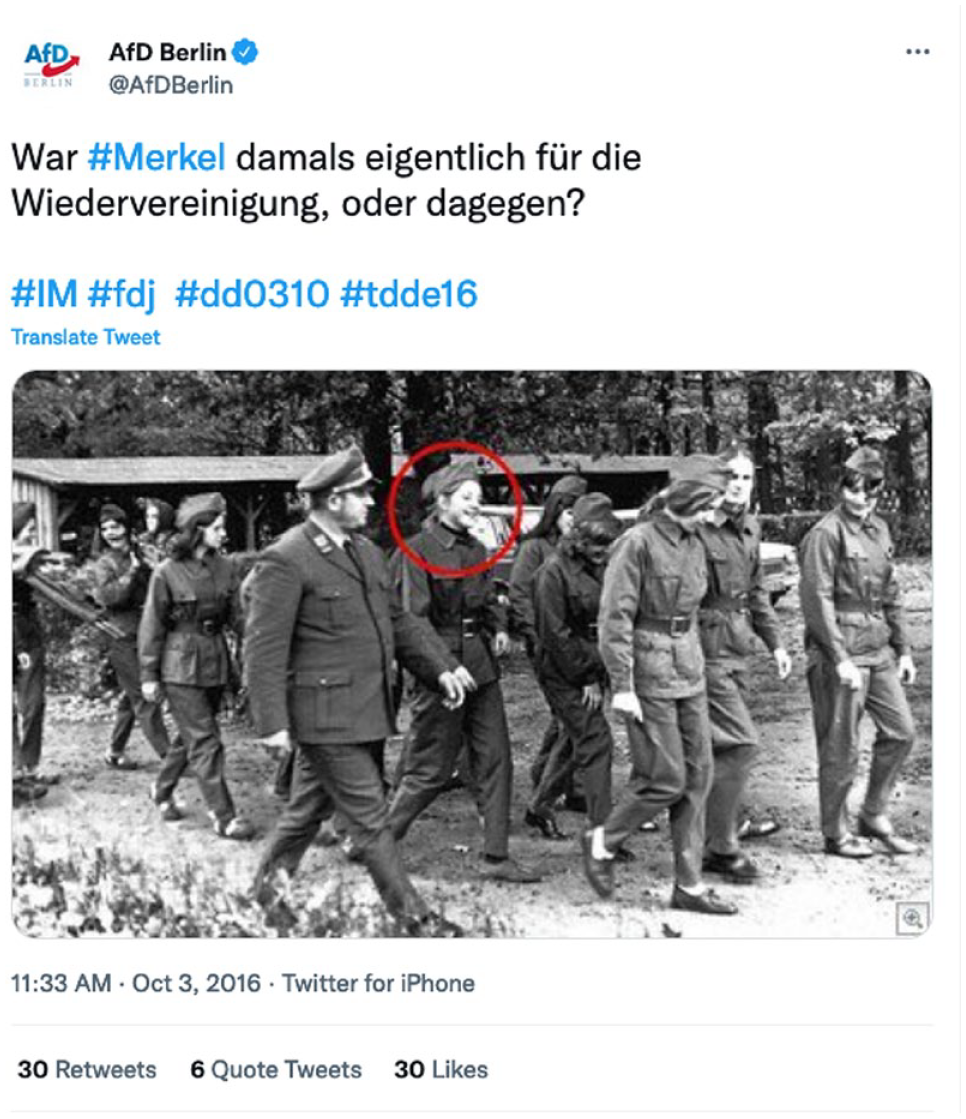
Usually reinforced by Twitter’s hashtag architecture and indicated by a hashtagged version of the name of the politician under attack, AfD’s commemorative attacks on Angela Merkel provide a good example of this. Paralleling far-right anti-Merkel hashtag campaigns like #Merkelmussweg (#Merkelmustgo) (see Böhm and Gätje, 2021), Merkel is targeted not only because of her East German past but also because of her policies – particularly Germany’s intake of close to a million refugees primarily fleeing the Syrian Civil War in 2015 – which have been deemed by many on the right to have dragged the CDU/CSU too far left and endangered the nation. One tweet from AfD Bundestag member Petr Bystron disparaged public calls in 2018 for German Unity Day to better reflect Germans with a migration background as a call to some sort of multicultural totalitarian state referred to as ‘Merkelland’. Another, earlier tweet from AfD Berlin during 2016’s German Unity Day included a photo of Merkel taken when she was a teenager in the GDR’s Free German Youth with the text ‘Was #Merkel actually for reunification back then or against it?’ (Figure 5).
The supportive replies to this tweet indicate how Twitter’s architecture allows for the digital accumulation of crowdsourced radical-right populist discourse and the amplification of the AfD’s personalized attack tweets. One reply from the Heidelberg’s AfD account contained the branch’s own attack on the Green party for their connections to anti-reunification rallies in 1990, indicating an attempt to amplify their own Twitter provocation. Two further replies came from an account with a Dutch bio. These claimed that Merkel was an agent of the GDR secret police – the Stasi – and now worked for the ‘Brussels Stasi’. Although AfD anniversary tweets studied in this article rarely attracted direct engagement from non-German Twitter accounts, such replies hint towards their transnationalization as discussed further below.
These sorts of techniques along with the occasional @mentioning of political opponents correspond to the party’s wider strategy of generating attention through scandal (Maurer et al., 2022). The use of @mentions serves more generally to expand the reach of a tweet in addressing not only the author’s followers but also other specific accounts and these account’s followers. Although @mentions need not always be confrontational, politicians often use them to increase their audiences by targeting and debating their political opponents (see Hemsley et al., 2018). When occasionally used in AfD anniversary tweets, @mentioning was weaponized to a greater extent insofar as it primarily served as a mnemonic combat strategy designed to attack, discredit and ultimately harm political opponents like Merkel while also encouraging supporters to do the same.
While Twitter’s architecture provided the AfD with a way to contest Germany’s consensual memory regime and attack its political opponents, it also opened the party to counter-contestations in the same manner, especially after the AfD entered the Bundestag and its political threat was confirmed. While before 2017 even the most provocative anniversary tweets from the AfD did not generate considerable counter reactions, in the years since there is evidence of increasing popular contestation of the party’s social media commemoration in the replies to their tweets. By 2018, AfD anniversary tweets were attracting dozens of replies, primarily from their opponents – thus further emphasizing how Twitter is a site of mnemonic conflict. One example of this is a tweet from AfD Bundestag member Leif-Erik Holm (2018) decrying political correctness and accompanied by a campaign photo and the quote: ‘we did not go into the streets in 1989 to exchange SED paternalism for a more subtle Western variant’. Although this tweet attracted some support, the majority of replies countered these sentiments, often by also invoking the GDR past. Several, for example, described Holm as having ‘not arrived at democracy’, implying that his own youth in the GDR continued to influence an authoritarian mindset. Some suggested that he was more likely to have sided with the National People’s Army (in which Holm served mandatory basic service in the late 1980s) than the GDR dissidents taking to the streets in 1989. Others still used their replies to highlight the Stasi connections of one of Holm’s AfD colleagues. In this way, digital counter-contestations similarly used memories of GDR events, but this time to create a competing discourse in which the AfD was framed as a continuation of the GDR’s intolerance and its dictatorial practices, and thus a contemporary threat to democracy. In short, the discursive contestation of AfD anniversary tweets revolves around the view that AfD’s vision for the German nation is authoritarian and thus it, and not the other mainstream parties, is best compared to the country’s historical forces of dictatorship, whether that be the Nazis, the SED or the Stasi.
Reunification anniversary tweet.
AfD anniversary tweets are almost exclusively written in German and pitched towards the country’s national audience and electorate. While some of the responses to their tweets indicate the outward transnationalization of AfD’s mnemonic discourses – as illustrated by ‘Brussels Stasi’ example and its equation of the European Union with the GDR – for the most part and reflecting the paradoxical transnationality of the far right more generally, the transnationalization evident in the party’s anniversary tweets relates to the more recent integration of transnational far-right discourses.
On a broader level, this is reflected by the content of the AfD’s (2021) federal election manifesto, Deutschland. Aber normal, which no longer celebrated the protagonists of 1989 and Germany’s democratic transition but rather referenced the ‘threats’ posed by Critical Race Theory and decolonization. The memory politics of the party have thus pivoted somewhat towards the valorization of German colonialism as a usable past of glory and heroism (see Heinze, 2021). While public debate surrounding the memory of German colonialism has been growing for some years, their mutedness when compared to those of other countries suggests that the AfD’s newer mnemonic discursive strategies are as much a reaction to transnational far-right concerns as national realities. This has not meant that the AfD has stopped marking GDR anniversaries with tweets, but it is starting to influence how it does so.
There is evidence from Twitter, for example, that the party’s discursive approach to German Unity Day is shifting in ways that highlight how the anniversaries of innately national events can be influenced by transnational far-right impulses. The commemoration of German reunification is becoming more generic and less German-specific. Illustrating this, in 2020, an AfD anniversary tweet from Bundestag member Jürgen Braun invoked ‘cancel culture’ to refer to the SPD, Greens and Left party decision to boycott a commemorative speech by CDU politician Arnold Vaatz – himself a former GDR dissident – because of the positive parallels he had drawn between East German civic rights activists and those that demonstrated against Covid-19 restrictions. The next year, during reunification’s 30th anniversary, AfD leader Alice Weidel (2021) tweeted that the country was divided once again between ‘East and #West, “light” and “dark”, #vaccine-opponents and -proponents, or “climate deniers” and “climate protectors”’. While the commemoration of some GDR-related events – like the Berlin Wall’s construction – remain rooted in a uniquely German memory, the AfD’s commemoration of reunification on German Unity Day is becoming a more generic celebration of nationhood that offers the chance to denounce communism and political elites in the context of global concerns such as the Covid-19 pandemic and climate change.
Conclusion
This article has not only demonstrated that the AfD has become a significant force with regard to the commemoration of GDR-related events on Twitter in the past decade but also explored how it has used this social media platform and its architectures to discursively open up new mnemonic battlefronts around these events. While neither the first nor the most prolific party to use anniversary tweets, the AfD and its politicians have more efficiently employed them in a decentralized manner. They have done so to promote mnemonic discourses that challenge the country’s public commemorative status quo and to position their party vis-à-vis their broader radical-right populist agenda as victimized heroes willing to stand up for the people against a monolithic and totalitarian political elite. Such discourses not only contest the country’s contemporary memory regime but are also communicated through Twitter to attack individual political opponents, while drawing counter mnemonic contestations from those opposing AfD efforts. While the discourses and contestations at the heart of the AfD’s GDR-related anniversary tweets primarily speak to and reflect the German national context, there is evidence that the party is becoming more receptive to incorporating transnational far-right concerns within their commemorative use of Twitter especially on German Unity Day.
Ultimately, the AfD has not completely upended the memory culture of mainstream politics in Germany, but their use of Twitter is beginning to have a noticeable impact. The AfD’s radical-right populist discourses concerning the GDR past and its call for the socialist past to never be repeated has echoed the commemorative message of the centre-right CDU and FDP. Those parties, however, traditionally prevented such commemorative discourses from morphing into direct partisan critiques. With such a tradition now broken by the AfD’s polarized and politicized discourses, there are signs that others are following suit. As the CDU faced losing power for the first time in 15 years during the 2021 election campaign, they too adopted the polarizing discursive techniques of AfD. In August 2021, on the 60th anniversary of the Berlin Wall’s construction, CDU General Secretary Paul Ziemiak attacked the Green Party Chancellor candidate Annalena Baerbock in response to her own anniversary tweet.
While Baerbock referred to the construction of the Berlin Wall as ‘the Cold War cast in concrete’, Ziemiak wrote ‘No! The #BerlinWall was socialism cast in concrete. An unjust government imprisoned its own people against their will. “Cold War cast in concrete” is more reminiscent of the SED tale of the “anti-fascist protective wall” #fail’ (Ziemiak, 2021).
This and other examples suggest the need for further research into the political use of Twitter during national commemorations and anniversaries, and the discourses, and forms of contestation and transnationalization therein, both in Germany and beyond. Indeed, that Ziemiak chose to write his final hashtag (#fail) in English further points to the role of social media as transnationalizing agents of commemoration in themselves.
Footnotes
Funding
The author(s) disclosed receipt of the following financial support for the research, authorship and/or publication of this article: S.M.’s contribution to this article was funded by a Swedish Research Council project entitled: Algorithms of Resistance: Analysing and harnessing anti-racist activism in the age of datafication (2019-03351). N.R.L. and L.A.’s contributions were funded by the VolkswagenStiftung project entitled: Towards Illiberal Constitutionalism in East Central Europe: Historical Analysis in Comparative and Transnational Perspectives.
